Introduction
Improvements in human health have historically been categorized into two distinct phases. The first is characterized by high mortality and low life expectancy, with minimal health differentials in the population. The second phase begins with the accumulation of wealth throughout industrialization, and the development of trade and technological and health innovations that reduce major disease outbreaks. Deaton (Reference Deaton2013) described this period as the path of ‘great escape’ for industrialized societies from the destitution and misery of mass killers. The Industrial Revolution resulted in a disproportionate increase in wealth and enabled the wealthier segments of the population to take advantage of health care developments and substantially improve their life expectancy relative to others (Deaton, Reference Deaton2013; Marmot, Reference Marmot2015a, b; Milanovic, Reference Milanovic2016).
Despite considerable progress on average health indicators across the world, there is evidence of the persistence of preventable mortality and morbidity in many developing countries (Vallin & Mesle, Reference Vallin, Mesle and Vallin2001, Reference Vallin and Mesle2004; Whitehead et al., Reference Whitehead, Dahgren and Evans2001; Vallin et al., Reference Vallin, Andreev, Mesle and Shkolnikov2005; Bloom & Canning, Reference Bloom and Canning2007; WHO, 2015). A ‘great divide’ in health and well-being, a socioeconomic gradient in health status and rising health costs of socioeconomic inequality are gradually becoming apparent (Marmot, Reference Marmot2015a, b; Piketty, Reference Piketty2014; Stiglitz, Reference Stiglitz2015; WHO, 2015; Milanovic, Reference Milanovic2016; Oxfam, 2017). A report by the United Nations (2019a) suggested that sub-Saharan Africa had the lowest average life expectancy (61 years) and the highest mortality of children below the age of five (79 deaths/1000 live births) in 2019. This contrasted with average life expectancies of above 80 years and under-5 mortality rates of below 5 deaths/1000 live births in developed countries. Furthermore, a recent UN report on the progress of Sustainable Development Goal (SDG) 10 suggested that ‘inequality within and among nations continues to be a significant concern despite progress in and efforts at narrowing disparities of opportunity, income, and power’ (United Nations, 2019b).
Despite the presence of stark health differentials, the most optimistic report from the Commission on Investing in Health anticipated the onset of the third stage of health transition in the near future, where the burden of communicable diseases in poor countries would converge towards the level of rich countries (Jamison et al., Reference Jamison, Summers and Alleyne2013). It has also been suggested that innovations and the strengthening of health interventions could lead to the realization of a ‘grand convergence’ of health within the current generation (Jamison et al., Reference Jamison, Summers and Alleyne2013; Lim et al., Reference Lim, Allen, Bhutta, Dandona, Forouzanfar and Pullman2016).
Although there is growing interest in assessing the convergence in health status across populations, much research has focused on inter-country differences and has rarely been in the context of developing countries, where growth trajectories remain hidden (Neumayer, Reference Neumayer2003; McMichael et al., Reference McMichael, Mckee, Shkolnikov and Valkonen2004; Moser et al., Reference Moser, Shkolnikov and Leon2005; Taylor, Reference Taylor2009; Dorius & Firebaugh, Reference Dorius and Firebaugh2010; Wilson, Reference Wilson2011; Goli et al., Reference Moradhvaj, Chakravorty and Rammohan2019). The dissimilar rates of progress in health status across different countries make it difficult to achieve SDG-3 and -10. Tracking progress in intra-country inequalities in health will help in designing better policies to accelerate progress in developing countries to catchup with developed countries (Nayyar, Reference Nayyar2013; Goli, Reference Goli2014; Atkinson, Reference Atkinson2015).
India’s health transition is critical for achieving the grand convergence of global health status, given its sizeable population, poverty, disease burden and mortality (UNICEF, 2011; Drèze & Sen, Reference Drèze and Sen2012, Reference Drèze and Sen2013; Goli & Arokiasamy, Reference Goli and Arokiasamy2013, Reference Goli and Arokiasamy2014; Goli, Reference Goli2014; James & Goli, Reference James and Goli2016). The country has made significant improvements in life expectancy and health status in the last two decades (Office of Registrar General of India, 2009, 2017; Ram et al., Reference Ram, Jha and Ram2013; Saikia et al., Reference Saikia, Singh, Jasilionis and Ram2013; Goli & Arokiasamy, Reference Goli and Arokiasamy2013; Goli & Siddiqui, Reference Goli and Siddiqui2015). However, there is substantial variation in the speed and timing of economic, health, and demographic transition across Indian states and geographical regions (Saikia et al., Reference Saikia, Jasilionis, Ram and Shkolnikov2011; Goli, Reference Goli2014; Goli & Arokiasamy, Reference Goli and Arokiasamy2013; Drèze & Sen, Reference Drèze and Sen2013). India’s demographic and epidemiological transition has resulted in disproportionate progress in health status and survival outcomes (Visaria, Reference Visaria and Dyson2004a, b; James, Reference James2011; Singh et al., Reference Singh, Pathak, Chauhan and Pan2011; James et al., 2016). The states in southern India are comparable to the most developed countries of Europe, whereas northern states are showing characteristics similar to the least-developed regions of Africa. A recent report from the Reserve Bank of India (RBI) found that in India, the poorest nine states account for 48% of the total population, but bear 70%, 75% and 62% of the burden of infant deaths, under-five deaths and maternal deaths, respectively (RBI, 2017).
Therefore, the challenges facing policy makers currently include the reduction of health inequities, and not merely a focus on average health status or improvements in life expectancies (Blas & Kurup, Reference Blas, Kurup, Blas and Kurup2010; Goli & Arokiasamy, Reference Goli and Arokiasamy2013; Goli, Reference Goli2014). Most previous literature on health inequalities has focused on most recent information. However, estimates based on recent health data have serious limitations in terms of understanding the true trajectories of between-state inequalities (Rivas & Villarroya, Reference Rivas and Villarroya2016). The present study assessed whether improvements in national average health status over the three decades from 1981 to 2015 had been equitably distributed across the different states of India. Understanding health transition and convergence over time will indicate where the country is heading. Furthermore, an assessment of the progress in health status and health inequality is critical for designing future health policy and suggesting pathways for achieving the SDGs in India. Against this backdrop, the primary objective of this paper was to address the question: is progress in health status across Indian states converging or diverging?
Methods
Data sources
Secondary data were obtained from the Sample Registration System (SRS) for 1981 to 2015 (Office of Registrar General of India (2007, 2009, 2014, 2015, 2017), all four rounds of the National Family Health Survey (NFHS) from 1992–93 to 2015–16 (IIPS & Macro International, 1995, 2000, 2007, 2017) and other official statistics. Convergence metrics were used to examine convergence and divergence in health and health inequality in Indian states over the period 1981–2015. The health status and health inequality indicators examined included: Life Expectancy at Birth (LEB), i.e. average number of years that a newborn is expected to live if current mortality rates continue; Infant Mortality Rate (IMR), i.e. number of children who die before reaching to their first birthday per 1000 live births; Neonatal Mortality Rate (NNMR), i.e. number of children who die before 28 days of life per 1000 live births; Maternal Mortality Ratio (MMR), i.e. number of women who die due to pregnancy-related causes per 100,000 live births; Child Underweight, i.e. number of children aged 0–59 months, whose weight is less than −2 standard deviations below the median weight for the age group in the international reference population; and Child Full Immunization, i.e. number of children aged 12–23 months who have received the recommended vaccines for the major states of India.
Statistical analysis: the convergence models
The concept of ‘convergence’ is widely used to study growth and income inequality transition (Goesling & Firebaugh, Reference Goesling and Firebaugh2004). In economics, the Convergence Hypothesis suggests that the gap in income between countries will close over time. Similar to inequality transition, the demographic and health transition process has also been described as going through the process of equilibrium and disequilibrium in terms of health and mortality convergence, divergence and re-convergence across different regions (McMichael et al., Reference McMichael, Mckee, Shkolnikov and Valkonen2004; Moser et al., Reference Moser, Shkolnikov and Leon2005; Dorius, Reference Dorius2008; Dorius & Firebaugh, Reference Dorius and Firebaugh2010). The concept of convergence lies at the heart of demographic and health transition theory. In the post-1990 period there was growing interest in convergence methodologies in demography and public health (Goli, Reference Goli2014).
Global studies on economic, demographic and health convergence have used models ranging from simple graphical tools to sophisticated econometric models, including catching-up plots, absolute β-convergence, σ-convergence, conditional β-convergence and non-parametric methods of convergence (Young et al., Reference Young, Higgins and Levy2008; Goli, Reference Goli2014). There has not been harmonization among researchers on the process and measures of convergence. O’Connell (Reference O’Connell1981) and Wilson (Reference Wilson2001) used simple graphical methods; Dorius (Reference Dorius2008) used three indices (population-weighted σ-and β-convergence and inequality measures); Tryggvi et al. (Reference Tryggvi, Herbertsson and Orszag2000) focused on the conditional β-convergence model; Franklin (Reference Franklin2002, Reference Franklin2003) used σ-convergence; and Bloom and Canning (Reference Bloom and Canning2007) used non-parametric tools. As there appears to be no agreement on a single standard measure of health convergence, this study used all available important convergence models, as described below.
Catching-up process
In the neoclassical growth model, the catching-up mechanism is necessary for convergence across regions. In this model, advanced states experience lower growth rates as they are already at higher values in the initial period. In contrast, laggard states experience higher growth rates given their lower values in the initial period. In this study, the catching-up process was identified by plotting a scatter diagram for change in an indicator at two points in time against values in the initial period.
Convergence metrics
Absolute β-convergence happens when health status in laggard regions progresses faster than in advanced regions. Thus, convergence in a given health indicator between t=0 and t=1 can be estimated by assessing the presence of a negative relationship between its base year values and change from t=0 to t=1 (Barro, Reference Barro1991; Barro & Sala-I-Martin, Reference Barro and Sala-I-Martin1991). Rey and Montouri (Reference Rey and Montouri1999) used the following linear regression model for estimation of β-convergence:
 $${\rm{In}}\left[ {{{{Y_{\!i,\;t + k}}} \over {{Y_{i,t}}}}} \right] = \;\alpha + \beta .\,\ln \left( {{Y_{i.t}}} \right) + {\varepsilon _{it}}$$
where
 $\;{\rm{In}}\left[ {{{{Y_{\!i,\;\;\;t + k}}} \over {{Y_{i,t}}}}} \right]$
is the average annual growth rate of the selected indicator Y in a country or state i in period (t, t+k),
 ${Y_{i.t}}\;$
is the value of selected indicators in the initial period t and
 ${\varepsilon _{it}}\;$
are the corresponding residuals.
The calculation of the speed of convergence for a particular indicator is as follows:
 $$s = - 1/T(\ln (1 + T\beta )$$
where s is the pace of convergence or divergence and Tβ is the β-convergence in time period T (Barro & Sala-I-Martin, Reference Barro and Sala-I-Martin1991, Reference Barro and Sala-I-Martin1992).
Sigma convergence estimates show the status of variations present among different countries or regions over time. If the standard deviation across the states in the selected indicator is decreasing or increasing over time, it is referred to as convergence or divergence, respectively. The estimates are not concerned with whether the laggard states are catching-up with advanced states, but only focus on the decline or increase in variations over time. Therefore, it is possible for convergence in the case of growth rate decreasing in advanced states and stagnant in laggard states.
The mathematical notation of the σ-convergence model is:
 $${\sigma _t} \gt {\sigma _{t + T}}$$
where
 ${\sigma _t}$
is the standard deviation of the indicator at time t. If the parameter
 ${\sigma _{t + T}}\;$
declines over time, it implies convergence, and divergence otherwise (Barro & Sala-I-Martin, Reference Barro and Sala-I-Martin1991, Reference Barro and Sala-I-Martin1992, Reference Barro and Sala-I-Martin1995).
The pace and timing of health transitions vary across Indian states. Therefore, in analysing the presence of convergence or divergence in any indicators of health status over time, the persistence of differences in the social and economic status of different states needs to be taken into consideration (Tryggvi et al., Reference Tryggvi, Herbertsson and Orszag2000). Dorius (Reference Dorius2008) estimated the conditional β-convergence to account for socioeconomic variability by including some explanatory indicators in the formal β-regression model. This study accounted for significant differentials in the proportion of the illiterate population and Net State Domestic Product (NSDP) of states as probable covariates in the Barro regression analysis. The mathematical equation for this model is:
 $${\rm{In}}\left[ {{{{Y_{i,\;t + k}}} \over {{Y_{i,t}}}}} \right] = \;\alpha + \beta .\ln \left( {{Y_{,i.t}}{Y_{1,i.t}}{Y_{2,i.t}}} \right) + {\varepsilon _{it}}$$
where
 ${\rm{In}}\left[ {{{{Y_{\!i,\;\;\;t + k}}} \over {{Y_{i,t}}}}} \right]$
is the average annual growth of selected indicator Y in state i for the period (t, t+k),
 ${Y_{i.t}}$
is the value of the selected indicator in the initial period t and
 ${\varepsilon _{it}}$
are the corresponding residuals. Likewise, Y
1 is the proportion of the illiterate population in state i in period (t, t+k) and
 ${Y_{2\;}}$
is the log of NSDP in state i in period (t, t+k).
Non-parametric model
The non-parametric estimates do not have any inherent assumption about the normality of the data under investigation (Quah, Reference Quah1993; Wang, Reference Wang2004). The theoretical explanation of the non-parametric estimation suggests that different countries or states are typically characterized by dual regimes, i.e. high and low mortality in the case of mortality transition (Moser et al., Reference Moser, Shkolnikov and Leon2005; Strulik & Vollmer, Reference Strulik and Vollmer2015). As convergence takes place, the second peak disappears because at this time all the countries or states successfully achieve high levels of life expectancy and low mortality. Kernel Density estimations identify the short-term divergent paths, which may occur in the long-term convergence process and are usually not detected in β- or σ-convergence models.
Kernel Density estimates are widely used in non-parametric estimation for convergence analysis. More formally, let f=f(x) denote the continuous density function of a random variable X at a point x, and let x 1 , …, x n be the observations from f. The Kernel function k may be expressed as:
 $$\mathop \int \limits_{ - \infty }^\infty k\left( y \right)dy = 1$$
where k(y) ≥ 0. The general Kernel estimator fˆ(x) is defined by:
 $${\mathop {\widehat {f( x)}} = \;{1 \over {hn}}\mathop \sum \limits_{i = 1}^n k\left( {{{{X_i} - x} \over h}} \right) = \;{1 \over {nh}}\mathop \sum \limits_{i = 1}^n k\left( {{Y_i}} \right)}$$
where
 ${Y_i} = \;{h^{ - 1}}\left( {{x_i} - x} \right)$
, n refers to the number of observations in the sample, h is the window width (bandwidth), which is a function of the sample size, and K (.) is the smooth and symmetric Kernel function integrated to unity (Quah,Reference Quah1993).
Inequality measures
Dispersion Measure of Mortality (DMM)
The DMM quantifies the prevailing dispersion of mortality experiences at any point in time in a certain region or state. This is equal to the weighted average of the absolute differences in mortality patterns among each pair of regions or states. The estimate of the average difference in mortality of the regions is weighted by its respective population size. Changes in DMM in selected regions or countries over time suggest that there are changes in patterns of mortality, whereas a decrease shows convergence and a corresponding increase is a divergence. The DMM of LEB, IMR, NNMR and MMR was estimated using the following formula (Shkolnikov et al., Reference Shkolnikov, Andreev and Begun2003; Moser et al., Reference Moser, Shkolnikov and Leon2005):
 $${\rm{DMM}} = {1 \over {2{{({W_Z})}^2}}}\mathop \sum \limits_{\rm{i}} \mathop \sum \limits_{\rm{J}} \left( {|{M_i} - {M_j}|{W_I}{W_J}} \right)$$
where I and j are the state, and 1 ≤ i, j ≤ 193, Z is equal to 1, M is the existing mortality rate, W is the population weight and
 $\mathop \sum \nolimits_i {W_i} = \mathop \sum \nolimits_j {W_j} = {W_z}$
.
When this is applied to life expectancy at birth, M = life expectancy at birth for the state, W Z = 1 and W I represents the relative population size of state i.
Average Interstate Differences (AID)
Similarly, average interstate differences (AID) measure absolute inequality in health status or mortality among selected regions or states. It shows dispersion in the selected indicators of health status. The formula to estimate the AID for LEB and IMR (Shkolnikov et al., Reference Shkolnikov, Andreev, Jdanov, Jasilionis, Kravdal, Vågerö and Valkonen2012) is:
 $${\rm{AID}} = \;{1 \over {2{u^2}}}\mathop \sum \limits_x \mathop \sum \limits_y {d_x}{d_y}\left| {\mathop {\hat {x}} - \mathop {\hat {y}}} \right|$$
where u is the mean of the selected health indicator and d
x
and d
y
are the population proportions of states x and y. Similarly,
 $ {\hat {x}} - {\hat {y}} $
is the difference in selected health indicator of states x and y.
Gini Index
Furthermore, to examine relative inequality in selected health indicators across states, the Gini index was estimated. The Gini of LEB is estimated by dividing the corresponding dispersion measure of mortality (DMM) by mean LEB among the selected states (Shkolnikov et al., Reference Shkolnikov, Andreev and Begun2003). Thus, the formula for the Gini index (G) of LEB is:
 $$G = {\rm{\;}}{{{\rm{DMM}}} \over {\overline {e_0^0} }}$$
where the mean life expectancy at birth adjusted by the population proportion of the country i…i
n
,
 ${\overline {e_0^0} }$
, is given by:
 $$\overline {e_0^0} = \left[ {\mathop \sum \limits_i Pie_0^i} \right]$$
Results
Descriptive statistics
Table 1 shows the values of the variables for the period 1981–2015. Data on LEB and IMR were available for sixteen major states. On average, LEB at the state level rose from a minimum of 50 years in 1981–85 to a maximum of 75 years in 2011–15, while IMR ranged from a maximum of 150 deaths per 1000 live births in 1981 to a minimum of 11 deaths per 1000 live births in 2015. Considerable improvements in average LEB, IMR, NNMR, MMR, Child Underweight and Child Full Immunization were observed over the study period.
Health status statistics for major Indian states

LEB: Life Expectancy at Birth; IMR: Infant Mortality Rate; MMR: Maternal Mortality Ratio; NMR: Neonatal Mortality Rate; NSDP, Net State Domestic Product.
Testing the hypothesis of convergence in health
Catching-up process
Differential changes in health outcomes across the Indian states were observed over the study period 1981–2015. Ideally, in the case of convergence, states with poor health status should experience a greater change than those with better health outcomes over the period under observation. Catching-up plots showed a weaker catching-up process in laggard states relative to leading states in the case of LEB, while there was evidence of a modest catching-up process in the case of IMR and MMR. There was also evidence of more unequal progress among states in the case of Child Underweight and Child Full Immunization. There was no evidence of a strong pattern of catching-up in any of the health indicators included in the study (Fig. 1).
Catching-up process in health indicators across the major states of India, 1981–2015.

Absolute β- and σ-convergence
Table 2 showed the results of the absolute β-convergence model for the selected health indicators for the major Indian states. In the period 1981–85 to 2011–15, progress in LEB resulted in significant convergence across states (β=−0.0543, p<0.001). The piecewise β-convergence models showed that there was convergence in LEB for the sub-periods as well. Moreover, estimates for the speed of convergence revealed that the progress in LEB across states was converging at the rate of 7.8 years per year from1981–85 to 2011–2015. However, in more recent decades, from 2001–05 to 2011–15, the speed of convergence declined at a slower pace (2.8 units per year).
Absolute β-convergence estimates for selected health indicators across the major states of India, 1981–2015

Number of states: 15; degree of freedom: 14.
a Speed of convergence in units per annum; ns: not significant.
Similarly, despite considerable catching-up during the period 1981–2015, absolute β-convergence for IMR showed divergence (β = 0.0005, p<0.929) for the years 1981–2015. Similarly, the divergence pattern continued for the sub-periods, except for the most recent one. The results of divergence during the sub-periods were, however, statistically insignificant. Moreover, the results from the most recent periods (2001–15) showed convergence in IMR (β=−0.0381, p<0.078).
A similar process was adapted to assess absolute β-convergence in NNMR, MMR, Child Underweight and Child Full Immunization for the overall period and sub-periods. Divergence and convergence were found in Child Underweight (β=0.0055, p<0.821) and Child Full Immunization (β=−0.1071, p<0.001), respectively, for the whole period. However, for the most recent period β-convergence in both indicators occurred. The results for NNMR and MMR indicated that the divergence process was underway for the overall period, but hinted at a re-emergence of convergence for the most recent period.
The faster growth rate of the laggard states suggested that there was β-convergence but there was insufficient evidence for the presence of σ-convergence, which is more important because it provides information on the increase or decrease in disparity across states over time. Thus, σ-convergence needs to be examined alongside β-convergence to find conclusive evidence of convergence or divergence. Therefore, σ-convergence was estimated by analysing the progress in the standard deviation of the selected indicators across the major states. The results indicated the presence of convergence for LEB, IMR, NNMR and MMR. For Child Underweight and Child Full Immunization there was divergence followed by the re-emergence of convergence (Table 3). However, the results from the most recent period showed that the convergence process was underway in almost all indicators examined.
Sigma convergence estimates for selected health indicators for different years across the major states of India, 1981–2015

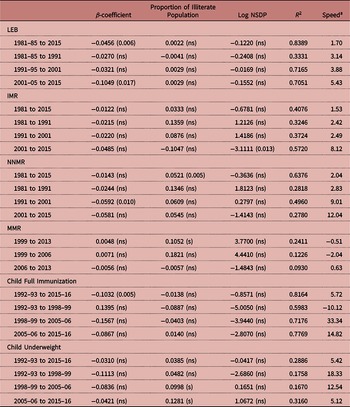
Conditional β-convergence
Previous research has shown that large gaps in socioeconomic conditions, sectoral distribution and policy environments are drivers of differential economic and health outcomes among states (Janssen et al., Reference Janssen, Hende, Beer and Wissen2016). Thus, a mere examination of absolute β- or σ-convergence, by assuming that all states have the same socioeconomic environment and policy conditions, generates incomplete evidence for future health policy design. Conditional β-convergence provides clues about the factors that need to be targeted to accelerate the regional convergence process. Therefore, the existing socioeconomic differentials among states were accounted for by considering two more explanatory factors in the β-regression model, as additional independent variables along with the annual growth rate. The first explanatory variable was the proportion of the illiterate population in the state (Proportion Illiterate), and the second variable the log of NSDP. The negative β-coefficient for LEB suggested a convergence while controlling for differences in literacy and NSDP across states for the overall period and the sub-period as well.
The conditional β-convergence estimates for IMR showed convergence with negative β-coefficients for the overall period, 1981–2015 and for sub-periods as well. However, the results for absolute β-convergence showed divergence for the overall period. Thus, to assess the convergence process, the existing differentials in the socioeconomic status of the population needs to be accounted for. The results also showed the greater speed of convergence in IMR across states while estimating the conditional β-convergence as compared to the absolute β-convergence. Moreover, both overall and piece-wise conditional β-convergence estimates for NNMR showed convergence for the overall period (1981–2015). However, the piece-wise conditional β-regression estimates for Child Full Immunization compared with the absolute β-regression estimates showed a greater speed of convergence for the most recent period (Table 4). Furthermore, the results for conditional β-convergence showed convergence in the case of Child Underweight and MMR for the most recent period. Although results from both absolute and conditional β-convergence models showed convergence in a majority of the indicators across the states for the whole period, the speed of convergence in the conditional β-convergence model differed significantly from absolute β-convergence estimates.
Conditional β-convergence estimates for selected health indicators across the major states of India, 1981–2015

Number of states: 15; degree of freedom: 14.
a Speed of convergence per annum.
p-values in parentheses.
ns: not significant.
Testing the hypothesis of convergence ‘clubs’
The non-parametric analysis provided evidence of the presence of convergence ‘clubs’, where some states are clustered with higher levels of health outcomes and some with lower levels. There was evidence of a bimodal distribution in LEB over the period 2011–15 across states. However, the distribution was widely spread in the initial period (1981–85) compared with the most recent period (2011–15). In 2015, the majority of the states were concentrated at a higher level of LEB, which suggests an emerging convergence process. In the case of IMR, the presence of convergence clubs was evident in 1981 with a wider spread, but in 2015 there was evidence of a larger peak at higher IMR values and a smaller secondary peak at lower IMR values. This suggests that some states were converging at a lower level of IMR and that most of the states were still at a higher level of IMR.
Similarly, NNMR and MMR showed two peaks, with a greater clustering of states at lower values with comparatively fewer states clustering at the higher end for the recent period (2011–15). However, in the case of Child Underweight and Child Full Immunization the results showed a wider spread instead of a bimodal distribution, even for the recent period (Fig. 2). However, across different models, there was no evidence of continued convergence in Child Full Immunization coverage.
Kernel Density distribution for selected health indicators across the major states of India, 1981–2015.

Trends in health inequalities
One of the major objectives of this study was to measure the convergence in disparity in health status across Indian states. The inequality assessment was categorized into two broad domains: absolute inequality through DMM and AID and relative inequality through the Gini index. A decline in these over the period suggested a convergence and an increase suggested a divergence (Shkolnikov et al., Reference Shkolnikov, Andreev and Begun2003).
Table 5 displays the estimates of DMM and Gini indices for all the health indicators for the major Indian states during the period 1981–2015. The DMM and Gini index for LEB declined for the whole period, although the rate of decline became slower in the most recent decade. The DMM for IMR showed a much steeper decline, while Gini index trends were not unidirectional throughout the period. Similarly, DMM continued to show a steady decline in NNMR and MMR for the overall period. Thus, the estimates of the DMM and Gini index for LEB confirmed the presence of the Convergence Hypothesis in absolute and relative inequality. The results indicate different trends for DMM for the Gini index in the case of IMR. Trends in DMM for IMR were declining from 1981 to 2015, but for the Gini index the values were stagnant with little fluctuation. Furthermore, in the case of NNMR and MMR, the Gini index value showed a small increase in the most recent period (2015 and 2013 respectively). These patterns suggest that although absolute inequality in IMR, NNMR and MMR has been on the decline, relative inequality has continued to rise or stagnate rather than show a conclusive decreasing trend.
Trends in DMM, AID and Gini index for the health status variables across the major states of India

Discussion
Health convergence, alongside economic convergence, is a compelling theoretical prediction. When it fails to occur, the structural obstacles are usually obvious. Convergence theory in health progress marks the crevices in existing health policies and calls for greater focus on inclusive and strategic policies. In an effort to identify the failure or success of the convergence process in health transition in India, this study examined the Convergence Hypothesis for different health indicators across the major Indian states using cutting-edge convergence metrics. The findings showed a convergence in life expectancy at birth (LEB) as measured through β-convergence. Similar trends were observed for IMR, Child Full Immunization and Child Underweight. However, there was a significant divergence in NNMR and MMR for the overall period (1981–2015, 1999–2013), with convergence for the most recent period (2001–2015, 2006–2013).
Furthermore, σ-convergence backed the findings of β-convergence for IMR, NNMR and MMR. However, β showed divergence and σ suggested convergence for Child Underweight and Child Full Immunization. Moreover, after adjusting for state-level variation in Illiteracy and NSDP, the results of conditional β-convergence also suggested that there was convergence for LEB, MMR, Child Underweight and Child Full Immunization across the states for the entire period. Interestingly, the results of conditional β-convergence in NNMR showed convergence for the overall period, but divergence for the recent period. However, the findings for IMR suggested that the convergence process was underway for the most recent period (2001–2015) and there was a divergence for the overall period (1991–2015). Other results, such as the Kernel Density Distribution, supported the hypothesis of convergence ‘clubs’, with the presence of a bimodal distribution for all the selected indicators. Overall, the findings did not support the hypothesis of convergence, although there was some evidence of convergence in a group of states and asymmetrical distribution of growth in health status among major states of India. Hence, the different conclusions from the various convergence measures supported the presence of a weak but not robust convergence process in different health indicators for the study period. This indicates an urgent need for more inclusive policies and programmes to reduce the unfair burden of disease and mortality in the laggard states. Moreover, the application of different convergence metrics works as a robustness check in the assessment of convergence process in select health indicators for India over the period.
The findings further suggest that despite economic prosperity in the country, regions that were under-privileged in child nutrition and literacy level were more likely to fall behind. Literacy in general, and mother’s education in particular, is having a much stronger impact on child health and their survival compared with the historical persistence role of economic conditions (Gachter & Theurl, 2011). The σ-convergence shows that the state differentials in different indicators of the health status of the population have become smaller over time. On the other hand, β-convergence with more insights on distributional changes in individual states showed that states with the highest mortality or adverse health condition in the past showed greater improvements than states with lower mortality in the past.
Similarly, conditional β-convergence accounted for structural differences, i.e. differences in education level, economic status, disease prevention, provision of care, environment and state-specific endowment at the onset (Gachter & Theurl, 2011; Janssen et al., Reference Janssen, Hende, Beer and Wissen2016). Previous studies in this field have mostly reported a convergence process in health status using β- and σ-convergence metrics (Nixon, Reference Nixon2001; Roberto et al., Reference Roberto, Juan and Jose2007; Janssen et al., Reference Janssen, Hende, Beer and Wissen2016). However, non-parametric models provide substantial information on the entire distribution of health status among a population (Quah, Reference Quah1993; Wang, Reference Wang2004). Thus, for a comprehensive examination of health status and its temporal distribution, there is a need for statistically diverse measures. The rationale stated above for the use of different measures would help to choose the best possible scenarios by considering the data quality and its reliability. However, the use of different measures does not have much impact on the outcomes of the study indicators, but they can act as robustness checks for one another.
Therefore, constant evaluation of health progress across different Indian regions and socioeconomic groups, and subsequent revision of health policies, has become an essential step towards ensuring equity in health status (Dorius, Reference Dorius2008; Goli & Arokiasamy, Reference Goli and Arokiasamy2013, Reference Goli and Arokiasamy2014; Goli, Reference Goli2014; Goli & Siddiqui, Reference Goli and Siddiqui2015). This might be because growth, inequality and the catching-up process is omnipresent in the success story of developed countries. The transition to convergence is not a certain process, and convergence may be replaced by divergence and vice-versa at any time (Moser et al., Reference Moser, Shkolnikov and Leon2005; McMichael et al., Reference McMichael, Mckee, Shkolnikov and Valkonen2004; Dorius & Firebaugh, Reference Dorius and Firebaugh2010). Similarly, the last few decades have shown that there is a trend towards a mortality trap, or reversals or stalling of further improvements, among advanced nations (Bloom & Canning, Reference Bloom and Canning2007; Clark, Reference Clark2011). Thus, a constant evaluation of health status progress and its distribution will help policymakers to adopt a dynamic strategic approach for having inclusive growth to mark success and achieve the targets of the ongoing SDGs (Rahman et al., Reference Rahman, Karan, Rahman, Parsons, Abe and Bilano2017).
This paper contributes to future health policy and programmes in India by suggesting areas where there should be greater focus to reduce regional disparities and improve average health status. Convergence measures could be useful tools to measure and monitor health progress and distribution and measure whether or not there is catch-up in health measures. Disparities in health may then be reduced through appropriate policy interventions. The study has also highlighted the importance of different convergence metrics for the monitoring of health status and its distribution, taking into consideration the substantial socioeconomic and geographical disparity among Indian states. The assessment of regional progress in health indicators identifies the advantages and disadvantages of ongoing policies and informs policymakers. Convergence analysis provides an important tool for assessing progress towards the SDGs at the country, regional and the global level.
The success story of India’s reduction in mortality and acceleration in the average life expectancy is widely acknowledged. However, the tempo and quantum of progress in health status are not uniform and stable across the states. Health disparities find their genesis historically through social, economic and political mechanisms that lead to social stratification according to income, levels of education, occupation, gender, caste and social groups (WHO, 2008). Thus, the lack of adequate progress on these underlying social determinants of health should be considered as a failure of India’s public health achievements in the laggard states (Reddy et al., Reference Reddy, Patel, Jha, Paul, Kumar and Dandona2011; Goli, Reference Goli2014).
Although government policies, such as the National Health Mission (NHM), act as a catalyst for establishing effective integration and convergence of health services, they suffer from poor investment centrally, but especially in the laggard states (Government of India, 2017). The larger health goal for a nation like India should the reduction of inter-state, intra-state and socioeconomic gradients in health. Health care services should be available, accessible and affordable through publicly funded health systems if poverty is to be eliminated and inequality minimized. Similarly, in order to achieve health for all, and address the needs of everyone, future health policies should be framed under the umbrella of the SDGs and should be boosted by a substantial rise in government health care investment. India’s public investment (1.2% of its gross domestic product) on health care is meager in comparison to that of countries with successful convergence-focused health transitions (Drèze & Sen, Reference Drèze and Sen2012).
Acknowledgments
The datasets generated and/or analysed in this study are available in the public domain and can be accessed from the Office of Registrar General of India, Sample Registration System and Reports of the National Family and Health Survey 1991–2015 (NFHS-I-IV). Also, statistics were taken from the Planning Commission, Government of India, and the Ministry of Health and Family Welfare (MoHFW), Government of India.
Funding
The research did not receive financial support from any source.
Conflict of Interest
The authors declare that they have no conflicts of interest.
Ethics Approval
The study used the dataset available in the public domain for specific and intensive analyses as a part of the authors’ independent research work. Thus, there is no need to seek a separate ethical clearance for this study.