In Das Buch von der deutschen Ostmark (The book of the German Ostmark; 1938), Nazi education specialist and SA (Sturmabteilung) member Richard Suchenwirth blamed the fin de siècle for debasing the traditional culture of Vienna:
Another serious reproach: Vienna was Jewified, while the German-speaking Austrian crownlands were affected to a much lesser extent by this plague. Liberalism had utterly failed the city in terms of racial purity …. In all areas the Jews seized the lead. … When Arthur Schnitzler wrote his society plays, when Jewish authors were performed at the Burgtheater, when Jewish actors and actresses appeared on the German stage, an art institution raised up to the highest level, when the University of Vienna was swarming with Jewish PhDs, was all this not an indication of a resentment against the old city and a desire to loosen ties to her?Footnote 1
Encompassing the final decades of Habsburg rule and the rise of modern culture, the cosmopolitan and Jewish Vienna of the fin de siècle was a despised locus in the Nazi historical imaginary. Vienna 1900 was a polyglot, multicultural city, a place where European Jewry had risen to unforeseen heights of economic prosperity and cultural influence; many Nazi ideologues, historians, and authors focused on the verjudet nature of late imperial Vienna. It was the site of the last flourishing of the hated Habsburg Empire, portrayed as a corrupt and dangerous interruption in the true Germanic history of what was now the Ostmark, derided as a period that had severed the bond between Germans of the Ostmark and the Altreich. The decades surrounding the turn of the century were politically (imperial Vienna), culturally (fin-de-siècle and modernist Vienna), and racially (Jewish Vienna) degenerate; for that reason, the fin de siècle would need to be largely erased from history.
But the Nazi relationship to history was exceedingly complex. History might be negated and thoroughly destroyed, as in book burnings or the denunciations of well-known narratives, such as those surrounding German surrender in World War I. History books often mystified periods or events in ways that rendered the subject nearly unrecognizable. At times, attempts were made to transform history, to read it through the twisted lens of Nazi ideology. Historical objects or texts were preserved with the explicit aim of controlling a future historical narrative (most obvious here is Reich minister and ideologue Alfred Rosenberg's Institute for the Study of the Jewish Question, dedicated to “documenting” Jewish history for future generations).Footnote 2
As the site of Adolf Hitler's encounter with the Jewish other, turn-of-the-century Vienna was a profoundly reviled lieu de mémoire.Footnote 3 A variety of strategies were employed to distance the Nazi present from Vienna 1900; it was alternately suppressed and ignored, or deeply vilified. Yet the period was also inseparable from two figures celebrated in Nazi Vienna: Mayor Karl Lueger and artist Gustav Klimt. While Karl Lueger could easily be hailed as someone who had struck back against the Jewish ascendancy in Vienna, Klimt posed a dilemma: How could the most iconic artist of Vienna, an artist whose early career was dependent upon the late imperial government and whose later career rested heavily on Jewish patronage, be salvaged for a Nazi-sponsored exhibition? In 1943, organizers at the Künstlerhaus solved this dilemma: the Klimt memorial exhibit, in the former Secession building, celebrated a Gustav Klimt without the Habsburg inheritance, the modernist fever, and the Jewish support that had produced him.
In the following essay I look at Nazi discourse on Vienna 1900, especially that originating from Viennese writers, ideologues, and political figures. Reflecting both scholarly and popular views, I examine academic texts, books for popular readers, films, and art exhibitions. Turn-of-the-century Vienna embodied three overlapping historical constructs vilified in the Nazi worldview: late imperial Vienna, fin-de-siècle Vienna, and the birthplace of modernist Vienna. The fin de siècle generally referred to the two decades straddling the new century and was associated with a cultural malaise, vice, and a turn toward interiority; it was part of the larger modern period, which included other movements like geometric abstraction and utopian design. All three historical constructions were characterized by oversized Jewish contribution, pan-European links, and a sense of decadence (some of the characterizations of Vienna 1900 persist in the discourse today).Footnote 4 For this reason, I look, in turn, at each of these constructs within the Nazi Weltanschauung.
After examining the perception and appropriation of Vienna 1900 between the years 1938 and 1945, I end by exploring its instrumentalization in a different context. In an ironic twist of history, the very period suppressed and derided in Nazi discourse would in turn be called upon, by the 1970s, to distract from the shadow of the Nazi era that still hung over the city.Footnote 5
Late Imperial Vienna: The Final Perfidy of the Habsburgs
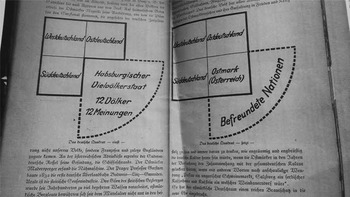
It was not only a dizzying array of laws and organizations that erased Austria and legitimized a political entity known as the Ostmark, its existence was also constructed through the cultural realm.Footnote 6 From the first days of the Anschluss, a giant wave of books on Ostmark history, poetry, art, folklore, and regional character, among other topics, flooded the Reich. In these paeans to the new “sister” of the Altreich—such as Suchenwirth's book—the narrative often began with the brave Germanic tribes that had settled the land, conquered it back from the Romans, only to see it lost again to foreign interlopers after the Middle Ages and thereby relegated to a state of utter corruption until the recent past. Friedrich Lange's Unsere alte Ostmark Österreich (1941) includes a diagram revealing how the southeast region of the Reich had once consisted of the multiracial Habsburg state of “12 peoples and 12 sensibilities,” now transformed into the Ostmark and surrounded by friendly nations.Footnote 7 (Fig. 1) If Hitler was clearly the savior of the Ostmark, there was no doubt which rulers had led to its ruin.
Illustration showing “transformation of Habsburg Vienna from multiethnic city to friendly Ostmark.” “Die Deutsch Quadrat—einst/Die Deutsche Quadrat—jetzt” in Friedrich Lange, Unsere alte Ostmark Österreich (Berlin/Leipzig, 1941). Photo: author.

In the Nazi vision, centuries of Habsburg betrayal had culminated in the imperial rule of Franz Josef II. It was due to the Habsburg character and their betrayal of German Austria that fin-de-siècle Vienna had become a modernist and Jewish dystopia. In the texts of academic historians working in Nazi Vienna and in popular historical accounts for mass audiences, the Habsburgs were portrayed as corrupt and world-trotting figures who had sold out and forced a separation between the “brethren” of Austria and Germany. The Habsburgs had turned the once pure Ostmark into part of a mongrel empire, put the Slavic populations on equal footing, and emancipated the Jews. Yet, earlier in the century many Pan-Germans had viewed the Habsburg legacy as a continuation of the Catholic Holy Roman Empire and an embodiment of the German mission.Footnote 8 In the mid 1930s, Chancellor Kurt Schuschnigg was not immune to playing on nostalgia and hinting at the idea of a future restored empire.Footnote 9
Following the Anschluss, however, the imperial past was often the source of fervent scorn. The Habsburg rulers were derided as interlopers, decadent outsiders who had betrayed Austria in allegiance to the royal family and the Catholic Church. Nazi discourse portrayed them as cosmopolitan traitors, aligned against the German Volk; the rulers’ hearts lay with the Spanish, Italian, French, and the papacy, willing to sell out German blood at every turn. The titles alone of Nazi publications reveal their contempt: Aufruf gegen Habsburg: Revolution in drei Jahrhunderten (Outcry against the Habsburg: Revolution in three centuries); Nie wieder Habsburg! (Never again Habsburg!); Habsburger in der Geschichte der Deutschen (The Habsburgs in the history of the German people); Die Habsburger: die Tragödie eines halben Jahrtausends deutscher Geschichte (The Habsburgs: Tragedy of a half millennium of German history).Footnote 10
A colorful representative of these texts is Gottfried Zarnow's Gekrönt—entehrt! Europas Schicksal, Habsburgs Schuld. Das Problem des XX Jahrhunderts Footnote 11 (Crowned—dishonored! Europe's fate, Habsburg's fault. The problem of the 20th century; 1937). Zarnow was the pseudonym for Ewald Moritz, who penned other books outlining the treacherous deeds of the Habsburgs.Footnote 12 Moritz served as publisher of a right-wing weekly, Die Deutschen-Spiegel, banned by the Nazis in July 1933 for not always following the party line.Footnote 13 Gekront focuses on the nefarious plots of the last empress of Austria-Hungary, Zita, wife of Charles I and mother of Otto, to restore her son to the throne at all costs. She is cast as a spider, spinning a web that reached to Paris, London, and Rome. Sparing no cost, no means, no victim to reach her aim, the empress Zita “sacrifices even the father of her eight children. … The road is clear, but at the end of it the purple cloak of the Habsburg will lie as a shroud over Central Europe.”Footnote 14
Historian Karl Itzinger, in his Nie wieder Habsburg! agreed, referring to the Habsburgs as a “papal dynasty” that was treacherous for Germany and Austria.Footnote 15 Prior to the Anschluss, Itzinger was an illegal SA member and leader of the Freikorps Oberland. From 1938 until the end of the war he served in many official NSDAP positions, while publishing both “history” and fictional works. (Itzinger's National Socialist link was largely forgotten until the recent past; in 1981 a street in Ried im Innkreis was named after him.)Footnote 16 Alfred Rapp, another historian reflecting popular Nazi ideas, noted that the House of Habsburg had experienced more crises than any other dynasty.Footnote 17 In an interesting conflation, Rapp blamed the Habsburgs for bringing disease and “the Habsburg nose” to Austria. (The spread of disease and large noses was usually attributed to the Jews.)Footnote 18
Hitler carried a deep-seated hatred for the Habsburgs, formed during his days as a failed artist in Vienna (his abiding disgust with the fin de siècle will be explored in greater depth in the following). Referring to the Habsburgs as “the most miserable dynasty ever ruling over German lands” and seeing their destruction as necessary for the rise of a German Reich, he condemned former German leaders for not abandoning them: “Germany's sticking to this ragged Habsburg state, come what may, was a crime for which the responsible leaders of German policies should still be hanged.”Footnote 19 Josef Goebbels’s diary entries chronicle Hitler's railings against the Habsburgs:
[The] Führer once again describes [the] fragility of the former Habsburg Empire. How abandoned the German element was. The bad and disgusting character of Franz Josef. … How he himself [Hitler, GH] first became an antisemite in Vienna. How his father was only anticlerical and anti-Habsburg. [The] Führer describes the great merits of Lueger. Footnote 20
Hitler seethed with a particular hatred for Archduke Franz Ferdinand and his Czech wife; within hours of the Anschluss he had their sons, Maximillian and Ernst Hohenberg, arrested and deported to Dachau.Footnote 21
The protection of all ethnic groups within the Austro-Hungarian Empire was the very antithesis of the Nazi Weltanschauung, embodied in Nazi policy. But the greatest crime of the Habsburgs, in Nazi conviction, was of course their centuries-long protection of European Jewry (with notable exceptions such as Albert V and Maximillian I, who pursued antisemitic policies).Footnote 22 But it was in the second half of the nineteenth century, as Nazi historians never tired of reminding their audience, that the Jewish population of Mitteleuropa exploded, largely due to the policies of Franz Josef. By then, Habsburg lands held the largest concentration of Jews west of Russia. The emperor's Toleranzpatent, Clause 19 of Cisleithania's national constitution of 1867, finally gave the Jews complete emancipation. It was in those decades that Jews throughout the empire streamed into its heart, into the city of Vienna. In 1777, of 350,000 Jews in Austria, only 520 resided in Vienna. By 1850 the number had risen to 11,000, and in the first decade of the twentieth century, up to 175,000. For the Nazi Robert Körber, the Verjudung of Vienna could be solidly blamed on the Toleranzpatent of Franz Josef, for “believing the Jews could be Germanified like everyone else.”Footnote 23
Scholars of Third Reich cinema have revealed a similar anti-Habsburg sentiment in films, notably within popular Wien-Film. This marks a contrast to films during the Ständestaat, which often trafficked in Habsburg nostalgia. Robert von Dassanowsky explores Erich Engel's 1939 Hotel Sacher as a rejection of both Red Vienna and Vienna as a capital of a Mitteleuropean empire. He sees the plot, centered on the betrayal of a Ukrainian-Austrian military officer by a Slavic-Austrian woman working for the Russians, as “intended, at least cinematically, to bury the Habsburg myth”Footnote 24 and to rewrite historical “memory,” negating the Habsburg past and, by association, the anti-Nazi Austrofascist regime.
In a similar fashion, Johann Hüttner reads the 1941 film Die Liebe Augustin, directed by E. W. Emo (not to be confused with the film of the same name from 1960 by F. W. Murnau), as a harsh criticism of Austrian institutions and of the Habsburgs.Footnote 25 The film follows the life of the seventeenth-century emperor Leopold I, depicted as foolish, corrupt, and wholly unconcerned with the Viennese Volk. Throughout numerous historical dramas, court life and Austrian officialdom are mocked and portrayed as self-interested and oblivious to the needs of the people. Thus, such Tendenzfilme,Footnote 26 seemingly unpolitical, furthered the narrative of Habsburg treachery repeated in history books both popular and scholarly.
As these texts and films implied, the incompetence, disloyalty, and racial mixing encouraged by the rulers had corroded Austria for centuries. It was in the final decades of the nineteenth century that the policies of the Habsburgs had come home to roost, nearly destroying the city and turning fin-de-siècle Vienna into an island of “racially alien Jewry.”
Fin de Siècle: Verjudet Wien
Nazi strategy regarding the history of the Habsburgs was to cast aspersions and create a cultural and institutional memory of their villainy. When it came to Vienna during the final decades of their rule, Nazi publications either aimed to ignore it—to erase those decades as if they had never existed—or to cast it as an island of “racially alien Jewry” (rassenfremde Volk dem Juden).Footnote 27
The turn of the century was for many reasons more problematic in the Nazi imaginary than earlier periods of Habsburg rule. First, it was the high point of Jewish immigration: Vienna would reach its peak Jewish population in those decades and the few immediately following. Many of these newly arrived Jews were Ostjuden and fed the stereotypes held by many non-Jews. Second, this period was one in which Jewish contributions emanated not only from the banking and political realms but also from many reaches of culture, including the press, literature, theater, science, philosophy, and music. Moreover, many Jews served as patrons of the visual arts and architecture.Footnote 28 Fin-de-siècle Vienna was not only linked with the Jewish upper bourgeoisie but was of course one of the most celebrated modernist periods. If earlier decades of cultural modernism had “belonged” to Paris, Vienna was arguably the most important—and in many ways the most radical—of modernist cities in the decades spanning 1900.Footnote 29 Thirdly and importantly, the fin de siècle was not a distant historical period, the outlines of which could be entirely shaped by Nazi-approved discourse; rather, it was part of the living memory of many people. Inevitably, individual memory and knowledge of this time and place might compete with and challenge the constructed cultural memory woven in the Nazi imaginary.Footnote 30
As previously noted, while only about 11,000 Jews lived in Vienna prior to the reign of Franz Josef, by 1910 the number had soared to 175,000.Footnote 31 Moreover, this wave of immigrants was less assimilated than previous waves and decidedly poorer; many of these Ostjuden came from the region of Galicia. By 1914, 25 percent of all Viennese Jews were Galician in origin. If such Ostjuden were threatening in their foreignness and difference, a stratum of well-assimilated and financially secure Jewry was resented for the cultural capital it had acquired in turn-of-the-century Vienna. Many industries—including ready-to-wear clothing (Konfektion), leather goods, and department stores—were largely in the hands of Jewish ownership. Jews were also overrepresented in more high-status fields such as medicine, law, theater, and opera. By 1900, Jews comprised one-fourth of all students at the University of Vienna. Marsha Rozenblit has shown that regardless of class status, Jews tended to form neighborhoods with other Jews, living primarily in the areas of Leopoldstadt and, for the better off, Alsergrund and the Inner City.Footnote 32 The concept of “Jewish difference,” as Lisa Silverman makes clear, transcended individual identity to become a category by which to understand broad realms of culture and society. The “Jewish”—outside of any individual religious practice—existed in an often oppositional relationship to the “Austrian,” although the terms of this relationship were fluid rather than fixed.Footnote 33
This sharp rise in both the population and the cultural capital of Jews in Vienna contributed to mass resentment. Despite its glittering facade, early twentieth-century Vienna was rife with political, economic, and social strife that was exacerbated by profound changes stemming from industrialization.Footnote 34 The swell of Jewish immigrants—both the successful and the destitute—brought forth new forms of political and racial antisemitism (although the hatred was hardly confined to the lower classes). Karl Lueger, Christian Socialist leader and mayor of Vienna from 1897 to 1910, was the first modern politician to come to power on an antisemitic platform.Footnote 35
As has been widely explored, Lueger became a hero for Hitler, who arrived in Vienna during the period we are exploring.Footnote 36 Indeed, Hitler remained fixated on the city as it was during his stay. The opinion he formed of Vienna stayed with him all his life and poisoned his attitude toward the city, leading him to “punish” it, for example, by leaving it out of his extravagant urban planning. The attitudes he held toward Vienna, transmitted to Josef Goebbels and others, are in part a result of his personal failures in the city.Footnote 37
By 1910, Hitler was an avid reader of the Pan-Germanist and antisemite Georg Schönerer.Footnote 38 Writing later in Mein Kampf, Hitler (falsely) cast his “awakening” to the Jewish problem as a result of his years in Vienna:
For since I had begun to concern myself with this question and to take cognizance of the Jews, Vienna appeared to me in a different light than before. Wherever I went, I began to see Jews, and the more I saw, the more sharply they became distinguished in my eyes from the rest of humanity. Particularly the Inner City and the districts north of the Danube Canal swarmed with people who even outwardly had lost all resemblance to Germans.Footnote 39
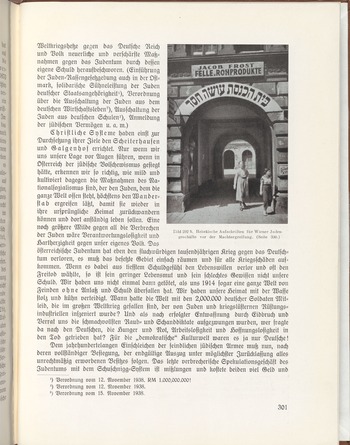
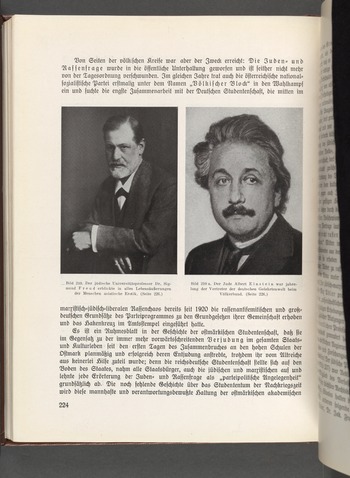
This vision of Vienna, crowded with nefarious, turbaned Jewish men “swarming” through the Leopoldstadt district, takes photographic form in Robert Körber's 1939 Rassesieg in Wien, der Grenzfeste des Reiches (Racial victory in Vienna, the border fortress of the Reich). (Fig. 2) Körber's numerous photos juxtapose healthy Aryans and feeble, threatening-looking Jews. If the city had formerly had to contend with Hofjuden and powerful individual Jews, it was clear in Körber's text that the last century had transformed Vienna into the “European headquarters of Asiatic Bolshevism.”Footnote 40 Thwarting Vienna's role as the “border fortress of the Reich,” the modern city fell sharply under control of a racially alien Jewry, which “pulled the strings of the state and press, theater and film, banks and stock markets, state and financial institutions.”Footnote 41 Copious photographs of the Leopoldstadt district drove Körber's message home. Hebrew signage and storefronts turned the city's streets into “shtetls.” While photos showed streets crowded with black-hatted Ostjuden, the author also included portraits of a virtual who's-who of Jewish luminaries from the fin de siècle, such as Albert Einstein and Sigmund Freud. (Fig. 3) The description of early twentieth-century Vienna as a “cesspool of Jewry,” witnessed in texts such as Mein Kampf and Rassensieg, became a common trope within Nazi Vienna, paralleled in photos that “proved” how decrepit both the people and the streetscape had become.
Photograph depicting the Viennese streets covered in Hebrew writing after the Jewish “power grab.” “Hebräische Aufschriften für Wiener Juden geschäfte vor der Machtegriefung” (Hebrew writing on Viennese Jewish businesses before the seizure of power) in Robert Körber, Rassesieg in Wien, der Grenzfeste des Reiches (Vienna, 1939), plate 292 B. Credit: New York Public Library, Dorot Division.

Photographs of Sigmund Freud and Albert Einstein in Robert Körber, Rassesieg in Wien, der Grenzfeste des Reiches (Vienna, 1939), plates 210 and 210A. Credit: New York Public Library, Dorot Division.

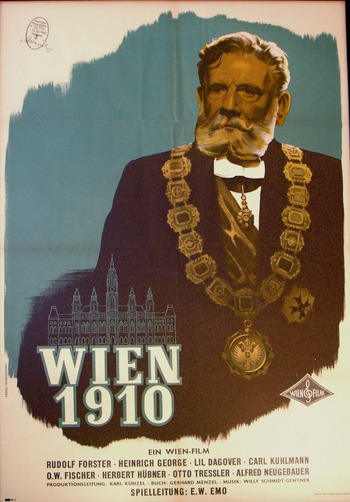
A film debuting in 1943 reveals the difficulty in presenting even the lauded figure of Lueger within the despised period. On 16 April 1943, Wien 1910, directed, like the earlier Liebe Augustin, by E. W. Emo, premiered in the city. It was originally intended by Goebbels to ratchet up antisemitism.Footnote 42 (Fig. 4)
Film poster for Wien 1910, dir. E. W. Emo, Wien-Film, 1940/41. Credit: The Gillespie Collection, Australia.

A product of Wien Film, the film starred Rudolf Forster as Mayor Karl Lueger. Echoing the discourse we have traced on the Habsburgs and verjudet Vienna, Lueger functions as a hero against the noxious forces of the fin de siècle: Jews, the emperor's court, and unfettered capitalism. Lueger is dying, his death hastened by (Jewish) socialist Victor Adler. To his good fortune, Pan-Germanist Georg von Schönerer is in town. United in antisemitism, the two men respect each other, but Schönerer wants revolution and to move faster in “curing” the city. Schönerer is shown as the better man for advocating for the Reich, while Lueger's priority is his Austrian base. While Lueger is a warm man of the people, Schönerer, a revolutionary, emerges as the real predecessor of Hitler. Gernot Heiss notes that in addition to its explicit antisemitism, the film is “German nationalist, anti-capitalist, anti-Habsburg, and anti-democratic.”Footnote 43
Goebbels’s feelings about the film were positive at first. He found the original script “exciting” and believed it offered a genuine evocation of the period.Footnote 44 Soon, however, he worried that powerful Nazis in Vienna, unhappy about the heroization of Lueger, would sink the film, commenting that
I … discussed the critical case of the Lueger film with Gauleiter[Baldur von] Schirach. In Vienna there is a radical political clique that wants to destroy this film. I won't let this happen. The film must be made and then we can decide whether corrections must be made or whether the whole thing should be changed.”Footnote 45
No doubt the mumblings over the film triggered Goebbels’s ever-present worry about Viennese separatism.Footnote 46
Goebbels’s suspicions proved correct; Nazi factions in Vienna objected to the positive portrayal of the Christian Socialists. So, too, the film portrayed Lueger's interest in working within the framework of the Habsburg Empire, although Goebbels insisted that it ultimately ridiculed the monarchy:
This film shows once again what a desolate state the Habsburg monarchy found itself in before the World War. It's no wonder that the Central Powers lost the World War; it would have been a miracle if they had won. Their leadership at the time was so badly criticized that she was no match even for the likewise badly criticized Allies.Footnote 47
After its debut in Vienna, the film was not played again in the Ostmark and largely failed at the box office in Berlin. It is difficult to determine whether the film flopped due to a lack of interest in the historical period or to its particular portrayal in this case. Either way, Wien 1910 was no celebration of the era. Even lionizing a figure like Lueger, personally sanctioned by Hitler, could prove controversial.
Jüdisches Wien, Modernistisches Wien
If the fin de siècle was an era in Vienna in which Jewish contribution was outsized, this went hand in hand with its foray into modernism, which rendered the period doubly debased. The Jewish element in Viennese modernism is profoundly complex and has long been the subject of debate among scholars.Footnote 48 Recent scholarship has seen a backlash against an earlier tendency, evident in the works of authors including Eric Hobsbawm, Peter Gay, and more notably Ernst Gombrich and Carl Schorske, to underplay Jewish contribution.Footnote 49 Scholars have sought an explanation for Jewish influence in Viennese culture in a variety of phenomena, including Jews’ outsider status, a culture of the book and education, and an attempt to gain status through culture. More recent authors focus on the more subtle and context-specific embrace or rejection of Jewish identity.Footnote 50 While Steven Beller sees Jews playing a less significant role in the visual arts—outside their place as patrons—Elana Shapira emphasizes the impact of Jewish references, identity, and self-fashioning, often stemming from the (Jewish) patrons themselves, in major architectural and visual commissions.Footnote 51 Both Beller and Shapira attribute the Jewish dimension in fin-de-siècle Viennese culture to the individuals who made it as well as to larger elements within Jewish history and culture reflected in it; and both focus largely on a Jewish elite.
In some fields, the overlap of Jewish artists maps nearly perfectly with the creation of radical new forms and genres; and Jewish patrons were certainly at the forefront of support for modernist artists in the visual realms (a phenomenon that Carl Schorske's canonical text largely overlooks).Footnote 52 Thus, turn-of-the-century Vienna represented a double threat, or perhaps more accurately a double horror, within the Nazi view of history. Scott Spector goes somewhat further in his argument on “Modernism without Jews,” noting that both philosemites and antisemites have located in all Germanic manifestations of the modern a profoundly Jewish element:
The philo-semitic and pro-modernist argument in this case (as in others) is dependent on the twin premises that modernism is Jewish, and yet that modernism's Jewishness is somehow hidden and needs to be revealed …. It is hence a somewhat counter-historical exercise to seek to reconstruct a German discourse on the modern or “modernism” purged of reference to Jews, Judaism, or Jewishness.Footnote 53
Spector's concept of “anti-modern anti-Semitism” gets at the twinned nature of the two, while warning us that we might be attributing to some nebulous notion of the “Jewish” something inherent in modernism itself.
For our purposes we might argue that the omission or erasure of “the Jewish” is simultaneously an erasure of the modern (and of the modern, the Jewish). The latter is dependent on the former. Hence, it was a common strategy in Nazi publications to simply omit both. The period might be demonized (as in Körber) or it might be simply negated altogether. This desire to “correct” or erase the Jewish elements in turn-of-the-century Vienna would later take literary form in Hugo Bettauer's oft-cited 1922 novel City without Jews (Die Stadt ohne Juden).Footnote 54 In the built environment, Jewish erasure was enacted through the destruction of synagogues and, as Tim Corbett has explored, the decimation of Vienna's Jewish cemeteries.Footnote 55
This fantasy of eradicating the fin de siècle is visible in art historian Karl Ginhart's Wien: Das Antlitz der Stadt in Bildern (Vienna: The face of the city in images), a book of photos published in 1941.Footnote 56 Beginning with the Stephansdom, it includes images from throughout Vienna's illustrious history, highlighting Schönbrunn, buildings on the Ringstrasse, famous baroque paintings in the Kunsthistorische Museum, and so forth, but conveniently leaves out nearly all structures associated with the fin de siècle. There is one image showing Joseph Maria Olbrich's Secession Building, which would soon house exhibits of the Künstlerhaus and thus had official approval, and mention is made of both Adolf Loos and Otto Wagner. Wagner's reputation as an antisemite had kept Jewish students from taking his courses, which certainly helped him find favor in the Nazi period.Footnote 57 Exception is made as well for the architect/designer Josef Hoffmann, who received many commissions under the Nazis, including the 1939 Wiener Opernball and designs for the Haus der Wehrmacht. Prior to the Anschluss, Hoffmann cofounded the Neue Werkbund Österreichs (New Austrian werkbund) with the explicit aim of rebuffing the Austrian Werkbund led by the Jewish architect Josef Frank. His language grew increasingly nationalist and reactionary after 1938; for his efforts he not only received plum commissions but was also appointed special commissioner for Viennese arts and crafts (Leitung des Amts zur Hebung des Wiener Kunsthandwerks).Footnote 58 (Despite Hoffmann's attempt to accommodate the regime, at least one official Nazi memorandum complained of the architect's “friendliness to Jews” [judenfreundlich]).Footnote 59 In contrast, none of the most famous of the Vienna 1900 painters—Gustav Klimt, Egon Schiele, or Oskar Kokoschka—are included. The modernist city is essentially reduced to a footnote. Ginhart, who had studied art history with Josef Stygowski at the University of Vienna, had an interest in the buildings and culture of Vienna that was not simply academic: a member of the NSDAP, in 1938 Ginhart was placed in charge of overseeing the furniture left in the apartments of deported or fleeing Jews that had not yet been confiscated. He lectured on the links between art and race for the Wiener Gesellschaft für Rassenpflege (Viennese society for the conservation of race).Footnote 60
Similarly, in The German Ostmark, a photo book published in Vienna for English-speaking readers to celebrate the Anschluss and boost tourism, of 194 pages, forty are devoted to Vienna.Footnote 61 The fifty-nine photos of Vienna include the National Library, the Karlskirche, the Vienna choir, the Vienna National Hospital, the Ringstrasse, and others, but not a single photo devoted to any aspect of the fin de siècle. That chapter of cultural history is made entirely invisible.
Writing in the Kunst dem Volk in 1940, Karl E. Baumgärtel expressed his opinion on the “crisis” that had befallen the visual arts in the period. Baumgärtel had been affiliated with the Social Democrats in the 1920s and had led a largely bohemian existence. By the early 1930s he came into the orbit of the antisemitic publisher Anton Fellner and began publishing several Nazi dailies in Oberdonau, becoming a member of the Reichskammer after the Anschluss.Footnote 62 He described the “empty days around the turn of the century” as a time during which “fashion prevailed over laws,” “when schools fought against each other or against tradition,” when the healthy and down-to-earth were overcome by “the shock of the lost war, the confusion of emotions, and the influx of foreign elements into society.”Footnote 63
If ever an artist stood for modern and turn-of-the-century Vienna, it was Gustav Klimt. With his Jewish patrons, commissions for the imperial government, and his reputation as one of the most important catalysts for Viennese modernism in the visual arts, Klimt would seem a thoroughly unlikely candidate for celebration in Nazi Vienna. And yet, as I have explored elsewhere, the most complete retrospective of the artist's work was held at the Wien Künstlerhaus in 1943, under the direct sponsorship of Reichsstatthalter and Gauleiter Baldur von Schirach.Footnote 64 How might we understand this exhibit in the framework of the widespread repudiation of the “empty days around the turn of the century”?
Reimagining Klimt: Purging the Fin de Siècle
For Vienna's most powerful Nazi, Baldur von Schirach, Klimt was the embodiment of Vienna's privileged and enviable artistic inheritance.Footnote 65 Yet Klimt's art was inherently interwoven with Vienna 1900, a time and place despised as decadent and unhealthy in official discourse. While Klimt's name is synonymous with the Vienna Secession, his early career and the entirety of his life were lived within the final flourishing of late imperial Vienna.Footnote 66 There was much in Klimt's art that was anathema to National Socialism: libertarian sexuality and decidedly “unhealthy” looking sylphs and studio models; the adamant individualism of the artist and his refusal to work for the greater public; the eclectic mix of Eastern and Western inspiration; the compelling commitment to modernism; the decadence of a waning empire; and, of course, the inspiration and support of so many Jewish patrons and subjects. To salvage Klimt required skillfully reinterpreting and repositioning his art, transforming him from a bon vivant painting decadent nudes, wealthy Jews, and drawing on a wide array of Eastern and Western influences in a city exploding with new ideas to something entirely different. He would come to be portrayed as a deeply Germanic artist, tied to the blood and soil of his birthplace, creating goddesses and icons rather than flesh-and-blood Jews.
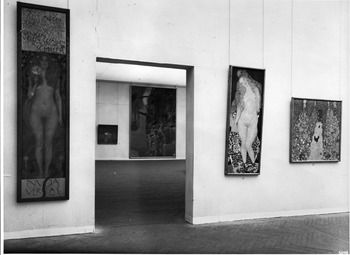
The Gustav Klimt Ausstellung was held at the Künstlerhaus from 7 February to 7 March 1943. It was visited by 24,000 people.Footnote 67 Sponsored by von Schirach, the show was organized by Bruno Grimschitz, director of the Österreichische National Galerie (Belvedere) from 1938 to 1945, and painter Carl Moll. (Both men revealed an early allegiance to the Nazis and remained committed to them.)Footnote 68 (Fig. 5)
Photo of the installation Gustav Klimt Ausstellung, 1943. Künstlerhaus, former Secession Building. Credit: “Künstlerhausarchiv, Klimt-Ausstellung 1943.” Photo: Jules Scherb.

Never again would a retrospective of Klimt's art be so complete. The exhibit totaled sixty-seven paintings and one hundred drawings, occupying four rooms as well as the hallway. A small exhibition catalog, with an introduction by Fritz Novotny, was published to accompany the show.Footnote 69 The rooms held a mixture of landscapes, allegorical works, and portraits. Works of various sizes in simple, identical frames were hung on the white walls of the gallery in a modernist style with minimalist labeling.
The works had been borrowed from public and private collections, including the Österreichische National Galerie, Staatlichen Kunstgewerbe Museum, and the Staatlichen Graphischen Sammlung Albertina. The catalog also thanked all the “private collectors.” But many of those private collectors were hardly positioned to bask in the acknowledgment: they had fled for their lives, been deported, or were already dead. Indeed, one-third of the works in the exhibit had been expropriated from Jewish families, including several that hung in public institutions.Footnote 70 In addition to the five works looted from the Bloch-Bauer family, the show included twelve Klimts from his most important collectors, the Jewish Lederer family, whose entire property had been confiscated during the Anschluss.Footnote 71 Thus the first act of cultural erasure was to obscure the real collectors and patrons of Klimt's paintings, writing out the history of the commissions, the original conditions of display, and the individuals who had nurtured and supported the works over decades.
In his short catalog essay, Novotny argued for Klimt's ability to transcend realism in favor of a powerful ornamental and decorative language. Such interpretation not only aligned Klimt with specifically German movements like expressionism that aimed for an internal or underlying reality but also linked his aim with that of metaphysical German philosophy. Elsewhere I have argued that it is not difficult to find affinities between some of the thematic threads of Gustav Klimt's paintings and the wider cultural heroes and motifs cherished in Nazi circles.Footnote 72 Such affinities are not the result of any connection, intended or otherwise, between Klimt and any proto-Nazi or antisemitic individuals or ideas. Far from it. Links between Klimt's works and certain figures and concepts of Nazi admiration lay in a shared cultural heritage, albeit one distorted and carefully selected to fit the National Socialist Weltanschauung.
A far longer and more polemical text than that of Novotny's brief essay, however, helped to shape the way in which Klimt was interpreted in 1943 and to distance him from the milieu in which he had flourished. Emil Pirchan's 1942 monograph Gustav Klimt: Ein Künstler aus Wien had deeply impressed von Schirach, who called upon the author to help formulate the show.Footnote 73 If there were any doubts about Klimt as a founding member of the Secession, whose brazen nudes, Jewish patrons, and embrace of fin-de-siècle currents might make him seem a less than ideal artistic hero for National Socialism, Pirchan's book put such doubts to rest. The artist that emerges from his book is both deeply inscribed within German culture and profoundly völkisch. In his portrayal of Klimt, Pirchan clung closely to the officially accepted criteria for celebrated artists, shoring up his Aryan heritage, his peasant roots, and his noble aims.
A focus on the more “philosophical” Klimt is evident from the very first page. Entire chapters are devoted to the loftier allegorical works, including one for each of the university paintings (1900–7), as well as the Beethoven Frieze (1902). This emphasis on a mystical, antimaterialist bent also does double duty in tying him to a Germanic sensibility. To that end, each chapter begins with a quotation from an important German philosopher, poet, or artist, among them Friedrich Schiller, the brothers Grimm, Arthur Schopenhauer, Arnold Böcklin (of Swiss origin), Johann Wolfgang Goethe, Albrecht Dürer, Caspar David Friedrich, and Max Klinger. Thus, Klimt's art will not be seen in conjunction with his symbolist and modern contemporaries, but as the continuation of a northern spirit.Footnote 74
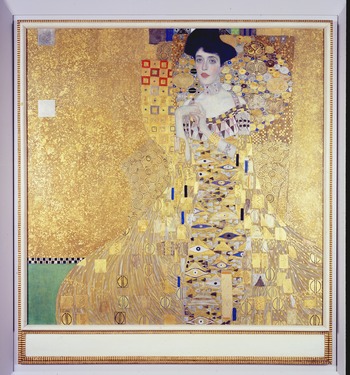
The difficulty of including the many portraits depicting fin-de-siècle Jewish sitters was “solved” by simply stripping the works of their real titles and references to specific individuals. Like acts of damnatio memoriae,Footnote 75 with this act of erasure the works ceased, in the cultural memory, to refer to concrete subjects. (This act of forgetting or suppressing the presence of Jews was a practice so deeply embedded in everyday life under the Nazi regime that it could hardly have caused much conscious dissidence.) The Portrait of Margaret Stonborough Wittgenstein (1905) was transformed into a Portrait of a Lady in White (Damenbildnis in Weiss; cat. 108). Most famously, the sensuous and widely seen Portrait of Adele Bloch-Bauer I (1907), illegally “traded” into the Österreichische National Galerie (Belvedere), became the Female Portrait with a Gold Background (Damenbildnis mit Goldhinter).Footnote 76 (Fig. 6)
Gustav Klimt, Portrait of Adele Bloch-Bauer, 1907, oil on canvas, 54” x 54”. Credit: Neue Galerie, New York.

In addition to anonymizing the portraits, Pirchan got around this difficulty by discussing the works as genre scenes, turning away from the inspiration of distinct individuals to depicting them as types. The Portrait of Adele Bloch-Bauer referred to in his text only as “Damenporträt,” is removed from the sphere of portraiture altogether, to become an icon, a goddess, rather than a real woman:
The female portrait in the Belvedere has lost all attachment to nature, the golden ornament of the dress detached from everyday life; a goddess stares at us, not with aloofness, as in the solemn sanctity of the gold mosaics in the Dome of Ravenna, but with a hidden sensuality, like something unleashed from the ceremonial tales of Wilde's Salome.Footnote 77
In Pirchan's reading, the work is not that of a flesh-and-blood Jewess but of a mythic, timeless icon.
Pirchan's Klimt was innovative and young—but no rebel without a cause. In his telling, Klimt's time at the Secession is hardly marked by radicalness or by the artist's absolute liberty. “Today, from a clarifying distance of forty years, we do not find ‘Medicine’ as ‘uber-modern’ and incomprehensible as it appeared to the overexcited judgment of his contemporaries,”Footnote 78 Pirchan explains. While “young and fresh,” the union of like-minded artists is seen as a latter-day variant of the “neudeutsch-religiös-pathetischen” Nazarene brotherhood.Footnote 79 Klimt's truly important role in bringing modernism to Vienna is utterly disavowed.
The revolutionary spirit that had spurred Gustav Klimt to form the Secession, and to break once again in 1905, the spirit that linked Klimt with his modernist contemporaries and his Jewish patrons in fin-de-siècle Vienna, is here reduced to his rebellion against materialism and rationality:
Klimt was no stylistic pioneer, no sudden trailblazer, no insurgent of a new art, as it seemed then, but rather a great, ingenious force of continuity and of conclusion, the last branch of the autumnal tree of a civilization which stood at the border of two centuries: He nourishes the artistic development of the old Austrian cultural soil, from the contemplative Romanticism of Waldmüller and Schwind to the pompous surface of the Renaissance peacock Makart.Footnote 80
Moreover, only three of Klimt's fellow Secessionists are ever mentioned throughout the book: Josef Hoffmann, Alfred Roller, and Rudolf Alt. As noted, Hoffmann was embraced by the Nazi party and designed both private and public works for high-ranking members. Roller was personally called by Hitler to design the stage sets for the Wagner festivals at Bayreuth. Hitler remained enamored of the streetscapes of Alt, which he had emulated as a young art student in Vienna.Footnote 81 If the Secession embodied the fin-de-siècle city, this was certainly not the case in Pirchan's pages.
But if the 1943 show can be seen as an attempt to re-envision the fin de siècle, it was not an entirely successful venture for everyone. NSDAP member and prominent art historian of the Ostmark Karl OettingerFootnote 82 still had difficulty reconciling Klimt's greatness with the period in which he had lived; ultimately the artist was tainted by the culture in which he produced. Turn-of-the-century Vienna was too much to overcome; it was not a continuation but a caesura in Ostmark culture. Writing in Das Wienerische in der bildenden Kunst (Viennese elements in the visual arts; 1944), Oettinger warned against assimilating the period into the narrative:
It is already evident to us why we should call into question the art of 1900 as valid historical testimony of the Viennese. … Its patrons were, and thus its art was, an expression of the Culture of Money (Geldkultur), of the latter jaded financial generation. Certainly, the portraits of Klimt, leader of the Secession, reflect a locally inflected Jugendstil style, which dominated Europe. But Anton Faistauer, the great Salzburg painter, has seen clearly when he notes that Klimt owed his erotic and highly refined, Oriental play of forms to Budapest and Constantinople.Footnote 83
The terms “Oriental” and “Geldkultur” were fairly transparent references to the Jewish nouveau-riche that had so dominated the art of the period. The foreign and Jewish taste had ultimately subsumed even the Viennese blood of Klimt: “In service to a thin, international strata of wealth and decadent taste, testimony of the alienation of the Metropolis from above and below, even the Viennese birth of Klimt was unable to express itself.”Footnote 84
In a fascinating manner, Oettlinger's quote disparages nearly all the things so despised in the Nazi imaginary: the city (Metropolis), the “wealth and decadent taste” (a reference to portraits of Jewesses like Adele Bloch-Bauer), and the whole phenomenon of fin-de-siècle culture. His condemnation of Klimt shows that while Vienna 1900 had been suppressed it had not been entirely eradicated. Beneath the rewritings of exhibits and texts survived a palimpsest of the culture that had been destroyed. The 1943 show had done its best to remove Klimt from the fin de siècle but had not entirely succeeded in removing the fin de siècle from Klimt's works. If Vienna 1900 had produced things of worth, such things had survived in opposition to the culture in which they arose. If Klimt and Lueger had achieved greatness in the fin de siècle, they had done so in a climate alien to their nature, in a city hostile to their pure intentions.
Resurrecting the Fin de Siècle
Nazi culture had done its best to diminish, excoriate, or neglect the enormous contributions of Vienna 1900. In the second half of the twentieth century, however, fascination for the period returned with a vengeance, serving a very different set of needs. The negative and repressive view of fin-de-siècle Vienna could not more strongly contrast with the ubiquitous celebration of it that emerged in the postwar period. Yet these opposing visions are tethered together: the turn-of-the-century Vienna so anathema to the Nazi Weltanschauung would serve postwar Austria to suppress the memory of, and focus upon, the years from 1938 to 1945.
Already by the 1960s the trope of Vienna as the incontestable “birthplace of modernism,” a realm of dazzling, intoxicating, and never-ending creativity fueled by cigarettes and coffee, had begun to take shape.Footnote 85 (The trope continues: the current reinstallation of the Leopold's modern collection is titled “Vienna 1900: Birth of Modernism.”) Late imperial Vienna became a dreamworld of waltzes and kaffee mit schlag, a fictional construct that serves, in Katherine Aren's term, as a “belle necropolis.”Footnote 86
By the 1980s, this image of Vienna had crystallized into a modernist myth, a twenty-five-year moment fueled by radical innovation and cross-cultural connections, with the city serving as a magnet drawing in foreign influences from the territories of the empire and beyond. Carl Schorske's Fin-de-Siècle Vienna (1980) became mandatory reading for cultural historians of the modern period.Footnote 87 Mammoth exhibitions held in Vienna (Künstlerhaus), Paris (Centre Pompidou), and New York (Museum of Modern Art) made clear that Vienna 1900 had taken up residence in the Zeitgeist.Footnote 88 Moreover, it was now a crucial part of the Austrian patrimony. Writing of the enormous Traum und Wirklichkeit exhibit, Michael Finch noted how the show
spans the chasm of official amnesia regarding the Nazi years and reaches a more positively regarded period of Austrian history, one not requiring Austrians to engage in moral self-examination or questions of guilt. It was an historical moment presented as having nothing to do with 1938–45.”Footnote 89
Beginning with the works of Steven Beller and Marsha Rozenblit, Jewish Vienna resumed its rightful place.Footnote 90 Vienna 1900 had become a lieu de mémoire, a Gedachtnisort (Uhl), an oft-visited spot in the cultural memory.Footnote 91
But it cannot be doubted that the more space Vienna 1900 occupied in the collective imagination, the less room was left for that painful, shameful, and repressed other twentieth-century history, the years of the Anschluss and Nazi rule. Moreover, the myth of Vienna 1900 must be examined in conjunction with those other potent Austrian myths—that of the Opfernation and of the Stunde Null—for the way in which they all promoted a denial, even a refusal, to believe the horrifying reality of what Vienna had become under Nazism.Footnote 92 The prominence of late imperial Vienna in the historical imagination served as a useful deflection from contemplating that other era, but it went deeper than that. It offered to the world a counter image: To focus on Vienna 1900 was to reclaim its links to Jewish culture without acknowledging its destruction. Fin-de-siècle Vienna was so steeped in cosmopolitan sensibility, artistic excitement, challenge to authority, and Jewish contribution that it seemed to defy the very concept of a Vienna stripped of rebellion and emptied of Jews. How could that city have been transformed into this one?
Perhaps no greater symbol of the “resurrection” of fin-de-siècle Vienna exists than the narrative around Klimt's portrait of Adele Bloch-Bauer I (1907). Hanging in the Belvedere in the 1980s, the portrait became Vienna's calling card, an instant ticket to the glamor of Vienna 1900, a symbol of echt Vienna. All the world flocked to see the cultured Jewish queen of the Ringstrasse. Yet, as we have seen, when the portrait had been exhibited in 1943, Adele had been stripped of her name and identity, carrying out the Nazi fantasy of a Vienna 1900 without Jews, even a “world without Jews.”Footnote 93 Such was true as well of the film Wien 1910 and in texts like those of Körber, where there is an urgency to erase and permanently “correct” verjudet Vienna. In the Klimt show and its accompanying texts, Vienna was a garden not a metropolis, the art produced within it was young and new, free of the questioning and doubt attached to modern art. If Bettauer's City without Jews had projected this fantasy forward, precisely the opposite occurred in the 1943 exhibit, which projected a judenfrei Vienna back into the turn of the century.
In the postwar appropriation and fetishization of Vienna 1900 we once again see an inversion, an undoing. In contrast to an entjudet Vienna mapped onto the future, the movie is run backward and the projector stalled. The dark march toward the future never happens. The portrait still hangs on the wall at 19 Elisabethstrasse; Adele's cigarette still burns in the Wiener Werkstätte ashtray. Vienna gets her Jews back, and this time, suspended in the dream, they intend to stay.
Acknowledgements
I wish to thank Dr. Megan Brandow-Faller for her insightful comments on an alternative version of this essay. The essay benefited greatly from the anonymous readers of the first submitted draft. I thank editors Daniel Unowsky and Maureen Healy for their encouragement and suggestions for this piece.
Laura Morowitz is Professor of Art History at Wagner College and Senior Research and Programming Assistant at the Wagner College Holocaust Center. Author of numerous scholarly books and articles on European art and history, she is coeditor, with Megan Brandow-Faller, of the forthcoming Erasures and Eradication in Modern Viennese Art, Architecture and Design (Routledge, 2022). She is co-organizer, with Lori Weintrob, of the 2022 international symposium on Heroines of the Holocaust: New Frameworks of Resistance (2022). Her essay on “Art as a Source for Studying the Holocaust” will appear in Sources for Studying the Holocaust: A Guide for Students, edited by Paul Bartrop (Routledge, 2022).