Introduction
As in other industrialized countries, consumption of psychotropic medication in Spain has been increasing in recent years (Codony et al., Reference Codony2007; Demyttenaere et al., Reference Demyttenaere2008; Soudry et al., Reference Soudry, Dufouil, Ritchie, Dartigues, Tzourio and Alpérovitch2008; Mojtabai and Olfson, Reference Mojtabai and Olfson2010). Recent research shows that the prevalence of depression and anxiety among elderly people is now high (King-Kallimanis et al., Reference King-Kallimanis, Gum and Kohn2009). Many studies show that depression and anxiety, if not treated adequately in older age groups, are associated with adverse outcomes, such as increased risk of disability, poor quality of life, and mortality (Covinsky et al., Reference Covinsky, Yaffe, Lindquist, Cherkasova, Yelin and Blazer2010).
Elderly persons comprise a heterogeneous population, and many have chronic illnesses that require multiple medications. Polypharmacy in the elderly patient has a marked impact on public health; for example, elderly individuals in Spain receive 20–50% of all drugs prescribed in primary care, i.e. 70% of national expenditure on medication (Blasco et al., Reference Blasco, López de Letona, Villares and Jiménez2005). Elderly patients are particularly vulnerable to adverse drug reactions caused by multiple-drug regimens and age-associated changes in pharmacokinetics and pharmacodynamics (Payne and Avery, Reference Payne and Avery2011).
In this context, the prevalence of use of psychotropic medication has reached considerable levels in this group (Carrasco-Garrido et al., Reference Carrasco-Garrido, Jiménez-García, Astasio-Arbiza, Ortega-Molina and de Miguel2007; Marengoni et al., Reference Marengoni2011; Rikala et al., Reference Rikala, Korhonen, Sulkava and Hartikainen2011), although prescribing the psychotropics is often inappropriate (Lai et al., Reference Lai, Hwang, Chen, Chen, Lin and Chen2009; Akazawa et al., Reference Akazawa, Imai, Igarashi and Tsutani2010; Zhang et al., Reference Zhang2010; Blumstein et al., Reference Blumstein, Benyamini, Chetrit, Mizrahi and Lerner-Geva2012). These studies have identified as possible the inappropriate use of antidepressant prescribed for sleeping problems or anxiety and overuse of antidepressant for mild depressive disorders (Zhang et al., Reference Zhang2010). Inappropriate use of anxiolytics includes use for excessive extended periods and in indications for depressive symptoms (Lai et al., Reference Lai, Hwang, Chen, Chen, Lin and Chen2009; Akazawa et al., Reference Akazawa, Imai, Igarashi and Tsutani2010; Blumstein et al., Reference Blumstein, Benyamini, Chetrit, Mizrahi and Lerner-Geva2012).
We performed a pharmacoepidemiology study whose main objectives were as follows: first, to analyze the prevalence of prescription anxiolytics and antidepressants in elderly individuals in Spain between the years 2003 and 2009; and second, to identify those factors associated with the likelihood of consumption of these drugs during the study period.
Methods
We used individualized secondary data retrieved from the 2003 and 2006 Spanish National Health Surveys (SNHS) and the 2009 European Health Interview Survey (EHIS) for Spain to conduct a nationwide, descriptive, cross-sectional pharmacoepidemiology study on psychotropic medication in the population aged 65 years and over in Spain (INE, 2005; 2008; 2011). SNHS are interview-based surveys undertaken by the Ministry of Health and Consumer Affairs that target a large sample of the non-institutionalized population in Spain. The surveys use multistage cluster sampling, with proportional random selection of primary and secondary sampling units (towns and sections, respectively); the final units (individuals) are selected using random routes and gender- and age-based quotas. The 2003 survey included 21,650 adults of both genders interviewed between April 2003 and March 2004; the 2006 survey included 29,478 persons interviewed between June 2006 and June 2007. Details of National Health Survey methodology are described elsewhere (INE, 2005; 2006).
Data from the year 2009 were obtained from the EHIS, which was proposed by the European Commission to European Union (EU) Member States and conducted by the Spanish National Statistics Institute (Instituto Nacional de Estadística, INE) under the aegis of the Spanish Ministry of Health and Social Affairs. The methods of the EHIS are the same as those used in the SNHS. The data collection period ranged from April 2009 to March 2010, and a sample of 22,188 subjects aged 16 or over was selected. The surveys used are filled by a trained interviewer with the information provided by the participant. The interviewer reads the questions to the participants exactly as they appear in the questionnaire. Interviewers are not allowed to provide additional information or answer to questions by the participants as this could affect the results. A more detailed description of the methodology of the EHIS can be found elsewhere (INE, 2011).
Our study population comprised subjects of both genders aged 65 years and over. A total of 19,995 surveys were used, as follows: 6,134 from SNHS 2003; 7,835 from SNHS 2006; and 6,026 from EHIS 2009.
All variables used in this investigation were collected identically in the three surveys. The dichotomous dependent variables chosen were the answers “yes” or “no” to the question “In the last two weeks have you taken the following medicines and were they prescribed for you by a doctor?” with two possible answers, (1) tranquilizers (anxiolytics) or sedatives (anxiolytics) or sleeping pills (hypnotics), and (2) antidepressants, used to create the dependent dichotomous variables (“yes” or “no”). Neither lists nor names of tranquilizers or antidepressants are provided.
The independent variables were the primary socio-demographic characteristics of the population, namely, age, marital status, and educational level. To identify subjects with an associated chronic condition, we used the self-reported affirmative answer to the presence of any of the following physician-diagnosed diseases: arterial hypertension, hypercholesterolemia, respiratory disease (asthma and chronic bronchitis), heart disease, diabetes, and cancer (categorized as none, 1–4, >4). The variables related to lifestyle and health profile used in the study were current smoking (yes/no), consumption of alcoholic beverages in the two weeks prior to the survey (both defined as dichotomous variables), body mass index, and leisure time physical activity (moderate, light, or none). Self-rated health was analyzed as a dichotomous variable (very good and good/fair or poor and very poor).
In order to assess the use of healthcare resources, respondents were asked about visits to the primary care doctor (medical consultation in the preceding four weeks [yes/no]). They were also asked if they had taken any type of non-psychotropic medication in the last two weeks (categorized as none, 1–4, >4). Respondents were also asked if they found it difficult to take their medication (remembering when and the dose).
We calculated the prevalence of total consumption of anxiolytics and antidepressants for each of the three surveys according to the study variables. Pearson's χ 2 test was used for the bivariate comparison of proportions, and statistical significance was set at a p-value <0.05 (two-tailed).
To estimate the independent effect of each of the study variables on the consumption of anxiolytics and antidepressants, we also obtained the corresponding adjusted odds ratio (AOR) by means of multivariate logistic regression analysis. All variables that showed a significant association in the bivariate analysis were included in the multivariate analysis, along with those variables that were considered relevant in the scientific literature. Two models were generated, one to identify those factors associated with the overall consumption of anxiolytics in our sample and another to identify those factors predicting the use of antidepressants in the elderly population.
Estimates were made by incorporating the sampling weights and using the “svy” (survey command) functions of STATA (STATA Corp, College Station, Texas, USA), which enabled us to incorporate the sampling design into all our statistical calculations (descriptive, χ 2, logistic regression). Statistical significance was set at a two-tailed α < 0.05.
Results
The mean (±SD) age of the study population did not vary during the study period: 74.30 (12.60) years in 2003; 74.67 (10.56) years in 2006; and 75.16 (11.33) years in 2009. The percentage of women was greater than that of men throughout the study period (57.32% vs. 42.68%; p > 0.05).
As for drug consumption, 83.42% (5,117) of the subjects included in SNHS 2003, 90.41% (7,084) of those in SNHS 2006, and 85.36% (5,144) of those in EHIS 2009 reported having taken some type of medication during the two weeks preceding the survey, in reference to a list of medicines that might be consumed by the population. Such list included medication for a given list of common medical disorders including, for example, high blood pressure, diabetes, asthma, heart disease, and pain.
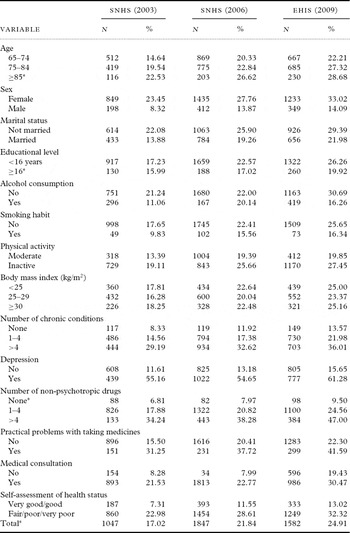
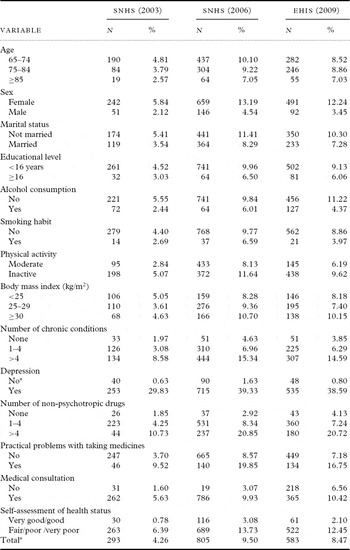
We found a statistically significant increase (p < 0.05) in the prevalence of consumption of both anxiolytics and antidepressants. Data from SNHS 2003 showed that the consumption of prescription anxiolytics reached 17.02% (95% CI, 15.83–18.28%), compared with 21.84% (95% CI, 20.64–23.08%) in SNHS 2006 and 24.91% (95% CI, 23.63–26.24%) in EHIS 2009 (p < 0.05). Data from SNHS 2003 showed that the consumption of antidepressants reached 4.26% (95% CI, 3.66–4.94%), compared with 9.50% (95% CI, 8.70–10.37%) in SNHS 2006 and 8.47% (95% CI, 7.70–9.32%) in EHIS 2009 (p < 0.05).
Data on consumption of anxiolytics according to sociodemographic characteristics, lifestyle, and health-related study variables are given in Table 1. Values increased from 2003 to 2009 in all the age groups. A significant increase in consumption was observed for both genders, and prevalence was significantly higher for women (p < 0.05). Of note, between 2003 and 2009, the percentage of elderly people consuming more than four non-psychotropic drugs increased (p < 0.05), as did that of subjects who reported experiencing difficulty taking their medication (p < 0.05).
Prevalence of consumption of prescription anxiolytics in persons aged ≥65 years in Spain, according to sociodemographic variables, lifestyle, and health profile (Spanish National Health Survey (SNHS) 2003–2006 and European Health Interview Survey (EHIS) 2009 for Spain)

*No statistically significant differences were observed during the period 2003–2009.
Table 2 shows data for consumption of prescription antidepressants. Prevalence was higher in women (p < 0.05). When the subject took several drugs, experienced difficulty taking medication, and had a negative opinion of his/her health, values for the consumption of antidepressants were significantly higher (p < 0.05).
Prevalence of consumption of prescription antidepressants in persons aged ≥65 years in Spain, according to sociodemographic variables, lifestyle, and health profile (Spanish National Health Survey (SNHS) 2003–2006 and European Health Interview Survey (EHIS) 2009 for Spain)

*No statistically significant differences were observed during the period 2003–2009.
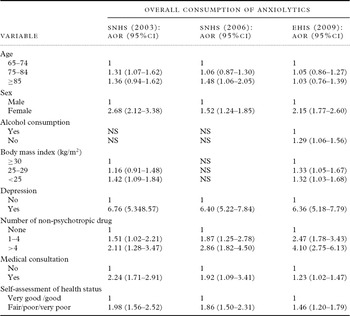
The results of the multivariate analysis are given in Tables 3 and 4. The variables associated independently and significantly with a greater likelihood of taking anxiolytics were as follows: female gender (2009 values for AOR, 2.15; 95% CI, 1.77–2.60), reporting having depression, taking more than four non-psychotropic drugs (AOR, 4.10; 95% CI, 2.75–6.13), medical consultation, and negative perception of health (Table 3).
Factors associated with consumption of anxiolytics in elderly persons ≥65 years in Spain (Spanish National Health Surveys (SNHS) 2003–2006 and European Health Interview Survey (EHIS) 2009 for Spain; data are expressed as adjusted odds ratio (AOR) and 95% confidence intervals (95% CI))

Note: NS = non-significant association.
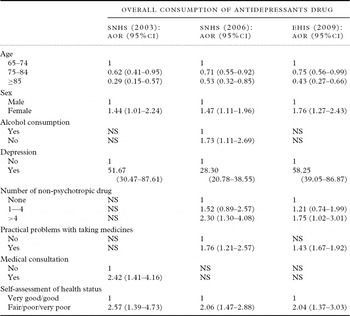
Factors associated with consumption of antidepressants in elderly persons aged ≥65 years in Spain (Spanish National Health Surveys (SNHS) 2003–2006 and European Health Interview Survey (EHIS) 2009 for Spain; data are expressed as adjusted odds ratio (AOR) and 95% confidence intervals (95% CI))

Note: NS = non-significant association.
With respect to antidepressants (Table 4), we observed throughout the study period that individuals aged ≥85 years were less likely to consume antidepressants (SNHS 2003 AOR, 0.29 [95% CI, 0.15–0.57]; SNHS 2006 AOR, 0.53 [95% CI, 0.32–0.85]; and EHIS 2009 AOR, 0.43 [95% CI, 0.27–0.66]). It is noteworthy that AOR values were high among women in all the three surveys. The variables that predicted consumption of antidepressants in both 2006 and 2009 were negative perception of health, taking more than four non-psychotropic drugs, and suffering from depression (the variable with the strongest association with consumption of prescription antidepressants by elderly subjects [EHIS 2009 AOR, 58.25; 95% CI, 39.05–86.87]).
After adjusting for differences in socioeconomic data and health status, consumption of prescription anxiolytics between 2003 and 2009 increased 8% between 2003 and 2006 and 16% between 2003 and 2009 (AOR, 1.08 [95% CI, 1.06–1.10] for 2006 with 2003 as the reference). The consumption of antidepressants during the study period increased by 11% between 2003 and 2006 and by 22% between 2003 and 2009 (AOR, 1.11; 95% CI, 1.08–1.14).
Discussion
We found a marked increase in the consumption of prescription anxiolytics and antidepressants among elderly persons in Spain during the study period; these findings are consistent with those of other studies analyzing consumption of these drugs over time (Paulose-Ram et al., Reference Paulose-Ram, Safran, Jonas, Gu and Orwig2007; Lai et al., Reference Lai, Hwang, Chen, Chen, Lin and Chen2009; Zhang et al., Reference Zhang2010). EHIS 2009 showed that the prevalence of the consumption of prescription anxiolytics in persons aged ≥65 years increased during the study period, reaching 24.91%. This prevalence is considerably higher than the 15.29% prevalence found in persons aged more than 65 years in the European Study of the Epidemiology of Mental Disorders (ESEMeD), whose objective was to examine factors associated with the use of antidepressants and benzodiazepines in six European countries (Demyttenaere et al., Reference Demyttenaere2008).
Psychotropic drugs are frequently used in the population and account for a big share of the Spanish health budget. Codony et al. (Reference Codony2007) recently performed a study aimed to describe the patterns of use of psychotropic drugs in the Spanish general population and its relationship with mental health, and concluded that the use of psychotropic drugs in the Spanish general population is high, although many individuals with mental disorders remain untreated. The Spanish elderly showed an association with psychotropic drug use independent of mental health. The prevalence of depression in Spain in 2006 was 3.9% (Haro et al., Reference Haro2006), increasing to 4% in 2010 (Gabilondo et al., Reference Gabilondo2010). According to data from the Spanish National Health System, 19 million packs of antidepressant drugs were sold in the year 2005 (Ministerio de Sanidad, Servicios Sociales e Igualdad, 2006), while in 2010 sales increased to 29 million packs (Ministerio de Sanidad, Servicios Sociales e Igualdad, 2011).
The prevalence of the consumption of prescription antidepressants also increased, from 4.26% in 2003 to 8.47% in 2009, findings that agree with those of other authors such as Soudry et al. (Reference Soudry, Dufouil, Ritchie, Dartigues, Tzourio and Alpérovitch2008) who analyzed changes in antidepressant use in an elderly population and found that the prevalence increased from 7.0% at baseline to 8.6% after two years. It is important to mention that we did not find an increasing trend in consumption of antidepressants with age after adjustment for sociodemographic factors and health status. These findings differ from those of the interview-based study in Finland by Desplenter et al. (Reference Desplenter, Caenen, Meelberghs, Hartikainen, Sulkava and Bell2011) whose objective was to compare and contrast the use of psychotropic drugs among community-dwelling people aged ≥75 years in 1998 and 2004. The authors found an increase in the consumption of antidepressants (AOR, 1.59; 95% CI, 1.06–2.40). The gender bias in prescription and consumption of specific drug families such as psychotropic drugs is well documented (Ruiz-Cantero and Verdú-Delgado, Reference Ruiz-Cantero and Verdú-Delgado2004; Mastroianni et al., Reference Mastroianni, Vaz, Noto and Galduróz2008). Consistent with the findings of other studies, the use of anxiolytics and antidepressants was more prevalent among women (Mojtabai and Olfson, Reference Mojtabai and Olfson2010; Carrasco-Garrido et al., Reference Carrasco-Garrido, Jiménez-García, Astasio-Arbiza, Ortega-Molina and de Miguel2007). An interview-based study of subjects aged >65 years in Canada attempted to identify factors associated with dependence on benzodiazepines and found that women were three times more likely to be dependent than men (Voyer et al., Reference Voyer, Preville, Roussel, Berbiche and Beland2009). The study by Lesén et al. (Reference Lesén, Andersson, Petzold and Carlsten2010) based on data from the Swedish National Board of Health and Welfare in persons ≥75 years revealed that Norwegian women were more likely to take three or more psychotropic drugs than men (AOR, 1.14; 95% CI, 1.12–1.16).
An analysis of lifestyle did not reveal an association between consumption of alcohol and the probability of consuming prescription anxiolytics and antidepressants. Various studies have linked major depressive episodes to obesity. The association may be partially mediated by use of antidepressants (Ohayon, Reference Ohayon2007). We found no such association in our study population for anxiolytics or antidepressants, a result that is consistent with those of the longitudinal study by Patten et al. (Reference Patten, Williams, Lavorato, Khaled and Bulloch2011) using data from the Canadian National Population Health Survey, in which persons aged >65 years taking antidepressants did not gain weight.
As with other authors (Demyttenaere et al., Reference Demyttenaere2008; Soudry et al., Reference Soudry, Dufouil, Ritchie, Dartigues, Tzourio and Alpérovitch2008; Hämäläinen et al., Reference Hämäläinen, Isometsä, Sihvo, Kiviruusu, Pirkola and Lönnqvist2009; Blumstein et al., Reference Blumstein, Benyamini, Chetrit, Mizrahi and Lerner-Geva2012), and somewhat logically, our results showed a clear association between consumption of prescription anxiolytics and antidepressants and depression, a variable that presented the strongest association in our elderly population throughout the study period. Other associated variables included visits to the doctor and perception of health. For elderly patients, having good health is necessary for their well-being, and they identify this with their ability to manage and not be dependent. Our results agree with those of several authors in that they reveal negative perception of health to be a predictor of the consumption of psychotropic medication, as shown in the results of the study by Rikala et al. (Reference Rikala, Korhonen, Sulkava and Hartikainen2011) in Finland, where the consumption of psychotropic drugs was almost double among elderly people who had a poorer perception of their health (AOR, 1.90; 95% CI, 1.01–3.68).
Older people consume an increasing amount of drugs. Polypharmacy is associated with an elevated risk of adverse health outcomes. The mean consumption of drugs in individuals aged over 65 years is four to eight drugs per person (Blasco et al., Reference Blasco, López de Letona, Villares and Jiménez2005; Crentsil et al., Reference Crentsil, Ricks, Xue and Fried2010; Payne and Avery, Reference Payne and Avery2011). During our study period, elderly individuals taking anxiolytics were up to four times more likely to take more than four concomitant non-psychotropic drugs (EHIS 2009 AOR, 4.10; 95% CI, 2.75–6.13). Similar behavior was also observed in elderly people who take antidepressants, although the AOR values are lower and consistent with those recorded in a recent longitudinal study in France with persons aged ≥65 years. The authors found a significant association between consumption of antidepressants and ≥4 concomitant non-psychotropic drugs (Soudry et al., Reference Soudry, Dufouil, Ritchie, Dartigues, Tzourio and Alpérovitch2008). In this context, we must remember that older people may have greater difficulty managing their medicines and complying with dosage regimens for various reasons. We found that elderly persons taking antidepressants in Spain reported having practical problems with taking medicines (SNHS 2006 AOR, 1.76 [95% CI, 1.21–2.57]; and EHIS 2009 AOR, 1.43 [95% CI 1.67–1.92]). Studies involving elderly persons aged ≥65 years reflect this circumstance, as was the case with Tordoff et al. (Reference Tordoff, Simonsen, Thomson and Norris2010) whose objective was to explore how New Zealanders aged ≥65 years manage their medicines in their own homes. Similarly, Kairuz et al. (Reference Kairuz2008) identified intentional and non-intentional adherence issues that could hinder optimal use of medicines by elderly people at greater risk of medicine-related adverse effects.
Chronic and inappropriate use of such substances constitutes a major public health problem (Demyttenaere et al., Reference Demyttenaere2008). Canadian researchers have recently stated that psychoactive drugs are taken by 35% of the elderly population for approximately 206 days per year (Fortin et al., Reference Fortin2005). It should be pointed out that medical drugs such as benzodiazepines, which are widely used (Fourrier et al., Reference Fourrier, Letenneur, Dartigues, Moore and Begaud2001), pose the risk of dependence that is necessarily entailed in uninterrupted consumption, as well as additional risk factors, such as their influence on cognitive deterioration in elderly patients (Pélissolo et al., Reference Pélissolo, Maniere, Boutges, Allouche, Richard-Berthe and Corruble2007).
In our opinion some possible reasons, among others, for the increase in the use of medication for depression and anxiety in Spain could include the following: better access to healthcare services, improved management of these diseases at primary care centers, more advertising, more drug company support for such medications, a real increase of the incidence of these disorders, or less resources for non-pharmacological treatments among others. Further studies are needed in Spain to clarify these possible reasons.
The main strength of this study is the use of a national representative sample to assess the prevalence of consumption of prescription anxiolytics and antidepressants in elderly persons in Spain during the period 2003–2009. The methodology followed by the three surveys is similar, as is the way respondents were questioned. Consequently, in our study, we were able to analyze and control for the same factors.
However, our study is subject to a series of limitations. First, causality cannot be inferred, because this is a cross-sectional survey. Second, the conclusions drawn are difficult to generalize, since neither the SNHS nor the EHIS has been validated for drug use. One important limitation of both surveys is that they are based on self-reported data, with the result that the consumption of medication may be underestimated; in addition, some replies may be socially conditioned, owing to the sociocultural characteristics that surround drug use. However, a Norwegian study aiming to examine the level of adherence to prescribed medication in outpatients with severe mental disorders and evaluating the validity of a simple self-report rating of adherence, suggest that a simple self-report questionnaire is a reasonably valid method for measuring adherence. When patients admitted not taking their medications, this was usually correct, and when patients claimed taking their medication in the past week, the majority had serum concentrations that confirmed this (Jónsdóttir et al., Reference Jónsdóttir2010).
Another possible limitation of the surveys is that rather than identifying specific active ingredients, they identify groups of medications for certain diseases or disorders.
Lastly, as the initial SNHS and EHIS response rates were 65% and 64%, a possible non-response bias should be taken into consideration (INE, 2005; 2008; 2011).
According to the EHIS, the health survey was completed by most of the selected persons, except that some were absent due to admission to a hospital or found not qualified to answer the interview by old age, disability, disease, ignorance of the language, cognitive impairment, or other circumstances.
Subjects with cognitive impairment could be identified by information provided by someone living in the household or by the interviewers who were trained to identify this situation.
In such cases, the questionnaire could be completed by other adult household member sufficiently informed and qualified for it (proxy informant). Only in 0.64% of subjects included in the final sample information was completed by the proxy informant.
We observed a significant increase in the consumption of prescription anxiolytics (AOR, 1.08 [95% CI, 1.06–1.10]) and antidepressants (AOR, 1.11 [95% CI, 1.08–1.14]) in individuals aged ≥65 years in Spain between the years 2003 and 2009. This increase is consistent with the findings of other authors who have analyzed the consumption of these medications (Paulose-Ram et al., Reference Paulose-Ram, Safran, Jonas, Gu and Orwig2007; Demyttenaere et al., Reference Demyttenaere2008).
The variables associated with consumption of prescription medication were female gender, depression, polypharmacy (more than four non-psychotropic drugs), and a negative perception of one's health. The Spanish elderly individuals taking antidepressants reported having problems to manage these medicines in their own homes.
Conflict of interest
None.
Description of authors’ roles
P. Carrasco-Garrido researched the data, contributed to the discussion, and wrote and reviewed/edited the paper; A. López de Andrés contributed to the discussion and reviewed/edited the paper; V. Hernandez-Barrera researched the data and reviewed/edited the paper; I. Jiménez-Trujillo contributed to the discussion and reviewed/edited the paper; and R. Jiménez-García researched the data, contributed to the discussion, and wrote and reviewed/edited the paper. All authors reviewed and gave their final approval of the version to be submitted.
Acknowledgments
This study forms part of a research project funded by the Spanish Health Research Fund (Fondo de Investigaciones Sanitarias) of the Carlos III Institute of Public Health, grant PI10/00514.