The townships on the low-lying, sandy Cape Flats, as much as forty-five kilometres from the city of Cape Town in South Africa, comprise acres of sub-economic housing interspersed with wood, zinc and plastic shacks that are plagued by heat and wind in summer and by sporadic floods in winter.Footnote 2 However, despite the absence of infrastructural amenities and financial backing, theatre in the townships continues to thrive, impelled by its determined practitioners. In the townships, theatre draws from and is part of a sophisticated performance-based, cultural repertoire that is a fundamental social lubricant and communicative tool of township life.Footnote 3 Life in the townships is crowded and communal, steeped in orality. Life is spoken of, sung, danced and declaimed, in a shared performativity which is the modus vivendi of township living, at family gatherings, coming-of-age ceremonies, church services and events such as weddings, funerals and political rallies. Working collectively and without scripts, groups make plays that are richly patterned in movement, speech and song, by means of repetitive layering or symmetrical arrangements of physical images, spoken word, song and dance, within the dramaturgy. These plays tell stories deploying any and all elements that the theatre-makers bring into the process: fragments and themes from everyday life, embodied in images, snatches of story, random props, poetry, bits of costuming and even feelings that are melded together, bricolage fashion, to create works that are more than the sum of their parts. Thus theatre is a much-practised art and an effective, accessible means by which young people in particular share social and political concerns and probe the perceptions of their audiences. ‘Audiencing’ is likewise an active social pursuit that is not solitary or silent but engaged and vocal.Footnote 4 Township youth deploy theatre to speak out where traditionally they should be silent and listen to and learn from their elders. Assisted and influenced by premier theatre artists from the city who offer workshops, theatre is artistically, politically and educationally purposive for township theatre-makers even when it is not financially profitable. The plays challenge the systemic inequality and endemic poverty of township life, decrying crime, corruption and the abuse of women.
Meanwhile, in the urban centre and affluent suburbs of Cape Town, huddled on the slopes of its lovely Table Mountain, theatre follows Western European traditions, albeit infused with South African and African performance aesthetics that were initially collectively generated in response to South Africa's apartheid rule (1948–91). In the new millennium, urban theatres stage local as well as new European or American plays and revivals of the classics, which are performed mostly in English to largely white audiences, who make up less than one-fifth of the population of Cape Town.
When I first began researching the theatre originating in Cape Town's black townships, its practitioners were struggling to gain performance opportunities and recognition in the city, and continued to be ascribed outsider status.Footnote 5 During the past decade, however, there has been a marked change in how theatre from the black townships on the margins is treated in the city. New initiatives amongst urban artists and in urban theatres have not only included township artists and theatre in the city centre but also provoked significant change in the hierarchies of value in cultural production in Cape Town. In this article, I examine the nature and significance of these changes and how they have been achieved. In order to do so, I first establish the historical and material context for the current situation, and then focus on the Baxter Theatre as an exemplary instance of a city theatre diminishing the distance between township and town.
Financial support and the political will for theatre
Following South Africa's first democratic elections in 1994, and recognizing the need for redress and equal opportunity for all artists, an Arts and Culture White Paper of 1996 advocated festivals as a means of supporting hitherto marginalized artists.Footnote 6 Festivals could overcome the shortage of playhouses in the townships, promote community and bourgeois cultural interactions, and generate a sense of celebration which could attract audiences.Footnote 7 Within a decade, a number of such festivals had sprung up. But by 2009 my own research into festivals serving township artists led me to conclude that imposing theatre from the townships on an unprepared and unreceptive city audience was producing far from satisfactory results. Because the townships are separated from the city and the plays almost entirely invisible as dramatic literature, theatre attendees in Cape Town are hardly aware that theatre exists in the townships and consequently are not poised to attend performances when festivals do occur. Publicity was often poorly managed, and marketing almost non-existent. Township theatre routinely deals with serious social problems such as crime and violence – unattractive issues for those not directly affected. Township theatre is ‘poor theatre’: it makes minimal use of scenery, costuming or properties, and can therefore be perceived as ‘amateurish’ and ‘community-oriented’, possessing little aesthetic value in the eyes of urban audiences, particularly when it does not have the backing of urban artists or theatre producers. It may also be unintelligible to those who do not speak Xhosa, the most common language used in the plays apart from English. Additionally, it is very far away and hence costly for township audiences to attend a festival in the city.
These specific challenges are further exacerbated by more general problems, most notably the fact that cultural production suffers from precarity throughout the African continent, including in South Africa. Possessing little prestige, it is vulnerable to political, economic and social change. Frequently unstable and highly contested state powers adversely affect the stability of the civil service, parastatal and civil society institutions, making long-term development and organization in the arts all the more difficult. In South Africa today, the needs of independent theatre are entirely overshadowed by state support for the ailing and poorly managed public broadcaster and volatility in the funding landscape with regard to the National Arts Council and the National Lotteries Commission. As for theatre in the townships, usually the most it can hope for is a modicum of state support as part of poverty alleviation, ‘youth development’ and programmes to combat unemployment.
Despite this invidious funding environment, a decade ago a series of concurrent and mutually reinforcing initiatives in Cape Town began to change the theatre scene and the lot of township theatre-makers. Leading players in theatre began to use their professional reputations and leadership positions in the organizations where they were active to foster the artistry and vision of township theatre-makers. Magnet Theatre's Full Time Training and Job Creation programme began in 2007 and is led by Mark Fleishman and Jennie Reznek.Footnote 8 The Theatre Arts Admin Collective (TAAC) was started by Caroline Calburn, Paula Kingwill and Lara Foot in 2008, though a paucity of funds necessitated that Calburn continue to develop it single-handedly from 2009.Footnote 9 Infecting the City, Cape Town's annual public arts festival, began in 2008 and was initially co-curated by Brett Bailey and Jay Pather, who recruited artists and performers from all quarters of the city. Pather is also head of the Gordon Institute for the Performing and Creative Arts (GIPCA), which has included township theatre-makers in symposiums and colloquia since 2012.Footnote 10 Driven locally by International Vice-President Yvette Hardie, the International Association of Theatre for Children and Young People (ASSITEJ) generates many performance opportunities for township groups.Footnote 11 And at the Baxter Theatre Centre, which is owned by the University of Cape Town, Thami Mbongo, Bongile Mantsai and Zoleka Helesi launched the Zabalaza Festival in 2011.Footnote 12
How is one to evaluate the significance of these initiatives? One immediate consideration is that in Cape Town, profound change is being precipitated by independent theatre artists and leaders who, in contrast to the state-initiated institutions, are leading the way by taking many small, incremental steps. An abstracted structural analysis is thus unsuitable but there is insufficient space to enumerate all worthwhile initiatives in detail. I have thus opted to examine a single instance, the Zabalaza Festival, as a case study of an event in which township theatre takes the stage in a fully equipped, urban play and production house. I begin by locating the festival's host institution, the Baxter Centre Theatre, both historically within the Cape Town performing arts scene, and in relation to its role as host of Zabalaza.
Cape Town is South Africa's oldest city, spatially and socially imbued with an imperial–colonial and apartheid past. In 1960, at the height of the apartheid era and just a year before the Nationalist government took South Africa out of the British Commonwealth, a prominent Capetonian, William Duncan Baxter, made a bequest to the University of Cape Town (UCT) for the building of a theatre for all the people of Cape Town.Footnote 13 After sixteen years of haggling over a suitable location that would be able to admit patrons from all of Cape Town – a stipulation by Baxter that ran quite contrary to an apartheid policy which, at the time, dictated that all social, cultural and educational amenities be separate for each ‘race’ – the decision was taken to build the Baxter Theatre Centre on ground belonging to the University of Cape Town. UCT's property is, by title deed, open to people of every racial designation. In 1977 the centre opened in the leafy suburb of Rondebosch, twelve kilometres from the city centre, though integrally part of it, and almost as far from the townships as the centre itself. The centre comprises a 660-seat proscenium arch theatre, a 500-seat concert hall, and a 170-seat studio theatre.
Under the guidance of its board and its director, John Slemon, who came to the Baxter directly from the Abbey Theatre in Dublin, the Baxter aligned itself from the start with the UCT's anti-apartheid mission. But if the Baxter was to contribute to the freedom struggle in the apartheid years and stage works criticizing apartheid, it could only do so if it retained its credibility (and financial stability) as artistically distinctive and world-class. Interviews and essays documenting the Baxter's first two decades of operation repeatedly reveal the endeavour to address both of these needs. However, apartheid rule made effective or far-reaching support of marginalized communities and artists nearly impossible. Looking back, it is reasonable to perceive the Baxter's support of black communities and artists to have been tokenistic, although at the time it was not so perceived by white patrons and artists, as evidenced in these publications. But in 1987, when apartheid still prevailed, Sylvia Vollenhoven, the only black writer (together with thirteen white writers) to contribute to the Baxter's tenth-anniversary publication Theatre Alive!, wrote,
The Baxter occasionally attracts a spurt of black theatre-goers . . . and has staged some excellent works that show white South Africans how their neighbours live behind the apartheid fences. But too often these productions have to be imported from the North [Johannesburg and Pretoria]. For the rest the Baxter is perceived mainly as a venue for the white English-speaking middle classes.Footnote 14
When legislated apartheid finally ended in 1994, white domination ended politically and the need for change in theatre was understood by everyone involved.
Exactly what form this would take, however, was unclear. Cultural-policy expert Carol Steinberg and leading theatre director Malcolm Purkey wrote, ‘Clearly with the demise of apartheid, South African theater's role in society has disintegrated. Now the old audiences see no place for it at all, even as it hesitantly forges new roles for itself. Theater is being killed by its own glorious past’.Footnote 15 In 1998, the late actor, designer and playwright Peter Krummeck wrote in the Baxter's twenty-first-birthday celebratory publication,
Today the Baxter finds itself in the position of many theatres. It's becoming a dinosaur. What is interesting in that analogy, is that research has indicated that dinosaurs did not really become extinct, but rather they evolved into birds. The theatre has to learn to do the same, and learn to fly. Between the conflicting demands of Euro-centric and struggle theatre we have a lost a generation of theatre-goers.Footnote 16
In spite of South Africa's turn to democracy, Krummeck perceived the political struggle as oppositional to the Eurocentric aesthetic values dominant at the Baxter, and he suggested that this could place the Baxter in peril of losing its artistic status and credibility. Staging and producing only ‘great’ (meaning Western) works of theatre, even if this were financially possible, could lead to a loss of what French sociologist Pierre Bourdieu terms ‘symbolic capital’, as the institution would be perceived as having ‘sold out’ to neo-liberal capitalism, and to those from the city with the wherewithal to support theatre.Footnote 17 On the other hand, staging works of theatre simply because they came from deserving communities would result in a loss of respect from those conferring artistic distinction, even when the latter were no longer deemed to be leading the way, as Krummeck's image of ‘dinosaurs’ suggests. As such, the centre risked losing both social capital and financial support. The tension between these contradictory demands of artistic distinction and social activism is not easily released. Nazli George, one of three black contributors to Baxter 21, alongside eighteen white contributors, commented,
I've enjoyed the relationship with the Baxter – it's given me lots of opportunities, but I feel we can still do more – if I hadn't come to them personally and shown initiative my shows would never have seen the light of day. There's lots of talent out there, but people who live in disadvantaged communities don't always have the confidence to come forward . . . I believe a theatre outreach programme needs to be developed which will bring the mainstream theatre experience into other communities.Footnote 18
In 1998 the Ikhwezi Festival of Community Theatre was launched at the Baxter by Itumeleng Wa-Lehulere, a theatre activist from the townships. Although the Baxter provided the physical infrastructure for the Ikhwezi Festival, undertook all the fundraising and provided what little publicity there was, Wa-Lehulere retained ownership and leadership of this biannual event until its closure in 2010. At the time township attendees enthusiastically endorsed the festival:
INTERVIEWER: What does Ikhwezi mean to you?
RESPONDENT: It means a lot to me, because that is where we get our platform. ‘We’ being young black actors coming from disadvantaged areas where we get no support from the community or from our families. They have the mentality that ‘Actors will die poor’ entrenched in their minds. The festival helps in changing these views because performing at the Baxter is advantageous since it is a well-known theatre.Footnote 19
However, between 2005 and 2009, when I viewed and recorded township performances, researched the festivals in which the works featured, interviewed township theatre-makers and, with the help of research assistants who spoke Xhosa, conducted and translated group audience interviews at festivals, such as the extract above, it became apparent that while theatre from the townships was greatly valued by township practitioners, at that time festivals held in the city to include marginal theatrical efforts, including Ikhwezi, mostly inadvertently preserved the divide between town and township theatre.Footnote 20 This was for the reasons I have signalled above: most festivals were ‘hit-and-run’ affairs, with little mentoring of township theatre leadership; minimal administrative, publicity and production support; and, unsurprisingly, poor audience attendance.
2010, however, saw the appointment of Lara Foot as CEO of the Baxter, and this, I argue, marked a change in the centre's conception of artistic and cultural distinction and consequently of strategy. In addition to having been artistic director in 2009 and resident director and dramaturg in 2007 at the Baxter, Foot had been also been resident director at the Market Theatre in Johannesburg, where she founded the Barney Simon Young Directors and Writers Festival in honour of her late mentor of many years. Immediately before joining the Baxter, she spent a year in London as the Rolex International Theatre Award mentee under Sir Peter Hall. Foot is one of South Africa's leading theatre managers as well as a multi-award-winning playwright and director.Footnote 21 When Foot took over as CEO in 2010, she faced dire financial constraints but did not waver in her vision for the Baxter Theatre ‘to remain an urgent agent of social change’.Footnote 22 In 2011 the Baxter took up responsibility for driving a development initiative and launched the Zabalaza Festival. Synergies between provincial policies for out-of-school youth and the vision of the Zabalaza festival have kept the Western Cape Department of Cultural Affairs and Sport in support of this initiative. The department is the Baxter's largest single donor toward a total annual income (in 2014) of just over 26 million rand (US$1.9 million), 77 per cent of which the Baxter earned.Footnote 23 Whereas, for the sake of comparison, the Artscape Theatre Centre in Cape Town, an agency of the Department of Arts and Culture nationally, earned only 21 per cent of its annual revenue for 2014, which was R104 million (US$7.65 million), with 78 per cent of this (R81 million, or US$6 million) coming from state subsidy.Footnote 24 Latterly, a series of international tours have accrued much-needed revenue to the Baxter, particularly given the falling value of the rand since 2011.Footnote 25 When all other sources are used up, UCT underwrites any deficit.Footnote 26 Without this assistance, I doubt the Baxter could survive. At least the department's 1 million rand annually provides some funding constancy for Zabalaza.
The Zabalaza Festival: a case study in changing cultural values
The Zabalaza Festival is the brainchild of Foot, together with Thami Mbongo, Bongile Mantsai and Zoleka Helesi, all of whom worked for three years on the Ikhwezi Festival at the Baxter and were in the cast that created the original production of Foot's play Karoo Moose under her direction in 2007, which has since garnered fifteen theatre awards and is repeatedly revived. All three were also in Foot's reworking of Daniel Kramer's adaptation of Büchner's Woyzeck (2010), which received Fleur du Cap awards for best director (Foot) and best supporting actor (Mantsai) and was nominated for best actor (Mbongo). The triumvirate report to and consult with Foot but they carry responsibility for running Zabalaza. The artistic director, Thami Mbongo, ran his first theatre group in the country township of Mbekweni in the 1990s, then he studied at the Community Arts Project NGO and in 2001 he graduated with a performer's diploma from UCT. Mbongo has taught at NGOs, regularly presents in theatre festivals for township work, and performs in mainstream theatre and on television. In 2008 he won the Brett Goldin bursary to spend a year with the Royal Shakespeare Company in the UK.Footnote 27 When he was staging Ubizo: Voices of E'lokshini at the Ikhwezi Festival in 2007 he claimed his affiliation with township theatre: ‘I'm the child of this festival. This festival groomed me because I have been involved since 1998 when it started, up until now, so every year I come’.Footnote 28 Nevertheless he was aware that theatre managements, agents, the media and urban audiences were mostly conspicuous by their absence from the Ikhwezi Festival. He shared his skepticism with me:
The term ‘community theatre’ has been misused and become equivalent to ‘cheap theatre’ for ‘disadvantaged communities’. But there are communities in Observatory [an inner-city suburb] and Constantia [one of the richest suburbs in Cape Town] as well as in Khayelitsha [Cape Town's largest black township]. Nowadays community theatre has become a cheap label, solely associated with black community theatre.Footnote 29
In 2009 he wrote,
We need to change this cheap perspective of people – be it theatre practitioners, companies and institutions who say they are doing community theatre in the name of helping out or developing the community. Community theatre mustn't be made a charity case. It is a form of theatre that needs to be respected and treated with dignity.Footnote 30
Today, Mbongo remains determined to shift perceptions of artistic distinction among the theatre-going public and his professional peers, and the Zabalaza Festival affords him, Mantsai and Helesi a multitude of opportunities to make a difference. In a news briefing in 2011 Helesi explained, ‘We want to personalise the process and build sound relationships with these communities by interacting and engaging with them. That way we can make sure that the festival office and the festival itself become a home for the artists’.Footnote 31 Two cognate practices are characteristic of the triumvirate and their fieldworkers’ attitudes. First, they encourage the exchange of viewpoints, ideas, perceptions and cultural beliefs at every opportunity, among and between artists, theatre-makers and audiences. Second, they utilize every possible chance for young artists to learn through doing: practising, rehearsing, revising and performing their theatre works. Rather than simply staging a pop-up festival for a week at the Baxter, the triumvirate have developed a continuous sequence of teaching and learning occasions and events for Zabalaza's annual cycle.
To kick-start engagement, frequent postings on the Baxter website and social media invite township youth – indeed, anybody who is interested – to participate in the Zabalaza Festival process.Footnote 32 The postings announce the requirements of formal application and emphasize the sustained engagement offered to participants in the festival as well as the possibility of earning at the festival proper, when every performing group receives their box-office takings. Once a theatre group has made an application, their work is auditioned in its ‘home location’ by a Zabalaza team member who offers on-the-spot feedback. Next steps might include participating in skilling workshops on playwriting, acting or directing, led by a Zabalaza fieldworker in a nearby venue, and then presenting in a Zabalaza mini-festival for groups who are selected. Between six and nine day-long mini-festivals are held over weekends between September and January throughout the Western Cape – their number and location depending upon funds and where the most groups are situated. Mbongo explains,
Outreach into the communities is a key component of our ethos at Zabalaza . . . All year round our team travels to various areas in this province and elsewhere in the country. We are committed to working closely with the artists and the communities, whether through the mini-festivals or simply through our many visits and viewing of theatrical creations by some overwhelmingly talented people.Footnote 33
Mbongo invites theatre artists, teachers and aspirants to attend each festival as ‘observers’ who provide feedback and fresh perspectives to the fieldworkers who will mentor those plays that are chosen by the triumvirate to perform in the Zabalaza Festival at the Baxter. In 2015, I was invited to be an observer at two mini-festivals. Mbongo explained to me that they suspected that written feedback from the observers would be more helpful than verbal commentary and that is why he hoped I would participate.Footnote 34 In order to explicate how the mini-festivals serve the process, I draw on my notes from the mini-festival that took place on Sunday 25 January 2015 at the Zolani Centre, Nyanga East township.Footnote 35 I arrived at 10.30 am to find Mantsai, Helesi and Baxter technicians all busy setting up the sound system and coordinating the order of performances. They were modelling that theatre is not only about performing but also about heightening the experience of the theatrical event for the audience of approximately three hundred that grew throughout the day. I was given a typed programme, which was indispensable to the observers – Alex McCarthy, Baxter intern for 2016; Ongezwa Mbele, who worked for ASSITEJ; and myself – who had to report on thirteen plays. At 11 am Mandisi Sindo, a Zabalaza fieldworker and the day's host, heartily welcomed us, Mantsai blessed the proceedings, and then Sindo introduced the first group. By these means the occasion was solemnified and the audience invited to honour the participating groups with their undivided attention.
From first to last the plays reverberated with township culture and experience. The first was a play called Witchcraft, with a cast of more than a dozen children, which concerns a young girl, raised by her grandmother, who is believed to be a witch in the community. The group work was good, there was plenty of action and it was over in ten minutes. The last play, called The Journey, had twenty-eight cast members and was thirty-five minutes long. Deploying coloured T-shirts to distinguish groupings, the play considered the impact of the apartheid era freedom struggle on children. Marital break-ups, missing parents and deaths were depicted in a series of physical images supported by snippets of dialogue and choral hymns, as the play questioned how the youth might reconcile themselves with such traumatic events. The focused engagement of the very large cast was striking, particularly given that the audience (and probably this cast) had already watched theatre for over eight hours.
With a five- to ten-minute break between performances that pulsated with tannoyed music, and only half an hour for lunch, the theatre continued until eight o'clock that night. Nevertheless, each group was properly introduced and cheered off the stage by the audience.
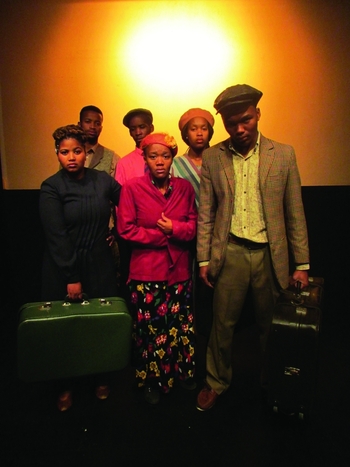
There were many works that stood out for different reasons. Crying was a three-hander about a teenage girl struggling to breastfeed the baby she had given birth to after being raped, a crime that her own mother had refused to report to the police. Her grandfather very gently helps her come to terms with her trauma and with motherhood. Egoli (Fig. 1) tells the story of a woman who loses contact with her husband and goes looking for him in the city. The cast of nine deployed freshly composed and well-known songs from South African musicals, dance and mime, to tell a 1950s tale of the ‘country-bumpkin-goes-to-the-city’ genre in vivid vignettes. The work was nostalgic, beautifully performed and highly entertaining.
The cast of Egoli. Photograph by Leon van Zyl, courtesy of the Baxter Theatre Centre.

Ndendile (I Am Married) tells the story of Bongani, a man from the Eastern Cape, who is married to a woman and falls in love with a young man in Cape Town, whom he also wants to marry. Polygamy is permitted and not centrally at issue; the play's interest lies in Bongani's desire to marry a male partner in a way that follows Xhosa tradition. In order to marry his new partner in the traditional way, Bongani needs his father's blessing. Bongani, his aspirant ‘wife’ and his father, as well as a chorus of three male ooNonzaba (ancestors) in tableau, comprise the actors. In ironic gender reversals, Bongani's first wife, who has left the rural homestead in despair, is performed in woman's clothes by each of the chorus of ancestors in different memory scenes. And Bongani's father insists that tradition requires Bongani's new ‘bride’ brew beer for him clad in the traditional headcloth and skirt of the makoti (daughter-in-law), much against the young man's wishes. The play is impelled forward by the unison singing; poetic, compassionate commentary; and the vivid gestural language of the ooNonzaba.Footnote 36
At 7.15 pm the performances were over and the observers made a brief comment to the excited audience. Then Sindo thanked all the participants and praised their efforts. Sindo said that the work was so fine that it deserved to be performed at the Baxter Theatre, which raised a big cheer. But when Mbongo's turn came to speak, although he thanked his ‘brother Mandisi’ for his praise, he himself felt the work was so fine that the people right here in Nyanga East deserved to see it – at which the audience roared approval more loudly still. Both of these commendations enhanced the artistic status of participants and perhaps encouraged self-respect among audience members. Helesi urged Mbele, McCarthy and myself to write our reports within days so that our input could be taken up by the fieldworkers mentoring the chosen productions.
Mentoring is not limited to the artistic domain. When groups from the township come to the Baxter to perform in the festival, their knowledge of how to work in a fully equipped theatre cannot be assumed and there is considerable chance that there will occur misunderstandings in procedure, lack of respect in working relations, and small conflicts between groups and Baxter staff. Under Foot's leadership and following the example of the Zabalaza triumvirate, the Baxter theatre staff meet regularly to recount their experiences, and debate and critically evaluate their approach towards developing mutually respectful intentions, courtesies and ways of doing things both for themselves and for the festival participants. In this way a confident and happy use of the theatre is facilitated amongst all parties.Footnote 37 The visiting groups are mentored by the Zabalaza team and stage management staff. With practice, their embodied theatrical ‘know-how’ develops into a conscious grasp of the requirements of a fully equipped playhouse and their enthusiasm and respect for the modus operandi of professional theatre become increasingly evident. Zabalaza also encourages participating groups to market their shows and sell tickets. At best this increases the revenue of groups at the same time as they learn about sales and marketing under the guidance of Baxter marketing staff.
These efforts to develop skills and overcome tacit social, cultural and craft-related differences between participants and theatre staff are further enhanced by the structure and framing of the festival to generate public acknowledgement and participation. The marketing and front-of-house staff now make the important assumption that all the Baxter's patrons will be interested in this festival, which has the outcome of raising the visibility, and the social and symbolic capital, of the performers, and thereby inducing urban theatre audiences to perceive the subject matter, character and languages of theatre from the township as an integral part of the range of theatre in the city, rather than some anomalous addition. Photographers and publicity materials in the foyer, ushers to provide a programme and show you to your plush seat in a raked auditorium, and bright lights glowing on the stage – all these elements enhance the social experience of those performing and audiencing. The Zabalaza opening ceremony annually celebrates many of the core strengths of theatre originating in the township, such as song, dance and storytelling captured in physical images by a seamless ensemble. For instance, in 2015 Mbongo melded together excerpts from the plays of fifteen groups, interspersed within, alongside and after one another, bricolage fashion, into a unique performance, which generated uproarious applause from the audience – myself included.
Each year the festival brings together the best works from the many hundreds whom the triumvirate and fieldworkers have auditioned in townships, suburbs and provincial regions. Guest productions are also staged by arrangement with ASSITEJ, Magnet, TAAC and other initiatives elsewhere in the country. This encourages participants towards aesthetic, cultural and social interchange, as they watch each other's work, engage in feedback sessions, and informally discuss during the festival. The festival starts with a Weekend (‘fringe’) Festival of approximately thirty performances by newcomer groups who deserve the opportunity to showcase their plays but are unlikely to draw audiences for more than one performance. The Main Festival, held over five days with nine performances per day, consists of a dozen or more plays (plus guest productions), which are performed three times at different times of the day, with audiences bussed in by Zabalaza. With the help of sponsorship from a local bus company, transport to the festival is affordable for township pupils even though the distances are considerable.
In 2015 I was interested to learn how the groups I had seen at mini-festivals had further developed their work for the festival proper, using input from a fieldworker and our observer reports. I asked Mantsai, whose response assured me that my reports had been useful. In turn he asked me if I could see my suggestions in the resulting productions, and in some cases I could. I mention this to demonstrate the level of attention paid by the Zabalaza team at each stage of the process to augmenting the performers and their plays. The final works lose none of the character of their origins but are, if anything, more incisive and confidently performed after engaging with the mentoring they have received.
Sharpened skills, opportunities for enhanced self-esteem and advocacy by role models are changing how young performers are operating. Scanning cast lists at Zabalaza, I notice that experienced township and university-trained artists are working together, directing one another or acting alongside each other. This was not the case at the Ikhwezi Festival, in which few of my university students or graduates were involved unless they were directing. The Zabalaza team have modelled an egalitarian approach that rejects social or cultural exclusivity. By subtly altering the rules of the game they have levelled the playing field. In effect the Zabalaza Festival at the Baxter has become a bridging space, spanning the cultural and physical distance between township and urban theatre, and affording the theatre community in both sites the chance to open up their conceptions of what theatre is and might be.
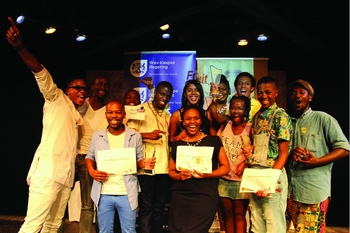
The festival closes with an awards ceremony (Fig. 2) at which the best plays, performers and directors are honoured. The winning play, selected by a judging panel appointed by the triumvirate, is restaged after further rehearsals for a fortnight with all the publicity and status accorded ‘a Baxter production’. Publication of the play, by Junkets Publisher in conjunction with the Baxter, increases its visibility and viability because henceforward it can be produced by others or studied in educational institutions.Footnote 38 Three or four of the best-received productions also go on to be performed at the Cape Town Fringe Festival under a joint agreement with Zabalaza. Performers winning the acting awards are recommended by Zabalaza to local television companies and many of them are subsequently cast.
Zabalaza Festival closing awards ceremony, 2015. Mantsai and Mbongo (left) with the winners. Photograph by Fahiem Stellenboom, courtesy of the Baxter Theatre Centre.

In the account of Zabalaza above I have referred to Foot's indirect influence on the festival through the production, front-of-house and marketing staff at the Baxter. Her direct advocacy, however, is also sufficiently effective to merit discussion. Foot is consistent and conspicuous in her praise of the festival, of its leaders and of participating play-makers in media briefings, public appearances and her own reporting. In 2011, when Zabalaza was launched, she wrote in the Annual Review,
The launch of the Zabalaza Theatre Festival and development programme is testimony to the passion and ingenuity that exists within young artists in Cape Town and its surrounding communities. Zabalaza is led by three brilliant young artists, Thami Mbongo, Bongile Mantsai and Zoleka Helesi. The opening night of this festival brought together over seventy artists on our Studio stage, and it was a night that I will never forget. Talent oozed from the walls of the theatre, and our future took to the stage with a sense of passion and celebration.Footnote 39
The commitment underpinning this kind of endorsement carries over into Foot's own artistic work, as she draws collaboratively upon the cultural knowledge, creativity and talent of township artists, as I have already mentioned with regard to Karoo Moose and Woyzeck. In 2011 Foot revised the text of her play Reach (2009) and restaged it as Solomon and Marion, a ‘story of trying to connect, of trying to narrow the divide between differing histories, generations and racial lines in an attempt to accept, acknowledge and reconcile the traumatic past shared by Marion Banning and Solomon Xaba’.Footnote 40 Directing the play herself, Foot asked Thami Mbongo to be assistant director so that she could learn from his knowledge of Xhosa culture and nuance the interpretation of the youth Solomon.Footnote 41 Rather than ask the experienced, university-trained actor Mbulelo Grootboom to reprise his performance as Solomon, fourteen actors who had participated in Zabalaza were auditioned. Foot chose Khayalethu Anthony from Imbawula Theatre group in Khayelitsha to perform opposite Janet Suzman, the renowned British South African actress. Her bold choice worked. Solomon and Marion has repeatedly and successfully toured nationally and to the UK and the USA.
Supported by the Baxter marketing staff, Foot's status visibly confers esteem and earning power upon those with whom she consults and collaborates, and in turn, I would argue, public acknowledgement of her collaborators increases Foot's symbolic capital. Take Solomon and Marion, for example: in 2012 Khayelethu Anthony performed in another Baxter production, Waiting for the Barbarians, adapted from the novel by J. M. Coetzee, which then toured to Canada. But far from leaving township theatre to build a career in town, Anthony is developing his craft in both sites. As a member of Imbawula Theatre group he has written, directed and performed in plays for Zabalaza in 2011, 2013, 2014 and 2016. In 2013 he was appointed a Zabalaza fieldworker. His play The Champion was the winning play of the festival in 2014, and has consequently been published by the Baxter in collaboration with Junkets Publisher, while Anthony also won the Fleur du Cap theatre award for his performance. This is the Cape's most prestigious award ceremony and the prize carries a considerable purse. Winning a Fleur du Cap award signifies the accrual of huge symbolic capital for outstanding achievement in Cape Town theatre, whether as playwright, director, actor or innovator. The latter award is usually given to a company who have made a distinctive contribution to the character of the local theatre scene. In 2016 Zabalaza won the Fleur du Cap Innovation Award for Theatre. But ever-faithful to Zabalaza's mission, when Mbongo accepted the award he dedicated it to
the artists that feel their works are not recognized.
The artists that feel that they have always been categories in development but they are never given an opportunity to showcase how developed they are.
To every arts organisations and institutions who struggles in getting recognition and funding but they keep going [be]cause they know the real intention. They know there is that four-letter word – HOPE.Footnote 42
It is a mark of how significantly cultural values have changed that Anthony and Zabalaza should have won these awards. And they are not the only ones. In 2017 fieldworker Mandisi Sindo won the Innovation Award for starting the first ‘shack theatre’ in Khayelitsha: The Makukhanye Art Room in 2007. And in 2016 the Fleur du Cap award ceremony at the Baxter was directed by Thando Doni. Both of these artists began their careers more than a decade ago in theatre groups in Khayelitsha and today both work regularly in town and township.
Conclusion
Zabalaza has changed how cultural value is accorded and perceived in Cape Town by planning and staging a series of occasions and spaces in which participants from town and township can exchange views, perceptions and beliefs about what constitutes theatre of quality. It fosters communication in rehearsals, feedback sessions, mentoring processes, post-show dialogues and ongoing conversations between artists and theatre-makers. All of these occasions have the potential to nurture intercultural insight and self-esteem and to generate artistic distinction.
By organizing and facilitating ongoing processes of rehearsal at which skills can be developed, Zabalaza has promoted township performers on the one hand, and township groups and the plays they make on the other, to the extent that theatre from the township is more evident both in its home settings and in the urban centre. Not all the plays in the festival are, in my view, artistically satisfying or even ethical in their thematic unfolding, but these issues do not undermine the new visibility and status of work from the township, nor its significance as a catalytic driver of change. The number of artists who are inalienably formed by township theatre and now work regularly and professionally in urban theatre is considerably larger than a decade ago. The number of works of theatre staged in town in which township aesthetics, stories or languages are centred is notably increased. Seizing opportunities to audition, perform and ‘speak back’, township artists are exerting a particular aesthetic and ideological influence that now irrevocably colours the character of theatre in Cape Town, especially at the home of Zabalaza, the Baxter Theatre Centre. Krummeck's comment of 1987 appears premonitory: ‘dinosaurs did not really become extinct, but rather they evolved into birds. The theatre has to learn to do the same, and learn to fly’.