Introduction
Understanding the contextual meanings of humour in older adults is important. In late life, there is an increasing imbalance between life successes and challenges, both physical and psycho-social. Expressing and appreciating humour in inter-personal contexts may provide an adaptive mechanism for coping with the inevitable challenges of growing old. While a growing number of studies show that older adults use humour to manage the psychological impact of ageing (Berk Reference Berk2001; Capps Reference Capps2006; Dziegielewski et al. Reference Dziegielewski, Jacinto, Laudadio and Legg-Rodriguez2004), lacking are studies of the types of humour experienced by older adults in different life contexts. Because humour can be used in ways that are self-enhancing or self-defeating (Martin Reference Martin2003, Reference Martin2007), it is important to understand older adults' perceptions of humour in the context of their day-to-day life experiences. An analysis of older adults' narratives about what it means to be getting older can illuminate the types of humour experienced/expressed in specific life contexts. The appreciation of humour, in self and others, can further play an important role in sustaining a sense of wellbeing during the ageing process. The aim of this paper was to examine the types of humour experienced by 20 Canadian community-dwelling older adults in their day-to-day lives and how this contributes to a positive sense of self while sustaining social connections.
Background
Definitions of humour have varied over time but consistently included the appreciation of humour, the production of humour, and the physical response to humour. Humour can be classified as either beneficial or harmful to one's psychological wellbeing (Martin et al. Reference Martin, Puhlik-Doris, Larsen, Gray and Weir2003). Self-enhancing humour is beneficial and corresponds with the ability to form a positive, optimistic outlook on life despite the presence of enduring or immediate life stressors (Martin et al. Reference Martin, Puhlik-Doris, Larsen, Gray and Weir2003; Olson et al. Reference Olson, Hugelshofer, Kwon and Reff2005; Saroglou and Scariot Reference Saroglou and Scariot2002). Affiliative humour is also classified as beneficial because it facilitates the cultivation of positive inter-personal relationships through telling jokes, sharing humour, and laughing with others (Martin et al. Reference Martin, Puhlik-Doris, Larsen, Gray and Weir2003; Olson et al. Reference Olson, Hugelshofer, Kwon and Reff2005). Martin et al. (Reference Martin, Puhlik-Doris, Larsen, Gray and Weir2003: 52) described affiliative humour as ‘tolerant and accepting of both self and others’ and thus, is benevolent in nature. Saroglou and Scariot (Reference Saroglou and Scariot2002) referred to this style of humour as social humour, where the primary objectives include creating harmonious relationships with others and providing amusement. Self-defeating humour may appear affiliative in intent but is essentially harmful to one's self-esteem. Self-defeating humour includes making jokes about oneself or allowing others to make the person the ‘butt’ of the jokes, ostensibly to gain acceptance from others (Martin et al. Reference Martin, Puhlik-Doris, Larsen, Gray and Weir2003).
Authentic humour is expressed in the context of stressful life events where the experience of pain and loss is suspended temporarily in order to invoke ‘trust and hope’ for the future, and affirm personal meaning in the present (McFadden Reference McFadden and Seeber1990, Reference McFadden2004). Furthermore, the utilisation of humour demonstrates an underlying recognition that the paradoxical aspects of life contribute to a sense of wholeness and personal meaning throughout the lifecourse. For example, the neurologist Victor Frankl used levity to help him survive the Holocaust and the journalist Erma Bombeck used humour to bring sanity to the unpredictability of her life (Bombeck Reference Bombeck1997; Frankl Reference Frankl1984). Similarly, Brillinger's analysis of the novelist Nabokov's fiction suggests that he pointedly used humour to alert readers to life's unpredictability (Brillinger Reference Brillinger2007/Reference Brillinger2008). A study of the use of humour by hospice palliative-care staff showed that humour was part of authentic person-to-person connectedness within the context of patient, family and staff coping with the stress of loss (Dean and Gregory Reference Dean and Gregory2005). Combined with caring and sensitivity, humour proved to be a powerful therapeutic asset in hospice/palliative care. In summary, authentic humour is invoked in life contexts that are either unpredictable or inevitable such as physical decline associated with normal ageing. Sick humour is harmful and maladaptive. According to Saroglou and Anciaux (Reference Saroglou and Anciaux2004), sick humour occurs when socially unacceptable or inappropriate jokes focus, for example, on death, deformity, race, ethnicity and social class. Closely related to sick humour is hostile humour. This form is intentionally mean-spirited, causes pain, is humiliating and expresses anger and resentment in a conflicted interpersonal context. Martin et al. (Reference Martin, Puhlik-Doris, Larsen, Gray and Weir2003: 52) stated that hostile or aggressive humour inflicts injury, ‘either to self or to one's relationship with others’ without concern for its harmful impact on others. Belittling others is an example of this form of humour (Martin et al. Reference Martin, Puhlik-Doris, Larsen, Gray and Weir2003).
Benefits of humour
Humour and its association with health status is a universal aspect of human nature experienced in cultural contexts worldwide (Davies Reference Davies2010; Martin Reference Martin2007; Parrish and Quinn Reference Parrish and Quinn1999). It is also a multi-dimensional construct influenced by social norms within specific socio-cultural groups (Davies Reference Davies2010). Studies show that humour can be beneficial for psychological and physical health. A sense of humour can help with the management of stress (Kuiper and Martin Reference Kuiper and Martin1993; Newman and Stone Reference Neuman and Stone1996; Overholser Reference Overholser1992) and the sharing of a burden through humour can lessen its negative impact (Richman Reference Richman2006–7). The appreciation and use of humour is associated with psychosocial wellbeing. For example, affiliative and/or self-enhancing humour contributes to lowering levels of experienced dysphoria (Olson et al. Reference Olson, Hugelshofer, Kwon and Reff2005) and fosters the development and maintenance of mutually rewarding relationships (Witkin Reference Witkin1999). In terms of physical health, studies have shown that the expression of humour and laughter can relax muscles, improve respiration, stimulate circulation, decrease stress hormones, and increase the immune system's defences (Berk Reference Berk2001).
Humour and healthy ageing
Given the multiple losses that accompany the ageing process, having a sense of humour can contribute to sustaining an optimal quality of life in a variety of inter-personal contexts, such as relationships with family members, friends, health-care providers, and spiritual leaders. In so far that having a sense of humour contributes to overall wellbeing, it may help explain Jopp and Rott's (Reference Jopp and Rott2006) finding that centenarians experience wellbeing at levels similar to or greater than middle-aged adults despite the losses experienced as a result of significantly advanced age. Possibly, the most important contribution of having a sense of humour as one ages has to do with using humour to reframe stressful situations and enhance one's coping mechanisms (Erskine et al. Reference Erskine, Kvavilashvili, Conway and Myers2007; Jopp and Smith Reference Jopp and Smith2006; Saroglou and Anciaux Reference Saroglou and Anciaux2004; Tanner Reference Tanner2007). The use of humour involves a cognitive shift in perspective that allows one to distance oneself from the immediate threat of a problematic situation and to reflect on possible solutions (Berk Reference Berk2001; Frankl 1986 in MacKinlay Reference MacKinlay2004: 45). Older adults may use humour and laughter as expressions of hopefulness about dealing with the inevitable realities of physical and cognitive decline and death (Dalby Reference Dalby2006; Thomson Reference Thomson2004). Older adults' experience of humour in social contexts evokes universal truths about the process of ageing, enabling positive adjustment to losses and changes in relationship contexts (community versus institutional) (Richman Reference Richman2006–7). However, with regard to ageing, a socially negative use of humour is reflected in comic strips and advertisements that stereotype the ageing process, often portraying older adults as cognitively dull or ‘out of it’ (Carrigan and Szmigin Reference Carrigan and Szmigin2000; Hanlon, Farnsworth and Murray Reference Hanlon, Farnsworth and Murray1997; Robinson, Gustafson and Popovich Reference Robinson, Gustafson and Popovich2008).
Methods
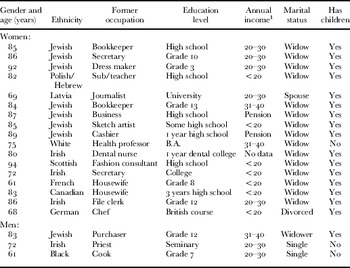
Descriptive exploratory study methods were used to illuminate older adults' subjective experience of humour expression and appreciation within inter-personal contexts (Sandelowski Reference Sandelowski2000). The sample of 20 participants for this study (see Table 1) was chosen from a larger survey study of 73 community-dwelling older adults' subjective perceptions of the role of humour, spirituality, self-efficacy and social support in their day-to-day lives (Marziali, McDonald and Donahue Reference Marziali, McDonald and Donahue2008). They were referred from a telephone support programme provided by a large multi-service geriatric health centre, contacted by phone, and a time for a home visit interview was arranged. Having obtained informed signed consent, trained interviewers engaged the participants initially in talking about themselves, their health status and their involvement with family, friends and community activities. Specific questions on humour in the interview guide included the following: Do you use humour in your day-to-day life? If so, in what ways? Can you give an example? The interviews lasted between one and one-and-a-half hours. Of the 73 interviews completed, we chose 20 where the respondents' narratives had included content reflecting humour in their lives. For the original study, ethics approval was obtained by the sponsoring institution. All interviews were conducted following an interview guide, were audio-recorded and transcribed.
Socio-demographic characteristics of the sample

Note: 1. Thousands of Canadian dollars.
Qualitative data analysis
A content analysis was conducted using qualitative methods (Berg Reference Berg1995). All 20 transcripts were read several times and analysed in their entirety. Operational definitions of humour types (self-enhancing, affiliative, self-defeating, authentic, sick/hostile) were generated from the literature and used to code interview narratives for presence of each type of humour. Narratives that referred to humour in any format were coded for context; that is, was the reference inter-personally distal, or was it proximal? An additional coding strategy noted spontaneous expressions of humour from the interaction with the interviewer. To ensure reliability of coding and interpretation of the qualitative analysis, a second researcher independently coded and analysed the transcripts. The researchers conducted frequent reviews and discussions as to consistencies and discrepancies of codes, themes, and excerpts that represented the different types of humour until consensus was reached. Excerpts from the transcripts illustrated four types of humour used by participants and their potential function or benefit. The aim was to express in the voices of the participants, their experiences of humour in inter-personal contexts and speculate as to their meanings in sustaining a sense of wellbeing while ageing within their respective communities.
Results
The 20 participants had diverse ethnicity and origins (Irish, Scottish, French, Polish, German and Jamaican); were primarily female (17); and their ages ranged from 61 to 95 years. Their education level was high school; and their annual income ranged from Canadian $20,000 to $50,000. Five of the participants lived with spouses; the others lived alone. The qualitative analysis identified four types of humour experiences in different relationship contexts: affiliative, self-enhancing, authentic and self-defeating.
Affiliative humour
The most frequently occurring type of humour in the older adults' narratives was affiliative humour, which by definition occurs in a relationship context. Mrs S spontaneously told a humorous story about her son's dog and the dog's attachment to her:
Like I'll tell you a story about a dog, a pug. My son had a pug, he was nuts about me. When he was little, I had pinholes in my shoes. But when he got older, no, he was still young when my son was living in London, and I went to visit, this you are going to laugh [at] (chuckling), when I had to go home, the dog used to need a psychiatrist. He used to sit by the door about three days waiting for me to come back (chuckling).
Another participant focused on the inter-personal aspects of humour and how she uses humour to stay socially engaged in her later years:
I enjoy humour (laugh). Oh, it just comes naturally to me. And I do make friends, I try … maybe somebody doesn't want to be friendly there are a lot of people that want to be alone that are loners but I'm not a loner I like friends so I talk.
Similarly, Mrs F stated, ‘Yes, I have a sense of humour. My friend, when he comes here I always make jokes and we laugh and I think a sense of humour is very important’. Mrs M highlighted that she used humour intentionally when she argues with her son so as to break up the intensity of the argument, ‘I think mostly I try to say some outlandish thing … to say something outlandish that makes me stop and think. Or, we don't really mean that. [If] you can't laugh … you are lost’. Other participants did not enjoy telling or hearing jokes; for them, humour occurred spontaneously and naturally in interactions with others. Mrs J expressed it in this way, while reminiscing on a previous experience:
I'm not good at making jokes … day to day. I try to keep … the sister happy. I keep myself happy. At the dinner dance on New Year's Eve we met up with some of the old Scout leaders and friends of mine and they were telling stories and one of them, brave enough wanting to know if I remember wearing the nightgown they stuffed in my sleeping bag (laughing).
Self-enhancing humour
There were a number of examples of self-enhancing humour in the participants' narratives. In a dialogue with the interviewer over the participant's patterns of eating, a participant reflected on her struggle with weight management, amused by her lack of willpower to go on a diet:
I have one big problem. I am overweight. I have a good appetite and I am not strong enough to go on a diet and it is my biggest problem to date. Maybe five years ago, I was strong willed and I was 14 kg less and I was very happy, now I have to go, I need this goal. I try to do this but not today. My appetite is good – too good (laughing).
Mrs D appeared pleased with the fact that her children can afford to travel extensively: ‘Last year they (her children) were in London (England), and then they're down in South Africa. And they are planning now in March to go to Spain. I didn't know there was that much money in the family (laughing)’. Another participant highlighted how humour is a self-enhancing personality trait for older adults while enriching their interpersonal context:
I've heard … some women say their husbands don't have a sense of humour and some say their husbands do have a sense of humour and that's why they love their husbands and vice versa. I think you can't be just blah you have to have something going for you, you know!
There were several examples of how humour helped to deflect other's negative attitudes towards ageing and physical decline. Mrs N chose to ‘reframe’ her use of her walker, ‘I go with my walker whenever I can, I call it my BMW (laughing)’. In the context of attending live theatre, one participant gave an example of how she uses humour to inform others of her hearing loss:
I used to like live theatre and movies but I started to lose my hearing about a year ago. So I am a little frustrated. But I am getting used to telling people that I am not dumb, I just can't hear you (laughing).
Authentic humour
Authentic humour communicates acceptance of life's paradoxes and attempts at adapting to what cannot be changed (McFadden Reference McFadden2004). However, in our analysis of three participants' narratives, authentic humour appeared to portray the individual's identity with being an older person, and his or her comfort with adapting to what cannot be changed in the ageing process. For example, one participant spoke amusingly about her competence at preparing complicated dishes and of not being able to make hamburgers, because physically she could not cope with standing long enough to complete the task. Her self-identity now accommodated a loss of function in the context of cooking while joking about her age:
I'm going to tell you something, I can cook the most complicated thing and I can't make hamburger. It's too much work. You do everything by hand. I can't stand that long. I'm not, at 70 or 80, well I'm still in my eighties, [I'm] 89 (laughing).
There were a number of examples of how participants used humour to cope with an increased loss of function as they aged. Mrs A reflected on how laughing at herself helped her to accept her mechanical abilities were in decline while persevering with the task:
If something's bugging me … then I kind of try to laugh it off, and say well I don't know why you're so upset about that. … I turn it around to make me feel good … Like if I'm trying to put a nut and bolt together and I can't get it to go, I'll put it down and I'll say you did it before why can't you do it now and I start it again and it works! You know I sort of talk myself into it I guess … because I can say well, see you're not that old girl you think you are!
Another participant laughed about activities that she could no longer engage in, thereby accepting the inevitable changes to physical capacity that come with the ageing process, ‘I can't climb a ladder anymore but I never went beyond the third step anyway (laughing). I used to play golf, I don't do that because of the arthritis. I tried curling, and they told me to go home and take a bath (laughing)’. In a similar vein, another participant talked about selecting activities that she could share socially with others her age, ‘I go to aqua-fit, but I only go for the coffee and donuts (laughing). If you go from 9:30 to 10:00 am and you get your coffee, you are lucky to be home by two in the afternoon (laughing). But I don't miss out’.
Self-defeating humour
There were few examples of self-defeating humour. Participants did not use self-defeating humour to express negative self-perceptions, or ageing stereotypes, nor did they portray themselves as being victims of others' negative jokes. Participants' narratives tended to combine self-defeating and self-affirming forms of humour:
My son John is out in BC [British Columbia] – that is about as far away as you can get from your mother. Sally (daughter) lives here. We talk a lot about our problems and I try to help her. She thinks I'm a wise person, I think she's dumb to think that (laughs).
Humour and life experiences
There were several examples of participants expressing the value of humour in their lives. For these participants, humour served multiple functions in enhancing their relationships with others, supporting a positive image of the ageing self, and helping them to cope with the physical and psychological challenges of ageing. Mr P explained:
Humour in my life is very, very important because without humour I cannot live my day-to-day life; my humour helps me in all ways. It helps with my health, helps in my mood, helps in my daily activities, and it helps me with people.
Another participant appeared to use humour to acknowledge her limitations in problem solving: ‘I use humour sometimes because I feel that this problem, it's not for me to solve, so not to get upset about this, so I will try to humour myself’. Some participants made explicit links between humour and how it helped them to manage their daily lives. Humour appeared effective in deflecting depressive affect and loneliness. One participant stated:
Well humour is important in anybody's life, not just mine. It is. If you haven't got it, then you are depressed. Well, for coping, an older person, from what I understand, they feel depressed, they feel alone. So, you got to have humour. If you don't have it, it's too bad.
In a similar fashion, Mrs C laughed at herself when playing golf: ‘If something doesn't just go right for example if I'm playing golf and it's a bad shot I'll say sh--, it's a bad shot so I'll laugh it off’. Another participant did not see the use of humour as helpful for resolving day-to-day problems; rather, experiencing the joy of humour followed the resolutions of the problem:
I don't use humour with daily problems; it wouldn't solve day-to-day problems. I suppose humour would help me cope with problems but I wouldn't use it to solve it [my problems]. You first solve your problem and then you get on with your fun!
The benefits of humour for some participants were reflected in activities such as exercising or while watching a funny television advertisement:
I'm trying to think what was the last thing that made me laugh (laughs). I was sitting there kind of depressed watching TV and on came this dumb advertisement about squirrels and rabbits; I thought that was funny (laughing)!
Even though this participant was initially feeling ‘kind of depressed watching TV’, she was amused by what she described as a ‘dumb ad’ involving a squirrel and a rabbit – thus highlighting the personally subjective nature of humour in older adults' everyday activities. Two participants provided narratives about the balance between expressing and responding to humour in inter-personal contexts. People do not necessarily view the communication of humour in a similar fashion with consequent risks in being misunderstood. The following narratives show this dilemma. Reflecting on using humour day-to-day in relationships with others, the participant stated:
It depends where you are and who you are with. I don't like it when you tell something funny and people say, ‘what's funny about that!?’ (laughing), and I get that a lot because to other people, humour – we are not all the same, we are not the same at telling people jokes; this person I am talking about … and if you tell her something, a joke or something, she says, ‘so’; she can't understand it. I try to be funny every day, but I do what I can.
Unlike the above quote, where humour is dependent on the receiver, another participant reflected on how she might still think her joke was funny even if the response was indifferent:
I never take it the wrong way. If it's funny it's there, it happens because I do have a good sense of humour as long as its the right time and who it might be telling it to me or even if I make it funny myself. Yes, I still have a good sense of humour!
Discussion
Types of humour
This study examined the experiences of humour in community-dwelling older adults. While a growing number of studies show that older adults use humour to manage the psychological impact of ageing (Berk Reference Berk2001; Capps Reference Capps2006; Dziegielewski et al. Reference Dziegielewski, Jacinto, Laudadio and Legg-Rodriguez2004), few have examined the types of humour experienced by older adults in different life contexts. Through our interview data, 20 older adults articulated in depth the multiple functions of humour in enhancing their lives and in helping them cope. In particular, several types of humour were identified in participants' narrative responses such as: affiliative, self-enhancing, authentic and the more ambiguous classification of self-defeating humour.
The findings show that the study participants grounded their references to humour in life contexts that were primarily inter-personal; that is, humour was shared with others – family members and friends. The many examples of affiliative and self-enhancing humour underline the importance of humour in forging a positive outlook on life and maintaining social connections. Also, having a sense of humour was valued and viewed as an essential element for managing the inevitable loss of function that accompanies the ageing process. In this regard, authentic humour supports previous works (McFadden Reference McFadden and Seeber1990, Reference McFadden2004) when it communicates acceptance of life's paradoxes and attempts at adapting to what cannot be changed. For the older adults in this study, their narratives highlight how authentic humour can play an important role in affirming a changing, yet positive sense of personal identity. Possibly, the use of authentic humour to ward off negative affect associated with physical decline allows for maximum adaptation to functions that cannot be restored or changed. Dean and Gregory's 2005 article suggested the use of humour was helpful for staff and families to engage in an authentic communication with regard to providing palliative care. The function of authentic humour, especially as used by older adults, requires further study, both conceptually and empirically. If authentic humour is associated with maintaining a sense of mastery and control over thoughts, behaviours and emotions in the context of physical decline while building social bonds it could be viewed as having a powerful effect on maintaining wellbeing while ageing in one's community.
There were fewer instances of self-defeating humour. Although types of sick, hostile, dark humour are well established in the literature (Martin Reference Martin2003; Saroglou and Anciaux Reference Saroglou and Anciaux2004), in this small sample, there were no narratives that contained references to either sick or hostile humour. Nor did the older adult participants report situations where they were victims of other's hostile humour. Martin et al. (Reference Martin, Puhlik-Doris, Larsen, Gray and Weir2003) found that older adults compared with younger adults had lower scores on both affiliative and aggressive forms of humour and were less likely to use humour to disparage or control others. However, several participants were aware of how jokes about ageing reflected a prejudiced view of growing old, as for example in the context of attending live theatre; one participant illustrated how she used humour to inform others that her declining hearing loss was to be differentiated from any perception of her as being in cognitive decline. In general, the participants' narratives showed that mutual respect among peers and within their families were beneficial in terms of maintaining an overall sense of wellbeing, despite any loss of function and having to relinquish previously enjoyed activities.
This study focused on understanding the subjective experiencing of humour by community-dwelling older adults and contrasted with questionnaire methods used in studies that compare older adults' humour expression and response with that of younger adults (Martin et al. Reference Martin, Puhlik-Doris, Larsen, Gray and Weir2003; Wingyun and Carpenter Reference Wingyun and Carpenter2007). The qualitative analyses have shown that previous categorisations on the meanings of humour expression and response are not mutually exclusive or well understood, as when self-defeating humour combines with a self-enhancing role in older adults' narratives. The combination of self-defeating and self-enhancing humour may represent growing wisdom as reflected in the older adult's ability to laugh at oneself and not take oneself too seriously, thereby transcending the stress of managing challenging events while still engaged in them (McFadden Reference McFadden and Seeber1990, Reference McFadden2004).
Health benefits of humour
Consistent with previous authors' works on the health benefits of humour (Berk Reference Berk2001; Martin Reference Martin2007; Witkin Reference Witkin1999), the current findings have shown that being able to express and respond to humour was viewed by some participants as a necessary component for the prevention of loneliness and the avoidance of depression. For example, recalling previous humorous events evoked laughter and enjoyment for the older adult. In this study, direct observation of how older adults expressed and processed humour in different life contexts was not possible, nor was the link between personality style and the use of different types of humour studied. However, humour in its various forms and contexts were ever present in participants' lives; it was shared with others in social contexts or could be enjoyed in the privacy of one's own home as for example when watching television. Thus, experiencing humour appeared to shift perspectives, stimulate new ways of perceiving life events, and manage life's contradictions resulting in enhanced wellbeing.
Defining humour
While humour is considered a universal aspect of human nature, it is largely influenced by cultural contexts (Davies Reference Davies2010). For example, humour is frequently associated with the telling of jokes, but the study participants' narratives of their day-to-day context raise the question of the degree to which humour expression is linked to the telling of jokes. Several of the older adults in this study did not provide stories about telling or hearing jokes. The participants discussed differences in people's capacity for appreciating or evoking a humorous response in others and the risk of being misunderstood when jokes or humorous comments did not produce the expected response. Some stated that they were not good at telling jokes (may never have been good at it) and others accepted the fact that some of their friends did not appreciate their efforts at being humorous. Many older adults valued and engaged in more spontaneous forms of ‘positive’ humour that arose daily and naturally in their interpersonal and social contexts. Thus, it appears that the expression and response to humour in a variety of social contexts may be imbedded in personality style, regardless of gender or age. A more expanded understanding of the varied types of humour expressed by older community-dwelling adults and appreciating the function of humour in social contexts could advance knowledge about older adults' adaptive capacities and maintenance of wellbeing.
Understanding how older adults express and appreciate humour may be important for health-care professionals who work with older adults in helping them manage day-to-day self-care while living with a chronic disease. Ideally, inter-disciplinary professionals working with older adults would become familiar with the different types of humour and encourage older adults to express the beneficial forms of humour while listening for and challenging those messages that potentially reinforce society's stereotypes and negative perceptions of ageing. For example, the participant who referred to her walker as her BMW, may have been trying to reframe initial resistance to having to use this device to ambulate while also countering others' negative views of ageing. The analysis of humour expression and meanings was limited by the inclusion of primarily older, white, middle-class, urban-dwelling Canadian women in this sample. Excluded was the study of factors such as personality, race, religion and geographic contexts that can affect humour expression and response. Another area of inquiry with regard to the experiencing of humour by older adults has focused on persons with cognitive decline, such as dementia. Comprehension of the nuances of humour expression is affected by problems with cognitive function (Mak and Carpenter Reference Mak and Carpenter2007; Uekermann, Channon and Daum Reference Uekermann, Channon and Daum2006). It may be that as executive function declines, the ability to appreciate the complexities and paradoxical context of some forms of humour expression would be limited.
Observational data of older adults in their real-life settings with particular sensitivity to cross-cultural context may further our understanding of the types of humour expressed by a globally ageing and diverse population. The results of this study suggest that humour expression and appreciation may play an important role in managing the ageing process in ways that are not only adaptive and enriching in interpersonal and social contexts but may provide opportunities for countering society's limited views of the ageing process.