INTRODUCTION
Leptocephali are the larvae of the true eels of the order Anguilliformes and their close relatives (Smith, Reference Smith and Böhlke1989a; Miller & Tsukamoto, Reference Miller and Tsukamoto2004; Miller, Reference Miller2009). They are remarkably transparent because they have greatly reduced body musculature and organs, and their highly laterally compressed bodies are filled with transparent jelly-like materials (Smith, Reference Smith and Böhlke1989a; Pfeiler, Reference Pfeiler1999; Miller, Reference Miller2009). They grow larger than most fish larvae, with maximum sizes ranging from about 50 mm to more than 300 mm, but probably <120 mm for most species (Böhlke, Reference Böhlke1989). The leptocephali of some species of congrids can occasionally reach about 400 mm (Mochioka et al., Reference Mochioka, Kakuda and Tabeta1982; Strehlow et al., Reference Strehlow, Antunes, Niermann and Tesch1998) and some notacanthiform larvae have been collected at sizes up to 1.8 m (Bertin, Reference Bertin1954; Castle Reference Castle1959, Reference Castle1967; Tabeta, Reference Tabeta1970).
Because their morphology is so different from the juveniles and adults, they are difficult to match with the adults of their species, so few types of leptocephali have been identified to the species level in the Indo-Pacific (Miller & Tsukamoto, Reference Miller and Tsukamoto2004, Reference Miller and Tsukamoto2006). Much greater progress has been achieved in identifying leptocephalus species in the Atlantic Ocean (Blache, Reference Blache1977; Smith, Reference Smith1979; Böhlke, Reference Böhlke1989; Leiby, Reference Leiby and Böhlke1989), but even in the Atlantic the leptocephali of moray eels of the family Muraenidae are especially hard to identify, because of a lack of morphological features that can be linked to the adults (Smith, Reference Smith and Böhlke1989b).
Leptocephali live in the upper few hundred metres of the open ocean or over the continental shelf, with some species showing diel vertical migrations (Castonguay & McCleave, Reference Castonguay and McCleave1987; Miller, Reference Miller2009). They can be abundant along the edge of the continental shelf (Miller et al., Reference Miller, Otake, Minagawa, Inagaki and Tsukamoto2002; Miller & McCleave, Reference Miller and McCleave2007) or in offshore areas where anguillid and mesopelagic eels spawn (Tsukamoto, Reference Tsukamoto1992; Miller & McCleave, Reference Miller and McCleave1994; Miller et al., Reference Miller, Aoyama, Mochioka, Otake, Castle, Minagawa, Inagaki and Tsukamoto2006). The behavioural ecology of eel larvae is very poorly known though. Leptocephali enter shallow tropical habitats for recruitment using tidal currents (e.g. Thorrold et al., Reference Thorrold, Shenker, Maddox, Mojica and Wishinski1994a, Reference Thorrold, Shenker, Mojica, Maddox and Wishinskib; Dufour et al., Reference Dufour, Riclet and Lo-Yat1996; Harnden et al., Reference Harnden, Crabtree and Shenker1999; McIlwain, Reference McIlwain2003; Nolan & Danilowicz, Reference Nolan and Danilowicz2008), but there have been few reported observations of live leptocephali. Divers have recently filmed a few leptocephali at night over deep water, providing some new insights into their behaviour and morphology (Miller et al., Reference Miller, D'Avella and Tsukamoto2010, Reference Miller, Norman, Tsukamoto and Finn2013).
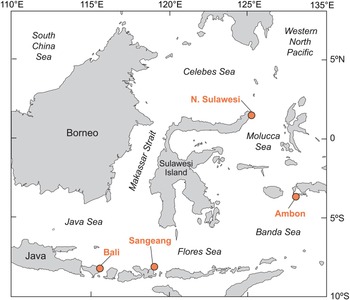
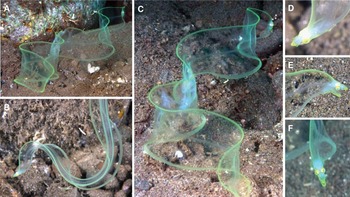
One of the few reported observations of leptocephali in shallow water was of a large greenish-appearing metamorphosing leptocephalus that was recently photographed adjacent to Sangeang Island in the Flores Sea (Figure 1) of southern Indonesia (Miller et al., Reference Miller, Powell and Tsukamoto2009). The leptocephalus appeared to be about 400 mm in length and was moving along the bottom (Figure 2). It differed in morphology from other leptocephali described previously (Blache, Reference Blache1977; Smith, Reference Smith and Böhlke1989a; Miller & Tsukamoto, Reference Miller and Tsukamoto2004), because it appeared to be a remarkably large leptocephalus of the family Muraenidae. Muraenid leptocephali are rarely collected at sizes greater than 90 mm (Smith, Reference Smith and Böhlke1989b; Miller et al., Reference Miller, Aoyama, Mochioka, Otake, Castle, Minagawa, Inagaki and Tsukamoto2006), so that leptocephalus appeared to be a completely new type of moray eel larva.
Map showing the locations where large leptocephali were observed along the north-eastern side of Sangeang Island in June 2008, in Lembeh Strait adjacent to north-eastern Sulawesi Island in late December 2009, on the north shore of Ambon Bay in April 2010 and March 2011, and at Bali on two consecutive days in April 2010 (Table 1).

Photographs showing the body (A–C) and head region (D–F) of the large leptocephalus that was observed along the coast of Sangeang Island, Indonesia on 26 June 2008. External nostrils are seen in (D).

The present study examines 6 observations of this type of large leptocephalus that were made by divers from 2008 to 2011 in the Indonesian Archipelago that appear to be the same species of large metamorphosing moray eel larvae. The distribution of these sightings is documented and the video recordings and photographs are evaluated to help advance understanding of these unusual eel larvae that are present in Indonesia and probably elsewhere in the Indo-Pacific.
MATERIALS AND METHODS
Recording imagery of larvae
Observations of the large leptocephali were made by SCUBA divers equipped with underwater cameras or video cameras at 4 general locations (Table 1; Figure 1). The larvae were encountered during dives in shallow water during daytime, and each larva was photographed or filmed for several minutes as it swam along the bottom or in the water column. The larva photographed at Sangeang Island in June 2008 was not seen at an established dive site, so the exact location at the island could not be precisely determined (Table 1). Larvae were observed on 2 different dates at dive sites along the north shore of Ambon Bay of Ambon Island called Rhino City (April 2010) and Laha 3 (March 2011). The photographs of the larva in the second sighting are not included in this study. On the north-eastern shore of Bali at a dive site called Seraya between Amed and Tulamben, a leptocephalus was seen on two consecutive days.
Locations, dates and conditions where the large leptocephali were observed at four locations in the Indonesian Archipelago.

Analyses of observations
Video footage was obtained from 4 of the observations (Sulawesi, Ambon and 2 sightings at Bali) and converted into video clips. Video from the sightings were converted from three different formats and resolutions into a single master video file. This video clip is permanently available online on the website of the Australian Museum (see link in Results section).
Still photographs were taken of the Sangeang, Sulawesi and Bali leptocephali. As shown by Miller et al. (Reference Miller, Powell and Tsukamoto2009) some photographs were lightened through a filtering process to remove haziness and increase clarity of the images. This makes it easier to see the morphology of the leptocephali as seen in Figure 3.
Photographs of the head and body of the leptocephalus observed in Lembeh Strait adjacent to north-eastern Sulawesi Island on 24 December 2009. The larva has no teeth (B), which is a characteristic of metamorphosis.

RESULTS
Locations and habitats of sightings
Large leptocephali with the same basic appearance were observed 6 times from 2008 to 2011 at 4 different general locations within the Indonesian Archipelago (Table 1). All of the sightings were made from late morning to mid-afternoon, at a range of depths from about 5 m to 23 m. The water temperatures in all of these coastal areas ranged from 27–30°C during the sightings from December to June.
The first sighting was on 26 June 2008 at Sangeang Island along the southern edge of the Flores Sea (Figure 1) as reported by Miller et al. (Reference Miller, Powell and Tsukamoto2009). The leptocephalus was photographed (Figure 2) at about midday at a depth of about 4–5 m. The habitat was a coarse sand and coral clump area, with various sizes of stones or coral debris on the bottom where the larva was swimming.
The next observation was in Lembeh Strait between the north-eastern tip of Sulawesi Island and Lembeh Island to the east (Figure 1). The leptocephalus was filmed and photographed (Figures 3 & 4) in the afternoon on 24 December 2009 at a depth of 23 m. The larva moved quickly over the complex structure of the bottom that included coarse sand and coral rubble. The leptocephalus filmed at Ambon Island on 6 April 2010 was seen in the afternoon at a depth of 23 m along the north shore of Ambon Bay in a similar complex rubble substrate area. The habitat of the other larva, observed at an adjacent dive site in Ambon Bay almost one year later on 27 March 2011, was likely similar based on the location and the background of the photograph (not shown).
Photographs of the leptocephalus in Lembeh Strait adjacent to north-eastern Sulawesi Island while it was swimming in the water column.

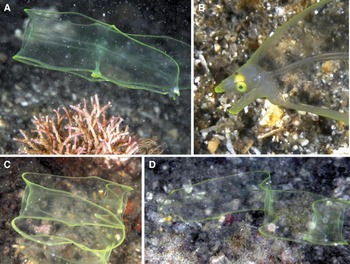
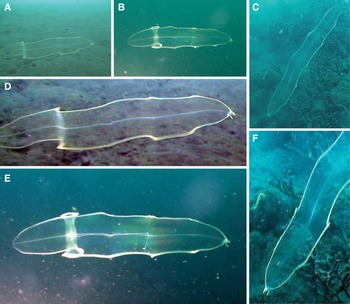
Less than two weeks after the first sighting at Ambon, single leptocephali were seen at Bali (Figure 1) on the two consecutive days of 18–19 April 2010 (Table 1). It is not certain if these two sightings were of the same leptocephalus, because the larvae were apparently about the same size and in the same general area, but in different types of habitats. However, the leptocephalus on the second day had distinct scratches on the side of its body, and a twisted region of its notochord, so it was probably a different individual unless the first larva was damaged between sightings. The first sighting was made in areas with rubble and other types of structure on the bottom (Figure 5C), but the second sighting was made over more uniform sand–silt habitat with little or no rubble (Figure 5A). The second larva moved off the bottom at times and was filmed swimming in the water column (Figure 5B). The water depths in these areas were about 5–8 m on the first day and 12–17 m on the second day.
Photographs of the large leptocephalus at Bali on 18 April 2010 while it was actively swimming. Panels (D), (E) and (F) are enlarged images of panels (A), (B) and (C), respectively.

Morphology and behaviour of larvae
The large leptocephali had distinctly rounded tails (Figures 2A & 5E) and no apparent gut swellings or distinct pigmentation (Figure 5). This combination of characteristics is only consistent with the leptocephali of the family Muraenidae. The guts appeared to be longer than 75% of the bodies (Figure 5), although it is difficult to see the exact position of the end of the gut, probably because it becomes less distinct during metamorphosis, when the gut moves forward, and the larvae are not feeding.
All of the larvae appeared to be undergoing metamorphosis because they lacked teeth (Figures 2E, 3B, 4B & 5). At least one could be seen to have developed externally protruding nostrils (Figure 2D). The larvae appeared to be at an early stage of metamorphosis, because they were all still highly transparent and laterally compressed, with no apparent thickening of their bodies. Several of the larvae appeared greenish in colour, with the coloration being most distinct along the margins of the body and on the head (Figures 2–6). All larvae had their jaws seemingly locked into a fixed open position as they swam (Figures 3–6).
Photographs of the head region of the second leptocephalus observed at Bali showing a lack of teeth indicating that it is at the metamorphosing stage.

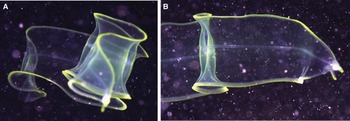
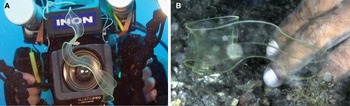
The size of these larvae cannot be determined exactly, but they all appeared to be similarly large. The larva at Sangeang Island was estimated in situ to be larger than 400 mm in length (Miller et al., Reference Miller, Powell and Tsukamoto2009). The other larvae were all about the same length (estimated to be 300 to 400 mm) as demonstrated by the images of larvae compared to the diver's hands or camera (Figure 7).
Photographs of the leptocephalus at Bali (A) and the one at Ambon (B) in relation to the sizes of the diver's hands and camera.

The swimming behaviour of the 4 larvae that were videotaped was similar and anguilliform in style, with some variation depending on the situation (video clip can be seen at: http://www.australianmuseum.net.au/BlogPost/Fish-Bits/Large-Muraenid-Leptocephali). The amount of body curvature ranged from highly curved (Figures 2, 3, 4 & 7) to minor swimming undulations with a mostly straight body (Figure 5). The larvae swam continuously as they moved over the substrate and around obstacles, and some swam off the bottom into the lower water column. The first larva seen at Bali appeared to be attempting to enter holes or crevices, but failed to find a deep enough opening. In one case, it was able to get about half of its body into the hole before backing out and continuing to swim along the bottom.
DISCUSSION
The large leptocephali that have been observed in several places in the Indonesian Archipelago in this study appear to belong to the family Muraenidae, because their rounded tail, lack of large pigmentation spots, and straight gut with no swellings are consistent with muraenid leptocephali from around the world (Blache, Reference Blache1977; Smith, Reference Smith and Böhlke1989b; Miller & Tsukamoto, Reference Miller and Tsukamoto2004). This combination of morphological features does not match any of the leptocephali of the other families of eels and their close relatives or other rare, unidentified leptocephalus forms (Castle, Reference Castle, Moser and Richards1984; Böhlke, Reference Böhlke1989; Smith, Reference Smith and Böhlke1989c; Miller & Tsukamoto, Reference Miller and Tsukamoto2004). However, their ~300–400 mm size at metamorphosis estimated in this study is much larger than other known muraenid leptocephali, which rarely reach sizes larger than 90 mm (Blache, Reference Blache1977; Smith, Reference Smith and Böhlke1989b; Tawa & Mochioka, Reference Tawa and Mochioka2009). Therefore, these large leptocephali are not likely to be a species of the most common genus of moray eels, Gymnothorax, whose larvae metamorphose at much smaller sizes.
The maximum larval sizes of some other muraenid genera are not known however, and this may offer a clue to the identity of the large leptocephali seen in Indonesia. The leptocephali of Enchelycore or Echidna have not been distinguished in the western North Atlantic, even though these genera include some common species of moray eels (Böhlke et al., Reference Böhlke, McCosker, Böhlke and Böhlke1989; Smith, Reference Smith and Böhlke1989b). In the Indo-Pacific there are even more genera of moray eels (Böhlke et al., Reference Böhlke, McCosker, Böhlke and Böhlke1989; Böhlke & Smith, Reference Böhlke and Smith2002) whose larvae are not yet known. Most of the larvae of these genera probably have typically sized leptocephali, so the question is which genus may have a type of larva that is greatly different in maximum size from all the others?
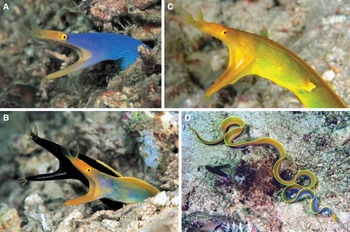
Two Indo-Pacific genera with adults that have exceptionally long and thin bodies are Strophidon and Rhinomuraena. The slender giant moray Strophidon sathete (Hamilton, 1822) is a long thin moray that can reach sizes of up to 4 m and is found across the Indo-Pacific (Froese & Pauly, Reference Froese and Pauly2012: FishBase accessed 21 February 2012, subsequently cited as FishBase). The leptocephalus of the other species of the genus, Strophidon ui Tanaka 1918 has been identified recently, and it is a typical type of muraenid leptocephalus, but with a high number of total myomeres (Tawa & Mochioka, Reference Tawa and Mochioka2012). An even more unusual species is the ribbon moray, or ribbon eel, Rhinomuraena quaesita. This species is widely distributed and is frequently seen by divers in Indonesian waters with their heads and anterior bodies protruding from crevices (Figure 8) in sand and rubble habitats from very shallow to about 60 m (FishBase). It has unique, large, flower-like nostrils and a long ribbon-like body that can reach up to 1.3 m (FishBase). They are also well known for their characteristic jaws that are frequently opened very widely when a diver approaches. Ribbon eels appear to be protandrous and are thought to change sex from males to females, with juveniles being black, males blue, and females yellow (Fishelson, Reference Fishelson1990; Sadovy de Mitcheson & Liu, Reference Sadovy de Mitcheson and Liu2008) (Figure 8).
Photographs of ribbon eels, Rhinomuraena quaesita from the Indonesia region, possibly showing a blue male in Lembeh Strait adjacent to northern Sulawesi Island (A), a black juvenile and another transitional individual at Derawan Island, off the coast of East Kalimantan in Indonesia (B), a yellow female at Lembeh Strait (C), and the whole body of a male at Kapalai, Malaysia (D). These eels are thought to change sex and colour, and are typically seen with their heads extending out of their hiding places (photographs courtesy of T. Wu (A & B), T. Yavuzdoğan (C) and R. Groeneveld (D)).

There are several types of indirect evidence that suggest the large leptocephali described in this study may be the larvae of the ribbon eel, R. quaesita. First is the similar ribbon-like body form seen in the larvae (Figures 2B & 4A). Another is the presence of large nostrils formed even at the early metamorphic stage (Figure 2D), which are not present, or are less prominent in other metamorphosing muraenid leptocephali (Miller & Tsukamoto, Reference Miller and Tsukamoto2004; Miller, Reference Miller2009). The nostrils may form in the early metamorphosing larvae, because they grow exceptionally large in the juveniles and adults (Figure 8), and are highly specialized structures that are part of their olfactory organs (Holl et al., Reference Holl, Schulte and Meinel1970). Perhaps the most striking resemblance between these larvae and ribbon eels is the locked-open position of the long lower jaw of the leptocephali and the open jaws of the ribbon eels (Figure 8). The widespread distribution of the observations of the large leptocephali in the Indonesian Archipelago in just a 2 year period, suggests that this species of eel is widespread in the region, which is consistent with ribbon eels that are widely distributed across the Indo-Pacific (FishBase). Although these qualitative characteristics do not prove these are ribbon eel leptocephali, there presently seem to be few characteristics that can be used to hypothesize that these are the larvae of some other species of moray eel, or any other family of eels.
If these are the larvae of ribbon eels, then a wider range of families have large leptocephali than previously known. The leptocephali of Ariosoma (Congridae) and Nemichthys (Nemichthyidae) can reach >200 mm, and other species known only as larvae, such as Ascomana eximia Castle, Reference Castle1967, have been collected at a size of 700 mm (Castle, Reference Castle1967). Notacanthiform leptocephali such as Leptocephalus giganteus Castle, Reference Castle1959 have been collected at sizes of 565–1800 mm (Bertin, Reference Bertin1954; Castle, Reference Castle1959, Reference Castle1967; Tabeta, Reference Tabeta1970; Moser & Charter, Reference Moser, Charter and Moser1996). Some other rare taxa whose adults are unknown such as Thallassenchelys can reach >200 mm (Castle & Raju, Reference Castle and Raju1975), but the number of species that reach these large sizes are few compared to the more than 800 species of eels in the world (Nelson, Reference Nelson2006).
The observations of these large often greenish leptocephali in shallow water suggest they were entering these habitats to transform into juvenile eels. Although their greenish coloration may mostly be caused by the greenish ambient light in some of these areas, it is more certain that they were all at an early stage of metamorphosis. They had no teeth and at least some had protruding nostrils, which are only characteristics of metamorphosing leptocephali (Castle, Reference Castle1970; Smith, Reference Smith and Böhlke1989a; Otake, Reference Otake, Aida, Tsukamoto and Yamauchi2003; Miller & Tsukamoto, Reference Miller and Tsukamoto2004; Miller, Reference Miller2009). Metamorphosing leptocephali of several families can be transported into shallow water tropical habitats by tidal currents in many parts of the world (Thorrold et al., Reference Thorrold, Shenker, Maddox, Mojica and Wishinski1994a, Reference Thorrold, Shenker, Mojica, Maddox and Wishinskib; Dufour et al., Reference Dufour, Riclet and Lo-Yat1996; Harnden et al., Reference Harnden, Crabtree and Shenker1999; McIlwain, Reference McIlwain2003; Nolan & Danilowicz, Reference Nolan and Danilowicz2008). Therefore it is possible that these large leptocephali in Indonesia were entering shallow water and were searching for a suitable place for hiding while they metamorphose into young eels. The fact that these large leptocephali have not been collected in several offshore surveys in the region (Wouthuyzen et al., Reference Wouthuyzen, Miller, Aoyama, Minagawa, Sugeha, Suharti, Inagaki and Tsukamoto2005; Miller, et al. unpublished data), suggests the possibility that they may remain in oceanic waters near the shelf-break not far from the shallow habitats where they will eventually recruit after reaching large size. This could explain why they have not been detected by scientists until they have been photographed and filmed by divers as shown in this study.
The observations of these large leptocephali were mostly in similar types of habitats that were mixtures of coral rubble and sand–silt habitats, but not coral reef areas. A variety of marine organisms can be seen in these habitats and ribbon eels are frequently seen there (T. Wu, personal observation). The number of observations of these unusual larvae is still too small to speculate if this is the typical recruitment habitat of these leptocephali, or if they have a particular recruitment season, but they are suggestive of where these larvae may be seen again in the future. A live specimen of this type of large leptocephalus needs to be caught and allowed to transform into a juvenile in an aquarium to see what it becomes. Or a specimen needs to be collected for morphological and DNA analyses, to determine for sure if these unusually large leptocephali are the larvae of ribbon eels.
CONCLUSION
A type of large leptocephalus has been observed and documented by divers in shallow coastal areas during daytime at several locations of the Indonesian Archipelago. These larvae are hypothesized to be the leptocephali of the ribbon moray, Rhinomuraena quaesita, based on circumstantial evidence such as morphological similarities in their body forms, prominent nostrils, basic jaw structure, and a lack of evidence for alternative hypotheses. These larvae were at an early stage of metamorphosis and were possibly entering shallow water seeking a hiding place where they could complete their transformation into juvenile eels. All sightings were in about the first 6 months of the year, but further research on their species identity and seasonality of recruitment is needed to learn about these remarkable large leptocephali that have been seen in recent years in Indonesian waters.
ACKNOWLEDGEMENTS
We thank Mark McGrouther and the Australian Museum for hosting the video clip on their website. Rokus Groeneveld kindly allowed us to use his photograph of a ribbon eel. The assistance of the dive operators of Kunkungan Bay Resort at Lembeh Strait on northern Sulawesi Island, Maluku Divers on Ambon Island, and Puri Wirata Dive Resort, Villas and Spa on Bali was also appreciated. We also thank Andy Shorten of Maluku Divers for providing information about the second sighting at Ambon and Cathy Church for organizing the diving trip on Sangeang Island.