Introduction
Following moderate–severe traumatic brain injury (TBI) many individuals experience a breakdown in social functioning, including reduced social networks, loss of employment, and disruption to intimate relationships (Elsass & Kinsella, Reference Elsass and Kinsella1987; Kersel, Marsh, Havill, & Sleigh, Reference Kersel, Marsh, Havill and Sleigh2001; Oddy & Humphrey, Reference Oddy and Humphrey1980; Ylvisaker & Feeney, Reference Ylvisaker and Feeney2000). While numerous factors probably contribute to the social dysfunction following TBI, deficits in emotion recognition may be critical, as this ability enables us to infer the mental states of others in daily life (Bornhofen & McDonald, Reference Bornhofen and McDonald2008; Knox & Douglas, Reference Knox and Douglas2009).
A growing body of research suggests that a large proportion of individuals with TBI are impaired in their ability to correctly recognize emotional expressions. This impairment has been observed when people have to judge emotional facial expressions, whether these are presented as a static photograph or a videoed presentation, and also emotionally charged voices, or audio-visual displays (Green, Turner, & Thompson, Reference Green, Turner and Thompson2004; Hopkins, Dywan, & Segalowitz, Reference Hopkins, Dywan and Segalowitz2002; McDonald & Flanagan, Reference McDonald and Flanagan2004; McDonald, Flanagan, Rollins, & Kinch, Reference McDonald, Flanagan, Rollins and Kinch2003; Spell & Frank, Reference Spell and Frank2000). For example, a meta-analysis on 296 adults with moderate-to-severe TBI and 296 matched controls (Babbage et al., Reference Babbage, Yim, Zupan, Neumann, Tomita and Willer2011) revealed that individuals with TBI, on average, perform 1.1 SD below healthy controls on measures of facial emotion recognition. Ietswaart, Milders, Crawford, Currie, and Scott (Reference Ietswaart, Milders, Crawford, Currie and Scott2008), reported that, shortly after injury, patients with TBI had impaired emotion recognition for both faces and voices, compared to an orthopedic patient control group, with no evidence of recovery at 1 year follow-up. This suggested that deficits in emotion recognition in this population are a direct impact of brain injury, rather than a consequence of sheer isolation from social networks and poor community reintegration, a possibility considered by a few researchers (e.g., Bornhofen & McDonald, Reference Bornhofen and McDonald2008).
The emotion recognition difficulties in TBI are not surprising given the nature of this type of injury. Rapid acceleration–deceleration forces in TBI lead to heterogeneous brain damage, but commonly result in damage to the ventral surfaces of the frontal and temporal lobes with focal injuries concentrated in the orbitomedial frontal lobes (Adams et al., Reference Adams, Doyle, Graham, Lawrence, McLellan, Gennarelli and Sakamoto1985; Bigler, Reference Bigler2007) and attendant, diffuse, axonal damage (Adams et al., Reference Adams, Doyle, Ford, Gennarelli, Graham and McLellan1989). Focal frontal injuries are known to result in emotion perception deficits and might, at least partially, explain the emotion recognition difficulties in TBI (Hornak, Rolls, & Wade, Reference Hornak, Rolls and Wade1996).
In addition to a general impairment in facial emotion recognition, individuals with TBI have been reported to be worse at recognizing negative emotions compared to positive, regardless of how the emotional expression is presented (Croker & McDonald, Reference Croker and McDonald2005; Green et al., Reference Green, Turner and Thompson2004; Hopkins et al., Reference Hopkins, Dywan and Segalowitz2002; McDonald et al., Reference McDonald, Flanagan, Rollins and Kinch2003; Zupan & Neumann, Reference Zupan and Neumann2013). One explanation for this difference holds that distinct neural substrates underlie recognition of positive and negative emotions. In particular, the amygdala in an integrated system with the ventral and orbital frontal lobes, has been proposed to mediate the processing of specifically negative valenced stimuli (Adolphs, Reference Adolphs2001).
Thus, it is possible that TBI has a greater impact on negative emotional expressions due to the propensity for damage to occur in these ventral frontal systems. However, this explanation seems unlikely given the heterogeneous nature of TBI, and the finding that greater impairment of negative emotions is consistently observed in other neurological or psychiatric patient groups as well, such as schizophrenia (Mandal, Pandey, & Prasad, Reference Mandal, Pandey and Prasad1998), frontotemporal dementia (Fernandez-Duque & Black, Reference Fernandez-Duque and Black2005), Alzheimer’s disease (Kohler et al., Reference Kohler, Anselmo-Gallagher, Bilker, Karlawish, Gur and Clark2005), and stroke (Braun, Traue, Frisch, Deighton, & Kessler, Reference Braun, Traue, Frisch, Deighton and Kessler2005). Moreover, to the best of our knowledge, there is little evidence for impaired recognition of happy faces following damage of specific brain regions, or in patients with either neurological or psychiatric disorders (Hennenlotter & Schroeder, Reference Hennenlotter and Schroeder2006). Only two studies report such deficits. The first is a single patient with amygdala damage who was slightly impaired in her appraisal of happiness (Anderson & Phelps, Reference Anderson and Phelps2000). The second is a study that compared a subgroup of patients with TBI with severe emotion recognition deficits to a subgroup without (Zupan & Neumann, Reference Zupan and Neumann2013). The impaired group performed more poorly on both positive and negative emotions, although the effect size for positive emotions was very small (ŋp 2=.07) relative to negative (ŋp 2=.60). Thus, the literature largely suggests that happiness is a unique class of emotional facial expression that is almost universally recognized, regardless of clinical pathology. An alternative explanation is that the valence-based discrepancy in emotion recognition observed in TBI might be an artifact of the tasks used, rather than reflecting a genuine impairment.
Most of the research in the TBI population has used static photographs of actors displaying full-blown, 100% expressions of the six “basic” facial expressions, predominantly from the Pictures of Facial Affect (Ekman & Friesen, Reference Ekman and Friesen1976). The Ekman and Friesen set includes only a small number of faces and has several limitations, including restriction in ethnicity and age, and an absence of ecological validity. Comparisons of the recognition of positive and negative emotions involves comparing happiness and surprise, both conventionally categorized as positive (e.g., Babbage et al., Reference Babbage, Yim, Zupan, Neumann, Tomita and Willer2011) to four negative (sad, angry, disgust, and fear). Such a comparison is problematic. First, as there are twice as many negative emotions as positive, the valence effect may reflect differential reliability and sensitivity of mean scores within the two categories (Croker & McDonald, Reference Croker and McDonald2005). Second, whereas surprise is often grouped under the positive category, it is debatable whether it is indeed a positive emotion, or simply “not negative” (i.e., it does not possess a clear negative valence as the other four emotions; Kreibig, Reference Kreibig2010). Third, negative emotions are generally more difficult to recognize than positive, even by healthy individuals (Biehl et al., Reference Biehl, Matsumoto, Ekman and Hearn1997; Russell, Reference Russell1994). Fear is often reported to be the most difficult facial emotion to recognize, while happiness is reported to be the easiest (Biehl et al., Reference Biehl, Matsumoto, Ekman and Hearn1997; Rapcsak et al., Reference Rapcsak, Galper, Comer, Reminger, Nielsen, Kaszniak and Cohen2000; Russell, Reference Russell1994). This asymmetry will cause floor and ceiling effects. Thus valence is being confounded with difficulty.
Indeed, when standard tests using Ekman and Friesen faces are made more sensitive by the use of computer-interpolated (“morphed”) images, blending expressions that are likely to be confused with each other (such as “happiness-surprise”: Calder, Reference Calder1996), individuals with TBI were found to perform more poorly than controls in overall emotion recognition, but there were no differences between groups for specific emotions (Ietswaart et al., Reference Ietswaart, Milders, Crawford, Currie and Scott2008). These findings suggest that different categories of emotion are not, after all, differentially disrupted by brain injury. However, the overall level of severity of TBI in that study (which included participants with mild injuries) was less severe than in previous studies of emotion recognition. This may explain the somewhat surprising absence of group differences in recognition of any particular emotion in the discrimination and labeling tasks in that study. In addition, morphing of different emotions, based on confusability, limits conclusions about the recognition of individual emotions. Consequently, the question of whether individuals with TBI have a general impairment in emotion recognition, or are impaired in some emotions rather than others, remains to be answered.
To address this issue, the current study examined the performance of a group of individuals with moderate–severe TBI and matched controls on the Emotion Recognition Task (ERT; Montagne, Kessels, De Haan, & Perrett, Reference Montagne, Kessels, De Haan and Perrett2007). The ERT affords several advantages over traditional measures. It uses video clips of increasingly intense emotional expressions which mirror the natural transition of real facial expressions, thus providing a more ecologically valid portrayal of emotion. Importantly, presentation of a range of intensities for each emotion provides a means to examine each emotion at different levels of difficulty. The ERT has been shown to be sensitive in numerous clinical populations, specifically, schizophrenia (Scholten, Aleman, Montagne, & Kahn, Reference Scholten, Aleman, Montagne and Kahn2005), autism spectrum disorder (Law Smith, Montagne, Perrett, Gill, & Gallagher, Reference Law Smith, Montagne, Perrett, Gill and Gallagher2010), obsessive-compulsive disorder (Montagne et al., Reference Montagne, de Geus, Kessels, Denys, de Haan and Westenberg2008), bipolar disorder (Gray et al., Reference Gray, Venn, Montagne, Murray, Burt, Frigerio and Young2006), depersonalization disorder (Montagne, Sierra, et al., Reference Montagne, Sierra, Medford, Hunter, Baker, Kessels and David2007), amygdalectomy (Ammerlaan, Hendriks, Colon, & Kessels, Reference Ammerlaan, Hendriks, Colon and Kessels2008), frontotemporal dementia (Kessels et al., Reference Kessels, Gerritsen, Montagne, Ackl, Diehl and Danek2007), social anxiety disorder (Montagne, et al., Reference Montagne, Schutters, Westenberg, van Honk, Kessels and de Haan2006), and stroke (Montagne, Nys, et al., Reference Montagne, Nys, Van Zandvoort, Kappelle, De Haan and Kessels2007). By use of the ERT, this study provided an examination of whether people with moderate-to-severe TBI are more impaired in recognizing some emotions than others, and specifically negative more so than positiveFootnote 1 , while addressing differential item difficulty.
Consistent with previous research, we predicted that individuals with moderate–severe TBI would be (1) more impaired in overall emotion recognition compared to demographically matched control participants (between-group difference), and (2) more impaired in the recognition of some emotions more than others, relative to controls (group×emotion interaction) and specifically negative emotions (anger, disgust, fear, and sadness) compared to positive emotions (happy and surprise) (group×valence interaction). Finally, we aimed to evaluate emotion recognition at different intensity levels to investigate whether between-group differences are influenced by floor or ceiling effects. We predicted that difficult emotions (such as fear) might produce a “floor” effect such that both control and TBI participants have comparably low accuracy for low intensity expressions but might differ on high. Conversely, easy emotions (such as happy) might produce a ceiling effect whereby both groups have comparably high accuracy for high intensity expressions but differ on low intensity. If this prediction is correct we would expect a group×intensity×emotion interaction which would be teased out by examining each emotion separately.
Method
Participants
Clinical sample
Participants were 29 individuals with TBI (21 male; 8 female). They were recruited from several brain injury units in Sydney, Australia, and met the following criteria: (1) all had sustained a moderate–severe TBI (had post-traumatic amnesia; PTA greater than 1 day), (2) were at least 1 year post-injury, (3) were able to comprehend and adhere to instructions, and (4) had no identified aphasia or agnosia.
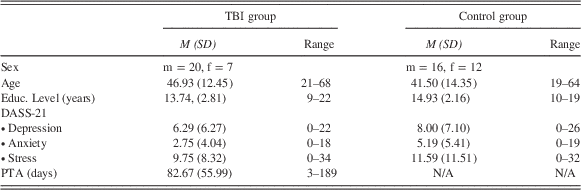
Two individuals with TBI were excluded from the study as they were experiencing high symptomatology of depression and/or anxiety (as measured by the Depression Anxiety and Stress Scale, DASS-21; Lovibond & Lovibond, Reference Lovibond and Lovibond1995, cut offs for extremely severe symptoms of depression and anxiety are 28 and 20, respectively), resulting in 27 TBI participants (20 male; 7 female). Twenty three of these participants also took part in two other studies examining emotion expression production in our laboratory (Dethier, Blairy, Rosenberg, & McDonald, Reference Dethier, Blairy, Rosenberg and McDonald2012, Reference Dethier, Blairy, Rosenberg and McDonald2013), but there was no overlap in experimental procedures. The TBI participants were aged from 21 to 68 years (M age=46.93 years; SD=12.45) and had achieved an average 13.74 years (SD=2.81) of education (range, 9–22 years). They have experienced PTA ranging from 3 to 189 days (M=82.67; SD=55.99), and time post injury ranged from 2 to 40 years (M=13.74; SD=9.23). PTA scores were obtained from medical records, with an exception of a few participants for whom medical records were unavailable. In these cases the injury was judged as severe because each reported a duration of coma exceeding 24 hr, conventionally regarded as indicating a severe injury (Corrigan, Selassie, & Orman, Reference Corrigan, Selassie and Orman2010). Based on this classification, one participant was classified as having a moderate TBI and 26 had severe TBI. Injuries were sustained as a consequence of motor vehicle accidents (n=17), falls (n=6), assaults (n=2), and accidental hits to the head during sporting events (n=2). As is common with this population, the injuries of the TBI participants were heterogeneous, and included skull fractures, contusions, intracerebral or subarachnoid hemorrhages, and subdural hemorrhages. CT scans (obtained from clinical records) revealed comparable distributions of left (n=16), right (n=15) and frontal injuries (n=13), with a large number of participants having overlapping injuries (e.g., left-hemisphere and frontal). For five participants, CT scans did not identify the injury site, or were unavailable. Before the TBI, they had been employed in occupations ranging from unskilled (n=5) to skilled trade (n=8), clerical (n=2), professional or managerial (n=8), or full/part-time study (n=4). At the time of participating in this study, five TBI participants were working in unskilled positions, three in skilled positions, one in a clerical position, three in professional/ managerial positions, three were in full or part time study, and 12 were unemployed. Description of demographic variables and socio-emotional functioning is outlined in Table 1.
Demographics and measures of socio-emotional functioning of TBI (n=27) and control (n=28) group

M, mean; SD, standard deviation; f, female, m, male; PTA; post traumatic amnesia. There are no significant group differences in all variables (p>.05)
Control group
Twenty nine healthy individuals (17 male; 12 female) were recruited from the general community. One participant was excluded from the analyses as he was currently experiencing extremely severe anxiety (as measured by the DASS-21; Lovibond & Lovibond, Reference Lovibond and Lovibond1995), resulting in 28 control participants. These participants also took part in two other studies that were conducted in our laboratory (Dethier et al., Reference Dethier, Blairy, Rosenberg and McDonald2012, Reference Dethier, Blairy, Rosenberg and McDonald2013). The baseline performance of the control and TBI participants across all intensities of the ERT has been also reported in another study (Rosenberg, Dethier, Kessels, Westbrook, & McDonald, Reference Rosenberg, Dethier, Kessels, Westbrook and McDonald2014). Control participants were aged from 19 to 64 years (M age=41.50 years; SD=14.35), had a mean education level of 14.93 years (SD=2.16 years; range, 10–19 years), and were matched as closely as possible to the TBI participants in respect to age, sex, years of education, and pre-injury occupation. At the time of the study, they had been employed in occupations ranging from unskilled (n=3) to skilled trade (n=2), clerical (n=3), professional or managerial (n=9), part/full-time study (n=7), and four participants were unemployed. For both groups, exclusion criteria included history of developmental, psychiatric, or neurological disorders (with the exclusion of the TBI in the clinical group), uncorrected vision or hearing impairments, inability to communicate effectively, and severe emotional distress, as measured by DASS-21 (Lovibond & Lovibond, Reference Lovibond and Lovibond1995).
Stimuli
The ERT (Montagne, Kessels, et al., Reference Montagne, Nys, Van Zandvoort, Kappelle, De Haan and Kessels2007) is a computer-generated program consisting of a series of 216 video clips of facial emotion expressions across different intensities ranging from 20 to 100%, which is achieved by blending them with a neutral expression. The dependent variable is accuracy for each emotion at different intensities. For a further explanation of the ERT, see Appendix 1, and for a detailed description of the stimuli development, see Frigerio, Burt, Montagne, Murray, and Perrett, Reference Frigerio, Burt, Montagne, Murray and Perrett2002; Montagne, Kessels, et al., Reference Montagne, Kessels, De Haan and Perrett2007).
Additional Measures
The 21-item, short form of the DASS (DASS-21; Lovibond & Lovibond, Reference Lovibond and Lovibond1995) was administered to all participants to assess their psychological status. The DASS-21 is a well-established measure in both clinical and non-clinical populations (Antony, Bieling, Cox, Enns, & Swinson, Reference Antony, Bieling, Cox, Enns and Swinson1998; Henry & Crawford, Reference Henry and Crawford2005) and has strong psychometric properties (Lovibond & Lovibond, Reference Lovibond and Lovibond1995).
Data Analysis
The nine intensity levels were combined into three groups to increase the number of trials for each level of intensity, and allow a simpler comparison across levels of intensity. This resulted in three intensity levels of low (20%, 30%, and 40%), medium (50%, 60%, and 70%), and high (80%, 90%, and 100%). The overall results were analyzed using a general linear model (GLM) repeated-measures analysis of variance (ANOVA), with one between-subjects factor (group) with two levels (TBI vs. controls), and two within-subjects factors: emotion type, with six levels (anger, disgust, fear, happy, sad, and surprise), and emotion intensity, with three levels (low, medium, and high) conducted using IBM SPSS Statistics version 21.0. Follow-up analyses involved repeated measures ANOVA for each emotion. Bonferroni correction was applied to all simple effect contrasts, which resulted in a corrected probability level of α=0.017 (i.e.,.05/3). A positive versus negative emotions contrast analysis was conducted using the PSY Statistical Program (Bird, Reference Bird2011). Following Ferguson’s (Reference Ferguson2009) guidelines for a minimum effect size representing a “practically” significant effect for social science data, we considered all effect sizes larger than ηp2=.04, as clinically significant. A power analysis was conducted with IBM SPSS Statistics version 21.0. Given the obtained effect sizes, the achieved power in the analyses for the main effects and interaction contrasts ranged from .74 to 1, and from .55 to .99 for simple effect contrasts.
Procedure
Participants were informed of the study procedures and gave written informed consent to participate in the study. The procedures were approved by the Human Research Ethics Board of the University of New South Wales, and conducted at the neuropsychology laboratory at the University.
Results
Confounding Variables and ERT Reliability
There were no significant differences between the TBI and control groups on distribution of sex [χ 2(1, n=55)=1.08; p=.3], pre-injury occupation [χ 2(1, n=52)=8.84; p .11], age (F 1,53=2.24; p =.14), or education level (F 1,53=3.11; p=.08). There were also no between-group differences for depression (F 1,53=0.90; p=.35), anxiety (F 1,53=3.59; p=.06), and stress (F 1,53=4.66; p=.50) as measured by the DASS-21 (Lovibond & Lovibond, Reference Lovibond and Lovibond1995). Chronbach’s Alpha for the six emotions included in the ERT from the current sample ranged from .7 to .9. According to the George and Mallery (Reference George and Mallery2003) guidelines, these reliabilities ranged from acceptable (>.7) to excellent (>.9).
Analyses of Emotion Recognition
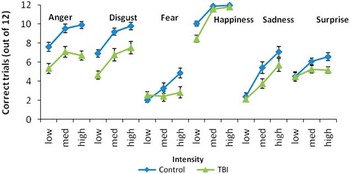
The total correct trials of the six emotions across the three intensity levels (low, medium, and high) for TBI and control participants are presented in Figure 1.
Total correct trials of six basic emotions across three intensity levels (low: 20–40%, medium: 50–70%, high: 80–100%) in participant with TBI (n=27) and controls (n=28).

Overall Emotion Accuracy
A mixed-design ANOVA revealed a significant main effect of group (F 1,53=22.59; p=.00002; ηp2=.30), indicating that, consistent with our first hypothesis, the TBI group performed more poorly overall than controls. The ANOVA also revealed a significant group×emotion interaction (F 5,53=3.59; p=.005; ηp2=.06), suggesting that, consistent with our second hypothesis, differences between TBI and control groups differed according to emotion category. This was, however, tempered by a significant three-way interaction among group, intensity, and emotion (F 7,53=2.62; p=.01; ηp2=.05) suggesting that, consistent with our third hypothesis, there was a complex interaction between group differences and intensity level that differed for the different emotions.
Accuracy for Different Types of Emotion
To examine the two-way interaction, and to tease out our second hypothesis that recognition impairment would differ across emotions, we conducted six 2 (group)×3 (intensity) mixed-design ANOVAs, one for each emotion. These revealed that participants with TBI performing significantly more poorly than controls on anger (F 1,53=21.15; p=.00003; ηp2=.29), disgust (F 1,53=16.09; p=.0002; ηp2=.23), and happiness (F 1,53=14.71; p=.0003; ηp2=.22). While observation of Figure 1 suggests that there was a trend for TBI participants to perform more poorly than controls on the remaining three emotions, these main effects failed to reach significance [fear (F 1,53=1.99; p=.16; ηp2=.04), sadness (F 1,53=3.45; p=.07; ηp2=.06), and surprise (F 1,53=3.03; p=.09; ηp2=.05)]. However, intensity played a role here, and is discussed further below.
A specific interaction contrast comparing accuracy of the two positive emotions to the four negative emotions revealed that individuals with TBI had significantly poorer recognition of negative than positive emotions, compared to controls (F 1,53=7.87; p=.007; ηp2=.13). However, observation of Figure 1 reveals that this difference was driven by high accuracy on happy facial expressions compared to the other emotions, while the recognition of surprise was more similar to the recognition of the negative emotions, especially sadness.
Influence of Intensity across Emotions
The three-way interaction (group×intensity×emotion) of the overall ANOVA suggests that not only did intensity affect accuracy differently for the different emotions, but this pattern was different in the TBI group compared to the controls. This suggestion was confirmed by the subsequent ANOVAs, which revealed a significant group × intensity interactions for fear (F 1,53=7.59; p=.001; ηp2=.13) and happiness (F 1,53=8.86; p=.002; ηp2=.14), but not for the other emotions. To explore the effect of intensity across the six emotions, we conducted three Bonferroni-corrected simple effect contrasts, for each emotion, with a corrected probability level of α=0.017 (i.e., 05/3). These comparisons revealed that the TBI group performed significantly more poorly than controls in anger and disgust, across all three intensity levels (ps≤.005; ηp2≤.35), while in fear and surprise they performed significantly more poorly only in the high intensity level (ps≤.013; ηp2=.11), but no difference was found in low and medium intensities (ps≥.13; ηp2≤.04). Of interest, the opposite pattern was observed in happiness, with the TBI group performing significantly more poorly than controls in low intensity expressions (p=.001; ηp2=.2), but not in the medium and high intensity trials (ps≥.02; ηp2≤.09). In sadness, there was no difference in emotion recognition between controls and TBI participants in all three intensities (p≥.04; ηp2≤.08).
Labeling Errors
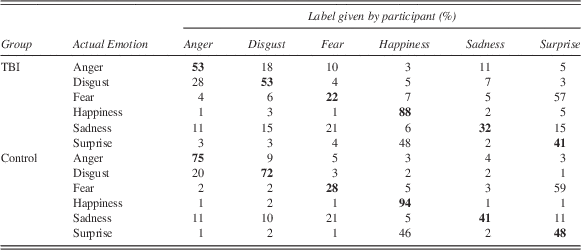
Average error scores were calculated to examine the type of errors made by control and TBI participants averaged across the nine intensities (see Table 2). Visual inspection of the error scores revealed that in both groups, some facial expressions were frequently confused with others, which was especially evident for fear and surprise. Inspection also revealed that in the control and TBI groups, surprise was most frequently labeled as happiness (46% and 48%, respectively), and fear was most commonly labeled as surprise (59% and 57%, respectively). It is especially striking that in both groups, fearful expressions were twice more likely to be incorrectly labeled as surprise (59% and 57%, respectively) than correctly labeled as fear (28% and 22%, respectively). Similarly, both groups were almost as likely to incorrectly label surprised expressions as happy (46% and 48%, respectively) as they were to correctly recognize them as surprise (48% and 41%, respectively). Of interest, this confusion did not work in reverse, since in both groups happiness was very rarely labeled as surprise (1% in control and 5% in TBI group) and surprise was rarely labeled as fear (1% in control and 4% in TBI group).
Percentage of error types for TBI (n=27) and control participants (n=28) for each of the six emotions, averaged across the nine intensities.

Note. The correct responses are in bold. For example, on average, the control group correctly labeled fearful expressions as fear 28% of the time, and incorrectly labeled them as surprise 59% of the time.
Discussion
This study investigated facial emotion recognition deficits in people with TBI, using the ERT (Montagne, Kessels, et al., Reference Montagne, Nys, Van Zandvoort, Kappelle, De Haan and Kessels2007), a sensitive measure of emotion recognition which incorporates morphed displays of facial expressions of gradually increasing intensities. By using this task, we asked whether the TBI group was more impaired in overall emotion recognition, and specifically, more impaired in the recognition of negative as opposed to positive emotions, compared to controls. In addition, we examined emotion recognition at different intensity levels, to investigate whether group differences are influenced by floor or ceiling effects.
Consistent with prior research (Babbage et al., Reference Babbage, Yim, Zupan, Neumann, Tomita and Willer2011; Bornhofen & McDonald, Reference Bornhofen and McDonald2008; Radice-Neumann, Zupan, Babbage, & Willer, Reference Radice-Neumann, Zupan, Babbage and Willer2007), we found that individuals with TBI had worse facial emotion recognition than matched controls. We also found that across the different intensities, individuals with TBI were worst at recognizing facial expressions of anger, followed by disgust, and happiness. There was also a trend of poorer recognition of surprise, sadness, and fear in the TBI group compared to the controls, but these effects failed to reach statistical significance. Furthermore, as predicted, and consistent with previous literature (Croker & McDonald, Reference Croker and McDonald2005; Green et al., Reference Green, Turner and Thompson2004; Hopkins et al., Reference Hopkins, Dywan and Segalowitz2002), individuals with TBI were more impaired on the overall recognition of the negative, compared to the positive emotions. However, examining the recognition of the individual emotions revealed that this difference was more complex than a simple positive versus negative distinction, and was dramatically affected by intensity.
Finally, we examined emotion recognition in the different intensity levels, to investigate whether individuals with TBI would benefit from increased intensity more than controls, as could be the case if recognition of some emotions were affected by floor or ceiling effects. Our findings show that as intensity increased, it became easier for both groups to recognize the emotions correctly. However, the benefit individuals with TBI received from an increase in intensity was contingent on the emotion type. The TBI group benefited from increased intensity more than controls on happiness, as evident by an impaired recognition of happy expressions compared to controls in low, but not medium and high intensities. Contrary to this, TBI patients showed the opposite pattern on fear and surprise, benefiting less than controls from increase in intensity, as evident by impaired recognition of these emotions in high, but not low and medium intensities. For the remaining three emotions—anger, sadness, and disgust—the TBI group benefited as much as control participants from increased intensity.
The response patterns for happiness, fear, and surprise are especially interesting as an illustration of the problem posed by differential difficulty levels in emotion research. Happiness is clearly an “easy” emotion. Individuals with TBI performed at the same level as controls on the high-intensity version of this expression, approaching ceiling. One reason why happiness is easier to recognize than other emotions is that it can be inferred by detecting a single feature, the smile, making this emotion unlikely to be confused with other emotions. In contrast, discriminations among negatively valanced emotions require additional information about the configuration of the face (Adolphs, Reference Adolphs2002b). Thus, inferring happiness from facial expressions might simply be too easy, and therefore inappropriate to use when comparing recognition of emotion from full-blown facial expressions (Demaree, Everhart, Youngstrom, & Harrison, Reference Demaree, Everhart, Youngstrom and Harrison2005).
Of interest, the opposite pattern was observed in fear, where responses of both groups were approaching a floor on low intensity. This suggests that, while fear becomes easier to recognize with increased intensity, it remains a difficult emotion to recognize overall, especially for individuals with TBI, but even in healthy controls (Biehl et al., Reference Biehl, Matsumoto, Ekman and Hearn1997; Russell, Reference Russell1994). A similar pattern to that observed in fear is also observed in surprise, with the TBI group performing more poorly than controls on high, but not on low and medium intensities. The similarity between fear and surprise in terms of response patterns is not surprising, and is consistent with their physical resemblance in terms of facial features, such as open eyes, raised forehead, and a slightly open mouth (Bornhofen & McDonald, Reference Bornhofen and McDonald2010). Their similarity is also reflected in the error patterns. Both groups were twice as likely to incorrectly label fearful faces as surprised, than to correctly identify them as fearful. In contrast, surprise was very rarely labeled as fear, and more frequently confused with happiness. This suggests that the categorization of surprise in the positive category alongside happiness is problematic, since it shares common features with both happiness and fear, and is consistent with the idea that it does not have as clear valence as the other emotions (Kreibig, Reference Kreibig2010).
The finding that fear is a difficult emotion to recognize, even for healthy controls, and remains so even with increased intensity, raises the question as to why is it so difficult to recognize. This finding contradicts the view that a fearful expression may signal a threat in the environment that has special status and causes early triggering of the amygdala circuit (Adolphs, Reference Adolphs2002a, Reference Adolphs2002b). According to this account, because fear and anger are processed preferentially, they should increase recognition to initiate adaptive behavioral responding (LeDoux, Reference LeDoux1995; Vuilleumier, Reference Vuilleumier2002). In contrast to this account, our findings revealed that fear clearly has attributes in common with surprise that make it confusing and difficult to recognize. Furthermore, the recognition pattern of fear is very different from the pattern of anger, which is also considered to be a part of the threat network.
One possible explanation for these results is that they reflect the cognitive appraisal of participants who were asked to label these emotions rather than simply orient to them. Thus, it is possible that threat signals lose their special status at this higher level of processing. This is consistent with the theory that threat perception might unfold along at least two parallel pathways, an early processing route and a later more elaborative conscious-level route, which are temporally and structurally dissociable (Phillips, Drevets, Rauch, & Lane, Reference Phillips, Drevets, Rauch and Lane2003).
Taken together, these findings contradict the claim that it is specifically negative emotions that are impaired by TBI, but rather suggest that particular facial configurations may be more ambiguous, and therefore more difficult, for both people with TBI and non-injured, healthy adults to ascertain. Our results indicate that differential difficulty across different categories of emotions for people with TBI reflects the same pattern of differential difficulties that is experienced by non-injured controls. Differences between groups that do emerge reflect the influence of both ceiling and floor effects. One emotion (i.e., happiness), is so easy that it is almost universally recognized at full intensity, reflecting ceiling effects. To find any group differences it needs to be at much lower intensity. Conversely, other emotions, particularly fear, are so difficult that both people with TBI and non-injured controls are very poor at identification. Possibly because of this high level of difficulty, participants with TBI are less able than their non-injured peers to make use of increasing intensity as a cue, and remain impaired, such that group differences only emerge at the easiest (100% intensity) level.
Our findings suggest that people with TBI have an overall deficit in recognizing facial affect, rather than a specific deficit in the recognition of some emotions compared to others. Furthermore, it proposes that the differential impairment in the recognition of negative versus positive emotions, which is often reported in the literature, is an artifact of the use of a limited set of six emotions and static, 100% full blown expressions, rather than representing a real neurological phenomenon. Consequently, when emotions are made more subtle by decreasing intensity, the valence effect dissipates and is replaced by a general impairment of the TBI group in emotion recognition. Thus, debates about valence based differences in emotion recognition in TBI are confounded by methodological issues.
Our results support the notion that all types of facial expressions might be processed by a single, general-purpose facial affect recognition system, rather than by specific, dedicated neural networks that subserve discrete categories of facial expressions. They also highlight the need for caution when drawing conclusions about selective impairment in the recognition of some emotions compared to others in clinical populations. To validly explore differences in recognition rates between emotions stimuli should include a comparable number of positive and negative emotions, and should be equated on difficulty level.
In addition to shedding more light on the emotion recognition difficulties following TBI, our findings have important implications for psychoeducation and remediation. Once again we have demonstrated that facial emotion recognition is impaired following TBI. As a consequence, carers would benefit from instruction to act as coaches in emotional situations by using verbal instruction and modeling, to help the person with TBI to make sense of the emotional situation rather than expecting them to simply be able to “understand” why others are upset or angry. This might reduce anger and frustration and increase pro-social functioning and societal reintegration.
Acknowledgments
This research was funded by the Australian Research Council (ARC) Discovery Project grant DP0988689 and the NHMRC. The authors have no conflict of interest affecting this manuscript. The authors wish to thank the individuals who participated in this study. The authors are also grateful to Jacob Rosenberg for assistance with data processing and Marios Panayi for statistical advice.
APPENDIX 1
Emotion Recognition Task (ERT; Montagne et al., Reference Montagne, Nys, Van Zandvoort, Kappelle, De Haan and Kessels2007).
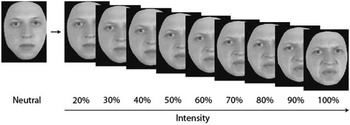
The stimuli included in the ERT were developed using algorithms (Benson & Perrett, Reference Benson and Perrett1991) which created intermediate morphed images between a neutral face (0% emotion) and a full-blown (100% emotion) expression (see Figure 2 for an example). The stimuli were based on color pictures from four actors (two male and two female) who each posed a neutral face, as well as six emotions (anger, disgust, fear, happiness, sadness, and surprise). The generated images were used to construct video clips of increasing emotional expression in 10% steps, from 20% to 100%, resulting in nine video clips for each emotion (6) and for each actor, that is, a total of 216 clips. Participants first viewed four practice trials followed by the actual task. During the task, participants saw, in a random order, the 24 video clips changing from neutral to 20% expression (6 emotional expressions by all 4 actors), followed by the 24 clips from neutral to 30%, and continued in blocks of increments of 10% until they reached the final sequence of clips in which the neutral face changed into a full-blown expression (100%). The duration of the video clips depended on the emotional intensity presented, ranging from approximately 0.5 s (20% emotion) to 3 s (100% emotion). After the clip played the static image of the final intensity, the image remained on screen while six emotional expression labels were displayed. There was no time restriction for each trial and the next trial started once the participant chose the emotion label.
The Emotion Recognition Task (ERT). Picture shows nine picture frames of gradually increasing emotional intensity of a disgusted expression. The actual test shows these frames morphing from a neutral expression in 10% increments (starting with 20% intensity).