Transoesophageal echocardiography has been used during operative treatment of patients with congenital cardiac malformations since the late 1980s. Previous reports have suggested that it plays an important role in providing additional information in the operation room.1–5 Pre- and post-operative transoesophageal echocardiography is performed to confirm the anatomical arrangements, to assess cardiac function, to evaluate the surgical repair, and to guarantee the absence of air in the cardiac chambers prior to the completion of intracardiac manipulation, all of which can assist surgeons in planning the most appropriate procedures. Recognizing the unique aspects, and growing applications, of transoesophageal echocardiography in the patient with acquired or congenital cardiovascular diseases, the Paediatric Council of the American Society of Echocardiography has established a statement specifically for the performance of transoesophageal echocardiography in children. It reviewed current indications, contraindications, issues of safety, and requirements for training in transoesophageal echocardiography.6 In this report, and in the light of these guidelines, we describe our own experiences using perioperative transoesophageal echocardiography in children with congenital cardiac diseases.
Materials and methods
Population examined
We included in our study the 350 patients, 208 being of male gender and 142 female, all with congenital cardiac diseases, who underwent surgical repair at the Children's Hospital of Fudan University between May, 2004, and August, 2005. Their ages ranged from 2 months to 17 years and 9 months, with a median age of 2.7 years. The body weight ranged 4.0 kilograms to 92.5 kilograms, with a median of 12.0 kilograms. All patients consented to the transoesophageal echocardiographic examinations.
Equipments for transoesophageal echocardiography
We used HP SONOS 2500 and Philips SONOS 7500 ultrasound machines, equipped with a paediatric biplane transoesophageal echocardiography probe and a paediatric multi-plane transoesophageal echocardiography probe (Philips Medical System, Boston, USA), respectively. Before each use, the probe was disinfected with 2% glutaraldehyde.
Technique for transoesophageal echocardiography
All of the patients were examined under general anesthesia. After tracheal intubation, the probe was introduced through a bite guard into the oesophagus. Insertion was successfully done blindly in 346 cases (98.9%), and with laryngoscopic guidance in 4 cases (1.1%). Preoperative diagnosis was always undertaken prior to the initiation of cardiopulmonary bypass. Transoesophageal echocardiography was performed again when the heart had resumed spontaneous beating after the surgical procedure. During cardiopulmonary bypass, the probe remained in the stomach in a frozen state, whereas, in those patients not requiring cardiopulmonary bypass, consecutive monitoring was feasible. All of the images were stored in the form of videotapes.
Collection of data
We collected the data prospectively on a predefined sheet. In each case, we recorded:
- general data, such as gender, age, weight
- preoperative diagnosis by transthoracic echocardiography
- preoperative diagnosis by transoesophageal echocardiography
- surgical findings
- postoperative diagnosis by transoesophageal echocardiography
- changes made in the planned operative strategy due to the transoesophageal echocardiographic findings taken either before or after the operation
- complications, if any.
Analysis of data
We categorised the impact of the intraoperative transoesophageal echocardiographic examinations in five categories:
- The preoperative therapeutic impact was refined or revised so as to change the planned surgical procedure.
- The postoperative period was complicated by severe residual problems or sequels as revealed by the postoperative transoesophageal echocardiography, necessitating instant intervention or even return to bypass for surgical modifications.
- The preoperative diagnosis required modification in the light of the preoperative transoesophageal echocardiography but without the need to alter the established surgical plan.
- The postoperative period was complicated by mild residual problems or sequels revealed by postoperative transoesophageal echocardiography that could be tolerated, and did not lead to surgical revision.
- No new information was discovered on either the preoperative or the postoperative scans when compared with transthoracic echocardiography.
A severe complication was defined as death, shock, asphyxia, oesophageal or gastric perforations, bleeding into the upper gastrointestinal tract, or arrhythmias, all seen as during the perioperative period in consequence of the transoesophageal echocardiographic scans. Mild complications were defined as dental injury, transient problems with ventilation, temporary hypotension, or trivial oropharyngeal scratches produced by the transoesophageal echocardiographic probe.
Results
Impacts of preoperative transoesophageal echocardiography
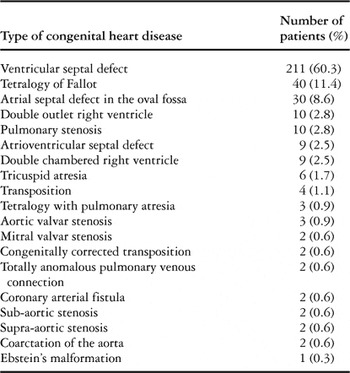
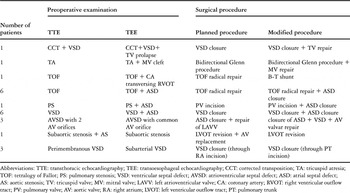
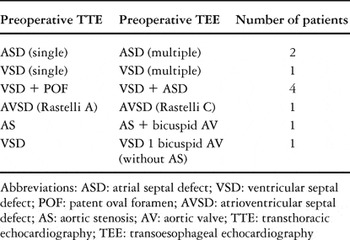
The dominant defects of all the 350 patients undergoing cardiac surgery included ventricular septal defect, tetralogy of Fallot, atrial septal defect, double outlet right ventricle, and so on, as listed in Table 1. In comparison with transthoracic echocardiography, transoesophageal echocardiography complemented or amended the diagnoses in 33 cases (33/350, 9.4%), among which there were 23 cases (23/350, 6.6%) in which the findings altered the planned surgical procedures (Table 2). In 13 patients, including 6 cases of tetralogy of Fallot, 6 cases of ventricular septal defect, and 1 case of pulmonary stenosis, an atrial septal defect was revealed by transoesophageal echocardiography just before operation. All the atrial septal defects were subsequently repaired in addition to the initially planned procedures. In 3 patients, ventricular septal defects were found to be doubly committed and juxta-arterial, rather than in perimembranous position, and therefore the route for surgical access was changed from transatrial to transpulmonary, thus facilitating the repairs. In 6 patients with valvar abnormalities, including 3 cases of atrioventricular septal defects, 1 case of isolated cleft of the mitral valve, 1 case of tricuspid valvar prolapse, and 1 case of aortic stenosis, the proposed surgical procedures were modified on the basis of the transoesophageal interrogation, and subsequently the newly identified malformations were treated in appropriate fashion. In one patient with tetralogy of Fallot, a coronary artery was discovered crossing the subpulmonary outflow tract, and the planned radical repair was changed to construction of a Blalock-Taussig shunt. The diagnoses made using transthoracic echocardiography were refined in 10 cases (2.9%), the new findings including atrial septal defects, ventricular septal defects, and so on, as shown in Table 3.
Table 1. The dominant defects in 350 patients.

Table 2. Preoperative therapeutic impact due to transoesophageal echocardiographic examination.

Table 3. Preoperative diagnostic impact due to transoesophageal echocardiographic examination.

Impacts of postoperative transoesophageal echocardiography
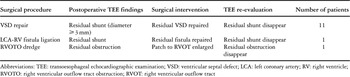
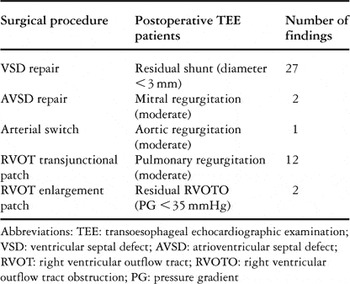
Residual problems or sequels were detected in 57 cases (57/350, 16.3%). Among them, instant intervention was needed in 13 patients (3.7%), including repair of residual ventricular septal defects in 11 cases, ligation of a coronary arterial fistula in 1 case, and revision of the obstructed right ventricular outflow tract in 1 case (Table 4). Tolerable residual problems or sequels were revealed in 44 cases, specifically in patients undergoing repair of ventricular or atrioventricular septal defects, the arterial switch procedure, or enlargement of the right ventricular outflow tract (Table 5).
Table 4. Postoperative therapeutic impact due to transoesophageal echocardiographic examination.

Table 5. Postoperative diagnostic impact due to transoesophageal echocardiographic examination.

Complications
No severe complications occurred during the perioperative periods, with mild complications observed in only 2 patients (0.6%), both due to trivial oropharyngeal scratches manifesting as minimal bleeding. Follow-up of these 2 patients with laryngoscopy showed that the lesions had healed in both patients prior to discharge from the cardiac intensive care unit. We performed transoesophageal echocardiography in 24 patients (6.9%) weighing less than 6 kilograms, and both patients suffering mild bleeding were in this group.
Discussion
Intraoperative transoesophageal echocardiography has been increasingly used during the surgical repair of patients with congenital cardiac disease. It remains to be determined, however, whether the procedure should be performed routinely or selectively, and how many patients will benefit from the procedure.3, 7–10 We carried out our investigation to help answer these questions.
Previous reports have shown that transoesophageal echocardiography prior to the commencement of the operation may be valuable in providing additional information, which may confirm or correct preoperative transthoracic echocardiography findings. Several reports have also confirmed the value of transoesophageal echocardiography in guiding transcatheter closure of atrial septal defects.11, 12 Milani et al.13 emphasised the value of the technique in visualizing atrioventricular valves, showing the arrangement of the papillary muscles, tendinous cords, annulus and leaflets, and helping the surgeon in decision-making.13 Ho et al.14 described the advantages of the technique in showing the position and number of ventricular septal defects, permitting surgical repairs to be modified on the basis of the findings.
We discovered unsuspected atrial septal defects in 13 cases, all findings having therapeutic impact. We also discovered abnormalities in atrioventricular valves in 6 patients, and the need to change the planned route for closure of ventricular septal defects in 3 patients. The guidelines have emphasized, however, that intraoperative transoesophageal echocardiography should not stand alone as the sole diagnostic technique,6 In this respect, we did find inherent limitations in imaging certain important structures, such as the patent arterial duct, the aortic isthmus, the branches of the pulmonary arteries, and so on, and relied on the transthoracic images for information regarding these structures.
We also found indications for transoesophageal echocardiography in patients not requiring cardiopulmonary bypass. Thus, we performed consecutive transoesophageal echocardiographic monitoring in 7 such patients, 6 with valvar pulmonary stenosis and 1 with a coronary arterial fistula. Our experience showed the advantage of the technique in permitting visualization of the operative procedure in real time, providing more lucid and accurate guidance for the surgeon. The technique also permitted monitoring of cardiac function throughout the whole course of the operation.
The need to return to cardiopulmonary bypass for revision on the basis of postoperative transoesophageal echocardiographic findings has varied between different medical centres.3, 15–16 Rosenfeld et al.15 reported that transoesophageal echocardiography was a highly reliable predictor of postoperative closure of ventricular septal defects, or the presence of aortic regurgitation, mitral stenosis, and mitral regurgitation. Ungerleider17 suggested that postoperative transoesophageal echocardiography had the greatest impact on three types of surgical repairs, namely closure of ventricular and atrioventricular septal defects, and relief of obstructed ventricular outflow tracts. Based on our findings, our surgeons needed to return to cardiopulmonary bypass to repair the residual problems or sequels in 3.7% of the patients, our experience largely confirming the prognostications of Ungerleider.17
The complications of the technique relate to insertion of the probe, and the subsequent procedure. Previous studies have revealed an acceptably low incidence of complications when the procedures are performed by experienced operators under proper safety conditions.3, 18–21 But operators need to be vigilant when advancing, withdrawing, rotating, or flexing the probe. In adults, several kinds of complications have been reported, including pulmonary oedema, 22 laryngeal neural palsy,23 oesophageal or gastric bleeding or perforation,24 and dysphagia.25 The complications encountered in children have been different. In addition to dysphagia, compressions of adjacent vascular structures by the probe have also been reported.26–28 Greene et al.29 performed flexible upper gastrointestinal endoscopy immediately following intraoperative transoesophageal echocardiography, and found that the technique when performed in children frequently caused mild mucosal injury, but they found no long-term difficulties in feeding or swallowing.29 We sought the help of our paediatric anesthetists to learn about passing the probe into oesophagus, especially regarding the need for laryngoscope guidance. Once resistance was encountered, the procedure was aborted, as it was if the angle modulation fell to nil. On this basis, we produced no severe complications, and only 2 of our patients suffered trivial oropharyngeal scratches, both these infants weighing less than 6 kilograms. As technology continues to improve, the introduction of smaller and more flexible probes should minimize even these complications.
In summary, therefore, the implementation of the technique has significant parallels around the world, albeit that teams may have approaches, philosophies, and resources that may be very different. Given its demonstrated value, and the minimal rate of complications, we suggest that the procedure should become routine during surgical treatment of children with congenital cardiac disease.
Acknowledgement
We thank Dr. Qi-Ling Cao from Department of Cardiology, University of Chicago Children's hospital, USA, Dr. Derek Human from Department of Cardiology, University of British Columbia Children's Hospital, Canada, and Dr. Yiu-Fai Cheung from Department of Pediatric Cardiology, the Grantham Hospital, University of Hong Kong, for their help in initiating our programme, and Dr. Shou-Bao Ning, Dr. Yong-Hao Gui from Pediatric Heart Center, Children's Hospital of Fudan University for their ongoing support. This work was supported by the Clinical Research Project of the Ministry of Health of China (20011827).