INTRODUCTION
Five decades after the Civil Rights Act was passed, racial inequalities persist in almost every area of American life. Identifying factors that explain this persistent inequality has been an important part of the scholarly effort to reduce it. Empirical evidence from this research routinely points to structural forces, such as discrimination and the unequal distribution of resources and opportunities (e.g., Massey and Denton, Reference Massey and Denton1993; Pager et al., Reference Pager, Western and Bonikowski2009). Critically, however, the American public is strongly divided in its understanding of the factors that cause inequality: While some do point to the role of systemic forces in creating and maintaining racial inequalities, many still affirm individual-focused explanations (e.g., lack of motivation or ability), either in addition to or instead of structural factors.
White Americans are particularly likely to affirm individual over structural explanations for racial inequality (e.g., Hunt Reference Hunt2007); however, not all Whites reject structural explanations (Hunt Reference Hunt2007; Kluegel Reference Kluegel1990; also see Manning et al., Reference Manning, Hartmann and Gerteis2015). It is imperative that we understand these perceptions because the possibility of reducing racial inequalities is strongly linked to public—particularly non-Hispanic White—understandings of the causes of these inequalities (Burstein Reference Burstein1998; Manza and Brooks, Reference Manza and Brooks2012). Indeed, these perceptions have been directly tied to policy support. Adherence to individual-centered explanations for inequality is associated with lower support for policies meant to address existing racial disparities, such as government spending on “improving the conditions of blacks” (Kluegel Reference Kluegel1990, p. 520), affirmative action, and welfare (Groskind Reference Groskind1994; Kluegel and Smith, Reference Kluegel and Smith1983). Although the proportion of Whites in the population is declining, Whites continue to disproportionately influence national and local policies, which makes understanding their beliefs about inequality especially important for directing political change (also see DiTomaso Reference DiTomaso2013). Why do some non-Hispanic Whites continue to use individual instead of structural perspectives to explain racial inequality? We aim to elucidate the processes underlying this range in perceptions as part of a larger effort to understand persistent racial inequality in the United States.
We provide insight into the processes driving perceptions of the causes of racial inequality by developing a framework informed by social psychological theories of out-groups and racialized boundaries and by taking advantage of unique data available through the Portraits of American Life Study (PALS). First, by examining how Whites explain inequality for a previously unstudied group—Asians—and for Blacks, we assess whether a group’s position in the racial hierarchy is linked to the types of explanations employed by Whites when explaining racial disadvantage. Second, we examine the extent to which the importance given to race in one’s identity relates to how Whites explain racial disadvantage. We aim to provide insight into the processes related to social position and out-group boundaries that affect perceptions of racial inequality; however, we emphasize that our findings are associational and cannot establish causal direction. Despite this limitation, this research offers a unique analysis and will help inform how we frame future discussions of inequality, as well as our understanding of how race structures U.S. society.
EXPLANATIONS FOR RACIAL INEQUALITY
A rich history of scholarship investigating explanations for racial inequality lays the foundation for our own research (see especially Hunt Reference Hunt2007; Kluegel Reference Kluegel1990; Kluegel and Bobo, Reference Kluegel, Bobo, Sniderman, Tetlock and Carmines1993; Schuman and Krysan, Reference Schuman and Krysan1999). We review this literature in order to situate our contributions within the broader strokes of the field; however, we also identify an important missing theoretical link—namely, how social boundaries are reflected in people’s understandings of racial inequality in the United States—that we aim to address, at least in part, through our own research.
Early research (e.g., Kluegel Reference Kluegel1985; Kluegel and Bobo, Reference Kluegel, Bobo, Sniderman, Tetlock and Carmines1993; Kluegel and Smith, Reference Kluegel and Smith1982) conceptually divided explanations for racial inequality into two types—individual and structural—and this framework continues to be used in recent work (e.g., Croll Reference Croll2013; Hunt Reference Hunt2007; Manning et al., Reference Manning, Hartmann and Gerteis2015; Shelton Reference Shelton2017). Individual explanations for inequality locate the cause of inequality within the disadvantaged individual. These individual-centered explanations can range from the traditionally overt racist notion that disadvantaged individuals have less innate ability or intelligence to a more “equal opportunity” rhetoric, such as the belief that disadvantaged individuals are less motivated or less willing to work hard to succeed. Structural explanations for inequality, on the other hand, reference disparate opportunities by race within the legislative and educational systems, widespread racism and discrimination, and lingering effects of historical oppression (Kluegel Reference Kluegel1990; Kluegel and Bobo, Reference Kluegel, Bobo, Sniderman, Tetlock and Carmines1993).
A second core feature of prior research on explanations for racial inequality is the use of the same set of questions, which we will refer to as the “traditional questions.” The traditional questions ask respondents to affirm or deny the impact of four factors in causing Black disadvantage relative to Whites in jobs, income, and housing: 1) discrimination, 2) lack of access to quality education, 3) lack of motivation, and 4) lack of inborn ability to learn (Kluegel Reference Kluegel1990). These questions continue to be used with few if any changes (see e.g., Shelton Reference Shelton2017). One important aspect of these questions to consider is the target group. Historically, these questions were used to address only one minority group—Blacks. While this may have been reasonable when the questions were first developed, increasing racial and ethnic diversity challenges the utility of this singular focus on Blacks. In fact, scholars have argued that increased diversity and its social consequences require fundamental changes to our approach to asking questions about racial/ethnic inequality in addition to needing to include a larger number of racial/ethnic minorities in our analyses (see especially Abascal Reference Abascal2015; Kim Reference Kim1999). Research in other areas of racial inequality, particularly the literature on residential preferences, has already taken steps in this direction (e.g., Bobo and Zubrinksy, 2006), but more attention is needed when studying explanations for racial inequality.
Related to the need to expand our attention beyond explaining Black-White inequality, scholars have begun to attend to how a wider range of groups—not just Whites—explain racial inequality (Croll Reference Croll2013; Hunt Reference Hunt2007; Shelton Reference Shelton2017; also see Manning et al., Reference Manning, Hartmann and Gerteis2015). While including the perceptions of other groups is beyond the scope of our study given our focus on other theoretical innovations, this emerging research highlights an important theoretical consequence of research focusing on Whites: Our current understanding of explanations for racial inequality has been developed from the perspective of a racialized group in a position of political and social power. In effect, much of our theoretical development is specific to the dynamic represented by how those on top (i.e., Whites) view the disadvantage of those on the bottom of the racial hierarchy (i.e., Blacks). We extend this previous focus by explicitly incorporating relative social position into our theoretical framework and by examining the significance of the varying importance attached to one’s Whiteness.
HOW SOCIAL BOUNDARIES CONTRIBUTE TO PERCEPTIONS OF RACIAL INEQUALITY
We argue that social boundaries are centrally involved in shaping perceptions of racial inequality and subsequently the explanations individuals employ to explain it. Explanations for racial inequality involve the identification of causes for disparities that exist across racialized social groups. We use Lamont and Molnár’s (Reference Lamont and Molnár2002) definition of social boundaries to inform our analysis of those explanations. They describe social boundaries as “objectified forms of social difference manifested in unequal access to and unequal distribution of resources (material and nonmaterial) and social opportunities” (p. 168). Lamont and Molnár importantly distinguish between social boundaries, which delineate groups that have objectively disparate experiences or outcomes, and symbolic boundaries, which are “conceptual distinctions made by social actors to categorize” people (p. 168). Symbolic boundaries are necessary for the creation of social boundaries but are distinct because they exist at the perceptual level only. That is, social boundaries exist because of objective disparities across groups, but the degree to which social boundaries are salient to individuals is determined by the strength of the symbolic boundaries they draw between themselves and others (Lamont and Molnár, Reference Lamont and Molnár2002; Lamont et al., Reference Lamont, Silva, Welburn, Guetzkow, Mizrachi, Herzog and Reis2016). We argue that the social boundaries between racial groups—including their relative positioning among one other—as well as the degree to which these social boundaries are salient—i.e., the strength of symbolic boundaries—shape explanations for racial inequality.
Of particular relevance to how symbolic boundaries are involved in the explanations used by Whites is the “ultimate attribution error” (Pettigrew Reference Pettigrew1979). The ultimate attribution error is the tendency for individuals to attribute their own failings to outside forces but others’ failings to internal, dispositional causes. Critically, attribution error is more common when the boundary between the individual and the identified person or group is more distinct. Drawing on this perspective, James Kluegel (Reference Kluegel1985) argues in his work on perceptions of racial inequality that racial/ethnic groups that are “otherized” to a greater extent will be viewed primarily through an internal/individualistic rather than structural lens. In this way, the contrast between in-group and out-group explanations becomes starker when the perceived distance between the groups is greater. Scholars have used the ultimate attribution error to understand racial and ethnic bias in a variety of settings (e.g., Froehlich et al., Reference Froehlich, Martiny, Deaux and Mok2016; Yamamoto and Maeder, Reference Yamamoto and Maeder2017; also see Hewstone Reference Hewstone1990), but the consequences of this social psychological process have received limited attention within sociological research on perceptions of racial inequality. We elaborate on this core argument in the following sub-sections to detail how social and symbolic out-group boundaries connect to research on racial hierarchies and White identity to help us better understand explanations for racial inequality in the United States.
Racial Hierarchies
The ongoing transformation of the racial/ethnic composition of the United States due to increased immigration from Asian and Latin American countries has increased scholarly efforts to understand the structure of emerging racial/ethnic hierarchies. Despite greater attention to these new hierarchies (see e.g., Bonilla-Silva Reference Bonilla-Silva2014; Gans Reference Gans and Lamont1999, Reference Gans2012; Lee and Bean, Reference Lee and Bean2007, Reference Lee and Bean2010), implications of this work have yet to be incorporated into the framing of Whites’ explanations for racial inequality (for an alternative approach to incorporating emerging racial/ethnic hierarchies, see Croll Reference Croll2013).
We argue that the social position of groups is reflected in how others explain that group’s material disadvantage. In this analysis, we assess this argument by examining how Whites explain Asian disadvantage—a dynamic not yet studied in this literature—in addition to how Whites explain Black disadvantage. The strategic juxtaposition of Blacks—a traditionally negatively viewed group—and Asians—a generally positively viewed group—provides strong analytical leverage for examining how group position is related to the explanations offered by Whites. The connections between social position and explanations for inequality are complex and likely reciprocal. However, even identifying associational differences in the explanations offered by Whites is valuable because doing so would suggest that Whites’ explanations are, at least in part, shaded by racial biases rather than guided by a universal theory of inequality that applies to all racialized out-groups.
Social Positions of Blacks and Asians
Despite sharing a racial/ethnic minority status, Blacks and Asians occupy distinct positions within the U.S. racial hierarchy. Social positions are multidimensional, but, by most measures, Asians have a higher social positioning than Blacks. This relative positioning is reflected in traditional measures of social distance, such as patterns of interracial marriages (e.g., Qian and Lichter, Reference Qian and Lichter2007), residential segregation (e.g., Logan and Stults, Reference Logan and Stults2011; Logan and Zhang, Reference Logan and Zhang2010) and Whites’ reported neighborhood preferences (Bobo and Zubrinsky, 1996; Emerson et al., Reference Emerson, Chai and Yancey2001; Lewis et al., Reference Lewis, Emerson and Klineberg2011). Indeed, analysis of a traditional social distance measure—comfort with intermarriage—in our own data (discussed below) indicates that Whites feel more socially distant from Blacks than Asians. When asked how comfortable they would be if their daughter married someone who is Black, twice as many Whites expressed discomfort (42%) than when the proposed marriage partner was Asian (21%).
Similarly, research examining material racial disparities generally suggests a hierarchy in which Asians are positioned above Blacks, while Blacks remain the most disadvantaged group (Hochschild et al., Reference Hochschild, Weaver, Burch, Hochschild, Weaver and Burch2012; Lee and Bean, Reference Lee and Bean2010; O’Connell et al., Reference O’Connell, King and Bratter2016; Taylor et al., Reference Taylor, Wang, Parker, Passel, Patten and Motel2012). Although some segments of the Asian population are in a similar position of disadvantage as Blacks (e.g., Hmong), the monolithic Asian group often holds a socioeconomic advantage relative to Blacks and even relative to Whites (Fong Reference Fong2008). We emphasize that at least some Asians remain socioeconomically disadvantaged by discrimination in the United States (see e.g., Kim and Sakamoto, Reference Kim and Sakamoto2010), which means that the question asking respondents to explain Asian-White inequality is still a relevant one despite similarity in aggregate outcomes. However, the socioeconomic success of Asian Americans has led scholars to postulate that at least some Asian groups will assimilate into Whiteness within the next century (Bonilla-Silva Reference Bonilla-Silva2002, Reference Bonilla-Silva2014; Yancey Reference Yancey2003; but see Kim Reference Kim2007). In other words, this similarity in socioeconomic status may lead Whites to feel a sense of commonality with Asians and to draw a weaker symbolic boundary between themselves and Asians as a result of the weaker social boundary defined by aggregate material disparities. This may subsequently affect the explanations for inequality that Whites employ for Asians.
The above evidence suggests that Whites will use individual-centered explanations to explain the disadvantage of Asians at a lower rate than they will for Blacks because Asians occupy a social position nearer to their own than Blacks. However, there are other axes along which an out-group may be evaluated that suggest the opposite hypothesis.
In contrast to the positive image painted above, prior research has found that Whites view Asians as potential threats because of their economic success (Ho and Jackson, Reference Ho and Jackson2001) and perceive them as perpetually foreign (Devos and Banaji, Reference Devos and Banaji2005; Huynh et al., Reference Huynh, Devos and Smalarz2011; Sue et al., Reference Sue, Bucceri, Lin, Nadal and Torino2007; Xu and Lee, Reference Xu and Lee2013). In addition, out-groups that are perceived as competent are also often perceived as cold (Fiske et al., Reference Fiske, Xu, Cuddy and Glick1999). These perceptions may lead Whites to draw stronger symbolic out-group boundaries between themselves and Asians and to “other” them more than Blacks. As a result, Whites may actually be more likely to employ individual explanations for Asian relative to Black disadvantage, despite Asians’ higher overall position within the racial/ethnic hierarchy based on social and economic outcomes.
Importance of Whiteness
The measures of social boundaries and relative position in the U.S. racial hierarchy presented above provide indirect evidence of the symbolic boundaries Whites draw among themselves, Blacks, and Asians in the aggregate. However, there is likely variation in the strength of the boundaries that individual Whites draw. We argue that the importance of race to an individual’s own identity is a helpful, albeit still indirect, indication of how strongly they perceive symbolic boundaries between themselves and other racialized groups.
White identity has received increasing attention in the study of racial inequality (Bunyasi Reference Bunyasi2015; Croll Reference Croll2013; McDermott Reference McDermott2015). We contribute to this emerging focus by elaborating on the theoretical pathways linking Whiteness to perceptions of the causes of racial inequality. Specifically, we argue that the importance of race to one’s identity informs which explanations are employed to explain racial disadvantage through processes linked to the strength of perceived out-group boundaries.
Similar to our argument regarding social positioning and the racial hierarchy, we use the ultimate attribution error perspective to argue that seeing race as important to one’s identity could influence the strength with which symbolic racial out-group boundaries are perceived and therefore influence the explanations for racial inequality that individuals employ.Footnote 1 Consistent with this argument, Miles Hewstone (Reference Hewstone1990) identifies the salience of group membership as “the most basic cognitive factor” underlying the ultimate attribution error (p. 328). Although attribution error applies to all individuals, we argue that this phenomenon may be more pronounced and/or more likely among those with stronger White identities when considering racialized issues. Therefore, we hypothesize that Whites who assign a higher importance to their Whiteness will be more likely to explain Black and Asian disadvantage using individual rather than structural causes than Whites who assign a lower importance to their Whiteness (also see Bunyasi Reference Bunyasi2015).
DATA & METHODS
Portraits of American Life Study
We employ the second, most recent wave of the Portraits of American Life Study (PALS) collected in 2012 in order to address questions regarding how social and symbolic boundaries shape Whites’ explanations for racial inequality. The PALS is a nationally-representative study that focuses on religion and race (Emerson et al., Reference Emerson, Sikkink and James2010). These data are ideal for extending our understanding of Whites’ explanations for other racial groups’ disadvantage because they allow us to compare Whites’ explanations for Black and Asian disadvantage (but, unfortunately, not Hispanic disadvantage) and to explore the role that the strength of a White identity plays in shaping explanations for racial inequality.
The response rate in the second wave of the PALS was 51%, and the survey was conducted using multiple methods: 80% were conducted online, 13% by phone, and 7% in-person. We use sample weights provided by the PALS researchers for all analyses to adjust for the geographic-based selection of respondents (zip codes were the primary sampling units) and attrition between waves. The second wave included 1,417 total respondents, 771 of whom are non-Hispanic White and are the focus of our analysis. A total of fifty respondents, or 6.5% of the White sample, had missing values on at least one of the independent or dependent variables. We employed listwise deletion to address missing values, leaving a final sample size of 721. Previous research suggests that dropping these missing cases will not significantly bias our results given that the missing cases represent less than 10% of the total sample (Langkamp et al., Reference Langkamp, Lehman and Lemeshow2010). Additionally, descriptive analyses suggest that Whites with missing data are similar to those in our analytic sample based on observed characteristics.
Our analysis proceeds in two steps: 1) We conduct a descriptive comparison of factors used to explain Black and Asian disadvantage; and 2) We estimate two separate regression models that provide insight into the impact that the importance of race to one’s identity has on explanations used for Black and Asian disadvantage. Because our dependent variables, described further below, have more than two categories with no particular rank order (i.e., they are nominal variables), we employ multinomial regression analysis. Multinomial logistic regression is preferred to a series of binary logistic regressions because of its increased statistical efficiency.
Dependent Variables: Explanations for Racial Inequality
PALS respondents answered the following questions regarding Black and Asian disadvantage: “To some people’s surprise, research shows that, on the average, [black/Asian] Americans have worse jobs, incomes, and housing than white Americans. I will read you a list of five reasons people give for this difference. Tell me with which of the following you agree.”Footnote 2 Respondents gave answers of “yes” (coded as 1) or “no” (coded as 0) when asked if the differences were: a) mainly due to discrimination, b) because most [Blacks/Asians] don’t have access to a quality education, c) because most [Blacks/Asians] have less in-born ability to learn, d) because most [Blacks/Asians] just don’t have the motivation or the will power, or e) due to cultural and language differences between [Blacks/Asians] and Whites. We will subsequently refer to these questions as the discrimination, education, ability, motivation, and culture and language explanations, respectively. The order in which the five explanations were presented was randomized. Respondents were asked the question twice, first about Blacks and then about Asians, in separate sections of the survey. The question on Black disadvantage was consistently asked before the question on Asian disadvantage. It is possible that consistency bias could have affected answers to the Asian disadvantage questions, as respondents may have wanted to give answers consistent with their answers to the Black disadvantage questions. However, this bias would contribute to fewer differences in White explanations for inequality across groups. As a result, these data provide a conservative estimate of differences in how Whites explain Black and Asian disadvantage. We further note that the phrase, “to some people’s surprise,” is a unique introduction for this set of questions, which may make our results somewhat distinct from other surveys. The principle investigators of the survey added the phrase to make rejection of the question premise—that racial inequality exists —less likely. We revisit the possibility of this occurring despite this wording in the conclusion, but we expect that this addition will benefit our analysis by increasing the number of meaningful responses.
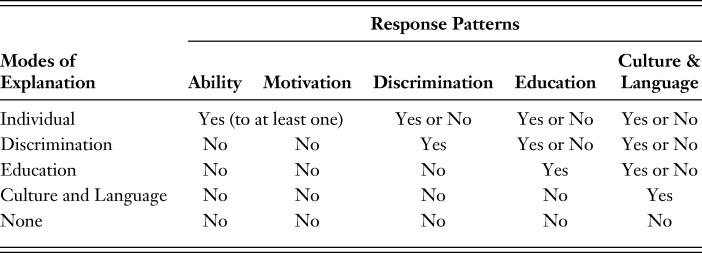
Respondents could affirm more than one explanation (or none), which results in thirty-two possible response combinations (see Appendix A). Consistent with previous research, we construct “modes of explanation” (Kluegel Reference Kluegel1990) that collapse similar answer combinations in order to improve the conceptual clarity of our regression analysis (also see e.g., Hunt Reference Hunt2007). We rely on theory to drive our final decisions regarding how to combine the responses, but we also employ a post-regression test that indicates the extent to which categories in a multinomial dependent variable are distinguishable based on the characteristics in the model. Specifically, we use results provided by the “mlogtest” post-estimation package in Stata 13 (Stata Corp 2013). This approach empirically evaluates the extent to which different response combinations are used by distinct sub-groups within the sample. For instance, the test allows us to assess whether individuals who affirm both individual and structural explanations (e.g., ability and discrimination) differ significantly from individuals who affirm only individual or only structural explanations.
We began the mode creation process by relying on the modes of explanation established in previous work (e.g., Hunt Reference Hunt2007; Kleugel Reference Kluegel1990). There are seven original modes that reflect both the individual-structural dichotomy and specific mixes of individual and structural explanations: ability, mixed-ability, motivation, mixed-motivation, discrimination, education, and none. The mixed categories indicate affirmation of the specified individual explanation along with affirmation of one or more of the structural explanations. We also added a separate mode for the culture and language explanation that was absent from the data employed previously. Our initial set of modes, therefore, included eight distinct categories. We conducted the post-estimation “mlogtest” on a full regression model using these eight categories to assess which of the modes could be combined due to statistical similarity. Our results suggested that only five of these initial eight modes were statistically distinguishable from one another (see Table 1).
Constructed Modes of Explanations for Racial Inequality

Table 1 details how respondents were allocated to each of the five modes based on their combinations of answers to the five questions. The first mode, the Individual mode, includes any respondents who affirmed “in-born ability” and/or “motivation” as factors causing racial inequality. Our post-estimation results suggest that affirmation of an individual explanation is a unique and distinguishing characteristic: Whites who affirmed one or both of these explanations did not differ from one another on any of the characteristics included in our model, regardless of whether they also affirmed structural explanations. Thus, affirmation of individual explanations is privileged in our mode creation because these answers differentiate individuals from all other response combinations. As a result, we combine these two response types into a single mode despite separation of the ability and motivation explanations in prior work (e.g., Kluegel Reference Kluegel1990). This decision does not affect our substantive conclusions. The Discrimination mode includes all respondents who affirmed the discrimination explanation (i.e., they may have also affirmed the education or cultural and language differences explanation), minus those who also affirmed either the ability or motivation explanations. The Education mode includes respondents who affirmed the education explanation either alone or in combination with the culture and language explanation, but not in combination with the discrimination, ability, or motivation explanations.
The culture and language differences explanation is a new addition to studies of perceived causes of racial inequality, so its alignment with the other explanations is particularly enlightening. Our post-estimation tests suggest that the Culture and Language mode could be combined with the Individual mode for the Black regression model. However, for the Asian model, the combination test results were only marginally significant. These results suggest some ambiguity in how this explanation is employed: Whites using this explanation for Black disadvantage are statistically indistinguishable from the Whites who rely on individual explanations, but the exclusive use of this explanation for Asian disadvantage is more distinct from the other modes of explanation. Given the novelty of this explanation, we maintain a separate Culture and Language mode that includes respondents who affirmed the cultural and language differences explanation and no other explanations.Footnote 3 This approach allows us to more fully assess how individual characteristics align with the use of this explanation relative to the more traditionally employed explanations. Finally, the None mode includes respondents who said “no” or “I don’t know” to all five explanations.
Independent Variables
Importance of White Racial Identity
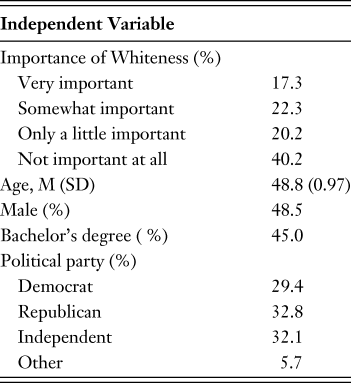
To assess the centrality of Whiteness to a person’s identity, we draw on responses to a question asking, “When you think about yourself, how important to you is being White to your sense of who you are?” Answer choices (coded 1–4) were “very important,” “somewhat important,” “only a little important,” and “not important at all.” Overall, 17% of Whites responded with “very important,” 22% with “somewhat,” 20% with “only a little,” and 40% with “not important at all.” We maintain all four categories in our analysis and use the “very important” response as the reference. Alternative configurations of this variable were tested and do not affect the reported results.
Controls
Prior research indicates that a variety of other factors shape how Whites explain racial inequality and therefore need to be accounted for in our analysis (e.g., Bunyasi Reference Bunyasi2015; Croll Reference Croll2013; Hunt Reference Hunt2007; Kluegel Reference Kluegel1990; Kluegel and Smith, Reference Kluegel and Smith1982). First, we measure respondents’ political affiliation using responses to whether they are Republican, Independent, Democrat (reference), or some other political affiliation. We also measure respondents’ educational attainment using a binary variable that distinguishes among respondents that have a college degree (1) and those who do not (0). This binary approach is consistent with the idea that four-year college attendance can be a transformative experience with regard to students’ political and social attitudes (Lottes and Kuriloff, Reference Lottes and Kuriloff1994). However, we investigated a number of other categorical specifications for respondents’ answers, including three- and four-category approaches. These additional distinctions were not significant and do not otherwise affect our models. Finally, a continuous measure of age (ranging from 21 to 80) and a dichotomous measure of gender (male=1, female=0) are included in each model. A table with weighted descriptive statistics of our covariates can be found in Appendix B.
Additional variables were considered but ultimately excluded from the final models due to their limited contributions and our desire to preserve statistical power. Specifically, household income was included in preliminary analyses but was not significant and reduced the sample size significantly due to nonresponse. Similarly, despite previous research suggesting important differences in racial inequality explanations based on Christian religious affiliation (see Emerson and Smith, Reference Emerson and Smith2001), indicators for Christians or fundamentalist Christians were not significant in our models. Finally, region of residence was not significant when we accounted for the sampling structure of the PALS data using the sampling weights. Our substantive results are unaffected by excluding these variables.
RESULTS
Our presentation of results is organized into two sections. First, we compare Whites’ explanations for Black and Asian disadvantage to assess any differences in Whites’ reported perceptions. Second, we examine the results of our multinomial logistic regressions and a coefficient comparison test to assess how the importance of Whiteness to one’s identity shapes explanations of racial inequality.
Reflections of the Racial Hierarchy in Explanations for Black and Asian Disadvantage
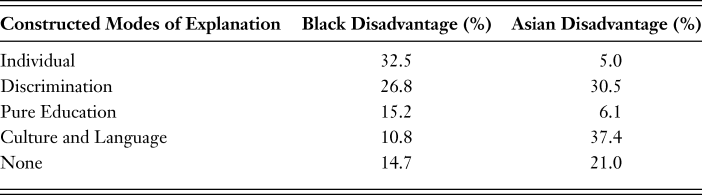
A comparison of the explanations for racial inequality provided by Whites suggests substantial differences depending on the target group. Table 2 shows the percentage of respondents in the weighted sample that affirmed a given cause of Black and Asian disadvantage. Note that the percentage total exceeds 100 because respondents could affirm more than one explanation. We also provide the breakdown of respondents across our constructed modes (see Table 3). However, we focus our discussion on the results in Table 2 because it provides a more complete picture of all of the responses given, and the patterns are virtually identical when examining the distributions across the modes.
Weighted Distribution of Whites’ Explanations for Black and Asian Disadvantage, PALS Wave 2 (N=721)

Note: The sum of the percentages exceeds 100 because respondents could affirm more than one explanation.
Weighted Distribution of Constructed Modes of Whites’ Explanations for Black and Asian Disadvantage, PALS Wave 2 (N=721)

Consistent with temporal trends presented in previous studies (Kluegel and Bobo, Reference Kluegel, Bobo, Sniderman, Tetlock and Carmines1993; Hunt Reference Hunt2007), few Whites in our 2012 data stated that Blacks have less in-born ability to learn than Whites (5%). Even fewer—2%—affirmed this explanation for Asians. The distinction in how Whites think about inequality for Blacks relative to Asians is more pronounced when considering the other individual-centered explanation: 32% of Whites said that Black-White inequality is caused by Blacks lacking motivation, whereas only 4% of Whites affirmed this explanation for Asians. These results are consistent with the broader idea that the prevailing racial hierarchy is reflected in perceptions of racial inequality and the specific expectation that Whites will use individual-centered explanations more for Blacks than for Asians.
Despite the disparities in individual-centered explanations, Whites did not differ in the rates at which they affirmed discrimination as a cause of Black and Asian disadvantage. About a third of Whites affirmed this explanation for each group. This suggests that the use of structural explanations is not related to racial/ethnic hierarchies in the same way as individual-centered explanations. However, the distributions are quite different for the other structure-oriented explanation focused on access to quality education. Roughly 40% of Whites stated that lack of educational opportunities causes Black disadvantage. In contrast, only 13% of Whites affirmed this explanation for Asian disadvantage. Finally, while 69% of Whites stated that culture and language differences cause Asian disadvantage, only 45% of Whites affirmed this explanation for Black disadvantage. These distinctions are unexplained by our theoretical model, but they are consistent with the understanding that these explanations—namely, educational opportunities and culture and language differences—may be particularly susceptible to alternative interpretations depending on the target group (i.e., “culture and language differences” may mean something different to White respondents when considering Blacks compared to Asians). We elaborate on the consequences of this possibility in our discussion section. Among our constructed modes of explanation, we find very similar patterns, namely more support of individual-centered explanations for Blacks than for Asians but similar rates of acknowledgement of discrimination (see Table 3).
In addition to these aggregate differences, we find telling differences in the explanations employed by the same person. Even among Whites who gave responses consistent with the Individual mode for Black disadvantage, only 38% used the same type of explanations for Asian disadvantage (not shown). The corresponding figure when focusing on White responses for Asian disadvantage is strikingly higher: 75% of Whites who gave explanations consistent with the Individual mode for Asian disadvantage gave similar responses for Black disadvantage. The greater consistency from the vantage point of Asian disadvantage reflects the less frequent use of individual-centered explanations for Asian disadvantage by Whites and the selectivity of that group. The large discrepancy among Whites who use individual-centered explanations for Blacks suggests that Whites use different logics when explaining racial inequality for different target groups. Furthermore, the pattern is consistent with the expectation that a group’s position within the racial hierarchy is related to Whites’ perceptions of that group’s disadvantage, specifically that there is greater social distance between Whites and Blacks than Whites and Asians.
There was greater consistency among those who were in the Discrimination mode. Whites who see discrimination as a factor explaining racial disadvantage for one group are likely to do so for the other group: 68% of Whites who were in the Discrimination mode for Black disadvantage were in the same mode for Asian disadvantage; the corresponding percentage for Whites in the Discrimination mode for Asian disadvantage is 78%. The evidence suggests clear overlap in the use of a Discrimination explanation; however, we note that there is some indication that Whites who are in the Discrimination mode for Black disadvantage are less likely—by 10 percentage points—to be in the same for mode for Asian disadvantage than vice versa.
These results suggest the complexity of how Whites’ perceptions of a group may affect the explanations given, such that the direction of and/or the factors informing a groups’ relative position are not always the same. But what explains the wide variation in how Whites think about what causes racial inequality? We next examine the individual characteristics associated with the type of explanations employed by Whites (i.e., their identified “mode”) in two multinomial logistic regression models—one for Black disadvantage and one for Asian disadvantage. We set the Discrimination mode as the base outcome in each model because it represents the “strongest” structural mode (Kluegel Reference Kluegel1990). Choosing this base allows us to compare use of the Discrimination mode with the Individual mode as well as the Education, Culture and Language, and None modes.
Explaining Black Disadvantage
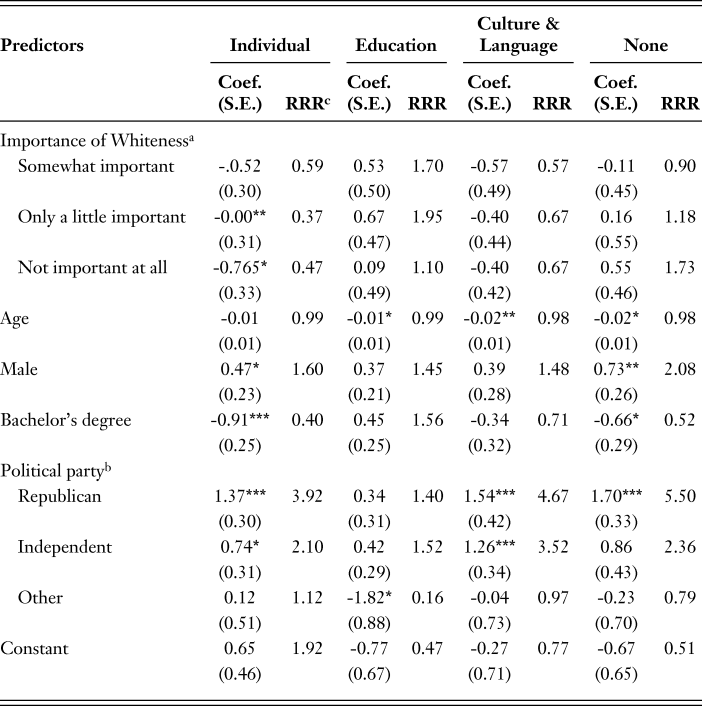
The most pronounced differences in our Black disadvantage model are between the Individual and Discrimination modes (see Table 4). Respondents employing individual rather than discrimination explanations are more likely to be male, less likely to have a bachelor’s degree, and more likely to be a Republican or Independent compared to a Democrat. In addition to sociodemographic differences identified in previous work, our results suggest that the importance of Whiteness to one’s identity is a significant distinguishing factor. With other factors controlled, Whites who report that being White is “only a little important” or “not important at all” to their identity have a significantly lower risk of being in the Individual rather than the Discrimination mode relative to Whites who find their Whiteness to be “very important” to their identity. Whites for whom race is important to their identity—either somewhat or very important—have a higher probability of using individual explanations than Whites who see race as less important to their identities. With all other covariates held at their means, the predicted probability of affirming individual-focused explanations is 0.30 for Whites who state that their Whiteness is not at all important to their identity, while the probabilities for those who say that their Whiteness is somewhat or very important are 0.37 and 0.49, respectively.
Weighted Multinomial Logistic Regression of Whites’ Explanations for Black-White Inequality, Reference: Discrimination (N=721)

a Reference: Very important
b Reference: Democrat
c Relative risk ratio
* p<0.05, ** p<0.01, *** p<0.001
In contrast to the Individual mode, the Education mode is largely indistinguishable from the Discrimination mode. The only factors that significantly explain being in the Education mode relative to the Discrimination mode are age and one category of political affiliation (i.e., “other” relative to Democrat). For each unit increase in age, Whites’ relative risk of being in the Education mode decreases, meaning that older individuals are less likely to affirm educational explanations than they are discrimination. Additionally, the relative risk for Whites who indicated an “other” political affiliation suggests that they are less likely than Democrats to be in the Education mode instead of Discrimination. This limited distinction is not surprising because both modes are related to a broader structural perspective.
Whites in the Culture and Language mode are distinguished from those in the Discrimination mode by age and political affiliation. Similar to Whites who are more likely to be in the Individual mode, Republican and Independent Whites have a higher relative risk of being in the Culture and Language mode relative to Democrats. However, unlike the Individual mode, the salience of Whiteness to one’s identity does not help explain who employs the culture and language explanation instead of a Discrimination mode of explanation.
Finally, we find that age, gender, education, and political affiliation significantly differentiate Whites who affirm none of the explanations for Black disadvantage from those in the Discrimination mode. Being female, older, and having a bachelor’s degree decrease Whites’ risk of being in the None mode. Identifying as Republican, however, is associated with a relative risk ratio of 5.5 relative to Democrats, suggesting greater representation of Republicans within the None category relative to the Discrimination mode. We reflect more on the potential meaning of the None mode in our discussion section.
Explaining Asian Disadvantage
In contrast to what we discussed above in relation to Blacks, the importance of being White to one’s identity does not significantly distinguish Whites who are in the Individual versus Discrimination modes when explaining Asian disadvantage. This suggests a weaker role of the boundary processes associated with the importance of race to Whites’ identity when the target group is Asians. We formally tested the difference between the coefficients for the importance of race to one’s identity across the Black and Asian models by employing simultaneous regression analysis and a coefficient comparison test using the SUEST and LINCOM commands in Stata. The results indicate that the coefficients for both “only a little important” and “not important at all” are significantly different across the two models, such that the coefficients for these categories are smaller in the Asian disadvantage model (not shown). The smaller magnitude of these coefficients in the Asian model provides evidence that the importance of race to one’s identity is more involved in the processes shaping White explanations for Black disadvantage than Asian disadvantage. This suggests that the ways in which Whiteness is linked to explanations of Black disadvantage do not extend to all other racialized groups. The other Individual mode results are similar to the model examining explanations for Black disadvantage: Whites who are older and do not have a bachelor’s degree have a higher risk of being in the Individual mode compared to the Discrimination mode.
The remainder of the Asian disadvantage results is remarkably similar to what we found in the Black disadvantage model. Due to that similarity, we provide a brief summary of the results rather than describing them in detail. First, no factors significantly differentiated Whites in the two structural modes (i.e., Education and Discrimination). Second, political identification relates significantly to White respondents’ risk of being in the Culture and Language mode. Third, having less than a bachelor’s degree and being a Republican or Independent increased respondents’ risk of being in the None mode relative to the Discrimination mode.
Weighted Multinomial Logistic Regression of Whites’ Explanations for Asian-White Inequality, Reference: Discrimination (N=721)

a Reference: Very important
b Reference: Democrat
c Relative risk ratio
* p<0.05, ** p<0.01, *** p<0.001
CONCLUSIONS AND DISCUSSION
Disparities along racialized lines continue to pervade almost every aspect of American life, but there is a discrepancy between the reasons that the White public and social scientists give for their persistence. Such a discrepancy between social perceptions and empirical realities reminds us that studying perceptions is as necessary to understanding society as is studying social problems themselves. As Jeff Manza and Clem Brooks (2012) contend, “the struggle over public opinion is…a key part of the struggle for power” (p. 92).
Though we cannot establish a causal direction with our analysis or identify the specific dimensions of group positions that are driving perceptions of racial disadvantage, our study provides suggestive evidence regarding the processes that shape the explanations Whites use to explain racial inequalities by assessing the roles of social position and out-group boundaries. This is accomplished in two steps. First, we compare Whites’ explanations for Black and Asian disadvantage. This particular comparison illuminates the extent to which out-group position within racial hierarchies affects the types of explanations Whites employ and more generally extends the scope of research on Whites’ explanations for racial disadvantage. We find that Whites are more likely to employ individual explanations for Black disadvantage than Asian disadvantage but employ structural explanations at similar rates for both groups. Second, we unite research on explanations for disadvantage with related work on racial identity in order to assess whether the importance given to Whiteness influences the use of individual versus structural explanations. Our results indicate that Whites who see their race as being important to their identity are more likely to use individual rather than structural explanations for Black disadvantage but not Asian disadvantage. These extensions provide useful insight into the social psychological processes that shape the way Whites understand racial inequality. In the following sections, we revisit our most important findings and discuss their implications for theory and future research.
Racial Boundaries Shape Whites’ Explanations for Racial Inequality
The broader picture of the U.S. racial hierarchy is reflected in our results: The social position of a racial group is tied to Whites’ perceptions of their disadvantage. Whites employ individual explanations more often for Blacks than for Asians, but they employ explanations related to discrimination at similar rates. The more frequent use of the individual-centered explanations for Blacks is consistent with the argument that Whites utilize a more individualistic lens for Blacks than Asians because Whites draw stronger symbolic boundaries between themselves and Blacks than between themselves and Asians. Importantly, however, Asians’ position does not translate into a higher acceptance of structural explanations, particularly discrimination, when explaining their inequality. Therefore, our results suggest that adherence to individual explanations is related to a group’s position within the racial hierarchy, but affirmation of the role of discrimination does not follow this same pattern. This distinction could develop if the position of the target group primarily affects views of the out-group, while leaving views of the in-group intact. Discrimination requires a negative evaluation of Whites, the in-group for the respondents in our study, and therefore would be unaffected by the social position of the out-group. Similar to recent research highlighting the distinction between explaining other racialized groups’ disadvantage and White advantage (Croll Reference Croll2013), our results suggest that approaches aimed at increasing White acknowledgment of structural explanations––particularly those that negatively implicate White America––will need to differ from those aimed at reducing any emphasis on individual explanations.
We further contribute to understanding the role of racial boundaries in shaping Whites’ perceptions by examining how the importance of race to one’s identity is related to which explanations Whites affirm. Our regression results suggest that seeing race as important to one’s identity is significantly related to the likelihood of adherence to individual relative to discrimination explanations, but only in the case of Black disadvantage. Whites who see race as more important to their identities are more likely to rely on individual frames to explain Blacks’ disadvantage. The exact mechanisms involved in this process are unidentifiable in the present study, but we suggest that this relationship may result from stronger motivation to engage in boundary work to protect the privileged position of Whites (Lamont and Molnár, Reference Lamont and Molnár2002). Acknowledging the disadvantage of other racialized groups may be a greater psychological threat when race is more important to one’s identity because more is bound up in that particular aspect of one’s identity. Additional theoretical insight can be gained from the fact that White identity did not significantly distinguish the Discrimination mode from the Education, Culture and Language, and None modes. This suggests that the salience of race to one’s identity only matters for use of explanations found at the poles of the individual/structural dichotomy; the other modes of explanation may not be as clearly linked to or activated by the racialized boundaries associated with the importance of being White. Moreover, we emphasize that the boundary associated with this aspect of Whiteness is triggered to a greater extent when Whites think of Blacks compared to when they think of Asians. This suggests that the symbolic boundary of Whiteness is defined in closer relation to Blackness than it is to Asian-ness, and it may reflect differences in how Whites otherize Asians relative to Blacks. Perceptions of Asians as perpetually foreign (e.g., Sue et al., Reference Sue, Bucceri, Lin, Nadal and Torino2007), for example, could mean that the centrality of being American to one’s identity may be much more salient when considering Whites’ explanations for Asian disadvantage (also see Abascal Reference Abascal2015). Similarly, Kim (Reference Kim2007) has argued that the racialization and subordination of Asians by White Americans is closely bound up with citizenship. Our results reflect that distinction in how Asians and Blacks are racialized and emphasize the need to consider the specific historical and contemporary dynamics that contribute to a group’s racialized position (also see Quisumbing King Reference Quisumbing King2018). Despite their shared connection to more generalizable boundary-making processes, the content of those boundaries may differ.
Conceptual Challenges to Measuring Explanations for Racial Inequality in an Era of Transforming Racisms
While not our primary focus, our study highlights two aspects related to the measurement of explanations for racial inequality that raise important questions for future research. First, regarding the differential use of the culture and language explanation for Black relative to Asian disadvantage, we need additional insight into the extent to which the interpretation of this explanation differs depending on the target racial group. Second, a sizeable portion of respondents rejected all offered explanations of racial inequality, which suggests the need to investigate their reasons for doing so.
Interpreting Culture and Language across Groups
Overt racism persists, as evidenced by the continued use of the ability explanation among Whites in our sample, but scholarly debate has increasingly focused on the historical shift in the explanations being used. Many theories of new racism contend that older, more overt expressions of racism that center on the biological inferiority of minority groups are being replaced by new subtler expressions, such as ones that focus on the culture of minority groups (e.g., Bobo et al., Reference Bobo, Kluegel, Smith, Tuch and Martin1997; Bonilla-Silva Reference Bonilla-Silva2014). Our results share some connection to this literature through our analysis of the culture and language explanation. We find an important distinction in its use by Whites, suggesting that this form of racism may carry more or less weight depending on the minority group in question. However, existing theoretical developments (see especially Bonilla-Silva Reference Bonilla-Silva2014) have focused primarily on how these new types of racism apply in reference to Blacks; its relevance or comparability when considering other groups has yet to be determined. A critical extension to this discussion of the role of cultural racism will center on how it is applied across different racialized groups.
Our results cannot speak to how Whites are interpreting the explanations provided, but we offer some speculation based on evidence from our post-estimation tests. These tests indicate that the culture and language explanation aligns with individual-centered explanations when Whites explain Black disadvantage but not when Whites explain Asian disadvantage. This supports the notion that this explanation has distinct manifestations depending on the target racial group. Specifically, it suggests that individuals who only reference culture and language differences when explaining Black-White inequality are most similar to the Whites who affirm individual-centered explanations. Culture and language may be providing an alternative to using the more traditional individual-centered explanations. In contrast, identifying culture and language differences as the only factor explaining Asian-White inequality was not as interchangeable with the individual explanations––it seemed to be a unique explanatory category. This distinction is consistent with differences in how the targeted attributes––culture and language––are discussed for each group within U.S. society. Consider, in particular, references to how Black culture and vernacular is deemed inconsistent with or inappropriate in mainstream society, whereas notions of Asian culture conjure ideas about the “model minority” (Xu and Lee, Reference Xu and Lee2013) and temporary barriers to English language acquisition among the immigrant population. We suggest that the complex nature of race, including its meaning and the characteristics attached to a given racialized group, necessitates a more nuanced, race-specific approach when measuring and studying explanations for inequality (also see Abascal Reference Abascal2015; Kim Reference Kim1999). Additional research that can speak more directly to how respondents are interpreting the available explanations is needed to address this argument.
Understanding the “None” Respondents
The percentage of Whites rejecting all causes of inequality offered by the traditional questions (i.e., those in the “None” mode) has risen from 9% in 1977 to over 21% in 2014 (authors’ calculation using weighted General Social Survey data; for similar results see Hunt Reference Hunt2007). Even with the added option of cultural and language differences, which was not available in the GSS, 15% of Whites in the PALS survey still rejected all explanation choices for Black disadvantage.
Expressions of disagreement with the available options could be due to a number of causes. First, it may suggest that the explanations are inadequate to capture contemporary perspectives. If this is the case, then revised survey questions are necessary. Second, rejection of all explanations could suggest a disagreement with the basic premise of the question––that Blacks and Asians are in fact disadvantaged––despite the question explicitly noting that the existence of inequality may come as a “surprise.” Finally, rejection of all explanations could be due to a general apathy regarding racial inequality. Tyrone Forman (Reference Forman, Krysan and Lewis2004) describes racial apathy as a new form of prejudice characterized by a lack of concern about racial inequality and an avoidance of engaging with social issues regarding race. Resolving what explains the rise in the “none” category will be an important direction of future research if we are to continue to advance our understanding of how people conceive of racial inequalities.
Expanding Our Understanding of Inequality Explanations
The findings of this study support the investigation of a wide range of new questions, but we focus on three that we have not yet discussed. First, there is the question of how individuals outside of the dominant White group explain racial inequalities and whether the factors identified for Whites apply to those groups as well. It is not immediately clear whether all of our findings will extend to other racialized groups because Whites occupy a unique position of privilege and power in American society. Indeed, other dynamics may be operating for other groups, and the identification of such dynamics is increasingly relevant to understanding explanations of inequality in the United States (also see Croll Reference Croll2013). Second, and related, we have compared Whites’ explanations for the disadvantage of Blacks and Asians, the racialized groups that occupy the most disparate social positions in the racial/ethnic hierarchy. However, now that we have set the stage, researchers should conduct a complete comparison across the major racial/ethnic categories using alternative data sources and perhaps even consider divisions within these larger umbrella categories (e.g., Cubans versus Mexicans). Finally, future research should consider the extent to which changing racial/ethnic configurations will affect the connections that we see between racialized boundaries and explanations for inequality. Our findings provide insight into the current racialized landscape, but many scholars have postulated that existing boundaries will shift in the near or distant future (Alba Reference Alba2012; Gans Reference Gans and Lamont1999; Hochschild et al., Reference Hochschild, Weaver, Burch, Hochschild, Weaver and Burch2012). Importantly, some predict that Asians and Hispanics will assimilate into Whiteness as the Irish and Italians did a century ago (Yancey Reference Yancey2003). Our research suggests that the extent to which and direction in which these shifts occur will partially determine the future of how Americans explain racial inequality.
ACKNOWLEDGMENTS
We thank Tony Brown and Patrick Sharkey for their valuable comments and suggestions on an earlier draft, and the support of Michael O. Emerson and Junia Howell. We also thank the American Sociological Society for the opportunity to present this research at the 2016 annual meetings in Seattle, WA.
APPENDIX A: COMBINATIONS OF EXPLANATIONS FOR RACIAL DISADVANTAGE
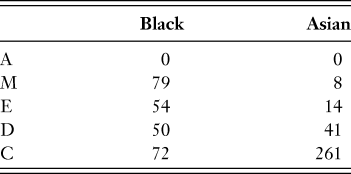
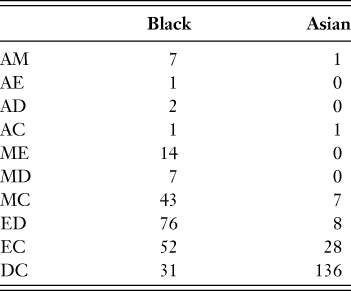
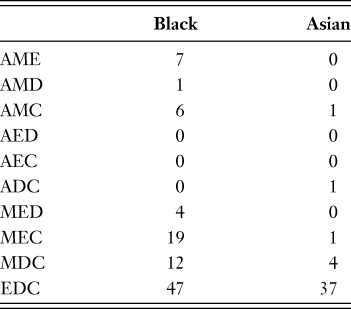
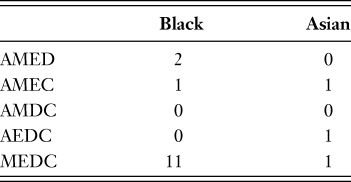
The following tables present the frequency with which White respondents affirmed each possible combination of explanations for Black and Asian disadvantage.
Abbreviations Key

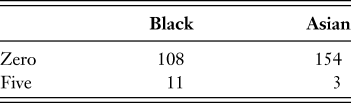
The Number of Respondents Who Used None or All of the Explanations

The Number of Respondents Who Used Only One Explanation

The Number of Respondents Who Used Two Explanations

The Number of Respondents Who Used Three Explanations

The Number of Respondents Who Used Four Explanations

APPENDIX B: DISTRIBUTION OF INDEPENDENT VARIABLES IN PALS WAVE 2 SAMPLE
Weighted Distribution of Independent Variables, PALS Wave 2 (N=721)