


Introduction
Depressive and anxiety disorders are two widespread categories according to the Diagnostic and Statistical Manual of Mental Disorders (DSM-5; American Psychiatric Association, 2013). These disorders are highly prevalent, so that the lifetime prevalence rate is estimated at 29% and 19% for anxiety disorders and depressive disorders, respectively (Kessler et al., Reference Kessler, Berglund, Demler, Jin, Merikangas and Walters2005a).
Although cognitive behavioural therapy (CBT) has empirically been established as the gold standard treatment modality for most depressive and anxiety disorders (American Psychiatric Association, 2009; National Collaborating Centre for Mental Health, 2011; National Institute for Health Care and Excellence, 2013), there is a gap between the studies indicating CBT’s efficacy and its effective use in clinical settings (Pearl and Norton, Reference Pearl and Norton2016). Most CBT protocols are disorder specific; however, the evidence suggests that anxiety and depressive disorders are co-morbid and often experienced simultaneously (Harvey et al., Reference Harvey, Watkins and Mansell2004; Kendler, Reference Kendler1996; Kessler et al., Reference Kessler, Chiu, Demler and Walters2005b). Several studies have reported a prevalence of co-morbidity ranging from 40 to 80% (Brown et al., Reference Brown, Campbell, Lehman, Grisham and Mancill2001; Kessler et al., Reference Kessler, Chiu, Demler and Walters2005b). Furthermore, individuals with co-morbid emotional disorders have lower efficacy of treatment than those who have only one disorder (Rosellini et al., Reference Rosellini, Boettcher, Brown and Barlow2015). Brown et al. (Reference Brown, Campbell, Lehman, Grisham and Mancill2001) found that there was a correlation between co-morbidity and severity of symptoms, duration of their experience, incentive and effort for treatment, higher relapse rates, and suicide risk. Nevertheless, it appears that judging the effectiveness of CBT cannot be simple. Hilbert et al. (Reference Hilbert, Kunas, Lueken, Kathmann, Fydrich and Fehm2020) maintain that prediction of CBT outcomes in most studies is based on traditional research methods that are often inaccurate; however, if more accurate methods are used that can calculate the effect of various variables correctly, different results will be obtained. They used machine learning analysis in their study. The results showed that the predictor performance significantly exceeded the chance level, but it was far from the clinical utility. Neither applying more sophisticated approaches nor restricting the sample to homogeneous subgroups resulted in considerable performance gains.
Results of studies on psychopathology indicate the presence of similar or common aetiological and maintenance processes and factors between these disorders, ranging from genetic to familial and environmental factors (Kessler et al., Reference Kessler, Berglund, Demler, Jin, Merikangas and Walters2005a; Newby et al., Reference Newby, McKinnon, Kuyken, Gilbody and Dalgleish2015). It is also found that these disorders, despite their differences, have many similarities in cognitive, emotional, behavioural and interpersonal fields (Harvey et al., Reference Harvey, Watkins and Mansell2004; Talkovsky and Norton, Reference Talkovsky and Norton2018).
In this regard, experts concluded that they needed a new approach that could provide a more accurate and practical conceptualization of disorders to achieve a better outcome in the prevention and treatment of emotional disorders (Barlow et al., Reference Barlow, Allen and Choate2004; Fairburn et al., Reference Fairburn, Cooper and Shafran2003). As a result, they shifted their focus from a single diagnosis to multiple diagnoses. They utilized the ‘transdiagnostic’ term to introduce and explain the new approach. A transdiagnostic process is ‘an aspect of cognition or behavior that may contribute to the maintenance of a psychological disorder’ (Harvey et al., Reference Harvey, Watkins and Mansell2004; p.14). In recent years, the use of this term has significantly increased, and many experts have used it to describe their various therapeutic approaches (e.g. Barlow et al., Reference Barlow, Farchione, Fairholme, Ellard, Boisseau, Allen and Ehrenreich-May2011; Leichsenring and Salzer, Reference Leichsenring and Salzer2014; Norton and Philipp, Reference Norton and Philipp2008). However, despite their commonalities in the focus angle (focusing on several disorders rather than one disorder), there are differences between them in terms of conceptualization and ways by which their treatment results in improving different disorders (Newby et al., Reference Newby, McKinnon, Kuyken, Gilbody and Dalgleish2015).
To clarify these differences, Sauer-Zavala et al. (Reference Sauer-Zavala, Gutner, Farchione, Boettcher, Bullis and Barlow2017) sought to classify them into separate categories based on the criteria set out in several articles. First, Mansell et al. (Reference Mansell, Harvey, Watkins and Shafran2009) set what they described as ‘arbitrary but challenging criteria’ to determine whether a process could be considered transdiagnostic. Specifically, their criteria require that transdiagnostic processes be assessed in both clinical and non-clinical samples and be present in a minimum of four disorders. More recently, Harvey and colleagues (Harvey et al., Reference Harvey, Murray, Chandler and Soehner2011) have highlighted differences between constructs that are ‘descriptively transdiagnostic’ (i.e. processes present in various diagnoses), which is consistent with the criteria proposed by Mansell et al. (Reference Mansell, Harvey, Watkins and Shafran2009), and those that are ‘mechanistically transdiagnostic’ (i.e. processes reflecting a causal, functional mechanism for co-occurrence).
A large number of transdiagnostic constructs have been discovered and reported in a wide range of disorders, for instance emotional regulation (Sloan et al., Reference Sloan, Hall, Moulding, Bryce, Mildred and Staiger2017). Many studies have demonstrated the central roles of problems in emotional regulation strategies in the creation and maintenance of various mental disorders (Aldao, Reference Aldao2012; Aldao and Dixon-Gordon, Reference Aldao and Dixon-Gordon2014; Aldao et al., Reference Aldao, Nolen-Hoeksema and Schweizer2010; Carpenter and Trull, Reference Carpenter and Trull2013; Gratz et al., Reference Gratz, Weiss and Tull2015). According to studies, there are problems with emotional regulation in more than 85% of disorders reported in DSM (Kring and Sloan, Reference Kring and Sloan2009). Difficulties in emotional regulation can be defined as the lack of necessary skills for regulating emotional responses or using maladaptive strategies (Sloan et al., Reference Sloan, Hall, Moulding, Bryce, Mildred and Staiger2017). Problems of emotional regulation have been identified as an obstacle to the treatment process (Norton and Mehta, Reference Norton and Mehta2007). Aldao et al. (Reference Aldao, Nolen-Hoeksema and Schweizer2010) found a very strong association between the use of maladaptive emotion regulation strategies (e.g. experimental avoidance, suppression and rumination) and symptoms of disorders, their duration in individuals with anxiety, depression, eating disorders, and substance abuse.
The unified protocol for emotional disorders (Barlow et al., Reference Barlow, Farchione, Fairholme, Ellard, Boisseau, Allen and Ehrenreich-May2011), is a transdiagnostic therapy protocol, which is a cognitive behavioural protocol focusing on emotional regulation processes. Numerous studies have reported the effectiveness of this treatment for various disorders, either as a single disorder or co-morbid (e.g. Barlow et al., Reference Barlow, Farchione, Bullis, Gallagher, Murray-Latin, Sauer-Zavala and Boswell2017; Bullis et al., Reference Bullis, Sauer-Zavala, Bentley, Thompson-Hollands, Carl and Barlow2015; Farchione et al., Reference Farchione, Fairholme, Ellard, Boisseau, Thompson-Hollands, Carl and Barlow2012; Harris and Norton, Reference Harris and Norton2019; Mohajerin et al., Reference Mohajerin, Bakhtiyar, Olesnycky, Dolatshahi and Motabi2019; Steele et al., Reference Steele, Farchione, Cassiello-Robbins, Ametaj, Sbi, Sauer-Zavala and Barlow2018).
Furthermore, perfectionism is a multi-dimensional construct, leading to a particular cognitive and behavioural style having both normal and abnormal aspects (Frost et al., Reference Frost, Marten, Lahart and Rosenblate1990). Abnormal or dysfunctional perfectionism has centred on the pursuit of unrealistically high standards and self-criticism due to failure to meet those standards (Limburg et al., Reference Limburg, Watson, Hagger and Egan2017), and it can involve a set of assumptions and behaviours that are maladaptive (Stumpf and Parker, Reference Stumpf and Parker2000). Dysfunctional perfectionism has been described as a transdiagnostic process playing a crucial and effective role in the aetiology and maintenance of several disorders, such as anxiety, mood and eating disorders (Dunkley et al., Reference Dunkley, Sanislow, Grilo and McGlashan2006; Egan et al., Reference Egan, Wade and Shafran2011; Limburg et al., Reference Limburg, Watson, Hagger and Egan2017; O’Connor et al., Reference O’Connor, Rasmussen and Hawton2010; Shafran et al., Reference Shafran, Cooper and Fairburn2002).
Dysfunctional perfectionism positively correlates with worry and rumination (Xie et al., Reference Xie, Kong, Yang and Chen2019), and is assumed to be associated with stress and interpersonal difficulties (Chang et al., Reference Chang, Watkins and Banks2004). Tran and Rimes (Reference Tran and Rimes2017) in a mediational analysis found that beliefs in emotions mediated the relationship between unhealthy perfectionism and emotional suppression, and emotional suppression mediated the relationship between unhealthy perfectionism and symptoms of depression. Some studies suggest that dysfunctional perfectionism can predict poor outcomes in treatment due to problems with relationships and assignments (e.g. Shahar et al., Reference Shahar, Blatt, Zuroff, Krupnick and Sotsky2004). It has been suggested that targeted interventions to reduce mental illness stigma should be tailored to address the beliefs and concerns of perfectionistic people vulnerable to distress (Shannon et al., Reference Shannon, Goldberg, Flett and Hewitt2018). Clinical perfectionism can also cause co-morbidity in disorders (Bieling et al., Reference Bieling, Summerfeldt, Israeli and Antony2004).
Therefore, treatments targeting clinical perfectionism can reduce this factor in addition to symptoms associated with disorders. This issue has been reported in several studies investigating the effectiveness of CBT of perfectionism in various disorders, both specifically and co-morbidly, and both face-to-face or internet-based (e.g. Egan and Hine, Reference Egan and Hine2008; Egan et al., Reference Egan, van Noort, Chee, Kane, Hoiles, Shafran and Wade2014a; Handley et al., Reference Handley, Egan, Kane and Rees2015; Kothari et al., Reference Kothari, Barker, Pistrang, Rozental, Egan, Wade and Shafran2019; Limburg et al., Reference Limburg, Watson, Hagger and Egan2017; Riley et al., Reference Riley, Lee, Cooper, Fairburn and Shafran2007; Rozental et al., Reference Rozental, Shafran, Wade, Egan, Nordgren, Carlbring and Thelander2017; Steele and Wade, Reference Steele and Wade2008; Wade et al., Reference Wade, Kay, de Valle, Egan, Andersson, Carlbring and Shafran2019; Zetterberg et al., Reference Zetterberg, Carlbring, Andersson, Berg, Shafran and Rozental2019).
The current study
Given that the transdiagnostic treatment with the unified protocol for emotional disorders (Barlow et al., Reference Barlow, Farchione, Fairholme, Ellard, Boisseau, Allen and Ehrenreich-May2011) does not target perfectionism directly and specifically, and according to some researchers’ views that ignoring the perfectionism can be a barrier to psychotherapy and undermine effectiveness (Blatt et al., Reference Blatt, Zuroff, Bondi, Sanislow and Pilkonis1998; Egan et al., Reference Egan, Wade and Shafran2011; Fairburn et al., Reference Fairburn, Cooper, Doll, O’Connor, Bohn, Hawker, Wales and Palmer2009; Mitchell et al., Reference Mitchell, Newall, Broeren and Hudson2013), we are curious to know whether perfectionism also creates an obstacle to the effectiveness of the unified protocol.
Given the focus of cognitive behavioural therapy for perfectionism (CBT-P) on perfectionism as a transdiagnostic construct, and focus of the unified protocol for transdiagnostic treatment (UP) on emotion regulation as another construct, the present study compared three groups of individuals with depression and anxiety disorders and dysfunctional perfectionism in three phases, namely the pre-treatment, post-treatment, and a 6-month follow-up; two treatment groups, CBT-P and UP, and a waiting list control group (WL). In fact, it was interesting for us to investigate which target construct would be more effective in reducing the severity of disorders in individuals with problems with both transdiagnostic constructs. Therefore, the present study examined several hypotheses and questions:
(1) CBT-P and UP are superior to the waiting list status.
(2) The effectiveness of two treatment groups will be maintained at 6-month follow-up.
(3) Is there any difference between effects of two treatment groups on perfectionism and emotion regulation constructs in the post-treatment and/or follow-up phases?
(4) Is there any difference between effectiveness of two treatment groups on the severity of other symptoms associated with emotional disorders in the post-treatment and/or follow-up phases?
Method
Participants
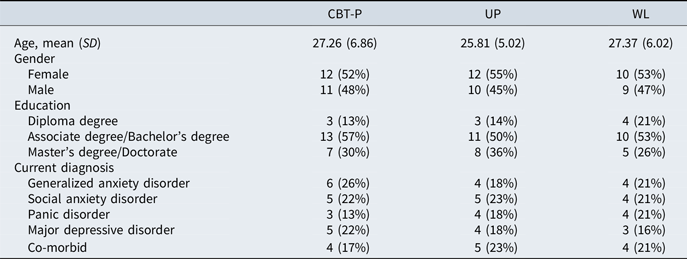
The participants were selected from clients of four counselling and psychotherapy centres in Tehran. First, as a criterion of entry, individuals were selected with scores higher than 24 (the suggested cut-off point in one review study by Egan et al., Reference Egan, Wade and Shafran2011) on the Concern over Mistakes (CM) subscale from the Frost Multidimensional Perfectionism Scale (FMPS; Frost et al., Reference Frost, Marten, Lahart and Rosenblate1990), as well as score 7 and higher on the depression subscale, and 6 and higher on the anxiety subscale from the Depression Anxiety Stress Scale (DASS-21; Lovibond and Lovibond, Reference Lovibond and Lovibond1995). Other inclusion criteria were as follows: minimum of 18 years of age; at least high school diploma degree; and being motivated and satisfied with participation in the research. Using structured interviews based on the diagnostic criteria of DSM-5, the individuals who received diagnostic criteria for at least one disorder such as generalized anxiety disorder (GAD), social anxiety disorder (SAD), panic disorder (PD) and unipolar depression as the principal diagnosis, were selected at the next stage. Exclusion criteria were as follows: severe thinking about self-harm or suicide; psychosis; major medical illness; history of substance abuse or alcohol consumption over the past year; other psychiatric disorders (except depressive and anxiety disorders) as the principal diagnosis; any moderate to severe impairment in attention and concentration; any psychological treatment and any change in psychotropic medication from 3 months prior to entering treatment to the end of the follow-up. In total, 127 people were assessed for eligibility. In the end, 75 individuals were included and randomized to one of three conditions (25 per group). Finally, nine of the participants starting treatment did not complete the treatment programme, and 64 participants continued to collaborate until the end of study and were analysed (CBT-P: 23 participants; UP: 22 participants; WL group: 19 participants). Final participants included 30 males (average age 26.1 years) and 34 females (average age 27.0 years) with an age range of 18–40 years. See Table 1 for the final sample characteristics and Fig. 1 for the flowchart.
Demographic characteristics of CBT-P, UP and WL

Consort diagram of participant flow. CBT-P, cognitive behavioural therapy for perfectionism; UP, unified protocol for transdiagnostic treatment; WL, waiting list control group.

Design and procedure
Baseline stage measurements were performed after selecting eligible participants and obtaining written consent to participate in the study and make audio recordings of sessions. The participants were randomly allocated to three groups (CBT-P, UP and WL). The Random Allocation Software (Saghaei, Reference Saghaei2004; version 1.0) was used due to various diagnoses to select an appropriate combination for each group. Using this software, a list of random numbers was allocated to participants, and it was decided to which group each one should be allocated. The patients were individually stratified on primary diagnosis prior to randomization (i.e. GAD, SAD, PD or major depressive disorder) and randomly assigned to either CBT-P, UP or WL. The randomization was performed 2 weeks before the treatment to allow participants to plan and prepare for sessions. All three groups were re-examined after the treatment sessions. The final evaluation was also performed 6 months after the randomization. Immediately after ending the follow-up period, the waiting list participants received cognitive behavioural interventions. All evaluations were conducted at pre-treatment, post-treatment and follow-up stages blindly by a Master’s student in clinical psychology. All stages of research were performed under the supervision of faculty members in the Department of Clinical Psychology at Shahid Beheshti University of Medical Sciences. This randomized controlled trial complied with the CONSORT guidelines (Moher et al., Reference Moher, Hopewell, Schulz, Montori, Gøtzsche, Devereaux and Altman2010) and was registered as a clinical trial with the Iranian Registry of Clinical Trials (IRCT; 2008).
Treatments
Cognitive Behavioral Therapy for Perfectionism (CBT-P)
The treatment was individually conducted in one session per week, and each session lasted for 60 minutes. Number and content of treatment sessions were selected based on the proposed protocol and included the following steps:
-
Session 1: Assessment and motivation to change: pros and cons of changing perfectionism.
-
Session 2: Cognitive behavioural formulation.
-
Session 3: Psychoeducation and self-monitoring.
-
Sessions 4–5: Checking, avoidance, and counterproductive behaviours, behavioural experiments and surveys.
-
Session 6: Dysfunctional scheme for self-evaluation.
-
Session 7: Rigidity, rules and extreme standards.
-
Sessions 8–9: Cognitive biases: behavioural experiments, including pleasurable activities, refocusing attention, cognitive restructuring and thinking errors.
-
Session 10: Problem solving (including relaxation/time management strategies/procrastination).
-
Session 11: Self-criticism and self-compassion.
-
Session 12: Relapse prevention.
The Unified Protocol for transdiagnostic treatment (UP)
The treatment was individually conducted in one session per week, and each session lasted for 60 minutes. Number and content of treatment sessions were selected based on the proposed protocol and included the following steps:
-
Session 1: Psychoeducation and treatment rationale.
-
Session 2: Motivational enhancement.
-
Session 3: Emotional awareness.
-
Sessions 4–5: Cognitive reappraisal.
-
Session 6: Prevention of emotional avoidance.
-
Sessions 7–8: Interoceptive exposure.
-
Sessions 9–11: Situational exposures.
-
Session 12: Relapse prevention.
Therapists
CBT-P was implemented by a PhD student in clinical psychology who had been trained and accredited in cognitive behavioural therapy. He was also one of the translators of the book Cognitive Behavioral Therapy for Perfectionism (Egan et al., Reference Egan, Wade, Shafran and Antony2014b) in Persian. He used the relevant protocol for CBT-P prior to initiating the study for 2 years. During the research, the student’s treatment sessions were weekly supervised by a senior clinical psychologist familiar with the treatment protocol and qualified in CBT.
A clinical psychologist accredited in cognitive behavioural therapy implemented UP. He was also a translator of the book Unified Protocol for Transdiagnotic Treatment of Emotional Disorders (Barlow et al., Reference Barlow, Farchione, Fairholme, Ellard, Boisseau, Allen and Ehrenreich-May2011) in Persian and had used UP prior to initiating the study for about 4 years.
All therapy sessions for every participant were audio recorded. Four (for each protocol) independent clinical psychologists qualified in CBT and familiar with the treatment protocols, randomly selected and rated the audiotapes of 10% of all sessions. The raters listened to the records and rated the degree of adherence to the protocol as well as the quality of the therapy session using the following dimensions: supportive encouragement, conveyance of expertise and warmth. These dimensions were adopted from the criteria used by Agras et al. (Reference Agras, Walsh, Fairburn, Wilson and Kraemer2000) in their study of treatment for bulimia nervosa. All ratings were made on a Likert scale ranging from 1 to 7. No significant difference was found between the therapists in adherence to the protocol and quality of therapy sessions. The mean score for adherence to the UP protocol was 5.79 (SD 1.12), and 5.64 (SD 1.04) for the CBT-P protocol (i.e. good). Quality of therapy sessions was also good, with the mean score for supportive encouragement 5.51 (SD .97) for UP therapist and 5.66 (SD 1.18) for CBT-P therapist, conveyance of expertise 5.89 (SD 1.14) for UP therapist and 5.74 (SD 1.22) for CBT-P therapist, and warmth 5.87 (SD .96) for UP therapist and 5.99 (SD .89) for CBT-P therapist.
Measures
Structured Clinical Interview for DSM-IV-TR (SCID; First et al., Reference First, Spitzer, Gibbon and Williams2002)
The SCID is a valid and reliable semi-structural interview and is widely used to diagnose psychiatric disorders based on DSM-IV-TR (American Psychiatric Association, 2000). Its reliability coefficient was reported to be from 0.1 to 0.7 according to specific diagnostic groups (First et al., Reference First, Spitzer, Gibbon and Williams2002). Diagnostic agreement was 0.52 for all current diagnoses and 0.55 for lifetime diagnoses. The Persian version of SCID Kappa score was reported to exceed 0.85 (Sharifi et al., Reference Sharifi, Assadi, Mohammadi, Amini, Kaviani, Semnani and Shooshtari2009) and in the current study it was used to diagnose GAD, SAD and PD.
Depression Anxiety Stress Scale-21 (DASS-21; Lovibond and Lovibond, Reference Lovibond and Lovibond1995)
The DASS-21 is a short form of the original 42-item self-report measure of depression, anxiety and stress. This scale and its subscales have high internal consistency and validity (Henry and Crawford, Reference Henry and Crawford2005). Any scores of moderate to extremely severe levels were considered as unfavourable stress, anxiety and depression. In the current study, the internal consistency of the three subscales was reported to be 0.79, 0.84 and 0.81 respectively.
Beck Depression Inventory – II (BDI-II; Beck et al., Reference Beck, Steer and Brown1996 )
The BDI-II is a 21-item self-report measurement that assesses depression symptoms and severity during the past 2 weeks. Its internal consistency, both in the clinical (α = 0.92) and non-psychiatric population (α = 0.93), and its test–re-test reliability (r = 0.93) are high (Beck et al., Reference Beck, Steer and Brown1996). The internal consistency of the Persian version of the BDI is good (α = 0.91) (Kaviani, Reference Kaviani2008), and internal consistency in current study was α = 0.84.
Beck Anxiety Inventory (BAI; Beck et al., Reference Beck, Epstein, Brown and Steer1988 )
The BAI measures severity of anxiety symptoms. BAI scores are interpreted as follows: 0–7, minimal anxiety symptoms; 8–15, mild; 16–25, moderate; 26–63, severe. The BAI shows excellent internal consistency (α = .92) and good test–re-test reliability (r = .75) (Beck et al., Reference Beck, Epstein, Brown and Steer1988). The internal consistency of the Persian version of the BAI is good (α = 0.92) (Kaviani and Mousavi, Reference Kaviani and Mousavi2008), and internal consistency in current study was α = 0.90.
Penn State Worry Questionnaire (PSWQ; Meyer et al., Reference Meyer, Miller, Metzger and Borkovec1990 )
The PSWQ is a 16-item self-report instrument that measures both frequency and intensity of worry. It has high internal consistency and validity (Meyer et al., Reference Meyer, Miller, Metzger and Borkovec1990). Items are rated on a 5-point Likert-type scale ranging from 1 (not at all typical) to 5 (very typical). Total score can range from 16 to 80, with high scores meaning high worry. In the Persian version of this scale have also been reported an internal reliability using Cronbach’s α of 0.78 and test–re-test reliability of 0.73 (Borjali et al., Reference Borjali, Sohrabi, Dehshiri and Golzari2010), and Cronbach’s α in the current study was 0.91.
Social Phobia Inventory (SPIN; ConnorPIN; Connor et al., Reference Connor, Davidson, Churchill, Sherwood, Weisler and Foa2000 )
The SPIN is a 17-item self-report measure designed to assess symptoms severity of social phobia. Each item is measured on a 5-point Likert scale in three symptom dimensions (i.e. fear, avoidance and physiological arousal). The SPIN total score has excellent psychometric properties (Connor et al., Reference Connor, Davidson, Churchill, Sherwood, Weisler and Foa2000). In the current study Cronbach’s was 0.93.
Anxiety Sensitivity Index (ASI; Peterson and Heilbronner, Reference Peterson and Heilbronner1987 )
The ASI is a 16-item self-report instrument designed to assess fear of anxiety. For each statement, respondents rate their magnitude of concern on a Likert-type scale ranging from very little (0) to very much (4). The ASI total score is computed by summing responses across the 16 items. Data on the reliability and validity of the ASI total score and its subscales have been favourable (Peterson and Heilbronner, Reference Peterson and Heilbronner1987). In the current study, Cronbach’s alpha in the current study was 0.90.
Frost’s Multidimensional Perfectionism Scale (FMPS; Frost et al., Reference Frost, Marten, Lahart and Rosenblate1990 )
The FMPS is a 35-item self-report questionnaire that provides a global measure of perfectionism as well as ratings on the six subscales of concern over mistakes (CM), personal standards (PS), parental expectations (PE), parental criticism (PC), doubts about actions (D) and organization (O). Participants were asked to rate their responses on a 5-point scale with the anchor points of 1 (strongly disagree) to 5 (strongly agree). Frost et al. (Reference Frost, Marten, Lahart and Rosenblate1990) reported an internal reliability for the FMPS using Cronbach’s α of 0.90 with scores for the six subscales ranging from 0.77 to 0.93. In the present study, Cronbach’s α for the FMPS was 0.77 and the subscales ranged from 0.60 to 0.82.
Emotion Regulation Questionnaire (ERQ; Gross and John, Reference Gross and John2003 )
The ERQ is a 10-item scale that assesses two different emotion regulation strategies, reappraisal (reappraising emotions to alter one’s view of an emotional event) and suppression (suppressing emotions to inhibit the expression of emotional behaviour). Gross and John (Reference Gross and John2003) reported internal reliabilities ranging from 0.75 to 0.82 for reappraisal and 0.68 to 0.76 for suppression. Higher scores represent more frequent use of the different emotion regulation strategies. Cronbach’s alpha in the current study was 0.77 for the whole questionnaire, and 0.77 for reappraisal and 0.69 for suppression.
The WHOQOL-BREF (World Health Organization, 1996 )
The WHOQOL-BREF is a 24-item questionnaire consisting of four domain scores including the physical (7 items), psychological (6 items), social (3 items) and environmental (8 items) domain. All items are rated on a 5-point scale. The mean score of items within each domain is used to calculate the domain scores. Mean scores are multiplied by 4 in order to make domain scores and subsequently, scores for each domain range from 4 to 20. Cronbach’s alpha in the current study was 0.70 for the whole of questionnaire and from 0.64 to 0.79 for subscales.
Statistical methods
Data were analysed by SPSS 22. The Kolmogorov–Smirnov test was used to test for normal distribution of data (p > 0.05). ANOVA was conducted to check for differences at pre-treatment for all variables in three groups (p > 0.05). Repeated measures ANOVA was used to investigate group differences and identify within-group differences. Paired sample t-tests were used to indicate whether participants maintained their treatment gains after a 3-month treatment interval. Partial eta-squared statistics and Cohen’s d were calculated to determine the effect size of the intervention effects. A partial eta-squared value of 0.01 signifies a small effect, 0.06 a moderate effect and 0.15+ a large effect (Richardson, Reference Richardson2011). Effect sizes (Cohen’s d) were calculated based on Feingold (Reference Feingold2009). Interpretations were based on the classification of Cohen: the terms small, moderate and large were used for Cohen’s d of 0.2, 0.5 and 0.8, respectively (Cohen, Reference Cohen1988).
Results
Descriptive characteristics at baseline
No significant differences were found with one-way ANOVA and chi square tests between the three groups in age (F 2,61 = 0.90, p = 0.41), sex (χ2 2 = 0.02, p = 0.98), education (χ2 4 = 0.94, p = 0.91) and current diagnosis (χ2 8 = 1.11, p = 0.99). Demographic characteristics in CBT-P, UP and WL groups are presented in Table 1.
At baseline assessment there were no significant differences between these groups in depression symptoms (F 2,61 = 0.24, p = 0.78), anxiety symptoms (F 2,61 = 0.05, p = 0.94), perfectionism (F 2,61 = 0.56, p = 0.57), social phobia (F 2,61 = 0.10, p = 0.90), state worry (F 2,61 = 0.72, p = 0.48), anxiety sensitivity (F 2,61 = 0.06, p = 0.93), difficulties regulating emotion (F 2,61 = 0.44, p = 0.64) and quality of life (F 2,61 = 0.15, p = 0.85).
Treatment outcomes
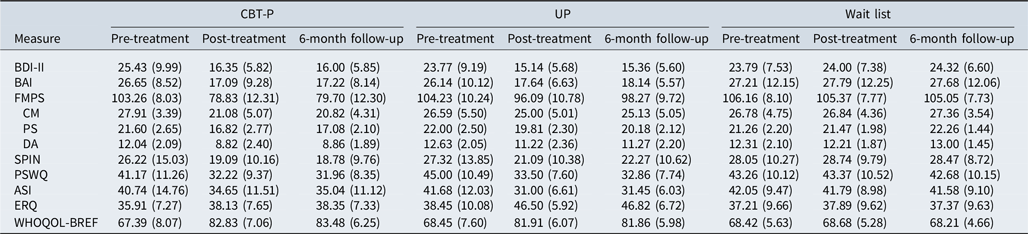
Means and standard deviations (SD) of dependent variables at baseline, post-treatment and 6-month follow-up are presented in Table 2. Baseline assessment indicated that all the participants experienced moderate depression (mean = 10.78, SD = 3.31) and moderate to severe anxiety (mean = 9.85, SD = 3.17) in subscale from the DASS-21. Also the mean score on the Concern over Mistakes (CM) subscale from the FMPS (mean = 27.12, SD = 4.57) suggested major difficulties in Perfectionism.
Pre-treatment, post-treatment and follow-up

BDI-II, Beck Depression Inventory-II; BAI, Beck Anxiety Inventory; FMPS, Frost’s Multidimensional Perfectionism Scale; CM, Concern over Mistakes; PS, Personal Standards; DA, Doubts about Actions; SPIN, Social Phobia Inventory; PSWQ, Penn State Worry Questionnaire; ASI, Anxiety Sensitivity Index; ERQ, Emotion Regulation Questionnaire; WHOQOL-BREF, WHO Quality Of Life-BREF.
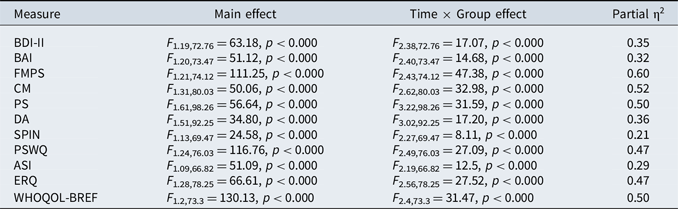
Repeated measure ANOVA design with 3 times (baseline, post and follow-up) × 3 groups (CBT-P, UP, WL) was used. The Muchly test for all the measures were significant, therefore Greenhouse-Geisser was used. As seen in Table 3, there were significant Group × Time interactions for all measures. In addition, effect sizes for the interactions were large for all measures.
Repeated measure ANOVA

F Greenhouse-Geisser were used; partial η2, partial eta-squared; BDI-II, Beck Depression Inventory-II; BAI, Beck Anxiety Inventory; FMPS, Frost’s Multidimensional Perfectionism Scale; CM, Concern over Mistakes; PS, Personal Standards; DA, Doubts about Actions; SPIN, Social Phobia Inventory; PSWQ, Penn State Worry Questionnaire; ASI, Anxiety Sensitivity Index; ERQ, Emotion Regulation Questionnaire; WHOQOL-BREF, WHO Quality of Life-BREF.
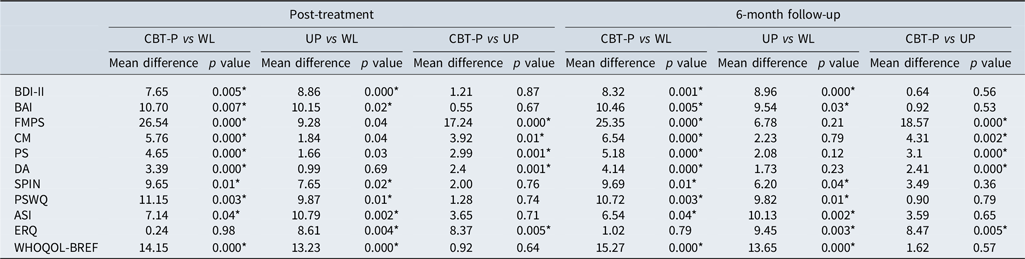
Post-hoc analyses indicated that the groups displayed a significant difference between CBT-P and WL in post-treatment for all measures (p < 0.05) except for emotion regulation (p = 0.98). There was a significant difference between UP and WL in post-treatment for all measures (p < 0.05) except for DA subscale of the FMPS. There was no significant difference between CBT-P and UP in reducing general anxiety (BAI), depression (BDI-II), worry (PSWQ), social anxiety (SPIN), anxiety sensitivity (ASI) and increasing quality of life (WHOQOL-BREF) in the post-treatment and follow-up stages. However, in reducing perfectionism (CM, PS and DA subscales of the FMPS), the CBT-P was significantly more effective than UP, and in improvement of emotion regulation (ERQ), the UP was significantly more effective than CBT-P (Table 4).
Pairwise comparison between groups after treatment and 6-month follow-up

BDI-II, Beck Depression Inventory; BAI, Beck Anxiety Inventory; FMPS, Frost’s Multidimensional Perfectionism Scale; CM, Concern over Mistakes; PS, Personal Standards; DA, Doubts about Actions; SPIN, Social Phobia Inventory; PSWQ, Penn State Worry Questionnaire; ASI, Anxiety Sensitivity Index; ERQ, Emotion Regulation Questionnaire; WHOQOL-BREF, WHO Quality of Life-BREF. *p < 0.05.
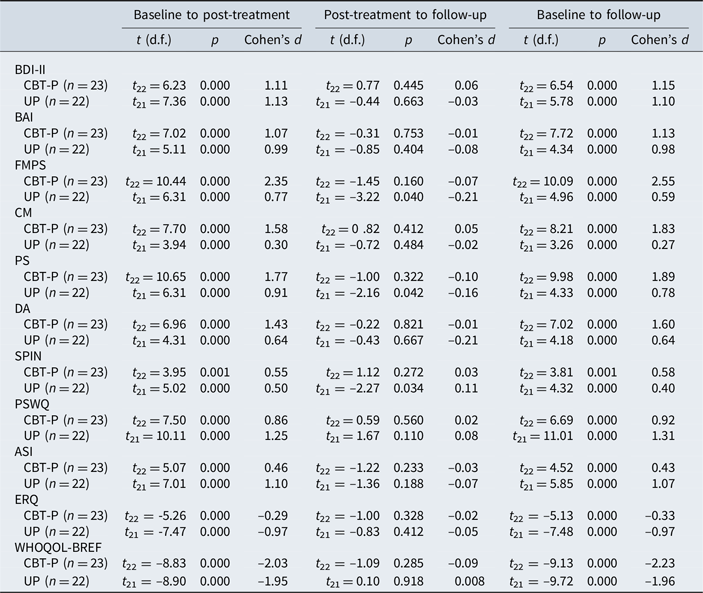
To examine whether treatment efficacy was maintained at the 6-month follow-up, a paired t-test was conducted for all measures. To identify treatment effectiveness, a paired t-test was conducted at first between baseline and post-treatment in two groups (CBT-P, UP) and then between post-treatment and follow-up, and the last between baseline and follow-up (Table 5). These results show that the treatment groups displayed a significant reduction in depression and anxiety symptoms, perfectionism, social phobia, state worry and anxiety sensitivity. In addition, these groups show a significant increase in emotion regulation and quality of life. In CBT-P, effect sizes (Cohen’s d) were large for all measures except for social phobia and anxiety sensitivity, which were moderate, and for emotion regulation, which was small. The effect sizes (Cohen’s d) in UP were also large for all measures except for social phobia, which was moderate. These results were maintained after 6-month follow-up.
Paired t-test and effect size in CBT-P and UP

BDI-II, Beck Depression Inventory; BAI, Beck Anxiety Inventory; FMPS, Frost’s Multidimensional Perfectionism Scale; CM, Concern over Mistakes; PS, Personal Standards; DA, Doubts about Actions; SPIN, Social Phobia Inventory; PSWQ, Penn State Worry Questionnaire; ASI, Anxiety Sensitivity Index; ERQ, Emotion Regulation Questionnaire; WHOQOL-BREF, WHO Quality of Life-BREF. Cohen’s d = M 1 – M 2/SDpooled.
Discussion
The present study aimed to compare the efficacy of two transdiagnostic therapies with each other and with the control group. Both CBT-P and UP were significantly superior to the waitlist control group, and their effects on the 6-month follow-up period was maintained. This was in line with the results of previous studies during which each of these therapies was compared with the control group alone (Barlow et al., Reference Barlow, Farchione, Bullis, Gallagher, Murray-Latin, Sauer-Zavala and Boswell2017; Bullis et al., Reference Bullis, Sauer-Zavala, Bentley, Thompson-Hollands, Carl and Barlow2015; Egan et al., Reference Egan, Wade, Shafran and Antony2014b; Farchione et al., Reference Farchione, Fairholme, Ellard, Boisseau, Thompson-Hollands, Carl and Barlow2012; Handley et al., Reference Handley, Egan, Kane and Rees2015; Steele et al., Reference Steele, Farchione, Cassiello-Robbins, Ametaj, Sbi, Sauer-Zavala and Barlow2018; Zetterberg et al., Reference Zetterberg, Carlbring, Andersson, Berg, Shafran and Rozental2019).
Furthermore, no significant difference was found between CBT-P and UP in the reduction of general anxiety (BAI), depression (BDI-II), worry (PSWQ), social anxiety (SPIN), anxiety sensitivity (ASI) and the increase of quality of life (WHOQOL-BREF) at post-treatment and follow-up stages. However, in the reduction of perfectionism (CM, PS and DA subscales of FMPS), CBT-P was significantly more effective than UP, and in the improvement of emotion regulation (ERQ), UP was significantly more effective than CBT-P.
Comparison of UP with WL at the post-treatment stage indicated that UP was significantly more effective, leading to a greater reduction in perfectionism (CM and PS subscales of FMPS). However, no significant difference was found in the follow-up between the two groups (Table 4). The same situation was observed for within-group comparisons for UP. However, a significant difference was found between pre–post and post–follow-up (Table 5). In other words, UP initially reduced perfectionism at the end of the treatment, but it did not maintain its effect in the follow-up period. In this regard, although perfectionism is described as a cognitive behavioural construct and is a specific type of emotionally avoidant emotion regulation, UP does not strongly and directly target it. Despite being partially challenged by the patients’ perfectionist beliefs during the cognitive reappraisal, it appears that two or three sessions may not have a lasting impact on it.
In addition, comparison of CBT-P with WL in ERQ showed no significant difference between them in the post-treatment and follow-up. However, the within-group comparison revealed a significant effect of CBT-P on ERQ in the pre- to post-treatment, and no difference between the post-treatment and follow-up. Therefore, considering the effect size, it can be stated that although CBT-P was effective on emotion regulation, its effect size was small and was not significantly different from WL. A reasonable explanation for this result may be that CBT-P directly and specifically has no plan to modify emotion regulation strategies in patients.
This is the first study comparing these two treatment protocols. Therefore, in this section, we cannot directly refer to the results of similar studies. However, the results can be implicitly discussed. Given that all participants in this study had dysfunctional perfectionism, and according to some researchers that perfectionism could be an obstacle to treatment efficacy, we expected that this would have a negative effect on the UP efficacy and to demonstrate the superiority of CBT-P efficacy, while this expectation was not met. As noted in the results, CBT-P had a significantly greater effect on reducing perfectionism than on the UP method, while the UP method had a significantly greater effect on improving emotion regulation.
A comparison of the effect size obtained by Cohen’s (Reference Cohen1988) criterion for CBT-P in this study was consistent with other previous studies (e.g. Handley et al., Reference Handley, Egan, Kane and Rees2015; Rozental et al., Reference Rozental, Shafran, Wade, Egan, Nordgren, Carlbring and Thelander2017), and the effect size was moderate to large in most indices (except for ERQ). Consequently, studies have so far concluded that CBT-P can lead to a significant decline in dysfunctional perfectionism, anxiety disorders and depression based on a criterion defining measures of treatment efficacy as an indicator of clinical significance (Kraemer, Reference Kraemer2013). It is interesting to observe the large effect size on the reduction of the psychological syndrome, as therapy does not directly target the symptoms. This is one of the key reasons for confirming the view stated by Egan et al. (Reference Egan, Wade and Shafran2011), that perfectionism is transdiagnostic.
Regarding UP, the comparison of the effect sizes obtained in this study was large in most indexes (except for SPIN, which is moderate), being consistent with the results of other previous studies.
This confirms the results of previous studies maintaining that both perfectionism and emotion regulation are transdiagnostic factors, and by directly affecting them, the symptoms of disorders can be indirectly reduced.
Conclusion
It can be deduced from the results that whether we focus solely on the perfectionism factor or on the emotion regulation factor, we can reduce the symptoms of depression and anxiety disorders by approximately the same extent (if both dysfunctional perfectionism and emotional problems are simultaneously present in the patient). Contrary to some claims by some researchers on the negative effect of ignoring perfectionism in the treatment, it appears that perfectionism cannot be a serious obstacle to UP. Although CBT-P has been introduced as a transdiagnostic therapy, it is best used for patients with depression and anxiety disorders when they have dysfunctional perfectionism at the same time, whereas there is no such restriction on the application of UP. Therefore, it can be mentioned that the scope of the use of UP is wider than that of CBT-P. However, it is more logical to use CBT-P if perfectionism is the main clinical problem. Furthermore, if emotional regulation is the main clinical problem, then UP is used.
Limitations
Limitations of this study are as follows. (1) The sample size was small. The study may have been underpowered to detect the difference between two active treatments in all measures. Thus, it will be difficult to generalize all the results to the population under study. (2) We only analysed the results of participants who completed the study and did not conduct intention to treat (ITT) analysis. (3) The follow-up duration was short. We opted for a 6-month follow-up period to adhere to ethics for long waiting list participants; however, 1 year or longer follow-up would be advisable to prove the durability of the treatment effects over time, even if it is applied only for treatment groups. (4) To measure dysfunctional perfectionism and the effect of treatment in this study, only FMPS was used. Further research is needed to establish whether the intervention has any impact on other aspects of perfectionism such as clinical perfectionism and perfectionistic vulnerability.
Acknowledgments
This article has been extracted from the thesis written by Mr Mohammad Mahmoodi (registration no. 193). We thank the individuals who participated in the study, and the research assistants who assisted in data collection. We are also grateful to Azadeh Soltani for all his help.
Financial support
This research did not receive any specific grant from funding agencies in the public, commercial, or not-for-profit sectors.
Conflicts of interest
All author declare that there are no conflicts of interest.
Ethical statement
Ethics approval was received from the Research Ethics Committee of Shahid Beheshti University of Medical Sciences, Tehran, Iran (research ethics committee approval code: IR.SBMU.MSP.REC.1395.439).




Comments
No Comments have been published for this article.