Implication
Reliable alternatives to in-feed antibiotics need to be identified and chitooligosacharide may be a possible substitute. It was observed in the current experiment that the molecular weight ranges of 5 to 10 kDa and 10 to 50 kDa chitooligosaccharides decreased Escherichia coli numbers while increasing nutrient digestibility of the diets.
Introduction
The piglet is subjected to many environmental, behavioural and dietary stresses immediately after weaning. As a result, weaning is associated with reduced nutrient intake, reduced growth and a greater susceptibility to diarrhoea. In order to prevent diarrhoea or poor performance post-weaning, these problems were managed by the use of prophylactic antibiotics. However, the European Union placed a total ban on the use of in-feed antibiotic growth promoters on the 1st January 2006, which has prompted the search for alternatives. Chitooligosaccharides (COS) may offer a dietary means to modulate the microbiota in the gut, therefore promoting the productivity of the animals. Chitosan is a linear polymer composed of β (1 to 4) linked glucosamine residues with various degrees of N-acetylation and is a partially deacetylated derivative of chitin, which is found in the outer skeletons of crabs, shrimps, insects and lobster (Kittur et al., Reference Kittur, Vishu Kumar, Varadaraj and Tharanathan2005). Chitooligosaccharide are generally produced by hydrolysis of the chitosan polymer through a variety of methods, which includes chemical, enzymatic or physical process of hydrolysis (Kittur et al., Reference Kittur, Vishu Kumar, Varadaraj and Tharanathan2005). Compared with the intact high molecular weight (MW) chitosan, COS generally have a greater solubility and often a higher level of biological activity (Jin et al., Reference Jin, Reynolds, Redmer, Caton and Crenshaw1994; Kim and Mendis, Reference Kim and Mendis2006).
Chitooligosaccharide exhibits numerous interesting biological properties such as antimicrobial, antitumour, immune stimulatory effects and the acceleration of wound healing (Kim and Rajapakse, Reference Kim and Rajapakse2005). Many of the biological properties reported for chitosan and COS depend on MW and concentration (No et al., Reference No, Young Park, Ho Lee and Meyers2002; Liu et al., Reference Liu, Chen, Park, Liu, Liu, Meng and Yu2006; Chung and Chen, Reference Chung and Chen2008). However, the results of studies investigating the biological properties of COS have been inconsistent and this variation is partly due to the widely different MW used across studies (Jeon et al., Reference Jeon, Park and Kim2001; Liu et al., Reference Liu, Chen, Park, Liu, Liu, Meng and Yu2006). The current study was designed to determine the effects of dietary supplementation of COS at varying MW on pig performance, faecal scoring, selected microbial populations, volatile fatty acid (VFA) concentrations and nutrient digestibility post-weaning. The aim of the study is to screen a panel of increasing MW of COS in order to identify a suitable MW range to use as an effective substitute for in-feed antibiotics.
The inclusion level of COS used in the current study was based on previous work by Liu et al. (Reference Liu, Piao, Kim, Wang, Shen, Lee and Li2008) and Li et al. (Reference Li, Piao, Kim, Liu, Wang, Shen, Jung and Lee2007). It is hypothesised that the supplementation of varying MW of COS will improve pig growth performance due to the biological properties of COS, resulting in altered microbiota and digestibility in the gastrointestinal tract.
Material and methods
All procedures described in this experiment were conducted under experimental licence from the Irish Department of Health in accordance with the cruelty to Animals Act 1876 and the European Communities (Amendments of the Cruelty to Animals Act 1976) Regulations.
Experimental diets
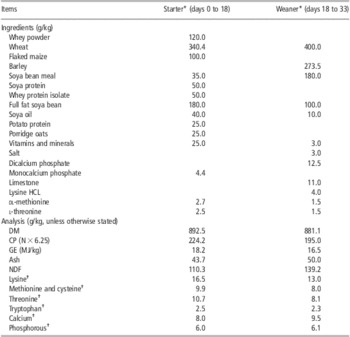
The experiment was a complete randomised design and comprised of six dietary treatments. The dietary treatments were as follows (1) control diet (0 ppm COS), (2) control diet plus <1 kDa COS, (3) control diet plus 3 to 5 kDa COS, (4) control diet plus 5 to 10 kDa COS, (5) control diet plus 10 to 50 kDa COS and (6) control diet plus 50 to 100 kDa COS. The COS was sourced from Kitto Life Co. Ltd (Kyungki-do, Seoul, Korea) and was supplemented in the experimental diets at a concentration of 250 ppm (Helander et al., Reference Helander, Nurmiaho-Lassila, Ahvenainen, Rhoades and Roller2001; Liu et al., Reference Liu, Chen, Park, Liu, Liu, Meng and Yu2006). Both the COS content and the deacetylation percentage of all of these COS were >70%. The pigs were offered a starter diet from days 0 to 18 and then a weaner diet from days 18 to 33. The starter diet was formulated to have similar concentrations of digestible energy (DE; 16 MJ/kg) and standardised ileal digestible (SID) lysine (14 g/kg) contents. The weaner diets were formulated to contain similar concentrations of DE (14.4 MJ/kg) and SID lysine (12.5 g/kg) contents. All amino acid requirements were met relative to SID lysine (National Research Council (NRC), 1998). All diets were milled on site and fed in meal form. The ingredient composition and chemical analysis of the dietary treatments are presented in Table 1.
Composition and chemical analysis of experimental diets (as-fed basis)

DM = dry matter; GE = gross energy.
Starter diet provided (mg/kg completed diet): Cu, 175; Fe, 140; Mn, 47; Zn, 120; I, 0.6; Se, 0.3; retinol, 1.8; cholecalciferol, 0.025; alpha-tocopherol, 67; phytylmenaquinone, 4; cyanocobalamin, 0.01; riboflavin, 2; nicotinic acid, 12; pantothenic acid, 10; choline chloride, 250; thiamine, 2; pyridoxine, 0.015.
Weaner diet provided (mg/kg completed diet): Cu, 25; Zn, 100; Se, 0.3; Mn, 25; I, 0.2; retinol, 0.3; cholecalciferol, 0.05; alpha-tocopherol, 40.
*Chitooligosaccharide was included in dietary treatments T2 to T6 at a rate of 250 mg/kg.
†Calculated for tabulated nutritional composition (Sauvant et al., Reference Sauvant, Perez and Tran2004).
Animals and management
A total of 396 piglets (progeny of Large White × (Large White × Landrace sows)) were selected after weaning at 24 days with an initial weight of 7.3 kg (s.d. = 1.7). Pigs were weighted individually at the beginning of the experiment (day 0 = day of weaning), day 7, day 18, day 25 and day 33. The pigs were housed in groups of three (22 replicates/treatment) on fully slatted floors (1.68 × 1.22 m). The ambient environmental temperature within the house was thermostatically controlled. The temperature was controlled at 30°C for the first week and reduced by 2°C per week thereafter. The feed was available ad libitum to the pigs and water was available ad libitum via nipple drinkers. Food was available up to the final weighing and all remaining food was weighed back for the purpose of calculating feed efficiency. During the experiment, ration samples were taken at the time of feeding and retained for chemical analysis. Fresh faecal samples were taken from each pen on days 10 and 25 and were stored in sterile containers (Sarstedt, Wexford, Ireland), placed in insulated containers with dry ice, and transported to the microbiology laboratory within 2 h for microbial analysis. Fresh faecal samples were also taken from each pen on days 10 and 25, and stored at −20°C until analysis for VFA concentrations. Fresh faeces samples were collected from each pen from days 10 to 14 and days 25 to 29 for the determination of nutrient digestibility analysis.
Faeces scoring
Pigs were observed for clinical signs of diarrhoea and a scoring system applied to indicate the presence and severity of this as described by Pierce et al. (Reference Pierce, Callan, McCarthy and O'Doherty2005). Faeces scoring were given daily for individual pens from day 0 on the experimental diets and continued until day 33. Scores were given daily for individual pens and the average faecal score value per pen was given. The following faeces scoring system was used: 1 = hard faeces; 2 = slightly soft faeces in pen; 3 = soft, partially formed faeces; 4 = loose, semi-liquid faeces; 5 = watery, mucous-like faeces.
Nutrient analysis
Both concentrates and faeces were analysed for nitrogen (N), dry matter (DM), ash, gross energy (GE), neutral detergent fibre (NDF), acid insoluble ash and ether extract concentrations. Following collection of the faeces, they were dried at 100°C for 48 h. The concentrates and dried faeces were milled through a 1 mm screen (Christy and Norris hammer mill, Christy and Norris Ltd, Ipswich, UK). The DM of the concentrates/faeces was determined after drying overnight at 103°C. Ash was determined after ignition of a known weight of concentrates or faeces in a muffle furnace (Nabertherm, Bremen, Germany) at 500°C. The CP content of both feed and faeces was determined as N × 6.25 using the Leco FP 528 instrument (Leco Instruments (UK) Ltd, Stockport, Cheshire, UK). The NDF was determined by the method of Van Soest et al. (Reference Van Soest, Robertson and Lewis1991) using the Ankom 220 Fibre Analyzer (Ankom™ technology, Fairport, NY, USA). The oil content was determined using the Ether Extract Method B. The MW of each COS sample were verified using viscometry, which is a simple and rapid method for the determination of MW (Rinaudo et al., Reference Rinaudo, Milas and Dung1993). The GE was determined using a Parr 1201 oxygen bomb calorimeter (Parr, Moline, IL, USA). The acid insoluble ash technique was used for the determination of nutrient digestibilities (McCarthy et al., Reference McCarthy, Bowland and Aherne1977).
Faecal microbiota
A 1.0 g sample was removed from the faecal sample, serially diluted (1:10) in 9.0 ml aliquots of maximum recovery diluents (MRD; Oxoid, Basingstoke, UK) and spread plated (0.1 ml aliquots) onto selective agars, as follows. Lactic acid bacteria were isolated on de Man, Rogosa and Sharp (MRS) agar (Oxoid) with overnight (18 to 24 h) incubation at 37°C in an atmosphere enriched with CO2 5%, as recommended by the manufacturers (Oxoid). The Escherichia coli were isolated on MacConkey agar (Oxoid), following aerobic incubation at 37°C for 18 to 24 h (O'Doherty et al., Reference O'Doherty, Dillon, Figat, Callan and Sweeney2010). Target colonies of lactic acid bacteria and E. coli were identified by Gram stains and colony morphology (Salanitro et al., Reference Salanitro, Blake and Muirhead1977). The analytical profile index (API) 50 CHL (BioMerieux, Craponne, France) kit was used to confirm suspect lactic acid bacteria. Suspect E. coli colonies were confirmed with API 20E (BioMerieux, Craponne, France). This API system identifies the suspect colonies by measuring their ability of produce cytochrome oxidase. All bacteria counts of between 30 and 300 colonies from each sample were characterised with Gram stain and the API system. These colonies were recorded and expressed as log10 colony forming units (CFU) per gram of wet faeces after being serially diluted.
VFA analysis
Samples of faeces were collected to measure VFA concentration and molar proportions of VFAs. The VFA concentrations in the faeces were determined using gas liquid chromatography according to the method described by Pierce et al. (Reference Pierce, Callan, McCarthy and O'Doherty2007).
Statistical analysis
The experimental data were analysed for the linear, quadratic and cubic effects of different MW of COS inclusion using the GLM procedure of SAS (SAS, 2004). The individual pen represented the experimental unit. The initial pig live weight was included as a covariate in the model for the performance analysis. All data were checked for normality using the Proc Univariate function of SAS. The means were separated using the Tukey–Kramer Test. The microbial counts were log transformed before statistical analysis. Probability values of <0.05 were used as the criterion for statistical significance. All results are presented in the tables as least square means ± standard error of the means (s.e.m.).
Results
Performance
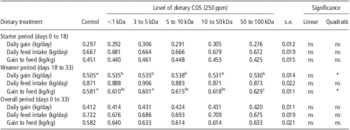
The effects of varying MW of COS on pig growth performance are shown in Table 2. During the starter period (days 0 to 18), there were no differences in daily gain, feed intake or gain to feed ratios among the treatments (P > 0.05). However, there were quadratic responses in daily gain (P < 0.05) and gain to feed ratio (P < 0.05) to the increased MW of COS inclusion during the weaner period, with all the COS-supplemented treatments improving daily gain and all COS treatments with the exception of 3 to 5 kDa improving gain to feed ratio compared with the control. However, the different MW of COS in the diet had no effect on daily gain (P > 0.05), feed intake (P > 0.05) or gain to feed ratios (P > 0.05) during the overall experimental period (days 0 to 33).
The effect of COS supplementation at different MW on pig performance post-weaning (least square means and s.e.)

COS = chitooligosaccharide; MW = molecular weight.
Means with the same superscript alphabets within rows are not significantly different (P > 0.05).
Probability of significance; *P < 0.05, **P < 0.01, ***P < 0.001, ns = non-significant (P > 0.05).
There were no significant cubic responses in growth performance (P > 0.05).
Faeces scoring
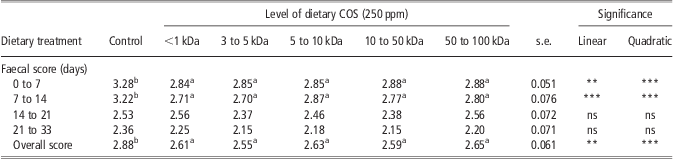
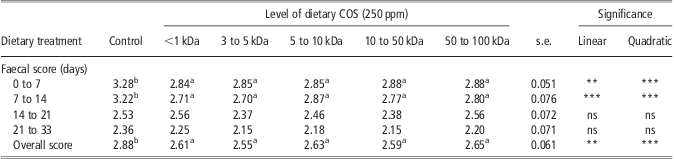
The effects of varying COS MW on faeces scoring are shown in Table 3. There was a quadratic response in faecal scoring to the increased MW of COS inclusion from days 0 to 7 (P < 0.001), days 7 to 14 (P < 0.001) and during the overall experimental period (P < 0.01) with all the COS-supplemented treatments having an improved faecal score compared with the control.
The effect of COS supplementation at different MW on faecal scoring in weaned pigs (least square means and s.e.)
COS = chitooligosaccharide; MW = molecular weight.
Means with the same superscript alphabets within rows are not significantly different (P > 0.05).
Probability of significance; *P < 0.05, **P < 0.01, ***P < 0.001, ns = non-significant (P > 0.05).
There were no significant cubic responses in growth performance (P > 0.05).
Microbiology
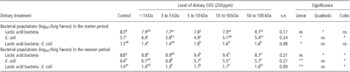
The effects of COS supplementation at different MW on selected faecal microbial populations of the weaned pig are shown in Table 4. There was a quadratic response in lactic acid bacteria populations to the increased MW of COS inclusion during the starter period (P < 0.05). The 3 to 5 kDa and 5 to 10 kDa COS decreased lactic acid bacteria populations compared with the control, whereas lactic acid bacteria populations increased again at 10 to 50 kDa. There was a cubic response in E. coli populations to the increased MW of COS during the starter period (P < 0.05). The 5 to 10 kDa and 10 to 50 kDa COS reduced E. coli populations compared with the control; however, E. coli populations increased again at 50 to 100 kDa. There was a linear increase in lactic acid bacteria : E. coli ratio as the MW of COS in the diet increased during the starter period (P < 0.05).
The effect of COS supplementation at different MW on faecal lactic acid bacteria and Escherichia coli populations (least square means and s.e.)

COS = chitooligosaccharide; MW = molecular weight.
Means with the same superscript alphabets within rows are not significantly different (P > 0.05).
Probability of significance; *P < 0.05, **P < 0.01, ***P < 0.001, ns = non-significant (P > 0.05).
During the weaner period, there was a cubic response in lactic acid bacteria and E. coli populations as the MW of COS increased (P < 0.05). The 5 to 10 kDa and 10 to 50 kDa COS increased lactic acid bacteria populations compared with the control, whereas lactic acid bacteria populations decreased again at 50 to 100 kDa. The 5 to 10 kDa, 10 to 50 kDa and 50 to 100 kDa COS decreased E. coli populations compared with the control. There was also a cubic response in the lactic acid bacteria : E. coli ratio as the MW of COS increased during the weaner period. The 5 to 10 kDa and 10 to 50 kDa COS increased the lactic acid bacteria : E. coli ratio compared with the control; however, the lactic acid bacteria : E. coli ratio decreased at 50 to 100 kDa.
Total tract nutrient digestibility
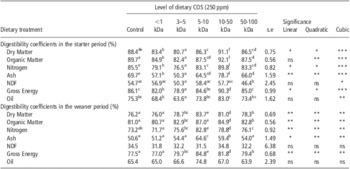
The effect of COS supplementation at different MW on apparent total tract nutrient digestibilities in the weaned pig are shown in Table 5. There was a cubic response in the apparent total tract digestibility of DM (P < 0.001), organic matter (OM; P < 0.001), ash (P < 0.001), N (P < 0.001), GE (P < 0.001), oil (P < 0.01) and NDF (P < 0.05) to the increased MW of COS inclusion during the starter period. The apparent total tract digestibility of DM, OM, ash, N, GE and oil declined at <1 kDa and 3 to 5 kDa COS inclusion, whereas the apparent total tract digestibility of these nutrients increased at the 10 to 50 kDa COS diet compared with the control. There was a cubic response in the apparent total tract digestibility of DM (P < 0.01), OM (P < 0.01), ash (P < 0.01), N (P < 0.01) and GE (P < 0.01) to the increased MW of COS inclusion during the weaner period. The 5 to 10 kDa COS had a higher apparent total tract digestibility of DM, OM, ash, N and GE in comparison to the control, whereas the apparent total tract nutrient digestibility of these nutrients decreased at 50 to 100 kDa.
The effect of COS supplementation at different MW on apparent nutrient digestibility of diets (least square means and s.e.)

COS=chitooligosaccharide; MW=molecular weight.
Means with the same superscript alphabets within rows are not significantly different (P > 0.05).
Probability of significance; *P < 0.05, **P < 0.01, ***P < 0.001, ns= non-significant (P > 0.05).
VFAs
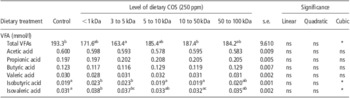
The effect of COS supplementation at different MW on faecal VFA concentrations in the weaned pig are shown in Table 6. There were cubic responses in total faecal VFA concentrations (P < 0.05) and in the molar proportions of isobutyric acid (P < 0.05) and isovaleric acid (P < 0.05) to the increased MW of COS inclusion during the starter period. The 3 to 5 kDa COS had a lower concentration of total VFA concentration compared with the control; however, the total VFA concentration increased at 5 to 10 kDa. The lower MW of <1 kDa and 3 to 5 kDa COS had higher levels of isobutyric acid and isovaleric acid compared with the control; however, isobutyric acid and isovaleric acid concentrations increased at 5 to 10 kDa.
The effect of COS supplementation at different MW on the total concentration and molar proportions of VFA in the faeces during the starter period (least square means and s.e.)

COS = chitooligosaccharide; MW = molecular weight; VFA = volatile fatty acid.
Means with the same superscript alphabets within rows are not significantly different (P > 0.05).
Probability of significance; *P < 0.05, **P < 0.01, ***P < 0.001, ns = non-significant (P > 0.05).
Discussion
The hypothesis of the current experiment is that the supplementation of varying MW of COS will affect pig growth performance due to the biological properties of COS, resulting in altered microbiota and digestibility in the gastrointestinal tract. It was demonstrated in the current experiment that the MW ranges of 5 to 10 kDa and 10 to 50 kDa COS decreased E. coli numbers while increasing apparent total tract nutrient digestibility of the diets.
In the current study, the incidence of diarrhoea and overall diarrhoea score were decreased in pigs fed the COS diets compared with the control. The pigs fed the diets supplemented with different MW COS had a lower faecal score, which may support the improvement in daily gain and gain to feed ratio achieved during the weaner period. As a large number of intestinal bacterial species are unculturable (Leser et al., Reference Leser, Amenuvor, Jensen, Lindecrona, Boye and Møller2002), lactic acid bacteria were enumerated as a reflection of changes in the population structure of beneficial bacteria. The relevance of measuring E. coli populations as an indicator of pathogenic bacteria is debated; however, increased coliform counts were recorded in the intestine of scouring pigs (Muralidhara et al., Reference Muralidhara, Sheggeby, Elliker, England and Sandine1977) and the density of coliforms in the gastrointestinal tract are used as an indicator of E. coli in pigs (Jørgensen et al., Reference Jørgensen, Dahl, Jensen and Poulsen1999; Hojberg et al., Reference Hojberg, Canibe, Knudsen and Jensen2003; Mikkelsen et al., Reference Mikkelsen, Naughton, Hedemann and Jensen2004). Hence, coliform reductions due to dietary intervention are, within limits, considered by many to be beneficial (Demeckova et al., Reference Demeckova, Tsourgiannis and Brooks2003; Mikkelsen et al., Reference Mikkelsen, Naughton, Hedemann and Jensen2004; Gardiner et al., Reference Gardiner, Campbell, O'Doherty, Pierce, Lynch, Leonard, Stanton, Ross and Lawlor2008). In the current study, the inclusion of different MW of COS had a highly significant effect on E. coli populations during the starter period. The 5 to 10 kDa and 10 to 50 kDa COS decreased E. coli populations compared with the control during the starter period. However, all of the COS treatments had a lower faecal score compared with the control. On the basis of the substantial reduction in faecal score with COS supplementation in current study, it would have been beneficial to measure faecal Enterotoxigenic E. coli as Enterotoxigenic E. coli is a major cause of diarrhoea in weaned pigs (Hayden et al., Reference Hayden, McGuirk, West and Carey1998). Unfortunately this parameter was not measured in the current experiment. It was also demonstrated that supplementation of 5 to 10 kDa, 10 to 50 kDa and 50 to 100 kDa COS had the strongest inhibitive effect against E. coli during the weaner period. Similar results were reported by Liu et al. (Reference Liu, Piao, Kim, Wang, Shen, Lee and Li2008), who reported that faecal lactobacilli numbers were increased while E. coli populations were decreased when COS was included at a level of 200 mg/kg. The supplementation of COS can alter permeability characteristics of microbial cell membranes and prevent the entry of materials or cause leakage of cell contents that leads to death of bacteria (Sudarshan et al., Reference Sudarshan, Hoover and Knorr1992).
Most of the studies on MW of COS are completed in vitro and a range of different MW COS have shown antibacterial activity (Kittur et al., Reference Kittur, Vishu Kumar, Varadaraj and Tharanathan2005). However, in the present study, the lower MW of <1 kDa and 3 to 5 kDa COS had no inhibitive effect on E. coli, whereas the higher MW of 5 to 10 kDa COS upwards exerted an inhibitive effect on E. coli. This in agreement with the in vitro study of Jeon et al. (Reference Jeon, Park and Kim2001), where COS with a MW of around 10 kDa or larger may be be suitable for antimicrobial activity. These results indicate that higher MW COS from 5 to 10 kDa upwards may serve as a growth promoter in weaned pigs by modulating the concentrations of intestinal microbiota.
In the present study, the inclusion of different MW of COS was found to have a highly significant effect on the apparent total tract digestibility of DM, OM, N, ash and GE during the starter and weaner periods. The inclusion of <1 kDa and 3 to 5 kDa COS decreased the apparent total tract digestibility of DM, OM, N, ash, GE and oil, whereas the higher MW of 10 to 50 kDa COS increased the apparent total tract digestibility of these nutrients during the starter period. Chitin and its derivatives are known for their ability to immobilise enzymes and has been demonstrated to immobilise enzymes such as lipase, β-amylase and pepsin (Krajewska, Reference Krajewska2004). One possible reason for this reduced apparent total tract nutrient digestibility with the lower MW of <1 kDa and 3 to 5 kDa COS may be due to the ability of COS to bind with enzymes. Despite the significant effects of different MW of COS on apparent total tract nutrient digestibility during the starter period, there was no response to COS supplementation on growth performance. This lack of response may be due to the fact that the starter diets were formulated to have a high DE concentration. The response may have been more evident in low energy diets using poor quality raw materials (Pierce et al., Reference Pierce, Callan, McCarthy and O'Doherty2005).
The inclusion of 5 to 10 kDa, 10 to 50 kDa and 50 to 100 kDa COS were found to improve apparent total tract digestibilities of DM, OM, N, and GE during the weaner period. Previous studies investigating the effects of COS on nutrient digestibility have been variable. Han et al. (Reference Han, Kwon, Lohakare, Heo and Chae2007) demonstrated that COS supplementation (1 to 4 g/kg) had no effect on DM, GE and CP digestibilities in weanling pigs. Wang et al. (Reference Wang, Yoo, Kim, Lee and Kim2009) reported an improvement in digestibilities of DM, N and GE in growing pigs when COS was supplemented at 5 g COS/kg. A possible reason for this enhanced apparent total tract digestibility in the current study may be attributed to COS supplementation enhancing intestinal morphology. In a similar study, Walsh et al. (Reference Walsh, Sweeney, Bahar, Flynn and O'Doherty2012) found that the inclusion of 10 to 50 kDa COS was found to increase villous height and villous : crypt depth ratio in the small intestine of pigs post-weaning.
In the present study, the supplementation of the lower MW of <1 kDa and 3 to 5 kDa COS resulted in greater production of the branched chained fatty acids such as isobutyric acid and isovaleric acid during the starter period. These fermentation end products may indicate proteolytic activity in the gastrointestinal tract as these branched chain VFA are formed from protein fermentation (Rasmussen et al., Reference Rasmussen, Holtug and Mortensen1988). The observed increase in such indices of protein fermentation in pigs offered diets containing <1 kDa and 3 to 5 kDa COS may reflect the decrease in N digestibility that was observed in these treatments during the starter period.
Despite these significant responses to supplementation with varying MW of COS, the inclusion of COS in the diets of pigs had no effect on daily gain, feed intake or gain to feed ratio during the starter period. This lack of response to COS supplementation on growth performance during the starter period may be partly due to the quality of the starter diet, and the positive effects on growth performance were observed only during the weaner period when the diet was of poorer quality. This agrees with the concept that the magnitude of response to food additives is likely to be related to the nature of the diet, with the greatest benefits evident when diets are formulated with cereals and plant protein (Estrada et al., Reference Estrada, Drew and Van Kessel2001; Pierce et al., Reference Pierce, Sweeney, Brophy, Callan, Fitzpatrick, McCarthy and O'Doherty2006). The starter diet used in the current experiment contained a high level of milk products and low levels of soya bean meal in comparison to the weaner diet. Pierce et al. (Reference Pierce, Sweeney, Brophy, Callan, Fitzpatrick, McCarthy and O'Doherty2006) found that the inclusion of high levels of milk products in the diet of weaned pigs resulted in improved intestinal health. Soya bean protein is not included in large quantities in weaned pig diets as it can cause morphological changes in the pig's gut (Miller et al., Reference Miller, Newby, Stokes and Bourne1984). In the current study, it was demonstrated that daily gain and gain to feed ratio were increased in pigs fed the COS diet compared with the control during the weaner period. Liu et al. (Reference Liu, Piao, Kim, Wang, Shen, Lee and Li2008) demonstrated that the supplementation of COS at different concentrations increased daily gain, feed intake and gain to feed ratio in weaned pigs and also COS supplementation increased BW gain in broilers (Zhou et al., Reference Zhou, Chen, Yoo, Huang, Lee, Jang, Shin, Kim, Cho and Kim2009). The improved daily gain and gain to feed ratio reported in the current experiment may be attributable to the highly significant increase in apparent total tract nutrient digestibility and reduction of pathogenic E. coli during the weaner period.
In conclusion, the biological activities of COS are very much influenced by MW. This study shows the benefits of offering diets to weaned pigs supplemented with different MW of COS on pig growth performance, microbial populations and apparent total tract nutrient digestibility. This study revealed that there were no differences observed on growth performance during the starter period, however the inclusion of COS improved average daily gain and gain to feed ratio during the weaner period. This indicates that COS supplementation may play a vital role in lower nutrient quality diets or may prevent the negative impact of a bacterial challenge. The MW of 5 to 10 kDa and 10 kDa to 50 kDa COS decreased E. coli numbers while increasing apparent total tract nutrient digestibility. Thus, supplementation of COS at a particular MW range may be an effective substitute for in-feed antibiotics during the post-weaning period. Further studies will explore the potential of these diets to prevent the negative impact of a pathogen challenge.
Acknowledgements
Funding for this research was provided under the Marine Functional Food Research Consortium (NutraMara) by the Marine Institute and the Department of Agriculture, Fisheries and Food, Agriculture House, Co. Dublin, Ireland.