INTRODUCTION
Protozoan parasites of the genus Leishmania cause a broad spectrum of diseases, collectively known as leishmaniasis, that occur predominantly in tropical and subtropical regions. It is estimated that worldwide there is an annual incidence of 1·5–2 million new cases, with up to 350 million people at risk of infection (Murray et al. Reference Murray, Berman, Davies and Saravia2005). Chemotherapy is the main control strategy for leishmaniasis and pentavalent antimonials (SbV) remain the mainstay, but their efficacy is threatened by the emergence of drug-resistant Leishmania parasites, as described in several endemic regions (Lira et al. Reference Lira, Sundar, Makharia, Kenney, Gam, Saraiva and Sacks1999; Hadighi et al. Reference Hadighi, Mohebali, Boucher, Hajjaran, Khamesipour and Ouellette2006; Rojas et al. Reference Rojas, Valderrama, Valderrama, Varona, Ouellette and Saravia2006; Yardley et al. Reference Yardley, Ortuño, Llanos-Cuentas, Chappuis, De Doncker, Ramirez, Croft, Arevalo, Adaui, Bermudez, Decuypere and Dujardin2006).
The in vitro intracellular amastigote-macrophage model is currently considered the gold standard for susceptibility testing of Leishmania clinical isolates (Vermeersch et al. Reference Vermeersch, da Luz, Toté, Timmermans, Cos and Maes2009). But the screening entails a complex, labour-intensive and time-consuming protocol, which involves in vitro infection of primary macrophages with an infective stage of Leishmania parasites (metacyclic promastigotes, axenic amastigotes, or ex vivo amastigotes), 3–7 days SbV exposure and the final step of microscopical evaluation of the different infections (Neal and Croft, Reference Neal and Croft1984; Vermeersch et al. Reference Vermeersch, da Luz, Toté, Timmermans, Cos and Maes2009). In view of this scenario, research is needed to identify molecular markers that would by-pass these limitations and would improve the epidemiological surveillance of SbV-resistance in the field. These markers are not yet available, due to the limited knowledge of the molecular and biochemical mechanisms underlying resistance to SbV, especially in clinical isolates.
Even if intracellular amastigotes may be considered as the clinically relevant stage, the current protocols to study their gene expression require extreme care to ensure reproducibility of the results (Decuypere et al. Reference Decuypere, Vanaerschot, Rijal, Yardley, Maes, De Doncker, Chappuis and Dujardin2008) and are not adapted to the study of a large number of isolates. In contrast, promastigotes can be easily cultivated and harvested with minimal risk of affecting their biological state under well-controlled in vitro conditions (Decuypere et al. Reference Decuypere, Vanaerschot, Rijal, Yardley, Maes, De Doncker, Chappuis and Dujardin2008). Furthermore, molecular changes during promastigote differentiation serve as pre-adaptations for parasite transmission and initial infection stages in the vertebrate host (Sacks, Reference Sacks1989; Saxena et al. Reference Saxena, Worthey, Yan, Leland, Stuart and Myler2003). Hence, a time-course analysis of gene expression changes throughout the promastigote growth cycle may show differences in molecular adaptations of parasites to intracellular life. Our previous study on L. donovani clinical isolates indicated that promastigote expression-curves could indeed reveal molecular features distinguishing isolates with different in vitro SbV susceptibility phenotypes (Decuypere et al. Reference Decuypere, Vanaerschot, Rijal, Yardley, Maes, De Doncker, Chappuis and Dujardin2008). Moreover, considering that the in vitro growth rates could vary among different isolates, expression-curves are advisable to guarantee a reliable molecular comparison of identical developmental stages among various isolates under study.
In the present work, we aimed to compare the gene expression patterns of 21 L. braziliensis clinical isolates showing 2 different phenotypes of in vitro SbV susceptibility (respectively sensitive and resistant). Promastigotes were used, as this life-stage can be easily cultured for high-throughput applications. We used real-time quantitative PCR (qPCR) to assess the RNA expression profiles of 13 genes encoding proteins with roles in SbV metabolism, oxidative stress or housekeeping functions and compared molecular data to the 2 in vitro defined SbV phenotypes.
MATERIALS AND METHODS
Parasites and in vitro culture
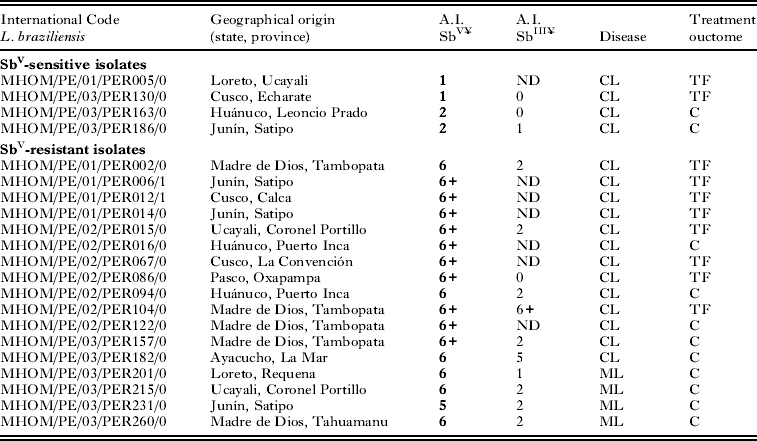
In total, 21 L. braziliensis isolates were obtained from confirmed cutaneous or mucosal leishmaniasis patients recruited at the Institute of Tropical Medicine Alexander von Humboldt in Lima, Peru, within the framework of LeishNatDrug-R, a multicentre study on SbV treatment failure in leishmaniasis. Isolates were essentially obtained before treatment of patients, typed by PCR-RFLP analysis of hsp70 and cpb genes (Garcia et al. Reference Garcia, Kindt, Quispe-Tintaya, Bermudez, Llanos, Arevalo, Bañuls, De Doncker, Le Ray and Dujardin2005) and tested as intracellular amastigotes for their in vitro susceptibility to SbV (Yardley et al. Reference Yardley, Ortuño, Llanos-Cuentas, Chappuis, De Doncker, Ramirez, Croft, Arevalo, Adaui, Bermudez, Decuypere and Dujardin2006) (see Table 1 for summary of isolate features). Promastigote forms were grown at 24°C in a biphasic medium consisting of rabbit blood agar overlaid with medium 199 (M199; Sigma) containing 20% heat-inactivated fetal bovine serum (FBS; Lonza Bioscience), 25 mm Hepes (pH 7·4), 100 units/ml penicillin and 100 μg/ml streptomycin (Lonza). Growth curves were initiated by inoculating 3×10⁶ parasites/ml in 5 ml of M199-20% FBS. Two independently grown cultures and corresponding harvests at 24 h (early-log phase), 72 h (late-log phase), 120 h (early-stationary phase) and 168 h (late-stationary phase) time-points were performed in parallel for each isolate (biological replicates). RNA sampling protocols used here were described previously (Decuypere et al. Reference Decuypere, Rijal, Yardley, De Doncker, Laurent, Khanal, Chappuis and Dujardin2005). All studied isolates showed similar growth behaviour during in vitro culture, thereby allowing synchronization of the promastigote growth cycle among isolates. The in vitro passage numbers (post-isolation from patients) were: (i) in the group of SbV-sensitive isolates: mean±standard deviation (s.d.): 20·5±5·9; (ii) in the group of SbV-resistant isolates: mean±s.d.: 19·9±4·5. There was no statistically significant difference in the mean passage number between isolate groups (P=0·9, t-test). Previous work of our group showed that the in vitro SbV-resistant phenotype was stable far beyond these passage numbers (Laurent et al. Reference Laurent, Rijal, Yardley, Croft, De Doncker, Decuypere, Khanal, Singh, Schönian, Kuhls, Chappuis and Dujardin2007, and unpublished results).
Geographical origin, in vitro SbV and SbIII susceptibility data of Peruvian Leishmania braziliensis isolates included in the study and corresponding clinical data: disease (CL, cutaneous leishmaniasis, ML, mucosal leishmaniasis) and treatment outcome (TF, treatment failure; C, cure)

¥ The in vitro SbV or SbIII susceptibility of a tested isolate was expressed as an ‘activity index’ (A.I.), i.e. as the ratio of the ED50 (50% effective dose) of that tested isolate to the ED50 of the WHO reference L. braziliensis strain MHOM/BR/75/M2903. Isolates with an A.I. of 0–2 were considered sensitive to SbV or SbIII (0, more sensitive than the reference strain M2903), while isolates with an A.I. of 3 or higher were considered resistant. Data shown were reported by Yardley et al. Reference Yardley, Ortuño, Llanos-Cuentas, Chappuis, De Doncker, Ramirez, Croft, Arevalo, Adaui, Bermudez, Decuypere and Dujardin2006.
RNA isolation and real-time quantitative PCR
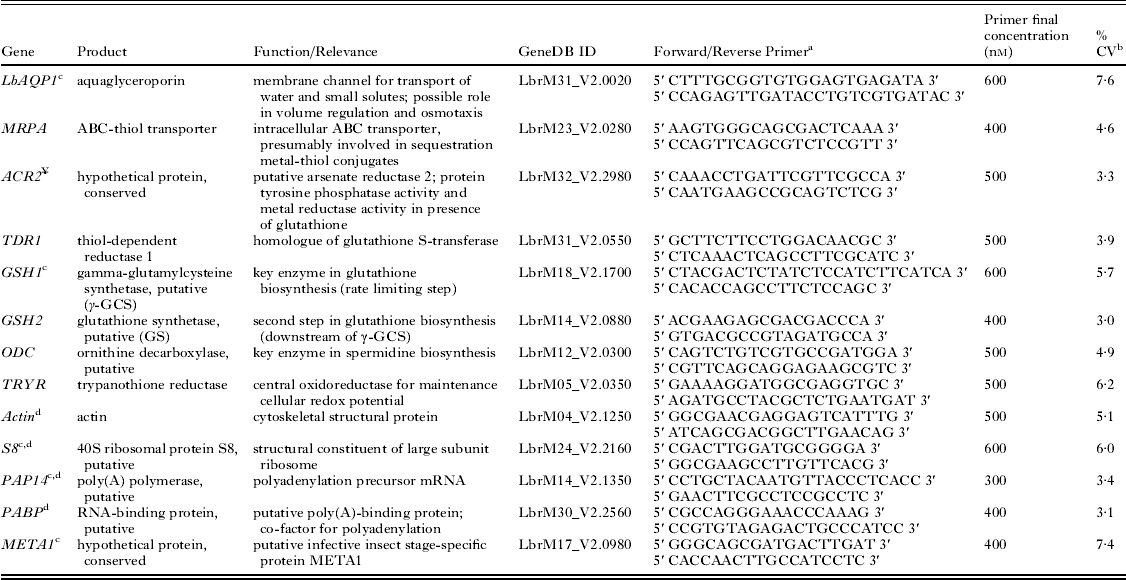
Total RNA was isolated, analysed and reverse transcribed as described before (Decuypere et al. Reference Decuypere, Rijal, Yardley, De Doncker, Laurent, Khanal, Chappuis and Dujardin2005). The resulting cDNA was diluted 10-fold, and 2 μl was used as template in 25 μl of SYBR Green-based quantitative PCR (qPCR) reactions on the iCycler (Bio-Rad), as previously described (Decuypere et al. Reference Decuypere, Rijal, Yardley, De Doncker, Laurent, Khanal, Chappuis and Dujardin2005), with only the modification that amplification was done for 34 cycles. We analysed 13 genes. First, a set of 8 genes putatively involved in SbV metabolism and/or implicated in laboratory-induced resistance (Ashutosh et al. Reference Ashutosh, Sundar and Goyal2007). This set includes genes with predicted function in transport (LbAQP1, MRPA), thiol biosynthesis/redox metabolism (GSH1, GSH2, ODC, TRYR) and cellular reduction (ACR2, TDR1). Secondly, 2 genes resulting from a differential screen of L. braziliensis SbV-resistant and -sensitive isolates and putatively involved in RNA poly(A)-tail metabolism (PABP, PAP14) (Decuypere, Reference Decuypere2007). Thirdly, 2 genes coding for housekeeping functions: Actin (cytoskeleton function) and S8 (ribosomal function). Fourthly, the META1 gene, up-regulated in the infective metacyclic stage of distinct Leishmania species (Uliana et al. Reference Uliana, Goyal, Freymüller and Smith1999; Gamboa et al. Reference Gamboa, Van Eys, Victoir, Torres, Adaui, Arevalo and Dujardin2007), was analysed using primers and conditions reported elsewhere (Gamboa et al. Reference Gamboa, Van Eys, Victoir, Torres, Adaui, Arevalo and Dujardin2007).
Full-length gene sequences in L. major and L. infantum genome databases were used as queries for BLAST searches in the L. braziliensis genome database (GeneDB, http://www.genedb.org/). Primers (Table 2) were designed with Primer3 (Rozen and Skaletsky, Reference Rozen and Skaletsky2000) and tested for specificity using NCBI BLAST (http://www.ncbi.nlm.nih.gov/BLAST).
Genes selected for expression profiling of Leishmania braziliensis: primer sequences, qPCR conditions and reproducibility of assays

GeneDB ID, gene Accession number on GeneDB (http://www.genedb.org/); Product, predicted gene function based on orthologues in the different TriTrypDB organisms [annotation from GeneDB and TriTrypDB (http://tritrypdb.org/tritrypdb/) databases].
a Leishmania-specific primer sets.
b Mean coefficient of variation [CV=(standard deviation/mean)*100] of normalized relative quantities between biological replicates (calculated across all measurements).
c Primers and qPCR conditions as reported previously (Gamboa et al. Reference Gamboa, Van Eys, Victoir, Torres, Adaui, Arevalo and Dujardin2007).
d Primers developed by Decuypere (Reference Decuypere2007).
¥ Potential orthologous gene and protein sequences in L. major (LmjF32.2740 at GeneDB) are annotated as ACR2 and Sb(V)-As(V) reductase (LmACR2) at GenBank (Accession numbers: AY567836.1, AAS73185.1, respectively).
Data analysis and statistics
Analysis was performed on duplicate biological samples that were each assayed in triplicate. The arithmetic average threshold cycle (Ct) was used for data analysis. For each primer set, reaction efficiency estimates were derived from standard curves generated by serial dilutions of a cDNA pool of a promastigote sample. Efficiencies ranged between 1·84 and 2·07 and correlation coefficients were ⩾0·997 (iCycler 3.1 software, Bio-Rad).
The Ct values of each qPCR run were imported as Excel files into qBasePlus (Biogazelle NV, Zulte, Belgium), a software for real-time PCR data analysis based on the geNorm method (Vandesompele et al. Reference Vandesompele, De Preter, Pattyn, Poppe, Van Roy, De Paepe and Speleman2002) and qBase technology (Hellemans et al. Reference Hellemans, Mortier, De Paepe, Speleman and Vandesompele2007). Four genes (ACR2, GSH2, PAP14 and TDR1) showed the most stable expression in our sample panel (geNorm stability mean M-value and mean coefficient of variation lower than 0·35 and 15%, respectively) and data were normalized to their geometric mean. The analysis of 13 genes in 168 samples (21 parasite isolates×4 time-points in duplicate harvests) could be performed as one integrated experiment by performing inter-plate calibrations (based on 3 cDNA samples included in each qPCR run for that purpose). Overall, 1084 out of 1092 data points did not differ by more than 20% in CV (coefficient of variation) of normalized relative quantities between biological replicates, demonstrating the reproducibility of our methodology (Table 2).
The fold change of gene expression between log- and stationary-phase promastigotes (time-points 24 h and 72 h vs 120 h and 168 h of the growth curves, respectively) was determined for each parasite isolate, further called FC-PRO. The linear component of the variability of the expression level of each gene during in vitro growth was modelled in a multiple linear regression. Predictors tested were the examined time-points during in vitro promastigote growth and the SbV susceptibility of the studied isolates. The significance of the regression coefficient corresponding to the SbV-susceptibility was used to test difference in intercepts (change in baseline or initial gene expression level) between the SbV-sensitive (further called SbV-S) and SbV-resistant (further called SbV-R) isolates. The interaction between the examined time and the SbV susceptibility was included, and the significance of the regression coefficient corresponding to the interaction term was used to test difference in slopes (change in gene expression level along time) between the SbV-S and SbV-R isolates. To increase the strength of the evidence, a significance level of 0·01 was considered. To achieve biological significance we only considered cases where the slope ratio or the intercept ratio (between the SbV-S and SbV-R groups) was ⩾2, as recommended elsewhere (McCarthy and Smyth, Reference McCarthy and Smyth2009).
A multiple logistic regression to model the SbV susceptibility using the ODC and TRYR slopes (gene expression rate) and intercepts (baseline gene expression level) as predictors for all the isolates was performed. A linear score to estimate the probability of SbV-resistance was developed based on the best regression model. An isolate was predicted to be SbV-resistant if the probability was greater than the best cutoff (Pr-cutoff). A Receiver Operating Characteristic curve (ROC) was calculated and the Pr-cutoff was estimated in order to maximize the Youden's J-index (Sensitivity+Specificity−1) (Youden, Reference Youden1950). The 95% Confidence Intervals (CI) for the estimated sensitivity and specificity were calculated for proportions following a binomial distribution. All the analysis was performed using the statistical software Stata 10 (StataCorp).
RESULTS
Gene expression profiling throughout the promastigote growth cycle of L. braziliensis isolates
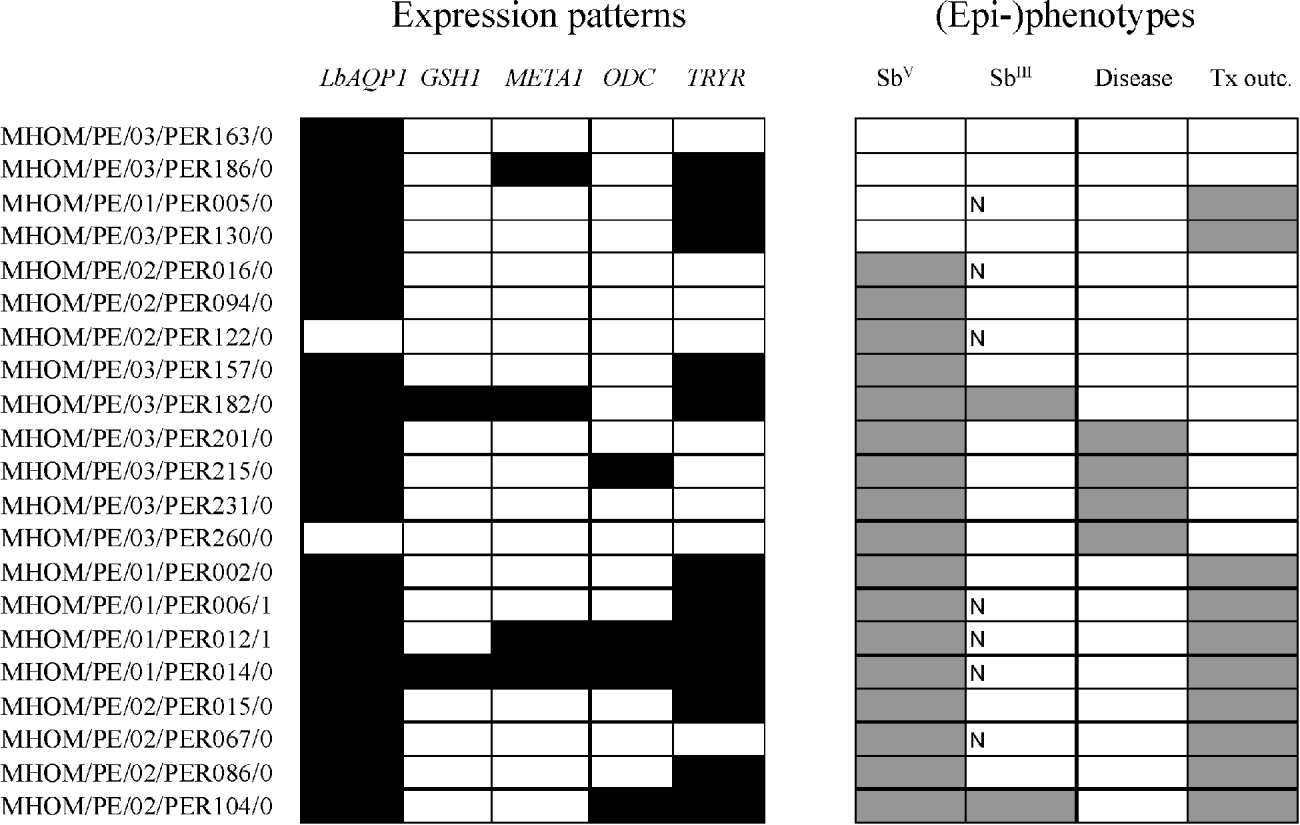
In order to assess for each gene the extent of expression regulation during in vitro promastigote growth/differentiation of L. braziliensis, we examined the fold change in mRNA abundance from log- to stationary phase (FC-PRO) in all isolates. The expression level of 8 genes did not change significantly during the promastigote growth cycle (FC-PRO <2), a pattern common to all 21 isolates. Genes in this category include: ACR2, Actin, GSH2, MRPA, PABP, PAP14, S8 and TDR1. Five genes showed a significant up-regulation of expression (FC-PRO ⩾2), each of them in a different set of isolates, hereby providing a ‘mosaic’ picture of gene expression in the present sample (Fig. 1). Three of these genes showed significant up-regulation in very few isolates: GSH1 (2 isolates, both SbV-R), META1 (4 isolates – one SbV-S and 3 SbV-R) and ODC (4 isolates, all SbV-R). The last two genes, LbAQP1 and TRYR, showed a FC-PRO ⩾2 in more than 50% of the isolates (19/21 isolates for LbAQP1; 12/21 isolates for TRYR). The isolates showing growth-dependent changes in LbAQP1 corresponded to the 4 SbV-S isolates and 15/17 SbV-R isolates. As for TRYR, 3/4 SbV-S isolates and 9/17 SbV-R isolates showed modulated expression during promastigote growth. Interestingly, when other phenotypes associated with the parasites were taken into consideration, it appeared that 9/10 isolates from patients with treatment failure showed a significant up-regulation of TRYR expression during growth, vs 3/11 from cured patients (Fig. 1).
Gene expression and phenotype mosaic. Schematic representation of the significantly modulated gene expression (highlighted in black if FC-PRO ⩾2, see Materials and Methods section) in the 21 isolates here studied. Schematic representation of the phenotype diversity: (i) in vitro SbV susceptibility (grey if resistant), (ii) in vitro SbIII susceptibility (grey if resistant; N, not available), (iii) clinical form (grey if ML, otherwise CL) and (iv) treatment outcome (grey if failure, otherwise cure).

Comparison of gene expression profiles during promastigote growth between L. braziliensis isolates, in relation to the in vitro SbV susceptibility
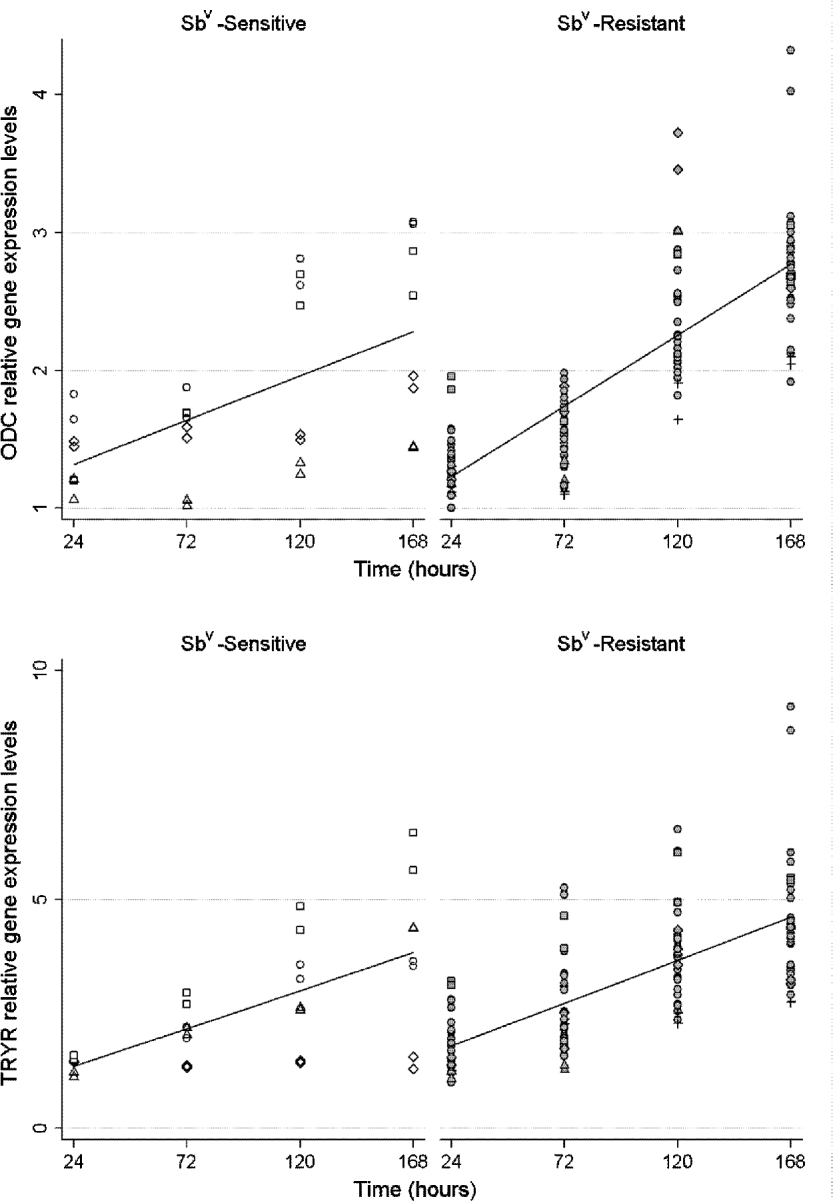
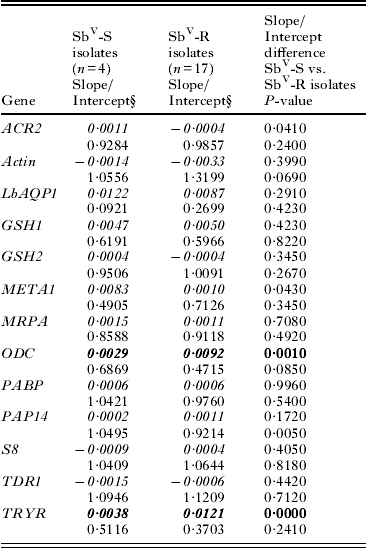
Next, we compared the gene expression patterns between SbV-S and SbV-R L. braziliensis isolates. We did a multiple linear regression in order to identify genes showing differential expression between these 2 groups of isolates. We did not find significant differences in the baseline expression level (intercept); only the slopes were informative, hereby further validating the importance of analysing gene expression curves. A significant difference was observed between SbV-S and SbV-R isolates in slopes for 2 genes, ODC and TRYR (Table 3). The change in expression level along time (slope) of both genes in the group of SbV-R isolates was significantly higher than that in the group of SbV-S isolates (P<0·01) (Table 3, Fig. 2). For the rest of the examined genes, the slopes of the expression curves were similar between the 2 groups of SbV-S and SbV-R isolates (Table 3).
Differential expression rate of genes ODC and TRYR between SbV-sensitive (n=4) and SbV-resistant (n=17) Leishmania braziliensis isolates. The relative expression levels of each gene [re-scaled relative to the sample with the lowest expression] and the estimated linear regression lines are shown for each group of isolates. The 2 independent biological replicates analysed at each time-point for a given isolate are labelled with the same symbol. Time-points during in vitro promastigote growth/differentiation: 24 h, parasites harvested at early-log phase; 72 h, parasites harvested at late-log phase; 120 h, parasites harvested at early-stationary phase; 168 h, parasites harvested at late-stationary phase.

Comparison of slope and intercept parameters of modelled expression levels of examined genes between SbV-sensitive and SbV-resistant Leishmania braziliensis isolates

SbV-S, in vitro sensitive to pentavalent antimony; SbV-R, in vitro resistant to pentavalent antimony; n, number of isolates in each group.
§ Shown are the slopes (first line in italics) and the intercepts (second line) derived from multiple linear regression analysis of the variability of the expression level of each gene during promastigote growth/differentiation. Genes for which (i) statistically significant comparisons (P<0·01) between the groups of SbV-S and SbV-R isolates and (ii) ratio between slopes or intercepts was ⩾2 (see Materials and Methods section) are highlighted in bold text.
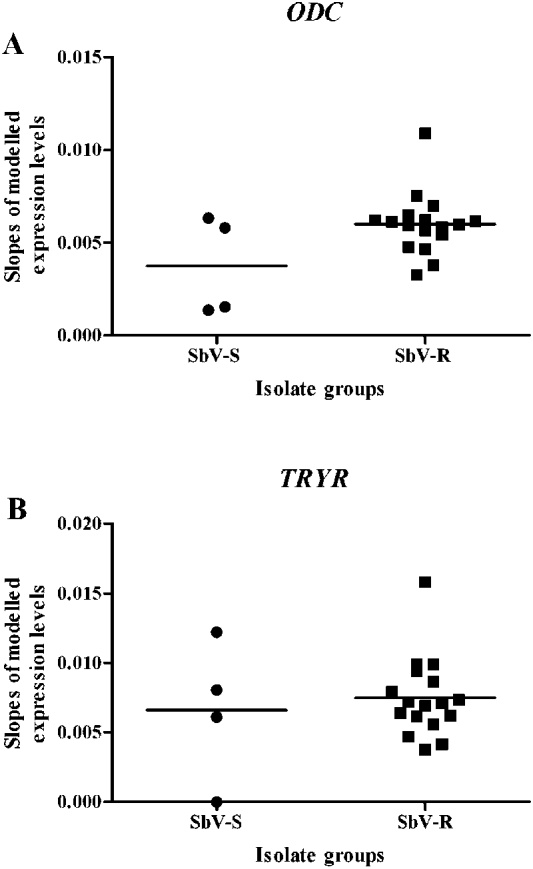
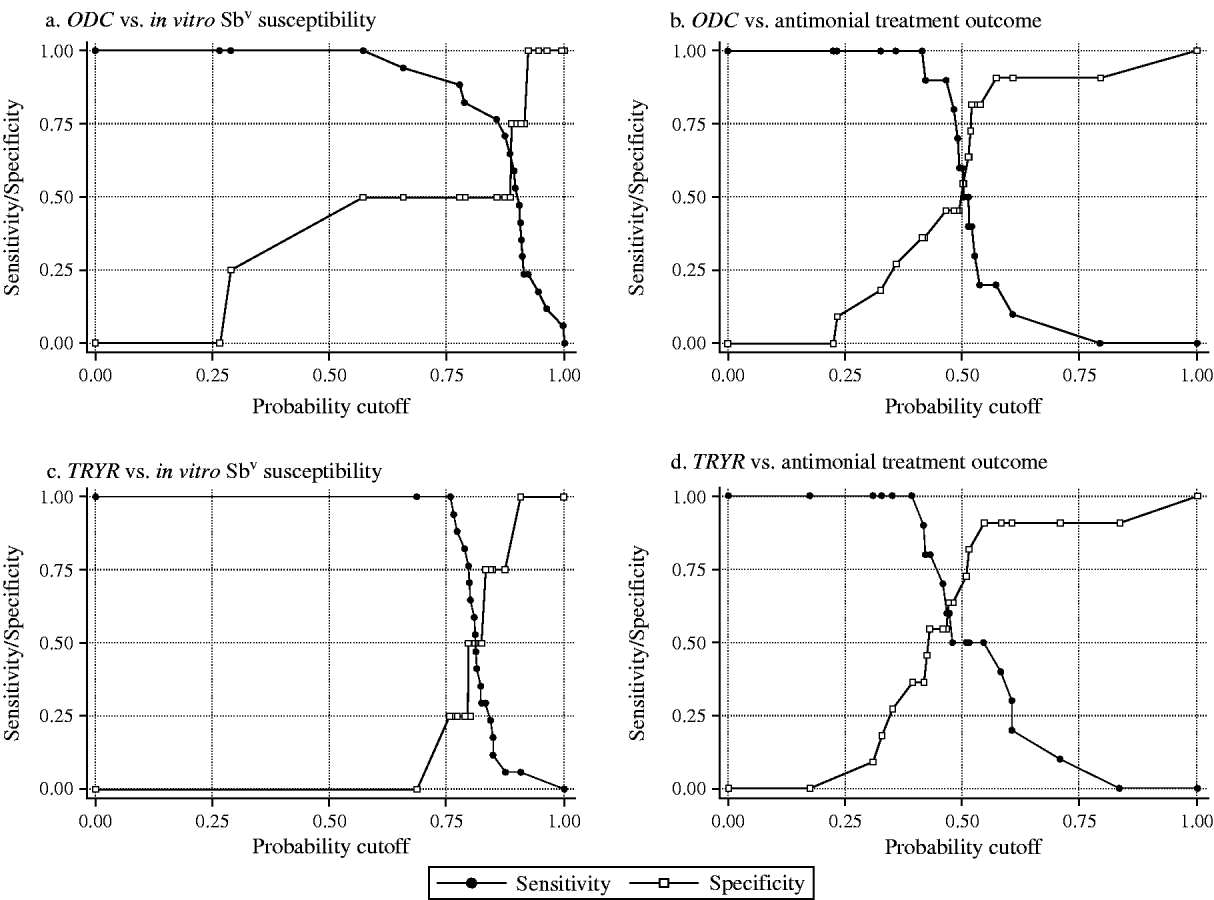
Focusing on ODC and TRYR genes, we also assessed the slopes of the expression curves of individual isolates (Fig. 3A,B) and calculated the sensitivity and specificity of each marker by comparison to the in vitro phenotype of SbV-susceptibility. The best logistic model to predict SbV-resistance only included the expression rate (slope) of ODC gene (P=0·06). Based on the Pr-cutoff that maximized the Youden's J index, the sensitivity and specificity of the ODC expression rate to detect SbV-resistance was 100% (95% CI: [100%, 100%]) and 50% (95% CI: [28%, 71%]) respectively. Reciprocally, specificity of 100% was associated with a sensitivity of 24%. The sets of sensitivity/specificity and their relationship are shown in Fig. 4a. The assay efficacy, measured by Youden's J index, was 0·5, and the area under the ROC curve was 0·72. With regard to data of TRYR, the logistic model to predict SbV-resistance did not achieve statistical significance (P=0·61). Based on the Pr-cutoff that maximized the Youden's J index, the sensitivity and specificity of the TRYR expression rate to detect SbV-resistance was 76% (95% CI: [51%, 92%]) and 50% (95% CI: [44%, 65%]) respectively (Fig. 4c). The assay efficacy, measured by Youden's J index, was 0·26, and the area under the ROC curve was 0·53.
Distribution of slopes corresponding to the gene expression profile of individual isolates resistant or sensitive to SbV, for ODC (A) and TRYR (B). The horizontal line denotes the mean of slope values in each group of isolates.

Sensitivity/Specificity curves calculated from the multiple logistic regression model using the ODC or TRYR slopes as predictors of in vitro SbV susceptibility (a, c) or antimonial treatment outcome (b, d) for all the isolates.

Comparison of gene expression profiles during promastigote growth between L. braziliensis isolates, in relation to the treatment outcome
Finally, we analysed among individual isolates the sensitivity and specificity of ODC and TRYR slope values in comparison to the antimonial treatment outcome. With regard to data of ODC and TRYR, the logistic model to predict treatment outcome did not achieve statistical significance (P=0·291 for ODC, and P=0·229 for TRYR). Based on the Pr-cutoff that maximized the Youden's J index, the sensitivity and specificity of the ODC expression rate to detect antimonial treatment failure was 100% (95% CI: [100%, 100%]) and 36% (95% CI: [15%, 57%]) respectively (Fig. 4b). The assay efficacy, measured by Youden's J index, was 0·36, and the area under the ROC curve was 0·6364. With regard to data of TRYR, the sensitivity and specificity of the TRYR expression rate to detect antimonial treatment failure was 50% (95% CI: [28%, 71%]) and 90% (95% CI: [77%, 100%]) respectively (Fig. 4d). The assay efficacy, measured by Youden's J index, was 0·41, and the area under the ROC curve was 0·70.
DISCUSSION
The present paper is, to our knowledge, the first to report results of the molecular characterization of clinical isolates of L. braziliensis in the context of in vitro SbV susceptibility. Our targeted approach focused on the analysis of expression profiles of genes putatively involved in SbV metabolism and/or implicated in laboratory-induced resistance (Ashutosh et al. Reference Ashutosh, Sundar and Goyal2007) in the present collection of L. braziliensis isolates, naturally SbV-resistant or -sensitive. It allowed assessment of the extent and types of variability in gene expression patterns that occur under a natural context.
Herein, we first analysed the gene expression patterns throughout the promastigote growth cycle of L. braziliensis isolates, independently of their in vitro SbV susceptibility. This revealed for 8 genes a striking picture of non-modulated transcript patterns during the growth cycle. In the 5 remaining genes (GSH1, META1 and ODC, LbAQP1 and TRYR), there was a ‘mosaic’ of up-regulated expression among the studied isolates. In the context of stage-related gene expression, the META1 gene deserves specific attention. Indeed, it has already been shown to be up-regulated in the infective metacyclic stage of distinct Leishmania species (Uliana et al. Reference Uliana, Goyal, Freymüller and Smith1999; Gamboa et al. Reference Gamboa, Van Eys, Victoir, Torres, Adaui, Arevalo and Dujardin2007), but in the present study, less than 25% of isolates exhibited a significantly higher expression in late-stationary phase (FC-PRO ⩾2). Even if all our isolates were infective (as demonstrated by the in vitro susceptibility assays undertaken in macrophages, Yardley et al. Reference Yardley, Ortuño, Llanos-Cuentas, Chappuis, De Doncker, Ramirez, Croft, Arevalo, Adaui, Bermudez, Decuypere and Dujardin2006; Rijal et al. Reference Rijal, Yardley, Chappuis, Decuypere, Khanal, Singh, Boelaert, De Doncker, Croft and Dujardin2007), further work is needed to determine (i) if this low proportion of META1 expression up-regulation reflects variations in the level of metacyclogenesis among our isolates as reported elsewhere (Da Silva and Sacks, Reference Da Silva and Sacks1987) or (ii) if the validity of META1 as a metacyclogenesis marker should be questioned.
In a second stage, we analysed the gene expression patterns in the context of the in vitro SbV resistance as defined by the reference biological assays. Two genes, ODC and TRYR, showed a significantly different change in expression level (slope of the expression curve) between the 2 groups of in vitro SbV-S and SbV-R isolates. However, analysis of individual slopes revealed an overlap in the distribution of slopes, with a direct impact on the sensitivity and specificity of the respective markers. High sensitivity was generally accompanied by low specificity and vice-versa. Taking an arbitrary cut-off with the highest specificity, ODC slopes provided the best performances among the genes studied, but this corresponded to a sensitivity of 24% only. In other words, when using this marker under stringent conditions, it could only identify a fourth of the in vitro SbV resistant isolates of the present sample.
The low sensitivities of ODC and TRYR markers by comparison to the in vitro-defined SbV susceptibility could be explained in different ways. First, different mechanisms of resistance might have been selected by different L. braziliensis subpopulations. Thus, in a subpopulation of L. braziliensis isolates, alteration of ODC gene expression might be linked with resistance, a phenomenon reported in metal-resistant laboratory mutants (Haimeur et al. Reference Haimeur, Guimond, Pilote, Mukhopadhyay, Rosen, Poulin and Ouellette1999). In another L. braziliensis subpopulation, other gene(s) would be involved, like TRYR, also reported in L. donovani to be related with resistance (Mandal et al. Reference Mandal, Wyllie, Singh, Sundar, Fairlamb and Chatterjee2007; Mittal et al. Reference Mittal, Rai, Ashutosh, Ravinder, Gupta, Sundar and Goyal2007). In other subpopulations, other genes not detected yet could be involved. The hypothesis of a pleiotropic response of the parasite to drug pressure is supported by previous observations in L. donovani (Decuypere, Reference Decuypere2007; Laurent et al. Reference Laurent, Rijal, Yardley, Croft, De Doncker, Decuypere, Khanal, Singh, Schönian, Kuhls, Chappuis and Dujardin2007). Analysis of additional genes possibly involved in antimony resistance might provide a clue to this question, but with the avenue of new high-throughput sequencing technologies, it would be more powerful in a next exploration stage to address the whole genome or transcriptome than to pursue with targeted, and hereby possibly biased, studies (Dujardin, Reference Dujardin2009). Later, the most robust (set of) markers could be assembled in a simple monitoring tool.
Secondly, it is possible that molecular adaptations in L. braziliensis promastigote stages could be different than in L. donovani, impeding the discrimination of SbV-resistant and -sensitive isolates by gene expression studies. Our previous study on Nepalese L. donovani clinical isolates indicated that promastigote expression-curves could reveal molecular features distinguishing isolates with different in vitro SbV susceptibility phenotypes (Decuypere et al. Reference Decuypere, Vanaerschot, Rijal, Yardley, Maes, De Doncker, Chappuis and Dujardin2008). The comparative genomic analysis of L. major, L. infantum and L. braziliensis (Peacock et al. Reference Peacock, Seeger, Harris, Murphy, Ruiz, Quail, Peters, Adlem, Tivey, Aslett, Kerhornou and Ivens2007; Smith et al. Reference Smith, Peacock and Cruz2007) showed the presence of a putative RNAi machinery in the latter species, which might have an effect on gene expression regulation. In line with this, the comparison of the organization of the H locus conserved repeats between L. braziliensis and L. major resistant mutants did not show amplified episomal molecules in L. braziliensis (Dias et al. Reference Dias, Ruiz, Lopes, Squina, Renzi, Cruz and Tosi2007). Furthermore, we cannot exclude that point mutations in important functional sites could be also related to resistance in L. braziliensis.
Thirdly, the antimony susceptibility phenotype definition, as currently established by the in vitro macrophage-amastigote assays, should also be considered. Indeed, different epi-phenotypes to which the parasites could have developed specific adaptations might remain hidden in the in vitro SbV susceptibility assays, but interfering with the gene expression patterns. For instance, (i) the variable adaptation to the macrophage effectors in the immunological context of the clinical infection (absent in the in vitro susceptibility assays) or (ii) the resistance to the reduced form of the drug, SbIII (Yardley et al. Reference Yardley, Ortuño, Llanos-Cuentas, Chappuis, De Doncker, Ramirez, Croft, Arevalo, Adaui, Bermudez, Decuypere and Dujardin2006; Rijal et al. Reference Rijal, Yardley, Chappuis, Decuypere, Khanal, Singh, Boelaert, De Doncker, Croft and Dujardin2007). These epi-phenotypes would explain the incongruences between the parasites’ in vitro SbV resistance and chemotherapy failure reported elsewhere (Yardley et al. Reference Yardley, Ortuño, Llanos-Cuentas, Chappuis, De Doncker, Ramirez, Croft, Arevalo, Adaui, Bermudez, Decuypere and Dujardin2006; Rijal et al. Reference Rijal, Yardley, Chappuis, Decuypere, Khanal, Singh, Boelaert, De Doncker, Croft and Dujardin2007) and illustrated in Table 1. More specifically, half of the parasites isolated before treatment from patients who later showed a definitive cure were found in vitro to be resistant to SbV. Interestingly, the P-value of the logistic model for TRYR results was much lower in the context of treatment outcome (0·229) than in the context of in vitro SbV resistance (0·61). This is in line with the observations made when classifying the isolates according to the significant up-regulation (FC-PRO ⩾2) of TRYR expression during growth: (i) 9/10 and 3/11 in isolates from patients with treatment failure and success respectively and (ii) 9/17 and 3/4 in isolates respectively SbV-resistant and sensitive. In a parallel study of Brazilian isolates, using the same protocol as here described, we did not find any informative difference in L. braziliensis isolates from SbV treatment failure, but sample size was much smaller than in the present study (Torres et al. Reference Torres, Adaui, Alves, Romero, Arevalo, Cupolillo and Dujardin2010). However, analysis of 25 L. guyanensis isolates revealed an overexpression of GSH1 in promastigotes of strains from treatment failure, hereby further validating our methodology (Torres et al. Reference Torres, Adaui, Alves, Romero, Arevalo, Cupolillo and Dujardin2010). In the present study, GSH1 was not as discriminative in L. braziliensis and this could reflect differences between species or geographical populations (Arevalo et al. Reference Arevalo, Ramirez, Adaui, Zimic, Tulliano, Miranda-Verastegui, Lazo, Loayza-Muro, De Doncker, Maurer, Chappuis, Dujardin and Llanos-Cuentas2007).
Further work with larger cohorts would be needed to verify these trends. Special attention could also be paid to the analysis of parasites isolated after treatment failure (in the present study, most of them were isolated before treatment), as drug pressure could also affect or select the expression pattern of several genes.
Variation in the gene expression of ODC and TRYR might thus contribute to explain only a small part of the variation in phenotype of in vitro SbV susceptibility in the present sample of L. braziliensis isolates. Further work is needed to identify a marker or a set of markers of SbV resistance as well as the best parasite stage in which to apply it. This molecular exploration should take into account a phenotype definition that may be more complex than that revealed by the in vitro SbV biological assays. Certainly, a second step in our exploration should consider the amastigote stages. Indeed, this latter model already implied overexpressed genes in SbV-resistant L. donovani isolates (Decuypere et al. Reference Decuypere, Rijal, Yardley, De Doncker, Laurent, Khanal, Chappuis and Dujardin2005; Mukherjee et al. Reference Mukherjee, Padmanabhan, Singh, Roy, Girard, Chatterjee, Ouellette and Madhubala2007). However, this life stage is extremely sensitive to minimal disturbance of the parasite's environment during harvesting, hence extreme care is needed to ‘freeze’ gene expression levels instantly (Decuypere et al. Reference Decuypere, Vanaerschot, Rijal, Yardley, Maes, De Doncker, Chappuis and Dujardin2008). In that sense, axenic amastigotes might represent an interesting biological compromise between promastigotes and intracellular amastigotes, but axenization is not straightforward for some species and for clinical isolates.
ACKNOWLEDGEMENTS
This work was supported by the European Commission (INCO-DEV contracts LeishNatDrug-R – ICA4-CT-2001-10076, and LeishEpiNetSA – INCO-CT2005-015407); and the Directorate-General for Development Cooperation of the Belgian Government (framework agreement 02 – project 95501, and framework agreement 03 – project 95502).