1. Introduction
Morphophonology is standardly conceived of as the phonological variation of morphological units. Two fundamental aspects in the study of allomorphy include the linguistic status of the unit showing variation and the nature of the factors conditioning this variation. The former aspect may be illustrated by the distinction between stem and affix allomorphy, the latter deals with a wide array of influences ranging from phonological and lexical to stylistic and sociolinguistic. This paper will pick out a small segment of this universe and consider only phonemically conditioned allomorphy of grammatical units, both bound and free. This double focus on (bound) morphemes and (free-standing) words follows not only from their commonality as closed-class items but also from their similar morphophonological behaviour.
Allomorphic variation springs from the conflicting constraints to which the morphological and the phonological levels are subject. Whereas morphology demands pattern uniformity and transparency, phonology demands ease of articulation and perception (e.g. Ronneberger-Sibold Reference Ronneberger-Sibold1996: 249). This ever-present antagonism may be reconciled in one of two ways. If the morphological influence wins out, there will be no allomorphy. However, if the phonological influence locally prevails, morphophonological variation will emerge as a compromise result. Let us consider two simple examples from English (E.) and Spanish (Sp.), respectively.
(1) E. (a) a pear
(b) an apple
(2) Sp. (a) Pedro y María ‘Pedro and María’
(b) Pedro e Isabel ‘Pedro and Isabel’
Example (1) illustrates the well-known alternation of the English indefinite article. The vowel-final variant occurs before consonants while the consonant-final form appears before vowels. The Spanish case in (2) shows the phonological variation of the additive conjunction. If the conjunction is followed by any phoneme other than /i/, it is realized as /i/ (see (2a)). If, however, the following word begins with /i/, the conjunction surfaces as /e/ (see (2b)).
The phonological motivation underlying the allomorphy of the English indefinite article is not hard to find. This variation ensures the emergence of an ideal phoneme-class sequence, viz. the simple alternation of consonants and vowels. This alternation instantiates the principle of (maximum) contrast whereby it is both easier to produce and perceive successive phonemes which stand at opposite ends of the sonority scale. At a coarse-grained level, consonants and vowels perfectly fulfil this requirement. The Spanish case illustrates the same principle at a more fine-grained level. If there was no allomorphy, two identical vowels would follow each other in phrases like (2b) for instance. Given the continuous nature of vowels, it would be difficult to distinguish one from the other, i.e. to identify the first /i/ as a full morpheme and the second as part of another. Note that this perceptual problem is compounded by a difficulty in repeatedly producing the same unit in close succession (e.g. MacKay Reference MacKay1987). It thus seems that a conspiracy of productive and perceptual constraints underlies the phonological variability of morphological forms.
However disparate the morphological and phonological constraints may be, both sets are ultimately grounded in processing principles. The processing advantages incurred by satisfying the phonological constraints have been sketched out immediately above (with production and perception being understood as encompassing both high-level and low-level aspects). At the morphological level, invariant and transparent word forms are obviously easier to process than variable and opaque ones because they abide by the ‘one meaning – one form’ principle known as ‘Humboldt's Universal’ (e.g. Vennemann Reference Vennemann1972, Dressler Reference Dressler and Dressler1987a, Mayerthaler Reference Mayerthaler and Dressler1987, Wheeler Reference Wheeler1993). It transpires, then, that one and the same processing system generates competing demands due to its multi-level structure, and that morphophonology is a direct consequence of this competition.
There are various ways in which the problem of repeated segments or segment classes can be dealt with (compare Menn & MacWhinney Reference Menn and MacWhinney1984 and Casali Reference Casali1997). Probably the two most common solutions are epenthesis and coalescence.Footnote 2 The former process breaks up the troublesome sequence by inserting a buffer element, as in (1b), while the latter produces a single segment where two identical segments would be expected. Further strategies of eliminating offensive sequences include dissimilation, as in (2b), and the complete avoidance of lexical items containing repeated material, as in E. *friendlily.
It is a remarkable fact that few studies have provided explanations for the occurrence of morphophonology.Footnote 3 The necessary and sufficient reasons for morphophonological variation are poorly understood. Why does this variation occur in one case but not in another? To return to the Spanish example above, why does the disjunctive conjunction o ‘or’ behave like y ‘and’ in dissimilating to u before words beginning with /o/, while subordinating conjunctions such as si ‘if’ and cuando ‘when’ are invariable? Do we wish to extrapolate from these data that subordinating conjunctions are impervious to allomorphy whereas coordinating conjunctions are not? And if so, what conceptual link do we posit between the type of conjunction and allomorphy? To take another example, why does French (F.) si ‘if’ coalesce with the following pronoun in (3) though not with the following noun in (4)?
(3) F. Je me demande s'il est parti. (s'il←si il)
‘I wonder whether he is gone.’
(4) F. Je me demande si Isabel est partie. (*s'Isabel)
‘I wonder whether Isabel is gone.’
The general question is not only which domain is subject to morphophonological variation and which is not, but also what factor (or set of factors) of relevance to allomorphy distinguishes the one domain from the other. Answers to these questions require a comparison between domains with and without allomorphy.
As for the repair strategies mentioned above, when is epenthesis and when is coalescence the preferred option? The two strategies have basically the same effect of restoring the ideal consonant–vowel alternation. Their main difference is of course that epenthesis is an additive while merging is a subtractive process. The problem thus comes down to identifying the factors facilitating additions and those facilitating deletions, and to determining their relative strength. However, as the above case of dissimilation in Spanish shows, restoring the preferred CV sequence is anything but compulsory. Through dissimilation, segmental identity – though not segment class identity – is eliminated. The question is, then, how tolerant a language is of hiatus and consonant clusters. It is likely that the preference for a particular repair strategy is determined on a language-specific basis.
It is also likely that there is a language-specific threshold for morphophonological variation. Although a given language may conceivably have a single allomorphy threshold, it seems more realistic to assume different thresholds for different domains within the same language. The former case would be a highly economical solution. In the latter case, different sets of allomorphic rules would co-exist in the same language. It would then have to be ascertained why a certain set of rules is more appropriate in one domain but less appropriate in another.
Of paramount importance in the present work is the diachrony of morphophonological patterns. How and why does allomorphy come into existence and how and why does it dissolve? Also, how ephemeral or lasting is allomorphy? The inclusion of the historical perspective will help us to pin down the ‘ecological context’ within which allomorphy is best understood.
It is the major aim of this contribution to outline a unified account of allomorphic variation which accommodates the aspects mentioned above. The paper is organized as follows. In the next section, the grammatical-marker allomorphy of English is taken as a starting point. A review of the relevant empirical data, most of which are well-known, serves as input to the account developed in Section 3. Standard English is a particularly apt language to begin with because its allomorphic system is simple and relatively well described. Sections 4 and 5 present a battery of tests of the predictions that derive from the model. These tests will be performed on a number of different languages. The final section will integrate allomorphy into the larger picture of variationist phenomena in language.
2. Grammatical-marker allomorphy in English
The ensuing analysis consists of three parts. The first establishes a contrast between areas with allomorphy and those without. The second examines the choice of different repair strategies, and the third approaches allomorphy from a diachronic angle.
2.1 The synchronic perspective I: allomorphy vs. no allomorphy
Modern English evinces allomorphic variation in very few inflectional domains. Basically, there is the third person singular present tense and the past tense morpheme on verbs, and the plural and the possessive morpheme on nouns. At the phonological level, these four cases reduce to two, with the third person singular, the plural and the possessive morphemes following largely the same rules (but see next subsection). The repair principles, which are highly similar across the four domains, are mainly constituted by voicing assimilation and vowel epenthesis.Footnote 4, Footnote 5
The only allomorphy at the word level is found with both the definite and the indefinite article. Notably, the two types of article display quite disparate repair strategies. While the indefinite article has recourse to consonantal epenthesis (see (1)), the definite article does not discard hiatus. Although it does eliminate the schwa, the repair is restricted to replacing the schwa with the full vowel /iː/. This retains the adjacency not only of vowels but also of identical vowels, as can be observed in the eel.
Owing to the paucity of inflections in English, there is little to compare the morphological allomorphy to. In fact, the alveolar obstruents provide the phonological basis for all of the inflections. The only other regular morpheme {-ing} has an invariant shape. It attaches without any modification even to verbs ending in 〈-ing〉, as in singing and ringing. This permissiveness is not particularly surprising given the phonotactic orthodoxy of the resultant string.Footnote 6 It is also no problem to add {-ing} to a vowel-final verb (e.g. see-ing and glu-ing) even though this causes hiatus.
A larger basis for contrasting allomorphy to no allomorphy can be found at the word level. As noted, among the determiners allomorphy is restricted to the articles. Neither possessive nor demonstrative determiners exhibit allomorphic variation.Footnote 7 The same holds true of negative and indefinite determiners. Thus, there must be something that sets articles off from all other determiners.
2.2 The synchronic perspective II: plural vs. possessive
This subsection draws attention to a minor but significant difference in the allomorphy of the plural and the possessive morphemes. The general rule is that the allomorphy of both is governed by sibilant similarity. This constraint requires an epenthetic vowel after sibilants for plural and possessive alike (e.g. the bushes – Bush's administration). This rule is largely exceptionless in plural formation even though Latin and Greek plurals mar the picture slightly. Some Latin words in -us and -um form their plural with -i and -a, respectively (e.g. alumnus→alumni). The only case to remotely resemble coalescence is the pluralisation of Greek nouns ending in -is (e.g. crisis→crises), where, under one analysis, vowel lengthening and final voicing induce word-internal changes. If the suffix rule had applied, the plural form would be composed of two highly similar phoneme sequences abutting on each other (/is–iz/). This similarity was apparently felt to be intolerable and so word-internal plural marking avoids such sequencing. It is important to note that this is not a true instance of coalescence because the singular and the plural forms are phonologically distinct. To conclude, the relevant cases of English pluralisation almost invariably rely on epenthesis. No genuine example of coalescence could be found.
The case of the genitive marker is somewhat different. Many commonalities notwithstanding, the possessive morpheme makes greater use of coalescence than does the plural. In their grammar of the English language, Quirk, Greenbaum, Leech & Svartvik (Reference Quirk, Greenbaum, Leech and Svartvik1985: 320) mention five areas where the genitive may be realized as phonetically null: (A) Greek names in /z/ of at least two syllables in length, (B) some biblical names ending in /s/, and (C) fixed expressions of the type for X's sake. Quirk et al. consider coalescence to be the rule in (A) and (C). For (B), they introduce the hedge normally. Case (D) involves English surnames ending in /z/ such as Burns. Here, the authors note vacillation between epenthesis (/bɜːnziz/) and coalescence (/bɜːnz/), with the former being more common than the latter (see also Zwicky Reference Zwicky, Cohen and Wirth1975: 133). Finally, coalescence is exceptionless when the genitive morpheme is stacked onto a regular plural noun (case E). These areas suffice to show that coalescence sits more comfortably with the possessive than the plural marker in English.
2.3 The diachronic perspective: the rise and fall of allomorphy
Old English had no phonologically conditioned grammatical-marker allomorphy (Berg Reference Berg2009). It thus offers an excellent point of departure for an examination of the rise of allomorphy. As Middle English exhibited morphophonological variation where there is none in Modern English, we also have occasion to trace the downfall of morphophonology. This subsection may therefore serve to outline the life cycle of a morphophonological system.
Let us begin with the determiner system, in particular the possessive determiners. Old English pronouns formed inflectional paradigms like adjectives. The possessive determiners were the genitive forms of the personal pronouns. Of special interest are the forms of the first and second person singular, viz. min and þin, respectively. Crucially, these forms were invariant in Old English. Their significance derives from their coda consonant /n/. The alveolar nasal was one of the major inflectional markers of Old English. It functioned to code plural on weak nouns, present tense plural and past tense subjunctive on verbs (in the Midlands also plural indicative in Middle English (ME)). Furthermore, it constituted the final part of the regular infinitive marker -an, of the past tense plural indicative ending -on and of the past participle of strong verbs -en. Last but not least, it was the final part of the non-nominative suffix -an of the weak declension of adjectives.
As is well-known, inflections underwent a process of massive erosion from Old to Middle English, during which the alveolar nasal came under considerable pressure. However, it did not disappear all of a sudden. As Schlüter (Reference Schlüter, Rohdenburg and Mondorf2003) demonstrated in a lucid analysis, the probability of the loss of /n/ was a function of the nature of the initial phoneme of the following word. A following consonant facilitated, while a following vowel inhibited, its disappearance. The reason for this differential behaviour is an output-driven one. In both cases, the retention and the omission of the critical element guarantees the simple alternation of consonant and vowel, the ideal syllable structure tout court (Schlüter Reference Schlüter, Rohdenburg and Mondorf2003).
The sensitivity to the immediate context generated a relatively systematic pattern in which the old (i.e. consonant-final) forms were required before vowel-initial (as well as 〈h〉-initial) words (see (5)) while the innovative (i.e. vowel-final) forms only occurred before consonant-initial words (see (6)). It is only natural that the old forms were also found before consonant-initial words as they were not abandoned instantaneously (see (7)).
(5) ME myn age ‘my age’
(6) ME þi wif ‘your wife’
(7) ME min drihten ‘my lord’
It is of critical importance that the gradual loss of /n/ gave birth to morphophonology. Apparently, the sensitivity to the subsequent phonological context emerged quite swiftly. Looking back as far as the Early Middle English period, the system had developed simple allomorphic rules which were largely categorical (see Schlüter Reference Schlüter and Minkova2009). That is, the gradual disappearance of /n/ created a morphophonological paradigm consisting of the old and the new forms, whose selection became phonemically motivated.
The perspective from Modern English reveals that this morphophonological variation did not stand the test of time. The simple Middle English rule system had already been disturbed in the 16th century (Crisma Reference Crisma and Minkova2009). As examples (8) and (9) from Shakespeare's The Comedy of Errors (Act 5, Scene 1) illustrate, my and mine could occur in the same phonological context.
(8) (a) my order
(b) mine oath
(9) (a) my honest friend
(b) mine honesty
Shakespeare's works show the gradual loss of the consonant-final forms to be well underway. The Early Modern English period thus marks the transition from an allomorphic to an allomorphy-less usage via probabilistic variation (Schendl Reference Schendl, Hickey and Puppel1997). By the 18th century, the alveolar nasal on the possessive determiners had disappeared (Crisma Reference Crisma and Minkova2009). Nowadays, we are left with diphthongized my and thy, with the latter being thoroughly archaic (hallowed be thy name) after its replacement by your in Early Modern English.Footnote 8 It may be inferred from this development that the tendency to eliminate inflections as well as pseudo-inflections was stronger than the preservation of the ideal syllable structure, which itself was ensured by allomorphy but has been given up in the modern language (witness the hiatus in my eyes).
It is worth adding that the possessive determiners were not alone in undergoing temporary vacillation between consonant-final and vowel-final alternants. This Middle English process also affected verbs such as see vs. seen ‘to see’ and go vs. gone ‘to go’ as well as the negation particle no vs. noon ‘no’ (see Schlüter Reference Schlüter, Rohdenburg and Mondorf2003). In the verbal infinitive as well as the adverbial negation marker, the word-final consonant did not survive into Modern English.
A most intriguing contrast exists between the possessive determiners and the indefinite article. The latter derives from the Old English numeral an ‘one’ which was inflected much like adjectives (and could even occur in the plural). In the accusative form, it was suffixed by 〈ne〉. By Early Middle English, all inflectional variants had been lost and the consonant-final form on/an existed alongside the vowel-final form o/a.Footnote 9 At Chaucer's time, the following allomorphic rules were fairly consistently applied: the consonant-final variant was selected before vowels and 〈h〉 (see (10) and (11), respectively) while the vowel-final variant was selected before consonants (see (12)). The examples are all taken from Chaucer's The Wife of Bath.
(10) (a) an ydiot ‘an idiot’
(b) an owle ‘an owl’
(11) (a) an hooly man ‘a holy man’
(b) an hen ‘a hen’
(12) (a) a forest ‘a forest’
(b) a woman ‘a woman’
Evidently, with the exception of 〈h〉-initial words, this is the distribution that has been preserved to this day in Standard English.
The preceding discussion firmly invites a comparison between the indefinite article and the possessive determiners. The parallelism between the two word classes in terms of their allomorphy in Middle English is all too obvious. Both used the same type of allomorphic rules.Footnote 10 However, it is a highly significant fact that the allomorphic variation had a differential life expectancy in the two word classes. While both morphophonological domains came into existence at roughly the same time, the allomorphy of the possessive determiners had come to an end in the 17th century whereas the allomorphy of the indefinite article survives to this day. Of course, we cannot tell whether the demise of the possessive determiner allomorphy only antedates that of the article or whether the allomorphy of the article is set in stone. What is certainly in need of an explanation is the greater historical stability of the latter than the former.
The final diachronic analysis addresses verb and noun inflection. These sets may be considered together because the diachronic processes at work are largely the same. As noted before, the Old English inflectional suffixes had disappeared by the end of the Middle English period. In particular, the different vowel qualities of Old English inflections merged in /e/, which was subsequently reduced to schwa and ultimately lost.Footnote 11 The regular plural marker on all nouns in Middle English was syllabic (with a good deal of dialectal variation with regard to the rapidity with which schwa disappeared). Thus, we typically encounter disyllabic stones and names. Crucially, the change from the syllabic to the non-syllabic suffix was not carried through across the board. It happened in the case of nouns ending in a non-sibilant but failed to take place in nouns ending in a sibilant. This marks the birth of allomorphic variation. Note that two allomorphic decisions are at stake here. For one thing, there is the choice between the syllabic and the non-syllabic allomorph. For another, the elimination of schwa created adjacent consonant clusters whose members could have the same or a different voicing value. As adjoining obstruents of divergent voice specification were illicit, a further differentiation was necessary. The Middle English plural marker /(ə)s/Footnote 12 could remain unscathed after nouns ending in voiceless consonants but had to assimilate after nouns ending in voiced consonants. It is likely that schwa omission and voicing assimilation were concurrent historical processes.Footnote 13 In this way, a bipartite variation between syllabic and non-syllabic allomorphs as well as voiced and voiceless allomorphs came into being. Needless to say, this allomorphic pattern is still current today.
The emergence of the third person singular present tense allomorphy respected the same principles as those laid out for noun inflection. As far as I can see, there is no evidence to suggest that morphophonological variation was implemented earlier in the verbal than in the nominal domain (or vice versa). Since the phonological basis was the same in the two domains, it is probable that their allomorphy emerged simultaneously in (12th-century) Middle English. By and large, the rise of the allomorphy of the genitive marker followed the same path as in the above cases. However, there is one critical difference, which relates to what was said in the previous subsection. The genitive marker was produced less consistently than the plural marker. When the nominal stem ended in /s/, the genitive was often left unexpressed in Middle and Early Modern English (Curme Reference Curme1935: 134), as in hors fet ‘horse's feet’. What we observe here is a certain divergence in the historical development of the two morphemes. While the plural marker uses epenthesis,Footnote 14 the genitive marker is more likely to be subject to coalescence.
In conclusion, the diachronic perspective has shown English to be a paradigm case for studying the rise and fall of morphophonology. The variation arises as a result of the gradualness of language change, which leads to the co-existence of the old and the new forms. Crucially, the concurrent forms do not stand in free variation because language change occurs faster in contexts which are favourable to the innovation but more slowly in contexts where the innovation creates new problems (see e.g. Rohdenburg Reference Rohdenburg, Rohdenburg and Mondorf2003). This is precisely the ecological setting required for the emergence of morphophonology. The contextual factors determine whether the old or the new form is to be preferred and so give rise to phonologically motivated allomorphic variation. The demise of morphophonology is essentially the mirror-image of its birth. When the new form has completely supplanted the old one, the basis for variation has evidently been lost.
On a more fine-grained level, the gradualness of language change entails a sequence of three transitional stages which may be represented thus:
(13) no allomorphy before the change→
phonemically and otherwise conditioned allomorphy→
phonemically conditioned allomorphy→
phonemically and otherwise conditioned allomorphy→
no allomorphy after the change
Allomorphy may be understood as a transitory phenomenon which arises between the beginning and endpoint of sound change. The sequence in (13) represents an oscillation between more and less categorical stages. While the old and the new usage as well as the middle stage are close to categorical,Footnote 15 the phases between them are more probabilistic in nature. This is because the intermediate stages are open to a larger number of influences, none of which overrides the others. These contextual factors are omnipresent but too weak to leave their mark when usage is strict. However, once this usage loosens its deterministic grip, these factors may make themselves felt and influence the linguistic patterns. During the earlier probabilistic stage, there is a bias in favour of the old forms whereas the opposite is true of the later probabilistic stage. In this view, phonemically conditioned allomorphy represents the middle stage in phonological change. Note finally that no claim is made here to the effect that allomorphy is of necessity a transitory phenomenon. A linguistic change may stop mid-way and settle in a quite stable state. Completion of a change is not an end in itself. The indefinite article allomorphy has persisted for almost a millennium and there is little to foreshadow its imminent disappearance in the standard language (but see footnote 15).
3. Towards a diachronic frequency account
As argued in the preceding section, allomorphic variation comes into being through sound change. In particular, the instability of a certain phoneme is essential.Footnote 16 If no instability is observed, allomorphy cannot occur. This simple point has an important theoretical consequence. A viable account of allomorphy has to be embedded into a historical setting which may be fully independent from the nature of the theory. In other words, the reasons for a particular diachronic change may be completely different from the reasons bringing about allomorphy.
The point of departure of the following theoretical analysis is that morphophonological variation incurs mental cost. In violation of Humboldt's Universal referred to above, allomorphy involves the pairing of one meaning with more than one form. This means that speakers have to make choices. Viewed from the perspective of the architecture of the linguistic system, the selection of the appropriate allomorph requires information from a level which is different from the one at which the decision has to be taken. To be specific, the relevant level for allomorph selection is of course the morphological one while the relevant information on which to base this selection is phonological in nature (both segmental and featural). Thus, in order to make a decision on selecting the appropriate allomorph (or applying the appropriate rule), speakers have to look further down the line in the hierarchy of levels. From the perceptual side, listeners have to map different forms onto the same concept. At least two options are available to them (see Boudelaa & Marslen-Wilson Reference Boudelaa and Marslen-Wilson2004). The mapping process may be holistic, whereby each allomorphic percept addresses a separate mental representation which joins the other allomorphic representations to form a morphemic representation; alternatively, listeners may filter out irrelevant details and identify the common core of the allomorphs which is used to access one mental template. Clearly, allomorphy is orthogonal to both storage and processing economy.
We will start out from the common-sense assumption that allomorphy is a tolerable, if not beneficial, property of language. Otherwise, it would not occur in the first place. From this perspective, the central question is as follows: Under what circumstances can the costliness of morphophonological variation be overcome and allomorphy be turned into an advantage? The major hypothesis on which the following theoretical argument rests is that frequency can at least partly offset the processing cost of allomorphy. To see this, we need to consider the effects of frequency on processing and representations. It is well-known that high-frequency items are more accurately and more quickly produced and recognized than low-frequency items (e.g. Howes Reference Howes1957, Oldfield & Wingfield Reference Oldfield and Wingfield1965, Grosjean Reference Grosjean1980). It is equally well-known that frequency affects the storage of linguistic units. The general rule is that the higher the frequency, the higher the likelihood of holistic storage.Footnote 17 This principle operates at all linguistic levels. Since lower-level units are more frequent than higher-level ones, it follows that the former have a stronger representation than the latter (Bybee Reference Bybee, Huebner and Ferguson1991). This hypothesis has been vindicated at the level of morphologically complex words. Stemberger & MacWhinney (Reference Stemberger and MacWhinney1986a) argued that high-frequency, regularly inflected words are holistically stored in the mental lexicon while low-frequency words are generated by rule. Bybee (Reference Bybee, Bybee and Hopper2001) advocated the same principle one level further up. A sequence of two independent words is more likely to be part of long-term memory, the higher its frequency. It is of paramount importance that holistic storage and rule generation are in no way mutually exclusive. In fact, Stemberger & MacWhinney (Reference Stemberger and MacWhinney1986a) claim that high-frequency items are both holistically stored and broken down into their morphological components in the mental lexicon. Frequency sensitivity at the morphological level was documented by Stemberger & MacWhinney (Reference Stemberger and MacWhinney1986b), who observed more errors on the consonant-final than on the vowel-final allomorph of the indefinite article in a production task. The latter allomorph is six times more frequent than the former in English.Footnote 18 These results allow us to invoke frequency as an explanatory concept at different levels of analysis (Gahl Reference Gahl2008). Specifically, we may refer to the frequency of both free-standing words and bound morphemes in our account of grammatical-marker allomorphy.
The storage of high-frequency items as chunks has an important implication. Since lexical access is frequency-sensitive, it is easier for high-frequency than for low-frequency units. That is, fewer acoustic cues are necessary for the successful retrieval of high-frequency items. In other words, there is a higher tolerance towards a certain deviation of the acoustic input from the mental representation. This latitude allows natural phonological processes to manifest themselves. Since the applicability and benefit of these processes are context-dependent, allomorphic variation sees the light of day.
To reiterate the major claim, allomorphy is understood here as a spin-off of lexicalization, which is a frequency-sensitive process. Let us compare the NP an English man to an Englishman. The latter item is lexicalized whereas the former is not. When man is an independent word, it requires the full vowel /æ/. In the compound Englishman, however, phonological adaptation sets in. As a result of prosodic integration, the vowel of the second part of the compound is reduced to schwa. Exactly the same process is argued here to lead to allomorphy. Because the article and the following noun frequently co-occur and hence are stored holistically (in the gradual sense explained in footnote 17), accommodation may take place between them and allomorphy may come into existence. Inversely, in the case of the infrequent co-occurrence of two morphemes or words, there is no opportunity for holistic storage and thus no basis for allomorphy to emerge.
4. Testing the frequency hypothesis
The key claim to be tested in this section is, then, that allomorphy is brought about by high or rather ultra-high frequency. Note that frequency is defined here in relative rather than absolute terms. A frequency threshold is assumed above which allomorphy occurs and below which it does not occur. A very clear prediction follows from this hypothesis. Morphemes and words showing allomorphy should always be more frequent than invariant units within the same domain. The diachronic counterpart of this hypothesis is that allomorphy should emerge in high-frequency items earlier, and be lost in high-frequency items later, than in low-frequency ones. In other words, allomorphy should be diachronically stable in high-frequency units but more ephemeral in less frequent ones. A third prediction pertaining to repair strategies will be derived after the first two have been examined. In fact, the above model generates a number of additional predictions which will be addressed in the next section.
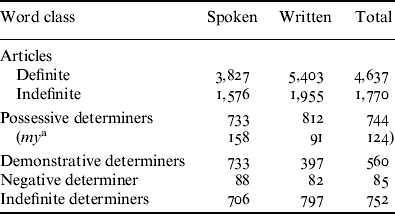
Let us begin with the determiners in Modern English. It was observed in Section 2.1 that of all the determiners only the article shows allomorphic variation whereas the possessive, the demonstrative, the negative and the indefinite determiners do not. We thus expect a major difference in frequency between articles and all other determiners. This prediction was tested on the basis of the file J of the British National Corpus (BNC). The major reason for selecting file J was that it contains both spoken and written language. The procedure was as follows. All subfiles containing spoken language were subjected to analysis, yielding a total of 1.7 million words. Subsequently, as many subfiles containing written language were selected as were needed to generate roughly the same number of word tokens as for the oral corpus. This allowed one to monitor for possible differences between spoken and written language. Determiners were identified by the search terms ‘determiner+noun’ and ‘determiner+adjective’. These two syntactic contexts cover the overwhelming majority of possible distributions of determiners. Table 1 presents the relative frequencies of all determiners in spoken and written English.
Frequency of determiners in spoken and written English (normalized to tokens per 100,000 words)
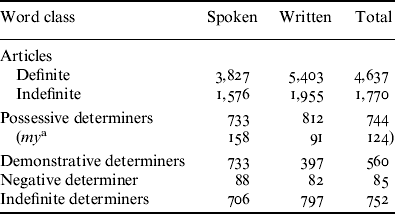
a The first person possessive determiner my is separately given in parentheses in this table only to establish the contrast with the indefinite article.
It is obvious from Table 1 that articles are much more frequent than the other determiners in English. Note that, with the exception of the negation marker no, the determiners form multi-member sets whereas there exists only one definite and one indefinite article. The difference in frequency comes out more strongly in the written than in the spoken data set, but even in the latter, the indefinite article occurs more than twice as often as the most common sets of non-articles (i.e. all possessive or all demonstrative determiners). This finding is in keeping with the research hypothesis. It may therefore be argued that high frequency is responsible for the generation of article allomorphy whereas the relatively low frequency of the other determiners accounts for their formal invariance.
We now turn to the allomorphy in noun and verb inflection. Undoubtedly, the third person singular and the past tense markers on verbs as well as the plural and the genitive markers on nouns are of very high frequency. Generally speaking, the frequency of these bound morphemes is considerably higher than that of free-standing morphemes, and it is this frequency which lets us expect allomorphic variation. This difference provides a simple explanation for the observation that morpheme-based allomorphy is more common than word-based allomorphy.
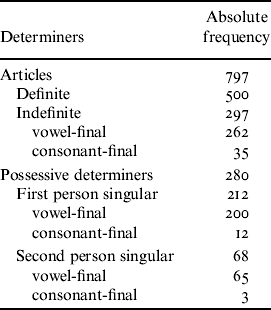
As we proceed to the diachronic data, we are faced with the difficulty that the use of articles as we know it today has only established itself fully in Early Modern English. It is therefore inappropriate to examine Chaucer's language even though the allomorphies of indefinite articles and possessive determiners co-existed in his time. The frequency analysis therefore had to be based on Early Modern English texts. The choice fell on Shakespeare's A Midsummer Night's Dream for which the results are presented in Table 2. Similar frequency distributions can be found in his other plays.
Token frequency of selected determiners in A Midsummer Night's Dream
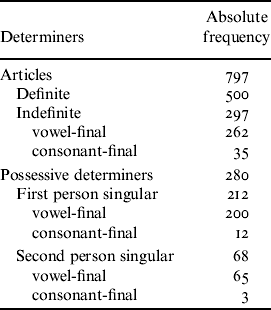
Table 2 reveals that articles are nearly three times more frequent than possessive determiners of the first and second person singular. However, when the comparison is restricted to the indefinite article, the difference vanishes almost completely. It is not entirely clear which comparison is the appropriate one. One way out of this difficulty may be to suggest that one member of the paradigm (i.e. the indefinite article) profits from the strength of another member (i.e. the definite article). Very probably, this benefit derives from both the ultra-high frequency and the allomorphic variation of the definite article. It may be tentatively concluded that frequency is one factor in the preservation or loss of the alveolar nasal. By virtue of the support from the definite article, the allomorphy of the indefinite article is historically stable whereas the possessive determiners lack this support and therefore relinquished their allomorphy. We return to this argument in Section 5.5.
As noted in Section 2.3, the loss of allomorphic variation was not only true of the possessive determiners but also of ME verbal infinitives such as se~seen and say~sayn. This latter allomorphy was not preserved because content words are not of sufficiently high frequency. In general, main verbs are less common than possessive determiners, which in turn are less common than inflectional suffixes. It is noteworthy that the threshold for allomorphy preservation falls between the bound morphemes and articles on the one hand and the possessive determiners and verbs on the other. Furthermore, the differential frequency between verbs and possessive determiners allows us to formulate the prediction that the former should have lost their allomorphy earlier than the latter. This prediction is clearly borne out by the diachronic data. As exemplified in (8) and (9) above, Shakespeare still used both the consonant- and vowel-final variants of the possessive determiners. In stark contrast, the Middle English infinitival marker 〈en〉 is not found in Shakespeare's works.
The ME verb be(en) is of particular interest. The fact that it eliminated its infinitival allomorphy much like the other verbs results from its lower frequency relative to the articles. However, as shown in Schlüter (Reference Schlüter and Minkova2009), its frequency surpasses that of the possessive determiners in some text types. This means that there must have been an additional factor which weakened the allomorphy on the verbal infinitive. Dropping the alveolar nasal from the infinitive helped establish a formal contrast between the infinitive and the past participle and thus fulfilled a grammatical function.Footnote 19
Next, an explanation will be offered for the higher proclivity of the possessive than the plural to coalescence (see Section 2.2). Let us begin with an analysis of the different communicative effects of coalescence and epenthesis. Each of the two repair strategies has one advantage and one disadvantage. Coalescence is a fusional process whereby morpheme boundaries are blurred and hence the identification of individual morphemes is aggravated. At the same time, the utterance is kept maximally short. By contrast, vowel epenthesis increases the length of an utterance by one syllable, whereby articulatory effort is increased. Its great asset is that it preserves morpheme boundaries, which is of help to the listener in identifying the individual morphemes.
This tie suggests that the two repair processes are viable alternatives and that it depends on specific circumstances as to which of these is favoured. In particular, it stands to reason that the less explicit strategy is resorted to in contexts where the burden it imposes on the listener is limited. Similarly, it is to be expected that the more explicit strategy is used in circumstances where the communicative risk is higher. Clearly, the more frequently a troublesome sequence occurs, the larger its adverse effects on communication. It may accordingly be predicted that epenthesis is preferred in frequent structures whereas coalescence is favoured in less frequent ones.Footnote 20 The underlying logic is that extra articulatory effort is only expended when it is necessary, i.e. when the danger of processing difficulty is high. In this way, a balance between effort and effect may be struck.
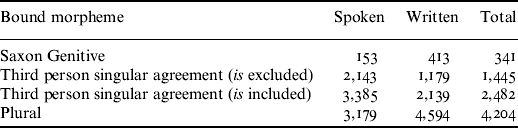
As will be recalled from Section 2.2, the (regular) plural morpheme always resorts to epenthesis whereas coalescence is a real option for the possessive marker. Thus, the (regular) plural morpheme may be expected to be of much higher frequency than the Saxon Genitive. To this we may add the third person singular present tense marker, which behaves like the plural marker and should therefore also have a higher frequency than the possessive morpheme. The suppletive nature of the third person singular form of to be makes it a special agreement marker. Table 3 therefore provides separate figures for verb agreement including and excluding is. The frequency count was based on the entire file J of the BNC. Note that the written corpus is 2.6 times the size of the spoken corpus. Table 3 presents the results obtained.
Frequency of 〈s〉-based morphemes in spoken and written English (normalized to tokens per 100,000 words)
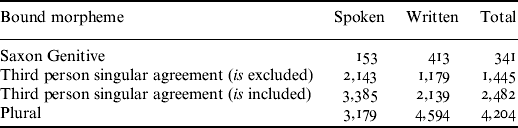
Table 3 demonstrates quite clearly that the Saxon Genitive occurs far less frequently than plural marking or verb agreement. There is a difference between the possessive and the plural marker of factor 20 in the spoken register and factor 11 in the written register. These results lend credence to the hypothesis that the selection of the repair strategy is sensitive to frequency. Higher-frequency units require the more explicit strategy whereas lower-frequency units may better tolerate coalescence as the less explicit strategy.
The frequency account of allomorphy proffered here would be considerably strengthened if ultra-high frequency could be shown to bring forth further ‘unusual’ effects. This is, in fact, the case. Let us briefly consider three phenomena which are also caused by high frequency and which show that ultra-high frequency is so powerful a mechanism as to overcome robust ‘natural’ tendencies in a language. The first and the second are structural effects. Like most other languages, English has a strong preference for consonant-initial syllables and words. In the CELEX database, 83.2% of all word types begin with a consonant. However, when the most frequent words of the language are examined, the picture changes dramatically. Six of the 10 most frequent words in Denes's (Reference Denes1963) list begin with a vowel. In respect to the presence or otherwise of the initial phoneme, ultra-high frequency items are significantly different from all other words in the vocabulary (p<0.01). While Zipf's correlation between frequency and length is clearly in operation here, the important point in the present connection is that ultra-high frequency may rescind the general proclivity for consonant-initialness.
The power of high frequency can be observed in another particularity of monosyllabic words.Footnote 21 There is a pervasive rule prohibiting short vowels in English open syllables. Significantly, the very few items that violate this rule (e.g. to and the) are of extremely high frequency, which strengthens the claim that high frequency brings about anomalous patterns.
The third effect is a historical one. Many languages display a distinct bias for voiceless obstruents in coda positions and a concomitant diachronic tendency to devoice voiced coda obstruents. For example, Old English eorþe developed into Modern English earth, with fricative devoicing following the loss of the final vowel. Interestingly, the opposite process, i.e. voicing, is also observed in the history of English, albeit on a very limited scale. Specifically, it occurred only in high-frequency items such as his, was and the regular plural morpheme (see Berg Reference Berg1995). Again, high frequency manifests itself as powerful enough to induce an unusual process.
Thus, high frequency brings together such diverse phenomena as allomorphy, coda obstruent voicing and ‘empty onsets’ under a common umbrella. This does not, however, mean that the frequency threshold above which these phenomena arise is a constant. It is not, as can be gathered from the fact that and and his do not permit phonotactically governed variation but are subject to vowel-initialness and final voicing, respectively. It therefore has to be assumed that frequency thresholds are process-specific.
When we return to the diachronic underpinning of the frequency account with which the previous section began, we come full circle. It may now be seen that it is not frequency per se that engenders allomorphy. Indeed, it is not the case that the most frequent words in a language are consistently subject to phonotactically determined allomorphy whereas the less frequent items are not (with some arbitrarily defined dividing line). For instance, phonotactically conditioned allomorphy is absent from ultra-high frequency items such as you and it. Frequency becomes a necessary factor only after the historical process has set in. Thus, frequency effects unfold themselves in conditions set by language change which themselves may or may not be related to frequency.
An interesting case is presented by the diachronic development of the first person singular personal pronoun. Anglo-Saxon had invariant ic [itʃ] ‘I’. What we witness in Middle English is the weakening and eventual disappearance of the coda consonant. This is precisely the historical condition that led to allomorphy in the case of the indefinite article and the possessive determiners. In fact, the first person personal pronoun followed the same path and developed allomorphic variation whereby the old form was preserved longer before vowels than consonants and the innovative form occurred earlier and more frequently before consonants than vowels (see Schlüter Reference Schlüter and Minkova2009: 224). Like the possessive determiners but unlike the indefinite article, the personal pronoun lost its allomorphy (in the 15th century at the latest). This is somewhat surprising as the personal pronoun I is four times more frequent than the possessive pronoun my in Johansson & Hofland's (Reference Johansson and Hofland1989) frequency dictionary. It may thus be suspected that there is a factor beyond word frequency that made the allomorphy of the personal pronoun more fragile than that of the indefinite article. While theoretically possible, it is unlikely that phonological reasons were responsible for the disappearance of the allomorphy of the personal pronoun. The affricate /tʃ/ does not seem to be inherently weaker than the alveolar nasal. If anything, the opposite would be inferred from, let us say, assimilation patterns. It is more probable that syntax and its effects on lexicalization play a role in this process. The subject pronoun I marks the syntactic boundary between the NP and the VP in SV(O) sentences. Thus, the personal pronoun never forms a syntactic constituent with the following word. Since the pronoun may combine with an infinite variety of VPs, the frequency of the sequence I plus any following word will be rather low. As the conditions for lexicalization above the single-word level are quite unfavourable in this case, the ephemeral nature of the allomorphy of the personal pronoun is readily understandable.
However sensible the general argument may seem, one might still feel that frequency (and historical change) are not powerful enough to bring forth allomorphy. In fact, one would expect allomorphy to emerge only if the processing cost of implementing it is reasonably low. So only if this condition is met can the frequency account be convincing.
Allomorphy requires that a prior morphological decision be informed by subsequent phonological factors. However, this is only paradoxical in a system with serially ordered operations. Once a parallel architecture is assumed, phonological information is automatically available (at least to a certain extent) at the moment that morphological decisions are taken. In this view, the generation of allomorphy incurs relatively little cost in that the processing system naturally provides for this possibility owing to the interactive nature of information exchange between its components. Empirical support for this characterization of the production system comes from the occurrence of phonological speech errors with allomorphic accommodation. The critical data involve the inadvertent substitution of a stem-final consonant of an inflected verb with another consonant which requires a different allomorph. A parallel model readily predicts that the appropriate allomorph is chosen as a secondary process accompanying the original slip of the tongue. A relevant example is in (14).
(14) the infant tucks [tʌks] – touches the nipple.
(from Stemberger Reference Stemberger1983: 583)
The basic error process in (14) is the replacement of stem-final /tʃ/ with /k/. According to the rules of Standard English, the velar stop requires a non-syllabic allomorph and the affricate requires a syllabic allomorph. As can be observed in (14), the segmental error induces a ‘blind’ repair process in that the contextually appropriate allomorph is chosen. Stemberger (Reference Stemberger1983: 583) notes that such morphological accommodation to phonological errors is the rule in English. This may be taken as strong evidence for parallel processing. From this it may be inferred that the production system offers a potential which supports the generation of allomorphy at a relatively low processing cost.
In the following section, it will be shown that the frequency account is fairly wide-ranging and that it unfolds its explanatory power in quite a few domains that go beyond the familiar ones reviewed in Section 2.
5. Extension to other languages: tests of further predictions
Since frequency is a universal property of linguistic units, we would expect a frequency sensitivity of allomorphy across languages, even though the allomorphy threshold is certainly a language-specific parameter. However, rather than just replicating the English results for other languages, we will focus on novel predictions highlighting aspects some of which were briefly considered in the introductory section. The languages to be examined are French, Italian, Greek, German and Spanish.
5.1 The case of French: string frequency
It was argued in the last but one section that frequency effects arise at various levels of linguistic analysis. Therefore, it is only to be expected that allomorphy is sensitive to frequency effects located at levels above the single word or morpheme. Such is the case in French, as evidenced by the data in (3) and (4), repeated here for convenience as (15) and (16).
(15) F. Je me demande s'il est parti. (s'il←si il)
‘I wonder whether he is gone.’
(16) F. Je me demande si Isabel est partie. (*s'Isabel)
‘I wonder whether Isabel is gone.’
Why do we observe contraction in s'il ‘if he’ but not in si Isabel ‘if Isabel’ even though the phonological points of contact are identical? The reason, I argue, lies in what is known as string frequency (Krug Reference Krug1998, Reference Krug, Rohdenburg and Mondorf2003). This measure assesses frequency effects at the level of word sequences, which need not even form a syntactic unit (compare Bybee & Scheibman Reference Bybee and Scheibman1999). Clearly, the string frequency of s'il is much higher than that of si Isabel. The high frequency of s'il affords it increased lexical strength which eases the way for phonological interaction between the two words, hence the coalescence of the two /i/s. As the string si Isabel is much less frequent, it cannot undergo lexicalization and hence its constituent parts remain phonologically autonomous. In this way, high string frequency may be argued to bring about allomorphy.Footnote 22
5.2 The case of Italian: optional allomorphy
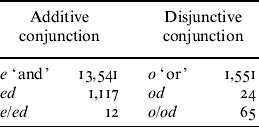
Unlike the languages discussed so far, Italian displays optional allomorphy. An epenthetic voiced alveolar stop may be added to certain function words such as e ‘and’ and a ‘to’ when the following word begins with a vowel (Maiden & Robustelli Reference Maiden and Robustelli2000). The optional nature of this process reveals one facet of allomorphy which remains invisible in compulsory allomorphies: optional processes bring into the picture gradualness and with it, the possibility of gradual differences. It may accordingly be predicted that allomorphy is found more often in more frequent items. Focusing on the two coordinating conjunctions e ‘and’ and o ‘or’, we may predict a higher degree of /d/-epenthesis in the more frequent than in the less frequent word.
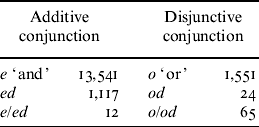
Pertinent data, taken from Juilland & Traversa's (Reference Juilland and Traversa1973) frequency dictionary, are reproduced in Table 4, which shows that the additive conjunction is almost ten times more frequent than the disjunctive one. This result allows us to predict a higher rate of /d/-epenthesis in the case of e than o.
Token frequency of selected conjunctions in Italian
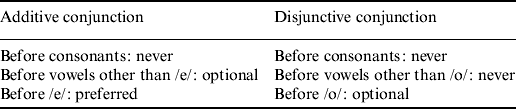
Although precise quantitative information on /d/-epenthesis is apparently unavailable, Table 5 may serve as a rough approximation to a complex phenomenon which is subject to individual speakers' preferences and prescriptivist effects among other factors.
Extent of /d/-epenthesis in Italian
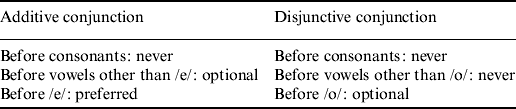
An intriguing difference emerges from a comparison of the two conjunctions. Epenthesis starts ‘earlier’ in e than in o. That is, more powerful facilitators for /d/-insertion are required for o than for e. Specifically, only if o is followed by an identical vowel does epenthesis occur whereas any following vowel is good enough to induce epenthesis in the case of e. The two conjunctions are sensitive to the same hierarchy in exhibiting a higher degree of epenthesis when they are followed by identical vowels than when they are followed by non-identical vowels. The greater reluctance of the disjunctive conjunction to undergo /d/-insertion can also be seen in the higher ratio of non-epenthesized to epenthesized forms in o than e in Table 4. This result lends neat support to the research hypothesis.
5.3 The case of Greek: the scope of allomorphy
Allomorphy may vary not only in the degree to which it is implemented but also in its scope. Allomorphic variation may occur in more or less restricted circumstances, depending on the generality of the allomorphic rules. The frequency account predicts more frequent structures to develop more extensive allomorphies than less frequent structures do. This prediction will now be tested on definite and indefinite articles in Greek.
Greek articles are declined for number, case and gender. The gender system is three-valued (masculine, feminine, and neuter), and so is the case system (nominative, genitive, and accusative). Allomorphic variation occurs only in the masculine and feminine accusative singular forms of the definite and the indefinite article. Allomorphy in both types of article operates on the presence or absence of a final alveolar nasal. According to Holton, Mackridge & Philippaki-Warburton (Reference Holton, Mackridge and Philippaki-Warburton1997), the relevant definite articles take /n/ before following words beginning with any vowel or stop (which may either be singleton or the first part of a consonant cluster). By contrast, the relevant indefinite articles take /n/ only when they are followed by a vowel or a voiceless stop. The allomorphy of the indefinite article is thus a subset of that of the definite article. There is an additional difference between the two types of article. As Holton et al. point out, the insertion of the alveolar nasal is mandatory in the definite, but optional in the indefinite, article, which is reminiscent of the behaviour of the Italian conjunctions as discussed in the preceding subsection.
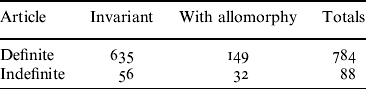
The obvious prediction that can be derived from the disparate behaviour of the two types of article is that, in Greek, the definite one should be used more commonly than the indefinite one. This prediction was examined on the basis of a frequency analysis of the spoken language. A video recording of a TV show lasting approximately one hour was scrutinized for all occurrences of articles.Footnote 23 The database numbered 7590 words. The pertinent results are presented in Table 6. The few cases where the definite article occurred as a concomitant of the demonstrative determiner were left out of consideration.
Token frequency of definite and indefinite articles in spoken Greek
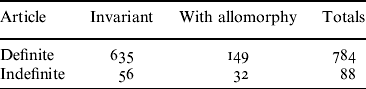
Table 6 shows the definite article to be nine times more frequent than the indefinite one, thus providing strong confirmation of the research hypothesis. Not surprisingly, the frequency difference holds for invariant articles and those with allomorphy alike. It may thus be argued that frequency determines the scope of allomorphic rules. The higher the frequency, the wider the scope of allomorphy. A further remarkable insight brought forth by the Greek data is the relationship between the generality and the optionality of allomorphy. While these two aspects might seem unrelated at first sight, the present account suggests that the generality and the optionality of allomorphy are linked by frequency. High frequency is the single cause that induces both the wider scope and the (largely) compulsory nature of allomorphy.
5.4 The case of German and English: coalescence vs. epenthesis
The next analysis adopts a contrastive perspective and compares genitive marker allomorphy in English and German. A contrastive approach represents a particular challenge because, as noted above, different languages may have different allomorphy thresholds and thus do not compare easily. It is therefore necessary to ‘calibrate’ the two languages by showing that they face similar problems and tackle these in similar ways.
An appropriate area to start from is verbal inflections. The problem that arises during the addition of an inflectional suffix is highly similar in the two languages even though English inflects its verbs far less than German. The third person singular present tense inflection is 〈s〉 in English and 〈t〉 in German (G.; see (17)). The crucial question is how English deals with verbs ending in /s/ or /z/ and how German deals with verbs ending in /t/ or /d/. Actually, the two languages have evolved identical solutions to this problem: they insert an epenthetic short vowel, as shown in (18).
(17) (a) E. she laugh-s
(b) G. sie lach-t ‘she laughs’
(18) (a) E. he kiss-e-s
(b) G. er wart-e-t ‘he waits’
German also makes use of epenthesis in the second person singular of /t/- or /d/-final non-umlauting verbs, even though the relevant inflectional suffix is /st/, i.e. suffixing does not create two contiguous /t/s; see (19).
(19) G. (a) du lach-st ‘you laugh’
(b) du reit-e-st ‘you ride’
The second person epenthesis may be understood as an analogical extension of the third person repair strategy. By contrast, umlauting verbs do not undergo epenthesis and so may have /tst/ in the second person singular, which is broken up in (19b). Consider the conjugated first and second person forms of the infinitive raten ‘to guess’ in (20).
(20) G. (a) du rät-st /reːtst/ ‘you guess’
(b) er rät /reːt/ ‘he guesses’
The phonological shape of the second person singular suffix raises the question of how German copes with /s/-final verbs. Intriguingly, although this situation leads to two /s/s in a row, the epenthetic process again fails to occur. Instead, coalescence takes over, as can be observed in (21).
(21) G. (a) du reißt ‘you tear’ (*du reiß-e-st) (from infinitive reiß-en ‘to tear’)
[raist] [raisεst] [raisən]
(b) du reist ‘you travel’ (*du reis-e-st) (from infinitive reis-en ‘to travel’)
[raist] [raizεst] [raizən]
The only difference between (21a) and (21b) is that the stem-final obstruent is voiceless in reißen ‘to tear’ but voiced in reisen ‘to travel’. However, this difference is levelled out in the inflected forms which are homophonous in both the second and third person singular. This is due to a pervasive devoicing process in German.
Cases of coalescence in English were reviewed in Section 2.2 in connection with the Saxon Genitive.
As an interim conclusion, English and German make use of both epenthesis and coalescence in verb and noun inflection. This basic similarity warrants a comparison of the two languages in terms of their repair strategies.
A notable difference is found in the inflectional possessive marker in English and German. Its similar phonological shape renders the comparison especially direct. Compare the semantically equivalent NPs in (22) and (23).
(22) E. Robert's ticket
[rɒbəts tikit]
(23) G. Roberts Ticket
[roːbεrts tikεt]
It seems at first sight that the only difference between English and German lies in the invariably voiceless coda [s] in German (due to final devoicing) and the allomorphic variation between [s] and [z] in English. However, an interesting contrast emerges when it comes to examining the reaction of the two languages to phoneme repetition. The critical case is represented by names terminating in /s/, as exemplified in (24) and (25).
(24) E. Thomas's car
[tɒməsiz kɑː]
(25) G. Thomas' Auto
[toːmas autoː]
As can be seen from examples (24) and (25), English employs epenthesis whereas German resorts to coalescence. Here, the two languages seem to follow different principles.
To investigate this issue more systematically, I ran two small experiments, one in English and one in German, with identical procedures. The task of the participants was to generate a possessor+genitive marker+possession NP on the basis of a first name that the experimenter provided. For example, participants had to expand Don into Don's wife. The experiment was announced as a free association task which was intended to elucidate the type of associations that subjects had with certain names. This was to divert subjects' attention from the genitive marker.
The German stimuli focused on the three final phonemes /s/, /ts/ and /ʃ/, the English stimuli on the six final phonemes /s/, /z/, /ʃ/, /tʃ/, /dʒ/ and /θ/. First names ending in other phonemes served as fillers and were quasi-randomly selected. A distinction was introduced between monosyllabic and disyllabic names because this variable is known to affect the choice of repair strategy. Quirk et al. (Reference Quirk, Greenbaum, Leech and Svartvik1985: 320) note that Greek names ending in /z/ go for epenthesis when monosyllabic but coalescence when disyllabic (see above). I planned to test each word length and each critical phoneme on the basis of two names. This would have yielded 12 critical items in German (3×2×2) and 24 (6×2×2) in English. However, the three final phonemes /ʃ/, /tʃ/ and /dʒ/ do not combine easily with English disyllabic names. These phonemes could consequently only be tested with monosyllabic stimuli. In German, /ʃ/ is hardly ever found at the end of first names. Thus, only a singleton example was examined in the monosyllabic set. The list of stimuli included 25 items in German (11 critical and 14 filler items) and 30 in English (18 critical and 12 filler items). Twenty native speakers of Standard German and ten native speakers of English participated in the experiment.
Subject responses were near-categorical in the two languages. Consistency levels were similarly high in English and German at approximately 95%. Word length was without effect in both languages. The repair pattern in evidence in German was straightforward. Coalescence occurred after /s/ and /ts/, as in (25) above. All other phonemes (including /ʃ/) were followed by the non-syllabic genitive allomorph. Instances of epenthesis were infrequent (N=5) and randomly scattered across subjects and items.
As expected, the English subjects consistently generated epenthesis after all sibilants. All words ending in non-sibilants took the non-syllabic allomorph, although the phonemes /θ/ and /f/ were occasionally followed by epenthetic vowels. Not a single case of coalescence occurred in the data.
The conclusion that these experimental results invite is very clear. If the need for repair arises, epenthesis is the rule in English genitive marking and coalescence is the rule in German genitive marking. However, one qualification is called for in English. As noted in Section 2.2, coalescence is not completely excluded from genitive constructions. A few biblical names and the construction for X's sake prefer coalescence but are also compatible with epenthesis.Footnote 24
Why does German gravitate towards coalescence whereas English tends towards epenthesis? It was argued above that epenthesis is the less disruptive of the two repair processes and should therefore be favoured in more frequent structures. It may consequently be predicted that the Saxon Genitive should be more common in English than in German.
Comparing the use of the Saxon Genitive in English and German, one cannot but notice a major difference. Whereas the possessor has lexical status in German, it assumes phrasal status in English (Hartmann & Zimmermann Reference Hartmann, Zimmermann and Maienborn2003). The lexical nature of the possessor restricts the possessor position essentially to proper nouns, as these do not normally take an article. The Saxon Genitive thus has a fairly limited use in German. In English, by contrast, the Saxon Genitive has a far wider range. In addition to proper nouns, the possessor position may be occupied by common nouns, both animate and inanimate, and preceded by articles and several premodifiers, as exemplified in (26).
(26) the former Deputy Prime Minister's words
(from Rosenbach Reference Rosenbach2005: 624)
The point of interest here is that the use of the Saxon Genitive is much less constrained and hence its frequency of occurrence is much higher in English than in German (see Hansen-Schirra, Hansen, Wolfer & Konieczny Reference Hansen-Schirra, Hansen, Wolfer and Konieczny2009 for empirical support). In the light of this contrast, it makes sense to develop different repair strategies. The recourse to epenthesis in English and to coalescence in German can now be understood as a frequency effect which is embedded in a discourse situation in which speakers and listeners have to balance out articulatory effort and the risk of disruptive communication.
This account leaves some latitude for within-language variation. Since frequency is by hypothesis the major determinant, coalescence may be expected in infrequent structures even in a language like English, which favours epenthesis. Thus, part of the explanation for the cases of coalescence noted in Section 2.2 may be the infrequency of the foreign names and the construction for X's sake. There are certainly additional factors at work. For instance, the fact that epenthesis is found in monosyllabic Greek words while longer ones prefer coalescence recalls the notion of the ideal length of an inflected word. To be specific, resorting to epenthesis in monosyllabic names but to coalescence in disyllabic ones gives a syllable number of two in both cases.
5.5 The case of Spanish: the inheritance effect
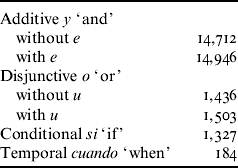
In the final analysis we return to the Spanish conjunctions as introduced at the beginning of this study. The prediction from the frequency account is very clear. The conjunctions allowing allomorphy should occur more often than the invariable conjunctions. The counts in Table 7 are taken from Juilland & Chang-Rodriguez's (Reference Juilland and Chang-Rodriguez1964) frequency dictionary.
Token frequency of selected conjunctions in Spanish
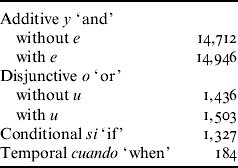
It is obvious from Table 7 that, viewed as groups, the coordinating conjunctions are much more common than the subordinating ones. Frequency thus seems to distinguish between the invariant and the phonologically variable conjunctions. However, there is a fly in the numerical ointment. The frequency difference between the disjunctive and the conditional conjunction is only minimal. It is necessary therefore to take additional factors into account. One such factor, which has already been invoked in the interpretation of the historical data in Section 4, capitalizes on the presence of y ‘and’ in the same paradigm and may be understood as an inheritance effect. It is conceivable that o ‘or’ inherits its allomorphy from its closest neighbour which is not only of extremely high frequency but also subject to allomorphic variation.Footnote 25 The effect of the frequency of individual items would thus have to be gauged in conjunction with the frequency of the other members of the paradigm.
5.6 Conclusion
All five tests reported in the foregoing discussion have by and large borne out the predictions of the frequency account. Despite its general success,Footnote 26 the frequency account needs to be flanked by additional factors in a comprehensive theory of allomorphy. Clearly, within-paradigm inheritance (see previous subsection) is only one of them. Another such factor is required to account for the allomorphy or otherwise in German verb inflection. As discussed in Section 5.4, umlauting verbs defy allomorphic variation whereas non-umlauting verbs evince it (contrast (19) and (20)). The reason for this difference lies in the tendency to code a given piece of information only once, that is, to avoid redundancy. In the above, epenthesis was argued to increase the salience of the inflectional marker (at the expense of extra length) and thus to be advantageous to the listener. The umlaut in umlauting verbs performs a highly similar function in that it signals the second and third person singular present tense. No umlaut occurs in the other persons. Notably, it is precisely in the second and third person where the troublesome phoneme sequence arises. We thus register a competitive relationship between umlaut and epenthesis. As both serve the same function, the language system chooses one or the other (though not both).
6. General conclusion: the larger picture of variation
The following conclusion places the frequency account of allomorphic variation into a wider context and briefly discusses some phenomena which are also subject to variation but which are not normally regarded as allomorphic in nature. This will help us see a connection between superficially distinct classes which are bound together by the same underlying mechanism.
Of course, allomorphy is not the only type of variation we find in language. A very prominent phenomenon in English is the alternation between so-called strong and weak forms (e.g. Dixon Reference Dixon2007). As shown in (27) and (28), respectively, the full forms and [ænd] and of [ɒv] may undergo weakening to various degrees.
(27) bread [ənd/nd/ən/n] butter
(28) a cup [əv/ə] coffee
There are obvious commonalities between strong vs. weak forms and allomorphic variation. Both involve closed-class items (and thus a low degree of semanticity) and both are context-sensitive phenomena. However, there are also several disparities. The overarching factor in strong vs. weak forms is stress (or lack thereof), which plays no role in present-day allomorphy. In addition, allomorphy nowadays is largely categorical whereas speakers have more leeway in the degree to which they may implement reduction processes.
The notion of frequency unifies the two phenomena under discussion on a theoretical level. The fifty or so words allowing for the alternation between strong and weak forms are all high-frequency items. They thus benefit from the advantages of easy lexical access, which, as explained above, paves the way to phonetic–phonological variation.
Variation occurs not only between strong and weak forms but also between non-assimilated and assimilated forms, as in (29) and (30).
(29) good night→[gʊn nait]
(30) good girl→[gʊg gɜːl]
The prediction of the frequency account is fairly clear. The higher the string frequency of items like (29) and (30) for example, the higher their lexicalization and, hence, the greater their openness to phonological variation. To the best of my knowledge, quantitative studies of the extent of assimilation which take string frequency into account are lacking.
A superficially very different issue is resyllabification. In casual or fast speech, coda consonants tend to become associated with following vowel-initial words. Formulaic phrases such as Who's dunnit? and Take it or leave it may serve to illustrate this phenomenon. The coda /n/ in done, the /k/ in take and the /v/ in leave fill the ‘empty onset’ of the following pronoun. Because English has a strong preference for consonant-initial words (see Section 4 above), resyllabification may be seen as a phonological process which pushes the resultant string towards some kind of phonological normality – just like the simple alternation between consonants and vowels in allomorphy. The frequency account offered here leads us to expect that resyllabification is especially common in chunks with high string frequency, and cases such as Who's dunnit? would seem to bear this out.
The final type of variation is probably the most radical one – suppletion. Standard examples include lower ordinal numbers, certain irregular verbs and adjective comparison. As may be inferred from various sources (e.g. Mańczak Reference Mańczak and Lüdtke1980, Dressler Reference Dressler1985a, Dehaene & Mehler Reference Dehaene and Mehler1992), suppletive forms invariably occupy the high-frequency range within their domains. The present account views suppletion on a par with less extreme forms of contrast (e.g. single-phoneme variation) in that both are in essence frequency-based effects of lexicalization.
Concluding, a case has been made for understanding phonemically conditioned allomorphy as one member of a family of phenomena involving formal variation. However diverse these phenomena might appear at first glance, they are tied together through a common mechanism which is claimed to be a high-frequency effect. This is not to say that all these phenomena follow exactly the same principles. However, these types of variation are argued to have certain empirical properties in common. Exploring their commonalities and disparities in greater detail will be a worthwhile task for the future.