

Introduction
In human athletes, an increase in the knowledge of exercise physiology has allowed the development of scientific approaches to athletic training and conditioning, leading to improvements in performanceReference McArdle, Katch, Katch, McArdle and William1. In competitive equine sports, improvements in the knowledge of the metabolic demands of competition have also occurred in various disciplines, including racingReference Snow, Mason, Ricketts, Douglas, Snow, Persson and Rose2–Reference Davie, Priddle and Evans5, three-day eventingReference Amory, Art, Linden, Desmecht, Buchet and Lekeux6–Reference White, Williamson, Maykuth, Cole and Andrews8, poloReference Marlin and Allen9, showjumpingReference Art, Amory, Desmecht and Lekeux10–Reference Covalesky, Russoniello and Malinowski13 and enduranceReference Sloet van Oldruitenborgh-Oosterbaan, Wensing, Barnveld and Breukink14, Reference Schott, Marlin, Geor, Holbrook, Deaton, Vincent, Dacre, Schroter, Jose-Cunilleras and Cornelisse15. An understanding of the physiological and metabolic demands of competition is essential for the development of training regimens that elicit adaptations appropriate for the sport being participated in.
Growth in dressage on a worldwide level continues to take place [source: Fédération Équestre Internationale (FEI)], although only a limited number of studies have so far investigated the physiological demands of this discipline. Dressage is judged subjectively, the quality of the gaits and expressiveness of the movement are important factors in establishing scores achieved in competitionReference Clayton16, and identification of horses with superior gait qualities has been performedReference Holmstrom, Magnusson and Philipsson17. ClaytonReference Clayton18 reported that the heart rate of a horse performing a Grand Prix dressage test in a training environment was between 62 and 142 bpm (beats min− 1). LindnerReference Lindner and Lindner19 studied training programmes of dressage horses and reported mean heart rate values of 120 bpm. To date, as far as we are aware, there are no published studies that describe in any detail the heart rates of horses performing dressage in a competition environment.
National dressage competitions within the United Kingdom are governed by British Dressage (BD). A series of tests have been established starting at preliminary level, progressing to novice and then through elementary, medium and advanced medium to advanced level. International competitions use tests devised by the FEI ranging from Prix St Georges to Grand Prix Special. The tests have been constructed such that upward progression through the levels demands an increase in intensity, difficulty of movements and degree of collection and extension of gaits. Marks are awarded for each numbered movement on a scale of 0–10, 0 being movement not executed and 10 being excellent (BD).
The aims of the present study were to: (1) describe the physiological demands of competition in elementary- and medium-level dressage using heart rate as an index; (2) attempt to determine any relationship between the physiological response to competition and marks awarded; and (3) describe the duration and intensity of warm-up used by competitors for these competitions. We hypothesized that (1) heart rate in warm-up would be related to heart rate in competition; (2) heart rates in competition would be higher than those in warm-up; and (3) higher heart rates in competition would be associated with higher marks.
Materials and methods
Competition venues
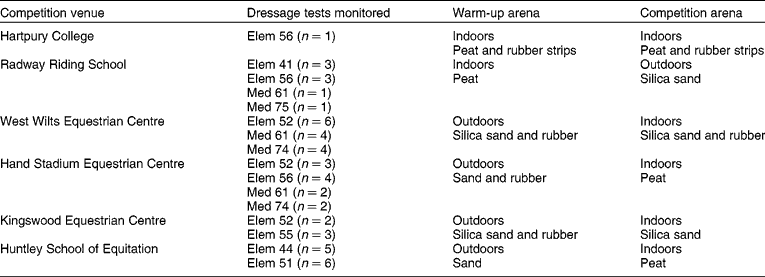
Horses performing elementary- and medium-level dressage were monitored at six different competition venues affiliated to BD throughout January and February in a single year (Table 1). The arenas used for warm-up and competition, including the surface type, are described in Table 1.
Competition venues used for data collection and surfaces of warm-up and competition arenas
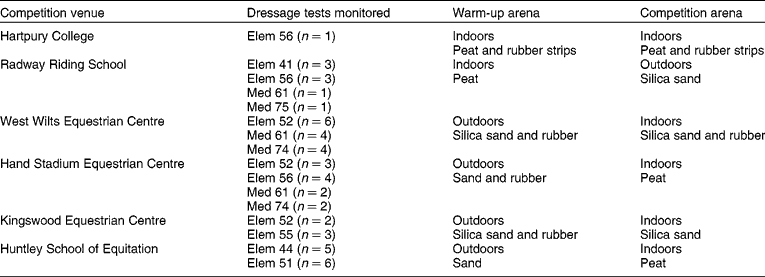
Elem, elementary level; med, medium level.
Sample population
Thirty-five horses performing dressage under BD rules and competing in a total of 50 dressage tests, 36 of which were at elementary level and 14 at medium level, were studied. None of the BD tests at elementary or medium levels include collected movements. The horses were selected only on the basis of competing at elementary or medium level and with the agreement of the owner/rider to take part in the study. The overall study group consisted of 78% geldings and 22% mares, belonging to the following breeds: 47% Warmblood, 36% Thoroughbred cross and 17% Thoroughbred. Ages ranged from 6 to 17 years with a mean ± SD age of 10.0 ± 2.5 years. The average height of the population was 16.1 hh, ranging from 15.0 to 17.1 hh. A total of 36 dressage performances were monitored in horses performing one of six different elementary-level tests (Table 1). A total of 14 dressage performances were monitored at medium level and comprised three different tests (Table 1). Horses were monitored while performing their entire warm-up and throughout the duration of the dressage test.
Dressage test characteristics
For the BD elementary-level tests studied, there was an average of 300 marks awarded for the movements performed, of which 14% were awarded for walk, 48% for trot and 38% for canter. The BD medium-level tests studied were similar, having an average of 330 marks awarded for movements, with 14% awarded for walk, 49% for trot and 37% for canter. BD elementary tests require horses to perform collected, medium and extended walk, trot and canter, walk pirouettes, simple changes through walk, rein back and shoulder-in, travers, renvers and leg yielding (all at trot). Medium tests are essentially the same but with the addition of half-pass in trot and canter. Higher-level medium tests also require collected canter entry to halt at x. The average stated durations for the tests at elementary and medium levels were 5.36 and 5.33 min, respectively. Tests were either performed in a 20 × 40 m or 20 × 60 m arena for elementary but only in a 20 × 60 m for medium-level tests.
Data collection
A single digital video camera (Sony Digital DCR-TRV80E PAL) was used to obtain video recordings of each dressage test. The camera was placed on a tripod near to the dressage judge at ‘A’ (point of entry into the arena on the middle of one short side of the rectangular arena) or ‘C’ (directly opposite the arena entrance on the other short side of the arena) to enable a recording to be obtained that matched the view of the judge as best possible. Recording started as the horse entered the arena before the bell rang, the horse was kept in view throughout the duration of the test and recording was terminated as the horse left the arena.
Heart rate recordings were made using Polar S610 horse trainer heart rate monitors set to record in 5 s averaging mode, T52H coded transmitter and electrodes (Polar, Bodycare Products, Southam, UK). The two electrodes of the heart rate monitor were fitted underneath the horse's girth; one was placed slightly to the left of the ventral midline and one at the middle of the thorax on the left hand side, directly beneath the girth straps. The coat under the electrodes was dampened and electrode gel was applied to the electrodes to ensure a good contact. The transmitter was attached to the left ‘D’ ring at the top of the horse's saddle. The receiver unit was placed on the rider's left wrist. A stopwatch was started at the same time as the stopwatch function on the heart rate monitor in order to relate the movements of the horse in the arena to the video and the heart rate recordings. The data stored in the receiver were downloaded to a laptop using a Polar infrared interface for analysis with the Polar Precision Performance 3.0 program.
Copies of dressage score sheets were obtained for all horses that were studied. Overall scores for the tests, as well as placing within the competition, were recorded.
Data handling and analysis
Markers were applied to the data using the Polar Precision 3.0 program to allow the warm-up data to be separated from competition data. The data were then transferred to Microsoft Excel 2000 for further analysis. The peak heart rate and mean heart rate ± standard deviation (SD) were calculated for each individual horse, during both warm-up and competition. The peak and mean heart rates ( ± SD) were then calculated for all horses performing either elementary or medium-level dressage tests and for all horses in all tests. The proportions of time, expressed as a percentage, horses spent at different ranges of heart rates for the duration of warming up and competition were calculated.
The video recording was transferred to video home system tape. Any extremes in heart rate during the test were then checked against the video recording to attempt to determine whether aberrations were due to extreme movement (e.g. ‘spooking’) or equipment failure (e.g. loss of contact).
Statistical analysis
The Kolmogorov–Smirnov test (SPSS version 12.0) was used to determine whether data were normally distributed. Microsoft Excel was used for all subsequent statistical analysis. A level of P < 0.05 was considered significant. Differences between warm-up and competition heart rates were investigated using a two-sample paired T-test. A two-sample F-test was used to confirm that the variances in heart rate and warm-up duration between elementary and medium were similar. Subsequently, an unpaired T-test assuming equal variances was used to investigate differences between elementary and medium variables.
A one-way analysis of variance (ANOVA) was used to investigate differences between the different dressage tests at elementary level. ANOVA was not used at medium level because one of the tests (medium 75) contained only one horse. An F-test was therefore used for medium level, followed by a T-test (two samples assuming equal variances).
Pearson's correlation coefficient was used to investigate the relationship between heart rate during warm-up and that in subsequent competition, and the relationship between heart rate and score.
Results
Warm-up
Mean warm-up and peak warm-up heart rates were not different between the different elementary tests (P < 0.05). Warm-up duration was significantly different (P < 0.01) between horses warming-up for the different elementary tests, ranging from 18 ± 7 min for elementary test 56 to 53 ± 17 min for elementary test 41 (Table 1). At medium level, there was no significant difference (P>0.05) in mean warm-up or peak warm-up heart rate between the different medium-level tests. Warm-up duration was not significantly different between the different medium-level tests (P>0.05).
The distribution of heart rate values was normally distributed for horses warming up and competing at elementary-level dressage. During warm-up, 65.2% of the time was spent at heart rate values in the range of 80–160 bpm, of which 54.5% was 80–120 bpm, and only 1.3% of time the heart rate values exceeded 160 bpm. At medium level, over 69.7% of the time heart rate values for horses warming up were in the range of 80–160 bpm, of which 54.7% was between 80 and 120 bpm. There were no heart rate values that exceeded 160 bpm.
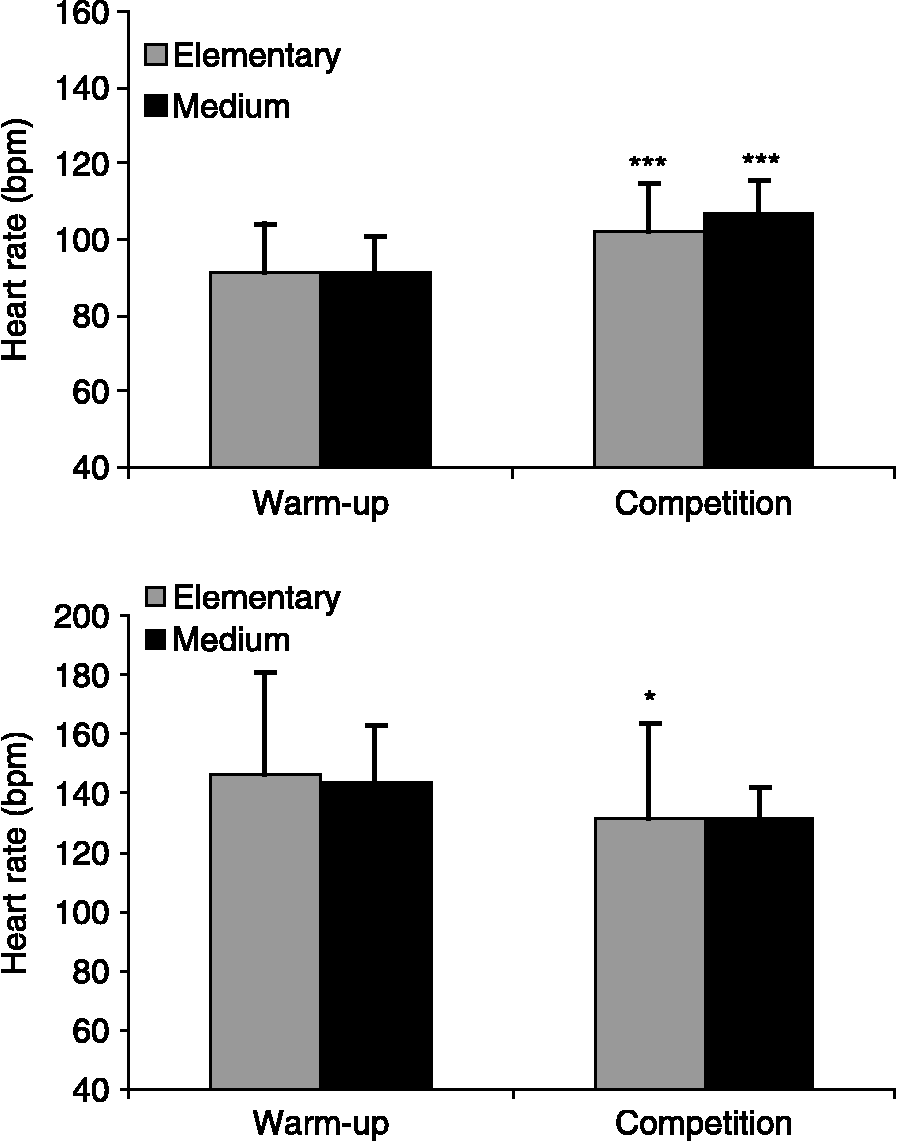
The average durations of warm-up for all horses competing were 31.3 ± 15.4 min at elementary level (n = 36) and 31.4 ± 10.0 min at medium level (n = 14; P>0.05). The mean and mean peak heart rates for horses warming-up for elementary level were 91 ± 13 and 146 ± 35 bpm, respectively, and were not different from that for horses warming up for medium level (mean 91 ± 10 bpm; mean peak: 144 ± 32 bpm; Fig. 1). There was no significant difference in mean or mean peak warm-up heart rates between elementary and medium levels (P>0.05).
Mean ( ± SD) heart rate (top panel) and mean ( ± SD) peak heart rate (bottom panel) in warm-up and competition in horses competing in elementary (n = 36) and medium (n = 14) dressage competitions. Competition significantly different from warm-up *P < 0.05; ***P < 0.001

Competition
There was no significant difference in mean or mean peak heart rate between the different individual tests at elementary level or between individual tests at medium level (P>0.05).
In competition at elementary level, 82.7% of heart rate values recorded were in the range of 80–160 bpm, 69.7% of which were between 80 and 120 bpm and only 0.2% of heart rate values exceeded 160 bpm. At medium level, 83.8% of the time the heart rate values for horses competing were between 80 and 160 bpm, 55.9% of which was between 80 and 120 bpm. No heart rate values were recorded above 160 bpm during competition.
The mean and mean peak heart rates for all horses, while competing at elementary level (n = 36) were 102 ± 13 and 132 ± 20 bpm, respectively, and 107 ± 8 and 132 ± 10 bpm, respectively for medium level (n = 14; Fig. 1). There was no significant difference between the mean or peak competition heart rates between the two levels (P>0.05).
Mean heart rates were significantly higher in competition compared with those during warming up for both elementary and medium levels (P < 0.001; Fig. 1). By contrast, peak heart rates during warming-up were significantly higher than peak heart rates in competition at elementary level (P < 0.05; Fig. 1) but not at medium level (P>0.05).
Repeatability of measurements during competition at the same level
Eight horse and rider combinations competing at elementary level and four at medium level were monitored on two separate occasions at different competitions during the study. For these horses, there was no significant difference in mean warm-up heart rate (test 1: 89 ± 11 vs. test 2: 94 ± 9 bpm; P>0.05), mean peak warm-up heart rate (test 1: 146 ± 28 vs. test 2: 136 ± 20 bpm; P>0.05), mean competition heart rate (test 1: 105 ± 8 vs. test 2: 106 ± 9 bpm; P>0.05) or mean peak competition heart rate (test 1: 141 ± 21 vs. test 2: 133 ± 11 bpm; P>0.05).
Relationship between heart rate and score
Mean heart rates for horses that achieved the highest scores in competition were very variable, ranging from some of the lowest (79 bpm) to the highest (131 bpm) heart rates recorded. There was no correlation between heart rate and dressage score awarded at either elementary or medium level (P>0.05), nor when the data between the two levels were pooled (P>0.05).
Relationship between heart rates during warm-up and competition
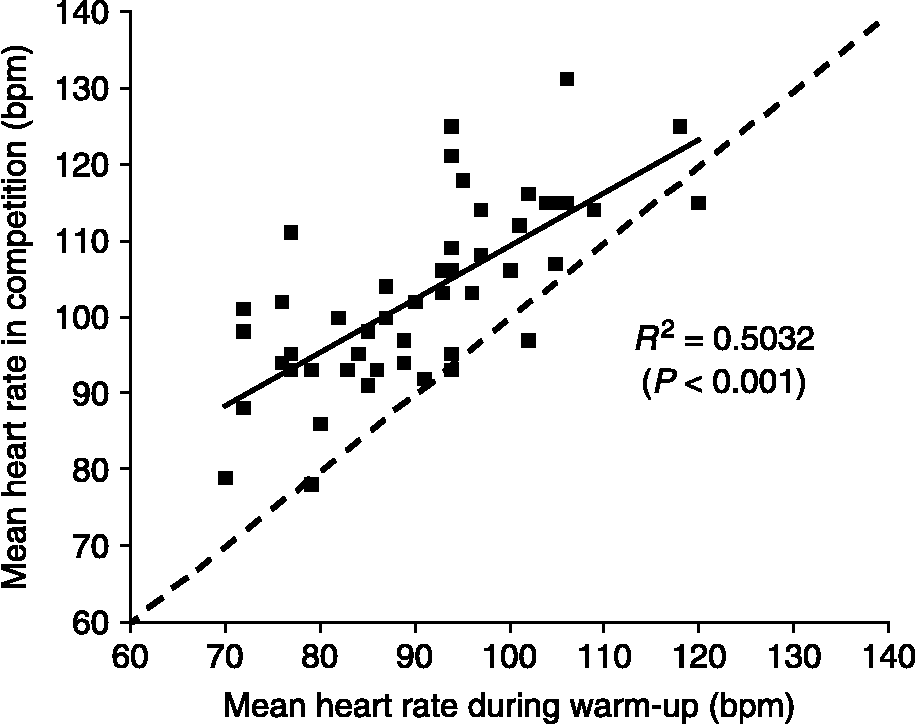
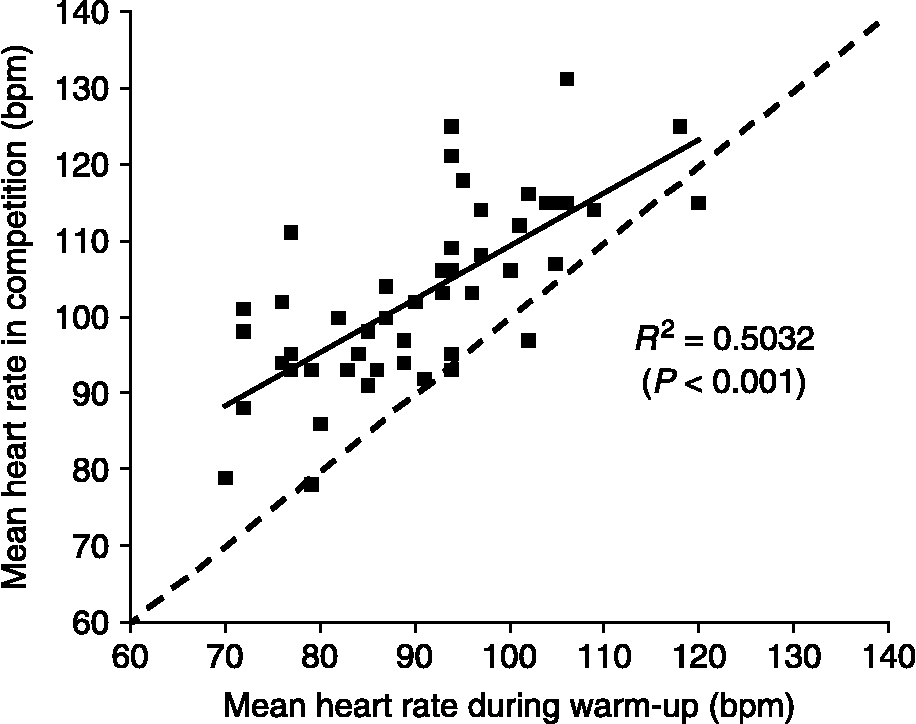
There was a significant positive correlation between mean heart rates of horses warming up and in competition for both elementary and medium dressage tests combined (P < 0.01; Fig. 2). A significant positive correlation was also seen for both elementary- (r 2 = 0.523; n = 36; P < 0.01) and medium (r 2 = 0.568; n = 14; P < 0.01) level tests individually.
Mean heart rate during competition as a function of mean heart rate during preceding warm-up in horses competing in elementary (n = 36) and medium (n = 14) dressage competitions (combined datasets). Broken line, line of identity
Discussion
Potential limitations of the present study
A potential limitation of this study is the use of heart rate to estimate workload, as heart rates during exercise below values of ~160bpm are known to be susceptible to elevation due to anxiety/excitement separate from effort per se. However, examination of the individual heart rate recordings suggested that this would have been minimal as all horses showed similar trends throughout the individual tests. However, the higher heart rates in competition compared with those in warm-up may be due to some component of anxiety and/or excitement, as dressage riders frequently perform similar movements in warm-up to which they will be doing in subsequent competition. However, the duration of warm-up is longer and the movements are generally not performed in as concentrated a time period as during real competition.
Test characteristics of elementary- and medium-level dressage
Understanding the physiological demands of dressage tests and how riders warm up for them may enable the rider and/or coach to tailor training to best suit the demands of the competition through identification of aspects of the performance that contribute most significantly to marks awarded, enabling specific preparation to occur for each competition to improve the chance of success. Coaches of human athletes constantly strive to improve performance, and it is well documented that when appropriate feedback is provided motor skill acquisition improves significantlyReference Schmidt and Lee20. Of course, in equestrian sport, the feedback is to the rider who must then in turn apply this to the horse.
In both the elementary- and medium-level dressage tests studied, trot was found to be the most influential gait in relation to the amount of marks awarded (48 and 49%, respectively), with canter being the second most important (38 and 37%, respectively) and walk contributing the least to the marks awarded (14% in both levels). Training and competition preparation should therefore be aimed mainly at improving the trot and the canter, and movements within these gaits, to achieve optimal marks in competition.
Very little work has been undertaken in the sport of dressage in contrast to other disciplines, for example endurance or eventing. ClaytonReference Clayton18 looked at the physical requirements of a Grand Prix test and found that low-intensity exercise of slow-speed duration contributed 88% of the marks in the test and that movements performed in the faster gaits contributed only 12%.
Identification of the percentage of marks awarded for specific dressage gaits and movements in individual tests can easily be identified by the rider/trainer, enabling training to be tailored to a specific competition, with the aim of improving performance. Identification of dressage tests that the horse is most likely to perform well–depending on its natural ability and expressiveness of the gaits – can then be made, which would enable competitors to choose competitions to best suit the individual horse and its current progress through training.
The average durations of the elementary- (5.36 min) and medium (5.33 min) level tests in the present study are similar to that reported by ClaytonReference Clayton21 for Canadian dressage basic-level tests of 4.50 min and medium-level tests of 6.17 min.
The stated duration of the dressage tests at elementary level increased progressively throughout the test series in the sample of tests investigated in the present study (4.30, 5.00, 5.30, 5.40, 5.30 and 6.00 min). As the horse progresses, it is required to perform for longer, as well as performing more difficult movements. Training for specific tests should therefore mimic this pattern to ensure the horse is adequately conditioned to perform for the required period of time, without becoming physically or mentally fatigued. From a training point of view, ClaytonReference Clayton21 suggested that horses should be trained in concentrated periods of work approximately equal to the duration of the test, with rest intervals in between. On the basis of the data in the present study, it would seem appropriate to focus on the requirement for movements at a higher level before attempting to increase the ability of the horse to work for longer durations when progressing from elementary to medium level.
Warm-up duration
Competitors at both elementary and medium levels warmed up for an average total duration of 31 min, with a greater variation in duration at elementary level. This may be a reflection of riders competing at this level ranging from low to high levels of experience. The duration of warm-up appears to be appropriate based on suggestions that ~20 min is required for initial warm-up prior to undertaking more strenuous workReference Lindner and Lindner19. However, the structure of warm-up was not recorded in the present study and it could be that riders undertook strenuous movements early on in the warm-up period before the horses were appropriately warmed up. This may be one explanation for the higher peak heart rates observed in warm-up compared with competition. The duration of warm-up in the present study is also similar to that previously reported by Murray et al. Reference Murray, Mann and Parkin22.
For the horse to achieve optimal performance in competition, it is common practice for competitors to practice movements during their warm-up that are contained within the test. The duration of warm-up suggests that some competitors may not be allowing sufficient time to warm up the horse prior to commencement of these more strenuous movements. Low-intensity warm-up in a training environment prior to undertaking more strenuous movements has previously been reported to last for a duration of 20–30 minReference Lindner and Lindner19.
Warm-up of short duration may affect the performance of individual horses. Correct warm-up should promote freedom of movement through relaxation and stretchingReference Clayton16. Interestingly, Murray et al. Reference Murray, Mann and Parkin22 recently reported that both increased warm-up time and specific warm-up design were positively (but weakly) associated with final score at novice and Prix St Georges levels.
Mean and peak heart rates at elementary and medium levels
The only previous studies performed on the heart rate response to pure dressage (i.e. dressage as an individual discipline) were conducted in a training environmentReference Clayton18, Reference Lindner and Lindner19. The findings of the present study are, to the best of our knowledge, the first published information on the heart rate response of horses during dressage.
The mean and peak heart rates for horses warming up and competing at both levels were found to be in the range of 70–160 bpm, suggesting that at whole body level these horses are working almost entirely aerobically. However, it is speculated that individual muscle groups work intensely during particular dressage movements. The fact that no difference was seen between elementary and medium levels may indicate these horses were sufficiently conditioned to meet the physical demands of the increased difficulty of movements at medium level. Alternatively, the lack of difference could be due to other factors such as insufficient warm-up, fitnessReference Fregin, Thomas, Snow, Persson and Rose23–Reference Cikrytova, Kosteclecka, Kovar, Horak, Hanak, Persson, Lindholm and Jeffcott25 or ageReference McKeever and Malinowski26 of horses at the different levels.
During competition, the mean heart rates for elementary- and medium-level dressage were 102 and 107 bpm, respectively. LindnerReference Lindner and Lindner19 reported the mean heart rate value for horses performing dressage exercise in a training environment to be 120 bpm, which is higher than that found in the present study.
The only previous report in the literature for heart rates during dressage competition was a mean of 92 bpm in event horses competing in a one-star three-day event, which is considerably lower than the mean values seen in the present study, even though the event horses were competing in temperatures of 33°CReference Marlin, Schroter, White, Maykuth, Matthesen, Mills, Waran and Harris27. Exercise in thermally challenging environments will increase the degree of thermoregulation (e.g. skin blood flow, ventilation, heart rate, sweating) and, consequently, increase heart rate. Explanations for the differences may be a higher level of fitness in the event horses and differences in breed.
Relationship between heart rate in competition compared with warm-up
Mean heart rates in this sample of elementary- and medium-level dressage horses were found to be greater in competition than when warming up. Heart rates may be higher in competition due to the effects of excitement or anxiety, as heart rates below ~150–160 bpm are most susceptible due to the effects of adrenalineReference Hamlin, Klepinger and Gilpin28. Alternatively, it may be that movements are performed with more intensity during competition. There is also the possibility of increased heart rate during competition cardiac drift through increased body temperatureReference Erickson, Lundin, Erickson, Coffman, Persson, Lindholm and Jeffcott29 as a result of warm-up. Another possibility is the elevation of heart rate as a result of development of progressive fatigue. For example, when the same movement is performed twice in a dressage test, the heart rate has been observed to be higher the second time the movement is performed (Fielding, Geering and Marlin, unpublished data).
Mean heart rate during warm-up was significantly positively correlated with mean heart rate during competition. Three horses particularly stood out in the sample of horses at elementary level, where their heart rate in competition was considerably higher than when warming up. All three horses were studied at a single venue (Radway), where the warm-up area was inside but the competition arena was outside; at all other venues, the competition arena was inside and at all but Hartpury the warm-up was outside. The heart rate of the horses at Radway may have been elevated in response to the weather, which was particularly windy, or through distractions from performing outdoors.
The competing surface may also have had an effect on the heart rate of the horse studied, For example, Sloet van Oldruitenborgh-Oosterbaan et al. Reference Sloet van Oldruitenborgh-Oosterbaan, Wensing, Barnveld, Breukink, Persson, Lindholm and Jeffcott31 reported that the heart rates of vaulting horses could be raised by as much as 50% when cantering in deep sand. However, surface alone is unlikely to explain the elevations in the horses at Radway, as the surface was of a similar type to several of the other venues studied. Interestingly, in the case of two of the three horses with the highest heart rates, they were observed to be poorly performing, where one horse had the lowest score out of all (n = 50) horses studied. From the analysis of the video footage for this horse, it could clearly be seen the horse was tense and ‘spooking’, possibly accounting for the low score and high heart rate.
Two data points particularly stood out at medium level as demonstrating a higher than expected heart rate in competition from the values recorded during warm-up. Both data points were from the same horse, which had the same warm-up heart rate (95 bpm) for both tests; this horse performed well, being the fifth and seventh most highly performing horse in the sample (n = 50).
The heart rates recorded in the present study show that these horses are working as hard, and in some cases harder, than the Grand Prix horse studied by ClaytonReference Clayton18 during training where heart rate values ranged from 62 to 141 bpm. This assumes that heart rate is a reliable indicator of workload and may not be for reasons already highlighted. Alternatively, the horses at Grand Prix level, while performing more difficult and/or intense movements and for a longer duration, may either be fitter or athletically superior to those in the present studyReference Clayton16, However, this makes the assumption that heart rate in Grand Prix horses is the same during competition as during training. Based on the present study, this may not be the case.
Heart rate and warm-up durations for individual dressage tests
There were no statistically significant differences between mean or peak heart rates for the different tests at either level, although it is difficult to be certain whether this is due to the relatively small numbers of horses studied in individual tests. However, elementary test 41 stood out as having a higher mean heart rate of 112 bpm compared with other elementary tests. This was a surprising finding, as this test is of the shortest duration and the first test in the elementary series. As discussed above, this could be due to the warm-up and arena locations. Alternatively, however, when the requirements of the test are examined, it is apparent that elementary 41 has a higher proportion of marks awarded for canter (47%) than the other five tests studied at elementary level, and also has a correspondingly lower than average proportion of trot (41%) and walk (12%). Thus, it is not unexpected that horses may have to work harder in this particular test.
One possible conclusion from the warm-up observation is that some riders may not allow sufficient time for the horse to physically warm-up and to subsequently perform specific movements in preparation for the test. They may also be progressing too rapidly from light to intense warm-up in order to focus on specific movements, possibly increasing the likelihood of injury. Murray et al. Reference Murray, Mann and Parkin22 observed that mean warm-up duration only increased from around 25 min at novice level to around 34 min at Prix St Georges level. As the movements are more demanding and the length of the test longer at Prix St Georges, one could speculate that either riders at the lower levels are warming up for too long or that riders at the higher levels are not warming up sufficiently.
Heart rate characteristics for individual horses competing in more than one test
In general, in the present study in a limited number of horses, heart rate characteristics, for both warm-up and competition, appear to be very repeatable between dressage tests of the same level. This suggests that it may be possible to monitor individual horses training and performance in dressage over time using the heart rate response to warm-up and competition.
Relationship between heart rate and performance in individual horses
Looking at the whole sample of horses studied, there was no indication that there was a simple relationship between heart rate and performance. The horses that scored the highest in competition in this study varied greatly in their heart rate values. One horse had the lowest mean heart rate value in competition (79 bpm). One potential reason for this exceptionally low heart rate for this level of work could relate to the fitness of the horse, as this horse was an advanced eventer being prepared for Badminton CCI**** (four-star level) Horse Trials. In addition, this horse was being ridden by an elite rider. All the other horses in the group of highly scoring horses were dressage horses aged 6–8 years and Warmblood breeding, all of which were ridden by experienced riders.
In the case of dressage, the quality of the gaits is likely to have the most influence on the scores achieved in competition, perhaps irrespective of the effort required to achieve the movements. What may be more useful is to establish baselines for the heart rate responses of individual horses over time and to relate heart rate to the ability to perform specific movements rather than the overall performance.
In conclusion, heart rate in warm-up was related to heart rate in competition, but heart rates in competition were generally lower than those recorded in warm-up. Higher heart rates in competition were not associated with higher marks.
Further studies are indicated to examine how heart rate response to competitive dressage changes over time within tests and in relation to different movements and with higher levels of competition above those studied here.