

Cerebral Palsy and its Impact
The diagnosis of cerebral palsy can have a profound impact, not only on the diagnosed individual themselves, but also on their parents and siblings. Raising a child who has been diagnosed with cerebral palsy is a challenge faced by many families. Cerebral palsy (CP) is regarded as a developmental disability which impairs movement and posture caused by damage to a child's brain (Buran, Sawin, Grayson & Criss, 2008). CP is reported to be permanent and non-progressive (Buran et al., 2008) and may lead to associated deficits including intellectual, visual and auditory impairments, along with the increased risk of epilepsy (Fleiss & Gressens, Reference Fleiss and Gressens2012). Studies indicate that within Australia, approximately 600 to 700 infants are born with cerebral palsy each year and it is ranked in the top 5 most costly diagnosed conditions per capita, costing an average of $43,000 per individual annually (Access Economics, 2008).
Adjustment After Diagnosis and Support Needs
Children with CP require significant support throughout their lives, therefore, it is important that families are provided with relevant and accessible information regarding the condition and available support services (Buran et al., 2008). Mitchell and Sloper (Reference Mitchell and Sloper2002) argued that providing appropriate support and information to families is vital because such support and information empowers the family and enables the family to actively engage in therapeutic programs. Further, Law et al. (Reference Law, Hanna, King, Hurley, King, Kertoy and Rosenbaum2003) suggested that maintaining a quality relationship between health professionals and families encourages families to be involved in every aspect of the services available for the child.
When a child is diagnosed with CP parents and siblings must make a number of adjustments (Rentinck, Ketelaar, Jongmans & Gorter, Reference Rentinck, Ketelaar, Jongmans and Gorter2006). Recent research has focused on an individual's positive adaptation to family life after another family member has been diagnosed with a disability (Kruijsen-Terpstra et al., Reference Kruijsen-Terpstra, Ketelaar, Boeije, Jongmans, Gorter, Verheijden, Lindeman and Verschuren2013), however, limited research has focused on adaptation after a child has been diagnosed with CP. As explained by Rentinck and colleagues (Reference Rentinck, Ketelaar, Jongmans and Gorter2006), adaptation is a multi-faceted process which will constantly change over time. They believe that if allied health professionals are able to identify those who are experiencing difficulties after the diagnosis of a child with CP, they may be able to intervene and provide services that will assist towards positive family adaptation. McCulloch and Simon (Reference McCulloch and Simon2011) explained that without appropriate information and interventions, many families are left without the depth of understanding, empathic responses and resources to effectively interact with and care for their family member with cerebral palsy. However, individuals and families can learn to adapt adequately to financial, psychological, social and educational requirements with the use of evidence-based therapeutic treatment plans (Tomasello, Manning & Dulmus, Reference Tomasello, Manning and Dulmus2010).
According to Jackson et al. (Reference Jackson, Baird, Davis-Reynolds, Smith, Blackburn and Allsebrook2007), providing appropriate and timely information and support to families after a child has been diagnosed with cerebral palsy can facilitate control and empowerment to the carers involved. Chen and Lukens (Reference Chen and Lukens2011) suggested that it is also important to include siblings in discussions regarding a child's diagnosis, because siblings are often overlooked when a child has been diagnosed with a disability. Chen and Lukens emphasised that siblings require appropriate information, education and support from other family members and health professionals to ensure their own optimal understanding and development (McCulloch & Simon, Reference McCulloch and Simon2011). Tomasello, Manning and Dulmus (Reference Tomasello, Manning and Dulmus2010) found that a family-centred, systemic approach to working with families who have a child with a disability may help health professionals meet the varying needs of each family.
Rationale and Aims
From the literature, it is evident that there is a need for health professionals to provide relevant and accessible information regarding the diagnosis of cerebral palsy to families. This has been highlighted in a number of studies relating to individual families’ ideas of their specific requirements (Mitchell & Sloper, Reference Mitchell and Sloper2002; Rahi, Manaras, Tuomainen & Hundt, Reference Rahi, Manaras, Tuomainen and Hundt2004; Vargus-Adams, Reference Vargus-Adams2011), along with what health professionals view as important factors for the delivery of required information (Baine, Rosenbaum, & King, Reference Baine, Rosenbaum and King1995; Mitchell & Sloper, Reference Mitchell and Sloper2002).
Although there are a number of available programs offered to families after a diagnosis, much of the research focuses on providing appropriate information relating to a child who has been diagnosed with an illness or disability in general. There is limited research specifically examining the efficacy of psychoeducation programs for families who have a child who has been diagnosed with cerebral palsy. Further, there appears to be no systematic guidelines to provide effective information and evidence-based support to families after a child has been diagnosed with cerebral palsy.
The aim of this study was to systematically review the available literature and research on group and family interventions for families who have a child diagnosed with cerebral palsy. The literature was critically examined to identify the factors considered to be the most important features of such programs that predict each family member's adjustment following a diagnosis of cerebral palsy.
A further aim of this research was to develop and propose guidelines regarding best practice delivery for service providers who conduct such interventions. This study provides the basis for future research evaluating programs in this field.
Method
Research Design
The Preferred Reporting Items for Systematic Reviews and Meta-Analyses (PRISMA) guidelines were adopted (Moher, Liberati, Tetzlaff, & Altman, Reference Moher, Liberati, Tetzlaff and Altman2009) for this systematic literature review. These guidelines were employed because PRISMA can be applied to a variety of systematic literature reviews including evaluations of interventions. A narrative approach was used to synthesise the data extracted. This is described later in the Data Aggregation section. The study was exempt from ethical review by the Human Research Ethics Committee in Tasmania, Australia.
Search Procedure
A systematic literature search of articles was conducted using psychINFO, Taylor and Francis Online, PsychARTICLES, Medline and ProQuest. The initial search, with key search terms ‘cerebral palsy’ were used, along with ‘diagnosis’, ‘disability’, ‘adaptation’, ‘family’, ‘parent’, and ‘family functioning’. The second search assisted to identify research relating to ‘cerebral palsy’ AND ‘psychoeducation’ ‘support groups’, ‘social support’, ‘parental distress’, ‘information’, ‘effective delivery of information’ and ‘family AND information AND diagnosis’. The search was restricted to papers published in English in peer review journals from January 1990 to July 2013. The set time period was selected as researchers have acknowledged that there has been increased awareness about the need to provide families with information regarding the diagnosis of a child with cerebral palsy over the past two decades.
Data Aggregation
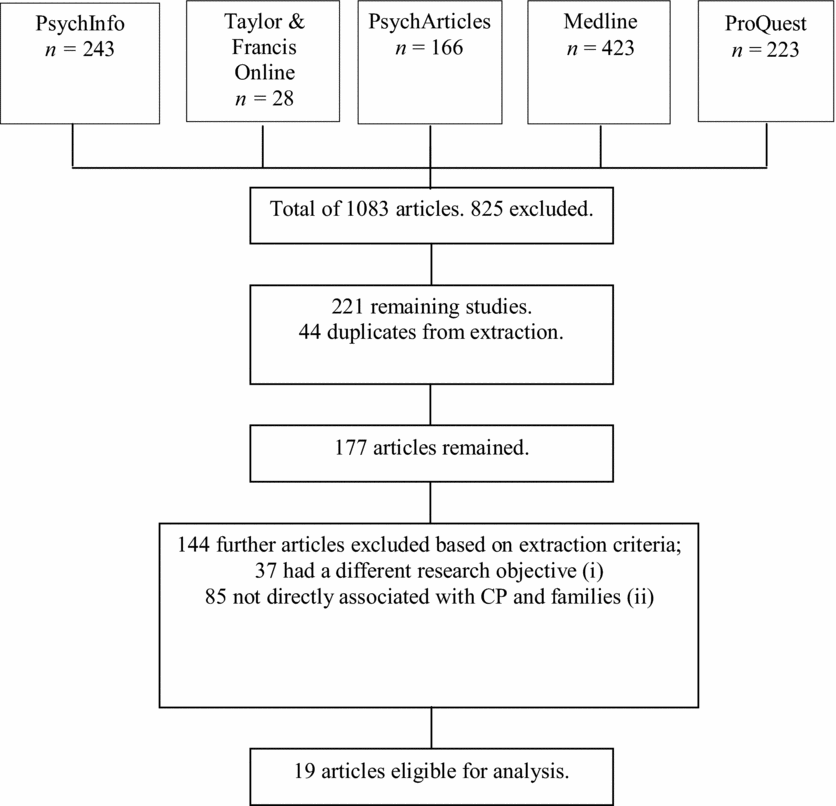
A total of 1083 journal articles were found. The titles and abstracts of the articles retrieved from the search were examined, and any articles that were not relevant to the research topic were discarded. The inclusion criteria employed were as follows:
i) The purpose of the article was to explore and identify the direct impact of parents, caregivers and/or families after the diagnosis of a child's disability.
ii) The sample of the population incorporated parents, caregivers and families of children with CP.
The full texts of the articles meeting the inclusion criteria were analysed. Any article that did not meet the criteria after analysis was discarded (see Figure 1).
Selection process for the articles analysed in this review.

The data retrieved was synthesised using a narrative approach. Guidance on the Conduct of Narrative Synthesis in Systematic Reviews was used (Popay, Roberts, Sowden, Petticrew, Arai, Rodgers, Britten, Roen, & Duffy, Reference Popay, Roberts, Sowden, Petticrew, Arai, Rodgers, Britten, Roen and Duffy2006). This approach to data synthesis was used because narrative approaches are considered useful when a meta-analysis is considered inappropriate because a range of evidence beyond randomised controlled trials will be explored (Popay et al., Reference Popay, Roberts, Sowden, Petticrew, Arai, Rodgers, Britten, Roen and Duffy2006).
Results and Discussion
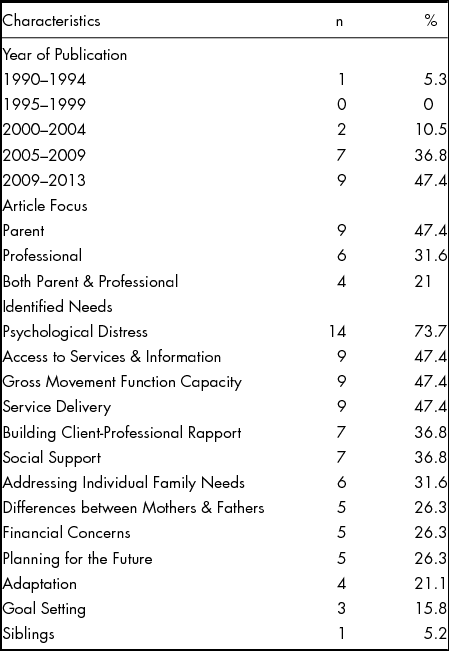
Table 1 details the characteristics of the studies, and includes the year of publication, whether the results of the article were targeting parents and caregivers or service providers, and also identifies the key findings from the reviewed literature.
Year of publication, article focus, and identified key findings from the reviewed articles
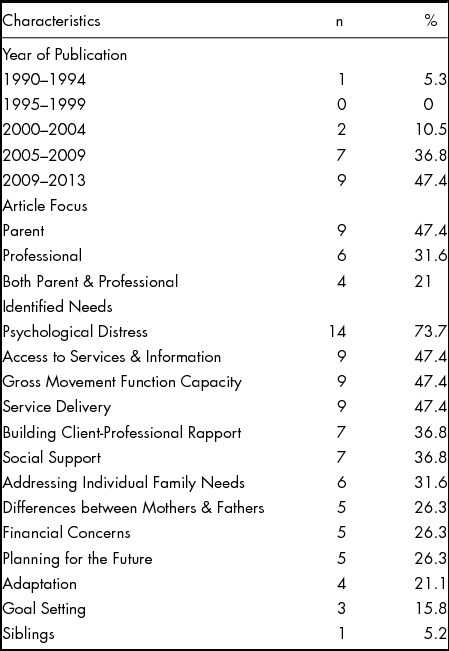
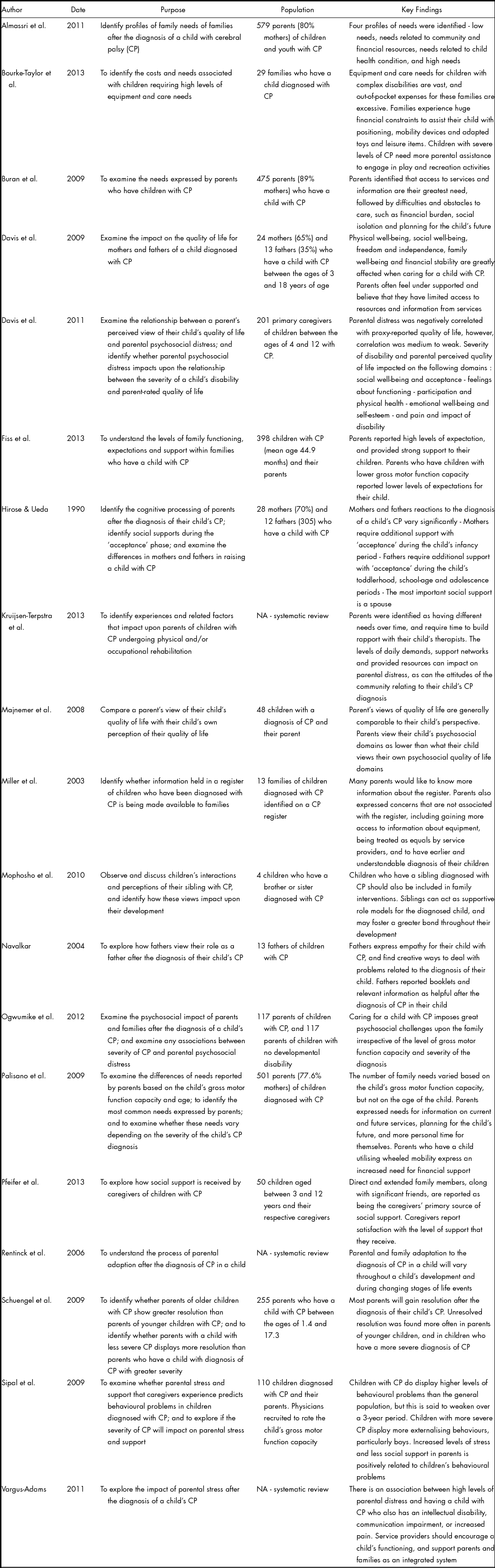
Table 2 shows a summary of the 19 articles analysed in this study. The table highlights the main aim of the article, the population measured and the key findings of the research. The mass of the articles were research studies (16 articles, 84.2%), and three journals were systematic reviews (15.8%).
Summary of reviewed articles and key findings
Important Factors
Most reviewed studies (14 articles, 73.7%) showed that parents and caregivers experience an increase in stress and anxiety after a child's diagnosis of CP (Sipal et al., Reference Sipal, Schuengel, Voorman, Van Eck and Becher2009; Vargus-Adams, Reference Vargus-Adams2011; Pfeifer et al., Reference Pfeifer, Silva, Lopes, Matsukura, Santos and Pinto2013). The studies suggest that children with CP require increased levels of support and care, which cause families to experience physical and emotional distress (Rentinck et al., Reference Rentinck, Ketelaar, Jongmans and Gorter2006; Davis et al., Reference Davis, Shelly, Waters, Boyd, Cook and Davern2009; Palisano et al., Reference Palisano, Almarsi, Chiarello, Orlin, Bagley and Magg2009; Fiss et al., 213; Pfeifer et al., Reference Pfeifer, Silva, Lopes, Matsukura, Santos and Pinto2013). Levels of parental stress were associated with a child's level of gross motor function capacity (Davis et al., Reference Davis, Shelly, Waters, Boyd, Cook and Davern2009; Palisano et al., Reference Palisano, Almarsi, Chiarello, Orlin, Bagley and Magg2009; Schuengel et al., Reference Schuengel, Rentinck, Stolk, Voorman, Loots, Ketelaar, Gorter and Becher2009; Sipal et al., Reference Sipal, Schuengel, Voorman, Van Eck and Becher2009; Fiss et al., Reference Fiss, Chiarello, Bartlett, Palisano, Jeffries, Almassri and Chang2013), whether or not the child had an intellectual disability (Buran et al., 2008; Palisano et al., Reference Palisano, Almarsi, Chiarello, Orlin, Bagley and Magg2009; Vargus-Adams, Reference Vargus-Adams2011; Pfeifer et al., Reference Pfeifer, Silva, Lopes, Matsukura, Santos and Pinto2013), the level of communication impairment (Buran et al., 2008; Almassri et al., Reference Almassri, Palisano, Dunst, Chiarello, O’Neil and Polansky2011; Vargus-Adams, Reference Vargus-Adams2011), and the level of physical pain associated with the CP diagnosis (Sipal et al., Reference Sipal, Schuengel, Voorman, Van Eck and Becher2009; Vargus-Adams, Reference Vargus-Adams2011). Interestingly, research by Davis and colleagues (Reference Davis, Shelly, Waters, Boyd, Cook and Davern2009) and later in studies by Ogwumike, Adeniyi and Obidiegwu (Reference Ogwumike, Adeniyi and Obidiegwu2012), Fiss et al. (Reference Fiss, Chiarello, Bartlett, Palisano, Jeffries, Almassri and Chang2013) and Pfeifer et al. (Reference Pfeifer, Silva, Lopes, Matsukura, Santos and Pinto2013) found that parents of children diagnosed with CP experience a significant increase in levels of psychological distress that was not influenced by the level of gross motor function capacity of the child. However, five of the studies showed that families who have a child with a more severe diagnosis will require more assistance with home modifications (Palisano et al., Reference Palisano, Almarsi, Chiarello, Orlin, Bagley and Magg2009; Bourke-Taylor, Cotter & Stephan, Reference Bourke-Taylor, Cotter and Stephan2013), transportation (Almassri et al., Reference Almassri, Palisano, Dunst, Chiarello, O’Neil and Polansky2011; Bourke-Taylor et al., Reference Bourke-Taylor, Cotter and Stephan2013)), financial assistance (Buran et al., 2008; Davis et al., Reference Davis, Shelly, Waters, Boyd, Cook and Davern2009; Almassri et al., Reference Almassri, Palisano, Dunst, Chiarello, O’Neil and Polansky2011), and access to services and recreational activities for their child (Buran et al., 2008, Almassri et al., Reference Almassri, Palisano, Dunst, Chiarello, O’Neil and Polansky2011; Bourke-Taylor et al., Reference Bourke-Taylor, Cotter and Stephan2013). It may be that distress associated with gross motor function capacity is mediated by how well such disability can be overcome with assistive technology and devices. However, these devices come at a cost, which in turn impacts on parents’ psychological well-being.
The financial cost associated with having a child with CP is extensive, and the costing associated with CP was discussed in 26.3% of the reviewed articles. It has been suggested that financial concerns may be an important factor that limits access to community services and resources for some families (Buran et al., 2008; Almassri et al., Reference Almassri, Palisano, Dunst, Chiarello, O’Neil and Polansky2011; Pfeifer et al., Reference Pfeifer, Silva, Lopes, Matsukura, Santos and Pinto2013). From the studies analysed, it was identified that the costs to families caring for a child with CP are not only incurred directly, such as home modifications, medical bills and mobility assistance equipment (Miller, Colligan & Colvert, Reference Miller, Colligan and Colver2003; Palisano et al., Reference Palisano, Almarsi, Chiarello, Orlin, Bagley and Magg2009; Bourke-Taylor et al., Reference Bourke-Taylor, Cotter and Stephan2013), but also indirectly such as loss of employment by the primary caregiver, specialist transportation and childcare for siblings (Buran et al., 2008; Sipal et al., Reference Sipal, Schuengel, Voorman, Van Eck and Becher2009; Bourke-Taylor et al., Reference Bourke-Taylor, Cotter and Stephan2013).
Buran et al. (2008) identified that parents regularly express concerns regarding substantial financial burden. Studies have demonstrated the importance of service providers addressing financial concerns by providing information about government funding contributions (Bourke-Taylor et al., Reference Bourke-Taylor, Cotter and Stephan2013), private insurance options (Almassri et al., Reference Almassri, Palisano, Dunst, Chiarello, O’Neil and Polansky2011; Bourke-Taylor et al., Reference Bourke-Taylor, Cotter and Stephan2013), community services and resources (Buran et al., 2008; Davis et al., Reference Davis, Shelly, Waters, Boyd, Cook and Davern2009; Palisano et al., Reference Palisano, Almarsi, Chiarello, Orlin, Bagley and Magg2009; Almassri et al., Reference Almassri, Palisano, Dunst, Chiarello, O’Neil and Polansky2011), and advocacy services (Almassri et al., Reference Almassri, Palisano, Dunst, Chiarello, O’Neil and Polansky2011).
Almost half of the articles analysed identified the need for information to be provided to parents around the time of diagnosis (Buran et al., 2008; Palisano et al., Reference Palisano, Almarsi, Chiarello, Orlin, Bagley and Magg2009). Parents have identified that information relating to conditions and symptoms of CP (Buran et al., 2008), possible tests and treatments (Navalkar, Reference Navalkar2004; Buran et al., 2008; Kruijsen-Terpstra et al., Reference Kruijsen-Terpstra, Ketelaar, Boeije, Jongmans, Gorter, Verheijden, Lindeman and Verschuren2013), and educational services (Buran et al., 2008; Almassri et al., 2009; Davis et al., Reference Davis, Shelly, Waters, Boyd, Cook and Davern2009; Palisano et al., Reference Palisano, Almarsi, Chiarello, Orlin, Bagley and Magg2009; Bourke-Taylor et al., Reference Bourke-Taylor, Cotter and Stephan2013) are extremely important during the period immediately following the diagnosis. Five of the studies analysed (26.3%) indicated that there is a need for health professionals to assist and prepare families for key developmental and transitional periods in their children's lives (Almassri et al., Reference Almassri, Palisano, Dunst, Chiarello, O’Neil and Polansky2011; Buran et al., 2008; Palisano et al., Reference Palisano, Almarsi, Chiarello, Orlin, Bagley and Magg2009). Palisano and colleagues (Reference Palisano, Almarsi, Chiarello, Orlin, Bagley and Magg2009) reported that many parents who have a child with CP have expressed a need to acquire information on planning for the future, and, as Almassri et al. (Reference Almassri, Palisano, Dunst, Chiarello, O’Neil and Polansky2011) explained, the specific information needs may vary depending on the child's age and key periods in the life of the child. Parents not only require information regarding the diagnosis of CP, but also information relating to the transition to educational pathways (Almassri et al., Reference Almassri, Palisano, Dunst, Chiarello, O’Neil and Polansky2011; Rentinck et al., Reference Rentinck, Ketelaar, Jongmans and Gorter2006), future employment (Almassri et al., Reference Almassri, Palisano, Dunst, Chiarello, O’Neil and Polansky2011), and planning for the care of their child after the death of the parents (Buran et al., 2008).
The importance of establishing a rapport between families and service providers was identified in 36.8% of the articles analysed (seven articles). Mophosho, Widdows and Taylor-Gomez (2003), and Kruijsen-Terpstra and colleagues (Reference Kruijsen-Terpstra, Ketelaar, Boeije, Jongmans, Gorter, Verheijden, Lindeman and Verschuren2013) reported that parents often feel unsupported by services they have accessed. The development of rapport must include open communication and trust between the family and service provider (Buran et al., 2008; Kruijsen-Terpstra et al., Reference Kruijsen-Terpstra, Ketelaar, Boeije, Jongmans, Gorter, Verheijden, Lindeman and Verschuren2013), along with the opportunity for families to collaborate and contribute towards their child's health and well-being (Palisano et al., Reference Palisano, Almarsi, Chiarello, Orlin, Bagley and Magg2009; Almassri et al., Reference Almassri, Palisano, Dunst, Chiarello, O’Neil and Polansky2011; Kruijsen-Terpstra et al., Reference Kruijsen-Terpstra, Ketelaar, Boeije, Jongmans, Gorter, Verheijden, Lindeman and Verschuren2013).
The current study revealed that service providers must identify individual and family strengths in order to work collaboratively with the family in a decision making process regarding the child with CP (Almassri et al., Reference Almassri, Palisano, Dunst, Chiarello, O’Neil and Polansky2011). Maximising the child's and the family's opportunities to engage in community services and resources was also found to be important (Kruijsen-Terpstra et al., Reference Kruijsen-Terpstra, Ketelaar, Boeije, Jongmans, Gorter, Verheijden, Lindeman and Verschuren2013). Because an individual's and family's needs change over time (Kruijsen-Terpstra et al., Reference Kruijsen-Terpstra, Ketelaar, Boeije, Jongmans, Gorter, Verheijden, Lindeman and Verschuren2013), Schuengel and colleagues (Reference Schuengel, Rentinck, Stolk, Voorman, Loots, Ketelaar, Gorter and Becher2009) suggested that service providers demonstrate flexibility and individualisation when implementing psychoeducational support programs in order to support a parents’ coping mechanisms.
The need for strong support networks for families after the diagnosis of CP was highlighted in over a third of the reviewed research (36.8%, seven articles). The studies found that immediate and extended family members, such as a spouse, mother, father and siblings, along with friends, are the most common support providers utilised by families (Pfeifer et al., Reference Pfeifer, Silva, Lopes, Matsukura, Santos and Pinto2013). Other research identified that support from family members and communities for families of children with CP assist to improve family functioning (Almassri et al., Reference Almassri, Palisano, Dunst, Chiarello, O’Neil and Polansky2011; Fiss et al., Reference Fiss, Chiarello, Bartlett, Palisano, Jeffries, Almassri and Chang2013), parental satisfaction (Rentinck et al., Reference Rentinck, Ketelaar, Jongmans and Gorter2006; Fiss et al., Reference Fiss, Chiarello, Bartlett, Palisano, Jeffries, Almassri and Chang2013), and emotional well-being (Davis et al., Reference Davis, Shelly, Waters, Boyd, Cook and Davern2009; Almassri et al., Reference Almassri, Palisano, Dunst, Chiarello, O’Neil and Polansky2011).
Proposed Practice Guidelines
From the literature reviewed, several important factors that influence a family's adaptation after the diagnosis of a child with CP have been identified. If service providers are to develop a psychoeducational support group for families, they may consider the following guidelines derived from the literature. The focus of these guidelines is to enhance a family's functioning, decrease levels of psychological distress, and assist with establishing empowerment and control within the family system.
Establishing rapport
It is important that service providers identify a family's information and service needs prior to the commencement of the group program. Meeting with parents and families, which may also include the child with CP and any other additional siblings, will help establish a family-professional partnership, and assist in developing open communication and trust. During these sessions, families and service providers can collaborate and establish expectations and goals to assist with positive family adaptation.
Providing relevant information
Information should be relevant to the families’ requested needs. Information provided should include details of what CP is, along with the varying levels of gross motor functioning capacity, treatment and tests the child may undergo, the use of equipment and aids that may be required presently or in the future, any relevant funding contributions which may be available to families, as well as information regarding the child's future, such as transitioning to education and future employment. It is important that information relating to respite care (Palisano et al., Reference Palisano, Almarsi, Chiarello, Orlin, Bagley and Magg2009), child care (Buran et al., 2008) and educational assistance (Rahi et al., Reference Rahi, Manaras, Tuomainen and Hundt2004) be included, as this has been identified as impacting upon parental distress. During the psychoeducational sessions, service providers should discuss with families the available services they may be able to utilise, and provide them with information on support available at both state and national levels.
Parents have identified that the use of several information mediums has been effective in the presentation of psychoeducational programs. Therefore, service providers should consider incorporating written information with verbal dialogue, as well as including the use of videos, internet and role play into the sessions.
Reducing parental distress
Research has indicated that gaining awareness of CP can assist in providing an increased sense of empowerment and control in parents (Mitchell & Sloper, Reference Mitchell and Sloper2002; Miller, Colligan & Colvert, Reference Miller, Colligan and Colver2003; Jackson et al., Reference Jackson, Baird, Davis-Reynolds, Smith, Blackburn and Allsebrook2007). Dixon, Adams and Lucksted (Reference Dixon, Adams and Lucksted2000) suggest that service providers should ensure that an individual's and family's quality of life and family functioning are considered after the diagnosis of a child's CP, in order to allow for positive adaptation within the family. Therefore, service providers might choose to incorporate stress reduction techniques into sessions. It is believed that encouraging families to engage with community services and resources may also help to reduce levels of distress, as this assists to increase their social support networks (Davis et al., Reference Davis, Shelly, Waters, Boyd, Cook and Davern2009).
Who should be involved in psychoeducational groups?
Service providers should encourage all immediate and significant extended family members to engage in community support groups. Although families have reported limited numbers of social support networks in some instances (Pfeifer et al., Reference Pfeifer, Silva, Lopes, Matsukura, Santos and Pinto2013), service providers should encourage not only the immediate family, but any significant caregivers or supports to engage in community services and gain further information regarding the diagnosis of CP to assist the supported family towards a positive adaptation, and therefore increased well-being and family function.
It has been identified by Hirose and Ueda (Reference Hirose and Ueda1990) that mothers and fathers have difficulty adapting to the diagnosis in their child at different stages of the child's life, and access to services should also allow for family engagement throughout a child's key developmental periods. Literature has also suggested that siblings should be involved because psychoeducational groups may assist siblings with their own optimal understanding of the diagnosis and foster healthy adjustment (McCulloch & Simon, Reference McCulloch and Simon2011).
Enhancing relationships
Service providers should also provide information on communication and problem solving skills. CP can often produce fear within a family, which can then lead to conflict between family members. Although information can help with a family's understanding of the diagnosis of CP, learning effective communication, negotiation and problem solving skills can enable parents to constructively discuss difficult and emotional topics (Lundwall, Reference Lundwall1996; Dixon, Adams & Lucksted, Reference Dixon, Adams and Lucksted2000). Lundwall (Reference Lundwall1996), stated that service providers should offer families tips and techniques regarding interacting with the child with CP, such as addressing violent or behavioural issues, as well as ensuring that the child and family engage and interact in play with one another (Navalker, Reference Navalkar2004).
Limitations of the current study
Much of the literature exploring parental adaptation after the diagnosis of a child with a disability primarily focuses on reports by mothers and little attention has been paid towards the role of fathers and their experiences throughout. The differences of adaptation between mothers and fathers after the diagnosis of their child were explored in only 26.3% of the reviewed articles. However, throughout the analysis it was apparent that the majority of the research population were female caregivers. Surprisingly, there was little discussion throughout the reviewed articles relating to incorporating siblings into service delivery and interventions.
A further limitation was the potential risk of bias during the data extraction, as only one researcher selected the articles from the online databases. To ensure that this bias does not occur in future research in this field, it has been suggested that researchers ensure that a cross-reference check on all extracted data is completed.
Conclusions and Suggestions for Future Research
From the current research, it has been identified that there is a greater awareness for service providers to work collaboratively with parents and families who have a child diagnosed with CP in order to ensure optimum adaptation and family functioning. Therefore, the process of parental adaptation after the diagnosis of a child's CP requires further investigation, with exploration relating to how fathers and siblings adapt after a family member has been diagnosed. As the proposed guidelines in this study are the basis of future research in this area, it would also be important to determine the effectiveness of psychoeducational groups for parents and families after the diagnosis of CP.
Financial Support
This research received no specific grant from any funding agency, commercial or not-for-profit sectors.
Conflict of Interest
None.
Ethical Standards
The authors assert that all procedures contributing to this work comply with the ethical standards of the relevant national and institutional committees on human experimentation and with the Helsinki Declaration of 1975, as revised in 2008.