Vocabulary development in English monolinguals has been the focus of numerous studies over several decades, with increasing interest in the size and sequence of children's developing vocabulary (Biemiller, Reference Biemiller, Hiebert and Kamil2005a, Reference Biemiller, Dickenson and Neuman2005b; Biemiller & Slonim, Reference Biemiller and Slonim2001). To understand the acquisition of word meanings, several researchers began by categorizing words into types, and articulating principles that may guide the sequence of acquisition. Beck, McKeown, and Kucan (Reference Beck, McKeown and Kucan2002) describe three tiers of words categorized according to their usefulness and frequency of use (basic, academic, and domain specific). In this conceptualization, children may already understand the general semantic concept of words (e.g., “quick”), but could benefit from familiarity with more specific words such as “swift.” Other researchers have focused on identifying word families or root words (e.g., Anglin, Reference Anglin1993; Biemiller & Slonim, Reference Biemiller and Slonim2001; Nagy & Anderson, Reference Nagy and Anderson1984). Root words are words that must be learned (e.g., “copy”) and hold the key to understanding other types of words. Derived words are semantic variations of root words (e.g., “copier”), inflections are syntactic variants of root words (e.g., “copying”), and compounds are words that can be understood if both the root word(s) and relevant modification (semantic or syntactic) are known (e.g., “copyright”).
Because many variants can be understood if the root is known, several studies have examined the development of this type of vocabulary (e.g., Anglin, Reference Anglin1993; Biemiller & Slonim, Reference Biemiller and Slonim2001). Biemiller and Slonim (Reference Biemiller and Slonim2001) sampled root word meanings from Dale and O'Rourke's (Reference Dale and O'Rourke1981) living word vocabulary (LWV) and assessed the words known by children, adolescents, and adults, and the order in which words are learned in elementary-aged children by isolating root words from the LWV and categorizing them into word levels. The six achievement levels 2, 4, 6, 8, 10, and 12, of Biemiller and Slonim's root word vocabulary task, were created using similar criteria to those used in Dale and O'Rourke's original study. To be assigned to a level, 67 to 80% of the children at that grade level had to know the meaning of a given word. Biemiller and Slonim's task was based on a sentence context approach to assessing vocabulary knowledge. The root word vocabulary task, comprised of target words embedded in sentences, was administered to English as a first language (EL1) children in kindergarten, Grades 1, 2, 4, and 5. They found that vocabulary acquisition takes place in more or less the same order by most children, and that by Grade 5 EL1 children know approximately 8,400 root words (Biemiller & Slonim, Reference Biemiller and Slonim2001). Although vocabulary knowledge has been identified as an important predictor of various reading skills, few studies have focused on the development of vocabulary knowledge in ESL children, particularly in the upper elementary years. Quantity, lexical richness, and syntactic complexity of the input contribute to individual differences in vocabulary knowledge and lexical development (Hart & Risley, Reference Hart and Risley1995; Hoff & Naigles, Reference Hoff and Naigles2002; Huttenlocher, Haight, Bryk, & Lyons, Reference Huttenlocher, Haight, Bryk, Seltzer and Lyons1991; Weizman & Snow, Reference Weizman and Snow2001). By definition, English as a second language (ESL) children begin to be exposed to vocabulary in English at a later age. They are also less likely to be exposed to extensive English oral language experiences at home and in their neighborhood, and therefore, their English vocabulary development may be affected by their lack of opportunity. In addition, Proctor, Carlo, August, and Snow (Reference Proctor, Carlo, August and Snow2005) found that bilingual learners are less likely than monolinguals to increase their vocabulary knowledge through incidental learning and reading. Not surprisingly, minority children have poorer knowledge of second language (L2) vocabulary than their EL1 counterparts (Umbel, Pearson, Fernandez, & Oller, Reference Umbel, Pearson, Fernandez and Oller1992), and even after a number of years of instruction they do not catch up with their monolingual counterparts (Farnia & Geva, Reference Farnia and Geva2007). In comparison to monolingual children who speak the societal language, minority children from homes in which the primary language spoken is not the societal language, may be at a disadvantage with respect to their L2 vocabulary development. Several aspects of their vocabulary development have been shown to be impaired, including vocabulary depth (knowing less about the meanings of words; August, Carlo, Dressler, & Snow, Reference August, Carlo, Dressler and Snow2005) and the breadth of their vocabulary knowledge (knowing fewer words; Verhallen & Schoonen, Reference Verhallen and Schoonen1993).
Cummins (1992) theorized that although everyday conversational language may take an ESL learner an average of 2 years to acquire, ESL learners continue to lag behind their L1 peers in the attainment of academic language for an average of 5 to 7 years. Preliminary research conducted by Biemiller (Reference Biemiller1999) has found that ESL children were restricted in the development of vocabulary knowledge, although they learn word meanings in the same sequence as EL1 children. The development of English vocabulary knowledge in older ESL children is in need of research attention to determine if differences in academic vocabulary knowledge continue to exist in the upper elementary years.
Another important issue that will be explored in the current study concerns the role of vocabulary knowledge in the acquisition of word reading skills. Reading acquisition is a cumulative process to which several cognitive and linguistic skills make varying contributions over the course of development (Perfetti, Reference Perfetti1985). The order of acquisition of certain literacy skills is important, as some skills must be automatized before acquiring others (August & Shanahan, Reference August and Shanahan2006). For example, in their primary years, children must first learn word-level skills such as accurate and quick decoding of words in isolation, and later, fluent reading of text. By the late elementary years, monolingual children have become fluent readers who concentrate on “reading to learn” rather than “learning to read” (Chall, Reference Chall1996), and focus their attention on comprehending text. Among reading skills, word recognition holds a crucial role in the cumulative process of reading acquisition. This is true for monolingual and L2 learners even beyond the primary years, because effective word recognition skills are needed when children face higher volumes of text containing unfamiliar and complex words (Lesaux & Geva, Reference Lesaux, Geva, August and Shanahan2006). Therefore, a secondary goal of the present study was to examine the relationship between this foundational skill and vocabulary knowledge in upper elementary ESL children. The processes thought to contribute to the word recognition ability of monolingual children have been studied extensively and will be reviewed in the following sections.
FACTORS CONTRIBUTING TO WORD RECOGNITION IN MONOLINGUAL CHILDREN
A fundamental skill in reading acquisition is the ability to decode printed words. Gaining a solid understanding of the encoding of oral language to print involves many interrelated cognitive and linguistic structures. Research on the reading acquisition of monolinguals has identified phonological awareness (PA), rapid automatized naming (RAN), letter knowledge, and working memory (WM) as cognitive–linguistic factors involved in the development of early reading. Other studies focus on the contribution of oral language proficiency (OLP), and in particular, vocabulary knowledge, to early word reading development. Using similar theoretical frameworks, in recent years there has been an increase in studies that examine factors that contribute to the reading development of L2 learners. The research reviewed in the next sections of this paper focuses on the relationship between cognitive skills, oral language skills (e.g., vocabulary), and word reading in monolingual and L2 learners in late elementary school years.
Various cognitive–linguistic skills play a role in the development of word-level reading skills. Throughout the research in the area of reading development in monolinguals, PA skills have been shown to be associated with word recognition in early readers (Castles & Coltheart, Reference Castles and Coltheart2004). This phonological–reading association has been documented amply with EL1 learners (e.g., Goswami & Bryant, Reference Goswami and Bryant1990; Rack, Hulme, & Snowling, Reference Rack, Hulme and Snowling1993; Siegel, Reference Siegel and Reese1993; Stanovich & Siegel, Reference Stanovich and Siegel1994; Wagner & Torgesen, Reference Wagner and Torgesen1987; Wagner, Torgensen, & Rashotte, Reference Wagner, Torgesen and Rashotte1994) and monolinguals of other alphabetic languages (Carillo, Reference Carillo1994; de Jong & van der Leij, Reference de Jong and van der Leij1999; Jimenez-Gonzalez, Reference Jimenez-Gonzalez1997; Wimmer, Mayringer, & Landerl, Reference Wimmer, Mayringer and Landerl2000). The same association has been supported in research on nonalphabetic monolinguals (Ho & Bryant, Reference Ho and Bryant1997; Hu & Catts, Reference Hu and Catts1998; McBride-Chang & Ho, Reference McBride-Chang and Ho2000; Shu, Anderson, & Wu, Reference Shu, Anderson and Wu2000). There is evidence that deficits in PA skills (i.e., the ability to represent, retrieve, or analyze phonological information in words or pseudowords) are often characteristic of individuals with persistent problems or delays in word recognition (Share, Jorm, Maclean, & Matthews, Reference Share, Jorm, Maclean and Matthews1984; Stanovich, Reference Stanovich, Gough, Ehri and Treiman1992; Stanovich & Siegel, Reference Stanovich and Siegel1994). Based on the effects of phonological training programs in several languages, some researchers believe PA is a cause of reading disability (Bradley & Bryant, Reference Bradley and Bryant1983; Bus & van Ijzendoorn, Reference Bus and van Ijzendoorn1999; Cunningham, Reference Cunningham1990; Lundberg, Frost, & Peterson, Reference Lundberg, Frost and Petersen1988; Muter, Hulme, Snowling, & Stevenson, Reference Muter, Hulme, Snowling and Stevenson2004; Torgensen et al., Reference Torgesen, Wagner, Rashotte, Rose, Lindamood and Conway1999).
Different phonological skills may influence word recognition skills to varying degrees and exert their effects at different points of reading development (Muter et al., Reference Muter, Hulme, Snowling and Stevenson2004; Schatschneider, Fletcher, Francis, Carlson, & Fodman, 1999). There is evidence that the size of a young child's vocabulary may support the emergence of subsequent PA (e.g., Metsala, Reference Metsala1999). Moreover, in their review of PA training programs, Bus and van Ijzendoorn (Reference Bus and van Ijzendoorn1999) found that PA explains only about 12% of the variance in word-identification skills. Based on this finding, they assert that PA constitutes an important but not sufficient condition for learning to read. Other linguistic factors must account for the remaining variance in reading skill.
Another cognitive factor shown to contribute distinct variance to reading skill is RAN (Manis, Seidenberg, & Doi, Reference Manis, Seidenberg and Doi1999; Schatschneider, Francis, Carlson, Fletcher, & Foorman, Reference Schatschneider, Fletcher, Francis, Carlson and Foorman2004). Good and poor readers can be differentiated on the basis of their ability to name and label objects, colors, and letters quickly and accurately (Denckla & Rudel, Reference Denckla and Rudel1976; Wolf & Obregon, Reference Wolf and Obregon1992). The relationship between RAN and word recognition skill is not constant. In normally achieving learners, it decreases with age (Wagner et al., Reference Wagner, Torgesen, Rashotte, Hecht, Barker and Burgess1997; Walsh, Price, & Gillingham, Reference Walsh, Price and Gillingham1988; Wolf, Reference Wolf1991), whereas in poor readers, the relationship remains stable over time (Korhonen, Reference Korhonen1995).
Letter knowledge refers to the learner's understanding of letter names and sound–symbol relationships (Muter, Hulme, Snowling, & Taylor, Reference Muter, Hulme, Snowling and Taylor1998, Shatschneider et al., Reference Schatschneider, Fletcher, Francis, Carlson and Foorman2004). The ease with which young children learn this information is an important predictor of later reading ability (Bond & Dykstra, Reference Bond and Dykstra1967; Chall, Reference Chall1967; Muter et al., Reference Muter, Hulme, Snowling and Taylor1998). In a study by Muter and associates (Reference Muter, Hulme, Snowling and Stevenson2004), letter knowledge at the beginning of first grade predicted word recognition skills 1 year later (Muter et al., Reference Muter, Hulme, Snowling and Stevenson2004). In addition, Schatschneider and associates (Reference Schatschneider, Fletcher, Francis, Carlson and Foorman2004) found that letter knowledge in kindergarten contributes unique variance to reading outcomes in Grades 1 and 2.
WM refers to the ability to temporarily store information while other information is retrieved from long-term storage, so that both types of information can then be processed together. An association between the efficiency of WM and reading ability has been shown in previous studies (Baddeley & Hitch, Reference Baddeley, Hitch and Bower1974). However, it is unclear whether WM predicts word recognition over and above the variance accounted for by PA. From a number of studies examining reading acquisition longitudinally (e.g., Torgesen, Wagner, & Rashotte, Reference Torgesen, Wagner and Rashotte1994; Wagner et al., Reference Wagner, Torgesen and Rashotte1994, Reference Wagner, Torgesen, Rashotte, Hecht, Barker and Burgess1997), Torgesen and associates (Reference Torgesen, Wagner and Rashotte1994) concluded that only PA, and not WM, explains distinct variance in word recognition because both factors are rooted in the same underlying phonological component. In contrast, other research with primary-aged children has revealed that, even after PA was partialed out, WM contributed unique variance to word recognition (Gottardo, Stanovich, & Siegel, Reference Gottardo, Stanovich and Siegel1996; Strattman & Hodson, Reference Strattman and Hodson2005).
OLP AND READING SKILLS IN MONOLINGUAL CHILDREN
In monolinguals, the development of oral language skills precedes reading acquisition, and may serve as a critical foundation for learning to read (Chall, Reference Chall1996; Hiebert, Pearson, Taylor, Richardson, & Pris, Reference Hiebert, Pearson, Taylor, Richardson and Paris1998). Numerous studies have found that the level of OLP, the ability to comprehend oral language and to communicate, is associated with reading comprehension performance (e.g., Catts, Fey, Zhang, & Tomblin, Reference Catts, Fey, Zhang and Tomblin1999; Muter et al., Reference Muter, Hulme, Snowling and Stevenson2004; Storch & Whitehurst, Reference Storch and Whitehurst2002). However, there is less support for the view that OLP drives the development of word recognition skills. A recent longitudinal study involving beginning readers found that even when their effects were combined with those of measures of visual-motor integration and recognition-discrimination, oral language measures (i.e., vocabulary, expressive and receptive language), only accounted for 1% of unique variance of word recognition in Grades 1 and 2, after accounting for PA and RAN (Schatschneider et al., Reference Schatschneider, Fletcher, Francis, Carlson and Foorman2004).
Despite little support for the association between OLP and word recognition, one element of oral language skill, vocabulary knowledge, has received research attention over the past several years, although research on its predictive utility has been inconclusive. Several researchers have argued that vocabulary is important for learning to recognize printed words (Nation & Snowling, Reference Nation and Snowling1998; Plaut, McClelland, Seidenberg, & Patterson, Reference Plaut, McClelland, Seidenberg and Patterson1996). They propose that the mechanism by which vocabulary knowledge influences word recognition skills is through fast mappings between orthographic, phonological, and semantic representations in the lexical system (Biemiller & Boote, Reference Biemiller and Boote2006; Carey, Reference Carey, Halle, Bresnan and Miller1978).
Research involving young monolinguals has shown that vocabulary knowledge (assessed with a receptive vocabulary task) explains variations in word recognition skills (Bryant, Maclean, & Bradley, Reference Bryant, Maclean and Bradley1990; Stevenson, Parker, Wilkinson, Hegion, & Fish, Reference Stevenson, Parker, Wilkinson, Hegion and Fish1976), and its unique contribution ranges from 2 to 7%. To illustrate, recently, Strattman and Hodson (Reference Strattman and Hodson2005) examined reading ability in monolingual beginning readers (Grade 2) and found that receptive vocabulary explained an additional 2% of the variance in word recognition measured concurrently, after the effects of several cognitive and linguistic factors, including PA, RAN, and WM, had been partialed out. Using path analysis, Nagy, Berninger, Abbott, Vaughan, and Vermeulen (Reference Nagy, Berninger, Abbott, Vaughan and Vermeulen2003) also found that oral vocabulary in young readers (Grade 2) contributed unique variance to word recognition. Likewise, in their investigation of the reading acquisition of low-income preschool-aged children, Dickenson, McCabe, Anastasopoulos, and Peisner-Feinberg (Reference Dickenson, McCabe, Anastasopoulos, Peisner-Feinberg and Poe2003) found that receptive vocabulary predicted word recognition even after controlling for phonological sensitivity. In fact, when both PA and receptive vocabulary were included in the model, their contributions were equal, with each contributing 7% of additional unique variance in word recognition in young children. However, other studies have found that PA, but not receptive vocabulary, predicted word level reading ability in young children (Muter et al., Reference Muter, Hulme, Snowling and Stevenson2004; Tunman, Herriman, & Nesdale, Reference Tunmer, Herriman and Nesdale1988). Muter and associates (Reference Muter, Hulme, Snowling and Stevenson2004) used a path model to examine over time the various linguistic factors and their associations with reading ability. The authors asserted that, based on their results, in the first 2 years of formal education, the growth of word recognition abilities is relatively uninfluenced by vocabulary knowledge. It has been suggested that although vocabulary knowledge may not be a strong predictor of word recognition ability when children are first learning to read, a stronger association may exist in the later elementary years (Flynn & Rahbar, Reference Flynn and Rahbar1998). This may be so because in later elementary years students are more likely to encounter a wider range of unfamiliar academic vocabulary in text, than in the primary years (Beck, McKeown, & Kucan, Reference Beck, McKeown and Kucan2002; Biemiller & Slonim Reference Biemiller and Slonim2001). In the same vein, Willows and Ryan (Reference Willows and Ryan1986) suggested that during the later elementary school years, there is an increase in sensitivity to semantic features in text.
THE DEVELOPMENT OF L2 WORD RECOGNITION IN BILINGUAL CHILDREN
Recent studies have addressed the extent to which reading development in an L2 involves the same cognitive and linguistic factors, and follows the same trajectories as found in research with monolinguals (Geva, Yagoubzhadeh, & Shuster, Reference Geva, Yagoubzadeh and Schuster2000). Similar to monolingual learners, the relationship between phonological skills and word recognition has been supported in research involving L2 learners (for a review, see Geva, Reference Geva, August and Shanahan2006). Among phonological processing skills, PA has garnered substantial research attention. Because of the converging findings of numerous studies, the link between PA and word recognition skill is widely accepted for L2 learners (Nakamoto, Lindsay, & Manis, Reference Nakamoto, Lindsay and Manis2007).
Fewer studies have examined the role of RAN in reading development in bilingual learners, particularly with older ESL learners. Because bilingual learners are less proficient in their L2, one would expect that they might be slower at tasks measuring naming speed (Geva & Wang, Reference Geva and Wang2001). This expectation has been supported only to some extent. Geva and associates (Reference Geva, Yagoubzadeh and Schuster2000) reported that although in Grade 1 ESL children were slower than EL1 children on RAN letters, the EL1 advantage disappeared within 2 years. Everatt, Smythe, Adams, and Ocampo (Reference Everatt, Smythe, Adams and Ocampo2000) report that L2 children who were poor spellers were slower on RAN than the average spellers. However, the L2 average spellers had significantly better scores on rapid naming than the native speakers. Similar results were also reported by Lesaux and Siegel (Reference Lesaux and Siegel2003) and Geva and Yaghoubzadeh (2006), who found an ESL advantage on naming speed. RAN of objects, letters, and colors are significant predictors for word recognition skills in young L2 children (Geva et al., Reference Geva, Yagoubzadeh and Schuster2000; Gholamain & Geva, Reference Gholamain and Geva1999; Lesaux & Siegel, Reference Lesaux and Siegel2003). However, recent research with young ESL learners found that RAN assessed in kindergarten contributed no additional unique variance in word reading performance in Grade 2 once PA and letter knowledge were accounted for (Lesaux & Siegel, Reference Lesaux and Siegel2003).
As mentioned previously, WM is another cognitive skill involved in the reading development of monolingual learners (Siegel & Ryan, Reference Siegel and Ryan1989). L2 WM has a crucial role in L2 language acquisition (Geva & Ryan, Reference Geva and Ryan1993). A handful of studies involving elementary-aged bilingual children (Grades 1–5) have indicated that L2 WM is a significant predictor of L2 word recognition (Geva & Siegel, Reference Geva and Siegel2000; Gholamain & Geva, Reference Gholamain and Geva1999).
In general, it appears from the available research that the same underlying cognitive processing skills are implicated in L1 and L2 reading, although there is some evidence that the weight of the various factors is not identical in EL1 and ESL learners (Lesaux & Geva, Reference Lesaux, Geva, August and Shanahan2006).
OLP AND L2 READING SKILLS IN BILINGUAL CHILDREN
For monolinguals, OLP is attained before reading instruction begins. However, for children learning an L2 upon school entry, this foundation is not in place in the L2. Instead, the development of reading skill and oral language learning co-occur (Chall, Reference Chall1996). This concurrent development may have implications for the acquisition of reading skills in ESL children. Similar to research with monolinguals, research with bilingual learners indicates that L2 OLP (particularly oral vocabulary) has an important role in L2 reading comprehension (Carlisle, Beeman, Davis, & Spharim, Reference Carlisle, Beeman, Davis and Spharim1999; Proctor et al., Reference Proctor, Carlo, August and Snow2005; Verhoeven, Reference Verhoeven2000). In line with these findings, it might be expected that ESL children would have lower word recognition than EL1 children. However, a recent meta-analytic review concludes that this is not necessarily the case, and that despite the fact that ESL children have more limited vocabulary in their L2, ESL and EL1 children in the primary grades reach similar levels of accuracy in word recognition skills (Durgunoglu, Nagy, & Hancin-Bhatt, Reference Durgunoglu, Nagy and Hancin-Bhatt1993; Geva, Reference Geva, August and Shanahan2006; Geva & Siegel, Reference Geva and Siegel2000; Geva et al., Reference Geva, Yagoubzadeh and Schuster2000; Lesaux, Rupp, & Siegel, Reference Lesaux, Rupp and Siegel2007; Lesaux & Siegel, Reference Lesaux and Siegel2003). Among oral language skills, vocabulary knowledge is considered a central aspect of general language development. Not surprisingly, monolinguals tend to have significantly more developed vocabulary knowledge than L2 learners do in their L2 (Beech & Keys, Reference Beech and Keys1997; Geva et al., Reference Geva, Yagoubzadeh and Schuster2000; Leseman, & de Jong, Reference Leseman and de Jong1998; McLaughlin et al., Reference McLaughlin, August, Snow, Carlo, Dressler and White2000; Muter & Diethelm, Reference Muter and Diethelm2001). L1 researchers have hypothesized that in beginning readers, vocabulary knowledge is a significant predictor of L1 word recognition skills through its supporting role in partial phonological recoding (Share, Reference Share1995; Share & Stanovich, Reference Share and Stanovich1995). It has been suggested that vocabulary aids in word recognition because children are able to draw from their knowledge of real L2 words and use this information to adjust their approximate pronunciation of the printed word to that of an actual word (Geva & Siegel, Reference Geva and Siegel2000; Gottardo, Reference Gottardo2002). At the same time, studies of young L2 learners from diverse home language backgrounds have not shown a consistent and unique role of L2 vocabulary in L2 word recognition (Arab-Moghaddam & Sénéchal, Reference Arab-Moghaddam and Sénéchal2001; Geva et al., Reference Geva, Yagoubzadeh and Schuster2000; Gottardo, Reference Gottardo2002; Muter & Diethelm, Reference Muter and Diethelm2001). For example, in a study involving young low socioeconomic status (SES) Spanish–English bilingual children, L2 receptive vocabulary knowledge explained approximately 3% of unique (concurrent) variance in L2 word reading skills (Gottardo, Reference Gottardo2002). A recent meta-analysis that included studies with participants from various language groups (Geva, Reference Geva, August and Shanahan2006) concludes that English oral-language proficiency and English phonological processing skills explain on occasion a modest proportion of unique variance (usually 3–4%) in ESL students' word recognition scores. It is important to examine in more depth the possible relationship between vocabulary and word reading among L2 learners, as the findings of previous studies are inconsistent. Moreover, studies conducted to date with L2 students, have focused primarily on the relationship between these variables in ESL children in the primary years (Geva, Reference Geva, August and Shanahan2006; Lesaux et al., Reference Lesaux, Rupp and Siegel2007). As suggested in the research on monolinguals, vocabulary knowledge should be further investigated in older school children to fully understand its potential influence on word recognition skills.
THE PRESENT STUDY
The present study focused on the development of L2 vocabulary in a group that has not been targeted sufficiently in the literature, namely, upper elementary ESL readers. The primary objective of the present study was to examine the extent to which the knowledge of English word roots of upper elementary monolingual children resembles that of ESL children. It was hypothesized that EL1 children would outperform ESL children on measures of vocabulary overall, but there would not be differences between the groups for vocabulary corresponding to lower grade levels. Furthermore, it was predicted that the vocabulary knowledge of both groups would improve from Grade 5 to Grade 6. A secondary focus of the present study was the specific contribution of English vocabulary knowledge to English word recognition skills of this group and their EL1 peers. Previous studies were correlational in nature, and the reading and vocabulary items were not identical. The current study investigates the relationship between familiarity with specific word roots and the ability to read those words in ESL children and their EL1 counterparts. It was hypothesized that knowledge of specific vocabulary would correlate more strongly with the ability to read the same words than vocabulary and reading tasks that include different words, as has been the case in the literature to date. It was also hypothesized that in EL1 and ESL children alike, vocabulary knowledge, measured both receptively and through a sentence context method, would be significant concurrent predictors of word recognition and would explain additional variance after accounting for the contributions of cognitive variables such as PA, RAN, and WM to word recognition.
METHODOLOGY
Participants
This multicohort longitudinal study focuses on the performance of students in Grades 5 and 6. The overall sample consisted of 213 children: 64 EL1 and 149 ESL. Participants were recruited from nine schools in four different school boards in a large Canadian metropolis. The nine schools at which the students were enrolled were located in regions with relatively low SES. One EL1 child was eliminated from the sample because his score on the nonverbal measure was more than 3 SD below the mean. Because of the reading demands of the root word vocabulary measure, children with severe reading difficulties (defined as scoring at the second percentile or below on the standardized word reading measure) were excluded from the sample. Two children in the EL1 group and three children from the ESL group were eliminated from the sample based on this criterion. The final sample consisted of 207 children: 61 EL1 and 146 ESL. In the EL1 sample, there were 35 female and 26 male students, and in the winter of Grade 5 the mean age was 10 years and 10 months (SD = 3.7). In the ESL sample there were 76 female and 70 male students representing nine native language groups: Cantonese, Portuguese, Punjabi, Hindi, Gujerati, Urdu, Tamil, and Sinhalese. When tested in the winter of Grade 5, the mean age of the ESL group was 10 years and 8 months (SD = 3.6).
The study is part of a larger longitudinal study that began when the children were in Grade 1. At that time a letter explaining the research and a consent form were sent to the home of all the EL1 and ESL children in participating schools. Information gathered from school files was used to validate each child's language status. Information about language status and language usage at home was also confirmed during interviews with classroom teachers. Several factors, including budgetary constraints, language barriers, and limited access to parents, precluded the gathering of information regarding literacy and language usage at home. Of the children whose parents had returned consent forms, only the children who had lived in an English-speaking country for at least 4 months at the onset of the study, had no special disability (e.g., sensory impairment, autism), and whose parents had consented to their participation were included in the study. The 4-month minimum criterion served to ensure some exposure to English language and literacy instruction.
In Canada, children who have recently emigrated from non-English-speaking countries or have limited English proficiency are placed in regular classrooms in which instruction takes place in English with EL1 peers. Teachers make appropriate adaptations and accommodations to the programming and curriculum for their ESL students. From the outset, for up to 2 years, ESL students are also withdrawn daily for 30–40 min of English language instruction. These classes are taught by teachers with ESL specialist training, and are typically comprised of children of various ages and first languages, grouped by level of English language proficiency. At the initiation of the study, some of the participants in the ESL group were enrolled in these classes and others had been recently involved in such classes.
MEASURES
Cognitive, linguistic, and reading measures
Nonverbal ability task
The Raven Standard Progressive Matrices (Raven; Raven, Court, & Raven, Reference Raven, Court and Raven1983) was administered as a control variable to assess children's nonverbal ability. The children were shown an incomplete illustration of a matrix and asked to complete the matrix by choosing one pattern from an array of five or six patterns. Raven is considered a relatively culture-free test used often to assess the nonverbal ability of children from diverse linguistic backgrounds.
WM
Digit span backward, a component of the digit span subtest of the standardized Wechsler Intelligence Scale for Children—Third Edition (Wechsler, Reference Weschler1981) was used to measure the intake, maintenance, manipulation, and retrieval of information. The examiner said a series of orally presented numbers and the participants were required to the repeat the same series of numbers but in reverse order.
RAN
The letter naming section of Denckla and Rudel's (Reference Denckla and Rudel1976) Rapid Automatization Naming Test is designed to estimate the speed with which participants can access the names of highly frequent letters of the English alphabet (Bowers, Golden, Kennedy, & Young, Reference Bowers, Golden, Kennedy, Young and Berninger1994). For this task, the participants were presented with five highly frequent letters of the English alphabet in random order. Each of the letters appears 10 times in random order. The participant's score is the time (in seconds) taken to name all the letters on the stimulus card.
PA
An adapted version of the Auditory Analysis Test (Rosner & Simon, Reference Rosner and Simon1971) was used to measure children's PA. To minimize the effect of lexical knowledge, only high-frequency words were used for the initial stimuli and target responses in this task (e.g., sunshine, picnic, leg). The task consists of 25 items requiring children to omit syllables, initial or final single phonemes in one syllable words, and single phonemes in an initial or final consonant blend in a word. The test was discontinued after five consecutive errors. Each correct answer was scored as 1 point.
Vocabulary
Two measures of vocabulary were used. (a) The Peabody Picture Vocabulary Test—Revised (PPVT-R; Dunn & Dunn, Reference Dunn and Dunn1981) was administered to assess receptive vocabulary. In this standardized test, the child hears a word, is shown four pictures, and is asked to point to the picture that matches the word heard. (b) In the (adapted) written root word vocabulary task (Biemiller & Slonim, Reference Biemiller and Slonim2001), children are presented with a sentence containing the stimulus word and asked to write a sentence that explains the meaning of the italicized target word. The sentence context and open-ended response format of this task was appropriate for use with Grades 5 to 6 ESL learners because the multiple-choice format, employed by many other measures, has been shown to overestimate the vocabulary knowledge of this group (Biemiller, Reference Biemiller1999). At the beginning of the task, example sentences were printed with sample definitions. Responses were scored 1, 0.5, or 0, based on the degree to which the answer indicated that the child knew the word well enough to be able to follow a story containing the target word embedded in the stimulus sentence. For example,
Sentence with target word: “Stephanie's voice could be heard from far away.”
Scoring: “the sound that comes from inside her” (1), “sound” (0.5), “thing in her” (0)
Children were instructed to write “I don't know” if they did not know the meaning of the word. For the present study, five items were randomly selected from each of the six-word achievement levels (i.e., 2, 4, 6, 8, 10, and 12) in Biemiller and Slonim's (Reference Biemiller and Slonim2001) original written root word vocabulary task. The 30 items were presented in order of difficulty beginning with the least difficult (Level 2) words to the most difficult (Level 12) words. This task has been shown to correlate highly with both PPVT picture items and PPVT context sentence items (Biemiller, 2001, as cited in Biemiller & Slonim, Reference Biemiller and Slonim2001). Scores could range from 0 to 30.
Word recognition measures
Two measures assessed children's ability to read accurately printed words out of context. (a) The word reading subtest of Wide Range Achievement Test, Revised Edition (WRAT-R; Wilkinson, Reference Wilkinson1993) was administered to assess children's ability to read isolated words in English. This test consists of 42 monosyllabic and polysyllabic words (nouns, verbs, adjectives, and prepositions). (b) The experimental word reading list consists of the same 30 stimulus words from the (adapted) written root word vocabulary task (Biemiller & Slonim, Reference Biemiller and Slonim2001). Children were asked to read the words. There are no discontinue criteria. Total score on the task was the total number of correctly read words, with a range of 0 to 30.
PROCEDURE
In this longitudinal study, only children with data for both Grades 5 and 6 on all variables were included. At each testing wave of the project, children were withdrawn from their classrooms for four separate sessions, and administered four separate batteries of tests by experienced graduate students and research assistants. Three batteries were administered on an individual basis and the fourth was group administered. The research reported here pertains to two times of assessment: winter of Grade 5 and winter of Grade 6.
Of the tasks used for this study, only the written root word vocabulary was administered in small groups. The order of administration of the batteries was randomized, however, the within-battery order was fixed. To minimize confounding, the written root word vocabulary task was always administered in a session following the administration of the experimental word reading list. Each session was approximately 30 min in duration. Interrater reliability was determined for the written root word vocabulary task. This task was scored by an independent second rater for 87.3 and 44.8% of the participants at Grades 5 and 6, respectively. The correlation between Rater 1 and Rater 2 scores for each of the 30 items ranged from r = 0.872 to 1.000 for Grade 5 and r = 0.955 to 1.000 for Grade 6. Interscorer correlation coefficients for the written Root Vocabulary task total score indicated strong interscorer reliability (r = 0.996 for Grade 5 and r = 0.999 for Grade 6).
DATA ANALYSIS PROCEDURES
The analyses were based on the raw scores for all standardized and experimental tasks (rather than standard scores or percentiles). This decision was made for two reasons: to avoid bias associated with using norms standardized on samples not representative of ESL children, and to be able study change over time. Statistical analyses included descriptive statistics, Pearson correlations, t tests, and multivariate statistics, including hierarchical multiple regression techniques. To compare the cognitive and linguistic profiles of the participants in both the EL1 and ESL groups, t tests were used, and to examine language group, time, and interaction effects for the various cognitive and linguistic factors, multivariate analyses of covariance (MANCOVA) were conducted separately for Grades 5 and 6. MANCOVAs were also conducted to investigate the performances of the two groups on the numerous levels of the root word vocabulary measure. To determine the degree of the relationship between the cognitive, linguistic and reading variables for each of the two language groups, Pearson correlations were calculated. For each of the criterion variables (i.e., measures of word recognition), and each of the two language groups, separate hierarchical multiple regression analyses were carried out both concurrently and longitudinally.
Results
EL1–ESL differences on cognitive, linguistic, and reading measures
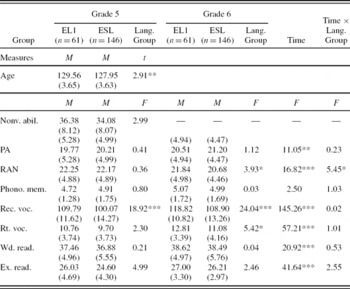
The profiles of upper elementary EL1 and ESL learners on various cognitive and linguistic factors that have been shown to predict word recognition in these groups were compared. Table 1 provides a summary of the means and standard deviations of the cognitive, linguistic, and reading measures administered in the winters of Grades 5 and 6. The t tests indicated that the EL1 and ESL groups differed significantly with respect to age, with children in the ESL group being approximately 2 months younger than those in the EL1 group. Results from a comparison of the EL1 and ESL groups on the nonverbal ability measure (Raven) showed that the EL1 and ESL groups did not differ significantly when age was used as a covariate. Because of the difference between the groups with respect to age, age was covaried in subsequent MANCOVA analyses. In each of the MANCOVAs (conducted separately for Grades 5 and 6), language group (EL1 or ESL) was the fixed factor and the dependent variables were PA, RAN, WM, receptive vocabulary, root word vocabulary, word reading, and experimental word reading.
Descriptive statistics and multivariate analysis of variance summary of differences between EL1 and ESL Groups in Grades 5 and 6

Note: Lower scores on the RAN measure indicate faster naming speed. EL1, English as a first language; ESL, English as a second language; Age, age in months; PA, phonological awareness (Auditory Analysis Test); Nonv. abil., Raven Standard Progressive Matrices; RAN, rapid automatized naming (s); Phono. mem., phonological memory (digit span backwards of Wechsler Adult Intelligence Scale—Revised); Rec. voc., receptive vocabulary (Peabody Picture Vocabulary Test—Revised); Rt. voc., root word vocabulary (Biemiller's written root word vocabulary task); Wd. read., word reading (word reading from Wide Range Achievement Test—Revised); Ex. read., experimental word reading (Biemiller's experimental word reading list).
*p < .05. **p < .01. ***p < .001.
As illustrated by the MANCOVA summaries in Table 1, the language group main effect (EL1 vs. ESL) was not significant for PA for Grades 5 or 6, but the time main effect was significant showing improvement from Grade 5 to Grade 6. There was no significant interaction of group by time for PA. A language group main effect was significant on RAN in Grade 6 but not in Grade 5, with the ESL children outperforming the EL1 group in Grade 6. Both a time main effect and a significant interaction of group by time were found for RAN, indicating a bigger increase in speed from Grade 5 to Grade 6 in the ESL group than in the EL1 group. For WM, no significant language group or time main effects were revealed by the MANCOVAs. There was also no significant group by time interaction.
There was a significant language group main effect on receptive vocabulary, with EL1 children attaining higher scores in both Grades 5 and 6 on the PPVT. The effect of time was also significant, indicating vocabulary growth from Grade 5 to Grade 6. The interaction of group by time was not significant. Likewise, on the written root word vocabulary task the language group main effect for Grade 6 was significant, whereas in the expected direction, the language group main effect did not reach significance in Grade 5. The time main effect was significant, and the interaction of group by time was not significant.
On the reading measures, the MANCOVAs revealed that the language group main effect was not significant in Grades 5 or 6, but the effect of time was significant for the standardized measure of word reading (WRAT), indicating growth from Grade 5 to Grade 6. No significant interaction of group by time was found. There was also no language group main effect on the measure of experimental word reading. As was the case with word reading (WRAT), the effect of time was significant but the interaction of group by time was not.
In general then, the EL1 and ESL groups did not vary on measures of PA, RAN, WM, or word recognition. However, the EL1 group outperformed the ESL group on vocabulary measures.
EL1–ESL differences on root word vocabulary: Analysis by achievement level
As noted above, the language group effect on the PPVT was significant in both grade levels, but the root word vocabulary group effect was significant in Grade 6 but not in Grade 5. However, the root word vocabulary measure can be subdivided into sets by vocabulary level, as defined by Biemiller and Slonim (Reference Biemiller and Slonim2001). Therefore, further analyses were conducted to gain a more fine-grained understanding of the differences between the groups and changes over time in vocabulary growth on the different levels.
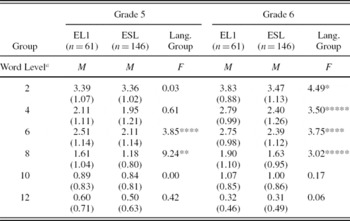
For Grades 5 and 6, separate MANCOVAs were conducted to determine at which levels of the root word vocabulary measure the two language groups differed significantly from one another. Age was included in the analysis as a covariate. Means and standard deviations for the root word vocabulary scores by level are presented in Table 2. In Grade 5, a significant difference favoring the EL1 group was found at Level 8, F (1, 204) = 9.24, p < .01. The difference between the groups at Level 6 was marginally significant, F (1, 204) = 3.85, p = .051. In Grade 6, a significant language group difference was found for Level 2 vocabulary, F (1, 204) = 4.49, p = .035, and a marginally significant group difference was found at Level 6, F (1, 204) = 3.75, p = .054. The MANCOVA also indicated that group differences for Levels 4 and 8 (p = .063 and p = .084, respectively) approached significance.
Descriptive statistics and multivariate analysis of variance summary of differences between EL1 and ESL groups on root word vocabulary in Grades 5 and 6

Note: EL1, English as a first language; ESL, English as a second language.
aWord level on the root word vocabulary task.
*p < .05. **p < .01. ****p < .06. *****p = .10.
A within-subjects analysis of variance (ANOVA) was conducted for each level of the root word vocabulary with the within (repeated) factor being time (i.e., grade), and language group (EL1 vs. ESL) being the between factor. Significant time effects were evident for all six levels. A significant Time × Group interaction was found for the least difficult subset (Level 2). Significant group main effects were found for Level 6, F (1, 205) = 6.31, p < .05, and Level 8, F (1, 205) = 8.27, p < 0.01, but not for Levels 10 and 12.
Correlates of word recognition and vocabulary knowledge
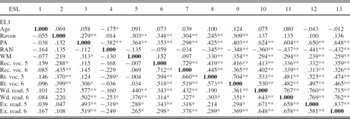
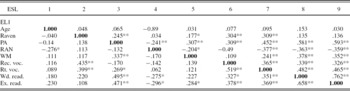
Pearson correlations were computed among the cognitive, linguistic, and reading variables within the EL1 and ESL groups. Concurrent intercorrelations in Grade 5 as well as the intercorrelations between Grade 5 and 6 variables are reported in Table 3. Table 4 summarizes the intercorrelations among variables in Grade 6. Most tasks correlated significantly with each other in the ESL group. In general, fewer tasks correlated significantly with each other in the EL1 group. For both the EL1 and ESL groups, analyses indicated positive and strong correlations between the receptive vocabulary measure and the root word vocabulary measure in both groups, providing support for the construct validity of the (experimental) root word vocabulary measure. The word recognition measures (experimental word reading and WRAT) also correlated strongly with each other in both language groups.
Concurrent and longitudinal correlates of word recognition, vocabulary knowledge, and reading comprehension intercorrelations in the EL1 (n = 61) and ESL (n = 146) groups in Grade 5

Note: Lower scores on the RAN measure indicate faster naming speed. EL1, English as a first language; ESL, English as a second language; Age, age in months; Raven, Raven Standard Progressive Matrices; PA, phonological awareness (Auditory Analysis Test); RAN, rapid automatized naming (s); WM, working memory (digit span backwards of Wechsler Adult Intelligence Scale—Revised); Rec. voc. 5, receptive vocabulary in Grade 5 (Peabody Picture Vocabulary Test—Revised); Rec. voc. 6, receptive vocabulary in Grade 6 (Peabody Picture Vocabulary Test—Revised); Rt. voc. 5, root word vocabulary in Grade 5 (Biemiller's written root word vocabulary task); Rt. voc. 6, root word vocabulary in Grade 6 (Biemiller's written root word vocabulary task); Wd. read. 5, word reading in Grade 5 (word reading from Wide Range Achievement Test—Revised); Wd. read. 6, word reading in Grade 6 (word reading from Wide Range Achievement Test—Revised); Ex. read. 5, experimental word reading in Grade 5 (Biemiller's experimental word reading list); Ex. read. 6, experimental word reading in Grade 5 (Biemiller's experimental word reading list).
*p < .05 (two-tailed). **p < .01 (two-tailed).
Concurrent correlates of word recognition, vocabulary knowledge, and reading comprehension intercorrelations in the EL1 (n = 61) and ESL (n = 146) groups in Grade 6

Note: Lower scores on the RAN measure indicate faster naming speed. EL1, English as a first language; ESL, English as a second language; Age, age in months; Raven, Raven Standard Progressive Matrices; PA, phonological awareness (Auditory Analysis Test); RAN, rapid automatized naming (s); WM, working memory (digit span backwards of Wechsler Adult Intelligence Scale—Revised); Rec. voc., receptive vocabulary (Peabody Picture Vocabulary Test—Revised); Rt. voc., root word vocabulary (Biemiller's written root word vocabulary task); Wd. read., word reading (word reading from Wide Range Achievement Test—Revised); Ex. read., experimental word reading (Biemiller's experimental word reading list).
*p < .05 (two-tailed). **p < .01 (two-tailed).
Vocabulary as a concurrent and longitudinal predictor of word recognition
Separate hierarchical multiple regression analyses were conducted for each of the criterion variables (i.e., word recognition as measured by the standardized measure WRAT, and word recognition as measured by the experiment word reading list) in the EL1 and ESL language groups. For concurrent analyses, data collected in Grade 5 were used to predict performance on word recognition at the same time, and data from Grade 6 used to predict Grade 6 performance on these variables. Hierarchical multiple regression was used to examine the role of age, cognitive variables (Raven, PA, RAN, and WM), and vocabulary knowledge(root word vocabulary and receptive vocabulary) in explaining word recognition concurrently in Grades 5 and 6. First, the regression analyses were conducted using age, Raven, PA, RAN, and WM, root word vocabulary and receptive vocabulary measures to predict word recognition as measured by the experimental word reading list. To determine the unique contribution of each of the vocabulary measures to the criterion variable, the order in which these two variables were entered were reversed for each of the regression models (i.e., for Order 1: root word vocabulary was entered into the regression before receptive vocabulary; Order 2: receptive vocabulary was entered into the regression before the measure of root word vocabulary). By examining the role of receptive vocabulary in predicting experimental word reading, it was possible to ascertain whether vocabulary knowledge, in general, predicted individual differences in word recognition or whether the relationship between root word vocabulary task and the concomitant experimental word reading list is stronger. Next, the same variables (age, Raven, PA, RAN, WM, and root word and receptive vocabulary) were used to predict word recognition as measured by the WRAT (a standardized measure of word recognition). This set of analyses was conducted to determine whether the unique variance explained by vocabulary knowledge in word recognition involving the same words (experimental word reading list) was greater than word recognition involving different stimulus words (WRAT) and also to allow for comparison to past research, because previous studies that investigated the contribution of vocabulary knowledge to word recognition have employed the PPVT and WRAT.
Using stepwise multiple regression analyses, intercorrelations permit predictor variables that do not contribute significantly (or only weakly) to the criterion variable to be removed as stronger predictors are entered (George & Mallery, Reference George and Mallery1999). Raven did not explain a significant proportion of the variance in any of the separate stepwise multiple regression analyses for EL1 or ESL groups and therefore was dropped from all subsequent analyses. Given the established roles that cognitive factors such as PA, RAN, and WM have in the development of word recognition, these variables were entered one at a time into the regression model before vocabulary knowledge. The measures of vocabulary knowledge were entered last because the objective of the study was to determine the unique contribution of vocabulary knowledge to word recognition over and above the roles of PA, RAN, and WM.
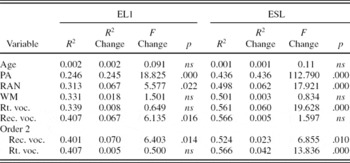
As illustrated in Table 5, PA, which was entered first into the concurrent hierarchical regression analysis for (Grade 5) experimental word reading, accounted for 24.6% of the variance for the EL1 group and 43.6% for the ESL group. RAN, which was entered next, contributed an additional 6.7% to the variance in experimental word reading for the EL1 group and 6.2% for the ESL group. WM, which was entered next into the analyses, did not play a significant role in explaining additional variance for either language group. Of the vocabulary measures, root word vocabulary, which was entered first, contributed an additional 6% of the variance in the dependent variable for the ESL group but was not significant in the EL1 group. The receptive vocabulary measure was entered last and was not significant for the ESL group; however, it contributed an additional 6.7% of the variance for the EL1 group. When the order of the vocabulary measures was reversed (see Order 2, Table 5), receptive vocabulary explained an additional 2.3% of the variance for the ESL group and 7.0% for the EL1 group. Root word vocabulary, entered after receptive vocabulary, still contributed an added 4.2% of the variance for the ESL group, but was not significant for the EL1 group.
Hierarchical regression analyses: Concurrent prediction of word recognition (experimental)a for EL1 and ESL children in Grade 5 with various measures as independent variables

Note: EL1, English as a first language; ESL, English as a second language; Age, age in months; PA, phonological awareness (Auditory Analysis Test); RAN, rapid automatized naming (s); WM, working memory (digit span backwards of Wechsler Adult Intelligence Scale—Revised); Rt. voc., root word vocabulary (Biemiller's written root word vocabulary task); Rec. voc., receptive vocabulary (Peabody Picture Vocabulary Test—Revised); Wd. read., word reading (word reading from Wide Range Achievement Test—Revised); Ex. read., experimental word reading (Biemiller's experimental word reading list).
a Experimental word reading list.
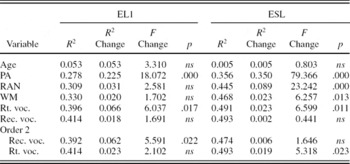
Table 6 indicates that in Grade 6, age was not a significant concurrent predictor for either language group. PA in Grade 6 was again a sensitive concurrent predictor of experimental word reading in Grade 6 for both language groups. It accounted for a significant proportion of the variance in the dependent variable (22.5% for the EL1 sample, 35% for the ESL sample). When entered second into the regression after PA, RAN did not account for additional variance for the EL1 sample but contributed an additional 8.9% of the variance for the ESL group. WM was a significant predictor for the ESL group, accounting for an additional 2.3% of the variance of experimental word reading, but it was not significant for the EL1 group. Root word vocabulary was found to be a significant concurrent predictor of experimental word reading, contributing an additional 6.6% unique variance for the EL1 group and 2.3% for the ESL group after controlling for PA, RAN, and WM. When entered last, receptive vocabulary did not explained any unique variance in experimental word reading for either language group. However, as seen in Order 2 (Table 6), when receptive vocabulary was entered into the regression model before root word vocabulary, it explained an additional 6.2% of unique variance for the EL1 group but was not significant for the ESL group. In contrast, even when entered after receptive vocabulary (in Order 2), root word vocabulary contributed unique variance in experimental word reading for the ESL group, but was not significant for the EL1 group.
Hierarchical regression analyses: Concurrent prediction of word recognition (experimental)a for EL1 and ESL children in Grade 6 with various measures as independent variables

Note: EL1, English as a first language; ESL, English as a second language; Age, age in months; PA, phonological awareness (Auditory Analysis Test); RAN, rapid automatized naming (s); WM, working memory (digit span backwards of Wechsler Adult Intelligence Scale—Revised); Rt. voc., root word vocabulary (Biemiller's written root word vocabulary task); Rec. voc., receptive vocabulary (Peabody Picture Vocabulary Test—Revised).
a Experimental word reading list.
In summary, the analyses indicated that vocabulary knowledge was a significant predictor of experimental word reading for both groups in Grades 5 and 6. However, although root word vocabulary consistently predicted additional variance (after the contributions of PA, RAN, and WM were accounted for) of the dependent variable in the ESL group, in the EL1 group, of the two vocabulary measures, receptive vocabulary consistently contributed unique variance to experimental word reading.
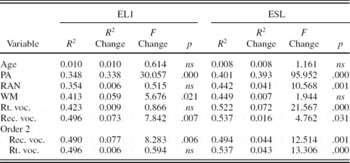
The next set of regression analyses involved predicting word reading as measured by a standardized measure, the WRAT, as the dependent variable for both Grade 5 and Grade 6. This enabled the examination of the contribution of vocabulary knowledge to word recognition when the items presented in the measure of word recognition are different from those included in two vocabulary measures. Table 7 summarizes the role of development (age in months), cognitive measures assessed in Grade 5 (PA, RAN, and WM), and the two measures of vocabulary knowledge (root word and receptive vocabulary) in explaining individual differences in word reading (WRAT) in Grade 5. Age was entered first into the regression and not found to be a significant predictor of word reading for either the EL1 group or ESL group. PA contributed 33.8% of additional variance for the EL1 group, and 39.3% for the ESL group. RAN contributed additional variance only for the ESL group (4.1%) but not for the EL1 group. WM explained an additional 5.9% of the variance in the dependent variable for EL1 children in the current analysis but did not contribute any unique variance for the ESL group. When entered next in to the regression, root word vocabulary contributed an additional 7.2% of the variance for ESL children, but it did not add any added variance for the EL1 group. Receptive vocabulary, entered last, contributed additional variance to both language groups, even when the contributions of all other variables were accounted for (7.3% for the EL1 group, 1.6% for the ESL group). When the order of the vocabulary measures was reversed (see Order 2 in Table 7), receptive vocabulary contributed additional variance in both the EL1 group (7.7%) and ESL group (4.4%). Root word vocabulary was entered last and predicted an additional 4.3% of unique variance in the ESL group, but it was not a significant predictor for the EL1 group.
Hierarchical regression analyses: Concurrent prediction of word recognition (standardized)a for EL1 and ESL children in Grade 5 with various measures as independent variables

Note: EL1, English as a first language; ESL, English as a second language; Age, age in months; PA, phonological awareness (Auditory Analysis Test); RAN, rapid automatized naming (s); WM, working memory (digit span backwards of Wechsler Adult Intelligence Scale—Revised); Rt. voc., root word vocabulary (Biemiller's written root word vocabulary task); Rec. voc., receptive vocabulary (Peabody Picture Vocabulary Test—Revised).
a Word reading (from Wide Range Achievement Test).
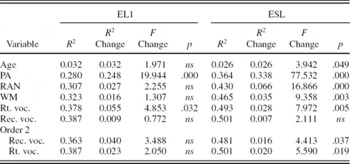
Table 8 summarizes concurrent predictors of standardized word reading (WRAT) in Grade 6. Age, entered first into the regression, accounted for 2.6% of the variance in standardized word reading in the ESL group, but it was not a significant predictor for the EL1 group. When entered next, PA contributed an additional 24.8% of the variance in WRAT for the EL1 group and 33.8% for the ESL group. RAN was not a significant predictor for EL1 children when entered after PA, but contributed an additional 6.6% of the variance for the ESL sample. When entered after PA and RAN, WM was also not a significant predictor of WRAT for the EL1 group but contributed additional variance (3.5%) for the ESL group. Root word vocabulary was a significant concurrent predictor of the dependent variable for both language groups, contributing an additional 5.5% for the EL1 group and 2.8% for the ESL group. Receptive vocabulary, when entered after root word vocabulary and all other variables, was not a significant predictor for either language group. In Order 2, receptive vocabulary was entered before root word vocabulary, and found to contribute an additional 1.6% of additional variance in the ESL group but was not significant for the EL1 group. Likewise, root word vocabulary predicted an additional 2% of variance in WRAT, only in the ESL group.
Hierarchical regression analyses: Concurrent prediction of word recognition (standardized)a for EL1 and ESL children in Grade 6 with various measures as independent variables

Note: EL1, English as a first language; ESL, English as a second language; Age, age in months; PA, phonological awareness (Auditory Analysis Test); RAN, rapid automatized naming (s); WM, working memory (digit span backwards of Wechsler Adult Intelligence Scale—Revised); Rt. voc., root word vocabulary (Biemiller's written root word vocabulary task); Rec. voc., receptive vocabulary (Peabody Picture Vocabulary Test—Revised).
a Word Reading (from Wide Range Achievement Test).
Overall, the results indicate that vocabulary knowledge predicted performance on the WRAT concurrently in Grades 5 and 6 for both groups. Of note, the two vocabulary knowledge measures contributed jointly between 3.6 and 8.8% of additional unique variance to WRAT in the ESL group. Receptive vocabulary was a sensitive predictor of word reading for the EL1 group in Grade 5, contributing approximately 7–8% of unique variance.
DISCUSSION
Group cognitive and linguistic profiles
The results of this study revealed that on several cognitive and reading variables, there was no difference between the language groups (e.g., PA, WM, word reading). However, the two groups differed on measures of vocabulary knowledge, with the ESL children lagging behind their EL1 peers in both Grades 5 and 6. On nearly all cognitive and linguistic variables, both language groups showed improvements over time.
The similarities between the groups with respect to their word reading skills indicate that by Grade 5, ESL children are able to decode as well as their EL1 peers. Both language groups continue to develop their word reading skills from Grade 5 to Grade 6 and, despite differences in OLP favoring the EL1, EL1 children do not outperform ESL children, a finding that echoes those of previous studies with younger ESL learners (e.g., Geva et al., Reference Geva, Yagoubzadeh and Schuster2000; Lesaux & Siegel, Reference Lesaux and Siegel2003). This suggests that, as would be expected by the end of elementary school, children in both groups have acquired accurate decoding skills and thus reached the goal of Chall's “learning to read” stage of reading development.
Furthermore, no differences were found on several cognitive measures. Of note, in accordance with the available research involving primary-level second language learners, EL1 and ESL children did not differ in performance on the PA task, which suggests that phonological sensitivity is an underlying skill that continues to play a significant role in ESL and EL1 children even beyond the primary grades. Of interest, differences in naming speed (RAN) were found between the EL1 and ESL groups. EL1 children had slower naming speeds than ESL children in Grade 6 but not in Grade 5. Although the two groups continue to develop from Grade 5 to Grade 6, their ability to name highly familiar items, the increase in speed of lexical access, was more pronounced in the ESL group. The faster naming speed in the ESL group replicates previous research with younger bilinguals (Everatt et al., Reference Everatt, Smythe, Adams and Ocampo2000; Geva et al., Reference Geva, Yagoubzadeh and Schuster2000; Geva & Yaghoub-zadeh, Reference Geva and Yaghoubzadeh2005; Lesaux & Siegel, Reference Lesaux and Siegel2003).
Based on the profiles of the two language groups, two general observations can be made about children's vocabulary development. First, it is evident that even in the upper elementary years, ESL children continue to have a poorer command of English vocabulary than EL1 children. This is especially noteworthy because these ESL children have been attending school in an English-speaking environment since the beginning of the primary grades. Consistent differences between EL1 and ESL children were noted on a receptive vocabulary measure as well as on the root word vocabulary measure, although the difference between the groups on the root word vocabulary measure reached significance only in Grade 6. The second observation is that EL1 and ESL children alike continue to develop their vocabulary from Grade 5 to Grade 6, and this improvement can be observed on a standardized multiple-choice receptive vocabulary measure, as well as on a more demanding expressive vocabulary measure, that requires children to provide definitions for words frequently encountered in academic contexts and in written language.
Vocabulary development
The design and organization of the root word vocabulary task permitted fine-grained analyses regarding the nature of the differences between the language groups on academic vocabulary. Consistent with one of the hypotheses of the study, Grade 5 EL1 and ESL children had equivalent knowledge of Level 2 and Level 4 root word vocabulary, that is, of words expected to be known by the majority of Grade 2 and 4 children, respectively, and there was an improvement on each of these levels in both groups. EL1 children were more likely to be familiar with Level 2 words. On the whole, mean performance for both groups indicates solid understanding of Level 2 and Level 4 academic words. Although Biemiller and Slonim (Reference Biemiller and Slonim2001) maintain that the Level 2 and Level 4 words were selected as being known by the majority (67–80%) of middle class EL1 children in Grades 2 and 4, it is noteworthy that our participants in both language groups performed below that level. To illustrate, even by Grade 6, the ceiling was not reached in either group on Level 2 words. Mean percentage correct was 76.6% in the EL1 sample, and 69.4% in the ESL sample versus 89% in Biemiller and Slonim's study. Likewise for Level 4 words achieved in Grade 6, the mean percentage correct was 55.8% in the EL1 sample and 48% in the ESL sample versus 74% in Biemiller and Slonim's study. These are words that need to be mastered in the primary years by most children. Another observation that has important implications is that the EL1 group in the present study performed more poorly on all levels compared to the normative EL1 sample in Biemiller and Slonim's (Reference Biemiller and Slonim2001) study of vocabulary development. This finding may reflect the fact that the EL1 group in the present study came from a relatively low SES neighborboods, where the ESL children reside as well.
Clearly, even after 5 to 6 years of schooling in an immersion context, ESL children have lower command of English vocabulary than their EL1 counterparts. This is evident on a receptive task that requires them merely to recognize words, as well as when they are asked to provide definitions to words that are likely to be used in academic school contexts. The current results provide a window into the process of vocabulary development in ESL and EL1 children. By Grade 5, ESL children possess academic vocabulary that begins to approximate that of typical English monolingual children in Grade 2. At the same time, the EL1 children continue to improve their knowledge of Grade 2 and 4 academic words at a faster pace than the ESL children, so that the gap between the EL1 and the ESL children in terms of their knowledge of Grade 2 to 4 lexical items is, in fact, larger in Grade 6 than in Grade 5.
On the whole, at each progressive vocabulary level, children in both groups knew fewer words. Clearly, regardless of their language status, Grade 5 or 6 children are less likely to be familiar with lexical items that are typically mastered at the end of elementary school and beyond. However, it is noteworthy that in Grade 6, both the EL1 and the ESL groups did not reach mastery on Level 6 items: mean percentage correct was 55% in the EL1 sample, and only 47.8 % in the ESL sample versus 66% in Biemiller and Slonim's study. Both groups were even less likely to be able to provide definitions for words above their grade level (Levels 8, 10, or 12). With increase in word level fewer children were likely to be familiar with these words, and the EL1 advantage disappeared altogether, so that for Level 10 and Level 12 words, there was no difference between the EL1 and ESL groups. Finally, it is worth noting that for upper level (i.e., Levels 8–12) words, the means in the current sample of EL1 and ESL children were consistently lower than those achieved in Biemiller and Slonim's (Reference Biemiller and Slonim2001) study.
In general then, the consistent direction of the current findings supports a true difference between the two language groups, and the quasisignificant differences may have been because of the small number of items that were assessed at each word level in the current study. It has been shown that children from low SES backgrounds possess lower levels of vocabulary knowledge than their more affluent counterparts (Hart & Risley, Reference Hart and Risley1995; Hoff, Reference Hoff, Bornstein and Bradley2003). In line with this robust finding, the vocabulary knowledge demonstrated by EL1 children in the present study was lower than that noted among the advantaged participants of Biemiller and Slonim's (Reference Biemiller and Slonim2001) study. In addition, the current study underscores the added L2 disadvantage that ESL children living in low SES neighborhoods face with regard to their vocabulary knowledge, in comparison with their EL1 peers. The results show that even after 5–6 years of schooling their academic vocabulary knowledge lags behind that of their EL1 peers.
Biemiller (Reference Biemiller1999) reported that words are acquired in roughly the same sequence in different groups of children. The current results suggest that this observation applies also to the development of vocabulary in ESL children. Cummins (Reference Cummins1980) proposed that approximately 5–7 years are needed for immigrant children to master the academic language required for the regular English curriculum. This notion may warrant revision and refinement in light of the persistent gap in academic vocabulary knowledge demonstrated in the present study, and the well-established far-reaching impact of vocabulary knowledge upon reading comprehension.
Predictors of word recognition skills
The secondary objective of the present study was to examine the contribution of vocabulary knowledge to word reading skills of Grade 5–6 children over and above the potential contribution of underlying processing factors such as PA and RAN. The results revealed that word recognition skills are predicted by both cognitive–linguistic factors and by vocabulary knowledge but the contribution of latter, although statistically significant, is quite small.
Cognitive factors and linguistic factors
Similar cognitive and linguistic factors contributed to variance in word recognition in varying proportions in the EL1 and ESL groups. In both groups, and at both grade levels, PA continues to be a sensitive and strong predictor of word recognition skills, mirroring the results of other studies with younger ESL learners (e.g., Durgunoglu et al., Reference Durgunoglu, Nagy and Hancin-Bhatt1993; Geva et al., Reference Geva, Yagoubzadeh and Schuster2000). Although Wagner and associates (Reference Wagner, Torgesen, Rashotte, Hecht, Barker and Burgess1997) maintain that the influence of RAN on reading might diminish in higher grades, in the present study, individual differences in RAN continued to explain significant differences in word recognition in Grades 5 and 6 (both concurrently and longitudinally) in the ESL group. However, RAN was much less reliable as a predictor of word reading skills in the EL1 group. It is possible that because of their ESL status, ESL children are more challenged when they perform academic tasks, and therefore the ease with which they can access phonological and orthographic information with accuracy and speed has a greater influence upon their word recognition skills. The current study also found that nonverbal ability was a sensitive concurrent and longitudinal predictor of word recognition. Although this finding was not consistent across measures of word reading, it is unexpected and worth noting, because this association has not been supported typically in previous research.
The findings of this study are equivocal with respect to the role of WM in word recognition. On the whole, with a few exceptions, for both EL1 and ESL children, WM was not a unique concurrent or longitudinal predictor of both measures of word recognition. Overall, the findings do not provide a clear picture of WM's unique role in predicting variance in word recognition skills in EL1 and ESL children in middle school. It would be expected that WM may not be as important, because children in both groups have become more fluent readers. Fluent readers require less conscious recoding and temporary storage of sounds and do not need to retrieve phonological information to decode words (Strattman & Hodson, Reference Strattman and Hodson2005). At the same time, it is important to note that WM correlated positively with the reading measures and with PA in both language groups. Presumably, because of shared variance, once PA was entered in to the regression equation, WM was less likely to be significant.
Vocabulary
Of particular interest in the current study was the role of vocabulary knowledge in predicting word recognition in EL1 and ESL children. Unlike many studies in the past, which used receptive or oral vocabulary measures, this study sought to investigate the role of “deep” vocabulary knowledge in word recognition by employing the written root word vocabulary task (Biemiller & Slonim, Reference Biemiller and Slonim2001). The use of this task and the corresponding experimental word reading list allowed for a closer examination of the role of vocabulary knowledge, because the stimulus words were the same on both the vocabulary and word recognition measures. In other words, it was possible to pose the question “to what extent does knowledge of a word's meaning predict being able to read it?” To add to the previous research involving young readers, another important question addressed was whether vocabulary knowledge, in general, explains unique variance in word recognition in older children. This was achieved by examining the role of receptive vocabulary knowledge in predicting word recognition in both language groups. It was hypothesized that both root word vocabulary knowledge and receptive vocabulary knowledge would explain unique variance in word recognition even after accounting for the effects of cognitive and linguistic factors. Furthermore, it was expected that this association would be true for both EL1 and ESL children. This hypothesis was to some extent supported by the findings as vocabulary knowledge consistently accounted significantly for individual differences in word recognition for both the EL1 and ESL groups, even after the contributions of PA, RAN and WM were accounted for.
Results of previous studies with monolinguals (e.g., Storch & Whitehurst, Reference Storch, Whitehurst, Damon, Britto and Brooks-Gunn2001, Reference Storch and Whitehurst2002; Whitehurst & Lonigan, Reference Whitehurst and Lonigan1998) have indicated that the relationship between oral language and word recognition is indirect, with coding-related skills (i.e., PA and print concepts) acting as the mediator in the relationship. For the monolingual children in the current study, there is evidence of a direct relationship between vocabulary knowledge and word recognition. Moreover, the bulk of the regression analyses indicated that in both language groups vocabulary knowledge accounts for additional variance in word recognition, regardless of the vocabulary or word recognition measures used. In both the EL1 and ESL groups, across all analyses, vocabulary knowledge (receptive and root word vocabulary combined) contributed up to 7.5% of additional variance after individual differences in PA, RAN, and WM were accounted for.
An objective of the current study was to investigate whether knowing the meaning of specific words directly predicts being able to read those same words. The findings indicate that the nature of the relationship between vocabulary knowledge and word recognition skill is more general. Performance on both vocabulary measures predicted unique variance on measures of word reading, regardless of whether or not the stimulus words read matched those on the vocabulary task. Root word vocabulary knowledge predicted unique variance in word reading on both the standardized measure (containing nonmatched words) and the experimental measure (containing matched words). Receptive vocabulary was also found to predict unique variance on both measures of word reading (i.e., standardized or experimental). In fact, for monolingual and ESL children, for both the standardized and experimental measures of word reading, the results were highly similar, with vocabulary knowledge explaining approximately 7% of unique variance. However, unlike the EL1 children, in the ESL group, root word vocabulary consistently predicted additional variance, even when the effects of receptive vocabulary (and all other variables) were taken into account. One possible explanation for this finding is that because of the sentence context format of the task, the root word vocabulary measure is more demanding for ESL students and therefore captures additional variance related to language proficiency, as it draws on additional linguistic skills (e.g., grammatical sensitivity, word retrieval, morphological knowledge).
In general, this study replicates in an older group of more advanced ESL children the finding that L2 oral vocabulary knowledge is a significant albeit not unique predictor of word recognition skills. However, vocabulary knowledge explains only a small proportion of additional variance on word recognition in Grade 5 and 6 students, relative to the effect of PA.
DIRECTIONS FOR FUTURE RESEARCH
The ESL children who participated in the current study represented numerous language groups. The diverse backgrounds of the participants allows for greater generalizability of the current results. Instead of comparing the profiles of ESL group versus EL1 learners, future research should focus on the within-group variability in the ESL group, as there is evidence that aspects of different L1s may have differential influences on the development of L2 vocabulary and L2 reading acquisition (e.g., Hancin-Bhatt & Nagy, Reference Hancin-Bhatt and Nagy1994; Holmes & Guerra Ramos, Reference Holmes, Ramos, Huskin, Haunes and Coady1993; Mumtaz & Humphreys, Reference Mumtaz and Humphreys2002).
Although the present study provides support for the significant role of vocabulary knowledge in word recognition in bilingual children, there is room for adopting a more nuanced approach of vocabulary knowledge and how it may be related to types of words being read. Snowling (Reference Snowling2001) has proposed that semantic skills are strong predictors of reading nontransparent or irregular words, whereas phonological skills are strong predictors of transparent or regular words, and some support for this scenario comes from Mumtaz and Humphreys (Reference Mumtaz and Humphreys2002). Therefore, another area that may merit additional study is the potential relationship between vocabulary knowledge and word recognition for specific categories of words.
Pedagogical implications of the current study
The results reported here illustrate that ESL children continue to lag behind their EL1 peers in grade-appropriate English vocabulary knowledge even after several years of formal education in English. Given empirically established relationship between vocabulary knowledge and reading comprehension skill, these findings indicate that there is a need for explicit vocabulary instruction with ESL children (August et al., Reference August, Carlo, Dressler and Snow2005). This call for explicit teaching of academic vocabulary is further supported by the aforementioned finding that bilingual learners are less likely than monolinguals to increase their vocabulary knowledge through incidental learning and extensive reading (Proctor et al., Reference Proctor, Carlo, August and Snow2005). It is apparent that there is a lack of systemic and explicit vocabulary instruction in educational programs for EL1 (Biemiller, Reference Biemiller2003) and ESL students (Appel & Vermeer, Reference Appel and Vermeer1996; Dutro & Moran, Reference Dutro, Moran and Garcia2003; Gersten & Baker, Reference Gersten and Baker2000; Scarcella, Reference Scarcella1996). In addition to grade-appropriate vocabulary words, explicit vocabulary instruction for ESL learners and children coming from low SES communities should also focus on closing the gap by teaching academic words corresponding to lower levels of word difficulty. ESL children require support to “catch up” with their EL1 peers on these higher frequency words that have already been acquired by their EL1 peers in lower grades.