

The history of active, intentional menstrual suppression is usually assumed to be brief, only really beginning in the 1960s with the advent of oral contraceptives that could also be used to standardise, delay and even skip a period.Footnote 1 Many twentieth- and twenty-first-century menstruators have adopted menstrual suppressant technologies eagerly, particularly once assured of their safety and lack of impact on fertility.Footnote 2 When asked why they engage in menstrual suppression, modern-day menstruators in the United States often list one or more of the following reasons: to reduce or eliminate premenstrual and menstrual discomfort; to avoid or reduce the inconveniences of managing menstruation and the financial and ecological costs of menstrual hygiene products; to create closer alignment between one's sex and gender identities; and to ensure that one's menses do not impact socially significant events (e.g. weddings, vacations, conferences, romantic dates).Footnote 3 These motivations must be understood within their specific cultural contexts — in dialogue, for example, with the gendered and other social norms that operate in the modern-day United States and with the Western, biomedical understanding of menstruation as a strictly biological phenomenon that can be manipulated without harm. However, we can imagine versions of some of these motivations pertaining even within the very different cultural context of Imperial Rome. Then, as now, menstruation could be painful and burdensome to manage, and it could prevent women from entering certain social spaces and engaging in certain activities. Therefore, might not some ancient menstruators have sought to moderate, delay or even eliminate their menses, whether for physiological or social reasons?
Classicists, anthropologists and historians of medicine alike have tended to assume that the answer is no, and for good reason. Many of our extant Greek and Roman medical texts, particularly those within or inspired by the Hippocratic Corpus, see menstruation as performing a vital cleansing function within the reproductive-age female body.Footnote 4 Suppressed menses, in their view, are dangerously pathogenic and become a medical problem to be solved rather than a goal to be sought.Footnote 5 Consistent with this view, medical and pharmacological treatises alike are brimming with recipes and instructions for emmenagogues, therapies — including bloodletting; cupping; the ingestion, insertion or application of medically potent substances; and various warming and loosening exercises — designed to induce the menstrual flow and thereby flush the body of dangerous waste.Footnote 6 Many ancient medical authors also believed that regular periods were a vital indicator of a woman's fertility status. The first-century c.e. physician Soranus, for example, suggests that, in order for a man to gauge the fertility of a prospective wife, he ought to ask some rather invasive questions about the state of her menses:
Since most women are joined [to their partners] in marriage for the sake of children and succession, and not merely for pleasure, it is completely absurd to ask questions, on the one hand, about the nobility of their lineage and the abundance of their property, but, on the other, to leave uninvestigated whether they are able to conceive or not, and whether they are naturally predisposed for childbearing or not. Therefore, we must make an account concerning the matter before us. … [They can conceive] if they menstruate regularly and [if it consists] not of some moisture or various kinds of serous discharges but of blood, and of this neither too much nor entirely too little.Footnote 7
Thus, we can appreciate how, in a pronatalist society like Rome, where many believed irregular menses or the complete lack thereof to be pathogenic, one might assume that menstrual suppression was rarely, if ever, intentionally sought. This assumption, however, is based on another: that the perspectives of our extant medical authors — all educated, elite and male — accurately reflect the beliefs and behaviors of actual menstruators across the spectrum of class, civic status and culture. Soranus himself acknowledges that, even among other elite physicians of his time, there were diverse views regarding menstruation's role in maintaining a reproductive-age female's general and reproductive health.Footnote 8 Amidst this diversity, there is room for the position that, at least for some women and under certain circumstances, menstrual suppression might be viewed as harmless or even beneficial.
This study demonstrates that there is, in fact, meaningful evidence for the use of menstrual suppression techniques in Imperial Rome, with some enigmatic precedents dating back to Late Babylonian and Hippocratic medicine, and it explores the social history of this practice.Footnote 9 Driving this study are the following questions: What methods were available for menstrual suppression, and who provided them? Who might have sought menstrual suppression, and why? And, finally, to what extent might such therapies have offered menstruators control over their own bodily rhythms? To address these questions, this study employs a combination of two methods that have seen increasing use among researchers interested in developing informed historical counter-narratives that centre the experiences, perspectives and contributions of members of historically marginalised groups. First, I endeavour to read our elite male sources not only with but also against the grain.Footnote 10 This practice, which became a cornerstone of feminist theory in the 1970s, involves critically examining the assumptions that these elite, male authors make and the details about their worlds that they include or omit. This can help us to identify ambiguities and contradictions, challenge dominant social narratives and perhaps catch glimpses of what actual menstruators were doing.Footnote 11
Second, I engage in informed speculative research akin to what Saidiya Hartman has termed ‘critical fabulation.’Footnote 12 Hartman developed her methodology in order to confront and attempt to redress the violence done to black women entangled in the Atlantic slave trade — both the physical violence done to their bodies and the narrative violence done to their memories, as our existing archives converted them into mere ‘numbers, ciphers, and fragments of discourse.’Footnote 13 Hartman uses strategies related to reading against the grain — such as ‘listening for the unsaid, translating misconstrued words, and refashioning disfigured lives’Footnote 14 — to develop speculative arguments and narratives that are grounded in the archive's lacunose and often ambiguous evidence. Hartman is thereby ‘straining against the limits of the archive to write a cultural history of the captive, and, at the same time, enacting the impossibility of representing the lives of the captives precisely through the process of narration.’Footnote 15 While critical fabulation has only recently been gaining traction in studies of the ancient Mediterranean world,Footnote 16 it has become popular among scholars studying the history of slavery,Footnote 17 and related methods are also being advocated in the realm of social theory.Footnote 18 For example, as the feminist theorists Justine Grønbaek Pors and Signe Ravn note:Footnote 19
[S]peculative research [is] particularly important when doing research on topics such as young women's futures dominated by strong, neoliberal and potentially harmful narratives; here there is particular need for acknowledging the plurality of the present and consider[ing] the cracks in this dominant narrative. … If we understand research as co-creating futures, it is timely to consider how we as social researchers can co-create alternatives to this dominant narrative. Rather than simply repeating findings that are already well documented, we are interested in attending to that which gets hidden when we only focus on the dominant story.
My project, too, engages in critical speculation in order to explore the range of possible realities supported by our complicated and highly lacunose evidence for ancient menstruators’ experiences and to gain a broader appreciation for the reasons why individuals of different civic statuses, classes or professions might have felt incentivised to pursue menstrual suppression. Like Hartman, I extend this imaginative exercise not only to the group under direct consideration (i.e. menstruators themselves), but also to the individuals (e.g. husbands, fathers, enslavers, pimps, madams) who were likely to have made decisions about menstruators’ bodies. I also aim, as Hartman does, to address the physical and archival violence done to ancient female bodies and perspectives, though my investigation considers not only enslaved women but also the free and even elite. It is important to acknowledge that not all women in the ancient Mediterranean are equally absent from our archives or equally denigrated in their representation. However, within the textual corpus of antiquity, the vast majority of women — elite and lower-class, free and enslaved — were at risk of physical and sexual violence and have been deprived of the opportunity to tell their own stories. By critically exploring how different kinds of menstruators, and other individuals in their lives, might respond to technologies aimed at manipulating menstrual rhythms, I endeavour to open a space for what might have been, a realm of informed conditional thinking that, as Lisa Lowe puts it, ‘seeks to encompass at once the positive objects and methods of history and social science and the matters absent, entangled and unavailable by its methods’.Footnote 20
As a final methodological note, this project does not engage with the question of how effective ancient menstrual suppression techniques may have been. As is frequently emphasised in scholarship on ancient medicine and pharmacology, it is very difficult to speak authoritatively about the efficacy of a particular ancient remedy due to challenges such as uncertainty surrounding the identification and properties of ancient medical materials relative to their prospective modern-day counterparts and imprecision in our sources about dosage and preparation.Footnote 21 The fact that, since the 1960s, pharmaceutical menstrual suppression techniques have become very safe and reliable does indeed mark a point where the parallel between modernity and the Roman world breaks down. Of concern for this paper's argument, however, is not the real-world efficacy of ancient menstrual suppression therapies, but the hopes or expectations of efficacy that motivated users to seek them out. Whether or not these therapies produced the desired results, the very fact that some menstruators and/or other agents believed they could produce those results would have expanded the range of actions they understood to be available to them and, by extension, the range of ‘imagined futures’ they might conceive of for themselves.Footnote 22
As case studies, I focus on three sets of sources that represent a range of genres and perspectives: Galen's works on bloodletting, which are technical medical treatises; the pharmacological compendia of Pliny's Natural History and Dioscorides’ On Materia Medica which, between them, draw on a wide range of both medical and popular traditions; and a series of body amulets from Roman Egypt that could be used to regulate vaginal blood flow through both suppression and induction and that offer us a glimpse of private ritual interventions. These sources reveal to us a rich marketplace of menstrual suppression offerings which often invert the principles and/or use the same materials as menstrual induction techniques. We will see that medical writers tend to assume there is only one legitimate reason for engaging in menstrual suppression: namely, to reduce excessively long and painful bleeding (what we would now call menorrhagia). However, I also argue that there is reason to believe some menstruators sought suppression not only to relieve physical discomfort but also for a variety of other reasons, some of which, like social inconvenience, would resonate with many in the modern-day West, and others, such as concerns about the ritual purity status of oneself or one's sexual partner, which highlight contrasts between Roman antiquity and today. I also address the question of whether ancient users of menstrual suppressants may have understood them to be a form of contraception, though we lack explicit, positive evidence for this connection.
I METHODS OF MENSTRUAL SUPPRESSION
Late Babylonian and Hippocratic Precedents
While the focus of this study is on Imperial Rome, the Romans were not the first to demonstrate interest in menstrual suppression. Medical texts from the Late Babylonian Period (c. 500–10 b.c.e.)Footnote 23 preserve recipes and rituals for stopping or regularising vaginal blood flow, and pithy references to menstrual suppression are also preserved in the Hippocratic Aphorisms.Footnote 24 We will briefly examine this Late Babylonian and Hippocratic evidence in order to understand better the precedents that may have informed Roman approaches to menstrual suppression and why the Roman Imperial period provides a particularly rich case study for exploring such practices.
Late Babylonian medical texts, particularly those collated in BAM and SpTU,Footnote 25 are concerned with abnormal, irregular and excessive vaginal bleeding. They preserve recipes to treat amenorrhea by inducing menstruation,Footnote 26 recipes to halt uterine bleeding during pregnancy,Footnote 27 and — most relevant for our purposes here — recipes that simply claim to reduce vaginal blood flow in general, without specifying the context. There has been disagreement among Assyriologists over the extent to which such recipes might have been used to treat excessive menstruation, or menorrhagia. Ulrike Steinert, in an important article on suppressing abnormal vaginal blood flow in Mesopotamian medicine, explains the conundrum this way:Footnote 28
Because the expression ‘blood of a women’ in [tablet] K.263+ and other gynaecological texts is very general and because no specific Akkadian term for ‘menstruation’ is known so far (in contrast to Egyptian and Greek), it seems that the Mesopotamian healers did not discriminate between abnormally excessive menstrual discharge and the pathological flow of blood due to internal ailments of the uterus (e.g. tumours, uterine fibroids).
Steinert thus allows the possibility that recipes for stopping or reducing ‘the blood of a woman’ could have been used to treat menorrhagia. However, she cautions against assuming this usage, as such recipes could equally well have been intended to treat other forms of irregular vaginal bleeding.
One diagnostic term in particular, naḫšātu, has been the subject of significant scholarly debate and may be particularly relevant for our present inquiry. Scholars like Irving Finkel and Steinert understand the term to refer strictly to bleeding during pregnancy and therefore to be unrelated to menstruation.Footnote 29 Kilian Butz, however, translates naḫšātu more capaciously, as ‘irregular bleeding.’Footnote 30 This leaves room for us to understand naḫšātu remedies as menstrual suppressants but does not offer definitive proof. Finally, scholars like René Labat, Jo Ann Scurlock and Burton Anderson equate the term specifically with menorrhagia, which would mean that recipes against it indeed aimed to suppress menstruation.Footnote 31 Scurlock and Anderson, in their magisterial sourcebook for and analysis of Mesopotamian diagnostic practices, collect a series of recipes under the heading ‘Menorrhagia (Excessive Menstruation),’ explaining that ‘irregular bleeding (naḫšātu) was known to be a problem.’Footnote 32 Under this heading, Scurlock and Anderson include the following rubrics as examples:Footnote 33
SpTU 4.153:17: Potion to stop a woman from bleeding.
SpTU 4.153:1: If a woman's blood flows and does not stop, to stop it …
BAM 381 iii 24: Plant for a woman who is sick with naḫšātu.
In her 2014 sourcebook of Mesopotamian medical texts, Scurlock also features BAM 237 (= KAR 194), which includes an extensive list of remedies for naḫšātu. Their headings typically take the form of, ‘If you [do X], the irregular bleeding (naḫšātu) should stop’, where ‘do X’ could entail inserting suppositories, consuming drinks, performing fumigations, preparing amulets or reciting text.Footnote 34
In support of her decision to translate the contentious term naḫšātu as menorrhagia, Scurlock (pers. comm. 2023) notes that naḫšātu remedies never mention pregnancy and appeal to the goddess Ištar, whereas remedies that explicitly target spotting during pregnancy do not use the term naḫšātu and appeal to the god of childbirth, Marduk. She also notes that certain treatments recommended for naḫšātu, such as sitting over hot coals and fumigating with a medicinal plant, are frequently used to bring down the lochia after childbirth and would therefore be unsafe to perform during pregnancy. Though not myself an Assyriologist, I am persuaded that ancient Mesopotamian physicians recognised excessive menstrual bleeding as a condition that merited medical intervention, and I therefore see in these texts plausible precursors to the more explicit menstrual suppression remedies we encounter in Greek and Roman medical writings. It is important to note that, absent references to the total elimination of the menses, it is most likely that the goal of the Late Babylonian interventions was not to skip or delay a period (for whatever reason), but to restore regularity by reducing flow to a normative level. However, we can also imagine how someone interested in suppressing the menses to the point of elimination might take such therapies as their starting points, perhaps increasing the dosage, duration or intensity to produce more dramatic results.
The Hippocratic author/compiler of Aphorisms (c. 400 b.c.e.)Footnote 35 seems also to have understood menorrhagia as a condition requiring treatment. One aphorism, for example, warns physicians, ‘If the menses are too copious, diseases result, and if they do not appear, diseases of the womb arise.’Footnote 36 Here we see not only the typical Hippocratic concern, discussed above, with suppressed menses as a pathogenic state, but also a concern with the opposite condition: menses that are in excess. Earlier in the text, the author also provides a suggestion for how excessive menses might be checked: ‘If you want to check menstruation, apply to the breasts as large a cupping glass as possible.’Footnote 37 The verb used here, episkhein, simply means ‘to restrain or hold back’; it is not clear whether this therapy is meant to stop the menses entirely or simply to reduce them from an excessive to a normative level. Here too, though, regardless of the author's intentions, we can imagine how an enterprising patient or physician could adapt such a therapy in an effort to eliminate the menses completely — by, for example, holding the cupping glass in position for longer than the recommended time.
We will see that, in Imperial Rome, medical authors seem to share the Babylonian and Hippocratic interest in using suppressants to regularise excessive menses. These doctors, like their predecessors, present menorrhagia as the only clinically legitimate reason to engage in the otherwise risky business of suppressing the menses. However, compared with earlier periods, attestations of menstrual manipulation in the Roman era are much more numerous, detailed and diverse, allowing us to reconstruct a more complex picture of when and why different authors and actors might have advocated for or against menstrual suppression. These sources contain hints that menstrual suppression might also have been sought for reasons other than mitigating menorrhagia, reasons which might have been social rather than physiological. Examining these hints will help us to appreciate how, once made available, menstrual suppressant technologies might be used by a range of actors with a range of goals and motivations.
Under the Roman Empire
Clear references to menstrual manipulation appear in Celsus’ On Medicine and Galen's treatises on bloodletting, and they proliferate within the pharmacological sections of Pliny the Elder's Natural History and Dioscorides’ On Materia Medica.Footnote 38 Amulets have also come down to us aimed at regulating vaginal blood flow both through induction and through suppression. These sources allow us at least limited access to a range of perspectives on menstrual suppression, including those of physicians, discussing their own (and their rivals’) theories and practices; non-practising aggregators of medical knowledge, reporting popular as well as specialist therapies; and actual menstruators, as reflected and refracted through the material culture of private ritual and through the assertions, assumptions and descriptions of male medical authors. In the following section, I use the tools of reading against the grain and forms of critical speculation to flesh out these perspectives and consider the range of positionalities, motivations and goals suggested by our evidence. First, though, it will be helpful to survey the kinds of menstrual suppression techniques attested in these sources so as to get a sense of the broader menstrual suppression ‘marketplace’ that patients and providers navigated and the kinds of burdens, risks and benefits these therapies might offer menstruators.
Galen believed bloodletting to be an effective way both to induce and to suppress the menses. In On Treatment by Venesection, he explains the basic principles in the context of describing his preferred menstrual induction therapy:Footnote 39
Inflammations of the uterus are benefited even more than those of the kidneys by bloodletting from the legs. For with evacuations from the elbow another difficulty arises. These check the menses by drawing the blood back toward the upper parts of the body. By means of bloodletting from the legs, it is possible not only to draw back but also to urge on the menses.
For Galen, unlike many of his contemporaries, the effectiveness of bloodletting depends very much on where in the body it is performed. He imagines a cut vein as drawing blood toward the opening and away from the opposing side of the body. By this reasoning, a cut to the calf or ankle would facilitate the evacuation of retained menstrual blood by encouraging the blood to flow downward from the uterus, in the direction of the cut. Conversely, a cut to the elbow would suppress the menses by encouraging the blood to move upward in the body, away from the vaginal opening. It is worth noting, however, as Peter Brain has done, that while Galen's scheme here is not entirely unique (elements of it are shared, for example, by Aretaeus), it was certainly not a consensus view.Footnote 40 The Latin medical writer Celsus, for instance, suggests that letting blood from the arm will actually induce menstruation, while lightly scarring and cupping the groin will suppress it — a nearly-exact inversion of Galen's model.Footnote 41 To add to the confusion, though, Celsus proceeds to suggest another remedy that seems to operate in agreement with, rather than in opposition to, Galen's principles: ‘or even [the remedy is cupping glasses] moved under the breasts.’Footnote 42 The application of a cupping glass draws heat and blood to the area. Therefore, this remedy — which should remind us of the Hippocratic recommendation to suppress menstruation by cupping — seems to work by drawing heat and blood upward in the body, away from the vaginal opening, rather than downward toward it. Thus, we can see that, in the Roman period, menstrual manipulation via bloodletting was a site of active debate and experimentation among physicians, with actual menstruators (or other agents) left to evaluate and choose from an array of theories and practices.
Included in that wider array were also herbal, mineral and animal remedies, which typically took the form of an ingestible substance (food or drink), a vaginal suppository (inserted like a modern-day tampon), a topical lotion or a body amulet. A great quantity of menstrual suppression recipes can be found in the pharmacological books of Pliny the Elder's encyclopaedic Natural History, as well as in Dioscorides’ roughly contemporary pharmacological reference work On Materia Medica.Footnote 43 Appendices 1 and 2 list the menstrual suppressant recipes I have identified within these two texts, indicating the terms these authors use for the blood flow, whether or not that blood flow is explicitly described as excessive, and the specific medical substances to which the menstrual suppressant properties are attributed. Medical materials that are assigned such properties by both Pliny and Dioscorides appear in the tables in bold. These tables reveal interesting features about the breadth of terminology used (in both Latin and Greek) to describe menstrual suppression; the frequency with which non-practising aggregators of medical knowledge, in contrast to iatroi like Galen or Soranus, emphasise the use of menstrual suppression specifically to regulate excessive bleeding; and, finally, the diversity, as well as the degrees of standardisation and accessibility, of menstrual suppressant remedies under the Empire.
Let us begin with the terminology used to describe menstrual suppression. I have identified here thirty-four entries in Pliny's Natural History that seem to attribute menstrual suppressant properties to various medical substances. In twenty-one (i.e. nearly two-thirds) of those instances, Pliny uses the word menses, usually in combination with a form of the verb sistere (‘to arrest, stop or check’), to make it clear that the type of vaginal bleeding under discussion is, in fact, menstruation rather than abnormal uterine haemorrhage. In the other cases, he uses terms like profluvium (‘flow’) and purgatio (‘purge or cleansing’) which, though more general, are well-attested as terms for menstruation.Footnote 44 It seems likely, then, that in the context of Pliny's Natural History, the terms menses, profluvium and purgatio functioned more or less as synonyms, though perhaps recipes treating the latter two conditions could be used to affect other kinds of vaginal blood flow as well. The situation in Dioscorides’ On Materia Medica is somewhat less straightforward. In Appendix 2, I have taken a maximalist approach, including all terms that could be interpreted as referring to menstruation, though some are more ambiguous than others. Of the twenty-nine entries in Appendix 2, only three clearly indicate that menstruation in particular is meant, rather than vaginal blood flow more generally. In these entries, Dioscorides employs the terms emmēna and katamēnia (i.e. ‘the monthlies’). In the remaining twenty-six entries, however, he uses the terms rhoikē and rhous, which simply mean ‘flow’. I submit that these terms are capacious enough to include menstruation, especially since some of the materials to which Dioscorides attributes ‘flow’-suppressing properties also appear in Pliny's Natural History in explicit connection to menstruation.Footnote 45
It is interesting to note that, while our extant medical writers, like Galen, tend to discuss menstrual suppression specifically as a corrective to menorrhagia, the entries in Pliny and Dioscorides tend to be less restrictive. I have identified only nine instances in which Pliny specifies that a remedy suppresses ‘excessive menstruation’ (typically mensum abundantiam in his Latin) and no explicit instances in Dioscorides. There are two entries in On Materia Medica where this use-case seems implied, though by the choice of verb rather than by the addition of an adjective. In one case, Dioscorides says that a substance ‘regulates the flows’ (rhoikais harmozei), while in the other he says that the substance ‘helps the flows’ (rhoikas ōphelousin).Footnote 46 In both collections, however, the vast majority of relevant entries speak simply of checking the (menstrual) flow without commenting on the severity of that flow before or after the therapeutic intervention.
Finally, comparison of the specific medical materials included in Appendices 1 and 2 yields some interesting observations about the levels of diversity, standardisation and accessibility of such substances. First of all, it is clear that in the first century c.e., when both Pliny and Dioscorides produced their texts, a wide range of medical materials was known (at least to these prominent men) to reduce or eliminate the menses. Across the two texts, approximately fifty-six different materials are mentioned, along with a great variety of delivery mechanisms.Footnote 47 Second, there is not a substantial amount of overlap between Pliny's and Dioscorides’ lists, which suggests that, at this time, there was a lack of standardisation or consolidation of this knowledge across the Empire. By my count, only seven substances are mentioned as menstrual suppressants by both authors, meaning that only about 12 per cent of each author's list is shared by the other.Footnote 48 As Pliny and Dioscorides were active in different parts of the Empire — Pliny in Rome, Dioscorides in Anazarbus, a town in southwestern Asia Minor — this divergence may be explained, at least in part, by differences in the authors’ local ecologies and, by extension, differences in the availability of and traditions surrounding specific plants, animals and minerals.
Despite the diversity of specific treatments for menstrual suppression that Dioscorides and Pliny provide, the two authors seem to be in broad agreement about some of the qualities that make a particular substance appropriate for this task. Some seem to have been used for menstrual suppression and other forms of haemostasis (e.g. stopping nosebleeds) because of their inherent thickening, astringent or otherwise repressive properties. Pliny's entry on the olive, for example, proceeds as follows (HN 23.69–70):Footnote 49
Next, the power of the olives is recognised. Its leaves are very powerfully astringent, cleansing and binding. Therefore, if chewed and applied, they heal sores; if spread on with oil, they heal headaches. A decoction of them, along with things which doctors have burned in honey, heals inflammation of the gums, paronychia, and foul and putrifying sores. With honey, [the decoction] restrains the flow of blood out of the sinewy parts. … Applied in a pessary to the vulva, it checks the menses and is useful for sores running with purulence, as well as for anal swellings, erysipelas, spreading sores and night pustules.
Likewise, Pliny says of the plant of Ida that it ‘checks loose bowels, the menses and all excess bleeding. It has a natural disposition toward thickening and binding’.Footnote 50 Dioscorides also notes of lysimachia that the juice of its leaves is ‘astringent (styptikos)’ and that, in addition to suppressing menstruation, ‘stuffed in the nostrils, the plant is good for nosebleeds’ or can be used to staunch blood in wound care.Footnote 51
Yet we also see cases in both authors where the same substance can be used either to suppress or to induce menstruation, depending on its mode of application. Pliny reports, for example, that crabs are ‘taken with water to check menstruation, taken with hyssop to induce it,’ while the wild lentil ‘called by the Greeks elelisphacos … with wine, likewise draws down delayed menses while, if a decoction of it is drunk, it checks excessive menses.’Footnote 52 Dioscorides notes of the mandragoras that ‘the seed of the fruit, if drunk, purges the womb [i.e. induces menstruation], while, if inserted as a pessary with unfired sulphur, it checks the red flow [i.e. suppresses the menses]’.Footnote 53 In such cases, the substance seems to be considered useful for regularising bleeding in general, whether that involves increasing or decreasing the amount. Often such medical materials (along with many deemed suitable only for menstrual induction or suppression) have a property that is symbolically reminiscent of the womb or menses, such as a red colour.
Finally, it is worth noting that the majority of these plant, animal and mineral remedies involve easily accessible ingredients and simple steps that require no specialist knowledge or equipment. In short, these are remedies that could have been used more or less by anyone, in the privacy of their own homes, and perhaps — provided that one was familiar with these items’ proclaimed properties — without ever consulting a healthcare provider. In this context, it is also noteworthy that recipes which could be used to suppress the menstrual flow are also included in some of the texts associated with the euporista tradition (i.e. texts, typically organised a capite ad calcem, that list simple remedies using easily accessible ingredients).Footnote 54
One of the menstrual suppressant remedies Pliny relates stands out for having a different mode of application than the rest. When discussing the properties of the mulberry, Pliny notes that it will check menstruation if — rather than being consumed, inserted or applied as a cream or poultice — it is instead worn as a body amulet (HN 23.137–8):Footnote 55
[Of the mulberry] there are additional marvels that have been related. At germination, before the leaves unfurl, the nascent fruit is plucked with the left hand. The Greeks call these ricini. If they have not touched the ground, these, when tied on [as an amulet], check the blood, whether it flows out from a wound, the mouth, the nose or haemorrhoids. For this purpose, they are preserved and stored. The same thing is also said to happen if a branch just starting to bear fruit is broken off during the full moon. If it does not touch the ground and is tied on to the upper arm [as an amulet], then it is especially [useful] for women against excessive menstruation. People reckon that this result is also achieved if [the branch] is broken off at any time by the women themselves in such a way that it does not touch the ground and is [then] tied on [as an amulet].
Unsurprisingly, given that such amulets were unmarked and made of perishable material, none of this type has been identified in our archaeological record. We do, however, have many examples of stone amulets which seem intended to promote or suppress vaginal bleeding. A common gem type, most frequently inscribed on haematites or ‘blood-stones’, depicts an upside-down jar, representing the uterus, with a key at its mouth (see Fig. 1).Footnote 56 There is an inherent ambiguity to this gem type: is the key locking the opening of the uterus, thereby preventing blood or anything else from coming out? Or is it unlocking the uterus, thereby encouraging blood or a miscarried or unwanted fetus to emerge? While it is hard to tell which possibility might pertain in the case of any individual gem, scholars like Robert Ritner and Christopher Faraone have noted that elements of this gem type (the key, the uterine jug) sometimes appear reversed, suggesting, in Faraone's words, ‘a binary use of these haematite gems to either open or close the womb, depending on the circumstances’.Footnote 57
Haematite gem dated to the third century c.e. (CBd-176; Inv. No. G 546 [EA 48984]). The obverse features an upside-down uterus with a seven-toothed key, an encircling ouroboros, a group of deities (from left to right: Anubis, Chnoubis, Isis-Tyche), the Greek vowel series and an inscription (the σοροορ-logos). Inscribed on the reverse is the word ορωριουθ. (© Trustees of the British Museum)

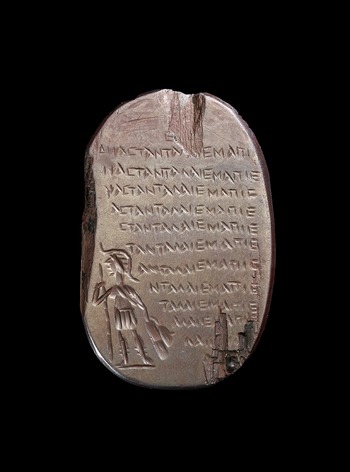
There is another amulet type that aims to control vaginal bleeding, and with which it is possible to be more precise about whether a particular version aims to induce or suppress that bleeding.Footnote 58 Amulets of the so-called ‘Tantalus type’ derive from Egypt and the Eastern Mediterranean, probably date to the second and third centuries c.e., and include the following elements. The obverse tends to depict Ares or a figure with an animal head in addition to text that commands Tantalus to drink blood. Etched on the reverse are an upright uterine jug atop a Syrian altar, as well as the seven Greek vowels and the powerful names of the Jewish god (see Fig. 2). Some of these amulets, however, incorporate an additional feature: they make the command to Tantalus disappear one letter at a time, in what is often called a wing-formation. There has been scholarly debate over how to interpret the two versions of this amulet, the one where the command to Tantalus persists and the one where it is made to vanish. Faraone has proposed a persuasive explanation:Footnote 59
[A]lthough the non-vanishing versions of the command (extant in two Latin recipes and on one Greek gem)Footnote 60 clearly command Tantalus to drink in order to bring different kinds of bleeding to a halt, the vanishing versions on these Tantalus amulets seem to have developed as a kind of back formation designed to undo the original purpose of the command and … it does so only in the case of menstrual bleeding, in which bleeding (uniquely) can be either beneficial or pathological, depending on the context: the [nine vanishing] Tantalus gems … are, in short, designed to promote menorrhea by undoing the command to Tantalus.
Haematite gem dated to the third century c.e. (CBd-754; Inv. No. GR 1928,5-20,1). The obverse features a repeated, vanishing form of the command, ‘If you are thirsty, Tantalus, drink blood!’ (διψᾷς Τάνταλε, αἷμα πίε) as well as a standing figure of Ares dressed in armour. On the reverse is an image of a uterus, stylised like an amphora, and a series of inscriptions, including variants on the Greek vowel series and the Hebrew names of power, Adonai and Sabaoth. (© Trustees of the British Museum)

I follow Faraone in seeing the Tantalus amulet as a type which, like that of the uterine haematites considered above, could be made either to induce or suppress vaginal bleeding, including menstruation, by retaining or reversing elements of the base type.Footnote 61 In the case of the uterine haematites, the orientation of pictorial elements were reversed; in the case of the Tantalus amulets, the written command (‘Tantalus, drink blood!’ vel sim.) was either sustained or reversed through the text's gradual disappearance.
The uterine haematites, the Tantalus amulets and Pliny's instructions for creating an amulet from a mulberry branch help us to appreciate that individuals interested in manipulating the menses, whether through induction or suppression, had a range of interventions available to them, facilitated by a range of knowledgeable assistants (e.g. doctors, friends, family members, amulet-makers, herbalists). Following what medical anthropologists call ‘the hierarchy of resort’,Footnote 62 anyone interested in manipulating a woman's menses might begin by trying some of the simple home remedies recounted in Pliny's Natural History, remedies which he or she might also have learned about by speaking with others within his or her domestic and social spheres. The next rung on the hierarchy of resort would be to consult one or more specialists — doctors of varying physicalist schools of thought (e.g. rationalists, empiricists, methodists, pneumatists, eclectics), ritualists, and/or amulet-makers. Providers with different specialisations would offer different mechanisms for intervention (e.g. physical or metaphysical), sell their services at different price points and relate to the individual seeking assistance according to different social dynamics.
We have also seen that our extant recipes for and activated examples of menstrual regulation interventions often fail to specify the exact goals and motivations that might attract a user. This gives us space to imagine a variety of possibilities beyond the narrow use-cases envisioned by elite, male, medical writers like Galen or Celsus. In the case of suppression, we can imagine someone hoping to reduce or eliminate vaginal bleeding in order not only to regulate excessive menstruation (menorrhagia) but also to delay or skip a period for convenience. At times, our attested suppression therapies may not have been used in the context of menstruation at all, but rather to prevent abnormal and potentially dangerous bleeding during a desired pregnancy. In the next section, we will survey a number of passages that offer further insight into menstruators’ goals and motivations in attempting menstrual suppression and employ forms of critical speculation to envision a range of possible circumstances supported by that evidence.
II WHY SEEK MENSTRUAL SUPPRESSION?
As we have begun to see above, to the extent that our extant medical writers discuss the reasons for menstrual suppression, they focus almost exclusively on mitigating the effects of menorrhagia, or excessive menstrual bleeding. We recall that Celsus, for example, introduces his menstrual suppression recommendations with the phrase, ‘if excessive menstruation (purgatio nimia) is harming a woman’, and some of Pliny's pharmacological entries specify that a medical substance will ‘check excessive menstruation’.Footnote 63 In this formulation, menstrual suppression is a medical solution to a medical problem: a woman who is experiencing physical (and likely psychological) distress due to long, painful and copious periods, will experience relief through menstrual suppression. Furthermore, when menstrual suppression was seen as a medical corrective to the condition of menorrhagia, the goal of the intervention was likely not to minimise or eliminate the menses, but merely to reduce them from an excessive to a normative duration, amount and level of discomfort. In the present day, however, many women do indeed seek to minimise or eliminate their menses through the use of oral contraceptives, often motivated by social rather than, or in addition to, physiological concerns. Might some ancient menstruators have attempted to do something similar? In what follows, we will probe the scattered pieces of evidence that may point in such a direction and consider the kinds of social pressures that might have incentivised some Roman-era women (or, as we shall see, the men in their lives) to try to minimise or eliminate their periods.
These pieces of evidence include the following: the uterine amulets which feature a key and could, therefore, have been understood to block the flow of vaginal blood completely; an entry from Pliny's Natural History on the use of coriander seed; a passage from Galen's On Venesection against the Erasistrateans at Rome, which suggests that drinking snow-water can eliminate the menses; and two Demotic recipes for halting vaginal blood flow in one's sexual partner. Having already discussed the uterine amulets above, I will introduce the remaining pieces of textual evidence and then use this collection of data as the launch point for critical speculation about who may have been interested in these remedies and why.
Let us begin with Pliny's entry on coriander, which reads as follows (HN 20.216.1):Footnote 64
Xenocrates relates a marvellous thing, if it is true: that the menses are kept back for one day if women swallow one seed [of the coriander], for two days if they swallow two, and so on, for as many days as the number of seeds taken.
Pliny makes no mention here of excessive menstruation, nor does this simple procedure result in a regularised period. Instead, the goal of this intervention seems to be to give the user (whose gender is unspecified) control over the precise day on which a menstrual period will arrive. I have difficulty conceiving of medical reasons why this might be necessary; the likelier interpretations, in my view, are that a menstruator might use such a process to make the timing of her menses more socially convenient — for example, to delay it until after an important event — or that a man, for reasons we will explore further below, might use it to delay strategically the menses of a woman under his control (e.g. a wife, domestic slave or prostitute).
But how well known and frequently used were recipes like this, which delay menstruation? Pliny himself is clearly sceptical of Xenocrates’ testimony. He describes this treatment as a ‘marvellous thing (rem miram)’ and qualifies the account with ‘if it is true (si vera est)’. Xenocrates himself — presumably the Imperial-period physician Xenocrates of Aphrodisias — also had a reputation for peddling popular and fantastical remedies. Thus, the best we can say, considering this passage in isolation, is that at least one recipe for delaying menstruation was in circulation during Pliny's time, though, to a man of Pliny's position, the idea seemed far-fetched. We can imagine a variety of reasons for Pliny's scepticism, first, of course, being that this kind of menstrual suppression was indeed rarely sought. However, Pliny's surprise at the notion may also suggest that individuals interested in this kind of intervention did not usually approach male physicians for assistance.
In any case, this kind of menstrual manipulation may seem a little less far-fetched, if we place Pliny's passage in dialogue with another, drawn from one of Galen's early bloodletting treatises, On Venesection against the Erasistrateans at Rome. The single line that concerns us appears amidst a discussion of the popularity of bloodletting and includes a fascinating detail that may point to a tension between physicians’ desires to pathologise menstrual suppression and some menstruators’ desires to achieve it (Ven. sec. Er. Rom. 11.205.11–14 K, trans. Brain Reference Brain1986):Footnote 65
Phlebotomy has had its greatest test in our own time in Rome, through the great number of women who drink very cold water from snow, with the result that their menstrual purgations are either abolished or reduced; but the doctors, by venesecting these women, keep them in good health, so that they neither spit blood nor are seized with pleurisy, peripneumonia or synanche.
If we first read Galen's text with the grain of his self-promotional project, what emerges is a paternalistic picture in which learned male iatroi protect women from themselves. While these women are off ‘abolishing or reducing’ their menses by drinking ice water, doctors like Galen are busy cleaning up the mess, using bloodletting to reinstate menstruation and thereby prevent the kinds of symptoms that can develop from pathologically suppressed periods and/or the drinking of cold water. If, however, we read this text against the grain, the possibility arises that Galen's text reflects a sort of do-it-yourself menstrual suppression technique known to actual menstruators. Regardless of the motivations Galen himself might have attributed to the women drinking such cold water, this passage allows us to imagine individuals (both menstruators and other agents) who understood there to be a causal connection between cold drinks and menstrual suppression and who exploited this connection in order to minimise or eliminate the menses. In such cases there would then be an antagonistic relationship between the individuals hoping to suppress menstruation and the physicians, like Galen, who hoped to induce them. The fact that, according to Galen, drinking snow water was believed to have the capacity to eliminate the menses totally also suggests that enterprising individuals might have used it not only to ease physiological distress, but also to reduce the chance that a menstrual period would appear at a socially inopportune time.
Finally, further evidence that some individuals sought menstrual suppression for social reasons can be found in the collection of Roman-period and Late Antique private ritual instructions known today as the Greek and Demotic Magical Papyri, which preserves a handful of recipes to halt the menstrual flow completely. These are particularly interesting as they clearly assume a male, rather than a female, audience and suggest that men may have employed menstrual suppressants to increase the sexual availability of their female partners, whether those were prostitutes or free or enslaved women within the home. One pair of recipes, for example, written in Demotic Egyptian and dated by Christopher Faraone and Sofía Torallas Tovar to the late second century c.e., proceeds as follows:Footnote 66
A prescription to cut [i.e. stop] blood: Leaf of …, leaf of mild ‘copper-fly’ plant. Pound, put on yourself while you lie with the woman. Another: myrrh, garlic, gall of a gazelle; pound with old, scented wine; put on yourself while you lie with her.
These recipes directly address a male reader (‘while you lie with the woman’, etc.) who will prepare the drug and apply it to himself, rather than to his female partner. While some users of these and similar recipes may have first consulted with their female partners, it would also have been possible for them to perform the whole intervention without their female partners’ knowledge or consent.
This last example serves as an important reminder that menstrual suppressant technologies could appeal not only to menstruating women themselves but also to men who possessed, or sought, the power to exert control over women's bodies. Thus, we can see how, depending on the context of use and the motivations of the user, menstrual suppressant technologies could be understood both to grant menstruators perceived agency over their own bodies and to take that agency away. What kinds of social pressures might have led individuals of the Roman era to seek these sorts of intervention, and what kinds of women might have sought or been subjected to them most often? To pursue these questions, we must enter the world of critical speculation, as no extant records preserve menstruators’ thoughts on these matters. To anchor our speculations, however, I will review some elements of Roman society that may have informed the degree of a menstruator's, or other agent's, interest in delaying, minimising or eliminating her periods.
Most obvious is the network of regulations, fears and perceived potencies associated with menstruation in the Roman period, the specifics of which varied according to one's cultural and religious contexts.Footnote 67 Pliny's account of menstrual blood's awful and awesome powers is particularly famous and goes on at great length. Here are some relevant excerpts:
About the menstrual discharge itself, indeed — a variously magical [substance], as I mentioned in the proper place — ill-boding and unspeakable tales are told, among which I am not ashamed to relate [the following]. If that power coincides with an eclipse of the moon or sun, something irremediable will take place, and not more slowly if the moon is not shining. At such a time [i.e. during menstruation], sex is deadly and disease-bearing for men. Purple, also, at that time, is defiled by them [i.e. menstruating women]; by such an amount is their power greater. But if naked women, menstruating at any other time [of the month], walk around the cornfield, caterpillars, worms, beetles and other harmful creatures drop dead. … The midwife Sotira has said that it is very efficacious for tertians and quartans for [menstrual blood] to be smeared on the soles of a patient's feet — all the more efficacious [if this is done] by the woman herself and without the patient's knowledge — and [this remedy] likewise revives epileptics.Footnote 68
According to Pliny's portrayal, menstrual blood is a highly potent substance that can be wielded for good or ill and therefore must be managed closely, not only by the menstruating woman herself but also by those who interact with her. A menstruator may, on these principles, be banned from touching certain items, entering certain spaces or engaging in certain activities. Conversely, when certain medical, agricultural or domestic needs arise, she may be conscripted into service, called upon to donate her time, her body and its most intimate fluids.Footnote 69 We can appreciate how individuals whose familial and/or social circles shared some of these beliefs might be eager to reduce the amount of time that they themselves, or certain menstruators in their lives, spent in this state or to ensure this status was not acquired at an inconvenient time.
Of course, not all Romans held these beliefs. In fact, Roman religious spaces did not bar menstruators from entering, nor do we have evidence that women in ritually authoritative posts, like the Vestal Virgins, were suspended from their duties during their periods. However, the Roman Empire and, by extension, Rome itself was a diverse, multicultural place, and some traditions, like Rabbinic Judaism, developed particularly detailed rules about what menstruating women should and should not do. According to Rabbinic texts, menstruation placed a woman's body, and everything it touched, into a state of ritual defilement.Footnote 70 Objects and persons that came into contact with a menstruating woman's body or its fluids could be purified via prescribed lustrations. The menstruating woman herself, however, had to wait until the end of her cycle before she was permitted to resume her normal activities, including, e.g. participating in certain rituals and sleeping with her husband. The tractates on managing niddah, or ‘menstrual purity’, which are included within the legal compendia known as the Mishnah, Tosefta, Yerushalmi and Bavli, respond to a particular anxiety among Jewish men that they might accidentally incur ritual pollution by unknowingly sleeping with a woman who has begun to menstruate. To guard against such a perceived violation, the tractates enjoin women to engage in a daily practice of self-examination that will allow them to identify quickly— to themselves and to others — significant changes in their menstrual status.Footnote 71 The Demotic recipes examined above, though deriving from a different cultural context, also suggest that some men might have taken matters into their own hands, in this case by applying a potent substance to themselves aimed at eliminating the menses of their sexual partners.
We have so far seen that, in addition to the physical discomforts of menstruation and the inconveniences of its management, Roman-era menstruators, as well as the men in their lives, may have felt constrained by the level of potency often ascribed to menstrual blood and by the various norms and rules different cultures and communities developed to control menstruators’ power. I would now like to turn, as case studies, to three demographics of menstruators who may have felt socially incentivised or been compelled to consider menstrual suppression: prostitutes, who were typically poor and/or enslaved; wetnurses, who were also frequently enslaved; and women within elite families. Let us begin with the first.Footnote 72 As we have seen, both Pliny's Natural History and the Rabbinic texts preserve taboos (whether formally stated or normatively assumed) against sleeping with a menstruating woman. It is therefore likely that some clients looking to purchase sex would have refused to sleep with a menstruating sex worker. Islamic historians preserve a tale about the fifth-century c.e. Sasanian King Kavad I that revolves around this assumption.Footnote 73 While the king is in prison, his sister manages to free him by first distracting the guard and then fending off his advances with the claim that she is menstrually impure.Footnote 74 We can imagine, by extension, that prostitutes (and/or their pimps or madams) servicing clients who upheld this kind of taboo might have been interested in delaying, minimising or eliminating their periods in order to maximise their income, available working days, or accessibility to particular clients.Footnote 75
For those prostitutes, pimps or madams who understood regular menstruation to be important only for fertility rather than for general health, it is also possible that the risks of engaging in menstrual suppression did not seem particularly great. Our Roman-era sources often describe women in this demographic as interested in limiting, rather than enhancing, their fertility.Footnote 76 This, of course, raises the thorny question of whether we might go one step further and imagine prostitutes — and perhaps other women, as well — engaging in menstrual suppression with the specific goal of reducing their fertility. It is very difficult to parse how, exactly, our ancient authors understood the relationship between menstrual suppression and contraception. In the present day, the two concepts are intimately linked. Most menstrual suppressants on the market today are also, even primarily, contraceptives, which accomplish their task by disrupting the usual cycle of ovulation and menstruation. Among our extant ancient sources, however, we lack any direct, explicit statement that one might seek to prevent pregnancy by using a menstrual suppressant. Nor are our sources shy about discussing contraception: contraceptive therapies are, in fact, widely attested in our medical and pharmacological sources. Nevertheless, many ancients clearly believed that a regular and robust menstrual flow was an indicator of fertility and, by extension, that amenorrhea or irregular menses could be viewed as signs of infertility.Footnote 77 There are also places within the extant pharmacological writings where menstrual suppression and contraception are juxtaposed as uses for the same medical materials. Dioscorides, for example, says the following of iron rust (5.80.1–2 Wellmann):Footnote 78
The rust of iron is astringent and, when applied, it checks the womanly flow and, when drunk, it renders one unable to conceive.
Likewise, in his entry on fossilised oyster shells, Dioscorides tells us (5.146.3–5 Wellmann):Footnote 79
A quantity of one drachma, drunk with wine, checks the menses. A weight of two drachmas, if a woman drinks it on a day after the menses [are over], renders her unable to conceive.
In both of these cases, the same substance is recognised as having both menstrual suppressant and contraceptive properties, though these properties are not explicitly linked in a causal relation. To further complicate matters, in order to achieve these goals, one must employ different procedures. To stop menstruation, one must apply iron rust topically; to prevent pregnancy, one must ingest it in a drink. While oyster shells must be drunk in both cases, the dosage and timing of the interventions are different: to halt menstruation, one drachma (a unit of weight) should be drunk during the menses; to prevent pregnancy, two drachmas should be drunk post-menstruation. I am unaware of any instances where the same therapy — identical in terms of material, dosage, timing and delivery mechanism — is recommended for both menstrual suppression and contraception. Thus, it is impossible to say with certainty whether female prostitutes — or women of any class or civic status — would have turned to menstrual suppression therapy as a contraceptive strategy. However, given the popular understanding that amenorrhea could reduce fertility and the recognition that some medical materials could be used for both purposes, it is feasible that some menstruators, or those making decisions for them, may have sought contraception through the use of menstrual suppression.Footnote 80
The second demographic under consideration here is that of wetnurses. Antonio Ricciardetto and Danielle Gourevitch's study of wetnursing contracts from Roman Egypt demonstrates that such nurses — who were responsible for breastfeeding and otherwise caring for others’ biological, found or adoptive children — were sometimes of free or freed status but were more frequently enslaved.Footnote 81 Wetnurses were compensated for their services with monthly wages in drachmas; with food, oil and other materials to be put toward the baby's care; and with occasional bonuses in the form of wine or livestock. Their contracts typically lasted one to three years. Wetnursing positions could thus offer some women valuable resources and stretches of job or role security, but they also placed a great deal of pressure on a woman to maintain a consistent flow of ‘high-quality’ breastmilk for the contracted period. This contingency could be a source of anxiety among both wetnurses and their employers and led medical authors like Soranus and Galen to issue warnings about the kinds of behaviours that could reduce the quantity and quality of breastmilk. Galen, for instance, in his treatise On Health, says
I direct women nursing young children to abstain from all sexual relations. For their monthly periods are provoked by such relations with men, and the milk no longer remains fragrant. And some of them get pregnant, than which nothing could be more harmful for the child being nourished with her milk. For in this situation, the most nutritious part of the blood is used up by the fetus … Because of this, the milk stored in her breasts is both worse and less. Therefore, I, for one, would advise that, if the person nursing a child should become pregnant, [the family members] find a different wetnurse, reviewing and evaluating the quality of her milk meticulously with respect to taste, appearance and smell.Footnote 82
This passage provides valuable examples of (a) how enslavers or employers might police the sexual activity of their wetnurses and (b) how the re-emergence of menstruation, in so far as it was understood to reflect both a woman's breastmilk quality and her potential for impregnation, might presage the end of a woman's utility as a wetnurse. Thus, we can imagine how wetnurses and their enslavers or employers, like prostitutes and their pimps or madams, might also be interested in menstrual suppression therapies, which promised to prolong their breastfeeding capabilities and help them retain their positions.
A final demographic of menstruators who may have considered suppression (perhaps in conjunction with husbands or fathers) is that of elite Roman women. Such women, as Konstantinos Kapparis has argued, often had to navigate conflicting messages about their reproductive lives.Footnote 83 On the one hand, from the time of Augustus onward, Imperial administrations often pushed a pronatalist agenda, creating legislative incentives for elites, in particular, to have many children and to grow the ranks of the Roman upper classes within an ever expanding and diversifying empire. On the other hand, our epigraphic and historical records indicate that these efforts may have been more prescriptive of cultural norms than descriptive, and elites themselves seem often to have behaved in ways that opposed rather than supported pronatalism. As Kapparis demonstrates, our sources suggest that, in fact, elites often favoured smaller families and that elite women, in particular, engaged in practices like using contraceptives and abortifacients that would have enabled them to remain more active and influential in high society. It is therefore conceivable that such women might have been interested in further reducing the burdens of their reproductive processes by using menstrual suppressants to delay, minimise or eliminate inopportune periods.
These brief critical speculations have enabled us to imagine socially inflected reasons why women of three different demographics — prostitutes, wetnurses and elites, as well men with a stake in such women's bodily rhythms — might have sought to minimise, delay or eliminate menstruation. There are doubtless more demographics that I have not considered. Nor, in treating men and women within these categories collectively, have I been able to do justice to the wide range of complex, interlocking circumstances, hopes and fears that would have influenced individuals’ decisions to pursue menstrual suppression and the kinds of alternative futures they envisioned as a result. Nonetheless, I believe such generalised fabulations can offer important correctives to the entrenched position that our medical authors’ assertions about menstrual regulation are to be taken at face value, and I hope they will serve as jumping-off points for further investigation.
III CONCLUSION: THE LONG LIFE OF MENSTRUAL SUPPRESSION
Just as the Romans were not the first to develop menstrual suppression therapies, they were also not the last pre-modern society to do so. Recipes for menstrual suppression can be found, for example, in the pharmacological compendium of Ibn Sīnā's al-Qānūn fī al-Ṭibb (Canon of Medicine), the Medieval Catalán handbook known as The Trotula, and the Medieval Jewish compilation The Book of Women's Love (Sefer Ahavat Nashim).Footnote 84 Ibn Sīnā recommends the use of Indian barberry, myrtle, hemlock seed, nightshade, walnut, Arabian thorn, water lily seed and haematite (taken with wine, rather than used as a body amulet) to check excessive menstruation, and he even notes that sumac will stop the flow of menstrual blood altogether.Footnote 85 Likewise, sections 24–44 of the portion of The Trotula known as On the Conditions of Women discuss a range of treatments for excessive menstruation including bloodletting, cupping and the application, insertion or ingestion of various medical materials. The portion known as On Treatments for Women offers several more such recipes, including one with the somewhat vaguer goal of ‘restraining the menses’ (s. 16):Footnote 86
For restraining the menses, take sage and camphor, pound them thoroughly, and make little wafers with wine, and cook them upon a tile, and give them to the patient. Afterward, take nettle seed and buck's-horn plantain, and give a powder made of this to drink with wine.
The author of the Hebrew Book of Women's Love includes an extensive list of menstrual suppressant treatments, which he attributes to a wide range of sources and cultural traditions.Footnote 87 He cites the Arabic Book of al-Zahrāwī and Book of Ibn Sīnā; the Greek Treatise of Hippocrates, as well as unnamed works attributed to Plato and Aristotle; and traditions of the Ishmaelites, mentioning by name the Book of Medical Experiences. While the author often reports that a recipe has been tried and tested, he also includes one personal testimonial:Footnote 88
She [i.e. the female patient] must have a bath and astringent fumigations and [also] astringent poultices and pessaries in the womb; thus on several occasions I stopped her menstruation by means of a cloth soaked in vinegar mixed with egg white, and applied under the breasts and over the genitalia. If the menstruation blood still flows, use a pessary [made] of goat's excrement or coriola juice or great plaintain.
It is clear that interest in menstrual suppression did not wane in the broader Mediterranean region after the Roman imperial period. Less clear is the extent to which these later authors understood their menstrual suppressant treatments to have broader applications than simply regulating menorrhagia. But, whether intended by these authors or not, it seems plausible that sufficiently motivated individuals might use these therapies in attempts to delay, minimise or eliminate periods for non-medical reasons. As I have emphasised throughout, once a technology becomes available — whether it is an ancient technique for suppressing vaginal bleeding or a modern-day smartphone — it can be used by a range of actors to accomplish a range of goals motivated by a range of personal, social and cultural incentives.
Since the voices and perspectives of these actors are far from equally represented in our archives, it behoves us to use our pithy, lacunose, biased and often enigmatic evidence as anchor points from which to imagine absent or under-represented perspectives. Using the tools of critical speculation and reading against the grain, this study sought especially to understand (a) the range of menstrual suppression therapies available to menstruators in Imperial Rome, (b) who might have sought them and why, and (c) the extent to which such therapies might have offered menstruators control over their own bodies. By examining the writings of practising physicians and medical encyclopaedists, as well as the material remains of private ritual practice, we sketched the contours of an active menstrual suppression ‘marketplace’, where physicians, amulet-makers and other healthcare providers offered competing interpretations of menstruation and its suppression as well as an abundance of possible therapies, such as bloodletting; cupping; ingesting, inserting or applying potent substances; and wearing specialised amulets. By reading the extant sources against the grain and critically imagining the perspectives of various stakeholders in women's reproductive processes (including not only menstruators themselves, but also their healthcare providers, family members, enslavers and employers), we identified certain demographics of women who might have felt particularly incentivised, or compelled, to engage in menstrual suppression, such as prostitutes, wetnurses and elites. Our review of Roman medical and cultural attitudes towards menstruation, including the deeply entrenched belief that suppressed menses could be pathogenic, helped us to appreciate the uphill battles menstruators might face in seeking to skip, delay or reduce their periods. Yet, just as women have long sought abortions in the face of powerful, and often punitive, pronatalist norms, so too, I suggest, might sufficiently motivated women, and other agents, have pursued menstrual suppression in spite of norms running counter to it.
The evidence assembled here — Babylonian, Greek, Roman, Islamic, Medieval — attests to the fact that techniques of menstrual suppression have a longer, richer and more continuous history than has been appreciated in previous scholarship. While suppression techniques were commonly used to normalise excessively long, heavy and painful periods, our sources also contain hints that, even as far back as Roman antiquity, some menstruators may have sought to delay, minimise or eliminate their periods for reasons of convenience, as many do in the modern day.
Appendices
Note: In Appendices 1 and 2, medical materials that appear in both Pliny and Dioscorides are indicated in bold.
Appendix 1: Recipes for Suppressing Vaginal Blood Flow in Pliny's Natural History

Totals

Appendix 2: Recipes for Suppressing Vaginal Blood Flow in Dioscorides’ On Materia Medica

Totals