Introduction
Malignancies of the larynx and the hypopharynx are among the commonest cancers affecting humanity, and contribute significantly to the morbidity and mortality of those afflicted. It has now been proven that these cancers have a genetic component, with DNA mutations being the primary initiating event.Reference Loyo and Pai1 Such mutations can be caused by tobacco, alcohol, certain viruses, and a diet lacking micronutrients and antioxidants. Antioxidants are required to neutralise the harmful effects of free oxygen radicals, which are capable of altering cell homeostasis.
Many studies have demonstrated an association between oxygen free radicals and various cancers.Reference Dwivedi, Raturi, Kandpal, Dwivedi, Singh and Puri2–Reference Brown and Bicknell5 However, there are limited studies investigating the relationship between laryngeal and hypopharyngeal cancers and, firstly, increased free radicals, and, secondly, decreased total antioxidant capacity.
In this study, we attempted to evaluate the relationship between these reactive oxygen species and laryngeal and hypopharyngeal malignancies. We hoped that this research might improve understanding of the pathogenesis of these diseases, reveal new therapeutic possibilities, and contribute to a reduction in the incidence of such illness. Laryngeal and hypopharyngeal malignancies were investigated together, as they share a common anatomical site and behave similarly with respect to aetiology, clinical features and local spread.
Materials and methods
All patients with laryngeal or hypopharyngeal malignancies attending the ENT out-patient department at a tertiary care centre were included in the study, regardless of their operative feasibility.
The project was approved by the medical college ethics committee.
Our study group comprised 50 patients with laryngeal or hypopharyngeal malignancy, confirmed by direct laryngoscopy and biopsy with histopathological examination. A control group of 40 subjects was selected from individuals aged over 40 years with a history of smoking, who were free of malignancy. Patients with other malignancies or concurrent illness known independently to increase oxidative stress (e.g. diabetes or heart disease) were excluded from the study. All patients were classified by tumour–node–metastasis (TNM) staging, according to the cancer staging system of the American Joint Committee on Cancer.Reference Greene, Page, Fleming, Fritz, Balch and Haller6
Under strict, aseptic conditions, venous blood was drawn from each patient and centrifuged at 1500 rpm to separate the serum. Lipid peroxidation was assessed by measuring serum malondialdehyde concentration, according to the colorimetric method of Satoh.Reference Satoh7 Total antioxidant capacity was measured by serum ferric reducing antioxidant power assay, according to the method of Benzie and Strain.Reference Benzie and Strain8
Results were expressed as mean±standard deviation. Patients' results were compared with those of controls. Results were also compared for patients with versus without nodal metastasis, and for patients with early stage (i.e. T1 or T2) versus late stage (i.e. T3 or T4) tumours, as these are the major factors determining survival.Reference Watkinson, Gaze and Wilson9 Statistical analysis was performed using Student's t-test. Statistical significance was set at a p value of <0.05.
Results
The study included 50 patients with laryngeal or hypopharyngeal cancer (mean age 55 years) and 40 control subjects (mean age 52 years). All the study patients abused tobacco in some form (the women chewed tobacco while the men smoked it). Thirty-two study patients also abused alcohol. The control subjects used tobacco in a similar fashion. All patients and controls were from a low socioeconomic background, lived in rural areas, and had very little knowledge of the importance of diet in health.
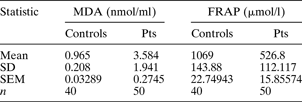
Control subjects had a mean malondialdehyde concentration of 0.965 nmol/ml with a standard deviation (SD) of 0.208 (95 per cent confidence interval (CI) = 0.898 to 1.032), while study patients had a mean malondialdehyde concentration of 3.584 nmol/ml with a SD of 1.941 (95 per cent CI = 3.032 to 4.136); this level was approximately three times greater.
Controls had a mean ferric reducing antioxidant power of 1069 µmol/l with a SD of 143.88 (95 per cent CI = 1022.984 to 1115.015), while study patients had a mean ferric reducing antioxidant power of 526.8 µmol/l with a SD of 112.117 (95 per cent CI = 494.937 to 558.663); this level was approximately halved, that of controls (Table I).
Malondialdehyde and ferric reducing antioxidant power in controls and patients
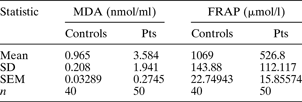
MDA = malondialdehyde; FRAP = ferric reducing antioxidant power; pts = patients; SD = standard deviation; SEM = standard error of the mean
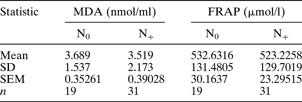
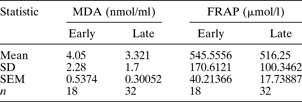
There was no statistically significant difference in the mean malondialdehyde concentration or ferric reducing antioxidant power of patients with versus without nodal metastasis (p > 0.5) (Table II). Likewise, there was no statistically significant difference in either of these two parameters for patients with early stage versus advanced tumours (Table III).
Malondialdehyde and ferric reducing antioxidant power in patients with and without nodal metastases
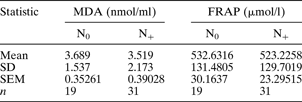
MDA = malondialdehyde; FRAP = ferric reducing antioxidant power; N0 = no nodal metastases; N1 = nodal metastases; SD = standard deviation; SEM = standard error of the mean
Malondialdehyde and ferric reducing antioxidant power in patients with early and late stage tumours
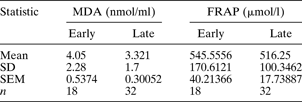
MDA = malondialdehyde; FRAP = ferric reducing antioxidant power; early = tumour (T) stage T1 or T2; late = T3 or T4; SD = standard deviation; SEM = standard error of the mean
Discussion
All mammals produce oxygen radicals as part of the oxidative phosphorylation process within mitochondria. These oxygen radicals, also known as reactive oxygen species, are powerful oxidising agents and induce lipid peroxidation, leading to loss of cell homeostasis through modification of the structure and functions of the cell membrane. Most importantly, lipid peroxidation results in significant damage to DNA.Reference Abidi and Ali10, Reference Van-Ginkel and Sevanian11 This DNA damage can cause mutations that can initiate tumour formation and progression.Reference Wiseman and Halliwell12, Reference Suresh, Silvia and Agarwal13
In order to neutralise the deleterious effects of reactive oxygen species, mammalian cells possess elaborate antioxidant defence mechanisms.Reference Klaunig, Xu, Isenberg, Bachowski, Kolaja and Jiang14, Reference Barber and Harris15 These antioxidant mechanisms are present in the extracellular fluids, and may be from endogenous or exogenous sources; together, they are referred to as the total antioxidant capacity.
Oxidative stress is defined as an imbalance between reactive oxygen species and antioxidant defence mechanisms. There is extensive evidence of an association between oxidative stress and many cancers, such as breast cancer. In order to counteract these reactive oxygen species, individuals should consume at least five portions of fruit or vegetables each day.Reference Brown and Bicknell5
Oxidative stress is assessed in biological samples by monitoring malondialdehyde concentration, a measure of lipid peroxidation.Reference Llesuy, Evelson, Campos and Lissi16, Reference McCall and Frei17 Ferric reducing antioxidant power has been reported as a novel indicator of total antioxidant capacity, and is considered a useful measure of the body's ability to regulate the damage caused by reactive oxygen species.Reference Pstova, Zahalkova, Hrbac, Simanek and Bartek18
In the current study, we found that cancer patients' malondialdehyde concentrations were approximately three times greater, and their ferric reducing antioxidant power was approximately halved, compared with controls. Similar results were obtained by Dwivedi et al. Reference Dwivedi, Raturi, Kandpal, Dwivedi, Singh and Puri2 This indicates that oxidative stress may be involved in the development of these cancers.
• Oxidative stress influences the initiation of laryngeal and hypopharyngeal malignancies in patients with other risk factors such as smoking and alcohol
• This study assessed serum malondialdehyde concentration and ferric reducing antioxidant power to evaluate oxidative stress
• The role of oxidative stress in the initiation and progression of these cancers needs to be evaluated by larger cohort studies and animal models
However, we found no statistically significant difference in malondialdehyde concentration or ferric reducing antioxidant power, comparing patients with and without nodal metastasis. There were also no differences in either of these two parameters, comparing patients with early and late stage tumours (i.e. T1 or T2 versus T3 or T4). This may be because further progression of the cancer was independent of oxidative stress. This may also be due to the smaller sample size in our study.
Conclusion
Oxidative stress influences the initiation of laryngeal and hypopharyngeal malignancies in patients with other, well proven risk factors such as smoking and alcohol. However, the role of oxidative stress in the initiation and progression of these cancers needs to be evaluated using larger cohort studies and animal models. In addition, the role of oxidative stress in later stage tumour progression and tumour metastasis requires further evaluation. Better understanding of these interactions will help us to further establish the importance of dietary antioxidant factors in cancer protection.