Introduction
Mammalian oocytes are surrounded by a transparent envelope called the zona pellucida (ZP), which is involved in several critical aspects of fertilization. Its functions include species-selective recognition of sperm, blocking of polyspermy, and protection of the oocyte and embryo until implantation (Wassarman et al., Reference Wassarman, Jovine and Litscher2001; Hoodbhoy & Dean, Reference Hoodbhoy and Dean2004; Topfer-Petersen et al., Reference Topfer-Petersen, Ekhlasi-Hundrieser and Tsolova2008). The ZP consists of three or four ZP glycoproteins (ZPGs). In the human, rat, monkey, and hamster, there are four ZPGs (ZP1, ZP2, ZP3, and ZP4) (Lefievre et al., Reference Lefievre, Conner, Salpekar, Olufowobi, Ashton, Pavlovic, Lenton, Afnan, Brewis, Monk, Hughes and Barratt2004; Hoodbhoy et al., Reference Hoodbhoy, Joshi, Boja, Williams, Stanley and Dean2005; Ganguly et al., Reference Ganguly, Sharma and Gupta2008; Izquierdo-Rico et al., Reference Izquierdo-Rico, Jimenez-Movilla, Llop, Perez-Oliva, Ballesta, Gutierrez-Gallego, Jimenez-Cervantes and Aviles2009, respectively), whereas the porcine and bovine ZPs are comprised of three ZPGs (ZP2, ZP3, and ZP4, which correspond to ZPA, ZPC, and ZPB, respectively, in other nomenclature) (Harris et al., Reference Harris, Hibler, Fontenot, Hsu, Yurewicz and Sacco1994). The mouse ZP also consists of three ZPGs (ZP1, ZP2, and ZP3) (Bleil & Wassarman, Reference Bleil and Wassarman1980). The porcine, bovine, and mouse ZPs have ZP2 and ZP3 in common, whereas ZP1 and ZP4 are products of distinct genes (Hughes & Barratt, Reference Hughes and Barratt1999). All ZPGs contain the ZP domain, which consists of ~260 amino acids and contains eight conserved Cys residues (Jovine et al., Reference Jovine, Darie, Litscher and Wassarman2005).
Attempts have been made to identify the sperm-binding component of the porcine and bovine ZPs. Estimated protein molar ratio of ZP2/ZP3/ZP4 in the porcine ZP is 1:6:6 (Nakano et al., Reference Nakano, Yonezawa, Hatanaka and Noguchi1996). When porcine ZP2 was separated from a mixture of porcine ZP3/ZP4 by gel filtration column chromatography, the mixture of ZP3/ZP4 retained the sperm-binding activity of the solubilized ZP (Berger et al., Reference Berger, Davis, Wardrip and Hedrick1989; Sacco et al., Reference Sacco, Yurewicz, Subramanian and Matzat1989). When ZP3 and ZP4 were separated by reverse phase-high performance liquid chromatography (RP-HPLC) after digestion of the proteins with endo-β-galactosidase (Yurewicz et al., Reference Yurewicz, Sacco and Subramanian1987; Yonezawa et al., Reference Yonezawa, Hatanaka, Takeyama and Nakano1995a), the purified ZP4 showed sperm-binding activity, whereas the purified ZP3 did not, which suggested that ZP4 alone can bind sperm (Sacco et al. Reference Sacco, Yurewicz, Subramanian and Matzat1989; Yurewicz et al., Reference Yurewicz, Pack, Armant and Sacco1993; Yonezawa et al., Reference Yonezawa, Hatanaka, Takeyama and Nakano1995a, Reference Yonezawa, Aoki, Hatanaka and Nakanob, Reference Yonezawa, Mitsui, Kudo and Nakano1997). However, Yurewicz et al. (Reference Yurewicz, Sacco, Gupta, Xu and Gage1998) reported that ZP4 purified by RP-HPLC contained a small amount of ZP3; moreover, ZP4 without contamination by ZP3 did not bind sperm, although a heterocomplex of ZP3 and ZP4 displayed sperm-binding activity. This report suggested that the sperm-binding activity of ZP4 reported previously might have been due to contamination with ZP3. This suggestion is further supported by our recent report that neither porcine recombinant ZP3 (rZP3) nor rZP4 expressed alone in Sf9 cells exhibited sperm-binding activity, whereas the mixture of rZP3 and rZP4 co-expressed in Sf9 cells bound sperm (Yonezawa et al., Reference Yonezawa, Kudo, Terauchi, Kanai, Yoda, Tanokura, Ito, Miura, Katsumata and Nakano2005a). The rZPGs bound bovine sperm specifically and did not bind porcine sperm, because the rZPGs expressed in Sf9 cells have pauci- and high-mannose-type chains as their major N-linked chains (Yonezawa et al., Reference Yonezawa, Kudo, Terauchi, Kanai, Yoda, Tanokura, Ito, Miura, Katsumata and Nakano2005a; and see below).
Previously, we had separated partially an endo-β-galactosidase-digested bovine ZPG mixture into ZP2, ZP3, and ZP4 fractions by RP-HPLC (Yonezawa et al., Reference Yonezawa, Fukui, Kuno, Shinoda, Goko, Mitsui and Nakano2001). Of the three components, ZP4 exhibited the strongest sperm-binding activity, and ZP2 and ZP3 exhibited much weaker binding activities. However, the components were not resolved completely by HPLC and might have been cross-contaminated. The individual bovine rZPGs expressed in Sf9 cells did not have sperm-binding activity, but the bovine rZP3/rZP4 mixture co-expressed in Sf9 cells were found to bind sperm (Kanai et al., Reference Kanai, Yonezawa, Ishii, Tanokura and Nakano2007). The co-expressed mixture formed a heterocomplex, as revealed by co-precipitation when using an N-terminal FLAG tag. A previous report that bovine sperm–egg binding is inhibited by the presence of anti-porcine ZP3 or ZP4 antibodies supported the involvement of the ZP3/ZP4 complex in sperm–ZP binding (Topper et al., Reference Topper, Kruijt, Calvete, Mann, Topfer-Petersen and Woelders1997). The mechanism of sperm binding to ZPGs appears to be similar between pigs and cows, as ZP3/ZP4 complexes both in pigs and cows show sperm-binding activity. Therefore, the question remains as to whether ZP3 or ZP4 is responsible for the sperm-binding activity of the ZP3/ZP4 complex.
Neutral N-linked carbohydrate chains that are released by hydrazinolysis of a porcine ZP3/ZP4 mixture retain their sperm-binding activities (Noguchi et al., Reference Noguchi, Hatanaka, Tobita and Nakano1992); the triantennary and tetra-antennary complex-type chains binding more strongly than the biantennary complex-type chains (Kudo et al., Reference Kudo, Yonezawa, Katsumata, Aoki and Nakano1998). In one study, the non-reducing terminal β-galactosyl (Gal) residues of the complex-type N-linked chains were shown to be involved in sperm binding (Yonezawa et al., Reference Yonezawa, Amari, Takahashi, Ikeda, Imai, Kanai, Kikuchi and Nakano2005b). Conversely, another study reported that the O-linked carbohydrate chains, and not the N-linked chains, that are released specifically from the ZP3/ZP4 mixture inhibit sperm–egg binding (Yurewicz et al., Reference Yurewicz, Pack and Sacco1991). Therefore, both the N- and O-linked carbohydrate chains are thought to act as ligands for sperm binding; the sperm-binding activities of carbohydrate chains released from polypeptides are much weaker than the activity of the ZP3/ZP4 mixture.
In cows, the major neutral N-linked chain consists of only one structure, a high-mannose (Man)-type chain that contains five Man residues (Katsumata et al., Reference Katsumata, Noguchi, Yonezawa, Tanokura and Nakano1996). The α-Man residues at the non-reducing termini are essential for the sperm-binding activity of the bovine ZP (Amari et al., Reference Amari, Yonezawa, Mitsui, Katsumata, Hamano, Kuwayama, Hashimoto, Suzuki, Takeda and Nakano2001). As mentioned above, the porcine rZP3/rZP4 mixture binds bovine sperm specifically, but not porcine sperm (Yonezawa et al., Reference Yonezawa, Kudo, Terauchi, Kanai, Yoda, Tanokura, Ito, Miura, Katsumata and Nakano2005a). This situation is because the porcine rZPGs expressed in Sf9 cells do not have β-Gal residues but have α-Man residues at the non-reducing termini of N-linked chains of the proteins (Yonezawa et al., Reference Yonezawa, Kudo, Terauchi, Kanai, Yoda, Tanokura, Ito, Miura, Katsumata and Nakano2005a). Sialic acids at the non-reducing ends of acidic N-linked and/or O-linked chains of the bovine ZP are also involved in sperm binding (Velasquez et al., Reference Velasquez, Canovas, Barajas, Marcos, Jimenez-Movilla, Gallego, Ballesta, Aviles and Coy2007).
Studies on murine sperm–ZP binding are the most advanced among mammal studies. In mice, ZP3 alone binds sperm and induces an acrosome reaction, while, in pigs and cows, ZP3 alone does not bind sperm. An essential role of the carbohydrate moiety of mouse ZP3 in sperm recognition has been proposed by several studies, as it has been reported that O-linked chains of ZP3 are essential for sperm binding of ZP3 (Florman & Wassarman, Reference Florman and Wassarman1985; reviewed in Wassarman et al., Reference Wassarman, Jovine and Litscher2001; Hoodbhoy & Dean, Reference Hoodbhoy and Dean2004). The proposed role of carbohydrate chains in sperm recognition has been supported rarely, by a series of studies using transgenic mice. Alternatively, it has been proposed that sperm recognize the supramolecular structure of ZP (Rankin et al., Reference Rankin, Coleman, Epifano, Hoodbhoy, Turner, Castle, Lee, Gore-Langton and Dean2003). As pointed out by a recent review (Clark, Reference Clark2011), however, conditional knockout of the N-acetylglucosaminyltransferase I gene in mouse oocytes reduced sperm-binding ability compared with the ability of wild-type oocytes and also reduced fertility, which suggested the involvement of complex and/or hybrid type N-glycans in sperm recognition. The current combined model for sperm recognition by ZP describes that both protein and carbohydrate moieties in domain(s) of ZPGs are involved in sperm recognition (Clark, Reference Clark2011). Therefore it is necessary that the sperm recognition sites on ZP are examined from aspects of both protein and carbohydrate moieties.
The porcine native ZP3/ZP4 (nZP3/nZP4) mixture prepared from porcine ovaries has been shown to have binding activity towards porcine sperm, and the porcine rZP3/rZP4 mixture co-expressed in Sf9 insect cells has binding activity towards bovine, but not porcine, sperm. Therefore in this study, we prepared mixtures of native and recombinant porcine proteins in order to examine whether ZP3 or ZP4 is the more responsible for the porcine sperm-binding activity of the ZP3/ZP4 complex.
Materials and methods
Porcine rZP3 and rZP4 expression
Porcine rZP3 and rZP4 with N-terminal His- and S-tags were expressed as secretory proteins in Sf9 insect cells as described previously (Yonezawa et al., Reference Yonezawa, Kudo, Terauchi, Kanai, Yoda, Tanokura, Ito, Miura, Katsumata and Nakano2005a). They were purified from culture medium using the N-terminal His-tag of the rZPGs as described previously (Yonezawa et al., Reference Yonezawa, Kudo, Terauchi, Kanai, Yoda, Tanokura, Ito, Miura, Katsumata and Nakano2005a).
Porcine nZP3 and nZP4
Porcine ZPs were isolated from ovaries and solubilized in H2O at 70 °C for 20 min as described previously (Yonezawa et al., Reference Yonezawa, Hatanaka, Takeyama and Nakano1995a). The solubilized ZPs were digested with Escherichia freundii endo-β-galactosidase (Seikagaku Kogyo) and fractionated into three components by RP-HPLC (Yonezawa et al., Reference Yonezawa, Hatanaka, Takeyama and Nakano1995a).
Competitive inhibition assay: Method 1
A competitive inhibition assay was performed as described previously (Yonezawa et al., Reference Yonezawa, Kudo, Terauchi, Kanai, Yoda, Tanokura, Ito, Miura, Katsumata and Nakano2005a). Briefly, solubilized porcine ZP [0.2 μg in 50 μl of phosphate-buffered saline (PBS)] was added to each well of a 96-well plate (Maxisorb, Nalge Nunc) and incubated overnight at 4 °C. The wells were washed with PBS and blocked with Tris-buffered saline (TBS) containing 3% bovine serum albumin (BSA), at 37 °C for 2 h. Frozen porcine sperm were thawed, washed twice in pre-warmed (37 °C) modified Krebs-Ringer bicarbonate (mKRB) solution (Toyoda & Chang, Reference Toyoda and Chang1974; Noguchi et al., Reference Noguchi, Hatanaka, Tobita and Nakano1992), and capacitated by incubation in mKRB solution for 30 min. Capacitation and all subsequent incubations were performed at 37°C under 5% CO2. A 50-μl aliquot containing 4 × 10⁵ capacitated sperm was mixed with 50 μl of mKRB solution without BSA but with inhibitors and incubated for 30 min. The amounts of inhibitors used are indicated in Figs. 2 and 3. Then the wells were washed three times with PBS and once with mKRB solution. The pre-incubated sperm solution was added to the wells, and the plates were incubated for 3 h. The wells were washed three times with mKRB solution, 50 μl of 70% glycerol in PBS was added to each well, and the bound sperm were recovered by 20 strokes of vigorous pipetting. The number of sperm in 0.1 μl of suspension was determined using a haemocytometer. The number of sperm bound non-specifically to the wells not coated with solubilized ZP, which was 0–5, was subtracted from the number of sperm bound to the coated wells. The number of bound porcine sperm in the control experiments without inhibitors varied from 40 to 110, with an average of 60. For the assays of frozen bovine sperm, solubilized bovine ZP was used instead of solubilized porcine ZP, Brackett and Oliphant (BO) solution (Brackett & Oliphant, Reference Brackett and Oliphant1975) was used instead of mKRB solution, and the incubations were performed at 38.5 °C in 2% CO2 (Yonezawa et al., Reference Yonezawa, Fukui, Kuno, Shinoda, Goko, Mitsui and Nakano2001; Kanai et al., Reference Kanai, Yonezawa, Ishii, Tanokura and Nakano2007). The average number of bovine sperm in the control experiments without inhibitors was 70.
Competitive inhibition assay: Method 2
Method 2 was performed according to our previous report (Noguchi et al., Reference Noguchi, Hatanaka, Tobita and Nakano1992; Yonezawa et al., Reference Yonezawa, Aoki, Hatanaka and Nakano1995b). Frozen porcine sperm were thawed and capacitated as described in Method 1. Several drops (50 μl each) of mKRB solution that contained the inhibitors to be examined were prepared under paraffin oil. The amounts of the inhibitors used are indicated in Fig. 5. A 10-μl aliquot of the capacitated sperm was added to the drop to give a sperm concentration of 1.0 × 10⁶ cells/ml. The suspension was incubated at 37 °C for 30 min in 5% CO2 in air. Then, 10–13 porcine eggs, prepared from ovaries, were added to each drop, and the mixture was incubated at 37 °C for 3 h. Next, to remove loosely attached sperm, the eggs were washed 10 times by transfer to fresh mKRB solution using a pipette with a bore size of around 200 μm. The washed eggs were fixed in 3% glutaraldehyde in PBS. The number of sperm heads bound to the ZP was counted after staining with 4′6-diamidino-2-phenylindole. The average number of porcine sperm bound to one egg in the control experiments without inhibitors was 70. For the assay of frozen bovine sperm, BO solution was used instead of mKRB solution, bovine eggs were used instead of porcine eggs, and sperm incubation was performed at 38.5 °C under 2% CO2 in air (Yonezawa et al., Reference Yonezawa, Fukui, Kuno, Shinoda, Goko, Mitsui and Nakano2001; Kanai et al., Reference Kanai, Yonezawa, Ishii, Tanokura and Nakano2007). The average number of bovine sperm bound to one egg in the control experiments without inhibitors was 100.
Indirect immunofluorescence staining of rZPGs bound to sperm
Frozen porcine sperm were washed and capacitated as described above. Aliquots of 50 μl (2 × 10⁶ sperm/ml) were incubated with 0.2 μg of solubilized porcine ZP or ZPGs in mKRB solution at 37 °C for 30 min in 5% CO2 in air. The sperm were washed three times by centrifugation at 2000 g for 1 min, suspended in PBS, transferred onto cover glasses, and fixed with 3.7% formaldehyde in PBS at 37 °C for 30 min. The cover glasses were rinsed with PBS and blocked with 3% BSA in TBS at 37 °C for 1 h. The proteins that were bound to the sperm were detected using a mixture of anti-porcine ZP3 and ZP4 antibodies (both diluted 1:1000 with 1% BSA in TBS) as primary antibodies and fluorescein-conjugated goat anti-rabbit IgG antibody (diluted to 1 μg/ml with 1% BSA in TBS; Wako Chemicals) as the secondary antibody. The sperm were observed under a fluorescence microscope.
Coprecipitation of porcine ZP3 and ZP4
A mixture of nZP3 (2 μg) and rZP4 (1 μg); nZP3 (2 μg) alone; rZP4 (1 μg) alone; a mixture of rZP3 (1 μg) and nZP4 (2 μg); rZP3 (1 μg) alone; or nZP4 (2 μg) alone was incubated overnight at 4 °C in 40 μl of mKRB solution without BSA. S-protein agarose beads (5 μl, Novagen) were added to each, and the mixture was incubated for 1 h at room temperature, followed by centrifugation at 2000 g for 1 min. The supernatant was recovered, and the pellet was washed three times with PBS containing 1% Nonidet P-40, 0.5% sodium deoxycholate, and 0.1% sodium dodecyl sulphate (SDS), followed each time by centrifugation at 2000 g for 1 min. Samples of both the supernatant and the pellet that contained the S-protein agarose beads were prepared for SDS-PAGE in 12.5% separating gels under reducing conditions, according to the Laemmli protocol (Laemmli, Reference Laemmli1970). The separated proteins were transferred to Immobilon-P membranes (Millipore) in accordance with the method of Towbin et al. (Reference Towbin, Staehelin and Gordon1979). The membranes were blocked with 3% BSA in TBS for 1 h and then incubated for 2 h with a mixture of anti-porcine ZP3 and ZP4 antibodies (each diluted 1:1000 with 1% BSA in TBS) as primary antibodies, to detect ZP3 and ZP4 in the pellet and supernatant. The membranes were washed three times for 15 min each with TBS that contained 0.05% Tween 20 (T-TBS), incubated for 1.5 h with horseradish peroxidase-conjugated goat anti-rabbit IgG antibody (diluted to 1 μg/ml with 1% BSA in TBS; Wako Chemicals), washed again three times with T-TBS, and finally developed using tetramethyl benzidine (TMB) solution (KPL).
Statistical analysis
Student's t-test or Welch's t-test was used to determine the significance of differences between two groups. p-values <0.05 were considered to be statistically significant.
Results
Inhibitory activity of porcine nZP3/nZP4 and rZP3/rZP4 mixtures for the binding of sperm to solubilized ZP
We examined the inhibitory activity of porcine nZPGs and rZPGs for the binding of sperm to solubilized ZP in 96-well plastic plates (Method 1). We also examined the inhibitory activity of the ZPGs for the binding of sperm to ZP-encased eggs, using a different in vitro competition assay (Method 2).
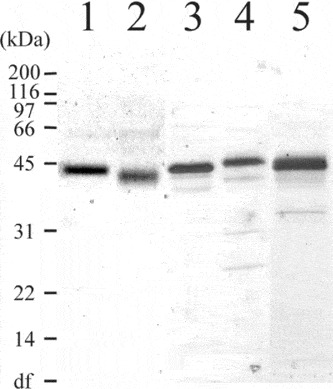
Porcine nZP3 and nZP4 can be separated only after digestion of the proteins with endo-β-galactosidase (Yurewicz et al., Reference Yurewicz, Sacco and Subramanian1987). Therefore, carbohydrate structures of the separated proteins are not intact, but nZP4 retains inhibitory activity for sperm–egg binding (Sacco et al., Reference Sacco, Yurewicz, Subramanian and Matzat1989; Yurewicz et al., Reference Yurewicz, Pack, Armant and Sacco1993; Yonezawa et al., Reference Yonezawa, Hatanaka, Takeyama and Nakano1995a, Reference Yonezawa, Aoki, Hatanaka and Nakanob, Reference Yonezawa, Mitsui, Kudo and Nakano1997). The inhibitory activity of porcine nZP4 purified by RP-HPLC for sperm–egg binding has been attributed to contamination with ZP3 (Yurewicz et al., Reference Yurewicz, Sacco, Gupta, Xu and Gage1998). Therefore, we purified the ZP3 and ZP4 fractions further by rechromatography of each fraction via RP-HPLC. The rechromatographed ZP3 was collected as one fraction and did not exhibit significant inhibitory activity for sperm binding to solubilized ZP (Method 1, nZP3 in Fig. 2A). This rechromatographed ZP3 showed single band on SDS-PAGE (Fig. 1, lane 2) and was used as nZP3 in this study. On the rechromatography of the ZP4 fraction by RP-HPLC, the ZP4 peak was separated into five fractions, and we used Method 1 to examine the inhibitory activity of each of the five ZP4 fractions. Two of the fractions did not exhibit significant inhibitory activity, even when tested with 1.5 μg (data not shown), which suggested that there was negligible ZP3 contamination in the two fractions of ZP4. We combined these two ZP4 fractions and used the combined fraction as nZP4 in this study (Fig. 1, lane 1). Both rZP3 and rZP4 were expressed separately in Sf9 cells and purified partially from the culture medium by nickel-chelating column chromatography (Fig. 1, lanes 4 and 3, respectively). A mixture of rZP3 and rZP4 was obtained by co-infection of Sf9 cells with rZP3 baculovirus and rZP4 baculovirus (Fig. 1, lane 5). Similar expression of both proteins was confirmed by western blotting using antibodies specific to each protein (data not shown). Although contaminated with proteins of higher mobility, the rZPGs were not purified further because of their low yields.
SDS-PAGE of porcine ZP3 and ZP4. Porcine nZP4 (lane 1), and nZP3 (lane 2), were purified from endo-β-galactosidase digests of porcine ZP by RP-HPLC. Porcine rZP4 (lane 3), rZP3 (lane 4), and rZP3/rZP4 mixture (lane 5), were purified partially with an N-terminal His-tag by nickel-chelating column chromatography from culture medium of Sf9 cells infected with respective recombinant baculovirus(es). The ZPGs (lanes 1–4, 1 μg; lane 5, 2 μg) were subjected to SDS-PAGE in 12.5% separating gels. Proteins were stained with Coomassie brilliant blue. Molecular mass standards are shown on the left. df, dye front.

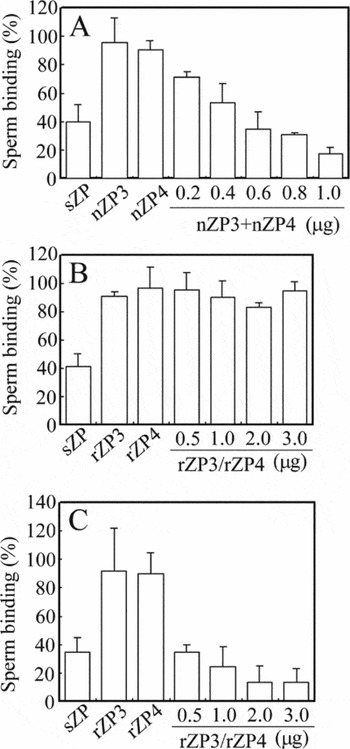
The number of porcine sperm binding to the solubilized porcine ZP-coated plastic wells was reduced to about 40% in the presence of solubilized porcine ZP (Method 1, sZP in Fig. 2A). Neither nZP3 nor nZP4 alone inhibited porcine sperm–ZP binding significantly, whereas the nZP3/nZP4 mixture, after overnight incubation at 4 °C, as described in a previous report (Yurewicz et al., Reference Yurewicz, Sacco, Gupta, Xu and Gage1998), inhibited the binding in a dose-dependent manner (Fig. 2A). These results are consistent with a previous report that stated that the heterocomplex of ZP3 and ZP4 had sperm-binding activity, although each protein alone did not (Yurewicz et al., Reference Yurewicz, Sacco, Gupta, Xu and Gage1998). We have reported previously that rZP3/rZP4 (0.2 μg) inhibited bovine sperm–ZP binding, but not porcine sperm–ZP binding (Yonezawa et al., Reference Yonezawa, Kudo, Terauchi, Kanai, Yoda, Tanokura, Ito, Miura, Katsumata and Nakano2005a). In this study, we examined whether higher amounts of rZP3/rZP4 inhibit porcine sperm–ZP binding. Amounts up to 3.0 μg of the porcine rZP3/rZP4 mixture expressed by cotransfection of Sf9 cells did not inhibit porcine sperm–ZP binding significantly (Fig. 2B), but porcine rZP3/rZP4 inhibited bovine sperm–ZP binding in a dose-dependent manner (Fig. 2C).
Inhibitory effects of porcine nZP3/nZP4 and rZP3/rZP4 mixtures on the binding of sperm to solubilized ZP. Inhibitory effects of ZPGs on the binding of porcine sperm to solubilized porcine ZP-coated plastic wells (A, B) and on the binding of bovine sperm to solubilized bovine ZP-coated plastic wells (C) were examined using Method 1 as described in Materials and methods. The number of sperm bound to ZP in the absence of inhibitors is considered as 100% at each assay and the means of percentages in the presence of inhibitors from three experiments are shown with standard deviations. (A) The amounts of inhibitors were 0.3 μg for solubilized porcine ZP (sZP), 1 μg for porcine nZP3 alone (nZP3) and porcine nZP4 alone (nZP4). Equal amounts of nZP3 and nZP4 were mixed and incubated overnight at 4°C and then subjected to the assay (nZP3 + nZP4). Total amounts of nZP3 and nZP4 are shown. (B) The amounts of inhibitors were 0.3 μg for solubilized porcine ZP (sZP), 1.5 μg for porcine rZP3 alone (rZP3) and porcine rZP4 alone (rZP4). rZP3 and rZP4 were co-expressed in Sf9 cells by infecting the cells with rZP3 virus and rZP4 virus (rZP3/rZP4). Total amount of rZP3/rZP4 is shown. (C) The amounts of inhibitors were the same as those shown in (B), except that sZP in (C) indicates solubilized bovine ZP.

In the experimental conditions of Methods 1 and 2, the acrosomal regions of 84% of porcine sperm and of 90% of bovine sperm were stained by fluorescent peanut agglutinin (Yonezawa et al., Reference Yonezawa, Hatanaka, Takeyama and Nakano1995a) and by Pisum sativum agglutinin (Cross & Watson, Reference Cross and Watson1994), respectively, which indicates that the acrosome was intact after 3 h of incubation in the absence of ZPGs. These percentages did not change significantly after 3 h incubation of the sperm in the presence of solubilized ZP (3 μg/ml) or ZPG mixtures (20 μg/ml, data not shown). Neither solubilized ZP nor ZPG mixtures affected the motility of porcine sperm or bovine sperm, compared with that of sperm incubated without these proteins (data not shown).
Inhibitory activity of porcine rZP3/nZP4 and nZP3/rZP4 mixtures for the binding of sperm to solubilized ZP
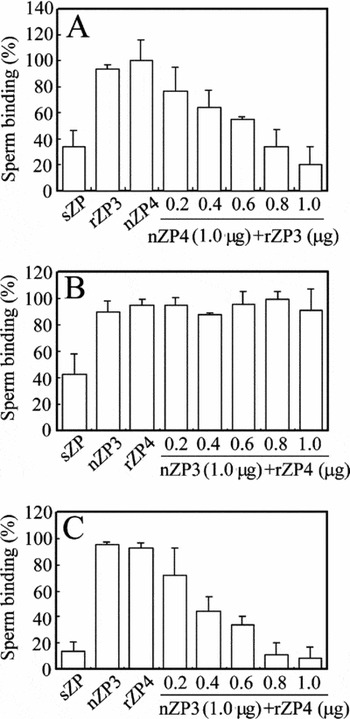
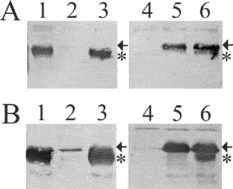
A mixture of rZP3 and nZP4 was incubated overnight at 4 °C and tested for binding activity by Method 1. The rZP3/nZP4 mixture inhibited porcine sperm–ZP binding significantly, and the inhibitory activity increased with increasing amounts of rZP3 (Fig. 3A). As only the ZP3/ZP4 complex has inhibitory activity, this result suggested that the amount of rZP3/nZP4 complex increased with increasing amounts of rZP3. The interaction between rZP3 and nZP4 was examined by using the N-terminal S-tag of rZP3 to co-precipitate the proteins. nZP4 was not precipitated by S-protein agarose beads (Fig. 4A, lane 4), but rZP3 was precipitated by the beads (Fig. 4A, lane 5), which demonstrated that the S-tag of rZP3 was recognized specifically by the S-protein beads, with no non-specific binding of nZP4. A mixture of rZP3 and nZP4 was incubated overnight and subjected to precipitation by S-protein agarose beads. A portion of the nZP4 co-precipitated with rZP3 (Fig. 4A, lane 6), which indicated that some of the nZP4 had formed a complex with rZP3. Thus, the porcine rZP3/nZP4 mixture contained rZP3/nZP4 complexes and inhibited porcine sperm–ZP binding.
Inhibitory effects of the mixture of nZPGs and rZPGs on the binding of sperm to solubilized ZP. Inhibitory effects of ZPGs on the binding of porcine sperm to solubilized porcine ZP-coated plastic wells (A, B) and on the binding of bovine sperm to solubilized bovine ZP-coated plastic wells (C) were examined using Method 1 as described in the Materials and methods. The number of sperm bound to ZP in the absence of inhibitors is considered as 100% at each assay and the means of percentages in the presence of inhibitors from three experiments are shown with standard deviations. (A) The amounts of inhibitors were 0.3 μg for solubilized porcine ZP (sZP), 1 μg for porcine rZP3 alone (rZP3) and porcine nZP4 alone (nZP4). nZP4 (1 μg) was mixed with rZP3 of the amount shown and incubated overnight at 4°C and then subjected to the assay (nZP4 + rZP3). (B) The amounts of inhibitors were 0.3 μg for solubilized porcine ZP (sZP), 1 μg for porcine nZP3 alone (nZP3) and porcine rZP4 alone (rZP4). nZP3 (1 μg) was mixed with rZP4 of the amount shown and incubated overnight at 4°C and then subjected to the assay (nZP3 + rZP4). (C) The amounts of inhibitors were the same as those shown in (B), except that sZP in (C) indicates solubilized bovine ZP.

Interactions between nZP4 and rZP3 and between rZP4 and nZP3. (A) nZP4 alone (2 μg, lanes 1 and 4), rZP3 alone (1 μg, lanes 2 and 5), or a mixture of nZP4 (2 μg) and rZP3 (1 μg) (lanes 3 and 6) was incubated at 4°C overnight and then subjected to pull down with S-protein agarose which specifically binds to S-tag of rZP3. The proteins in the supernatants (lanes 1–3) and in the pellets (lanes 4–6) were detected with a mixture of anti-porcine ZP3 and ZP4 antibodies. Arrows and asterisks indicate rZP3 and nZP4, respectively. (B) nZP3 alone (2 μg, lanes 1 and 4), rZP4 alone (1 μg, lanes 2 and 5) or a mixture of nZP3 (2 μg) and rZP4 (1 μg) (lanes 3 and 6) was incubated at 4°C overnight and then subjected to pull down with S-protein agarose which specifically binds to S-tag of rZP4. The proteins in the supernatants (lanes 1–3) and in the pellets (lanes 4–6) were detected with a mixture of anti-porcine ZP3 and ZP4 antibodies. Arrows and asterisks indicate rZP4 and nZP3, respectively.

Similarly, a mixture of nZP3 and rZP4 was incubated overnight at 4 °C and tested for inhibitory activity using Method 1. The nZP3/rZP4 mixture did not inhibit porcine sperm–ZP binding significantly (Fig. 3B). However, the nZP3/rZP4 mixture inhibited the binding of bovine sperm to bovine ZP significantly (Fig. 3C), and the inhibitory activity increased with increasing amounts of rZP4, which suggested that the amount of nZP3/rZP4 complex increased with increasing rZP4. The interaction between nZP3 and rZP4 was examined by using the N-terminal S-tag of rZP4 to co-precipitate the proteins. The control experiments confirmed that rZP4 was precipitated by S-protein agarose beads (Fig. 4B, lane 5), with no non-specific binding of nZP3 to the beads (Fig. 4B, lane 4). A mixture of nZP3 and rZP4 was incubated overnight at 4 °C and subjected to precipitation by S-protein agarose beads. A portion of the nZP3 co-precipitated with rZP4 (Fig. 4B, lane 6), which indicated that some of the nZP3 formed a complex with rZP4. Thus, the porcine nZP3/rZP4 mixture contained nZP3/rZP4 complexes and inhibited the binding of bovine sperm, but not porcine sperm, to the ZP.
Inhibitory activity of the ZP3/ZP4 mixture for the binding of porcine sperm to ZP-encased porcine eggs
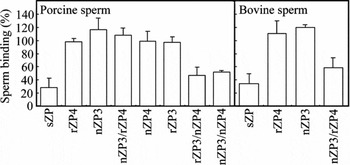
We examined the inhibitory activity of ZPGs for the binding of porcine sperm to the intact ZP using Method 2, which gave results parallel to those of Method 1. Solubilized porcine ZP (1 μg) inhibited the porcine sperm–egg binding significantly (Fig. 5, sZP in porcine sperm panel). The binding of porcine sperm to eggs was not inhibited significantly by nZP3, nZP4, rZP3, or rZP4 alone (Fig. 5, porcine sperm). The ZP3/ZP4 mixtures that contained nZP4 inhibited porcine sperm–egg binding significantly (Fig. 5, porcine sperm). In contrast, the nZP3/rZP4 mixture did not inhibit porcine sperm–egg binding significantly (Fig. 5, porcine sperm), although the nZP3/rZP4 mixture inhibited bovine sperm–egg binding significantly (Fig. 5, bovine sperm).
Inhibitory effects of ZPGs on the binding of porcine sperm to porcine eggs (porcine sperm) and on the binding of bovine sperm to bovine eggs (bovine sperm). Inhibitory effects were examined by Method 2 as described in the Materials and methods. The average number of sperm binding to one egg in the absence of inhibitors is designated 100%. Assay was performed six times and the data shown represent the means with standard deviations. The amounts of inhibitors were 1 μg for solubilized porcine (sZP in the porcine sperm panel) or bovine ZP (sZP in the bovine sperm panel), 1 μg for porcine rZP4 alone (rZP4) and porcine nZP3 alone (nZP3), 2 μg for a mixture of porcine rZP4 (1 μg) and porcine nZP3 (1 μg) (nZP3/rZP4), 1 μg for porcine nZP4 alone (nZP4) and porcine rZP3 alone (rZP3), 2 μg for a mixture of porcine nZP4 (1 μg) and porcine rZP3 (1 μg) (rZP3/nZP4) and 2 μg for a mixture of porcine nZP3 (1 μg) and porcine nZP4 (1 μg) (nZP3/nZP4).

Indirect immunofluorescent staining of ZPGs bound to porcine sperm
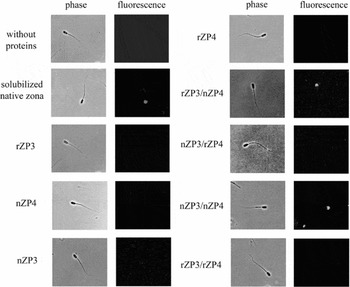
A mixture of anti-ZP3 and anti-ZP4 antibodies revealed the binding of solubilized porcine ZP at the acrosomal region of porcine sperm (Fig. 6, solubilized native zona). Positive staining in the acrosomal region was also observed when porcine sperm were incubated with the mixture of rZP3/nZP4 or nZP3/nZP4 (Fig. 6). The binding pattern for the rZP3/nZP4 mixture on porcine sperm was indistinguishable from that of solubilized native zona or the nZP3/nZP4 mixture. Staining of sperm was not observed when porcine sperm were incubated with nZP3, nZP4, rZP3, or rZP4 alone, or the mixture of nZP3/rZP4 or rZP3/rZP4 (Fig. 6). These results indicated that the inhibition of porcine sperm–ZP binding by the rZP3/nZP4 mixture resulted from specific binding at the acrosomal region of porcine sperm and that the nZP3/rZP4 mixture did not inhibit the porcine sperm–ZP binding because it did not bind to porcine sperm.
Indirect immunofluorescence staining of ZPGs bound to porcine sperm. Cryopreserved epididymal porcine sperm were thawed, capacitated and incubated with the proteins indicated on the left of each panel in mKRB medium. After washings, the sperm were fixed on cover glasses. The ZPGs remained on the sperm were detected by a mixture of anti-ZP3 and anti-ZP4 antibodies as primary antibodies and fluorescein-conjugated anti-rabbit IgG as secondary antibody.

Discussion
In pigs and cows, ZP3/ZP4 heterocomplex has sperm-binding activity, but neither ZP3 nor ZP4 alone possesses the activity (Yurewicz et al., Reference Yurewicz, Sacco, Gupta, Xu and Gage1998; Yonezawa et al., Reference Yonezawa, Kudo, Terauchi, Kanai, Yoda, Tanokura, Ito, Miura, Katsumata and Nakano2005a; Kanai et al., Reference Kanai, Yonezawa, Ishii, Tanokura and Nakano2007). In contrast, mouse ZP3 alone shows sperm-binding activity (Florman & Wassarman, Reference Florman and Wassarman1985). Thus, the sperm-binding mechanism may be similar between pigs and cows but different for mice.
The neutral N-linked chains of porcine nZPGs are complex-type chains, with β-Gal and β-N-acetylglucosamine residues at the non-reducing ends (Nakano et al., Reference Nakano, Yonezawa, Hatanaka and Noguchi1996), and the β-Gal residues are involved in sperm binding (Yonezawa et al., Reference Yonezawa, Amari, Takahashi, Ikeda, Imai, Kanai, Kikuchi and Nakano2005b). In a previous study, we were not able to detect complex-type chains on porcine rZPGs; instead, pauci- and high-mannose-type chains were the major N-linked chains of the recombinant proteins (Yonezawa et al., Reference Yonezawa, Kudo, Terauchi, Kanai, Yoda, Tanokura, Ito, Miura, Katsumata and Nakano2005a). The non-reducing terminal α-Man residues of high-mannose-type chains of bovine nZPGs are involved in bovine sperm binding (Amari et al., Reference Amari, Yonezawa, Mitsui, Katsumata, Hamano, Kuwayama, Hashimoto, Suzuki, Takeda and Nakano2001). Thus, the change in specificity of sperm recognition from porcine to bovine may be primarily attributable to the change in the N-glycan structures. In the present study, we showed that a portion of the rZP3/nZP4 mixture formed heterocomplexes, as did a portion of the nZP3/rZP4 mixture. The ZP3/ZP4 mixtures that contained nZP4 had porcine sperm-binding activity, whereas the mixtures that contained rZP4 did not, as shown consistently by the results of our competitive binding assays and immunostaining. As the porcine sperm-binding activity was dependent on ZP4, but not on ZP3, as shown in the present study, it is suggested that ZP4 is responsible for the sperm-binding activity of the ZP3/ZP4 complex in pigs. Furthermore, the present study suggested that the structures of the N-glycans linked in the sperm-binding sites on ZP4 are responsible for porcine sperm recognition.
The question of why ZP4 represents the sperm-binding activity only in a complex with ZP3 needs to be clarified in the future. One review (Topfer-Petersen et al., Reference Topfer-Petersen, Ekhlasi-Hundrieser and Tsolova2008) has suggested that conformational changes of ZP4 are induced by the interaction with ZP3. These changes could induce the exposure and/or clustering of sperm-binding active glycans in the supramolecular structure of ZP4 in order to produce high-avidity binding between ZP4 and sperm.
Acknowledgements
This work was supported in part by a Grant-in-Aid from the Ministry of Education, Science, Sports, and Culture of Japan. We thank Ms Ai Mariko for technical assistance.