Introduction
Disaster has been defined as a situation or event that “overwhelms local capacity, necessitating a request to a national or international level for external assistance.”Reference Shapira and Shemer 1 Events that can lead to disasters are classified as natural events (e.g., earthquakes, floods, tornadoes) and manmade events (e.g., military emergencies and terrorist attacks using chemical, biological, radiological, nuclear or explosive devices (CBRNE)).Reference More, Phelan and Boylan 2 - Reference Glotzer, Rinchiuso and Rekow 4 There has been an increase in the frequency of both natural and manmade disasters recently.
The impact that any of these disasters can have on the society is manifold. O'Neill has pointed out that disasters can have an adverse impact on the development of the entire nation.Reference O'Neill 5 Disasters not only affect developmental activities, they also can push the progress of nations backwards by several decades. A disaster will initially lead to casualties, and an increase in the number of people who need immediate attention by health care professionals. This will eventually lead to a shortage in the number of health professionals who are trained in disaster management.Reference Psoter, Herman and More 3 , Reference Colvard, Lampiris and Cordell 6 The resulting environment is called the “surge environment,” and can be a serious impediment to optimal disaster management.
One of the approaches to overcoming this manpower shortage is to include health professionals other than conventional medical personnel.Reference More, Phelan and Boylan 2 , Reference Psoter, Herman and More 3 Hence, various health care professionals such as dentists and related personnel, nursing professionals, and pharmacists need to be considered for optimal disaster management.
Dentists have previously contributed to disaster management as forensic odontologists in victim identification,Reference Vale and Noguchi 7 - Reference Galligan 9 members in Disaster Mortuary Operational Response TeamsReference Galligan 9 and in armed forces.Reference Flores, Mills and Shackelford 10 Dental professionals possess various skills that can contribute to efficient disaster management.Reference More, Phelan and Boylan 2 They are trained in obtaining detailed history, making and interpreting radiographs, managing valuable data and maintaining patient records. They can be employed in prescription of medications, immunization, and distribution of medical supplies to victims. They can place sutures, aid in management of wounds and infections, and contribute towards overall infection control procedures. They can also provide information to patients and the public, manage victim triage, and manage patients.Reference More, Phelan and Boylan 2 , Reference Psoter, Park and Boylan 11 - Reference Guay 16 Rekow has observed that dentists have the ability to manage patients who are concerned and upset.Reference Rekow 13 Dental professionals might represent an often overlooked resource during times of disasters. Dentists are looked upon as respected members of the community and thus have a responsibility to protect the public.Reference Rekow 13 , Reference Glick 17 Moreover, they have an ethical duty to contribute to the overall welfare of the community, state and nation.
India has been the focal point for various manmade and natural disasters, especially recently. A total of 80% of the area of India is prone to natural disasters. 18 Twelve percent of the country's landmass is prone to floods and river erosion, and 58.6% is prone to earthquakes. Hilly areas can witness landslides and avalanches, and 68% of cultivable area is drought-prone. A total of 5,700 km out of the 7,516 km-long coastline in India is prone to cyclones and tsunamis. Moreover, the threat of disasters and emergencies of chemical, biological, radiological, nuclear and explosives (CBRNE) origin is constantly present in India. 18
The number of dental institutions in India has increased recently. A total of 294 institutions are currently providing dental training in India, with more than half of these institutions (169) providing postgraduate (PG) dental education. Each year in India, a total of 23,430 students enroll in the Bachelor of Dental Surgery (BDS) degree program, while 3,381 students enroll in the Master of Dental Surgery (MDS) degree program. 19 This represents a large reserve of valuable workers. When one considers the increasing frequency of disasters in India, along with the number of students enrolling in the BDS degree program, inclusion of dental professionals in disaster management activities in India should be considered.
In a study conducted among dental postgraduates in India, Rajesh et al have reported that the respondents’ mean attitude score was 85.78%, while mean knowledge score was 58.74% and mean behavior score was 31.60%.Reference Rajesh, Chhabra and Shetty 20 Attitude scores of 85.78% suggest that the postgraduates are amenable to initiatives directed towards enhancing disaster management capabilities in India. There are no studies in the literature that explore various aspects of disaster management among dental graduates in India. The objective of the present study was to explore the willingness of dental interns to participate in disaster management, their perceived knowledge, prior training and their knowledge, attitude and behavior towards disaster management.
Methods
The present study was a structured, written survey study exploring various issues related to disaster management among dental undergraduates in India. The study was conducted at Manipal College of Dental Sciences, Mangalore Karnataka, India. Ethical clearance was obtained from the Institutional Ethics Committee. The Dean of the institution and tutors were informed about the purpose of the study. Interns undergoing training as a part of their compulsory rotating internship who were available during the study period were included. Those interns who did not provide consent were excluded.
A structured, pretested, self-administered questionnaire (Appendix 1) was employed to assess the study subjects’ willingness to participate in disaster management, and their objective knowledge, attitude, and behavior towards disaster management. Study subject's perceived knowledge, their previous disaster management training and their willingness to assist during times of disasters were also assessed. Items for the questionnaire were generated from theory, research, observation, and expert opinion.Reference Rajesh, Chhabra and Shetty 20 , Reference Streiner and Norman 21 The questionnaire consisted of 26 items assessing objective knowledge, eight items each for attitude and behavior, and three pertaining to perceived knowledge. Attitude and perceived knowledge were assessed on a five-point Likert scale: definitely yes, yes, neutral, no, and definitely no. The response options for behavior were as follows: <1 month, 1-6 months, 7-12 months, >1 year, and never.
Objective knowledge of respondents was assessed using 26 questions that focused on disasters common in the local region, victim identification, triaging and tagging, agents used in bioterrorism, and signs and symptoms of diseases related to bioterrorism. Attitude was assessed by questions which focused on whether dentists should:
-
• be actively involved in disaster management activities;
-
• coordinate with other professionals in disaster management;
-
• constantly update their knowledge on disaster management; and
-
• maintain proper patients records to assist in victim identification.
Aspects of behavior of respondents focused on frequency of perusal of scientific journals and the Internet regarding disaster management, maintenance of accurate patient records, and disaster management training programs attendance. Questions on perceived knowledge focused on whether respondents thought they could respond effectively to disasters, identify and recognize an event of bioterrorism, and identify and recognize oral manifestations of bioterrorism.
Objective knowledge scores ranged from 0-26, while attitude and behavior scores ranged from 8-40, and perceived knowledge scores ranged from 3-15. Correct responses to items pertaining to objective knowledge were scored as “1,” whereas the wrong answers were scored “0.” Scores for questions on attitude and perceived knowledge ranged from 5 (definitely yes) to 1 (definitely no) and those on behavior ranged from 5 (<1 month) to 1 (never).
The data were entered into a Microsoft Excel spreadsheet Version 12.0 (Microsoft, Redmond, Washington USA); SPSS Version 16.0 (IBM, Armonk, New York USA) was used for statistical analysis. A Mann-Whitney test was employed to assess the differences in knowledge, attitude, behavior and perceived knowledge by age, gender, residence and religion among study subjects. Pearson's correlation analysis was used to assess associations between knowledge, attitude, behavior and perceived knowledge of study subjects. Associations of demographic variables with knowledge, attitude, behavior and perceived knowledge of study subjects were assessed using a Chi-squared test.
Results
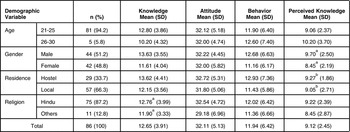
A total of 89 interns were invited to participate in the present study. Eighty-six interns returned the questionnaires, representing a response rate of 96.63%. The mean age of the respondents was 23.47 years. A total of 51.2% (n = 44) of respondents were male; 48.8% (n = 42) were female. The majority were not residing in hostels (n = 57, 66.3%). The majority of respondents were Hindu (n = 75, 87.2%), 11 (12.8%) of them specified other religious affiliations. The mean knowledge, attitude, behavior and perceived knowledge scores of the respondents were 12.65 (SD = 3.91), 32.11 (SD = 5.13), 11.94 (SD = 6.42) and 9.12 (SD = 2.45) respectively (Table 1).
Demographic Variables and Knowledge, Attitude and Behavior about Disaster Management Among Study Subjects

a1% level of significance (P = .02, CI: 0.30-2.33)
b5% level of significance (P = .008, CI: 0.30-2.33)
Results of a Mann Whitney U-test indicated that males had greater perceived knowledge scores compared to those of females (P = .008), and hostel residents had greater perceived knowledge scores compared to those of the local residents (P = .02). Hindus had higher knowledge scores compared to those affiliated with other religions (P = .008) (Table 1).
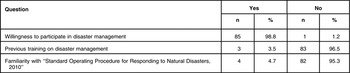
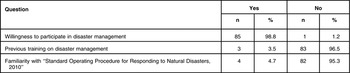
A total of 85 respondents (98.8%) reported they were willing to participate in disaster management; only one respondent (1.2%) reported otherwise. Overall, 83 (96.5%) of the respondents reported that they had not undergone any previous training on disaster management; only three (3.5%) indicated they had previous disaster management training. Eighty-two respondents (95.3%) reported they were not familiar with the document “Standard Operating Procedure for responding to natural disasters, 2010;” only four (4.70%) reported in the affirmative (Table 2). A total of 24 respondents (27.91%) strongly agreed that they could respond effectively to disasters. Overall, 22 respondents (25.58%) replied that they could identify and recognize an event of bioterrorism and 21 respondents (24.42%) replied that they could identify and recognize oral manifestations of bioterrorism.
Distribution of Study Subjects Regarding Willingness to Participate, Previous Training and Familiarity with National Disaster Management Document (N = 86)
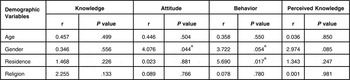
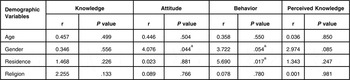
Correlation analysis showed a statistically significant correlation between knowledge and attitude (r = 0.24, P = .02), knowledge and behavior (r = 0.31, P = .004) and attitude and behavior (r = 0.22, P = .03) of respondents regarding disaster management. There were also statistically significant correlations between attitude and gender (r = 4.076, P = .044), behavior and gender (r = 3.722, P = .054) and behavior and residence (r = 5.690, P = .017). There were no statistically significant correlations between perceived knowledge and knowledge, attitude and behavior of study subjects. Results also indicate there were no statistically significant correlations between any of the other demographic variables and knowledge, attitude, behavior and perceived knowledge of respondents regarding disaster management (Table 3).
Correlation Analysis of Demographic Variables with Knowledge, Attitude and Behavior about Disaster Management among Study Subjects Using Chi-Square Test
a5% level of significance
Discussion
The present study was conducted to explore various issues related to disaster management among dental interns in India. There are very few studies that have investigated these issues, and there are no studies reported on issues related to disaster management among Indian dental interns. Various researchers have explored knowledge, attitude and behavior/practices (KAB/KAP) of study subjects in other areas. Attitude has been defined as “a relatively enduring organization of beliefs around an object, subject or concept which pre-disposes one to respond in some preferential manner.”Reference Park 22 The investigators in the present study explored perceived effectiveness, willingness to participate in disaster management and previous training regarding disaster management.
The earlier contributions of dental professionals in disaster management have been in the capacity of forensic odontologists. Dentists in the armed forces also have been trained in handling various emergency situations. Galligan has reported that dentists were a part of Disaster Mortuary Operational Response Teams and contributed to disaster management.Reference Galligan 9 The role of dentists in natural disasters like tsunamis and earthquakes has been documented in the literature.Reference Kieser, Laing and Herbison 23 - Reference Dai, Zhao and Li 32 Dentist participation in various accidents involving airplanes, trains, ships, and burns also has been reported.Reference Brannon and Morlang 33 - Reference Valenzuela, Martin-de las Heras and Marques 38 Dental professionals’ involvement in identifying victims and human remains, and in dealing with mass suicides, mass graves, homicides, and terrorist attacks also have been reported.Reference Nedel, Nedel and da Silva 39 - Reference Hinchliffe 45
Kieser et al have reported the various aspects related to identification of individuals based on their dental records in the 2004 tsunami that occurred in South Asia.Reference Kieser, Laing and Herbison 23 They highlighted the importance of maintaining dental records that might contribute to identification of victims of mass disasters. Wang et al highlighted the important role played by oral and maxillofacial surgeons in treating orofacial injuries sustained by victims of the 2008 earthquake in China.Reference Wang, Wei and He 31 They stressed the need for incorporation of oral and maxillofacial surgeons and even general dentists for effectively handling disasters. A new computerized method for age estimation using dental tissues has been reported by Keiser et al.Reference Kieser, DeFeiter and TeMoananui 46 The authors report that the new method is quick, reliable, requires minimal effort by the operator, and can be used by general dentists with little additional training.
At the Terrorism and Mass Casualty Curriculum Development Workshop conducted by American Dental Association and American Dental Education Association, it was concluded that core competencies for disaster management should be included at the level of undergraduate training.Reference Chmar, Ranney and Guay 47 This entails dental professionals being able to not only respond effectively during bioterrorism and contain the spread of bioterrorist attacks, but also take part in surveillance activities. Frykberg has indicated that dental professionals should read the growing scientific literature on disaster management, and should be involved in disaster planning at the level of local communities.Reference Frykberg 48
The low objective knowledge scores of the respondents in the present study are in agreement with the findings reported by Katz et alReference Katz, Nekorchuk and Holck 15 and Rajesh et al,Reference Rajesh, Chhabra and Shetty 20 but are contrasting to that reported by Colvard et al.Reference Colvard, Naiman and Mata 49 Low perceived knowledge scores among the respondents are in concurrence with the findings of Katz et alReference Katz, Nekorchuk and Holck 15 and Rajesh et al.Reference Rajesh, Chhabra and Shetty 20 Lack of any definitive steps for involving dental professionals in disaster management in IndiaReference Rajesh, Chhabra and Shetty 20 might have contributed to low objective and perceived knowledge scores among the study subjects in the present study. This is in contrast with the efforts undertaken in countries like US, where dental professionals’ role in disaster management is more defined. High attitude scores among the respondents in the present study indicate that they were inclined to make meaningful contributions towards disaster management.
Objective knowledge, attitude and behavior of study subjects showed a statistically significant correlation. However, there was no statistically significant correlation between perceived knowledge and objective knowledge, attitude and behavior of study subjects. Gender showed a statistically significant correlation with attitude and behavior, while residence showed a statistically significant correlation with behavior of study subjects regarding disaster management. Males tend to have a more proactive role in Indian families and this might have an influence on the results of the present study. Study subjects residing with their family members might perceive the threat of disasters in a different manner than those who stay in hostels away from their families. Further studies are essential to shed more light on these issues related to disaster management.
Earlier investigators have highlighted the need for incorporating professionals other than conventional medical professionals for effective disaster management.Reference More, Phelan and Boylan 2 , Reference Psoter, Herman and More 3 This is of special significance in countries like India with high vulnerability to disasters, both natural and manmade, but with limited resources at their disposal. Dental professionals comprise a group of individuals who need minimal further training to make a meaningful contribution to disaster management.
Investigators have suggested that disaster management should be included in the undergraduate dental curriculum.Reference Guay 8 , Reference Chmar, Ranney and Guay 47 Incorporating these competencies in training for dental professionals has also been reported in the literature.Reference More, Phelan and Boylan 2 , Reference Psoter, Herman and More 3 , Reference Chmar, Ranney and Guay 47 , Reference Glotzer, More and Phelan 50 It has also been observed that competencies prescribed for disaster management are already present in the dental curriculum.Reference Psoter, Herman and More 3 , Reference Colvard, Naiman and Mata 49 There might not be a need to design a new curriculum; instead the current curriculum could be made more specific to disaster management. There are advantages to the latter approach. At the outset, it will not lead to greater financial burden on budgets allocated for undergraduate dental training. It will reinforce the medical training of undergraduate dental students. This might ultimately enhance the learning experience of undergraduate dental students. The curriculum prescribed by the Dental Council of India (DCI) for undergraduate BDS training includes various topics that might be of immense help during disaster management. 51 This includes general surgery, oral and maxillofacial surgery, microbiology, and pharmacology, oral and maxillo-facial radiology, public health dentistry and related topics. Reorienting them towards disaster management can be of value.
However, one also has to consider the pitfalls of such an exercise. Developing uniform training on disaster management might be difficult due to regional variations in the occurrence of disasters. Apart from the obvious financial implications, altering content might pose problems regarding the timely management of basic sciences curriculum.Reference Chmar, Ranney and Guay 47 There might also be legal implications in permitting dental professionals to carry out certain procedures during disaster management.Reference Galligan 9 , Reference Rekow 13 These issues should be considered by the policymakers and decision makers in rendering disaster management more effective in India.
Conducting training programs on disaster management is another area of consideration. Training programs should be developed along the lines of the training programs for basic and advanced life support courses. The development of a training and credentialing system for disaster management must be appropriate for India. Training professionals from different streams is challenging due to varied cultural backgrounds, diverse previous training and work experience, and dissimilar skills. Best practices regarding disaster management must also be identified.Reference Hsu, Thomas and Bass 52 Investigators have highlighted the need for adopting an evidence-based approach for disaster management.Reference Auf der Heide 53 Defining target audiences and rendering training that is specific to their needs is essential.Reference Gerberding, Hughes and Koplan 54
Colvard et al have reported that dentists undergoing training in disaster management programs under the American Medical Association's (AMA's) National Disaster Life Support (NDLS) curriculum need minimal further additional training.Reference Colvard, Naiman and Mata 49 Such efforts undertaken for effective integration of dental and other professionals in disaster management will provide invaluable lessons for the development of the same in other countries like India. Further research into integrating general dental practitionersReference Gerberding, Hughes and Koplan 54 and other health professionals like pharmacists, physiotherapists, and nursing professionals will provide valuable insights into disaster management.
The increasing frequency of disasters, both natural and manmade, in India is a cause for concern. Limited resources, coupled with the large number of dental professionals in India and the skillset they possess, suggests that dental professionals can make effective and meaningful contributions to disaster management in India. The present study draws attention to the need for incorporating disaster management in undergraduate dental curricula, and for conducting training programs on disaster management on a periodic basis in India.
Limitations
The results of the present study should be viewed with caution. The respondents at the dental institution at which the study was conducted might not be representative of all dental professionals. As with any questionnaire-based study, there is the possibility of social desirability or faking good bias, deviation or faking bad bias and yea-saying or acquiescence bias. Instruments employing Likert scales are prone to biases such as end-aversion bias, positive skew and the halo effect.Reference Streiner and Norman 55 Further studies are required to shed more light into various issues related to disaster management in India.
Conclusions
High willingness to participate in disaster management was observed among dental interns in a private dental institution in India. Study subjects had low knowledge and behavior scores, but high attitude scores. Males and subjects residing in hostels reported greater perceived knowledge and Hindu respondents had greater objective knowledge about disaster management. Gender showed significant correlation with attitude and behavior, while residence showed significant correlation with behavior of respondents regarding disaster management. The present study emphasizes the importance of incorporating disaster management in the dental curriculum at the undergraduate level in India. Including personnel other than conventional medical professionals might optimize disaster management, especially in developing countries like India with scarce resources.
Abbreviations
- BDS:
-
Bachelor of Dental Surgery
- CBRNE:
-
chemical, biological, radiological, nuclear and explosives
Acknowledgement
The authors would like to acknowledge Dr. Ashwini Rao, Professor and Head, Department of Public Health Dentistry, Manipal College of Dental Sciences, Manipal University, Mangalore for all her constant support and help. The authors also acknowledge Dr. Shuba Kumar, Social Scientist, SAMARTH, Chennai for inspiring us.