Implications
The structure and composition of triglycerides affect the quality of dry-cured meat products, including the hams. The structure of the triglyceride molecule affects the incidence and development of different illnesses in humans as obesity, type 2 diabetes and hypertension. Research on modification of these variables by changing animal diets might help to improve the quality of meat products and help in the prevention of certain human diseases.
Introduction
Modification of the fatty acid (FA) profile of pig tissues is a matter of interest in the production of high-quality meat products (D’Arrigo et al., Reference D’Arrigo, Hoz, López-Bote, Cambero, Pin, Rey and Ordonez2002; Candek-Potokar and Skrlep, Reference Candek-Potokar and Skrlep2012). Limiting the concentration of linoleic acid (C18:2n-6) in pig fat improves fat consistency, decreases the susceptibility to oxidation and development of undesirable flavor and reduces the incidence of technological problems, such as those related to water migration (López-Bote, Reference López-Bote1998; López-Bote et al., Reference López-Bote, Isabel and Daza2002; Isabel et al., Reference Isabel, López-Bote, de la Hoz, Timón, García and Ruiz2003). A reduction in C18:2n-6 concentration is achieved through the incorporation of saturated fats or other ingredients that enhance endogenous fat synthesis during the fattening diets period (Farnworth and Kramer, Reference Farnworth and Kramer1987; Wood et al., Reference Wood, Richardson, Nute, Fisher, Campo, Kasapidou, Sheard and Enser2004; Duran-Montgé et al., Reference Duran-Montgé, Realini, Barroeta, Lizardo and Esteve-Garcia2008).
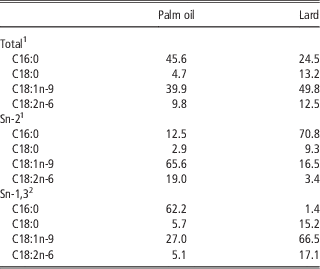
Lard and palm oil are saturated sources of fat frequently used in pig fattening because of their low C18:2n-6 and high saturated and monounsaturated FA concentration (De Blas et al., Reference De Blas, Gasa and Mateos2010). The saturated plus monounsaturated FA to polyunsaturated FA ratio is similar for both fat sources, although palm oil has a higher proportion of C16:0 (45.6% v. 24.5%) and lower of C18:1 (39.9% v. 49.8%) than lard. In addition, these two fat sources differ markedly in the location of the individual FA within the triglyceride (TAG) molecule, a characteristic that is not usually taken into consideration by swine nutritionists. Most of the C16:0 present in lard is located in the internal (Sn-2) position whereas, in palm oil it locates in the external (Sn-1 and Sn-3) positions (Small, Reference Small1991; Innis, Reference Innis2011). This difference might be relevant in further processing for the industry of dry-cured products because FA distribution within the TAG molecule modifies the physical properties of the adipose tissue (Smith et al., Reference Smith, Yang, Larsen and Tume1998; Segura et al., Reference Segura and López-Bote2015) and might affect the incidence of human illnesses such as obesity, diabetes or hypertension (Ponnampalam et al., Reference Ponnampalam, Lewandowski, Nesaratnam, Dunshea and Gill2011; Gouk et al., Reference Gouk, Cheng, Mok, Ong and Chuah2013).
Glycerol is a co-product of the bio-fuel industry of common use in swine feeding. The inclusion of glycerol in the diet affects pH, water holding capacity and other characteristics of potential interest in the production of dry-cured hams (Mourot et al., Reference Mourot, Aumaitre, Mounier, Peiniau and Francois1994). Moreover, dietary glycerol enhances FA synthesis and might reduce C18:2n-6 concentration in pig tissues, resulting in an increase in fat firmness (Schieck et al., Reference Schieck, Shurson, Kerr and Johnston2010).
This research studied the effects of inclusion of glycerol (which enhances de novo FA synthesis) and two fat sources (lard v. palm oil) differing in the FA distribution on the profile and positional distribution of the FA within the TAG molecule of subcutaneous fat of gilts and barrows.
Material and methods
All the experimental procedures used in this research were approved by the Animal Ethics Committee of Universidad Politécnica de Madrid and were in compliance with the Spanish guidelines for the care and use of animals in research (Boletín Oficial del Estado, 2007).
Husbandry, diets and experimental design
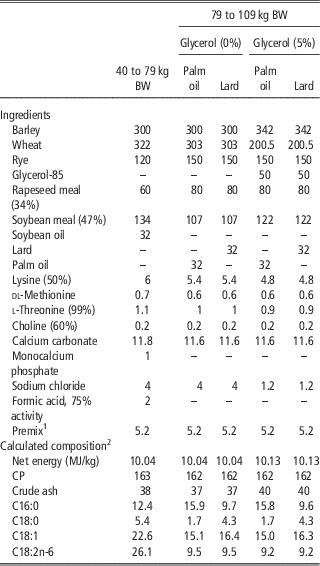
In total, 160 crossbred pigs (40.3±0.78 kg BW) obtained from a commercial farm were used in this experiment. The female line (Syra, Gene+, Erin, France) used included blood from Large White, Landrace and Duroc and the sire line was PIC L65 (PIC, Barcelona, Spain). Upon arrival at the experimental farm, pigs were housed in groups of 10 (five gilts and five barrows) in a naturally ventilated finishing barn in 16 pen replicates (4×3 m). All pigs received a common pre-experimental diet containing 20 g C18:2n-6/ kg diet for 38 days (79.0±6.58 kg BW). Then, pigs received their respective experimental diets for 32 days. The four diets used had similar nutritive value but differed in the fat source (palm oil or lard) and the concentration of glycerol (0 v. 50 g/kg). The C18:2n-6 concentration of all the experimental diets was low (10 g/kg). Diets were provided for ad libitum consumption and were formulated according to De Blas et al. (Reference De Blas, Mateos and Rebollar2013). The ingredient composition and the calculated (De Blas et al., Reference De Blas, Gasa and Mateos2010) nutrient content of the diets are shown in Table 1. The FA distribution within the TAG molecule, of the fat sources used is shown in Table 2 (see analytical methodology; Perona and Ruíz-Gutiérrez, Reference Perona and Ruíz-Gutiérrez2004).
Ingredient composition and calculated analysisFootnote 1 of the experimental diets (g/kg diet as fed basis unless otherwise indicated)

1 Supplied per kg diet: 7000 IU vitamin A (trans-retinyl acetate); 1600 IU vitamin D3 (cholecalciferol); 20 IU vitamin E (all-rac-tocopherol-acetate); 1.0 mg vitamin K3 (bisulphate menadione complex); 0.7 mg thiamine (thiamine-mononitrate); 3.0 mg riboflavin; 9 mg of pantothenic acid (D-Ca pantothenate); 15 mg vitamin B3 (niacin); 150 mg choline (choline chloride); 1 mg pyridoxine (pyridoxine HCl); 0.016 mg vitamin B12 (cobalamin); 16.5 copper (CuSO4·5H2O); 75 mg iron (FeSO4·7H2O); 40 mg manganese (MnO2); 110 mg zinc (ZnO); 0.3 mg selenium Se (Na2SeO3); 0.8 mg iodine [Ca(IO3)2] and 125 mg ethoxiquin. Phytase (500 FTU; Natuphos 5000, Basf Española, Barcelona, Spain).
2 According to Fundación Española Desarrollo Nutrición Animal (2010) (supplied per kg of diet).
Total (whole triglyceride), position 2 (Sn-2) and position 1,3 (Sn-1,3) fatty acid composition of fat sources used in this experiment

1 g/100 g of total present fatty acids.
2 g/100 g of total present fatty acids calculated as Sn-1,3=(3× %Total – %Sn-2)/2.
Growth performance
BW of the pigs and feed disappearance were recorded by pen at the beginning and at the end of the finishing period. Feed wastage was not measured. From these data, average daily gain (ADG), average daily feed intake (ADFI) and feed conversion ratio (FCR) per pen were calculated.
Carcass measurements and primal cuts yield
The day before slaughter, pigs were weighed, fasted for 15 h and transported 300 km to a commercial abattoir (Incarlopsa, Cuenca, Spain) where they were allowed to rest for 4 h with full access to water but not to feed. Pigs were stunned in a 90% CO2 atmosphere and then slaughtered, exsanguinated and scalded at 65°C according to standard commercial procedures. Lean percentage, backfat depth and the weight and yield of the fresh hams of four carcasses per pen chosen at random, were measured using the Autofom classification system (Carometec Spain, SL., Barcelona, Spain) as described by Busk et al. (Reference Busk, Olsen and Brondum1999). Then, carcasses were eviscerated and split down the center of the spine. Hot carcass weight was individually recorded and used to calculate carcass yield. Carcasses were suspended in the air and refrigerated at 2°C (1 m/s; 90% relative humidity) for 2 h. At 2 h postmortem, the subcutaneous BF depth, between the third and fourth last ribs, including the skin, was measured at the thinnest point in the left side of each carcass, using a flexible ruler with a precision of 0.5 mm. Carcasses were processed according to standard commercial procedures. Hams were kept in the chilled room at 4°C for 24 h, and the weights of the untrimmed hams and loins were recorded (chilled weight). Then, the hams were trimmed of external fat and weighed again (trimmed weight). The trimming consisted of eliminating part of the external fat and skin to fit commercial requirements and was performed by qualified personnel as described by Serrano et al. (Reference Serrano, Valencia, Fuentetaja, Lázaro and Mateos2009). Data on ham and loin weights were used to calculate chilled and trimmed ham yield and chilled loin yield. Because of the design of the processing line of the slaughterhouse and the method of carcass dissection, shoulder weights were not recorded.
After collection of carcass data, a 300 g sample of Longissimus dorsi and 150 g of subcutaneous fat (SF) were excised at the last rib. The meat samples were stored in individual plastic bags and vacuum packaged at −20°C until subsequent meat analyses. The intramuscular fat (IMF) was quantified as proposed by Segura and López-Bote (Reference Segura, Escudero, Romero de Ávila, Cambero and López-Bote2014). Briefly, the total lipids were extracted from the outer subcutaneous backfat layer and the TAGs were purified by thin-layer chromatography (TLC) on silica gel plates (0.25 mm thickness) that were developed with hexane/ethyl ether/acetic acid (75 : 25 : 1 by volume). The TLC plates were sprayed with primuline acetone/water (80 : 20 by volume) 0.05% solution to detect TAG fractions. They were scraped off the plates and eluted from silica with hexane/diethyl ether (95 : 5 by volume). In each case, the purified TAG samples were analyzed by gas chromatography after lipase hydrolysis. For the positional analysis of TAG Sn-2 FAs, 10 mg of purified TAGs were hydrolyzed with 2 mg of pancreatic lipase in 1 ml of 1 M Tris–HCl buffer (pH 8), 0.1 ml CaCl2 (22%) and 0.25 ml deoxycholate (0.1%). The reaction was stopped by adding 0.5 ml of 6 N HCl when ~60% of the TAGs were hydrolyzed (1 to 2 min). The lipids were extracted three times with 1.5-ml aliquots of ethyl ether, and the reaction products were separated by TLC (see above). Free FA and Sn-2-monoacylglycerol bands representing the positions Sn-1,3 and Sn-2 of TAG were scraped off the plate and transmethylated. The validity of the procedure was confirmed by comparing the FA composition of the original TAG and those remaining after the partial hydrolysis (Perona and Ruíz-Gutiérrez, Reference Perona and Ruíz-Gutiérrez2004).
Fatty acid methyl esters (FAME) were obtained from isolated lipids by heating the samples at 80°C for 1 h in 3 ml of methanol/toluene/H2SO4 (88 : 10 : 2 by volume) as indicated by Garcés and Mancha (Reference Garcés and Mancha1993). After cooling, 1 ml of hexane was added and the samples were mixed. FAME were recovered from the upper phase, separated and quantified using a gas chromatograph (HP 6890 Series GC System) equipped with flame ionization detector. Separation was performed with a J&W GC Column, HP-Innowax Polyethylene Glycol (30 m×0.316 mm×0.25 m). Nitrogen was used as a carrier gas. After injection at 170°C, the oven temperature was raised to 210°C at a rate 3.5°C/min, then to 250°C at a rate of 7°C/min and held constant for 1 min. The flame ionization was held at 250°C. The split ratio was 1 : 40. FAME peaks were identified by comparing their retention times with those of authentic standards (Sigma – Aldrich, Alcobendas, Spain).
Statistical analyses
All data were analyzed as a completely randomized design with dietary fat source, glycerol level and gender as main effects and their interactions, by using the GLM procedure of SAS 9.2 (SAS Institute Inc., NC, USA, 2009). A factorial arrangement was used to analyze production (2 fat sources×2 glycerol levels) and carcass and meat quality (2 fat sources×2 glycerol levels×2 sexes) data. The experimental unit was the pen for growth performance traits (gilt and barrows together; n=4) and the individual pig for carcass and meat quality traits (two pigs of each gender chosen at random from each pen; n=8).
Results and discussion
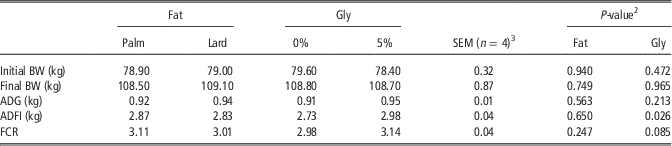
No interaction between fat and glycerol on growth performance was detected. As expected, ADG was not affected by dietary treatment (Table 3). Recent research has demonstrated that the inclusion of glycerol in finishing pig diets at levels of 50 (Doppenberg and Van Der Aar, Reference Doppenberg and Van der Aar2007), 80 (Zijlstra et al., Reference Zijlstra, Menjivar, Lawrence and Beltranena2009) or 100 g/kg diet have not adverse effects on production (Lammers et al., Reference Lammers, Kerr, Weber, Bregendahl, Lonergan and Prusa2008; Zijlstra et al., Reference Zijlstra, Menjivar, Lawrence and Beltranena2009). The FCR increased with the inclusion of glycerol (Table 3) in agreement with previous research. Kijora and Kupsch (Reference Kijora and Kupsch1996) observed that ADFI of pigs increased by 7.5% in all groups that received glycerol compared with the control group, but no effect was observed in the finishing period. Zijlstra et al. (Reference Zijlstra, Menjivar, Lawrence and Beltranena2009) reported that the inclusion of 80 g glycerol/kg diet in substitution of wheat, increased ADFI and ADG but had no effect on FCR. Possible reasons for the higher feed intake of the diets containing glycerol are the sweet taste, the improvement in feed structure of the diets and the lower than planned net energy content of the glycerol containing diet.
Effect of dietary fat source (Fat) and glycerol (Gly) inclusion on growth performance of pigs during the last 32 days of fatteningFootnote 1

1 ADG=average daily gain; ADFI=average daily feed intake; FCR=feed conversion ratio.
2 No significant interaction Fat×Gly was detected.
3 Four pens per treatment of 10 pigs each.
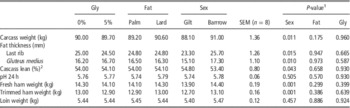
The effects of the inclusion of the fats and glycerol in the diet on the characteristics of the carcasses are shown in Table 4. As expected, sex affected backfat depth (Peinado et al., Reference Peinado, Medel, Fuentetaja and Mateos2008; Latorre et al., Reference Latorre, Ripoll, García-Belenguer and Ariño2009), but not the main carcass characteristics, pH or the ham and loin weights (Table 4). Published data on the effect of dietary glycerol on carcass fatness are controversial, probably because of potential differences reported on feed intake, which may affect carcass fatness. Kijora et al. (Reference Kijora, Bergner, Kupsch and Hageman1995) reported that the inclusion of glycerol in the diet did not affect carcass leanness. Moreover, in a second experiment, Kijora et al. (Reference Kijora, Kupsch, Bergner, Wenk and Prabucki1997) reported a decrease in backfat thickness. Opposite to these findings, Zijlstra et al. (Reference Zijlstra, Menjivar, Lawrence and Beltranena2009) reported that glycerol supplementation increased backfat depth. In the current experiment, no effect of glycerol was found on carcass fatness. Moreover, an interesting sex×glycerol interaction was observed; dietary glycerol increased lean content in gilts but had no effects in barrows. More research on the response to dietary glycerol between sexes is needed to confirm this effect and to determine if it is due to a specific effect of sex or to variable effectiveness of dietary glycerol depending on the capacity of the pig lean growth. Moreover, a possible relationship between feed intake and the response because of sex cannot be ruled out.
Effect of sex, dietary fat source (Fat) and glycerol (Gly) inclusion on carcass quality and meat composition

1 Although otherwise stated, no significant interactions for main effects were detected (P>0.05).
2 Interaction Sex×Gly (P=0.055) was detected (mean values Gilt-5% Gly=55.2, Gilt-0% Gly=54.3, Barrow-5% Gly=53.1, Barrow-0% Gly=53.8).
Dietary treatment did not affect the IMF content of the loin in agreement with data of Kijora and Kupsch (Reference Kijora and Kupsch1996) who did not observed any effect of dietary glycerol on meat quality. In contrast, Kijora et al. (Reference Kijora, Kupsch, Bergner, Wenk and Prabucki1997) reported a slight increase in backfat and marbling with glycerol inclusion. Zijlstra et al. (Reference Zijlstra, Menjivar, Lawrence and Beltranena2009) reported that glycerol supplementation increased backfat depth, but decreased loin marbling and carcass leanness.
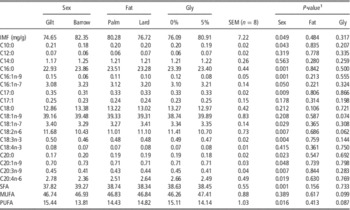
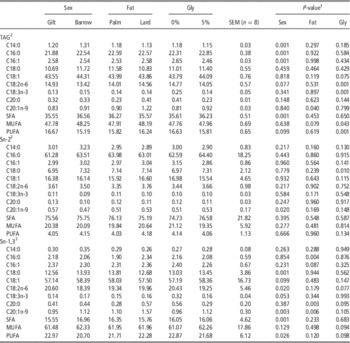
The effects of dietary treatment and sex on FA composition of the IMF or outer SF are shown in Tables 5 and 6, respectively. The FA profile of the IMF of the Longissimus dorsi muscle was affected by sex, with all the individual and total saturated fatty acid (SFA) concentration being higher in barrows than in gilts (P<0.001). On the contrary, the concentration of total PUFA, C18:2n-6, C18:3n-3, C20:3n-9 and C20:4n-6 in the IMF was higher in gilts than in barrows. However, sex did not affect total MUFA concentration. In the SF, a marked effect of sex on total SFA was found, with barrows showing higher values than gilts (P<0.001). Individual SFA concentrations were affected by sex only in the case of C14:0 and C16:0 (P<0.001). As reported for IMF, no effect of sex on total MUFA was observed but total PUFA (P=0.099) and C18:2n-6 (P=0.077) concentration tended to be higher in gilts than in barrows. Piedrafita et al. (Reference Piedrafita, Christian and Lonergan2001) also reported that gender affected the proportion of FA, with gilts showing higher proportion of C18:2n-6 than barrows showing opposite effects for unsaturated FA. In addition, Alonso et al. (Reference Alonso, Campo, Español, Roncalés and Beltrán2009) observed that C18:2n-6, total n-6 FA and total PUFA proportions were higher in Semimembranous muscle (P<0.05) of gilts than barrows, although the effects on C16:0, C18:1n-9, total SFA and total MUFA proportions were not significant in gilts (P>0.05). Barea et al. (Reference Barea, Isabel, Nieto, López-Bote and Aguilera2013), Latorre et al. (Reference Latorre, Ripoll, García-Belenguer and Ariño2009) and Serrano et al. (Reference Serrano, Valencia, Nieto, Lázaro and Matéos2008) observed higher C16:0, C18:0 and total SFA concentrations in SF, and lower 18:2n-6 and total PUFA proportions in barrows than in gilts. Warnants et al. (Reference Warnants, Van Oeckel and Boucque1999) reported higher percentages of SFA, C14:0 and C16:0 in barrows than in gilts, with no differences for C18:1n-9 and total MUFA. Nuernberga et al. (Reference Nuernberga, Dannenbergera, Nuernberga, Endera, Voigta, Scollanb, Wood, Nutec and Richardson2005) also observed that SF from gilts had lower total SFA and higher total PUFA proportions than SF from barrows. Generally, fatter pigs receiving the same diet have lower concentration in essential FA (C18:2n-6 and C18:3n-3) and higher in C18:1n-9 than leaner pigs. Consequently, an explanation on the sex differences reported might be due to the higher feed intake of barrows. As a result, the endogenous FA synthesis is also higher in barrows than in gilts.
Effect of sex, dietary fat source (Fat) and glycerol (Gly) inclusion on fatty acid profile of the IMF

MF=intramuscular fat; SFA=total saturated fatty acids; MUFA=total monounsaturated fatty acids; PUFA=total polyunsaturated fatty acids.
1 No significant interactions were detected.
Effect of gender (Sex), dietary fat source (Fat) and glycerol (Gly) inclusion on the subcutaneous fat in the whole triglyceride (TAG), position 2 (Sn-2) and position 1,3 (Sn-1,3) fatty acid composition

SFA=saturated fatty acids; MUFA=monounsaturated fatty acids; PUFA=polyunsaturated fatty acids.
1 No significant interactions were detected.
2 g/100 g of total present fatty acids.
3 g/100 g of total present fatty acids calculated as Sn-1,3=(3×%Total – %Sn-2)/2.
No effects of dietary fat on intramuscular total SFA, MUFA or PUFA were detected. In fact, no effects of dietary fat on subcutaneous SFA or PUFA were observed. However, a tendency (P=0.079) for higher total MUFA concentration was observed in pigs fed the lard containing diet (Table 6).
Focusing on glycerol inclusion, no significant interactions between main effects were detected. In fact, dietary glycerol tended to increase total MUFA and C18:1n-9 of the IMF, in agreement with most published research. A tendency for lower total PUFA (P=0.087) and C18:2n-6 (P=0.062) concentration was detected in pigs fed the glycerol containing diet (Table 5). Similarly, pigs fed glycerol showed an increase in total MUFA (P=0.013) and a decrease in PUFA (P=0.001) in the SF (Table 6). The concentration of C18:2n-6 and C18:3n-3 in the SF was markedly affected by dietary glycerol (P<0.001). Mourot et al. (Reference Mourot, Aumaitre, Mounier, Peiniau and Francois1994) observed that dietary glycerol increased C18:1n-9 and reduced C18:2n-6 in the backfat and the Semimembranosus muscle of the pigs. Kijora et al. (Reference Kijora, Kupsch, Bergner, Wenk and Prabucki1997) did not observe any significant effect of glycerol on the SFA profile of the backfat but reported a moderate increase in C18:1n-9, with a decrease in C18:2n-6 and C18:3n-3 concentrations. Consequently, the PUFA to MUFA ratio in this tissue was reduced.
Schieck et al. (Reference Schieck, Shurson, Kerr and Johnston2010) compared a control diet (31 to 128 kg BW), a diet with 8% glycerol for the last 8 weeks of the fattening period (45 to 128 kg BW) and the same diet with 16% glycerol for the last 16 weeks (31 to 128 kg). The authors reported similar growth performance, with little concomitant effect on carcass composition or pork quality for the two feeding programs. Moreover, these authors did not report any potential effect of the dietary treatment on FA composition, but observed that glycerol inclusion enhanced belly firmness when compared with pigs fed a corn-soybean meal control diet, results that are consistent with the data of the current experiment.
The effect of sex or dietary treatment on FA location within the TAG in SF is shown in Table 6. It can be observed that, in any case, C16:0 was mainly located in the Sn-2 position, whereas C18:0, C18:1n-9 and C18:2n-6 occupied preponderantly the external positions (Sn-1,3) of the TAG. Similar results have been reported for various pig tissues by Christie and Moore (Reference Christie and Moore1970), in human milk and substitutes by Christie and Clapperton (Reference Christie and Clapperton1982) and in plasma and milk of rats and rabbits by Christie (Reference Christie1985). It is well known that FA are not esterified at random to the glycerol hydroxyl groups in TAG of animal fats. In pigs and human milk, as opposed to what happens in most species, the 2-position in TAGs of the adipose tissue is occupied by a SFA, mainly C16:0 (Christie and Moore, Reference Christie and Moore1970).
One of the main findings of this research was the very limited effect of both sex and dietary treatment on the FAs located in the internal Sn-2 position. In fact, the only noticeable effect was the higher concentration of C18:0 in Sn-2 position in pigs fed the glycerol containing diets, a finding that agrees with the increase of the endogenous synthesis of FA induced by dietary carbohydrates (Óvilo et al. Reference Óvilo, Benítez, Fernández, Isabel, Núñez, Fernández, Rodríguez, Daza, Silió and López-Bote2014). On the other hand, a marked effect of sex on Sn-1,3 position for C18:0, C18:2n-6 and C18:3n-3 FA concentrations was observed (Table 6). Reasonably, the reported effect of sex on FAs concentration in the TAG molecule should be also reflected in the TAG position where the FA is majority. In addition, lower concentration of C16:0 and a tendency to higher concentration of C18:0 and C20:1n-9 were observed in external positions.
As shown in Table 2, a marked difference in the FA composition of the Sn-2 position exists between dietary lard and palm oil. The composition of the Sn-2 position in stored lipids was not affected, thus suggesting a high metabolic regulation. Little information on this topic is available. In weaned piglets, Innis et al. (Reference Innis, Dyer and Lien1997) observed a marked effect of diets differing in total FA content and distribution within the TAG molecule, on chylomicron FA composition (including those located in the Sn-2 position). The authors also studied the FA composition of liver lipids and reported limited effect of dietary treatment. These data suggest a high metabolic regulation of FA composition in Sn-2 position.
Dietary FA composition and positional distribution within the TAG determine at high extent the FA digestion and absorption (Mu and Hoy, Reference Mu and Hoy2004). The gastric and pancreatic lipases hydrolyze the FA from the 1,3 position of the TAG. Hunter (Reference Hunter2001), Mu and Porsgaard (Reference Mu and Porsgaard2005) and Innis (Reference Innis2011) observed that ~70% of the FAs located in Sn-2 was conserved unaltered in the chylomicrons, which might be also the case in the SF. In the current experiment, lard contained ~25% C16:0 most of it is esterified in the internal Sn-2 position (~70% of Sn-2 FA). In contrast, the C16:0 in palm oil is predominantly esterified at the 1,3 position, while C18:1n-9 and C18:2n-6 are located preferentially in the internal Sn-2 position (Table 2). As a result, the formation of free FA and 2-monoglycerides during the digestion of fat is markedly different depending on the dietary fat source (Innis and Nelson, Reference Innis and Nelson2013). In our case, the use of palm oil should involve higher restructuration of TAG in SF after digestion and absorption in order to keep constant the previously Sn-2 positional distribution described. Consequently, the lower availability of C16:0 and the higher of C18:0 to conform Sn-1,3 must have implications in the final TAG structure.
Dietary intervention has been proven to alter FA in the external Sn-1,3 position of the TAG rather than the Sn-2 location, in bovine tissue. Smith et al. (Reference Smith, Yang, Larsen and Tume1998) observed that when the desaturase enzyme activity was depressed, the concentration of C18:0 located in the external Sn-1,3 position was increased in bovine adipose tissue, but limited response was observed on Sn-2 position. The possibility of altering the FA composition at the Sn-2 location of the TAG by dietary intervention during the fattening phase is very limited. This observation has important practical application, because saturated FA in the Sn-2 position might have more detrimental effect on human health than those located in the external Sn-1,3 location (Berry, Reference Berry2009), thus reducing pork consumer acceptability. More research efforts are needed to elucidate the potential effect of management conditions, including genetics and more prolonged feeding regimens, on Sn-2 fatty acid composition in pig fat.
Acknowledgments
This project was partially supported by MEDGAN (S2013/ ABI-2913). Comunidad de Madrid and CEI Campus Moncloa UCM-UPM, 28040 Madrid, Spain and AGL2013-48121 Ministerio de economía y competitividad. Thanks are due to Isabel Martín for her skillful technical assistance.