Low parental monitoring is widely recognized as a risk factor for the development of child and adolescent conduct problems, delinquency, and other adjustment difficulties (for a review, see Racz & McMahon, Reference Racz and McMahon2011). Dr. Tom Dishion and colleagues have played a seminal role in enhancing the field's understanding of how to conceptualize and measure parental monitoring, stimulating additional research that has deepened our approach to this parenting behavior. From this work, parental monitoring has been defined as “a set of correlated parenting behaviors involving attention to and tracking of the child's whereabouts, activities, and adaptations” (Dishion & McMahon, Reference Dishion and McMahon1998, p. 61). However, the majority of previous studies examining parental monitoring have largely measured parental knowledge (the outcome of parental monitoring), not the active parental efforts to obtain that information. Stattin and Kerr's seminal work (Stattin & Kerr, Reference Stattin and Kerr2000; Kerr & Stattin, Reference Kerr and Stattin2000, Reference Kerr, Stattin, Crouter and Booth2003; Kerr, Stattin, & Burk, Reference Kerr, Stattin and Burk2010) noted that parental knowledge derives from three sources: (a) parental solicitation, where parents ask children and/or their children's friends for information; (b) parental control, where parents use rules and restrictions to limit their children's ability to engage in activities without informing their parents; and (c) child disclosure, where children freely and openly provide information to their parents about their whereabouts and activities. A recent conceptualization using the same sample as described in the current study (Bendezú, Pinderhughes, Hurley, McMahon, & Racz, Reference Bendezú, Pinderhughes, Hurley, McMahon and Racz2018) noted that parental solicitation and control encompass more active parental monitoring strategies (i.e., what parents actually do to gather information from their children), whereas child disclosure is a more passive monitoring strategy whereby parents obtain information from their children.
While work by Stattin and Kerr (Reference Stattin and Kerr2000) and others (e.g., Criss et al., Reference Criss, Lee, Morris, Cui, Bosler, Shreffler and Silk2015; Keijsers, Reference Keijsers2016; Keijsers, Branje, VanderValk, & Meeus, Reference Keijsers, Branje, VanderValk and Meeus2010; Lahey, Van Hulle, D'Onofrio, Rodgers, & Waldman, Reference Lahey, Van Hulle, D'Onofrio, Rodgers and Waldman2008; Vieno, Nation, Pastore, & Santinello, Reference Vieno, Nation, Pastore and Santinello2009; Willoughby & Hamza, Reference Willoughby and Hamza2011) suggests that child disclosure is the main source of parental knowledge, and that it is this link that is most directly tied to child behavioral difficulties, it is important to note that most of these studies have been conducted with racially homogenous (e.g., White) participants residing in low-risk neighborhoods. Therefore, it may be the case that active parental monitoring strategies (i.e., solicitation and control) are particularly important when raising children in at-risk neighborhoods (Burton & Jarrett, Reference Burton and Jarrett2000; Ceballo & McLoyd, Reference Ceballo and McLoyd2002; Ceballo, Ramirez, Hearn, & Maltese, Reference Ceballo, Ramirez, Hearn and Maltese2003; Gartstein, Seamon, & Dishion, Reference Gartstein, Seamon and Dishion2014). In these contexts, parents may rely more heavily on active monitoring strategies to ensure the safety and well-being of their children. Past research indicates that in highly disadvantaged neighborhoods, high levels of maternal monitoring in toddlerhood has been shown to moderate the association between neighborhood risk and child behavior problems such that monitoring serves a protective role in this context (Supplee, Unikel, & Shaw, Reference Supplee, Unikel and Shaw2007). Various contextual factors that place these families at-risk (e.g., significant environmental risks, parental employment that keeps them away from the home for many hours/overnight) may mean that parents cannot wait for their children to disclose their activities and whereabouts. A recent study with a racially diverse sample of families living in at-risk neighborhoods (the same sample as described in the current study) indicated that parental discussions of daily activities (an aspect of parental solicitation) was the strongest predictor of parental knowledge as measured in adolescence (i.e., Grades 9 and 10; Bendezú et al., Reference Bendezú, Pinderhughes, Hurley, McMahon and Racz2018).
These mixed findings suggest that the importance of different parental monitoring strategies depends on various demographic (e.g., homogenous versus heterogenous samples) and contextual (e.g., low risk versus at-risk neighborhoods) factors. What has not been explored in the literature is the broader family context, with particular attention to early family life that may “set the stage” for both active and passive parental monitoring strategies. That is, specific experiences or dynamics within the family early in the child's development (i.e., toddlerhood through school entry) may make it more likely for a parent to engage in higher levels of active parental monitoring strategies later in childhood and into adolescence (Pettit, Keiley, Laird, Bates, & Dodge, Reference Pettit, Keiley, Laird, Bates and Dodge2007; Pettit, Laird, Dodge, Bates, & Criss, Reference Pettit, Laird, Dodge, Bates and Criss2001). It is also important to consider that parental monitoring strategies likely change over time (Frick, Christian, & Wootton, Reference Frick, Christian and Wootton1999; Kerr & Stattin, Reference Kerr, Stattin, Crouter and Booth2003; Laird, Criss, Pettit, Bates, & Dodge, Reference Laird, Criss, Pettit, Bates and Dodge2009); however, little attention has been paid to this developmental course because most studies of parental monitoring have only focused on one time point or on one developmental period. The goal of the current study was to address these gaps in the broader parental monitoring literature in a diverse sample of families living in at-risk neighborhoods. Specifically, we examined the development of two aspects of active parental monitoring strategies (i.e., discussing daily activities and setting curfews) as well as one aspect of passive parental monitoring strategies (i.e., child communication with parents). We examined the developmental course of these monitoring strategies across different developmental periods from middle childhood through adolescence to examine how these strategies develop over time. Additionally, we investigated several individual, family, and contextual antecedents (as measured in kindergarten) of these parental monitoring strategies.
Developmental Course of Parental Monitoring Strategies
Throughout infancy and early childhood (including the early elementary school years), the majority of children's time is spent at home, where it is easier for parents to directly observe their behavior. As children's school and peer relationships develop and expand (i.e., during middle childhood and into adolescence; that is, later elementary school through high school), children begin to spend less time with their parents and more time outside the home. To adapt to this natural developmental process of children's forming peer relationships and exerting their independence, parents may use active parental monitoring strategies to track their children's activities and whereabouts (Larson, Richards, Moneta, Holmbeck, & Duckett, Reference Larson, Richards, Moneta, Holmbeck and Duckett1996). Engagement in these parenting behaviors is important to ensure that children are behaving appropriately and safely, forming positive peer affiliations, and demonstrating adaptive independence and autonomy (Dishion & McMahon, Reference Dishion and McMahon1998). However, both parents and children report that parental knowledge and monitoring strategies tend to decrease as adolescent age increases (Frick et al., Reference Frick, Christian and Wootton1999; Keijsers & Poulin, Reference Keijsers and Poulin2013; Pettit et al., Reference Pettit, Keiley, Laird, Bates and Dodge2007; Wang, Dishion, Stormshak, & Willett, Reference Wang, Dishion, Stormshak and Willett2011). These reductions are considered developmentally normative due to expanding adolescent autonomy, increased parent–adolescent conflict, and adolescent defiance (Laird, Marrero, & Sherwood, Reference Laird, Marrero, Sherwood, Guilamo-Ramos, Jaccard and Dittus2010; Masche, Reference Masche2010).
However, broader research efforts have paid little attention to the possibility that active and passive parental monitoring strategies may develop differently over time (e.g., perhaps active strategies become less important in adolescence, but passive monitoring strategies remain constant or even increase) and in different contexts (e.g., active monitoring strategies may remain stable across development for families living in at-risk neighborhoods). Existing evidence suggests that a large proportion of previous studies have created a single “monitoring” score, with little attention to differences in how various monitoring strategies manifest and interact with other variables of interest (Bendezú et al., Reference Bendezú, Pinderhughes, Hurley, McMahon and Racz2018; Keijsers et al., Reference Keijsers, Branje, VanderValk and Meeus2010; Keijsers, Frijns, Branje, & Meeus, Reference Keijsers, Frijns, Branje and Meeus2009; Laird, Marrero, & Sentse, Reference Laird, Marrero and Sentse2010). Therefore, we modeled the developmental course of these three parental monitoring strategies separately. It is also important to consider that these monitoring strategies may increase or decrease at a slower rate at earlier developmental periods (i.e., childhood), shifting to a quicker rate of change at later developmental periods (i.e., adolescence) due to increased adolescent independence (Laird, Pettit, Bates, & Dodge, Reference Laird, Pettit, Bates and Dodge2003). These linear and nonlinear trends need to be considered in future studies, and longitudinal models that span different developmental periods may be able to address these changes in parental monitoring strategies over time (Bailey, Hill, Oesterle, & Hawkins, Reference Bailey, Hill, Oesterle and Hawkins2009). In related research, Keijsers and Poulin (Reference Keijsers and Poulin2013) documented a linear decrease in parental control from ages 14 to 19 but not from ages 12 to 14.
An additional consideration for studies examining growth in parental monitoring strategies over time is that there may be group-level demographic differences (i.e., in terms of sex, race, and living in rural versus urban areas) in developmental trajectories. However, most previous studies have only focused on testing for differences in levels or amount of parental monitoring at one point in time. These findings have documented that, according to child report, girls experience higher levels of parental solicitation and control than do boys (Masche, Reference Masche2010; Stattin & Kerr, Reference Stattin and Kerr2000; Willoughby & Hamza, Reference Willoughby and Hamza2011). Both parents and children also report more parental knowledge for girls than for boys, in part due to increased solicitation and control for girls (Jacobson & Crockett, Reference Jacobson and Crockett2000; Pettit et al., Reference Pettit, Keiley, Laird, Bates and Dodge2007). One study has documented developmental differences in these parental monitoring strategies (Keijsers & Poulin, Reference Keijsers and Poulin2013) such that for girls, parental solicitation and adolescent disclosure decreased during early adolescence (ages 12 to 14) but then increased during middle adolescence (ages 14 to 17). Boys also demonstrated decreases in disclosure in early adolescence (ages 12 to 14), but parental solicitation remained stable across adolescence (ages 12 to 19). As such, there appear to be important sex differences in both initial levels of parental monitoring and the developmental course of parental monitoring strategies over time.
Additionally, data from the same sample included in the current study indicated that Black parents tend to engage in less solicitation and control. Consequently, they have less parental knowledge than White parents do (Pinderhughes, Hurley, & Conduct Problems Prevention Research Group [CPPRG], Reference Pinderhughes and Hurley2008). Several other studies, however, have not found any significant differences between Black and White families, instead noting more similarities than differences in parental knowledge and monitoring strategies (Forehand, Miller, Dutra, & Chance; Reference Forehand, Miller, Dutra and Chance1997; Laird, Marrero, & Sentse, Reference Laird, Marrero and Sentse2010). Moreover, the vast majority of studies on parental monitoring have examined samples composed mainly of White families, so drawing conclusions about differences in monitoring strategies by race is difficult. Attention to these questions with more diverse samples is a crucial direction for future research.
Antecedents of Parental Monitoring Strategies
To accomplish a comprehensive examination of parental monitoring strategies across different developmental periods, it is important to consider that these behaviors may have important underpinnings earlier in development. Furthermore, it may be that early family life experiences lead parents to rely more heavily on active versus passive parental monitoring strategies or vice-versa. Drawing from Bronfenbrenner's ecological systems theory (Reference Bronfenbrenner1979), several factors may be important antecedents of parental monitoring strategies: (a) child characteristics (i.e., child behavior); (b) early parenting practices and family interactions (i.e., parenting style, parent–child relationship quality); and (c) broader contextual aspects (i.e., the surrounding neighborhood). At the child level, early child conduct problems in kindergarten predicted lower levels of parental solicitation and control and child disclosure in grades 3 and 4 (Patrick, Snyder, Schrepferman, & Snyder, Reference Patrick, Snyder, Schrepferman and Snyder2005). Additionally, oppositional defiant disorder at age 3 has been shown to predict poor parental monitoring at age 6 (Brown, Granero, & Ezpeleta, Reference Brown, Granero and Ezpeleta2017). It could be argued that parents respond to early manifestations of conduct problems by increasing their active monitoring efforts in hopes of deterring children from continued negative behavior. Alternatively, parents may feel frustrated by these conduct problems, leading them to withdraw their active monitoring strategies as they feel powerless to change this early pattern of negative behavior. In support of the latter argument, studies have shown that parental knowledge and monitoring decline in response to child conduct problems (Burke, Pardini, & Loeber, Reference Burke, Pardini and Loeber2008; Dishion, Nelson, & Bullock, Reference Dishion, Nelson and Bullock2004; Kerr & Stattin, Reference Kerr, Stattin, Crouter and Booth2003; Laird et al., Reference Laird, Criss, Pettit, Bates and Dodge2009; Salari & Thorell, Reference Salari and Thorell2015; Wertz et al., Reference Wertz, Nottingham, Agnew-Blais, Matthews, Pariante, Moffitt and Arseneault2016).
In terms of individual parenting behaviors, high levels of parental warmth and communication as well as attending to child behavior in kindergarten predicted more monitoring in 3rd and 4th grades (Patrick et al., Reference Patrick, Snyder, Schrepferman and Snyder2005). Furthermore, the quality of the parent–child relationship is frequently highlighted as a particularly important antecedent of parental monitoring strategies (for reviews, see Crouter & Head, Reference Crouter, Head and Bornstein2002; Dishion & McMahon, Reference Dishion and McMahon1998). Some researchers suggest that the monitoring process will only be effective and parents will only gain knowledge of their children's activities and whereabouts if parents first establish a supportive and positive parent–child relationship (Kerr, Stattin, & Trost, Reference Kerr, Stattin and Trost1999; Pettit & Laird, Reference Pettit, Laird and Barber2002). It is important to note, though, that most studies examining this developmental antecedent have focused on parent–child relationship quality measured in middle childhood and early adolescence (e.g., Fosco, Stormshak, Dishion, & Winter, Reference Fosco, Stormshak, Dishion and Winter2012; Kerns, Aspelmeier, Gentzler, & Grabill, Reference Kerns, Aspelmeier, Gentzler and Grabill2001; Laird, Marrero, & Sherwood, Reference Laird, Marrero, Sherwood, Guilamo-Ramos, Jaccard and Dittus2010; Stattin & Kerr, Reference Stattin and Kerr2000). Therefore, while qualitative reviews support the idea that parent–child relationship quality early in development (e.g., ages 0–5) is an important antecedent of later parental monitoring, there is minimal empirical evidence supporting this assertion.
Several potentially important parenting antecedents of parental monitoring have not been examined, including parental satisfaction and efficacy. Parents who feel frustrated, unmotivated, and ineffective early in their parenting experiences may engage in low levels of active parental monitoring strategies because these feelings may lead them to “give up.” Children may then respond to this parental disengagement by decreasing their communication with their parents, thereby leading to decreases in passive monitoring strategies as well. An additional potential antecedent is parents’ broader involvement with children's education and teachers at school entry. Parents who consistently interact with their children's teachers and schools and involve themselves with their children's early education may be more likely to express an interest in remaining aware of children's activities and whereabouts outside of the classroom. Thus, these parents may be more likely to engage in broader active monitoring strategies in the future. Children may then become accustomed to having their parents involved in their academic activities, and therefore may communicate more frequently and openly with their parents in the future. These parental behaviors can be broadly conceptualized as “parental involvement,” and previous research supports the influence of this involvement on later parental monitoring (Pettit & Laird, Reference Pettit, Laird and Barber2002).
At the contextual level, theoretical work suggests that the effects of neighborhoods must be placed within a broader developmental framework (Leventhal & Brooks-Gunn, Reference Leventhal and Brooks-Gunn2000). It is therefore important to consider the influence of neighborhood experiences on child and family outcomes. Previous research suggests that a constellation of risk factors found in unsafe, high-risk neighborhoods (e.g., young motherhood, low educational level, psychological distress, stressful life events, economic hardship) may be particularly disruptive to parent- and child-reported parental knowledge and monitoring (Ceballo & McLoyd, Reference Ceballo and McLoyd2002; Crouter & Head, Reference Crouter, Head and Bornstein2002; Kilgore, Snyder, & Lentz, Reference Kilgore, Snyder and Lentz2000; Klein, Forehand, & Family Health Project Research Group, Reference Klein and Forehand2000; Pettit & Laird, Reference Pettit, Laird and Barber2002; Pettit et al., Reference Pettit, Keiley, Laird, Bates and Dodge2007). On the other hand, high levels of parental monitoring could protect children from the inherent dangers observed in these neighborhoods (Dishion & McMahon, Reference Dishion and McMahon1998; Jones, Forehand, Brody, & Armistead, Reference Jones, Forehand, Brody and Armistead2003; Wilson, Reference Wilson1980). Studies that have examined parental monitoring strategies separately provide a more differentiated view of these associations. As noted above, in at-risk neighborhoods, it is parental discussions of daily activities, and not child communication with parents, that most strongly predicted parental knowledge in the sample examined in the current study (Bendezú et al., Reference Bendezú, Pinderhughes, Hurley, McMahon and Racz2018). Furthermore, parental solicitation leads to decreases in antisocial behavior among adolescents who spend a lot of their time unsupervised (Laird, Marrero, & Sentse, Reference Laird, Marrero and Sentse2010), such as is frequently experienced by children living in at-risk communities. Higher levels of rule-based monitoring strategies were also noted among mothers of children aged 10 to16 years who perceived higher levels of neighborhood problems (Byrnes, Miller, Chen, & Grube, Reference Byrnes, Miller, Chen and Grube2011). Emerging empirical work also notes that parental monitoring both moderates and mediates the association between neighborhood adversity experienced early in development (i.e., in toddlerhood and at school entry) and the development of child behavior problems (Odgers et al., Reference Odgers, Caspi, Russell, Sampson, Arseneault and Moffitt2012; Supplee et al., Reference Supplee, Unikel and Shaw2007), highlighting that it is also important to consider the role of early environmental risk on child and parent behavior.
Overall, more research is needed to identify factors early in development that influence the developmental course of parental monitoring strategies, including any variations in how these parenting behaviors change over time. For instance, the amount and timing of the decrease in parental knowledge and monitoring varies widely among families (Laird et al., Reference Laird, Criss, Pettit, Bates and Dodge2009), and it is important to examine predictors of this differential change. Examination of early antecedents may also inform preventive interventions by identifying young children and families who may have difficulties effectively engaging in the monitoring process later in childhood and adolescence.
Overview of the Current Study
The current study had three goals. First, in keeping with Stattin and Kerr's (Reference Stattin and Kerr2000; Kerr & Stattin, Reference Kerr and Stattin2000) reconceptualization, we examined how two active parental monitoring strategies (i.e., discussing daily activities and setting curfews) and one passive parental monitoring strategy (i.e., child communication with parents) developed over time, beginning in middle childhood and continuing through adolescence (Grades 4–5 and 7–11, approximately ages 9 through 17). Selection of this age range allowed for the examination of these aspects of parental monitoring across different developmental periods. Previous research (e.g., Pettit et al., Reference Pettit, Keiley, Laird, Bates and Dodge2007) suggests that we would observe decreases in these parental monitoring strategies over time. However, keeping in mind that that this is a sample residing in at-risk neighborhoods, we hypothesized that active parental monitoring strategies (i.e., parental discussions of daily activities and curfew rules) would remain relatively stable over time, reflecting broader parental monitoring efforts to ensure children's safety in this environmental context (Burton & Jarrett, Reference Burton and Jarrett2000; Ceballo & McLoyd, Reference Ceballo and McLoyd2002; Gartstein et al., Reference Gartstein, Seamon and Dishion2014; Supplee et al., Reference Supplee, Unikel and Shaw2007). In keeping with the broader research base (e.g., Laird, Marrero, & Sherwood, Reference Laird, Marrero, Sherwood, Guilamo-Ramos, Jaccard and Dittus2010), we hypothesized that we would observe decreases in child communication with parents over time. We also considered the possibility of nonlinear change in these parental monitoring strategies, reflecting potential differences in the rate of change in these behaviors at different developmental points. Given the novelty of these analyses and the overall lack of prior literature examining nonlinear growth in parental monitoring, we did not have any specific hypotheses about the shape of these trajectories. However, given emerging empirical work documenting such nonlinearity (Keijsers & Poulin, Reference Keijsers and Poulin2013), we expected to find some evidence of nonlinear growth in parental monitoring strategies.
Second, we tested for sex and race/urbanicity (i.e., living in rural versus urban areas) differences in initial levels of and growth in parental discussions of daily activities, curfew rules, and child communication with parents. Based on prior research, we hypothesized that females would experience higher initial levels of but less stability in these active and passive parental monitoring strategies over time than would boys. Given conflicting findings regarding racial differences in parental monitoring strategies and the lack of inclusion of diverse samples in previous research, we did not have any specific hypotheses regarding differences in active or passive parental monitoring strategies for Black and White children.
Finally, we investigated several child, parent, and contextual kindergarten antecedents of parental discussions of daily activities, curfew rules, and child communication with parents. Most previous studies of antecedents of parental monitoring have examined these factors either in toddlerhood and the preschool period or in adolescence (e.g., Brown et al., Reference Brown, Granero and Ezpeleta2017; Byrnes et al., Reference Byrnes, Miller, Chen and Grube2011; Fosco et al., Reference Fosco, Stormshak, Dishion and Winter2012; Supplee et al., Reference Supplee, Unikel and Shaw2007). However, data from the same sample as included in the current study (Flanagan, Bierman, Kam, & CPPRG, Reference Flanagan, Bierman and Kam2003) as well as other research groups (Odgers et al., Reference Odgers, Caspi, Russell, Sampson, Arseneault and Moffitt2012) indicate that the effects of proximal and distal contextual factors demonstrate particular importance at school entry, a crucial transition point for both children and their parents. We know of only one other study that considered antecedents of parental monitoring measured in kindergarten (Patrick et al., Reference Patrick, Snyder, Schrepferman and Snyder2005), so the current study expands this research base by considering several kindergarten antecedents of parental monitoring strategies measured across several developmental periods (i.e., middle childhood through adolescence). Specifically, we expected that low levels of child conduct problems; high levels of parental warmth, involvement, satisfaction, efficacy, and school involvement; positive parent–child relationship quality; and low neighborhood safety would predict higher initial levels of and less of a decrease in parental discussions of daily activities, parental rules regarding curfews, and child communication with parents over time. These characteristics may create an environment where parents perceive a need to monitor their children and also feel effective in their parenting efforts and interactions with their children. These individual and contextual factors may therefore enhance parental discussions and rule setting as well as child communication with their parents (Dishion & McMahon, Reference Dishion and McMahon1998; Patrick et al., Reference Patrick, Snyder, Schrepferman and Snyder2005). A main strength of the current study is our ability to examine the development of parental monitoring strategies across several developmental periods, with a particular ecological focus on how kindergarten experiences may have established a foundation for the course of these parental behaviors over time.
Method
Participants
Fast Track Project
Participants came from a community-based sample of children drawn from the Fast Track Project, a longitudinal multisite investigation of the development and prevention of childhood conduct problems (CPPRG, in press). Schools within four sites (Durham, North Carolina; Nashville, Tennessee; Seattle, Washington; and rural Pennsylvania) were identified as high risk based on crime and poverty statistics of the neighborhoods that they served. Within each site, schools were divided into sets matched for demographics (size, percentage of free or reduced lunch, ethnic composition), and the sets were randomly assigned to control and intervention groups. Using a multiple-gating screening procedure that combined teacher and parent ratings of disruptive behavior, 9,594 kindergarteners across three cohorts (1991–1993) from 55 schools were screened initially for classroom conduct problems by teachers using the Authority Acceptance (AA) score of the Teacher Observation of Classroom Adaptation-Revised (TOCA-R; Werthamer-Larsson, Kellam, & Wheeler, Reference Werthamer-Larsson, Kellam and Wheeler1991; see Lochman & CPPRG, Reference Lochman1995 for more details regarding screening procedures). The AA scale of the TOCA-R includes 10 items asking teachers to rate the frequency of their students’ behavior problems in the classroom. Those children scoring in the top 40% within cohort and site were then solicited for the next stage of screening for home behavior problems by their parents, using items from the Child Behavior Checklist (CBCL; Achenbach, 199l) and similar scales, and 91% agreed to participate (n = 3,274). The teacher and parent screening scores were then standardized and summed to yield a total severity-of-risk screening score. Children were selected for inclusion into the high-risk sample based on this screening score, moving from the highest score downward until desired sample sizes were reached within sites, cohorts, and groups. Deviations were made when a child failed to matriculate in the first grade at a core school (n = 59) or refused to participate (n = 75) or to accommodate a rule that no child would be the only girl in an intervention group. The outcome was that 891 children (control = 446, intervention = 445) participated.
In addition to the high-risk sample of 891 children, a stratified normative sample of 387 children was identified to represent the population normative range of risk scores and was followed over time. This normative sample was selected from the control schools, such that 100 kindergarten children were selected at each site (except for Seattle, Washington, where only 87 children were selected). Participants in the normative sample were stratified to represent the population according to race, sex, and level of teacher-reported behavior problems (10 children at each decile of the distribution of scores from the TOCA-R). Written consent from parents and verbal assent from children were obtained. Parents were paid $75 for completing the summer interviews, and teachers were compensated $10 per child for completing the classroom measures. The Institutional Review Boards of the participating universities approved all procedures.
Sample
The current study used data from the high-risk control and normative groups. Because 79 of those recruited for the high-risk control group were also included as part of the normative group, the final sample for the current analyses included 753 participants. Children were on average 6.55 years old (SD = .43) at the start of the Fast Track Project. The socioeconomic status of the sample was largely lower to lower middle class (Hollingshead, Reference Hollingshead1975; M = 25.66, SD = 12.90). As would be expected given the higher prevalence of conduct problems documented among boys than among girls during childhood and adolescence (Kimonis, Frick, & McMahon, Reference Kimonis, Frick, McMahon, Mash and Barkley2014), 57.8% of the sample was male. Reflecting the ethnic diversity in the populations at the four sites, the majority of the sample was either White (50%) or Black (46%), with 4% of the sample representing other ethnic groups (i.e., Hispanic, Asian, Native American).
Procedure
Annual home interviews were conducted with primary caregivers (typically mothers) and children. Interviews began during the summer before the children's entry to first grade and concluded 2 years after the children completed (or should have completed) 12th grade. Caregivers and children completed the interviews separately with two different interviewers over the course of approximately 2 hours. Measures given during these interviews assessed several domains, including parenting behaviors, child behavior problems, family functioning, peer relationships, and characteristics of the neighborhood. Specific measures included in the current study are described below. We chose the specific grades included in this study because they aligned with assessments from the Fast Track Project that fell within the developmental periods we intended to address. The timing of assessments during the Fast Track Project also took into account the length of the assessment battery at each year. For this reason, not all measures were administered at all years, leading to an uneven timing of assessments (e.g., Grades 4–5 and 7–11).
Measures
Covariate
To account for any differences in findings based on site (i.e., Durham, Nashville, Seattle, and Pennsylvania), all models included this variable as a covariate. The inclusion of this covariate is particularly important given that there may be significant differences in the types of neighborhood risks experienced across the four sites included in the Fast Track Project.
Demographics
To test for sex and race/urbanicity differences in the development of parental monitoring strategies over time, we included the sex of the child (-1 = male, 1 = female) and race/urban status (contrast coded) in multigroup analyses. Due to the multisite sampling design of the Fast Track Project, race and urban/rural status were confounded, as virtually all of the Black participants lived in urban areas. Thus, analyses examining race used a race/urbanicity status variable representing three groups (Urban White, 24.2%; Urban Black, 46.0%; Rural White, 25.7%). Other ethnic minorities were not included in these analyses due to the small sample sizes in these groups.
Active parental monitoring strategies
Two specific active parental monitoring strategies—parental discussions of child's daily activities and rules regarding curfew—were measured in Grades 4–5 and 7–11 per child and parent report with the Supervision Questionnaire (Doyle & McCarty, Reference Doyle and McCarty2000a, Reference Doyle and McCarty2000b), which is an adapted version of the Supervision/Involvement Scale (Loeber, Farrington, Stouthamer-Loeber, & Van Kammen, Reference Loeber, Farrington, Stouthamer-Loeber and Van Kammen1998).The discussing daily activities subscale of the Supervision Questionnaire taps into parental solicitation and evaluates the frequency of parent–child communication about the child's activities and whereabouts. Parents were asked, “In the past 6 months, how often have you discussed with your child his/her plans for the coming day?” and “In the past 6 months, about how often have you talked with your child about what he/she had actually done during the day?” Children were presented with two parallel items, plus the following question: “In the past 6 months, how often did your parent talk to you about how things were going at school?” The curfew rules subscale taps into parental control and assesses the presence of parental regulations on children's activities through the use of curfews (i.e., “Does your child/you have a set time to be home on school nights?”; “Does your child/you have a set time to be home on weekend nights?”; two items per child and parent report). Item responses were recorded on a 5-point scale ranging from 1 (almost never) to 5 (almost always). Subscale scores were created by taking the average of these items. Reliability estimates are based on average inter-item correlations given that these subscales only contained two to three items each. Across all grades, inter-item correlations ranged from .39 to .52 for child-reported parental discussions, .43 to .66 for parent-reported parental discussions, .47 to .66 for child-reported curfew rules, and .47 to .65 for parent-reported curfew rules.
Passive parental monitoring strategy
One specific passive parental monitoring strategy—child communication with parents—was measured in Grades 4–5 and 7–11 per parent and child report with selected items from the Parent–Child Communication Questionnaire (Loeber et al., Reference Loeber, Farrington, Stouthamer-Loeber and Van Kammen1998; Thornberry, Huizinga, & Loeber, Reference Thornberry, Huizinga, Loeber, Howell, Krisberg, Hawkins and Wilson1995). The items from this scale tap into child disclosure. Specifically, parents were asked to respond to the following four statements: “Your child tells you about personal problems”; “Your child keeps feelings to self” (reverse scored); “Your child lets you know what is bothering him/her”; and “Your child admits mistakes without hiding them.” Children were asked, “Are there things that you do not discuss with your parent?” (reverse scored); “Do you discuss problems with your parent?”; “Do you think that you can tell your parents how you really feel about some things?”; and “Can you let your parents know what is bothering you?” Item responses were recorded on a 5-point scale from 1 (almost never) to 5 (almost always). Reliability coefficients were acceptable across all time points (αparent ranged from .60 to .72; αchild ranged from .62 to .79).
Individual, family, and contextual antecedents
All kindergarten antecedents were measured in kindergarten. Early child conduct problems were measured from the raw score of the parent-reported Externalizing broad-band scale of the CBCL (Achenbach, Reference Achenbach1991). Internal consistency of the CBCL was strong (α = .90). Parental warmth/involvement was measured with the Parent Questionnaire (derived from a scale by Strayhorn & Weidman, Reference Strayhorn and Weidman1988). The warmth/involvement subscale of this measure was calculated as the average of 10 items and asked parents to report on how often they praised and engaged in activities with their children. This measure is on a 4-point scale, ranging from “never” to “all the time” (α = .76).
Parent satisfaction and efficacy were measured with the Being a Parent measure, which was adapted from the Parenting Sense of Competence Scale (Gibaud-Wallston & Wandersman, Reference Gibaud-Wallston and Wandersman1978, cited in Johnston & Mash, Reference Johnston and Mash1989). The parenting satisfaction subscale (α = .74) consisted of 12 items and measured parental feelings of anxiety, frustration, and motivation. The parenting efficacy subscale (α = .76) contained six items and assessed parental competence, capability, and problem-solving abilities. Items were measured on a 7-point Likert scale ranging from “strongly disagree” to “strongly agree,” and subscales were created by taking an average of the items.
Parental involvement with children's education and school was measured with the parent's involvement and volunteering at school subscale of the Parent-Teacher Involvement scale (developed by the Fast Track Project; Miller-Johnson & Maumary-Gremaud, Reference Miller-Johnson and Maumary-Gremaud1995). Parents reported on their engagement with teachers and the overall education of their children (e.g., attend parent–teacher conferences, volunteer at the school). This subscale contained 10 items and was measured on a 5-point Likert scale ranging from “never” to “more than once per week” (α = .79); subscale scores were calculated by taking the average of the items.
Parent–child relationship quality was assessed with the quality of parent–child relationship subscale of the Life Changes questionnaire (from the Developmental History interview; Dodge, Bates, & Pettit, Reference Dodge, Bates and Pettit1990). This subscale asked parents open-ended questions about their relationship with their children. Interviewers then rated these responses on a 5-point scale ranging from “very negative relationship” to “very positive relationship” (α = .87). The subscale contained eight items and a mean value was calculated from these items.
Parents’ perceptions of the quality of the neighborhood were assessed in kindergarten with the neighborhood safety subscale of the Neighborhood Questionnaire (developed by the Fast Track Project; Greenberg & Lengua, Reference Greenberg and Lengua1995). Items on this subscale asked parents about the amount of crime, drug dealing, and police presence in their community (α = .81). This subscale contained five items, each with varying response scales (e.g., dichotomous, 3-point, 4-point). Therefore, raw scores were converted to a 10-point scale by multiplying the scores by 10 and dividing by the highest possible score within each item. The rescaled item responses were then averaged and multiplied by the number of items on the scale to create the subscale score.
Analysis Plan
Analyses were conducted in SPSS version 14.0 and Mplus version 8.2 (Muthén & Muthén, Reference Muthén and Muthén2018). To account for the overrepresentation of high-risk children in the Fast Track Project, a probability weight based on group (normative vs. high-risk control) was used in all analyses (see Jones, Dodge, Foster, Nix, & CPPRG, Reference Jones, Dodge, Foster and Nix2002, for a description of this weight). Use of this weight allowed us to analyze the sample as a whole. We examined parent and child ratings separately in all analyses, as parents and children often give markedly different reports of parental monitoring strategies (Augenstein et al., Reference Augenstein, Thomas, Ehrlich, Daruwala, Reyes, Chrabaszcz and De Los Reyes2016; Crouter & Head, Reference Crouter, Head and Bornstein2002; Dishion & McMahon, Reference Dishion and McMahon1998). Indeed, in the current study, correlation coefficients for parent- and child-reported parental discussions ranged from r = .03, ns to r = .25, p < .001, and coefficients for curfew rules ranged from r = .01, ns to r = .31, p < .001 (higher correlations were observed for between-reporter measures at the same or adjacent time points). Correlation coefficients for parent- and child-reported child communication with parents were higher, ranging from r = .33, p < .001 to r = .91, p < .001 (higher correlations were observed for between-reporter measures at the same or adjacent time points). These correlations are consistent with findings documenting moderate correlations between parent- and child-reported child disclosure (Augenstein et al., Reference Augenstein, Thomas, Ehrlich, Daruwala, Reyes, Chrabaszcz and De Los Reyes2016) as well as moderate to high correlations between parent and child reports of open communication (De Los Reyes, Ohannessian, & Laird, Reference De Los Reyes, Ohannessian and Laird2016). Regardless, we decided to examine parent and child reports of all parental monitoring strategies separately so that we could maximize the use of multireporter models.
For the models of parental discussions and child communication with parents, we used a maximum likelihood estimator to calculate standard errors (MLR), which is robust to non-normal data (Little & Rubin, Reference Little and Rubin2002). Frequency distributions of the parent- and child-reported curfew rules variables revealed a preponderance of “5's” (i.e., the majority of children and parents indicated that children “almost always” had a curfew); therefore, we modeled these variables as censored, requiring the use of a weighted least squares (WLSMV) estimator in Mplus (Muthén & Kaplan, Reference Muthén and Kaplan1985).
Missing data
Attrition throughout the course of the Fast Track Project was relatively low, with participation rates around 80% at Grade 10. The amount of missing data ranged from 11.27% to 32.63% for parental discussions, curfew rules, and child communication with parents; and from .001% to .01% for the kindergarten antecedents. We noted no systematic evidence of differential attrition by risk group, site, race/urbanicity, or sex of the child. Missing data were handled with full-information maximum likelihood (FIML) in Mplus (Muthén & Muthén, Reference Muthén and Muthén2018), which is robust to the presence of missing data when they are missing at random (MAR; Little & Rubin, Reference Little and Rubin2002).
Latent trajectory modeling (LTM)
We used structural equation modeling-based LTM (Bollen & Curran, Reference Bollen and Curran2006; Curran & Hussong, Reference Curran and Hussong2003; Preacher, Wichman, MacCallum, & Briggs, Reference Preacher, Wichman, MacCallum and Briggs2008) to address the goals of the study. We modeled six separate growth curves—one for each of the three parental monitoring strategies (active and passive)—separately by child and parent report. For all models, the latent intercept factor was set to Grade 8, reflecting theoretical reasoning and empirical evidence that parental monitoring tends to decrease as children enter adolescence (Larson et al., Reference Larson, Richards, Moneta, Holmbeck and Duckett1996; Racz & McMahon, Reference Racz and McMahon2011). Centering the intercepts at Grade 8 also resolved issues related to nonessential multicollinearity (Marquardt, Reference Marquardt1980) among the growth factors. We tested whether linear and quadratic slopes (i.e., squaring the loadings of the linear slope factor) improved model fit. The intercept and slope factors were allowed to covary.
The presence of a higher-order (i.e., quadratic) slope factor in the models means that the linear slope factor is interpreted as the rate of change at the intercept (i.e., at Grade 8) and not at other time points. However, the intercept and slope factors jointly influence the overall shape of the curve as they shift the entire curve up or down (for the intercept), tilt it up or down (for the linear slope), or change its “curviness” (for the quadratic slope). In this way, a predicted effect on the linear slope would only change the tilt of the curve, but not its curviness. Thus, although the interpretation of the linear slope is the rate of change at the intercept, predictor effects on linear slopes of the parental monitoring strategies influence the shape of the trajectory. Positive linear slope coefficients indicate a positive, or increasing, tilt, while negative linear slope coefficients indicate a negative, or decreasing, tilt. Positive quadratic slope coefficients tend to indicate acceleration in the curve. In this way, the shape of these curves is convex because the curve is opening up. Negative quadratic slope coefficients tend to indicate a deceleration in the curve. As such, the shape of these curves is concave and the curve is opening down. However, it is important to note that the overall shape of the curve is influenced by all three latent growth factors, and covariate effects must not be considered in isolation, but interpreted in terms of their joint effects on all growth factors (King, Littlefield, McCabe, Mills, Flournoy, & Chassin, Reference King, Littlefield, McCabe, Mills, Flournoy and Chassin2018).
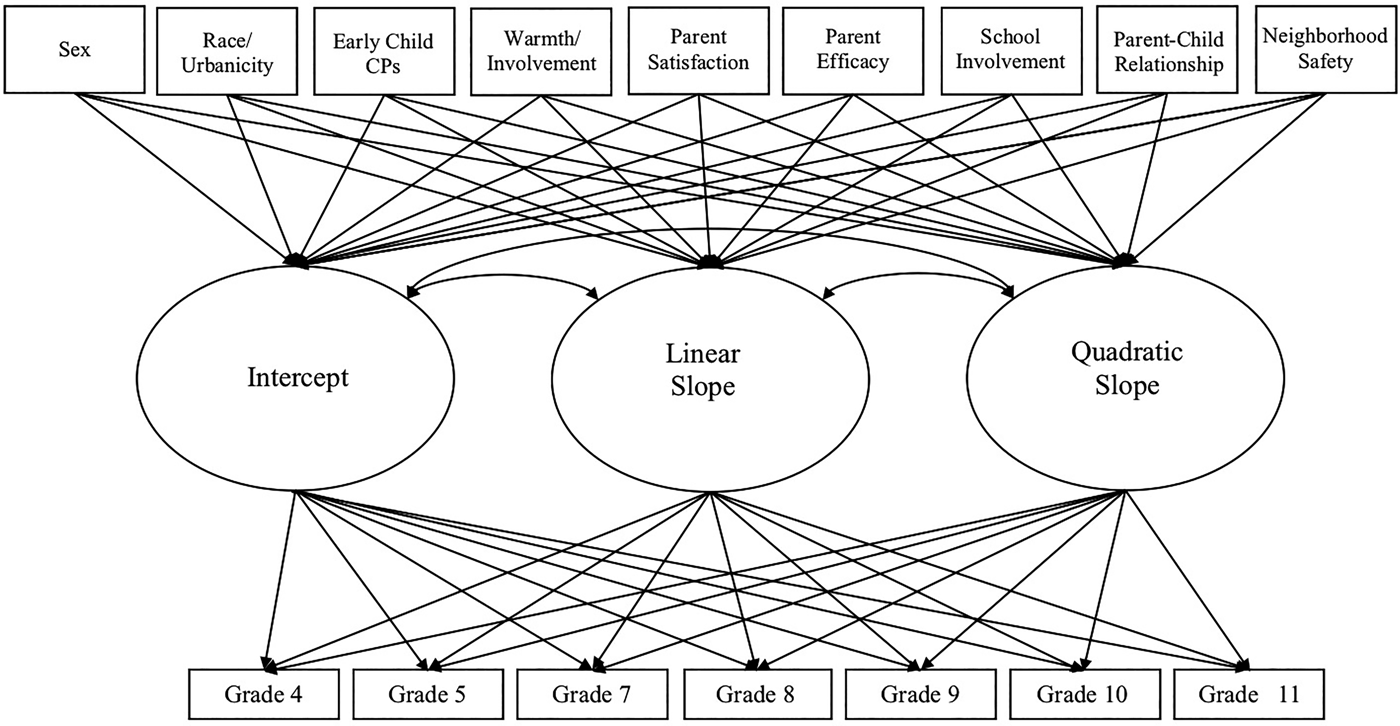
To examine how parental discussions, curfew rules, and child communication with parents developed in this sample, we first tested unconditional univariate LTMs to determine the shape of the trajectories. Next, we conducted conditional univariate LTMs (see Figure 1) to test for sex and race/urbanicity differences in the growth of parental discussions, curfew rules, and child communication with parents, and to investigate the influence of the kindergarten antecedents. Sex of the child, urbanicity (represented by two contrast-coded variables), and the hypothesized kindergarten antecedents (mean centered to aid in interpretation) were entered as exogenous predictors of the intercept and slope factors. In this regard, these variables were time-invariant covariates and therefore account for between-person variance in the intercept and slope estimates (Curran & Hussong, Reference Curran and Hussong2003; Preacher et al., Reference Preacher, Wichman, MacCallum and Briggs2008).
Conditional univariate latent trajectory model (LTM). Note. Race/urbanicity effects were analyzed with two contrast coded variables; CPs = child conduct problems. Conditional LTMs provided a good fit to the data per parent-reported, χ 2 (78, N = 753) = 126.17, p < .001; CFI = .94, TLI = .93, RMSEA = .03, SRMR = .05, and child-reported, χ 2 (63, N = 753) = 67.41, p = .33; CFI = .99, TLI = .99, RMSEA = .01, SRMR = .05, parental discussions; per parent-reported, χ 2 (78, N = 753) = 81.75, p = .36; CFI = .98, TLI = .98, RMSEA = .01, SRMR = .09, and child-reported, χ 2 (63, N = 753) = 73.89, p = .16; CFI = .96, TLI = .93, RMSEA = .02, SRMR = .07, curfew rules; and per parent-reported χ 2 (63, N = 753) = 103.49, p < .01; CFI = .95, TLI = .93, RMSEA = .03, SRMR = .06, and child-reported, χ 2 (63, N = 753) = 65.41, p = .39; CFI = .99, TLI = .99, RMSEA = .01, SRMR = .03, child communication.

Assessing model fit
We assessed fit using the root-mean-square error of approximation (RMSEA), comparative fit index (CFI), Tucker-Lewis Index (TLI), and standardized root mean square residual (SRMR) because these indices have been shown to be most sensitive to model misspecification. Modification indices (which indicate areas of model misspecification) and residuals were also examined to determine if the model provided an adequate fit to the data (Marsh, Hau & Wen, Reference Marsh, Hau and Wen2004). Nested model tests examined the Satorra-Bentler scaled Δχ 2-difference test (Satorra & Bentler, Reference Satorra and Bentler2001) and changes in the Bayesian information criteria (BIC) values (lower is considered better). For the censored models using the WLSMV estimator, nested model tests were conducted with the DIFFTEST option in Mplus.
Results
Descriptive Statistics
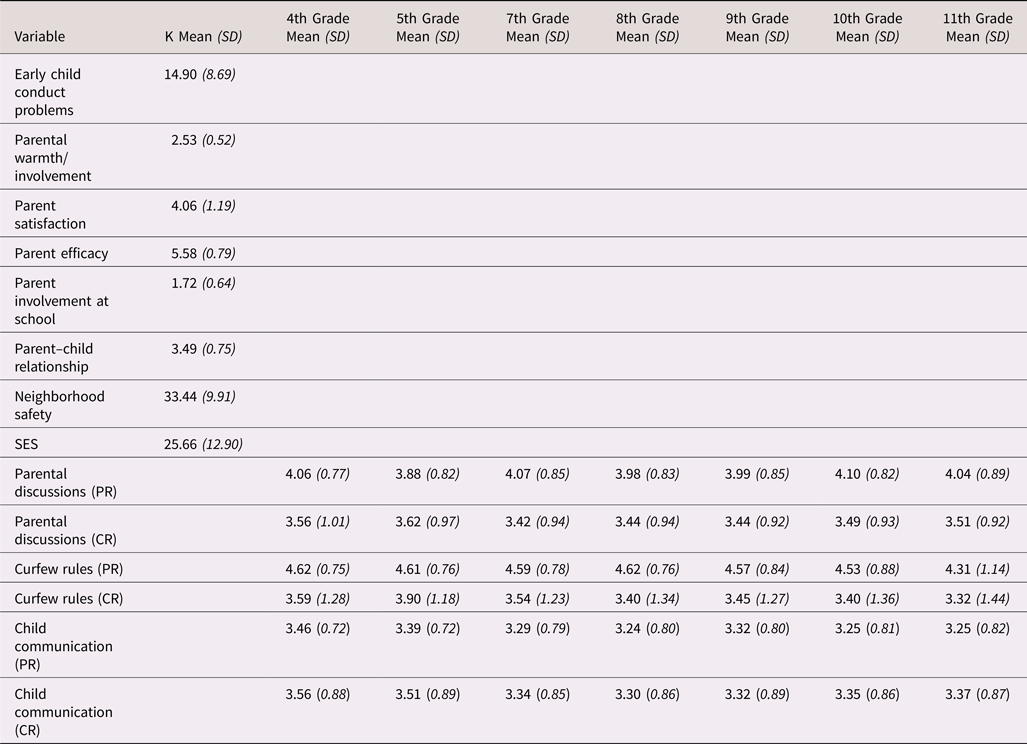
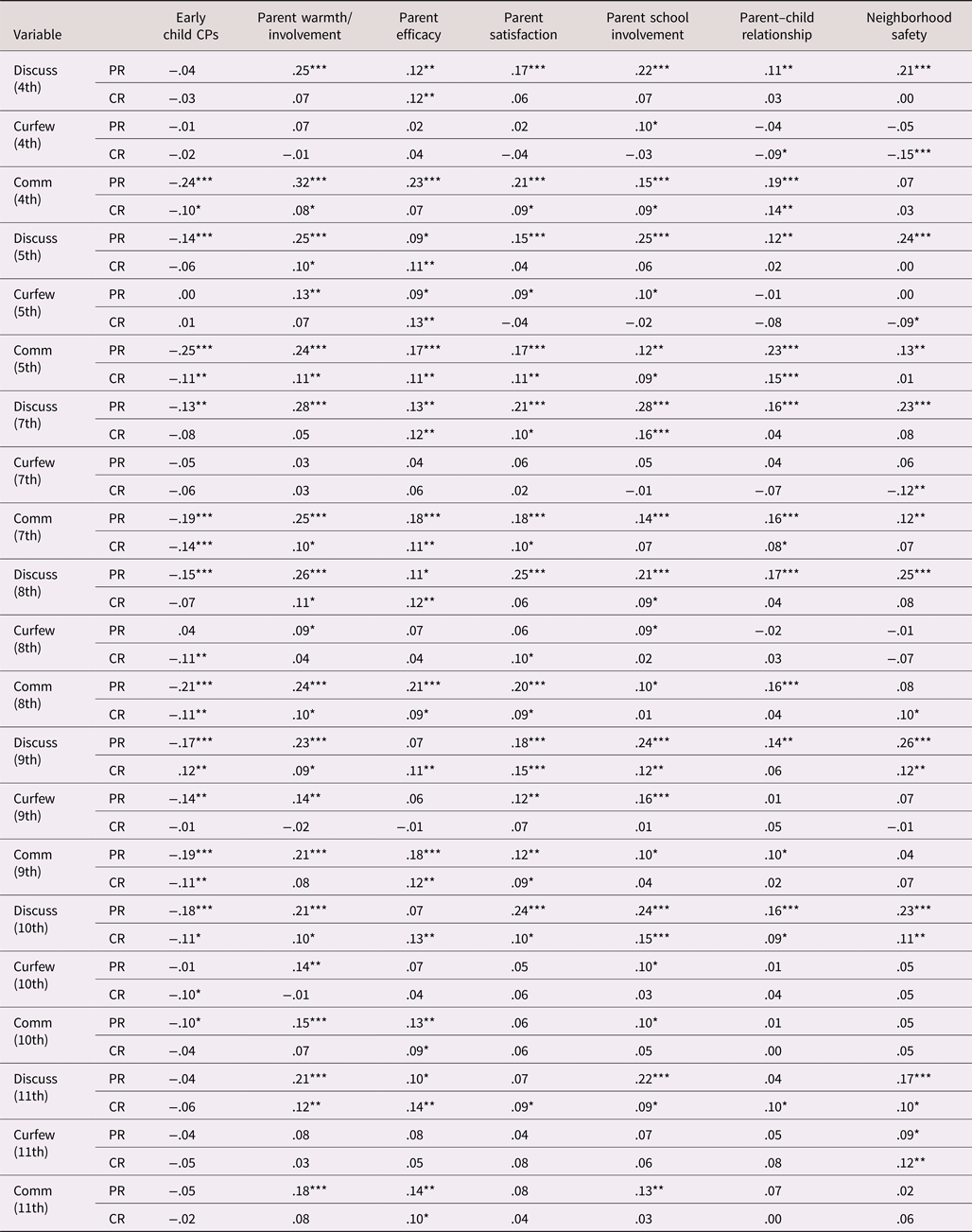
Means and standard deviations are presented in Table 1. Given the scaling of our measures, the average scores across time indicated that parents and children reported engaging in parental monitoring strategies “sometimes” to “often” (average scores for active parental monitoring strategies according to parent report were the highest). Table 2 provides the intercorrelations between parental discussions, curfew rules, and child communication with parents and the kindergarten antecedents. There were more significant correlations between earlier reports of parental monitoring strategies and the kindergarten antecedents than between the antecedents and reports of these monitoring strategies at later time points. More significant correlations were also observed for the kindergarten antecedents regarding parenting behaviors (e.g., parent efficacy and satisfaction) and the monitoring strategies compared with the other kindergarten antecedents. Generally, however, correlations presented in Table 2 indicated that higher levels of parental discussions, curfew rules, and child communication with parents were associated with fewer early child conduct problems; more parental warmth, involvement, efficacy, satisfaction, school involvement, and relationship quality; and higher levels of neighborhood safety as measured in kindergarten (except for a negative correlation between child-reported curfew rules and neighborhood safety at Grades 4, 5, and 7, suggesting that higher levels of child-reported curfew rules were associated with lower levels of neighborhood safety).
Means and standard deviations of antecedents, parental discussions, curfew rules, and child communication with parent

Note: K = kindergarten, SES = socioeconomic status, PR = parent report, CR = child report.
Correlations between parental discussions, curfew rules, and child communication and kindergarten antecedents

Note: Discuss = parental discussions, curfew = curfew rules, comm = child communication with parent, PR = parent report, CR = child report, CPs = child conduct problems.
*p < .05 **p < .01 ***p < .001.
Goal One: Shape of the Growth Trajectories of Parental Discussions, Curfew Rules, and Child Communication with Parents
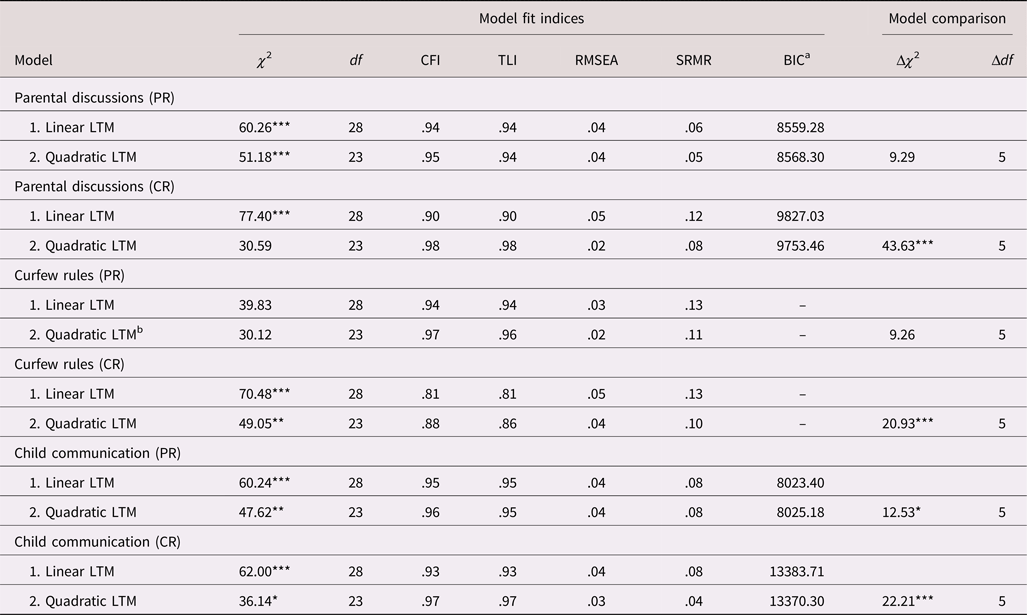
For our first goal of assessing the development of parental discussions, curfew rules, and child communication with parents from middle childhood through adolescence, we used univariate LTMs, conditional on the covariates, to determine the shape of the growth trajectories (see Table 3). For parent-reported discussions and curfew rules, the two-factor LTM with a linear slope provided a good fit to the data. For child-reported parental discussions and curfew rules, as well as parent- and child-reported child communication with parents, the addition of the quadratic slope factor significantly improved model fit. This quadratic factor captured nonlinear growth and accounted for acceleration or deceleration in these parental monitoring strategies.
Model fit indices and model comparisons of univariate LTMs of parental discussions, curfew rules, and child communication according to parent and child report

Note: PR = parent report, CR = child report, LTM = latent trajectory model. All models conducted controlling for site. Model comparisons are compared to the first linear LTM.
aBIC not available for WLSMV estimator; b Model estimation errors.
*p < .05 **p < .01 ***p < .001.
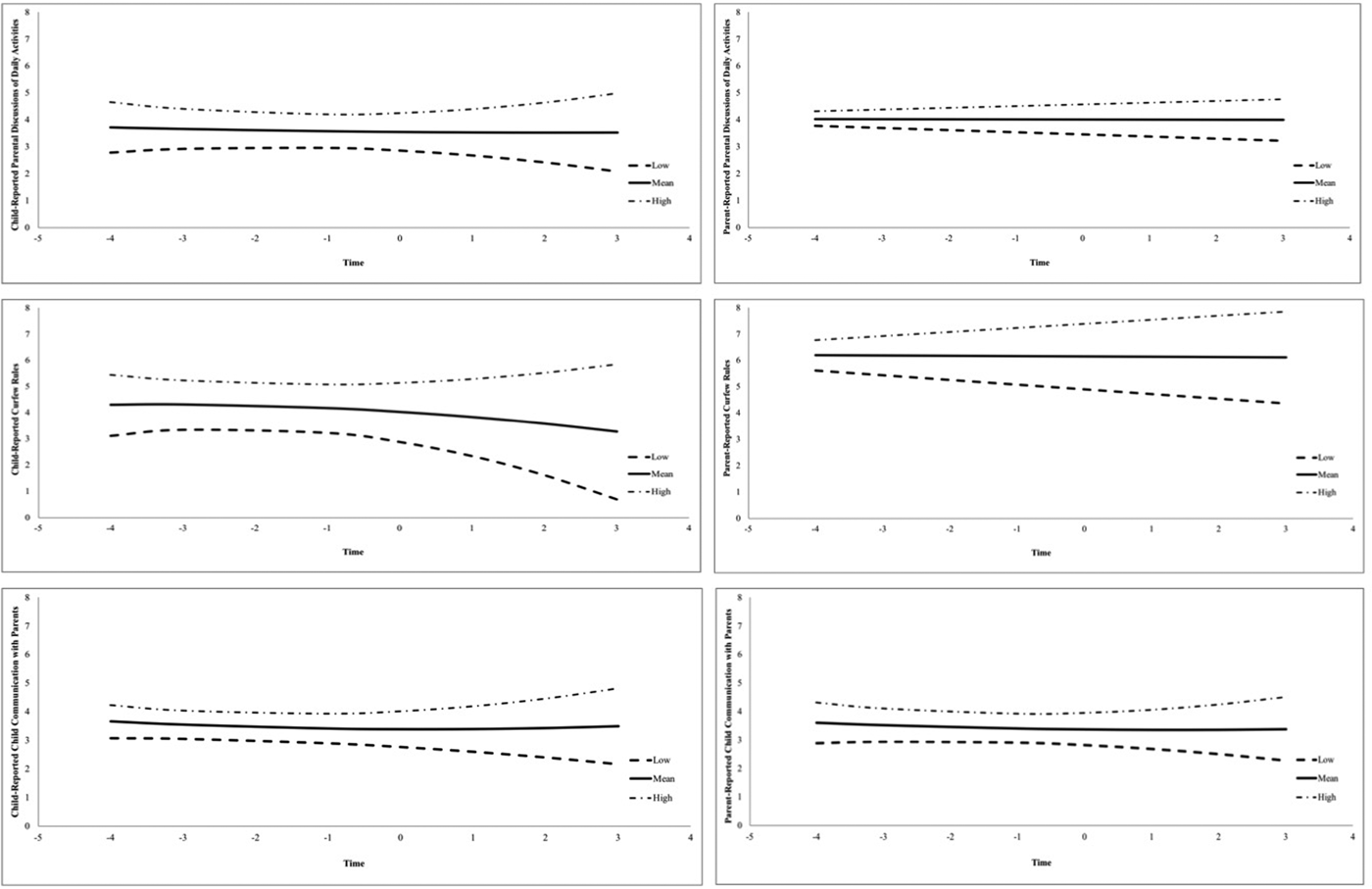
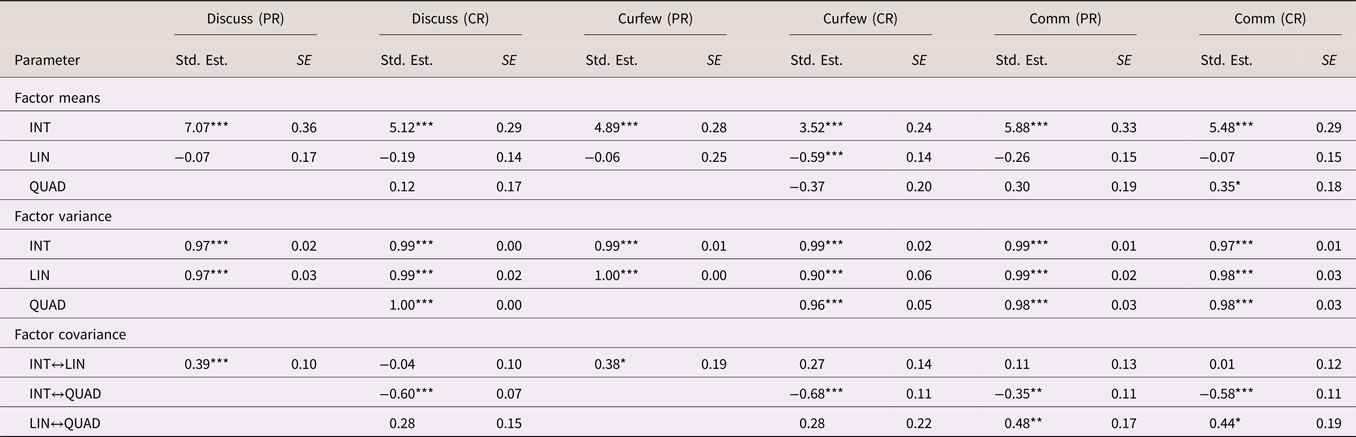
Table 4 presents the estimated means, variances, and covariances between the intercept and slope factors. Since this table presents growth parameter coefficients that have been standardized with respect to the outcome, it is possible to interpret the growth curves as a time effect in standard deviation units. For example, our model predicted that every 1 year would bring a 0.07 decrease in parent-reported parental discussions such that by the end of the study, the average participant would demonstrate a decrease in these parental discussions by .21 standard deviation units relative to their baseline (i.e., Grade 8) levels. All intercept factors for all six developmental trajectories were significant, indicating that they were significantly different from zero. The linear slope of child-reported curfew rules was significant and negative, indicating a decrease in the tilt of the curve in child-reported curfew at Grade 8. Taking into account the negative quadratic slope for child-reported curfew rules, the shape of this curve is decreasing and accelerating (i.e., the curve is concave and the curviness is increasing). A significant positive quadratic slope was also found for child-reported child communication with parents. Taking into account the negative linear slope for child-reported communication with parents, the shape of this curve is convex and the curviness is increasing (i.e., accelerating). All other slope factors were not significant, indicating no average change in parent- and child-reported parental discussions or in parent-reported curfew rules and child communication with parents. This lack of average change in these trajectories is visualized in the relatively flat average model estimated growth over time for all six LTMs depicted in Figure 2.
Graphs illustrating model estimated growth for all six LTMs for participants at average growth over time (Mean), at +1 SD (High) for the intercept and slopes, and at −1 SD (Low) for all growth factors.

Estimated factor means, variances, and covariances of the univariate LTMs of parental discussions, curfew rules, and child communication

Note: Discuss = parental discussions, Curfew = curfew rules, Comm = child communication, PR = parent report, CR = child report, INT = intercept, LIN = linear slope, QUAD = quadratic slope, Std. Est. = standardized model estimate, SE = standard error.
*p < .05 **p < .01 ***p < .001.
Significant variances around all intercept and slope parameters indicated heterogeneity (i.e., individual differences) in initial levels and rates of change in parent- and child- reported parental discussions, curfew rules, and child communication. For example, significant variance around the linear slope factors for parent-reported parental discussions and curfew rules suggested that some children showed a decrease in the tilt of the curve at Grade 8, whereas for other children that tilt increased or remained stable. Figure 2 provides an illustration of this variability in the growth models.
Several significant factor covariances were also observed. Specifically, the intercepts and linear slopes for parent-reported parental discussions and curfew rules were positively correlated. Since the linear slopes in these models are negative, this finding indicates that higher levels of parent-reported parental discussions and curfew rules at Grade 8 were related to an increase in the negative tilts of the curves at that time (i.e., the slopes become less negative). Several correlations with the quadratic slope factors were also noted. It is important to note that the magnitude of these correlations is dependent on the location of the intercept, and thus must be interpreted with caution (Muthén, Reference Muthén2009).
Goal Two: Sex and Race/Urbanicity Differences in the Developmental Course of Parental Discussions, Curfew Rules, and Child Communication with Parents
To assess this goal, sex and urbanicity (represented by two contrast-coded variables) were entered as predictors of the latent intercept and slope factors in the six growth curve models (see Table 5 for coefficients).
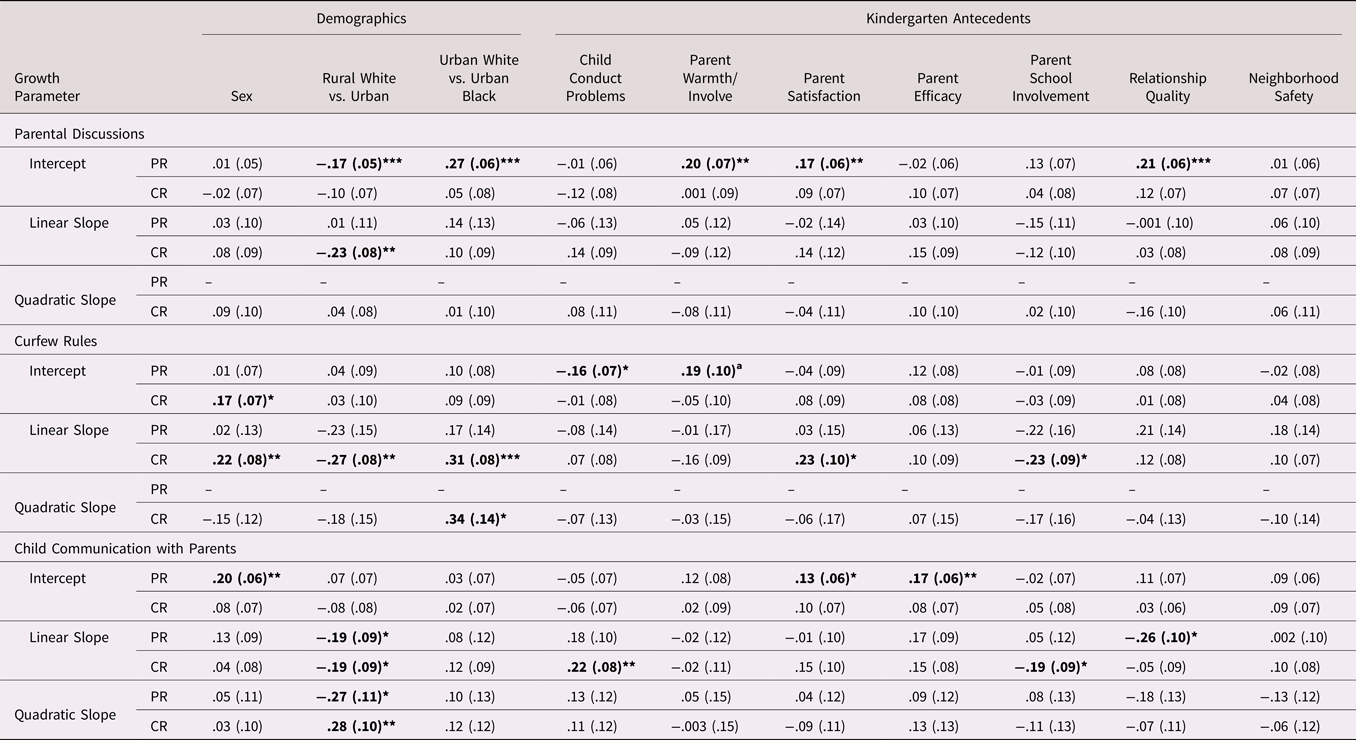
Predictive effects of sex, race/urbanicity, and the kindergarten antecedents on the conditional LTMs of parental discussions, curfew rules, and child communication

Note: Standardized beta coefficients are presented with standard errors in parentheses. Significant effects are bolded. PR = parent report, CR = child report, Rural White vs. Urban and Urban White vs. Urban Black are the two race/urbanicity contrast-coded variables.
*p < .05 **p < .01 ***p < .001 a p = .05.
Sex differences
Only a few significant sex differences emerged in the conditional LTMs. Specifically, females exhibited higher Grade 8 levels and an increase in the negative tilt of the curve at that time (the slope became less negative) for child-reported curfew rules as well as higher Grade 8 levels of parent-reported child communication with parents.
Race/urbanicity differences
Higher Grade 8 levels of parent-reported parental discussions were indicated for urban White children than for urban Black children and for rural White children than for urban White and urban Black children. There was also an increase in the negative tilt of the curve at Grade 8 (the slope became less negative) for child-reported parental discussions and child-reported curfew rules for rural White children compared with urban White and urban Black children.
Differences in child-reported curfew rules between urban White and urban Black children and in parent- and child-reported child communication with parents between rural White and urban White and Black children were more complex given that there were significant effects on both the linear and quadratic slopes. Specifically, there was an increase in negative tilt of the curve at Grade 8 (the slope became less negative) and the quadratic slope became less curvy (decelerated) for child-reported curfew rules for urban White children than for urban Black children. Additionally, for parent-reported communication with parents, for rural White children compared with urban Black and urban White children, there was an increase in the negative tilt of the curve at Grade 8 (the slope became less negative), while the quadratic slope became curvier (accelerated). For child-reported communication with parents, for rural White children compared with urban Black and urban White children, there was an increase in the negative tilt of the curve at Grade 8 (the slope became less negative) while the quadratic slope became less curvy (decelerated).
Goal Three: Kindergarten Antecedents of Parental Discussions, Curfew Rules, and Child Communication with Parents
To assess this goal, the child, parent, family, and contextual kindergarten antecedents were entered as predictors of the latent intercept and slope factors in the six growth curve models (see Table 5 for coefficients).
Conditional LTMs of parental discussions
More parental warmth/involvement and satisfaction and better parent–child relationship quality in kindergarten predicted higher Grade 8 levels of parent-reported discussions. No kindergarten antecedents predicted the intercept or slope factors of child-reported parental discussions.
Conditional LTMs of curfew rules
Fewer early child conduct problems and more parental warmth in kindergarten predicted higher Grade 8 levels of parent-reported curfew rules. Higher levels of parental satisfaction in kindergarten predicted an increase in the linear slope of child-reported curfew rules such that the tilt of the curve became less negative at Grade 8. Additionally, parent–school involvement in kindergarten predicted a decrease in the linear slope of child-reported curfew rules such that the tilt of the curve became more negative at Grade 8.
Conditional LTMs of child communication with parents
Higher levels of parental efficacy and satisfaction in kindergarten predicted higher Grade 8 levels of parent-reported communication with parents. Additionally, better parent–child relationship quality in kindergarten negatively predicted the linear slope of parent-reported communication, such that the tilt of the curve became more negative at Grade 8. For child-reported communication with parents, both early child conduct problems and parent–school involvement in kindergarten predicted the linear slope, such that higher levels of child conduct problems predicted an increase in the negative tilt of the curve (the tilt became less negative) at Grade 8 while higher levels of parent–school involvement predicted a decrease in the negative tilt of the curve (the tilt became more negative) at Grade 8.
Discussion
The goals of this study were to examine the developmental trajectories of parent- and child-reported parental discussions, curfew rules, and child communication with parents across multiple ages and developmental stages (i.e., Grades 4–5 and 7–11; middle childhood through adolescence). We also sought to determine if there were any sex and race/urbanicity differences in these active and passive parental monitoring strategies in order to determine if these aspects of parental monitoring developed differently for different groups of children. Using an ecological perspective, we also examined several individual, family, and contextual antecedents measured in kindergarten of parental discussions, curfew rules, and child communication with parents. Findings from this study highlighted several early precursors of these active and passive forms of parental monitoring strategies, suggesting potential targets for preventive interventions.
Development of Parental Discussions, Curfew Rules, and Child Communication during Middle Childhood and Adolescence
While previous studies have suggested that aspects of parental monitoring tend to decrease over time (e.g., Kerr & Stattin, Reference Kerr, Stattin, Crouter and Booth2003; Laird et al., Reference Laird, Criss, Pettit, Bates and Dodge2009; Larson et al., Reference Larson, Richards, Moneta, Holmbeck and Duckett1996; Pettit et al., Reference Pettit, Keiley, Laird, Bates and Dodge2007; Wang et al., Reference Wang, Dishion, Stormshak and Willett2011), the findings from the current study generally indicated little to no change or growth in parental discussions, curfew rules, and child communication with parents over time. We did observe a significant linear slope of child-reported curfew rules, indicating a negative tilt of the curve at Grade 8. Taking into account the quadratic slope in this model, the tilt of this curve decreased at Grade 8, and this decrease accelerated with time. This finding is consistent with a documented linear decrease in parental control at later ages (i.e., 14–19) and not at earlier ages (i.e., 12–14; Keijsers & Poulin, Reference Keijsers and Poulin2013). Also consistent with other studies (Keijsers et al., Reference Keijsers, Frijns, Branje and Meeus2009; Laird et al., Reference Laird, Pettit, Bates and Dodge2003), we documented the presence of nonlinear growth in child-reported parental discussions and curfew rules, and parent- and child- reported child communication with parents. While only the quadratic slope factor for child-reported child communication with parents was significant (indicating an acceleration in the positive tilt of the curve at Grade 8), the addition of the quadratic slope to these models improved model fit and captured some of the nonlinearity in the development of these constructs over time. It is also important to note significant individual heterogeneity around the intercept and slope factors of the LTMs, indicating that initial levels of and growth in parental discussions, curfew rules, and child communication with parents varied significantly in this sample.
The overall stability in the active and passive parental monitoring strategies examined over time in the current study is most clearly visualized in Figure 2. There may be several reasons for these seemingly surprising findings. First, the current study examined a diverse sample of families living in at-risk neighborhoods, whereas most previous studies have studied homogenous, low-risk samples. Our findings therefore suggest that in more at-risk settings, parents may engage in more active parental monitoring strategies consistently over time in order to ensure the safety and well-being of their children (Burton & Jarrett, Reference Burton and Jarrett2000; Gartstein et al., Reference Gartstein, Seamon and Dishion2014; Supplee et al., Reference Supplee, Unikel and Shaw2007). This interpretation is further supported by findings from analyses with the same sample as was included in the current study (Bendezú et al., Reference Bendezú, Pinderhughes, Hurley, McMahon and Racz2018), which highlighted the important role of parental discussions in more at-risk contexts. Furthermore, and counter to our hypotheses, we also observed no change in child communication with parents over time. Therefore, it may be the case that families residing in at-risk neighborhoods use both active and passive parental monitoring strategies consistently over time and that there are expectations that both parents and children contribute to the monitoring process. In fact, caregiving for emerging and older adolescents involves dynamic interactions and negotiations between parents and adolescents to balance adolescents’ needs for autonomy and independence while also ensuring their safety (Kurz, Reference Kurz2002).
It is also important to note differing operationalizations of active and passive parental monitoring strategies in our study compared with previous studies. While our measures capture some of the essential components of these monitoring strategies, we may have discovered a different developmental course if we had examined more traditional conceptualizations of parental solicitation, parental control, and child disclosure. Close examination of our specific measures also reveals that these questions largely center on parent–child communication and rule setting, reflecting a multifaceted and complex series of parent–child behaviors and interactions. Some recent qualitative work highlights that Latina mothers residing in more at-risk neighborhoods reported using strict rules and enhancing parent–child communication in order to engage in effective parenting strategies in these more challenging contexts (Ceballo, Kennedy, Bregman, & Epstein-Ngo, Reference Ceballo, Kennedy, Bregman and Epstein-Ngo2012). The documented stability in parental discussions, curfew rules, and child communication with parents in a diverse sample living in at-risk neighborhoods is consistent with these qualitative reports and suggests that our findings largely reflect some aspect of the context in which these families reside.
The current study demonstrated some support for our hypotheses regarding sex and race/urbanicity differences in parental discussions, curfew rules, and child communication with parents. Generally, our findings did not identify any consistent evidence for sex differences in active and passive parental monitoring strategies, indicating similar growth patterns for males and females in this sample. Those that were significant (i.e., child-reported curfew rules and parent-reported child communication with parents) documented higher levels of parental monitoring and less decrease over time for females than for males. These findings are in line with previous research suggesting that girls are monitored more than boys (Jacobson & Crockett, Reference Jacobson and Crockett2000; Masche, Reference Masche2010; Willoughby & Hamza, Reference Willoughby and Hamza2011).
More consistent race/urbanicity differences were identified in both initial levels of and growth in parental discussions, curfew rules, and child communication with parents. Taken together, these findings largely indicated higher levels of and less decrease across time in these parental monitoring strategies for urban White children than for urban Black children and for rural White children than for urban White and urban Black children. Of note, a similar pattern of findings regarding Black children was identified in a previous study that used data from the Fast Track Project (Pinderhughes et al., Reference Pinderhughes and Hurley2008). These findings also highlight the difficulty that families residing in urban neighborhoods have in implementing parental monitoring strategies. While all families in the sample were residing in at-risk neighborhoods, only some were residing in urban areas where a multitude of risk factors (e.g., violence, economic distress) may disrupt the monitoring process (Ceballo & McLoyd, Reference Ceballo and McLoyd2002; Crouter & Head, Reference Crouter, Head and Bornstein2002; Klein et al., Reference Klein and Forehand2000; Pettit et al., Reference Pettit, Keiley, Laird, Bates and Dodge2007). These findings again highlight the need to consider the effects of broader contextual factors and the multitude of extrafamilial influences that parents and children must contend with when engaging in the monitoring process.
Kindergarten Antecedents of Parental Monitoring
Several significant kindergarten antecedents of parental discussions, curfew rules, and child communication with parents suggest that these parental monitoring strategies have important foundations earlier in development. The analyses captured aspects related to child behavior, parental behavior (i.e., warmth, involvement, efficacy, satisfaction), and parent–child relationship quality, and the results generally suggested that more parental warmth, satisfaction, and efficacy and a better parent–child relationship predicted higher initial levels of and a more positive tilt in the growth curves at Grade 8. Overall, these findings highlight the important role that early family experiences and behaviors have in setting the stage for both parents and children to engage in the monitoring process during later developmental periods (Crouter & Head, Reference Crouter, Head and Bornstein2002; Dishion & McMahon, Reference Dishion and McMahon1998).
A number of the specific parenting variables measured in kindergarten emerged as more consistent predictors of the latent intercept and slope factors in active and passive parental monitoring strategies. These variables included parental warmth/involvement and parental satisfaction, both of which may lead parents to interact frequently with their children and feel positive about their parenting efforts. Differential predictive effects in these kindergarten antecedents warrant further explanation. That is, higher levels of parental warmth predicted higher Grade 8 levels of both aspects of active parental monitoring strategies (i.e., parental discussions and curfew rules), but only according to parent report. It may be that parents who are warm and involved with their children during kindergarten find it easier to initiate conversations with their children and implement curfew rules during early adolescence than parents who lack this earlier emotional connection to and involvement with their children. Other research about integrative models of parenting practices suggests that warmth in the parent–child relationship enhances the effectiveness of various parenting practices (Darling & Steinberg, Reference Darling and Steinberg1993; Lippold, Greenberg, Graham, & Feinberg, Reference Lippold, Greenberg, Graham and Feinberg2014; Lowe & Dotterer, Reference Lowe and Dotterer2013; Patrick et al., Reference Patrick, Snyder, Schrepferman and Snyder2005). However, the influence of kindergarten levels of parental warmth/involvement on these active parental monitoring strategies was only evident to parents. This finding may reflect parental perspectives about the emotional quality of their parenting and how that predicts their future parenting efforts, but it may also be due in part to same-reporter method variance.
Predictive effects of parental satisfaction were observed for both active and passive monitoring strategies according to both parent and child report, but again, these effects were not consistent across all parental monitoring strategies according to both reporters. Regardless, this series of findings suggests that parental satisfaction is a particularly important antecedent of these monitoring strategies (e.g., initiating conversations and setting curfew rules), leading parents to engage in more proactive parenting strategies later in development (Pettit et al., Reference Pettit, Laird, Dodge, Bates and Criss2001). In turn, children may respond to this parental engagement by reciprocating the behavior and communicating openly with their parents. We also documented predictive effects of parental efficacy on child communication with parents according to parent report. One study demonstrated that parental efficacy has both direct and indirect (through parenting practices and behaviors) effects on child adjustment (Jones & Prinz, Reference Jones and Prinz2005), suggesting that parents who feel effective in their parenting create a context wherein children are able to engage in family processes and interactions. Taken together, these findings highlight the important role of parental behaviors and perceptions about their parenting, as measured in kindergarten, on the ability of both parents and children to engage in parental monitoring strategies later in development.
We did identify a number of unexpected findings in these predictive effects of kindergarten antecedents on later active and passive parental monitoring strategies. First, it was interesting to note that we documented a negative effect of early child conduct problems on the intercept factor of parent-reported curfew rules but a positive effect on the linear slope factor of child-reported child communication with parents. Consistent with research indicating declines in parental monitoring in response to child behavior problems (e.g., Dishion et al., Reference Dishion, Nelson and Bullock2004; Laird et al., Reference Laird, Criss, Pettit, Bates and Dodge2009; Patrick et al., Reference Patrick, Snyder, Schrepferman and Snyder2005), our findings here highlight a reciprocal effect between early child conduct problems and later curfew rules. It may be that parents with more agreeable and behaviorally controlled children find it easier to implement rules when those children begin to enter adolescence. Put another way, parents may withdraw their rule-setting efforts in response to high levels of behavior problems because they feel helpless or ineffective in their efforts to alter their children's behavioral patterns. In terms of the influence of early child conduct problems on child-reported communication, more behavior problems predicted an increase in the negative tilt of the curve at Grade 8 such that the curve became less negative at that point. This finding may reflect that children with high levels of behavior problems evidence difficulties with impulse control, oppositionality, and emotional learning (Kimonis et al., Reference Kimonis, Frick, McMahon, Mash and Barkley2014), which may increase their (albeit aversive) communication with their parents. It is also important to note that this finding was only identified for child-reported communication with parents, and therefore warrants further examination in future studies.
Additional unexpected findings centered on the parent–child relationship quality and parent–school involvement in kindergarten. While the positive effect of the quality of the parent–child relationship on the intercept factor of parent-reported parental discussions was in line with our expectations and was consistent with the broader literature (e.g., Crouter & Head, Reference Crouter, Head and Bornstein2002; Dishion & McMahon, Reference Dishion and McMahon1998; Fosco et al., Reference Fosco, Stormshak, Dishion and Winter2012), we were surprised to find a negative effect of this antecedent on the linear slope of parent-reported child communication with parents. The direction of this effect indicated that better parent–child relationship quality predicted a decrease in the negative tilt of the curve at Grade 8 such that the curve became more negative. It may be that the parent–child relationship quality in kindergarten has more of an influence on parent-directed communication and that other factors (e.g., broader parenting practices and family interactions) are more influential for later child-directed communication. It is also important to note that this is just one finding in a series of significant predictive effects, so future research is needed to assess the direction and magnitude of this finding more directly.
A final unexpected finding concerned the negative effects of parent–school involvement on the linear slopes of child-reported curfew rules and child communication with parents. Both findings indicated decreases in the tilt of the curves at Grade 8 (such that the curves became more negative), but we expected that parent–school involvement would predict increases in parental monitoring strategies over time. These findings suggest that parents who demonstrate early involvement in their children's schooling continue to do so throughout development and do not need to engage in high levels of parental monitoring strategies because they are able to track their children's activities and whereabouts through other means (e.g., involvement at school functions, interactions with teachers and administrators). Additionally, it is important to note that both effects were only apparent according to child report, which may suggest that children react negatively to their parents’ engagement at school. Children may perceive this type of involvement as negative and invasive, and these perceptions may spill over to create more negative opinions of other parenting practices and behaviors. In fact, there is some evidence to suggest that parental school involvement has both positive and negative influences on children's functioning and educational outcomes (Domina, Reference Domina2005). These interpretations are speculative, so future research should seek to understand child perceptions of and reactions to parental involvement at school.
Our findings from the unconditional growth curves demonstrated little to no growth in active or passive parental monitoring strategies, which we have largely attributed to the fact that these families are residing in more at-risk environments and therefore need to engage in more consistent levels of these strategies over time. Therefore, we were surprised to see that perceived neighborhood safety in kindergarten had no effect on any of the growth parameters in our six growth curve models. It may be that broader and immediate contextual factors have more influence on parental monitoring strategies than perceptions of neighborhood problems at an earlier phase of development. That is, the effects of neighborhood difficulties perceived in kindergarten may dissipate by the time children enter middle childhood and adolescence. It is also important to note that neighborhood risk may appear very different across the four sites included in the Fast Track Project such that differences in perceptions of risk both within and across sites may have washed out any significant effects. While we controlled for site in all analyses, it is still important to consider that neighborhood risk in urban areas may be qualitatively different from neighborhood risk in rural areas. Furthermore, while there were not any significant effects on the growth curves, there were some significant bivariate correlations between neighborhood safety in kindergarten and the active and passive parental monitoring strategies. These associations were largely positive, indicating that higher levels of neighborhood problems were associated with higher levels of active and passive parental monitoring strategies, and vice versa. These findings suggest that parental monitoring efforts may be difficult to implement in unsafe neighborhoods due to a constellation of psychosocial stressors inherent in these environments (Dishion & McMahon, Reference Dishion and McMahon1998; Laird et al., Reference Laird, Criss, Pettit, Bates and Dodge2009; Pettit et al., Reference Pettit, Laird, Dodge, Bates and Criss2001, Reference Pettit, Keiley, Laird, Bates and Dodge2007). Of note, we also identified negative correlations between neighborhood safety and child-reported curfew rules at 4th, 5th, and 7th grades. These correlations suggested that lower levels of neighborhood safety were related to higher levels of child-reported curfew rules at those time points. Consistent with our interpretations of the unconditional growth curves, and literature documenting high levels of rules among diverse families living in at-risk communities (Ceballo et al., Reference Ceballo, Kennedy, Bregman and Epstein-Ngo2012), it may be the case that parents respond to neighborhood difficulties by implementing strict rules regarding when children need to be home and off the streets. These types of rules may be particularly important for younger children who are more vulnerable to the effects of these unsafe neighborhoods (Leventhal & Brooks-Gunn, Reference Leventhal and Brooks-Gunn2000).
Strengths and Limitations
The strengths of the current study include the use of a longitudinal design with a large, diverse, multisite sample. Most studies of parental monitoring have examined homogenous, low-risk samples, so the current study fills an important gap in our understanding of the developmental course of parental monitoring strategies among diverse families living in at-risk neighborhoods. Additionally, this study examined parental monitoring at an earlier age (i.e., Grade 4) and over a longer period of time (i.e., 7 years) than the majority of previous studies. Therefore, this study provides an in-depth examination of the development of this parenting behavior through the use of statistically sophisticated techniques (i.e., LTMs).
An additional strength of this study is the inclusion of both parent- and child-report measures. Many previous studies have used single-reporter measures (usually from the child), thereby obscuring potentially important differences in rates of parental monitoring by parent and child report. Consideration of these potential reporter differences is important, especially given that children's and parents’ reports of parental monitoring are remarkably inconsistent (Augenstein et al., Reference Augenstein, Thomas, Ehrlich, Daruwala, Reyes, Chrabaszcz and De Los Reyes2016; Crouter & Head, Reference Crouter, Head and Bornstein2002; De Los Reyes, Goodman, Kliewer, & Reid-Quiñones, Reference De Los Reyes, Goodman, Kliewer and Reid-Quiñones2010; Dishion & McMahon, Reference Dishion and McMahon1998; Pettit et al., Reference Pettit, Laird, Dodge, Bates and Criss2001). Results from the current study also indicated important differences by reporter in the shapes of the growth curves and in the predictions from kindergarten antecedents. Future research should continue to include dual-reporter models and to consider the influence of highly discordant reports of parental monitoring. Specifically, there may be important differences between families who report both high child- and parent-reported monitoring and families who have less concordant reports.
While a strength of our study is the examination of parental monitoring strategies according to both parent and child report, it is important to note that several of our antecedent analyses were only identified within a single reporter (i.e., parent-reported kindergarten antecedents predicting parent-reported monitoring strategies). While these findings may highlight the importance of parents’ early parental experiences and perceptions, they may also reflect shared-reporter method variance. Therefore, these findings should be interpreted with some degree of caution. Cross-reporter findings (i.e., parent-reported kindergarten antecedents predicting child-reported monitoring strategies) identified significant effects for parental satisfaction, child conduct problems, and parental school involvement in kindergarten on later child-reported curfew rules and communication with parents. However, several of these findings were rather surprising, as discussed above, suggesting that the effects of these kindergarten antecedents on later parental monitoring strategies may not be as straightforward as previously thought. Continued work to explore the direction and magnitude of these effects is warranted as well as consideration of differences in how parents and children view and interpret parental monitoring strategies.
In terms of limitations of the current study, our measures of parental discussions, curfew rules, and child communication with parents only included a few items each, so they may be missing some aspects of parental monitoring strategies (e.g., soliciting information from parents of children's friends). This limitation may explain some of the differences between the current findings and those of previous studies. However, the items included in the current study tap into the essential components of these parental monitoring strategies, and they are consistent with similar conceptualizations of active and passive parental monitoring in the same sample as the current study (Bendezú et al., Reference Bendezú, Pinderhughes, Hurley, McMahon and Racz2018). These relatively brief measures of parental monitoring strategies may also explain why we observed relatively little variation in scores across time. So, while the stability in parental monitoring strategies across time may reflect the fact that these families live in at-risk neighborhoods, this finding could also be related to our measures.
An additional and related limitation is that we were only able to assess parental monitoring strategies with brief questionnaires. While this measurement approach is consistent with that used in the broader parental monitoring literature, some advances have been made in developing additional modalities to assess parental monitoring, including observational data and ecological momentary assessment (Hawes & Dadds, Reference Hawes and Dadds2006). It will be important for future research to continue to develop and implement these methods to provide a more comprehensive picture of parental monitoring strategies, which may also create more variability and patterns in the data than what are observed from self-report questionnaires.
Implications and Conclusions
In conclusion, the findings from the current study indicated little to no growth in active and passive parental monitoring across middle childhood and adolescence in this diverse sample of families living in at-risk neighborhoods. This finding largely suggests that these families may engage in more consistent levels of monitoring strategies in order to counteract the risks and difficulties inherent in these environments (Burton & Jarrett, Reference Burton and Jarrett2000; Gartstein et al., Reference Gartstein, Seamon and Dishion2014; Supplee et al., Reference Supplee, Unikel and Shaw2007). This study also highlighted the importance of employing an ecological perspective and considering broader contextual factors when examining parental monitoring strategies. In particular, several parenting practices and behaviors (i.e., parental warmth/involvement, satisfaction, and efficacy) emerged as more consistent predictors of later active and passive parental monitoring strategies according to both child and parent report. Therefore, it appears that aspects of parenting and family life measured in kindergarten are important in setting the stage for higher levels of parental monitoring strategies later in development. These parenting factors highlight potential components of early family life that could be targets of preventive interventions that seek to encourage healthy and adaptive development of parenting behaviors and practices during middle childhood and adolescence. It is also important to note that there may be additional precursors to these parental monitoring strategies that emerge even earlier in development (i.e., toddlerhood and the preschool period). Most empirical investigations have focused on the potential that child behavior problems exhibited during this early stage of development predict later parental monitoring (Brown et al., Reference Brown, Granero and Ezpeleta2017; Supplee et al., Reference Supplee, Unikel and Shaw2007). Future research should seek to identify additional precursors of parental monitoring that demonstrate particular importance during toddlerhood and the preschool years (e.g., parent–child attachment, child emotion regulation; Crouter & Head, Reference Crouter, Head and Bornstein2002; Dishion & McMahon, Reference Dishion and McMahon1998).
The results from the current study may assist in the early identification of families at-risk for developing ineffective parental monitoring strategies or who may need to engage in more consistent levels of parental monitoring strategies than other families due to various family and contextual factors (e.g., difficulties during early parenting, living in at-risk neighborhoods). Several prevention and intervention programs already target parental monitoring strategies as well as additional parenting behaviors. A prime example of such programming is the Family Check-Up (FCU; Dishion & Kavanagh, Reference Dishion and Kavanagh2003), a multilevel intervention developed by Tom Dishion and colleagues where families receive parent management training and feedback on their parenting efforts. FCU is a strengths-based intervention that is flexible and tailored to each family's needs and motivation. Evaluation studies with FCU have documented increases in parental monitoring 4 years later among families that participated in the intervention (Dishion, Nelson, & Kavanagh, Reference Dishion, Nelson and Kavanagh2003). These broad family systems-based approaches to treatment may therefore be a promising avenue to bolster parental monitoring among those families most in need of these strategies.
Following established and recent conceptualizations of parental monitoring (e.g., Bendezú et al., Reference Bendezú, Pinderhughes, Hurley, McMahon and Racz2018; Dishion & McMahon, Reference Dishion and McMahon1998; Racz & McMahon, Reference Racz and McMahon2011; Stattin & Kerr, Reference Stattin and Kerr2000), we encourage future research that examines parental monitoring strategies across different developmental time points with measures that incorporate all aspects of these strategies according to both parent and child report. Drawing from the influential work of Tom Dishion and others (e.g., Capaldi, Reference Capaldi, Crouter and Booth2003; Dishion & Stormshak, Reference Dishion and Stormshak2007; Granic, Dishion, & Hollenstein, Reference Granic, Dishion, Hollenstein, Adams and Berzonsky2006; Kotchick & Forehand, Reference Kotchick and Forehand2002), we further endorse the need for studies of parenting behaviors and family life to incorporate an ecological perspective on the development of these constructs over time and to take a family-centered approach to interventions with children and parents. Future research should consider that active and passive parental monitoring strategies are likely associated with several family factors including parental motivation, beliefs, and ability to implement effective parenting behaviors; quality of family relationships; and family conflict (Dishion & McMahon, Reference Dishion and McMahon1998; Pettit & Laird, Reference Pettit, Laird and Barber2002; Racz & McMahon, Reference Racz and McMahon2011). It is also likely that a constellation of factors plays a crucial role in the developmental course of parental monitoring strategies over time (Odgers et al., Reference Odgers, Caspi, Russell, Sampson, Arseneault and Moffitt2012), and consideration of how these individual, parent, family, and contextual factors interact is warranted. Work by Tom Dishion and others has also enhanced our understanding of the multitude of negative child and adolescent outcomes associated with poor parental monitoring including antisocial behavior, substance use, and affiliation with deviant peers (e.g., Dishion, Bullock, & Kiesner, Reference Dishion, Bullock, Kiesner, Kerr, Stattin and Engels2008; Dishion, Patterson, Stoolmiller, & Skinner, Reference Dishion, Patterson, Stoolmiller and Skinner1991; Fosco et al., Reference Fosco, Stormshak, Dishion and Winter2012; Gartstein et al., Reference Gartstein, Seamon and Dishion2014; Kiesner, Dishion, Poulin, & Pastore, Reference Kiesner, Dishion, Poulin and Pastore2009; Wang et al., Reference Wang, Dishion, Stormshak and Willett2011). Consideration of these factors may help further elucidate how family dynamics contribute to the development of effective parental monitoring and the many untoward consequences that result when difficulties are encountered in the parental monitoring process.
Acknowledgments
We are grateful to the members of the Conduct Problems Prevention Research Group (in alphabetical order, Karen L. Bierman, Pennsylvania State University; John D. Coie, Duke University; D. Max Crowley, Pennsylvania State University; Kenneth A. Dodge, Duke University; Mark T. Greenberg, Pennsylvania State University; John E. Lochman, University of Alabama; Robert J. McMahon, Simon Fraser University and B.C. Children’s Hospital Research Institute, and Ellen E. Pinderhughes, Tufts University) for providing the data and for additional involvement. We are grateful for the collaboration of the Durham Public Schools, the Metropolitan Nashville Public Schools, the Bellefonte Area Schools, the Tyrone Area Schools, the Mifflin County Schools, the Highline Public Schools, and the Seattle Public Schools. We appreciate the hard work and dedication of the many staff members who implemented the project, collected the evaluation data, and assisted with data management and analyses.
Financial Support
The Fast Track project has been supported by National Institute of Mental Health (NIMH) Grants R18 MH48043, R18 MH50951, R18 MH50952, R18 MH50953, K05MH00797, and K05MH01027; National Institute on Drug Abuse (NIDA) Grants DA016903, K05DA15226, RC1DA028248, and P30DA023026; National Institute of Child Health and Human Development Grant R01 HD093651; and Department of Education Grant S184U30002. The Center for Substance Abuse Prevention also provided support through a memorandum of agreement with the NIMH. Additional support for this study was provided by a B.C. Children’s Hospital Research Institute Investigator Grant Award and a Canada Foundation for Innovation award to Robert J. McMahon.