Following the 2006 elections in Brazil, there was talk that the country was undergoing a process of political polarisation between the more developed South and the less developed North which could have led to the emergence of potentially explosive regional and social cleavages, along the lines of what was being observed elsewhere in Latin America. It is argued in this paper that this is not the case. Even though the 2006 elections marked a dramatic shift in Lula's electoral base away from the more developed regions of the country and into its poorest areas, this can be explained mainly by the government's massive cash transfer programme, the Bolsa Familia, and by a pro-government electorate that, it is argued here, typifies the country's least developed areas.
Pundits and academics alike have debated the connection between the Bolsa Familia and Lula's re-election. Wendy Hunter and Timothy Power set the terms of the academic debate, soon after the election itself, by noting the economic voting rationale, both in terms of targeted social policies and general economic performance, behind Lula's victory in 2006.Footnote 1 Since then contributions from Jairo Nicolau and Vitor Peixoto, who argue in support of the Bolsa Familia effect, and from André Carraro et al., who question it, have stirred controversy among Brazilian academics.Footnote 2 This paper adds to the understanding of this political process by analysing carefully municipal-level electoral results and a wide array of co-variates. More importantly, however, it places the 2006 electoral results in the context of the five preceding democratic elections, and argues that there exists a strong tendency for the more backward regions of the country to vote for the incumbent government, irrespective of the candidate and what he stands for. From this perspective, the dramatic shift in Lula's vote base fits rather neatly into the empirical regularity with which, since the early 1990s, government candidates always perform better in the less developed municipalities of the country, even if this has involved shedding traditional constituencies.
In the first section of the paper I present and analyse electoral data which identify the change in Lula's voting base that occurred in the 2006 elections. Section two explores the link between the Bolsa Familia programme and the electoral results, and the following section documents the existence (and persistence) of a pro-government electorate in the poorest regions of the country. The final part summarises the findings and concludes with a discussion of their implications for the functioning of democracy in highly unequal countries.
Lula's Shifting Electoral Base
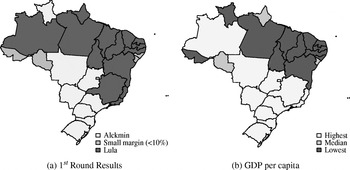
After surviving a sharp downturn in his popularity about one year prior to the elections, President Lula of the Partido dos Trabalhadores (PT) gradually and consistently improved his popular standing to the point where, during most of the four months that preceded the elections on 1 October 2006, he looked set to win an outright majority in the first round. However, a very late push by the main opposition candidate, Geraldo Alckmin of the Brazilian Social Democracy Party (Partido da Social Democracia Brasileira, PSDB), forced a second round. The first round results showed a surprisingly close 48.6 per cent to 41.6 per cent split in the country, with the other candidates combining for just under 10 per cent of the vote. These results also revealed the distinct voting pattern shown in Figure 1.
Electoral and Socioeconomic Maps of Brazil.

Most of the Centre/South of the country gave Alckmin a plurality of the vote, while in the North/Northeast Lula carried most states by a landslide. The most interesting aspect of this map is not the simple geographical distribution of votes, but rather its socioeconomic aspects, as it corresponds to the levels of development of the different regions of Brazil (Figure 1(b)). In the less developed half of Brazil's municipalities, Lula beat Alckmin by 66 per cent to 30 per cent, building up an advantage of almost eight million votes, which was far greater than the deficit of 1.3 million votes which he suffered in the more developed half of the country, where he lost by 43 per cent to 45 per cent.
The principal media outlets in the country all displayed maps such as this one, and hinted that Brazil could be inching towards a scenario of increasing polarisation and exacerbated class conflict, such as had been occurring in some of the country's neighbours. Although the electoral campaign showed nothing close to the left-right polarisation experienced in other countries, or even in past elections in Brazil, it grew increasingly conflictive as election day approached. In a contest where there were limited policy difference, the opposition attacked the personal attributes of the incumbent president, such as his competence and honesty. With the mensalão corruption scandal still fresh, and new corruption allegations popping up on a regular basis, the opposition tried to maximise the political fallout and to explore the theme to the greatest possible extent.Footnote 3 As Hunter and Power argue, however, not only did those in the lower socioeconomic strata of the population have little awareness of corruption accusations, but they also attached little importance to the theme. As a result, support for Lula among these voters remained very strong.
The opposition's late surge eventually proved short-lived. Lula regained his lost ground immediately after the first round and cruised to a landslide victory in the second, receiving more than 60.1 per cent of the votes and beating Alckmin by almost 20 million votes. In the second round, Lula's vote share in the less developed half of the municipalities reached an amazing 74 per cent. Despite the ease of Lula's victory, the 2006 election results exhibit interesting traits that deserve further attention.
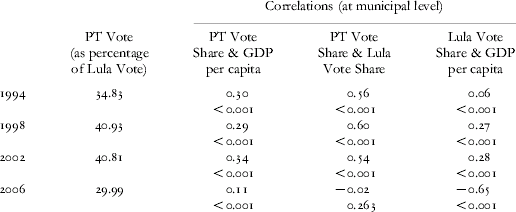
The first point to observe is the divergence between the vote for Lula and the vote for the PT, a point that has also been identified by Hunter and Power. The fact that Lula obtained more votes than were given to the PT in the legislative elections that were held at the same time as the presidential vote is neither new nor surprising. Not only does Lula possess his own personal appeal, which is not contingent on the party, but there is also a simple mechanical effect caused by the fact that a far greater number of parties present candidates for the legislature than for the presidency. This same tendency is evident in past elections, as Table 1 shows. What is new is that for the first time Lula's share of the vote does not seem to correlate with the PT's share for the lower house: rather, to the extent that any conclusion is possible, the party seems to fare better where Lula does worse.
Vote for the PT and Vote for Lula: 1994–2006
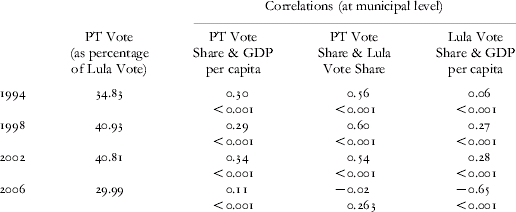
Notes: ‘PT Vote’ and ‘PT Vote share’ are the vole given to the party (legenda) and to its candidates in the elections for the lower house. GDP and population figures were obtained from IPEA, and the log of GDP per capita was used in the computations.
The disassociation between Lula and PT is perhaps not surprising. Its causes can be traced to several factors: Lula is better known than his party; he has been the only presidential candidate in the PT's history, and has become a regular fixture of Brazilian politics for the past 30 years; and, as the incumbent president, Lula was constantly in the spotlight, and was able to widen his name recognition even further. It is also the case that, even though frowned upon by many among the more well-educated Brazilians, Lula's origins as a poor migrant from the Northeast of the country afforded him an unparalleled ability to communicate with the masses, that was not shared by all of the PT's candidates for other offices. Finally, sensing the president's electoral strength, many politicians were willing to jump on Lula's bandwagon, allowing for the establishment of a wide network of local alliances. Although Lula himself seemed at ease with strange bedfellows in some regions, some local PT chapters were left in the highly uncomfortable positions of not being able to claim, even if they wanted, exclusive endorsement by the president.
Still, to a large extent, the disassociation between the party and its presidential candidate was caused by a marked shift in latter's electoral base. While both Lula and the PT traditionally performed better in the more developed regions of the country, and the party continued to do so in the 2006 elections, Lula, for the first time, drew much more support from the most backward regions of the country.
This is not simply a shift from the more developed South and Southeast to the poorer Northern and Northeastern regions of the country. In fact, this trend can be noted within virtually every state. In 22 out of 26 states there exists a negative relationship between the share of the vote obtained by Lula and the level of socioeconomic development at the municipal level, as measured by the municipal Human Development Index (HDI-M), a United Nations Development Programme (UNDP) index based on life expectancy, per capita income and educational levels.Footnote 4 Moreover, a look at the change in Lula's vote share between the last two elections reveals that Lula gained ground in the least developed municipalities at the expense of the more developed areas in no fewer than 24 states.
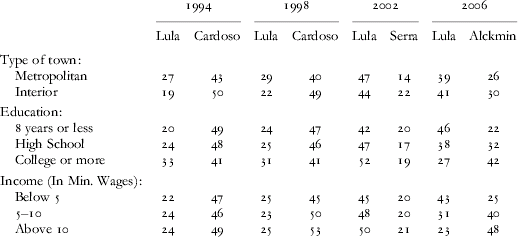
To the extent that they are available, individual level data (Table 2) corroborate most of these points. The results of the final Datafolha surveys, which were published prior to each of the last four presidential elections, show the same shift in Lula's electoral base. Whereas he traditionally performed better in the metropolitan areas, among the more highly educated and the middle and upper classes, in 2006 these trends were reversed.
Voting Intentions Close to Elections: 1994–2006
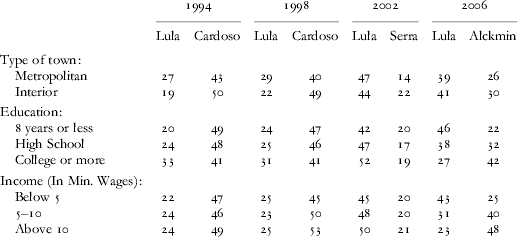
Notes: Data were obtained from Datafolha's online archives, available at www.datafolha.com.br. Figures are from the last survey preceding the first round of each election, which were published on I October 1994, 25 September 1998, 2 October 2002, and 30 September 2006, respectively.
This change in Lula's support base is particularly striking considering his party's history. The PT was born in São Paulo, the country's economic powerhouse, and expanded first through the larger cities of the more developed regions, gradually making its way into the rest of the country. A higher socioeconomic level has been shown to be a strong predictor of party identification with the PT, and until very recently the PT was all but absent from the most backward regions of the country.Footnote 5 How, then, could such a radical shift happen in such a short time?
Although it might be tempting to criticise Lula, claiming that he polarised the country during his first term, there are no grounds for such a depiction. First of all, Lula quickly secured support from most elected governors after his re-election, and began constructing a broad alliance for his second term, which widened in less than six months to include almost all political forces in Brazil, except for the Partido da Frente Liberal (Liberal Front Party, PLP), the PSDB and the Partido Popular Socialista (Popular Socialist Party, PPS). More important, however, is the fact that the shift in Lula's electoral base was not caused by a polarising discourse, nor by any type of incitation to class conflict. To the contrary, as Lula has recently stated, he was ‘never a socialist’; his government has been excessively conservative (or ‘cautious’ in the words of his supporters) in the economic realm, and it has managed to ‘regain the confidence’ of investors after the acute economic crisis that followed his first election in 2002. Lula's new support base, it is argued in the sections that follow, is both the latest development in the tendency of poorer regions to support the incumbent candidate, and the product of a pragmatic response by voters to direct cash handouts from the government.
The Bolsa Familia Factor
The Bolsa Familia is a massive cash transfer programme maintained by the federal government.Footnote 6 It is the main component of a larger umbrella programme called Fome Zero, and reaches families with a monthly income of up to R$ 120 (just under US$ 60). Most of its benefits depend on the number of children in the household, and are conditional on them attending school as well on keeping immunisation records and maintaining a schedule of visits to the doctor. Extremely poor families also receive a flat benefit on top of the per-child one, in which case total monthly benefits can add up to just under R$ 100 per family.
The Bolsa Familia incorporated several pre-existing programmes such as the Bolsa Escola (Schooling Allowance) and Bolsa Alimentação (Food Allowance), among others. The number of households served by the programme rose quickly from 4.1 million in June 2004 to 11.1 million in July 2006, which represented, at the time, more than the total number of families deemed poor by the Ministry of Social Development, and a significant portion of the estimated 56 million households in the country. Footnote 7
While state-level data already shows a strong relationship between the scope of the Bolsa Familia and Lula's electoral performance, the picture that emerges from the analysis of the data at the municipal level is striking. Brazil is divided into more than 5000 municipalities (half of which have a population of fewer than 10,000), and for each of them I computed the share of families included in the programme. These calculations were undertaken by obtaining the number of families covered by the programme in October 2006, the month of the election, and comparing this to the total number of households in each municipality using the IBGE's data on population and the average size of household in the state to which the municipality belonged.Footnote 8
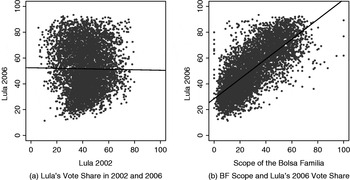
The chart on the right of Figure 2 illustrates the strength of the relationship between the scope of the Bolsa Familia and Lula's share of the vote in the first round of the presidential elections in 2006 for each municipality. It is a particularly remarkable figure, especially when contrasted with the relationship between Lula's 2006 and 2002 share of the vote (the chart on the left).
Lula's Vote Share and Scope of the Bolsa Familia, by Municipality.

The political effects of the programme are further corroborated by a multivariate analysis of the electoral results, which enables one to take a closer look at the relationship between the scope of the bolsa familia programme and Lula's electoral performance.Footnote 9 While similar in spirit to the work undertaken by Nicolau and Peixoto, the analysis here includes a number of other independent variables, and seeks to address, albeit tentatively, the important issue of co-variance between poverty levels and the scope of the bolsa familia programme. Even though this analysis relies on data from more than 5,000 generally small municipalities (the size of the median municipality is just over 10,000 people), it is necessary to bear in mind that an analysis based on aggregate data does not generally allow us to infer individual-level behaviour. It is still possible, nonetheless, to find substantive empirical associations, and to explore some of the possible mechanisms behind them.
Alongside the obvious variables such as Lula's share of the vote in the first round of the 2002 presidential election, and the HDI-M for the year 2000, others that capture both political and socio-demographic factors that might be at work have been included. Political variables included dummies indicating whether the mayor of the municipality elected in 2004, or the governor of the state elected in 2002, were from the PT, and the share of the vote obtained by the PT-backed candidate in the mayoral elections of 2004. Socio-demographic variables included the log of the municipality's population, as well as variables that capture potential racial and religious cleavages, namely the proportion of non-whites and Pentecostal Christians in each municipality.Footnote 10
The expectation here is that local-level PT office holders should have provided an extra boost to Lula's share of the vote. Not only did the PT have a reputation for competent local government, but a PT mayor could obviously function as a high profile local campaigner for the president. With regard to the socio-demographic variables, the general expectation is that Lula should have performed better wherever the share of the population considered to be on the fringes of Brazilian society, such as non-whites and Pentecostal Christians, is larger. During his first term Lula began addressing issues of racial inequality much more explicitly than ever before in the country, extending his pro-poor image derived from the Bolsa Familia to a more general pro-minority one. With respect to religion, the growth of the Pentecostal churches, and their notorious capacity to organise politically, has become subject to much debate in the country in recent years. While their political clout could swing either way (Lula is a Catholic), the fact that Lula's running mate in both elections enjoyed very good relations with Pentecostal churches suggests that they might have invested their electoral capital in the president.
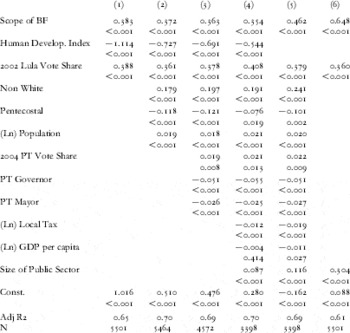
Table 3 reports the estimates for six different regression models explaining Lula's 2006 share of the vote by municipality. I start by analysing the results of the first three. Model 1 includes only the three main explanatory variables, the socio-demographic variables are added in Model 2, and in Model 3 the local political variables enter the picture. In all the models shown, the scope of the Bolsa Familia has a positive, significant, and substantially relevant effect on Lula's share of the vote. The negative association between HDI-M and Lula's share of the vote, and the effect of previous voting for Lula, are also quite stable.
OLS Regressions for Lula's 2006 Vote Share by Municipality

Notes: The dependent variable is Lula's proportion of votes in each municipality in the first round of the 2006 presidential election. P-values are shown below the estimates. The main variable of interest is the scope of Bolsa Familia. which is the proportion of families in each municipality included in the programme.
One can gauge the substantive effects of the main variables in these models by considering, for instance, a comparison between Blumenau in the state of Santa Catarina and Juazeiro do Norte in Ceará. Both are important regional centres which are comparable in terms of population size, but while the former sits at the heart of the highly industrialised Vale to Itajaí region in Southern Brazil, the latter is located in the middle of the drought-prone Sertão Nordestino, where some of the poorest municipalities in country lie. In 2002, Lula received almost the same share of the vote in both cities (44 per cent and 42 per cent, respectively), but in 2006 Lula won 64 per cent of the vote in Juazeiro do Norte and only 26 per cent of the vote in Blumenau. Using figures from Model 2, for instance, and with all else equal, the difference in the HDI-M alone between the two cities would imply an 18 per cent higher share of the vote for Lula in Juazeiro do Norte. However, all else is not equal. Along with the HDI-M, the scope of the Bolsa Familia also varies from a mere 2 per cent of the families in Blumenau to 31 per cent of the families in Juazeiro do Norte, leading to a further 11 per cent increase in Lula's share of the vote.
The indusion of the socio-demographic variables does not really affect these basic results, except that they pick up some of the explanatory power of HDI-M while revealing some other interesting patterns. The data suggest that Lula performed significantly better where the share of non-whites was larger, a result which is consistent across models, and makes sense considering that Lula has made an effort to bring racial issues into the political agenda of the country.Footnote 11 While the data do not allow us to say that non-white individuals tended to vote for Lula, there is some circumstantial evidence that this is probably the case. For instance, Lula obtained on average 69 per cent of the vote in municipalities where non-whites amounted to at least 80 per cent of the population, against 52 per cent of the votes in all municipalities, and a mere 34 per cent of the vote when non-whites totalled 20 per cent or less of the population.
The regression coefficients indicate that Lula performed worse in municipalities with larger contingents of Pentecostal Christians. However, this surprising result concerning religion may require future analysis: there is an even stronger risk of ecological fallacy here, due to the fact that Pentecostal Christians account on average for less than 10 per cent of the population in each municipality. It might very well be the case, for instance, that reaction to pro-Lula Pentecostal mobilisation induced non-Pentecostals to vote against him.
As for the political variables, although the performance of the PT-backed candidate in the municipal election of 2004 has a small positive effect on Lula's performance, all the models suggest that the presence of a PT mayor has a negative effect on Lula's vote share. Even more striking is the fact that the same applies to state governors.Footnote 12
It is worth noting that although many of the original programmes that were merged into the Bolsa Familia were in place prior to 2004, the number of beneficiaries increased dramatically between 2004 and 2006. Therefore, even if local PT candidates could claim credit and benefit electorally from the programme's popularity, the 2004 elections were not a good indicator of this. Still, it is interesting to note that the link between local elections in 2004 and presidential elections two years later is tenuous at best. Whereas the PT has often campaigned on the record of its local administrations and state governors, this analysis suggests that this ‘expertise’ did not assist its presidential candidate. Moreover, these results suggest that Lula did not need PT mayors in order to connect to voters since he seemed to be able to claim direct credit for the benefits to the poor.
It is probably the case, however, that the existence of PT local office holders does not strictly cause a lower vote share for Lula. It can, instead, be interpreted as a sign of the strength of the party's ‘old’ constituency – namely, organised social movements, unions and middle classes – which managed to elect local office holders before the Bolsa Familia existed and Lula's constituency had changed. If this is the case, the negative coefficients on the political variables simply reflect the fact that part of this old voting base abandoned Lula, as is argued later in this paper.
One important consideration is the strong association between the HDI-M and the scope of the Bolsa Familia, derived in part from the fact that the HDI-M itself is used to determine the targets of coverage that each municipality has to meet. While the −0.8 correlation between these two variables is evidence that the programme is quite well targeted, it poses challenges for analysis of the political effects of the programme.
There is clear evidence that in 2006 Lula performed better in less developed municipalities, while the opposite had happened in 2002. Part of the effect of the HDI-M on Lula's share of the vote in 2006 seems to have been channelled through the Bolsa Familia programme: municipalities with lower HDI-M received greater programme coverage, which boosted support for Lula. However, the regressions shown in Table 3 indicate that there is also a direct effect of HDI-M on the vote for Lula in 2002 that persists even after accounting for the Bolsa Familia.
Given Lula's electoral record of traditionally performing better among the urban middle class, how can one explain this positive direct effect of HDI-M on Lula's share of the vote in 2006? The most straightforward answer is that the policies of the Lula government in general benefited the poor, with the result that the poorest municipalities, independently of the Bolsa Familia programme, voted massively for his re-election. In fact, this is the gist of the argument made by Carraro et al., for whom the economy, and not the government's cash transfer programme, was the essential determinant of electoral results.Footnote 13 According to them, low inflation, higher wages among the poor, and cheap food ensured that the bulk of the population in poorer municipalities backed the incumbent candidate.
In order to assess this hypothesis properly, a measure of real disposable income at the municipal level is necessary, though is, unfortunately, not available. Nonetheless, without ruling out this interpretation, there is at least another possibility to be considered: since HDI-M is correlated with a series of other variables it might, in fact, be capturing other characteristics of the less developed municipalities in the county that would make their voters prone to vote for Lula. For instance, in these mostly rural areas non-government related economic activities are very limited. Hence, the population typically relies more on the government, and the local governments typically rely more on higher-level governments than in other areas. As a consequence of this relationship of dependency, government handouts should affect these areas more than the overall state of the economy.
To investigate this hypothesis, I introduce variables that attempt to capture the lack of economic alternatives that characterises many of the less developed regions in the country (Model 4). These variables are the (log of) municipal GDP per capita, (a measure of) the relative size of the public sector in each municipality's economy, and the proportion of the municipality's operational revenue that is raised locally through tax, as opposed to that received through transfers from the federal or state governments.
This analysis finds that Lula performed better in municipalities in which the public sector is larger relative to the local economy, and where the share of locally raised revenue is smaller. The effect of HDI-M diminishes with the inclusion of these variables, and the subsequent exclusion of HDI-M (Model 5) hardly affects the explanatory power of the model. Additionally, it is also shown that substituting the size of the public sector for HDI-M (Model 6) produces results that are comparable in strength to Model 1. Taken together, this evidence supports the idea that at least part of the effects of HDI-M in Model 1 were really attributable to each municipality's reliance on the government. This suggests that it is not merely poverty that drives the vote in favour of Lula, and that dependence on the government also matters.
Clearly, reliance on the government is a characteristic that cannot change as fast as the shift in Lula's electoral base did. Therefore, if this argument is true, it implies that the less developed regions of the country should always tend to vote for the government candidate. This is exactly what the next section of the paper attempts to show: there exists a stable ‘pro-government’ vote, irrespective of who the government candidate is, that is typical of the less developed regions of the country.
A Pro-Government Electorate?
In the past few years, pundits have been giving increasing attention to the political importance of the so-called grotões, the thousands of small and mostly poor municipalities in the interior of the country. Until recently these municipalities voted solidly for conservative candidates, and despite its growth across the country, the PT continued to lag behind its competitors in these areas.Footnote 14 The 2006 elections, however, have shown that Lula – if not his party – gained control of the votes of the grotões.
The Bolsa Familia is the most visible cause of the ‘magic’ that rearranged voting patterns in Brazil between 2002 and 2006, but such a shift is not unheard of in the country. The pattern of ‘opposition’ to the governing party in the state capitals and most developed regions, and pro-government voting in the grotões is, in fact, typical of the cyclical rise and decline of the main political forces in the country during the last three decades. For instance, the PMDB began its growth in the large cities and, as it became the party in power in the 1980s, it expanded into the less developed regions, remaining the party with the largest structure in the country. Similarly, the PSDB, which began as a São Paulo-based splinter of the PMDB, also found its way into the most backward regions of the countries while it was in office during the 1990s. Following this logic, it makes sense that Lula should make inroads into the grotões, and that opposition to him should be strongest among the urban middle classes.
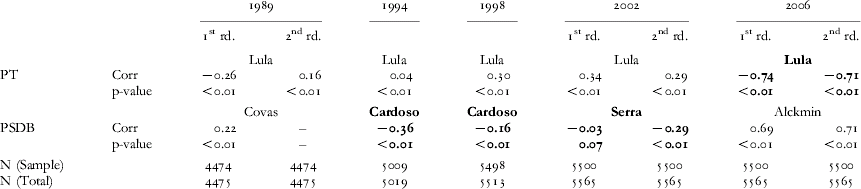
Table 4 shows that this pattern is quite clear in the voting results of the PT and PSDB, the parties that have all but dominated presidential elections since the return to democracy. Government-party candidates, shown in bold, display a negative association between vote share and HDI-M, meaning that they pull more votes in the less developed regions of the county, while the exact opposite holds for the opposition candidates.Footnote 15 Note that this effect holds for these two parties regardless of whether the actual incumbent is running or not.Footnote 16 This suggests that irrespective of the individual, and what he stands for, government candidates always fare better in the poorest regions of the country while the opposite holds for the main opposition candidates.
Electoral Performance of the PT and PSDB, 1989–2006
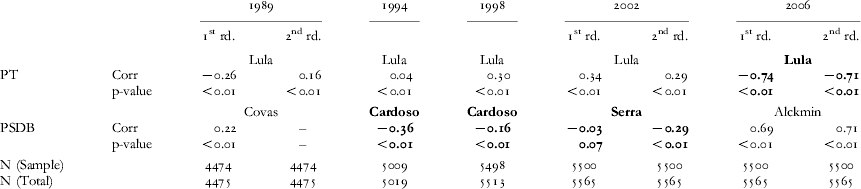
Notes: Figures indicate the correlations between the HDI-M and the share of the vote obtained by each party's presidential candidate, with the p-value shown in parenthesis. Figures in bold are tor incumbent party candidates. Data were obtained from IPEA and TSE.
The only exception to this rule occurred in the first round of the 1989 elections, although the circumstances of those elections attenuate its meaning in the present analysis. This was the first time that Brazilians directly chose a president in almost 30 years. None of the four main candidates was backed by the government, or was from the then president's party. More importantly, the negative correlation between Lula's vote and levels of socioeconomic development in 1989 can be accounted for by the fact that the ‘leftist’ vote in the first round was equally split between Lula and the PDT candidate, Leonel Brizola, then governor of the well-off state of Rio de Janeiro. In the second round, when both united against Fernando Collor, the association between Lula's share of the vote and levels of socioeconomic development followed the usual pattern.
Until 2006, the stylised interpretation was that the positive association between the PT's share of the vote and HDI-M existed because the rural and less developed regions of the country were socially conservative, and dominated by local political bosses that exerted a firm grip on power. The 2006 results do not mean that the grotões suddenly took a turn to the left, but rather that voters there responded to an improvement in their material living of standards that the Bolsa Familia had afforded them, and they continued to vote for the government candidate, as they had done in the past.
This does not mean that the government candidate always wins in the less developed regions. The PSDB's candidate in 2002, José Serra, received only 27 per cent of the vote in the municipalities below the median in terms of socioeconomic development. Nonetheless, even then, that result was better than the 22 per cent of the vote which he obtained in the upper half of the municipalities. Despite the influence of tangible and intangible factors on determining the ultimate winner, the pattern that the incumbent party candidate performs better in the less developed regions remains a notable empirical regularity.
The existence of a pro-government electorate in the less developed regions of the country has interesting implications for political competition and for democratic governance. Almost by definition, a political opposition force emerges without government largesse to distribute, so the tendency in this case is to offer ideology to voters, as well as promises of future government resources to its supporters.Footnote 17 By contrast, governments have the means to distribute concrete goods to voters and will do so according to the incentives they face. The type of goods to be distributed depends on a wide range of factors but, as the standard literature on clientalism suggests, private goods such as cash handouts are more effective the poorer the recipients are.Footnote 18
Here, an important qualification is due. Even if clientalism and poverty alleviation policies can be subject to a similar analysis in terms of their electoral returns, the Bolsa Familia and the programmes that preceded it depart from traditional forms of clientalism in a fundamentally important way: eligibility for inclusion in the programme is universal, incorporating all those who fall within certain objective and measurable criteria. This breaks the ‘exchange’ relation that is the very essence of clientalism. Footnote *Cash handouts from these programmes are not dependent on personal ties between voters and politicians, and cannot be withheld or cancelled because of the beneficiary's electoral behaviour.
For this reason, poverty alleviation policies might provide today's politicians with fewer incentives to keep voters poor than those faced by the caudillos and coronéis of yesterday. After all, if the threat of withholding the benefit cannot be used, votes will be won solely on the basis of the size of the benefit and the identifiability of the provider. In this sense, the unprecedented scope of the Bolsa Familia, along with the government's marketing and ability to claim credit for it strengthened the electoral returns it reaped from the programme. On the other hand, however, the Bolsa Familia is no more than the latest ‘technology’ in the field, whose origins were bequeathed by previous governments, and which finds close analogues in other countries.Footnote 19
The evidence thus far is that governments stand to gain – and have apparently gained – from actually lifting recipients out of acute poverty. In principle, poverty alleviation policies owe much of their electoral attractiveness to the pervasiveness of extreme poverty, so reducing poverty will tend to reduce the political returns of these policies. Still, the immediacy of the political returns that can be reaped, coupled with the sheer size of the ‘stock’ of poverty that still exists, suggests that many more governments will be elected and re-elected using this formula before initiatives such as the Bolsa Familia fall into oblivion.
It is also important to remember that redistributive politics is not a win-win game, and under most circumstances one cannot simply add new groups to the governing coalition indefinitely. During Lula's first term, losses were concentrated among the much less numerous middle class, which was precisely his ‘old’ constituency. Sluggish economic growth, increases in taxation, and a perception in the wealthier regions that the government only cares for ‘them’ – as opposed to ‘us’ – provided sufficient reason for sections of the middle classes to abandon Lula. Hunter and Power, in pointing to the heightened awareness among the middle class of the many scandals involving the government, add that this perception of corruption helped complete the shift in Lula's vote base.
Although such a break with the past could be seen as intriguing, it makes perfect electoral sense. From the strictly political standpoint, large-scale cash distribution to the poor is a formidable short run strategy. In slightly more general terms, such a strategy should be equally powerful in other highly unequal democracies where, as in Brazil, large portions of the electorate are close to or below the extreme poverty line, and consequently the electoral returns for each real transferred to the extremely poor, are gigantic. Moreover, in Brazil the federal government enjoys a virtual monopoly in the countryside, since it is the only entity with the resources and distributional capacity to undertake the task of large scale poverty alleviation. The government's access to this state structure enables it to play an essential role in the poorest regions of the country and creates a pro-government electorate. In this sense, the shift in Lula's voting base is not surprising. It was not caused by a change in the logic of political competition in Brazil, and much less by the stirring of class conflict or by ideological polarisation. Lula's first administration went beyond what previous governments had accomplished and consequently reaped greater electoral profits but did not fundamentally alter the political landscape.
Conclusions
There can be no doubt that in the last presidential elections Lula was the preferred candidate among the poorest portion of the Brazilian electorate, rendering him the ‘candidate of the North/Northeast’ of the country. However, in this paper I have argued that this cleavage is not spurred by ideological polarisation, nor by regional rivalries, unlike other Latin American countries at the moment. It is, instead, merely the response of voters to material changes in their living conditions, much of which can be traced to the Bolsa Familia cash transfer programme.
The paper has also identified a stark and clear empirical tendency for government-backed presidential candidates in Brazil to perform better in less developed municipalities. This is true for all the election rounds since 1994, irrespective of the candidate or what he stood for. This, I argue, is explained by the reliance of the poorer regions of the country on government largesse, and the federal government's capacity as the only institution that can make any real difference to people's lives in these regions.
This finding has important implications for the argument of Carraro et al. that it was economic performance rather than the Bolsa Familia programme that caused the change in Lula's electoral base. It is true that during the first Lula government the average wage stopped falling for the first time in a decade, unemployment fell significantly and the minimum wage increased. It is also the case that, as a consequence, there was a reduction in the share of the population considered poor and extremely poor, and the country's Gini coefficient receded for the first time in decades. However, if voters' perceptions of the economy – rather than the economy itself – are the important element in determining the fate of incumbents, it is difficult to separate the electoral effects of general economic performance from those of targeted social policy.Footnote 20 In fact, such a distinction might not be very meaningful, especially if one is looking at a single election. One reason is that much of the improvement in the economic conditions of the poor can be attributed to the Bolsa Familia itself.Footnote 21 Yet another, perhaps even more important, factor is that in the highly impoverished regions of the country that rely heavily on the Bolsa Familia programme there is limited private economic activity. Here, the dependency of the local economy on the government results in a significant influence of cash handouts in voters' perceptions of the economy. In this context, the effect of actually receiving a cash transfer and the effects of improved economic performance resulting from having a large percentage of the local population receiving these transfers would probably be blurred.
This is where the finding that in poorer regions the electorate tends to vote for the government enters the argument. It is clear that a strictly economic argument cannot explain the persistence of a pro-government electorate in the less developed regions of Brazil over five elections. In 2006 the economy was quite favourable to the Brazilian poor, but it is clearly the case that this was not true through much of the past twenty years. My alternative story is that poverty is related to – and works alongside – dependence on federal government transfers. This reliance, in turn, provides incentives for voters to support their benefactor. While Lula was able to exploit this situation to greater extent than his predecessors, he was not the first, nor will he be the last, to do it.
Lula, in his first term, went above and beyond past governments, and perfected not only the cash transfer system itself, which today makes a greater difference in people's lives and in the economy of the poorest municipalities, but also the government's capacity to claim credit for the initiative.Footnote 22 Such a system, I have argued, is attractive both in terms of the size of the electoral benefits to be reaped and of its cost-effectiveness as a political strategy. In the specific case of the Bolsa Familia, total expenditure in the programme in 2006 was around ten billion reais, which corresponds to less than 10 per cent of what was spent on debt servicing, and less than 2 per cent of total expenditure in the previous year's budget.
In a post-stabilisation environment in which there is much pressure to allocate resources ever more effectively, the Bolsa Familia is a very cost-efficient way to ‘buy’ votes, allowing for compatibility between a balanced budget and politically effective social policy. As a result, Lula has been able to gain and maintain the confidence of investors, while securing high levels of support among the largest segment of the electorate. Although this has come at the cost of a loss of support among the middle classes, which have been squeezed by taxes and limited economic growth, it is an almost unbeatable strategy from the strictly electoral perspective.
Following this logic, I echo Hunter and Power's argument that the Bolsa Familia and/or other programmes of its type are likely to be permanent fixtures of Brazilian politics in the years to come, regardless of which party comes to occupy the Planalto Palace. After all, although any incumbent can expect to improve his (or her) performance in the grotões simply by becoming president and taking charge of the government's long tentacles, Lula has shown that programmes such as the Bolsa Familia make the most out of an already favourable situation. Not surprisingly, all candidates in the elections of 2006 proposed ‘improvements’ to the programme and claimed that they planned to expand its scope.
While the long-run consequences of programmes such as this are still debatable, there is no denying that poverty reduction is now at the centre of the political debate. Many will argue that handing out small amounts of cash to poor families does little to make the world a better place, and that it simply keeps people poor and helps politicians to build and maintain political clienteles. Nevertheless, adopting a more optimistic perspective, a programme such as the Bolsa Familia, with its objective eligibility criteria and universal scope, can be interpreted as a sign of the increasing responsiveness of the government to the median voter, rather than as simply old fashioned clientalism.
There is an old and well known political aphorism in Brazil according to which ‘to govern is to build roads’, which was probably true for a period during which voting rights were limited, and the support of local and regional elites was crucial to maintaining the social order intact.Footnote 23 Times have changed, and although the country is still highly unequal, and road building is still important, universal suffrage affords the bulk of the population at least some say in the political processes. Twenty years into this new reality, it might be pertinent to update the saying to something along these lines of: ‘to govern is to distribute cash to the poor’.