Introduction
Although young adults have long been identified as a group of the electorate less likely to vote, recent research suggests that turnout levels among young cohorts are declining rapidly. This implies that today’s young adults turn out at lower levels than their parents and grandparents did when they were young. Trends of declining young adult turnout levels have been particularly well documented in Canada (Gidengil et al., Reference Gidengil, Nevitte, Blais and Nadeau2003; Pammett and LeDuc, Reference Pammett and LeDuc2003; Johnston et al., Reference Johnston, Matthews and Bittner2007), the United States (Levine and Lopez, Reference Levine and Lopez2002; Lopez et al., Reference Lopez, Kirby and Sagoff2005) and Great Britain (Phelps, Reference Phelps2004, Reference Phelps2006).Footnote 1
Young voters grow into older voters. Unless turnout losses are made up as young people age, the recently witnessed decline in turnout levels among young adults predicts lower general turnout levels in the future. According to the political life-cycle argument, young adults vote less than older citizens because they are faced with ‘start-up’ problems: pre-occupations outside the political sphere that lead to low attachment to civic life. In terms of the life-cycle theory, declining turnout patterns among young adults suggest that today’s young people face more or extended start-up problems than previous generations (Kimberlee, Reference Kimberlee2002; Flanagan et al., Reference Flanagan, Finlay, Gallay and Kim2012). Indeed, delayed transitions to adulthood are witnessed in almost all advanced industrial democracies (Vogel, Reference Vogel2001; Iacovou, Reference Iacovou2002; Nico, Reference Nico2014).
This paper seeks to understand whether, and if so to which extent, delayed transitions to adulthood play a role in the observed patterns of declining turnout among young adults. Combining elements of the life cycle and the cohort/generation approaches to age differences in voter turnout, the later maturation hypothesis examines the idea that the timing of life events that are considered important for the development of electoral participation varies between generations. Since key events such as leaving school, starting a first job, getting married, and forming a family are gradually taking place at a higher average age, the trend towards later maturation should be able to explain part of the turnout decline among young voters. More sharply put: if the movement of life-cycle events to a higher average age does not translate into changes in turnout patterns of young people, we have serious reasons to doubt the over time validity of the life-cycle model.
The relationship between (later) maturation and young adult voter turnout is assessed in two ways. First, a maturation index based on six basic socio-demographic indicators that mark the transition to adulthood is used. Analyses with the separate life-cycle events, secondly, allow a peek into the black box of the effect of age on voter turnout. Empirical research of individual-level voter turnout often uses age as a proxy for the respondent’s life-cycle stage and it is on the whole a significant explanatory factor of voter turnout (see Smets and van Ham, Reference Smets and van Ham2013). Yet, from an empirical point of view, we know relatively little about why turnout increases as citizens age and even less about how the relationship between age and turnout changes with time.
Empirical analyses based on the British Election Studies from 1964 to 2010 support the general observation that the proportion of young adults that has experienced consequential life-cycle events has decreased over time. As expected, maturation is a strong, stable, and significant predictor of individual-level turnout among young voters. Combining these two insights, later maturation can be linked to declining turnout levels among younger voters. Had there been no delays in the transition to adulthood since the pre-war generation experienced its young adulthood years, turnout among Britain’s post-1970s generation would have been 53% instead of 41%: a 12 percentage point difference. These findings are particularly relevant in light of the present-day economic crisis, which causes additional hurdles in the transition to adulthood for the current generation of young adults.
Focussing on separate life-cycle events instead of an index of maturation, moreover, brings to light the differential impact of various life-cycle events on young adult turnout. As expected, the maturation index explains away the effect of age on voter turnout; however, not all life-cycle indicators perform as expected. Home ownership, marriage, and cohabitation are found to have a consistent positive effect on turnout. Contrary to theoretical expectations of the life-cycle model, leaving education negatively influences turnout of young adults. The same is true for childbearing; however, the variable does not reach statistical significance in a plurality of the models. Having a job and residential stability, while positively related to young adult voter turnout, also do not reach statistical significance.
Later maturation and turnout decline among young adults
The impressionable or formative years between childhood and adulthood are generally believed to be a crucial period during which citizens form the basis of political attitudes and behaviours (see e.g. Jennings, Reference Jennings1979; Strate et al., Reference Strate, Parrish, Elder and Ford1989; Highton and Wolfinger, Reference Highton and Wolfinger2001; Kinder, Reference Kinder2006). Young citizens have not yet developed political habits and are, therefore, more easily influenced by external factors (Alwin and Krosnick, Reference Alwin and Krosnick1991; Flanagan and Sherod, Reference Flanagan and Sherod1998; Sears and Levy, Reference Sears and Levy2003). Social, cultural, political, and historical changes affect young citizens disproportionally thus creating generational differences in turnout patterns.
One way in which today’s young adults differ decisively from young adults of the past seems to have been systematically overlooked in the empirical literature.Footnote 2 Young citizens nowadays grow into their adult roles – defined in terms of a set of social qualifiers rather than in terms of psychological development (see Mary, Reference Mary2014 on this distinction) – at a different pace than their parents or grandparents did when they were young. To understand how such later maturation is tied to declining levels of young adult voter turnout, we need to consider the life-cycle approach of political participation.
According to the life-cycle argument of political behaviour, young people participate less in politics given their low attachment to civic life: a characteristic that is fuelled by young people still going through education, being occupied with finding a partner, establishing a career, having higher mobility, dealing with the psychological transformation into adulthood, etc. These characteristics lead young people to be politically inexperienced and to have little interest in politics, low levels of knowledge and fewer skills (i.e. to have few political resources). This, in turn, makes electoral participation both more difficult and less meaningful in this first stage of the life cycle (Strate et al., Reference Strate, Parrish, Elder and Ford1989; Jankowski and Strate, Reference Jankowski and Strate1995).
In middle life, turnout rates are thought to stabilize at a higher level as people experience life-cycle events that mark the transition to adulthood. Such events include leaving the parental home, starting a full-time job, cohabiting or getting married, buying a house, starting a family, settling down in a community, etc. Even though many of these processes put a demand on time, they are associated with activities (involvement in organizations, associations, the community, etc.) that tend to enhance turnout due to increased mobilization, skills, and pressure (Lane, Reference Lane1959: 218; Strate et al., Reference Strate, Parrish, Elder and Ford1989: 444; Kinder, Reference Kinder2006). As stakeholders, home owners are more likely to be interested in property tax and mortgages. To those with (full time) jobs, issues such as pensions and income tax become relevant (Flanagan et al., Reference Flanagan, Finlay, Gallay and Kim2012). As a result, the transition to adulthood increases attention to, and familiarity with, parties’ and candidates’ positions, which in turn fosters party attachment and other forms of political engagement. All in all, the middle-aged seem to have the best cards to understand politics and their part in it (Jankowski and Strate, Reference Jankowski and Strate1995: 91), which is most likely the reason why this stage of the political life cycle is often used as a base against which to compare the political participation levels of younger and older citizens (Braungart and Braungart, Reference Braungart and Braungart1986: 210).
Participation rates among older age groups, finally, tend to drop under the influence of, for example, health problems, the loss of a politically active spouse, retirement, and declining family income. Summarizing, it is the more general disengagement from social life that leads to a lower attachment to political life (Cutler and Bengtson, Reference Cutler and Bengtson1974: 163).
So far, the political life cycle has mostly been conceived as a static curvilinear relationship between age and voter turnout. However, we do not know whether the life cycle of political participation really exists, or whether its shape differs across time and space.Footnote 3 With accumulating evidence that the decision to vote is to some extent habitual (Green and Shachar, Reference Green and Shachar2000; Kanazawa, Reference Kanazawa2000; Plutzer, Reference Plutzer2002; Bendor et al., Reference Bendor, Diermeier and Ting2003; Gerber et al., Reference Gerber, Green and Shachar2003; Cutts et al., Reference Cutts, Fieldhouse and John2009; Aldrich et al., Reference Aldrich, Montgomery and Wood2011; Dinas, Reference Dinas2012), a lack of life experiences may cause young adults to form the habit to abstain rather than to vote.
Based on findings in the sociological and demographic literature as well as circumstantial evidence, it seems plausible to reason that the political life-cycle of today’s young adults is not similar to the initial stage of the life-cycle of their parents or grandparents. Higher educational levels have resulted in young adults staying in school longer, having extended co-habitation with – as well as longer financial dependence on – their parents, and postponed full entry into the labour market. Moreover, the average age of marriage has risen and childbearing is increasingly postponed (see Pirie and Worcester, Reference Pirie and Worcester1998; Billari and Wilson, Reference Billari and Wilson2001; European Commission, 2001; Billari and Kohler, Reference Billari and Kohler2002; Furstenberg Jr. et al., Reference Furstenberg, Kennedy, McCloyd, Rumbaut and Settersten2003; Kennedy, Reference Kennedy2004; OECD, 2007). Seemingly facing more and/or extended start-up problems than young people of previous generations, turnout patterns of today’s young adults are expected to have been negatively affected. Variation in the timing of life events has thus far been overlooked as an explanatory factor of generational differences in young adults’ propensity to turn out to vote. The later maturation hypothesis, moreover, provides an explanation as to why contemporary young people are often found to be less interested, more alienated and more disengaged from the political system.
Life-cycle events and their impact on young adult voter turnout
Notwithstanding decennia of references to the life-cycle model in the literature, relatively little is known about the influence that each possible life event has on individuals’ levels of turnout. The acquisition of an ‘adult role’ is what ties together the life events that mark the transition from the first to the middle life-cycle stage. Leaving education is one of the first steps towards entering the adult world. Being in education, from a theoretical perspective, thus, is seen as a first stage life-cycle characteristic: a start-up problem that causes these citizens to be too pre-occupied with externalities to become involved in political affairs (Wolfinger and Rosenstone, Reference Wolfinger and Rosenstone1980; Strate et al., Reference Strate, Parrish, Elder and Ford1989; Jankowski and Strate, Reference Jankowski and Strate1995; Highton and Wolfinger, Reference Highton and Wolfinger2001). Empirical research paints a different picture, however. Studies that have researched the effect of ‘being in education’ on individual-level turnout, find a positive and significant relationship between the two variables (Wolfinger and Rosenstone, Reference Wolfinger and Rosenstone1980; Highton and Wolfinger, Reference Highton and Wolfinger2001; Sandell Pacheco and Plutzer, Reference Sandell Pacheco and Plutzer2007; Tenn, Reference Tenn2007). An explanation for this finding is that young people who are still in school find themselves in a much more stimulating environment than their non-school going peers. Since theory and empirical findings are contradicting, the direction of the hypothesized effect of leaving education on turnout can be twofold.
At some point after leaving education most people leave the parental home (Elder, Reference Elder1985). Some take up temporary residence in the city where they study, others settle down more permanently. Not many studies have focussed on the effect of leaving the parental home on turnout. From an adult role perspective, leaving the parental home should foster turnout. Highton and Wolfinger (Reference Highton and Wolfinger2001), nonetheless, find turnout among young people who left the parental home to be lower than among those who had not taken the adult step of moving out. Controlling for confounding factors such as residential stability (discussed in more detail below), the relationship between leaving the parental home and turnout was, however, found positive.
Settling down in a community goes hand in hand with residential stability. Students in particular are not tied to one place (see Squire et al., Reference Squire, Wolfinger and Glass1987 for a breakdown of the characteristics of movers and stayers). This is especially problematic in countries where electoral registration is the responsibility of the voter (Highton, Reference Highton2000; Highton and Wolfinger, Reference Highton and Wolfinger2001). The need to constantly re-register is a burden that often leads citizens to abstain from voting. Home ownership, just like residential stability, is considered to strengthen community ties (Lane, Reference Lane1959; Jankowski and Strate, Reference Jankowski and Strate1995).
After leaving school, getting a job is often the next step toward assuming adult roles (Lane, Reference Lane1959; Elder, Reference Elder1985; Jankowski and Strate, Reference Jankowski and Strate1995). The work environment is considered a place of political socialization in various ways – both direct and indirect (Sigel, Reference Sigel1989; Brady et al., Reference Brady, Verba and Schlozman1995). Certain jobs bring citizens directly in touch with socio-political issues. Having a job, secondly, puts certain demands on citizens (e.g. time-consciousness, punctuality, ability to follow written instructions, etc.). Moreover, certain occupations come with a certain status. This status brings with it a diversity of resources, skills, knowledge, and prestige that are also useful for electoral participation. The work environment is also considered to influence political interest because workers are often organized in unions, which inform their members and mobilize them to protest against unpopular measures. These mobilization efforts can trigger interest in socio-political issues. On the whole, having a job is therefore expected to boost turnout.
Marriage and starting a family are also positively related to turnout in the long run (Elder, Reference Elder1975, Reference Elder1985). While Stoker and Jennings (Reference Stoker and Jennings1995) find that the transition to married life initially has a disruptive effect on political participation levels, in the mid to long term being married is generally found to be positively correlated to participation. Partners can learn from and influence each other, and a politically active spouse is likely to motivate and mobilize his or her partner. Denver (Reference Denver2008) argues that married citizens adhere to more traditional values. This may lead married people to be more likely to conform to the idea of ‘good citizenship’ and to consider voting and political engagement a civic duty. In this paper marriage and cohabitation are treated as one. Both social and legal boundaries between cohabitation and marriage are fuzzy (Thornton et al., Reference Thornton, Axinn and Xie2007). Moreover, the practical and beneficial consequences of living with a partner are present in a similar fashion among cohabiting and married couples. Childbearing, lastly, increases the awareness of social needs, such as education, health care, and playgrounds, as well as the responsibility to perform as a citizen model (Lane, Reference Lane1959). Parents of school-going children are likely to become part of social networks that mobilize them into collective action (Flanagan et al., Reference Flanagan, Finlay, Gallay and Kim2012). While those with young children can be expected to have little time on their hands, parenthood is often interpreted as a sign of stability, and therefore, stronger links to the community (see Anderson, Reference Anderson2009 for an empirical study of the relation between being part of a community and voter turnout).
Data
The aim of this paper is to assess the extent to which later maturation affects generational differences in voter turnout. First, we need to establish whether generational differences in the transition to adulthood can indeed be observed. Second, we have to assess to which extent generational differences in patterns of political maturation influence generational turnout patterns of young adults. Panel data following the same respondents over time are best suited to study the effect of transitions to adulthood on voter turnout (Hooghe, Reference Hooghe2004; Glenn, Reference Glenn2005; Hobbs et al., Reference Hobbs, Christakis and Fowler2014). However, to study generational differences a long time span is essential. To my knowledge, there are no panel data available that contain the relevant indicators and are composed of sufficient waves to allow for a large time dimension. I, therefore, rely on the best alternative to assess my hypotheses: repeated cross-sectional election surveys. Compared with election surveys in other advanced industrial democracies, the British Election Studies from 1964 to 2010 are much more inclusive when it comes to the over time measurement of life-cycle events that mark the transition to adulthood. For the purpose of this study, ideally we would like to know whether respondents are in education, whether they have a partner, have a full-time job, live away from their parents, have stable residence, and own their own home. Only an indicator keeping track of whether a respondent has left the parental home or not is missing from the British Election Studies.
The dependent variable in the analyses presented below is reported turnout in the last general election. The key independent variables in all models are events marking the transition to adulthood. They are measured as dichotomous variables where a ‘1’ indicates that the respondent has made the transition.
A question asking after the respondent’s marital status was used to create a dummy variable identifying those respondents who were either married or cohabiting with their partner. A measurement of the respondent’s job status was used to identify the respondents with a (full-time) job.
The variable ‘left education’ is based on a question asking the respondent’s age when leaving (full-time) education. In some instances, a separate category was included for those still in education. For the earlier election years, the question concerning the age at which the respondent left education referred to primary or secondary education only. In these instances, a proxy was calculated based on the age and educational level of the respondent. For all respondents with a post-secondary educational level, 3 years were added to the age the respondent left secondary education. Three is the minimum number of years it takes to complete a bachelor degree in Great Britain and the measure, although not optimal, is a conservative estimate of the period a respondent was in post-secondary education. If a respondent was younger than the computed school leaving age or had an age equal to it, he or she was considered to still be in education.Footnote 4
Whether a respondent has children was only asked in the earlier election studies. In subsequent years, instead, the number of young people in the household was enquired after. Usually, the threshold was put at the age of 18 years, but in two instances the question referred to young people aged <16 (1987) or <15 (1983) years. When dealing with young respondents, it is impossible to distinguish between siblings and own children with a question phrased this way. To avoid this mix-up, only children in the household of married, cohabiting, divorced, widowed, or separated respondents where counted as being the respondent’s own. No references to children are available for the February 1974 and 1992 elections.
A variable tapping home ownership was derived from a question asking the respondent whether their home was owned or rented. The home ownership variable was not included in the election survey of 1966. A measure of residential stability of respondents, lastly, is based on a question asking the respondent after the number of years he or she lived in the neighbourhood or area. This question was missing from the 1983 and 1992 election studies and was only posed to two-thirds of the respondents in 2001. A respondent is considered to have residential stability when he or she has lived in the same place for 3 or more years.Footnote 5 However, there is one problem with these last two measures. An 18-year old who has lived with her/his parents since birth is likely to live in an owned home and have residential stability. Neither scenario has much to do with maturation. As a filter, respondents who are in education and indicate to live in an owned home or to live in their neighbourhood for a long time are set to zero on the home ownership and residential stability variables. This filter should at the very least improve the measurement of home ownership and residential stability.
The six dichotomous life-cycle indicators available in the British Election Studies from 1964 to 2010 – having left education, being married or cohabiting, having children, owning a home, long residential stability and having a job – are combined in an additive ‘maturation index’.Footnote 6 As such, the maturation index is a seven-point scale ranging from 0 to 6 where a higher score indicates a higher level of maturation.
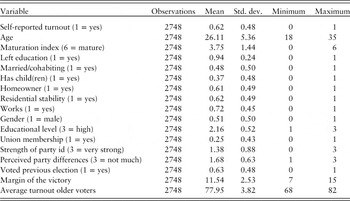
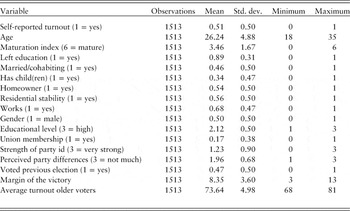
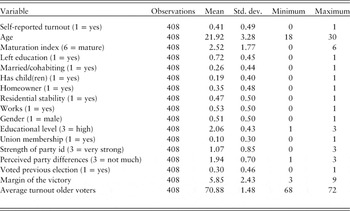
Some of the models presented below also include control variables: gender, educational level, union membership, strength of partisanship, the perceived difference between political parties, turnout in the previous elections, and the margin of the victory. The first four variables are expected to boost turnout as they are linked to the socio-economic, mobilization, and psychological models of turnout. The rationale for including perceived differences between parties is linked to the rational choice model. If differences are small, turnout is expected to be lower. The margin of the victory is the simple difference in the vote share between the first and second placed parties at the national level. The smaller the difference, the more competitive the election. High stake elections generally attract more voters. Turnout in previous elections, lastly, is a measure of the habitual nature of voter turnout whereby previous behaviour is a predictor of current behaviour. Descriptive statistics and value labels for all variables are presented in Appendix A.
As indicated above, not all indicators of interest are available in all election years. Because this missing data problem affects the robustness of the results, missing values have been replaced through a multiple imputation method. Multiple imputation methods replace missing values by a list of m>1 simulated values and produces m plausible alternative versions of the data set. Each of the m data sets is estimated in the same fashion by a complete data method. The estimates of parameters of interest in the m data sets are averaged to give a single estimate. The main advantage of multiple imputation is that it yields a constant sample size over all models. The imputation process is described in detail in the online Appendix C. All analyses presented in the next two sections are based on the imputed data sets. The data have, moreover, been adjusted for sampling errors and over-reporting of turnout.Footnote 7 Lastly, in order to facilitate comparison all variables were standardized to vary between 0 and 1.
A comparison of the political life cycle of different generations
As a first step, we need to establish whether generational differences in levels of maturation can indeed be observed. There are various suggestions of this in the literature; however, most empirical research focuses on one or two life-cycle indicators at a time. In this section, a broader overview of over time changes in life-cycle indicators will be presented. All analyses focus on a young subset of the electorate aged 35 years or less. The crucial ‘impressionable years’ are often situated between the ages of 17 and 25 (Jennings and Niemi, Reference Jennings and Niemi1981). Nonetheless, both a clear definition and operationalization are lacking and political learning is certainly not confined to these early adulthood years. Recent research by Bhatti and Hansen (Reference Bhatti and Hansen2012b) suggests that turnout drops after the first voting experience at the age of 18 and that only by the age of 35, do citizens return to their first-time turnout levels. Moreover, the theoretical expectation is that life-cycle events experienced during early adulthood influence the development of political interest and political participation. Delays in the transition to adulthood imply that defining the group of young adults too narrowly entails the missing out of a number of important life-cycle changes (Iacovou, Reference Iacovou2002; Council of Europe, 2005).
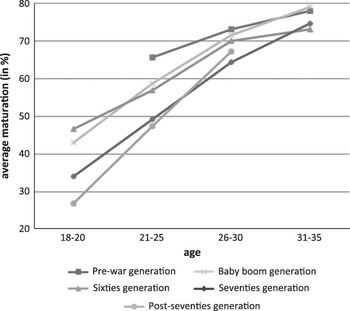
To investigate generational differences in the assumption of adult roles, the average scores (in percentages) on the maturation index were plotted by decade for young adults of five generations. Following Blais et al. (Reference Blais, Gidengil, Nevitte and Nadeau2004), Wass (Reference Wass2007), and Bhatti and Hansen (Reference Bhatti and Hansen2012a), I have used the distinction between the pre-war generation (born before 1944), the baby boomers (1945–59), the 1960s generation (1960–69), the 1970s generation (1970–79), and the post-1970s generation (born in 1980 or later). Figure 1 tracks the average scores on the maturation index for those aged 18–20, 21–25, 26–30, and those aged 31–35, whereby each line represents a different generation (Note that the earliest election surveys did not include respondents under the age of 21 as they were not allowed to vote).
Average maturation score by age for young adults of different generations, British Election Studies (BES) 1964–2010.

As expected, the older the respondent, the higher the score on the maturation index. Generational differences are largest for the youngest age group with a 20 percentage point gap between the maturation scores of 18- to 20-year-olds of the 1960s generation compared with the post-1970s generation. Generational differences are smaller in the oldest two age groups (26–30 and 31–35 years), which implies that while maturation levels of the youngest citizens these days are much lower than those of previous generations, these generational differences do seem to even out to some extent by the time citizens arrive in their mid-30s.
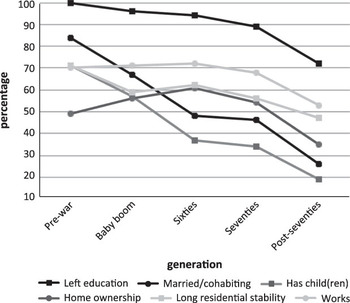
Average scores on life-cycle events of young adults of different generations, British Election Studies (BES) 1964–2010.

Figure 1 looks at the generational differences in the transition to adulthood for 348 different age groups. The lines in Figure 2, on the other hand, track the average scores on the six life-cycle indicators from one generation to the next. It shows that the percentage of young adults who have left education, are married and have children, has declined steadily and drastically between the pre-war generation and the post-1970s generation. The 1960s generation scores highest for having a job, residential stability and home ownership by the age of 35. Young adults of the post-1970s generation score lower than the pre-war generation on these three items, however.
Based on the findings in this section, we can conclude that the political life-cycle has indeed changed over time and it has done so in the expected direction. Overall, young adults nowadays mature at a different pace than their parents and grandparents did. Today’s young adults have lower starting levels of maturation. Even though some of the losses are made up as citizens age over time differences remain apparent and young adults are found to experience ever fewer life events with each election year that passes. The next step is to assess the extent to which the delayed assumption of adult roles is linked to generational differences in voter turnout.
Later maturation and young adult turnout: an empirical test
Although national election surveys are designed to include a representative sample of the electorate as a whole, subsequent analyses will be performed on a young subset of the electorate only (aged 35 years or less). There are several reasons for doing so. First, the aim of this research is to understand what makes the turnout patterns of today’s young adults different from young adults of the past. Second, the later maturation hypothesis central to this study applies to young voters and abstainers only. Although the hypothesis assumes that certain life-cycle events are experienced later in life, which may suggest increasing the upper age bound, the more important assumption is that the proportion of young citizens that has matured by a certain age has decreased with time because of more or extended ‘start-up’ problems: a finding that was corroborated in the previous section.
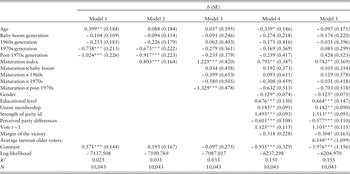
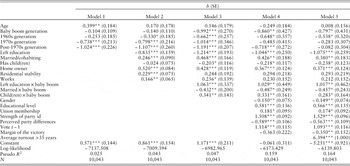
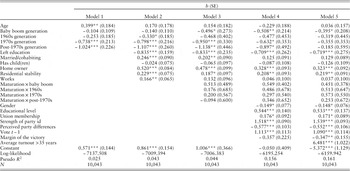
The analyses of young adult turnout presented in Table 1 consist of five steps. In the first step, a model is estimated including only age and the dichotomous variables for the different generations (see Model 1). The pre-war generation is the reference category and is therefore not included in the model. As expected, the age variable is positive and significant at the P<0.05 level. The coefficients for the 1970s and post-1970s are negative and significant, implying that the propensity to vote for young adults of these generations is significantly lower than for the pre-war generation.
Young adult turnout by maturation, BES 1964–2010

BES=British Election Studies.
b coefficients from logit analyses with robust SEs clustered by election in parentheses.
Reference category is pre-war generation.
*P<0.10, **P<0.05, ***P<0.01.
In a second step the maturation index is added to the model. The relationship between the index variable and turnout is expected to be positive: the higher the level of maturation, the higher the probability that a respondent will turn out to vote. This is indeed the case as is evidenced by the positive and significant coefficient for the maturation index in Model 2 of Table 1. The coefficient for the age variable should become smaller once the life-cycle indicators are included in the model. The life-cycle model predicts that turnout increases with age as age increases the likelihood of experiencing certain life-cycle events that are important for the development of turnout patterns. Controlling for such events should therefore reduce the impact of the variable age itself. Upon the inclusion of the maturation index in Model 2, we find that the effect of age disappears completely. The magnitude of the generation effects for the 1970s and post-1970s generation appears, moreover, somewhat reduced compared with Model 1.
The third model involves the inclusion of interactions between the generational dummy variables and the maturation index. The inclusion of these interaction effects assesses the extent to which maturation has the same impact on voter turnout for young adults belonging to different generations. As can been seen in Model 3 of Table 1, the impact of maturation is equal for young voters of all generations except for those belonging to the post-1970s generation. The impact of political maturation on voter turnout is lower for today’s young adults than for young adults of the pre-war generation in a model that does not include control variables.
In Model 4, these control variables are added to the model. Gender and margin of the victory do not reach statistical significance at the P<0.05 level, but the other variables are statistically significant and in the expected direction with the exception of perceived differences between parties. Larger perceived differences appear to confuse the voter and lead to lower turnout levels. More interesting, the impact of maturation on voter turnout does not disappear in a better specified model even if the magnitude of the coefficient does decrease slightly. The interaction effect between the post-1970s generation and maturation is no longer significant after the inclusion of the control variables.
In the final model of Table 1, a variable that measures the average turnout of older voters (aged 36 years or more) is added to the model. This variable is a constant for a given election year. Through the inclusion of the average turnout of older voters, we can take account of the differences between younger and older voters (see Fieldhouse et al., Reference Fieldhouse, Tranmer and Russell2007 for a similar approach). If significant, this variable shows us that young citizen’s turnout is partly a function of processes that are going on in the electorate at large. Including the average turnout of older voters, moreover, makes it possible to establish whether life-cycle changes influence turnout among young voters regardless of other factors that influence turnout levels in the electorate at large. The average turnout of older voters is significant and positive, implying that the turnout levels of younger and older voters move in conjunction in Great Britain. The standardized coefficients, moreover, show that the impact of unmeasured societal processes have the most substantial impact on young adult voter turnout. This, notwithstanding, maturation remains a positive and significant explanatory factor of young adult voter turnout in a fully specified model.
In terms of model fit, the maturation index in itself does not do a good job of explaining variation in young adult voter turnout. The pseudo R 2 of Model 2, in which the index was first included, is a meagre 0.03. This result is not in the least surprising. In their meta-analysis of individual-level voter turnout, Smets and van Ham (Reference Smets and van Ham2013) find that no less than 177 different explanatory factors had empirically been linked to turnout in journal articles published in the last decade. In other words, if there is a single determinant of voter turnout it seems like we have not yet found it. This is also reflected when looking at the model fit of Model 5, which includes most explanatory factors. Here the pseudo R 2 reaches 0.16, which is decent for an individual level model but still leaves a lot of room for improvement.
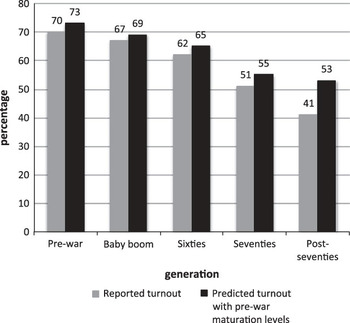
One of the questions that remains unanswered is what would have happened to young adult voter turnout had maturation levels remained stable through time. Figure 3 shows the reported and predicted probabilities of turnout by generation had maturation levels remained constant at the pre-war level (68%), while holding all other variables at their (generational) mean. The difference between observed and predicted levels of turnout is +2% for the baby boom generation, +3% for the 1960s generation, a difference of +4% for the 1970s generation, and a difference of +12% for the post-1970s generation. Delayed transitions to adulthood thus certainly play a role in the low attraction that elections have on young adults these days.Footnote 8
Reported young adult turnout and predicted turnout based on pre-war maturation levels, British Election Studies (BES) 1964–2010.

As a last step, it is worth looking into the black box of the maturation index. Until now we have assumed that all life-cycle events have an equal impact on young adult voter turnout. Table 2 shows models similar to those in Table 1, this time including the separate life-cycle events rather than the maturation index. There is one problem, however. Since respondents belonging to the post-1970s generation have hardly experienced any life-cycle events, there are too few observations taking a ‘1’ for the interaction effects between the life-cycle events and this particular generation. Interactions with the post-1970s generation are therefore not modelled.Footnote 9
Young adult turnout by life-cycle events, BES 1964–2010

BES=British Election Studies.
b coefficients from logit analyses with robust SEs clustered by election in parentheses.
Reference category is pre-war generation.
Models include all interactions between life-cycle events and the baby boom, 1960s and 1970s generations.
*P<0.10, **P<0.05, ***P<0.01; only interaction terms significant at the P<0.05 level are shown because of space limitations.
Starting with the impact of the life-cycle events, being married, cohabiting or being a home owner are consistently linked to higher turnout levels. Having left education is also a significant predictor of turnout, but not in the expected way. The coefficient is negative in all models, indicating that those in education are actually more likely to vote than those who left their formative years behind them. Although contradictory to the life-cycle hypothesis, these results are in line with the research of other scholars who find a similar positive relationship between being in education and turnout (see e.g. Wolfinger and Rosenstone, Reference Wolfinger and Rosenstone1980; Highton and Wolfinger, Reference Highton and Wolfinger2001; Sandell Pacheco and Plutzer, Reference Sandell Pacheco and Plutzer2007; Tenn, Reference Tenn2007). Those in school find themselves in a much more stimulating environment, are more likely to discuss politics with peers and in some instances are also engaged through the formal curriculum (e.g. social science students). Hence, the positive relationship between being in education and voter turnout. While not statistically significant at the P<0.05 level, having children is likewise found to negatively impact turnout among young adults in the more fully specified models. It is, of course, not a far stretch to assume that having small children leaves little room for political engagement. Residential stability and having a job are positively correlated with voter turnout but lose statistical significance once control variables are added to the model.
In comparison with the maturation index models, more significant differences in generational turnout patterns can be observed in Table 2. However, in terms of the interactions between life-cycle events and generations, we find very few significant effects. Due to space reasons only significant interactions are shown in the table. We see that the coefficients for having children, being married, and having left education are significant for the baby boom generation. However, in all cases the sign is opposite from that for the pre-war generation, which is the reference category. The two effects thus almost cancel each another out. This implies that on the whole the effect of life-cycle events on voter turnout is the same for young adults of all generations.
In terms of model fit, lastly, there are not many differences with the maturation index models. The most fully specified model explains 16% of the variation in young adult turnout.
Conclusion and discussion
According to the life-cycle theory, turnout increases as citizens age and experience life-cycle events that coincide with the transition to adulthood. These life-cycle events are thought to facilitate voter turnout. Findings in the sociological and demographic literature, as well as circumstantial evidence, suggest that in the past decades many life-cycle events have moved to a higher average age. In other words, young adults these days experience fewer life-cycle events than their parents and grandparents did when they were young. If the mechanisms of the life-cycle model are correct, these generational differences in the transition to adulthood should be able to explain – at least in part – why turnout in advanced industrial democracies has declined steadily among young adults in recent decades.
Based on the British Elections Studies from 1964 to 2010, this research shows how levels of political maturation have declined from one generation to the next. An index of six life-cycle events (having left education, being married or cohabiting, having children, owning a home, long residential stability, and having a job) is found to have a positive and significant effect on young citizens’ turnout even when modelled with other covariates of turnout. Had average levels of maturation remained constant since the pre-war generation faced young adulthood, turnout levels of the post-1970s generations would have been 12 percentage points higher.
While these results boost our confidence in the mechanisms of the political life-cycle model, not all life-cycle indicators were found to have an equal impact on young adult turnout. Home ownership and being married or cohabiting were found to have the expected impact on turnout. Leaving education, on the other hand, had an unexpected impact on turnout among young adults. While the life-cycle model considers leaving education to be a sign of maturation it actually leads to lower instead of higher turnout levels. This finding is in line with previous research. Students are most likely to be more easily mobilized to participate in politics than their non-school going peers. Residential stability, having a job, and childbearing were not found to pass the test of statistical significance in a more fully specified model.
Concluding, there does not seem to be any reason to doubt the over time validity of the life-cycle model. Generational differences in the transition to adulthood explain part of the generational differences in turnout among young adults. Previous research has overlooked to link this societal trend to patterns of declining young adult turnout in advanced industrial democracies. This study can be seen as a follow-up on earlier work in which the link between later maturation and turnout was assessed at the aggregate level (Smets, Reference Smets2012).
The later maturation hypothesis provides an intuitive explanation as to why young adults are often found to be less interested, more disengaged, and more alienated from the political system. Not having made the transition to adulthood, turnout seems more difficult and less meaningful for the current generation of young adults. While the results of this study can only speak for the impact of later maturation on voter turnout, it would be interesting to see whether a link with declining participation in other forms of political action can be established as well. Depending on data availability it would, moreover, be interesting to see whether a link between later maturation and declining turnout among young adults can be found beyond Great Britain. From a theoretical perspective, there are no reasons why this would not be the case. Young adult turnout has declined in almost all advanced industrial democracies and diversified life trajectories and delayed transitions to adulthood are observed in these countries as well.
While later maturation is found to negatively impact turnout among young voters, the models with the separate life-cycle events do show that more research is necessary to understand the exact mechanisms of the life-cycle models. The negative impact of some indicators suggests that their relationship with young adult turnout may be curvilinear rather than linear. In other words, transitions may have an initial disruptive effect on voter turnout before becoming a positive influence in the mid to long term. Also, while not all variables behave as expected, taken together they do have a positive impact on turnout. It seems that political maturation entails more than just a collection of life-cycle events. Their collective strength seems to outnumber the performance of the individual components.
The findings of this research also have potential policy implications. While it is difficult for governments to influence the pace of maturation in broad terms, assisting young citizens to become stable and independent earlier in life would have a positive impact on young adults’ turnout levels. Tackling youth unemployment, assistance for first-time home buyers, and sufficient childcare facilities are examples of measures that would facilitate the transition to adulthood for young citizens and increase their levels of political engagement. In this sense, the current economic crisis, which puts young Europeans in an exceptionally precarious situation, does not bode well for future levels of voter turnout.
Acknowledgements
The author is grateful to André Blais, Silvina Cabrera, Stefano Costalli, Geoffrey Evans, Mark Franklin, Oliver Heath, Evelyne Hübscher, Anja Neundorf, Rik de Ruiter, Alexander Trechsel, and three anonymous reviewers for their support, encouragement, and feedback on earlier versions of this paper.
Supplementary material
To view supplementary material for this article, please visit http://dx.doi.org/10.1017/S1755773914000460
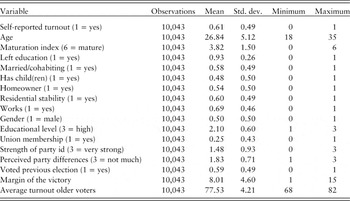
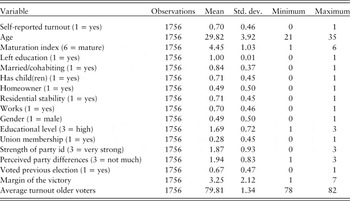
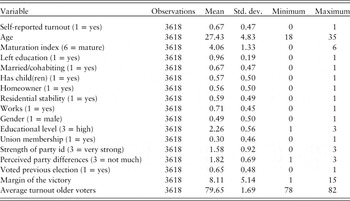
Appendix A
Descriptive statistics all respondents

Descriptive statistics pre-war generation (born<1945)

Descriptive statistics baby boom generation (born 1945–59)

Descriptive statistics sixties generation (born 1960–69)

Descriptive statistics 1970s generation (born 1970–79)

Descriptive statistics post-1970s generation (born⩾1980)

Appendix B
Young adult turnout by life-cycle events with maturation index interactions, BES 1964–2010