INTRODUCTION
Ecological processes are generally scale-dependent, i.e. they operate at a specific range of spatial scales (Levin, Reference Levin1992). Since non-random patterns of variability in distribution and abundance of species usually reflect the scale of underlying processes, measuring variability at several spatial scales means focusing attention on the range of processes that are likely to underpin the observed patterns (Underwood & Chapman, Reference Underwood and Chapman1996; Benedetti-Cecchi, Reference Benedetti-Cecchi2001). This explains why, in recent years, our view of spatial variability has evolved from simply considering it as noise to recognizing it as the key to link patterns with processes across scales.
Studies focusing on spatial patterns of species distribution and abundance have been particularly prolific for rocky intertidal systems, and reviews on the topic highlighted that variability is generally larger at small scales, from tens of centimetres to a few metres (Fraschetti et al., Reference Fraschetti, Terlizzi and Benedetti-Cecchi2005; Benedetti-Cecchi & Trussell, Reference Benedetti-Cecchi, Trussell, Bertness, Bruno, Silliman and Stachowicz2014). This originated the idea that rocky shores are mostly shaped by biotic processes, such as grazing (Underwood & Jernakoff, Reference Underwood and Jernakoff1984; Coleman et al., Reference Coleman, Underwood, Benedetti-Cecchi, Aberg, Arenas, Arrontes, Castro, Hartnoll, Jenkins, Paula, Della Santina and Hawkins2006; Díaz & McQuaid, Reference Díaz and McQuaid2011), competition (Blanchard & Bourget, Reference Blanchard and Bourget1999; Firth & Crowe, Reference Firth and Crowe2010) and facilitation (Barner et al., Reference Barner, Hacker, Menge and Nielsen2016; Benes & Carpenter, Reference Benes and Carpenter2015). Processes acting at broader spatial scales, from tens to hundreds of kilometres, such as mesoscale oceanographic features (e.g. upwelling sites), wave exposure, ice scour, coastal slope and recruitment (Broitman et al., Reference Broitman, Navarrete, Smith and Gaines2001; Schoch et al., Reference Schoch, Menge, Allison, Kavanaugh, Thompson and Wood2006), and from hundreds to thousands of km, such as coastal geomorphology, oceanography and climate gradients (Broitman et al., Reference Broitman, Navarrete, Smith and Gaines2001; Zacharias & Roff, Reference Zacharias and Roff2001; Schmidt et al., Reference Schmidt, Serrão, Pearson, Riginos, Rawson, Hilbish, Brawley, Trussell, Carrington, Wethey, Grahame, Bonhomme and Rand2008), are usually less important (Fraschetti et al., Reference Fraschetti, Terlizzi and Benedetti-Cecchi2005). Interestingly, the general picture emerging from these studies is that patterns of variation are consistent across ecosystems characterized by contrasting physical (e.g. tidal range) and biotic (e.g. species composition) conditions. However, these findings derive from the comparison of independent studies, each of them analysing different spatial scales and different ranges of scales. Formal comparisons between systems that differ in terms of environment and biota, while sharing habitat structural features, e.g. presence of foundation or keystone species, are therefore needed.
The North-east Atlantic and the Mediterranean Sea, although differing in terms of tidal range, sea surface temperature, salinity, productivity and nutrient availability, display several common features. Reef surfaces of both basins are largely dominated by canopy-forming algae, particularly in areas far from major sources of anthropogenic disturbance (Mangialajo et al., Reference Mangialajo, Chiantore and Cattaneo-Vietti2008; Bulleri et al., Reference Bulleri, Benedetti-Cecchi, Cusson, Maggi, Arenas, Aspden, Bertocci, Crowe, Davoult, Eriksson, Fraschetti, Golléty, Griffin, Jenkins, Kotta, Kraufvelin, Molis, Sousa Pinto, Terlizzi, Valdivia and Paterson2012). In the Atlantic, canopies are formed by a variety of macroalgal species dominated by fucoids and kelps, which can be found both in mid-shore (e.g. Fucus vesiculosus, Ascophyllum nodosum) and in low-shore (e.g. Fucus serratus, Laminaria digitata, Himanthalia elongata, Bifurcaria bifurcata) habitats (Raffaelli & Hawkins, Reference Raffaelli and Hawkins1996). In the Mediterranean, canopies generally dominate the low-shore habitat and are commonly constituted by fucoids of Cystoseira genus (Benedetti-Cecchi, Reference Benedetti-Cecchi2001; Mangialajo et al., Reference Mangialajo, Chiantore and Cattaneo-Vietti2008). In both regions, canopy algae provide three-dimensional habitat structures, shade and shelter for a vast array of marine organisms, thereby supporting assemblages generally characterized by high diversity (Bertness et al., Reference Bertness, Leonard, Levine, Schmidt and Ingraham1999; Bulleri et al., Reference Bulleri, Benedetti-Cecchi, Cusson, Maggi, Arenas, Aspden, Bertocci, Crowe, Davoult, Eriksson, Fraschetti, Golléty, Griffin, Jenkins, Kotta, Kraufvelin, Molis, Sousa Pinto, Terlizzi, Valdivia and Paterson2012; Crowe et al., Reference Crowe, Cusson, Bulleri, Davoult, Arenas, Aspden, Benedetti-Cecchi, Bevilacqua, Davidson, Defew, Fraschetti, Golléty, Griffin, Herkül, Kotta, Migné, Molis, Nicol, Noël, Sousa Pinto, Valdivia, Vaselli and Jenkins2013; Leclerc et al., Reference Leclerc, Riera, Leveque and Davoult2016). A conspicuous feature of mid-shore rocky habitats of both the NE Atlantic and Mediterranean is the presence of limpets (dominated by the genus Patella), which are the most common grazers of these systems. A consistent body of evidence highlights the strong top-down control that patellid limpets exert over their food resource that is mainly represented by filamentous algae, macroalgal spores and biofilm (Jenkins et al., Reference Jenkins, Arenas, Arrontes, Bussell, Castro, Coleman, Hawkins, Kay, Martínez, Oliveros, Roberts, Sousa, Thompson and Hartnoll2001; Coleman et al., Reference Coleman, Underwood, Benedetti-Cecchi, Aberg, Arenas, Arrontes, Castro, Hartnoll, Jenkins, Paula, Della Santina and Hawkins2006). Moreover, limpets can influence successional patterns, by consuming filamentous algae and thus indirectly promoting the growth of foliose algae and/or the recruitment of barnacles (Hawkins, Reference Hawkins1983; Hawkins & Hartnoll, Reference Hawkins and Hartnoll1983; Benedetti-Cecchi, Reference Benedetti-Cecchi2000; Coleman et al., Reference Coleman, Underwood, Benedetti-Cecchi, Aberg, Arenas, Arrontes, Castro, Hartnoll, Jenkins, Paula, Della Santina and Hawkins2006). Therefore, canopies and Patella spp. allow comparison of the abundance patterns of the same functional/taxonomic groups between NE Atlantic and Mediterranean basins.
Data from the EMBOS pilot study, encompassing several sites across both the Atlantic and the Mediterranean European coasts, offer the opportunity to investigate patterns of variability at a pan-European scale, speculate about underlying processes and perform regional comparisons. In this study, we capitalized on the harmonized hierarchical sampling design adopted in the EMBOS project to test whether patterns of variability in canopy cover, understorey richness and community structure of the low intertidal and the abundance of limpets in the mid intertidal were either consistent or different between NE Atlantic and Mediterranean regions. The spatial scales investigated were that of sites (from hundreds to thousands of km), stations (tens to hundreds of m) and replicates (from tens of cm to a few m). A preliminary analysis highlighted that the Atlantic sites were more ‘environmentally distant’ from each other (see Methods) with respect to the Mediterranean ones (see Results). Therefore, we expected a larger variability at the scale of sites in the Atlantic compared with the Mediterranean. Regarding the smallest spatial scale, i.e. among replicate quadrats, we hypothesized that differences in patterns of variability between the two regions could be related to emersion stress and its interaction with substratum heterogeneity (Benedetti-Cecchi et al., Reference Benedetti-Cecchi, Bulleri and Cinelli2000; Helmuth et al., Reference Helmuth, Harley, Halpin, O'Donnell, Hofmann and Blanchette2002). The Mediterranean has narrow tides and changes in barometric pressure may be more important than tidal forcing in dictating patterns of emersion-immersion, making the shore environment highly variable. For example, during periods of high barometric pressure organisms may remain exposed to aerial conditions for days or weeks, experiencing high, often fatal levels of stress (Benedetti-Cecchi et al., Reference Benedetti-Cecchi, Bertocci, Vaselli and Maggi2006). This stochasticity may emphasize the role of thermal refugia provided by small-scale habitat heterogeneity (Helmuth et al., Reference Helmuth, Broitman, Blanchette, Gilman, Halpin, Harley, O'Donnell, Hofmann, Menge and Strickland2006), possibly amplifying small-scale variability in the Mediterranean compared with the Atlantic, where aerial exposure for intertidal organisms is more deterministic. With regards to the intermediate spatial scale, i.e. between stations, we did not have any specific hypotheses.
MATERIALS AND METHODS
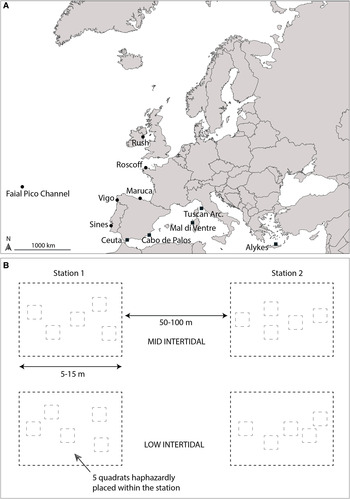
The EMBOS network of marine observatories covers a great part of European coasts, including sites in both the NE Atlantic and the Mediterranean (Figure 1A, Supplementary Materials, Appendix A). This offers the opportunity to investigate patterns and processes at the pan-European scale (see also Hummel et al., Reference Hummel, Van Avesaath, Wijnhoven, Kleine-Schaars, Degraer, Kerckhof, Bojanic, Skejic, Vidjak, Rousou, Orav-Kotta, Kotta, Jourde, Pedrotti, Leclerc, Simon, Rigaut-Jalabert, Bachelet, Lavesque, Arvanitidis, Pavloudi, Faulwetter, Crowe, Coughlan, Benedetti-Cecchi, Dal Bello, Magni, Como, Coppa, Ikauniece, Ruginis, Jankowska, Weslawski, Warzocha, Gromisz, Witalis, Silva, Ribeiro, Fernandes De Matos, Sousa-Pinto, Veiga, Troncoso, Guinda, Juanes De La Pena, Puente, Espinosa, Pérez-Ruzafa, Frost, McNeill, Peleg and Rilov2016; Kotta et al., Reference Kotta, Orav-Kotta, Jänes, Hummel, Arvanitidis, Van Avesaath, Bachelet, Benedetti-Cecchi, Bojanić, Como, Coppa, Coughlan, Crowe, Dal Bello, Degraer, De La Pena, Fernandes De Matos, Espinosa, Faulwetter, Frost, Guinda, Jankowska, Jourde, Kerckhof, Lavesque, Leclerc, Magni, Pavloudi, Pedrotti, Peleg, Pérez-Ruzafa, Puente, Ribeiro, Rilov, Rousou, Ruginis, Silva, Simon, Sousa-Pinto, Troncoso, Warzocha and Weslawski2016; Puente et al., Reference Puente, Guinda, Juanes de la Pena, Echavarri-Erasun, Ramos, de la Hoz, Degraer, Kerckhof, Bojanic, Rousou, Orav-Kotta, Kotta, Jourde, Pedrotti, Leclerc, Simon, Bachelet, Lavesque, Arvanitidis, Pavloudi, Faulwetter, Crowe, Coughlan, Benedetti- Cecchi, Dal Bello, Magni, Como, Coppa, de Lucia, Ruginis, Jankowska, Wesławski, Warzocha, Silva, Ribeiro, Fernandes de Matos, Sousa-Pinto, Troncoso, Peleg, Rilov., Espinosa, Pé rez-Ruzafa, Frost, Hummel and van Avesaathin press).
EMBOS sampling protocol: (A) Map of rocky shore sites included in the study, square symbols represent Mediterranean sites, while round circles represent Atlantic sites; (B) layout of sampling heights, stations and replicate quadrats at each observatory site.

Hypotheses definition
In order to accurately define our hypotheses, we tested whether variability in environmental conditions (calculated among sites) within the Atlantic and the Mediterranean was comparable. We estimated environmental distances by means of a Euclidean distance matrix (Sylvester et al., Reference Sylvester, Kalaci, Leung, Lacoursière-Roussel, Murray, Choi, Bravo, Therriault and MacIsaac2011; Seebens et al., Reference Seebens, Gastner and Blasius2013) based on normalized environmental data available at the scale of sites: mean Sea Surface Temperature (daily SST, OSTIA – Operational Sea surface Temperature and sea-Ice concentration Analysis – data, 1985–2014, resolution 0.050°), mean Significant Wave Height (hourly Hs, Regional hind-cast GOW, IH Cantabria, 1985–2014, resolution 0.025°), mean Photosynthetically Active Radiation (monthly PAR, SeaWifs and Modis Aqua, NASA, 1999–2004, resolution 0.018°) and mean Salinity (monthly salinity, World Ocean Database, 1985–2014, resolution 0.400°). All satellite data were gathered at vicinities of 3 to 12 km from the sampling sites (Appendix A). Since Salinity was highly correlated with SST and PAR, this variable was excluded from analyses. A similar matrix was created using geographic distances between each pair of sites. Both matrices (environmental and geographic) were compared between regions in terms of multivariate dispersion using the PERMDISP procedure (Anderson et al., Reference Anderson, Gorley and Clarke2008) and environmental data were subsequently analysed using Principal Component Analysis (both were conducted with Primer 6 software and PERMANOVA add-on).
Sampling design and data collection
We adopted a fully nested hierarchical sampling design comprising two random factors (site and station) in both regions. Sampling was conducted between March and April 2014 at six Atlantic sites and five Mediterranean sites (Figure 1A, Supplementary Materials, Appendix A). Sites were at least 100 km apart, were strictly rocky, i.e. excluding biogenic reefs, from fairly sheltered to semi-exposed to waves, fully marine, comparatively unbroken bedrock, of moderate slope and comparatively unimpacted by sediment or anthropogenic stressors.
Within each site, two stations, 5–15 m wide, were haphazardly placed 50–100 m apart. Two tidal heights (low and mid-intertidal) were sampled in each station using five random quadrats per height (Figure 1B). Tidal heights were defined operationally: mid intertidal as ~25% of the vertical extent of the shore centred on Mean Tidal Level (MTL), whilst low intertidal as 25% of the vertical extent of the shore working upwards from Mean Low Water Level (MLWL). The size of quadrats differed between the two regions to account for differences in tidal amplitude and size of organisms. We used a 50 × 50 cm quadrat on macro-tidal NE Atlantic shores, whereas along the micro-tidal Mediterranean coasts organisms were sampled with quadrats of 20 × 20 cm. Larger quadrats in this micro-tidal system would not have allowed the differentiation between the low-shore and mid-shore habitats. Smaller quadrats in the NE Atlantic would not have been appropriate to sample usually large-sized fucoid and kelp algae.
Non-destructive sampling techniques based on visual estimates of percentage cover were used to assess the abundance of algae and sessile invertebrates in the experimental units. Percentage cover values were estimated with the aid of a plastic frame divided into 25 sub-quadrats and giving a score from 0 to 4% to each taxon in each sub-quadrat. The final cover values were obtained by summing over the 25 sub-quadrats (Dethier et al., Reference Dethier, Graham, Cohen and Tear1993; Benedetti-Cecchi et al., Reference Benedetti-Cecchi, Airoldi, Abbiati and Cinelli1996). Densities of mobile organisms (mainly gastropods and arthropods) were expressed as number of individuals per quadrat. Organisms were generally identified to the species level, except for encrusting corallines and small filamentous algae (<2 cm). Cover of canopy algae, species richness of the associated understorey assemblage and community structure of the low intertidal, and abundance of limpets in the mid intertidal were selected as response variables.
Data analysis
We tested the null hypothesis that patterns of variability in the selected response variables were consistent between the NE Atlantic and the Mediterranean.
We used univariate analysis to estimate variance components for cover of canopy algae, species richness and abundance of limpets at each spatial scale (sites, stations, quadrats), separately for the two regions. This was done by implementing a random intercept model with the lmerTest package in R (R Development Core Team, 2015) for each response variable. The function VarCor (in the same package) allows extraction of bias-corrected variance components that are analogous to those estimated from the mean squares of ANOVA. In order to compare variance components between Atlantic and Mediterranean at the three selected scales, one would require at least two replicates of each variance component per region with which calculate a mean and a standard error. Our study provides only one estimate of variance component per scale and region. To overcome this problem and test our hypothesis, we first calculated the absolute value of the difference between the variance component estimated for the Atlantic and the one estimated for the Mediterranean (VarDIF_Site, VarDIF_Stat, VarDIF_Quad). Then, VarDIF_Site was compared with a distribution of values given that the null hypothesis is true (variance of the Atlantic at the scale of sites is equal to the variance of the Mediterranean at the same scale, i.e. VarDIF_Site = 0). We obtained this distribution through a bootstrapping procedure: the model has been refitted 10,000 times on as many datasets generated by randomly reallocating sites to each region, estimating variance components and calculating the absolute value of their difference (simulated VarDIF_Sites). This has been repeated also for VarDIF_Stat and VarDIF_Quad. The observed variance components for the Atlantic were deemed different from those observed for the Mediterranean at a given spatial scale if VarDIF exceeded the critical value (corresponding to α = 0.05) obtained from the null distribution (see Appendix C for an example). The exact significance level was estimated as the proportion of times out of 10,000 permutations in which the observed VarDIF was smaller than the critical value from the null distribution.
Regarding community structure, we derive estimates of variance components from mean squares of multivariate analysis based on a dissimilarity matrix, using the semi-metric Bray–Curtis index (Bray & Curtis, Reference Bray and Curtis1957) computed on species abundance data. Multivariate analyses were conducted in R through the function adonis in the vegan package (R Development Core Team, 2015), separately for the Atlantic and Mediterranean. To compare multivariate variance components of community structure between the Atlantic and Mediterranean at the three selected scales, we adopted the same procedure described for univariate response variables.
RESULTS
Geographic distances among sampling sites were evenly distributed between regions (PERMDISP: F 1,9 = 2.47 × 10⁻⁴, P = 0.987, mean ± SE: Atlantic = 824.3 ± 187.5 km, Mediterranean = 829.2 ± 255.0). In contrast, multivariate environmental dispersion differed significantly between regions (F 1,8 = 6.708, P = 0.033) with greater values observed in the Atlantic (1.45 ± 0.29, SE) compared with the Mediterranean (0.50 ± 0.07). In other words, across similar spatial extent, Atlantic sites encompass more diversified environmental conditions than their Mediterranean counterparts. Subsequent principal component analyses (Supplementary Materials Appendix B) indicated that the main dispersion was explained by concomitant effects of mean SST and PAR (on axis 1, 62.6% of variation) opposing Northern sites of the Atlantic (Ireland: Rush and France: Roscoff) to the others and by mean Hs (Axis 2, 33.0%) opposing, within the Atlantic, the Azores (Faial Pico Channel) to Ireland (Rush) sites.
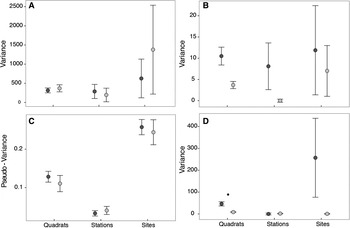
We found no significant differences between Atlantic and Mediterranean variance components in canopy cover and understorey species richness at any spatial scale examined (Figure 2A, B). Only the difference between variance components in abundance of limpets estimated for the Atlantic and the Mediterranean at the scale of quadrats was marginally statistically significant (P < 0.1, Figure 2D). Overall, variability was equally distributed among spatial scales (Figure 2). No significant differences between estimates of multivariate variance components (community structure) of the Atlantic and Mediterranean at any spatial scale were detected. However, multivariate variation among sites was much larger than variation at any other scale (Figure 2C).
Estimates of variance and pseudo-variance components at the scale of quadrats, stations and sites (estimated value ± bootstrapped standard error obtained from 10,000 iterations): (A) cover of canopy-forming algal species (low intertidal); (B) species richness (low intertidal); (C) community structure (low intertidal); (D) limpet abundance (mid intertidal). Dark grey: Atlantic; light grey: Mediterranean. • corresponds to P < 0.1.

DISCUSSION
In the present study we quantified the variability of rocky intertidal communities at several spatial scales, both in the NE Atlantic and the Mediterranean, and tested whether the observed patterns differed between the two basins. We found that horizontal spatial patterns of variability in canopy cover, understorey species richness and community structure of the low intertidal and abundance of limpets in the mid intertidal were generally consistent between NE Atlantic and Mediterranean regions. Variability was equally distributed among spatial scales for all the response variables, except for community structure, whose variability peaked at the largest scale examined, for both the Atlantic and the Mediterranean.
Our results did not support the view of Atlantic communities mostly shaped by large-scale processes and Mediterranean ones largely driven by small-scale interactions. Conversely, we found common patterns of spatial variability in the structure of assemblages on Atlantic and Mediterranean rocky shores. This suggests that, although species and environments differ between the two regions, the scale of influence of the processes operating is similar. Only the distribution of limpets in the mid intertidal showed a pattern of larger variability in the Atlantic compared with the Mediterranean at the scale of quadrats (from tens of cm to a few m). This result may reflect differences in the availability and distribution of food and habitat for limpets between the two regions. On fucoid-dominated shores in the Atlantic, limpets aggregate below mature algal canopies and forage in nearby open patches of substratum (Johnson et al., Reference Johnson, Burrows, Hartnoll and Hawkins1997, Reference Johnson, Hanley, Frost, Mosley and Hawkins2008). Dense patches of barnacles provide further constraints to the distribution of limpets, interfering with their grazing activity (Creese, Reference Creese1982). In the Mediterranean, in contrast, the mid-shore habitat is dominated by encrusting coralline algae, with algal canopies occurring lower down the shore and dense patches of barnacles dominating the high-shore environment. Limpets have therefore fewer biological and physical constraints compared with the Atlantic, displaying a lower degree of spatial aggregation.
Our study confirms what emerged from a review (Fraschetti et al., Reference Fraschetti, Terlizzi and Benedetti-Cecchi2005) collating results from published studies on the topic: patterns of variation can be consistent across ecosystems characterized by contrasting physical and biotic conditions. Nevertheless, it is the first that formally compares the spatial structure of NE Atlantic and Mediterranean rocky shore communities.
Canopy-forming algae displayed comparable levels of variability at all the spatial scales examined. This result could reflect the superimposition of different processes, each one acting preferentially at one or more specific scales, but none of them prevailing over the others (Dal Bello et al., Reference Dal Bello, Maggi, Rindi, Capocchi, Fontanini, Sanz-Lazaro and Benedetti-Cecchi2015). Cover of canopy-forming algae in the Mediterranean can show variability at the scale of metres (from few to tens of m), due to erratic recruitment (Mangialajo et al., Reference Mangialajo, Chiantore and Cattaneo-Vietti2008). Also biotic interactions, such as competition (Coleman, Reference Coleman2002; Bulleri et al., Reference Bulleri, Benedetti-Cecchi, Cusson, Maggi, Arenas, Aspden, Bertocci, Crowe, Davoult, Eriksson, Fraschetti, Golléty, Griffin, Jenkins, Kotta, Kraufvelin, Molis, Sousa Pinto, Terlizzi, Valdivia and Paterson2012) and grazing (Hawkins et al., Reference Hawkins, Hartnoll, Kain and Norton1992; Coleman et al., Reference Coleman, Underwood, Benedetti-Cecchi, Aberg, Arenas, Arrontes, Castro, Hartnoll, Jenkins, Paula, Della Santina and Hawkins2006), could be invoked to explain the small-scale patchiness in the spatial distribution of macro-algal canopies in both regions. Oceanographic features, such as latitudinal gradients in wave exposure (NE Atlantic, Hawkins et al., Reference Hawkins, Hartnoll, Kain and Norton1992), in sea surface temperature (Smale et al., Reference Smale, Burrows, Moore, O'Connor and Hawkins2013) and patterns of oceanic currents (Smale et al., Reference Smale, Kendrick and Wernberg2010, Reference Smale, Kendrick and Wernberg2011), instead, have been invoked to explain large-scale variability in the presence of canopy-forming species and may explain the spatial patterns in canopy cover observed in the present study.
The results highlighted that patterns of spatial distribution of species richness track those of cover of canopy-forming species, possibly reflecting the role of habitat-formers as major determinants of diversity and functioning of associated species assemblages (Byrnes et al., Reference Byrnes, Reed, Cardinale, Cavanaugh, Holbrook and Schmitt2011). Canopy-forming macroalgae can exert positive effects on understorey species by dampening environmental fluctuations and thus reducing thermal and desiccation stress (Bertness et al., Reference Bertness, Leonard, Levine, Schmidt and Ingraham1999; Benedetti-Cecchi et al., Reference Benedetti-Cecchi, Tamburello, Bulleri, Maggi, Gennusa and Miller2012). It follows that species richness is usually higher under canopies with respect to nearby areas dominated by algal turfs (Bertness et al., Reference Bertness, Leonard, Levine, Schmidt and Ingraham1999) or by suspension-feeders (Hawkins et al., Reference Hawkins, Sugden, Mieszkowska, Moore, Poloczanska, Leaper, Herbert, Genner, Moschella, Thompson, Jenkins, Southward and Burrows2009), and patchiness in the spatial distribution of tridimensional habitats created by canopy species and less complex communities at different spatial scales results in analogous patterns of variability in species richness (Valdivia et al., Reference Valdivia, Scrosati, Molis and Knox2011). Although several kelp species can form monospecific stands that reduce understorey richness through pre-emption of space or the sweeping action of fronds (Irving & Connell, Reference Irving and Connell2006; Smale et al., Reference Smale, Kendrick and Wernberg2011), also in this case, the spatial distribution of species richness should correspond to that of canopy cover.
Spatial variability of community structure of the low intertidal peaked at the scale of sites (100s–1000s of km) in both the NE Atlantic and the Mediterranean. As anticipated before, processes probably acting at these scales are usually linked to climate, geomorphology and oceanographic features, creating physical gradients that are considered the most important drivers of variation in biodiversity and assemblage structure at the scale of basin (Zacharias & Roff, Reference Zacharias and Roff2001; Coll et al., Reference Coll, Piroddi, Steenbeek, Kaschner, Ben Rais Lasram, Aguzzi, Ballesteros, Bianchi, Corbera, Dailianis, Danovaro, Estrada, Froglia, Galil, Gasol, Gertwagen, Gil, Guilhaumon, Kesner-Reyes, Kitsos, Koukouras, Lampadariou, Laxamana, López-Fé de la Cuadra, Lotze, Martin, Mouillot, Oro, Raicevich, Rius-Barile, Saiz-Salinas, San Vicente, Somot, Templado, Turon, Vafidis, Villanueva and Voultsiadou2010; Smale et al., Reference Smale, Kendrick and Wernberg2011; Ramos et al., Reference Ramos, Juanes, Galván, Neto, Melo, Pedersen, Scanlan, Wilkes, van den Bergh, Blomqvist, Karup, Heiber, Reitsma, Ximenes, Silió, Méndez and González2012; Smale et al., Reference Smale, Burrows, Moore, O'Connor and Hawkins2013). Both the NE Atlantic and the Mediterranean basins, indeed, exhibit strong gradients in temperature values (Jenkins et al., Reference Jenkins, Moore, Burrows, Garbary, Hawkins, Ingólfsson, Sebens, Snelgrove, Wethey and Woodin2008; Coll et al., Reference Coll, Piroddi, Steenbeek, Kaschner, Ben Rais Lasram, Aguzzi, Ballesteros, Bianchi, Corbera, Dailianis, Danovaro, Estrada, Froglia, Galil, Gasol, Gertwagen, Gil, Guilhaumon, Kesner-Reyes, Kitsos, Koukouras, Lampadariou, Laxamana, López-Fé de la Cuadra, Lotze, Martin, Mouillot, Oro, Raicevich, Rius-Barile, Saiz-Salinas, San Vicente, Somot, Templado, Turon, Vafidis, Villanueva and Voultsiadou2010; Ramos et al., Reference Ramos, Juanes, Galván, Neto, Melo, Pedersen, Scanlan, Wilkes, van den Bergh, Blomqvist, Karup, Heiber, Reitsma, Ximenes, Silió, Méndez and González2012; Smale et al., Reference Smale, Burrows, Moore, O'Connor and Hawkins2013; Ramos et al., Reference Ramos, Puente and Juanes2016) and nutrient availability (Bricaud et al., Reference Bricaud, Bosc and Antoine2002; Jenkins et al., Reference Jenkins, Moore, Burrows, Garbary, Hawkins, Ingólfsson, Sebens, Snelgrove, Wethey and Woodin2008; Lejeusne et al., Reference Lejeusne, Chevaldonne, Pergent-Martini, Boudouresque and Perez2010). In addition, wave exposure and tide amplitude vary greatly along Atlantic European coasts (Jenkins et al., Reference Jenkins, Moore, Burrows, Garbary, Hawkins, Ingólfsson, Sebens, Snelgrove, Wethey and Woodin2008). With regards to both local and biogeographic affinities of species, all these processes may elucidate the observed large-scale variability in community structure.
Variability in community structure at the scale of quadrats, although smaller than that at the scale of sites, also emerged from our analysis. Fine-scale variation in assemblage structure has been documented for a variety of benthic habitats (Foster, Reference Foster1990; Underwood & Chapman, Reference Underwood and Chapman1996; Hughes et al., Reference Hughes, Baird, Dinsdale, Moltschaniwskyj, Pratchett, Tanner and Willis1999; Benedetti-Cecchi, Reference Benedetti-Cecchi2001), and could reflect the importance of biotic interactions, such as those previously invoked to explain patterns of variations of canopy cover and species richness, i.e. competition, facilitation and grazing.
Although our study included 11 sites spanning a wide range of environmental and climatic conditions in both the NE Atlantic and the Mediterranean, we are aware that our results could partially be influenced by the sample size of the data. Dissecting patterns of variation across rocky shores at a pan-European scale is an ambitious task and a better understanding of how communities organize in space would come from the inclusion of more sampling sites, which would allow the quantification of variability at intermediate spatial scales (Broitman et al., Reference Broitman, Navarrete, Smith and Gaines2001), e.g. among basins inside the same region.
In conclusion, our results support the view of marine systems driven by presumably similar ecological processes that produce comparable patterns of variability across different environmental conditions and species pools. However, since species identity and functional traits can determine the spatial structure of natural communities, it could also be possible that different processes may create patterns of spatial variability that are similar among contrasting systems (Jenkins et al., Reference Jenkins, Moore, Burrows, Garbary, Hawkins, Ingólfsson, Sebens, Snelgrove, Wethey and Woodin2008). In order to discriminate between these two explanations, additional comparative and experimental studies at the pan-European scale are needed. Within the constraints due to the limited range of spatial scales investigated, our results offer new insights and hopefully will ignite new interest in the processes driving the distribution of key species and assemblage structure across European rocky shores.
SUPPLEMENTARY MATERIAL
The supplementary material for this article can be found at https://doi.org/10.1017/S0025315416001491
ACKNOWLEDGEMENTS
‘Penisola del Sinis – Isola di Mal di Ventre’ MPA (for logistics support). The authors would like to thank Nelson Valdivia and an anonymous reviewer for the useful comments on the manuscript and Caroline Broudin, Fanny Noisette, Aline Migné, Céline Houbin, Laurent Lévêque, Dominique Davoult, François Vandenbosch, Pascal Riera, Elena Maggi for their help with sampling.
FINANCIAL SUPPORT
This article is based upon work from COST Action ES1003 EMBOS, supported by COST (European Cooperation in Science and Technology). MDB and LBC were supported by the University of Pisa (PRA Project) and by a grant from the Italian Ministry for Research and Education (PRIN project ‘Biocostruzioni costiere: struttura, funzione, e gestione’ to LBC). JCL was funded by the French National Centre for Scientific Research and supported by an ATER position from UPMC-Sorbonne University. JJ was financially supported by the Région Poitou-Charentes through CPER funding, La Rochelle University and CNRS. PR was supported by the Portuguese Science Foundation (FCT) through a post-doctoral grant (ref. SFRH/BPD/69232/2010). VM was supported by the Portuguese Science Foundation (FCT) through a doctoral grant (ref. ||SFRH/BD/86390/2012). JK, HJ and HOK were supported by Institutional research funding IUT02–20 of the Estonian Research Council and the BONUS project BAMBI, the joint Baltic Sea research and development programme (Art 185), funded jointly from the European Union's Seventh Programme for research, technological development and demonstration and from the Estonian Research Council. IS-P and MR were funded by the European Regional Development Fund (ERDF) through the COMPETE – Operational Competitiveness Programme and national funds through FCT – Foundation for Science and Technology, under the project ‘PEst-C/MAR/LA0015/2011’.