Introduction
Rattus norvegicus, Berkenhout, 1769, is a synanthropic rat that can adapt to many environments around the world. Believed to have lived in Brazil since the 16th century, R. norvegicus is closely associated with human settlements and areas disturbed by human activities. The processes of urbanization and the unplanned growth of cities provide excellent habitats for rats. This species has attracted much research attention because of its role as a reservoir of human and livestock diseases, particularly zoonotic pathogens (Acha & Szyfres, Reference Acha and Szyfres2003; Ito & Itagaki, Reference Ito and Itagaki2003; Paramasvaran et al., Reference Paramasvaran, Sani, Hassan, Hanjeet, Krishnasamy, John, Santhana, Sumarni and Lim2009). The helminths of public health importance harboured by this rat include a large number of zoonotic species of nematodes (Leiby et al., Reference Leiby, Duffy, Darwin Murrell and Schad1990; Morand et al., Reference Morand, Pointier and Théron1999; Wang et al., Reference Wang, Lai, Zhu, Chen and Lun2008; Paramasvaran et al., Reference Paramasvaran, Sani, Hassan, Hanjeet, Krishnasamy, John, Santhana, Sumarni and Lim2009; Antoniou et al., Reference Antoniou, Psaroulaki, Toumazos, Mazeris, Ioannou, Papaprodromou, Georgiou, Hristofi, Patsias, Loucaides, Moschandreas, Tsatsaris and Tselentis2010; Moreira et al., Reference Moreira, Giese, Silva, Melo, Furtado, Maldonado and Santos2013; Simões et al., Reference Simões, Maldonado, Olifiers, Garcia, Bertolino and Luque2014). Studies in various countries have focused on taxonomic identification and community characterization of R. norvegicus (Seong et al., Reference Seong, Huh, Lee and Oh1995; Rafique et al., Reference Rafique, Rana, Khan and Sohail2009; Hancke et al., Reference Hancke, Navone and Suarez2011; Kataranovski et al., Reference Kataranovski, Mirkov, Belij, Popov, Petrovic, Gacic and Kataranovski2011; Zain et al., Reference Zain, Behnke and Lewis2012).
In Brazil, most studies on intestinal helminths from R. norvegicus usually involve species occurrence (Chieffi et al., Reference Chieffi, Grispino, Dias, Mangini and Guedes1980). Only one study described the helminth community (Araújo Reference Araújo1967), and a few studies were conducted on helminth community structures in wild rodents in the country (Maldonado Junior et al., Reference Maldonado Junior, Gentile, Fernandes-Moraes, D'Andrea, Lanfredi and Rey2006; Simões et al., 2010, Reference Simões, Souza, Maldonado and Luque2011). Little is known about factors that determine the structure of helminth communities in R. norvegicus, especially in tropical ecosystems.
This study aimed to identify the intestinal helminth species, analyse the effects of temperature, rainfall, host age and sex on the helminth community structure and investigate the possible associations among the helminth species in an urban population of R. norvegicus in São Gonçalo, Rio de Janeiro, sampled over a span of 2 years.
Materials and methods
Collection and examination of rats
São Gonçalo (22°48′26.7″S, 43°00′49.1″W) is the second most populous city in Rio de Janeiro, with more than 1 million inhabitants. It is an urban area with severe sanitation problems (IBGE, 2008). The climate is tropical, with rainy and hot seasons from November to March and a mild winter. The annual average temperature of the region is 25°C, ranging from 30 to 38°C in summer and from 17 to 19°C in winter. The average annual rainfall is 1200 mm (data gathered from the weather station of the Geosciences Laboratory (LabGeo) in São Gonçalo for the studied period).
Trapping was conducted every 3 months from March 2010 to December 2011, for a total of eight sampling events. Each capture session lasted four consecutive days. We established three transects spaced approximately 50 m apart with 20 trapping stations. A trapping station was established every 5 m and included both a Tomahawk® trap (Model 201; 16 × 5 × 5 inches; Tomahawk Live Trap, Hazelhurst, Wisconsin, USA) and a Sherman® trap (Model XLK; 3 × 3.75 × 12 inches; HB Sherman Traps, Tallahassee, Florida, USA).
Rats were transported to a field laboratory for euthanasia in a chamber enriched with CO2 and then necropsied. Biosafety techniques and personal safety equipment were used during all procedures involving animal handling and biological sampling, according to the Brazilian Ministry of Health recommendations (Lemos & D'Andrea Reference Lemos, D'Andrea, Martins, Martins, Silva, Lopes, Moreno and Silva2006).
Parasitological procedures
Following post-mortem examination, the stomach and small and large intestines of each rat were placed in Petri dishes for dissection under a stereomicroscope. All the helminths recovered were washed twice in saline to remove tissue debris and fixed in hot AFA (2% acetic acid, 3% formaldehyde and 95% ethanol). Nematodes were cleared in lactophenol (40% lactophenol, 20% lactic acid and 20% phenol in 100 ml with a sufficient quantity of water), and cestodes and acantho-cephalans were stained with chlorhydric carmine (Amato et al., Reference Amato, Walter and Amato1991). Helminths were identified according to Khalil et al. (Reference Khalil, Jones and Bray1994), Vicente et al. (Reference Vicente, Rodrigues, Gomes and Pinto1997) and Anderson (Reference Anderson2000).
Data analysis
The helminth community structure was analysed in terms of prevalence, mean intensity of infection and mean abundance of each species, using the methods described in Bush et al. (Reference Bush, Lafferty, Lotz and Shostak1997). The dispersion index was calculated by the variance-to-mean ratio. These parasitological parameters were calculated using Quantitative Parasitology software (Rósza et al., Reference Rósza, Reiczigel and Majoros2000). Rats were categorized into three age classes by weight: juvenile ( < 100 g), subadult (100–200 g) and adult (>200 g) (Webster & Macdonald, Reference Webster and Macdonald1995).
Helminth diversity was calculated using the Shannon index and compared in terms of gender and host age using the Shannon diversity T-test, a specific test to compare two alpha diversity indices (Magurran, Reference Magurran1988; Zar, Reference Zar1996). For this analysis, we grouped the juvenile and subadult age classes together.
The prevalence of each species was compared between rainy and dry seasons using the chi-square contingency table. Statistical analyses were performed only for parasite species with a prevalence greater than 10%.
The effects of temperature, rainfall, host gender, host age and abundance of Nippostrongylus brasiliensis were tested to investigate the occurrence of each helminth species (presence/absence) as follows. First, we analysed the individual effects of each independent variable on the response variable using logistic regression to minimize the number of variables in the final model. All independent variables with P≤ 0.05 in the first stage were selected for inclusion in the final model. Subsequently, generalized linear models (GLM) with binomial logit link functions were applied using a forward–backward stepwise procedure. The Akaike information criterion (AIC) was considered to select the most parsimonious risk-factor model. The abundance of N. brasiliensis was included as an independent variable in these analyses because this species was the most abundant and prevalent in the study and because it is considered a key species in the hosts’ immunological responses (Baek et al., Reference Baek, Islam, Kim, Lee and Hur1999).
We also investigated the effects of air temperature, soil temperature, rainfall, host gender and host age on the abundance of each helminth. Similarly, we first analysed each variable using univariate tests to reduce the number of variables in the final GLM model. Then, scale variables were tested using linear regression, and categorical variables were tested using ordinal regression.
We estimated an importance index to classify each helminth species in the community based on the number of infected hosts and the number of individuals of each parasite species. A helminth species is considered dominant when high numbers of helminths and infected hosts are recorded in the community (Thul et al., Reference Thul, Donald, Forrester and Abercrombies1985). The importance value, I, was calculated for each helminth species as follows:
 $$\begin{eqnarray} \end{eqnarray}$$
where A= number of individual parasites of a particular species; B= number of hosts infected with parasites of a particular species; j is the parasite species considered, i is any parasite species and M is a maturation factor, equal to 1.0 if at least one mature individual of the species considered is found and 0 otherwise. The importance index is classified as follows: (i) dominant species are characterized by I≥ 1.0; (ii) co-dominant species contribute significantly to the community although to a lesser degree than dominant species (0.01 ≤ I≤ 1.0); (iii) subordinate species occur infrequently, and although they may develop and reproduce, they do not contribute significantly to the community (0 < I< 0.01); and (iv) unsuccessful pioneer species gain access to the host but do not mature or reproduce, contribute little to the community and are characteristic of another host (I= 0) (Thul et al., Reference Thul, Donald, Forrester and Abercrombies1985).
Pearson correlations of the prevalence over time of each pair of helminths were carried out to investigate the possible relationships between species. Prevalence was estimated for each capture session for these analyses, totalling eight prevalence estimates for each species. Species associations were tested using the chi-square contingency table considering the number of infected and uninfected hosts of each helminth species of each pair tested. The Jaccard index of species association (Ludwig & Reynolds, Reference Ludwig and Reynolds1988) was calculated for each pair of species with a significant association in the chi-square test. A significance level was considered to be ≤ 0.05 in all analyses. These tests were performed using PASW Statistics software version 18 (SPSS Inc., Chicago, Illinois, USA), except for diversity indices and t-tests, which were carried out using PAST software version 2.10 (Hammer et al., Reference Hammer, Harper and Ryan2001), and GLM, which was conducted using R software version 2.10.1 (Bhattacharjee et al., Reference Bhattacharjee, Chatterjee, Han and Wheeler2012).
Results
A total of 114 R. norvegicus were trapped, with only two rats being free from infection. All helminths, totalling 14,401, were recovered from the small and large intestines. About 98.7% were nematodes, including N. brasilienesis (11,518), Strongyloides venezuelensis (1647) and Heterakis spumosa (189). Two cestode species, namely, Raillietina sp. (153) and Hymenolepis nana (29), were found. The only species of acanthocephalan found was Moniliformis moniliformis (4).
The overall parasite richness was six species, and the overall Shannon diversity index was 0.522. Male hosts had significantly higher diversity than females (M = 0.558, F= 0.422, t= 7.765. P< 0.001, n= 114). Young and subadult hosts (YS) had significantly higher diversity than adults (A) (YS = 0.613, A = 0.471, t= 8.169, P< 0.001, n= 114).
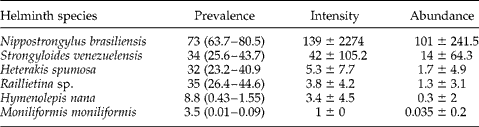
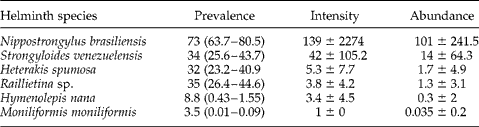
The nematode N. brasiliensis was the most prevalent and abundant species (table 1). Strongyloides venezuelensis presented significantly higher prevalence during the rainy season than during the dry season (χ2= 5.32, P= 0.02, n= 114). Prevalence of H. spumosa was higher during the dry season than during the rainy season (χ2= 4.67, P= 0.03, n= 114). Other species did not present significant differences between seasons in prevalence (considering α = 0.05).
Prevalence (95% confidence intervals), mean intensity and abundance (± SD) of intestinal helminths in Rattus norvegicus from São Gonçalo, Rio de Janeiro, Brazil.
Neither the occurrence (presence/absence of a helminth) nor the abundance of N. brasiliensis, H. spumosa and Raillietina sp. presented significant associations with any independent variable analysed in the univariate regressions. Thus, GLM was not performed for these species. The abundance of S. venezuelensis was not related to any of the variables tested. The occurrence of S. venezuelensis was related to air temperature (P= 0.001), rainfall (P= 0.002) and N. brasiliensis abundance (P= 0.002) in the univariate logistic regressions. After the GLM analysis, only rainfall and N. brasiliensis abundance were retained in the final model (rainfall+NB abundance) according to the AIC (119.75) (Null Model AIC = 148.47). This result indicates that the prevalence of S. venezuelensis is more likely to occur during the rainy season, when the abundance of N. brasiliensis is high. The sample size used in these analyses was 114 hosts.
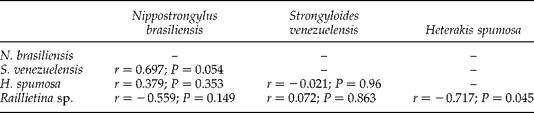
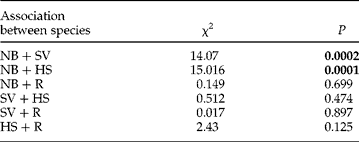
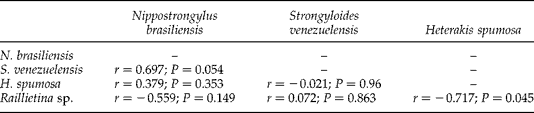
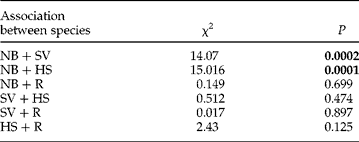
A significant positive correlation was found between N. brasiliensis and S. venezuelensis prevalence over time (table 2). A negative correlation was found between Raillietina sp. and H. spumosa prevalence over time (table 2). According to the species association analyses, co-occurrence was found between N. brasiliensis and S. venezuelensis and between N. brasiliensis and H. spumosa (table 3). The Jaccard indices of association for these species pairs were 0.455 and 0.419, respectively.
Correlation coefficients between prevalence of infection of four nematode species in Rattus norvegicus using host sample sizes=8.
Associations between each of four helminth species in infected and uninfected Rattus norvegicus using a chi-square test and a host sample size of 114; NB, Nippostrongylus brasiliensis; SV, Strongyloides venezuelensis; HS, Heterakis spumosa; R, Raillietina sp.
Importance indices (in parentheses) showed that the nematodes N. brasiliensis (87.069) and S. venezuelensis (5.7) were dominant; H. spumosa (0.602), Raillietina sp. (0.557) and H. nana (0.03) were co-dominant; and M. moniliformis (0.001) was the only subordinate species.
Discussion
The majority of rats were infected with at least one intestinal helminth species, a common pattern observed in rats worldwide (Abu-Madi et al., Reference Abu-Madi, Lewis, Mickail, Et-Nagger and Behnke2001; Waugh et al., Reference Waugh, Lindo, Foronda, Santana, Morales and Robinson2006; Simões et al., Reference Simões, Gentile, Rademaker, D'Andrea, Herrera, Freitas, Lanfredi and Maldonado2010). Moreover, previous studies have shown that nematodes and cestodes are more abundant in helminth communities of R. norvegicus (Abu-Madi et al., Reference Abu-Madi, Lewis, Mickail, Et-Nagger and Behnke2001, Reference Abu-Madi, Behnke, Mikhail, Lewis and Alkaabi2005; Hancke et al., Reference Hancke, Navone and Suarez2011; Kataranovski et al., Reference Kataranovski, Mirkov, Belij, Popov, Petrovic, Gacic and Kataranovski2011). This result is consistent with our findings, as nematodes accounted for 98.7% of the helminth community.
Although the helminth species that occur in R. norvegicus are similar around the world, the helminth community structure differs according to regional characteristics (e.g. air temperature, pH of the soil, rainfall and presence of the intermediate host). The helminth species richness observed in our study (6) was consistent with that observed in this rat in other countries, varying from 3 to 11 species (Araújo, Reference Araújo1967; Seong et al., Reference Seong, Huh, Lee and Oh1995; Gomez Villafañe et al., Reference Gomez Villafañe, Robles and Bush2008; Rafique et al., Reference Rafique, Rana, Khan and Sohail2009; Kataranovski et al., Reference Kataranovski, Kataranovski and Deljanin2010, Reference Kataranovski, Mirkov, Belij, Popov, Petrovic, Gacic and Kataranovski2011; Gürler et al., Reference Gürler, Beyhan, Bölükbas, Açici and Umur2011; Hancke et al., Reference Hancke, Navone and Suarez2011). However, comparing our findings with those in a previous study conducted in São Paulo, Brazil, by Araújo (1967), the richness observed in that study was much higher (11 species) than that observed in ours. The prevalence of helminths in R. norvegicus also differed between the two studies. This finding may be due to the fact that in Araújo's (1967) study, rats were captured in a large geographical area, including several districts of the city. This large variation in helminth community composition in different areas and countries may be caused by the presence or absence of some intermediate hosts and the parasites’ adaptability to environmental conditions.
High prevalence, intensity and abundance of N. brasiliensis were observed in the present study. This parasite has a worldwide distribution and is the most prevalent and abundant species in several helminth communities in R. norvegicus (Pulido Flores et al., Reference Pulido-Flores, Moreno-Flores and Monks2005; Waugh et al., Reference Waugh, Lindo, Foronda, Santana, Morales and Robinson2006; Coomansingh et al., Reference Coomansingh, Pinckney, Bhaiyat, Chikweto, Bitner, Baffa and Sharma2009). Nippostrongylus brasiliensis was referred to by Travassos (Reference Travassos1914) as Heligmosomun braziliense, which parasitized the small intestine of R. norvegicus in the district of Manguinhos, Rio de Janeiro. Subsequently, Travassos & Darriba (Reference Travassos and Darriba1929) categorized this nematode into the genus Nippostrongylus Lane, 1923 and changed the spelling of the species to brasiliensis. Some studies have demonstrated that, when juvenile rats are exposed to infection by N. brasiliensis, the helminth persists until adult life and young rats fail to cause the expulsion of the parasite, whereas adult rats exposed to N. brasiliensis infection develop a cellular immune response and consequently expel the helminth (Jarret et al., Reference Jarret, Jarret and Urquhart1966, Reference Jarret, Jarret and Urquhart1968; Dineen & Kelly, Reference Dineen and Kelly1973). Based on this fact, the infection of R. norvegicus by N. brasiliensis observed in the present study may have occurred during the juvenile age, which favours an increase in parasite burden during subsequent exposure to this helminth. This result partly corroborates with the high parasitological parameters.
In the present study, although the dominant species N. brasiliensis presented high parasitological parameters, its occurrence and abundance were not related to any of the variables tested. Therefore, helminth transmission may also be related to host group size, host home range size and host degree of sociability, as R. norvegicus has a high population abundance in the area. Arneberg et al. (Reference Arneberg, Skorping, Grenfell and Read1998) observed a strong positive correlation between host population density and parasite abundance in mammals. In fact, their results suggest the occurrence of a pattern that correlates parasites with direct cycle transmission and density of infected host populations (Anderson & May, Reference Anderson and May1978), which increases the probability of infection of rats.
Similarities in the life cycles of helminths or in the transmission routes can lead to an occurrence in the same host. The positive correlation observed between N. brasiliensis and S. venezuelensis, as well as the co-occurrence of these two dominant species, may have resulted from the similarity of their life cycles (Smyth, Reference Smyth1994). Both species can cause infection by oral ingestion and skin penetration by infective larvae (L3), which is the most common means of infection. Therefore, the main factors that drive the infection are probably the same. The relationship observed between S. venezuelensis occurrence with N. brasiliensis abundance also corroborates these results.
Moreover, the co-occurrence of N. brasiliensis and H. spumosa may be related to the characteristics of direct and oral infections, which both present. However, N. brasiliensis is transmitted by larval stages, whereas H. spumosa is transmitted by eggs; both species represent distinct life cycles. In fact, both species did not show any relationship with host sex, age, rainfall or air/soil temperature, a finding that corroborates this hypothesis.
Some environmental characteristics may favour the development of a specific life stage in helminths. The relationship found between the occurrence of S. venezuelensis and rainfall, as well as the high prevalence of this species during the rainy season, may be due to the characteristics of this species, which depends on moist soil for its free-living stage. According to Gillespie & Chapman (Reference Gillespie and Chapman2006), environmental characteristics strongly determine the development of nematodes during their free-living stage, either favouring their development or causing mortality because of dryness of the environment.
Variation in the abundance of the intermediate host can influence helminth prevalence (Abu-Madi et al., Reference Abu-Madi, Behnke, Lewis and Gilbert2000). The negative correlation between the prevalence of the two co-dominant species, Raillietina sp. and H. spumosa, may be caused by Raillietina sp. needing an intermediate host, usually an ant or a beetle, to complete its life cycle (Acha & Szyfres, Reference Acha and Szyfres2003); conversely, H. spumosa has a direct life cycle (Smith, Reference Smith1953). Therefore, the environmental factors that enhance the presence of the intermediate host, leading to an increase in the prevalence of Raillietina sp., may not enhance the directly transmitted nematode H. spumosa.
Among the species observed in the present study, the cestode H. nana and the acanthocephalan M. moniliformis are of particular public health concern because both species have been reported to infect humans. Humans become infected by H. nana accidentally by ingesting contaminated food containing the parasite eggs (Mason & Patterson, 1994) or by ingesting the intermediate host infected by cysticercoids, such as arthropods. In the same way, M. moniliformis is transmitted by the accidental ingestion of the intermediate hosts (e.g. beetles and cockroaches) (Miremad-Gassmann, Reference Miremad-Gassmann1981). Both parasites cause gastrointestinal alterations, especially in children (Counselman et al., Reference Counselman, Field, Lea, Nickol and Neafie1989; Gonçalves et al., Reference Gonçalves, Belizário, Pimentel, Penatti and Pedroso2011) who live in conditions of inadequate hygiene, without sanitary facilities (Mason & Patterson, Reference Mason and Patterson1994). In the present study, these two species were the least abundant and prevalent in the community and presented the lowest importance rates.
Understanding the helminth community structure in this synanthropic rat provides basic information on parasites of public health importance, as two helminth species recovered from the rats in the urban area studied could infect humans. Aside from these results, the observation on the pulmonary nematode Angiostrongylus cantonensis (the agent of human eosinophilic meningitis) in R. norvegicus in the same study area (Simões et al., Reference Simões, Maldonado, Olifiers, Garcia, Bertolino and Luque2014) highlights the importance of these species in infectious diseases with zoonotic origins. Overcrowding and poor sanitary practices in urban areas expose inhabitants to infection risk. Although, in this study, the species of medical importance were less abundant, we point to the need for continuous control of rat populations, further investigations of disease ecology and health education programmes to reduce human transmission of intestinal parasites.
Acknowledgements
We would like to thank all those who helped us with the field work.
Financial support
R.O.S. and J.L.L. were supported by a fellowship from the National Scientific and Technological Development Council (CNPq).
Conflict of interest
None.
Ethical standards
All animal procedures were performed according to the standards of the Committee on Animal Use Ethics of Oswaldo Cruz Foundation (License Number: LW 24/10). Captures were also authorized by the Brazilian Institute for Environment and Natural Resources/Chico Mendes Institute for Biodiversity and Conservation (License Number: 24 353–1).