By sometime in early grade school, children have enough knowledge of the positive integers to perform simple arithmetic and to recognize properties that are true of the integers. Our target article looked at the path they take to get there. Infants and many nonhuman animals are sensitive to quantitative differences: They react differently to small versus large groups of elements. Children's caregivers build on this ability in teaching them to enumerate small groups of objects – to assign to these groups the count term in their native language that denotes the appropriate number: for example, two pizzas, five cups, four trees. Developmental psychologists have naturally taken this ability as the antecedent of the children's later knowledge of the integers: two, five, four. It seems a small step from being able to enumerate small collections to being able to add two such collections by counting over them. A further step enables children to appreciate the properties of integers that support arithmetic reasoning; for example, that adding two positive integers produces a new integer larger than the first two.
Our article was meant as a skeptical analysis of the idea that there is a direct path from early numeric abilities – the abilities that underlie children's appraisal of the size of collections – to their later understanding of the positive integers.Footnote 1Sophian puts this point clearly: “characterizations of initial and mature knowledge must be congruent enough that there is a viable developmental pathway linking the two.” We would add that the pathway must be not only causal or motivational but also constitutive. That is, the component must be part of an initial or intermediate representation that eventuates in the final number concept. We learned that 7×8=56 in part because our grade-school teacher, Ms Foos, threatened, “No snacks until you memorize the 7 row of the multiplication table.” But this threat did not become part of our concept of multiplication, even though we may still become desperately hungry whenever we have to do 7×8. In the target article we argued that there might be no such constitutive pathway from the current candidates for initial number knowledge, where these candidates include mental magnitudes, object files, and internal sets. Knowledge of the integers, we think, is more likely to be imposed top-down from a mathematical schema that embodies the integers' structure.
This is such a radical thesis that we felt fairly sure that when readers got to our claim that enumerating objects may have little to do with understanding numbers, they would throw away the article with a laugh and return to more pressing business. We are grateful to the commentators for sticking with us long enough to write their thoughtful remarks.
R1. An overview of the commentaries
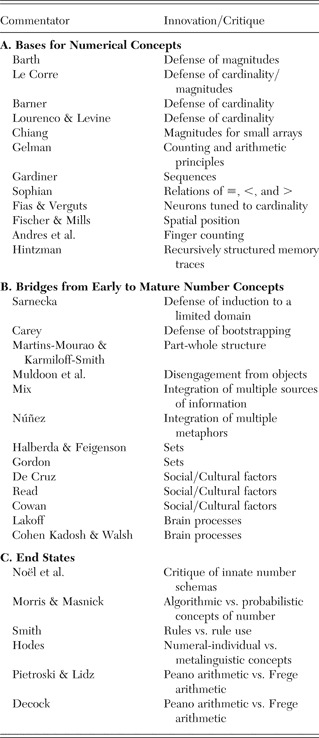
Because our claim is that you cannot get from Here to There, it is vulnerable in a number of places. For one thing, we may have selected the wrong Here. Our Figure 1 summarized one possible starting point: A current picture of infants' ability to discriminate quantity, which included parallel individuation of objects, longer-term representations of objects, and magnitude representations. As Chiang points out, the Figure 1 model shows that we were vision chauvinists, since the model is mainly geared toward assessing the cardinality of groups of visually presented objects. It is missing processes that infants need in order to determine the number of tones or actions in temporal sequences (Note 4 of the article mentions other patches). Our purpose, however, was not to defend this model in detail but to use it as a plausible partial theory of infants' initial quantitative skills. We also considered other possible starting points, such as the ability to place objects in groups and to form abstract representations of such groups. We argued that none of these representations provides a good conceptual basis for knowledge of the integers, as it would be difficult or impossible for children to extend them to such a concept through ordinary learning mechanisms. Some of the commentators dig in their heels and defend mental magnitudes (Barth; Lourenco & Levine) or, at least, assessments of the cardinality of small collections (Barner; Le Corre) as part of the story of number concepts. Gelman defends arithmetic principles as starting points – a position more in line with our own. However, other commentators propose representations that we did not consider as bases for number development. Although internal magnitudes (for example) may not be a reasonable starting point for numbers, infants might project numbers from: memory traces that embed other memory traces (Hintzman); neurons tuned to specific cardinalities (Fias & Verguts); finger counting (Andres, Di Luca, & Pesenti [Andres et al.]); spatial positions (Fischer & Mills); representations of sequences (Gardiner); and representations of relations of equivalence, less than, and greater than (Sophian). We have summarized the commentators' proposals about starting points in Part A of Table R1, and we examine them more closely in Section R3.
A breakdown of the Commentaries according to their view of where revision or defense is needed in theories of acquisition of the positive integers

A second point of logical vulnerability in our account is the transition from earlier to later numerical concepts. We are claiming that current theories have difficulty explaining this transition, but many commentators think that we adopt too limited a view of how kids get from Here to There. Part B of Table R1 includes those commentators who defend current views of the bridge to the positive integers and those who advance new types of connection. Some authors stick to versions of the traditional theory in which integer concepts arise from mappings between the first few count terms (“one,” “two,” “three,”… “ten”) and the cardinality of small collections, possibly supplemented by other mechanisms (Carey; Mix; Muldoon, Lewis, & Freeman [Muldoon et al.]; Sarnecka). Other authors implicate the role of additional structures, such as part-whole relations (Martins-Mourao & Karmiloff-Smith), empirical experience with objects in sets (Gordon; Halberda & Feigenson), motion along a path, object construction and collection, and measurement (Núñez). A few commentaries emphasize general factors that got short shrift in our article: the role of schooling and other social or cultural influences (Cowan; De Cruz; Read) and brain processes (Cohen Kadosh & Walsh; Lakoff). As Le Corre and Núñez note, related questions about bridging arise within our own theory when it comes to explaining how children achieve the correct schema for a math domain. We will have more to say about bridging in section R4.
Our argument could also go wrong in describing the nature of adults' number concepts. If instead of arriving at There, children arrive at Elsewhere, then the problems we raised may be irrelevant. We assumed that children eventually attain a concept (i.e., mental representation) of the positive integers as distinct individuals that obey the Dedekind-Peano axioms – what Hodes calls numerical-individual concepts. But several commentators (see Table R1C) question this assumption, suggesting instead that even adults may have no more than probabilistically defined number concepts (Morris & Masnick) or metalinguistic concepts of numerals (Hodes). Others doubt our conjecture that adults' number concepts are imposed top-down by schemas reflecting the axioms (Noël, Grégoire, Meert, & Seron [Noël et al.]). Perhaps such concepts are use-based (Smith) or reflect an underlying notion of equivalence between sets through one-to-one mapping of their elements (Decock; Pietroski & Lidz). We discuss these possibilities in section R5.
The pigeonholing in Table R1 is one way to organize the commentaries, but it obviously does not capture their full import. Many commentators' points fall into more than one of our categories. For example, if you believe that adults' representations of the positive integers involve equivalence relations on sets of objects, then you presumably think that the starting point for understanding numbers is the ability to represent sets, and that the route from early to mature representations takes sets into equivalence classes of these sets. The likely There carries implications for Here and for the route between them. Our purpose is only to indicate the relative emphasis of the critiques, and we have located them in Table R1 at the position where we believe their points are most telling. Within each of the three groups in Table R1, we have also ordered the commentaries roughly from those taking more conservative approaches (i.e., defending current theories) to those adopting novel proposals. This ordering suffers from the usual problem of having to collapse dimensions, and we hope readers won't take our listing as more than an outline.
R2. Clarifications
Before we go through the three substantive groups of commentaries in Table R1, we would first like to deal with some misperceptions about our project. These are all interrelated and are likely due to the sketchiness of the theory we tentatively offered in section 5. Several commentators (Mix; Muldoon et al.; Noël et al.; Sophian) take us to believe that any developmental account (or theory of learning) of the positive integers is futile; instead, knowledge of the positive integers is innate, much like knowledge of universal grammar. Other commentators (Carey; Mix) incorrectly attribute to us a view in which knowledge of the integers is based on verbal counting or enumerating objects. A third group (Barner; Cowan; Morris & Masnick; Muldoon et al.) seem to think we are evading a proper developmental account by uncritically accepting proposals from mathematicians and philosophers about the integers and by unfairly criticizing psychological theories if they fail to conform to these proposals.
R2.1. Assumptions about development and innateness
Some commentators take us to be advocating a nativist view of the integers, and they argue that anyone who has seriously studied the development of number concepts knows that children's progress is painfully slow and complicated, a struggle that is inconsistent with the triggering of an innate schema. We are not claiming, however, that people are born with an innate schema for the positive integers. Although this is possible, our approach is consistent with children gradually acquiring such a schema from more primitive components. In fact, we thought we were pretty explicit about this: “[Children] therefore do not start out with a schema for natural numbers in the sense in which an undergraduate who has just learned the axioms of set theory has a schema for set theory. Instead, children gradually acquire the information they need to understand the meanings of numbers” (target article, sect. 5.2, para. 1). Our negative thesis is that children cannot project these meanings from their experience grouping or enumerating physical objects, but this does not mean they do not learn them at all. We welcome developmental theories of how children learn the positive integers, but these theories won't get off the ground if they start with the wrong components.
Of course, something has to be innate in order for children to construct number schemas. In section 5.2 we suggested as starting points the concepts of a mapping and of uniqueness (among other concepts), because these would allow children to capture the structure of the positive integers (a unique initial element, a unique new element following each given element, and so forth). Children could also use these primitives to frame other types of structure, such as circular lists, partial orders, or finite linear lists (as Le Corre observes), but they could choose the correct structure through top-down, inference-to-the-best-explanation for arithmetic properties. Our suggestion could be completely off base – to our knowledge, no existing developmental evidence bears on it – but, contrary to Noël et al., it does not commit us to denying the gradual evolution of number concepts either in cultural history or in children. Again, we thought we were explicit about this: “In addition to the built-in aspects, however, children must still assemble the schematic or structural information that is specific to a domain of mathematics. … We typically expect children to acquire abilities such as these in a measured way that depends in part on their exposure to the key information” (sect. 5.2, para. 3).
R2.2. Assumptions about counting, enumerating, and modeling
Nor are we claiming, as Mix believes we are, that children learn the integers via knowledge of the numeral system (what we called “advanced counting”). As we mentioned in section 3.2.2, (para. 2) “we think it more likely that children learn an underlying set of principles that facilitates both advanced counting and the concept of natural number.” Along related lines, Carey defends her theory of math learning by claiming that:
the mastery of simple counting is a necessary prerequisite for the mastery of complex counting, which Rips et al. agree is likely to be a necessary part of acquiring the math schema of natural number. The mastery of simple counting draws on the resources of Figure 1 (plus others), and, in this sense, these structures are all part of the precursors of natural number.
However, we don't go along with this trajectory or with this description of our views. Carey misdescribes our account by ignoring our definitions of simple and advanced counting in section 1.1. Simple counting “consists of just reciting the number sequence to some fixed numeral, for example, ‘ten’ or ‘one hundred’” (sect. 1.1, para. 2), and no one's theory implicates the Figure 1 components in this kind of recitation. Second, “advanced counting is the ability to get from any numeral ‘n’ to its successor ‘n+1’ in some system of numerals for the natural numbers” (sect. 1.1, para. 2). Although simple counting may be necessary for advanced counting, neither draws on the components of Figure 1. Third, as we just noted, our view does not commit us to holding that advanced counting is a necessary part of acquiring the integers. In short, there is no connection in our account between the enumeration skills exhibited in Figure 1 and children's later knowledge of numbers. This is a good thing, because as far as we can see, no such connection exists.
Carey also believes that “the big mistake Rips et al. make is methodological: They miss the fact that modeling activities can give placeholder structures meaning, even if in the end the structures involved in these modeling processes, such as the schemata of Figure 1, are part of an acquisition ladder that is not essential to the conceptual role constructed.” Carey's “placeholder structure” is initially the simple count list we just mentioned (e.g., the sequence of numerals from “one” to “nine”), and the critical gap in her theory is that she provides no explanation of how enriching this structure by modeling (or other means) can give rise to the correct structure of the integers. The trouble is that the initial placeholder structure is a finite list, whereas the structure of the integers is a (particular type of) infinite list. Using the finite list to model the number of objects in a collection, for example, might motivate the search for alternative models, but it does not necessarily provide the right one. Of course, once you have the right structure – the structure of the positive integers – further modeling can be useful in establishing applications, as we describe in section R6. But the enhancement that these applications provide is not part of the meaning of the integers, as that meaning is already inherent in the structure. Numbers obviously have many uses, from figuring out the distance to Omaha, to calculating change from a $20 bill, to labeling house addresses. All these uses enrich the structure of the numbers, but they do not determine their meaning.
R2.3. Assumptions about mathematics and psychology
In describing what children eventually need to know about the integers, we relied on the standard Dedekind-Peano analysis. Mathematics and philosophy of math are helpful in this respect by providing a clear description of the properties of mathematical systems. Unlike Morris & Masnick, we think it extremely unlikely that adults could possess the intuitions and abilities they have in arithmetic unless they possess a concept of the integers that satisfies the requirements of analyses like Dedekind's or Frege's. No one, we hope, would set out to investigate kids' concept of prime numbers without taking into account the relevant mathematical definition (i.e., a positive integer evenly divisible only by itself and 1), and it is unclear why the same should not be true for kids' concepts of the positive integers themselves. We tried to emphasize, however, that this does not mean these concepts are identical to their formal mathematical definitions. What the axioms impose are constraints that a representation of the integers has to satisfy.
Moreover, we do not believe our use of these analyses violates any methodological strictures from the psychological side. Barner writes,
Rips et al.'s general thesis is that knowledge of natural number is defined in terms of an inferential system, and that therefore developmentalists should focus their efforts on evaluating how children come to manipulate numbers as syntactic objects, independent of their particular denotations. Stipulating that this particular knowledge should act as a metric of competence, however, is entirely arbitrary, and unprecedented in developmental psychology.
But we are not claiming that representations of numbers have a purely syntactic role. What we are suggesting is that rival theories may be wrong in supposing that the referents of numerals are sets of sets of physical objects (e.g., that “three” represents the set of all three-membered sets of physical objects), not that they have no referents at all. We also see nothing arbitrary in thinking that people's representations of the integers have to ensure that they function correctly in arithmetic.Footnote 2Cowan similarly suggests that relying on the philosophy of mathematics is unpsychological because philosophers disagree among themselves about math foundations and provide definitions that are not “operationalizable.”Footnote 3 However, although philosophers of mathematics differ (just as psychologists do) about the underlying nature of mathematics, we know of no serious disagreement about the correctness of the Dedekind-Peano axioms. We are also unconvinced that “operationalizing” mathematically or philosophically inspired theories is any more problematic than doing the same for other psychological theories. In short, although we are taking a novel approach to the development of math, the approach does not violate any well-grounded methodological principles within cognitive or developmental psychology.
R3. Bases for numerical concepts
We proposed that psychologists might be looking in the wrong place for the origins of knowledge of the integers. Instead of beginning with representations geared for physical objects, children may start from primitives that are more inherently mathematical. However, many of our commentators believe that we have not considered carefully enough the full range of possible initial representations. These commentaries seem to cluster in roughly three groups: (1) those that defend the traditional proposals about children's starting points, (2) those that take a structural approach closer to our own, and (3) those that propose novel representations.
R3.1. Magnitudes and cardinalities
As we predicted, several commentators think we are wrong to doubt that enumerating objects plays a direct role in number acquisition, and they have attempted to provide evidence for such a connection. Adults spend a lot of time getting children to connect the numeral “2” to pictures of pairs of pizzas, “4” to quartets of trees, and so on, with the hope that this will advance the children's knowledge of numbers. Assertions about cardinality are preschool teachers' most frequent use of numbers (e.g., “There are five new blocks in the block area”), far more frequent than use in calculations (Ehrlich Reference Ehrlich2007). How could it be that such efforts make no contact with later math knowledge?
Traditional theories assume that infants represent the cardinality of groups of objects by means of continuous internal magnitudes, discrete representations of individual objects, internal sets of these objects, or some combination of these. Debates among developmentalists concern what role (if any) each of these representations plays in promoting later math concepts, and traces of this debate appear in some of the commentaries. For example, Le Corre and Carey (Reference Le Corre and Carey2007) believe that magnitudes play no role in acquiring principles for enumerating objects, including Principle (3), repeated here:
(3) For any count word “n,” the next count word “s(n)” in the count sequence refers to the cardinality (n+1) obtained by adding one element to collections whose cardinality is denoted by “n.”
Barth, however, thinks Le Corre and Carey's (2007) evidence is not decisive, and Carey and Le Corre themselves allow a role for magnitudes in determining the relative cardinality of collections containing more than six items (see also Le Corre Reference Le Corre2005). Because we are skeptical about the role that all such representations play in understanding the integers, we won't dwell on the debate about magnitudes in particular. For reasons that we give in section 3.2.2 of our article (and in more detail in Rips et al. Reference Rips, Asmuth and Bloomfield2006; Reference Rips, Asmuth and Bloomfield2008), even if magnitudes are involved in acquiring Principle (3), this principle is not sufficient for understanding the integers. Similarly, Le Corre's (2005) experiment shows at most that magnitudes help children grasp the relative cardinality of small collections, not the relative ordering of integers. We know that 3,491 is less than 3,492, but this is far beyond the reach of the magnitude system. Although magnitudes might conceivably be a catalyst for learning integer order, they are not constitutive unless there is a reasonable story about how people transform magnitudes into integers.Footnote 4
Our point about cardinality is that children's ability to enumerate two pizzas or to use sentences like “Two pizzas are on the table” does not require the children to use “two” to refer to an integer, as such sentences are expressible without reference to numbers. This is the point that logical paraphrases, such as Proposition (4) in our article, drive home. Let us call the use of numerals to refer to small cardinalities of physical objects “c-use” and the use of numerals to refer to integers as “i-use.” Then our point is that the ability to engage in c-use does not determine whether children are capable of i-use. It is possible that mastering c-use in phrases such as “two pizzas” is causally necessary for acquiring the concept of the integer two, but we know of no compelling evidence that this is so. The fact that c-use emerges before i-use in children (as Barner and Le Corre assert) is not good evidence on this point, as the prior appearance of the former could be due to c-use's greater practicality, simplicity, concreteness, frequency in caregivers' speech, and many other factors. Much the same is true for the prior historical appearance of terms for cardinalities. As Read points out, the two can coexist in the same culture as independent systems.
Is there any empirical evidence for a causal-constitutive link between the use of numerals for cardinalities and their use for integers? Lourenco & Levine call our attention to several recent studies that suggest that early understanding or exposure to c-uses may influence children's later math abilities. Two of these studies (Ehrlich Reference Ehrlich2007 and Klibanoff et al. Reference Klibanoff, Levine, Huttenlocher, Vasilyeva and Hedges2006) show that the amount of time preschool teachers talk about numbers (predominantly in c-uses) influences their students' math improvement during that preschool year. Two others (Denton & West Reference Denton and West2002 and Duncan et al. Reference Duncan, Dowsett, Claessens, Magnuson, Huston, Klebanov, Pagani, Feinstein, Engel, Brooks-Gunn, Sexton, Duckworth and Japel2007) analyze large-scale studies linking children's math skills when they enter kindergarten to their later math performance in grade school. None of these studies, however, establishes that c-use causally influences i-use (nor were they designed to do so). The preschool studies are powerless in this respect because the investigators assessed the preschoolers' math improvement largely in terms of c-uses; i-uses were never tested. In Klibanoff et al., a particular task asked students to “point to the one that has more” for a display containing seven dots and five dots; another showed students a card with the numeral “2” on it and asked, “Which one of these goes with this one?” for a display containing one to four dots. A third task asked children to “point to four” for a display containing two to five objects. Although one additional task asked for a calculation, it was also phrased in terms of c-use, rather than i-use (“Johnny has one apple, and his mommy gives him one more. Point to how many apples Johnny has now,” where the display contained pictures of one to four apples). Ehrlich used a standardized test of math achievement (Ginsburg & Baroody Reference Ginsburg and Baroody2004), but according to Klibanoff et al., this test had a high degree of overlap with their own.Footnote 5 What these studies show, then, is that teachers' number talk influences pupils' c-performance, not necessarily their understanding of integers.
The large-scale math studies are no more helpful in showing that c-use directly affects i-use. Initial performance in these studies comes from beginning kindergartners (not preschoolers) whose i-abilities may already be in place, and the investigators do not attempt to break out the types of math skills that influence later performance. In fact, Duncan et al. (Reference Duncan, Dowsett, Claessens, Magnuson, Huston, Klebanov, Pagani, Feinstein, Engel, Brooks-Gunn, Sexton, Duckworth and Japel2007) report that math achievement at the beginning of kindergarten is not only correlated with later math skills, but also has a nearly equal correlation with later language skills, such as reading. This suggests that whatever the initial math achievement tests are tapping, it is likely to be considerably more general than mathematics.
R3.2. Structures and principles
We think psychologists should take more seriously the idea that the meaning of an integer is its position within the appropriate structure, and we are therefore sympathetic to the commentators who see structures or principles as primary. Like Gardiner, for example, we believe sequences are fundamental, but of course, the sequence of integers differs in its properties from the sequence of notes in a musical scale (with which Gardiner is concerned), letters in the alphabet, or days of the week. Appreciating that one element follows another is not sufficient for understanding the integers, but at least it is possible to see how adding further constraints could lead to the right destination.
Along somewhat similar lines, Muldoon et al. and Sophian suggest that concepts of equivalence and nonequivalence (along with the concept of a unit) may provide a developmental basis for the integers. The notion presumably is that one-to-one equivalence between sets provides a criterion for whether the sets have the same number of elements, an idea sometimes called “Hume's principle.” We ignored this possibility in our article mainly because of Gelman and Gallistel's arguments that children do not use Hume's principle in determining equality (i.e., same cardinality); instead, they enumerate both sets to see whether they contain the same total:
Young children, however, seem clearly to prefer (if not require) that decisions about the equivalence or nonequivalence of numerosities be based on the identity or nonidentity of their numerical representations rather than on the possibility of establishing a one-to-one correspondence between them. (Gelman & Gallistel Reference Gelman and Gallistel1978, p. 163)
According to this view, equivalence depends on cardinality rather than the other way round.
Of course, as Gelman reminds us, her theory has always insisted that principles of arithmetic underlie children's ability to determine cardinality. In particular, one-one matching plays a role in enumerating sets, since children have to match numerals to the objects in the sets in order to get a correct total. This is Gelman and Gallistel's (1978) “One-One Principle.” However, Gelman and Gallistel believe that this numeral-to-object matching is special – isolated from more general reasoning about equality:
From a logical point of view, the child's procedure for deciding numerical equivalence depends on the fact that the numerosities of both sets can be placed in a relation of one-to-one equivalence with the same set of counting tags. But the child does not normally take cognizance of the transitivity of one-to-one correspondence. He ignores or is indifferent to the fact that the cardinal numerons [i.e., mental count tags] representing two equally numerous sets are identical precisely because both sets have been placed in one-to-one correspondence with a count sequence that terminates with that cardinal numeron. (Gelman & Gallistel Reference Gelman and Gallistel1978, pp. 198–99)
It is possible, however, that Muldoon et al. and Sophian are right and that Gelman and Gallistel's conclusion should be revisited. Both Decock and Pietroski & Lidz point out that recent work in the foundations of mathematics shows that Hume's principle can serve as the basis for arithmetic (e.g., as an alternative to the Dedekind-Peano axioms), and an early appreciation of this principle could thus provide the right starting place for later mathematics. This is a tempting point of view, and we return to it in section R5.
R3.3. New cognitive starting points
A third set of commentators in Table R1-A propose a role for initial representations that we did not consider in our article and that may have properties closer to those of the integers. All these representations, however, still lack some of the integers' essential properties and therefore require additional learning to take up the slack. Some of these representations are simply variations on magnitudes – for example, neurons tuned approximately to specific cardinalities (Fias & Verguts) or spatial associations of numbers, similar to a number line (Fischer & Mills). Neither is able to represent the precise value of an integer but only the value plus or minus some amount. The problem with these representations is, in this respect, the same as that for magnitude formulations: There is no obvious method to get from them to mature integer concepts. Fias & Verguts assume that language is able to produce this shift, but they don't explain how this happens or why this proposal does not succumb to the difficulties pointed out by Gelman and Butterworth (Reference Gelman and Butterworth2005), Laurence and Margolis (Reference Laurence, Margolis, Carruthers, Laurence and Stich2005), and us.
Other commentators propose starting points that are genuinely different from magnitudes. For example, Hintzman suggests that retrieval of a memory trace creates a further memory trace that includes the first as a component; retrieval of this new trace creates, in turn, a third trace that embeds the first two, and so on. This structure is similar to the recursive representation for “3” that we presented as a tree diagram in section 3.2.1 (see Fig. 2) and to Dedekind's (Reference Dedekind1888/1963) famous attempt to prove that infinite systems exist. However, aspects of long-term memory impose limits on people's ability to resolve these degrees of embedding (as Hintzman acknowledges), whereas there is no such limit on our ability to deal with the positive integers. We can think about 3,491, but in doing so we do not represent it as a memory trace 3,491 levels deep. So children would still need a distinct representation of the integers and a means to learn this representation from the memory traces. Similarly, finger counting (see Andres et al.) would be a fine basis for the integers if only people had infinite fingers.
R4. Bridges from early to mature numerical concepts
Mental magnitudes, object files, internal sets, number lines, embedded memory traces, fingers, and other proposed representations have some properties in common with the integers, and some not in common. If children had a way to learn the integers from these representations, then there would be no need for the top-down approach that we believe is more likely. However, our review of proposals about such learning turned up no possibilities that did not appear to pull a rabbit out of a hat, where the rabbit in question is usually the infinite number or the discreteness of the integers. The typical strategy in these proposals is that if a representation lacks an essential integer property, then combine it with another representation that has that property. Mental magnitudes are not discrete, for example, but there are infinitely many of them. The initial members of the simple count list (“one,” “two,” …, “ten”) are not infinite, but they are discrete. So perhaps by combining magnitudes with simple counting, children could learn the integers. This combination strategy is tricky, however, because the offending properties do not automatically disappear. If you combine “one” with a fuzzy magnitude, “two” with a larger, fuzzier magnitude, and so on, why don't terms like “four” end up meaning several, rather than exactly four? When you reach the end of your (small finite) count list, what gets paired with the next fuzzy magnitude? “Lots”?
Our commentators adopt a variety of responses to this problem. One is to retrench, for example, by claiming that the learning proposal deals only with “one” through “nine,” not with the entire set of positive integers. A second response is to continue to apply the combination strategy by adding further components. A third is to recruit some external factor, such as schooling or neural mechanisms, to reinforce the right properties and to squelch the wrong ones. Let us see if any of these maneuvers helps.
R4.1. Retrenchment
We were hoping for an answer to the question, “How do children learn the positive integers?” where this is the set of numbers whose characteristics we defined in section 1.1 of the target article. We sometimes phrased this question, “How do children learn the concept of the positive integers (or the concept POSITIVE INTEGER)?” meaning a mental representation of the relevant set (i.e., the set of all and only the positive integers). This question perfectly parallels other questions that developmental psychologists ask about children's learning, such as how they learn the concept of cows or tables (or the concept COW or TABLE). In criticizing proposed learning procedures for the integers, we pointed to properties that these procedures failed to capture (e.g., the fact that there are infinitely many integers), and we concluded that the procedures were unable to give a correct answer to our question.
Sarnecka, however, believes we have misdirected these criticisms, as the learning procedures were never meant to handle the concepts we singled out. According to Sarnecka, properties of the positive integers – such as the property of there being infinitely many of them, or the property that for any two integers, x and y, x+y=y+x – are parts of “meta-numerical knowledge,” and children learn them by other means. The procedures in question only learn the meanings of specific integers, such as 7, which Sarnecka believes are cardinalities. Although these procedures capture concepts of particular positive integers (“numerical knowledge”), they are not supposed to capture the concept of the positive integers (“meta-numerical knowledge”), and Sarnecka thinks we have run the two together. This defense, however, is exactly like the claim that when psychologists investigate how children learn the concept of cows (or the concept COW) – for example, how children learn that all cows have four stomachs – they are actually investigating “meta-bovine” knowledge. By implication, this is secondary knowledge, and what the psychologists should be studying is how children learn the concept of Bossie or Buttercup, which is object-level bovine knowledge.
There is obviously a distinction between concepts of individual items like 7 or Bossie, and concepts of categories, like integers or cows, and it is fine to take as one's mission the study of concepts of individual integers (though we do not recommend trying to study all of them one at a time). So what is the scope of the learning procedure that Sarnecka is proposing? A first approximation is “we are interested in cardinalities that are (a) bigger than 4 (and thus too big for each individual to be represented in parallel), and (b) exact (and thus too fine-grained to be represented by the analog magnitude system),” as Sarnecka writes. This sounds as if the learning procedure is good for all integers greater than 4, which is surely how most people read the original proposals (e.g., Carey Reference Carey2004; Carey & Sarnecka Reference Carey, Sarnecka, Munakata and Johnson2006). The arguments in section 3 of our target article (given in more detail in Rips et al. Reference Rips, Asmuth and Bloomfield2006; Reference Rips, Asmuth and Bloomfield2008) show, however, that the procedure is useless outside the list of numerals the child currently knows (say, “one” through “nine”). And, in fact, Sarnecka now states that what the induction procedure actually yields is: “‘five’ means 1 more than 4; ‘six’ means 1 more than ‘five’; […]; ‘nine’ means 1 more than ‘eight.’” Full stop. As we've already mentioned, for small numerals like these and for the cardinality uses with which Sarnecka is concerned (e.g., “seven pencils”), no conclusions can be reached about whether children have representations of the corresponding integers (even the concept SEVEN). (See sect. 3.3 of our article for our reasoning about this.) Thus, Sarnecka's hypothesis fails on its own terms. That is why general statements about the integers are important: They are more likely to require concepts of the integers themselves, since they explicitly quantify over the integers. Carey asserts that the bootstrapping process that gets children to “nine” is “only one of several that eventually result in the capacity for representing natural number,” but she provides no details on what these further procedures might be. We don't mean to disparage children's achievement in getting from “four” to “nine” (or investigators' achievement in explaining how they do it), but this leaves unanswered our original question of how children learn the concept of the positive integers.Footnote 6
Martins-Mourao & Karmiloff-Smith's proposal is similar to Carey and Sarnecka's (2006) theory in supposing that children learn the integers by coordinating methods for enumerating collections with their knowledge of the numerals. (For Martins-Mourao & Karmiloff-Smith, the latter knowledge includes understanding the part-whole relations that govern the numerals' place-value system.) We agree that children eventually have to make these connections, but we are waiting for an account of how the learning takes place. The systems are supposed to develop in parallel, but it is unclear why this parallel development converges on the correct structure (the structure of the positive integers), rather than on something quite bizarre: for example, a structure that is like the integers up to the last term in the child's current count list – such as, “nine” – and then circles around from “ten” to “eleven” onward through to “nineteen” and then back to “ten” (see Fig. 1 of Rips et al. Reference Rips, Asmuth and Bloomfield2008).
R4.2. Numbers by combination and abstraction
We have no doubt that children reach the integers by a complex route. But merely acknowledging this complexity (or the host of possible influences on this process) should not be confused with a theory. It is possible that the integers emerge “from within a complex, ever-shifting, multifactorial system” (to use Mix's phrase), but so far we have not seen even a single persuasive theory of how this emergence takes place. Suppose one type of precursor representation has properties p 1, p 2, p 3, and p 4, and a second type of precursor has properties p 3, p 4, p 5, and p 6. We might try to combine the properties of the two representations to get something that neither can provide. For example, we could try taking the intersection of the property sets (i.e., p 3 and p 4) in the hope that intersection will eliminate possibly offending properties (e.g., p 1 might be fuzziness in the case of magnitudes). However, if each representation's resources were initially insufficient (e.g., because magnitudes lack discreteness), intersecting their properties will not provide the missing ingredients. If instead we take the union of their properties (i.e., p 1-p 6), we are including those same offending properties that disqualified them as number representations in the first place (e.g., fuzziness, again). Apparently, we require a smarter combination process than simple intersection or union, but what is it?
The intersection idea is quite similar to the possibility that children obtain the integers by abstracting over initial representations. By abstracting over the bad properties and retaining the good ones, you might get a representation more in line with the integers. For example, if you start with collections of three physical objects and abstract over them, then you might end up with a representation of three. Muldoon et al. suggest that children “disengage” numbers from small collections by reflecting on “how the accuracy of the counting procedure both identifies ordinal relations and determines the validity of the cardinal representation of the set.” But this idea is very similar to the theory that children learn the integers via Principle (3), and it is susceptible to the same objections. Some additional process must be involved in acquiring the integers. What process could this be?
A related issue puzzles us about Núñez's and Lakoff's commentaries (and about Lakoff & Núñez Reference Lakoff and Núñez2000). The integers are supposed to be formed from
the isomorphic structure of four different source domains of primary experiences… . Such isomorphism provides structural correspondences across the source domains of four different grounding metaphors, yielding equivalent numerical results. This understanding is not about a mere phrasing of operations on physical objects, it is about the abstracted numbers. (Quoted from Núñez's commentary)
But we do not understand why piling on metaphors is helpful, especially since there are many competing isomorphisms among complex domains. This does not bother Núñez because he believes that clashing inferences are commonplace in the history of mathematics and are sometimes resolved and sometimes not. For children, according to Núñez, “Similar, although more subtle, top-down dynamics must be accounted for in explaining the child's ‘acquisition’ of the concept natural number.” Just what might these be?
For Halberda & Feigenson, the fundamental bridging concepts are sets and the membership relation that binds individuals to sets. Gordon also proposes that “the indirect process of trying to figure out the nature of objects as objects and individuals within sets might be the catalyst for arriving at these principles in the relatively informal manner that we also acquire knowledge of other domains of folk-science.” In our article, we considered a related possibility – proposed by Carey and Sarnecka (Reference Carey, Sarnecka, Munakata and Johnson2006) – that internal sets might play a role in learning the integers. According to this approach, children first link the count terms “one,” “two,” and “three” to set-like representations, such as {a}, {a,b}, {a,b,c}, and then infer that increases in set size correlate with later terms in the count list (i.e., Principle [3]).Footnote 7 Carey and Sarnecka (Reference Carey, Sarnecka, Munakata and Johnson2006), Halberda & Feigenson, and Gordon might be right that these internal sets are better representations for one, two, and three than are magnitudes or object files; and Harberda & Feigenson are careful to note that the notion of a set to which they are appealing is not simply perceptual grouping. However, these sets do not help in learning the full range of integers for the reasons we spelled out in section 3 of the target article.
As Halberda & Feigenson acknowledge, “limits on parallel individuation or on working memory would therefore limit these set representations to small numbers of items,” and we lack an adequate explanation of how children could extend them to a full representation of the integers. Of course, investigators could adopt a more full-blooded notion of set, but these more complex formulations run directly into the issue raised by Hodes:
Perhaps this emergence of set-theoretic concepts [is] built upon some sort of ‘implicit conception’ […] of set-hood with older roots; but such a conception would also be sophisticated. In places […], [Rips et al.] seem to suggest that reputable psychologists believe children to possess these concepts (or their precursor conceptions)! I recommend that psychologists concern themselves with the concept of being three-membered only when investigating the psychology of professional mathematicians. (Hodes's commentary)
R4.3. External factors
Cohen Kadosh & Walsh and Lakoff suggest that brain processes help explain how children get from preliminary representations to representations for the integers, but we don't see how transposing the problem from mind to brain helps solve it. The very same difficulties about learning that we discussed in our target article and in the preceding subsection would seem to remain, whether the mechanisms in question are cognitive or neurological ones. According to Cohen Kadosh & Walsh, although “[Rips et al.] suggest why either magnitude or language might not play a role in the formulation of natural number, they do not explain why general magnitude and language cannot play an integrative role in shaping the understanding of natural numbers” (emphasis in the original). Yet we discuss exactly that possibility (in sect. 3.2.2) in connection with Spelke's (Reference Spelke2000) similar proposal. Nor are we the only ones who have questioned this idea; see Laurence and Margolis (Reference Laurence, Margolis, Carruthers, Laurence and Stich2005) and Leslie et al. (2007).
A suggestion that may be more helpful is that children learn the integers through external guidance by parents and teachers and through interaction with external symbols, such as the Arabic numerals. And, of course, mathematical knowledge does propagate through cultural channels, not only from adults to children but also from adults to other adults (De Millo et al. Reference De Millo, Lipton and Perlis1979). By the time children have a good grip on the integers, they may well be in kindergarten or early grade school; so school is a likely source of their knowledge. Thus, Cowan, De Cruz, Mix, Read, and others are probably correct in thinking that schooling, parent-child interactions, and other social-cultural factors are part of the story. As these commentators would agree, however, children cannot absorb this information unless they have enough relevant background to understand it. There are no current proposals about what this background is, which cultural inputs are effective, and how the inputs transform the background.
R5. End states
Older children and adults can correctly identify arithmetic facts (e.g., that 4 – 3=8,238 – 8,237) that are out of range for internal magnitudes, object files, working-memory object representations, internal sets, internal number lines, finger counting, embedded memory traces, and similar representations. Of course, in dealing with these facts, people sometimes make mistakes, due to the many factors that can interfere with their calculations. Nevertheless, people usually agree about arithmetic facts, and this is very unlikely to be entirely a result of chance or external influences (e.g., calculators, charts and diagrams, or teachers and mathematicians), though these external factors sometimes play a role. People's typically correct answers to arithmetic problems therefore require psychological explanation.
R5.1. Probabilistic and diagrammatic representations
We think the likely explanation of adults' arithmetic abilities is that they know the structure of the integers and the operations this structure supports. Perhaps people represent this structure in a non-propositional format, such as an internal diagram or model, as Morris & Masnick suggest, but we know of no diagrammatic representations that can handle the integers' infinite extent. Mental models are inadequate in this respect, because, as Johnson-Laird notes:
Mental models can contain only a finite number of entities, but we can reason about infinite quantities and sets of infinite size such as the natural numbers. There is accordingly a distinction between naïve or intuitive reasoning, which is directly based on mental models, and mathematical reasoning, which relies on other mechanisms. (Johnson-Laird Reference Johnson-Laird1983, p. 444)
Morris & Masnick also think that magnitudes could explain adults' arithmetic, as long as we are willing to accept a probabilistic rather than an algorithmic notion of the integers. However, outputs of the magnitude system are not just noisy or approximate. Their noise increases with the size of the represented cardinality. It is very unlikely that such a system could represent 8,238 as greater than 8,237 with greater than chance frequency, even after many trials. On any one trial, the likelihood that the system could represent 4 −3 as equal to 8,238 −8,237 is zero if each of these numbers is a magnitude. This isn't anything like adult performance.
R5.2. Rule use
Like most cognitive psychologists, we assume that adults have internal principles or rules that govern arithmetic operations. As Smith mentions, philosophers have challenged the idea that these internal rules alone can establish the correctness of their operations (e.g., Kripke Reference Kripke1982; Wittgenstein Reference Wittgenstein1958). To account for the correctness (normativity and necessity) of math, we need to appeal to factors other than a bare description of an individual's mental rules, and this idea has sometimes motivated the view that internal representations and rules are irrelevant to knowledge of mathematics: “As a body of knowledge, mathematics is not something I know, you know, or any individual knows: It is a part of our culture, our collective possession” (Wilder 1950/1998, p. 188, emphasis in the original text). Smith, however, does not seem to accept such a thoroughgoing cultural approach. According to him, “rule-meaning is dependent on rule-use… . Further, rule-use is regulated by reasons” and “reasons are investigable as normative facts.” Examples of these investigable reasons are children's statements that certain facts “must be the case” or “have to be true.” We agree about the psychological importance of justifications of this kind, but we don't see how they evade the skeptical challenges that Smith is trying to address. Taking reasons, rather than rules, as fundamental leaves exactly the same problem about the correctness of the reasons. Children's statements that certain mathematical facts must be true (or necessarily follow) do not certify their own correctness any more than do descriptions of rules.
R5.3. Numerals
The integer schema that we are proposing captures the structure of the integers, but it also captures the structure of the numerals for those integers because the two are isomorphic. We called knowledge of the numerals “advanced counting” and noted that it provides a better model for the integers than groupings of physical objects. As we mentioned earlier, though, we did not propose that children learn the integers through advanced counting. However, Hodes raises a related possibility – one that we did not consider – that most people never get beyond advanced counting. He doubts that even middle-school students have singular concepts for the integers, and notes that the claim that they possess such concepts “would have to distinguish such possession from possession of corresponding metalinguistic concepts; for example, of Arabic numerals.” Do older children and adults think that “three” in a sentence like “Three is less than four” refers to a numeral rather than a number? If so, then advanced counting might be the final stage in most people's conception of the integers. We know of no research on this matter, but middle-school children learn several different numeral systems, for example, Roman numerals, Arabic numerals, scientific notation, and sometimes others. One pre-algebra text (Wilcox Reference Wilcox1990) explicitly compares Chinese, Roman, Greek, and Arabic numerals. Unless the metalinguistic concept in question can encompass, for example, “6,” “VI,” and “6×100,” then the simplest assumption might be that older children have a concept of six that each of these numerals represents.Footnote 8
R5.4. Frege arithmetic
In proposing that children and adults have a schema for the positive integers, we were not assuming that this schema takes exactly the shape of the Dedekind-Peano axioms. As we said in the target article, “we are not claiming that the Dedekind-Peano axioms are the only ones that are sufficient for producing the natural numbers or that they are the most cognitively plausible for the job” (sect. 5.3.4). We do believe, however, that the integer schema has to conform to these axioms in order to provide a reasonable basis for people's arithmetical reasoning. Both Decock and Pietroski & Lidz point out, however, that there is a route to such knowledge via Hume's principle (there are the same number of F's as G's if the F's and G's can be paired one-to-one), and such a route might be more psychologically plausible than the more direct specification stated in the axioms. Hume's principle, however, is not sufficient for specifying the integers. It is perfectly consistent, for example, with systems containing only a finite set of numbers and with systems containing cardinals beyond the natural numbers. To get the natural numbers (or the positive integers), you also need some additional definitions (as Pietroski & Lidz note), including the following key definition of the natural numbers: n is a natural number if and only if n is a member of the successor series beginning with 0 (see, e.g., Heck [2000] or Zalta [Reference Zalta and Zalta2008] for a formal definition; further definitions are required for 0 and for the successor relation). In fact, several of the Dedekind-Peano axioms, including mathematical induction, follow from the definition (just given) of natural number alone, without the need for Hume's principle (see Rips & Asmuth [Reference Rips, Asmuth, Feeney and Heit2007] for a derivation).
The attraction of Hume's principle (and Frege's theorem deriving the axioms of arithmetic from this principle and the additional definitions) is presumably that it starts with cardinality (same number of F's as G's), rather than starting with a characterization of the natural numbers. In a developmental context, we could take this to mean that children could begin with one-to-one matching between collections as indicating that the collections have the same number of elements. However, as we noted earlier, Gelman and Gallistel's (1978) evidence on this score is not encouraging. Decock believes that we shouldn't take this evidence too seriously, as it may be biased by the training Western kids receive in enumerating objects. Maybe so. But even if we set aside the empirical evidence, children's concept of same number via one-one matching is going to play a limited role in their understanding of the natural numbers. Although Decock suggests that “it seems more promising to start with a psychological study of one-to-one correspondence […] than with Peano's mathematical induction or commutativity,” one-to-one correspondence does not allow an end run around mathematical induction. Even children for whom “same number” is defined in terms of one-one matching are going to have to learn mathematical induction (or an equivalent) in some other way.Footnote 9 In sum, it is possible that children start with a concept of cardinality as defined by one-one matching, learn further definitions of natural number, zero, and successor; and then deduce the correct properties of these numbers. However, this route does not give cardinality the central role that developmentalists imagine.
Of course, Pietroski & Lidz are right that what is deducible from what depends on the background logic available to children, but this doesn't affect the current point. Four-year-old logicists who start down the road of Frege's theorem armed with Hume's principle and full second-order logic still won't be able to deduce the definition for natural number, and we lack any account of how they learn it. Moreover, none of the theories that we examine in our article holds that children deduce the defining properties of the integers; assumptions about children's logical sophistication are of no help to them. All assume that children acquire this information by some form of empirical induction. That's the process we don't understand.
R6. Closing comments
In its instructions for replies, BBS explains that the commentaries will create an expectation among readers that “the other shoe will drop” for each of the commentators' points. The purpose of the authors' response is to drop those shoes. We thus find ourselves having to release 31 shoes, calculating conservatively just one pair of shoes per commentary. We have been throwing down shoes as fast as we can, but we apologize for any mismatched or undropped items. In surveying this array of often stylish footwear, we find that most commentators seem to agree with us that psychologists do not have a complete and convincing story about how children get from their early quantitative abilities to their later number concepts; but the commentators differ on the remedy. The solutions on offer here include beefing up infants' concepts for dealing with quantity, widening the range of factors that could lead them to more mature concepts, revising the nature of the mature concepts to put them within easier reach, or some combination of these strategies.
The purpose of most of these proposals is to preserve the link between early enumeration of physical objects and later concepts of the integers. The intuition is strong that enumeration must play some constitutive role in children's understanding of number, and the commentators see us as too quick to discard it. For the reasons given in sections R3 through R5 of this Response, however, we do not find the commentators' efforts to rescue enumeration convincing. The fancier methods that some commentators propose for early enumeration help reduce the difficulties with previous methods, but they don't eliminate them. The new learning procedures that other commentators advance to bridge between enumeration and number are too vague to be helpful explanations. And some of the alternative concepts of the integers give up too many of the properties that adults recognize and use in arithmetic.
Still, what is the connection between early enumeration and knowledge of the integers? As Carey suggests, enumeration might be important in providing children with a target for modeling efforts. According to our view, however, knowledge of the integers precedes this modeling. Suppose children have in mind a set of possible structures that they have constructed from primitive relations (e.g., x follows y). The structures might include linear ones with a finite number of elements (useful for understanding the alphabet, for example); circular lists (useful for understanding the days of the week); linear structures with an initial element but no final element; linear ones with no initial and no final element; and so on. Once children have the notion of a linear list with an initial element and no final one, they have the concept of the positive integers. But what purposes could this concept serve? The children's experience in enumerating collections suggests a correlation between the structure of the count terms and the structure of the cardinality of these collections, but it does not settle the question of which structure is the right one. However, evidence from several sources may increase the likelihood that the integer sequence is correct. Such sources may include many of those suggested by the commentators: feedback from preliminary experiments; hints from teachers and parents; and facts about the internal structure of the numerals. The numerals denote the elements of the integer sequence, and the elements have enumeration as one of their uses.
As important as it is to study such applications, the gist of our positive proposal is that we also need to look directly at the integer sequence's internal properties. There are already many elegant experiments on principles of enumeration and principles of arithmetic. Where are the studies of the integers' properties?