1 Introduction
A compact subset S of Euclidean space
 $\mathbb {R}^{n} $
is said to be computable if S can be effectively approximated by a finite set of rational points for any given precision [Reference Brattka and Presser4, Reference Weihrauch33]. Each nonempty computable set contains computable points, moreover they are dense in it.
A compact set
 $S\subseteq \mathbb {R}^{n} $
is said to be semicomputable if the complement
 $\mathbb {R}^{n} \setminus S$
of S can be effectively exhausted by rational open balls. Equivalently, S is semicomputable if there exists a computable (in the sense of [Reference Pour-El and Richards27, Reference Weihrauch33]) function
 $f:\mathbb {R}^{n} \rightarrow \mathbb {R}$
such that
 $S=f^{-1} (\{0\})$
.
While each computable set is semicomputable, the implication
 $$ \begin{align} S\mbox{ semicomputable }\implies S\mbox{ computable} \end{align} $$
does not hold in general. In fact, there exists a nonempty semicomputable subset of
 $\mathbb {R}$
which does not contain a computable number [Reference Specker and Heyting29]. However, under certain additional assumptions we can conclude that (1) holds and it turns out that the topological properties of S play an important role in this sense. The significance of topology here was first shown by Miller [Reference Miller24] who proved that (1) holds whenever S is a topological sphere, i.e., S is homeomorphic to the unit m-sphere
 $S^{m}=\{x\in \mathbb {R}^{m+1}\mid \|x\|=1\}$
for some m.
It is not hard to see that (1) does not hold in general if S is homeomorphic to the unit closed ball
 $B^{m} $
in
 $\mathbb {R}^{m} $
[Reference Miller24]. However, it is proved in [Reference Miller24] that (1) holds if
 $f:B^{m} \rightarrow S$
is a homeomorphism such that
 $f(S^{m-1})$
is a semicomputable set.
The notions of a semicomputable set and a computable set can be naturally defined in a computable topological space (see Section 2). The question is: under what conditions on S does the implication (1) hold for any copy of S in any computable topological space?
It was proved that (1) holds if S is a topological sphere or S is homeomorphic to
 $B^{m} $
by a homeomorphism which maps
 $S^{m-1}$
to a semicomputable set (in any computable topological space). More generally, it was proved that (1) holds if S is a compact manifold with boundary such that the boundary
 $\partial S$
is a semicomputable set [Reference Iljazović16, Reference Iljazović17, Reference Iljazović and Sušić22].
Related to this, the following notions naturally arise. We say that a topological space A has computable type if (1) holds whenever S is homeomorphic to A (in any computable topological space). We say that a topological pair
 $(A,B)$
has computable type if (1) holds whenever there exists a homeomorphism
 $f:A\rightarrow S$
such that
 $f(B)$
is a semicomputable set.
The aforementioned results can be now stated in this way:
 $S^{m}$
has computable type;
 $B^{m} $
does not have computable type, but
 $(B^{m} ,S^{m-1})$
has computable type; each compact manifold has computable type; a compact manifold with boundary need not have computable type, but if M is a compact manifold with boundary
 $\partial M$
, then
 $(M,\partial M)$
has computable type.
Not only manifolds have computable type. It was proved in [Reference Čičković, Iljazović and Validžić11] that each circularly chainable continuum which is not chainable (see [Reference Nadler26] for definitions of a circularly chainable and a chainable continuum) has computable type. For example, the Warsaw circle (see [Reference Nadler26]) is not a manifold, but it is a circularly chainable continuum which is not chainable. Related to this, see also [Reference Horvat, Iljazović and Pažek14, Reference Iljazović and Pažek21].
Semicomputability and computability can be generalized to noncompact sets and it turns out that (1) does not hold in general if S is a (noncompact) manifold [Reference Burnik and Iljazović6]. However, (1) holds in computable metric spaces if S is a 1-manifold which has finitely many connected components. In [Reference Iljazović and Sušić22] it was shown that (1) holds if S belongs to a certain class of noncompact manifolds of arbitrary dimension. Some conditions under which (1) holds can also be found in [Reference Brattka3, Reference Čelar and Iljazović8, Reference Iljazović and Pažek19]. See also [Reference Čačić, Horvat and Iljazović7, Reference Iljazović and Pažek20].
The computable type of topological spaces called graphs has been investigated in [Reference Iljazović18] (even in noncompact cases). Recently, Amir and Hoyrup examined conditions under which a finite polyhedron has computable type (see [Reference Amir, Hoyrup and Bojańczyk2]).
On the other hand, there are interesting examples of nonempty semicomputable sets which do not contain computable points (and which in particular are incomputable). Kihara constructed in [Reference Kihara23] a nonempty semicomputable compact set in the plane which is contractible and which does not contain a computable point. There also exists a semicomputable set of a positive measure which does not contain a computable point [Reference Tanaka30].
Let us mention that the famous Mandelbrot set is semicomputable, but it is not known whether it is computable (see [Reference Hertling13]).
We investigate conditions under which certain quotient spaces have computable type. It is proved in [Reference Čelar and Iljazović9] that if
 $M\cup _{\gamma }N$
is the space obtained by gluing compact manifolds M and N together by way of a homeomorphism
 $\gamma :A\rightarrow B$
, where A and B are closed subspaces of M and N contained in regular submanifolds, then
 $M\cup _{\gamma }N$
has computable type. The analog result for finitely many manifolds also holds [Reference Čelar and Iljazović9]. In this paper we are mainly focused on the quotient spaces
 $A/B$
, where B is a subspace of a topological space A and
 $A/B$
is obtained by collapsing all points of B to a single point, i.e.,
 $A/B$
is determined by the equivalence relation
 $\sim $
on A defined by
 $x\sim y$
if
 $x=y$
or
 $x,y\in B$
. It is known, for example, that
 $B^{n} /S^{n-1}$
is homeomorphic to
 $S^{n}$
for each
 $n\geq 1$
.
It is easy to see that the fact that
 $A/B$
has computable type does not generally imply that
 $(A,B)$
has computable type. We prove the following: if
 $A/B$
has computable type and the interior of B in A is empty, then
 $(A,B)$
has computable type. This means, for example, that the fact that
 $(B^{n} ,S^{n-1})$
has computable type follows from the fact that
 $S^{n} $
has computable type (recall the results from [Reference Miller24]).
On the other hand, if
 $(A,B)$
has computable type, then
 $A/B$
need not have computable type, even if
 $\mathop {\mathrm {Int}}_{A}B=\emptyset $
. We construct a closed subspace B of
 $S^{1}$
such that
 $\mathop {\mathrm {Int}}_{S^{1} }B=\emptyset $
and such that
 $S^{1}/B$
does not have computable type (since
 $S^{1}$
has computable type,
 $(S^{1},B)$
also has computable type).
So even if A is a compact manifold and B a closed subspace of A with empty interior,
 $A/B$
does not in general have computable type. We concentrate on the following question.
Question 1.1. Under what conditions does a quotient space of a compact manifold have computable type? More specifically, under what conditions on a subspace B of a compact manifold A does the quotient space
 $A/B$
have computable type?
Related to this, we introduce the notion of local computable type. We say that a topological space A has local computable type if in any computable topological space for any semicomputable set S the following holds: if
 $x\in S$
has a neighborhood in S homeomorphic to A, then S is c.e. at x. That S is c.e. at x means that there exist a neighborhood T of x in S and a c.e. subset
 $\Gamma $
of
 $\mathbb {N}$
such that for the basic open sets
 $I_{i} $
in the ambient computable topological space the following holds: if
 $I_{i} $
intersects T, then
 $i\in \Gamma $
; if
 $i\in \Gamma $
, then
 $I_{i}$
intersects S.
One of the main results from [Reference Iljazović and Sušić22] now can be stated in this way:
 $\mathbb {R}^{n} $
has local computable type. Since a semicomputable set S is computable if and only if it is c.e. at each
 $x\in S$
(this is easy to conclude, see [Reference Iljazović and Sušić22]), the fact that
 $\mathbb {R}^{n} $
has local computable type directly implies that each closed manifold has computable type.
We prove the following: if K is a compact subspace of
 $\mathbb {R}^{n} $
such that
 $\mathbb {R}^{n} \setminus K$
has finitely many connected components, then
 $\mathbb {R}^{n} /K$
has local computable type. We show that
 $\mathbb {R}^{n} /K$
need not have local computable type if
 $\mathbb {R}^{n} \setminus K$
has infinitely many connected components. We also show how these results for local computable type are related to Question 1.1.
2 Computable topological spaces
In this section we give some basic notions and facts about computable metric and topological spaces. See [Reference Brattka and Presser4, Reference Brattka and Weihrauch5, Reference Iljazović15, Reference Iljazović and Sušić22, Reference Pour-El and Richards27, Reference Turing31–Reference Weihrauch33].
The main ambient space in which we will examine computable and semicomputable sets is a computable topological space. The notion of a computable topological space is not new, for example see [Reference Weihrauch34, Reference Weihrauch and Grubba35]. The notion of a computable topological space which we will use corresponds to the notion of a SCT
 $_{2}$
space (effective second countable Hausdorff space) from [Reference Weihrauch34].
A triple
 $(X, \mathcal {T}, (I_i))$
, where
 $(X, \mathcal {T})$
is a topological space and
 $\{ I_i \mid i \in \mathbb {N}\}$
is a basis for
 $\mathcal {T}$
, is said to be a computable topological space if there exist computably enumerable sets
 $\mathcal {C},\mathcal {D}\subseteq \mathbb {N}^{2}$
with the following properties:
-
(CR1) if
 $(i, j) \in \mathcal {C}$
, then
$I_i \subseteq I_j$
;
-
(CR2) if
$(i, j) \in \mathcal {D}$
, then
$I_i \cap I_j = \emptyset $
; -
(CR3) for all
$i, j \in \mathbb {N}$
and for each
$x \in I_i \cap I_j$
there exists
$k \in \mathbb {N}$
such that
$x \in I_k$
and
$(k, i), (k, j) \in \mathcal {C}$
; -
(CR4) for all
$x, y \in X$
,
$x \neq y$
, there exist
$i, j \in \mathbb {N}$
such that
$x \in I_i$
,
$y \in I_j$
and
$(i, j) \in \mathcal {D}$
.


As shown in [Reference Iljazović and Sušić22, Proposition 3.3], any c.e. sets
 $\mathcal {C}$
and
 $\mathcal {D}$
which satisfy these four properties can be extended to c.e. sets with the following additional properties:
-
(CR5) if
$(i, j) \in \mathcal {D}$
, then
$(j, i) \in \mathcal {D}$
; -
(CR6) if
$(i, j), (j, k) \in \mathcal {C}$
, then
$(i, k) \in \mathcal {C}$
; -
(CR7) if
$(k, i) \in \mathcal {C}$
and
$(i, j) \in \mathcal {D}$
, then
$(k, j) \in \mathcal {D}$
.


From now on, given a computable topological space
 $(X,\mathcal {T},(I_{i} ))$
, we assume that
 $\mathcal {C}$
and
 $\mathcal {D}$
are c.e. sets with properties (CR1)–(CR7).
If
 $(X,\mathcal {T},(I_{i} ))$
is a computable topological space and
 $i_{0} ,\ldots ,i_{k} \in \mathbb {N}$
, then we say that
 $I_{i_{0} }\cup \cdots \cup I_{i_{k} }$
is a rational open set in
 $(X,\mathcal {T},(I_{i} ))$
. In order to fix an effective enumeration of all rational open sets in
 $(X,\mathcal {T},(I_{i} ))$
, we use the following notion.
A function
 $\Phi :\mathbb {N} \to \mathcal {F}(\mathbb {N})$
, where
 $\mathcal {F}(\mathbb {N})$
is the set of all finite subsets of
 $\mathbb {N}$
, is called computable if the set
 $$ \begin{align*}\{ (i, j)\in \mathbb{N}^{2} \mid i \in \Phi (j) \}\end{align*} $$
is computable and there exists a computable function
 $\phi : \mathbb {N} \to \mathbb {N}$
such that
 $\Phi (j) \subseteq \{0, 1, \ldots , \phi (j)\}$
for each
 $j \in \mathbb {N}$
.
From now on, let
 $\mathbb {N}\rightarrow \mathcal {F}(\mathbb {N})$
,
 $j\mapsto [j]$
, be a fixed computable function whose range is the set of all nonempty finite subsets of
 $\mathbb {N}$
. Furthermore, let
 $\langle \cdot \rangle : \mathbb {N} \to \mathbb {N}$
be a fixed computable function such that
 $$ \begin{align} [\langle i \rangle] = \{i\}, \quad\quad \forall i \in \mathbb{N} \end{align} $$
(e.g.,
 $[i] = \{x_1, \dots , x_n\}$
where
 $i = 2^{x_1} + \dots + 2^{x_n}$
,
 $x_1 < \dots < x_n$
and
 $\langle i \rangle = 2^i$
; see [Reference Soare28]).
Let
 $(X, \mathcal {T}, (I_i))$
be a computable topological space. For each
 $j\in \mathbb {N}$
we define
 $$ \begin{align*}J_j = \bigcup_{i \in [j]}I_i\text.\end{align*} $$
Clearly,
 $\{J_{j} \mid j\in \mathbb {N}\}$
is the family of all rational open sets in
 $(X,\mathcal {T},(I_{i} ))$
and
 $J_{\langle i \rangle } = I_i$
for each
 $i \in \mathbb {N}$
.
Let
 $$ \begin{align} C = \lbrace (a, b) \in \mathbb{N} \mid (\forall i \in [a])(\exists j \in [b]) (i, j) \in \mathcal{C}\rbrace \end{align} $$
and
 $$ \begin{align} D = \lbrace (a, b) \in \mathbb{N} \mid (\forall i \in [a])(\forall j \in [b]) (i, j) \in \mathcal{D}\rbrace \text. \end{align} $$
Note that C and D are c.e. sets,
 $(a, b) \in C$
implies
 $J_a \subseteq J_b$
and
 $(a, b) \in D$
implies
 $J_a \cap J_b = \emptyset $
.
[Reference Iljazović and Sušić22, Theorem 4.7] can be restated as follows.
Theorem 2.1. Let
 $(X, \mathcal {T}, (I_i))$
be a computable topological space. If
 $\mathcal {F}$
is a finite family of compact sets in
 $(X, \mathcal {T})$
and A is a finite subset of
 $\mathbb {N}$
, then there is a mapping
 $\mathcal {F}\rightarrow \mathbb {N}$
,
 $K\mapsto i_K$
, such that:
-
•
$K \subseteq J_{i_K}$
for each
$K \in \mathcal {F}$
; -
• if
$K, L \in \mathcal {F}$
are disjoint, then
$(i_K, i_L) \in D$
; -
• if
$K \in \mathcal {F}$
,
$a \in A$
and
$K \subseteq J_a$
, then
$(i_K, a) \in C$
.


This theorem will be used extensively throughout the paper, as it allows us to effective any set of containment or disjointness conditions for finitely many compact sets slightly expanded into rational open sets.
We say that a set
 $S \subseteq X$
is computably enumerable in
 $(X, \mathcal {T}, (I_i))$
if S is closed in
 $(X, \mathcal {T})$
and the set
 $\lbrace i\in \mathbb {N} \mid I_i \cap S \neq \emptyset \rbrace $
is c.e. We say that a compact set
 $S \subseteq X$
is semicomputable in
 $(X, \mathcal {T}, (I_i))$
if the set
 $\lbrace j\in \mathbb {N} \mid S \subseteq J_j \rbrace $
is c.e. We say that a compact set
 $S \subseteq X$
is computable if S is both semicomputable and computably enumerable. (It is not hard to check that these notions do not depend on the choice of the function
 $\mathbb {N}\rightarrow \mathcal {F}(\mathbb {N})$
,
 $j\mapsto [j]$
.)
These definitions are equivalent to those given in Section 1 for subsets of the Euclidean space
 $\mathbb {R}^n$
(see [Reference Brattka and Presser4]).
2.1 Computable metric spaces
To make an introduction to computable topology, it is often more natural to first consider computable metric spaces.
A computable metric space is a triple
 $(X,d,\alpha )$
, where
 $(X,d)$
is a metric space and
 $\alpha =(\alpha _{i} )$
is a sequence in X whose range is dense in
 $(X,d)$
and such that the function
 $\mathbb {N}^{2}\rightarrow \mathbb {R}$
,
 $(i,j)\mapsto d(\alpha _{i} ,\alpha _{j} )$
, is computable. Here, a function
 $f:\mathbb {N}^{k}\rightarrow \mathbb {R}$
being computable means that there exists a computable function
 $F:\mathbb {N}^{k+1}\rightarrow \mathbb {Q}$
such that
 $$ \begin{align*}|f(x)-F(x,i)|<2^{-i}\end{align*} $$
for all
 $x\in \mathbb {N}^{k} $
,
 $i\in \mathbb {N}$
.
A natural example of a computable metric space is the triple
 $(\mathbb {R}^{n} ,d,\alpha )$
, where
 ${n\in \mathbb {N}\setminus \{0\}}$
, d is the Euclidean metric on
 $\mathbb {R}^{n} $
and
 $\alpha :\mathbb {N}\rightarrow \mathbb {Q}^{n} $
is a computable surjection (computable in the sense that the component functions of
 $\alpha $
are computable). This computable metric space is called computable Euclidean space.
If
 $(X,d)$
is a metric space,
 $x\in X$
and
 $r>0$
, by
 $B(x,r)$
we will denote the open ball in
 $(X,d)$
with radius r centered at x.
If
 $(X,d,\alpha )$
is a computable metric space,
 $i\in \mathbb {N}$
and
 $r\in \mathbb {Q}$
,
 $r>0$
, then the open ball
 $B(\alpha _{i} ,r)$
will be called a rational open ball in
 $(X,d,\alpha )$
.
Suppose
 $(X,d,\alpha )$
is a computable metric space and
 $(I_{i} )$
is some effective enumeration of all rational open balls in
 $(X,d,\alpha )$
(effective in the sense that
 $I_{i} =B(\alpha _{f(i)},g(i))$
, where
 $f:\mathbb {N}\rightarrow \mathbb {N}$
and
 $g:\mathbb {N}\rightarrow \{q \in \mathbb {Q} \mid q> 0 \}$
are computable functions; such an effective enumeration certainly exists). Then
 $(X,\mathcal {T}_{d},(I_{i} ))$
is a computable topological space, where
 $\mathcal {T}_{d}$
is the topology induced by d (see e.g., [Reference Iljazović and Sušić22]).
We say that S is a c.e./semicomputable/computable set in
 $(X,d,\alpha )$
if S is a c.e./semicomputable/computable set in
 $(X,\mathcal {T}_{d},(I_{i} ))$
. It is not hard to check that these definitions do not depend on the choice of the effective enumeration
 $(I_{i} )$
of all rational open balls in
 $(X,d,\alpha )$
.
Suppose S is a nonempty compact set in
 $(X,d)$
. Then S is computable in
 $(X,d,\alpha )$
if and only if S can be effectively approximated by a finite subset of
 $\{\alpha _{0} ,\alpha _{1} ,\ldots \}$
with any given precision. More precisely, for
 $A\subseteq X$
and
 $r>0$
we define
 $N_{r}(A)=\bigcup _{a\in A}B(a,r)$
and if A and B are nonempty compact sets in
 $(X,d)$
and
 $\varepsilon>0$
, we write
 $A\approx _{\varepsilon }B$
if
 $A\subseteq N_{\varepsilon }(B)$
and
 $B\subseteq N_{\varepsilon }(A)$
. Then S is computable in
 $(X,d,\alpha )$
if and only if there exists a computable function
 $f:\mathbb {N}\rightarrow \mathbb {N}$
such that
 $$ \begin{align} S\approx_{2^{-k}}\alpha ([f(k)]) \end{align} $$
for each
 $k\in \mathbb {N}$
([Reference Iljazović17, Proposition 2.6]). (Recall that
 $j\mapsto [j]$
is an effective enumeration of all nonempty finite subsets of
 $\mathbb {N}$
.)
Actually, if
 $d_{H}$
is the Hausdorff metric on the family of all nonempty compact sets in
 $(X,d)$
, then for nonempty compact sets A and B we have that
 $A\approx _{\varepsilon }B$
if and only if
 $d_{H}(A,B)<\varepsilon $
. So S is computable in
 $(X,d,\alpha )$
if and only if there exists a computable function
 $f:\mathbb {N}\rightarrow \mathbb {N}$
such that
 $d_{H}(S,\alpha ([f(k)]))<2^{-k}$
for each
 $k\in \mathbb {N}$
.
In a recent paper, Amir and Hoyrup [Reference Amir and Hoyrup1] proved that any semicomputable compact set in a computable topological space can be embedded in the Hilbert cube by a computable embedding with computable inverse. This shows that, for the purpose of studying computable type (see Section 3), computable topological spaces are no more general than computable metric spaces, or in fact the Hilbert cube. Since the techniques used in this paper are strongly rooted in general topology, we have chosen computable topological spaces as the most natural setting for our work.
3 Computable type and local computable type
The general question we study is this: if S is a compact set in a computable topological space, under which conditions does the implication
 $$ \begin{align} S \text{ semicomputable} \quad\Rightarrow\quad S \text{ computable} \end{align} $$
hold? This is equivalent to
 $$ \begin{align*} S \text{ semicomputable} \quad\Rightarrow\quad S \text{ computably enumerable}\text. \end{align*} $$
It turns out that topological properties of a set S play an important role in view of (6). Related to this, we have the following definition. We say that a compact topological space A has computable type if, for any computable topological space
 $(X,\mathcal {T},(I_{i} ))$
, the implication (6) holds whenever
 $S \subseteq X$
is homeomorphic to A.
Furthermore, if B is a compact subspace of A, we say that
 $(A,B)$
has computable type if, for any computable topological space
 $(X,\mathcal {T},(I_{i} ))$
and any subspace
 $S \subseteq X$
, the implication (6) holds whenever there exists a homeomorphism
 $f:A\rightarrow S$
such that
 $f(B)$
is a semicomputable set.
If A has computable type, then clearly
 $(A,B)$
has computable type for any subspace B of A. On the other hand, A need not have computable type if
 $(A,B)$
does (namely
 $([0,1],\{0,1\})$
has computable type, but
 $[0,1]$
does not have). Note that A has computable type if and only if
 $(A,\emptyset )$
has computable type.
Recently, in [Reference Amir and Hoyrup1], Amir and Hoyrup introduced a notion of strong computable type, which is a relativization of the notion of computable type: a compact metrizable space A has strong computable type if for every oracle O and every homeomorphic copy S of A in a computable topological space, if S is semicomputable relative to O, then S is computable relative to O. More generally, a pair
 $(A, B)$
has strong computable type if for every oracle O and every embedding
 $f:A\rightarrow X$
of A in a computable topological space, if both
 $f(A)$
and
 $f(B)$
are semicomputable relative to O, then
 $f(A)$
is computable relative to O.
A second countable Hausdorff space M is said to be an n-manifold (where
 $n\in \mathbb {N}\setminus \{0\}$
) if each point of M has an open neighborhood which is homeomorphic to
 $\mathbb {R}^{n} $
. Furthermore, a second countable Hausdorff space M is said to be an n-manifold with boundary if each point of M has an open neighborhood homeomorphic to
 $\mathbb {R}^n$
or
 $\mathbb H ^n$
, where
 $\mathbb {H}^{n} =\{(x_{1} ,\dots ,x_{n})\in \mathbb {R}^{n} \mid x_{n} \geq 0\}$
. The boundary
 $\partial M$
of M is defined as the set of all
 $x\in M$
which only admit open neighborhoods homeomorphic to
 $\mathbb H ^n$
. It is known that the number n is uniquely determined by M. Furthermore, it is known that M is a manifold if and only if M is a manifold with a boundary and
 $\partial M=\emptyset $
. A compact manifold (with empty boundary) is called a closed manifold.
If M is a compact manifold with boundary, then
 $(M,\partial M)$
has computable type [Reference Iljazović and Sušić22] (in particular, any closed manifold has computable type). The proof of this result relies on the fact that a semicomputable set is “locally computable” at a point x if x has a Euclidean neighborhood in S. To explain this, we recall the following definitions from [Reference Iljazović and Sušić22].
Let
 $(X, \mathcal {T}, (I_i))$
be a computable topological space. Let A and B be subsets of X such that
 $A\subseteq B$
and such that there exists a c.e. set
 $\Omega \subseteq \mathbb {N}$
with the property that for each
 $i\in \mathbb {N}$
the following implications hold:
 $$ \begin{align*}I_i \cap A \neq \emptyset \quad\Rightarrow\quad i \in \Omega\end{align*} $$
and
 $$ \begin{align*}i \in \Omega \quad\Rightarrow\quad I_i \cap B \neq \emptyset.\end{align*} $$
Then we say that A is computably enumerable up to B.
Let
 $S \subseteq X$
be a set and let
 $x \in S$
. We say that S is computably enumerable at x if there exists a neighborhood U of x in S such that U is computably enumerable up to S. We say that S is locally computably enumerable if S is computably enumerable at every point
 $x \in S$
.
The proof of the following lemma is straightforward.
Lemma 3.1. Let
 $A_0, \ldots , A_n$
and S be sets in a computable topological space
 $(X, \mathcal {T}, (I_i))$
.
-
(1) If
$A_i$
is c.e. up to S for each
$i \in \{0, \ldots , n\}$
, then
$A_0 \cup \cdots \cup A_n$
is c.e. up to S; -
(2) S is computably enumerable if and only if S is c.e. up to S;
-
(3) If S is compact and locally computably enumerable, then it is computably enumerable.


[Reference Iljazović and Sušić22, Theorem 6.3] says that the fact that a semicomputable compact set is locally Euclidean implies its local computable enumerability. We state that result here.
Theorem 3.2. Let
 $(X, \mathcal {T}, (I_i))$
be a computable topological space, let S be a semicomputable compact set in this space and let
 $x \in S$
. Suppose there exists a neighborhood of x in S which is homeomorphic to
 $\mathbb {R}^n$
for some
 $n\in \mathbb {N}\setminus \{0\}$
. Then S is c.e. at x.
A direct consequence of Theorem 3.2 is that any semicomputable compact set which is a manifold is locally computably enumerable and thus, by Lemma 3.1(3), computable. So any compact manifold has computable type.
Motivated by this, we introduce the following notion. We say that a topological space A has local computable type if in any computable topological space
 $(X,\mathcal {T},(I_{i} ))$
for any semicomputable compact set
 $S \subseteq X$
and
 $x\in S$
the following holds:

By Theorem 3.2 we have that
 $\mathbb {R}^{n} $
has local computable type for each
 $n\in \mathbb {N}\setminus \{0\}$
. More generally, any open set
 $U \subseteq \mathbb {R}^n$
has local computable type (because any open ball in
 $\mathbb {R}^{n} $
is homeomorphic to
 $\mathbb {R}^n$
).
Let
 $k\in \mathbb {N}$
,
 $k\geq 3$
, be fixed. Let
 $e_{1} ,\dots ,e_{k} $
be the standard basis for
 $\mathbb {R}^{k} $
. For
 $S\subseteq \mathbb {R}$
and
 $v\in \mathbb {R}^{k} $
let
 $Sv=\{\lambda v\mid \lambda \in S\} \subseteq \mathbb {R}^k$
. Let
 $$ \begin{align*}T_{k} =[0,1\rangle e_{1} \cup \dots \cup [0,1\rangle e_{k} .\end{align*} $$
Here, for
 $a,b\in \mathbb {R}$
,
 $[a,b\rangle $
denotes the half-open interval
 $\{x\in \mathbb {R}\mid a\leq x<b\}$
(and we will use
 $\langle a,b\rangle $
,
 $\langle a,\infty \rangle $
and
 $\langle -\infty ,b\rangle $
to denote the corresponding open intervals).
The following result was proved in [Reference Iljazović18].
Theorem 3.3. Let
 $(X,\mathcal {T},(I_{i} ))$
be a computable topological space and let S be a semicomputable compact set in this space. Let
 $x\in S$
. Suppose that there exists a neighborhood N of x in S and a homeomorphism
 $f:T_{k} \rightarrow N$
, for some
 $k\geq 3$
, such that
 $f(0,\dots ,0)=x$
. Then S is computably enumerable at x.
This fact was crucial in the proof of the main result of [Reference Iljazović18]:
 $(G,E)$
has computable type if G is a finite topological graph and E is the set of all its endpoints. A finite topological graph is a Hausdorff space
 $\bigcup A$
, where A is a finite collection of arcs, each pair of which intersect in at most a common endpoint. An endpoint of a graph is a point which is an endpoint of exactly one arc from A.
Theorem 3.3 can be restated in terms of local computable type as follows.
Corollary 3.4.
 $T_{k} $
has local computable type for any
 $k\geq 3$
.
Proof. Suppose N is an open neighborhood of x in S, where S is a semicomputable compact set in
 $(X,\mathcal {T},(I_{i} ))$
, and
 $f:T_{k} \rightarrow N$
a homeomorphism. In view of Theorem 3.3, it only remains to consider the case when
 $f(0,\dots ,0)\neq x$
. But then
 $x\in f(\langle 0,1\rangle e_{i} )$
for some
 $i\in \{1,\dots ,k \}$
, and since
 $\langle 0,1\rangle e_{i}$
is open in
 $T_{k} $
,
 $f(\langle 0,1\rangle e_{i} )$
is open in N and so
 $f(\langle 0,1\rangle e_{i} )$
is an open neighborhood of x in S which is clearly homeomorphic to
 $\langle 0,1\rangle $
and therefore to
 $\mathbb {R}$
. By Theorem 3.2 S is c.e. at x.
Hence
 $T_{k} $
has local computable type.
Remark 3.5. Another example of a space with local computable type arises from [Reference Čelar and Iljazović9, Proposition 4.5], which, informally, states that a semicomputable compact set is c.e. at any point which has a neighborhood homeomorphic to a finite collection of open sets
 $U_i \subseteq \mathbb {R}^{n_i}$
,
 $n_i \geq 2$
, glued together along a closed subset of
 $(\mathbb {R}^{n_i-1} \times \{0\}) \cap U_i$
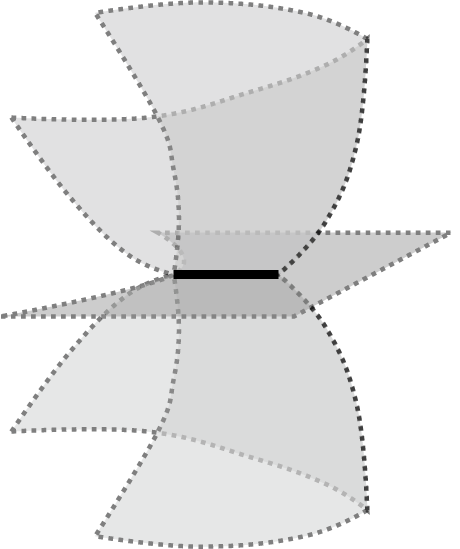
(see Figure 1). Therefore, spaces constructed in this way have local computable type. We refer the interested reader to the paper in question for precise definitions and detailed proofs.
Three copies of
 $\langle 0, 1\rangle ^2 \subseteq \mathbb {R}^2$
glued along a subset of
 $\langle 0, 1\rangle \times \{0\}.$

Here, we highlight the implications of this result to computable type of more general spaces than those studied in that paper. Namely, note that this implies that the quotient space
 $M/K$
(see Section 4) has (strong) computable type, where M is a closed manifold and
 $K \subseteq M$
is finite.
Remark 3.6. By analogy with strong computable type, we could further generalize the notion of local computable type as follows: we say that a topological space A has strong local computable type if, for any oracle O and any computable topological space
 $(X,\mathcal {T},(I_{i}))$
, if a compact set
 $S \subseteq X$
is semicomputable relative to O and
 $x\in S$
has an open neighbourhood in S which is homeomorphic to A, then S is c.e. at x relative to O (i.e., the set
 $\Omega $
witnessing the fact that an open neighbourhood N of x in S is c.e. up to S is c.e. relative to O).
It is not hard to verify that the proofs of all of the results mentioned in this section hold relative to any oracle, so
 $\mathbb {R}^n$
,
 $T_k$
and the space described in Remark 3.5 have strong local computable type. Therefore, (the relativizations of) these results can be used to make conclusions about strong computable type.
4 Quotient spaces
In this section, we give a brief overview of topological facts about quotient spaces which will be used in the paper. For more details, see [Reference Munkres25, Section 22].
Let X be a topological space and let
 $X^*$
be a partition of X into nonempty disjoint subsets. The quotient topology of
 $X^*$
is the finest topology which makes the canonical projection map
 $X \to X^*$
continuous, i.e., the topology defined by
 $$\begin{align*}V \text{ is open in } X^* \ \Longleftrightarrow\ \bigcup_{C \in V}C \text{ is open in } X \text.\end{align*}$$
 $X^*$
equipped with this topology is said to be a quotient space of X.
Some known facts about quotient spaces are the following:
-
• If X is compact, then
$X^*$
is also compact; -
• If X is connected, then
$X^*$
is connected.


The canonical projection map between a space and its quotient is an example of a quotient map. A quotient map is any surjective map
 $p : X \to Y$
between two topological spaces such that
 $$\begin{align*}V \text{ is open in } Y \ \Longleftrightarrow\ p^{-1}(V)\text{ is open in } X\end{align*}$$
holds for all sets
 $V \subseteq Y$
. An immediate consequence of this definition is that quotient maps are continuous and any injective (and therefore bijective) quotient map is a homeomorphism. Furthermore, one can easily check that a composition of two quotient maps is a quotient map.
Related to this is the notion of a saturated set. We say that
 $C \subseteq X$
is saturated with respect to
 $p : X \to Y$
if
 $$\begin{align*}p^{-1}(p(C)) = C \text.\end{align*}$$
One can easily check that quotient maps map saturated open (closed) sets to open (closed) sets. Moreover, if
 $C_1$
is p-saturated and disjoint from
 $C_2$
, then
 $p(C_1)$
and
 $p(C_2)$
are also disjoint.
Quotient maps are characterized by the following universal property (see [Reference Munkres25, Theorem 22.2 and Corollary 22.3]).
Theorem 4.1. Let
 $p : X \to Y$
be a quotient map. Let Z be a space and let
 ${g : X \to Z}$
be a map that is constant on each set
 $p^{-1}(\{ y\})$
, for
 $y \in Y$
. Then g induces a map
 $f : Y \to Z$
such that
 $f\circ p = g$
. The induced map f is continuous if and only if g is continuous; f is a quotient map if and only if g is a quotient map.

Corollary 4.2. Let
 $g : X \to Z$
be a surjective continuous map. Let
 $X_g$
be the following collection of subsets of X:
 $$ \begin{align*}X_g = \{g^{-1}(\{z\}) \mid z \in Z)\text.\end{align*} $$
Give
 $X_g$
the quotient topology. The map g induces a bijective continuous map
 ${f : X_g \to Z}$
, which is a homeomorphism if and only if g is a quotient map.

In this paper, we mainly study one distinct type of quotient spaces: the case when the partition
 $X^*$
has a single nontrivial element K, i.e., when there is
 $K \subseteq X$
such that
 $$ \begin{align} X^* = \{ K \} \cup \left\lbrace \{x\} \mid x \in X \setminus K \right\rbrace \text. \end{align} $$
In this case, we denote
 $X^*$
by
 $X/K$
and we say that
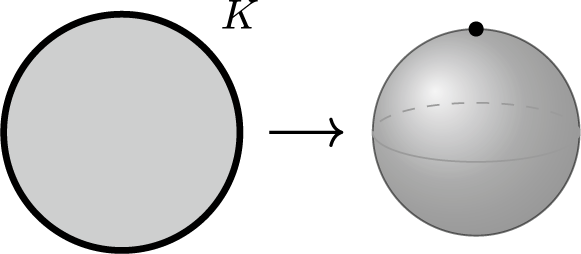
 $X^*$
was obtained from X by identifying points in K (see Figure 2).
Quotient space obtained by identifying points in the circle
 $K.$

For a subset Y of X, by
 $Y/K$
we will denote the image of Y under the canonical quotient map
 $p : X \to X/K$
. Note that Y is p-saturated if and only if
 $K \subseteq Y$
or
 $Y \cap K = \emptyset $
. In this case, we will sometimes say that Y is K-saturated (in order to avoid explicitly mentioning the quotient map where it is not necessary).
5 Computability on quotient spaces
Let
 $(X, \mathcal {T}, (I_i))$
be a computable topological space and let C, D be c.e. sets defined by (3) and (4). Take a semicomputable compact set K and let
 $\mathcal {T}_K$
be the quotient topology on
 $X/K$
. We want to define a structure of a computable topological space on
 $X/K$
. To do this, we must first consider the set
 $$ \begin{align} \Omega = \left\lbrace j \in \mathbb{N} \mid K \subseteq J_j\right\rbrace \cup \left\lbrace k \in \mathbb{N} \mid (\exists l \in \mathbb{N})(K \subseteq J_l \land (k, l) \in D )\right\rbrace \text. \end{align} $$
Note that this set is c.e., so we can fix a recursive surjective function
 $\phi : \mathbb {N} \to \Omega $
. For
 $i \in \mathbb {N}$
, let
 $$\begin{align*}I_i^{\prime}=(J_{\phi(i)})/K \subseteq X/K\text.\end{align*}$$
Lemma 5.1. The space
 $(X/K, \mathcal {T}_K, (I_i^{\prime }))$
defined above is a computable topological space.
Proof. The set
 $I_i^{\prime } = (J_{\phi (i)})/K$
is obviously open in
 $X/K$
for each
 $i \in \mathbb {N}$
, since
 $J_{\phi (i)}$
is K-saturated (
 $\phi (i) \in \Omega $
implies
 $K \subseteq J_{\phi (i)}$
or
 $J_{\phi (i)} \cap K = \emptyset $
).
Suppose V is open in
 $X/K$
, take
 $y \in V$
and let
 $U \subseteq X$
be the inverse image of V under the canonical quotient map. If
 $y=K$
, we know that
 $K \subseteq U$
. Since U is open and K is compact, we can find
 $j \in \mathbb {N}$
such that
 $K \subseteq J_j \subseteq U$
. Then
 $j \in \Omega $
, so
 $j = \phi (i)$
for some
 $i \in \mathbb {N}$
and we have
 $$\begin{align*}K/K \subseteq (J_j)/K \subseteq U/K \text,\end{align*}$$
which gives us
 $$\begin{align*}y \in I_i^{\prime} \subseteq V \text. \end{align*}$$
On the other hand, suppose
 $y = \{x\}$
for
 $x \in X \setminus K$
. We begin by fixing
 $J_j$
such that
 $x \in J_j \subseteq U$
and apply Theorem 2.1 to find
 $k, l \in \mathbb {N}$
such that
 $\{x\} \subseteq J_k$
,
 $K \subseteq J_l$
,
 $(k, j) \in C$
and
 $(k, l) \in D$
. Again, we have
 $k \in \Omega $
, so
 $k = \phi (i)$
for some
 $i \in \mathbb {N}$
and
 $\{x\} \in I_i^{\prime } \subseteq V$
. Therefore,
 $(I_i^{\prime })_{i\in \mathbb {N}}$
is a basis for
 $X/K$
.
Characteristic relations for this space can be defined as follows:
 $$ \begin{align*}\mathcal{C} := \lbrace (i, j) \mid (\phi(i), \phi(j)) \in C \rbrace \text,\end{align*} $$
 $$ \begin{align*}\mathcal{D} := \lbrace (i, j) \mid (\phi(i), \phi(j)) \in D \rbrace \text.\end{align*} $$
If
 $(i, j) \in \mathcal {C}$
, then
 $J_{\phi (i)} \subseteq J_{\phi (j)}$
and obviously
 $I_i^{\prime }=(J_{\phi (i)})/K \subseteq I_j^{\prime }=(J_{\phi (j)})/K$
. Similarly, if
 $(i, j) \in \mathcal {D}$
, then
 $J_{\phi (i)} \cap J_{\phi (j)} = \emptyset $
. Since
 $J_{\phi (i)}$
and
 $J_{\phi (j)}$
are K-saturated, we have
 $I_i^{\prime } \cap I_j^{\prime } = \emptyset $
. This proves (CR1) and (CR2).
To prove (CR3), suppose
 $y \in I_i^{\prime } \cap I_j^{\prime }$
. If
 $y=K$
, then we have
 $K \subseteq J_{\phi (i)} \cap J_{\phi (j)}$
, and by Theorem 2.1 we can find
 $l \in \mathbb {N}$
such that
 $K \subseteq J_l$
and
 $(l, \phi (i)), (l, \phi (j)) \in C$
. Then
 $l \in \Omega $
, so there exists
 $k \in \mathbb {N}$
such that
 $\phi (k)=l$
and we have
 $K \in I_k^{\prime }$
and
 $(k, i), (k, j) \in \mathcal {C}$
. If
 $y=\{x\}$
,
 $x \in X \setminus K$
, we can (again by Theorem 2.1) find
 ${l, m \in \mathbb {N}}$
such that
 $x \in J_l$
,
 $K \subseteq J_m$
,
 $(l, \phi (i)), (l, \phi (j)) \in C$
and
 $(l, m) \in D$
. Again
 $l \in \Omega $
, so there exists k such that
 $\phi (k)=l$
and we have
 $$ \begin{align*}\{x\} \in I_k^{\prime} \quad\text{ and }\quad (k, i), (k, j) \in \mathcal{C} \text.\end{align*} $$
Finally, we prove (CR4). Let
 $y_1\text , y_2 \in X/K$
,
 $y_1 \neq y_2$
. If
 $y_1=\{x_1\}$
and
 $y_2=\{x_2\}$
, we can find
 $k, l, m \in \mathbb {N}$
such that
 $x_1 \in J_k$
,
 $x_2 \in J_l$
,
 $K \subseteq J_m$
and
 ${(k, l), (k, m), (l, m) \in D}$
. If one of the points is K, for example
 $y_1=\{x\}$
and
 $y_2=K$
, we can, again, find
 $k, l \in \mathbb {N}$
such that
 $x \in J_k$
,
 $K\subseteq J_l$
and
 $(k, l) \in D$
. In either case, there exist
 $i, j \in \mathbb {N}$
such that
 $\phi (i)=k$
,
 $\phi (j)=l$
and we have
 $$ \begin{align*}y_1 \in I_i^{\prime}, \quad\quad y_2 \in I_j^{\prime} \quad\text{ and }\quad (i, j) \in \mathcal{D}\text.\end{align*} $$
This concludes the proof that
 $(X/K, \mathcal {T}_K, (I_i)^{\prime })$
is a computable topological space.
Remark 5.2. Note that, if
 $m, n \in \Omega $
and
 $[l] = [m] \cup [n]$
, then
 $l \in \Omega $
. Indeed, if
 $K \subseteq J_m$
or
 $K \subseteq J_n$
, then
 $K \subseteq J_l$
. Otherwise, there exist
 $i, j \in \mathbb {N}$
such that
 $K \subseteq J_i$
,
 $K \subseteq J_j$
and
 $(m, i), (n, j) \in D$
. Let
 $k \in \mathbb {N}$
be such that
 $K \subseteq J_k$
and
 $(k, i), (k, j) \in C$
. Then, by definition of D and (CR7), we have
 $(l, k) \in D$
and therefore
 $l \in \Omega $
. Obviously, the same holds for any finite union
 $[l] = [m_1] \cup \cdots \cup [m_n]$
.
Let
 $J_j^{\prime } = \bigcup _{i \in [j]} I_i^{\prime }$
. The following lemma shows that, given
 $j \in \mathbb {N}$
, it is possible to compute
 $k \in \mathbb {N}$
such that
 $J_j^{\prime } = J_k / K$
.
Lemma 5.3. There is a recursive function
 $\xi : \mathbb {N} \to \Omega $
such that
 $$\begin{align*}J_j^{\prime} = (J_{\xi(j)})/K, \quad\quad\quad \forall j \in \mathbb{N} \text.\end{align*}$$
Proof. We have
 $$\begin{align*}J_j^{\prime} = \bigcup_{i \in [j]}I_i^{\prime} = \bigcup_{i \in [j]}(J_{\phi(i)})/K = \big(\bigcup_{i \in [j]}J_{\phi(i)}\big)/K = \big(\bigcup_{i \in [j]}\bigcup_{k \in [\phi(i)]}I_k\big)/K \text.\end{align*}$$
Since the function
 $j \mapsto \bigcup _{i \in [j]}[\phi (i)]$
is computable (see e.g., the proof of [Reference Iljazović15, Lemma 33]), there exists a recursive function
 $\xi : \mathbb {N} \to \mathbb {N}$
such that
 $\bigcup _{i \in [j]}[\phi (i)] = [\xi (j)]$
,
 $\forall j \in \mathbb {N}$
. Now we have
 $J_j^{\prime } = (J_{\xi (j)})/K$
. By the remark above, we know that
 $\xi (j) \in \Omega $
,
 $\forall j \in \mathbb {N}$
.
Lemma 5.4. Let
 $(X, \mathcal {T}, (I_i))$
be a computable topological space, let K be a semicomputable compact set in
 $(X, \mathcal {T}, (I_i))$
and let
 $(X/K, \mathcal {T}_K, (I_i^{\prime }))$
be the corresponding computable quotient space, constructed as above. Let S be a semicomputable compact set in
 $(X, \mathcal {T}, (I_i))$
. Then
 $S/K$
is semicomputable in
 $(X/K, \mathcal {T}_K, (I_i^{\prime }))$
.
Proof. This is an immediate consequence of the following:
 $$\begin{align*}S/K \subseteq J_j^{\prime} \ \Longleftrightarrow\ S/K \subseteq (J_{\xi(j)})/K \ \Longleftrightarrow\ S \subseteq J_{\xi(j)} \text.\end{align*}$$
The first equivalence and
 $$\begin{align*}S \subseteq J_{\xi(j)} \ \Longrightarrow\ S/K \subseteq (J_{\xi(j)})/K\end{align*}$$
are obvious.
Suppose
 $S/K \subseteq (J_{\xi (j)})/K$
and take
 $x \in S$
. If
 $x \in S \cap K$
, we know that
 $S/K$
, and therefore also
 $(J_{\xi (j)})/K$
, contains K. Since
 $\xi (j) \in \Omega $
, this implies
 $K \subseteq J_{\xi (j)}$
and therefore
 $x \in J_{\xi (j)}$
. Alternatively, if
 $x \in S \setminus K$
, then
 $\{x\} \in S/K \subseteq (J_{\xi (j)})/K$
, which holds only if
 $x \in J_{\xi (j)}$
.
Lemma 5.5. Let
 $(X, \mathcal {T}, (I_i))$
be a computable topological space, let K be a semicomputable compact set in
 $(X, \mathcal {T}, (I_i))$
and let
 $(X/K, \mathcal {T}_K, (I_i^{\prime }))$
be the corresponding computable quotient space. Let
 $S \subseteq X$
be a set such that
 $K \subseteq S$
and
 $\operatorname {Int}_S K = \emptyset $
. If
 $S/K$
is c.e. in
 $(X/K, \mathcal {T}_K, (I_i^{\prime }))$
, then S is c.e. in
 $(X, \mathcal {T}, (I_i))$
.
Proof. Suppose
 $I_i \cap S \neq \emptyset $
. Since
 $\operatorname {Int}_S K = \emptyset $
, there exists
 $x \in (S \cap I_i) \setminus K$
. We have
 $x \in I_i = J_{\langle i \rangle }$
and
 $x \notin K$
. By Theorem 2.1, we can find
 $k, l \in \mathbb {N}$
such that
 $x \in J_k$
,
 $K \subseteq J_l$
,
 $(k, \langle i \rangle ) \in C$
and
 $(k, l) \in D$
. Now, we know that
 $k \in \Omega $
, therefore
 $k = \phi (j)$
for some
 $j \in \mathbb {N}$
, and we have
 $\{x\} \in I_j^{\prime } \cap S/K$
.
Conversely, suppose that for some
 $i \in \mathbb {N}$
there exists
 $j \in \mathbb {N}$
such that
 $I_j^{\prime } \cap S/K \neq \emptyset $
and
 $(\phi (j), \langle i \rangle )\in C$
. Then
 $$\begin{align*}\emptyset \neq I_j^{\prime} \cap S/K = (J_{\phi(j)})/K \cap S/K \subseteq (J_{\langle i \rangle})/K \cap S/K \text.\end{align*}$$
Since S is K-saturated,
 $J_{\langle i \rangle } \cap S$
cannot be empty – otherwise
 $(J_{\langle i \rangle })/K \cap S/K$
would also be empty. Therefore,
 $I_i \cap S = J_{\langle i \rangle } \cap S \neq \emptyset $
.
This proves
 $$ \begin{align*}\{i \in \mathbb{N} \mid I_i \cap S \neq \emptyset \} = \{ i \in \mathbb{N} \mid (\exists j \in \mathbb{N})(I_j^{\prime} \cap S/K \neq \emptyset \land (\phi(j), \langle i \rangle)\in C)\}\text.\end{align*} $$
The set on the right side is c.e. because
 $S/K$
is c.e. This shows that S is c.e.
Lemma 5.6. Let
 $(X, \mathcal {T}, (I_i))$
be a computable topological space and let S, T be disjoint compact subsets of X such that
 $S \cup T$
is semicomputable. Then both S and T are semicomputable.
Proof. Fix
 $a, b \in \mathbb {N}$
such that
 $S \subseteq J_a$
,
 $T \subseteq J_b$
and
 $J_a \cap J_b = \emptyset $
. Then we have
 $$\begin{align*}S \subseteq J_j \Leftrightarrow S \cup T \subseteq J_j \cup J_b \quad\text{ and }\quad T \subseteq J_j \Leftrightarrow S \cup T \subseteq J_j \cup J_a \text,\end{align*}$$
which implies that S and T are semicomputable.
Theorem 5.7. Let A be a topological space and let
 $B, C$
be compact subsets of A such that
 $\operatorname {Int}_A B = \emptyset $
and
 $B \cap C = \emptyset $
. If
 $(A/B, C)$
has computable type, then
 $(A, B \cup C)$
also has computable type.
Proof. Let
 $(X, \mathcal {T}, (I_i))$
be a computable topological space and let
 $f : A \to X$
be an embedding such that
 $f(A)$
and
 $f(B \cup C)$
are semicomputable. Denote
 $f(A)$
by S,
 $f(B)$
by K and
 $f(C)$
by T.
From the previous lemma we know that K and T are semicomputable.
Let
 $(X/K, \mathcal {T}_K, (I_i^{\prime }))$
be the computable quotient space obtained by identifying points in K. By Lemma 5.4, we know that
 $S/K$
and
 $T/K$
are semicomputable sets. Furthermore, since
 $K \subseteq S$
and
 $K \cap T = \emptyset $
, it holds that
 $S/K \cong A/B$
and
 $T/K \cong C/B \cong C$
. Given that
 $(A/B, C)$
has computable type, we can conclude that
 $S/K$
is computable. Since
 $\operatorname {Int}_SK = f(\operatorname {Int}_AB) = \emptyset $
, by Lemma 5.5, this implies that S is computable in
 $(X, \mathcal {T}, (I_i))$
.
Taking
 $C = \emptyset $
in Theorem 5.7, we get:
Corollary 5.8. Let A be a topological space and let B be a compact subset of A such that
 $\operatorname {Int}_A B = \emptyset $
. If
 $A/B$
has computable type, then
 $(A, B)$
has computable type.
Example 5.9. Let
 $A=[0, 1] \subseteq \mathbb {R}$
,
 $B=[0, 1]$
and
 $C=\emptyset $
. Obviously
 $A/B$
has computable type as a single point set. If we omitted the condition
 $\operatorname {Int}_A B = \emptyset $
from Theorem 5.7, in this instance we would be able to conclude that
 $[0, 1]$
has computable type, which is not true. Therefore, such condition is necessary.
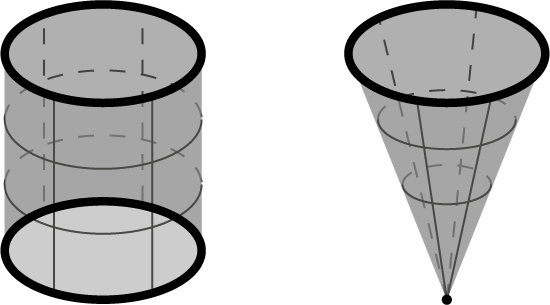
The spaces
 $S^1 \times [0, 1]$
and
 $\mathsf {C}(S^1)$
.

Example 5.10. Let K be a compact space. Consider the cylinder
 $K \times [0, 1]$
and the cone
 $\mathsf C (K) = (K \times [0, 1]) / (K \times \{0\})$
(Figure 3). The sets
 $K \times \{0\}$
and
 $K \times \{1\}$
are disjoint compact subsets of
 $K \times [0, 1]$
and the interior of
 $K \times \{0\}$
in
 $K \times [0, 1]$
is empty. By Theorem 5.7, if
 $(\mathsf C(K), K\times \{1\})$
has computable type, then
 $(K\times [0, 1], K \times \{0, 1\})$
also has computable type.
In particular, if
 $K = S^1$
is the unit circle, we know that
 $\mathsf C (S^1)$
is homeomorphic to the two dimensional unit ball
 $B^2$
by a homeomorphism which maps
 $S^1 \times \{1\}$
to
 $\partial B^2 = S^1$
. Since the pair
 $(B^2, S^1)$
has computable type [Reference Miller24], Theorem 5.7 allows us to immediately conclude that the pair
 $(S^1 \times [0, 1], S^1 \times \{0, 1\})$
of the cylinder and its boundary has computable type (without using the results from [Reference Iljazović and Sušić22]).
6 Quotient
$\mathbb {R} /K$

Suppose S and T are topological spaces,
 $K \subseteq S$
and
 ${S/K \cong T}$
. Let
 $f : S \to T$
be the composition of the natural projection map
 $S \to S/K$
and the homeomorphism
 $S/K \to T$
. Then f is a quotient map and
 $$ \begin{align} f(x_1) = f(x_2) \quad \Leftrightarrow\quad x_1 = x_2 \ \text{ or }\ x_1, x_2 \in K \text. \end{align} $$
Generally, if
 $f : S \to T$
is a function such that
 $f(K)=\{y_0\}$
for some
 $y_0 \in T$
and (9) holds, we will say that f collapses K to
 $y_0$
. Using Theorem 4.1, we can see that any quotient map which collapses K to
 $y_0$
can be written as a composition of a quotient map
 $S \to S/K$
and a homeomorphism
 $S/K \to T$
.
Theorem 6.1. Let K be a compact subset of
 $\mathbb {R}$
such that
 $\mathbb {R} \setminus K$
has finitely many connected components. Then
 $\mathbb {R} /K$
has local computable type.
Proof. Let
 $(X,\mathcal {T},(I_{i} ))$
be a computable topological space, S a semicomputable compact set in this space and
 $x_{0} \in S$
a point which has an open neighborhood N is S such that N is homeomorphic to
 $\mathbb {R}/K$
. We want to prove that S is c.e. at
 $x_{0} $
. Let
 $h:\mathbb {R}/K\rightarrow N$
be a homeomorphism.
If
 $K=\emptyset $
, then
 $\mathbb {R}/K$
is homeomorphic to
 $\mathbb {R}$
and the claim follows from Theorem 3.2. Suppose
 $K\neq \emptyset $
. Then
 $\mathbb {R}\setminus K$
has at least two connected components. If
 $\mathbb {R}\setminus K$
has exactly two connected components, then they must be of the form
 $\langle -\infty , a\rangle $
and
 $\langle b,\infty \rangle $
, where
 $a,b\in \mathbb {R}$
,
 $a\leq b$
, and
 $K=[a,b]$
(we use a well known fact that an open connected subset of
 $\mathbb {R}$
must be an open interval). Let
 $g:\mathbb {R}\rightarrow \mathbb {R}$
be defined by
 $$ \begin{align*}g(t) =\begin{cases} t &\text{ if } t\leq a \text, \\ a &\text{ if } a\leq t\leq b \text, \\ t-b+a &\text{ if } b\leq t\text. \end{cases}\end{align*} $$
It is easy to conclude that g is a quotient map which collapses
 $[a,b]$
to a. Using the notation from Corollary 4.2 we have that
 $\mathbb {R}_{g}=\mathbb {R}/K$
. By the same corollary g induces a homeomorphism
 $\mathbb {R}_{g}\rightarrow \mathbb {R}$
, hence
 $\mathbb {R}/K$
and
 $\mathbb {R}$
are homeomorphic and thus S is c.e. at
 $x_{0}$
.
Let us consider now the case when
 $\mathbb {R}\setminus K$
has at least three connected components.
We may assume that h maps K to
 $x_{0} $
. Otherwise,
 $x_{0} =h(a)$
for some
 ${a\in (\mathbb {R} /K)\setminus \{K\}}$
. The canonical quotient map
 $q:\mathbb {R}\rightarrow \mathbb {R}/K$
restricts to the map
 $\mathbb {R}\setminus K\rightarrow (\mathbb {R} /K)\setminus \{K\}$
which is easily seen to be quotient and bijective, hence it is a homeomorphism. We conclude that
 $(\mathbb {R} /K)\setminus \{K\}$
is an open set in
 $\mathbb {R}/K$
which is homeomorphic to an open set in
 $\mathbb {R}$
. Thus
 $h((\mathbb {R} /K)\setminus \{K\})$
is an open neighborhood of
 $x_{0} $
in N (and therefore also in S) which is homeomorphic to an open subset of
 $\mathbb {R}$
. Now the fact that each open subset of
 $\mathbb {R} $
has local computable type implies that S is c.e. at
 $x_{0} $
.
We have
 $$ \begin{align*}K=[a_{1} ,b_{1} ]\cup [a_{2} ,b_{2} ]\cup \dots \cup [a_{k} ,b_{k} ],\end{align*} $$
where
 $k\geq 2$
and
 $a_{i} \le b_{i} <a_{i+1} \le b_{i+1}$
for each
 $i\in \{1,\dots ,k-1\}$
. Choose
 $\varepsilon>0$
such that
 $b_{i} +\varepsilon <a_{i+1}-\varepsilon $
for each
 $i\in \{1,\dots ,k-1\}$
. Let
 $$ \begin{align*}U=\bigcup_{i=1}^{k} \langle a_{i} -\varepsilon ,b_{i} +\varepsilon \rangle .\end{align*} $$
Then U is open and K-saturated and so
 $q(U)$
is an open neighborhood of K in
 $\mathbb {R}/K$
. We have that q restricts to the map
 $U\rightarrow q(U)$
which is also quotient and collapses the set K to the point K. It follows from Corollary 4.2 that
 $$ \begin{align} U/K\cong q(U). \end{align} $$
On the other hand, let
 $\varphi :U\rightarrow T_{2k}$
(recall the definition of
 $T_{k} $
from Section 3) be defined in the following way: if
 $t\in \langle a_{i} -\varepsilon ,b_{i} +\varepsilon \rangle $
, let
 $$ \begin{align*}\varphi (t) =\begin{cases} \frac{a_{i} -t}{\varepsilon }e_{2i-1} &\text{ if } a_{i} -\varepsilon <t\leq a_{i} \text, \\ (0,\dots ,0) &\text{ if } a_{i} \leq t\leq b_{i} \text, \\ \frac{t-b_{i} }{\varepsilon }e_{2i} &\text{ if } b_{i} \leq t<b_{i} +\varepsilon \text. \end{cases}\end{align*} $$
It is easy to see that
 $\varphi $
is a quotient map which collapses K to
 $(0,\dots ,0)$
. It follows from Corollary 4.2 that
 $U/K\cong T_{2k}$
. This, together with (10), gives that
 $q(U)\cong T_{2k}$
. Since
 $h:\mathbb {R}/K\rightarrow N$
is a homeomorphism which maps K to
 $x_{0} $
and
 $q(U)$
is an open neighborhood of K in
 $\mathbb {R}/K$
, we have that
 $x_{0} $
has an open neighborhood in S which is homeomorphic to
 $T_{2k} $
. So S is c.e. at
 $x_{0} $
by Corollary 3.4.
Remark 6.2. It is not possible to omit the condition that
 $\mathbb {R}^n \setminus K$
has finitely many connected components from the statement of Theorem 7.1. This is because the subset
 $$\begin{align*}H = \bigcup_{n \in \mathbb{N}} \left\lbrace x \in \mathbb{R}^2 \mid d(x, (\frac{1}{n}, 0)) = \frac{1}{n} \right\rbrace \end{align*}$$
of
 $\mathbb {R}^2$
, known as the Hawaiian earring, does not have a computable type, i.e., admits a homeomorphic copy (in
 $\mathbb {R}^2$
) which is semicomputable, but not computable [Reference Čelar and Iljazović9].
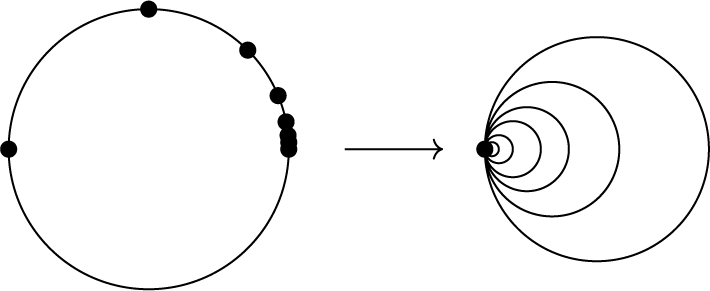
It is not hard to verify that H is homeomorphic to the quotient
 $S^1/K$
, where
 $S^1$
is the unit circle and
 $K \subseteq S^1$
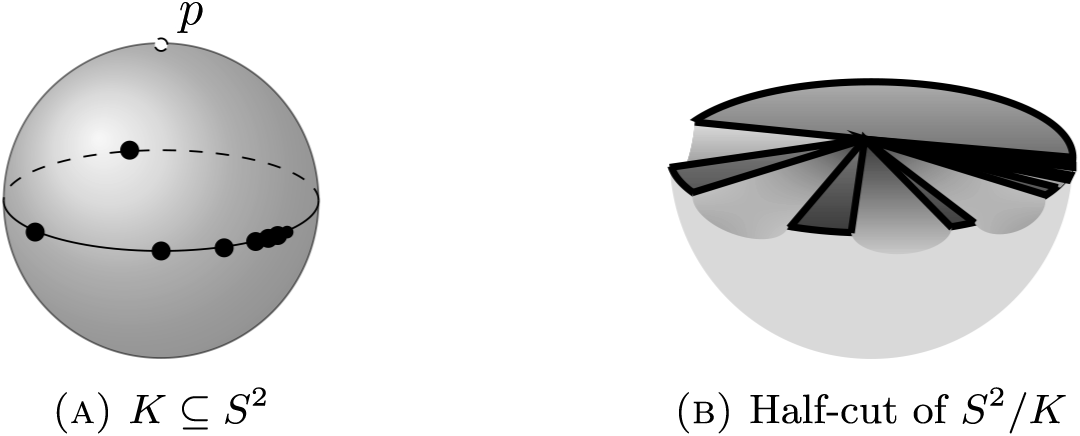
consists of a converging sequence of points and its limit (see Figure 4).
Hawaiian earring as a quotient space
 $S^1 / K$
from Remark 6.2.

Note that every point on H except
 $(0, 0)$
has an open neighborhood homeomorphic to
 $\mathbb {R}$
. Additionally, since
 $S^1 \setminus \{p\} \cong \mathbb {R}$
for any point
 $p \in S^1 \setminus K$
, it follows that
 $(S^1/K) \setminus \{p\}$
is an open neighborhood of
 $(0, 0)$
homeomorphic to a quotient
 $\mathbb {R} / K^{\prime }$
where
 $K^{\prime } \cong K$
, so
 $K^{\prime } \subseteq \mathbb {R}$
is compact and its complement has infinitely many connected components.
7 Quotient
$\mathbb {R}^{n}/K$

The bulk of this section is dedicated to the proof of the generalized version of Theorem 6.1.
Theorem 7.1. Let
 $n\in \mathbb {N}$
,
 $n \geq 2$
and let K be a compact subset of
 $\mathbb {R}^{n} $
such that
 $\mathbb {R}^{n} \setminus K$
has finitely many connected components. Then
 $\mathbb {R}^{n} /K$
has local computable type.
First, we give an informal outline of the proof of Theorem 7.1, which is rather technical and requires several auxiliary results.
Suppose S is a semicomputable compact set and
 $x \in S$
has an open neighborhood N which is homeomorphic to
 $\mathbb {R}^n/K$
. Denote by
 $f : \mathbb {R}^n \to N$
the composition of the natural quotient map
 $\mathbb {R}^n \to \mathbb {R}^n/K$
and the homeomorphism
 $\mathbb {R}^n/K \to N$
. Then f is a quotient map which collapses K into some point
 $y_0 \in N$
.
Take
 $x \in N$
. If
 $x \neq y_0$
,
 $N \cap f(\mathbb {R}^n \setminus K)$
is a Euclidean neighborhood of x, which means S is c.e. at x.
Now suppose
 $x = y_0$
. Our goal is to find a neighborhood
 $N^{\prime } \subseteq N$
of
 $y_0$
which is c.e. up to S. We construct
 $N^{\prime }$
as
 $N^{\prime } = \{y_0\} \cup f(Q_1) \cup \cdots \cup f(Q_k)$
, where each
 $Q_i$
is a subset of a connected component of
 $\mathbb {R}^n \setminus K$
.
To do this, we consider each connected component
 $P_i$
of
 $\mathbb {R}^n \setminus K$
separately and try to find a subset
 $Q_i$
of
 $P_i$
such that
 $f(Q_i) \cup \{y_0\}$
is c.e. up to S. This subset can be found directly when
 $P_i$
is an unbounded connected component. If
 $P_i$
is bounded, we show that we can find a different compact set
 $K^{\prime } \cong K$
and points
 $p, q \in \mathbb {R}^n$
such that
 $(\mathbb {R}^n \setminus \{p\}) / K \cong (\mathbb {R}^n \setminus \{q\}) / K^{\prime }$
, and
 $P_i\setminus \{p\}$
maps to the unbounded component under this homeomorphism (see Figure 5).
The bounded component (in gray) is “stretched out” and becomes unbounded.

Let
 $n\in \mathbb {N}$
,
 $n\geq 2$
, and let K be a compact set in
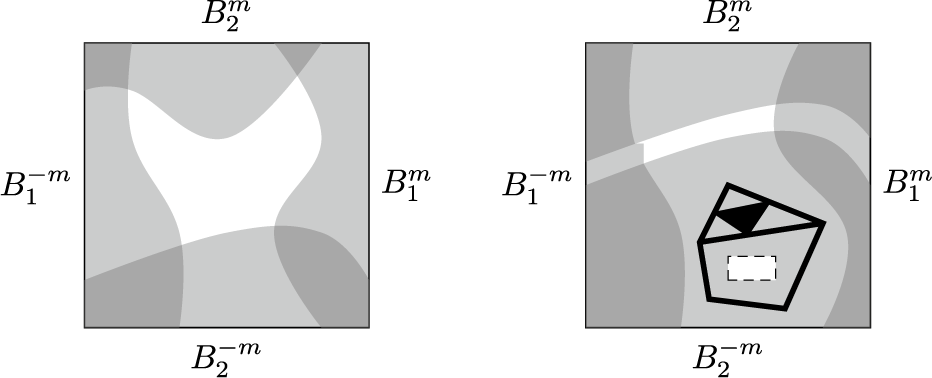
 $\mathbb {R}^{n}$
. Then there is
 $m> 0$
such that
 $K \subseteq \langle -m, m\rangle ^n$
. We state some definitions and facts related to cubes
 $\langle -m, m\rangle ^n$
which will be useful in the remainder of the section.
For
 $i\in \{1,\dots ,n\}$
let
 $$ \begin{align*}B_{i}^{-m} =\{(x_{1} ,\dots ,x_{n} )\in [-m,m]^{n} \mid x_{i} =-m\}\end{align*} $$
and
 $$ \begin{align*}B_{i}^m =\{(x_{1} ,\dots ,x_{n} )\in [-m,m]^{n} \mid x_{i} =m\}.\end{align*} $$
The boundary of the cube can be expressed as a union
 $$ \begin{align*}\partial [-m, m]^n = \bigcup_{i=1}^n \left(B_i^{-m} \cup B_i^m\right) \text.\end{align*} $$
Lemma 7.2. Let Y be a closed set in a topological space X and let
 $\bigcup _{i \in \mathcal {I}} Q_i = X \setminus Y$
be a separation of
 $X \setminus Y$
into pairwise disjoint open subsets. Then
 $\partial Q_i \subseteq Y$
for all
 $i \in \mathcal {I}$
.
Proof. Let
 $i \in \mathcal {I}$
. Since
 $Q_i$
is open in
 $X \setminus Y$
, it is also open in X and we have
 $$ \begin{align*}\partial Q_i \subseteq X \setminus Q_i = Y \cup \bigcup_{j \neq i}Q_j \text.\end{align*} $$
Take
 $x \in \partial Q_i$
. If
 $x \in Q_j$
for some
 $j \neq i$
,
 $Q_j$
is an open neighborhood of x and must intersect
 $Q_i$
, which is a contradiction. Therefore,
 $\partial Q_i \cap Q_j = \emptyset $
for all
 $j \neq i$
, and
 $\partial Q_i \subseteq Y$
.
Lemma 7.3. Let
 $n \in \mathbb {N}$
,
 $n \geq 2$
and let K be a compact set in
 $\mathbb {R}^n$
. There is a unique unbounded connected component of
 $\mathbb {R}^n \setminus K$
.
Proof. Since K is compact, there is
 $m> 0$
such that
 $K \subseteq \langle -m, m\rangle ^n$
. Then
 $\mathbb {R}^n \setminus \langle -m, m\rangle ^n$
is an unbounded subset of
 $\mathbb {R}^n \setminus K$
and, since it is connected, it must be a subset of a connected component (which must be unbounded). Any other component is then contained in
 $[-m, m]^n$
, i.e., it is bounded.
Let P be the unbounded connected component from Lemma 7.3. Suppose
 ${m> 0}$
is such that
 $K \subseteq \langle -m, m\rangle ^n$
. It is not hard to verify that
 $P \cap \left (\langle -m , m \rangle ^n \setminus K\right )$
is connected, so it is a connected component of
 $\langle -m , m \rangle ^n \setminus K$
. We will call this component the outer connected component of
 $\langle -m, m\rangle ^n \setminus K$
. Note that the outer connected component contains the “ring”
 $\langle -m , m \rangle ^n \setminus [-r, r]^n$
for any
 $r> 0$
such that
 $K \subseteq \langle -r, r\rangle ^n$
and
 $r < m$
.
The next theorem is a consequence of [Reference Engelking12, Theorem 1.8.1]. The proof can be found in [Reference Iljazović16].
Theorem 7.4. Suppose
 $U_1, \ldots , U_n$
and
 $V_1, \ldots , V_n$
are open subsets of
 $\mathbb {R}^n$
such that
 $U_i \cap B_i^{1} = \emptyset $
,
 $V_i \cap B_i^{-1} = \emptyset $
and
 $U_i \cap V_i = \emptyset $
for each
 $i \in \{1, \dots , n\}$
. Then
 $$ \begin{align*}[-1, 1]^n \nsubseteq U_1 \cup \dots \cup U_n \cup V_1 \cup \dots \cup V_n \text.\end{align*} $$
By applying the homeomorphism
 $\mathbb {R}^n \to \mathbb {R}^n$
,
 $x \mapsto \frac {1}{m}x$
, this can be easily generalized to cubes
 $[-m, m]^n$
for any
 $m> 0$
.
Corollary 7.5. Suppose
 $r> 0 $
and
 $U_1, \ldots , U_n$
and
 $V_1, \ldots , V_n$
are open subsets of
 $\mathbb {R}^n$
such that
 $U_i \cap B_i^{m} = \emptyset $
,
 $V_i \cap B_i^{-m} = \emptyset $
and
 $U_i \cap V_i = \emptyset $
for each
 $i \in \{1, \dots , n\}$
. Then
 $$ \begin{align*}[-m, m]^n \nsubseteq U_1 \cup \dots \cup U_n \cup V_1 \cup \dots \cup V_n \text.\end{align*} $$
Corollary 7.6. Let
 $n \in \mathbb {N}$
,
 $n \ge 2$
. Suppose
 $m> 0$
, K is a compact subset of
 $\langle -m, m \rangle ^n$
and P is the unique unbounded connected component of
 $\mathbb {R}^n \setminus K$
. Let
 $L\subseteq \mathbb {R}^{n} $
be a compact set such that
 $L\subseteq \mathbb {R}^{n} \setminus (P\cup K)$
. Suppose
 $U_1, \ldots , U_n$
and
 $V_1, \ldots , V_n$
are open K-saturated subsets of
 $\mathbb {R}^n$
such that
 $U_i \cap B_i^{m} = \emptyset $
,
 $V_i \cap B_i^{-m} = \emptyset $
and
 $U_i \cap V_i = \emptyset $
for each
 $i \in \{1, \dots , n\}$
(Figure 6). Then
 $$ \begin{align*}[-m, m]^n \setminus L \nsubseteq U_1 \cup \dots \cup U_n \cup V_1 \cup \dots \cup V_n \text.\end{align*} $$
Proof. Let
 $\mathbb {R}^n \setminus K = P \cup Q$
be a separation of
 $\mathbb {R}^n \setminus K$
into disjoint open sets (possibly
 $Q=\emptyset $
). Suppose
 $$ \begin{align*}[-m, m]^n \setminus L \subseteq U_1 \cup \dots \cup U_n \cup V_1 \cup \dots \cup V_n \text.\end{align*} $$
Since
 $U_1, \ldots , U_n$
,
 $V_1, \ldots , V_n$
are K-saturated and
 $K \cap L = \emptyset $
, at least one set must contain K. Suppose
 $K \subseteq U_1$
and let
 $$ \begin{align*}U_1^{\prime} = U_1 \cup Q \text,\quad\quad V_1^{\prime} = V_1 \setminus \overline{Q}\end{align*} $$
and
 $$ \begin{align*}U_i^{\prime} = U_i, \quad V_i^{\prime} = V_i, \quad\quad \forall i \in \{2, \dots, n\} \text.\end{align*} $$
Obviously,
 $U_1^{\prime }, \ldots , U_n^{\prime }$
,
 $V_1^{\prime }, \ldots , V_n^{\prime }$
are open,
 $U_i^{\prime } \cap V_i^{\prime } = \emptyset $
and
 $V_i^{\prime } \cap B_i^{-m} = \emptyset $
for all
 $i \in \{1, \ldots , n\}$
. Furthermore, since
 $\partial [-m, m]^n \subseteq P$
and
 $Q \cap P = \emptyset $
, we have
 ${U_1^{\prime } \cap B_1^m = \emptyset }$
, so
 $U_i^{\prime } \cap B_i^m = \emptyset $
holds for all
 $i \in \{1, \ldots , n\}$
.
It follows from Lemma 7.2 that
 $\partial Q \subseteq K$
, therefore
 $\partial Q \subseteq U_1 \subseteq U_1^{\prime }$
and
 $$ \begin{align*} U_1^{\prime} \cup V_1^{\prime} = (U_1 \cup Q) \cup (V_1 \setminus \overline{Q}) = (U_1 \cup \overline{Q}) \cup (V_1 \setminus \overline{Q}) \supseteq U_1 \cup V_1 \text. \end{align*} $$
Now, we have
 $$ \begin{align*} [-m, m]^n \setminus L \subseteq U_1 \cup V_1 \cup \dots \cup U_n \cup V_n \subseteq U_1^{\prime} \cup V_1^{\prime} \cup \dots \cup U_n^{\prime} \cup V_n^{\prime} \text. \end{align*} $$

Since
 $L \subseteq Q \subseteq U_1^{\prime }$
, this implies
 $$ \begin{align*} [-m, m]^n \subseteq U_1^{\prime} \cup \dots \cup U_n^{\prime} \cup V_1^{\prime} \cup \dots \cup V_n^{\prime} \text, \end{align*} $$
which contradicts Corollary 7.5.
Lemma 7.7. Let
 $n\in \mathbb {N}$
,
 $n\geq 2$
, let K be a compact set in
 $\mathbb {R}^{n}$
and let
 $m> 0$
be such that
 $K\subseteq \langle -m,m\rangle ^{n} $
. Let P be the outer connected component of
 $\langle -m,m\rangle ^{n} \setminus K$
. Then for all
 $x_{0} \in P$
and
 $\varepsilon>0$
there exist compact sets
 $F_{1},\dots , F_{n}$
,
 $G_{1},\dots , G_{n}$
and H such that
-
(I)
$x_{0} \in H,~~\mathop {\mathrm {diam}} H<\varepsilon $
, -
(II)
$[-m,m]^{n} =F_{1} \cup \dots \cup F_{n} \cup G_{1} \cup \dots \cup G_{n} \cup H$
, -
(III)
$F_{i} \cap G_{i} =\emptyset ~\mbox { for each }i\in \{1,\dots ,n\}$
, -
(IV)
$F_{i} \cap B_{i}^m =\emptyset ~\mbox { and }~G_{i} \cap B_{i}^{-m} =\emptyset \text { for each }i\in \{1,\dots ,n\}$
, -
(V)
$K\subseteq F_{1} ~\mbox { and }~K\cap (F_{2} \cup \dots \cup F_{n} \cup G_{2} \cup \dots \cup G_{n} )=\emptyset $
.


Proof. Let U be the set of all
 $x_{0} \in P$
with the following property: for each
 $\varepsilon>0$
there exist compact sets
 $F_{1} $
,…,
 $F_{n}$
,
 $G_{1}$
,…,
 $G_{n}$
and H such that (I)–(V) hold.
Claim 1. If
 $x_{0} \in P$
and
 $r>0$
are such that
 $\overline {B}(x_{0} ,r)\subseteq P$
, then
 $$ \begin{align*} B(x_{0} ,r)\cap U = \emptyset \quad\text{or}\quad B(x_{0} ,r)\subseteq U. \end{align*} $$
Proof of Claim 1.
Let
 $x_{0} \in P$
and
 $r>0$
be such that
 $$ \begin{align} \overline{B}(x_{0} ,r)\subseteq P~\mbox{ and }~B(x_{0} ,r)\cap U\neq\emptyset \text. \end{align} $$
Fix
 $x_{1} \in B(x_{0} ,r)\cap U$
and
 $r_{1}>0 $
such that
 $$ \begin{align} B(x_{1} ,r_{1} )\subseteq B(x_{0} ,r). \end{align} $$
Since
 $x_{1} \in U$
, there exist compact sets
 $F_{1} $
,…,
 $F_{n}$
,
 $G_{1}$
,…,
 $G_{n}$
and H such that
 $$ \begin{align} x_{1} \in H,\quad \mathop{\mathrm{diam}} H<r_{1} \end{align} $$
and such that (II)–(V) hold.
To prove that
 $ B(x_{0} ,r)\subseteq U$
, we take
 $x\in B(x_{0} ,r)$
and
 $\varepsilon>0$
and we proceed to construct sets with properties (I)–(V).
Let S be the sphere in
 $\mathbb {R}^{n} $
with radius r centered at
 $x_{0} $
, i.e.,
 $S=\{z\in \mathbb {R}^{n} \mid d(z,x_{0} )=r\}$
. For
 $T\subseteq S$
let
 $$ \begin{align*}\widetilde{T}=\bigcup_{z\in T}\overline{zx},\end{align*} $$
where
 $\overline {zx}$
is the line segment in
 $\mathbb {R}^{n} $
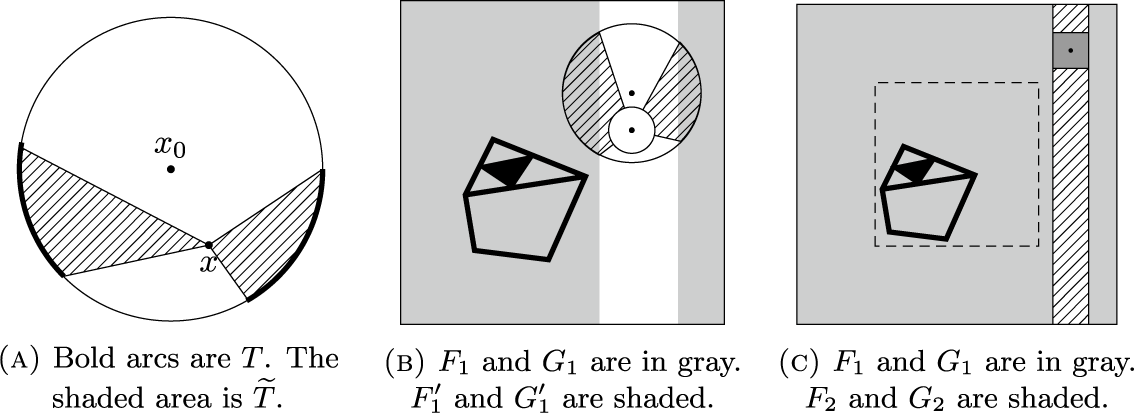
with endpoints z and x (see Figure 7a). Note that, since
 $S\subseteq \overline {B}(x_{0} ,r)$
,
 $x\in \overline {B}(x_{0} ,r)$
and
 $\overline {B}(x_{0} ,r)$
is convex, we have
 $\widetilde {T}\subseteq \overline {B}(x_{0} ,r)$
.
Sets used in the proof of Lemma 7.7 for
 $n=2$
. K is in black.

It is not hard to see that for all
 $z_{1} ,z_{2} \in S$
the following implication holds:
 $$ \begin{align} z_{1} \neq z_{2}~\Rightarrow~ \overline{z_{1} x}\cap \overline{z_{2} x}=\{x\}. \end{align} $$
Furthermore, if T is compact, then
 $\widetilde {T}$
is also compact. Namely, the function
 $T\times [0,1]\rightarrow \widetilde {T}$
,
 $(z,\lambda )\mapsto (1-\lambda )z+\lambda x$
, is a continuous surjection and
 $T\times [0,1]$
is compact.
Choose
 $\delta>0$
such that
 $$ \begin{align} \overline{B}(x,\delta )\subseteq B(x_{0} ,r)~\mbox{ and }~2\delta <\varepsilon. \end{align} $$
For
 $i\in \{1,\dots ,n\}$
let
 $$\begin{align*}F_{i}^{\prime}=\widetilde{F_{i} \cap S}\setminus B(x,\delta )~\mbox{ and }~G_{i}^{\prime}=\widetilde{G_{i} \cap S}\setminus B(x,\delta ) \text,\end{align*}$$
and, furthermore
 $$\begin{align*}F_{i}^{\prime\prime}=(F_{i} \setminus B(x_{0} ,r))\cup F_{i}^{\prime}~\mbox{ and }~G_{i}^{\prime\prime} =(G_{i} \setminus B(x_{0} ,r))\cup G_{i}^{\prime} \end{align*}$$
(see Figure 7b). As unions of compact sets, these sets are compact.
We claim that
 $F_1^{\prime \prime }, \dots , F_n^{\prime \prime }$
,
 $G_1^{\prime \prime }, \dots , G_n^{\prime \prime }$
and
 $\overline B(x, \delta )$
satisfy (I)–(V).
-
• (I): By (15) we have
$\mathop {\mathrm {diam}} \overline {B}(x,\delta )\leq 2\delta <\varepsilon $
. Hence
$$ \begin{align*} x\in \overline{B}(x,\delta ) \quad\text{and}\quad \mathop{\mathrm{diam}} \overline{B}(x,\delta )<\varepsilon. \end{align*} $$
-
• (II): Obviously
$S\cap B(x_{0} ,r)=\emptyset $
. It follows from (13) and (12) that (16)and thus
$$ \begin{align} H\subseteq B(x_{0} ,r) \end{align} $$
$H\cap S=\emptyset $
. Furthermore, it follows from (11) and
$S\subseteq \overline {B}(x_{0} ,r)$
that
$S\subseteq [-m,m]^{n}$
. From this, (II) and
$H\cap S=\emptyset $
it follows that
$$ \begin{align*}S\subseteq F_{1} \cup \dots \cup F_{n} \cup G_{1} \cup \dots \cup G_{n} .\end{align*} $$
So
(17)
$$ \begin{align} S= (F_{1}\cap S) \cup \dots \cup (F_{n}\cap S) \cup (G_{1}\cap S) \cup \dots \cup (G_{n}\cap S). \end{align} $$
It is not hard to check that
$$ \begin{align*}\overline{B}(x_{0} ,r)=\bigcup_{z\in S}\overline{zx}.\end{align*} $$
This and (17) imply
$$ \begin{align*}\overline{B}(x_{0} ,r)=\widetilde{F_{1}\cap S}\cup \dots \cup \widetilde{F_{n}\cap S} \cup \widetilde{G_{1}\cap S} \cup \dots \cup \widetilde{G_{n}\cap S}.\end{align*} $$
From this and (15) it follows that
(18)
$$ \begin{align} \overline{B}(x_{0} ,r)=F_{1}^{\prime}\cup \dots \cup F_{n}^{\prime} \cup G_{1}^{\prime} \cup \dots \cup G_{n}^{\prime} \cup \overline{B}(x,\delta ). \end{align} $$
By (16) and (II) we have
so
$$ \begin{align*}[-m,m]^{n} =F_{1} \cup \dots \cup F_{n} \cup G_{1} \cup \dots \cup G_{n} \cup \overline{B}(x_{0} ,r),\end{align*} $$
$$ \begin{align*} [-m,m]^{n} =(F_{1}\setminus B(x_{0} ,r)) \cup \dots \cup (F_{n}\setminus B(x_{0} ,r)) \cup \\ \cup (G_{1}\setminus B(x_{0} ,r)) \cup \dots \cup (G_{n}\setminus B(x_{0} ,r)) \cup \overline{B}(x_{0} ,r) \text. \end{align*} $$
This and (18) imply
$$ \begin{align*} [-m,m]^{n} =F_{1}^{\prime\prime} \cup \dots \cup F_{n}^{\prime\prime}\cup G_{1}^{\prime\prime}\cup \dots \cup G_{n}^{\prime\prime}\cup \overline{B}(x,\delta ). \end{align*} $$
-
• (III): Let
$i\in \{1,\dots ,n\}$
. By (III) we have
$(F_{i} \cap S)\cap (G_{i} \cap S)=\emptyset $
and now (14) implies that
$\widetilde {F_{i} \cap S}\cap \widetilde {G_{i} \cap S}=\{x\}$
, which, together with the definitions of
$F_{i}^{\prime }$
and
$G_{i}^{\prime }$
, gives that (19)
$$ \begin{align} F_{i}^{\prime}\cap G_{i}^{\prime}=\emptyset \text. \end{align} $$
We claim that
(20)
$$ \begin{align} F_{i}^{\prime\prime}\cap G_{i}^{\prime\prime}=\emptyset \text. \end{align} $$
Obviously
$G_i^{\prime } \subseteq \overline {B}(x_0, r)$
. Using this and (19) we get
$$ \begin{align*} (F_{i} \setminus B(x_{0} ,r))\cap G_{i}^{\prime} = (F_{i} \cap S)\cap G_{i}^{\prime}\subseteq F_{i}^{\prime}\cap G_{i}^{\prime}=\emptyset \text. \end{align*} $$
So
$(F_{i} \setminus B(x_{0} ,r))\cap G_{i}^{\prime }=\emptyset $
. In the same way we get
$F_{i}^{\prime }\cap (G_{i} \setminus B(x_{0} ,r))=\emptyset $
, which together with (III) and (19) gives (20). -
• (IV): Let
$i\in \{1,\dots ,n\}$
. We have
$(F_{i} \setminus B(x_{0} ,r ))\cap B_{i}^{m} =\emptyset $
by (IV) and
$F_{i}^{\prime } \cap B_{i}^{m} =\emptyset $
since
$F_{i}^{\prime }\subseteq \overline {B}(x_{0} ,r)$
and
$\overline {B}(x_{0} ,r)\subseteq \langle -m,m\rangle ^{n} $
by (11). So
$F_{i}^{\prime \prime }\cap B_{i}^{m} =\emptyset $
. In the same way we get
$G_{i}^{\prime \prime }\cap B_{i}^{-m} =\emptyset $
. Hence
$$ \begin{align*} F^{\prime\prime}_{i} \cap B_{i}^{m} =\emptyset ~\mbox{ and }~G^{\prime\prime}_{i} \cap B_{i}^{-m} =\emptyset\mbox{ for each }i\in \{1,\dots ,n\}. \end{align*} $$
-
• (V): By (11) we have
$\overline {B}(x_{0} ,r)\cap K=\emptyset $
. Using (V) we conclude that
$$ \begin{align*} K\subseteq F^{\prime\prime}_{1} ~\mbox{ and }~K\cap (F^{\prime\prime}_{2} \cup \dots \cup F^{\prime\prime}_{n} \cup G^{\prime\prime}_{2} \cup \dots \cup G^{\prime\prime}_{n} )=\emptyset. \end{align*} $$


To summarize, this shows that
 $x\in U$
and thus we have proved
 $B(x_0, r) \subseteq U$
, which concludes the proof of Claim 1.
Claim 2. There exists
 $x_0 \in U$
, i.e.,
 $U \neq \emptyset $
.
Proof of Claim 2.
Since P is an outer connected component of
 $\langle -m,m\rangle ^{n} \setminus K$
, there exists
 $0 < r < m$
such that
 $\langle -m,m\rangle ^{n} \setminus [-r,r] ^{n} \subseteq P$
and
 $$ \begin{align} K\subseteq \langle -r,r\rangle ^{n}. \end{align} $$
Choose
 $\lambda $
such that
 $r < \lambda < m$
and let
 $x_0 =(\lambda ,\dots ,\lambda ) \in \mathbb {R}^n$
. Clearly
 $x_{0} \in P$
. We claim that
 $x_{0} \in U$
.
Let
 $\varepsilon>0$
. Choose
 $\delta>0$
so that
 $r<\lambda -\delta <\lambda <\lambda +\delta <m$
and
 $$ \begin{align*}\mathop{\mathrm{diam}} [\lambda -\delta,\lambda +\delta ]^{n} <\varepsilon\text.\end{align*} $$
Let
 $H=[\lambda -\delta ,\lambda +\delta ]^{n}$
. Let
 $$ \begin{align*} F_{1} &=\{(x_{1} ,\dots ,x_{n} )\in [-m,m]^{n} \mid x_{1} \leq \lambda -\delta \} \text, \\ G_{1} &=\{(x_{1} ,\dots ,x_{n} )\in [-m,m]^{n} \mid x_{1} \geq \lambda +\delta \} \end{align*} $$
and for
 $i\in \{2,\dots ,n\}$
let
 $$ \begin{align*} F_{i} &=\{(x_{1} ,\dots ,x_{n} )\in [-m,m]^{n} \mid x_{i} \leq \lambda -\delta\mbox{ and }x_{1} \in [\lambda -\delta ,\lambda +\delta ] \} \text, \\ G_{i} &=\{(x_{1} ,\dots ,x_{n} )\in [-m,m]^{n} \mid x_{i} \geq \lambda +\delta\mbox{ and }x_{1} \in [\lambda -\delta ,\lambda +\delta ] \} \end{align*} $$
(see Figure 7c). Then
 $F_{1} $
, …,
 $F_{n} $
,
 $G_{1} $
, …,
 $G_{n} $
and H are compact sets and it is easy to check that (I)–(V) hold ((V) follows from (21)). So
 $x_{0} \in U$
, which concludes the proof of Claim 2.
Claim 1 implies that both U and
 $P\setminus U$
are open. Indeed, take
 $x_0 \in P$
. Since connected components of an open set in
 $\mathbb {R}^{n} $
are also open, we have that P is an open set in
 $\mathbb {R}^{n} $
. Thus we may choose
 $r>0$
such that
 $\overline {B}(x_{0} ,r)\subseteq P$
. If
 $x_0 \in U$
, we have
 $B(x_{0} ,r)\cap U\neq \emptyset $
. Claim 1 now implies that
 $B(x_{0} ,r)\subseteq U$
, so U is open. Similar argument follows for
 $x_0 \in P \setminus U$
.
Since P is connected and
 $U \neq \emptyset $
by Claim 2, we conclude that
 $U=P$
. This proves the statement of the lemma.
Lemma 7.8. Let
 $(X,\mathcal {T},(I_{i} ))$
be a computable topological space, let S be a semicomputable compact set in this space and let
 $x_{0} \in S$
. Let
 $n\in \mathbb {N}$
,
 $n\geq 2$
, and suppose
 $K \neq \emptyset $
is a compact set in
 $\mathbb {R}^{n} $
. Let P be the unbounded connected component of
 $\mathbb {R}^{n}\setminus K$
and let L be a compact subset of
 $\mathbb {R}^n \setminus (P \cup K)$
. Furthermore, let N be an open neighborhood of
 $x_{0} $
in S and let
 $f:\mathbb {R}^{n}\setminus L\rightarrow N$
be a quotient map which collapses K to
 $x_{0} $
. Then there exists a neighborhood
 $N^{\prime }$
of
 $x_{0}$
in
 $f(P)\cup \{x_{0} \}$
such that
 $N^{\prime }$
is c.e. up to S.
Proof. Let
 $m> 0$
be such that
 $K \subseteq \langle -m, m\rangle ^n$
.
Let
 $Q = \mathbb {R}^n \setminus (P \cup K)$
. Then
 $L \subseteq Q$
. Since
 $\mathbb {R}^n$
is normal, we can find compact sets
 $M_1$
and
 $M_2$
such that
 $$\begin{align*}L \subseteq \operatorname{Int} M_1 \subseteq M_1 \subseteq \operatorname{Int} M_2 \subseteq M_2 \subseteq Q \end{align*}$$
(see Figure 8a). Note that, if Q is empty, then L must also be empty and we can take
 $M_1 = M_2 = \emptyset $
.
Compact subsets of
 $[-(m+2), m+2]^n$
used in the proof of Lemma 7.8.

Consider the set
 $\langle -(m+2), m+2 \rangle ^n \setminus M_1$
. This set is open and f-saturated (contains K), so its image under f is open in N and, consequently, open in S. Therefore,
 $$ \begin{align} S \setminus f(\langle -(m+2), m+2 \rangle^n \setminus M_1) \end{align} $$
is closed in a compact set S, which means it is itself compact. Since
 $$\begin{align*}[-(m+1), m+1]^n \setminus \operatorname{Int} M_2 \subseteq \langle -(m+2), m+2 \rangle^n \setminus M_1 \end{align*}$$
and both sets are f-saturated,
 $f([-(m+1),m+1]^{n} \setminus \operatorname {Int} M_2)$
is a compact set which is disjoint with (22). By Theorem 2.1, there exists
 $m_0 \in \mathbb {N}$
such that
 $$\begin{align*}S \setminus f(\langle -(m+2), (m+2) \rangle^n \setminus M_1) \subseteq J_{m_0}\end{align*}$$
and
 $$\begin{align*}J_{m_0} \cap f([-(m+1), m+1]^n \setminus \operatorname{Int} M_2) = \emptyset \text.\end{align*}$$
Let
 $S^{\prime } := S \setminus J_{m_0}$
. This set is semicomputable and
 $$ \begin{align} f([-(m+1), (m+1)]^n \setminus \operatorname{Int} M_2) \subseteq S^{\prime} \subseteq f([-(m+2), m+2]^n \setminus \operatorname{Int} M_1) \text. \end{align} $$
For
 $i \in \{ 1, \ldots , n\}$
let
 $$ \begin{align*} C_i &= \{ (x_1, \dots, x_n) \in [-(m+2), m+2]^n \mid x_i \leq m \} \setminus (\operatorname{Int} M_1)\text, \\ D_i &= \{ (x_1, \dots, x_n) \in [-(m+2), m+2]^n \mid x_i \geq -m \} \setminus (\operatorname{Int} M_1) \end{align*} $$
(see Figure 8b and 8c). These sets are compact, f-saturated and
 $$\begin{align*}B_i^{-(m+1)} \cap D_i = B_i^{m+1} \cap C_i = \emptyset \text, \quad\quad \forall i \in \{ 1, \ldots, n\} \text,\end{align*}$$
which implies
 $f(B_i^{-(m+1)})$
,
 $f(B_i^{m+1})$
,
 $f(C_i)$
and
 $f(D_i)$
,
 $i \in \{1, \dots , n\}$
are compact in
 $(X, \mathcal {T})$
and
 $$\begin{align*}f(B_i^{-(m+1)}) \cap f(D_i) = f(B_i^{m+1}) \cap f(C_i) = \emptyset \text, \quad\quad \forall i \in \{ 1, \ldots, n\} \text.\end{align*}$$
By Theorem 2.1, there exist
 $c_1, \ldots c_n$
,
 $d_1, \ldots , d_n$
such that
 $$ \begin{align} &f(C_i) \subseteq J_{c_i}\text,\quad f(D_i) \subseteq J_{d_i} \quad \text{and} \end{align} $$
 $$ \begin{align} &J_{c_i} \cap f(B_i^{m+1}) = J_{d_i} \cap f(B_i^{-(m+1)}) = \emptyset \text. \end{align} $$
Consider the boundary
 $\partial P$
of P in
 $\mathbb {R}^n$
. Since P is open in
 $\mathbb {R}^n \setminus K$
, it is also open in
 $\mathbb {R}^n$
. If
 $\partial P = \emptyset $
, this would imply that P is both open and closed in
 $\mathbb {R}^n$
, which is impossible since
 $P \neq \emptyset $
and
 $P \neq \mathbb {R}^n$
. Therefore,
 $\partial P \neq \emptyset $
. By Lemma 7.2, we know that
 $\partial P \subseteq K$
. Now we have
 $$ \begin{align} \emptyset \neq f(\partial P) \subseteq f(K) = \{x_0\} \text, \end{align} $$
so
 $f(\partial P) = \{x_0\}$
. Now,
 $$ \begin{align} f(P) \cup \{x_0\} = f(P) \cup f(\partial P) = f(\overline P) \text, \end{align} $$
where
 $\overline P = P \cup \partial P$
is the closure of P in
 $\mathbb {R}^n$
.
Let us denote
 $$\begin{align*}N^{\prime} := f\left(\langle-m, m\rangle^n \cap P\right) \cup \{x_0\} \text.\end{align*}$$
First, note that
 $\langle -m, m\rangle ^n \cap P = \left ( \langle -m, m\rangle ^n \setminus L \right ) \cap P$
, since
 $P \cap L = \emptyset $
. Next, since f is injective outside K and
 $\left ( \langle -m, m\rangle ^n \setminus L\right ) \cap P$
does not intersect K, we have
 $$ \begin{align} f( \left(\langle-m, m\rangle^n \setminus L \right) \cap P) = f(\langle-m, m\rangle^n \setminus L) \cap f(P) \text, \end{align} $$
so
 $$ \begin{align} N^{\prime} = \left( f(\langle-m, m\rangle^n \setminus L) \cap f(P) \right) \cup \{x_0\} \text. \end{align} $$
Finally, since
 $x_0 \in f(K) \subseteq f(\langle -m, m\rangle ^n \setminus L)$
, we have
 $$ \begin{align} N^{\prime} = f(\langle -m, m\rangle^n \setminus L) \cap \left( f(P) \cup \{x_0\} \right) \text. \end{align} $$
Since
 $\langle -m, m\rangle ^n \setminus L$
is open in
 $\mathbb {R}^n \setminus L$
, its image under f is open in N. So
 $N^{\prime }$
is an open set in
 $f(P) \cup \{x_0\}$
which clearly contains
 $x_0$
, i.e.,
 $N^{\prime }$
is a neighborhood of
 $x_0$
in
 $f(P) \cup \{x_0\}$
.
Suppose
 $I_{i_0} \cap N^{\prime } \neq \emptyset $
. Then
 $f^{-1}(I_{i_0})$
obviously intersects
 $\langle -m, m\rangle ^n$
. If
 $x_0 \in I_{i_0} \cap N^{\prime }$
,
 $f^{-1}(I_{i_0})$
is an open set which intersects
 $\partial P$
, so it must also intersect P. Therefore, we have
 $$ \begin{align*} f^{-1}(I_{i_0}) \cap (\langle -m, m \rangle^n \cap P) \neq \emptyset \text. \end{align*} $$
Note that this is an open set. Take
 $x \in \mathbb {R}^n$
and
 $\varepsilon> 0$
such that
 $$ \begin{align} B(x, \varepsilon) \subseteq f^{-1}(I_{i_0}) \cap (\langle -m, m \rangle^n \cap P) \text. \end{align} $$
For this choice of x and
 $\varepsilon $
, let
 $F_1, \ldots , F_n$
,
 $G_1, \ldots , G_n$
, H be sets as in Lemma 7.7. Note that these sets are f-saturated. We have
 $H \subseteq B(x, \varepsilon ) \subseteq f^{-1}(I_{i_0})$
, so
 $$ \begin{align} f(H) \subseteq I_{i_0} = J_{\langle i_0 \rangle} \text. \end{align} $$
Let
 $$ \begin{align*} F_i^{\prime} &= (F_i \setminus (\operatorname{Int} M_1)) \cup \{ (x_1, \dots, x_n) \in [-(m+2), m+2]^n \mid x_i \leq -m \} \text, \\ G_i^{\prime} &= (G_i \setminus (\operatorname{Int} M_1)) \cup \{ (x_1, \dots, x_n) \in [-(m+2), m+2]^n \mid x_i \geq m \} \end{align*} $$
for all
 $i \in \{ 1, \dots , n\}$
.
These sets are compact and f-saturated. Using (II), (III), and (IV) we get
 $$ \begin{align} F_i^{\prime} \subseteq C_i, \quad G_i^{\prime} \subseteq D_i \quad\text{and}\quad F_i^{\prime} \cap G_i^{\prime} = \emptyset \text, \qquad \forall i \in \{1, \ldots n\}\text. \end{align} $$
Furthermore, (II) implies
 $$ \begin{align} F_1^{\prime} \cup \cdots \cup F_n^{\prime} \cup G_1^{\prime} \cup \cdots \cup G_n^{\prime} \cup H = [-(m+2), m+2]^n \setminus (\operatorname{Int} M_1) \text, \end{align} $$
so
 $$ \begin{align} \bigcup_{i = 1}^n f(F_i^{\prime}) \cup \bigcup_{i = 1}^n f(G_i^{\prime}) \cup f(H) = f([-(m+2), m+2]^n \setminus (\operatorname{Int} M_1)) \text. \end{align} $$
 $$ \begin{align} f(F_i^{\prime}) \subseteq J_{c_i}, \qquad f(G_i^{\prime}) \subseteq J_{d_i} \quad\text{and}\quad f(F_i^{\prime}) \cap f(G_i^{\prime}) = \emptyset \text. \end{align} $$
The sets
 $f(F_1^{\prime }), \ldots , f(F_n^{\prime })$
,
 $f(G_1^{\prime }), \ldots , f(G_n^{\prime })$
,
 $f(H)$
are non-empty compact sets in
 $(X, \mathcal {T})$
. By Theorem 2.1, (32) and (36) there exist numbers
 $f_1, \ldots , f_n$
,
 $g_1, \ldots , g_n$
,
 $h \in \mathbb {N}$
such that
 $f(F_i^{\prime }) \subseteq J_{f_i}$
,
 $f(G_i^{\prime }) \subseteq J_{g_i}$
for each
 $i \in \{1, \dots , n\}$
,
 $f(H) \subseteq J_h$
and
-
(i)
$(f_i, c_i), (g_i, d_i) \in C$
for all
$i \in \{1, \ldots , n\}$
; -
(ii)
$(h,\langle i_0\rangle ) \in C$
; -
(iii)
$(f_i, g_i) \in D$
for all
$i \in \{1, \ldots , n\}$
.


Additionally, from (23) and (35) we get
-
(iv)
$S^{\prime } \subseteq J_{f_1} \cup \dots \cup J_{f_n} \cup J_{g_1} \cup \dots \cup J_{g_n} \cup J_h$
.

Relations (i)–(iii) are clearly c.e. Moreover, it is possible to construct a c.e. function
 $\mathbb {N}^{2n+1} \to \mathbb {N}$
such that, if
 $(i_1, \dots , i_{2n+1}) \mapsto k$
, then
 $[k] = [i_1] \cup \dots \cup [i_{2k+1}]$
. Using this, we can conclude that (iv) is c.e. too.
Denote by
 $\Omega $
the set of all natural numbers
 $i_0$
for which there exist
 $f_1, \ldots , f_n$
,
 $g_1, \ldots , g_n$
,
 $h \in \mathbb {N}$
such that (i)–(iv) holds. Then
 $\Omega $
is a c.e. set.
So far, we have proved
 $$ \begin{align*}I_{i_0} \cap N^{\prime} \neq \emptyset \ \implies\ i_0 \in \Omega \text.\end{align*} $$
We now prove
 $$ \begin{align*}I_{i_0} \in \Omega \ \implies\ I_{i_0} \cap S^{\prime} \neq \emptyset\text.\end{align*} $$
Suppose
 $i_0 \in \Omega $
and
 $I_{i_0} \cap S^{\prime } = \emptyset $
. Let
 $f_1, \ldots , f_n$
,
 $g_1, \ldots , g_n$
, h be natural numbers such that (i)–(iv) holds. Since
 $I_{i_0} \cap S^{\prime } = \emptyset $
and
 $J_h \subseteq I_{i_0}$
by (ii), we have
 $J_h \cap S^{\prime } = \emptyset $
. From this, (iv) and (23), we know that
 $$ \begin{align*}f([-(m+1), m+1]^n \setminus (\operatorname{Int} M_3)) \subseteq J_{f_1} \cup \dots \cup J_{f_n} \cup J_{g_1} \cup \dots \cup J_{g_n} \text,\end{align*} $$
therefore
 $$ \begin{align*}[-(m+1), m+1]^n \setminus M_3 \subseteq f^{-1}(J_{f_1}) \cup \dots \cup f^{-1}(J_{f_n}) \cup f^{-1}(J_{g_1}) \cup \dots \cup f^{-1}(J_{g_n}) \text.\end{align*} $$
The sets
 $f^{-1}(J_{f_i})$
,
 $f^{-1}(J_{g_i})$
are open in
 $\mathbb {R}^n \setminus L$
and therefore open in
 $\mathbb {R}^n$
. They are also K-saturated. From (i) and (25) it follows that
 $$ \begin{align*}f^{-1}(J_{f_i}) \cap B_i^{m+1} = f^{-1}(J_{g_i}) \cap B_i^{-(m+1)} = \emptyset \text, \quad \forall i \in \{1, \ldots, n\} \text.\end{align*} $$
This contradicts Corollary 7.6. Therefore
 $I_{i_0} \cap S^{\prime } \neq \emptyset $
.
Lemma 7.9. Let
 $(X,\mathcal {T},(I_{i} ))$
be a computable topological space, let S be a semicomputable compact set in this space and let
 $x_{0} \in S$
. Let
 $n\in \mathbb {N}$
,
 $n\geq 2$
, and suppose K is a compact set in
 $\mathbb {R}^{n} $
. Let N be an open neighborhood of
 $x_{0} $
in S and let
 $f:\mathbb {R}^{n}\rightarrow N$
be a quotient map which collapses K to
 $x_{0} $
. Let P be a connected component of
 $\mathbb {R}^{n} \setminus K$
. Then there exists a neighborhood
 $N^{\prime }$
of
 $x_{0}$
in
 $f(P)\cup \{x_{0} \}$
such that
 $N^{\prime }$
is c.e. up to S.
Proof. If P is the unbounded connected component of
 $\mathbb {R}^{n} \setminus K$
, then the claim follows from Lemma 7.8.
Suppose P is bounded. Since K is compact, there exists
 $r>0$
such that
 ${K\subseteq \langle -r,r\rangle ^{n} }$
. Since
 $\mathbb {R}^{n} \setminus \langle -r,r\rangle ^{n} $
is connected, this set is contained in an unbounded connected component of
 $\mathbb {R}^{n} \setminus K$
, thus
 $(\mathbb {R}^{n} \setminus \langle -r,r\rangle ^{n})\cap P=\emptyset $
, which implies that
 $P\subseteq \langle -r,r\rangle ^{n} $
.
Choose
 $p\in P$
. It is a well known fact that there exists a homeomorphism
 $[-r,r]^{n} \rightarrow B^{n} $
which maps the boundary
 $\partial [-r,r]^{n}$
to
 $S^{n-1}$
. So
 $[-r,r]^{n} /\partial [-r,r]^{n}$
is homeomorphic to
 $B^{n} /S^{n-1}$
, hence to
 $S^{n} $
. Let
 $h:[-r,r]^{n} /\partial [-r,r]^{n}\rightarrow S^{n} $
be a homeomorphism. Then h induces a homeomorphism
 $$ \begin{align*}([-r,r]^{n} /\partial [-r,r]^{n})\setminus \{p\}\rightarrow S^{n} \setminus \{h(p)\}.\end{align*} $$
It is also known that
 $S^{n} \setminus \{x\}$
is homeomorphic to
 $\mathbb {R}^{n} $
for each
 $x\in S^{n} $
. So there exists a homeomorphism
 $$ \begin{align} ([-r,r]^{n} /\partial [-r,r]^{n})\setminus \{p\}\rightarrow \mathbb{R}^{n}. \end{align} $$
The canonical quotient map
 $[-r,r]^{n} \rightarrow [-r,r]^{n} /\partial [-r,r]^{n}$
induces a map
 $$ \begin{align} [-r,r]^{n}\setminus \{p\}\rightarrow ([-r,r]^{n} /\partial [-r,r]^{n})\setminus \{p\} \end{align} $$
which is quotient (this follows easily from the fact that
 $[-r,r]^{n}\setminus \{p\}$
is open in
 $[-r,r]^{n}$
). The composition of maps (37) and (38) gives the quotient map
 $$ \begin{align*}g:[-r,r]^{n}\setminus \{p\}\rightarrow \mathbb{R}^{n} .\end{align*} $$
Note that g collapses
 $\partial [-r,r]^{n}$
to some point
 $y_{0} \in \mathbb {R}^{n} $
. It follows that g restricts to the map
 $$ \begin{align*}h:\langle -r,r\rangle ^{n}\setminus \{p\}\rightarrow \mathbb{R}^{n} \setminus \{y_{0} \}\end{align*} $$
which is quotient and bijective. Hence h is a homeomorphism.
Note that
 $K\subseteq \langle -r,r\rangle ^{n}\setminus \{p\}$
. Since P is an open connected subset of
 $\mathbb {R}^{n} $
, it is easy to conclude that
 $P\setminus \{p\}$
is also connected (see e.g., [Reference Christenson and Voxman10, Corollary 2.F.4]). Clearly
 $P\setminus \{p\}\subseteq (\langle -r,r\rangle ^{n}\setminus \{p\})\setminus K$
.
Now we have that
 $P\setminus \{p\}$
is a connected component of
 $(\langle -r,r\rangle ^{n}\setminus \{p\})\setminus K$
. Otherwise, there would exist a connected set
 $Q\subseteq (\langle -r,r\rangle ^{n}\setminus \{p\})\setminus K$
such that
 $P\setminus \{p\} \subset Q$
(where
 $\subset $
means the strict inclusion). We would have that
 $Q\cup \{p\}$
is a connected set since
 $Q\cup \{p\}=Q\cup P$
(the union of two connected sets with nonempty intersection) and furthermore
 $Q\cup \{p\}\subseteq \mathbb {R}^{n} \setminus K$
and
 $P\subset Q\cup \{p\}$
, which is impossible since P is a connected component of
 $\mathbb {R}^{n} \setminus K$
.
Since h is a homeomorphism,
 $h(P\setminus \{p\})$
is a connected component of
 ${(\mathbb {R}^{n} \setminus \{y_{0} \})\setminus h(K)}$
. We claim that
 $h(P\setminus \{p\})$
is an unbounded set in
 $\mathbb {R}^{n} $
. It suffices to prove that the set
 $(\mathbb {R}^{n}\setminus \{y_{0} \})\setminus h(P\setminus \{p\})$
is bounded.
We have
 $$ \begin{align*} (\mathbb{R}^{n}\setminus \{y_{0} \})\setminus h(P\setminus \{p\})=h((\langle -r,r\rangle ^{n}\setminus \{p\})\setminus (P\setminus \{p\})) \\ = h(\langle -r,r\rangle ^{n}\setminus P)\subseteq g([-r,r]^{n} \setminus P) \end{align*} $$
and
 $g([-r,r]^{n} \setminus P)$
is a bounded set since g is continuous and
 $[-r,r]^{n} \setminus P$
is compact.
So
 $h(P\setminus \{p\})$
is an unbounded connected component of
 $(\mathbb {R}^{n} \setminus \{y_{0} \})\setminus h(K)$
. We claim that
 $h(P\setminus \{p\})$
is an unbounded connected component of
 $\mathbb {R}^{n}\setminus h(K)$
.
Suppose that Q is a connected component of
 $\mathbb {R}^{n}\setminus h(K)$
such that
 $h(P\setminus \{p\})\subset Q$
. Then
 $y_{0} \in Q$
(otherwise Q would be a connected subset of
 $(\mathbb {R}^{n} \setminus \{y_{0} \})\setminus h(K)$
which contains
 $h(P\setminus \{p\})$
as a proper subset, impossible). Since Q is open, we have that
 $Q\setminus \{y_{0} \}$
is connected and now
 $$ \begin{align*}h(P\setminus \{p\})\subseteq Q\setminus \{y_{0} \}\subseteq (\mathbb{R}^{n} \setminus \{y_{0} \})\setminus h(K)\end{align*} $$
implies that
 $h(P\setminus \{p\})= Q\setminus \{y_{0} \}$
. So
 $Q=h(P\setminus \{p\})\cup \{y_{0} \}$
. The set
 $\{y_{0} \}$
is clearly closed in Q. We now show that
 $\{y_{0} \}$
is also open in Q (which contradicts the fact that Q is connected).
Choose
 $s\in \langle 0,r\rangle $
so that
 $K\subseteq \langle -s,s\rangle ^{n} $
. As before we conclude that
 $P\subseteq \langle -s,s\rangle ^{n} $
. The set
 $[-r,r]^{n} \setminus [-s,s]^{n} $
is open in
 $[-r,r]^{n}\setminus \{p\}$
and contains
 $\partial [-r,r]^{n}$
, so
 ${g([-r,r]^{n} \setminus [-s,s]^{n} )}$
is an open set in
 $\mathbb {R}^{n} $
which is clearly disjoint with
 $g(P\setminus \{p\})$
, i.e., with
 $h(P\setminus \{p\})$
. Thus
 $g([-r,r]^{n} \setminus [-s,s]^{n} )$
is an open neighborhood of
 $y_{0} $
in
 $\mathbb {R}^{n} $
which is disjoint with
 $h(P\setminus \{p\})$
. This implies that
 $\{y_{0}\}$
is open in
 $h(P\setminus \{p\})\cup \{y_{0} \}$
, i.e., in Q.
We conclude that
 $h(P\setminus \{p\})$
is an unbounded connected component of
 ${\mathbb {R}^{n}\setminus h(K)}$
. Clearly
 $y_{0} \in \mathbb {R}^{n} \setminus (h(P\setminus \{p\})\cup h(K))$
.
The quotient map
 $f:\mathbb {R}^{n} \rightarrow N$
(which collapses K to
 $x_{0} $
) restricts to the quotient map
 $$ \begin{align*}f^{\prime}:\langle -r,r\rangle ^{n} \setminus \{p\}\rightarrow f(\langle -r,r\rangle ^{n} \setminus \{p\})\end{align*} $$
which collapses K to
 $x_{0} $
. Since
 $h^{-1} :\mathbb {R}^{n} \setminus \{y_{0} \}\rightarrow \langle -r,r\rangle ^{n} \setminus \{p\}$
is a homeomorphism, the composition
 $$ \begin{align*}f^{\prime}\circ h^{-1} :\mathbb{R}^{n} \setminus \{y_{0} \}\rightarrow f(\langle -r,r\rangle ^{n} \setminus \{p\})\end{align*} $$
is a quotient map which collapses
 $h(K)$
to
 $x_{0} $
. The fact that f is quotient and collapses K to
 $x_{0} $
implies that
 $f(\langle -r,r\rangle ^{n} \setminus \{p\})$
is an open set in N, therefore
 $f(\langle -r,r\rangle ^{n} \setminus \{p\})$
is an open neighborhood of
 $x_{0} $
in S.
By Lemma 7.8 there exists a neighborhood
 $N^{\prime }$
of
 $x_{0} $
in
 $$ \begin{align*}(f^{\prime}\circ h^{-1} )(h(P\setminus \{p\}))\cup \{x_{0}\}\end{align*} $$
such that
 $N^{\prime }$
is c.e. up to S. However,
 $(f^{\prime }\circ h^{-1} )(h(P\setminus \{p\}))=f^{\prime }(P\setminus \{p\})=f(P\setminus \{p\})$
, so
 $N^{\prime }$
is a neighborhood of
 $x_{0} $
in
 $f(P\setminus \{p\})\cup \{x_{0} \}$
.
Finally,
 $f(P\setminus \{p\})$
is an open set in N (since f is quotient) and if we choose an open set U in N such that
 $f(p)\notin U$
and
 $x_{0} \in U$
(which we certainly can because N is Hausdorff as a subspace of
 $(X,\mathcal {T})$
), then we have
 $$ \begin{align*}f(P\setminus \{p\})\cup \{x_{0} \}=(f(P)\cup \{x_{0} \})\cap (f(P\setminus \{p\})\cup U),\end{align*} $$
which shows that
 $f(P\setminus \{p\})\cup \{x_{0} \}$
is open in
 $f(P)\cup \{x_{0} \}$
. Therefore
 $N^{\prime }$
is a neighborhood of
 $x_{0} $
in
 $f(P)\cup \{x_{0} \}$
. This, together with the fact that
 $N^{\prime }$
is c.e. up to S, completes the proof of the lemma.
We can now prove Theorem 7.1.
Proof of Theorem 7.1.
Suppose
 $(X,\mathcal {T},(I_{i} ))$
is a computable topological space, S is a semicomputable compact set in this space and
 $x_{0} \in S$
a point which has an open neighborhood N in S such that N is homeomorphic to
 $\mathbb {R}^{n} /K$
where
 $n \geq 2$
. We want to prove that S is c.e. at
 $x_{0} $
.
Let
 $h:\mathbb {R}^{n} /K\rightarrow N$
be a homeomorphism. Let
 $f=h\circ q$
, where
 $q:\mathbb {R}^{n} \rightarrow \mathbb {R}^{n} /K$
is the canonical quotient map. Then
 $$ \begin{align*}f:\mathbb{R}^{n} \rightarrow N\end{align*} $$
is a quotient map which collapses K to some
 $y_{0} $
.
As in the proof of Theorem 6.1 we see that we may assume
 $y_{0} =x_{0} $
(i.e.,
 ${h(K)=x_{0}} $
). So f is a quotient map which collapses K to
 $x_{0} $
.
Let
 $P_{0} ,\dots ,P_{k} $
be all connected components of
 $\mathbb {R}^{n} \setminus K$
. By Lemma 7.9 for each
 $i\in \{0,\dots ,k \}$
there exists a neighborhood
 $N_{i}^{\prime }$
of
 $x_{0} $
in
 $f(P_{i} )\cup \{x_{0} \}$
such that
 $N_{i}^{\prime }$
is c.e. up to S. By the definitions of a neighborhood and a relative topology, for each
 $i\in \{0,\dots ,k \}$
there exists
 $U_{i}\in \mathcal {T} $
such that
 $$ \begin{align*}x_{0} \in U_{i} \cap (f(P_{i} )\cup \{x_{0} \})\subseteq N_{i}^{\prime}.\end{align*} $$
We have
 $N=f(\mathbb {R}^{n} )=f(P_{0} \cup \dots \cup P_{k} \cup K)=f(P_{0} )\cup \dots \cup f(P_{k} )\cup \{x_{0} \}$
, hence
 $$ \begin{align*}N=f(P_{0} )\cup \dots \cup f(P_{k} )\cup \{x_{0} \}.\end{align*} $$
Using this we obtain
 $$ \begin{align*}x_{0} \in \left(\bigcap_{j=0}^{k} U_{j}\right) \cap N\subseteq \bigcup_{i=0}^{k} \left(U_{i} \cap (f(P_{i} )\cup \{x_{0} \})\right) \subseteq N_{0}^{\prime}\cup \dots \cup N_{k}^{\prime}.\end{align*} $$
This implies that
 $N_{0}^{\prime }\cup \dots \cup N_{k}^{\prime }$
is a neighborhood of
 $x_{0} $
in N and, since N is open in S, we have that
 $N_{0}^{\prime }\cup \dots \cup N_{k}^{\prime }$
is a neighborhood of
 $x_{0} $
in S. This neighborhood is c.e. up to S since
 $N_{i}^{\prime }$
is c.e. up to S for each
 $i\in \{0,\dots ,k \}$
. Therefore, S is c.e. at
 $x_{0}$
.
Example 7.10 (Quotients of spheres).
Let
 $$\begin{align*}B = \left\lbrace \left( \cos \left( \frac{2\pi}{2^n} \right), \sin \left( \frac{2\pi}{2^n} \right) \right) \mid n \in \mathbb{N} \right\rbrace\end{align*}$$
and let
 $K = B \times \{0\} \subseteq S^2$
. Then
 $S^2 / K$
has computable type (see Figure 9a).
Quotient space from Example 7.10.

Suppose
 $(X, \mathcal {T}, (I_i))$
is a computable topological space, S is a semicomputable compact set in
 $(X, \mathcal {T}, (I_i))$
and
 $f : S^2/K \to S$
is a homeomorphism. Let
 ${p = (0, 0, 1) \in S^2}$
. We know that
 $S^2 \setminus \{p\} \cong \mathbb {R}^2$
. Denote by
 $K^{\prime }$
the image of K under this homeomorphism. Then
 $(S^2 \setminus \{p\})/K \cong \mathbb {R}^2 / K^{\prime }$
. Note that
 $K^{\prime }$
is compact (as a homeomorphic image of a compact set K) and its complement
 $\mathbb {R}^2 \setminus K^{\prime }$
is connected. Now,
 $f((S^2\setminus \{p\}) / K)$
is open in S and homeomorphic to
 $\mathbb {R}^2 / K^{\prime }$
. By Theorem 7.1, S is c.e. at all points in
 $f((S^2/K)\setminus \{p\})$
. Since
 $f(p)$
obviously has a Euclidean neighborhood in S, S is also c.e. at
 $f(p)$
. Therefore, S is computable.
Note that the same conclusion holds for any compact
 $K \subseteq S^2$
such that
 $S^2 \setminus K$
is non-empty and has finitely many connected components. In fact, this holds for any
 $K \subseteq S^n$
,
 $n \geq 1$
with the same properties. Moreover, since the proof of Theorem 7.1 holds relative to any oracle, we can conclude that
 $S^n/K$
has strong computable type for any
 $n \geq 1$
and any compact
 $K \subseteq S^n$
such that
 $S^n \setminus K$
is a non-empty set with finitely many connected components.
Acknowledgements
The authors thank the anonymous reviewers whose valuable suggestions and feedback improved the quality of this paper.
Funding
This work has been fully supported by Croatian Science Foundation under the project 7459 CompStruct.