1. Introduction
Acquiring a first language (L1) or additional languages (L2/L3) involves the acquisition of a variety of components in a linguistic system: morphology, syntax, semantics, pragmatics, phonology, phonetics, and the lexicon. In the case of bilingual speakers who have learned both languages during childhood or as a second language as adults, research has addressed the independence and the similarity of their linguistic systems in comparison to the single system of monolinguals. For example, many studies of bilingual speech have focused on the production and perception of phonemic contrasts in the L1 and the L2, thus, how bilinguals categorize speech sounds, their sensitivity to phonetic variation, and the influence of allophones across the bilinguals’ languages on these phonemic and phonetic abilities.
Phonetic analyses on bilingualism using voice onset time (VOT) are now abundant. VOT refers to the relative timing of the release of the air for a stop consonant and the onset of phonation (voicing) of a following vowel (Lisker & Abramson, Reference Lisker and Abramson1964). This lag is a major cue to distinguish phonologically voiced and voiceless stops. This acoustic cue is determined at a language-specific level (Cho & Ladefoged, Reference Cho and Ladefoged1999; Lisker & Abramson, Reference Lisker and Abramson1964; Maddieson, Reference Maddieson1984; Zampini & Green, Reference Zampini, Green and Nicol2001, among others) and can be classified within a continuum varying in degrees of aspiration. For instance, Spanish and French /p, t, k/ have a short VOT and are always unaspirated [p, t, k] (Abramson & Lisker, Reference Abramson and Lisker1973; Flege & Eefting, Reference Flege and Eefting1986; Langdon & Merino, Reference Langdon, Merino, Langdon and Cheng1992; Lisker & Abramson, Reference Lisker and Abramson1964; Williams, Reference Williams1977). In contrast, English voiceless stops on the onset of a stressed syllable are produced with a long lag and are aspirated [ph, th, kh] except when they follow /s/ (Kent & Read, Reference Kent and Read1992). Hence, the differences in the glottal–supraglottal timing of voiceless stops between English and Spanish can be quantified in terms of duration: Spanish voiceless stops have a VOT between zero and 20 ms, while English voiceless stops have a substantial delay between the release and the onset of laryngeal vibration, resulting in a VOT from 30 ms to 120 ms, corresponding to the aspiration interval (Benkí, Reference Benkí, Cohen, McAlister, Rolstad and MacSwan2005; Bullock & Toribio, Reference Bullock, Toribio, Isurin, Winford and de Bot2009; Caisse, Reference Caisse1982; Cho & Ladefoged, Reference Cho and Ladefoged1999; Docherty, Reference Docherty1992; Lisker & Abramson, Reference Lisker and Abramson1964; Solé, Reference Solé, Díaz and Pérez1997). VOT values have been shown to closely correlate with the degree of native-like speech (Flege & Eefting, Reference Flege and Eefting1986, Reference Flege and Eefting1987; Major, Reference Major1987, among others). In other words, a phonetic output becomes more native-like as VOT values approach those of the target monolingual range.
1.1 Bilingual speech and language dominance/balance
Previous studies have shown that native speakers of Romance languages acquiring L2 English are able to approximate their VOT values to the “monolingual” range (Bullock & Toribio, Reference Bullock, Toribio, Isurin, Winford and de Bot2009; Mack, Reference Mack1989; Magloire & Green, Reference Magloire and Green1999; Nathan, Reference Nathan1987; Nathan, Anderson & Budsayamongkon, Reference Nathan, Anderson, Budsayamongkon, Ioup and Weinberger1987). For instance, Mack (Reference Mack1989) tested the production and perception of English /d/–/t/ among monolingual English speakers and English-dominant English–French bilinguals, finding limited evidence of differences between the groups. Similarly, Magloire and Green (Reference Magloire and Green1999) report that early Spanish–English bilinguals produced Spanish and English /b/ and /p/ with nearly identical VOTs values as monolingual Spanish and English speakers. In another study of the VOT productions of early English–French bilinguals (i.e., speakers who learned both languages from birth), MacLeod and Stoel-Gammon (Reference MacLeod and Stoel-Gammon2005) found that the bilinguals’ VOT values for voiced and voiceless stops were monolingual-like when speaking Canadian French, however, when speaking Canadian English these bilinguals produced voiced stops significantly different from the monolingual English group: the bilinguals produced /b/ and /d/ with lead voicing (37.4 ms), whereas the monolingual Canadian English speakers rarely produced lead voicing (19.8 ms). It was argued that bilinguals strive to maintain acceptable language-specific distinctions maximizing phonetic contrasts while simultaneously producing overlap in some contrasts, thus “maintaining an acceptable voicing distinction in English, while simultaneously reducing the processing load by using lead voicing in both English and French voiced stops” (MacLeod & Stoel-Gammon, Reference MacLeod and Stoel-Gammon2005, p. 126). Importantly, these studies observed that bilinguals produced L1 and L2 VOTs that were free of L1–L2 interference.
Other studies have suggested a critical period for learning L2 phonology and phonetics (DeKeyser, Reference DeKeyser2000; Lenneberg, Reference Lenneberg1967; Long, Reference Long1990; Patkowski, Reference Patkowski1990; Scovel, Reference Scovel1988, among others). These works conclude that there are restrictions in the production of native-like phones due to maturational effects, indicating a correspondence between age of exposure to the second language and native-like production. Many studies suggest that L2 English speakers who began learning English as adults produced /p, t, k/ in English words with significantly shorter VOT values (approximating values in their Romance L1) than did native monolingual speakers of English (Caramazza, Yeni-Komshian, Zurif & Carbone, Reference Caramazza, Yeni-Komshian, Zurif and Carbone1973; Flege, Reference Flege1984, Reference Flege1991; Flege & Eefting, Reference Flege and Eefting1987; Flege & Hillenbrand, Reference Flege and Hillenbrand1984; Major, Reference Major1987; Williams, Reference Williams1979). For instance, Flege (Reference Flege1991) examines whether Spanish–English bilinguals are able to differentiate the VOT of Spanish and English /t/ and if there are differences between those who acquire English in early childhood and those who do so as adults. The VOT difference between early and late learners for English /t/ was interpreted as a difference in phonetic organization. Specifically, it was claimed that “the early learners fully differentiated English /t/ from Spanish /t/ because they, unlike the late learners, had distinct phonetic categories for the two /t/’s” (Flege, Reference Flege1991, p. 408). Similar differences between early and late learners of English are found by Yavaş (Reference Yavaş, Roca and Jensen1996), who examined the productions of voiceless stops in English by two groups of Spanish–English bilinguals. His results indicate that VOT values in the early bilinguals’ English production were significantly greater than those of late bilinguals, and the early bilinguals’ VOTs were closer to the values of the monolingual English speakers even though the late group's VOTs were found to be within the possible limits of the native range. In short, these studies show evidence of differences between bilingual groups who acquire both languages at different stages in life. However, previous work has not analyzed segmental production accuracy comparing highly proficient L2 learners with heritage speakers residing in different language communities along a continuum of language dominance.
The current study addresses phonetic production by comparing the Spanish VOTs of the voiceless dental stop consonant in Spanish by four groups of Spanish–English bilinguals who acquired their languages at different stages in life and who reside in different language environments: Spanish heritage speakers residing in an English-speaking community (“Spanish heritage speakers”), English heritage speakers residing in a Spanish-speaking community (“English heritage speakers”), highly proficient English L1–Spanish L2 learners (“English L1–Spanish L2” or “late Spanish learners”) and highly proficient Spanish L1–English L2 learners (“Spanish L1–English L2” or “late English learners”).
1.2 Bilingual speech and language representation
Spanish–English bilinguals must acquire different timing patterns for each of their languages to be able to produce native-like stop consonants when speaking English and Spanish, i.e., having the ability to lengthen and shorten their VOTs depending on the language they are speaking. However, for some words in Spanish and English, such as cognates, the phonologies are very similar, e.g. tumor /tuˈmor/ (Spanish) and tumor /ˈtumər/ (English), and in turn, these lexical items with considerable phonological, semantic and orthographic overlap may have an effect on the ability to maintain native-like phonological contrasts across languages. Facilitation effects with cognates have been widely studied particularly in the field of psycholinguistics. Both production and recognition experiments have demonstrated faster reaction times to cognates than non-cognates: L2 cognate words are translated more rapidly and accurately than non-cognates (de Groot, Reference De Groot, Frost and Katz1992a, Reference De Grootb), there is faster (and more accurate) lexical access for cognate words compared to non-cognates in a lexical decision task (Caramazza & Brones, Reference Caramazza and Brones1979; de Groot, Borgwaldt, Bos & van den Eijnden, Reference De Groot, Borgwaldt, Bos and van den Eijnden2002; Dijkstra, Grainger & van Heuven, Reference Dijkstra, Grainger and van Heuven1999; Dijkstra, van Jaarsveld & ten Brinke, Reference Dijkstra, van Jaarsveld and ten Brinke1998), cognates show greater repetition priming effects (Cristoffanini, Kirsner & Milech, Reference Cristoffanini, Kirsner and Milech1986; de Bot, Cox, Ralston, Schaufeli & Weltens, Reference De Bot, Cox, Ralston, Schaufeli and Weltens1995; Sánchez-Casas, Davis & Garcia-Albea, Reference Sánchez-Casas, Davis and García-Albea1992), cognates are easier to learn (de Groot et al., Reference De Groot, Borgwaldt, Bos and van den Eijnden2002), and there are facilitatory effects of cognate words in production (Costa, Santesteban & Caño, Reference Costa, Santesteban and Caño2005), with cognates being named faster in word naming tasks (de Groot et al., Reference De Groot, Borgwaldt, Bos and van den Eijnden2002) and picture naming tasks (Costa, Caramazza & Sebastián-Gallés, Reference Costa, Caramazza and Sebastián-Gallés2000; Hoshino & Kroll, Reference Hoshino and Kroll2008; Kroll, Dijkstra, Janssen & Schriefers, Reference Kroll, Dijkstra, Janssen and Schriefers2000). Because cognates “represent the lexical overlap between languages” (Lemhöfer, Dijkstra & Michel, Reference Lemhöfer, Dijkstra and Michel2004, p. 587), it is possible that in addition to facilitation effects and processing advantages, there might be a cognate effect on phonetic production, specifically, the ability to maintain native-like contrasts in both languages. For instance, considering the differences in VOT between Spanish and English voiceless stops, it could be expected that cross-language phonetic influences might occur in the speech of Spanish–English bilinguals by producing Spanish voiceless stops in cognate lexical items with higher VOT values (approximating the English values). In other words, cross-language phonetic influences may be enhanced by cognate lexical items in the speech of these bilinguals.
Previous studies have examined the effect of cognate status on the acoustic realization of phonetic segments and have concluded that a cognate effect is observed in bilingual speech production (Brown & Harper, Reference Brown and Harper2009; Cochrane, Reference Cochrane1980; Hammerly, Reference Hammerly1982; Mora & Nadeu, Reference Mora and Nadeu2009). For instance, Mora and Nadeu (Reference Mora and Nadeu2009) investigated the phonological status of the front mid-vowel contrast in the production of Catalan–Spanish bilinguals. A cognate effect was observed with both vowel height and frontness being significantly different for the two groups of bilinguals divided by language dominance with Catalan [ɛ] being produced higher (more /e/-like) in cognates than in non-cognates. Phonetic deviations in rates of phonological reduction in Spanish, such as final /s/ reduction, have also been explained by cognate effects (Brown & Harper, Reference Brown and Harper2009). Spanish–English bilinguals were found to delete final /s/ in cognates at a significantly lower rate than non-cognates. In addition, some studies have examined possible cognate effects in the production of VOT (Flege, Frieda, Walley & Randazza, Reference Flege, Frieda, Walley and Randazza1998; Flege & Munro, Reference Flege and Munro1994). These studies, however, have provided mixed results and interpretations for a cognate status effect. In Flege and Munro (Reference Flege and Munro1994) the effect of cognate status was tested by examining the production of word-initial /t/ in the word taco as well as in other English words expected to differ in terms of the perceived relationship to words in the Spanish lexicon (Flege & Munro, Reference Flege and Munro1994, p. 390), and the results indicated that Spanish–English bilinguals produced /t/ with shorter, more Spanish-like VOT values in English taco than in other English words without a cognate in Spanish. However, it must be noted that the authors admit that certain factors such as vowel height or perceived cognate status were not controlled adequately in the experiment. Flege et al. (Reference Flege, Frieda, Walley and Randazza1998) reexamined the effect of lexical factors, namely, subjective familiarity, estimated age of acquisition, imageability, perceived cross-language cognate status and text frequency on the VOT values produced by Spanish–English bilinguals (dividing the groups between those that had arrived in the United States before or after the age of 21 years), finding no evidence that any of the lexical factors examined influenced the production of the VOT values. Therefore, the analysis showed that the VOT values produced by Spanish–English bilinguals in sets of English cognate and non-cognate words did not differ significantly; however, a more uniform participant pool separated into groups of Spanish–English bilinguals who acquired their languages at different stages in life and from different language communities might create a better picture to represent the variability of bilingual learning contexts.
2. The present study: Interlingual influence in bilingual speech production
The present experiment examines the production of Spanish by Spanish–English bilinguals along a continuum of language dominance, with participants who have acquired English and Spanish from birth and as an L2 residing in both Spanish and English-speaking environments (Spain and the United States).Footnote 1 The aim of this speech production experiment is twofold: (i) to examine the effect of individual factors such as language dominance/balance, age of acquisition and language environment in the production of native-like VOT values, and (ii) to determine if different Spanish–English bilinguals produce Spanish /t/ “less accurately” (with a higher VOT and therefore more English-like) in cognate versus non-cognate Spanish lexical items. The predictions are simple: it is hypothesized that those speakers who acquired Spanish earlier will produce monolingual-like VOT values in their Spanish productions, whereas native English-speakers who acquired Spanish late are expected to produce less target-like VOT values. In addition, the expected effect of cognate status is that there will be a longer VOT (more English-like) in the production of Spanish words that are English cognates. Finally, the aim of this paper is to apply the findings to a theoretical model that can account for cognate effects in bilingual production to explore the question of lexical representation and shed light on the issue of bilingual language storage.
3. Experiment
3.1 Method
Participants
In order to examine language dominance and balance, forty-nine participants from Spain and the United States were recruited (35 females, 14 males) to participate in the present study. The sample mainly consisted of university students or recent graduates in Majorca (Spain) and Austin (Texas), and the mean age of the sample was 23.7 years (range 18–32).
Participants were recruited for five groups: four English-speaking bilingual groups and one non-English-speaking group (Spanish–Catalan bilinguals). Key criteria for the English-speaking bilingual groups included being raised in Spain or the United States, being bilingual in Spanish and English either by acquiring languages as an L1 or speaking Spanish or English fluently. The control group consisted of speakers residing in Spain that reported not speaking English.
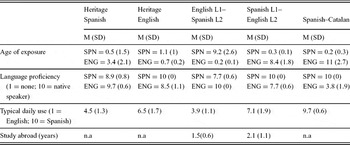
Spanish heritage speakers (n = 10) were early bilinguals who had been raised and educated in the United States, growing up in a bilingual environment and had extensive exposure to both languages on a daily basis. Importantly, all participants had been raised speaking Spanish at home with Spanish-speaking parents and had learned English in pre-school or kindergarten (sequential bilinguals) and completed their education in the U.S. Their mean self-ratings were 8.9 and 9.7 on a ten-point scale on their Spanish and English competence, respectively, and they used both Spanish and English on a daily basis, however, slightly favoring English.
English heritage speakers (n = 9) were simultaneous bilinguals who had been raised and educated in Spain, growing up in a household where the mother was a native speaker of (British) English and the father was a Spanish and/or Catalan speaker. These participants had extensive exposure to both languages on a daily basis, had been exposed to English and Spanish/Catalan since birth with English-speaking friends and family, and grew up using Catalan and Spanish in the community and in the education system. Their mean self-ratings were 10 and 8.5 on a ten-point scale on their Spanish and English competence, respectively and claimed to use both Spanish and English on a daily basis, however, slightly favoring Spanish.
English L1 bilingualsFootnote 2 (n = 10) spoke English as their native language and learned Spanish at school. They completed their education in the U.S., completed their post-secondary degrees (BA, MA, and PhD) as Spanish majors in Spanish departments, had resided in a Spanish-speaking country and used both Spanish and English on a daily basis. These participants were Spanish instructors at the time of the experiment and were completing their PhD in Spanish at the University of Texas at Austin. They rated themselves with at least a 7 or 8 on a ten-point scale on their Spanish linguistic competence and had studied abroad an average of 1.5 years.
Spanish L1 bilinguals (n = 10) spoke Spanish or Catalan as their native language and learned English at school (typically around 8–9 years old). These participants had resided in an English-speaking country and used Spanish, Catalan and English on a daily basis. They were educated in the Spanish school system in Majorca and completed their post-secondary degrees in English, with their classes taught in English (Licenciatura “BA” in English Philology at the Universitat de les Illes Balears) and were completing their PhD in English studies and/or were high school English instructors at the time of the experiment. They rated themselves with at least a 7 or 8 on a ten-point scale on their English linguistic competence and had studied abroad an average of 2.1 years.
Non-English-speaking Spanish–Catalan bilingualsFootnote 3 (n = 10) had either Spanish or Catalan as their native language, were educated in the Spanish school system in Majorca, predominantly used Spanish or Catalan on a daily basis, including speaking to friends and family, and rated themselves with the highest rating on their Spanish linguistic competence, and not higher than 4 on their English linguistic competence. Even though these Spanish speakers had minimal experience with English in the classroom they confirmed that they were not proficient English speakers and did not use English. See Table 1 for the language background of each group.
Age of exposure, language proficiency self-ratings, typical daily use of both languages and years of study abroad for each the five speaker groups.

Materials
In order to examine the VOT values of different groups of Spanish–English bilinguals and to analyze the role of cognate status, a reading aloud task was conducted exclusively in Spanish. The materials consisted of four blocks of 40 Spanish sentences. Each sentence contained a target word within the carrier phrase, Yo puedo decir TARGETWORD “I can say TARGETWORD”. The Spanish utterances in each repetition block elicited the pronunciation of 10 cognate words (cognate pairs with similar meanings and phonological structure in both languages) and 10 non-cognate words (items with no orthographic or phonological overlap with their English translation equivalents) with word-initial unstressed /t/ followed by a mid-vowel /e/ or /o/, together with filler sentences. Although the phonological match between words in two languages is seldom ever perfect, “correspondences noted between L1 and L2 words are more likely to involve the sound substance of lexical items rather than meaning or etymological history” (Flege & Munro, Reference Flege and Munro1994, p. 382–383). For this, cognate items were words that were phonologically similar and maintained the same meaning (i.e. teléfono “telephone” or terrorista “terrorist”). Contrary to the cognate items, non-cognates were not orthographically or phonologically similar to their English counterpart (i.e. teclado “keyboard”, torero “bullfighter”, tejado “ceiling” or testigo “witness”). In each of the cognate words in Spanish, the English translation contained stressed /t/ word-initially and this factor was kept constant throughout the experimental items (see Appendix). Finally, filler sentences contained a target word that did not contain a word-initial unstressed /t/ followed by a mid-vowel (i.e. verano “summer” or arriba “up”).
Procedure
For the data collection in both research sites (Spain and the United States) candidates were contacted in person or by e-mail, given a brief description of the study and asked if they would be willing to participate. Respondents provided information about their language background, specifically their native language(s), and length of time exposed to the other language (English or Spanish). This was considered sufficient information to determine if the volunteers were members of the specific language groups needed for the study. Those who had the linguistic competence and background appropriate for the study residing in the United States were scheduled to come to the laboratory (Spanish heritage speakers and Spanish–English bilinguals with L1 English and L2 Spanish) where participants were tested in a sound-proof booth and, in the case of the participants residing in Spain, the recordings took place in a quiet room at the home or workplace of the speakers (English heritage speakers, Spanish–English bilinguals with L1 Spanish and L2 English, Spanish–Catalan bilinguals).
Participants were told that the study involved reading sentences on a computer screen and that their speech would be recorded for later acoustic analysis. The task was explained in Spanish by a Spanish–English bilingual experimenter. The production data was obtained from a reading aloud task. Each sentence was presented on a computer screen for five seconds. Participants were told to read the sentences presented on the computer screen clearly and with a natural pace, speaking neither too quickly nor too slowly. Specifically, to minimize speaking rate effects in VOT production, speakers were asked to produce “clearly enunciated speech” (see Kessinger & Blumstein, Reference Kessinger and Blumstein1997, p.147) in the production of a carrier phrase, thus, articulating at a slow rate.
The 40 sentences presented appeared in four repetitions and in random order. Specifically, within each repetition block, six random trials were followed by 20 randomly selected target stimuli and 20 fillers/distractors. The speech samples for all participants were recorded using a head-mounted microphone and a solid-state digital recorder (Marantz PMD660), digitized (44 KHz, 16 bit) and computer-edited for subsequent acoustic analysis.
3.2 Acoustic analysis
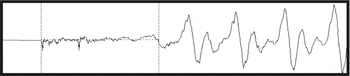
The Spanish unstressed word-initial voiceless dental stops /t/ were included in the VOT analysis. There were 20 word-initial unstressed voiceless dental stops × 4 repetitions × 49 subjects, which resulted in a total of 3920 VOT measurements, of which 1960 were cognate items and 1960 were non-cognate items. The VOT values of the target stops were obtained from the waveform using PRAAT (Boersma & Weenink Reference Boersma and Weenink1999–2011). Specifically, VOTs were obtained by measuring the time interval between the stop release and the onset of voicing as discerned on the waveform as periodic (repeating) cycles. The measurement (rounded to the nearest decimal) was determined from the beginning of the burst (identified by a sharp spike where the waveform changes from quiescent to transient) to the beginning of the first regularly repeating voicing cycle (Figure 1). The point in the first glottal cycle that was counted as the onset of voicing was the initial zero crossing in the waveform.
Measurement of VOT obtained from the waveform using PRAAT (Boersma & Weenink, Reference Boersma and Weenink1999–2011).

The same person made all measurements. To assess reliability, a different coder remeasured a randomly selected 5% of the tokens several months later. The largest difference observed (1 token) was 2 ms. The average difference in the two sets of measurements was 0.1 ms. A Cronbach's alpha of .75 was obtained as a measurement of intraclass correction.
4. Results
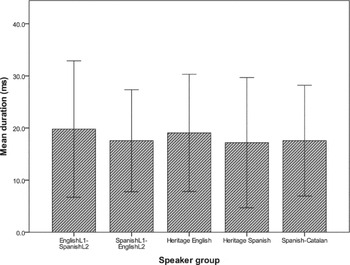
In order to compare the VOT values of the bilingual speakers of English and Spanish and the non-English-speaking Spanish–Catalan participants, the Spanish productions of the Spanish–English bilingual groups were examined alongside the Spanish productions of the non-English speakers (cognate and non-cognate items collapsed). The descriptive statistics for the groups were: English L1–Spanish L2, mean = 19.8, sd = 6.5, n = 800; Spanish L1–English L2, mean = 17.5, sd = 4.8, n = 800; English heritage, mean = 19, sd = 5.6, n = 720; Spanish heritage, mean = 17.1, sd = 6.2, n = 800; and Spanish–Catalan, mean = 17.5, sd = 5.3, n = 800. Figure 2 shows the data for /t/ by each of the speaker groups with the mean VOTs in Spanish for the English-speaking and non-English speaking groups.
Mean VOT for the four English-speaking bilingual groups and the non-English-speaking group (Spanish–Catalan).

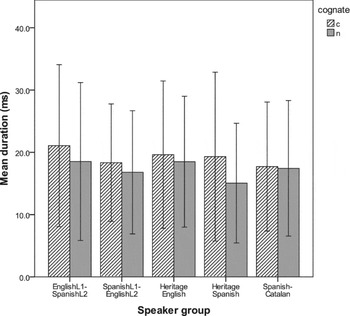
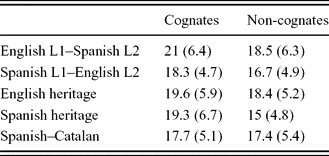
A dataset was created including the average over subjects as a condition of cognate function and group (two values per subject, one per subject per cognate condition). To examine the differences in VOT values by the participants in each speaker group, the dataset was submitted to a “by-subjects” repeated measures ANOVA with cognate as a within-subjects factor, group as a between-subjects factor and subject as the random term. The model revealed significant effects of cognate condition (F1,44 = 109.2, p < .001) and a significant interaction between group and cognate condition (F4,44 = 12.34, p < .001). No effects of group were found (F4,44 = 0.84, p < .5). The production data in each speaker group was next analyzed separating the VOT values of cognate and non-cognate target items (see Figure 3). Table 2 shows the data for /t/ in the production of each of the speaker groups separated by cognate status.
Mean VOT for cognate vs. non-cognate lexical items in each speaker group.

Mean (ms) and standard deviation (in parentheses) for the VOT values of /t/ in cognate vs. non-cognate target items.

In order to explore the interaction, the potential effects of group for each cognate condition were analyzed separately. No effects of group were found, either for cognate words (F4,44 = 1.06, p < .3) nor for the non-cognates (F4,44 = 1.24, p < .3). Subsequently, the effects of cognate condition for each speaker group were investigated separately. This was done through a series of five two-sample, paired t-tests on by-subject averages. Significant cognate effects were found for the English L1–Spanish L2 group (diff. = 2.56, t(9) = 5.32, p < .001, d = .39), the Spanish L1–English L2 group (diff. = 1.55, t(9) = 5.32, p < .01, d = .33), the English heritage group (diff. = 1.13, t(8) = 2.48, p < .05, d = .21), and the Spanish heritage group (diff. = 4.02, t(9) = 8.15, p < .001, d = .73), but there was not a significant cognate effect found for the non-English-speaking Spanish–Catalan group (diff. = 0.28, t(9) = 1.32, p < .2, d = .05). In sum, the data presented indicate a longer VOT for words in Spanish with a cognate in English in comparison to a lexical item classified as non-cognate, supporting the main hypothesis in the study.
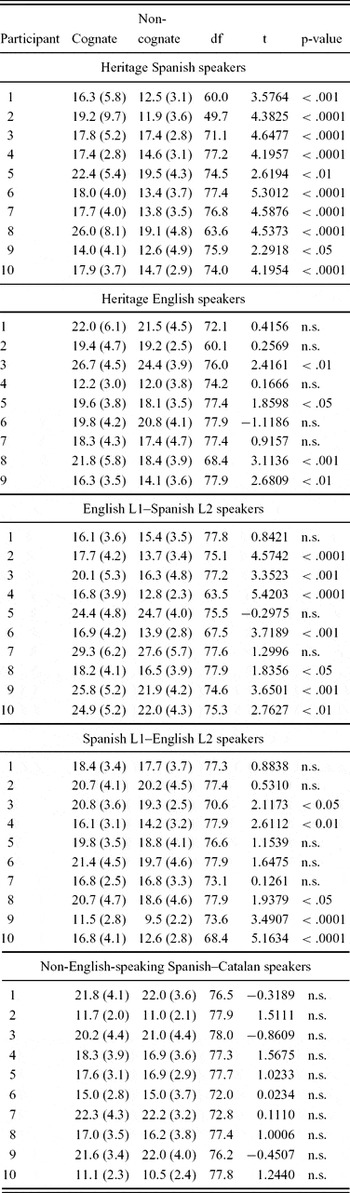
Individual differences in VOT between the cognate and non-cognate items were examined in Welch Two Sample t-tests on the VOT productions of each participant, as can be seen in Table 3 (below). T-tests comparing the production of cognate versus non-cognate lexical items indicate that there are individual differences in each group with production of cognates vs. non-cognate being significantly different for 10 of the 10 Spanish heritage speakers, 4 of 9 English heritage speakers, 7 of 10 English L1–Spanish L2 speakers, and 5 of 10 Spanish L1–English L2 speakers. In contrast, none of the non-English-speaking Spanish–Catalan bilinguals had significantly different productions in cognate vs. non-cognate lexical items.
Data from individual speakers’ production of VOT in ms (sd) for cognate and non-cognate lexical items and results of Welch two-sample t-tests.

5. Discussion
This study examined whether different types of Spanish–English bilinguals produce speech in Spanish that is affected due to an influence from English. Additionally, this study explored if lexical items with considerable phonological, semantic, and orthographic overlap (cognates) are able to enhance cross-language phonetic influences in the speech of Spanish–English bilinguals. Finally, this paper considers the applicability of the Exemplar Model of Lexical Representation (Bybee, Reference Bybee2001; Pierrehumbert, Reference Pierrehumbert, Bybee and Hopper2001) to account for cognate effects on VOT and to models of bilingual speech processing and storage. The results of the analyses reported in this study and their theoretical implications are summarized as follows.
5.1 Bilingual speech and language dominance/balance
To answer the first question of this experiment, if the VOT values of the bilingual speakers of English and Spanish and the non-English-speaking participants were different, the VOT values for the early and late bilinguals were compared, and statistical analyses did not yield significant differences among the early bilinguals and the late bilinguals. Even though the VOT value differences between the bilingual speaker groups were not significant, a close examination of the late bilingual groups, with cognate and non-cognate items collapsed, reveal that the English-dominant group (English L1–Spanish L2) produced VOT values that were higher (more English-like) than the Spanish-dominant group (Spanish L1–English L2) as expected (19.8 vs. 17.5 ms). However, for the early bilingual groups, on average the Spanish heritage group residing in the United States produced VOTs of 17.1 ms and those of the English heritage group residing in Spain averaged 19 ms, a difference in an unexpected direction, that is, the Spanish heritage group's VOTs were lower than the English heritage group, who in addition to growing up hearing Spanish since birth also lived in a Spanish-speaking country.
Consider first the finding that there were not significant differences between the groups for cognate and non-cognate words, and that the difference in VOT values among all five groups was relatively small (in a range of 2.7 ms). In fact, all bilingual speakers maintained VOT values for /t/ which fell in the monolingual range (Antoniou, Best, Tyler & Kroos, Reference Antoniou, Best, Tyler and Kroos2010; Bullock & Toribio, Reference Bullock, Toribio, Isurin, Winford and de Bot2009; Cho & Ladefoged, Reference Cho and Ladefoged1999; Lisker & Abramson, Reference Lisker and Abramson1964; Solé, Reference Solé, Díaz and Pérez1997). Similar findings were reported in Antoniou et al. (Reference Antoniou, Best, Tyler and Kroos2010) in which Australian English–Greek bilinguals matched the VOTs of the Greek and Australian English monolinguals. Additionally, the Spanish VOT values between early and late learners of Spanish and English were not statistically different (contrary to Flege, Reference Flege1991; Yavaş, Reference Yavaş, Roca and Jensen1996, among others), and these results are comparable to the findings in Mack (Reference Mack1989) and MacLeod and Stoel-Gammon (Reference MacLeod and Stoel-Gammon2005), in which very limited evidence was found of differences in production between early English–French bilinguals and monolingual speakers. Magloire and Green (Reference Magloire and Green1999) also analyzed the bilingual stop production of Spanish–English bilinguals and found almost identical VOTs in English and Spanish for these bilingual speakers when compared to monolingual speakers of each language.
Furthermore, MacLeod and Stoel-Gammon (Reference MacLeod and Stoel-Gammon2010) found no group differences between the simultaneous and sequential English and French bilinguals in their production of labial and coronal stop consonants and high vowels, demonstrating that earlier acquisition did not give simultaneous bilinguals an advantage over sequential bilinguals in the production of these sounds. This study corroborates these findings in that highly proficient L2 learners (English L1–Spanish L2 and Spanish L1–English L2) are also able to produce segments in Spanish that are not significantly different from simultaneous bilinguals. This is a remarkable feat if we consider that more precision may be required to maintain short lag Spanish stops (from 0 to 30 ms) in comparison to a wider span of VOT values for English voiceless stops (30 to 120 ms) in bilingual speech (Bullock & Toribio, Reference Bullock, Toribio, Isurin, Winford and de Bot2009). The fact that larger differences were not found in their Spanish production of short-lag voiceless stops, resulting in less variability, may be explained by a gestural account as suggested by Kessinger and Blumstein (Reference Kessinger and Blumstein1997): lengthening a short-lag VOT requires an additional gesture (aspiration). In the same vein, Beckman, Helgason, McMurray and Ringen (Reference Beckman, Helgason, McMurray and Ringen2011) explain that in aspirating languages (such as English) lengthening a short-lag VOT would reduce or eliminate the contrast, while in prevoicing languages (such as Spanish) this gesture would simply be additional effort.
It is important to note that all data from the experimental design are elicited entirely in monolingual Spanish mode (Grosjean, Reference Grosjean1998, p. 136), and in this respect this production study attempts to induce a monolingual language mode as in previous studies of bilingual speech production (Antoniou et al., Reference Antoniou, Best, Tyler and Kroos2010; Caramazza et al., Reference Caramazza, Yeni-Komshian, Zurif and Carbone1973; Flege & Eefting, Reference Flege and Eefting1987; Grosjean & Miller, Reference Grosjean and Miller1994; Magloire & Green, Reference Magloire and Green1999; Sundara, Polka & Baum, Reference Sundara, Polka and Baum2006, among others) as Antoniou et al. (Reference Antoniou, Best, Tyler and Kroos2010, p. 641) explains,
Bilinguals are most likely to produce monolingual-like speech when in a monolingual mode. That is, bilinguals should adapt their language output to suit the situational language context, to maximize communicative efficacy, and this should affect speech production as well as higher levels of language, akin to the way a monolingual speaker switches between speech registers or styles.
It must be noted that the ability to draw strong conclusions is hampered by two main limitations inherent to the study: (1) potential differences across dialects of Spanish, and (2) possible influences from Catalan. Because some participants used Spanish spoken in Spain and others used Spanish spoken in the US, possible influences due to VOT differences among Spanish dialects (see Rosner, López-Bascuas, García-Albea & Fahey, Reference Rosner, López-Bascuas, García-Albea and Fahey2000) cannot be excluded. Further research should consider this possibility and “only a cross-dialect study of Spanish VOT productions, using a single methodology, can test this possibility” (Rosner et al., Reference Rosner, López-Bascuas, García-Albea and Fahey2000, p. 222). As mentioned in footnote 1, the participants from Spain were not a homogenous group given that all were proficient or native in Catalan, thus creating a control group that was not composed of monolingual Spanish speakers and introducing variety in the native language of the participants (Spanish or Catalan). While additional work should systematically investigate differences in VOT across Romance speakers and speakers of multiple Romance languages in particular, proficiency in Catalan is not expected to influence Spanish VOT production (Aliaga-García & Mora, Reference Aliaga-García, Mora, Monroy and Sánchez2008; Rallo, Reference Rallo and Martinez Celdrán1998). Interestingly, there was not a significant difference in this study in the VOT productions of the bilingual groups that spoke Catalan and those that did not, perhaps supporting the assumption underlying this research that the groups in Spain are adequate examples of these categories of bilinguals. To address these potential complications, future work should determine if differences exist in VOT not only in varieties of Spanish but in Spanish speakers who speak another Romance language as well. These results are, thus, tentative and in need of replication with homogeneous groups of monolingual speakers of the same dialect of Spanish.
5.2 Bilingual speech and language representation
To answer the second question of this experiment, whether cognates are able to enhance the cross-language phonetic influences in the speech of Spanish–English bilinguals, the phonetic outputs of cognate and non-cognate lexical items were examined to detect any cross-linguistic influence. Cognate status was expected to produce a longer VOT in the production of Spanish words with English cognates, while shorter, more Spanish-like VOTs were hypothesized to surface in the articulation of non-cognates. The data answer in the affirmative. Bilingual speakers (early and late bilinguals alike) were found to produce significantly longer VOT values for cognate than for non-cognate words in Spanish. Additionally, no differences were found between cognate and non-cognate items by the non-English-speaking Spanish–Catalan group who were not sufficiently proficient in English and reported never using it.
A closer look at the production data of the Spanish heritage group by cognate status reveals that the VOT values of the cognate items are in the expected voiceless stop range for Spanish, between zero and 20 ms (19.3 ms); in contrast, the VOT values of the non-cognate items appear to be extremely low (15 ms), in fact lower than the production of non-cognates by the other bilingual groups and even the Spanish–Catalan control group. Similar findings with bilinguals “acting more monolingual-like” than monolingual participants have been reported in Flege and Eefting (Reference Flege and Eefting1986, Reference Flege and Eefting1987) with significant VOT shortening in voiceless stops by two groups of Spanish–English bilinguals in comparison to monolingual Spanish speakers in Puerto Rico. Since the bilinguals were shown to have established separate phonetic categories for the English voiceless stops, the authors argued that their Spanish stops were dissimilating from their English counterparts.
In terms of Flege's SLM (Flege, Reference Flege and Strange1995) this process is called phonetic “category dissimilation” in which the newly established L2 phonetic category and the nearest L1 phonetic category shift away from one another in the phonetic space. According to SLM, L2 learners strive to maintain phonetic distance between the L1 and L2 phonetic categories within the common phonetic space, and as a result produce /t/ unlike the group of monolingual baselines. Using the terminology of the model, SLM hypothesizes that if an L2 sound is phonetically similar to an L1 sound, this will result in an “equivalent classification” and merged L1/L2 phonetic category displaying some features of the two assimilated sounds which will differ from that of a monolingual speaker of either language. Eventually, some L2 learners (most likely early bilinguals) may develop a new, separate phonetic category for some L2 sounds; however, according to SLM, this does not mean that native-like L2 production will ever be achieved. For instance, in a production study of early English–French bilinguals, Fowler, Sramko, Ostry, Rowland and Halle (Reference Fowler, Sramko, Ostry, Rowland and Halle2008) found differences between the production of bilingual and monolingual speakers with bilingual speakers producing VOTs that were significantly longer than those of monolingual French speakers, and in English they produced VOTs that were significantly shorter than monolingual English speakers. The fact that this phonetic category dissimilation occurs exclusively in the non-cognate items and not in the cognates suggests that a cognate effect may be overriding the dissimilation process. This dissimilation process is not observed in the production of highly proficient late bilinguals. These results call for an examination of the cognate effect in the English production of English heritage speakers to test if this phonetic category dissimilation occurs in the other early bilingual group analyzed in this study.
Cognate status has been widely reported in the psycholinguistic literature with priming, reaction times, and facilitation effects, however, fewer studies have examined if cognates facilitate phonetic interference. The finding that cognates are able to enhance cross-language phonetic influences in the speech of Spanish–English bilinguals is in line with a recent series of studies investigating cognate effects in bilingual speech production (Brown & Harper, Reference Brown and Harper2009; Cochrane, Reference Cochrane1980; Hammerly, Reference Hammerly1982; Mora & Nadeu, Reference Mora and Nadeu2009). At this point, however, previous work on the influence of a cognate effect on segmental production accuracy has lacked consensus. Cochrane (Reference Cochrane1980) reported that Japanese adults produced more segmental errors in English when producing liquids in cognate than non-cognate words but Flege et al. (Reference Flege, Takagi and Mann1995) reexamined data from a similar population sample and observed no differences in the production of liquids between cognate and non-cognate lexical items. With regards to bilingual speech production analyzing VOTs, Flege and Munro (Reference Flege and Munro1994) found that native Spanish speakers produced /t/ with shorter, more Spanish-like VOT values in English words with a Spanish cognate than in English words that were apparently not related to a Spanish word. These findings diverge from those of Flege et al. (Reference Flege, Frieda, Walley and Randazza1998) which indicate that the VOT values produced by native Spanish speakers in sets of English words did not differ significantly between cognate and non-cognate status. Phonetic deviations in variable reductive processes have also been explained by cognate effects with Spanish–English bilinguals reducing /s/ in cognates at a significantly lower rate than non-cognates (Brown & Harper, Reference Brown and Harper2009). The results of the present study add to the growing literature examining cognate effects on bilingual phonetic production by presenting experimental data from highly proficient Spanish–English bilinguals along a continuum of language dominance, including participants who have acquired English and Spanish from birth or as an L2 and who reside in both Spanish and English-speaking environments.
5.3 Theoretical implications
The results of this experiment have broader implications in the field of psycholinguistics and specifically for theories of cognitive processing in bilinguals. Cognates are frequently used as a tool for investigating the structure of the bilingual mental lexicon, as “any difference between how cognates and MONOLINGUAL words are processed by bilinguals would indicate that the other, currently irrelevant, language must have played a role as well” (Lemhöfer et al., Reference Lemhöfer, Dijkstra and Michel2004, p. 587, emphasis added). This production study provides evidence that the two language systems of bilinguals do not operate completely independently of one another because both systems are activated at all times, at least to some degree (Grosjean, Reference Grosjean1982, Reference Grosjean1985, Reference Grosjean1989; Grosjean & Soares, Reference Grosjean, Soares and Vaid1986). Furthermore, these results support an interaction between the phonological and the lexical levels of representation across the two languages of a bilingual (Gollan, Forster & Frost, Reference Gollan, Forster and Frost1997; Sánchez-Casas et al., Reference Sánchez-Casas, Davis and García-Albea1992).
Beyond determining if there is a cognate status effect on the acoustic realization of phonetic segments, such an effect must be operationalized in a model of bilingual lexicon. Costa et al. (Reference Costa, Caramazza and Sebastián-Gallés2000) and Costa et al. (Reference Costa, Santesteban and Caño2005) obtained a cognate facilitation effect in speech production of bilinguals which was argued to support the cascaded activation model of lexical access (Caramazza, Reference Caramazza1997) in opposition to a strictly discrete activation. The difference between the discrete and cascaded proposals lies in the activation or not of phonological segments by the non-selected lexical nodes. According to the discrete serial view, only the selected lexical nodes are able to activate their phonological segments, whereas the cascaded activation models propose that both selected and non-selected lexical nodes activate their phonological segments allowing a cognate effect. A model that depends on a conceptual and phonemic link alone to account for cognate effects may be problematic as the phonological match between words in two languages is rarely ever perfect and “the two language-specific forms of a cognate are often not identical, not only because of differences between sound inventories of the languages in question, they may also differ in one, two or even more sounds, and still produce cognate effects” (Sherkina, Reference Sherkina2003, p. 140). In order to account for cognate effects in bilingual speech production, specifically, regarding the acoustic realization of phonetic segments (Brown & Harper, Reference Brown and Harper2009; Cochrane, Reference Cochrane1980; Hammerly, Reference Hammerly1982; Mora & Nadeu, Reference Mora and Nadeu2009) the cascaded activation models will need to be revised to include activations at the phonetic level for both languages that must be connected and activated by the non-selected lexical nodes. However, if we assume that speakers possess fine-grained, detailed, and word-specific knowledge about the sounds and words of their language (Coleman, Reference Coleman, Durand and Laks2002; Pierrehumbert, Reference Pierrehumbert, Bybee and Hopper2001, among others) we can explain variable phonetic outputs because all the possible phonetic manifestations would be stored within each word.
Exemplar theory is able to explore the lexical/phonetic interface in which the mental lexicon is represented phonetically and may be expanded to include bilingual data to analyze the bilingual lexicon. Within Exemplar Theory, phonological representations are not abstract entities separate from the semantics and morphology of the language, nor are they dependent upon rules for formation. Rather, in the exemplar model, all the possible phonetic manifestations and lexical meanings are stored with each unit (word), in addition to different contextual variations and realizations. In fact, according to Pierrehumbert (Reference Pierrehumbert, Gussenhoven and Warner2002) detailed information from the speech signal is processed by the listener and becomes part of the stored representation in the lexicon as exemplars. These exemplars are stored, rich in phonetic detail, in memory, along with extra-linguistic information. In terms of exemplar-based speech production, the phonological category represented by any specific label involves making a random selection from the exemplar cloud for that label, and these exemplars are categorized, on the basis of their similarity to extant stored exemplars, into clouds of memory traces with similar traces being close to each other while dissimilar traces are more distant.
Cross-language phonetic alterations (cognate effect) in bilingual speech can be accounted for within the exemplar model of lexical representation (see Bybee, Reference Bybee2001; Goldinger, Reference Goldinger, Johnson and Mullennix1997; Johnson, Reference Johnson, Johnson and Mullennix1997, Reference Johnson2005; Pierrehumbert Reference Pierrehumbert, Bybee and Hopper2001, Reference Pierrehumbert2003a, Reference Pierrehumbert, Bod, Hay and Jannedyb). At the core of phonological exemplar theories for spoken languages is the proposition that “there is a multidimensional mental acoustic map of the phonetic space, that individual utterances (exemplars) are assigned to appropriate locations on that map, and that grammar begins to emerge when there is a large statistical group of exemplars on the map that can be identified as a category by being linked to one or more groups of exemplars at other levels of representation (e.g. to a common lexical or morphological concept)” (Hall & Boomershine, Reference Hall and Boomershine2006, p. 3). This theory models a non-modular lexicon in which each category (lexical item) is stored with redundant phonetic, semantic, and contextual information represented in memory by a “cloud” of remembered exemplars which directly reflect a speaker's experience with the specific word in both production and perception. One of the key assumptions of exemplar theory is that phonetic and linguistic categories are learned by remembering labeled exemplars. Given the current results, the exemplar model can be extended to include bilingual lexical connections modulated by language experience and use. Bilinguals may associate two phonologically-similar word representations (cognates) in the same “cloud”, so the word for a particular concept/meaning is influenced by the orthographically, phonologically, and semantically similar representation from the other language. This association is not compromised in the case of non-cognates.
In an exemplar-based speech production model, the articulation of a category is realized by activating a section of the exemplar cloud of the category. The application of an exemplar-based approach on bilingualism has implications for the notion of bilingual language storage. The extension of this model to include bilingual or multilingual data would predict that there is an overlapping organization of bilingual memory, and in line with Costa et al. (Reference Costa, Santesteban and Caño2005), it has been assumed that a bilingual has “interconnected lexicons”. In addition, lexical representations in one language can affect lexical representations in another, that is to say, “if the words we know in different languages are mentally interconnected, then it follows that our knowledge of words in one language may affect how we learn, process, and use words in another language” (Jarvis & Pavlenko, Reference Jarvis and Pavlenko2008, p. 74).
With regard to the data presented in this paper, these bilingual speakers have exemplar representations for cognates that include the bilingual VOT values, thus, the phonetic target in the speech of a bilingual would be the average over the set of exemplars in the vicinity of a randomly selected exemplar. As a result, there seems to be subtle but significant cross-language interference (cognate effect) in the form of altered exemplar representations, which is apparent in the phonetic representation of the cognate lexical items. In other words, the realization of this production target results from the selection from a densely populated region of the exemplar cloud which includes both the English and the Spanish VOT values. This paper has argued that this model can be applied to bilingual data to explain cognate effects in which bilinguals do not separate “clouds of memory traces” in each language (they are in fact interconnected) and that the phonetic features of cognate lexical items form a stronger link, thus permitting cross-language alterations.
6. Conclusion
The findings of this study provide additional evidence that cross-language phonetic interference does occur in the production of bilingual speakers, and importantly, that these phonetic alterations are enhanced by cognate effects. These findings indicate that there are no significant differences in the Spanish VOT values between highly proficient early and late learners of Spanish and English when the production data is elicited entirely in monolingual Spanish mode. Additionally, there is a significant effect of cognate status in the production of VOT by Spanish–English bilinguals such that the bilinguals produced /t/ with longer VOT values (more English-like) in the Spanish words with English cognates in comparison to the non-cognate words. Statistical analyses found significant differences in the production of word-initial unstressed /t/ in cognate vs. non-cognate words by the Spanish heritage speakers, English heritage speakers, Spanish L1–English L2 and English L1–Spanish L2 speaker groups. Finally, it has been proposed that the exemplar model of lexical representation (Bybee Reference Bybee2001, Pierrehumbert, Reference Pierrehumbert, Bybee and Hopper2001) can be extended to include bilingual lexical connections through which cognates facilitate phonetic interference in the bilingual mental lexicon which result in alterations in the phonetic output.
Appendix. List of target stimuli