Implications
In Europe, meloxicam is licensed in adult pigs for the treatment of non-infectious locomotor disorders and for the relief of post-operative pain associated with minor soft tissue surgery such as castration. In addition, meloxicam is licensed in sows as adjunctive therapy for the treatment of puerperal septicaemia and toxaemia (mastitis–metritis–agalactia syndrome). This investigation studied the effects of a meloxicam administration in sows after farrowing. The underlying rationale was that by alleviating inflammation and pain after farrowing, the period of discomfort in sows could be reduced, thus improving piglet survival and growth. Although more studies are required, meloxicam treatment after farrowing could improve the well-being of the sows.
Introduction
The day before farrowing, sows in farrowing crates appear uneasy and restless and show behaviours similar to the nesting activity described in sows in natural environments (Cronin et al., Reference Cronin, Smith, Hodge and Hemsworth1994). During the day of farrowing, an important feature is the time spent lying in the same position throughout the birth of the whole litter (Fraser, Reference Fraser1984). With the sow lying quietly, piglets may have ready access to the udder for warmth and nutrition during their very early life (Fraser, Reference Fraser1984). On the day following farrowing, confined sows spend 89 ± 3% of their time lying down and this percentage slightly decreases during lactation to 78 ± 3% on day 20 (Hötzel et al., Reference Hötzel, Pinheiro Machado, Wolf and Dalla Costa2004). The reduction in activity after farrowing is restored sooner in free gilts than in tethered ones (Lammers and De Lange, Reference Lammers and De Lange1986). Valros et al. (Reference Valros, Rundgren, Špinka, Saloniemi and Algers2003) reported that a high activity level (in terms of total time standing) on day 3 of lactation might be a positive maternal characteristic of sows.
Moreover, the frequency of position changes markedly decreases after farrowing. For instance, sows allocated in farrowing crates without enrichment material performed 31.5 ± 3.5 position changes per day during the 3 days after farrowing (Mainau et al., Reference Mainau, Dalmau, Ruiz-de-la-Torre and Manteca2009).
Maternal behaviour, which includes the movements of the sows, affects piglet mortality, as crushing by the sow is the first cause of piglet deaths (Fraser, Reference Fraser1990; Marchant et al., Reference Marchant, Broom and Corning2001), occurring mainly during the first 24 h after farrowing (Edwards, Reference Edwards2002; Damm et al., Reference Damm, Forkman and Pedersen2005).
In addition, savaging gilts are characterised by increased time spent lying ventrally, increased posture changes, increased walking and a higher responsiveness index (Ahlström et al., Reference Ahlström, Jarvis and Lawrence2002). In the latter cases, the number of piglets weaned per sow, per year, which is the core economic parameter in pig production (Krieter et al., Reference Krieter, Engler, Tölle, Timm and Hohls2009), dramatically drops causing significant economic losses. The incidence of pre-weaning piglet deaths shows a large variability between studies, although 10% to 15% is accepted as an average figure in sows housed in farrowing crates (Marchant et al., Reference Marchant, Rudd, Mendl, Broom, Meredith, Corning and Simmins2000).
Lammers and De Lange (Reference Lammers and De Lange1986) suggested that in tethered gilts, individual differences in maternal behaviour may indicate that in the same housing conditions, some individuals suffer more than the others. For instance, activity level (as total time standing or walking) and the frequency of standing-to-lying events are individually stable characteristics, because some sows are generally more active and/or restless than others (Valros et al., Reference Valros, Rundgren, Špinka, Saloniemi and Algers2003).
Pain caused by parturition is a welfare problem and may substantially modify the normal behaviour of sows during and after parturition. Prolonged or difficult farrowings are associated with increased offspring mortality in pigs (Alonso-Spilsbury et al., Reference Alonso-Spilsbury, Mota-Rojas, Villanueva-García, Martínez-Burnes, Orozco, Ramírez-Necoechea, López and Trujillo2005). A proper selection criterion such as the number of piglets born alive, instead of the number of piglet born in total, appears to be a good way to limit the negative side effects on stillborn (Canario et al., Reference Canario, Roy, Gruand and Bidanel2006), and consequently reduce potential welfare implications for the mother and piglets.
Pain assessment in animals has tended to use one of the three following approaches: measures of general body functioning, measures of physiological response and measures of behaviour (Weary et al., Reference Weary, Niel, Flower and Fraser2006). Several studies used the combination of these three indicators in order to study the pain recovery associated to a painful process (e.g. Bussières et al., Reference Bussières, Jacques, Lainay, Beauchamp, Leblond, Cadoré, Desmaizières, Cuvelliez and Troncy2008). Although normal deliveries show changes in the three indicators of pain, dystocic deliveries show the most marked differences. For instance, in relation to measures of general body functioning, a reduction in food intake is commonly seen in dams around parturition; however, markedly than normal changes in dry matter intake during the periparturient has been used as to identify sows at risk of post-partum complications (Drackley, Reference Drackley1999; Grummer et al., Reference Grummer, Mashek and Hayirli2004). As for physiological indicators, during the period around parturition, sows commonly had increased cardiac frequency, respiratory rates and rectal temperature (RT; Noakes, Reference Noakes2001). Despite this, higher values than 39.5°C are indicative of fever or pyrexia around farrowing (Österlundh et al., Reference Österlundh, Hultén, Johannisson and Magnusson2002), and could indicate more discomfort and a slow recovery after farrowing. Finally, in relation to behaviour indicators, the increased restlessness before farrowing is a part of the normal farrowing situation; however, it has been suggested that may be due to discomfort in the crate (Damm et al., Reference Damm, Bildsøe, Gilbert and Ladewig2002). For instance, sow posture (lying down) and sow activity (lower number of position changes) during the day before and the day of farrowing appear to be important ease of farrowing indicators (Mainau et al., Reference Mainau, Dalmau, Ruiz-de-la-Torre and Manteca2010).
It is known that one of the essential components of good welfare is not only the recognition of pain but also the control of pain (FAWC, 1992). In simple terms, therapy based on steroids and non-steroidal anti-inflammatory drugs (NSAIDs) will primarily control pain by reducing inflammation and swelling (Short, Reference Short1998). The use of corticosteroids may not be appropriate because of their immunosuppressive effects (Bishop, Reference Bishop1998). In addition, corticosteroid injections during lactation have been shown to adversely affect sow milk yield, leading to a reduction in the suckling piglet growth (Bishop, Reference Bishop1998). Regarding NSAIDs, a study conducted in rats and mice (Engelhardt et al., Reference Engelhardt, Bögel, Schnitzler and Utzmann1996) found that the therapeutic index of meloxicam is higher than that of other NSAIDs, including piroxicam, diclofenac and indomethacin. Meloxicam, an NSAID of the oxicam class, acts by inhibiting prostaglandin synthesis (Engelhardt and Trummlitz, Reference Engelhardt and Trummlitz1990) and inducible cyclo-oxygenase-2 (COX-2; Engelhardt, Reference Engelhardt1996), thereby exerting anti-inflammatory, antitoxic, antiexudative, analgesic and antipyretic effects (Friton et al., Reference Friton, Schmidt and Schrödl2006). Meloxicam is used for non-infectious locomotor disorders in pigs, by reducing the signs of lameness and inflammation (Friton et al., Reference Friton, Philipp, Schneider and Kleemann2003), the porcine respiratory disease complex in growing pigs (Georgoulakis et al., Reference Georgoulakis, Petridou, Filiousis, Alexopoulos, Kyriakis and Papatsas2006) and for the relief of post-operative pain associated with minor soft tissue surgery such as castration (Keita et al., Reference Keita, Pagot, Prunier and Guidarini2010). In sows, meloxicam is used as an adjunctive therapy in the treatment of mastitis–metritis–agalactia syndrome (MMA) with appropriate antibiotic drugs (Hirsch et al., Reference Hirsch, Philipp and Kleemann2003).
The aim of this study was to investigate the effects of meloxicam on post-farrowing behaviour of the sows and the performance of piglets. We hypothesised that by alleviating the inflammation and pain of the sows after farrowing, the period of discomfort could be reduced and sows could recover their normal activity and behaviour sooner so that piglet survival and growth would be improved.
Material and methods
Animals, housing, feeding and general management
A total of 48 hybrid (Large White × Landrace) sows (24 primiparous sows and 24 multiparous sows in their third and fourth parity) were randomly selected on a commercial farm 1 week before the expected farrowing date from June to October 2007. The study was interrupted during August in order to avoid high environmental temperatures. Sows were divided into six different replicates with twelve sows per replicate (six primiparous sows and six multiparous sows). All sows in each replicate were inseminated on the same day. Sows that farrowed at night, sows that showed signs of lesions, illness or lameness and sows that had a body condition score (BCS) lesser than 2 were not included in the study. The BCS was visually determined according to a scale of 1 (very thin) to 5 (obese) points. On day 109 of gestation, sows were moved to the farrowing room. Farrowing pens were 2.40 × 1.80 m with fully metal slatted floors for sows and plastic slatted floor for piglets with a metal heat pad at 36°C for the piglets during their first week of life. Each pen contained a centrally positioned farrowing crate, 1.95 m in length and 0.60 m in width, and built with steel bars. The temperature in the farrowing room was kept constant approximately 20°C and light was on 24 h/day. Sows were fed three times a day (at 0700, 1300 and 1700 h), except on the day of farrowing. The food was a standard gestation concentrated diet with 12.25 MJ metabolisable energy, 143 g CP, 90 g crude fat, 80 g crude fibre and 63 g ash/kg fresh matter. During the days before farrowing, sows were offered 2.7 kg/day (900 g in each meal). After farrowing, the quantity of food offered was increased to 450 g/day (150 g in each meal) only when the sows consumed it completely. Water was available ad libitum from drinkers. On day 113 of gestation at 0700 h, farrowing was hormonally induced (0.7 ml PGF2 α-sintetic; SincrocelivenRR®, Iven SA, Madrid, Spain). Treatments and manual intervention during farrowing were very consistent. If the interval between two piglets exceeded 50 min, manual intervention was provided and sows were treated with 1ml of oxytocin (Oxipart-Vall®, Mevet SA, Lleida, Spain) intramuscularly (IM) in the neck. As recommended by Cassar et al. (Reference Cassar, Kirkwood, Friendship and Poljak2005), oxytocin treatments were performed only after evaluation of the dilatation of the cervix. When the cervical canal was not sufficiently dilated, sows were treated with 200 mg of vetrabutine hydrochloride (Monzal®, Boehringer Ingelheim España, S.A., Barcelona, Spain) IM in the neck. Litter size was standardised to 12 to 13 piglets, depending on their availability, by cross-fostering within 8 h post-farrowing. Piglets were given iron (200 mg IM; Ferrovall®, Mevet SA, Lleida, Spain), amoxicillin (75 mg IM; Vetrimoxin®, Ceva SA, Barcelona, Spain) and toltrazuril (100 mg oral; Baycox®, Bayer Schering SA, Berlin, Germany) on day +2. At the same time, tail docking was performed. Creep feeding was given to piglets from day +7. Piglets were weaned at 21 ± 0.1 days with an average weight of 5815.8 ± 45.3 g.
Experimental procedure and data collection
In each replicate, sows were randomly allocated into two homogeneous groups regarding parity and treated with either meloxicam (Metacam® 20 mg/ml Solution for Injection; Boehringer Ingelheim Vetmedica GmbH, Ingelheim, Rhein, Germany) IM, 0.4 mg/kg birth weight (BW) or saline solution as placebo. Meloxicam or placebo was administered on average 90 min after the birth of the last piglet.
For each sow, the number of position changes (defined as the number of postural changes from lying down to standing up or sitting position and vice versa) and the total time lying and standing or sitting were recorded continuously for 1 day before and 3 days after farrowing using automatic sensors (Standing Lying Sensors; Mainau et al., Reference Mainau, Dalmau, Ruiz-de-la-Torre and Manteca2009).
The duration of farrowing and the condition of piglets at birth (live, stillborn or mummified piglets) were registered by direct observation. The duration of farrowing was defined as the time period (in minutes) between the birth of the first and last piglet, including piglets born alive and stillborn, as well as mummified foetuses.
RT was measured 90 min after farrowing (just before meloxicam or placebo treatment) and during 3 days after farrowing twice a day (at 1000 and at 1800 h).
Food was considered as having been consumed if the feeder was empty 1 h after every meal. Food was calculated as the percentage of meals with full intake. Feed intake was recorded three times a day (at 0800, 1400 and 1800 h) for 1 day before and 3 days after farrowing.
A total of 545 piglets were individually weighed at farrowing and at weaning. The average daily gain (ADG) of each piglet was calculated according to lactation days (from 19 to 24 days). Piglet mortality was recorded during the entire lactation period.
Statistical analysis
All the statistical analyses were carried out with the Statistical Analysis System (SAS V9.1; software SAS Institute Inc., Cary, NC; 1991 to 2001). The significance level was established at P < 0.05. Normality test of data and residuals were performed for every variable evaluated.
In order to test whether treatment groups were well balanced, some variables during the day before (day −1) and the day of farrowing (day 0) were analysed. Variables that were normally distributed (total number born per litter, total number born alive per litter, total duration of farrowing, RT 90 min after farrowing and piglet weight at birth) were analysed using the GLM procedure. Variables that were not normally distributed (parity, total number of stillborns per litter, total number of mummified foetuses per litter, total number of cross-fostered piglets per litter, percentage of piglets born with manual intervention, total time lying on day −1, number of position changes on day −1 and percentage of meals with full intake on day −1) were analysed using the GENMOD procedure. The models included the fixed effects of treatment (meloxicam v. placebo), parity (primiparous v. multiparous) and treatment by parity interaction.
In order to test the effect of parity and meloxicam on dependent variables after farrowing, for variables that were normally distributed (RT and ADG), the GLM procedure was applied and the Student–Newman–Keuls test was used to establish differences between the least-square means (LSMEANS) of fixed effects. For variables that were not normally distributed (number of position changes, total time lying down, % of meals with full intake and mortality rate of piglets) the GENMOD procedure was used. The LSMEANS adjusted to Bonferroni's honestly significance difference was used as a test of comparisons. In these models, the fixed effects were parity (primiparous v. multiparous), treatment (placebo v. meloxicam) and their interaction, and data were analysed by day. In the feed intake model, the number of the meal effect (first, second or third meal of the day) also had been introduced as fixed effect. Moreover, sow was the experimental unit and replicate (from 1 to 6) was specified as a random effect.
In the RT model, RT at 90 min after the birth of the last piglet was considered as a covariable, because treated groups were not balanced in relation to this variable.
Finally, in order to study the performance of piglets with low BW, ADG was compared by BW at defined percentiles (percentile 5, 1054 g; percentile 10, 1138 g; percentile 15, 1180 g; percentile 20, 1257 g; percentile 25, 1304 g).
Results
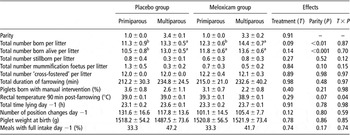
For most behaviour and performance variables recorded before farrowing, both treatment groups (meloxicam v. placebo) were comparable at the start of the experimental procedure. However, at the time of drug administration, a group by parity interaction effect (P = 0.04) was observed regarding RT. Gilts in the meloxicam group had a higher RT 90 min after farrowing than multiparous sows (P = 0.04). Moreover, a parity effect was observed on the total number of piglets born per litter and the total number of piglets born alive per litter. Multiparous sows had a higher total number of piglets born per litter and piglets born alive per litter (P < 0.01 and P < 0.001, respectively; Table 1).
Behaviour and performance of pre-farrowing variables (mean ± s.e.) regarding treatments (placebo v. meloxicam) and parity (primiparous v. multiparous) effects

Different superscripts indicate significant differences (P < 0.05).
Observations of sows
Number of position changes and total time lying down
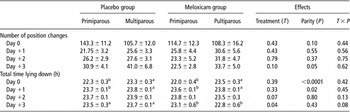
The number of position changes did not show significant differences according to parity during the puerperal period. Total time spent lying down showed a parity effect on day 0 and day +1 (P < 0.0001 and P = 0.02, respectively), as the 2 days primiparous sows spent less time lying down than multiparous sows. Although the actual number of position changes did not show significant differences in relation to treatment, sows spent less time lying down on day +3 after farrowing in the meloxicam group compared with the placebo group (P = 0.04; Table 2).
Number of position changes and total time lying down per day in hours (mean ± s.e.) during the puerperal period regarding treatments (placebo v. meloxicam) and parity (primiparous v. multiparous) effects

Different superscripts indicate significant differences (P < 0.05).
Feed intake
Feed intake showed a parity effect on day +1, +2 and +3 (P < 0.001) as multiparous sows consumed more number of meals than primiparous sows (67.1% v. 32.9% of meals with full intake). Feed intake showed a meal effect (P = 0.01). The first meal of each day was more frequently consumed than the second and the third meal (14.1% v. 10.3% and 8.9% of meals with full intake, respectively). No significant treatment effect was observed on day +1, +2 or +3 (P = 0.47, P = 0.41 and P = 0.30, respectively).
RT
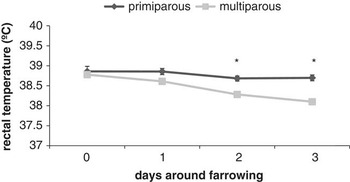
A parity effect was shown in RT on day +2 and day +3 (P < 0.001 and P < 0.0001) because primiparous sows had a higher RT on day +2 and day +3 after farrowing than multiparous sows. No significant treatment effect was observed (P = 0.67; Figure 1).
Rectal temperature (mean ± s.e.) according to parity (primiparous v. multiparous) during days around farrowing. *indicate significant differences (P < 0.05).

Piglet performance
Mortality rate of piglets at weaning
Out of 648 piglets born, 586 were born alive (90.4%), 29 were stillborn (4.4%) and 33 were mummified foetuses (5.1%). After the cross-fostering process, a total of 579 piglets were studied during the lactation period. During the lactation period, 6.2% (18 of 291) and 5.6% (16 of 288) of piglets died in the meloxicam and placebo group, respectively (P = 0.62). The mortality rate was 7.6% (22 of 289) and 4.1% (12 of 290) in multiparous and primiparous sows, respectively (P = 0.11). During the 1st week after farrowing, 67.7% of deaths occurred, with 2.9% of piglets dying on the day of farrowing, 17.7% on day +1, 14.7% on day +2 and 11.8% on day +3. Finally, mortality during the 2nd and 3rd week after farrowing accounted for the 23.5% and 8.8% of the total, respectively.
ADG
Fostered piglets had a mean BW of 1502 ± 12.7 g, and only 26 piglets (4.5%) weighed less than 1 kg. ADG from birth to weaning did not show any treatment (P = 0.34) or treatment by parity interaction (P = 0.06) effect. A parity effect was, however, observed in those piglets nursed by multiparous sows had both greater body weight at weaning (5666.1 ± 53.6 v. 5971.6 ± 72.6 g; P < 0.001) and ADG (213.3 ± 3.1 v. 196.9 ± 2.3 g/day; P < 0.001) than those nursed by primiparous sows. Moreover, in litters from multiparous sows, piglets of low BW (defined as percentile 15: BW <1180 g) had an ADG significantly higher in the meloxicam group than in the placebo group (196.6 ± 7.2 v. 166.6 ± 9.1 g/day; P = 0.03).
Discussion
Number of position changes and total time lying down
Despite the individual variability in activity levels between sows (Lammers and De Lange, Reference Lammers and De Lange1986), the number of position changes and total time lying down around farrowing showed similar or slightly higher values than other figures reported elsewhere (e.g. Thodberg et al., Reference Thodberg, Jensen and Herskin2002; Hötzel et al., Reference Hötzel, Pinheiro Machado, Wolf and Dalla Costa2004; Anderson et al., Reference Anderson, Berg and Bøe2005). In this study, the number of position changes was not affected by parity, but total time lying down was lower in primiparous sows on the farrowing day and on the day after it. Although Jarvis et al. (Reference Jarvis, Van der Vegt, Lawrence, McLean, Deans, Chirnside and Calvert2001) described a tendency to reduce the number of position changes across parities on day 0, previous studies did not find a parity effect on both activity parameters (e.g. Kelley and Curtis, Reference Kelley and Curtis1978).
No differences were found between treatment groups in the number of position changes. Haussmann et al. (Reference Haussmann, Lay, Buchanan and Hopper1999) showed a reduced number of body position changes 48 h after farrowing in sows treated with butorphanol and hypothesised that this may lead to a decrease in crushing rates. Although butorphanol and meloxicam have analgesic properties, butorphanol has a different mechanism of action and effect as compared with meloxicam. Moreover, not only the frequency of postural changes but also the speed and manner in which movements are performed (Weary et al., Reference Weary, Pajor, Fraser and Honkanen1996) and the protectiveness of the sow, described as an intense and quick responding to stimuli from piglets (Špinka et al., Reference Špinka, Illmann, de Jonge, Andersoon, Schuurman and Jensen2000), are important factors to prevent crushing events.
During the initial hours after birth, it has been reported that an optimum maternal behaviour is characterised by passivity and lateral lying (Jarvis et al., Reference Jarvis, McLean, Calvert, Deans, Chirnside and Lawrence1999). Lateral lying allows the piglets to find and remain near the udder to consume the colostrum. Wischner et al. (Reference Wischner, Kemper, Stamer, Hellbruegge, Presuhn and Krieter2009) reported that non-crushing sows performed significant longer bouts of lateral recumbency than crushing sows on the 1st day after parturition, but not on the second day. In general, as lactation advances, sows appear more active (Harris and Gonyou, Reference Harris and Gonyou1998; Hötzel et al., Reference Hötzel, Pinheiro Machado, Wolf and Dalla Costa2004), probably indicating the recovery of the sows from the farrowing process. Our results show that meloxicam has an effect on the behaviour of sows, causing an increase in their total time standing on day +3 compared with non-treated sows. It can be suggested that the effect of meloxicam on sow behaviour is a consequence of its analgesic effect, because increased or reduced physical activity may be a consequence of discomfort and pain (Short, Reference Short1998). For instance, pigs suffering from acute abdominal pain (e.g. after abdominal surgery) may become passive and apathetic (Dobromylskyj et al., Reference Dobromylskyj, Flecknell, Lascelles, Livingston, Taylor and Waterman-Pearson2000). In addition, different studies have reported that a high activity level at the beginning of lactation might be a positive maternal characteristic of sows. Valros et al. (Reference Valros, Rundgren, Špinka, Saloniemi and Algers2003) showed that sows with low piglet mortality are more active (in terms of total time standing) on day 3 post farrowing than those with high piglet mortality, and these differences are even clearer when sows are compared on the basis of crushing events. Furthermore, Fraser and Phillips (Reference Fraser and Phillips1989) reported that sows that are very passive (as percentage of time lying) during the first few days post partum may not drink enough water and therefore may produce less milk, resulting in a poor performance of their piglets. It might be speculated that, by increasing total time standing, the water intake may be increased, thus allowing more milk to be produced and a better growth of piglets to be achieved. Unfortunately, this hypothesis could not be verified as water consumption was not monitored in this study.
Feed intake and RT
Results on feed intake and RT showed that the recovery of multiparous sows after farrowing is clearly faster than that of primiparous sows. In agreement with previous studies (e.g. Koketsu et al., Reference Koketsu, Dial, Pettigrew, Marsh and King1996), feed intake in multiparous sows is higher than in primiparous sows during lactation. In contrast, Kelley and Curtis (Reference Kelley and Curtis1978) found higher RT in primiparous sows during farrowing, but not from the birth of the last piglet until 3 or 4 days post partum.
Although meloxicam treatment increased feed and water intakes in calves with neonatal calf diarrhoea complex (Todd et al., Reference Todd, Millman, McKnight, Duffield and Leslie2010), and improved feed intake in pigs with non-infectious locomotor disorders (Friton et al., Reference Friton, Philipp, Schneider and Kleemann2003), in comparison with placebo treatment, no effect was found in this study in the appetite of the sows after farrowing. It is, however, difficult to objectivate an increase in feed consumption in sows just after farrowing, especially in primiparous sows. The physical limitation of the gastrointestinal tract after low feeding levels during gestation or the high environmental temperatures in the farrowing room are some of the important factors that reduce voluntary feed intake in sows after farrowing (Eissen et al., Reference Eissen, Kanis and Kemp2000).
The elevated (higher than normal) body temperature that persists during the first few days after farrowing is partly associated with normal physiology (King et al., Reference King, Willoughby and Hacker1972). On the basis of previous studies, the normal temperature during the periparturient period is below 39.5°C (Österlundh et al., Reference Österlundh, Hultén, Johannisson and Magnusson2002), and higher values are indicative of fever or pyrexia. Meloxicam has an antipyretic effect and is only effective against pyrogen-induced fever (Engelhardt, Reference Engelhardt1996). As only a few sows had showed fever during a very short period, it is probably not warranted to expect a significant effect of meloxicam on body temperature during the 3 days after farrowing.
In addition, in our study, meloxicam was injected only after farrowing, when the inflammatory process was already established, and this delay may have reduced its potential effects. Meloxicam was injected after farrowing because it may inhibit prostaglandin production, and injecting meloxicam before farrowing may therefore result in prolonged parturition (Taverne, Reference Taverne1992; Rao and Knaus, Reference Rao and Knaus2008). In consequence, if meloxicam had been injected before parturition, an increase of the total duration of farrowing might have been expected. Total duration and birth interval appear to be important indicators of farrowing ease, because the prolonged farrowings are associated to be more difficult (Mainau et al., Reference Mainau, Dalmau, Ruiz-de-la-Torre and Manteca2010).
Mortality rate of piglets at weaning and ADG
The percentage of stillborn piglets in our study is similar to other figures reported in the literature for commercial pig farms despite differences in breed, litter size and farm management during farrowing (e.g. van der Lende et al., Reference Van der Lende, Knol and Leenhouwers2001; Leenhouwers et al., Reference Leenhouwers, Wissink, van der Lende, Paridaans and Knol2003; Borges et al., Reference Borges, Bernardi, Bortolozzo and Wentz2005). However, a higher percentage of mummified foetuses was found, and this could be due to the large litter size of the sows in this study (Borges et al., Reference Borges, Bernardi, Bortolozzo and Wentz2005).
The mortality rate of piglets during the lactation period (5.9%) is lower than the percentage reported in other studies (over 10%; Alonso-Spilsbury et al., Reference Alonso-Spilsbury, Ramírez-Necoechea, González-Lozano, Mota-Rojas and Trujillo-Ortega2007). Different reasons may explain this result, such as different environmental conditions in the farrowing room, differences in farm management or a higher BW of piglets in comparison with other studies. For instance, in relation to farm management, Deen and Bilkei (Reference Deen and Bilkei2004) showed that in large litters (n = 12), the mortality of low BW piglets was significantly lower when they were grouped with average BW piglets than with high BW piglets. Therefore, the fostering method used in our study may have reduced piglet mortality as compared with other studies. In relation to BW of piglets, piglets weighing less than 1kg at birth had a very little chance of being alive at weaning (Quiniou et al., Reference Quiniou, Dagorn and Gaudré2002) and in our study, only 26 piglets had a BW less than 1 kg.
No differences were found between treatment groups in relation to piglet mortality at weaning. Hirsch et al. (Reference Hirsch, Philipp and Kleemann2003), testing the efficacy of meloxicam in sows with MMA, found that fewer piglets of diseased litters died in the meloxicam group (14%) as compared with the flunixin group (31.7%). In our investigation, the incidence of MMA in the farm enrolled was low, as was the rate of pre-weaning deaths.
The distribution of pre-weaning deaths across days was as reported by previous studies. The majority of deaths occurred during the first 3 days after birth, with the 24 h after birth being the most critical period (Barnett et al., Reference Barnett, Hemsworth, Cronin, Jongman and Hutson2001). Other authors observed that the majority of piglet deaths occurred in the first 2 days of lactation across several types of housing (English and Smith, Reference English and Smith1975).
Although the causes of piglet deaths were not determined by necropsy in this study, several authors agree that the most common causes of mortality before weaning is crushing by the sow, starvation and the combination of these (Alonso-Spilsbury et al., Reference Alonso-Spilsbury, Ramírez-Necoechea, González-Lozano, Mota-Rojas and Trujillo-Ortega2007). In consequence, the behaviour of sows during lactation is crucial for the survival and growth of the piglets.
Piglet weights at birth and at weaning and ADG in this study are similar (Johansen et al., Reference Johansen, Alban, Kjærsgård and Bækbo2004) or slightly higher (Rozeboom et al., Reference Rozeboom, Pettigrew, Moser, Cornelius and Kandelgy1996; Quiniou et al., Reference Quiniou, Dagorn and Gaudré2002; Deen and Bilkei, Reference Deen and Bilkei2004) than values reported in other studies. Moreover, fostering strategies could lead not only to lower pre-weaning mortality, but also to higher daily gain in litters with similar BW (Deen and Bilkei, Reference Deen and Bilkei2004). As reported in previous studies (Coffey et al., Reference Coffey, Diggs, Handlin, Knabe, Maxwell, Noland, Prince and Gromwell1994; Yang et al., Reference Yang, Heo, Jin, Yun, Choi, Yoon, Park, Yang and Chae2009), greater litter weight at weaning and higher ADG were observed in litters nursed by multiparous sows as compared with those nursed by primiparous ones.
In multiparous sows, piglets of low BW (less than 1180 g) had a greater ADG in the meloxicam group than in the placebo group. Although this could be attributed to the decrease of total time lying down on day +3 as previously explained, it remains unclear why this effect was only found in multiparous sows and only in one of the percentiles studied. Clearly, more specific investigations are required to completely understand how meloxicam could improve performance of the smallest piglets in multiparous sows.
Conclusions
Meloxicam injected 90 min after farrowing has a positive effect on the total time lying of the sows, additional investigations are required to qualify better relevant indicators of pain following farrowing in sows and to determine the analgesic effects of meloxicam on both sows and piglets.
Acknowledgements
This study was funded by Boehringer Ingelheim España, S.A. The authors thank the staff of the commercial farm SAT-La Vall (Soses-Seròs, Lleida, Spain) and Vall Companys Grup S.A. for their assistance.