

Introduction
Recent years have seen enthusiastic adoption of the “what works” paradigm in policing (see Sherman Reference Sherman2009). But as the costs of law enforcement rise, especially in a tight fiscal environment, the question is being re-phrased as “what works most cost-effectively”. Increasingly, governments and their police agencies want to ensure that expenditure in law enforcement is being used both effectively, to achieve the desired outcomes, and is an efficient use of resources. Most of the existing “what works” literature focuses predominantly on the effectiveness question, examining for example the impact of focused policing of hot spots (see Weisburd Reference Weisburd2005) or street level drug law enforcement (Mazerolle et al. Reference Mazerolle, Soole and Rombouts2006).
Police agencies have traditionally allocated resources and pursued interventions based on perceived priorities, operational demands and likelihood of success (Stockdale and Whitehead Reference Stockdale and Whitehead2003). Multi-criteria analysis (MCA) improves on this simplistic protocol by allowing decision makers to employ a structured method for making informed choices about alternatives consistent with a range of criteria (Saaty Reference Saaty2000). Policy can then be developed that incorporates measures of both effectiveness and efficiency (Manning et al. Reference Manning, Homel and Smith2011).
Calls for more “evidence-based” policy making often assume a straightforward transferral of scientific data into public policy. In fact, these data were only one component of the policy process, which must also take into account competing sources of information, values, the views of stakeholders and their political agendas (see Ritter Reference Ritter2009) and the implementation process. This is particularly the case in law enforcement, where in many countries the political law and order agenda is the dominant policy paradigm (Edwards and Sheptycki Reference Edwards and Sheptycki2009).
Despite this, the collection of all relevant data is, or should be, a crucial part of an informed policy process. However, much of the relevant literature focuses on evaluations of a particular policy option rather than on comparing multiple, competing options. This raises complex issues, including the best way to capture and weigh all the relevant data from a variety of sources and people. In this paper we apply a method that can assist policy makers in making complex policy decisions that incorporate both criteria. We do so by providing an applied microeconomics method that assesses strategies to reduce the effect of the methamphetamine problem in Australia. This method involves comparing five alternative policy options: (1) Project STOP – a third-party policing initiative to address the problem of precursor diversion through Australian community pharmacies; (2) an outright ban on pseudoephedrine-based products sold in Australian pharmacies; (3) a prescription only model of products containing pseudoephedrine; (4) increased street-level policing responses; and (5) a do nothing option.
The overall research question is: among the alternatives available, which one has the most potential to moderate the usage of methamphetamine and minimise its associated harms? To answer this we apply a MCA method (Mendoza et al. Reference Mendoza, Macoun, Prabhu, Sukadri, Purnomo and Hartanto1999), namely the analytical hierarchy process (AHP) (Saaty Reference Saaty1980). AHP provides a structured model for analysing the various components incorporated in a decision problem. AHP also assists in identifying how experts rate the relative effectiveness of different policy options (Saaty Reference Saaty2000). This rating may not be the best evidence, in that the experts’ views are subjective and based on incomplete knowledge, however, given the paucity of evidence on what works in drug law enforcement (as discussed further below) it is the best available evidence in the current environment. When more evidence does become available, Manning (Reference Manning2008) has adapted the AHP method to incorporate an objective component.
This paper is divided into five sections. We begin with a brief survey of the policy responses to methamphetamine problems in Australia, and the development of Project STOP as a third-party policing intervention. Then we provide a brief summary of the AHP discussing the benefits and limitations of the method followed by an example of its application. Next, we discuss how we applied the AHP to assist in the development of better drug policy. Finally, we provide results briefly considering their implications.
Policy responses to the methamphetamine problem in Australia
The costs of illicit drug problems in Australia in 2004–2005 were estimated to be around A$8.1 billion (Collins and Lapsley Reference Collins and Lapsley2008). This figure includes social and economic costs associated with illness, premature death, crime, reduced community amenity, accidents and lost productivity. Common illicit drugs used in Australia are cannabis, heroin and amphetamine-type stimulants, which includes the synthetically produced stimulant methamphetamine. A national survey found methamphetamine prevalence rates in the general community of 7 per cent, behind cannabis (35.4 per cent), ecstasy (10.3 per cent) and hallucinogens (8.8 per cent) in 2010 (Australian Institute of Health and Welfare 2011). Although this represents a decline over earlier years, down from around 9 per cent in 2005 (Australian Institute of Health and Welfare 2011), other evidence suggests associated harms to be increasing. Such evidence includes emergency hospital admissions and ambulance attendances attributed to methamphetamine use (Victorian Government 2006). Possible explanations for the increase in reported harms include the increasing availability of more harmful forms of the drug, such as crystalline methamphetamine (or “ice”), and increased use of injection (Adams et al. Reference Adams, Sandy, Smith and Triglone2007).
Potential state responses to this problem fall into four main categories: prevention, such as education and community approaches; law enforcement, including source country programmes, border interdiction and domestic policing approaches; treatment, aimed at getting users to reduce or cease their use; and harm reduction, to reduce harmful side effects of use, such as by needle exchange programmes (Ritter and McDonald Reference Ritter and McDonald2008). To a large extent, the Australian experience has been dictated by the international regulatory regime on illicit drugs, which has in turn been driven by the United States led “war on drugs” (Bull Reference Bull2008). This environment favours law enforcement approaches to illicit drugs.
Australian governments’ reliance on law enforcement responses is considerable, with around 56 per cent of total illicit drug expenditure spent on such interventions, 22 per cent on prevention, 19 per cent on treatment and 2 per cent on harm reduction (Moore Reference Moore2008). Domestic law enforcement approaches typically include strategies such as undercover operations, crackdowns, drug-free zones, intensive street policing, raids and drug driving test programmes. More recent, innovative strategies include hotspot targeting, financial monitoring of suspects, precursor controls and third-party approaches (Mazerolle and Ransley Reference Mazerolle and Ransley2006).
While as discussed earlier, the evidence suggests some changes in the demand for methamphetamine, there have also been changes in supply patterns. Supply comprises the importation, manufacture, trafficking and selling of the drug, as opposed to its consumption. In Australia the major source of methamphetamine is local production in clandestine laboratories (Australian Crime Commission 2007), using precursor chemicals, principally pseudoephedrine, a component in cold and influenza medications. These precursors are obtained predominantly from local sources by diversion of legal products, principally cold and influenza medications bought from community pharmacies. A smaller proportion of the precursors are illegally imported.
In response to the misuse of these pharmaceuticals, the availability of licit precursors has become increasingly regulated in recent years. At the international level, the 1988 Convention against the illicit trafficking in narcotic drugs and psychotropic substances requires signatory states, such as Australia, to incorporate into domestic law measures against drug trafficking and the diversion of precursor chemicals. In Australia, the federal division of power has fragmented the response to this convention. The federal government has responsibility for customs, imports and border control; while the eight states and territories have power over most law enforcement, and pharmacy regulation. Significant measures addressing precursor diversion have occurred at both levels, including national level “rescheduling” of pseudoephedrine-based products, meaning that they can only be sold at licensed pharmacies by a pharmacist, rather than being available “across the counter”; and state-based tighter guidelines for the handling, storage, dispensing and sale of such products in pharmacies, along with increased criminal offences and penalties for diversion (Australian Crime Commission 2007). These state-based guidelines and regulations have varied significantly across the different jurisdictions.
The new regulatory environment, at both state and federal level, has increased the compliance burden for pharmacists. They are now subject to detailed rules about what products they may stock, where in their stores they keep them and how, who may sell them and to whom, how they must be labelled, and what information must be kept regarding such sales. As a result of this compliance burden, the Queensland branch of the Pharmacy Guild of Australia and the Queensland Police Service developed Project STOP. Project STOP is a real-time online recording system that can show pharmacists a customer's recent sales history for pseudoephedrine-based products at other pharmacies in the same state. This assists pharmacists in deciding whether or not to proceed with suspect sales, as well as aiding their statutory record-keeping and reporting obligations. Initially trialled in Queensland, the database was rolled-out throughout Australia as part of the National Strategy to Prevent the Diversion of Precursor Chemicals into Illicit Drug Manufacture, in late 2006 (Australian Crime Commission 2006), although with marked differences between the states (see Ransley et al. Reference Ransley, Mazerolle, Manning, McGuffog, Drew and Webster2011).
Most law enforcement responses to illicit drugs such as methamphetamine are largely reactive. They rely on after-the-event investigation and prosecution of people involved in diversion and manufacturing, using methods such as informants, undercover operations, crackdowns and raids (Mazerolle et al. Reference Mazerolle, Soole and Rombouts2006). By contrast, Project STOP has a preventive focus, aimed principally at preventing diversion from occurring in the first place by improving pharmacists’ knowledge and ability to refuse suspect sales. Project STOP also involves pharmacists in drug law enforcement. It does this by requiring pharmacists to gather information and pass it on to police, with the Project STOP database providing the key technology for this to occur. This constitutes “third-party policing”, by which some policing functions are undertaken by third parties using regulatory or civil law levers at their disposal (Mazerolle and Ransley Reference Mazerolle and Ransley2006), especially as pharmacists face disciplinary or legal sanctions for not complying with the requirements of the scheme. This mandating of policing functions by third parties has also been extended to other bodies, such as chemical wholesalers and retailers (Cherney et al. Reference Cherney, O'Reilly and Grabosky2006).
Project STOP, therefore, represents a major expansion in law enforcement efforts directed at the problem of methamphetamines. It has imposed significant compliance costs on non-police burden bearers, especially pharmacists and their associations, and the health agencies that regulate them. In addition, it has resulted in extra burdens for the public who face hurdles in accessing medications needed for legitimate reasons. This has occurred with little evaluation of either the impact of Project STOP on the problem it seeks to address, or its economic effectiveness in doing so. This paper sets out a framework for evaluating such policy initiatives using the AHP method.
The need for MCA
The call for more evidence-based policy has furthered the agenda for MCA, with economics/operations research seemingly able to provide the objective quantification of information that proponents argue should be the basis of all policy decisions (Neylan Reference Neylan2008). Social sciences such as economics offer a promise of removing policy decisions from the messy world of contested values, politics and clashing stakeholders, to one of objective rationality. In law enforcement policy, where law and order agendas have been so prominent (Currie Reference Currie2007), the promise of “scientification” has been particularly alluring. But critics, such as Neylan (Reference Neylan2008), argue that all science involves unstated assumptions shaped by beliefs and values. Edwards and Sheptycki (Reference Edwards and Sheptycki2009) also question the possibility or desirability of scientifically detached research, and ask why should the “contributory expertise” of social scientists be favoured over the views of other political and moral actors on questions that are inherently value-laden. They suggest instead that research knowledge should be assessed in context – the historical, political, cultural and economic conditions in which the particular problem is situated. Similarly, Head (Reference Head2008) suggests a three-lens approach to evidence-based policy, in which research, political and practice-based sets of evidence should be incorporated. MCA is a way of addressing such critiques of economic evaluations. Research data are an important first step towards a comprehensive understanding of the topic. However, by incorporating the views and experiences of expert practitioners via the AHP model, we can view the problem in a way that integrates the three lenses of research, practice and politics, and take account of different forms of expertise.
Ideally, when new policies are introduced data would be collected in a systematic way allowing the effectiveness of these policies to be measured and compared in both absolute and relative terms. Often this is not the case and we have to, after implementation, use available information to indirectly estimate effectiveness. For example, one might be able to obtain data on factors relating to the methamphetamine problem [e.g. X, Y and Z; where: X = difficulty in accessing other drugs; Y = social factors contributing to dependency; and, Z = policing the methamphetamine problem (i.e. resource allocation decisions)] before implementation of an intervention and on those same factors (X, Y and Z) after implementation and seek to attribute the change in X, Y and Z to the intervention – in effect conduct an interrupted time series analysis of the factors contributing to the methamphetamine problem. In short, an interrupted time series analysis is a quasi-experimental design where an ordered set of observations is analysed pre- and post-intervention. The causal hypothesis is that observations after the intervention will have a different level or slope from those before the intervention (Wei Reference Wei2006).
Unfortunately many variables other than the intervention may be influencing the factors contributing to the methamphetamine problem – for example, changing demographics or changing economic conditions. As a result any time series analysis would need to be multivariate in nature and have a sufficient number of observations (see Lucas Reference Lucas1983; Wei Reference Wei2006) to allow for meaningful statistical tests of effectiveness to be performed. Often policies need to be evaluated before the required time series of observations could be observed. For a full review of the interrupted time series technique as applied in the social sciences see McDowall et al. (Reference McDowall, McCleary, Meidinger and Hay1980) and Yaffee and McGee (Reference Yaffee and McGee2000). As a result, other methods for performing such evaluations need to be identified. A second option would be to have a semi-experimental design incorporated in the implementation of the policy, with some sections of the population participating in the programme and others not, and comparisons made with respect to the prevalence of the factors (X, Y and Z) in the control and non-control groups. This requires that the control and non-control groups be carefully selected so that they are comparable in terms of factors that might influence the prevalence of the X, Y and Z factors independent of the policy. It also, arguably, involves ethical/moral issues in the determination of who should be subject to the policy and who should not.
An alternative approach, which could be explored, is to draw upon expert opinion such as that of experienced practitioners who have worked with the methamphetamine problem and the associated X, Y and Z factors over an extended time period. This approach allows use of their subjective judgements regarding the relative effectiveness of proposed alternatives. While lacking a traditional “scientific” basis, this approach draws on previously untapped practitioner and implementation expertise in an organised way. One version of such an approach is the AHP procedure. This methodological framework, developed in the operation research/management science literature, serves as a set of tools specifically designed to deal with decision problems that involve complex conflicting criteria and objectives (Saaty Reference Saaty1980). We use the term evaluation in this paper to be consistent with what is commonly coined “multi-criteria evaluation problems” (Edwards and Newman Reference Edwards and Newman1982). Such problems often consist of a finite number of alternatives that are explicit in the beginning of the solution process. Applying the multi-criteria approach allows one to sort or classify these alternatives (Keeney and Raiffa Reference Keeney and Raiffa1976).
A number of multiple-criteria decision making (MCDM) techniques exist. Multiple-goal analysis (MGA) represents an evaluation of multiple goals, where the goals are expressed both quantitatively and quantitatively (Edwards and Newman Reference Edwards and Newman1982; Dodgson et al. Reference Dodgson, Spackman, Pearman and Phillips2001). For example, a MGA could evaluate three alternatives (e.g. alternatives X, Y and Z) with respect to four explicit goals (e.g. efficiency represented in dollars, revenue expenditure impact in dollars, equity and impact on employees). MCA, on the other hand, compares alternatives (e.g. alternative paper towel brands X, Y and Z) with respect to typically one goal (e.g. increasing product desirability). Separate MCA's are conducted for each goal. In this form of analysis, the attributes of product desirability (e.g. softness, absorptiveness, price, size, design and integrity) could be compared with respect to the goal. Further, the analysis could be extended to compare the attributes with respect to different levels of intensity (e.g. high, medium, low) to provide priority rankings for the three alternatives (Saaty Reference Saaty2001). MCA goes by other names including; multiple criteria weighting (Easton Reference Easton1973), multi-attribute decision making (Edwards and Newman Reference Edwards and Newman1982), multiple objective analysis (Keeney and Raiffa Reference Keeney and Raiffa1976), and multi-criteria decision analysis (Joubert et al. Reference Joubert, Leiman, de Klerk, Katua and Coenrad Aggenbach1997).
Multi-criteria techniques have been successfully applied to many social, economic and environmental problems. Ballestero and Romero (Reference Ballestero and Romero1998) provide a summary of the various multi-criteria techniques and their application to economic problems. Romero and Rehman (Reference Romero and Rehman2003) survey applications of MCDM as they apply to environmental problems. Saaty (Reference Saaty2001) provides practical examples of MCA to social and economic issues including the future of higher education, projecting oil prices, transport predictions in the Sudan, the future of the steel industry and dealing with traffic congestion. With respect to illicit drug research, Nutt et al. (Reference Nutt, King, Saulsbury and Blakemore2007) explored the feasibility of a nine-category matrix of harm, with an expert Delphi procedure, to scientifically assess the harms of a range of illicit drugs. In addition, Nutt et al. (Reference Nutt, King and Phillips2010) used multi-criteria decision analysis to assess the harms caused by the misuse of drugs and rate 20 drugs on 16 criteria to create a relative weighting with respect to their level of harm to individuals and others.
The origins of AHP in particular can be traced back to the 1970s (Saaty Reference Saaty1977) where it was applied to solve difficult decisions regarding scarce resource allocation and planning needs for the military (Saaty Reference Saaty1980). Since the 1980s, it has been applied in multiple contexts that range from the analysis of conflicts (e.g. Tarbell and Saaty Reference Tarbell and Saaty1980; Johannessen et al. Reference Johannessen, Bandara and Smith2004) in which attempts are made to identify and analyse potential political structures that may serve as a resolution to a conflict, to forming corporate strategies to bolster effective competition (Saaty Reference Saaty1994), and the adoption of a model for analysing facility location selection decisions (Yang and Lee Reference Yang and Lee1997). The method has also been employed in the health sector to assist in choosing the best hospice model to aid in caring for the terminally ill (Saaty Reference Saaty1994), and has been extended to incorporate the analysis of future education in the United States (Alexander and Saaty Reference Alexander and Saaty1977), and applications in finance (Saaty Reference Saaty1990) and engineering (Triantaphyllou and Mann Reference Triantaphyllou and Mann1995).
The analytical hierarchy method in more detail
The AHP is a method to assist in making complex policy decisions in areas involving multiple criteria. The method assists in capturing subjective and objective information (see Manning et al. Reference Manning, Homel and Smith2011) by identifying and weighting the criteria considered essential to these decisions. The method also provides a means of checking the consistency of the various weights employed thus reducing bias in the overall decision-making process (Saaty Reference Saaty1994; Manning Reference Manning2008). While other multi-criteria decision making methods could have been selected for use, these methods do not lend themselves readily to testing of key parameters using sensitivity analysis or checking for and correcting of results should participants selected for inclusion in the study generate inconsistent rankings of alternatives.
One of the other main benefits of the AHP is that it gives coherence to, and allows the ranking of, experts’ knowledge about competing alternatives with multiple attributes. It is less useful in areas where knowledge is limited. It could be argued that knowledge about alternative law enforcement approaches to methamphetamines is such an area. However, this is not the case, particularly in Australia. The different state systems of regulation, along with a history of policy experimentation over the past ten years, has provided policy makers with sources of information and knowledge about the effects of different approaches. For example, in that period precursors have been rescheduled, law enforcement crackdowns have been experienced, and different states have taken at least three distinct approaches to regulating the way in which precursor medications can be sold (see Ransley et al. Reference Ransley, Mazerolle, Manning, McGuffog, Drew and Webster2011). We argue that experience in this arena is likely to provide some valuable insights worthy of being analysed via AHP, particularly given the paucity of other research evidence in the area.
The first step in AHP involves constructing a hierarchy, which serves as a tool to model a problem as it represents all the salient elements in relation to the problem (Figure 1).
An illustrative hierarchy. Source: Manning (Reference Manning2008).

In its simplest form a hierarchy is comprised of a number of levels (Saaty Reference Saaty2000). The top of the hierarchy identifies the goal. The next level down (Level 1) represents the key actors involved in the decision process (e.g. A, B, C and D), below that level (Level 2) are the key objectives of each of the actors (e.g. Q 1 and Q 2); and, at the bottom of the hierarchy (Level 3) are the solutions or options available (e.g. R 1, S 1 and T 1). The size and complexity of the hierarchy may be considered unlimited as many more levels may be included should they prove necessary to fully analyse the problem. In addition, each criteria may include x number of items salient to the given criteria.
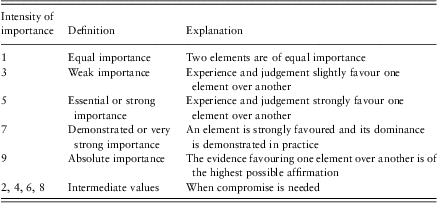
The next step is to survey a group of experts (e.g. academics, practitioners, policy makers) to attain their preferences for each of the criteria in the hierarchy. In short, the decision-maker judges the importance of each criterion in pair-wise comparisons (expressed by posing the questions “which of the indicators is more important?” and secondly, “by how much?”), which is expressed on a semantic scale of one (equality) to nine (i.e. an indicator may be indicated as nine times more important than the one to which it is being compared) (Table 1).
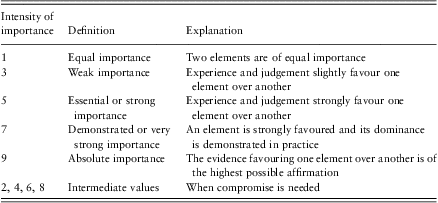
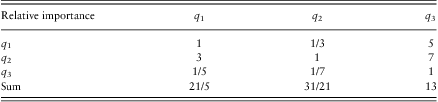
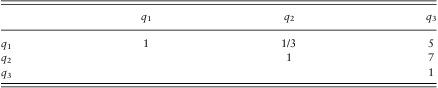
This scale is employed to value judgements relating to all possible pairwise comparisons in a summary matrix Q of dimension n × n (Table 2).
Example of pairwise comparisons of objectives (q 1, q 2, q 3)
Source: Saaty (Reference Saaty1980).
Depending on the complexity of the decision, and the number of levels present in the hierarchy, a number of such pairwise comparison matrices are developed. To illustrate this we use one matrix as an example. Table 3 provides a summary of judgements derived from Table 1 based on the objectives being compared. We use the reciprocal values of the upper diagonal to complete the matrix.
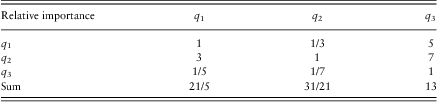
With a complete matrix (Table 3), we can then compute a normalised vector (Q*) of priorities (or relative importance/s). To compute a normalised vector we begin by dividing the elements of each column of the matrix by the sum of that column.
Next, we add the elements in the rows. Finally, we divide this sum by the number of elements in the row (in this case 3) to produce a column vector of priorities (0.2828, 0.6434, 0.0738). The sum of these elements is unity. The elements represented in Q* represent the respondent's relative weights or priorities for the objectives being compared. For example, Table 4 demonstrates that the respondent prefers objective q 2 2.27 (0.6434/0.2828) times more than q 1, and also prefers q 2 8.72 (0.6434/0.0738) times more than q 3.
Vector of priorities Q*
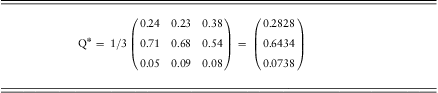
We then need to check the consistency of our respondent's answers. This is often referred to as the measurement of intransitivity (Manning et al. Reference Manning, Homel and Smith2011). A transitive ordering of preferences requires that if X is preferred to Y, and Y is preferred to Z, then X is preferred to Z. This logic of transitivity is taken as an axiom of rationality with regards to preferences of individuals. A violation of transitivity implies an ambiguous ordering of alternatives or an intransitive ordering of preferences (Isard and Smith Reference Isard and Smith1982; Manning et al. Reference Manning, Homel and Smith2011).
Measuring the consistency of our respondent's answers requires first computing λ max. λ max is calculated from the sum of products between each element of the eigenvector (Table 4) and the sum of the columns of the reciprocal matrix (Table 3). Using our earlier example, λ max = 21/5(0.2828) + 31/21(0.6434) + 13(0.0738) = 3.0967. Saaty (Reference Saaty1986) shows that a consistent reciprocal matrix is derived when the principal eigenvalue λ max is equal to the order of the largest comparison matrix (i.e. λ max = n).
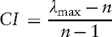
Next, we need to calculate a consistency index (CI). CI is a measure of the consistency of the pairwise comparisons, where
 $$CI\, = \,\frac{{{{\lambda }_{{\rm{max}}}}\,{\rm{ - }}\,n}}{{n\,{\rm{ - }}\,{\rm{1}}}}$$
Using the above example,  $$)(--><$>CI\, = \,\frac{{3.0967\,{\rm{ - }}\,3}}{2}\, = \,0.0484<$><!--$$
.
Calculating a consistency ratio (CR), which assists us in determining the consistency of our respondent's answers, requires dividing CI by a random consistency index (RI). Saaty (Reference Saaty1980) defines a random index (RI) as “…the consistency index of a randomly generated reciprocal matrix from the scale 1 to 9, with reciprocals forced” (p. 21). Thus:
 $$CR\, = \,\frac{{CI}}{{RI}}$$
If the value of the CR is smaller or equal to 10 per cent then the level of inconsistency displayed by the respondent's answers is deemed acceptable. Levels greater than 10 per cent indicate an intransitive ordering of preferences. Therefore, we need to go back to respondents and ask them to revise their pairwise comparisons to reduce this inconsistent ordering of preferences. Applying this to the above example,
 $$CR\, = \,\frac{{CI}}{{RI}}\, = \,\frac{{0.0484}}{{0.58}}\, = \,8.3\% \, \lt \,10\% $$
Given that CR is less than 10 per cent, based on a 3 × 3 matrix, we can conclude that our respondent's answers are within an acceptable range.
The final step is to test whether the ranking of alternatives is sensitive to key assumptions of the analysis (Levin and McEwan Reference Levin and McEwan2001). To conduct a sensitivity analysis one must first identify a key or group of key parameters. Generally, the key parameter is the importance weight that is assigned to each attribute. Consequently, it is important to gauge whether the ranking of alternatives change when alternative sets of weights are employed (Torrance Reference Torrance1986). A full description of conducting a sensitivity analysis is available from Levin and McEwan (Reference Levin and McEwan2001).
The above example represents the priorities of the elements on one level of a hierarchy with respect to one element of the next level. However, if there are more than two levels, the various priority vectors can be combined into priority matrices. This process would yield a final priority vector at the bottom of the matrix. A full example of such a model is provided in Manning (Reference Manning2008) and Manning et al. (Reference Manning, Homel and Smith2011).
Our AHP model
The AHP model used in this study determines, among the alternatives available, the policy that will best assist in reducing the methamphetamine problem. This problem is represented hierarchically in Figure 2.
Methamphetamine AHP model.
Level 1 of the hierarchy (see Figure 2) represents the potential factors or characteristics (as employed in this study) that contribute to the methamphetamine problem. The characteristics evaluated in this study were selected after consultation with experts from government (e.g. police), non-government organisations (e.g. drug outreach centres) and academics (e.g. researching and publishing in the area of health and criminology). They included:
(1) Social characteristics – the risk of an individual becoming involved in illicit drug abuse has been identified to increase upon exposure to certain genetic, biological, emotional, cognitive and social factors (Loxley et al. Reference Loxley, Toumbourou and Stockwell2004). Those factors that have been associated with a particularly high level of risk include experiences of sexual abuse, a history of family violence and neglect, incompletion of schooling, unemployment, relative poverty, lack of involvement in positive social networks, and exposure to parental drug abuse (Loxley et al. Reference Loxley, Toumbourou and Stockwell2004).
(2) Environmental characteristics – in Australia, there exists a number of different drug markets and sub-populations of methamphetamine users (McKetin et al. Reference McKetin, McLaren and Kelly2005a). Although there are numerous ways in which these sub-populations can be categorised, the analysis of usage patterns yields two general consumption environments. The first is the social consumption of methamphetamines (along with ecstasy) as a “party drug”. In this context, methamphetamines are taken socially with friends before going out to bars/nightclubs (McKetin et al. Reference McKetin, McLaren and Kelly2005a). In contrast to this group there are those who engage in frequent methamphetamine use, often regarded as dependant. These individuals will often take the drug within their own home to achieve a feeling of euphoria before engaging in regular daily activities (e.g. household chores, going to work, relaxing) (McKetin et al. Reference McKetin, McLaren and Kelly2005a).
(3) Market characteristics – there is evidence that users are responsive to the availability and price of illicit drugs, and can switch or substitute drugs if necessary (Saffer and Chaloupka Reference Saffer and Chaloupka1999; Weatherburn et al. Reference Weatherburn, Jones, Freeman and Makkai2003; Dave Reference Dave2006; Chalmers et al. Reference Chalmers, Bradford and Jones2010). For example, Australia's “heroin drought” in the 1990s coincided with a sharp increase in methamphetamine use. The possibility of methamphetamine users’ seeking out alternate drugs if other opportunities are blocked within the current Australian context is seen through recent evidence presented by McKetin et al. (Reference McKetin, McLaren and Kelly2005a). The authors found that users of methamphetamine also had very high levels of polydrug use with at least one in five survey respondents also identified as a dependent heroin user.
(4) Consumption characteristics – the extent to which users can become dependent on methamphetamines is related to the method of consumption; with evidence that injecting and snorting of the drug are more problematic, compared with oral ingestion (Ross Reference Ross2007). Different types of methamphetamines can also be more problematic than others, with evidence that “ice” or crystalline methamphetamine is particularly problematic (McKetin et al. Reference McKetin, McLaren and Kelly2005a). This association between a user's consumption habits and dependency is well established (McKetin et al. Reference McKetin, McLaren and Kelly2005a, Reference McKetin, McLaren, Kelly, Hall and Hickman2005b). Evidence shows that those individuals who reported injection as their favoured route of administration were far more likely to be dependent on the drug than those who reported swallowing or snorting of the drug. Further, people who took methamphetamine in the form of ice were twice more likely to be a dependant user than those who consumed the drug in other forms (McKetin et al. Reference McKetin, McLaren and Kelly2005a).
Level 2 of the hierarchy (see Figure 2) represent four possible methods of addressing the methamphetamine problem:
(1) Enforcement – law enforcement interventions are aimed at the detection, prosecution or prevention of illegal activities. In the context of the diversion of legal pseudoephedrine into illicit methamphetamine, this includes reactive policing strategies such as crackdowns, laboratory detections and frontline policing, along with the monitoring of other potential points of supply in the wholesale and distribution chain, and interdiction of imports.
(2) Harm reduction – harm reduction interventions are aimed at reducing the physical, psychological, social and economic harms associated with illicit drug use. They are often environmental strategies, for example, aimed at reducing unsafe user places and practices such as injection and snorting that have higher risks.
(3) Treatment – treatment interventions are aimed at individuals and populations identified as problematic, and focus on rehabilitative strategies along with the treatment of any physical and psychological harms caused by their drug use.
(4) Prevention – prevention interventions are aimed at inhibiting the take-up of drug use in the first place. Most common strategies include education and marketing campaigns.
Level 3 provides five alternative policies that may reduce the methamphetamine problem (see Figure 2). These include:
(1) Project STOP – Project Stop is a real-time web-based program for recording details from retail pharmacies of requests for legal pseudoephedrine products (used illegally for diversion into methamphetamine). It acts as a decision-making aid for pharmacists in fulfilling their legal obligation to ensure such products are sold only for a genuine therapeutic purpose. In Queensland, it also serves to record identifying details of all sales and non-sales. The database is available to all other pharmacy members to aid their decision making, but also to police who use it as a source of intelligence for crime detection and prevention purposes.
(2) Outright ban – an outright ban on pseudoephedrine products would prohibit their production, distribution or sale for both licit and illicit purposes. Substitutes such as phenylephrine would be required for therapeutic use, although for some conditions their therapeutic value is less.
(3) Prescription only – making pseudoephedrine products available only on the prescription of a medical practitioner would remove all discretion from pharmacists. Instead, doctors would assess the therapeutic need for such products and patients requiring pseudoephedrine would need to visit a doctor first.
(4) Increased reactive policing – police strategies to detect and deter the diversion of pseudoephedrine products into illicit methamphetamines include crackdowns on users and suppliers, clandestine laboratory detections, and more frontline policing such as random and targeted patrols, particularly in known hotspots such as clubs and bars. An increase in such strategies would be aimed at detecting pseudoephedrine after the pseudo-runners have acquired it from community pharmacies.
(5) Do nothing model – this model would involve having unrestricted access to pseudoephedrine within community pharmacies. An example of this type of scenario is the decriminalisation of cannabis within select parts of the United States, Portugal and other jurisdictions.
Respondents for this pilot AHP survey were selected on the basis of: (a) their ability to make decisions regarding methamphetamine policy; and/or (b) their demonstrated expertise and experience in evaluation of the efficacy of methods for reducing the methamphetamine problem in Australia. The selected participants came from three stakeholder groups: government officers (e.g. Police, Queensland Government and New South Wales Government officials); non-government organisations (e.g. drug treatment facilities and drug outreach centres); and academics expert in drug policy research and development. None of the respondents selected were involved in the development of Project Stop. The number of respondents selected was proportional to the size of the different stakeholder groups – with larger groups having more respondents. Recruitment of respondents was in accordance with an approved human research ethics protocol and an expert reference group guided their selection. None of the respondents were involved in the original conception of the Project STOP intervention, and none have been involved either in its ongoing implementation. This was a deliberate choice by the authors in order to reduce the problem of selection bias and/or accusations that the results represented a self-fulfilling outcome.
Results
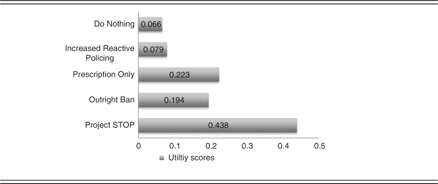
Results demonstrate that the experts surveyed consider Project STOP the highest priority (i.e. preference) among the policy alternatives with respect to reducing the methamphetamine problem with a priority rating of 0.438. Other policy options, in order of perceived priority (or preference) for the goal of reducing the methamphetamine problem are prescription only (0.223), an outright ban on pseudoephedrine-based products sold in pharmacies (0.194), increasing reactive policing (0.079) and a do nothing model (0.066) (see Table 5).
Combined results of AHP survey for policy option and factors that contribute to the methamphetamine problem
There were no significant differences in rankings by respondents associated with the various stakeholder groups. This was confirmed by conducting an analysis of variance analysis (ANOVA) to determine if there was a significant difference between the mean rankings of the three different groups across the five different policy options. The ANOVA assumptions of normality and homogeneity were not violated for any of these options and the F values ranged from 0.354 (with a p = 0.708) to 0.996 (with a p value of 0.393).
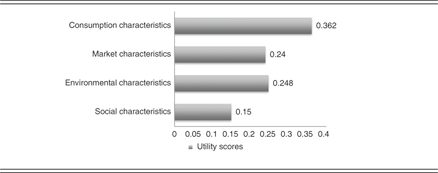
Experts considered consumption characteristics to be the most important characteristic with respect to reducing the methamphetamine problem (0.362), followed in order of priority (or preference) by environmental characteristics (0.248), market characteristics (0.240) and social characteristics (0.15) (Table 6).
AHP results highlighting the characteristics that contribute to the methamphetamine problem
Figure 3 combines the results of the priority rankings. The vector of priorities derived from factors or characteristics that potentially contribute to the methamphetamine problem (social, environmental, market, consumption characteristics) are provided on the X-axis (schematically represented by vertical bars). The overall outcome percentage is provided on the left-hand Y-axis, which ranges from 0.00 to 0.90. Policy alternatives (Project STOP, prescription only, outright ban, increased reactive policing and do nothing) are provided on the right-hand Y-axis, together with the alternative priority percentage, which ranges from 0.00 to 0.50. Overall rankings of programme alternatives can be read from the right-hand Y-axis. The five lines represent the overall contribution made by the outcomes, in terms of their percentage of priority, to each policy alternative.
Combined results of priority rankings.
Focusing first on the left-hand Y-axis, Figure 3 demonstrates that the policy alternative Project STOP rates the highest (43.8 per cent) with respect to overall priority percentage rankings or perceived utility when considering, among the alternatives, the best alternative for reducing the methamphetamine problem. This is followed in order of percentage priority by the alternatives prescription only (22.3 per cent), outright ban (19.4 per cent), increased reactive policing (7.9 per cent), and “do nothing” (6.6 per cent). Looking next at the vertical bars, the characteristic “consumption” is rated the highest with respect to its contribution to the methamphetamine problem (36.2 per cent of total priority), followed in order of priority by the characteristics “environmental” (24.8 per cent), “market” (24 per cent), and “social” (15 per cent). Furthermore, Figure 3 allows us to identify what characteristics contributed the most to the percentage priority rankings of the five policy alternatives – this is represented by the five lines showing the overall contribution made by characteristics, in terms of their percentage of priority, to each policy alternative. The lower four lines demonstrate a large gap between the characteristics “environmental”, “market” and “consumption”, whereby the uppermost line (representing Project STOP) lies significantly above the other lines by a large margin. This shows us that Project STOP received large priority percentage ratings with respect to environmental, market and consumption characteristics, but not social characteristics. In contrast, we can see little variation with respect to the policy alternatives “increased reactive policing” and “do nothing”, and also “prescription only” and “outright ban” when considering the priority ratings regarding all characteristics.
The level of inconsistency for the hierarchy is 0.09, which falls within the acceptable range. This result shows that choices made by respondents were overall relatively consistent. This value is important as it suggests that respondents collectively generated a transitive social ordering of preferences.
A sensitivity analysis was conducted to measure the responsiveness of the results to changes in the relative importance of characteristics contributing to the methamphetamine problem. Figure 4 shows results for “social characteristics”, whereby for there to be a change in overall priority rankings for the policy alternatives “Project STOP” and “prescription only”, respondents need to significantly change their ordering of preferences on this particular characteristic. The swapping of policy alternative preferences occurs at the intersection of the lines that represent “Project STOP” and “prescription only” in Figure 4. The sensitivity analyses for the other three characteristics demonstrate similar results where respondents would need to significantly alter their ratings of perceived priority with respect to their contribution to the methamphetamine problem.
Sensitivity analysis for the characteristic “social”.
The illustrative example of the AHP method employed in this paper does not permit an analysis of the statistical uncertainty associated with our results. While standard deviations associated with our overall priority rakings could be calculated a detailed analysis of such statistics is beyond the scope of the current paper which is already very lengthy. Such analysis will be explored in subsequent papers when the pilot survey is expanded in size and scope since this is possible using the Expert Choice software used for deriving the results reported in this paper.
Two main findings emerge from these results. The first is that experienced drug law enforcement policy makers and practitioners agree on viewing Project STOP as the most effective policy option of the five alternatives offered. This was strongly the case across the dimensions of consumption, market and environment, and less strongly when considering the social factors contributing to illicit methamphetamine use. We reiterate that we do not argue these results amount to proof of effectiveness; but that by drawing the views of experienced practitioners into the evaluative mix we provide a richer and more informed assessment of policy making in the area.
The second important finding is that increased policing is almost uniformly seen by experienced practitioners as only marginally better than doing nothing, when compared with the other policy options (Project STOP, prescription only, outright ban). This finding casts doubt on the reliance of Australian governments on law enforcement as the most prevalent and best-resourced approach to reducing drug problems. Our research suggests experienced practitioners and policy makers in the field see little value in increased law enforcement approaches, favouring instead a shift to more regulatory schemes. This finding has important implications for policy making.
As with all methods of policy evaluation there are weaknesses associated with the AHP approach which include the issue of rank reversal and hierarchy composition, the axiomatic foundations of the approach, the degree of ambiguity in the questions asked of the respondents, possible selection bias around choice of respondents, the scale used to measure the intensity of preferences. For a detailed outline of these weaknesses see Manning (Reference Manning2008), McCaffrey (Reference McCaffrey2005), Harker and Vargas (Reference Harker and Vargas1987), and Warren (Reference Warren2004).
Conclusion
Methamphetamine problems are a significant policy issue in Australia, as in many other countries. Governments overwhelmingly favour law enforcement responses to these problems, at the expense of diverting resources to other types of options, such as prevention, treatment or harm reduction. Increasingly, there is a need to establish that these resources have been well spent – that the law enforcement options pursued are both effective, in terms of achieving their objectives, but also represent the most efficient way of doing so. Good policy, we argue, should be based on the empirical evidence and also on the opinions of experts who contribute to policy making in this area. This raises complex issues, including the best way to capture and weigh all the relevant data from a variety of sources and people.
In this paper, we accomplished the goal of capturing and weighing all the relevant data from a variety of sources and experts using MCA; namely the AHP. In our study, we developed a hierarchy with the goal of identifying the best policy alternative (Project STOP, outright ban, prescription only, increased reactive policing and do nothing) that could potentially reduce the methamphetamine problem. The hierarchy was made up of another two levels that incorporated four characteristics (i.e. consumption, market, environmental and social) and four possible methods (i.e. enforcement, harm reduction, treatment and prevention) for addressing the methamphetamine problem. Our results, which were drawn from a survey of experts from Queensland, Australia, reveal that “Project STOP” is the most preferred option with respect to dealing with the methamphetamine problem followed in order of preference by “prescription only”, and an “outright ban” on pseudoephedrine-based products sold in pharmacies. The options “increased reactive policing strategies” and “do nothing” proved to be the least favoured options.
From these findings we concluded that there is strong support from experienced practitioners and policy makers for more regulatory approaches aimed at prevention of illicit methamphetamine problems, and surprisingly little support, across a range of dimensions, for increased policing as the strategy of choice. These findings are not reflected in the current drug policy and political debate in Australia. However, they are consistent with a notion that exploring various pathways to prevention of crime-related problems represent a more cost effective manner of dealing with these problems rather than waiting until these problems become entrenched as a way of life for a large segment of the population – since the latter would necessitate a large diversion of police manpower to address not just the drug offence itself but also the other ancillary offences commonly associated with supporting a drug habit and/or offences committed while under the influence of this habit (National Crime Prevention 1999).
Other authors have used multi-criteria approaches to the analysis of drug-related problems and have used expert opinion in this analysis. For example, Nutt et al. (Reference Nutt, King and Phillips2010) used key players, experts and specialists to help reveal the relative ranking of a range of drug harms in the United Kingdom. Our paper differs from previous studies in this area in that we focus explicitly on the use of MCA in policy evaluation or choice and conceive of the problem as one that can be disaggregated into a number of different hierarchical levels in order to assist in deriving a relative ranking of overall policy options.
While our methodology has the obvious limitation that the results derived from it are heavily dependent upon, and can be influenced significantly by, the choice of the group of experts selected to provide us with responses to our AHP questions, we adopt a range of strategies to minimise these drawbacks. In particular we cast our net for the selection of experts widely, we involve a steering group or expert panel to oversee our selection, we obtain our responses from selected experts in strict accordance with an approved human ethics protocol and we conduct a detailed sensitivity analysis of our results to ensure they are not unduly influenced by the responses of particular individual experts. Nevertheless as Project STOP is a national intervention, and the pilot study reported in this paper only includes respondents from one state within this nation, the authors plan a more extensive nationwide survey in the future to further address this potential source of criticism. We also plan to flesh out further some of the other policy options used as comparators for Project STOP within this survey.
Our current study focuses on the supply side of the illicit drug market, and in particular the relative effectiveness of various policy approaches aimed at reducing this supply (by reducing the availability of precursor inputs to their production). However, the analytical hierarchy method could usefully be employed to analyse the relative merits of alternative policy approaches that could be (or are currently being) used to reduce the demand for illicit drugs. This method also can be applied to evaluate proposed solutions beyond the field of illicit drug policy, thus further enhancing the usefulness of our results in working to provide clear guidance for policy makers.
Acknowledgements
The research for this paper was supported by a grant from Colonial Foundation Trust to the University of New South Wales to support the Drug Policy Modelling Program (part of the National Drug and Alcohol Research Centre).