INTRODUCTION
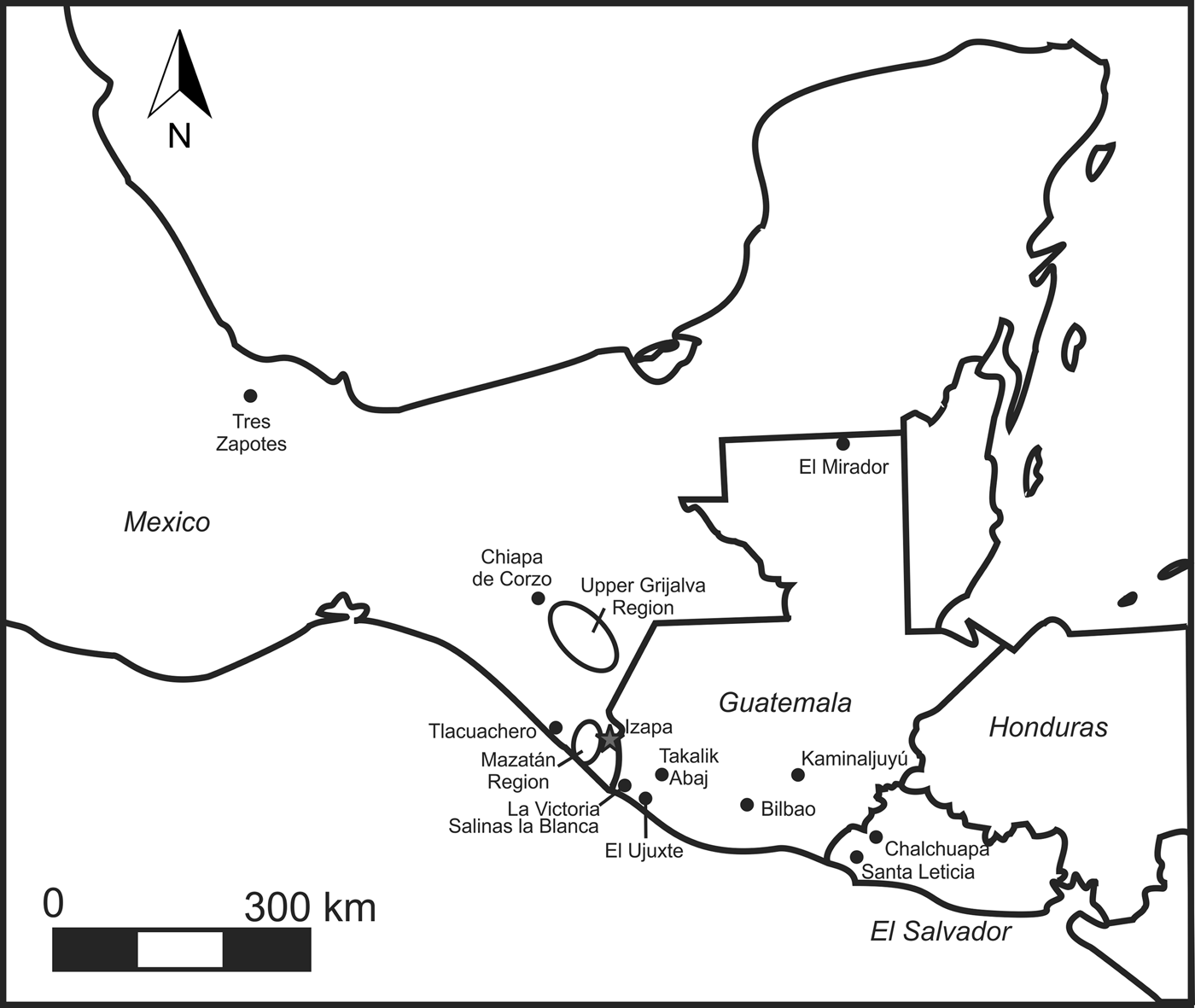
The Formative to Classic period transition was a time of great social change at Izapa (Figure 1), as it was for many other sites across Mesoamerica. In southern Mesoamerica, the period between 100 b.c. and a.d. 400 saw both the apogee and fall of several powerful Formative period cities. Researchers have documented the spread of low relief sculptural traditions with writing and depictions of rulers, the establishment of kingly burial practices, and the development of a widespread network for the procurement of foreign goods and materials during the first half of this period (Freidel and Schele Reference Freidel and Schele1988; Guernsey Reference Guernsey2006; Inomata and Henderson Reference Inomata and Henderson2016; Reese-Taylor and Walker Reference Reese-Taylor, Walker, Masson and Freidel2002). By the end of the period, many prominent early cities, such as El Mirador (Figure 1), had collapsed, and others, like Kaminaljuyu and Chiapa de Corzo, experienced major disruptions (Grube Reference Grube and Grube1995; Inomata et al. Reference Inomata, Ortiz, Arroyo and Robinson2014).
Map with the location of sites mentioned in the text. Map by the author.

Thus far, however, the pattern of rise and fall at Izapa has appeared to be distinct from its neighbors, with its initial decline around 100 b.c. (Lowe et al. Reference Lowe, Lee and Espinoza1982), when many southern Mesoamerican cities were prospering. At Izapa, the greatest changes at the site reportedly took place during the Hato phase, from 100 b.c.–a.d. 100 (applying the updated chronology by Lowe et al. Reference Lowe, Ekholm and Clark2013). Lowe and colleagues (Reference Lowe, Lee and Espinoza1982) see the Hato phase as a dramatic moment in the history of Izapa. They present several lines of evidence for major cultural change during the Hato phase, including the abandonment of central areas and possible conquest by an outside group (Lowe Reference Lowe, Lee and Espinoza1982:139). Their argument is founded on four main observations. First, production of Izapan-style monuments ceased around 100 b.c., after the Guillen phase. Second, Izapeños were no longer building up central areas of the site (Lowe et al. Reference Lowe, Lee and Espinoza1982:139). Third, the Hato phase saw the introduction of an urn burial tradition at Izapa that would continue for another 1,000 years. Finally, the ceramic vessels recovered from the Hato-phase urn burials at Mound 30d were foreign and almost exclusively of a southeastern origin (Lowe Reference Lowe1993; Lowe et al. Reference Lowe, Lee and Espinoza1982).
Lowe and colleagues (Reference Lowe, Lee and Espinoza1982:194) suggest that conquest by an outside group or a new cultural alignment may have been associated with the end of conservative customs, including the abandonment of the city's central zones and a cessation of monument production. An intrusive cultural group may have brought new customs to Izapa, including the tradition of burying the dead in urns, the construction of the new ceremonial center at Group F to the north, and the initiation of a new series of offerings at the central mound of this new plaza, Mound 125a (Figure 2). Lowe et al. (Reference Lowe, Lee and Espinoza1982:141, 315) did not speculate on the ethnicity of Hato-phase Izapeños, but suggest a break in ceramic ties with the Isthmus area and Western Chiapas around a.d. 1 and note increasing material correlates to the east. They observe, however, that “neither the victor nor the vanquished in this strife appears to have been of obvious Maya cultural affiliation, in terms of customary criteria” (Lowe et al. Reference Lowe, Lee and Espinoza1982:315).
Izapa site map illustrating key mounds and mound groups mentioned in the text. Map of Izapa developed by the New World Archaeological Foundation, from Lowe et al. (Reference Lowe, Lee and Espinoza1982:Inset).

This period of disruption was followed by an age of stability, with substantial construction activity in Group F during the subsequent Itstapa phase, a.d. 100–250 (Lowe et al. Reference Lowe, Lee and Espinoza1982:141). This period, though stable, marked the end of a major occupational shift at Izapa. Whereas Middle and Late Formative period residents of Izapa focused their mound building and monument erection efforts on central Izapa, Itstapa-phase Izapeños began concentrating their construction efforts in the northern sector, Group F.
The report of the New World Archaeological Foundation (NWAF) excavations at Izapa by Lowe and colleagues has been the leading account of the events that took place at the site since its publication in 1982. Recent work at the site, like the studies presented in this issue, have begun to update the picture. Geologists have since reported a major eruption of the Tacaná volcano, to which Izapa is oriented, between 30 b.c. and a.d. 80 (Macías et al. Reference Macías, Espíndola, García-Palomo, Scott, Hughes and Mora2000, Reference Macías, Luis Arce, Capra, Saucedo and Sánchez-Nuñez2018). New archaeological data from the Formative to Classic period transition has also emerged in the last five years from four separate projects. Additional excavation details of the NWAF excavations at Izapa have been published by Clark (Clark and Lee Reference Clark and Lee2013) and Lieske (Reference Lieske2013). Rosenswig's Izapa Regional Settlement Project (IRSP; Rosenswig et al. Reference Rosenswig, Gasco, Antonelli, Mendelsohn, Navarro Castillo and Vidal-Guzman2012, Reference Rosenswig, López-Torrijos, Antonelli and Mendelsohn2013; Rosenswig and Mendelsohn Reference Rosenswig and Mendelsohn2016) also produced a lidar (Light Detection and Ranging) map of the site and uncovered excavated contexts from this period (Rosenswig et al. Reference Rosenswig, Mendelsohn, Antonelli, Lieske and Núñez Cortés2014, Reference Rosenswig, Culleton, Kennet, Lieske, Mendelsohn and Núñez-Cortés2018). Most recently, the Izapa Household Archaeology Project (IHAP) recovered offerings and discarded ceramics associated with the Hato, Itstapa, and Jaritas phases (ca. 100 b.c.–a.d. 250) in the southern sector of the site. Taken together, these projects have greatly updated our understanding of the Formative to Classic period transition at Izapa.
With this recent work, a different understanding of this transitional period at Izapa is emerging. This recent research suggests that the site's Formative period core may not have been as abandoned as investigators previously believed. With an expanded complex of ceramics to evaluate, pottery complexes indicate signs of both continuity and change for the Late Formative to Terminal Formative transition. While an intrusion explanation still remains possible for Hato-phase Izapa, this data might also be interpreted as the involvement of Izapeños in a vast exchange network and increasing glorification of kings. By a.d. 250, shared ceramic styles with the southeast became less pronounced, but population levels at Izapa remained relatively steady. This evidence suggests that, while Izapa survived the decline of several neighboring cities, the relationship of the site's residents with peoples to the southeast was affected by the collapse of these sites, and their associated trade network, at the close of the Formative period.
The following pages present new data from the IHAP excavations at the southern periphery of Izapa (Figure 2), where unexpected deposits from the Formative to Classic period transition were recovered. These excavations were used to define better the non-offering ceramics for the Hato through Jaritas phases (100 b.c.–a.d. 400). A comparison of these materials with pottery from neighboring regions, application to survey collections (Rosenswig and Mendelsohn Reference Rosenswig and Mendelsohn2016; Rosenswig et al. Reference Rosenswig, Gasco, Antonelli, Mendelsohn, Navarro Castillo and Vidal-Guzman2012, Reference Rosenswig, López-Torrijos, Antonelli and Mendelsohn2013), and comparison to recently published excavation material from the NWAF excavations (Clark and Lee Reference Clark and Lee2013; Clark and Lowe Reference Clark, Lowe, Lowe, Ekholm and Clark2013; Lieske Reference Lieske2013), suggest that an update is necessary for our understanding of the Terminal Formative period at Izapa. I close with a discussion outlining the questions these recent findings raise about the people and events associated with this transition at Izapa and propose an alternative interpretation of the data.
NWAF Investigation at Izapa
The bulk of the archaeological research undertaken at Izapa was conducted in the 1960s by the NWAF. The NWAF team meticulously mapped the site and conducted extensive excavations between 1961 and 1965 (Lowe et al. Reference Lowe, Lee and Espinoza1982). This research culminated in their 1982 site report (Lowe et al. Reference Lowe, Lee and Espinoza1982). While comprehensive, the report was intended to be a preliminary summary of the excavation data.
Of particular importance from the NWAF project at Izapa was the establishment of a ceramic chronology for the site. The Formative-period ceramics were analyzed by Ekholm and Lowe. The ceramics of the Ocós through Duende phases (1900–950 b.c.) of the Early and early Middle Formative periods have been described by Ekholm (Reference Ekholm1969), and are based largely on the architectural sequence from the earliest mound at Izapa, Mound 30a. Lowe and colleagues (Reference Lowe, Ekholm and Clark2013) later published the ceramics of the Escalon through Guillen phases (950–100 b.c.).
The “Post-Formative” sequence included all periods of occupation after the depopulation of the city's monumental core, the Itstapa through Remanso phases (a.d. 100–1000). This sequence was documented by Lee (Reference Lee1969, Reference Lee1973) for the northern center, Group F. Construction at Group F began in the Hato phase and possibly earlier, as the NWAF excavations never reached sterile soils in this zone (Lowe et al. Reference Lowe, Lee and Espinoza1982:226). The findings from Group F included an unbroken ceramic sequence through the Terminal Classic Remanso phase (Lee Reference Lee1973), now updated to a.d. 900–1000 (Rosenswig and Mendelsohn Reference Rosenswig2016), indicating that occupation at Izapa continued for another 1,000 years after the decline of the city's monumental core. Lee's task was aided by the recovery of a remarkable series of offerings of complete vessels, deposited during the multiple stages of construction of the Mound 125a pyramid (Lee Reference Lee1973; Lowe et al. Reference Lowe, Lee and Espinoza1982:233, Figure 13.17). Offerings were not, however, deposited at Mound 125a until the final two construction episodes associated with the Itstapa phase (Lowe et al. Reference Lowe, Lee and Espinoza1982:Figure 13.17).
The missing piece of the Izapa chronology, the Hato phase, was defined by Lowe (Reference Lowe1993; Lowe et al. Reference Lowe, Lee and Espinoza1982:135–147), who published the details of the Terminal Formative urn burials and associated offerings recovered from Group B. Due to temporally diagnostic forms and decorative modes, these offerings could be used to define early and late facets of the Hato-phase ceramic complex (Lowe et al. Reference Lowe, Lee and Espinoza1982:135–147). Wavy-line Usulutan decoration, “swollen” supports, and stucco painting on vessels were among the ceramic features present in the Mound 30d urn burials that helped to link the Hato phase at Izapa to Terminal FormativeFootnote 1 ceramics at sites to the southeast and in the Maya lowlands (Lowe et al. Reference Lowe, Lee and Espinoza1982:135). Lowe conjectured that many of these vessels were imported from Guatemala and El Salvador to the southeast, and saw them as representing a new tradition at the site (Lowe Reference Lowe1993; Lowe et al. Reference Lowe, Lee and Espinoza1982). The Hato-phase urn burials began a 1,000-year pattern of offerings, which continued in the new center to the north, Group F.
While the ceramic descriptions and their projected social implications published by Lowe and colleagues (Reference Lowe, Lee and Espinoza1982, Reference Lowe, Ekholm and Clark2013) are comprehensive, one problematic portion of the chronology was the description of the Hato- and Itstapa-phase (100 b.c.–a.d. 250) ceramic complexes. The pottery for these complexes was defined using ritual contexts and intrusive offerings, like the caches and urn burials in the Mound 30 complex, material at the lowest levels of Mound 125a in Group F, offerings to monuments, and ritual refuse recovered from behind Mound 58 (Lieske Reference Lieske2013; Lowe Reference Lowe1993; Lowe et al. Reference Lowe, Lee and Espinoza1982:135–145). As Clark and Lowe (Reference Clark, Lowe, Lowe, Ekholm and Clark2013:79) observe, the offering vessels associated with the Hato-phase urn burials at Mound 30d were likely imported and “are not duplicated elsewhere in the sherd material at Izapa.”
Lowe and colleagues’ (Reference Lowe, Lee and Espinoza1982) proposal for major change in the Hato phase was, therefore, based primarily on the discovery of Hato-phase urn burials at Mound 30d and absence of similar materials at most other areas of the site. Other Hato-phase materials were found at the very lowest levels of Mound 125a in Group F, but could not be well documented due to the restricted size of the excavation units upon reaching this depth (Lowe et al. Reference Lowe, Lee and Espinoza1982:226). Lowe and colleagues’ proposal was, therefore, developed using a relatively limited ceramic understanding from a specialized, primarily burial, assemblage. Would the same dramatic changes in Terminal Formative ceramic assemblages be observed once non-funerary ceramics were identified?
Geological Research at Izapa
One significant update since the 1982 project is that geologists have now documented a volcanic event that occurred during the Hato phase. Macías and colleagues (Reference Macías, Espíndola, García-Palomo, Scott, Hughes and Mora2000, Reference Macías, Luis Arce, Capra, Saucedo and Sánchez-Nuñez2018) have recorded a Peléan style eruption of the Tacaná volcano dating between approximately 30 b.c. and a.d. 80. While lava flows did not reach Izapa, ash clouds and muddy floods may have impacted the site. Building upon the Hato-phase disruption highlighted by Lowe and colleagues (Reference Lowe, Lee and Espinoza1982), Macías and colleagues (Reference Macías, Espíndola, García-Palomo, Scott, Hughes and Mora2000) postulate that this eruption may have been associated with the halt in construction observed at Izapa during the Hato phase.
Recent Updates on the NWAF Excavations
The recent publication of unfinished manuscripts of Izapa excavation data by Clark and Lee (Reference Clark and Lee2013), Lowe (Lowe et al. Reference Lowe, Ekholm and Clark2013), and Navarrete (Reference Navarrete2013) have also updated our view on the events that transpired at Izapa during the Formative to Classic period transition. A thesis by Lieske (Reference Lieske2013) documented the construction activity, burials, and offerings at Group B, including additional details about the Terminal Formative urn burials recovered from Mound 30d. Through careful consideration of excavation notes and artifacts, these monographs drew attention to the occasionally conflicting data that appears for the Formative to Classic period transition. Below, I summarize the relevant updates from these projects.
These later monographs benefitted from Clark and Cheetham's (Reference Clark, Cheetham, Carrión and Cook2005) definition of Formative period ceramics in three major regions of Chiapas. For the coastal zone, collections from Izapa were instrumental in defining the Middle and Late Formative period ceramic complexes (Clark and Cheetham Reference Clark, Cheetham, Carrión and Cook2005). To better define the Terminal Formative Hato and Itstapa phases, Clark and Cheetham also used Clark's survey collections from the Mazatán region. Clark applied this updated information to ceramic collections still housed in the NWAF and, along with Lowe and Lee's excavation and ceramic analysis notes, revisited the occurrence of Terminal Formative and Early Classic ceramics in the NWAF excavations at Izapa (Clark and Lee Reference Clark and Lee2013).
Clark and Lee's (Reference Clark and Lee2013) recent publication of the lesser-known excavations at Izapa by the NWAF team suggest that more Hato-, Itstapa-, and even Jaritas-phase deposits were recovered from “Minor Excavations” in Lower Izapa (i.e., the area south of Group F) than were originally identified by Lowe and colleagues (Reference Lowe, Lee and Espinoza1982). In addition to the previously reported occupation at Mound 125a in Group F, Clark's study added Mound 61, Mound 5, and test pits south of Group F (Figure 2) to the known occupation for the Hato phase at the site (Clark and Lee Reference Clark and Lee2013; Clark and Lowe Reference Clark, Lowe, Lowe, Ekholm and Clark2013:79).
Perhaps the biggest update from Clark and Lee's project was the identification of Terminal Formative ceramics at Mound 61, a small mound in the heart of the Formative period core. The original descriptions of the excavations of this mound highlighted a cut-stone wall and plaster floor, construction techniques that were unique for the architecture at Izapa, dating to the Guillen phase (300–100 b.c.). Lowe and colleagues (Reference Lowe, Lee and Espinoza1982:254, Figure 14.10) also referenced later construction episodes at this mound.
Clark and Lee's (Reference Clark and Lee2013) reinvestigation of the Mound 61 construction sequence suggests that the final two renovations of Mound 61 represent Itstapa-phase building activity at Mound 61. Clark also observes that Terminal Formative sherds were found below Floor 3, suggesting the possibility that Structure 61–3, with its unique cut-stone architecture, was constructed during the Hato phase. He also remarks that the position of carbon date I-872 between Floors 3 and 4 may have been unclear, noting the limited vertical space between the two floors (Clark and Lee Reference Clark and Lee2013:106). An early Hato-phase date, he suggests, would help to explain the anomalous construction of Structure 61–3. Whether associated with the late Guillen or early Hato phases, Clark and Lee (Reference Clark and Lee2013:106) conclude that the fancy structure at Mound 61 was constructed in the first century b.c. This mound was continuously occupied for approximately four centuries, from the Guillen through the Itstapa phases (Clark and Lee Reference Clark and Lee2013:106, 108). Clark suggests that the lavish construction associated with Mound 61 may have represented a palace or a similarly prominent structure occupied by rulers or priests. The location of this structure in central Izapa would serve as a good point from which to deposit the urn burials in Mound 30d, even if the remainder of central Izapa was abandoned by this time (Clark and Lee Reference Clark and Lee2013:106–107).
Clark and Lee's (Reference Clark and Lee2013:5–11) publication of more NWAF excavation data also revealed Terminal Formative and Early Classic construction and occupation at Mound 5, north of the monumental core. Based on notes and sherds saved in the NWAF collections, Clark's reanalysis of the Mound 5 construction sequence suggests that a low platform was built over an Escalon-phase midden during the Itstapa phase (Clark and Lee Reference Clark and Lee2013:7–8). The building was further modified in a second Itstapa-phase construction episode, and once again during the subsequent Jaritas phase (Clark and Lee Reference Clark and Lee2013:7–8).
Test Pits 32, 34, and 35 were excavated in the intermediate zone between Group F to the north and the Formative period center and immediately south of Altar 61 (Clark and Lee Reference Clark and Lee2013:3–5). Clark suggested that thicker cultural deposits in Test Pit 34 and Test Pit 35 may have dated to the Terminal Formative period, potentially representing buried structures of the Hato and Itstapa phases. Clark and Lee also report Terminal Formative sherds recovered from mound fill in Test Pit 32 (Clark and Lee Reference Clark and Lee2013:3).
Clark and Lee's (Reference Clark and Lee2013) recent updates on NWAF excavation data prompted a search in the NWAF collections for more notes and sherds from the Mound 80 excavations originally highlighted in the Izapa report (Lowe et al. Reference Lowe, Lee and Espinoza1982:219–223). Additional information was provided in the April 1962 NWAF monthly report. There, Lowe writes that sherds associated with the Early Protoclassic (i.e., Hato phase) were recovered from the Mound 80 excavations (Lowe Reference Lowe1962:6). Sherds present in the NWAF collections, saved from the 1962 excavations in Mound 80, confirm the presence of Terminal Formative as well as Early Classic ceramics at the mound. Vessel supports were identifiable to Hato-, Itstapa-, Jaritas-, and Kato-phase vessels (Mendelsohn Reference Mendelsohn2017:Figure 3.8). Diagnostic rim sherds were also present for Hato- and Itstapa-phase ceramics. These finds suggest that at least one of the Mound 80 construction episodes may have been constructed during the Terminal Formative period.
Despite these updates, the ceramics of the Terminal Formative period remained perplexing. Clark and Lowe (Reference Clark, Lowe, Lowe, Ekholm and Clark2013:79) note that sherds like the vessels recovered from the Hato-phase urn burials were not encountered elsewhere at Izapa. Specifically, “not a single Usulutan sherd, and only three Kaminaljuyu fine-incised sherds (from Group F) appeared in the huge Izapa sherd inventory” (Clark and Lowe Reference Clark, Lowe, Lowe, Ekholm and Clark2013:79). Clark and Lowe also suggest that no signs of ceramic evolution were evident between the ceramic complexes of the Guillen phase and the Itstapa phase, which appeared to replace it in Group A (Clark and Lowe Reference Clark, Lowe, Lowe, Ekholm and Clark2013:79). They concluded that the “apparent hiatus at Central Izapa during Hato times needs to be investigated” (Clark and Lowe Reference Clark, Lowe, Lowe, Ekholm and Clark2013:79).
The Izapa Regional Settlement Project
As the NWAF studies were being compiled, Rosenswig undertook lidar mapping of Izapa in 2011 (Rosenswig et al. Reference Rosenswig, Gasco, Antonelli, Mendelsohn, Navarro Castillo and Vidal-Guzman2012, Reference Rosenswig, López-Torrijos, Antonelli and Mendelsohn2013; Rosenswig and Mendelsohn Reference Rosenswig and Mendelsohn2016). The IRSP involved surface collections from all the mounds at Izapa, including mounds previously mapped by the NWAF and new mounds discovered from the lidar map. This was the first time that all mounds were systematically collected at the site. The results doubled the areal extent of the Formative period occupation at Izapa, and tripled the documentation of Classic period occupation at the site (Rosenswig et al. Reference Rosenswig, López-Torrijos, Antonelli and Mendelsohn2013).
The results for the Formative to Classic period transition, however, remained hindered by the same incomplete understanding of the ceramic complexes encountered by Clark, Lowe, and Lee. In the original assessment, ceramics associated with the Hato through Metapa phases (100 b.c.–a.d. 700) were included within one large “Early Classic” category (Rosenswig et al. Reference Rosenswig, Gasco, Antonelli, Mendelsohn, Navarro Castillo and Vidal-Guzman2012). Mendelsohn's 2014 IHAP excavations subsequently helped to better define the ceramic complexes of the Hato, Itstapa, and Jaritas phases at Izapa. In 2015, this information was used to reanalyze the ceramics from surface collections collected during the IRSP lidar survey (Rosenswig and Mendelsohn Reference Rosenswig and Mendelsohn2016). The reanalysis focused greater attention on the final millennium of Izapa's occupation, from 100 b.c.–a.d. 1000.
The occupational pattern of the Hato and Itstapa phases of the Terminal Formative period was of particular interest for the reanalysis. It provided an opportunity to reinvestigate Lowe and Lee's (Lowe et al. Reference Lowe, Lee and Espinoza1982:139) assessment that the Mound 30d burials represented “the deceased of a people no longer living at Izapa, or at least no longer building up its central areas” and that Izapeños moved instead to Group F at the northern end of the site, relegating the monumental core to limited shrine activity. Did this assertion hold up with survey results based on better definitions of the Hato- and Itstapa-phase ceramic complexes?
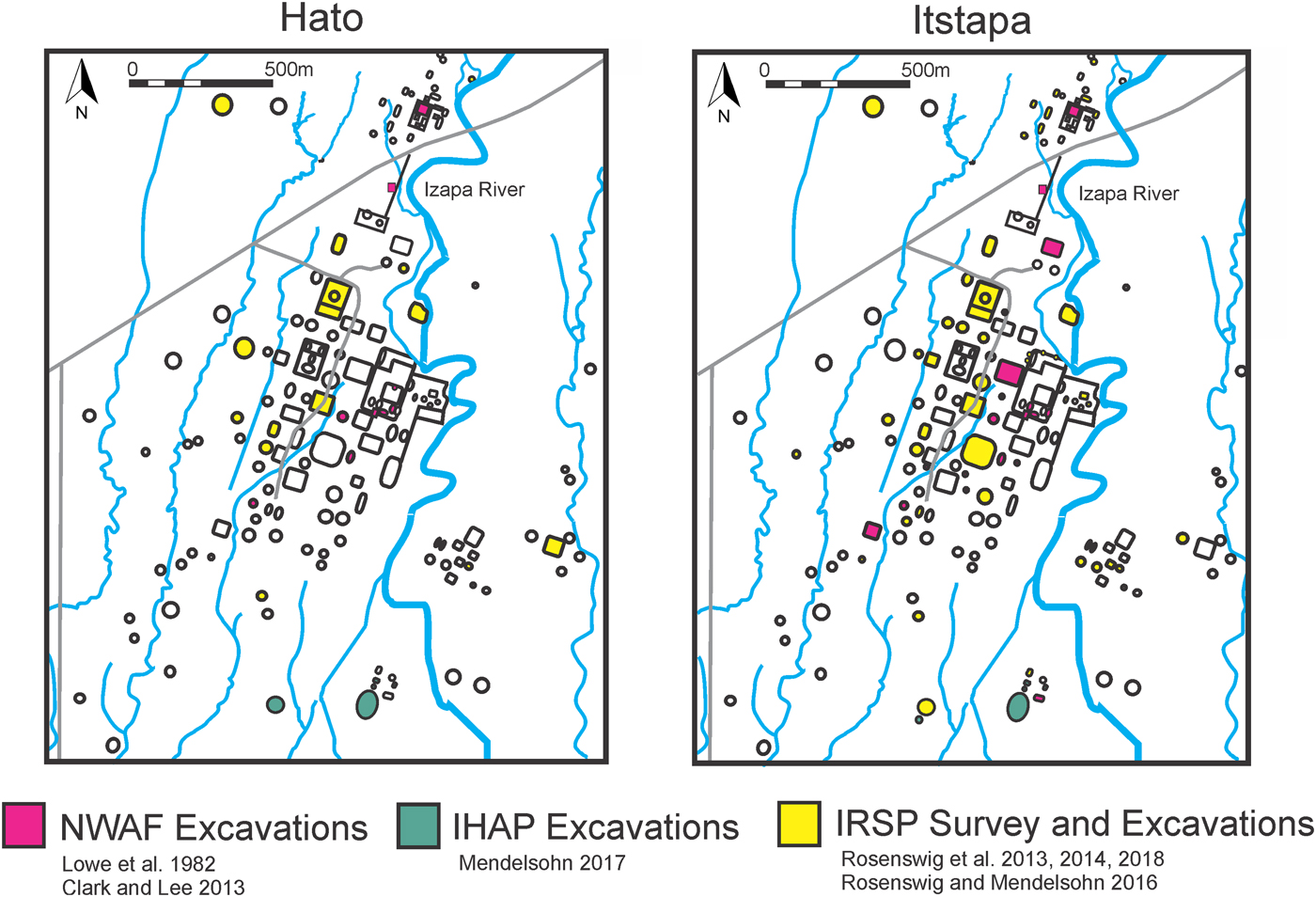
The pattern of Hato-phase ceramics collected during the IRSP survey at Izapa (Figure 3) suggests a shift in activity and/or construction to the western and northern sectors of the site (Rosenswig and Mendelsohn Reference Rosenswig and Mendelsohn2016). Hato-phase ceramics were recovered from several of the mounds at the western side of the Formative-period center, at Group F and its surroundings, and at mounds in the intermediate area between the two zones. Nevertheless, evidence for Hato-phase occupation was light in the Formative period core, and elsewhere at the site.
Distribution of Hato and Itstapa remains in central Izapa, coded by research project. Blue lines represent arroyos. Gray lines represent modern roads. Map by the author, developed from the Izapa Regional Settlement Project (IRSP) lidar (Rosenswig et al. Reference Rosenswig, Gasco, Antonelli, Mendelsohn, Navarro Castillo and Vidal-Guzman2012, Reference Rosenswig, López-Torrijos, Antonelli and Mendelsohn2013).
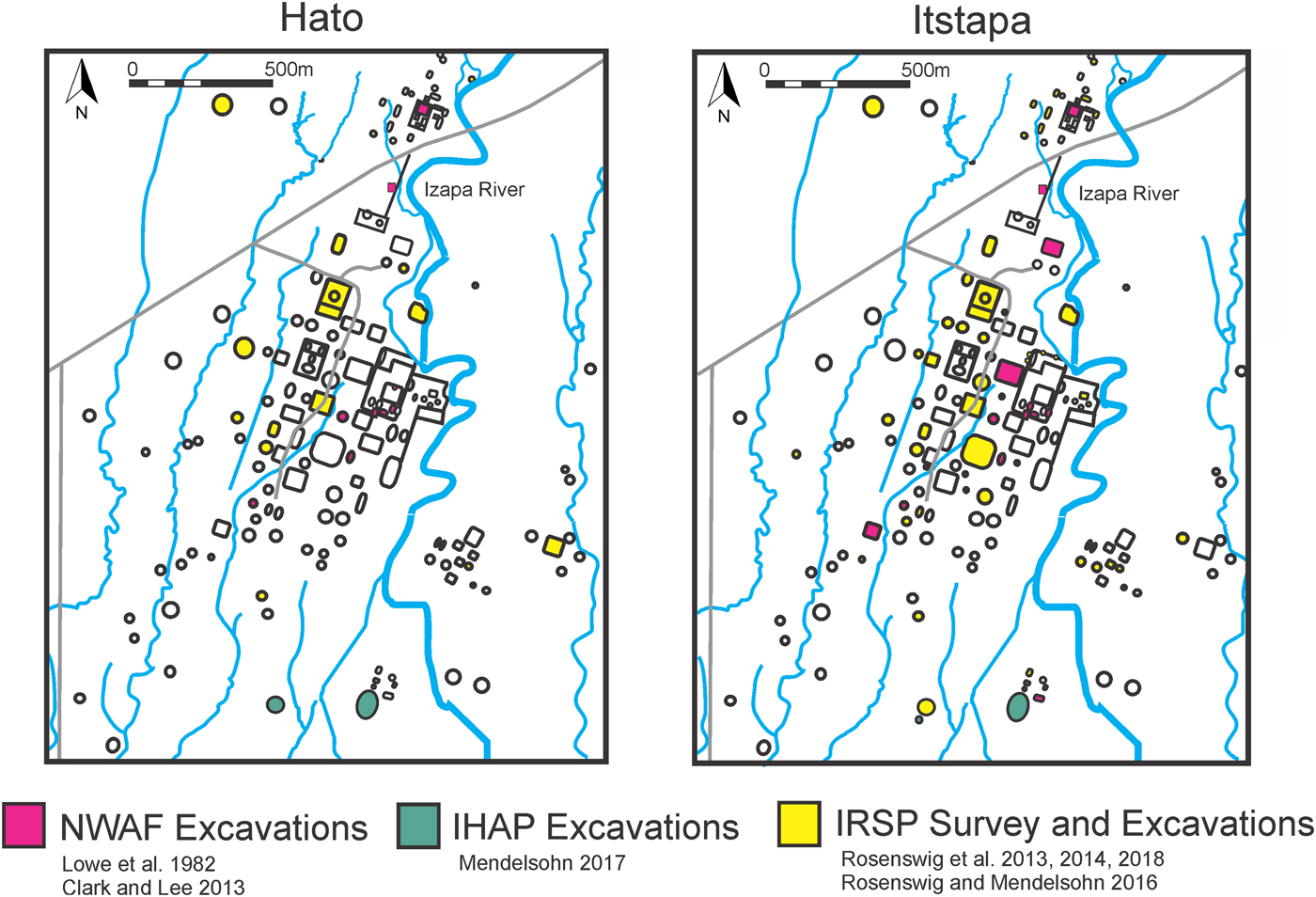
The Itstapa-phase patterns (Rosenswig and Mendelsohn Reference Rosenswig and Mendelsohn2016) were dramatically different, with Pale Orange coarse-incised ceramics (described below) identified at approximately one-third of the mounds in the Formative period core (Figure 3). Rather than viewing the Izapa center as abandoned in the Terminal Formative period, save for some shrine activity, survey data from IRSP suggests that Terminal Formative period Izapeños may still have been constructing, or expanding, mounds within the Formative period core (Rosenswig and Mendelsohn Reference Rosenswig and Mendelsohn2016). IRSP excavation data supported this finding (Rosenswig et al. Reference Rosenswig, Culleton, Kennet, Lieske, Mendelsohn and Núñez-Cortés2018). Occupation across Izapa continued into the Early Classic Jaritas phase, before it halted, seemingly abruptly, in the Kato phase (Rosenswig and Mendelsohn Reference Rosenswig and Mendelsohn2016).
RECENT DISCOVERIES FROM THE IZAPA HOUSEHOLD ARCHAEOLOGY PROJECT
The goal of the IHAP was to document the daily life of Middle and Late Formative-period Izapeños through their domestic refuse. Mounds selected for investigation were chosen due to their location on the periphery of the site, as well as their suspected occupation during both the Middle and Late Formative periods. The Middle and Late Formative dating for these mounds was inferred based on surface collections from the IRSP (Rosenswig et al. Reference Rosenswig, Gasco, Antonelli, Mendelsohn, Navarro Castillo and Vidal-Guzman2012, Reference Rosenswig, López-Torrijos, Antonelli and Mendelsohn2013) and by the presence of stone monuments in this southern sector (Lowe et al. Reference Lowe, Lee and Espinoza1982:Inset), including a carved stela (Gómez Rueda and Grazioso Sierra Reference Gómez Rueda, Sierra, Laporte and Escobedo1997).
The IHAP team excavated 25 units at seven mounds in this southern zone in 2014. Though the project targeted Middle and Late Formative period middens, most of the excavations revealed Terminal Formative and Classic period construction and habitation (Mendelsohn Reference Mendelsohn2017). Before the project, occupation of this time period was almost exclusively documented in the northern center of the site, Group F, approximately two kilometers away. Of particular significance were ceramic deposits of the Formative to Classic period transition.
The ceramic deposits recovered from the IHAP drew attention to gaps in knowledge in the Izapa ceramic sequence. Because the ceramic chronology for the Itstapa through Peistal phases was developed based on a sequence of stratified offerings in Mound 125a in Group F (Lee Reference Lee1969, Reference Lee1973), no non-offering ceramics had been documented for Izapa for these time periods. It quickly became apparent that the Hato phase, though seemingly well defined in the Izapa report with early and late facets, had been established solely on the basis of the elaborate urn burials and offerings at Mound 30d (Lieske Reference Lieske2013; Lowe Reference Lowe1993). The ceramics in the Hato-phase urn burials were so elaborate, and many of them likely imported, that it was difficult to document Hato-phase occupation in other areas of the site. Clark and Cheetham's (Reference Clark, Cheetham, Carrión and Cook2005) documentation of Hato- and Itstapa-phase ceramics from the Mazatán region was of considerable utility in bridging this gap. As their materials were collected on survey and were from a slightly different region, however, questions remained as to what the Hato- and Itstapa-phase materials would look like outside of the Izapa site center.
The ceramics recovered from the IHAP have helped document what non-offering ceramics look like for the Hato (100 b.c.–a.d. 100), Itstapa (a.d. 100–250), and Jaritas phases (a.d. 250–400) at Izapa. These results and the updated results of the IRSP survey (Rosenswig and Mendelsohn Reference Rosenswig and Mendelsohn2016) demonstrate how little we still know about the people who lived at Izapa during the Formative to Classic period transition. These ceramic results raise questions about the dramatic nature of the Hato-phase events at the site proposed by Lowe and colleagues (Reference Lowe, Lee and Espinoza1982).
Excavations at Mound 255
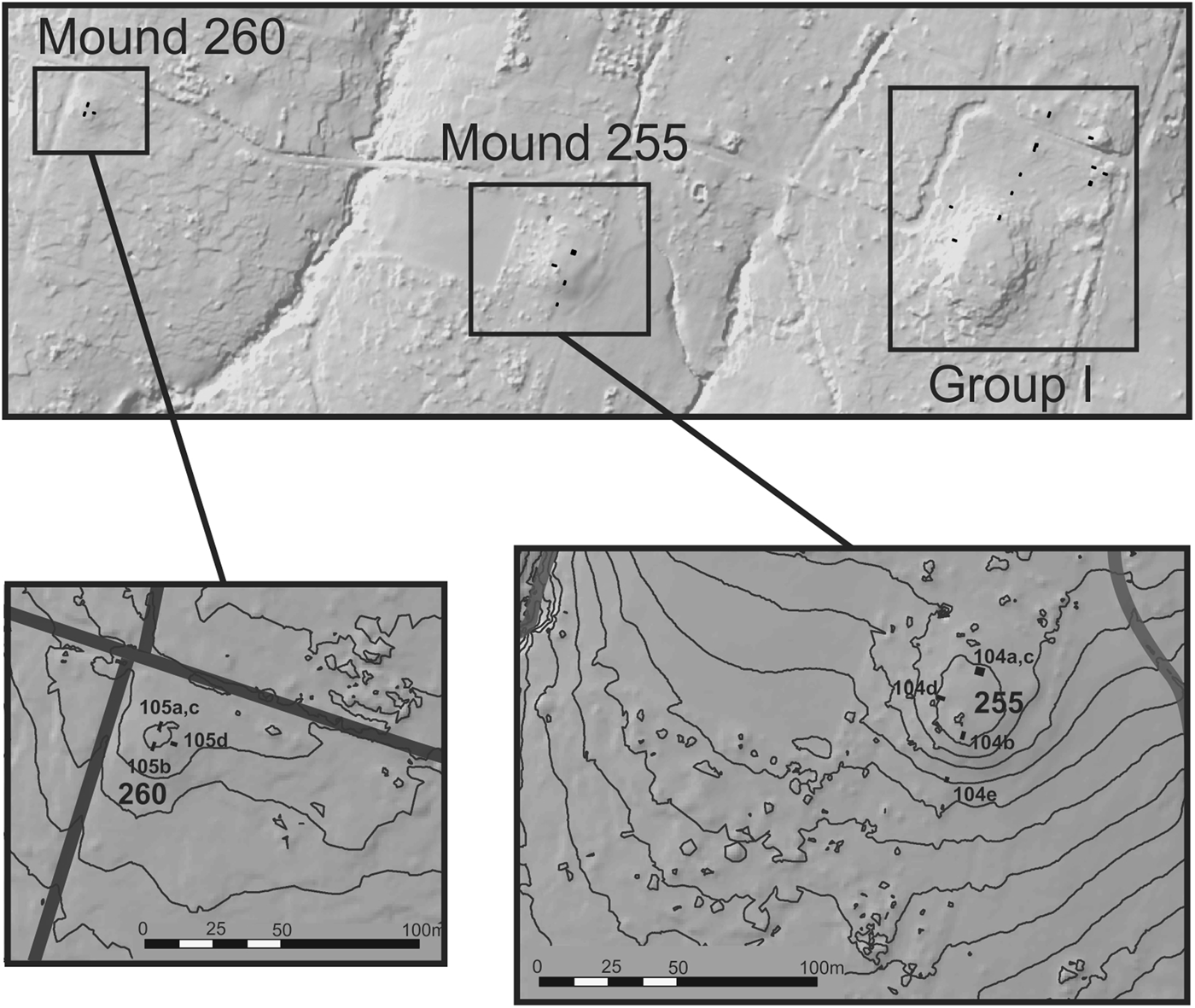
Mound 255 (Figure 4) was discovered in 2012 during the IRSP lidar mapping of the site (Rosenswig Reference Rosenswig, Gasco, Antonelli, Mendelsohn, Navarro Castillo and Vidal-Guzman2012, Reference Rosenswig, López-Torrijos, Antonelli and Mendelsohn2013). The IHAP excavations at this newly-discovered mound recovered Terminal Formative occupation and construction in southern Izapa. The discovery of Terminal Formative occupation this far from Group F was surprising, given the northward move of the Izapa population previously documented by Lowe et al. (Reference Lowe, Lee and Espinoza1982) for the Terminal Formative period. The construction of a two-meter-high mound in this zone was especially unexpected, as it indicated that people not only still inhabited this region, but were still constructing mounds at the southern end of the site.
Location of Izapa Household Archaeology Project (IHAP) excavation units. Lidar map courtesy of Rosenswig and the Izapa Regional Settlement Project (IRSP) (Rosenswig et al. Reference Rosenswig, Gasco, Antonelli, Mendelsohn, Navarro Castillo and Vidal-Guzman2012, Reference Rosenswig, López-Torrijos, Antonelli and Mendelsohn2013).

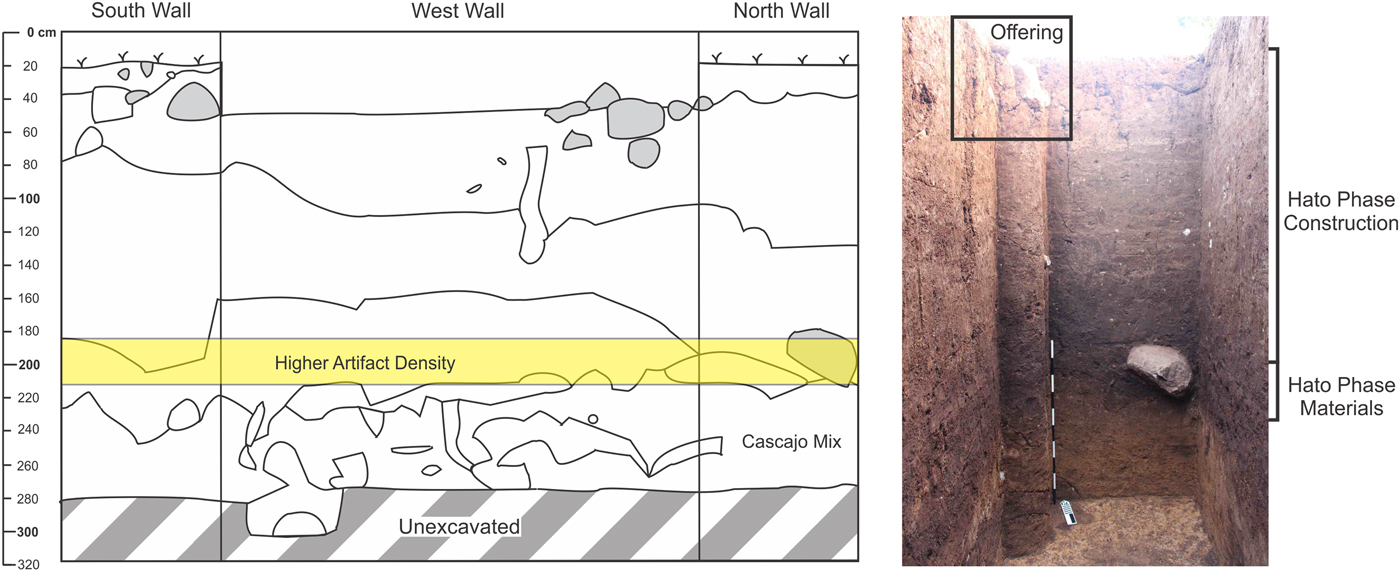
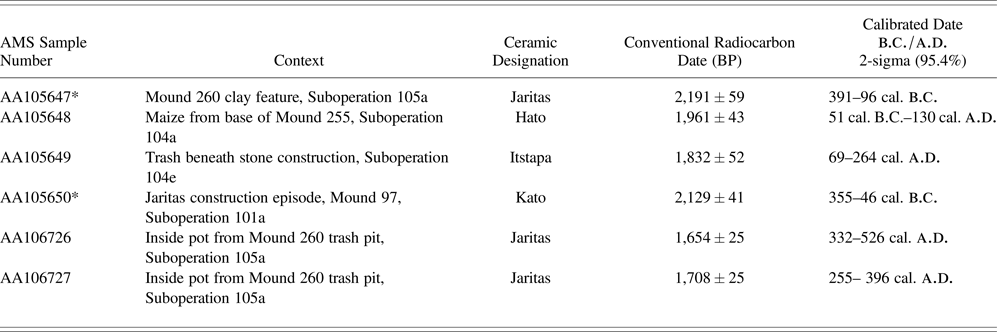
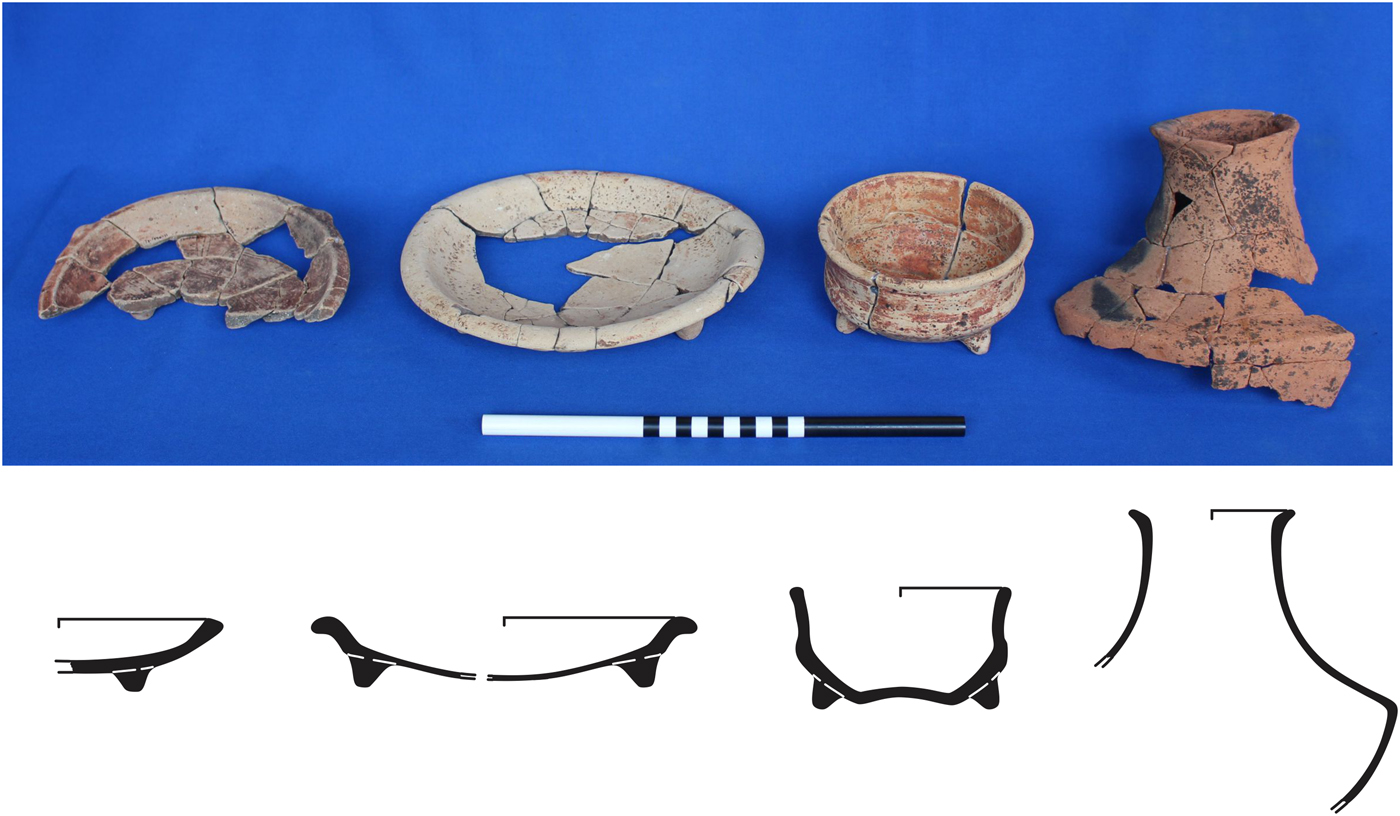
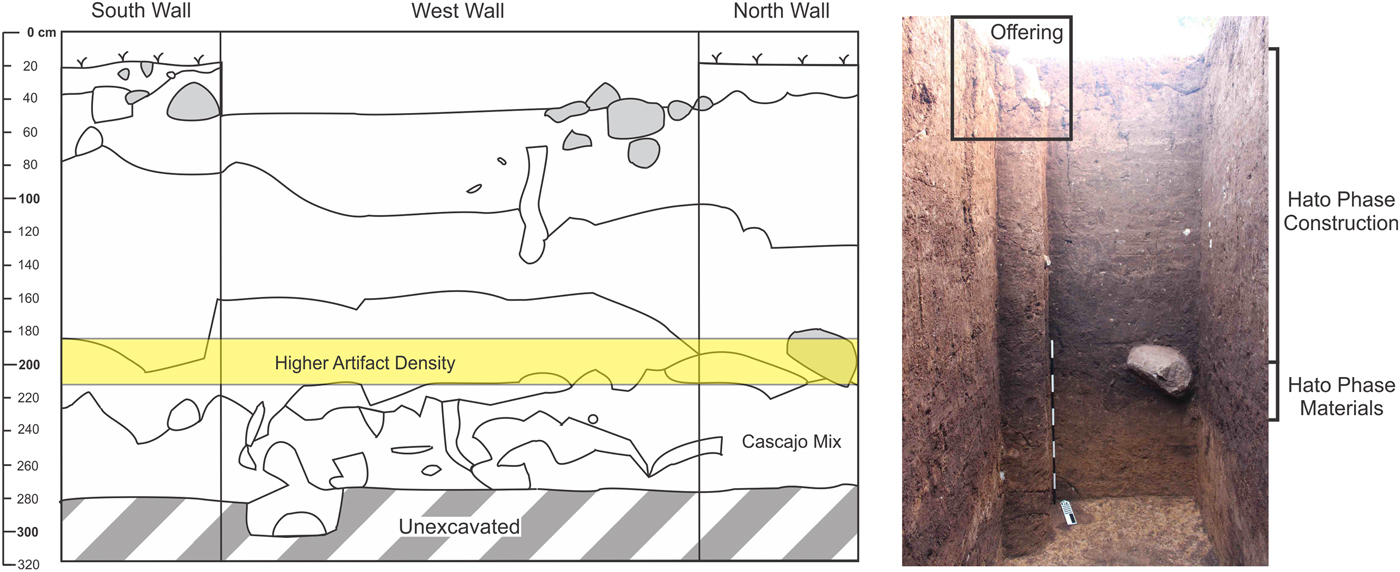
Multiple lines of evidence suggest that Mound 255 was constructed during the Hato phase. First, very-fine-paste sherds, attributed to the Hato phase, were found in low quantities throughout the construction fill of the mound. Larger fragments of Hato-phase ceramics were recovered from the base of the mound, associated with Levels 19–20 (Figure 5), which contained large Hato-phase sherds. A maize cob fragment recovered from a burned area within this layer (AA105648) yielded an AMS date with a 2-sigma range of 51 cal b.c.–130 cal a.d. (Table 1). Finally, an offering of Hato-phase ceramic vessels (Figure 6) was documented atop the mound. Taken together, this evidence suggests that Izapeños constructed the mound to its full height of 2 m during the Hato phase. In addition to documenting construction in this zone, the Mound 255 excavations (Suboperations 104a–104d) were helpful for differentiating Hato-phase ceramics from the earlier Guillen-phase ceramic complex and from later Itstapa-phase pottery.
Stratigraphy of Mound 255. Drawing and photograph by the author.
Hato-phase offering recovered from atop Mound 255. Reconstructed vessels are illustrated in Figure 8. Photographs by the author.
Accelerator Mass Spectrometry (AMS) dates recovered from the Izapa Household Archaeology Project (IHAP) excavations. Stars indicate dates that have been rejected.

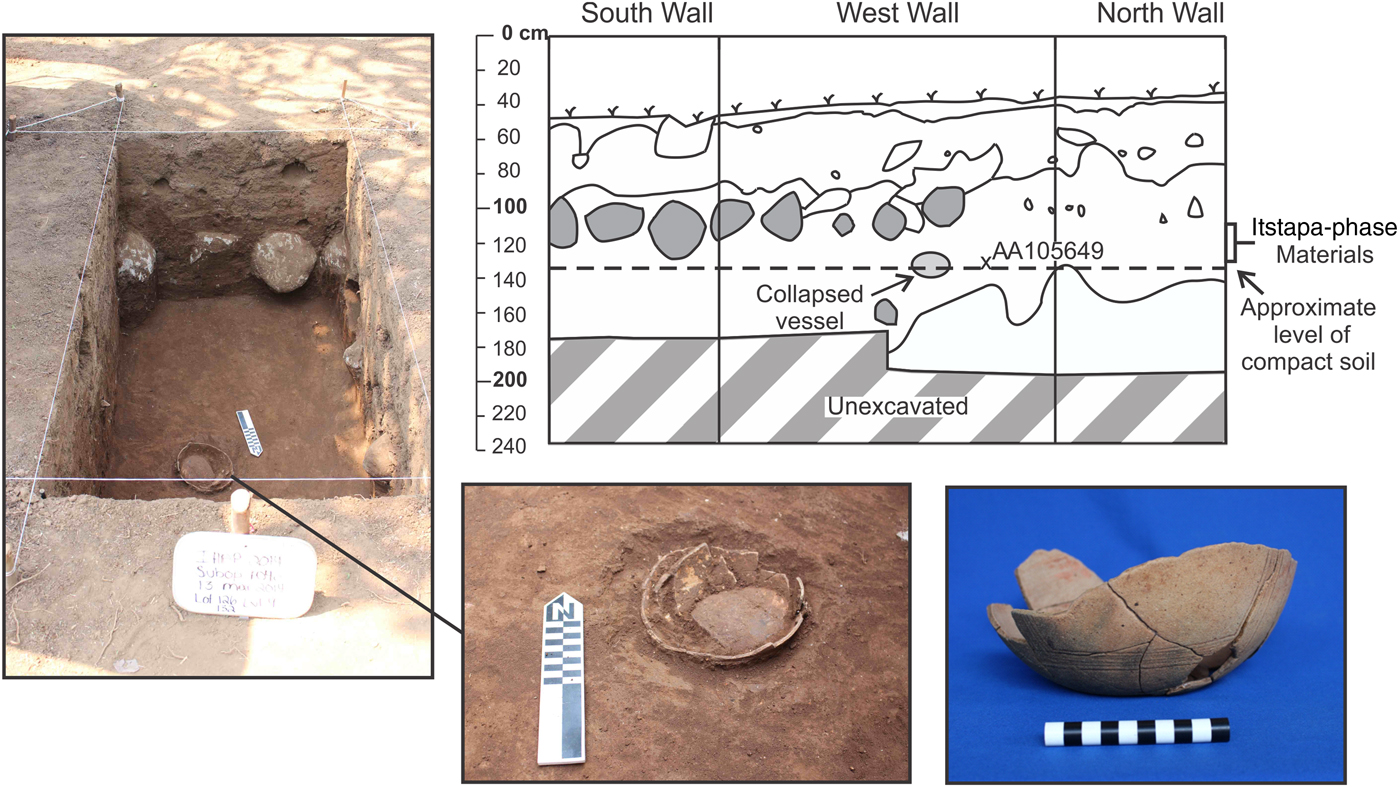
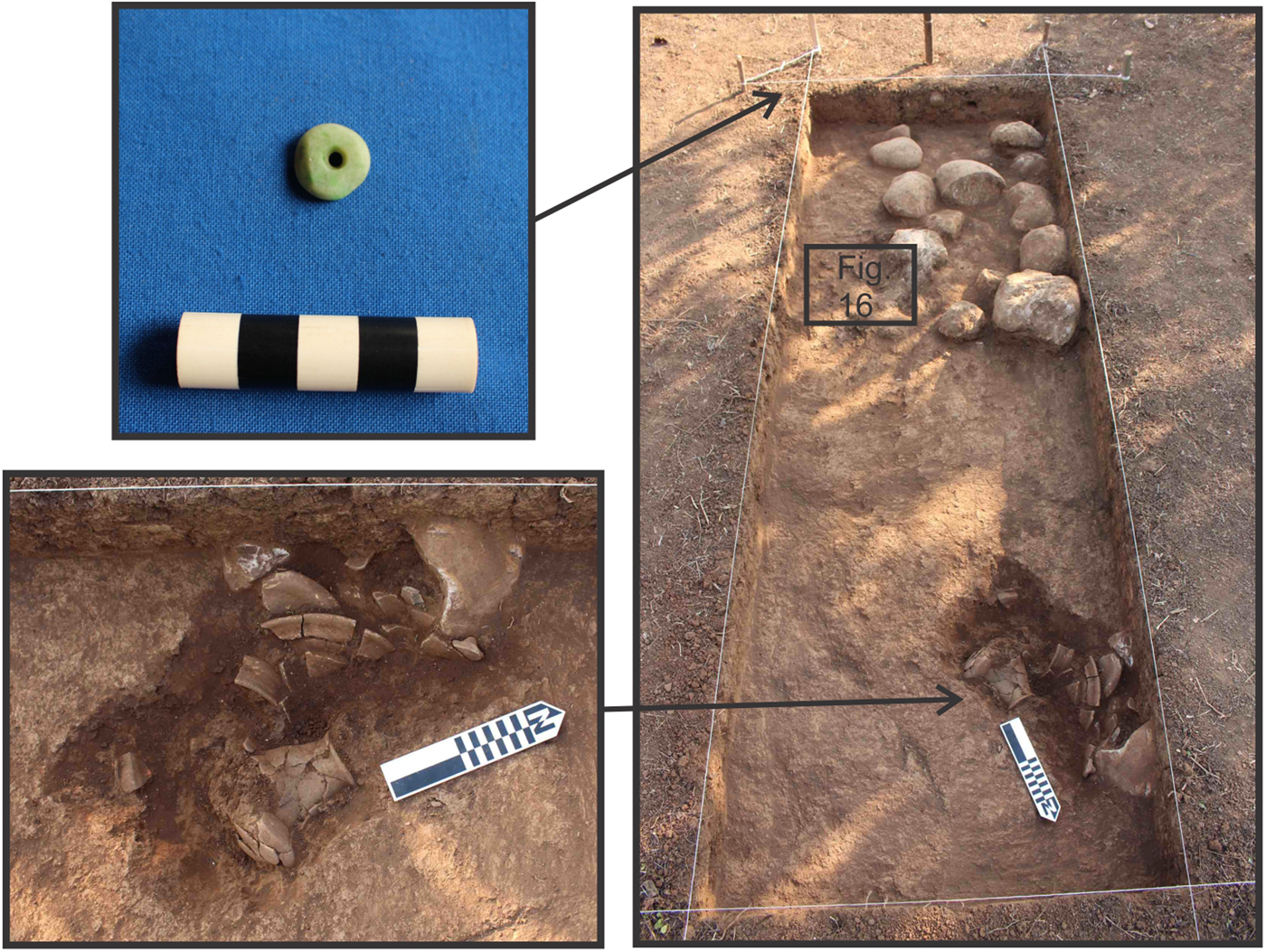
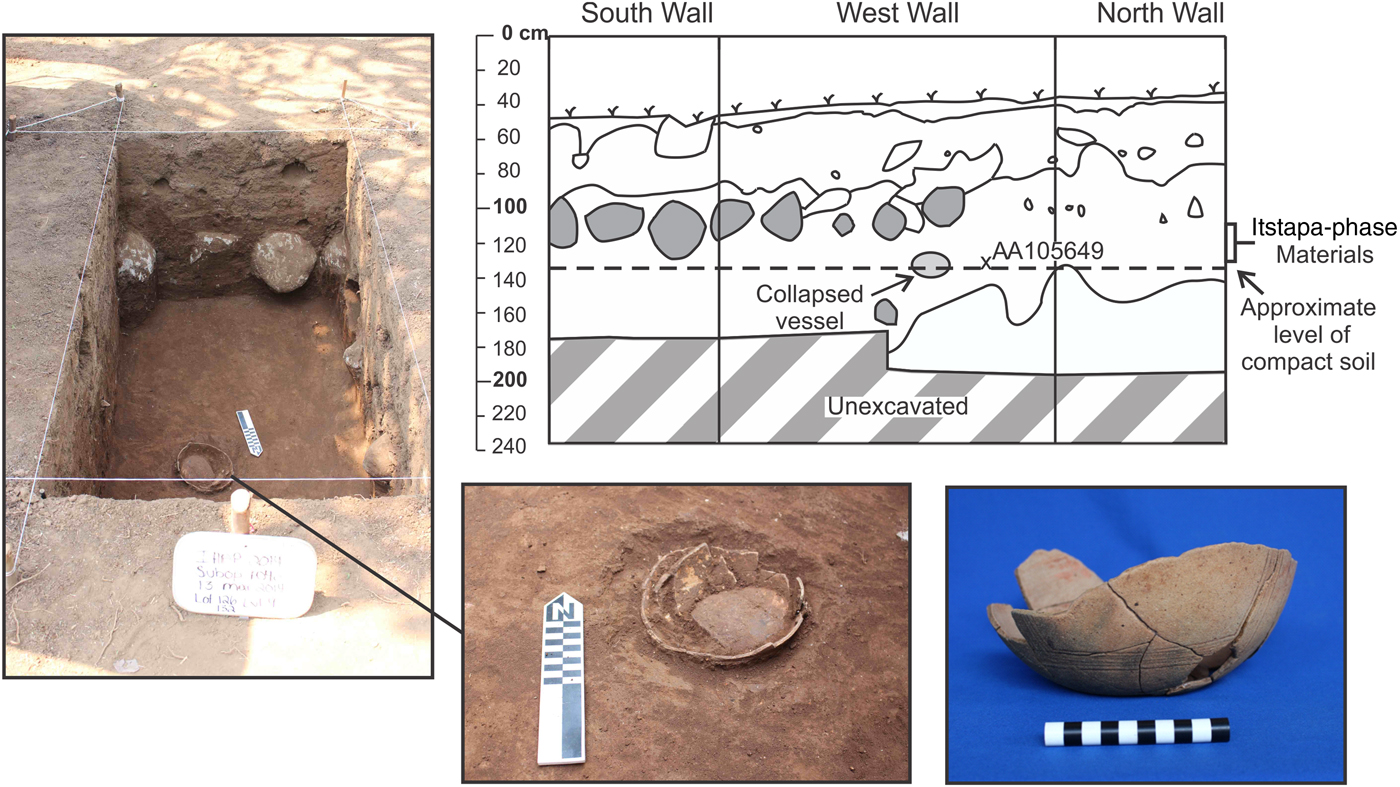
Also significant were the materials recovered from Suboperation 104e (Figure 7), a unit excavated off-mound immediately south of Mound 255 (Figure 4). This unit presented strong evidence for Itstapa-phase occupation in southern Izapa. The presence of large sherds of a Pale Orange, coarse-incised ware and the fragment of an imported San Jacinto black vessel suggest that this zone was occupied during the Itstapa phase after Mound 255 was constructed. This assessment was corroborated by the AMS date (AA105649) associated with the levels of large sherds and a collapsed vessel (Table 1). Readers are referred to Mendelsohn (Reference Mendelsohn2017) for additional details on the dating of these deposits.
Stratigraphy of Suboperation 104e where Itstapa-phase materials were recovered. Photographs and drawing by the author.
Excavations at Mound 260
Like Mound 255, Mound 260 was discovered during the 2012 IRSP lidar mapping and survey (Rosenswig et al. Reference Rosenswig, Gasco, Antonelli, Mendelsohn, Navarro Castillo and Vidal-Guzman2012, Reference Rosenswig, López-Torrijos, Antonelli and Mendelsohn2013). Mound 260 was an unassuming one-meter-high mound expected to represent a commoner residence associated with the Formative period (Figure 4). Upon excavation, however, it became apparent that the materials recovered were associated with domestic activities that took place during the Early Classic Jaritas phase (a.d. 250–400). This single component occupation offered a unique opportunity to document Jaritas-phase artifacts. The northern unit of the Mound 260 excavations, Suboperation 105a, yielded two notable deposits: a trash pit and a fired clay feature (Mendelsohn Reference Mendelsohn2017). A small extension, Suboperation 105c, was excavated to recover an intact vessel at the southeast corner of the unit. This small unit revealed household trash and yielded five nearly complete vessels associated with the Jaritas phase.
CERAMICS OF THE FORMATIVE TO CLASSIC PERIOD TRANSITION
Excavations from Mounds 255 and 260 have helped to further define the Hato-, Itstapa-, and Jaritas-phase ceramic complexes with materials recovered from outside of the Izapa site core. Ceramic analysis was conducted at the NWAF laboratory in San Cristobal de las Casas, Chiapas. This work benefitted greatly from the recent organization and publication of the Middle and Late Formative ceramics from Izapa (Lowe et al. Reference Lowe, Ekholm and Clark2013) and Clark and Cheetham's (Reference Clark, Cheetham, Carrión and Cook2005) description of the ceramics for the Hato and Itstapa phases. This project also involved a review of comparative collections from Chiapas (in the NWAF), Kaminaljuyu (lab at the Kaminaljuyu Archaeological Zone), elsewhere in Guatemala (ceramoteca at the Instituto de Antropología e Historia), Chalchuapa (University of Pennsylvania Museum of Archaeology and Anthropology), as well as a review of published accounts of ceramics from other regions, like the Gulf Coast and El Salvador.
Below, I focus on the key features helpful for differentiating between the ceramic complexes of the Hato, Itstapa, and Jaritas phases. I pay special attention to forms and decorative modes throughout this discussion, as these are often temporally diagnostic and can reflect participation in broader stylistic horizons. These definitions were later applied to identify materials associated with the Formative to Classic period transition on survey (Rosenswig and Mendelsohn Reference Rosenswig and Mendelsohn2016).
Hato Ceramic Complex (100 b.c.–a.d. 100)
As local Izapa ceramics were never defined for the Hato phase by the NWAF project (Lowe et al. Reference Lowe, Lee and Espinoza1982), descriptive types were never established for this phase. Clark and Cheetham (Reference Clark, Cheetham, Carrión and Cook2005) highlighted several changes that developed in the Hato ceramic complex, however, in their review of ceramics from survey collections from the Mazatán region west of Izapa. Potters began including new modes like button and small conical tripod supports, bi-lobed flanges, flaring “Stanley-cup” jar forms, and applying shiny reddish-orange and red-on-orange slips. Usulutan decoration and lowland Maya ceramics were also present in small quantities (Clark and Cheetham Reference Clark, Cheetham, Carrión and Cook2005:411–414). The discovery of the Mound 255 offering during the IHAP excavations (Figure 8) allowed for confirmation that many of the forms and decorative techniques Clark and Cheetham outlined for the Hato phase in the Mazatán region were also found among vessels in excavated contexts at Izapa.
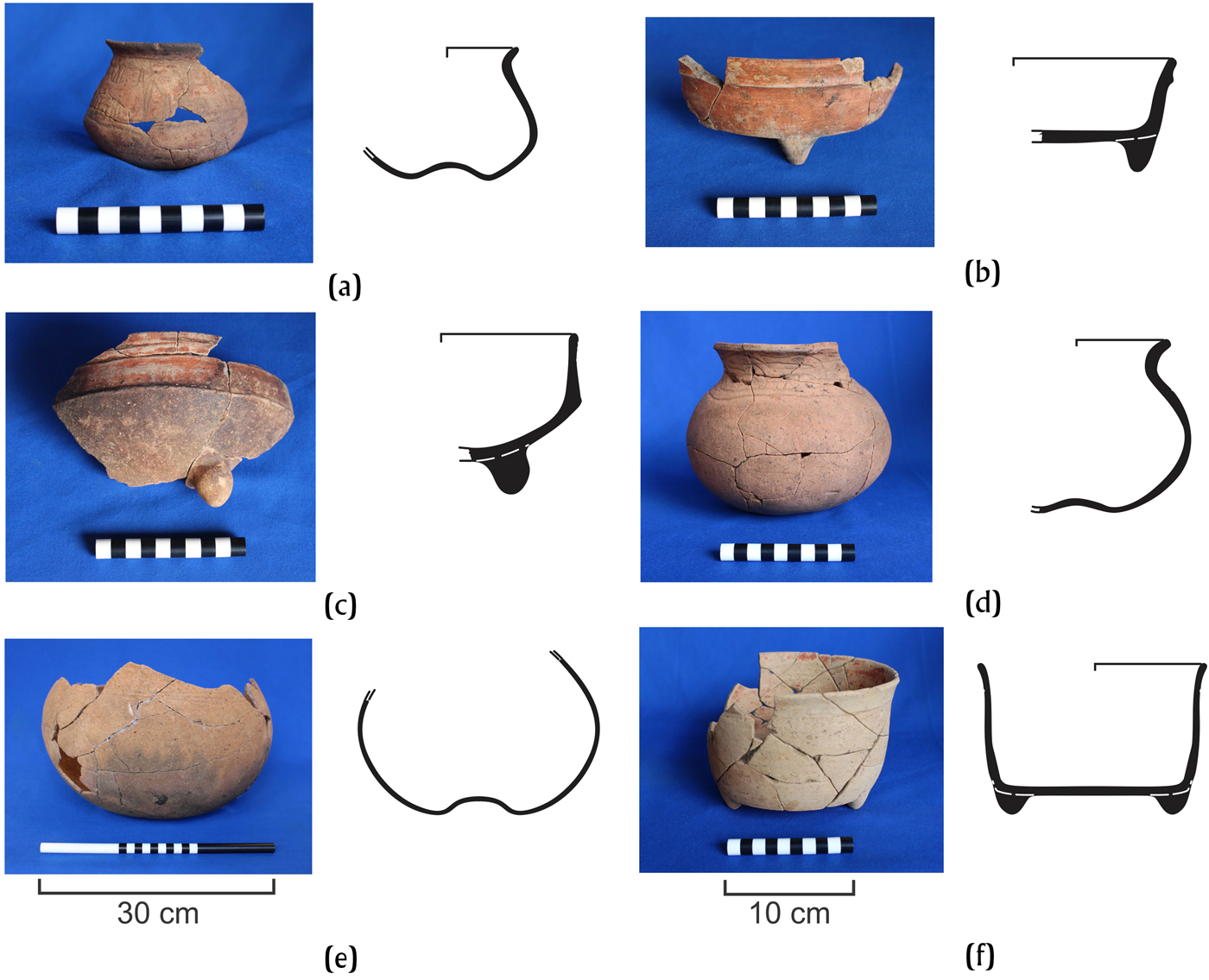
Reconstructed vessels from the Mound 255 offering. Photograph by the author, profile drawings by Roberto Hoover Silvano.
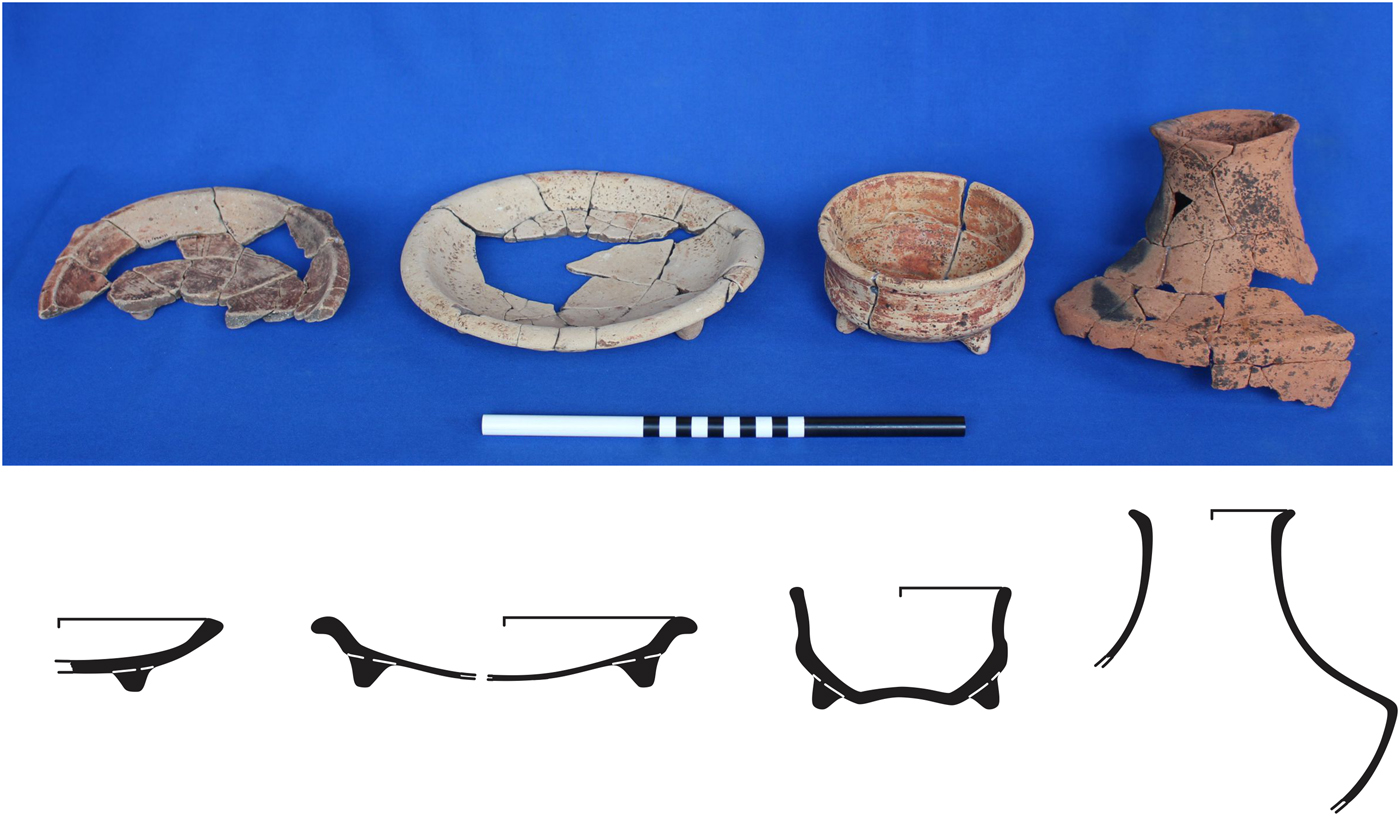
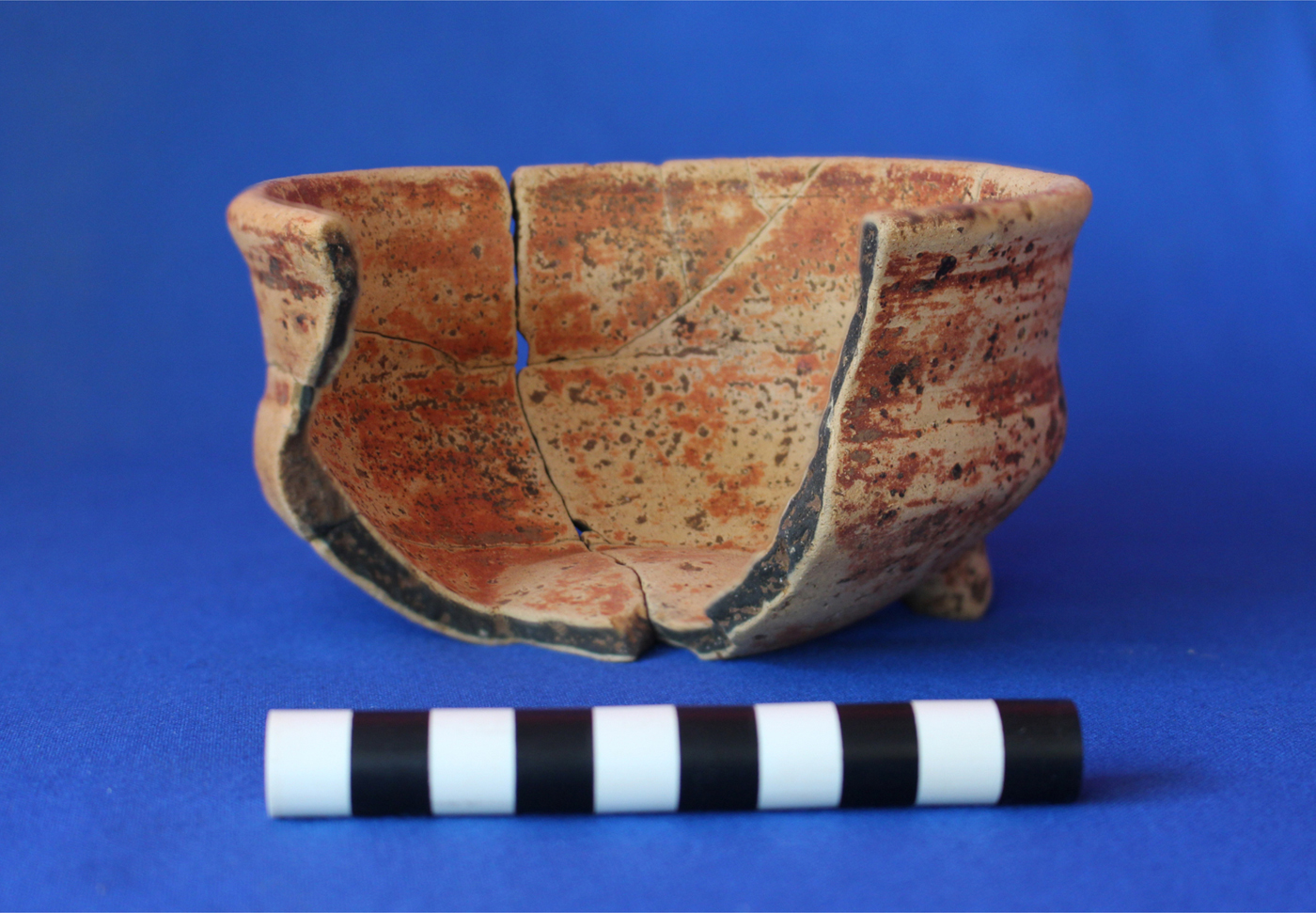
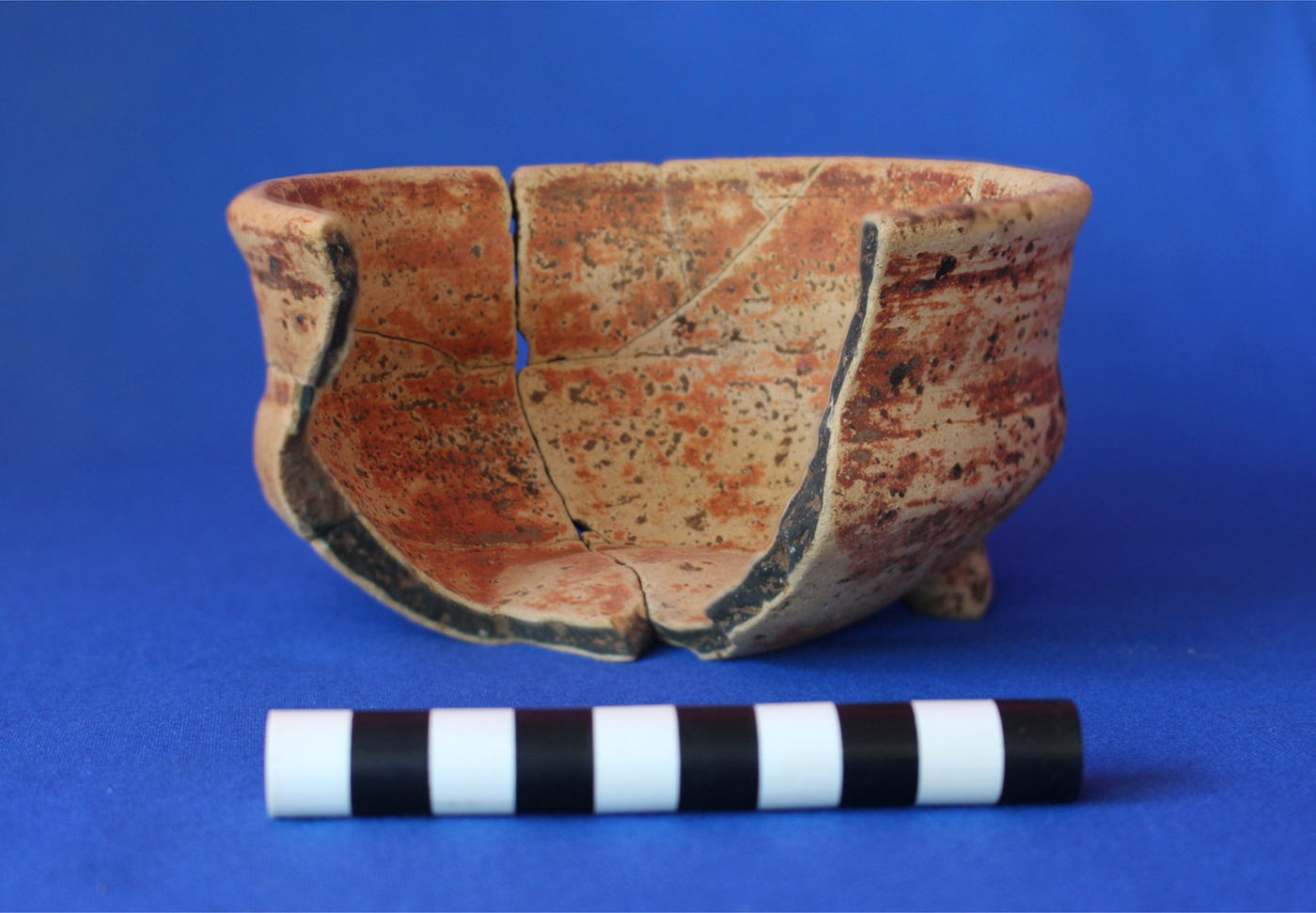
Among the Mound 255 vessels were plates with shallow everted rims and three solid conical supports (Figure 8) from an offering context (possibly a burial; see Mendelsohn Reference Mendelsohn2017:118–123 for discussion). One of these vessels contained decorative lobes along the rim. Also included was a composite-silhouette bowl with solid tripod supports with red-on-orange decoration (Figure 9). The vessel exhibited an eroded red exterior and an orange interior with a red rim.
Offering vessel from Mound 255 illustrating the fine dark cores characteristic of the fine-paste red-on-orange wares associated with the Hato phase at Izapa. Photograph by the author.
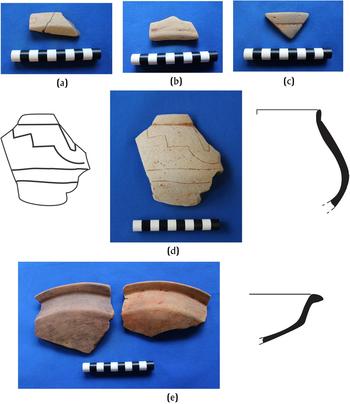
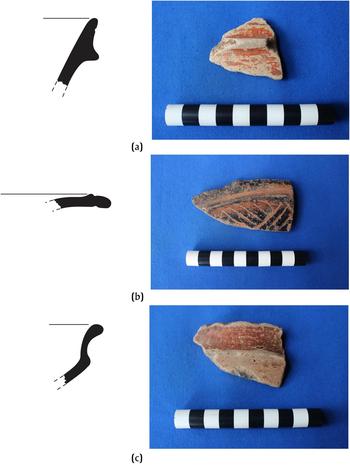
Other Hato ceramics recovered from excavations had shallow everted rims (≤1.5 cm) that sometimes exhibited scalloped modeling (Figure 10b). Another common form was the hemispherical bowl with nubbin supports, an externally thickened rim, and a characteristic dip dividing the exterior rim from the rest of the vessel (Figure 10c; see Clark and Cheetham Reference Clark, Cheetham, Carrión and Cook2005:Figure 68m for reconstructed vessel form). The clearest examples of Hato sherds included these forms with red-on-orange decoration, where red was most often restricted to the rim/lip.
(a–e) Hato-phase ceramics recovered from the base of Mound 255. Photographs and sherd drawing by the author, profile drawings by Roberto Hoover Silvano.
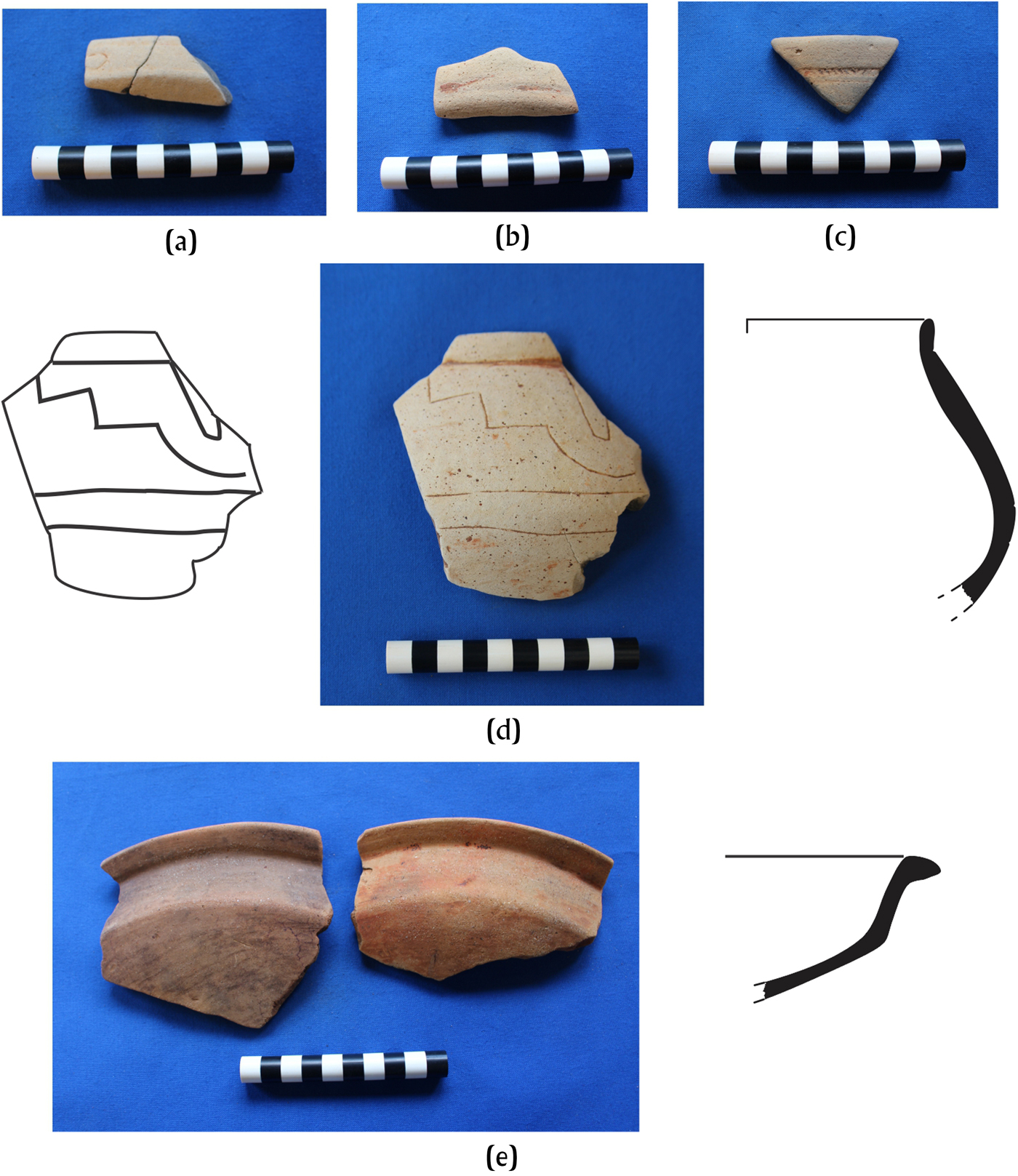
Hato-phase ceramics present both continuity and change from the earlier Tuzantan ceramics diagnostic of the Guillen phase. The presence of orange slip on white paste is continuous from the Guillen phase (see Discussion section below). The application of red slip to the rims of orange vessels became popular during the Hato phase, marking a transition from monochrome to bichrome decoration. Forms transition from the presence of wide-everted rims to shorter (≤1.5 cm) everted rims. The addition of nubbin or solid conical tripod supports is also a novel introduction. The presence of pre-slipped grooving on wide-everted rims falls out of fashion, except for an occasional single, thin, groove-incised line sometimes found on the everted rims of Hato ceramics.
The shift toward the use of a very-fine-white paste in Hato ceramics represented the biggest departure from Guillen-phase ceramics. Three of the vessels recovered from the Mound 255 offering all shared a very fine, almost kaolin-like, white paste. This fine material eroded leaving sherds with soft edges. These vessels also included a distinctive thick and very fine black or dark gray core (Figure 9). Fine-paste ceramics were also recovered in low quantities throughout the fill of Mound 255, and in sherds recovered from among the Hato-phase materials at the base of the mound (Figure 10). These fine-paste ceramics may signal the arrival of a new ceramic production technique at Izapa or a shift in preferred clay sources.
With a greater complex of Hato-phase ceramics defined, the cross-dating of these ceramics has become clearer. Many traits, like nubbin supports, fine pastes, red-on-orange decoration, and common vessel forms shared with the “Miraflores” ceramic sphere (Demarest and Sharer Reference Demarest, Sharer, Urban and Schortman1986), present in parts of Guatemala and El Salvador at this time (Lowe et al. Reference Lowe, Lee and Espinoza1982:139), have helped to tie the Hato-phase ceramic complex at Izapa with other early facet “Protoclassic” phases across Mesoamerica (Brady et al. Reference Brady, Ball, Bishop, Pring, Hammond and Housley1998; Inomata et al. Reference Inomata, Ortiz, Arroyo and Robinson2014; Lowe et al. Reference Lowe, Lee and Espinoza1982:135). Among the closest ceramic correlates during the Hato phase are the Horcones phase at Chiapa de Corzo, the Hun phase in the Upper Grijalva region, the Crucero phase at La Victoria and Salinas La Blanca, the Ilusiones phase at Bilbao, the Caynac phase at Chalchuapa, and the Verbena (or Miraflores) phase at Kaminaljuyu (see Mendelsohn Reference Mendelsohn2017 for a complete discussion of the ceramic cross-dating).
Ceramics of the Itstapa Ceramic Complex (a.d. 100–250)
As defined by Lee (Reference Lee1973), forms of Itstapa (formerly “Izapa”) ceramics included small, thickened-rim plates with flat bases, tripod bowls with nubbin feet, tall cylinders, and shouldered jars with outflaring rims (Lowe et al. Reference Lowe, Lee and Espinoza1982:141). Common decorative techniques included “notching on jar shoulders” and incised geometric lines (Lowe et al. Reference Lowe, Lee and Espinoza1982:141, Figures 7.16c, 7.17i, 7.17l). Clark and Cheetham (Reference Clark, Cheetham, Carrión and Cook2005:421–424) expanded this description, noting the presence of pale pinkish-orange vessels, buff unslipped vessels, and the continuation of Usulutan decoration and reddish-orange sherds.
Itstapa-phase ceramics were defined during the IHAP based on their presence in off-mound unit Suboperation 104e, but absence in Mound 255 fills, which contained Guillen- and Hato-phase ceramics, and absence from Mound 260, which included ceramics of the Jaritas phase (Mendelsohn Reference Mendelsohn2017). The largest and best-preserved sherds were associated with Levels 9 and 10 (Figure 11), which most likely represent Itstapa-phase refuse. Carbon recovered from Level 10 dated to a 2-sigma range of a.d. 69–264, corresponding with the period expected for the Itstapa phase.
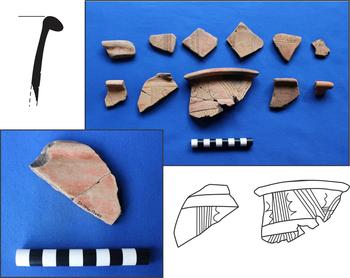
Pale Orange ceramics recovered from Suboperation 104e. Photographs and sherd drawing by the author, profile drawing by Roberto Hoover Silvano.

The Itstapa-phase ceramics recovered during IHAP best represent the pale pinkish-orange sherds (Figure 11) of Clark and Cheetham's (Reference Clark, Cheetham, Carrión and Cook2005:424, Figures 72k–72s) Pale Orange ware or Type 6 in Lee's (Reference Lee1969) system. The most common form for these vessels are large bowls or vases with parallel or outslanting walls and flat bases with or without solid conical supports. Rims are typically bolstered or bolstered and shaped into a triangular form. One common and characteristic feature of Pale Orange sherds is the presence of a groove or dip along the interior lip of the vessel (Figure 11), occasionally substituted with a thick pre-slipped incised line. The solid conical feet, when included on Pale Orange vessels, are generally larger than both the earlier Hato supports and the conical supports of the subsequent Jaritas phase. Dark cores continue to be common, but now include tempering agents.
Pale Orange ceramics also include thick-incised (or excised) designs in geometric patterns, often comprised of one or multiple sets of parallel lines. These parallel lines are generally grouped and are arranged in vertical, horizontal, and diagonal orientations. One common geometric motif found on Itstapa Pale Orange vessels was the combination of a group of vertical lines framed by scalloped lines (Figure 11). This design appears to be temporally diagnostic for Terminal Formative ceramics at Izapa, as it is featured on fine-incised pots with the Mound 30d urn burials (Lowe Reference Lowe1993:Figures 6 and 7) and it has not yet been identified on Guillen- or Jaritas-phase pots. It is worth observing, however, that a similar motif is present on significantly earlier ceramics. Examples of this motif have been documented locally on Early Formative sherds from the Jocotal phase (Coe and Flannery Reference Coe and Flannery1967:Figure 23b; Ekholm Reference Ekholm1969:Figure 45h). Survey at Izapa and in neighboring regions has indicated that Pale Orange and coarse-incised sherds were common and appear to be a good diagnostic for Itstapa-phase materials (Rosenswig and Mendelsohn Reference Rosenswig and Mendelsohn2016).
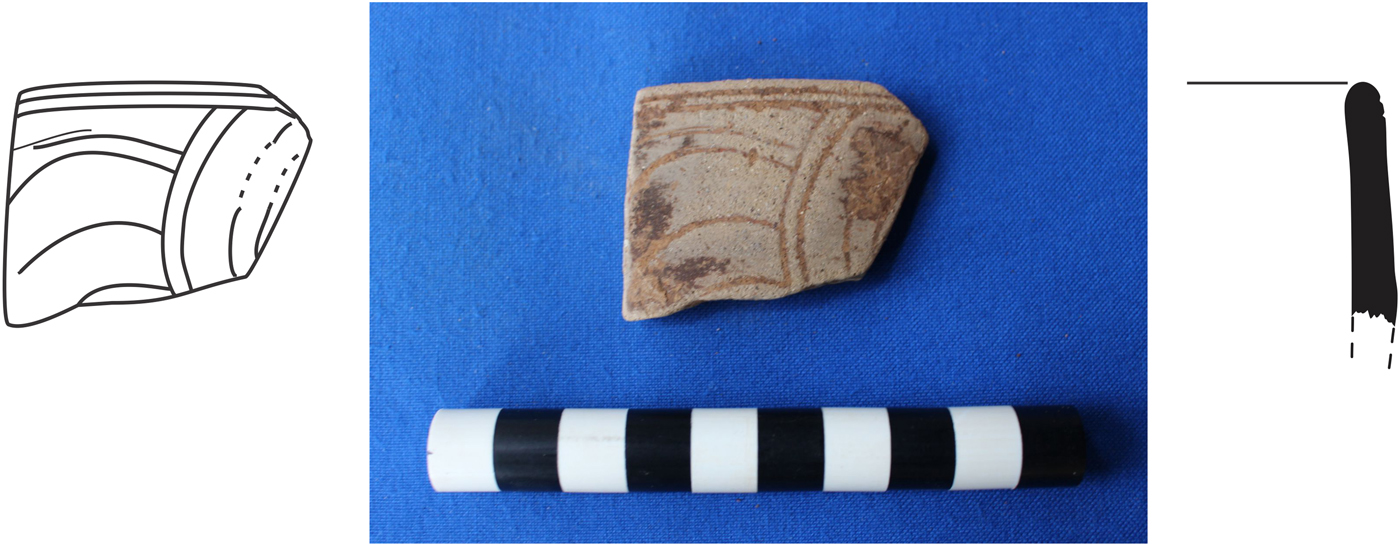
Another decorative pattern that may have begun in popularity during the Itstapa phase was a braided motif. One rim sherd, recovered from the Itstapa-phase deposit in Suboperation 104e (Figure 12) contains an incised braided motif along the exterior rim. This sherd exhibited a pinkish interior, like other sherds of the Pale Orange ware. A similar braided pattern is also present on contemporaneous ceramics associated with the Ix phase of the Upper Grijalva region (Bryant and Clark Reference Bryant, Clark, Bryant, Clark and Cheetham2005:Figure 5.31) and painted braided motifs on polychrome vessels have been identified on vessels associated with the Terminal Formative period in the Maya lowlands (Callaghan Reference Callaghan2013; Reese-Taylor and Walker Reference Reese-Taylor, Walker, Masson and Freidel2002). Braided motifs, like the one on the Suboperation 104e sherd, are often associated with the Mesoamerican mat motif, a symbol of power and authority among several Mesoamerican cultures. The appearance of a braided motif on an Itstapa-phase pot suggests that symbols of kingship or authority may have been embedded on ceramic vessels at Izapa by the end of the Terminal Formative period. The presence of this symbol so far outside of the site core, however, would be unexpected for a vessel displaying kingship symbolism. The discovery of this iconography outside the central zones of the site may suggest that this symbolism was not restricted to rules at Izapa during the Itstapa phase.
Itstapa-phase sherd with an incised braided motif recovered from Suboperation 104e. Photograph and sherd drawing by the author, profile drawing by Roberto Hoover Silvano.

Ceramics from Suboperation 104e also included examples of fine-paste wares, which might either be contemporaneous with the Pale Orange sherds or could have been mixed in during construction. At present, these fine-paste ceramics are interpreted as earlier Hato-phase sherds included in fill. Additional research at Izapa, however, may reveal distinctions in form and/or other modal traits between fine-paste ceramics of the Hato and Itstapa phases. Fine-paste sherds are also found in later, Jaritas-phase contexts (see Ceramics of the Jaritas Ceramic Complex (a.d. 250–400) section below), lending credence to the possibility that a subset of fine-paste ceramics may be associated with the intermediate Itstapa phase.
Evidence that importation of ceramics from inland Chiapas resumes at this time also comes from the excavations at the base of Mound 255. One sherd, recovered near the base of Suboperation 104e may have been a Hun-phase import of the Escobal Red-on-Buff type from the Upper Grijalva region (Figure 13c) Another Upper Grijalva region import, recovered from the Itstapa-phase refuse layer of Suboperation 104e, was a finely polished black San Jacinto rim likely dating to the Ix (Bryant and Clark Reference Bryant, Clark, Bryant, Clark and Cheetham2005:332–338) or possibly Hun phase (Clark and Cheetham Reference Clark, Cheetham, Carrión and Cook2005:417) in that zone (Figure 13b). Also included in the upper fill from this unit was the rim of a highly polished reddish-orange vessel, decorated with a labial flange (Figure 13a). This sherd could represent the import of a Chicanel vessel from the Maya lowlands, as flanges were not common in the Izapa ceramic inventory during the Terminal Formative period.
(a–c) Probable imports recovered from Suboperation 104e. Photographs by the author, profile drawings by Roberto Hoover Silvano.

While these descriptions represent the current understanding of Terminal Formative ceramics from Izapa at the time of writing, it is also important to note that some concern remains as to whether or not Hato and Itstapa ceramic complexes overlap temporally (Mendelsohn Reference Mendelsohn2017). This problem is apparently not unique to Izapa; researchers working at several coastal and highland sites encountered difficulties in distinguishing early and late facets of the Terminal Formative period. De Borhegyi (Reference de Borhegyi and Willey1965:11), for example, suggested that the Miraflores (Verbena) and Arenal complexes at Kaminaljuyu were roughly contemporaneous. He saw Miraflores ceramics as the elite ceremonial assemblage of the Arenal domestic assemblage (de Borhegyi Reference de Borhegyi and Willey1965:11). Such a scenario remains possible at Izapa. Nevertheless, a survey of the presence/absence and frequency of ceramics with coarse incision and deep basin forms is helpful in narrowing down the temporal range of this ware. These attributes peak at the end of the Terminal Formative period at Kaminaljuyu (Wetherington Reference Wetherington and Wetherington1978:131). Here, they are proposed to belong to the Itstapa phase at Izapa. The absence of coarse incision and deep basin forms in earlier Hato-phase and later Jaritas-phase deposits recovered by the IHAP support the present division between the Hato- and Itstapa-phase ceramic complexes.
Ceramics of the Jaritas Ceramic Complex (a.d. 250–400)
Lee's Jaritas-phase complex was well defined though offerings of predominantly local ceramics in Group B (Lieske Reference Lieske2013) and Group F (Lee Reference Lee1969). For detailed descriptions of the Jaritas-phase materials recovered from the NWAF excavations at Izapa, see Lee (Reference Lee1969, Reference Lowe1993), as well as Voorhies (Reference Voorhies1976:116–132) for comparable materials collected at the site of Tlacuachero in the Chantuto region of the Soconusco. Lowe and colleagues (Reference Lowe, Lee and Espinoza1982) do not comment explicitly on the proposed ethnicity of Early Classic Izapeños. They mention, however, a local ceramic complex that may have gone unidentified in nearby regions because of its “non-Maya character” (Lowe et al. Reference Lowe, Lee and Espinoza1982:145). They highlight the absence of Usulutan pottery in the Jaritas phase, postulating an end to relationships with the southeastern highlands. They suggest instead, on the basis of polished black pottery and the presence of a black and white tripod jar, that ties may have increased with the western highlands of Guatemala, western Chiapas, and the Gulf Coast at this time (Lowe et al. Reference Lowe, Lee and Espinoza1982:145, 147).
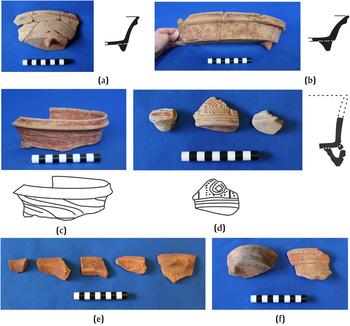
The IHAP deposits from Mound 260 illustrate that Jaritas-phase ceramics are most commonly identified by the occurrence of vessels with labial and sub-labial flanges or ridges and a red wash, with solid conical feet (Figures 14–15). They are also identified by their thin-walled jars, containing rims with “droopy” labial flanges and interior grooves (Figure 15c). These are often decorated with parallel wavy lines, sometimes referred to as the “sine” motif, on the neck (Figures 15–16). Jaritas vessels include buff unslipped, red-on-buff, and pale orange/pink ceramics. They also include thin-walled vessels with incised geometric designs, in opposition to the thicker-walled vessels with coarse-incised motifs which are common among Itstapa-phase ceramics.
(a–f) Vessels recovered from the Jaritas-phase trash pit in Mound 260. Photographs by the author, profile drawings by Roberto Hoover Silvano.

(a–f) Jaritas-phase ceramics recovered from Suboperation 105a. Photographs and sherd drawings are by the author. (a–b) Profile drawings by Roberto Hoover Silvano. (d) Profile drawing of vessel reconstruction by the author after Voorhies Reference Voorhies1976:Figure 68.

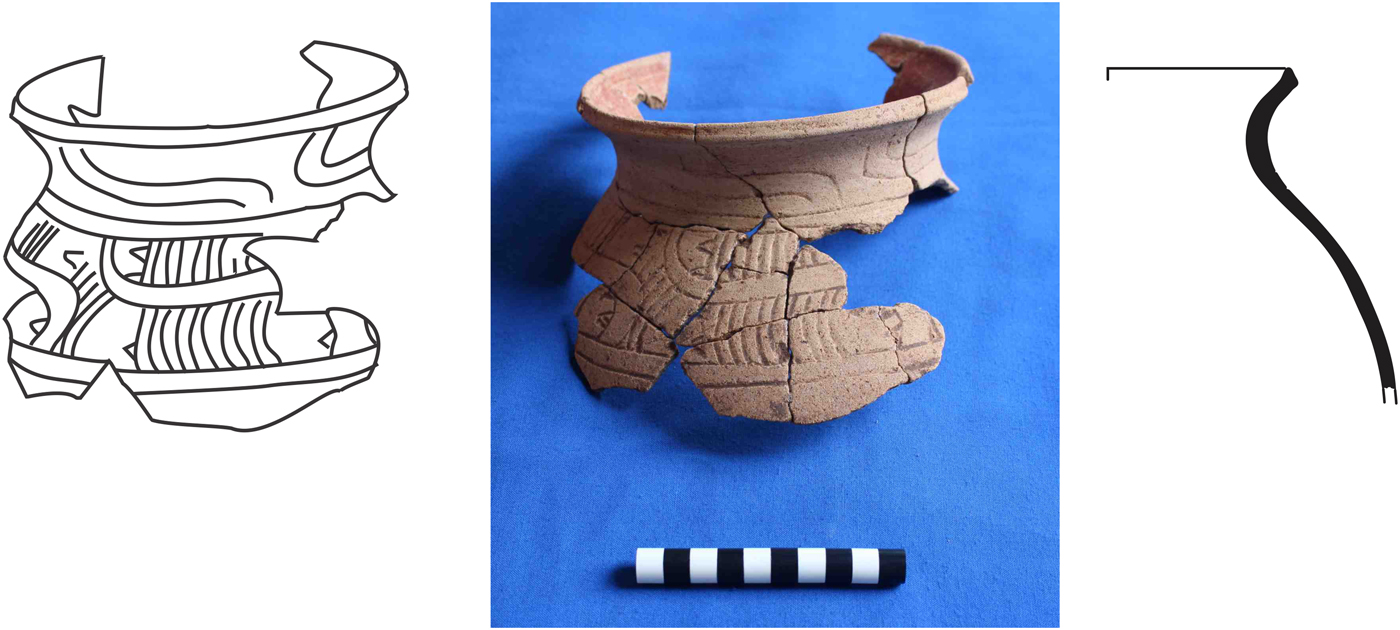
Jar recovered from atop Mound 255 (location illustrated in Figure 6). Photograph and sherd drawing by the author, profile drawing by Roberto Hoover Silvano.

The overwhelming majority of the sherds recovered from Suboperations 105a–105c corresponded to Lee's (Reference Lee1969) Type 6, or what Voorhies (Reference Voorhies1976:116–120) calls Dull Red Ware. This category included thick utilitarian bowls, thinner-walled bowls with similar formal characteristics, and thin-walled jars with incised designs on, and sometimes below, the neck. The thicker-walled utilitarian vessels had a red slip or wash with a white to buff paste and dark core (Figure 15b). Pastes included ash and shiny black inclusions, probably hornblende. The high frequency of these dark inclusions was a notable departure from earlier Guillen- and Itstapa-phase ceramics and helped to recognize these sherds as part of the Jaritas ceramic complex. Walls of these vessels were thick compared to other Jaritas-phase types. The most common form is the bowl with an outcurving or outleaning wall, flat base, labial flanges or ridges, and solid conical supports. As Lee (Reference Lee1973; Lowe et al. Reference Lowe, Lee and Espinoza1982:145) initially observed, vessels were relatively large, especially the flat-bottomed bowls with tripod supports (e.g., Figure 15b).
A thinner-walled version of Dull Red Ware represents an additional type (Figure 15a) subsumed within Lee's (Reference Lee1969) Type 6. The slip is reddish-orange to reddish-brown, often atop a buff or self-slip. Slips for this type are often flaky when eroded. Forms identified at Izapa include bowls with outcurving walls with labial flanges with lobes, which are sometimes pierced or modeled with animal (owl?) faces. Additional forms included jars, and vases with labial flanges.
Vessels with both a very fine paste and incised designs (otherwise Hato and Itstapa attributes, respectively) are also associated with the Jaritas phase (Figure 15d). These sherds are associated with Lee's (Reference Lee1969) Type 5–1, and called “Red Carved Ware” by Voorhies (Reference Voorhies1976:121–124). This type is characterized by its fine white paste, which erodes with soft edges and includes incised designs. Sherds from this type also include a fine black or gray core. Horizontally-grouped incised lines are common along the base. So far, only one form has been identified, a cup with a flat base with supports. These often have hollow or partially hollow stylized supports that taper at the base and sometimes included punched holes (Figure 15d). These hollow modeled supports were a precursor to the hollowed and rounded supports of the subsequent Kato phase (Lee Reference Lee1969, Reference Lee1973). Other examples of Red Carved Ware at Izapa were attributed to the Itstapa phase (e.g., Type 3–1) by Lee (Reference Lee1969, Reference Lee1973) and in the Izapa report (Lowe et al. Reference Lowe, Lee and Espinoza1982:144–147).
The thin-walled, incised jar recovered from one offering atop Mound 255 (Figure 16) corresponds to Lee's (Reference Lee1969) Type 6–6. Voorhies (Reference Voorhies1976:124) refers to these jars as “Monkey-Vessel Ware” for their frequent depiction of monkeys. These vessels are characterized by their jar forms and incised motifs. Their paste is a yellow-brown color and they often include fire-darkened cores and a thin red wash (Voorhies Reference Voorhies1976:124, Figure 70).
Incised jars of Type 6–6 were apparently common in offerings at Izapa, though their chronological classifications were not always consistent. The temporal association of these vessels was complicated by their frequent deposition in intrusive offerings. Vessels of this type were excavated by the NWAF in offerings in both Mound 125a in Group F and the Mound 30 complex (Lee Reference Lee1969, Reference Lee1973; Lieske Reference Lieske2013). Lee included examples from Group F in the Early Classic Jaritas phase (Lee Reference Lee1969). A similar offering jar was included with the Itstapa phase by Lowe (Lieske Reference Lieske2013:149–151). The drawing of this jar, from Offering 30f-1, contained the same double wavy line motif repeated along the neck (Lieske Reference Lieske2013:149–151). Its inclusion with three labial-flanged bowls with tripod supports, however, suggests that the offering dates instead to the Jaritas phase. The Jaritas phase association is most likely to be accurate given that the Mound 125a offerings were recovered in good stratigraphic context, unlike the intrusive offerings of the Mound 30 complex. Voorhies (Reference Voorhies1976:124, Figure 70) attributes Monkey-Vessel Ware jars to the Early Classic period, cross-dating them with Jaritas-phase sherds at Izapa (Lee Reference Lee1969, Reference Lee1973).
Other thin-walled jars with incised decoration were recovered during the IHAP excavations in Suboperations 105a–105c, suggesting that the Jaritas-phase attribution for Type 6–6 jars is appropriate (Figure 15c). This does not, however, rule out the possibility that these vessels first became popular during the Itstapa phase. The vessel base recovered from Suboperation 104e (Figure 7), tentatively associated with the Itstapa phase, also included some of the characteristic features (e.g., incised decoration, thin walls, and red slip on the interior) of Type 6–6 jars. These observations suggest that either this type became popular in the preceding Itstapa phase, or that the vessel in Suboperation 104e may have been deposited intrusively.
Finally, an additional Jaritas-phase utilitarian ware was identified from the ceramics of Suboperations 105a and 105c. This group is comprised of predominantly coarse, sandy, red paste jars (Figure 15e). Inclusions are variable and may contain quartz, ash, mica, and/or hornblende. Jars with outslanting rims appear to be a common form. One example of this form included incised lines along the interior of the outslanting rim.
DISCUSSION
Terminal Formative Ceramics at Izapa: Continuity and Change
The IHAP identification of ceramics for the Hato, Itstapa, and Jaritas phases from materials outside of the site's ceremonial core have allowed a reappraisal of the seemingly dramatic changes that accompanied the arrival of the Terminal Formative period at Izapa. One key question raised by this study was whether the Hato-phase ceramic assemblage represents a break with local traditions or suggests a continuation in a sequence of local pottery. After evaluating the materials recovered from the IHAP excavations, I am forced to conclude that both assessments are correct. While the adoption of fine-paste pottery and importation of foreign pots in the Hato phase marked a substantial shift from earlier traditions, continuity in local pottery is suggested through subtle modal changes to orange-slipped pottery, paralleled elsewhere on the Pacific coast.
Following the NWAF excavations at Izapa, Lowe and colleagues (Reference Lowe, Lee and Espinoza1982:139) described a “sudden and exotic character” for ceramics associated with the Mound 30d urn burials. Among these exotic ceramics were “many imported vessels bearing traditional ‘Protoclassic’ or early ‘Q-Complex’ (Willey and Gifford Reference Willey, Gifford and Lothrop1961) modes (early swollen tetrapod supports and spouts, Usulutan multiple-striped resist decoration, stucco paint)” that helped date these deposits to the Terminal Formative period (Lowe et al. Reference Lowe, Lee and Espinoza1982:135, Figures 7.13–7.15). Lowe and colleagues (Reference Lowe, Lee and Espinoza1982:139, Figures 7.13 and 7.14) proposed that many of these vessels were imported from sites to the southeast, in the highlands, and/or the Pacific coast of Guatemala and El Salvador.
The IHAP excavations, like Clark and Lowe's (Reference Clark, Lowe, Lowe, Ekholm and Clark2013:79) study, revealed that many of these vessels do appear to be unusual among the ceramics at Izapa. Sherds with stucco decoration were not observed among the materials from the southern periphery and vessels with tetrapod supports were not recovered from excavations. Likewise, no fine-incised ceramics were recovered from the south, though the possibility remains that the absence of fine-line incision may be related to the poor surface preservation of sherds at Izapa. The lack of many of these features initially led to difficulty in identifying Terminal Formative ceramics outside the ceremonial centers.
Instead of the fancy ceramics associated with the Hato-phase urn burials, the IHAP ceramics associated with the Hato and Itstapa phases shared considerably more features with ceramics reported by Clark and Cheetham (Reference Clark, Cheetham, Carrión and Cook2005) for the Mazatán region. Given that these materials were not recovered from fancy urn burials, these ceramics are presumed to better approximate local ceramic traditions. Hato-phase ceramics recovered from Mound 255 shared modal characteristics with materials reported by Clark and Cheetham, such as tripod nubbin supports (Figures 8 and 10; Clark and Cheetham Reference Clark, Cheetham, Carrión and Cook2005:Figures 68i, 68k, 68m, and 68 l) shallow bowls with short, sometimes modeled, everted rims (Figures 8 and 10; Clark and Cheetham Reference Clark, Cheetham, Carrión and Cook2005:Figures 68g, 68i, 68j, and 68l), bowl forms with externally thickened rims (Figure 8; Clark and Cheetham Reference Clark, Cheetham, Carrión and Cook2005:Figures 67 and 68m), and the introduction of red-on-orange decoration (Figures 8 and 9; Clark and Cheetham Reference Clark, Cheetham, Carrión and Cook2005:414).
The seemingly rapid proliferation of fine pastes for ceramics during the Hato phase underlies a major change to the production of pottery at Izapa. While not addressed explicitly in the Izapa report, Lowe observed this stark contrast in his notes. Apparently this observation factored heavily into his suggestion for greater southeastern influence at Izapa (John E. Clark, personal communication 2015). Is this major transition in pottery production sufficient, however, to suggest a southeastern conquest of Izapa?
Despite major changes in paste, continuity in local traditions is also suggested through gradual change in form and decorative techniques on orange-slipped pottery. The sequence of orange-slipped pottery at Izapa now appears to parallel gradual ceramic change present for neighboring coastal regions. Elsewhere (Mendelsohn Reference Mendelsohn2017), I have used ceramic cross-dating of the IHAP materials and Bayesian statistical analysis of the recovered AMS dates to support the ceramic chronology proposed by Lowe and colleagues (Reference Lowe, Lee and Espinoza1982, Reference Lowe, Ekholm and Clark2013). The well-documented ceramic chronology of the Salvadoran sites of Chalchuapa and Santa Leticia (Demarest Reference Demarest1986; Demarest and Sharer Reference Demarest and Sharer1982; Sharer Reference Sharer1978) were especially helpful for correlating ceramics of the Formative to Classic period transition at Izapa to other regions of Mesoamerica. In addition to their chronological significance, the parallel sequences of orange-slipped ceramics along the southern Pacific coast are helpful for understanding cultural changes at Izapa.
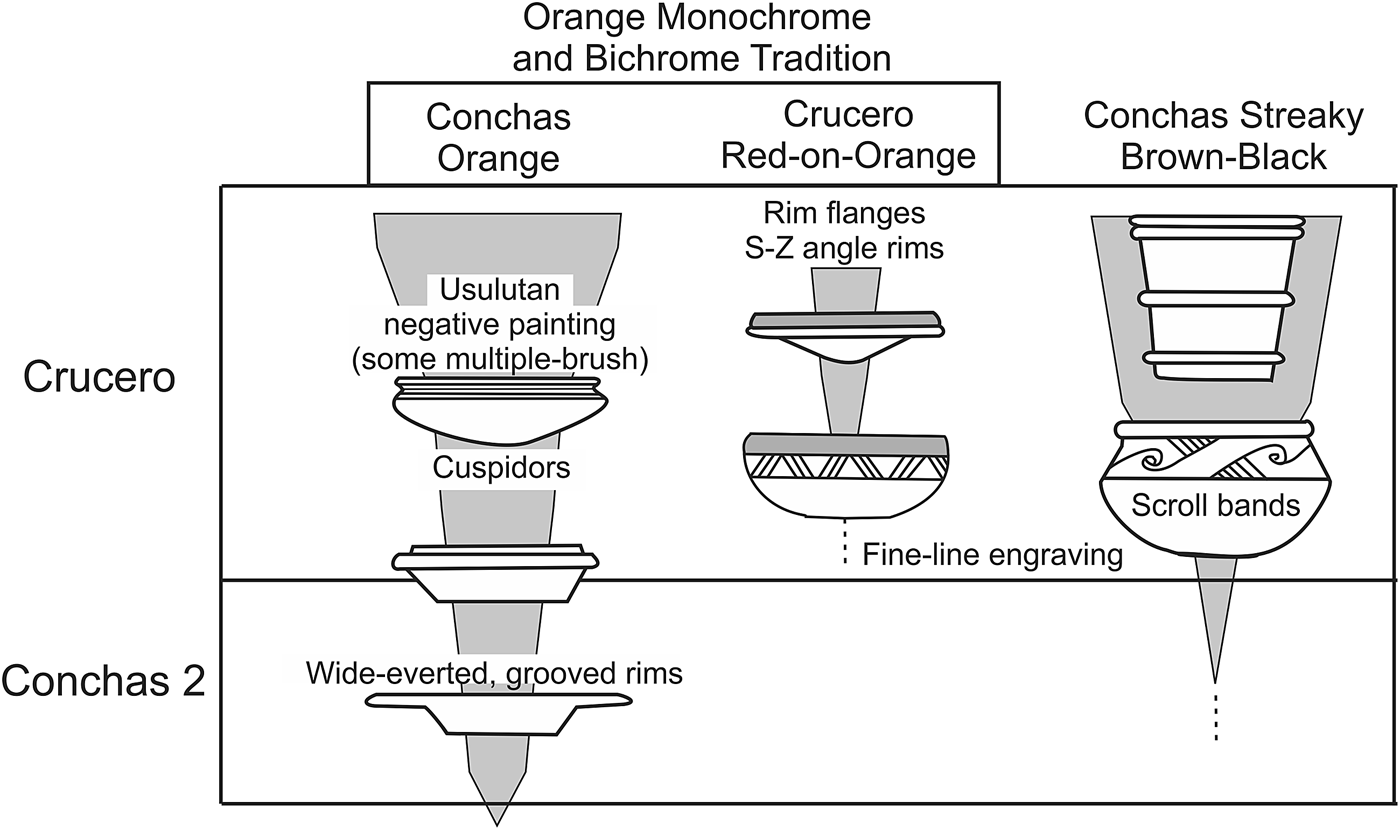
The documentation of a Soconusco sequence of orange-slipped pottery was begun by Coe (Reference Coe1961), who first identified this tradition as Conchas Orange. Coe observed that Conchas Orange ceramics began in popularity at the close of the Middle Formative period. Following excavations at La Victoria and Salinas la Blanca, Coe and Flannery (Reference Coe and Flannery1967:Figure 8) seriated the Conchas Orange vessels, illustrating changes in vessel form through time (Figure 17). They observed that the application of red accents to orange-slipped ceramics began toward the end of their sequence, toward the latter half of the Crucero phase, which spanned from 300 b.c.–a.d. 100 (Coe Reference Coe1961:85–86, Figure 10; Coe and Flannery Reference Coe and Flannery1967:Figures 8 and 42). Coe and Flannery also observed that Usulutan decoration and fine-line engraving peaked during the latter half of the Crucero phase (Figure 17).
Seriation of Orange-Slipped pottery for La Victoria and Salinas la Blanca, after Coe and Flannery (Reference Coe and Flannery1967:Figure 8). Coe and Flannery's (Reference Coe and Flannery1967:Table 3) dates for the Conchas 2 phase (500–300 b.c.) and the start of the Crucero phase (300 b.c.–a.d. 100) may be a little early.

More recently, Love (Reference Love, Love, de Hatch and Escobedo2002) has documented a similar pattern at for the Guatemalan coastal site of El Ujuxte. Love compares his group of Mopa Orange ceramics to the Conchas Orange ceramics described by Coe (Reference Coe1961). He observes that Mopa Orange becomes the defining ceramic at El Ujuxte during the Middle to Late Formative period (Love Reference Love, Love, de Hatch and Escobedo2002). As at La Victoria and Salinas la Blanca, red-on-orange decoration peaks at El Ujuxte toward the latter part of the sequence (Michael W. Love, personal communication 2015).
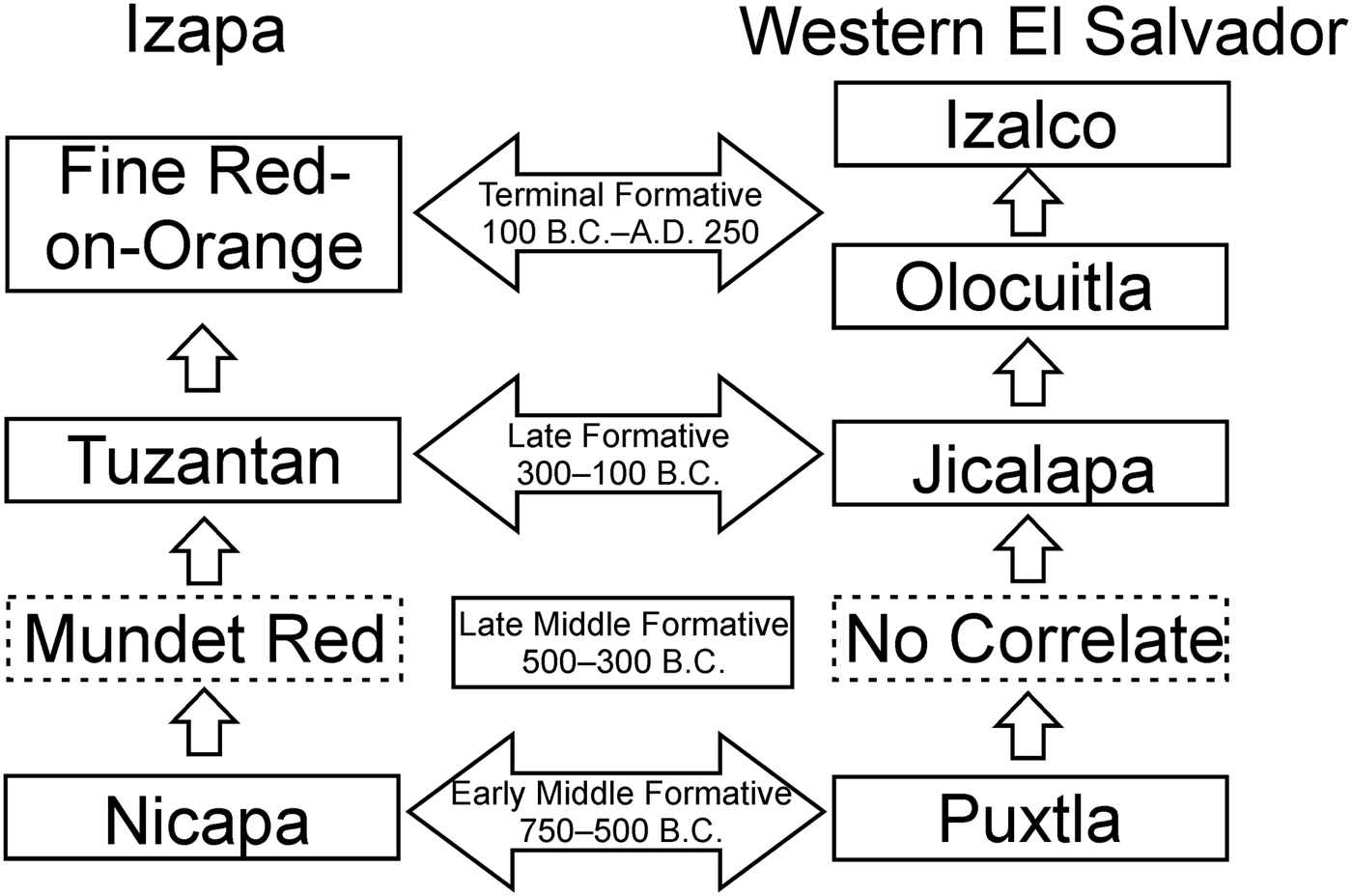
Down the coast in western El Salvador, sequences of orange-slipped ceramics have been further refined. This effort was undertaken to document the evolution of decorative resist that culminated in the wavy-line Usulutan technique that became a horizon marker across Mesoamerica. Demarest and Sharer (Reference Demarest and Sharer1982) divide orange-ware resist into three categories: Double-Slipped Usulutan, Olocuitla Orange Usulutan, and “True” or Single-Slipped Usulutan. Double-Slipped Usulutan ceramics include a thick cream underslip. The tradition of resist decoration on orange-slipped vessels began during the Middle Formative period with Puxtla Usulutan, an orange ceramic ware with a splotchy resist technique (Demarest Reference Demarest1986:145). Puxtla Usulutan represents the western Salvadoran variation of the splotchy orange pottery often associated with a widespread “Modified Olmec” horizon (Lowe Reference Lowe and Adams1977).
In the Chul phase of the Late Formative period, 400–100 b.c. in western El Salvador, the Puxtla ceramic group was replaced by Jicalapa Usulutan (Figure 18), a coarse-paste ware that represented the height of the double-slipped Usulutan tradition (Demarest and Sharer Reference Demarest and Sharer1982). Jicalapa Usulutan was eventually succeeded by a fine-paste version, Olocuitla double-slipped. This type represented the first of the fine-paste Usulutan wares. As defined by Demarest (Reference Demarest1986:146), Olocuitla began with a double-slipped variant similar to Jicalapa, before transitioning into a single-slipped version.
Proposed ties in sequences of orange wares between Izapa (Lowe et al. Reference Lowe, Ekholm and Clark2013) and western El Salvador (Demarest and Sharer Reference Demarest and Sharer1982). Image by author.

By the Caynac phase, ca. 100 b.c.–a.d. 250, Izalco Usulutan, a pinkish “self-slipped” type, gradually replaced Olocuitla (Demarest and Sharer Reference Demarest and Sharer1982). Izalco Usulutan is often considered the first “true” Usulutan technique because it included the single slip resist and characteristic wavy-line motifs associated with Usulutan pottery outside of El Salvador (Demarest and Sharer Reference Demarest and Sharer1982). Demarest (Reference Demarest1986:146) indicates that Izalco Usulutan reaches its peak popularity with the end of the Caynac phase, beginning around a.d. 100.
A similar sequence of orange wares, comparable to those documented on the Guatemalan coast and in western El Salvador is observed at Izapa (Figure 18). In the Escalon phase of the Middle Formative period, Izapan potters participated in a “Modified Olmec” horizon with their “splotchy orange” ceramics (Lowe Reference Lowe and Adams1977). Splotchy orange ceramics were represented locally by the Nicapa Orange Resist group, which included the Tizapa Fine Paste and Chumate Mottled Red subgroups (Lowe et al. Reference Lowe, Ekholm and Clark2013:15–26).
By the Late Formative period, Izapan potters, like their contemporaries down the coast, developed or adopted a double-slipped variant of their orange pottery, Tuzantan (Lowe et al. Reference Lowe, Ekholm and Clark2013:53–57). Tuzantan ceramics correlate with the Jicalapa double-slipped Usulutan technique common in western El Salvador during the Late Formative period. Both types share an orange slip, coarse paste, double slipping, dark cores, and grooved decoration (see Mendelsohn Reference Mendelsohn2017 for additional discussion of the Guillen-phase cross-dating). Tuzantan, however, does not appear to contain resist decoration like Jicalapa (Lowe et al. Reference Lowe, Ekholm and Clark2013:53–57).This observation may be due, in part, to poor surface preservation of ceramics at Izapa, especially for Tuzantan, which exhibits a powdery outer surface as it erodes. Examples across the border, at coastal sites where preservation is better, such as La Victoria (Coe Reference Coe1961:Figure 32) and El Ujuxte (personal observation of Love’s collections), include resist designs on Tuzantan correlates. Alternatively, the lack of resist on Tuzantan pottery might also represent an intentional stylistic choice by Izapan potters to differentiate themselves from their neighbors.
By the Hato phase, Izapeños, like their neighbors in Chalchuapa and Santa Leticia, were making (or, alternatively, importing) fine-paste, orange-slipped ceramics. At Izapa, red-on-orange decoration appears to be especially common among these fine-paste ceramics. Finally, links for the close of the Terminal Formative period remain unclear, but the transition toward the pinkish Pale Orange ceramics in the Itstapa phase may correlate with the development of the pinker Izalco Usulutan in western El Salvador.
Comparisons between these sequences of orange wares are also helpful for interpreting the cultural transitions at Izapa. Demarest and Sharer (Reference Demarest and Sharer1982), for example, discuss the origins and evolution of Usulutan pottery as one line of evidence suggesting gradual cultural development in western El Salvador. They present the shift to fine-paste ceramics decorated with Usulutan resist as the final stage of a long developmental sequence of resist pottery. From this same perspective, the tradition of orange wares at Izapa might also be understood as part of a gradual stylistic change in local ceramic styles from the Middle Formative to the Terminal Formative periods. While the Izapa polity most likely represents its own ceramic sphere, associated with a unique city-state culture (Love Reference Love, Love and Kaplan2011; Rosenswig Reference Rosenswig2016), the comparison of orange-slipped ceramics suggests that at least some connection was maintained along the Pacific coast throughout the Formative period.
When one considers the culture history of the Pacific coastal lowlands, it is not far-fetched that coastal settlements spanning from Izapa to western El Salvador might have maintained ceramic ties throughout the Formative period. Sites from Izapa to Chalchuapa share “Olmec” cultural traits for the Early Formative period, including white-rimmed black ware ceramics and figurines with Olmec-style facial features (Sharer Reference Sharer1978:208). In the Middle Formative period, Clark and Lowe (Reference Clark, Lowe, Lowe, Ekholm and Clark2013) highlight the links with El Salvador visible through ceramic ties of the Duende ceramic complex, present by 850 b.c. Peoples along the coast later participated in a “Modified Olmec Horizon” (Lowe Reference Lowe and Adams1977), exemplified by the “splotchy orange” ceramic tradition, observed beginning around 750 b.c. When one considers the long history of interaction along this Pacific coastal corridor, established by (at least) the Early Formative period, then a shared tradition of orange-slipped ceramics with sites in this region during the Late and Terminal Formative period might not represent any kind of dramatic cultural shift, but the continued development of a long-lasting and shared tradition.
A longstanding connection between Izapa and western El Salvador has also been proposed by Lowe, Clark, and Lee (Clark and Lee Reference Clark and Lee2013; Lowe et al. Reference Lowe, Lee and Espinoza1982). Lowe and colleagues noted that Guillen-phase Izapeños “capitalized on [their] proximity to eastern and southern cultures, with which relationships may have already been well established” (Lowe et al. Reference Lowe, Lee and Espinoza1982:133). In a similar vein, Clark has suggested that the Hato-phase mortuary vessels associated with the Mound 30d urn burials “indicate long-standing ties with eastern peoples, first evident about 850 b.c. with the advent of the Duende phase” (Clark and Lee Reference Clark and Lee2013:107). The intensity of ties between these regions, however, may have fluctuated through time. As Lowe and colleagues (Reference Lowe, Lee and Espinoza1982:194) note, the foreign origin and prominent position of the Hato-phase offering vessels at Mound 30d suggest an intensification of relationships with cultures to the southeast. But was this intensified contact sufficient to suggest a southeastern conquest of Izapa?
Ceramic Evidence for Southeastern Intrusion?
In the Izapa report, Lowe and colleagues (Reference Lowe, Lee and Espinoza1982:315) cite the appearance of southeastern ceramics in the Mound 30d urn burials as one line of evidence for an intrusive population element in the Hato phase. The intrusion of outside peoples has often been proposed by archaeologists to explain the appearance of new ceramic features. Use of intrusion as an explanation for the appearance of new ceramic modes been especially common for the Terminal Formative period, when Usulutan resist decoration, fancy orange wares, and fine-white-paste pottery became more widespread across southern Mesoamerica. Willey and Gifford (Reference Willey, Gifford and Lothrop1961:167), for example, have argued that the introduction of orange wares into the Floral Park complex at Barton Ramie in the Terminal Formative period is suggestive of “an intrusive population element” of peoples from the Guatemalan highlands or the Honduran lowlands. Terminal Formative intrusion theories were in vogue as the NWAF excavations at Izapa were underway.
Others have viewed these intrusion theories with more skepticism. Demarest (Reference Demarest1986, Reference Demarest, Love and Kaplan2011), in particular, has warned against using the presence of pottery with Usulutan resist decoration as a sign of intrusion. He asserts that “I would not interpret this sweep [of Usulutan pottery in other regions] as a migration of western Salvadorans in all directions carrying with them only this ceramic mode.… Because of its appeal, the design modes (in some cases the actual technique) spread rapidly by trade, imitation, and stimulus diffusion” (Demarest Reference Demarest1986:178). Pring (Reference Pring and Hammond1977) prefers to interpret the appearance of fancy orange wares among Floral Park ceramics in the Maya lowlands as a sign of the hierarchical differentiation taking place in the Terminal Formative period, rather than the stimulus for these ceramic types deriving from a group of foreign intruders. As these scholars point out, it is important to consider the entire ceramic assemblage and cultural context during the appearance of modes like Usulutan resist decoration before proposing the intrusion of foreign peoples.
At Izapa, the adoption of fine-paste pottery appears to be a significant change to the Hato-phase ceramic assemblage. But does the widespread adoption of fine-paste pottery at Izapa signal intrusion? Like Demarest (Reference Demarest, Love and Kaplan2011), I am skeptical that this type of ceramic change should be attributed to a population intrusion. First, the adoption of fine-paste pottery during the Late and Terminal Formative periods appears to be a relatively widespread phenomenon. Archaeologists have now documented the introduction of wares with fine pastes to ceramic complexes at the close of the Formative period at sites not only within the Miraflores sphere, like Chalchuapa (Sharer Reference Sharer1978), and Kaminaljuyu (Wetherington Reference Wetherington and Wetherington1978:78–79), but also in other regions, like the Gulf Coast (Pool et al. Reference Pool, Loughlin and Ceballos2018; Pool and Britt Reference Pool and Mudd Britt2000). It is important to acknowledge, however, that while contemporary fine-paste ceramics in Veracruz are similar in texture, pastes do not share the same white color. These ceramics may have been technologically similar but share little else in common (Pool et al. Reference Pool, Loughlin and Ceballos2018). As with the spread of Usulutan decoration, it is unlikely that a sweep of southeasterners migrated out in all directions bringing with them fine-paste pottery. Such a proposal is even more unlikely today, now that the eruption of the Ilopango volcano, which was once used to explain widespread migrations out of western El Salvador, has since been re-dated to the Early Classic period (Dull et al. Reference Dull, Southon and Sheets2001).
Instead, the technology associated with fine-paste pottery production more likely spread as trade networks expanded and intensified at the close of the Formative period. Thus far, this conclusion appears to be borne out through compositional studies. Sourcing studies of fine-white-paste ceramics from both the southeastern highlands and the Pacific coast (e.g., Bishop et al. Reference Bishop, Demarest, Sharer, Bove and Heller1989; Neff et al. Reference Neff, Bishop and Bove1989) have revealed that many wares were locally produced, including fine red, fine orange, and fine black-brown. The results indicate that, in most cases, potters were exchanging ideas associated with ceramic production rather than completed pots.
The motivation for the adoption of fine-white-paste pottery has also been of interest to researchers. Rice (Reference Rice1977) suggests that the production of white wares in the Valley of Guatemala was associated with increasingly specialized ceramic production techniques developed by potters over the course of the Formative period. As white wares became more specialized, their low frequencies, deposition in specialized contexts like burials, and association with interregional trade, Rice argues, suggests that they were considered status-reaffirming objects. Pool and Britt (Reference Pool and Mudd Britt2000), working across the Isthmus, have also argued that fine-paste ceramics represented a prestige technology associated with increased ceramic specialization. They suggest that the creation of fine-paste ceramics in southern Veracruz may have been associated with the invention of updraft kiln technology during the Terminal Formative period. This technology was, at first, restricted to the elite of the Terminal Formative period. By the Early Classic period it spread to other segments of society (Pool and Britt Reference Pool and Mudd Britt2000).
While notable ceramic changes, like the adoption of fine-paste ceramics and the inclusion of southeastern pots in the Hato-phase urn burials, are documented at Izapa, these occurrences do not necessarily imply the intrusion of an outside group. As proposed for studies of neighboring areas, the adoption of fine-paste ceramics could also be suggestive of technological changes in pottery production (Pool and Britt Reference Pool and Mudd Britt2000) or an emerging class of specialized, status-reaffirming pottery (Rice Reference Rice1977). The arrival of wavy-line Usulutan resist on pots at Izapa and in the nearby Mazatán region could represent the local adoption of this very popular form of ceramic decoration. Finally, the appearance of southeastern ceramics in the Mound 30d urn burials could just as easily imply an elite marriage union or the importation of foreign pots for personal prestige.
The proposal that these pots were imported for personal prestige is further supported by the importation of fine ceramic wares from other regions of Mesoamerica by Terminal Formative elites at Izapa. That presence of finely-made polished black serving vessels in a Late Hato-phase urn burial (Lowe et al. Reference Lowe, Lee and Espinoza1982:Figure 7.15) indicates that elite Izapeños did not limit their importation of fancy ceramics to the southeast. San Jacinto black is a fancy serving ware associated with Zoque high culture, produced in in central Chiapas (Bryant and Moore Reference Bryant and Moore1984). The recovery of another San Jacinto sherd in Suboperation 104e (Figure 13b), as well as a sherd that appears to have originated in the Maya lowlands (Figure 13a), supports the idea that Terminal Formative Izapeños were importing fancy pottery through a widespread exchange network.
An Alternative Proposal
Given these updated data for the Formative to Classic period transition, I suggest an alternate interpretation of the unusual Hato-phase patterns at Izapa. Instead of a conquest, perhaps a more likely explanation for the increase in foreign ceramics at Izapa, construction of a new ceremonial center, and the emergence of new burial traditions, is a shift in the display of kingly office at the site. Greater emphasis appears to be placed on individual leaders at Izapa beginning in the Hato phase. To put this in other terms, we may be seeing a shift from Blanton and colleagues’ (Reference Blanton, Feinman, Kowalewski and Peregrine1996) corporate leadership strategy to a network, or exclusionary, strategy. This proposal would account for both the unusual features of the Hato-phase material patterns, like the novel burial practices and construction of a new ceremonial center, as well as mounting evidence for cultural continuity at the site, like the proposed schema for gradual ceramic development and the greater stability in construction and occupation that have been recorded by recent studies by Clark and Lee (Reference Clark and Lee2013), Lieske (Reference Lieske2013), Mendelsohn (Reference Mendelsohn2017), and Rosenswig (Rosenswig and Mendelsohn Reference Rosenswig2016; Rosenswig et al. Reference Rosenswig, Culleton, Kennet, Lieske, Mendelsohn and Núñez-Cortés2018).
In this scenario, the Hato-phase urn burials represent the first examples of an elaborate burial tradition at Izapa exclusive to kings. Prior to this period, NWAF archaeologists recovered only one elite burial. This grave, Burial 30e-1, was dated to the late Frontera or early Guillen phase and was recovered from Mound 30e of the central precinct at Izapa (Lieske Reference Lieske2013:185–186; Lowe et al. Reference Lowe, Lee and Espinoza1982:129–130, 135). The fact that additional fancy burials were not recovered for this period, even despite the extensive NWAF excavations, suggests a lack of a royal burial tradition at Izapa prior to the Hato phase (Clark Reference Clark, Clark and Lee2013). This observation led Lowe and colleagues (Reference Lowe, Lee and Espinoza1982:316) to remark that “of all the major art styles and their accompanying cultures in Mesoamerica, that of Izapa… seems to be the least tomb oriented” (emphasis in original). The shift to urn burials represented a dramatic change at the site. Rather than being associated with conquest from an outside group, however, this major change may be more indicative of the evolving role of kings at Izapa.
Clark's (Clark and Lee Reference Clark and Lee2013:106) suggestion that the cut-stone building with a plastered floor at Mound 61 dates to the first century b.c. could also suggest the changing patterns of a kingly office. Clark (Clark and Lee Reference Clark and Lee2013:106–107) has interpreted this structure as either a palace or another prominent structure occupied by rulers or priests. If the palace designation is correct, then the initial establishment of a royal residence in the Guillen phase and its remodeling into a more extravagant building in the Hato phase corresponds nicely with the evolution of kingly burial traditions at the site. It was likely not a coincidence that the fanciest building known at Izapa was constructed at the same time that the most elaborate burials were interred at the site. Both changes (again, assuming the palace interpretation) suggest that a greater importance was placed on kingly individuals at this time and that outward displays of material wealth became more acceptable for kings during the Hato phase. It is also significant that a structure of such prominence was continuously occupied from the Late Formative to the Early Classic period. One might expect that a building of such importance would be targeted for destruction if outsiders from the southeast conquered Izapa.
The establishment of a widespread trade network in which the Izapeños participated beginning around 100 b.c. could also explain the arrival of pottery from the southeastern highlands of Guatemala and El Salvador and their inclusion in burials at a prominent location of the site. It is remarkable how well Hato-phase ceramics from Izapa cross-date with other regions (Mendelsohn Reference Mendelsohn2017), suggesting their residents’ participation in a widespread ceramic horizon (Rice Reference Rice and Rice1993) and trade network at this time. The importation of finely made pottery from Guatemala, El Salvador, and inland Chiapas, jade (seen in ornaments recovered from the Mound 30d urn burials and atop Mound 255), and the deposition of these objects in burial and/or ritual contexts suggests increased manipulation of long-distance exchange networks by elites for the display of political authority (sensu Blanton et al. Reference Blanton, Feinman, Kowalewski and Peregrine1996).
This new interpretation, if correct, would indicate that events taking place at Izapa correlate better with other southern Mesoamerican centers at this time then we initially believed. In the Maya lowlands, Reese-Taylor and Walker (Reference Reese-Taylor, Walker, Masson and Freidel2002) document increased interaction from 58 b.c.–a.d. 159, as the institution of kingship developed (or evolved) in that region, spurred on by (or perhaps prompting) the procurement of exotic goods like Usulutan pottery through long-distance exchange. In the Guatemalan highlands, Inomata and Henderson (Reference Inomata and Henderson2016) document the first royal tombs and spread of a low-relief sculptural horizon between 100 b.c. and a.d. 150. The timing of this increased interaction and trade reported by Reese-Taylor and Walker (Reference Reese-Taylor, Walker, Masson and Freidel2002) coincides nicely with the Hato phase at Izapa, which dates from approximately 100 b.c.–a.d. 100 (here, it is worth noting that Lowe and colleagues’ [Reference Lowe, Lee and Espinoza1982] original dates for the Hato phase were 50 b.c.–a.d. 100). Inomata and Henderson's (Reference Inomata and Henderson2016) placement of the royal tombs at Kaminaljuyu and other nearby centers in the Terminal Formative period corresponds well with the appearance of the elaborate urn burials at Izapa during the Hato phase. The erection of low relief monuments, however, was likely practiced at Izapa by the Late Formative period, prior to its popularity in the highlands (Lowe et al. Reference Lowe, Lee and Espinoza1982). This tradition may have spread to other regions, just as fine-paste pottery was adopted locally, as trade increased in the Hato phase.
By the close of the Formative period, many early cities collapsed, while some continued to be occupied into the Early Classic period seemingly uninterrupted. Many Pacific coastal centers, like El Ujuxte, appear to have been abandoned by a.d. 100 (Love Reference Love2007). Several cities in the Maya lowlands, including, most famously, El Mirador, also collapsed at this time (Grube Reference Grube and Grube1995; Reese-Taylor and Walker Reference Reese-Taylor, Walker, Masson and Freidel2002). Various explanations have emerged to explain the collapse and turmoil that was common at the close of the Formative period. Some researchers have pointed to environmental explanations like drought (Neff et al. Reference Neff, Pearsall, Jones, de Pieters and Freidel2006; Popenoe de Hatch Reference Popenoe de Hatch, Love, de Hatch and Escobedo2002) or volcanic eruption (prior to the re-dating of the Ilopango eruption) to explain the abandonment of many centers (Sharer Reference Sharer1978; Sheets Reference Sheets, Sheets and Grayson1979). Others, like Popenoe de Hatch (Reference Popenoe de Hatch, Love, de Hatch and Escobedo2002), point to intrusive population movements, which may have been either the product of or the catalyst for disruption at the close of the Formative period (Love Reference Love2007). Reese-Taylor and Walker (Reference Reese-Taylor, Walker, Masson and Freidel2002), on the other hand, point to major changes in political economy, specifically the disruption of an important long-distance exchange network, to explain the dramatic changes at the close of the Formative period. This final explanation appears to best represent the data currently known for Izapa.
The Itstapa- and Jaritas-phase results from the IHAP, the IRSP, and the NWAF excavations and survey at Izapa, suggest that the site was among the centers that survived collapse at the close of the Formative period, though the site did not maintain its former splendor in monumental construction or sculptural tradition. Izapeños apparently adapted relatively quickly to whatever environmental and economic changes may have occurred. Gradual ceramic change continued and population levels at Izapa appear to have held steady from the Itstapa to the Jaritas phase (Rosenswig and Mendelsohn Reference Rosenswig and Mendelsohn2016). Despite this local continuity, Izapeños' relationships with their neighbors appear to have shifted. As Lowe and colleagues (Reference Lowe, Lee and Espinoza1982:144–145) observed, Izapeños may have shifted their foreign trade preferences at this time, at least for pottery. Relationships appear to have been severed with the southeast and (re)established with the western highlands of Guatemala, western Chiapas, and the Gulf Coast (Lowe et al. Reference Lowe, Lee and Espinoza1982:145, 147). This cessation of trade with the southeast was likely associated with turmoil or abandonment at the homes of many of their former trade partners at the close of the Formative period.
CONCLUSION
There is still much that we do not understand about the Formative to Classic period transition at Izapa. The surprising discovery of Terminal Formative and Early Classic deposits during the IHAP excavations in southern Izapa have complicated the picture of the Formative to Classic period transition originally proposed by Lowe and colleagues (Reference Lowe, Lee and Espinoza1982). The IHAP results, coupled with the recent projects by Rosenswig, Clark, and Lieske, have in many ways raised more questions than they have answered. They have, however, provided us with updated information in the form of excavated ceramics, documented construction activity, and settlement patterns for this important cultural transition at Izapa.
These recent studies at Izapa suggest that the northward transition in occupation from the Formative period core to the new ceremonial center at Group F may not be as dramatic as was first projected by Lowe and colleagues (Reference Lowe, Lee and Espinoza1982). Future investigations should test internal explanations, like the above-proposed increased participation in a widespread trade network for the procurement of elite goods, against external explanations, like conquest, to explain the cultural changes at Izapa that took place at the close of the Formative period. On the one hand, settlement patterns appear to support Lowe and colleagues’ proposal for a Hato-phase disruption around 100 b.c. On the other, artifact and burial patterns suggest that the pattern of rise and fall at Izapa for the Formative to Classic period transition may have more in common with events taking place in the Maya highlands and lowlands than we previously realized. The local cultural impact of the Tacaná eruption near the end of the Hato phase is another important question that still remains unanswered.
Whatever happened with the apparent population decline in the Hato phase, its effect on the Izapa populace appears to have been short-lived. Just as Lowe and colleagues (Reference Lowe, Lee and Espinoza1982) suggested a stabilizing period for the Itstapa phase at Izapa, recent excavation and survey results suggest that Izapeños occupied the site in large numbers in the Itstapa and Jaritas phases. While much of this occupation was centered around the new ceremonial center, Group F, to the north, more of this occupation was present in the monumental core and southern zone then we previously realized. These recent updates suggest that a different model may be necessary to explain the cultural changes associated with the Formative to Classic period transition at Izapa.
RESUMEN
La transición del periodo formativo al periodo clásico fue una época de grandes cambios sociales en Izapa tanto como en otros sitios en Mesoamérica. En el sur de Mesoamérica, la época entre 100 a.C. y 400 d.C. marcó el apogeo y la caída de varias ciudades formativas poderosas. Sin embargo, hasta ahora, el patrón del apogeo y la caída en Izapa ha aparecido distinto del patrón de sus vecinos, con su decadencia inicial en aproximadamente 100 a.C. (Lowe et al. 1982), durante de la misma época cuando otras ciudades mesoamericanas estaban floreciendo. En Izapa, los mayores cambios en el sitio se reporta que ocurrieron durante la fase Hato, entre 100 a.C. y 100 d.C. Estos incluyen la construcción de un nuevo centro ceremonial hacia el norte y el establecimiento de una tradición funeraria en urnas acompañadas con vasijas importadas desde el sureste, desde Guatemala o El Salvador. Lowe y colegas (1982:139) sugieren que una conquista por un grupo del sureste podría ser responsable del abandono de las zonas centrales de Izapa y los nuevos patrones materiales.
Durante los últimos cinco años, nuevos datos arqueológicos han surgido acerca de la transición del formativo al clásico en Izapa. Este artículo resume estas actualizaciones, incluyendo la publicación reciente de datos de las excavaciones en Izapa por parte de la Fundación Arqueológica del Nuevo Mundo (Clark y Lee 2013; Lieske 2013; Lowe et al. 2013), el reconocimiento de Lidar de Rosenswig en Izapa (Rosenswig et al. 2012, 2013; Rosenswig y Mendelsohn 2016) y nuestras excavaciones del Proyecto de Arqueología Doméstica de Izapa (PADI) en la zona sur de Izapa (Mendelsohn 2017). El articulo resume el material cerámico que proviene de contextos fuera de ofrendas que pertenecen a las fases Hato (100 a.C.–100 d.C.), Itstapa (100–250 d.C.) y Jaritas (250–400 d.C.), recuperado de contextos PADI. Hasta ahora, solamente cerámica funeraria y proveniente de ofrendas han sido identificadas en Izapa para estas épocas. La definición de cerámica fuera de ofrendas para la transición formativo al clásico en Izapa es una actualización importante que nos permite reevaluar la propuesta de Lowe y colegas (1982) sobre la conquista de Izapa por un grupo externo durante de la fase Hato.
Se propone que mientras la cerámica de pasta fina indica cambios significativos en el material cerámico, el desarrollo de cerámica de vajilla anaranjada en Izapa sigue los cambios estilísticos observados en las secuencias cerámicas bien documentados en otros sitios en la costa Pacífica hasta El Salvador occidental. Este paralelismo ayuda a inferir la continuidad de la producción alfarera en Izapa entre el formativo tardío y el formativo terminal, en lugar de un cambio cultural dramático durante la fase Hato. También se propone que la aparición de la decoración Usulután tipo línea ondulada y de la cerámica de pasta fina durante de la fase Hato, pudiera representar la adopción y producción local de estas formas de decoración cerámica y técnicas alfareras, en lugar de la conquista del sitio por parte de extranjeros.
Se presenta a continuación una teoría alternativa para explicar los patrones enigmáticos de la fase Hato en Izapa. Sugerimos que el aumento de cerámica extranjera en Izapa, la construcción de un nuevo centro ceremonial, y la apariencia de nuevas tradiciones funerarias, también podría ser explicado por un cambio en el despliegue del cargo del rey en el sitio. Mayor énfasis parece ser colocado en líderes individuales en Izapa a partir de la fase Hato. Esta nueva explicación, si es correcta, indicaría que los eventos ocurridos en Izapa se correlacionan mejor de lo que creíamos inicialmente con otros centros en el sur de Mesoamérica. Los residentes de Izapa pudieron haber participado en la misma red de intercambio identificada y en los cambios en el cargo del rey presentes en la zona maya entre 50 a.C. y 150 d.C. (Reese-Taylor y Walker 2002). Sin embargo, aún hay mucho que no entendemos acerca de la transición del formativo al clásico en Izapa. Las investigaciones futuras deberían probar explicaciones internas, como el aumento de comercio propuesto aquí, en contra de las explicaciones externas como la conquista, para explicar los cambios culturales en Izapa durante de esta época enigmática.
ACKNOWLEDGMENTS
The Izapa Household Archaeology Project was supported by funds from a National Science Foundation Doctoral Dissertation Research Improvement Grant (#BCS-1349916), a Fulbright-García Robles grant, a DeCormier award from the Institute for Mesoamerican Studies, and a permit from Mexico's Instituto Nacional de Antropología e Historia. This write-up was made possible by a Junior Fellowship in Pre-Columbian Studies at the Dumbarton Oaks Research Library and Collection. I am thankful to Robert Rosenswig, John Clark, Hector Neff, Bárbara Arroyo, Michael Love, Simon Martin, the New World Archaeological Foundation, and Guatemala's Instituto de Arqueología e Historia for access to comparative ceramic collections. I am especially thankful to John Clark for his help throughout the ceramic analysis and for sharing unpublished notes and artifacts from the NWAF excavations at Izapa. I thank Roberto Carlos Hoover Silvano for drawing the ceramic profiles. The present paper has benefitted from the comments of Robert Rosenswig, John Clark, and Michael Love. While we do not agree on all points, their suggestions have helped to improve the manuscript.