The deleterious effects of economic disadvantage and its associated adversity in early childhood on children's social, emotional, and academic adjustment are well established (Barbain et al., Reference Barbain, Bryant, McCandies, Burchinal, Early, Clifford and Howes2006; Brooks-Gunn & Duncan, Reference Brooks-Gunn and Duncan1997; Evans, Reference Evans2003; Kim, Conger, Elder, & Lorenz, Reference Kim, Conger, Elder and Lorenz2003; McLoyd, Reference McLoyd1998; Mistry, Vandewater, Huston, & McLoyd, Reference Mistry, Vandewater, Huston and McLoyd2002; Petterson & Albers, Reference Petterson and Albers2001) and are shown to impact health and mental health well into adulthood (e.g., Duncan, Ziol-Guest, & Kalil, Reference Duncan, Ziol-Guest and Kalil2010; McEwen, Reference McEwen2012). Disruptions to neurobiological systems underlying self-regulation are a purported core mechanism in the lifelong effects of adverse childhood experiences (McLaughlin, Green, Gruber, Sampson, & Zaslavski, Reference McLaughlin, Green, Gruber, Sampson and Zaslavski2012). Two indicators of neurobiologically based, stress-sensitive systems underlying behavioral and emotional regulation were examined in this study: executive control indicating activity in the prefrontal cortex (PFC), and diurnal cortisol indicating regulation of the neuroendocrine stress system (hypothalamic–pituitary–adrenal [HPA] axis). The accumulation of stress early in development may disrupt the development of children's self-regulatory systems, which are thought to account for the effects of adversity on children's developmental outcomes (e.g., Gunnar, Reference Gunnar2016). However, how disruptions in each of these aspects of self-regulation simultaneously contribute to children's adjustment or impact each other over time is less well understood. It is possible that there are additive and bidirectional effects of systems of self-regulation, which in turn have implications for children's adjustment in the face of adversity. This study tested the effects of income and cumulative risk on children's executive control and diurnal cortisol level, the bidirectional effects of executive control and diurnal cortisol level on each other, and their joint prediction of preschool-age children's adjustment.
Low Income and Cumulative Risk
Low income is a marker for the potential presence of a number of risk factors, including negative life events, residential instability, family conflict and disorganization, parental mental health problems, and many other factors that often co-occur and have cumulative effects on children's adjustment (Ackerman, Brown, & Izard, Reference Ackerman, Brown and Izard2004; Evans, Reference Evans2003; Linver, Brooks-Gunn, & Kohen, Reference Linver, Brooks-Gunn and Kohen2002; Mistry et al., Reference Mistry, Vandewater, Huston and McLoyd2002), predicting children's academic achievement, social competencies, and externalizing and internalizing problems, among other developmental outcomes (Evans, Li, & Whipple, Reference Evans, Li and Whipple2013). Not all children in contexts of low family income experience multiple risk factors, and most risk factors are not specific to low-income contexts (e.g., negative life events, marital status transitions, family conflict, and parental mental health problems). However, there is a higher likelihood of the presence of multiple risk factors when families live in a low-income context. In particular, cumulative risk characterizes the burden of risk that may be associated with low income and poverty, and that stress and adversity associated with experiencing multiple risk factors is expected to play a role in children's adjustment beyond the effects of any one individual risk factor.
Evidence suggests that there are both direct and indirect effects of income on child adjustment (e.g., Linver et al., Reference Linver, Brooks-Gunn and Kohen2002). Consistent with a family stress model (Conger & Elder, Reference Conger and Elder1994), children's experiences of family risk factors and the burden of stress associated with the accumulation of risk factors might account for the effects of low income on children's self-regulation (Raver, Blair, & Willoughby, Reference Raver, Blair and Willoughby2013). A growing body of evidence indicates that the accumulation of poverty-related risk factors partially accounts for or mediates the effects of poverty on children's behavioral and neurobiological indicators of self-regulation (Buckner, Mezzacappa, & Beardslee, Reference Buckner, Mezzacappa and Beardslee2003; Evans & English, Reference Evans and English2002; Evans et al., Reference Evans, Li and Whipple2013), and specifically with lower effortful or executive control (Hughes & Ensor, Reference Hughes and Ensor2009; Lengua, Honirado, & Bush, Reference Lengua, Honorado and Bush2007; Lengua et al., Reference Lengua, Kiff, Moran, Zalewski, Thompson, Cortes and Ruberry2014; Mistry, Benner, Biesanz, Clark, & Howes, Reference Mistry, Benner, Biesanz, Clark and Howes2010; Raver et al., Reference Raver, Blair and Willoughby2013; Sektnan, McClelland, Acock, & Morrison, Reference Sektnan, McClelland, Acock and Morrison2010) and disrupted HPA axis regulation (Zalewski et al., Reference Zalewski, Lengua, Fisher, Trancik, Bush and Meltzoff2012).
It is possible that lack of resources related to low income might have a different effect on children's self-regulation than the adversity associated with the presence of multiple family and contextual risk factors that might increase levels of stress, chaos, and conflict. Thus, low income and cumulative risk might have differential effects on neurobiological systems underlying self-regulation. As an example, it is suggested that experiences of deprivation might impact different neural processes, those related to language, executive function, and memory, than experiences of threat, which impact salience processing systems associated with the amygdala (McLaughlin, Sheridan, & Lambert, Reference McLaughlin, Sheridan and Lambert2014). In a similar manner, it is possible that low income, when controlling for cumulative risk, might index the experience of the absence of resources and uncertainty about meeting basic needs, whereas an index of cumulative risk, when controlling for income, might indicate family stress and adversity. Further, income and cumulative risk may have distinct associations with potential mediators such as parenting. For example, low income was associated with less scaffolding and consistent limit setting, that is, control aspects of parenting, whereas, cumulative risk was associated with greater parental negativity, that is, an affective aspect of parenting (Lengua et al., Reference Lengua, Kiff, Moran, Zalewski, Thompson, Cortes and Ruberry2014). For these reasons, the unique effects of income and cumulative risk on children's executive control and diurnal cortisol levels were tested in this study to test the possibility of unique pathways from low income and cumulative risk to children's adjustment outcomes.
Executive Control and HPA Axis Indicators of Self-Regulation
Self-regulation is a broad term encompassing constructs including behavioral control, emotion regulation, executive functioning, and attentional processes, and can be assessed at multiple levels including behavioral styles, objective task performance, and neurophysiological responses. In children, self-regulation has been defined as biobehavioral systems that enable control of attention and emotional arousal (Blair, Reference Blair2010) composed of behavioral, cognitive, and physiological components that are reciprocally integrated, including top-down (executive and other cognitive) and bottom-up (stress and emotion physiology) processes that influence behavior (Blair & Raver, Reference Blair and Raver2012). In this study, we focus on top-down (executive control) and bottom-up (HPA axis) stress-sensitive neurobiological indicators of self-regulation that are relevant for predicting children's responses to socioeconomic and contextual adversity.
Diurnal cortisol, contextual risk, and adjustment
Diurnal cortisol is an indicator of the regulation of the HPA axis system. The end product of the system is cortisol, which is a useful, noninvasive marker of the system's activity. Cortisol follows a diurnal rhythm, with levels reaching their peak about 30 min after awakening and decreasing throughout the day (Kirschbaum et al., Reference Kirschbaum, Steyer, Eid, Patalla, Schwenkmezger and Hellhammer1990). Well-regulated HPA axis activity can be indicated by diurnal cortisol patterns characterized by higher morning levels and a steep declining slope across the day. In general, a higher morning cortisol level is thought to be essential for mobilizing metabolic and cognitive processes (e.g., de Kloet, Reference De Kloet1991). Similarly, a strong diurnal rhythm (high morning levels that decrease to low evening levels) is considered normative, and a weak or absent diurnal rhythm is considered a sign of wear and tear on the system (Ross, Murphy, Adam, Chen, & Miller, Reference Ross, Murphy, Adam, Chen and Miller2014). Together, low morning levels and flat diurnal slopes, a pattern sometimes referred to as a blunted pattern, suggest a dysregulated HPA axis system (e.g., Adam & Gunnar, Reference Adam and Gunnar2001). Although these indicators are often examined separately, together they may provide a more robust indicator of regulation of the system in that the low, flat diurnal cortisol pattern is more completely characterized. That is, in the current study, the diurnal slope is calculated by subtracting the evening level from the morning level so that a higher value reflects a steeper slope. Combining morning level and diurnal slope might provide a more complete picture of the system's regulation with the highest scores indicating both a higher morning level and a steeper slope, whereas the lowest scores indicate low morning levels that remain low through the day.
Stress, particularly severe or chronic adversity, can disrupt diurnal patterns or levels of cortisol (e.g., Miller, Chen, & Zhou, Reference Miller, Chen and Zhou2007). A meta-analysis showed that acute stress is associated with elevations in cortisol, whereas chronic stress is related to blunted levels in adults (Miller et al., Reference Miller, Chen and Zhou2007), and other research indicates that low income is most consistently related to low or blunted diurnal cortisol in adults (Dowd, Simanek, & Aiello, Reference Dowd, Simanek and Aiello2009). In children, low income and cumulative risk or stress have been found to relate to both elevated cortisol levels (Blair et al., Reference Blair, Granger, Willoughby, Mills-Koonce, Cox and Greenberg2011; Laurent et al., Reference Laurent, Neiderhiser, Natsuaki, Shaw, Fisher, Reiss and Leve2013) and lower or blunted levels (Badanes, Watamura, & Hankin, Reference Badanes, Watamura and Hankin2011; Fernald, Burke, & Gunnar, Reference Fernald, Burke and Gunnar2008; Zalewski, Lengua, Fisher, et al., Reference Zalewski, Lengua, Fisher, Trancik, Bush and Meltzoff2012). These inconsistent findings may be due to age or methodological differences across studies (see Zalewski, Lwngua, Kiff, & Fisher, Reference Zalewski, Lengua, Kiff and Fisher2012) or potential nonlinear effects (e.g., Bush, Obradović, Adler, & Boyce, Reference Bush, Obradović, Adler and Boyce2011, Gustafsson, Ankarsäter, Lichtenstein, Nelson, & Gustafsson, Reference Gustafsson, Anckarsäter, Lichtenstein, Nelson and Gustafsson2010, Marsman et al., Reference Marsman, Nederhof, Rosmalen, Oldehinkel, Ormel and Buitelaar2012). However, a blunted diurnal cortisol pattern, characterized by low morning levels and a flat diurnal slope, is most likely to emerge in relation to exposure to pervasive, chronic adversity (Gunnar & Vazquez, Reference Gunnar and Vazquez2001). The regulation of this system, in turn, relates to children's adjustment. There is evidence that higher cortisol is related to lower social competence (Gunnar, Tout, de Haan, Pierce, & Stansbury, Reference Gunnar, Tout, de Haan, Pierce and Stansbury1997), higher internalizing (Ashman, Dawson, Panagiotides, Yamada, & Wilkson, Reference Ashman, Dawson, Panagiotides, Yamada and Wilkson2002) and externalizing problems (Gunnar, Sebanc, Tout, Donzella, & van Dulmen, Reference Gunnar, Sebanc, Tout, Donzella and van Dulmen2003). There is also evidence that blunted (lower level and diurnal slope) cortisol is related to higher adjustment problems (Alink et al., Reference Alink, van IJzendoorn, Bakermans-Kranenburg, Mesman, Juffer and Koot2008). In sum, we expect low income and cumulative risk to be associated with lower, flat (or blunted) levels of cortisol, consistent with evidence regarding chronic, pervasive stress, and in turn, blunted cortisol levels will predict children's adjustment problems, partially accounting for the effects of low income and cumulative risk.
Executive control, contextual risk, and adjustment
Executive control includes attention regulation, inhibitory control, and flexible set shifting, which are core aspects of executive function (Best & Miller, Reference Best and Miller2010). Executive function is a broader construct that includes additional components including working memory, planning, and problem solving that were not assessed in the current study. Executive control is a robust predictor of lower externalizing (Hughes & Ensor, Reference Hughes and Ensor2009; Lengua, Reference Lengua2003) and internalizing problems (Kiff, Lengua, & Bush, Reference Kiff, Lengua and Bush2011; Muris, van der Pennen, Sigmond, & Mayer, Reference Muris, van der Pennen, Sigmond and Mayer2008), and of higher academic (Blair & Razza, Reference Blair and Razza2007; Obradovic et al., Reference Obradovic, Long, Cutuli, Chan, Hinz, Heistad and Masten2009) and social–emotional competence (e.g., Eisenberg et al., Reference Eisenberg, Valiente, Fabes, Smith, Reiser, Shepard and Cumberland2003; Lengua et al., Reference Lengua, Kiff, Moran, Zalewski, Thompson, Cortes and Ruberry2014; Raver, Blackburn, Bancroft, & Torp, Reference Raver, Blackburn, Bancroft and Torp1999). Executive control reflects activity in the PFC, which has been identified as highly sensitive to the effects of stress (Arnsten, Reference Arnsten2009), with evidence of structural changes in the PFC after just a week of stress exposure (Brown, Henning, & Wellman, Reference Brown, Henning and Wellman2005). These changes can be understood through the structural and functional connections with stress-response systems, and evidence of plasticity of the PFC has led to increased focus on the role of experience in shaping executive control. Low income and cumulative risk are related to lower executive control (e.g., Li-Grining, Reference Li-Grining2007; Mezzacappa, Reference Mezzacappa2004), and in previous analyses with this sample, executive control mediated the effects of low income on children's adjustment (Lengua et al., Reference Lengua, Moran, Zalewski, Ruberry, Kiff and Thompson2014).
Bidirectional effects of diurnal cortisol and executive control
There is a call for research that simultaneously examines multiple indicators of self-regulation or stress responses (Quas et al., Reference Quas, Yim, Oberlander, Nordstokke, Essex, Armstrong and Boyce2014), which is critical as dysregulation in one system may have cascading effects on other systems. Although prior studies have examined associations between cortisol levels and executive control, few studies have examined longitudinal relations across self-regulation indicators. For example, elevated infant cortisol predicted lower preschool executive function (Blair et al., Reference Blair, Granger, Willoughby, Mills-Koonce, Cox and Greenberg2011), whereas in our data lower morning cortisol at 36 months prospectively predicted lower executive control (Lengua, Zalewski, Fisher, & Moran, Reference Lengua, Zalewski, Fisher and Moran2013). More important, few if any studies have examined bidirectional effects across multiple indicators of self-regulation. As mentioned above, self-regulation consists of both top-down, effortful (executive) processes and bottom-up, automatic stress physiology processes that might be mutually influential. In particular, the medial PFC plays a role in both the stimulation and the inhibition of the HPA axis (Ulrich-Lai & Herman, Reference Ulrich-Lai and Herman2009) in a negative feedback circuit that is mediated through the binding of cortisol to glucocorticoid receptors in the PFC, which is rich in such receptors (Furay, Bruestle, & Herman, Reference Furay, Bruestle and Herman2008; Ulrich-Lai & Herman, Reference Ulrich-Lai and Herman2009). While in the short term, PFC activity might operate to lower cortisol levels in response to acute stress, in a context characterized by chronic or pervasive stress, prolonged activation of the stress response system would likely lead to a downregulation or blunting of HPA axis activity. An individual with higher or more efficient executive control might be better able to manage attention and emotions in a way that facilitates less stress arousal, and hence, have a lower likelihood of blunting of the HPA axis system over time. This process illustrates “top-down” regulation, with cortisol mediating the effect of the PFC on other areas involved in stress reactivity, including the amygdala and hippocampus. However, we are not aware of any previous study examining executive control as a predictor of changes in diurnal cortisol levels over time. Thus, the current study may elucidate important developmental mechanisms in which exposure to chronic adversity and stressors shapes children's developing top-down regulatory capacities, which in turn, may alter HPA axis regulation.
Conversely, it has been proposed that prolonged exposure to abnormal levels of cortisol reduces top-down HPA inhibition by the PFC, thereby facilitating excessive amygdala activity (Liberzon et al., Reference Liberzon, King, Britton, Phan, Abelson and Taylor2007; Reser, Reference Reser2016). The HPA axis, through glucocorticoid secretion, affects activity in the PFC (Cerqueira, Mailliet, Almeida, Jay, & Sousa, Reference Cerqueira, Mailliet, Almeida, Jay and Sousa2007). Moreover, there are direct neural connections between the PFC and other areas of the brain involved in stress reactivity, including the amygdala and hippocampus. Thus, there may be both structural and functional mechanisms underlying the association of HPA axis dysregulation and deficits in executive control over time. For example, it has been shown that chronic stress results in decreased synaptic density or dendritic loss in the PFC, while also promoting dendritic expansion in the amygdala (McEwen, Reference McEwen2012; Reser, Reference Reser2016). This may be associated with a weakening of abilities centralized in the PFC while strengthening structures that coordinate stress reactivity, potentially resulting in a predominant bottom-up pattern of reactivity in the context of chronic stress (Arnsten, Reference Arnsten2009; Veer et al., Reference Veer, Oei, Spinhoven, van Buchem, Elzinga and Rombouts2012). In most studies examining associations between cortisol and executive control, cortisol is examined as a predictor of executive control (Blair et al., Reference Blair, Granger, Willoughby, Mills-Koonce, Cox and Greenberg2011; Davis, Bruce, & Gunnar, Reference Davis, Bruce and Gunnar2002). It follows that dysregulation of the HPA axis due to adversity might contribute to the lower levels of executive control and adjustment observed among children. In this study, we go beyond these unidirectional tests to examine possible bidirectional effects of diurnal cortisol levels and executive control, each predicting changes in the other, in an attempt to map the unfolding of dysregulation in multiple indicators. We know little about how changes in self-regulation systems might shape each other over time, and such bidirectional effects between indicators of self-regulation in the contexts of low income and adversity would suggest that disruptions in these systems might have cascading effects on each other.
This Study
This study tested the effects of income and cumulative risk on executive control and HPA axis regulation and the bidirectional effects of executive control and HPA axis regulation over time. We tested the possibility that disruptions in each indicator of self-regulation would prospectively predict changes in the other above the effects of income and cumulative risk. Further, we examined the additive effects of executive control and HPA axis regulation on children's social–emotional and academic adjustment in preschool. Rarely have executive control and the HPA axis been examined simultaneously in a longitudinal, developmental study, particularly during preschool, when executive control capacities are developing markedly. We hypothesized that (a) low income and cumulative risk would predict lower executive control and lower diurnal cortisol levels, (b) lower diurnal cortisol level would predict lower executive control over time, (c) lower executive control would predict lower diurnal cortisol level over time, (d) executive control and diurnal cortisol level would additively predict children's adjustment problems, social–emotional competence, and academic readiness, and (e) income and cumulative risk would have indirect effects on children's adjustment through executive control and diurnal cortisol level.
Method
Participants
Participants were 306 mothers and their 36- to 40-month-old children (M = 37, SD = 0.84) who were recruited from a university hospital birth register, daycares, preschools, health clinics, and charitable agencies. Families at these sites received information forms about the study and could indicate their interest in participating in the study on the forms. Recruitment sites, other than the birth register, received an honorarium of $100 when 90% or more of their families returned forms, regardless of the number of families indicating interest in participating. If a site returned 75% or 50% of the forms, the site received $75 or $50, respectively.
Families were recruited to obtain equal representation across income levels. The 2009/2010 Federal HHS Poverty Guidelines (US Department of Health & Human Services, 2010), in place at Time 1 (T1), which is an income-to-needs ratio based on the family's income from all sources and the number of people in the home, was used to recruit families and to describe the income levels represented in the sample. The distribution included 29% of the sample at or near poverty (N = 90 at or below 150% of the federal poverty threshold), 28% lower income (N = 84 between 150% poverty and the local median income of $58,000), 25% middle income (N = 77 between the median income and $100,000), and 18% upper income (N = 54 above $100,000). To participate, families were required to have reasonable proficiency in English (self-determined) to comprehend the assessment procedures, and children diagnosed with a developmental disability were excluded. Participants included 50% girls. The racial and ethnic composition of the sample of children included 64% European American, 10% Latino or Hispanic, 9% African American, 3% Asian American, 2% Native or American Indian, and 12% multiple racial and ethnic backgrounds. Mothers’ educational distribution included 3% mothers with some high school attainment; 6% with high school degree; 34% with some college, technical school, or professional school; 30% college graduates; and 27% with postgraduate education. Eighty-one percent of mothers were married or had stable live-in partners, 12% were never married, and 7% were separated, divorced, or widowed and were single heads-of-household.
Substantial efforts were employed to minimize study attrition, including arranging assessments at the convenience of participants, providing transportation and childcare as needed, conducting home assessments when barriers to lab visits existed, completing phone assessments when families moved out of the state, and providing research assistants with extensive training so that families experienced a respectful, skillful research team. Analyses suggested that minimal bias was introduced as a result of missing data. Complete data were available on 222 cases (73%), with 53 cases missing one variable (17%), 13 cases missing two variables (4%), and 18 cases (6%) missing three or more. All participants had complete T1 income and cumulative risk data. Complete executive control data were available for 88% of participants at T1, 95% at Time 2 (T2), 94% at Time 3 (T3), and 94% at Time 4 (T4). Cortisol data were available for 89% of participants at T1, 86% of participants at T2, 88% of participants at T3, and 85% of participants at T4. T4 Teacher reports of child adjustment were available for 77% of participants. Missingness was related to lower income, higher cumulative risk, and lower executive control. However, the effect sizes of the associations of missingness were modest, average r = .19, range = .01–.28, and did not reach suggested thresholds for introducing substantial bias (i.e., r > .40; Collins, Schafer, & Kam, Reference Collins, Schafer and Kam2001). Thus, all analyses were conducted using missing data estimation and were based on the complete sample of 306.
Procedures
Families were assessed in offices on a university campus. They were assessed at four time points separated by 9 months each when children were 36–40, 45–49, 54–58, and 63–67 months. With approval by the Human Subjects Institutional Review Board at the University of Washington (Approval #32596, “Low Income, Family Disruption, and the Development of Effortful Control”), both active parental consent and child assent were secured prior to data collection. Assessments included behavioral, neuropsychological, and questionnaire measures administered by trained experimenters. Children completed neuropsychological and behavioral measures of executive control while mothers completed questionnaire measures in a separate room. Families received $70 for their first assessment and compensation increased by $20 for each of the three subsequent assessments. With parental consent, children's teachers were mailed a questionnaire and asked to complete measures about children's adjustment once they had the children in their classrooms for at least a month. Teachers received $15 for returning the questionnaires.”
Across all four time points, mothers were trained in the collection of child cortisol and were given a home-collection kit and instructions to collect the saliva samples at home. Specifically, mothers were instructed to collect their child's saliva 30 min after the child woke in the morning and 30 min prior to bedtime, for 3 consecutive days. Mothers were to place a sorbette (Salimetrics, LLC State College, PA) under the child's tongue for 1 min and then place the sorbettes into a prelabeled swab storage tube. Mothers repeated this process with another sorbette to ensure adequate saliva volume. A staff member called families on the first night to ensure proper collection and answer questions. A reminder call was placed on the third evening to prompt mothers to return the packets via the mail. Mailing saliva has been shown to have no influence on saliva collection (Clements & Parker, Reference Clements and Parker1998), and this method has been successfully used in childhood samples (Bruce, Davis, & Gunnar, Reference Bruce, Davis and Gunnar2002). Parents were paid an additional $30 for all cortisol packets returned. Families were invited to collect cortisol regardless of their ability to attend the laboratory visit at that time point.
Measures
Income
Mothers reported on household income from all sources on a 14-point Likert scale that provided a fine-grained breakdown of income at the lower levels facilitating identification of families at the federal poverty cutoff using an income-to-needs ratio (e.g., 1 = $14,570 or less, 2 = $14,571–$18,310, 3 = $18,311–$22,050, etc.). Families were recruited into the study to equally represent the full range of income, and as a result, family income and the income-to-needs ratio were highly correlated (r = .92). Therefore, the 14-point variable representing the full range of income was used for analyses (M = 8.75 [≈$38,000–$39,000], SD = 3.93, Range = 1.00 [$14,570 or less]–14.00 [above $150,000]. Correlations among T1–T4 income ranged from .80 to .88. Given the high stability in income, only T1 income was analyzed.
Cumulative risk
Cumulative risk was assessed at T1 and included eight risk factors: adolescent parent, low education, single parent, residential instability, family structure transitions, household density, negative events, and maternal depression, which represent risk factors commonly included in cumulative risk indices. There are numerous approaches to calculating a cumulative risk index, including efforts to avoid artificially dichotomizing continuous variables (Evans et al., Reference Evans, Li and Whipple2013). Dichotomous risk factors (adolescent parent, education, single parent, residential instability, and divorce) were scored as 0 = not present, 1 = present. Continuous risk factor scores (household density, negative events, and depression) were converted into proportions of the total possible score so that each score ranged from 0 to 1, and thus, were on a similar scale as the dichotomous variables. This was done to avoid arbitrary selection of a cutoff score and the artificial categorization of a continuous variable for which there are not well-established cutoffs for risk. Using this approach compared to dichotomizing the variables to create the cumulative risk score had little or no impact on the associations of cumulative risk with other variables as the rank order of participants’ scores was maintained across scoring approaches. The total cumulative risk score was the sum of all component factors.
Mothers reported their age at the time of the study child's birth, and 3% were adolescent parents (<19 years) when the child was born. Mothers reported on their education. Risk was indicated by mothers’ not graduating from high school (3% of the sample at T1). Mothers reported on marital status and were identified as single parents if they indicated being never married; currently widowed, separated, or divorced; or having a live-in partner for <1 year (19% at T1). Residential instability was indicated by the family changing households more than three times in the previous 3 years at T1 (10%). Family structure transitions were indicated by mothers reporting being divorced in the child's lifetime at T1 (3%). Household density was calculated as the number of individuals living in the home divided by the number of rooms in the home. At T1 the ratio ranged from .18 to 1.75, with a mean of .52, suggesting that on average, there were twice as many rooms as individuals in the home. The score was converted to a proportion of the highest score in the sample.
Negative life events were assessed with parent report on the General Life Events Schedule for Children (Sandler, Ramirez, & Reynolds, Reference Sandler, Ramirez and Reynolds1986). The 29 events include moderate to major negative events, including changing schools, death of a family member or friend, parental arrest, and loss of friends. Parents reported whether events occurred in the previous 9 months, and total scores were the number of events. The average number of life events at T1 was 5.3, SD = 4.0, range 0–26. The total score was converted into a proportion of the possible 29 events.
Mothers reported on their depressive symptoms over the previous month using the 20-item Center for Epidemiological Studies–Depression Scale (Radloff, Reference Radloff1977), designed to measure depressive symptoms in the general population. Participants indicated whether each symptom was present on a scale of 0 (rarely/never) to 3 (most of the time), and the items were summed for a total score. Internal consistency was 0.88. The T1 average score was 10.01, SD = 8.38, range 0–46.67. The total score was converted into a proportion of the total possible score of 60. Correlations among T1–T4 cumulative risk scores ranged from .60 to .79. Given the high stability in cumulative risk, only the T1 score was analyzed.
Given how cumulative risk is scored in this study, that is, using proportion scores for continuous variables, and excluding income so that it could be examined separately, the scores do not provide a clear indication of the level of risk in the sample. For descriptive purposes, we also calculated the number of risk factors present using 1.5 SD cutoffs for continuous scores. This cumulative risk score using this alternate scoring was correlated .92 with the variable used in the present study. Further, when including poverty status in the risk count, the distribution of risk in our sample is nearly identical to that reported for children growing up in low income (<200% of the federal poverty threshold) by the National Center for Children in Poverty for 2014 (consistent with those cited for 2010 in Evans et al., Reference Evans, Li and Whipple2013). That is, 39% have no risk factors, 46% have one or two risk factors and 16% have three or more risk factors.
Executive control
Executive control was assessed at all four times with identical measures of attention, inhibitory control, and flexible set shifting. We use the term executive control to reflect these core aspects of executive function, while acknowledging that we have not assessed other aspects of executive function such as working memory, planning, and problem solving. Modeled after traditional cognitive tests, measures were selected to be of varying difficulty for children across childhood so that identical measures could be used over time. Although some of the measures were normed for children older than those in the sample, there was variability in performance even at early time points. Conversely, some measures were developed for younger children, and as a result showed less variability at the later time points. Averaging across these test scores resulted in adequate variability at each time point. Proportion scores were used so that scores were on a comparable scale. Descriptive and psychometric statistics for each task at each time point are reported elsewhere (Lengua et al., Reference Lengua, Zalewski, Fisher and Moran2013; Reference Lengua, Moran, Zalewski, Ruberry, Kiff and Thompson2014).
Executive control was assessed using six tasks. The inhibition and auditory attention subscales of the NEPSY developmental neuropsychological assessment battery (Korkman, Kirk, & Kemp, Reference Korkman, Kirk and Kemp1998) were administered. The inhibition subtest assesses the ability to inhibit a dominant response to enact a novel response. Children are shown an array of circles and squares and asked to label each shape in an opposite manner (e.g., say “circle” when shown a square). Auditory attention is a continuous performance test that assesses the ability to be vigilant and to maintain and shift selective sets. Children are required to listen to a series of words and respond only when they hear a target word, refraining from responses to other words. Scores on the inhibition and auditory attention subscales were the proportion of correct responses.
Behavioral inhibitory control was assessed using Bear-Dragon (an appealing monkey puppet was substituted in this study; Kochanska, Murray, Jacques, Koenig, & Vandegeest, Reference Kochanska, Murray, Jacques, Koenig and Vandegeest1996), which requires the child to perform actions when the directive is given by the monkey puppet, but not when given by a dragon puppet. Children's actions during monkey trials were scored as performing no movement (0), wrong movement (1), partial movement (2), or complete movement (3); behaviors for dragon trials were scored in the reverse of monkey trials, such that a no movement was scored a 3 and a complete movement was scored 0. Trial scores were summed across both monkey and dragon trials (10 trials), and the total scores were converted into the proportion of the sum of trials to the total possible score.
Cognitive inhibitory control was assessed using Day-Night (Gerstadt, Hong, & Diamond, Reference Gerstadt, Hong and Diamond1994), which requires the child to say “day” when shown a picture of moon/stars and “night” when shown a picture of the sun. Responses were scored 1 = correct nondominant response or 0 = dominant response. Total scores were the proportion of correct responses out of 16 trials.
The Dimensional Change Card Sort (Zelazo, Muller, Frye, & Marcovitch, Reference Zelazo, Muller, Frye and Marcovitch2003) assesses working memory, cognitive inhibitory control, attention focusing, and set shifting. In this task, children were introduced to two boxes with slots in the top. Target cards were attached to the front of each box. The target cards included a silhouetted figure on a colored background (star on blue, truck on red). Children were instructed to sort cards first according to shape (6 trials) then according to color (6 trials). The experimenter stated sorting rules before each trial and presented a card labeled according to the current dimension (e.g., on a shape trial, “Here's a truck. Where does it go?”). Children advanced to the next level in which the target cards integrated the sorting properties. Target cards consisted of a colored figure on a white background (blue star, red truck), and children were again instructed to sort according to shape (6 trials), then color (6 trials). If they correctly sorted >75% of the cards, children advanced to the next level in which they were instructed to sort by color if the card had a border on it and by shape if the card lacked the border (12 trials). The score was the proportion of correct trials out of the total 36 possible trials.
Head–Toes–Knees–Shoulders integrates attention and inhibitory control (Ponitz et al., Reference Ponitz, McClelland, Jewkes, Conner, Farris and Morrison2008). Children are asked to follow the experimenter's instructions, but to enact the opposite of the direction (e.g., touch toes when asked to touch head). Behaviors were coded as 0 = touched the directed body part, 1 = self-corrected, or 2 = correctly touched the opposite. Scores were the proportion of the sum of the item scores across 20 trials to the total possible score.
An executive control score was computed at each time point as the mean of the proportion scores of the individual tasks and was considered missing if >50% of the component scores were missing (intraclass correlation = 0.83, T1 α = 0.67, T2 α = 0.70, T3 α = 0.74, T4 α = 0.70).
Diurnal cortisol
Details of salivary cortisol sample collection and processing are reported elsewhere (Zalewski, Lengua, Kiff, & Fisher, Reference Zalewski, Lengua, Kiff and Fisher2012; Zalewski, Lengua, Thompson, & Kiff, Reference Zalewski, Lengua, Thompson and Kiff2015), and summarized briefly here. Saliva samples were assayed using the High-Sensitivity Cortisol Salivary Enzyme Immunoassay Kit provided by Salimetrics LLC (State College, PA). The sensitivity of this kit ranges from .005 ug/dL to 2.5 ug/dL. All samples from the same subject for each set of saliva were included in the same assay batch to minimize inter-assay within-subject variability. Each time point was assayed after all cortisol had been collected. At T1, the intra-assay cortisol value (CV) = 3.98% and the inter-assay CV = 2.78%; T2 intra-assay CV = 3.82% and inter-assay CV = 4.9%; T3 intra-assay CV = 3.35% and inter-assay CV = 4.15%; and T4 intra-assay CV = 3.73% and inter-assay CV = 4.0%, all acceptable values. Assay results that were over 2.0 ug/dl were deemed biologically implausible and the values were not used, consistent with methods used in other studies (Ashman et al., Reference Ashman, Dawson, Panagiotides, Yamada and Wilkson2002). Values in samples that had been collected 90 min after wake-up or prior to bedtime were also discarded. Within each time point, the associations of raw morning and evening values were examined to determine if it was appropriate to average across days, as has been done in other studies to create a more reliable measure (Bruce, Fisher, Pears, & Levine, Reference Bruce, Fisher, Pears and Levine2009). For morning levels within a time point, cortisol values were all significantly correlated, with an average r = .35 (14–.48, all p < .05). For evening levels, all but two associations were significant, with an average r = .26 (.08–.56). As such, at each time point, cortisol levels refer to the average across the 3 days of sampling.
Average morning collection times ranged between 8 a.m. to 8:12 a.m. across T1–T4, respectively (SD range in collection times = 56–60 min). Samples that had been collected 90 min after wake-up or prior to bedtime were discarded, with 74 samples excluded, where a sample represents a single instance of sampling on 1 day of any of the 3 days across the four time points. Average latencies to collect these morning samples ranged from 27 to 40 min after awakening across T1–T4 (SD range = 10–22 min). Average evening collection times were 8:19 p.m. to 8:27 p.m. across T1–T4 (SD range in collection times = 59–72 min). On average, these samples were collected between 31 and 49 min before bed across T1–T4 (SD range = 12–19 min). In prior analyses with this sample, latency to collect from waking or evening collection times were largely uncorrelated with cortisol levels and had little or no impact on cortisol associations with other variables (Zalewski et al., Reference Zalewski, Lengua, Thompson and Kiff2015). As such, they were not included in the current analyses given the complexity of the models being tested. As is common with cortisol data, values were positively skewed, and log transformations were applied to average morning variables. All data used in analyses were conducted with log-transformed values. Diurnal slope was calculated as the average evening level subtracted from the average morning level, such that higher scores reflect a steeper diurnal slope. A composite of morning level and diurnal slope was created to provide a more robust measure of a regulated diurnal cortisol pattern. For both morning level and diurnal slope, a higher value suggests a better regulated system, and correlations of morning level with diurnal slope ranged from .37 to .51 across all study time points. In addition, their correlations with other study variables were predominantly in the same direction and with similar magnitude, suggesting that they could be combined to index a regulated cortisol pattern. The diurnal cortisol variable was computed as the average of morning level and diurnal slope values, with higher scores indicating a more regulated pattern.
Use of steroid medications or inhaler, health, and food intake have been shown to affect cortisol levels. Mothers completed a daily questionnaire regarding children's wake-up and bed times, sampling times, and their children's health, medication use, and eating times on sampling days. Variables indicating the time of sampling and the latency from children's wake-up time to morning collection and from evening collection to bedtime were calculated from mother's reports. The questionnaires were reviewed to ensure compliance. In addition, mothers were given a phone call on the first evening of collection to review the collection procedures and answer any questions. Mothers were reminded to avoid sampling when their children were using steroid-based medications or were ill. Mothers were mailed additional materials if they accidently sampled when the child was ill. Prior analyses indicated that these factors had little or no impact on the association of cortisol with other study variables, and were therefore not included further in this study.
Child adjustment
At T4, teachers rated children's academic readiness, social competence, and total adjustment problems. Teachers rated children's academic readiness using the School Readiness Survey (O'Donnell, Reference O'Donnell2008) in which teachers report on 9 items indicating children's ability to identify colors and letters, count, write their names, hold a pencil correctly, produce intelligible speech, and recognize letter sounds. Items were aggregated as the mean-weighted sum (average of the items present multiplied by the total number of items) and the α was 0.71. Teachers rated children's social competence and total problems using the preschool teacher-report form of the Social Skills Rating System (Gresham & Elliot, Reference Gresham and Elliot1990). Teachers rated children's cooperation (e.g., puts away toys and helps with tasks; 12 items), assertiveness (e.g., self-confident and introduces self; 8 items), and self-control (e.g., controls temper and attends to instructions; 10 items) for a social competence score (30 items). Teachers rated children's externalizing problems (7 items), internalizing problems (6 items), and hyperactivity (6 items) for a total adjustment problems score (19 items). Scores were the mean-weighted sum of the items, and αs for the composite Social Skills Rating System scales were 0.91 for social competence and 0.87 for total adjustment problems.
Results
Analytic plan
Parallel process and autoregressive latent trajectory modeling were used to examine potential additive and bidirectional effects of executive control and HPA axis regulation, and models were tested in Mplus 6.0 (Muthén & Muthén, Reference Muthén and Muthén2010) using full information maximum likelihood estimation to address missing data. The overall low level of missing data and modest effect sizes of missingness suggested that the data set would be robust to the assumptions of full information maximum likelihood estimation to generate unbiased parameter estimates (Enders & Bandalos, Reference Enders and Bandalos2001). Therefore, analyses included all 306 families. First, simultaneous growth models were tested for their effects on the outcomes. In these models, executive control and diurnal cortisol growth factors were conditioned on child gender, T1 income, and T1 cumulative risk and were examined as predictors of T4 adjustment problems, social competence, and academic readiness. Second, autoregressive and cross-lagged paths and correlated residuals were added to the model to determine improvement in model fit and to test potential time-specific bidirectional effects above the between-person variance captured in the intercept and slope growth factors. Latent intercept factors were specified to indicate T4 levels of executive control and diurnal cortisol, which were tested as predictors of T4 adjustment problems, social competence, and academic readiness. Third, possible curvilinear effects of cortisol level on child adjustment were tested given prior evidence that both high and low levels of cortisol were related to adjustment problems. Fourth, indirect effects of income and cumulative risk on outcomes were tested to determine whether executive control and diurnal cortisol accounted for the effects of income and cumulative risk on children's adjustment.
Preliminary analyses
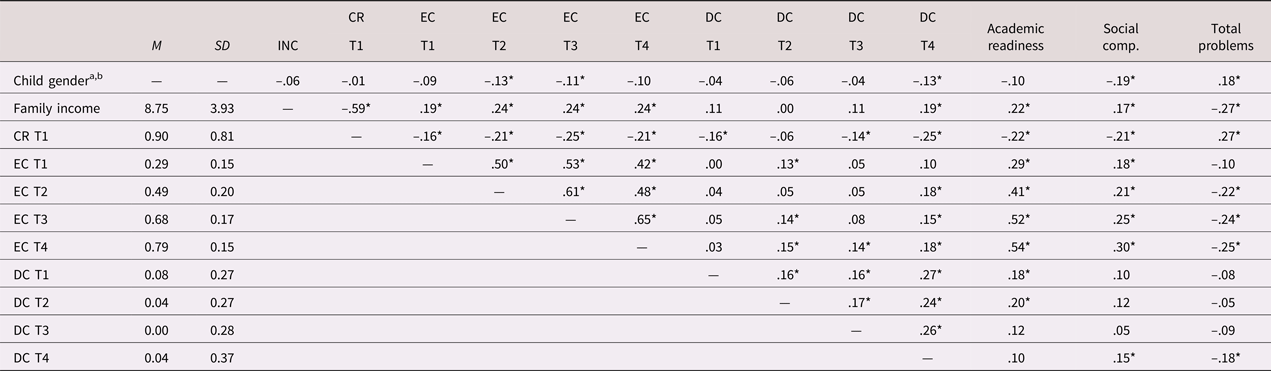
Descriptive statistics and correlations among the study variables are reported in Table 1. Average level of executive control increased across the time points, whereas average diurnal cortisol levels remained relatively consistent. Lower income was related to lower levels of executive control at all time points, and to lower levels of diurnal cortisol only at T4. Cumulative risk was related to lower executive control and lower diurnal cortisol at most time points. Both lower income and higher cumulative risk were associated with lower academic readiness and social competence and higher total problems at T4. Correlations between higher executive control and higher diurnal cortisol levels were significant at some time points. The pattern of correlations suggested that the hypothesized model was plausible.
Descriptive statistics and correlations among study variables

Note: aChild gender coded 0 = girl, 1 = boy. bPoint biserial correlations are reported for dichotomous variables. INC, income. T1–T4, Time 1–Time 4. CR, cumulative risk. EC, executive control. DC, diurnal cortisol. *p < .05.
Test of the effects of income and cumulative risk on executive control and diurnal cortisol, their bidirectional effects, and prediction of adjustment
A series of nested models was examined to test the extent to which income and cumulative risk predicted the growth factors (intercept and slope) of executive control and diurnal cortisol, whether there were bidirectional effects between these variables, and whether ultimate levels of executive control and diurnal cortisol predicted adjustment.
Unconditional executive control and diurnal cortisol growth models
Unconditional growth models of executive control and diurnal cortisol were tested first to identify models that reflected the form of growth of each variable. These were specified with the intercept reflecting T4 levels, and linear growth factors specified by the T1–T4 indicators. A linear growth model provided an acceptable fit for executive control, χ2 (5) = 25.97, root mean square error of approximation (RMSEA) = .08, comparative fit index (CFI) = .95. Executive control demonstrated an intercept significantly different than 0 (0.79, SE = 0.01, p < .001) with significant variance (0.02, SE = 0.002, p < .001), and a significant slope (0.10, SE = 0.002, p < .001) and significant variance in the slope (0.001, SE < 0.001, p < .001), indicating individual differences in rates of growth. A linear growth model fit the diurnal cortisol data poorly, χ2 (5) = 21.83, RMSEA = .11, CFI = .68, as would be expected given the observed mean values at each time point. A model that included a quadratic growth term also fit the data poorly, χ2 (1) = 10.99, RMSEA = .19, CFI = .81. Empirically based growth factor loadings were specified to represent the values of the observed means at each time point relative to the last time point while modeling unidirectional change (i.e., –1, –0.25, –0.2, 0) which resulted in an adequate fit to the data, χ2 (5) = 8.53, RMSEA = .05, CFI = .93. The intercept was significantly different than 0 (0.04, SE = 0.015, p = .008) with significant variance (0.023, SE = 0.007, p = .001). The average slope was significantly different than 0 (0.12, SE = 0.021, p < .001), with a trend toward significant variance in slope values (0.06, SE = 0.034, p = .07). Although the variance of the slope factor was not significant, we tested predictors of the cortisol slope as the additional degrees of freedom in these models and clarification of systematic variance by controlling for covariates can sometimes provide additional power to detect effects.Footnote 1
Tests of bidirectional effects of executive control and diurnal cortisol
A parallel growth model was specified in which correlated growth factors of executive control and diurnal cortisol were conditioned on T1 income, cumulative risk, and child gender, and the slopes and intercepts (i.e., T4 levels) of executive control and diurnal cortisol predicted T4 total adjustment problems, social competence, and academic readiness. This model demonstrated adequate fit to the data, χ2 (64) = 98.91, RMSEA = .04, CFI = .96. To test for potential bidirectional effects, directional effects were added in which the intercept of executive control was conditioned on the slope of diurnal cortisol, and the intercept of diurnal cortisol was conditioned on the slope of executive control. The addition of these effects, χ2 (60) = 89.98, RMSEA = .04, CFI = .96, resulted in a trend toward a significant improvement to the fit of the model, χ2 difference (4) = 8.93, p = .06; however, the effects of the slopes on intercepts were not significant, suggesting that the executive control and diurnal cortisol slope factors were not significant predictors of the T4 levels of the other variable.
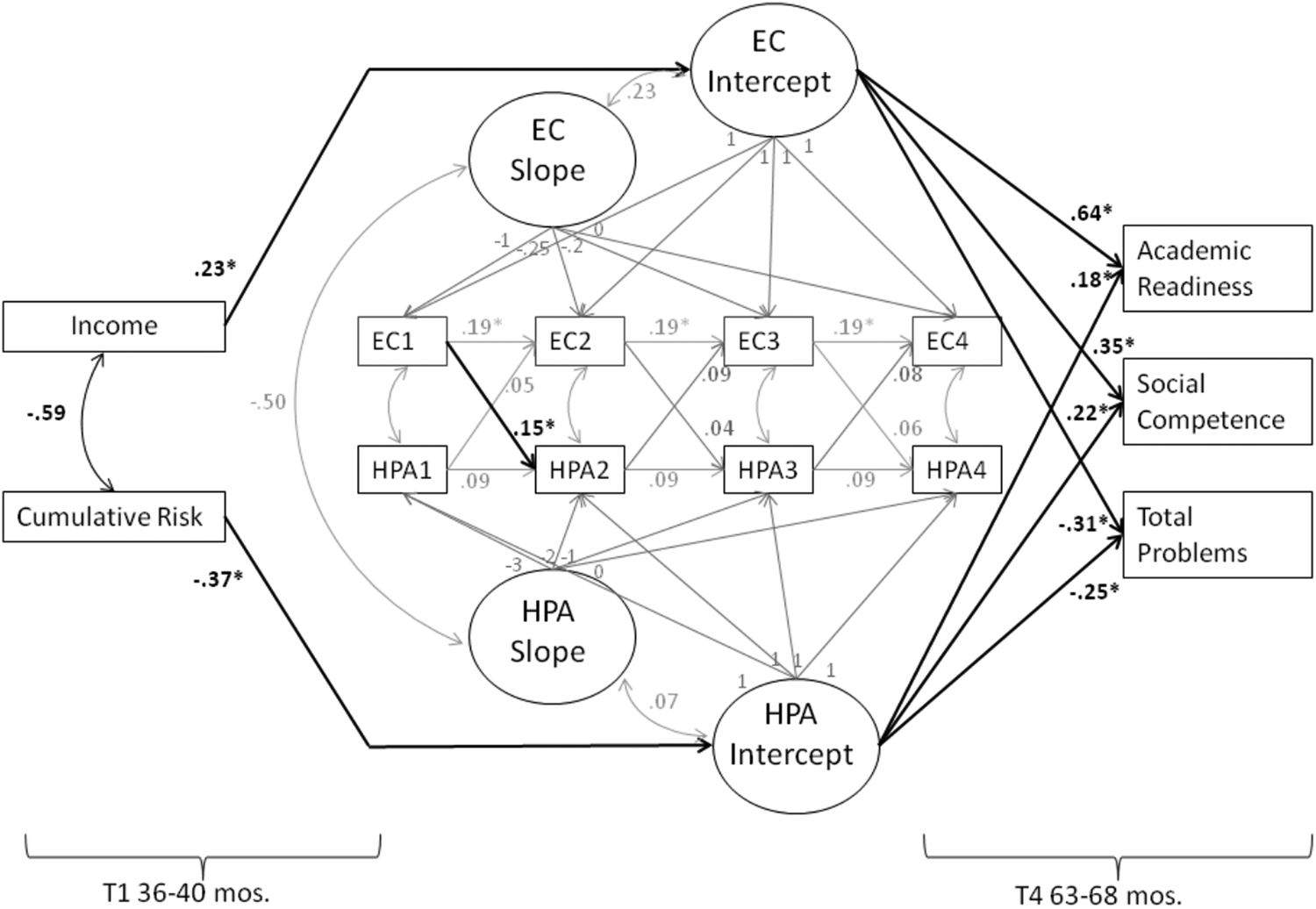
Autoregressive and cross-lagged effects of the T1–T4 residuals of executive control and diurnal cortisol and within-time residual correlations were included in the model, with within-construct autoregressive paths and between-construct, within-time residual correlations constrained to be equal, χ2 (59) = 78.14, RMSEA = .03, CFI = .98. This resulted in an improvement in model fit to the data, χ2 difference (5) = 20.77, p < .001. Autoregressive paths indicated modest stability of residuals for executive control and diurnal cortisol above the variance accounted for by the growth factors. Next, the cross-lagged paths from each time point of executive control and diurnal cortisol to the subsequent time point of the other variable were freed to vary to test whether there were time-specific bidirectional effects of executive control and diurnal cortisol, χ2 (55) = 68.45, RMSEA = .03, CFI = .99. This resulted in a significant improvement to the fit of the model, χ2 difference (4) = 9.69, p = .045. Only one cross-lagged path was significant, and that was for T1 executive control predicting T2 diurnal cortisol (β = .15, p = .01), although there was a trend toward an effect of T3 executive control on T4 diurnal cortisol (β = .06, p = .08) and a trend toward an effect of T3 diurnal cortisol on T4 executive control (β = .08, p = .08).
Effects of income and cumulative risk on executive control and diurnal cortisol
Based on the final model including directional slope effects, autoregressive and cross-lagged paths, and correlated residuals, we examined the effects of income and cumulative risk on executive control and diurnal cortisol intercept and slope factors (Figure 1). Neither the slope of executive control nor diurnal cortisol was predicted by income or cumulative risk. A higher intercept of executive control was predicted by higher income (b = 0.01, β = .23, p = .01), but not cumulative risk (b = –0.02, β = –.14, p = .09). A higher intercept of diurnal cortisol was predicted by lower cumulative risk (b = –0.05, β = –.37, p = .02), but not income (b = 0.03, β = .10, ns).
Model with standardized coefficients of the effects of income and cumulative risk on executive control and diurnal cortisol level, the bidirectional effects of executive control and diurnal cortisol, and their effects on children's academic readiness, social competence, and adjustment problems. Effects of child gender were covaried but are not depicted. *p < .05.

Effects of executive control and diurnal cortisol on adjustment
Above the effects of diurnal cortisol, the intercept of executive control significantly predicted lower T4 adjustment problems (b = –22.72, β = –.31, p < .001), higher social competence (b = 37.41, β = .35, p < .001), and higher academic readiness (b = 25.47, β = .64, p < .001). Above the effects of executive control, the intercept of diurnal cortisol predicted lower adjustment problems (b = –25.04, β = –.25, p = .01), higher social competence (b = 25.82, β = .22, p = .02), and higher academic readiness (b = 5.91, β = .18, p = .01). Adjustment outcomes were not predicted by the executive control or diurnal cortisol slope factors.Footnote 2 The possibility that both high and low levels of diurnal cortisol might be related to child adjustment was tested by examining the effects of a quadratic T4 diurnal cortisol term on child adjustment above the linear effects indicated by the intercept factor. These effects were nonsignificant.
Indirect effects of income and cumulative risk on adjustment
The indirect effects of income and cumulative risk through the intercepts of executive control and diurnal cortisol were tested to identify potential specific effects of income and cumulative risk. Given that the effects of income and cumulative risk on the slope factors were nonsignificant, these were not examined. Income had a significant indirect effect through the intercept of executive control on social competence (β = .07, p =.04), academic readiness (β = .15, p = .02), and a trend toward an indirect effect on adjustment problems (β = –.06, p = .07), whereas the indirect effects of income on adjustment through diurnal cortisol were all nonsignificant. Cumulative risk had significant indirect effects through diurnal cortisol on adjustment problems (β = .17, p = .01) and social competence (β = –.12, p = .04), but not on academic readiness, and the indirect effects of cumulative risk on adjustment through executive control were nonsignificant.
Discussion
In this study, we investigated the hypothesis that the effects of low income and cumulative risk on young children's adjustment would be accounted for by the additive effects of executive control and HPA axis regulation. Further, we hypothesized that disruptions in one aspect of self-regulation would have cascading effects on other aspects of self-regulation, with these bidirectional effects further accounting for the effects of income and cumulative risk on adjustment. In particular, exposure to low-income contexts and their associated chronic adversity were expected to predict lower executive control and dysregulation of the HPA axis, which we proposed would shape each other over time. There was little support for the hypothesis of bidirectional effects. However, executive control and HPA axis functioning each contributed uniquely to children's adjustment outcomes over and above the effects of the other, supporting the hypothesis that they have additive effects on adjustment. The results point to the value of examining multiple indicators of neurobiological systems of self-regulation simultaneously and support the presence of additive effects on children's adjustment, accounting for the effects of income and cumulative risk. There was also evidence of unique pathways of the effects of income and cumulative risk on children's adjustment through executive control and diurnal cortisol.
This study provided evidence that both executive control and diurnal cortisol independently contributed to children's adjustment above the effects of each other, implying they have additive effects on children's adjustment. This highlights the importance of considering multiple indicators of self-regulation simultaneously and supports the conjecture that income and cumulative risk have effects on children's adjustment in part through their impact on multiple self-regulatory systems. In the future, it would be useful to examine whether the effects of executive control and diurnal cortisol on adjustment problems are accounted for by distinct mechanisms, such as emotional versus behavioral dysregulation, or account for distinct adjustment problems, such as distinguishing internalizing and externalizing problems.
Interesting also was the suggestion in the results of unique pathways in the prediction of adjustment outcomes by income and cumulative risk. When cumulative risk is accounted for, income appears to be specifically related to children's executive control and has an indirect effect on children's adjustment through this effect. In addition, when income is accounted for, cumulative risk appears to be more relevant in the prediction of diurnal cortisol and has indirect effects on children's adjustment through this effect. It is important to note that these effect sizes, although significant, were small in magnitude. However, the distinct pathways highlight the value of examining low income and cumulative risk separately, as they appear to operate differently in relation to specific aspects of self-regulation. This is consistent with suggestions that different forms of stress or adversity can have differing effects on neurobiological systems underlying self-regulation (e.g., McLaughlin et al., Reference McLaughlin, Sheridan and Lambert2014). In addition, income and cumulative risk appear to have different effects on other potential mediating variables, such as parenting, that might account for their differential effects on aspects of self-regulation (Lengua et al., Reference Lengua, Kiff, Moran, Zalewski, Thompson, Cortes and Ruberry2014). In this study, when accounting for cumulative risk, which indexes contextual and family adversity and disruptions, the net effect of low income might capture few resources and greater uncertainty in meeting basic needs, including deficits in nutrition, cognitive and interpersonal experiences, and potentially less instrumental support from parents. Conversely, cumulative risk captures pervasive, chronic stress in the context that may also lead to greater negativity and conflict with parents, which may overwhelm the neuroendocrine stress response system resulting in a downregulation or blunting of the system. The specific effects of low income and cumulative risk on these potential mediating factors and other aspects of self-regulation should be examined in the future.
There is now ample evidence of the associations of low income and cumulative risk with lower executive control (Li-Grining, Reference Li-Grining2007; Mezzacappa, Reference Mezzacappa2004) and disrupted diurnal cortisol (Badanes et al., Reference Badanes, Watamura and Hankin2011; Fernald et al., Reference Fernald, Burke and Gunnar2008; Zalewski, Lengua, Fisher, et al., Reference Zalewski, Lengua, Fisher, Trancik, Bush and Meltzoff2012). This study expands the evidence in this area by considering a developmental model of self-regulation and by demonstrating how the effects of risk on adjustment might unfold over time through their effects on self-regulation. Specifically, it appears that levels of executive control and diurnal cortisol regulation attained in early childhood account for children's adjustment and readiness at school entry. These processes might represent a canalization of lower executive control and disrupted HPA axis regulation in early childhood with potential implications for later adjustment.
Few, if any, previous studies have examined the bidirectional, prospective associations of executive control and diurnal cortisol in young children. The results of this study provide minimal evidence of potential bidirectional effects once growth, average levels, and contextual factors were taken into account. Neither the slope of executive control nor of diurnal cortisol predicted the ultimate level of the other. However, there was some evidence of time-specific effects of the variables on each other. Adding the time-specific cross-lagged effects significantly improved the model fit, and albeit modest in magnitude, there was one significant and two trends toward significant cross-lagged effects. Most prior studies investigating these associations have tested cortisol as a predictor of executive control (e.g., Blair et al., Reference Blair, Granger, Willoughby, Mills-Koonce, Cox and Greenberg2011). The results of this study suggest the possibility that executive control affects HPA axis regulation as well. Initial executive control predicted changes in diurnal cortisol at the subsequent time point, with a trend toward an effect of executive control on diurnal cortisol, and vice versa, at later time points. However, given the modest effect sizes, these effects should be interpreted with caution. The results do point to the possibility that early executive control takes precedence in predicting diurnal cortisol in 3-year-old children. It is possible that young children who show higher executive control are better regulated in the face of stress or adversity, potentially managing their arousal, emotions, and behaviors more effectively, and they may have neuroendocrine stress systems that are more regulated as a result. These findings provide evidence of top-down regulation of HPA axis activity (Blair & Raver, Reference Blair and Raver2012).
There are several possible explanations for the minimal support for the hypothesized bidirectional effects. It is possible that executive control and diurnal cortisol levels are already established at this age or represent inherited individual differences, so that once accounting for the levels and stability, there was little variance remaining to be accounted for. Although possible, this is unlikely as other analysis with this data set demonstrate predictors of “state” levels of diurnal cortisol that represent specific time variations from trait levels (e.g., redacted for review, 2018), and other variables, specifically parenting, predict growth in executive control (e.g., Lengua et al., Reference Lengua, Kiff, Moran, Zalewski, Thompson, Cortes and Ruberry2014). It is also possible that any potential bidirectional effects were accounted for by the presence of contextual risk factors, particularly if those risk factors represent pervasive and chronic risk, such as indicated by low income and cumulative risk. In this case, contextual risk might operate as a third variable accounting for the associations and potential bidirectional effects between executive control and diurnal cortisol levels. This might parallel the recent findings that longitudinal effects of delay of gratification on adjustment were reduced when a wide range of family contextual, parenting, child cognitive ability, and temperament variables were controlled (Watts, Duncan, & Quan, Reference Watts, Duncan and Quan2018). Another possible explanation is that executive control and diurnal cortisol developmental processes operate on different time scales from each other, or on a time scale not captured in the assessments in this study, which were separated by 9 months. Finally, it is possible that cortisol levels have distinct and nuanced associations with specific aspects of executive control, as suggested by evidence regarding associations of acute stress and cortisol with specific executive functions (Shields, Sazma, & Yonelinas, Reference Shields, Sazma and Yonelinas2016). These alternative possibilities can be investigated in the future to contribute to our understanding about whether bidirectional effects between executive control and diurnal cortisol level exist. Further, there may be alternative processes or associations between executive control and diurnal cortisol that were not examined in this study. For example, it is possible that they interact such that they exacerbate each other's effects on children's adjustment, a possibility that should be examined in the future.
It is also interesting to note that the intercepts, and not the slopes, of executive control and diurnal cortisol were related to the predictors and outcomes in this study. For diurnal cortisol, this might reflect the fact that there was not significant individual variation around the average slope, although there was a trend toward significant variance. In addition, the pattern of change in diurnal cortisol levels was not well characterized by either a linear or a quadratic term, suggesting that there might not be a systematic pattern of change in diurnal cortisol levels. However, this does not explain the lack of significant associations with the executive control slope, which had both a significant linear slope pattern and significant variance around the average slope. The lack of association of income with the executive control growth is consistent with the results of another study that examined the relation of income to growth in executive function across early to middle childhood (Hughes et al., Reference Hughes, Ensor, Wilson and Graham2010). This might suggest that income has its effects on level of effortful control earlier in development, and that other factors not examined in this study, such as parenting and family relationships, might predict growth (for executive control) or time-specific levels (for diurnal cortisol), as indicated above.
However, the lack of association of executive control growth is inconsistent with prior evidence with preadolescent and adolescent children demonstrating that initial levels as well as rates of growth of effortful control were relevant to children's behavioral, social, and emotional adjustment (Bridget & Mayes, Reference Bridgett and Mayes2011; Hughes & Ensor, Reference Hughes and Ensor2009; King et al., Reference King, Lengua and Monahan2013). Thus, it is possible that the rate of developmental change is more relevant to children's adjustment when children are older and required to navigate their contexts more independently than during the preschool period, in which case a more accelerated rate of growth would be beneficial. In early childhood, it is possible that, for both executive control and diurnal cortisol, the level attained is more relevant than variation in growth rates, with children generally maintaining their rank order over time.
Notable strengths of the study include the longitudinal assessment of executive control and diurnal cortisol at multiple time points across the preschool period. Another strength of the study is the use of a relatively large sample that equally represented all levels of income, allowing robust tests of the effects of income and cumulative risk. In addition, multiple methods of assessment were utilized, including physiological, task performance, and parent and teacher reports, minimizing the likelihood that method variance or bias accounted for the observed effects.
However, the study also includes several limitations. First, only diurnal cortisol patterns were assessed in this study, whereas the inclusion of cortisol reactivity or awakening responses would have allowed clarification of the effects of adversity on the regulation of the neuroendocrine stress system and facilitated comparisons of findings with other related studies. Second, a cumulative risk score was used to capture income-related stress and adversity, in part to simplify already complicated models. Although there is value in utilizing a cumulative risk score to capture the burden of stress and adversity often associated with low income, there is also value in examining the specific effects of individual risk factors included in the cumulative risk score. Third, this study was not able to address the role that racial or ethnic background might play in experiences of low income and cumulative risk, as the study was not designed to adequately examine this. Low income was confounded with minority status, particularly for African American families, and we did not assess experiences of discrimination to facilitate understanding of additional sources of stress for families with diverse racial and ethnic backgrounds. Future studies should carefully recruit participants with representation across the range of income and risk levels for each ethnic and racial group included, such that the effects of income, cumulative risk, and race or ethnicity can be clarified. Fourth, we adopted a latent growth curve and autoregressive latent trajectory modeling framework to test the potential bidirectional effects between executive control and cortisol levels. However, latent growth curve models may not have been the optimal analytic approach for the cortisol data. Although the minimal evidence of bidirectional effects should be replicated, it also points to the need to examine the relations between cortisol levels and executive control in models that capture alternative temporal relations between them to specify the developmental processes that account for their association.
Future research could clarify the effects of low income and cumulative risk on children's developing self-regulation systems by following children from birth or even prenatally, to map the early effects of adversity on the neurobiological systems underlying self-regulation and the unfolding of self-regulation over time. For example, there is evidence of the association of prenatal stress exposure with later mental health problems (e.g., Class et al., Reference Class, Abel, Khashan, Rickert, Dalman, Larsson and D'Onofrio2014; Li, Olsen, Vestergaard, & Obel, Reference Li, Olsen, Vestergaard and Obel2010; Phillips, Hammen, Brennan, Najman, & Bor, Reference Phillips, Hammen, Brennan, Najman and Bor2005), and disruptions to self-regulation, such as HPA axis functioning (Huzink et al., Reference Huizink, Bartels, Rose, Pulkkinen, Eriksson and Kaprio2008), might account for these effects. In addition, it would be valuable to follow children into preadolescence and adolescence to examine the long-term differential effects of executive control and diurnal cortisol on emerging emotional, behavioral, and mental health problems in adolescence (e.g., Martin, Davies, Cummings, & Cicchetti, Reference Martin, Davies, Cummings and Cicchetti2017). Finally, examination of additional aspects of self-regulation, including emotion regulation and physiological reactivity, could elucidate potential cascading effects of disruptions in multiple self-regulation systems in the context of risk (e.g., El-Sheikh, Erath, Buckhalt, Granger, & Mize, Reference El-Sheikh, Erath, Buckhalt, Granger and Mize2008).
In sum, the results of this study indicate that executive control and diurnal cortisol additively contribute to children's adjustment problems, accounting for the effects of income and adversity on children's outcomes, and point to modest bidirectional effects. In terms of translational implications, interventions aimed at improving child outcomes that address one aspect of children's self-regulation, for example, only promoting executive function through training in executive function tasks or activities, might be hampered by failure to address other aspects of self-regulation simultaneously. It might be more fruitful to consider interventions that simultaneously promote multiple aspects of self-regulation. For example, prior research has shown that aspects of parenting, such as scaffolding and consistent limit setting, promote the development of executive function (Devine, Bignardi, & Hughes, Reference Devine, Bignardi and Hughes2016; Lengua et al., Reference Lengua, Kiff, Moran, Zalewski, Thompson, Cortes and Ruberry2014), while other aspects of parenting, such as negativity, might predict disruptions to diurnal cortisol regulation (Zalewski, Lengua, Kiff, et al., Reference Zalewski, Lengua, Kiff and Fisher2012). Most behavioral parenting programs target both reducing negativity and increasing warmth and consistent limit setting, thus, potentially impacting both executive control and HPA axis regulation. The results of this study highlight that both executive control and diurnal cortisol regulation impact children's adjustment, and interventions that target multiple aspects of self-regulation and the factors that shape them are ultimately more likely have a meaningful effect on children's adjustment.
Acknowledgments
The authors thank the families who participated in this study.
Financial support
Support for this research was provided by National Institute of Child Health and Human Development Grant R01HD054465 awarded to the first author.