INTRODUCTION
Rainfed agriculture plays an important role in contributing to world food security. In India, the land area under rainfed agriculture is 85 million ha representing 60% of net cultivated area and supports 40% population of the country. Apart from climatic constraints of erratic and uncertain rainfall, soils are highly degraded physically, chemically and biologically in rainfed regions (Maruthi Sankar et al., Reference Maruthi Sankar, Sharma, Dhanapal, Shankar, Mishra, Venkateswarlu and Kusuma Grace2010; Sharma et al., Reference Sharma, Mandal, Srinivas, Vittal, Mandal, Grace and Ramesh2005; Vittal et al., Reference Vittal, Maruthi Sankar, Singh, Balaguravaiah, Padamalatha and Yellamanda Reddy2003). The intensive tillage practices employing inversion implements such as mould board plough result in loss of surface crop residue and subsequent loss of soil organic carbon (SOC) from soil aggregates. This in combination with imbalanced fertilization and poor recycling of crop residues resulted in deterioration of soil quality leading to low crop productivity in rainfed regions (Campbell et al., Reference Campbell, Selles, Lafond and Zentner2001; Roldan et al., Reference Roldan, Caravaca, Hernande, Garcia, Sanchez-Brito, Velasque and Tiscareno2003; Sharma et al., Reference Sharma, Kusuma Grace, Mandal, Pravin Gajbhiye, Srinivas, Korwar, Ramesh, Ramachandran and Yadav2008b). Practices, such as zero or reduced tillage, green manuring, recycling of residues, proved effective in improving soil fertility and quality in irrigated and temperate regions (Unger, Reference Unger1990). No-tillage (NT) farming practiced in combination with growing a cover crop in rotation is widely recognized as a viable alternative to ‘plough tillage’ as a way to improve the environment and sustain natural resources.
Lal (Reference Lal2007) reported that the benefits of zero till farming in combination with residue retention are substantial in terms of erosion control, water conservation, soil fertility enhancement and C sequestration. After harvesting, the crop residue is removed from the soil surface for feeding livestock and used as fuel for domestic cooking. Due to moisture scarcity in rainfed areas, there is little scope to grow green manure and biomass generating crops without incurring loss on account of losing cropping season. Consequently, there is very low residue recycled back to fields. Sharma et al. (Reference Sharma, Mandal, Srinivas, Vittal, Mandal, Grace and Ramesh2005), reported that minimum tillage, when practiced in combination with 90 kg N ha−1 in castor–sorghum system, maintained desirable soil quality index of 1.10 in rainfed Alfisols. Further, they reported that to maintain higher yield as well as soil quality, primary tillage along with organic residues and N application are crucial. Reports also revealed that elimination of summer fallowing in arid and semi-arid regions and adopting NT with residue mulch improved soil structure, reduced bulk density, increased infiltration rate and productivity (Lal, Reference Lal2004; Shaver et al., Reference Shaver, Peterson, Ahuja, Westfall, Sherrod and Dunn2002). Minimum tillage maintains lower temperature, water, oxygen and thereby induces suitable environment for growth and activity of microflora and microfauna (Blevins and Frye, Reference Blevins and Frye1993; Follet, Reference Follet1990). Thus, optimum tillage combined with weed and fertilizer would be essential not only to enhance crop productivity but also to maintain soil health and sustainability (Maruthi Sankar et al., Reference Maruthi Sankar, Vittal, Ravindra Chary, Ramakrishna and Girija2006; Nema et al., Reference Nema, Maruthi Sankar and Chauhan2008).
Camara et al. (Reference Camara, Payne and Rasmussen2003) studied long-term effects of tillage, nitrogen and rainfall on wheat yields and found that despite beneficial effects on soil properties, conservation tillage tended to be less productive than ploughing with mould board due to poor control of downy brome weed control under low-tillage treatment. Sharma et al. (Reference Sharma, Abrol and Sharma2011) found that minimum tillage in combination with mulches had pronounced effect on soil physical properties, productivity, energy requirement, monetary returns of maize–wheat system in subhumid Inceptisols. Experience of Watts et al. (Reference Watts, Torbert, Prior and Huluka2008) revealed that long-term application of poultry litter resulted in higher C and N mineralization compared to inorganic fertilizer. They found that as depth increased, more C and N mineralization occurred under conventional tillage (CT) due to plough layer mixing, apart from increased nutrient retention and organic matter. Videnovic et al. (Reference Videnovic, Simic, Srdic and Dumanovic2011) attained significantly higher maize yields with CT compared to reduced tillage and NT, irrespective of fertilizer application in a Chernozem soil. Though much effort have gone into such studies in temperate regions, systematic long-term studies in rainfed semi-arid tropical regions are rare, especially in developing countries because of difficulties in controlling weeds, less water infiltration in compacted soil and non-availability of appropriate seeding implements (Sharma et al., Reference Sharma, Kusuma Grace, Mandal, Pravin Gajbhiye, Srinivas, Korwar, Ramesh, Ramachandran and Yadav2008b).
Rice, in general, is an important crop of tropical and subtropical countries. In Asia, India and China are leading countries where rice contributes significantly towards food basket. In India, rice is grown in an area of 43.77 million ha with production of 96.43 million tones. The productivity of rice during 2007 was 3208 kg ha−1. The low rice productivity is attributed to low and erratic rainfall distribution, inappropriate tillage, low soil fertility and suboptimal fertilizer levels used by farmers. The long-term effects of tillage and fertilizer practices on productivity and profitability of rice in kharif at all locations and lentil in rabi in Inceptisols of Varanasi and Faizabad; horse gram and linseed in Alfisols of Phulbani and Ranchi, respectively, are assessed in this study. The objectives of the study were: (i) to identify an efficient tillage and nutrient management treatment for sustainability of productivity, profitability and energy use efficiency (EUE) in different cropping systems for different locations.
MATERIALS AND METHODS
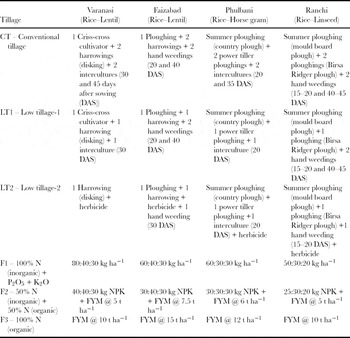
Field experiments were conducted at four locations of All India Coordinated Research Project for Dryland Agriculture to identify efficient tillage and fertilizer treatments for maximum productivity, profitability and EUE in: (i) rice (Oryza sativa) in kharif (June to October) at all locations followed by (ii) lentil (Lens esculentus) in rabi (October to February) at Varanasi and Faizabad, and (iii) horse gram (Dolichos biflorus) at Phulbani and linseed (Linum usitatissimum L.) at Ranchi during 2001 to 2010. The climate and soil types representing the study locations were dry subhumid Inceptisols at Varanasi and Faizabad and moist subhumid Alfisols at Phulbani and Ranchi. The experiments were conducted in a split-plot design with three replications. The treatments were randomized and superimposed to plots in the first year and continued every year in the same plots in subsequent years. These were only to the kharif crop, and the rabi crop was raised under residual soil fertility. The main plot treatments were: (i) conventional tillage (CT), (ii) low tillage + interculture (LT1) and (iii) low tillage + herbicide (LT2). The subplot treatments were: (i) 100% N (organic) (F1), (ii) 50% N (organic) + 50% N (inorganic) (F2) and (iii) 100% N (inorganic) (F3). The details of tillage operations performed and fertilizer treatments applied are given in Table 1. Farmyard manure (FYM) was used as organic source at all locations. Nitrogen @ 60 kg ha−1 was applied at Phulbani and Faizabad, while 80 and 50 kg ha−1 was applied at Varanasi and Ranchi, respectively. Standard crop management practices were adopted at each location from sowing to harvest (Vittal et al., Reference Vittal, Maruthi Sankar, Singh and Samra2002).
Tillage practices and fertilizer treatments adopted at different locations.

Soil and agronomic details
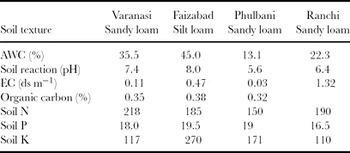
Soil samples were collected from experimental sites before the start and at the end of the study and analyzed for physical and chemical parameters viz., soil pH and electrical conductivity (Rhoades, Reference Rhoades, Page, Miller and Keeney1982), organic C (Walkley and Black, Reference Walkley and Black1934), available N (Subbaiah and Asija, Reference Subbaiah and Asija1956), P (Olsen et al., Reference Olsen, Cole, Watanabe and Dean1954), K (Hanway and Heidel, Reference Hanway and Heidel1952) and bulk density using soil cores (Blake and Hartge, Reference Blake, Hartge and Klute1986). Soil water retention at permanent wilting point (PWP) and field capacity (FC) was measured using pressure plate apparatus at −1.5 MPa and −0.033 MPa (Cassel and Nielsen, Reference Cassel, Nielsen and Klute1986). The details pertaining to the initial soil fertility status of different locations are given in Table 2.
Details of initial soil characteristics of different locations.

Rainfall and its distribution
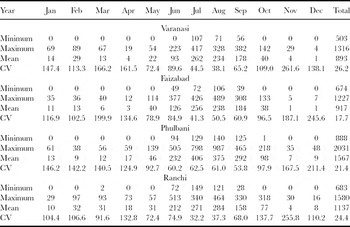
The data on monthly rainfall from sowing to harvest of crops during 2001 to 2010 were considered for assessing tillage and fertilizer treatments at different locations. In kharif, the total rainfall at Varanasi ranged from 453 to 1249 mm with mean of 806 mm and coefficient of variation (CV) of 29%, while it ranged from 547 to 1194 mm with mean of 842 mm (CV 22%) at Faizabad. At Phulbani, rainfall ranged from 753 to 1886 mm with mean of 1402 mm (CV 26%), while it ranged from 509 to 1242 mm with mean of 790 mm (CV 31%) at Ranchi. About 80% of annual rainfall was received in kharif (June to October) at all locations. The descriptive statistics of monthly rainfall received in different years at the four locations are given in Table 3.
Monthly rainfall (mm) received at different locations during 2001 to 2010.

Statistical analysis
The analysis of variance (ANOVA) was performed by using SPSS version 16 to test the tillage and fertilizer treatment effects. The treatment differences could be compared based on least significant difference (l.s.d.) criteria (Gomez and Gomez, Reference Gomez and Gomez1984).
One of the criteria adopted to identify an efficient tillage and fertilizer treatment was sustainability yield index (SYI), which is derived as a ‘ratio of the difference of mean yield and prediction error based on regression model and maximum yield attained by any treatment over years’ (Behera et al., Reference Behera, Maruthi Sankar, Mohanty, Pal, Ravindra Chary, Subba Reddy and Ramakrishna2007; Maruthi Sankar et al., Reference Maruthi Sankar, Mishra, Sharma, Singh, Nema, Kathmale, Upadhye, Sidhpuria, Osman, Ravindra Chary, Kusuma Grace, Venkateswarlu and Singh2011; Vittal et al., Reference Vittal, Maruthi Sankar, Singh, Balaguravaiah, Padamalatha and Yellamanda Reddy2003). The rainwater use efficiency (RWUE; kg ha−1 mm−1) of the treatments was also computed, which is expressed as a ratio of yield (kg ha−1) and crop seasonal rainfall (CRF; mm) (Rockstrom et al., Reference Rockstrom, Barron, Fox, Kijne, Barker and Molden2003).
In order to establish a relationship between CRF and performance of each treatment, we calculated the deviations between the mean yields of each treatment from overall mean of the treatments for a given year. The effect of CRF on the deviations of individual treatment yields from the overall mean was assessed based on a linear regression model as follows:
 \begin{equation}
Yd = \pm \alpha \pm \beta \,\,{\rm (CRF),}\end{equation}
where α is the intercept, β is the slope of the rainfall effect on yield deviations of a treatment and CRF is the crop seasonal rainfall from sowing to harvest of a crop. Those treatments, which maintained positive β values under different rainfall conditions, were considered quite superior from the viewpoint of sustainability and efficient use of natural resources.
In order to compute the profitability of tillage and fertilizer treatments over years, the gross and net returns and benefit-cost (BC) ratio were calculated (Maruthi Sankar et al., Reference Maruthi Sankar, Subramanian, Sharma, Mishra, Jyothimani, Bhaskar, Jawahar, Rajeswari, Taghavan, Ravindra Chary, Renuka Devi, Gopinath, Venkateswarlu and Kusuma Grace2012; Nema et al., Reference Nema, Maruthi Sankar and Chauhan2008). The gross returns (Rs ha−1) were computed as a product of mean yield of each treatment over years and value of the crop at each location. The net returns (Rs ha−1) were computed as a difference of gross returns and cost of cultivation (Rs ha−1) for each treatment. The BC ratio was derived as a ratio of gross returns and cost of cultivation for each treatment.
The input energy (MJ ha−1) was computed for each treatment by cumulating all the energy values (MJ ha−1) used for different inputs like seed, fertilizer, herbicide, labour, animal and implements for land preparation, sowing, interculture, harvesting and other agricultural operations. The output energy was computed from the grain and straw yield harvested and expressed in terms of MJ ha−1. The EUE could be derived as a ratio of output and input energy for each treatment in kharif and rabi crops. The test for significance of the treatments for profitability and energy use was performed using μ ± SD criterion. Based on these criteria, tillage and fertilizer treatments were grouped into:
(i) a (<μ − SD), (ii) b (μ ± SD) and (iii) c (>μ + SD),
where μ is the mean and SD is the standard deviation.
The treatments whose profitability and EUE values were >μ + SD were ranked significantly superior.
RESULTS
Effect of tillage and fertilizer treatments on crop yield
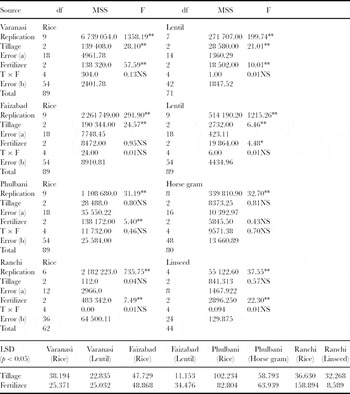
Based on the pooled analysis of long-term data (2001 to 2010), using standard analysis of variance of a split-plot design, the effects of tillage, fertilizer and their interactions were tested (Table 4). Significant (p < 0.05) tillage effect was observed in Inceptisols at Varanasi and Faizabad, while it was non-significant in Alfisols at Phulbani and Ranchi. The fertilizer effect was significant (p < 0.05) at Varanasi for rice and lentil, Ranchi for rice and linseed and also for rice at Phulbani and lentil at Faizabad. There was no significant interaction of tillage and fertilizer at all locations. At Varanasi, tillage and fertilizer treatments significantly (p < 0.05) influenced the rice yield over years. CT was found superior with maximum mean yield of 2389 kg ha−1, while F1 was superior with yield of 2378 kg ha−1. When the effects of tillage and fertilizer treatments were seen on the succeeding lentil crop, significant (p < 0.05) influence was observed on crop yield. CT gave maximum mean lentil yield of 927 kg ha−1, while F3 gave mean yield of 917 kg ha−1. At Faizabad, significant (p < 0.05) effect of tillage and fertilizer on rice yield was observed over years. CT was superior with mean rice yield of 1851 kg ha−1, while F1 was superior with 1704 kg ha−1. In lentil, CT was superior with mean yield of 977 kg ha−1, while F1 was superior with 993 kg ha−1 yield.
ANOVA of the effect of treatments on yield over years at different locations.

* and ** indicate significance at p < 0.05 and p < 0.01 level, respectively.
At Phulbani, only fertilizer treatments showed significant (p < 0.05) effect on rice yield over years. F2 was found superior with mean rice yield of 1170 kg ha−1. At Ranchi, fertilizer treatments significantly influenced the crop yield. F2 was superior in rice with mean yield of 986 kg ha−1, while F3 was superior in linseed with mean yield of 224 kg ha−1 over years.
Relationship between crop seasonal rainfall and crop yields in different treatments
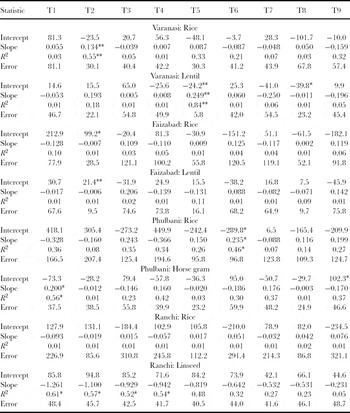
In order to assess the effect of CRF on the performance of a treatment for sustainability and resource use efficiency, models were developed between the mean yields of each treatment from overall mean of the treatments for a given year (Table 5). These linear regression models helped in understanding the performance of treatments with changing CRF. The slope of the model equations reflected the increasing trend in rice yield over mean (positive deviations) with an increase in CRF at most of the locations. However, the decreasing trend in yield over mean (negative deviation) with the increase in CRF was observed at Faizabad for lentil, Phulbani for horse gram and Ranchi for linseed except for lentil in Varanasi. Beside this, it was also observed that fertilizer treatments comprising of either organic nutrient source (F1) alone or in combination with inorganics (F2) in rice tended to reflect significant positive influence on yield deviations over mean with increase in CRF.
Effect of crop seasonal rainfall on the deviation of mean yield with different tillage and fertilizer treatments at different locations.

* and ** indicate significance at p < 0.05 and p < 0.01 level, respectively. R 2: Coefficient of determination.
Rainwater use efficiency of tillage and fertilizer treatments
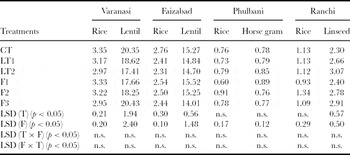
CT was superior for maintaining significantly higher RWUE of 3.35 kg ha−1 mm−1 for rice and 20.35 kg ha−1 mm−1 for lentil at Varanasi; 2.76 kg ha−1 mm−1 for rice and 15.27 kg ha−1 mm−1 for lentil at Faizabad. The tillage treatments were at par for both rice and horse gram at Phulbani and rice at Ranchi, while LT2 was superior with RWUE of 3.07 kg ha−1 mm−1 for linseed at Ranchi (Table 6). F1 was superior with RWUE of 3.33 kg ha−1 mm−1 at Varanasi and 2.54 kg ha−1 mm−1 at Faizabad for rice; while F2 was superior with 0.91 kg ha−1 mm−1 at Phulbani and 1.34 kg ha−1 mm−1 at Ranchi. In rabi, F1 was superior with RWUE of 15.52 kg ha−1 mm−1 for lentil at Faizabad and 0.89 kg ha−1 mm−1 for horse gram at Phulbani; while F3 was superior with 20.43 kg ha−1 mm−1 for lentil at Varanasi and 2.91 kg ha−1 mm−1 for linseed at Ranchi (Table 6). There was no significant interaction of tillage and fertilizer treatments in influencing RWUE at all locations.
Effect of tillage and fertilizer treatments on mean rainwater use efficiency (kg ha−1−mm−1) of crops at different centres.

Profitability of tillage and fertilizer treatments
There was a marginal variation in the cost of cultivation and value of rice, lentil, horse gram and linseed grain and fodder in different years. The cost of cultivation differed for treatments in rice. However, it was the same for all treatments in rabi, since the crop was sown under zero-tillage with residual soil fertility condition.
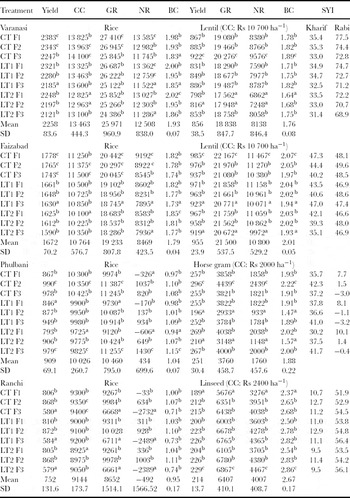
The mean value of rice was Rs 11.5 kg−1 for all locations and the cost of cultivation differed according to the tillage and fertilizer treatments in kharif season. The cost of cultivation was Rs 10700 ha−1 for lentil at Varanasi and Faizabad; Rs 2000 ha−1 for horse gram at Phulbani; and Rs 2400 ha−1 for linseed at Ranchi (Table 7).
Profitability (Rs) and SYI of tillage and fertilizer treatments at different locations.

CC: Cost of cultivation (Rs ha−1); GR: Gross returns (Rs ha−1); NR: Net returns (Rs ha−1); BC: Benefit-cost ratio.
a: <μ − SD; b: μ ± SD; c: >μ + SD.
At Varanasi, rice crop had mean cost of cultivation of Rs 13463 ha−1 and attained net returns of Rs 12508 ha−1 and BC ratio of 1.93. The lentil crop gave mean net returns of Rs 8138 ha−1 and BC ratio of 1.76. The analysis indicated that CTF1 was superior with total net returns of Rs 21965 ha−1 from the rice–lentil cropping system. At Faizabad, rice crop had mean cost of cultivation of Rs 10764 ha−1 resulting in net returns of Rs 8469 ha−1 and BC ratio of 1.79. In lentil, net returns of Rs 10800 ha−1 and BC ratio of 2.01 were attained (Table 7). Using the μ ± SD criteria, CTF1 was found superior with total net returns of Rs 20659 ha−1 from rice and lentil crops grown in sequence. At Phulbani, rice crop had mean cost of cultivation of Rs 10026 ha−1 and attained net returns of Rs 434 ha−1 and BC ratio of 1.04. In horse gram, net returns of Rs 1760 ha−1 and BC ratio of 1.88 were attained. CTF2 was significantly superior with total net returns of Rs 3476 ha−1 from rice and horse gram cropping sequence.
At Ranchi, rice crop had mean cost of cultivation of Rs 9144 ha−1 with net returns of Rs −492 ha−1 and BC ratio of 0.95. In linseed, net returns of Rs 4007 ha−1 and BC ratio of 2.67 were attained. LT2F2 was found significantly superior with total net returns of Rs 5383 ha−1 from rice and linseed crops under moist subhumid Alfisols. When the yield sustainability was considered, in kharif, CTF1 at Varanasi and Faizabad, CTF2 at Phulbani, LT1F2 at Ranchi were superior in maintaining relatively higher SYI. In rabi, CTF1 maintained higher SYI at Varanasi; CTF2 at Faizabad for lentil; LT2F1 for horse gram at Phulbani and LT2F3 for linseed at Ranchi (Table 7).
Energy use efficiency of tillage and fertilizer treatments
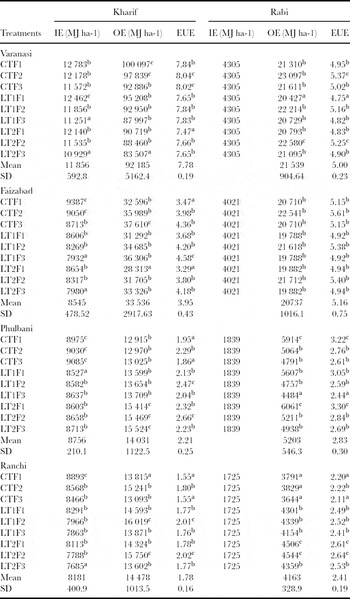
The data pertaining to input energy (MJ ha−1) of different agricultural operations from sowing to harvest, output energy (MJ ha−1) attained and EUE of treatments at different locations are given in Table 8. At Varanasi, with input energy of 11856 MJ ha−1, output energy of 92185 MJ ha−1 was attained in rice with EUE of 7.78. In lentil, with input energy of 4305 MJ ha−1, output energy of 21539 MJ ha−1 was attained with EUE of 5.00. Based on μ ± SD criteria, CTF1 and LT2F2 gave significantly higher maximum output energy in kharif and rabi, respectively. However, CTF2 gave maximum EUE in both the seasons.
Effect of tillage and fertilizer treatments on input and output energy at different locations.

a: <μ − SD; b: μ ± SD; c: > μ + SD.
At Faizabad, in rice, with input energy of 8545 MJ ha−1, output energy of 33536 MJ ha−1 was attained, the mean EUE being 3.95. In lentil, with input energy of 4021 MJ ha−1, output energy of 20737 MJ ha−1 was attained and EUE observed was 5.16. CTF3 in kharif and CTF2 in rabi gave maximum output energy, while LT1F3 and LT1F2 gave maximum EUE in kharif and rabi.
At Phulbani, with input energy of 8756 MJ ha−1, output energy of 14031 MJ ha−1 was attained while mean EUE observed was 2.21. In horse gram, with input energy of 1839 MJ ha−1, output energy of 5203 MJ ha−1 with EUE of 2.83 were attained. LT2F3 gave maximum output energy and LT2F2 gave maximum EUE in rice, while LT2F1 gave maximum of both the parameters in horse gram.
At Ranchi, with mean input energy of 8181 MJ ha−1 in rice, output energy of 14478 MJ ha−1 was attained with EUE of 1.78. In linseed, with input energy of 1725 MJ ha−1, output energy of 4163 MJ ha−1 and EUE of 2.41 were attained. LT2F2 gave maximum EUE in rice and maximum of both the parameters in linseed.
DISCUSSION
The critical analysis of data obtained from 10-year long study with tillage and fertilizer treatments in a permanent site using different yardsticks viz., crop response in terms of yield indicated that CT maintained 5.56 and 12.80% higher rice yield over low tillage levels viz., LT1 and LT2, respectively, at Varanasi. Similarly, F1 was found superior over F2 and F3 by maintaining 3.53 and 12.9% higher rice yield, respectively. The succeeding lentil crop got benefited by CT resulting in 14.9 and 7.8% higher yield over LT2 and LT1, respectively. However, in this case, among the fertilizer treatments, the benefit of organic manure alone and their conjunctive use with inorganics was higher. CTF1 found superior in terms of attaining maximum productivity besides improving RWUE and EUE in rice–lentil system. This implies that tilling of rainfed Inceptisol soils of Varanasi conventionally and adding 100% N through organic source was beneficial for sustaining yield and profitability of crop for a longer period. At Faizabad, CT gave 14.4 and 19.80% higher rice yield and 2.84 and 3.82% higher lentil yield over LT1 and LT2, respectively. Similarly, F1 gave 4.2 and 1.48% higher rice yield and 1.7 and 10.7% lentil yield over F2 and F3, respectively. In this case also, CTF1 combination was found superior for attaining maximum productivity besides giving advantage in terms of RWUE of rice and lentil crops. Earlier study has also revealed the importance of organics on rice–lentil system in Inceptisols (Singh et al., Reference Singh, Varma and Singh2004). Sharma and Mitra (Reference Sharma and Mitra1991) and Das and Mandal (Reference Das, Mandal and Das1986) reported that organic manure decomposition induced transformation and modified the mechanics and dynamics of nutrient mobilization. In this process, the part of nutrients remained unutilized by the main crop is expected to help growth and development of succeeding crop in addition to advantages associated with improved physical properties of soil. In the present study also, residual effect of organic manure has benefited the succeeding crop.
At Phulbani, LT2 recorded 8.33 and 3.57% higher rice yield compared to LT1 and CT, respectively. F2 was found superior with 54.76 and 16.76% higher yield compared to F1 and F3, respectively. Similarly, in case of horse gram, LT2 was superior and recorded 13.65 and 3.08% higher yield over LT1 and CT, while F1 gave 29.64 and 46.5% higher horse gram yield over F2 and F3, respectively. In case of rice in Alfisol soils of Phulbani, the higher yield advantage accrued under LT2 and F2 (integrated nutrient use, 50:50) could be due to better microbial biodiversity and activity, better soil structure, reduced soil loss through erosion and release and availability of nutrients synchronizing with plant uptake (Kihara et al., Reference Kihara, Bationo, Waswa, Kimetu, Vanlauwe, Okeyo, Mukalama and Martius2012; Landers, Reference Landers, Goddard, Zoebisch, Gan, Ellis, Watson and Sombatpanit2008). The succeeding horse gram crop at this location got more benefited from LT2 with F1. This could be possibly due to better soil condition under LT2 and sustained release of nutrients through organic manures. Horse gram being a sturdy rainfed legume crop relatively needs less tillage and low but sustained nutrient supply. Thus, it performed well under LT2 and F1 combination. At Ranchi, despite non-significant effect of tillage and fertilizer, LT2F2 combination helped in achieving higher yield benefits in rice–linseed system. Earlier studies of Roul and Mahapatra (Reference Roul and Mahapatra2006) have revealed the higher residual fertility effects of conjunctive use of organic and inorganic source of nutrients in linseed when grown after the harvest of rice. This may be attributed to slow and sustained release of nutrients, enhanced nutrient use efficiency and improved soil properties (Sarkar and Singh, Reference Sarkar and Singh1997).
The increasing trend in yield of rice crop and decreasing or negative trend in succeeding crops like lentil, horse gram and linseed with increase in rainfall was obviously due to more requirement of water in main crop (rice) and relatively less water requirement in succeeding crops. It is important to emphasize here that, lentil, horse gram and linseed crops are mostly raised on residual moisture available after the harvest of rice crop. Whenever, there are more rains leading to water stagnation in the field during rabi season, these crops grown after rice are severely affected, if there is no adequate provision for drainage.
Though, productivity and resource use efficiency parameters such as RWUE, EUE are important but the fact remains that farmers’ prime motive to do agriculture is to earn higher income and profitability. Thus, in the present study, finally, we considered economics or profitability analysis as more important and relevant criteria to narrow down the recommendations for the farming community. CTF1 performed better in terms of net returns and BC ratio in rainfed Inceptisol soils at Varanasi and Faizabad. When profitability was taken as the criteria, at Phulbani, CTF2 recorded significantly higher net returns and BC ratio, hence proved superior and could be considered for recommendation in rainfed Alfisol soils of this region. LT2F2 combination in moist subhumid Alfisols at Ranchi was superior for net returns and BC ratio and could be considered for recommendation to the farmers.
In general, in rainfed agriculture, two cardinal principles that help in growing a weed-free good crop are: practicing summer tillage (conventional method) to kill the weed seeds by exposing them to hot weather and capture pre-monsoon and monsoon rainwater in profile by way of loosening soil surface and enhancing infiltration rate. The CT also helps in loosening seedbed for good soil aeration, better root growth and ultimately bumper crop growth. The importance of tillage in weed control was highlighted by Richey et al. (Reference Richey, Griffith and Parsons1977) and Hatfield (Reference Hatfield1990). They reported that tillage aids in weed control by killing emerging seedlings, burying seeds, delaying growth of perennials and providing loose surface soil for efficient action of herbicide. Perhaps, because of some of these above benefits, CT at Varanasi, Faizabad and Phulbani proved effective in giving higher returns. In Alfisols of Ranchi, LT2 was found superior in terms of profitability probably due to better plant growing environment and effective weed control through herbicides owing to higher productivity and saving energy on tillage operations.
In general, it is well established that beneficial effects of low tillage can be accrued more effectively, if adequate amount of crop residue is retained on the soil surface on a long-term basis (Lal, Reference Lal1989, Sharma et al., Reference Sharma, Mandal, Srinivas, Vittal, Mandal, Grace and Ramesh2005, Reference Sharma, Kusuma Grace, Mandal, Pravin Gajbhiye, Srinivas, Korwar, Ramesh, Ramachandran and Yadav2008b). Unger (Reference Unger1990) reported that surface residue along with low tillage reduced runoff and increased infiltration. At all the four locations, we could not maintain crop residue on the surface since it is generally used for feeding livestock. Further, while highlighting the importance of tillage in dryland crops such as sorghum and pearl millet earlier, Vittal et al. (Reference Vittal, Vijayalakshmi and Rao1983) reported that deep tillage up to 23.3 cm helped in improving grain yield by better moisture recharge of soil profile and enhancing rooting depth in Alfisols. The rainfed soils, in general, are low in organic C and fertility, especially N, the response and performance of organics alone and in conjunction with inorganic fertilizers remain superior because of improved soil conditions and sustained release and availability of nutrients resulting in higher use efficiency (Nambiar, Reference Nambiar2002; Sharma et al., Reference Sharma, Neelaveni, Katyal, Srinivasa Raju, Srinivas, Kusuma Grace and Madhavi2008a). Although, in the long-term, tilling the soil more and more or using inversion tillage with implements like mould board plough may be harmful to soil quality, but in the short-run, yield gains remain higher with CT than under low tillage, owing to factors mentioned above (Sharma et al., Reference Sharma, Kusuma Grace, Mandal, Pravin Gajbhiye, Srinivas, Korwar, Ramesh, Ramachandran and Yadav2008b; Venkateswarlu et al., Reference Venkateswarlu, Sharma and Prasad2010).
CONCLUSION
Based on the study conducted under dry subhumid Inceptisols with rice–lentil at Varanasi and Faizabad; and moist subhumid Alfisols with rice–horse gram at Phulbani and rice–linseed at Ranchi during 2000 to 2010, suitable tillage and fertilizer practices have been identified for recommendation. On the basis of net returns and BC ratio, CTF1 could be recommended in rainfed Inceptisol soils at Varanasi and Faizabad. Similarly, in rainfed Alfisol soils of Phulbani, CTF2 recorded significantly higher net returns and BC ratio and could be considered for recommendation for this region. LT2F2 in moist subhumid Alfisols at Ranchi was found superior in terms of net returns and BC ratio and could be considered for recommendation to the farmers.
In the Indian subcontinent, which represents mostly subtropical and tropical environment, where lands are mostly at the verge of degradation and soil quality has deteriorated, such studies that warrant the shift of CT to reduced tillage or NT should be very relevant for future. However, such studies need to be conducted on long-term basis using appropriate low tillage levels. The results of the present study are not only useful to the given location but can also work as analogy for developing similar relationship for other crops in various part of the rainfed tropics across the world.