The temperature-humidity index (THI), as a function of ambient temperature (AT) and relative humidity (RH) is the most widespread indicator of heat stress in dairy cows (Brügemann et al. Reference Brügemann, Gernand, von Borstel and König2011; Hammami et al. Reference Hammami, Bormann, M'Hamdi, Montaldo and Gengler2013). The conventional THI can be used as heat stress indicator in the tropical or subtropical (Ravagnolo et al. Reference Ravagnolo, Misztal and Hoogenboom2000; Dikmen & Hansen, Reference Dikmen and Hansen2009; Villa-Mancera et al. Reference Villa-Mancera, Mendez-Mendoza, Huerta-Crispin, Vazquez-Flores and Cordova-Izquierdo2011) as well as in the temperate climate (Hammami et al. Reference Hammami, Bormann, M'Hamdi, Montaldo and Gengler2013; Hill & Wall, Reference Hill and Wall2015) and therefore allows the comparison of heat stress conditions between different climate zones. Furthermore, the calculation of critical THI thresholds enables an objective comparison of heat stress conditions and resulting physiological responses of dairy cows between different types of housing (Gorniak et al. Reference Gorniak, Meyer, Sudekum and Danicke2014), heat abatement strategies (Honig et al. Reference Honig, Miron, Lehrer, Jackoby, Zachut, Zinou, Portnick and Moallem2012) or breeds (Smith et al. Reference Smith, Smith, Rude and Ward2013). However, the precise measurement of climate conditions that cows are actually exposed to inside a dairy barn is a challenging task. Climate conditions inside a dairy barn differ significantly from the climate conditions at the closest meteorological station and the THI inside a dairy barn can differ up to 7 THI points between different measurement locations (Schüller et al. Reference Schüller, Burfeind and Heuwieser2013; Gorniak et al. Reference Gorniak, Meyer, Sudekum and Danicke2014). Even small variations in daily average THI, however, can have major effects on the reproductive performance and milk production of dairy cows (García-Ispierto et al. Reference García-Ispierto, López-Gatius, Bech-Sabat, Santolaria, Yániz, Nogareda, De Rensis and López-Béjar2007; Hammami et al. Reference Hammami, Bormann, M'Hamdi, Montaldo and Gengler2013). In a recent study we demonstrated that already 1 h of THI ≥ 73 at the day of breeding decreased the resulting conception rate about 5 percentage points (Schüller et al. Reference Schüller, Burfeind and Heuwieser2014). Therefore, the accurate determination of climate conditions at cow level is crucial to identify critical microclimates inside a dairy barn, to determine critical THI thresholds and to prevent the occurrence of heat stress effectively.
Beside the housing conditions also the social hierarchy within the herd has been long identified as an important factor affecting the use of resources by individual animals (Coimbra et al. Reference Coimbra, Machado Filho and Hötzel2012). The social status within a herd affects several behaviours of dairy cows. It is reported that feed and water intake is lower (Phillips & Rind, Reference Phillips and Rind2002; Huzzey et al. Reference Huzzey, DeVries, Valois and von Keyserlingk2006), lying time is shorter and number of displacements is higher from the feed bunk is higher for subordinate cows than for dominant cows (DeVries et al. Reference DeVries, von Keyserlingk and Weary2004; Lobeck-Luchterhand et al. Reference Lobeck-Luchterhand, Silva, Chebel and Endres2015). Furthermore, regrouping of dairy cows can disrupt behaviour and production in the days following regrouping (von Keyserlingk et al. Reference von Keyserlingk, Olenick and Weary2008; Schirmann et al. Reference Schirmann, Chapinal, Weary, Heuwieser and von Keyserlingk2011) and especially the mixing of primiparous and multiparous cows is assumed to cause greater disturbance, at least to the primiparous cows, because of the novelty of the situation (Phillips & Rind, Reference Phillips and Rind2001), their young age (Beilharz & Zeeb, Reference Beilharz and Zeeb1982), small size (Brantas, Reference Brantas1967) and inexperience (Schein & Fohrman, Reference Schein and Fohrman1955). Hasegawa et al. (Reference Hasegawa, Nishiwaki, Sugawara and Ito1997) exchanged primiparous cows between 2 groups and found that regrouped animals were frequently displaced from the feed bunk. A number of studies demonstrated, that cows adopt behavioural strategies to reduce their heat stress by actively seeking more comfortable climate conditions like shade (Schütz et al. Reference Schütz, Rogers, Cox, Webster and Tucker2011, Reference Schütz, Cox and Tucker2014) or overhead sprinklers (Chen et al. Reference Chen, Schütz and Tucker2013, Reference Chen, Schütz and Tucker2016). Therefore, we suppose that regrouping of primiparous cows into a group of multiparous cows effects the actually experienced climate conditions of primiparous cows due to displacement from cooler climate areas by more dominant multiparous cows. However, there is a dearth of information on the relationship of the social hierarchy of dairy cows inside a herd and experienced climate conditions at cow level.
Therefore the objectives of this study were to examine heat stress conditions dynamically at cow level and to investigate the relationship to the climate conditions at different stationary locations inside a dairy barn. In addition, we sought to compare the climate conditions at cow level between primiparous and multiparous cows for a period of 1 week after regrouping.
Materials and methods
Design of the barn
The study was conducted on a commercial dairy farm in Sachsen-Anhalt, Germany from May 2014 to July 2014. The herd consisted of 1200 Holstein dairy cows with an average milk production of 10 147 kg (4·0% fat, 3·3% protein) per lactation. The barn was positioned in a NE-SW orientation (51°77′N, 12°91′E) with open ventilation and a mechanical fan-system. Three fans were installed 4·5 m above the cubicles in the experimental pen and activated for the entire study period. Ventilation in the holding area and the rotary milking parlour was conducted by open ventilation and one exhaust ventilator centrally located in the ceiling of the holding area. All cows were housed in a freestall barn with slatted floors and cubicles equipped with rubber mats. Cows were fed a TMR consisting of 38·5% corn silage, 35·9% concentrate mineral mix, 22·5% grass silage, and 3·1% barley straw. Feed was delivered over a conveyer belt system 10 times per day. All cows had ad libitum access to water. Cows in the experimental pen were milked 3 times a day beginning at 08·00, 16·00 and 00·00 with a duration of approximately 1 h for each milking shift.
Data collection
Ambient temperature and RH within the experimental pen and on cow level were recorded using EL-USB-2 + data loggers (Lascar electronics, Salisbury, UK). This logger measured AT from −35 to +80 °C with an accuracy of ±0·3 °C and a resolution of 0·5 °C and RH from 0 to 100% with an accuracy of ±2% and a resolution of 0·5%. These data logger readings were made at 2 min intervals. Ambient temperature and RH data were used to calculate the THI according to the equation reported by the NRC (1971):
 $$\eqalign{{\rm THI} &= ({\rm 1} \!\cdot\! {\rm 8} \times {\rm AT} + {\rm 32}) - ((0 \!\cdot\! {\rm 55} - 0 \cdot 00{\rm 55} \times {\rm RH}) \times ({\rm 1} \!\cdot\! {\rm 8} \cr & \quad \times {\rm AT} - {\rm 26})).}$$
Stationary climate conditions within the barn were recorded on 2 locations within the milking parlour and on 3 locations within the experimental pen secured at beams 1·5 m from the ground. Climate loggers within the milking parlour were located on central positions in the holding area and the rotary parlour. Climate loggers within the experimental pen were secured between 2 rows of cubicles on an alley position located 2 m from the central alley of the barn, on a central position located in the centre of the experimental pen, and on a position located 2 m from a 5 by 10 m ventilation opening in the outer wall (i.e., window logger).
Climate conditions at cow level were recorded with data loggers attached to the collar of the cows within an isolated rubber tube. To ensure an upright position of the data logger and a minimum distance of 0·3 m to the cows body surface a balance weight was attached to the lower end of the collar. These climate data were recorded on cohorts of 6 to 10 primiparous and multiparous cows, respectively in 7 replicates for 7 to 8 d each (n = 61 primiparous and 62 multiparous cows) in the study period. Multiparous cows were in the third lactation or higher and had to be housed inside the experimemental pen for a minimum of 3 weeks before each replicate to assure a stable rank in the social hierarchy of the experimental group. Primiparous cows were transferred to the experimental pen at the first day of each replicate to enforce a subordinate rank in the social hierarchy of the experimental group (Hasegawa et al. Reference Hasegawa, Nishiwaki, Sugawara and Ito1997; Phillips & Rind, Reference Phillips and Rind2001).
Location of the experimental cow group was recorded for each milking shift by the milking staff as the time of the first cow of the experimental group entering the milking parlour and the last cow of the experimental group leaving the milking parlour.
Statistical analyses
Data from the climate loggers were exported into Excel spreadsheets (Office 2010, Microsoft Deutschland GmbH, Munich, Germany) and statistical analysis was performed using SPSS for Windows (Version 22·0, SPSS Inc., IBM, Ehningen, Germany). Hourly and daily mean AT, RH and resulting THI were calculated from 2 min measures. According to Ravagnolo et al. (Reference Ravagnolo, Misztal and Hoogenboom2000), days of heat stress were defined as days with a mean THI ≥ 72. Therefore, mean daily and hourly THI values were dichotomised (i.e., above or below threshold) for a THI threshold of 72.
Analyses on AT, RH and THI were carried out applying a linear mixed-model ANOVA. All mixed-model ANOVAs were built according to the model building strategies described by Dohoo et al. (Reference Dohoo, Martin and Stryhn2009). The model was built in a conditional backward stepwise manner with AT, RH or THI as dependent variable and logger type as independent variable. Logger type was categorised as stationary (i.e., window, central, alley, holding area and rotary) or mobile (i.e., cow level). Furthermore, stationary loggers were categorised as pen loggers (i.e., window, central, and alley) and milking parlour loggers (i.e., holding area and rotary). Mobile loggers were categorised as primiparous and multiparous loggers. ‘Day’ was included as a repeated factor and ‘data loggers within logger type’ as random effect, respectively. The scaled covariance structure was chosen based on the model with the lowest Akaike information criterion value and post hoc comparison was carried out applying the LSD test. The significance level was set at P ≤ 0·05. The experimental unit was ‘day’ (n = 52 experimental days) for all conducted analyses.
Six models were conducted to evaluate the effects on AT, RH, and THI values, comparing logger categories as follows: (1) pen vs. milking parlour loggers, (2) all stationary loggers, (3) stationary vs. mobile loggers, (4) primiparous vs. multiparous loggers, (5) pen loggers related to the location of the experimental group (i.e., experimental pen and milking parlour) and (6) mobile loggers related the location of the experimental group. von Keyserlingk et al. (Reference von Keyserlingk, Olenick and Weary2008) demonstrated that the number of displacements from the feeding area and the number of lying bouts for regrouped cows, was greatest at the day of regrouping and then declined gradually until 3 d after regrouping. Therefore, in an additional analysis we compared the AT, RH, and THI between primiparous and multiparous cows exclusively for the first day and the first 3 d after regrouping.
Furthermore, number of days with an average THI ≥ 72 and number of hours with an average THI ≥ 72 were compared between logger types, stationary logger categories, and mobile logger categories. The statistical significance was estimated using a Chi-square test and the significance level was set at P < 0·01.
Prior to initiation of the study, statistical power and sample size calculations were performed. Based on the results of a previous study that compared THI values measured at different locations inside one barn (Schüller et al. Reference Schüller, Burfeind and Heuwieser2013), we assumed that the difference between THI measured at the stationary and the mobile loggers would be close to 2 THI points. Considering a statistical power of 0·8 and a P-value of 0·05, a sample size of 36 primiparous and multiparous cows , respectively, was considered sufficient.
Results
Sixtyone primiparous and 62 multiparous cows were enroled in the study. Climate data of 1 mobile cow logger had to be excluded from further analyses due to group change of the cow. A total of 34 657 time values (2 min intervals) from 52 experimental days was collected.
Pen vs. milking parlour
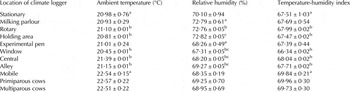
The RH measured at the pen loggers was 4·53% (P < 0·05, Table 1) lower than measured at the milking parlour loggers. There was no significant difference for the AT and THI between the pen loggers and the milking parlour loggers (Table 1).
Ambient temperature, relative humidity, and temperature-humidity index (mean ± se) measured at 5 locations inside the dairy barn over the study period of 52 experimental days (34 657 climate values)

a,b,cMeans within a column with same superscripts differ significantly (P < 0·05)
All stationary locations
The AT and THI differed significantly between all stationary loggers. The lowest AT and THI was measured at the window logger in the experimental pen and the highest AT and THI was measured at the central logger in the experimental pen (Table 1). The RH measured at the rotary and holding area logger differed significantly from the RH measured at the window, central, and alley logger in the experimental pen (Table 1). The highest RH was measured at the holding area logger and the lowest RH was measured at the window logger in the experimental pen.
Stationary vs. mobile
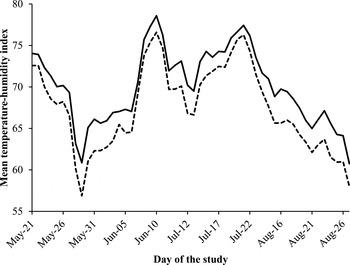
The AT measured at the mobile cow loggers was 1·56 °C (P < 0·05, Table 1) higher than measured at the stationary loggers. The THI at the mobile cow loggers was 2·33 THI points (P < 0·05, Table 1) higher than measured at the stationary loggers. Furthermore, the mean daily THI was higher at the mobile cow loggers than at the stationary loggers on all experimental days (Fig. 1).
Daily mean temperature-humidity index measured at stationary loggers (- - -) and at mobile loggers at cow level (—) inside the barn from May 2014 to August 2014 (n = 52 experimental days).

Primiparous vs. multiparous
There was no significant difference for the AT, RH, and THI between primiparous and multiparous cows for the entire study period (Table 1). Furthermore, there was no difference between primiparous and multiparous cows for the period of 1 or 3 d after regrouping.
Pen loggers related to the experimental group
The AT at the pen loggers was 0·26 °C (P < 0·05, Table 2) lower when the experimental cow group was not present; i.e., located in the milking parlour. The RH at the pen loggers was 0·41% (P < 0·05, Table 2) lower when the experimental cow group was not present; i.e., located in the milking parlour. The THI in the pen loggers was 0·44 THI points (P < 0·05, Table 2) lower when the experimental cow group was not present; i.e., located inside the milking parlour.
Climate conditions inside the experimental pen (mean ± se) considering the location of the experimental group present inside the experimental pen or not present in the experimental pen (i.e., located in the milking parlour) over the study period of 52 d (34 657 climate values)

*P < 0·05
Mobile loggers related to the experimental group
The AT measured at the mobile cow loggers was 1·04 °C (P < 0·05, Table 3) higher when the experimental cow group was located inside the milking parlour compared to the experimental pen. The RH measured at the mobile cow loggers was 0·60% (P < 0·05, Table 3) higher when the experimental cow group was located inside the milking parlour. The THI measured at the mobile cow loggers was 1·63 THI points (P < 0·05, Table 3) higher when the experimental cow group was located inside the milking parlour.
Climate conditions at cow level (mean ± se) considering the location of the experimental group inside the experimental pen or the milking parlour over the study period of 52 d (34 657 climate values)

*P < 0·05
Number of days averaging THI ≥ 72 were 12·86 percentage points higher measured at mobile cow loggers (n = 360 d with THI ≥ 72) than at stationary loggers (n = 67 d with THI ≥ 72, P < 0·05). Furthermore, number of hours averaging THI ≥ 72 were 12·63 percentage points higher measured at mobile cow loggers (n = 7250 h with THI ≥ 72) than at stationary loggers (n = 1458 h with THI ≥ 72 , P < 0·05). There was no significant difference in the number of days and hours averaging THI ≥ 72 between the stationary logger categories (milking parlour and pen) and the mobile logger categories (primiparous and multiparous cows), respectively.
Discussion
The climate conditions differed significantly between all stationary locations within the barn and even between all locations within the experimental pen. These observations support the results of previous studies that observed a high spatial microclimate variability within dairy buildings (Teye et al. Reference Teye, Hautala, Pastell, Praks, Veermäe, Poikalainen, Pajumägi, Kivinen and Ahokas2008; Schüller et al. Reference Schüller, Burfeind and Heuwieser2013). Microclimates are generated due to different construction characteristics, environmental and housing conditions and therefore heat stress conditions are not uniform across a dairy farm. In the current study the lowest THI was measured at the window logger and the highest THI was measured at the central logger within the experimental pen. Climate conditions inside a barn are directly influenced by the airflow patterns within a livestock building (Fiedler et al. Reference Fiedler, Berg, Ammon, Loebsin, Sanftleben, Samer, von Bobrutzki, Kiwan and Saha2013). Teye et al. (Reference Teye, Hautala, Pastell, Praks, Veermäe, Poikalainen, Pajumägi, Kivinen and Ahokas2008) demonstrated, that gases inside a dairy building are not uniformly mixed but pockets of low and high concentrations were found usually at the corners of the dairy building (e.g. poor ventilated areas) compared to calculated averages. In the current study, the window logger was located nearby a wide opening at the outer wall and the alley logger was located nearby the central alley that supports a free and constant air movement through the whole barn. The central logger was not exposed to fresh air and showed higher mean THI values compared to the window and alley loggers. Therefore, we assume that an immediate fresh air supply by natural or forced ventilation is essential to reduce heat stress conditions inside a dairy barn by causing a high air exchange rate (Bickert & Stowell, Reference Bickert and Stowell1993; Janni & Stowell, Reference Janni, Stowell, Bickert, Holmes, Janni, Kammel, Stowell and Zulovich2000). Especially in the temperate climate a constant fresh air supply can be a major advice to reduce the THI inside a dairy barn because critical THI thresholds are exceeded less often outside than inside the dairy barn (Schüller et al. Reference Schüller, Burfeind and Heuwieser2013; Gorniak et al. Reference Gorniak, Meyer, Sudekum and Danicke2014). Future studies should investigate the relationship between air flow pattern and resulting THI in different locations within a dairy barn.
The RH measured at the milking parlour loggers was 4·53% higher than measured at the pen loggers (Table 1). High RH inside the milking parlour is generated due to frequently conducted cleaning processes causing high evaporation rates. Additionally, function and management requirements demand a central location of the milking parlour inside a dairy barn and therefore an effective ventilation of this area is a challenging task. In locations in the barn with high evaporation and consequently high THI conditions, effective discharge of this hot and humid air should be provided to prevent heat stress. Furthermore, newly constructed dairy barns should contain constructional measures to provide an effective natural ventilation especially in the milking parlour.
In studies investigating heat stress in dairy cows, it is common practice to obtain the climate data from one stationary location inside the barn (Dikmen & Hansen, Reference Dikmen and Hansen2009; Gorniak et al. Reference Gorniak, Meyer, Sudekum and Danicke2014) or from meteorological stations loacated in the vicinity of the dairy farm (Hammami et al. Reference Hammami, Bormann, M'Hamdi, Montaldo and Gengler2013; Hill & Wall, Reference Hill and Wall2015). To our knowledge, this is the first study investigating the climate conditions dynamically at cow level in field conditions. The average THI at the cow level was 2·33 points higher than measured at the stationary loggers and the mean daily THI was higher at cow level than at the stationary loggers on all experimental days (Fig. 1). Cows significantly influence their climatic environment by the release of heat and humidity via convection, conduction and radiation through expired air and through excrement to their environment (Silanikove, Reference Silanikove2000). Furthermore, heat production (Robinson et al. Reference Robinson, Ames and Milliken1986) and evaporation (Berman et al. Reference Berman, Folman, Kaim, Mamen, Herz, Wolfenson, Arieli and Graber1985) increases with increasing heat stress resulting in the production of microclimates by each cow. The results of our study provide first evidence, that heat stress conditions that cows are actually exposed to differ significantly from the heat stress conditions measured at stationary locations inside the barn. Heat stress in the immediate surroundings of the cow is underestimated when climate conditions are obtained from one stationary location inside the barn. Nevertheless, the current study was conducted on one single farm and future studies should compare heat stress conditions on cow level between different farms and combinations of sprinkler, fans, evaporative, and conductive cooling systems (Collier et al. Reference Collier, Dahl and VanBaale2006; Ortiz et al. Reference Ortiz, Smith, Rojano, Choi, Bruer, Steele, Schuring, Allen and Collier2015).
Even small variations in mean daily or hourly THI can lead to a major decrease in conception rate (Schüller et al. Reference Schüller, Burfeind and Heuwieser2014), milk yield, and milk quality (Hammami et al. Reference Hammami, Bormann, M'Hamdi, Montaldo and Gengler2013) in dairy cows. For the assessment of physiological reactions of dairy cows to their climatic environment and the determination of THI thresholds for the performance of dairy cows, a precise measurement of heat stress conditions is mandatory. In our study, the number of days averaging THI ≥ 72 and the number of hours averaging THI ≥ 72 were 13 percentage points higher measured at mobile than at stationary loggers. Therefore, especially for the determination of specific THI thresholds the climate conditions should be obtained in the immediate surroundings of the cows.
Cows significantly influence their climatic environment by evaporation and thermal discharge (Berman et al. Reference Berman, Folman, Kaim, Mamen, Herz, Wolfenson, Arieli and Graber1985; Robinson et al. Reference Robinson, Ames and Milliken1986). In our study, the AT was 0·26 °C lower, the RH was 0·41% lower, and the resulting THI was 0·44 points lower at the pen loggers when the experimental cow group was located inside the milking parlour. The AT was 1·04 °C higher, the RH was 0·60% higher, and the resulting THI was 1·63 points higher, measured at the mobile cow loggers when the experimental cow group was located inside the milking parlour. These results illustrate, that cows not only influence their climatic environment, but also generate microclimates within different locations inside the barn within short-term periods (1 h). As discussed before, the milking parlour is a location within the farm with an elevated risk for heat stress conditions due to construction characteristics. Wagner-Storch & Palmer (Reference Wagner-Storch and Palmer2002) demonstrated, that housing more cows under one roof increased the risk of suboptimal climate conditions and stocking density was thought to be the major cause of climatic differences between different locations inside one barn. Therefore, we assume, that a high stocking density inside the holding area during the milking shifts in combination with poor ventilation lead to an accumulation of hot and humid air inside the milking parlour. Based on the results of our study we provide evidence for earlier postulations (Wiersma, Reference Wiersma1983) that the holding area is the location inside the farm where cows experience the most heat stress.
Previous studies found out, that social behaviour of dairy cows returns to baseline level between 5 to 15 d after regrouping (Kondo & Hurnik, Reference Kondo and Hurnik1990; Hasegawa et al. Reference Hasegawa, Nishiwaki, Sugawara and Ito1997). Therefore, in our study, group compositions was maintained over 7 d after regrouping. However, there was no significant difference for the climate conditions measured at cow level between primiparous and multiparous cows. von Keyserlingk et al. (Reference von Keyserlingk, Olenick and Weary2008) demonstrated that the number of displacements from the feeding area and the number of lying bouts which reflects the number of displacements from the lying area for regrouped cows, was greatest at the day of regrouping and then declined gradually until 3 d after regrouping. Therefore, in an additional analysis we compared the AT, RH, and THI at cow level between primiparous and multiparous cows exclusively for the first day and the first 3 d after regrouping. Nevertheless, AT, RH, and THI at cows level did not differ significantly between primiparous and multiparous cows at the first day after regrouping and at the first 3 d after regrouping, respectively. Especially the regrouping of primiparous cows into a group of multiparous cows is assumed to cause greater disturbance, at least to the primiparous cows, because of the novelty of the situation (Phillips & Rind, Reference Phillips and Rind2001), their young age (Beilharz & Zeeb, Reference Beilharz and Zeeb1982), small size (Brantas, Reference Brantas1967) and inexperience (Schein & Fohrman, Reference Schein and Fohrman1955). However, Phillips & Rind (Reference Phillips and Rind2001) did not find any difference in milk yield, grazing time, or time standing between primiparous and multiparous cows after regrouping. However, there is a lack of information about the relationship of age and social rank of dairy cows inside the herd. Based on our data we assume, that the age and experience of the cow are not reliable predictors for the heat stress conditions at cows level. Further research is necessary to identify the parameters that influence the actual experienced heat stress of dairy cows.
The climate conditions differed significantly between all stationary locations within the barn. Especially the holding area was the location inside the barn where cows experienced the most intensive heat stress. Furthermore, the average THI at cow level was 2·33 points higher than measured at the stationary loggers and the mean daily THI was higher at cow level than at the stationary loggers on all experimental days. This indicates, that the heat stress conditions that dairy cows are actually exposed to differ significantly from the heat stress conditions measured at stationary locations inside the barn and dairy cows significantly influence the microclimatic environment inside a dairy barn. Thus, a wide range of microclimates exists between different locations inside a dairy barn and heat stress is underestimated when climate conditions are obtained from one stationary location inside the barn. For the determination of specific THI thresholds, the climate conditions should be obtained in the immediate surroundings of the cows.
The authors thank the staff of the Clinic of Animal Reproduction, Freie Universität Berlin (Berlin, Germany) and the collaborating dairy farm for their superb cooperation and the possibility to collect the climate data.