


Introduction
For decades, Canada has portrayed itself as a multicultural “mosaic” where diversity is celebrated as part of its national identity (Kymlicka, Reference Kymlicka1995; Taylor, Reference Taylor and Gutmann1994). This metaphor depicts Canada as a country whose institutional pluralism accommodates group rights and highlights systemic inequality differently than the US approach to equality through “melting pot” assimilation (Porter, Reference Porter1965). The continued salience of the mosaic model depends considerably on how dominant groups—particularly white Canadians—respond to increasing diversity. Similar to other countries, Canada is experiencing demographic shifts that have the potential to challenge this inclusive approach toward multiculturalism in general, and immigration in particular. Analogous demographic trends in the United States have demonstrated the power of white identity to shape political attitudes and behaviors. Defined as a psychological attachment to a white racial ingroup, white identity has driven support for anti-immigrant policies, racial resentment and skepticism toward multiculturalism and pluralism in the United States over the past decade (Berry et al., Reference Berry, Ebner and Cornelius2019; Filindra et al., Reference Filindra, Buyuker and Kaplan2022; Filindra et al., Reference Filindra, Kaplan and Manning2023; Jardina, Reference Jardina2019). Similar to their US neighbors, there is some evidence that Canadians are increasingly skeptical of high levels of immigration, and for the first time in the last 25 years, a majority of residents say there is too much immigration in Canada (Neuman, Reference Neuman2024).
How do perceptions of demographic change affect the strength of white identity and corresponding attitudes toward immigrants, immigration and personal perceptions of victimhood? We conduct a survey experiment in which we show respondents several different framings on growing ethnic diversity in Canada. We find that the perception that Canada’s visible minority community and immigrant communities are growing activates white identity among white Canadians, but that this is not robustly associated with negative views of immigrants, immigration or a greater sense of personal victimhood. The results support the perspective that demographic threat has not yet become as politicized in the minds of Canadians as of those elsewhere, such as those in the United States, and that there is still time to guard against the potentially destructive appeals to white identity that may move in this direction.
White Identity and Perceptions of Diversity
The literature is fragmented when it comes to explaining the effects of perceived demographic shifts on the political attitudes of white people. Overall, there is support for the notion that when they feel their dominant position in society is in jeopardy, white people tend to react defensively (that is, Danbold and Huo, Reference Danbold and Huo2015; Jardina, Reference Jardina2019). Real or perceived, these threats bring out a heightened sense of white identity and increased group consciousness, fostering feelings of shared fate and collective anxiety (Schildkraut, Reference Schildkraut2017; Weller and Junn, Reference Weller and Junn2018). In turn, these sentiments contribute to discriminatory attitudes toward ethnic minorities (Davis and Perry, Reference Davis and Perry2021; Jardina and Piston, Reference Jardina and Piston2021). Much of this knowledge is confined to US studies, however, leaving a sizeable gap in our understanding of other pluralistic societies such as Canada.
The ubiquity of whiteness in North America obscures how white people experience their racial identity. For many, whiteness comprises a default identity, a perspective that treats ethnic minorities as the “other” (Mackey, Reference Mackey1998; Painter, Reference Painter2010). This contributes to the psychological tendency for white people to equate their racial identity with that of the nation-state or what it means to be “American” or “Canadian” (Devos and Banaji, Reference Devos and Banaji2005; Huynh et al., Reference Huynh, Devos and Altman2015; Jardina, Reference Jardina2019; Mackey, Reference Mackey1998; Perry, Reference Perry2007; Whitehead et al., Reference Whitehead, Perry and Baker2018). White people’s dominant position on top of the socioeconomic hierarchy and their majority demographic status means that few have given deep thought to the political implications of their whiteness (Jardina, Reference Jardina2019). Prior to the last two decades, research argued that white people tended not to view their political world in racial terms, remaining blind to the role of whiteness in upholding racial inequities (Doane, Reference Doane2006). In the United States, this positions white Americans uniquely, as their identity underlies and shapes American culture and institutions, while remaining latent in white Americans’ psyche (Knowles et al., Reference Knowles, Lowery, Chow and Unzueta2014; Wong and Cho, Reference Wong and Cho2005). Likewise, in Canada, the multicultural “mosaic myth” has masked the racial inequalities that privilege white citizens over their counterparts in many visible minority and Indigenous communities (Diamante, Reference Diamante2023; Porter, Reference Porter1965; Weinfeld, Reference Weinfeld1981).
Recent research has challenged these assumptions, demonstrating that the strength and prevalence of white identity may be contextual (Kalin and Sambanis, Reference Kalin and Sambanis2018; McDermott and Samson, Reference McDermott and Samson2005). In particular, demographic shifts have increased interracial contact, making the visibility of whiteness more explicit (Knowles and Peng, Reference Knowles and Peng2005; Maly et al., Reference Maly, Dalmage and Michaels2013; Mutz Reference Mutz2018) and discussions of white privilege more salient (Branscombe et al., Reference Branscombe, Schmitt and Schiffhauer2007). In other words, the diversification of certain communities appears to heighten racial awareness and feelings of interconnectedness among white people.
These sorts of associations are not new, nor are they unique to white people. Human cognition automatically sorts those we meet into groups such as those based on ethnicity, nation, gender, profession and class. Among these groups, individuals ascribe positive traits and emotions to the groups they relate to and connect with, giving rise to social groupings with “characteristics, beliefs, standards, and enemies to suit their own adaptive needs” (Allport, Reference Allport1954: 37–39; see also: Kinder, Reference Kinder, Huddy, Sears and Levy2013; Dovidio et al., Reference Dovidio, Gaertner, Lowrance and Isen1995; Sherif and Sherif, Reference Sherif and Sherif1953; Turner et al., Reference Turner, Oakes, Alexander Haslam and McGarty1994).
In this context, a pair of theoretical frameworks help us understand the relationships between individuals and groups: social identity theory (SIT) and realistic group conflict theory (RCGT). According to SIT, individuals derive a substantial portion of their personal identity from their membership in a group. Accordingly, SIT sees human behavior as divided between two categories: interactions among individuals and interactions between groups (Tajfel and Turner, Reference Tajfel, Turner, William and Worchel1979: 34). These interactions depend on the extent to which each society is stratified: in societies with clear hierarchies, there is more competition between groups, making social interactions more about factions than individuals (Tajfel, Reference Tajfel1974; Tajfel and Turner, Reference Tajfel, Turner, William and Worchel1979; Turner et al., Reference Turner, Oakes, Alexander Haslam and McGarty1994, 199). When this happens, people feel more connected to their own group and are more likely to discriminate against people from other groups (Tajfel and Turner, Reference Tajfel, Turner, William and Worchel1979: 33–39).
SIT helps to inform the second relevant framework: realistic group conflict theory (RGCT). According to RGCT, resource scarcity induces group-level attitudes of superiority and insecurity (Sherif and Sherif, Reference Sherif and Sherif1953; Giles and Evans, Reference Giles and Evans1986; Esses et al., Reference Esses, Jackson and Armstrong1998: 71; Kinder, Reference Kinder, Huddy, Sears and Levy2013). The resulting struggle for control over “economic, political, and social structures” tends to reinforce racial prejudice, discrimination and ethnocentrism (Giles and Evans, Reference Giles and Evans1986: 471; see also: Blumer, Reference Blumer1958; Bobo, Reference Bobo1983; Brief et al., Reference Brief, Umphress, Dietz, Burrows, Butz and Scholten2005; Kinder, Reference Kinder, Huddy, Sears and Levy2013; Zarate et al., Reference Zarate, Garcia, Garza and Hitlan2004). Most importantly for the present study, the mere perception of competition over scarce resources may be enough to spark these intergroup tensions (Bizumic et al., Reference Bizumic, Monaghan and Priest2021; Esses et al., Reference Esses, Jackson and Armstrong1998: 701; Schlueter and Scheepers, Reference Schlueter and Scheepers2010; Stephan et al., Reference Stephan, Ybarra, Martinez and Schwarzwald1998). The numeric growth of minority groups has challenged the historically dominant group position of white people, rousing defensive prejudice, anxiety and fear toward other ethnic groups (Blumer, Reference Blumer1958; Goren and Plaut, Reference Goren and Plaut2012; Outten et al., Reference Outten, Schmitt, Miller and Garcia2012). The demographic shift has been found to strengthen ingroup solidarity among white people, generating more ingroup favoritism than outgroup animus (Jardina Reference Jardina2019; Schildkraut Reference Schildkraut2017).
When this shared identity expands to include an awareness of the group’s common political interests, it crosses the line into group consciousness (McClain et al., Reference McClain, Johnson Carew, Walton and Watts2009; Miller et al., Reference Miller, Gurin, Gurin and Malanchuk1981). At its core, group consciousness requires some form of dissatisfaction with the ingroup’s social position (Miller et al., Reference Miller, Gurin, Gurin and Malanchuk1981) and a sense that outside forces must be stopped to preserve, restore or improve its place in society (Conover, Reference Conover1984). In other words, when historically dominant groups such as white people view their advantaged position as being threatened, their group consciousness rises, spurring them to engage politically with aim of maintaining the status quo or reinstating the conditions that led to their dominance (Miller et al., Reference Miller, Gurin, Gurin and Malanchuk1981).
Group consciousness involves a sense of “linked fate” to the extent that it fosters a sense of shared destiny among members (Dawson, Reference Dawson1994). Under these conditions, individuals feel as if their own social standing is connected to the group’s position relative to other groups in society (McClain et al., Reference McClain, Johnson Carew, Walton and Watts2009). Most literature on linked fate focuses on the shared experiences of discrimination and marginalization among African Americans (Gay et al., Reference Gay, Hochschild and White2016; Simien, Reference Simien2005). Unlike minority ethnic groups, white people have not faced the same group-level persecution. Instead, linked fate among white people has entailed a collective angst at the prospect of losing their systemically privileged status atop the racial hierarchy (Jardina, Reference Jardina2019; Painter, Reference Painter2010; Perry, Reference Perry2007). Marsh and Ramirez (Reference Marsh and Ramirez2019) label this phenomenon “linked anxiety.” This anxiety may in turn be associated with more negative attitudes toward immigrants, immigration and feelings of victimhood. The latter has been an important theme in the Untied States, where political entrepreneurs have made an explicit link between increasing diversity and the perception that white people are marginalized, falling behind or being “replaced” (see, for example, Confessore, Reference Confessore2022).
In this way, white identity activation has implications for political attitudes. The conflation of white identity with national identity contributes to white people developing xenophobic and nativist attitudes toward non-white immigrants (Abrajano and Hajnal, Reference Abrajano and Hajnal2015; Carter and Pérez, Reference Carter and Pérez2016; Jardina, Reference Jardina2019; Wright and Esses, Reference Wright and Esses2019). Hostility toward immigration tends to be accompanied by fear of contaminating the dominant cultural ethos—feelings commonly associated with ethnonationalism (Carter and Pérez, Reference Carter and Pérez2016; Thompson, Reference Thompson2022). White respondents who feel threatened, anxious or worried about the decline of white people in the population are more likely to agree with racist appeals (Christiani, Reference Christiani2021). White people are also more likely to be more tolerant of racists and intolerant of minority groups (Davis and Perry, Reference Davis and Perry2021), more likely to hold dehumanizing attitudes toward racial minority groups (Jardina and Piston, Reference Jardina and Piston2021) and less likely to be empathetic to racial minority victims of violence (Johnson and Lecci, Reference Johnson and Lecci2020). Variations in outgroup prejudice seem driven by the strength of attachment to whiteness; those who take the most pride in being white are more likely to hold anti-pluralist worldviews, stronger racial biases and stronger system-justifying beliefs (Goren and Plaut, Reference Goren and Plaut2012: 248).
While most research on white identity has been limited to the US context, where race is a more fundamental frame of political analysis (Thompson, Reference Thompson2008), a small number of studies have demonstrated that white ethnocentrism and attitudes about race, immigrants and ethnic minorities is also politically consequential in Canada, Britain and Australia (de Rooij et al., Reference de Rooij, Goodwin and Pickup2018; Dunn and Thornton, Reference Dunn and Thornton2022; Snagovsky, Reference Snagovsky2024). Outten et al. (Reference Outten, Schmitt, Miller and Garcia2012) observed that white Canadians exposed to statistics on the increasingly diversified racial composition of Canada exhibited negative emotions toward minority groups. Using Canadian Election Study data, Gravelle (Reference Gravelle2018) found that, in addition to neighborhood and partisan effects, intergroup contact is a key factor influencing attitudes toward Muslims in Canada. Further, Beauvais and Stolle (Reference Beauvais and Stolle2022) demonstrated that white identity is associated with greater support for policies that mostly benefit white Canadians, while Harell et al. (Reference Harell, Soroka and Ladner2014) showed that attitudes toward certain public programs, such as social assistance, can vary depending on racial stereotypes attached to its recipients. In a later study, Banting and Thompson (Reference Banting and Thompson2021) revealed that Canadian public policy frameworks are structurally ill-equipped to address such issues or racial economic inequality in general. This is reflected in comparative studies such as that of Quillian et al. (Reference Quillian, Heath, Pager, Midtbøen, Fleischmann and Hexel2019), who found rates of discrimination against non-white job applicants to be middling in Canada versus other countries. In terms of electoral politics, Besco (Reference Besco2019), Hale (Reference Hale2023) and Lachance and Beauvais (Reference Lachance and Beauvais2024) have demonstrated the impact of racial attitudes on vote choice, something reflected in leader evaluations as well (Bouchard, Reference Bouchard2022).
On the contrary, longitudinal survey evidence suggests that Canadian attitudes remain distinct from the intolerance that gave rise to the presidency of Donald Trump or Brexit (Burnett, Reference Burnett2017; Buyuker et al., Reference Buyuker, D’Urso, Filindra and Kaplan2021). The widespread perception that Canada is a “mosaic” multicultural society as opposed to a “melting pot” may also contribute to a political culture where norms around diversity and inclusion hold sway. However, there is reason to suspect that status threats to white Canadians may be more salient than in the past. Demographically, Canada is growing increasingly diverse, and immigration rates continue to rise. The ascendancy of right-wing populist parties federally and in several provinces has mirrored similar developments in other western countries (Budd, Reference Budd2021; Carlaw, Reference Carlaw2018). In the process, white Canadians’ dominant social position is becoming increasingly precarious. Given this context, if “scholars wait until White racial identity seems politically relevant, we will have missed [our] opportunity” to prepare policy responses that protect pluralism and multiculturalism (Wong and Cho, Reference Wong and Cho2005: 701). In this respect, Canadian researchers and policy makers have a duty to make up for lost time.
In short, while we have some understanding of the relationship between white identity and certain policy preferences in Canada (Beauvais and Stolle, Reference Beauvais and Stolle2022), we have less empirical evidence about what activates white identity in the first place, as well as how white identity activation changes other political attitudes.
Multiculturalism in Canada and the United States
Both Canada and the United States are settler societies. Built on colonial foundations, generations of immigration have shaped the demography and political cultures of the two countries in different ways. Canada’s official “mosaic” model of multiculturalism has fostered a set of norms in which ethnic diversity is valorized as a core component of national identity, in contrast to the United States’ assimilationist “melting pot” ethos.
Since the 1970s, Canadian institutions have explicitly recognized pluralism and group-differentiated rights, embedding multiculturalism into the country’s constitution, laws and self-image (Kymlicka, Reference Kymlicka1995). This mosaic paradigm encourages Canadians, including white citizens, to view ethnic and cultural diversity as a normal and positive feature of society, shaping public opinion toward greater acceptance of minority rights and immigration (Bloemraad, Reference Bloemraad2006). Empirical studies confirm that a majority of Canadians view multiculturalism as “very important” to the nation’s identity, surpassed only by universal healthcare and eclipsing hockey as a core element (Bloemraad and Wright, Reference Bloemraad and Wright2014: S320). Moreover, Canadians who express the highest patriotism are also the most supportive of increased immigration and pluralistic institutions (Ibid).
By contrast, the American melting pot narrative expects immigrants to assimilate into an Anglo-American mainstream, an ideology that has implicitly centered whiteness—or, at least, Anglo-Protestant culture—as the national norm (Huntington, Reference Huntington2004). White Americans have long tended to equate their racial ingroup with “true” American identity, often subconsciously (Devos and Banaji, Reference Devos and Banaji2005). This assimilationist legacy means that overt celebrations of multiculturalism (such as multilanguage versions of the American national anthem) have been more contentious in US public discourse, and the white majority there is more likely to view policies emphasizing racial or cultural differences as a challenge to the shared national identity (Schildkraut, Reference Schildkraut2017).
Together, these differences in national narratives—the Canadian mosaic of pluralism versus the US melting pot of assimilation—have produced distinct attitudinal climates: Canadians generally exhibit more pro-diversity attitudes and normative support for multiculturalism, whereas Americans show greater concern about maintaining a unified national culture, which has historically been entwined with the prerogatives of the white majority (Reitz, et al. Reference Reitz, Breton, Dion and Dion2009). When confronted with rising diversity or “majority–minority” projections, many white Americans react by strengthening their racial identity and opposing policies such as immigration or affirmative action, a dynamic reflected in recent electoral backlashes to multicultural change (Jardina, Reference Jardina2019). By contrast, Canada’s multicultural ethos and differing historical cleavages (focusing more on language and region than binary racial conflict) have thus far limited the activation of white identity as a political force (Abu-Laban and Gabriel, Reference Abu-Laban and Gabriel2002).
While Canada celebrates its identity as a multicultural mosaic, critics argue that this metaphor masks deep inequalities. Porter’s seminal Vertical Mosaic (Reference Porter1965) revealed how power was concentrated among white, Anglo-Canadian elites, while racial minority and immigrant communities were systematically excluded. Others have since argued that multiculturalism fosters passive coexistence rather than real inclusion, allowing structural barriers to persist (Diamante, Reference Diamante2023). Among them, the mosaic myth has absorbed Indigenous identities into a broader narrative of cultural diversity, thereby obscuring colonialism and undermining Indigenous sovereignty (Coulthard, Reference Coulthard2014). Together, these critiques expose the mosaic as more myth than reality—an aspirational ideal that often conceals enduring social and political hierarchies.
National narratives such as the mosaic and melting pot operate at the cultural (meso and macro) level. Do these narratives have limits at the individual level? Is there a point at which increased diversity challenges people’s adherence to multicultural principles, be they inclusive or assimilationist? To understand these dynamics, we draw on two complementary theoretical frameworks: social identity theory and realistic group conflict theory.
Theoretical expectations
This study examines how perceived status threat may affect group consciousness and intergroup hostility in Canada. While we do not offer a direct comparison with the United States, our study draws its hypotheses from the US literature. We are interested in the impact of perceived demographic changes on the salience of ethnic identity, attitudes toward immigrants and immigration and peoples’ own feelings of victimhood. As the literature suggests, white identity might become more salient for individuals who read about Canada’s changing demographics because doing so involves the perception that a relevant outgroup in society is gaining power compared with their own ingroup. Here, the mechanism is a social-identity-based status threat, which should lead members of this group to have more negative attitudes toward immigrants and immigration, and a greater perception of that group as being disadvantaged in society. This leads to four testable hypotheses:
White respondents who learn about Canada’s shifting demographics will have stronger feelings of white identity (H1), more negative attitudes toward immigrants (H2), will prefer Canada admit fewer immigrants in the future (H3) and have higher perceptions of personal victimhood (H4).
We expect these differences to emerge for white respondents who read about Canada’s shifting demographics compared with non-white respondents and to white respondents who are not exposed to the stimulus (information about increasing ethnic diversity).
If “white people” are the relevant ingroup for white identifiers, who forms the specific relevant outgroup? If white people feel most threatened by increasing ethnic diversity, they may see Black people, Indigenous people and other people of color (BIPOC) as threatening their privileged place in society. However, they may also recognize that most of Canada’s increasing diversity comes from increasing immigration to Canada; in this case, immigrants are the relevant outgroup. Finally, it may not be another ingroup at all that most matters for white identifiers, but rather the status of their own ingroup. While we do not have strong a priori views on which outgroups trigger identity activation for white identifiers, or whether identity is a function of white people’s own in group rather than any outgroup in the first place, the latter may more directly tap into identity threat. Thus, we expect:
White respondents who learn about the decreasing share of white people in Canada’s population will have stronger feelings of white identity than those who read about the increasing proportions of immigrants and visible minorities (H5).
We investigate these possible effects below.Footnote 1
Research Design
We use an experimental approach to examine whether perceptions of ethnic and cultural diversity change respondents’ attachment to their ethnic groups. The hypotheses, survey design, and analysis plan were preregistered using Open Science Framework (OSF).Footnote 2 Our research design relies on a between-subjects survey experiment conducted through Cint/Lucid Marketplace, which is a survey sample aggregator that allows for researchers to buy survey samples directly from many of the same commercial providers that customer-facing polling firms (that is, Qualtrics, Dynata, Abacus) subcontract to. Sampling was stratified according to census demographics (on the basis of gender, age and province of residence) and was conducted in both English and French. The survey was hosted using Qualtrics, which allowed us to block submissions with duplicate or suspicious IP addresses (including those outside Canada), as well as conduct a Captcha check for bots. Per our pre-analysis plan, we excluded respondents under 18 years of age and those who lived outside Canada, failed a straight-line check, failed three consecutive attention checks or sped through the survey.
Respondents read one of three vignettes based on real news stories about Canada’s changing ethnic composition and increasing ethnic diversity (Grant, Reference Grant2017; Todd, Reference Todd2017). All demographic projections in the articles are drawn from estimates from Statistics Canada and other demographic experts, and include a real quote about these changes from a university professor to increase external validity (Todd, Reference Todd2017). Each respondent was randomly assigned to read one of three fictional news articles of approximately 270 words, which varied in describing that either: (1) the share of white people in the Canadian population is decreasing, (2) the share of immigrants in the Canadian population is increasing or (3) the share of visible minorities in the Canadian population is increasing:
[White/Visible Minority/Immigrant] Population to Continue [Increasing/Decreasing] by 2036, StatCan Finds
Statistics Canada says our country is getting more diverse. New models from the agency predict that the [white/visible minority/immigrant] population will [shrink/grow] in all provinces, territories, and cities. In fact, people from [group] are expected to [drop/rise] to around [59/30–35/44–50] per cent of Canadians by 2036—a [drop/rise] of approximately [34/28/29] per cent since 1981.
Much of this growth is due to immigration from non-European countries, which has increased steadily over the past decade. The Middle East, Asia and Africa now supply most of Canada’s newcomers.
This means that 10 years from now, around [six in ten/over one-third/nearly half] Canadians will be [white/belong to a visible minority/an immigrant or children of immigrants]. As part of this trend, more Canadians will belong to non-Christian faith groups, have non-European cultural backgrounds and speak languages other than English and French.
Eric Kaufmann, a professor at the University of London, believes Canada as a whole, on the basis of current immigration patterns, will be almost 80 per cent non-white in less than a century. “I think a reasonable middle conclusion is that Canada will be 20 per cent white, 65 per cent non-white and 15 per cent mixed race by 2106,” he said. “Canada will probably become a ‘majority–minority’ country around 2060.”
These shifts will change the face of the voting public. Soon, people of white European descent will no longer be the majority in large cities such as Calgary, Vancouver, Winnipeg and Toronto. Experts think this marks the start of a more global Canada, where future leaders have ethnic roots that connect them to countries such as India and Nigeria as much as the United States or the United Kingdom.
A fourth vignette was included as a control in which participants read an article about the discovery of a large icicle. Respondents were evenly distributed between the four groups. After restricting the sample to white respondents, we were left with approximately 390 respondents per group (total N = 1,556). While there were real differences in framing between the three groups, they were relatively subtle: the overwhelming message was one of changing racial and ethnic demographics. As a result, we also examine the aggregate effects of being assigned to any treatment group at all versus the control.
Utilizing multiple vignette frames in this manner allows for greater validity and generalizability for several reasons. First, it accounts for differences in ethnic identity activation by varying the salience of the messaging respondents are exposed to. This is important as research suggests that exposure to messaging that explicitly emphasizes racial nouns or adjectives (for example, “Black, “white”) in their framing can limit the formation of racial attitudes, as respondents recognize this language as having “hostile racial intent” and guard against it (Mendelberg, Reference Mendelberg2001; Valenzuela and Reny, Reference Valenzuela, Reny, Druckman and Green2021). To account for this, vignettes (2) and (3) do not discuss the demographic decline of “white” Canadians, and instead mention marked increases in “immigrants” and “visible minorities,” respectively. This type of implied messaging is effective in studies that focus on priming racial identity, as it allows for the formation of racial attitudes more subconsciously (Mendelberg, Reference Mendelberg2008; Nteta et al., Reference Nteta, Lisi and Tarsi2016; White, Reference White2007).
Secondly, manipulating how individuals are exposed to different racial cues allows us to account for the variation in the salience of different cues across respondents when it comes to evoking ingroup identity and outgroup hostility. In doing so, we can more easily identify under which specific conditions white identity might be activated, alongside other ingroup–outgroup attitudinal outcomes (Spry, Reference Spry, Druckman and Green2021). For our purposes, this allows us to examine whether reading about rising shares of the “visible minority,” “immigrants” or a shrinking “white” population have idiosyncratic or similar impacts on white identity. While all three test whether exposure to demographic information heightens white identity, by manipulating the framing we can further examine whether ingroup shrinkage or outgroup growth have discernible effects.
After the vignettes, we asked respondents a multiple-choice question framed as a quality-control item about the percentage of Canadians that will either be white (treatment 1), visible minority (treatment 2) or immigrants and children of immigrants (treatment 3) in 10 years. Following this question, we confirmed to respondents what the article actually said. We adopted this approach because we were not substantively interested in whether reading a fictional newspaper article changes political attitudes; rather, we were interested in whether being presented with a piece of demographic information does. Moreover, the somewhat complicated nature of treatment, which relied on demographic statistics, risked being too cognitively demanding for respondents—indeed, only about a third of respondents on average correctly identified the projected percentage of each demographic group (out of a possible six options, including “don’t know”). Interestingly, however, a sizeable percentage thought that the coming demographic changes were even larger than what the treatment suggested: for example, while only 45 per cent of respondents correctly identified that article said the projected proportion of white Canadians would be around 60 per cent by 2036, an additional 48 per cent of that group thought the demographic changes would be even greater (25–50% by 2036). Similarly, but less dramatically, while only 36 per cent of respondents identified the correct projection for visible minority Canadians, another 14 per cent thought the coming changes would be even greater. By confirming the correct percentage after the treatment, we are able to make sure that the respondent is treated with the correct demographic information. In this respect, we were interested in maximizing the study’s internal validity (a strength of survey experiments), while acknowledging there may be small tradeoffs to external validity (which survey experiments already struggle with). However, the survey has three other attention check questions as quality control metrics, and if respondents “failed” those attention checks, they were informed as such immediately afterward. Thus, seeing another quality control question after a news article, before which they were explicitly asked to read the article carefully because there would be questions afterward, would not have appeared out of place to them. The full vignettes and follow-up questions are available in Online Appendix B.
Our analysis has four dependent variables: ethnic identity, attitudes toward immigrants, immigration preferences and perceptions of victimhood. The first of these, ethnic identity, leverages survey items adopted from Jardina’s (Reference Jardina2019) seminal study on white identity, which account for how central respondents’ ethnicity is to their identity, along with how strongly they relate to others of their ethnic group (see also: Hooper, Reference Hooper1976). We interlace Jardina’s scale with measures of linked fate (Dawson, Reference Dawson1994), perceived shared experiences (Mael and Tetrick, Reference Mael and Tetrick1992) and others adapted from measuring affect toward political groups from the Canadian Election Study (Stephenson et al., Reference Stephenson, Harell, Rubenson and John Loewen2020). In total, eight survey questions were used to create an index of ethnic identity:Footnote 3
-
1. How important is being white to your identity? (5 points, extremely important–not at all important)
-
2. How strongly do you identify with other white people? (5 points, extremely strongly–not at all strongly)
-
3. What happens to white people in this country will have something to do with what happens in my life.
-
4. When people criticize white people, it feels like a personal insult.
-
5. When I meet someone who is white, I feel connected with this person.
-
6. When I speak about white people, I feel like I am talking about “my” people.
-
7. When people praise white people, it makes me feel good.
-
8. I have a strong attachment to other white people.
Questions 1 and 2 stood alone, whereas questions 3–8 were part of a survey battery in which respondents were asked to indicate the extent to which they agreed with each statement (5 points, strongly agree–strongly disagree).
Jardina’s single-item and three-item measures of white identity (Reference Jardina2019, 58–59) are perhaps the most well-known set of measures for this concept, along with the additional two items she uses for white consciousness. The single-item measure, which she uses often throughout her work (primarily due to due to understandable space constraints in national surveys, alongside the considerable validity and stability of this single item), is also item 1 in our scale (Jardina, Reference Jardina2019: 59). However, we expand her scale to incorporate measures of ingroup commonality and linked fate, which have proven potent predictors of social or white identity and empirically distinct from intervening measures such as group consciousness (Berry et al., Reference Berry, Ebner and Cornelius2019; Capers and Smith, Reference Capers and Smith2016; Jardina, Reference Jardina2019; Knowles and Peng, Reference Knowles and Peng2005; Mael and Tetrick, Reference Mael and Tetrick1992; Spry, Reference Spry, Druckman and Green2021). By using a scale with more dimensions, we can better capture the multidimensional nature of white identity.
To ensure the validity of our multi-item measure of white identity, we fit a graded response model (GRM) and conduct exploratory factor analysis in Appendix C. The GRM evaluates the relationship between how respondents score on our white identity scale and the probability that they also score highly on each of the above survey instruments. Both the GRM and factor analysis strongly support the existence of a common factor or latent trait described by our survey items. As a final test for the internal consistency of our index, we compute both Cronbach’s alpha and McDonald’s omega to approximate our index’s internal consistency (Hayes and Coutts, Reference Hayes and Coutts2020; McDonald, Reference McDonald1999). Our ethnic identity index returned both an alpha and an omega value of 0.90, indicating excellent reliability.
Similarly, respondents’ attitudes toward immigrants were measured using an index consisting of three questions:
-
1. Immigration has had a positive impact on Canada’s culture.
-
2. Immigrants increase crime rates in Canada.
-
3. Letting immigrants into Canada significantly increases the threat of terrorism.
Respondents were asked to indicate how much they agree or disagree with each statement (5 points, strongly agree–strongly disagree). With the first item reversed, higher values of the index indicate more positive attitudes toward immigrants. An alpha of 0.77 and an omega of 0.78 indicate good internal scale consistency.
We measured respondents’ perceptions of victimhood using a four-question battery, in which respondents were asked to indicate how much they agree or disagree with the following statements (5 points, strongly agree–strongly disagree):
-
1. I usually get what I deserve in life.
-
2. The system works against people like me.
-
3. Sometimes it feels like the world is out to get me.
-
4. People like me are falling behind in society.
An alpha of 0.73 and omega of 0.75 indicate good internal consistency, and though they were lower than the other two scales, the alpha value still exceeded the minimum threshold of 0.70 included in our pre-analysis plan.
Finally, preferences toward immigrant admission were measured using a question that asked respondents whether they thought Canada should admit (1) more immigrants, (2) fewer immigrants or (3) about the same number of immigrants as now. Responses were organized ordinally (2, 3, 1), with higher values of the variable indicating a preference for more immigrants to be admitted.
We used ordinary least squares (OLS) to estimate our treatment effects for the three continuous dependent variables (strength of ethnic identity, attitudes toward immigration, perceptions of victimhood) and ordered logistic regression for our final dependent variable (immigration admission preference).Footnote 4 Our pre-analysis plan indicated that we would control for several alternative explanations for each variable (education, gender, income, Quebec residency, age, age squared and urban/rural). We do so in Online Appendix D; however, as we demonstrate, the inclusion of control variables does not change our experimental results. Thus, for simplicity, we present the results of the model without controls below.
Results
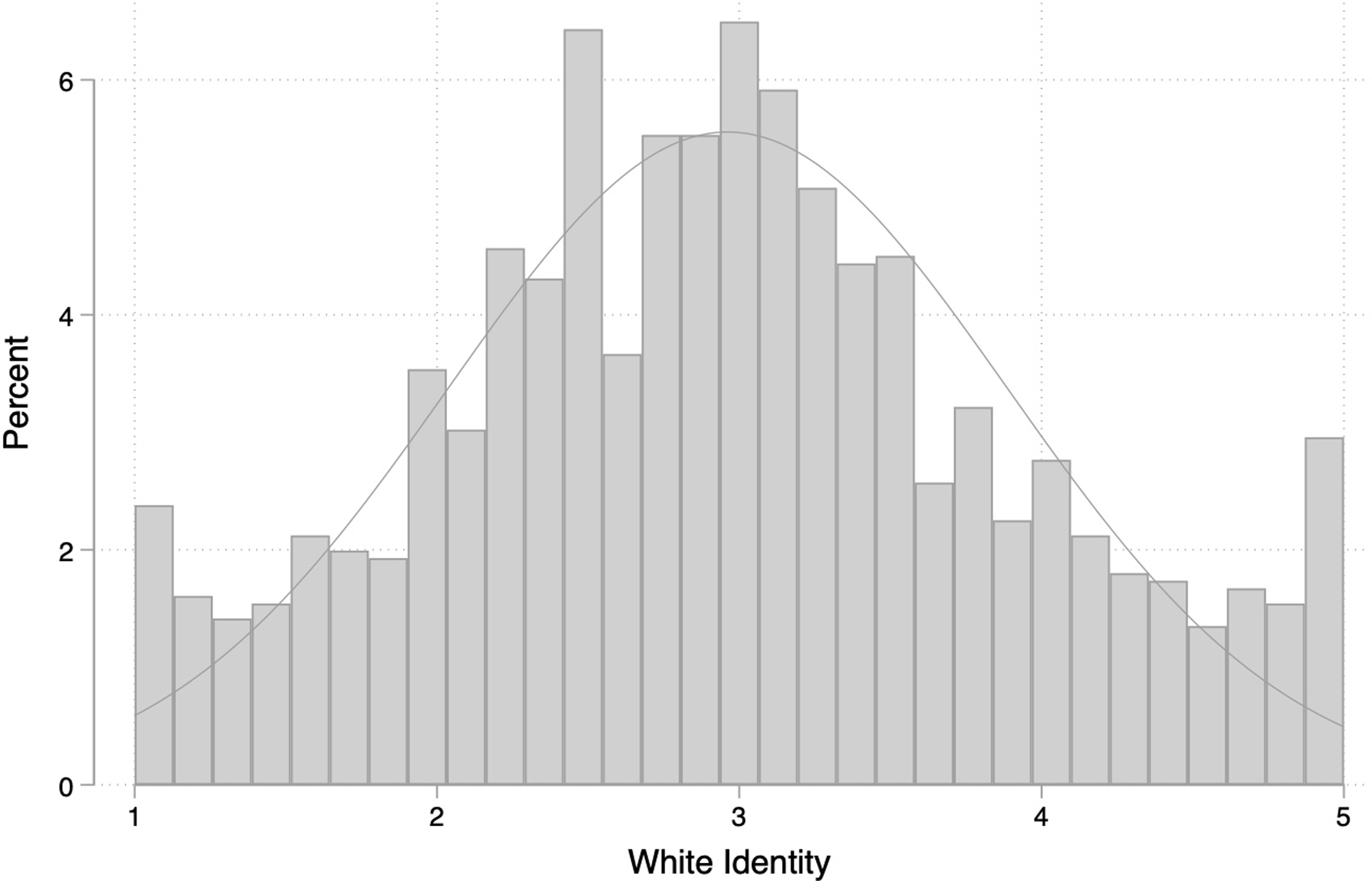
Descriptive statistics for white identity are presented in Figure 1, with additional descriptive statistics for the other variables and treatment groups available in Online Appendix E. Consistent with the findings in Beauvais and Stolle (Reference Beauvais and Stolle2022), white identity appears to be normally distributed in Canada, with a mean of 2.97 and a median value of exactly the midpoint of the scale (3). This demonstrates that white identity is clearly present in Canada.
The Distribution of White Identity in Canada.

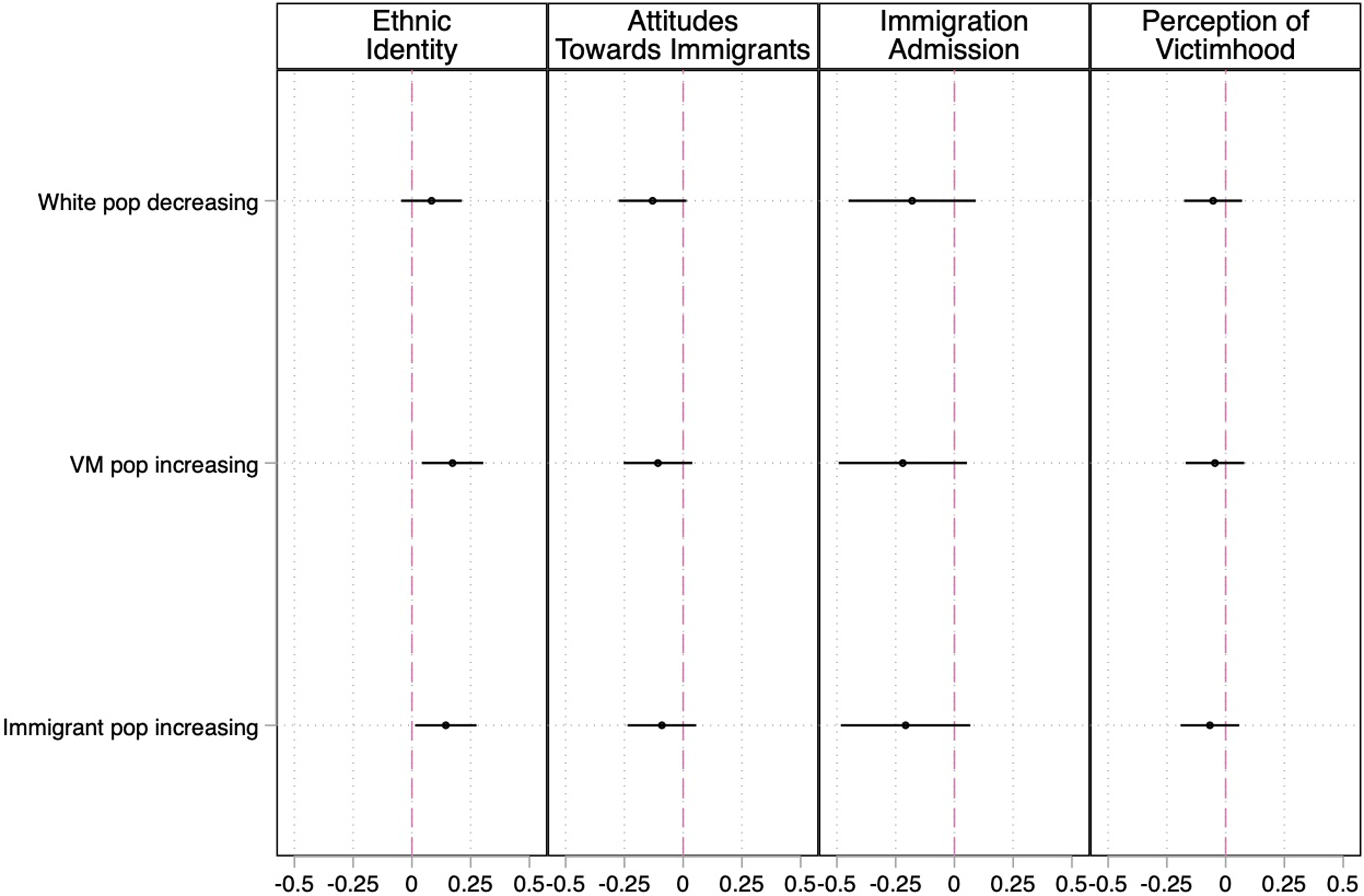
The results of our survey experiment are shown in Figure 2, with the corresponding tables presented in Online Appendix Tables A2–A5. The reference category in each case is the control article. As Figure 2 shows, reading about the growing proportion of visible minority Canadians or immigrant Canadians increases the strength of white identity. Learning that Canada’s visible minority population is growing increased feelings of white identity by 0.17 units in the univariate model and by 0.15 in the multivariate model, which represent a change of approximately 3 per cent of the scale. This was also the case for learning about the growth of the immigrant population, with an increase of 0.14 in both the univariate and multivariate model. In both cases, however, the increases to the strength of white identity were quite modest, corresponding to approximately the same as the effect for the increasing visible minority population treatment. The coefficients for these two treatments lend partial support to Hypothesis 1. By contrast, learning about increasing ethnic diversity did not lead to statistically significant changes for attitudes toward immigrants, immigration admission preferences and perceptions of victimhood for white respondents. While the coefficients for attitudes toward immigrants and immigration admission are in the expected direction and close to the preregistered threshold for significance, they are nevertheless not statistically different from zero.
Influence of Perceived Demographic Change on White Respondents.
Note: N = 1,555. Coefficients for ethnic identity, attitudes toward immigrants and perceptions of immigrants are from OLS regression, while those for immigration admission come from ordinal logistic regression. Immigration admission coefficients kept as log odds to facilitate comparability to the other variables. Odds ratios for these values are presented in Supplementary Appendix Table A4.

We conducted several robustness checks to verify the accuracy of our findings. Since the above models come close to the traditional level of statistical significance, one potential concern regarding these results might be that they are under-powered (that is, the sample size was too small to properly detect these effects).Footnote 5 For robustness, we examined whether receiving any treatment at all caused a change in our dependent variables. The results of these analyses are shown in Appendix F. Grouping respondents according to whether they received any of the demographic treatments at all versus receiving the control produced the same substantive effects as in our main models. Reading about Canada’s changing demographics caused a statistically significant increase in white identity among white respondents; however, while the other dependent variables (attitudes toward immigrants, immigration admission preferences, perceptions of victimhood) were in the expected direction, they again missed the preregistered threshold for statistical significance. Putting their statistical significance aside, here again the coefficients themselves were very modest (representing a change of approximately 3% of the scale). As a result, we conclude that while reading about demographic change is associated with an increase in white identity, this is not associated with a strong and robust change in attitudes toward immigrants, immigration admission preferences and perceptions of victimhood.
We also considered the possibility that even though perceptions of demographic change themselves are not associated with changes to respondents’ attitudes toward immigrants, immigration admission preferences and perceptions of victimhood, the combination of perceptions of demographic change and white identity could instead affect those attitudes. In Appendix G, we show the results of an interaction between white identity and our treatment, operationalized both in terms of the full 4-category experiment and a simplified treatment/control variable. The interaction between perceptions of demographic change and white identity had no statistically significant impact on any of these three dependent variables. These results support our main findings: that the primary effect of perceiving demographic change among white Canadians is to prime their levels of white identity, but that this does not, in turn, robustly activate these anti-pluralist political attitudes.
Finally, we considered the potential role of education as a buffer for anti-immigration attitudes (Ceobanu and Escandell, Reference Ceobanu and Escandell2010). In Appendix H (Tables A14 and A15), we refit our models with a continuous measure of education ranging from “none” to “PhD/professional degree” and then estimate the marginal effects of education on each outcome variable for our white and non-white respondents, holding our control variables at their arithmetic means (Figure A3). This allows us to better visualize how the effects of education function within our models. As expected, our dependent variable is related to this continuous education variable. Indeed, the analyses in Appendix D and F all have the results of a full model with controls, in which education is statistically significant for white respondents. This suggests that university-educated white respondents have lower levels of white identity, more favorable attitudes toward immigrants, prefer more immigrants to be admitted and have lower perceptions of personal victimhood. Since the inclusion of this control does not change our experimental main results, we continue to focus on those dependent variables in our analyses.
Discussion
The results show that perceptions of changing demographics lead to slightly increased white identity activation among white Canadians, but that this increase in white identity is not robustly associated with respondents’ attitudes toward immigrants, immigration admission preferences and perceptions of victimhood. This was the case when presented with demographic change writ-large or with specific treatments about the increasing proportion of visible minority and immigrant Canadians. Interestingly, none of the treatments had any effect on personal perceptions of victimhood; it appears that any changes to group-level identities did not translate into individual-level grievances for white Canadians. This finding challenges the applicability of US-based discourses about changing racial demographics as a driver of a personal perception of being left behind.
Our results are somewhat at odds with those in Outten et al. (Reference Outten, Schmitt, Miller and Garcia2012), who find that perceptions of demographic change increase anger and fear toward ethnic minorities while increasing sympathy toward white people. There are several possible reasons for this. First, Outten et al. focus on different dependent variables: it may be that anger and fear toward ethnic minorities does not translate to changes in actual attitudes toward immigration, perhaps because white identifiers may see a difference between immigrants and ethnic minorities. The second pertains to sample: Outten et al.’s study used a sample of 160 undergraduate students, while our study focuses on white people in the general Canadian population. However, our substantive findings regarding the link between perceptions of demographic change and white identity support those in their article.
A key assumption of the group behavior literature is that white identity largely remains latent until somehow activated. Here, both bottom-up and top-down drivers are relevant. Many bottom-up drivers, including those tested in this article, are contextual, such as the numerical decline of white people as well as society’s gradual realignment toward increased multiculturalism in social and economic spaces (Danbold and Huo, Reference Danbold and Huo2015; Jardina, Reference Jardina2019; Maly et al., Reference Maly, Dalmage and Michaels2013; Mutz, Reference Mutz2018). The logic of this literature is that these feelings are tied to the sense that influence and social standing are finite resources and that the gains of one social group must come at the direct expense of others. This zero-sum mentality manifests itself in the sense that, as racism against ethnic minorities decreases, discrimination against white people must rise commensurately (Norton and Sommers, Reference Norton and Sommers2011). By the same token, economic shifts such as job losses and wage decline may stoke white animosity by compounding prejudices and anger against those groups that appear to be getting ahead (Esses et al., Reference Esses, Dovidio, Jackson and Armstrong2001; Utych et al., Reference Utych, Navarre and Rhodes-Purdy2022).
As group identities are mobilized and made political into group consciousness, groups become dissatisfied with their group’s relative position in the social hierarchy, or feel otherwise threatened at the prospect of losing their privileged position (Miller et al., Reference Miller, Gurin, Gurin and Malanchuk1981). The analyses presented here suggest that while white identity is clearly present among the white Canadian population (see Figure 1), it remains more latent than in the portrait of the United States created by Jardina (Reference Jardina2019). With regard to the differences to the US context, it is possible measurement may play a role—we measure white identity differently than Jardina (Reference Jardina2019). However, the single item measure at the heart of both scales is the same, and we think that given the substantial face validity of both scales, it is very likely they refer to the same underlying construct. Another potential explanation for these results is that Canada still enjoys a relative consensus around the value of immigration and multiculturalism for the country’s economic prosperity and collective “mosaic” identity. If political culture is the sum of values that define what is acceptable to say, do or think in politics, our respondents may feel that expressing xenophobia and nativism is beyond the pale. As a cultural script, the mosaic myth provides a powerful lens through which individuals interpret social change, potentially buffering against the defensive group reactions predicted by SIT and RGCT.
Another explanation pertains to the top-down drivers of white identity activation, such as cues from political elites. In other words, while exposure to demographic changes may have heightened white Canadians’ sense of identity, it has yet to be mobilized in a way that brings about significant attitudinal changes toward other ethnic groups. In other words, Canadian white identity could lack a catalyst. For example, inflammatory rhetoric from politicians disparaging racial minority groups tends to activate white identification and drive up group consciousness (Long, Reference Long2023). Commentary that highlights or criticizes white privilege also has a similar effect (Branscombe et al., Reference Branscombe, Schmitt and Schiffhauer2007; Pérez, Reference Pérez2015). Policy decisions may also trigger white identity, particularly those that promote racial equity or elevate the status of marginalized groups, such as affirmative action (Perez et al., Reference Perez, Lee, Oaxaca, Cervantes, Rodriguez, Lam and McFall2023) or equity, diversity and inclusion (Lee, Reference Lee2024). In many cases, these elite-level cues and policy reforms encourage greater political mobilization among white people to defend their ingroup’s interests (Filindra et al., Reference Filindra, Buyuker and Kaplan2022: 140). With a few exceptions notable for their novelty, Canada has largely avoided the volume of inflammatory elite rhetoric directed toward immigrants and ethnic minority communities that has been present in the United States during the Trump era. However, future research should examine the potential impact of these sorts of inflammatory messages on white identity activation, as there is no reason to believe Canada will remain insulated from these forms of discourse indefinitely.
In summary, the mosaic may function both as a top-down and bottom-up restraint, both limiting elite mobilization of white identity and shaping individual-level responses in ways that normalize diversity rather than problematize it. Our results imply that while white identity exists and can be primed in Canada, it remains relatively depoliticized, at least for now. White Canadians do exhibit a sense of their whiteness, but the mosaic narrative provides fewer opportunities for translating that identity into organized opposition to diversity and immigration compared with the melting pot narrative.
As all studies, our findings are subject to certain limitations. To start, our findings are contextual and the effect sizes are relatively small. There are several reasons for this. First, while vignette experiments have high levels of internal validity, they can sometimes be difficult to extrapolate outside the context of an individual survey. This is especially true for experiments that, for example, ask respondents to imagine themselves in a hypothetical scenario such as a voting booth. In our experiment, however, we are not substantively interested in whether a fictitious newspaper article can change political attitudes; rather, we are interested in how knowledge about Canada’s changing demographics affects white identity and other political attitudes. Moreover, by confirming the associated demographic trend portrayed in the article to the respondents, we can have more confidence that the intended treatment (that is, information delivery) was administered. Since we are mostly interested in the internal process by which individuals arrive at these political attitudes, we place relatively less weight on external validity concerns.
Second, the experiment focuses on a single intervention at one point in time, and it remains to be seen the extent to which acquiring this sort of information has durable effects on political attitudes. On the one hand, long-term attitudes tend to be sticky, and the information presented in our experiment is one data point among many for respondents who read the news or pay attention to race and immigration in other ways. On the other hand, the fact that Canada is becoming more ethnically diverse is unlikely to be new information for most respondents; Canada’s status as an immigrant country is widely known among the general public, and especially in major urban centers, changing demographics can often be observed directly. The fact that this information still resulted in differences in political attitudes then likely tells us that it has some potency, even if not to the same extent as in the United States.
Third, our analysis is confined to the effect of white identity on attitudes toward immigration in Canada. The generalizability of these findings to other countries awaits further study, as well as do connections between white identity and policy preferences beyond immigration (for example, equity, diversity and inclusion; foreign aid), and the linkages between these attitudes and political behavior (for example, vote choice).
Conclusions
The existing literature from the United States suggests that when confronted with real or imagined threats to their group’s privileged position, white people develop a sense of group consciousness and linked fate that compels them to defend their dominant group status. This sense of status loss and anxiety has, in part, driven anti-immigrant attitudes in the United States (Hochschild, Reference Hochschild2018). In this study, we ask whether perceptions of demographic change activate white identity in Canada, and whether this in turn makes white identifiers feel more negatively toward immigrants, be less supportive of immigration, and have greater perceptions of personal victimhood. While some existing studies suggest that white identity activation can lead to more exclusionary attitudes among Canadians (Beauvais and Stolle, Reference Beauvais and Stolle2022; Outten et al., Reference Outten, Schmitt, Miller and Garcia2012), our survey experiment showed mixed results, suggesting that such identity can be primed without necessarily triggering xenophobic or anti-immigrant sentiment. Learning about the increasing proportion of visible minorities and immigrants in Canada’s population increased the strength of white identity among white respondents in our experiment. However, this was not robustly associated with a negative impact on respondents’ attitudes toward immigrants, immigration preferences or feelings of victimhood. These findings suggest that white identity is both present and can be primed in Canada—however, it does not appear to have been politically mobilized in the same way as studies based in the United States have shown in that context (Jardina, Reference Jardina2019). Through this study, we contribute to a growing but nuanced body of research on the political implications of white identity in Canada while also reinforcing the importance of conditional effects of identity priming in different sociopolitical contexts.
As new waves of immigration change the racial and cultural composition of white settler societies such as Canada, future research should examine how white identity can be primed by political elites, as well as what the potential attitudinal consequences of elite-driven rhetoric can be. If societies such as Canada are interested in maintaining the relative consensus multiculturalism has enjoyed, their goal should be to avoid the negative consequences of white identity activation that have materialized in the United States. Doing so involves first understanding the contours of white identity activation, with the goal of mitigating its potential harms.
Supplementary material
The supplementary material for this article can be found at https://doi.org/10.1017/S0008423925100929
Competing interests
The authors declare none.


 Open access

