Introduction
The Children Act 1948 established local authority responsibilities for children and young people and thereby the beginning of the Children's Services departments we see today. The engagement of the Voluntary and Community Sector (VCS) in the care and development of children, however, goes back much further to Victorian philanthropists such as Dr Thomas Barnardo who set up his first ‘Ragged School’ in London in 1867 and was actively fundraising for his children's homes by the mid-1880s. The mixed economy of social care provision for children has, then, existed for over 150 years. However, never before have the various organisations involved in supporting the care and development of children and young people been as interconnected and interdependent.
Since 1997, the state's vision has been of integrated public sector services based around the needs of individual citizens. Information with technology was seen to be the key enabler (Richter and Cornford, Reference Richter and Cornford2008; Baines et al., Reference Baines, Wilson and Walsh2010). The service ‘silo’ is an image that appears again and again in policy documents to represent all that is bad about old practices. Multi-agency service environments, in contrast, promise to the public services that will be timely and subject to less duplication and inefficiency. This implied that personal information about clients or users of public services must be made available across organisational and professional boundaries. In order for this to happen, appropriate legislative and governance mechanisms had to be put in place. Government commitment to ‘joined-up working’ and horizontal integration led to growing pressure for the sharing of citizens’ personal information among public service agencies (Performance and Innovation Unit, 2002; 6 et al., Reference Six, Raab and Bellamy2005; Bellamy et al., Reference Bellamy, Six and Raab2005; 6 et al., Reference Six, Bellamy, Raab and Warren2006). The scene was set by a range of generic legislation about information, such as the Data Protection Act 1998, and more specific legislation, including in this case the Children Act 2004. Over recent years, VCS organisations have become increasingly central to the delivery of state sponsored social care requiring VCS organisations to professionalise their administration to meet the stipulations of contracting and regulation. A side effect of this has been the need to become more adept at managing information (including their clients’ and staff's identity information) both internally and externally, which has had benefits for the larger VCS organisations in particular around lobbying, fundraising activity and internal resourcing.
The intention of this article is to unpack ideas about the use of identity information through the device of a case study (‘Mary's story’) and to explore the technical and social (individual, practice and organisational domains) aspects of identity governance in the social care domain. Much of the literature in the social policy and social work practice literature has been sceptical about the deployment of information and communications technology (ICTs) to support the implementation of government policy and improve practice. This has often been with good reason, as the reputation of the UK government's attempts to modernise with ICT tends to be patchy at best and includes a number of high-profile blunders where the personal identity information of citizens has been at the forefront of the debacle. In previous work, we have argued that it has been the inappropriate application of e-commerce solutions into public administration and social care environments that is the problem, not the ICT itself (e.g. Wilson et al., Reference Wilson, Baines, Cornford and Martin2007; Richter and Cornford, Reference Richter and Cornford2008; Wilson and Baines, Reference Wilson, Baines, Loader, Hardey and Keeble2009; McLoughlin et al., Reference McLoughlin, Maniatopoulos, Wilson and Martin2009). We have argued for instance that this can lead to ‘over-integration’ problems (Wilson et al., Reference Wilson, Baines, Cornford and Martin2007). E-commerce solutions with the emphasis on integration of data into a single database (or ‘single point of truth’) and specifically the automation of identity correlation in a data warehousing approach (a process sometimes referred to as data cleansing) are particularly significant in this respect. The technologies and approaches that have been developed to support the process of rationalising insurance and savings accounts within Customer Relationship Management (CRM) systems, for use by Banks, are not necessarily appropriate for addressing the information needs of the VCS as a sector or as individual organisations. We ultimately argue that the ongoing pessimism about ICT is nevertheless misguided. In order to support this, we draw upon the work of the philosopher Charles Pierce (Parker, Reference Parker1998; Pierce, Reference Pierce1998). We apply his theories of logic to the context of identity and how it is inscribed in information systems to show that these pessimistic views of ICT are both simplistic and reductive and that improvements in thinking around the design of systems could potentially enhance aspects of the delivery of care.
Debates about identity and information sharing in the domain of children and young peoples’ social care
In the context of services for children and young people, the factor which directly affected developmental and social welfare in recent times was the introduction of the Children Act of 2004. This legislation underpinned the Every Child Matters (ECM) agenda, which set out the Government's approach to the well-being of children and young people in terms of five outcomes: being healthy; staying safe; enjoying and achieving; making a positive contribution; achieving economic well-being. This was to be supported by a comprehensive suite of information systems to ensure the co-ordination of agencies and practitioners working with children and young people. The immediate driver behind this was the Climbié Inquiry (Laming, 2003), which had highlighted a breakdown in the inter-agency working and information sharing, as had a number of previous inquiry reports stretching back as far as the Colwell Inquiry of the early 1970s.
Laming's new recommendations for sharing basic information led to many years of continuing wrangling about the confidentiality and privacy issues surrounding the information aspects of the ECM programme (e.g. Information Commissioner, 2004). The overall programme was made up of three elements: Integrated Children's System (ICS), comprising of a set of forms for assessment of children at risk (Shaw et al., Reference Shaw, Bell, Sinclair, Sloper, Mitchell, Dyson, Clayden and Rafferty2009); Common Assessment Framework (CAF), comprising a single form for supporting multi-agency assessment of children and young people who have been identified by practitioners as being a source of concern (Peckover et al., Reference Peckover, White and Hall2008; White et al., Reference White, Hall and Peckover2009); ContactPoint, which, in contrast, was a national database of all children and young people. This latter element was originally conceived as Information Referral and Tracking (IRT) by the Home Office to track the ‘shifty fifty’ of children and young people thought to be responsible for the majority of ant-social and criminal behaviour in localities. It aimed to be the ‘signpost’ where those with access could see the other agencies working with a child or young person and ‘flag’ concerns (Payne, Reference Payne2004; Hudson, Reference Hudson2005a and Reference Hudson2005b). However, the emphasis shifted in the design and implementation processes to address the needs of universal service and the identification of the excluded and vulnerable.
The intention behind the introduction of these information tools as part of the overall programme was to underpin changes in the working practices of statutory agencies driven by the Every Child Matters agenda. The critics and opponents argued that it has implications for personal freedom and individual safety; practitioner effectiveness and organisational independence (e.g. Garrett, Reference Garrett2005; Dow, Reference Dow2005; Parton, Reference Parton2008). The governance of data sharing and privacy have been explored in a series of publications by Bellamy, 6 and Raab, in terms of managing the tensions between privacy protection and the goals of integrated, seamless public services, requiring more extensive data sharing. They analysed the extent to which either data sharing or privacy take precedence, or the two commitments are made consistent or even mutually reinforcing (6 et al., Reference Six, Raab and Bellamy2005; Bellamy et al., Reference Six, Raab and Bellamy2005). There is also a literature from the social work practice arena, which focuses on social work itself, and the critiques of the role of ICT in promulgating a change from a narrative form of practice knowledge to one where the computerisation or informationalisation makes knowledge accessible and performance open to management scrutiny. This is exemplified by Parton (Reference Parton2008) who suggests that the modelling processes inherent in databases potentially constrain the narrative practice of social work to such a degree where the client or family become, for the purposes of ICT based-recording, disembodied from their subjective reality. As a result of this ‘electronic turn’ (Garrett, Reference Garrett2005; Peckover et al., Reference Peckover, White and Hall2008), their identity is subverted or denatured for the purposes of computer-supported performance management.
However, relatively little attention has been given to the implications of information and its governance when VCS organisations deliver services under contract to state agencies. If it is the case that social workers, directly employed by public sector organisations with statutory responsibilities, feel a sense of alienation towards the practices and tools of information sharing, then the relationship of the third sector (or VCS) to this agenda becomes even more ambiguous. The safeguarding and sharing of clients’ personal information can be a significant tension in the delivery of public service contracts by organisations, practitioners and volunteers working in the sector (Wilson et al., Reference Wilson, Baines, Cornford and Martin2007; Baines et al., Reference Baines, Wilson and Walsh2010). The nature of the challenge here is poly-valent in that the identity of the sector (sometimes referred to as a ‘loose and baggy monster’) is deeply bound up with the missions and values of the organisations which comprise it (e.g. ‘Believe in Children’ – Barnardo's); the ethos of staff and volunteers; and the relationship that both the organisation and those working for or with it have with their ‘clients’ (in this case children and young people). This is consistent with the wider backdrop of concern about the role of the third sector and the blurring between its campaigning and lobbying roles, its service delivery roles and its role in civic renewal and promoting community participation in society (Lewis, Reference Lewis2005). The conflated use of the term identity, in practice and organisational contexts, by the VCS has multi-faceted implications in the use of identity by VCS organisation(s), workers and their clients. This complexity, which is deeply entangled in the ways that social care work is produced through relationships between care workers and clients and between care workers and their organisations, seems at odds with the implication that the information tools promulgated by ECM compartmentalise care worker and client narrative in order to integrate information for storage in computerised systems to support sharing and co-ordination (Peckover et al., Reference Peckover, White and Hall2008; White et al., Reference White, Hall and Peckover2009). This contradiction of the need to provide individualised care in an increasingly bureaucratised context echoes wider debates about the plurality of meanings of identity and tensions between workers and the organisations for whom they work (Webb, Reference Webb2004; Taylor et al., Reference Taylor, Lips and Organ2007; Richter and Cornford, Reference Richter and Cornford2008; Lips et al., Reference Lips, Taylor and Organ2009).
As we have stated above, this article argues that this pessimistic view of ICT is both simplistic and reductive. We argue that this may not necessarily have to be the case by drawing on the theories of Charles Pierce and an application of his theories of logic into the context of identity and how identity is inscribed in information systems. Pierce's analysis describes three logical ways of conceiving the world – monadic, dyadic, triadic (Parker, Reference Parker1998; Pierce, Reference Pierce1998). Considering identity in these terms helps us take a logical approach which shows that a monadic conception of identity corresponds to our experience of being ourselves (a phenomenon essentially inaccessible to other parties). Thinking about a dyadic concept of identity makes identity an attribute of the identified – an example is the way that identity is used in information system databases in terms of linking a system identifier to a demographic attribute (e.g. date of birth). This is where an individual's identity becomes a set of facts, such as given names, a date and place of birth and so forth. In this dyadic approach, the identifier remains implicit in their role as owner of the information system or database. It is the simplistic inscription of a dyadic logic of identity into the current generation of business information systems, where relationships are conceived simply in terms of supply or control, which leads to the underlying assumption that the entry in a database reflects the external ‘reality’. This in turn generates the problematic concept of a single point of registration (sometimes described by computer software suppliers as a ‘single point of truth’ or SPOT).
We argue that applying Pierce's (Reference Pierce1998) concept of triadic logic (which he regarded as ‘universally’ applicable) to identity manifests itself as the attribute of a relationship in which both the namer and the named, and, as a consequence, their relationship remain as explicit in the system as the name itself. This triadic logic means that the representation of identity and of relationship are not separated but always operate in conjunction to provide the scope for the appropriate governance of records information. By the application of the triadic logic to identity in this way, it is possible to make decisions about information systems and governance systems in order to protect freedoms and support the exercise of responsibility in public service and wider social care contexts of the mixed economy of welfare.
A logic of identity which supported the maintenance of appropriate organisational and/or service boundaries through a richer language of the description of roles, responsibilities and resources (or more governable system) would be a step forward in responding to the ‘wicked problems’ of caring for children and young people. By enriching the language of identity information and its governance, we argue that the ‘real world’ diversity of organisational and practice meanings of identity can both be potentially preserved and enhanced instead of being reduced to a dyadic system via the constraints of the current generation of computer systems.
Methodology
The authors have been involved in a range of studies exploring the context of information systems and information sharing in children services. The studies have been carried out over an eight-year period of exploratory and action research on social care records and on information sharing in the social care of older people and children and young people, looking at public service integration and partnership in the public and VCS contexts and has included work with central government departments (including the Department of Health (DH), Department for Children, Schools and Families (DCSF) and Department for Communities and Local Government (DCLG) and Government Office NE), local authorities and VCS organisations (e.g. Gannon-Leary et al., Reference Gannon-Leary, Baines and Wilson2006; Wilson et al., Reference Wilson, Baines, Cornford and Martin2007; Wilson et al., Reference Wilson, Walsh and Vaughan2008; Wilson and Baines, Reference Wilson, Baines, Loader, Hardey and Keeble2009; Baines et al., Reference Baines, Wilson and Walsh2010). Over this period, the role (and rhetoric about the role) of the VCS has significantly expanded (see Hogg and Baines this volume). Through our work, it became increasingly apparent that the sector's values and their relationships with clients were a source of significant differentiation compared with the public sector and its relationships. The ‘ownership’ and treatment of information is at the heart of this self-image. The case study – Mary's story – presented here and based on a real story illustrates two points. First, it shows the complexity of the issues facing those involved in these spaces where the relationships between and within organisations, service providers and user(s) and the choices and dilemmas they face are emergent and contingent. Secondly, it demonstrates how a more elaborate understanding of these real world challenges can be provided through the articulation of an abstract representation of identity and its logic.
The presenting case: Mary's story
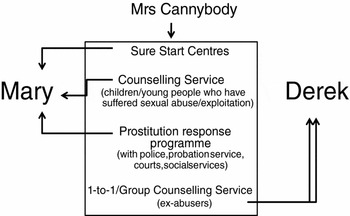
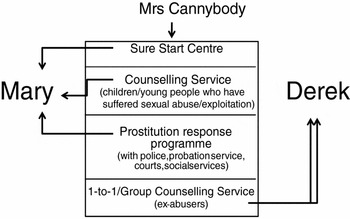
The case of ‘Mary’ was presented to us by a research partner who was faced with the challenge of information governance in their organisation (which for the purposes of this case study we shall call ‘BigVCSOrg’). It involved a large national VCS body concerned with the interests of children and young people. The organisational background was the growing pressure on the VCS, including the organisation in question, to provide detailed reporting to the commissioners of the services that it delivers about activities, costs and outcomes. This led to a proposal to the Head of the ‘BigVCSOrg’ organisation's IT department by his technical staff for a ‘Data Warehouse’ as part of a new ‘Enterprise Information Architecture’ to replace the existing records system (see Figures 1 and 2 below).
BigVCSOrg – proposed date warehouse system.

BigVCSorg – existing system.

This existing record system supported local ‘BigVCSOrg’ offices who can customise it to support the specific projects/services that they are involved with, This, however, led to difficulties when aggregating data at the local, regional and national levels (see Figure 2) as it worked by creating new instances of the system at the level of a project or service, thereby preventing the integration of identity within the overall system (indicated by the lines between the services). The new architecture or design (represented in Figure 1) had been presented to our research partner and their director as the solution to all the internal identity management and external information sharing challenges ‘BigVCSOrg’ were facing (including the need to communicate with the then proposed ContactPoint system).
At the same time, our research partner had been asked their advice about a case by a manager (who we will refer to as ‘Mrs Cannybody’) in a local urban area. In the area where the particular service is delivered, they are commissioned by the local authority to manage the Sure Start Centres where the parents of babies and toddlers can find support, advice and a range of services. At the time we are reporting, one of these centres was being managed, on a temporary basis, by Mrs Cannybody, who is not a qualified social worker but who has done both voluntary and contract work for the charity for many years and is highly experienced. ‘BigVCSOrg’ also delivers another service in the same urban area. This service provides counselling, therapy and support to children and young people who have suffered sexual abuse or exploitation. Clearly, this is a specialised service, which is not widely publicised and to which clients are referred by professional practitioners. Finally, ‘BigVCSOrg’ also works with the police, probation service, courts and social services in another urban centre at the other end of the region in a programme of initiatives to control prostitution, which is seen as a particular local problem.
The client who we shall call ‘Mary’ is seventeen years old and is a single mother with a six-month old baby. She has been attending the local ‘BigVCSOrg’ run Sure Start project but, recently, Mrs Cannybody has noticed that she has become withdrawn and unhappy. She cannot, however, get Mary to discuss her problems and, as a result, is concerned about her well-being. Unknown to Mrs Cannybody, or anybody else in Sure Start, Mary is also attending sessions at the ‘BigVCSOrg’ counselling service because, a year ago, she was relocated into the city by the Prostitution Response Programme as part of a police led action to close down a prostitution ring. The pimp, ‘Derek’, who ran the prostitution ring, was sent to prison and, in the initiative to support the then pregnant Mary, she was relocated and a number of services activated to help her rehabilitate herself and build a new life. Mary made it clear that she wanted to put her previous experiences behind her and that she was only prepared to discuss them with her individual councillor at the support service.
Meanwhile, Derek had been released on parole, after serving twelve months, on condition that he attended one-on-one and group counselling sessions for ex-abusers which are run by our ‘BigVCSOrg’ in the urban area where the prostitution ring was based. Whilst in prison, Derek became a ‘Born-again Christian’. He claimed to be the father of Mary's child and says he wants to do the right thing by her and support both her and the child. The relationship between Derek and his councillor in the local rehabilitation service was not one aimed at supervision and control, but is intended to be therapeutic and supportive.
In summary, within ‘BigVCSOrg’ – a single, national VCS organisation, we have three case workers. Two of these have a relationship with Mary, while the third has a relationship with Derek, whose records may have an historical, indirect link to her, for example via the various police or birth records. The question Mrs Cannybody and our research partner are faced with concerns how and where Mary's identity and her relationships are represented in the case management, recording and reporting systems of the ‘BigVCSOrg’ and what affect a data warehouse would have in such a context. Or, to put it another way, how can Mary's identity information and her relationships with ‘BigVCSOrg’ and its various services be safely governed and her interests and consents be respected?
Responding to Mary's identity governance interests
Putting this in the more concrete terms of Mary's case and the aims of Every Child Matters outcomes, the questions are: How could Mrs Cannybody signal her concerns in ways that respect Mary's choices? How can Mary's counsellor respond and engage Mary in that response? Does Derek have any rights as a father in this context? How can the three domains of information remain distinct and separate until and unless individuals with the appropriate rights and responsibilities perform explicit acts of relationship management (such as expressing consent) which connect things together and how, finally, can these acts of identity and relationship management be made auditable, accountable and governable?
Any attempt to approach the professionals engaged with Mary and her child to map processes to design information systems (by eliciting use cases and defining data sets) and security policies is potentially exacerbating their problems: this language is simply not adequate for expressing Mary's concerns and interests or, indeed, those of Derek and the professionals and the organisations involved. Equally, the policy objectives of integrated delivery, integrated planning and processes and integrated governance sound sensible, laudable and attractive. However, Mary needs real and dependable boundaries around her trusted relationships and partitioning of the identity information held by ‘BigVCSOrg’ (as shown in Figure 2). Mary's story forces us to reconsider the term ‘integration’ and the assumption that it is a universal value, where more is always better (see also Wilson et al., Reference Wilson, Baines, Cornford and Martin2007, Wilson and Baines, Reference Wilson, Baines, Loader, Hardey and Keeble2009).
When we are forced to consider situations such as this one, it becomes very clear that, if there is to be any resolution, then that resolution is one that will be co-constructed by the individuals involved within the context of the individual cases and relationships. The purpose of the organisational and systems resources that are deployed around the case is to facilitate this co-construction and to provide supportive and safe governance mechanisms. The questions that need to be asked about such systems concern how they enable the signalling of concern, the assumption, exchange and discharge of responsibility for care with consent and the appropriate governance of information in the interests, and under the control, of the parties concerned.
Arguments like this lead us to the conclusion that the dyadic notion of identity, whilst sufficient in the world of e-commerce, is not adequate for VCS contexts. Certainly when we remember Mary's story, we can see that, even though there is only one individual, Mary, the information systems which support the delivery of services to her cannot afford to take the process of interpreting identity attributes and recognising Mary away from the contexts of the particular relationships within which that recognition is taking place. In Piercian terms, this is rendering identity triadic. An identity is the three-way linkage between the means (information) by which a recogniser (person, institution, agency) recognises an individual (person). The purpose of the recognition is to maintain and make use of a shared history, that is it is to support a relationship.
In the design of our information systems, this has an important consequence. On the one hand, we understand the concept of identity management with its associated registration and authentication services. On the other, we understand the act of relationship management with its case and index services by which the records associated with different relationships can be combined. Mary's story, as an example of the most difficult and challenging ‘wicked’ case, shows that these two sets of information system functions and associated care service responsibilities cannot be divorced from each other and made separate and independent. Acts of identity management, where, for example, a registrar creates and records an identity for an individual and, as a result, generates the possibility for a set of persistent records (as is the case in Figure 2), cannot be assumed also to be acts of relationship management, where those records are automatically correlated with others relating to the same individual (as proposed in Figure 1). Creating connections between records must be seen as explicit acts which are distinct from those of creating records themselves and must be accounted for, audited and governed.
Conclusion – moving away from national policies of identity integration to supporting local governability of identity and relationships
Prevailing wisdom is that role-based access (linking roles and therefore identity in an organisation to levels of access) to information is sufficient for the delivery of social care. Cases such as Mary's demonstrate that it does not adequately encompass all of the concerns and issues that are relevant for the VCS. It is not simply whom Mrs Cannybody is and what her role is that governs her rights to see information about an individual, but, in addition, her specific relationship with Mary, so that information and the contexts of Mrs Cannybody's activities within that relationship need to be taken into account. For example a worker may be involved in an ongoing case that is governed by the established consents and a current information sharing protocol or might need to declare an emergency which will need to be accounted for at some later date in the context of the auditing and governance of their practice. Alternatively, Mrs Cannybody, might explore a concern by publishing a query to anyone who has a relationship with the individual she knows as Mary, on the understanding that this individual may have identities and relationships which she wants to maintain quite separately from the one Mrs Cannybody has with her. What the recipients of this narrowcast (as opposed to broadcast) and specific ‘publication’ do about it is up to them and Mary, and Mrs Cannybody may or may not get a direct answer. She must look to her experience, recommended practice and her relationship with Mary to formulate her next moves.
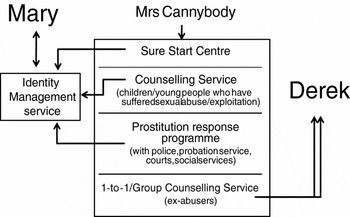
Within the language of legislation and technical deployment there remains a general presumption that the only response to the requirement for ContactPoint was a database integration solution. ‘Database’ is the only technical term that the legislators appear to have at their disposal to express the idea of ‘not paper’. In the world of large complex information systems, the term database is used infrequently and those who work in the roles of system architects (those who design such systems) tend not to refer to the concept of ‘database’ at the architectural level. This has come about because of a convergence of technologies. Specifically, between mark-up technologies (XML, etc.) and relational technologies (structured databases), both of which support the structuring and management of data and the preservation of context and interpretation. The choice between them belongs at a relatively detailed design level and is largely dictated by issues of legacy and context. In doing so, we have tried to position the explanation and argument in logical terms so that it can be related to the debate on legislation, approach and implementation which needs to be undertaken at the various levels nationally, sub-nationally and locally (both geographically and within organisations). To take this to a conclusion a triadic implementation of an identity system would separate the identity into a separate service which would hold ‘Mary's’ preferences and consents thereby ensuring that the co-ordination of the care plans and assessments between two service or project domains becomes a matter of governance (as shown in Figure 3 below), not an unintended side effect of an existing technical system design (Figure 2) or technical integration in a ‘data warehouse’ (Figure 1).
BigVCSorg – indentity governance system.

The design of ContactPoint was finalised in 2008, piloted in the North West of England 2009 and suspended in the summer of 2010. In the final design, the demographic data, relationship data and the common assessment flag were combined into a single record the purpose of which was to facilitate the communication between professionals who have a relationship with any particular child. The restrictions on who can access this data and by what means were defined under the legislation. Since the 2010 election the newly constituted Department of Education have signalled an end to the ContactPoint project in favour of a register which applies to more restricted cohort of children and young people who are judged to be at risk.
This outcome is the inevitable consequence of a government seeking to make efficiency savings and under pressure from the liberal interests around personal privacy. Both these interests and protection of privacy associated with identification information and those associated with relationship information fail to recognise that these are not the same. For the state the structural design of a new register with a more limited cohort of children and young people should in theory remain the same. For the organisation, either in the public sector or as a VCS provider such as the organisation described in Mary's story, the problem will be identifying the individuals who are deemed vulnerable (in the terms of the government register) and whether the various relationships with ‘BigVCSOrg’ should be actively linked together.
If data, however, continues to be aggregated in a single record then the necessary distinctions that require the partition of identity information cannot be appropriately made. The aspiration for ContactPoint came from the drive to reduce the risk of failure of multi-agency co-ordination in the context of children and young people. At the same time the previous government also aspired to give parents and young people more information about progress and choices in education and also reduce the threats to children and young people on the Internet (Department of Children, Schools and Families, 2008). All of these programmes and the new administration's initial proposals around the provision of education require a more sophisticated approach to understanding information and identity. As the ‘Byron Review’ of Children and New Technology in 2008 commissioned by the then DCSF emphasised:
Research is beginning to reveal that people act differently on the internet and can alter their moral code, in part because of the lack of gate-keepers and the absence in some cases of the visual cues from others that we all use to moderate our interactions with each other. This is potentially more complex for children and young people who are still trying to establish the social rules of the offline world and lack the critical evaluation skills to either be able to interpret incoming information or make appropriate judgements about how to behave online. (Byron, Reference Byron2008: 5)
The social, organisational and geographical scope and scale of any ‘register’ of children and young people large or small is such that the dyadic database approach represents an incomplete solution which will be subject to failure – this is not merely a technical issue but one of governance, quality and sustainability see (Walsh et al., Reference Walsh, Wilson, Baines and Martin2012). If the only solution presented and procured involves a system where data continues to be aggregated in a single database record the distinctions required to support the amelioration of complex ‘wicked problems’ that the ‘Mary's’ of the world face will not be possible. We will also continue to be condemned to replicate system function and data without even the hope of using multiple independent sources to corroborate each other. Only by revisiting the logics of identity inscribed within the current generation of policy and information systems can progress be made.
Acknowledgements
The authors would like to acknowledge Pat Ellison, Roger Vaughan, Sue Baines and the two anonymous reviewers who have contributed to the insights described in this article. We would also like to acknowledge funding bodies that have supported our programme of work including DH/NHS, DCLG and DfES/DCSF, Government Office NE and a range of local authorities and VCS organisations. The authors would also like to thank the respondents who participated in these projects who gave freely of their time and insights. This article is partially based on a presentation given at an ESRC Seminar which was part of the Re-Mixing the Economy of Welfare series 2008–2010 and represents the views of the authors not any of the funding bodies or research participants.