Introduction
Population growth and agricultural frontier expansion using slash-and-burn practices in the forested hillsides of subtropical to tropical areas have resulted in extensive reduction of forest cover, and increased runoff and soil erosion throughout the world and especially in Central AmericaReference Heerink, van Keulen and Kuipers1–Reference Shriar4. The resulting loss of soil productivity and biodiversity has exacerbated rural poverty, particularly in steepland areas that make up 78% of the total area of Central AmericaReference Young5. For the past 25 years, reversing land degradation and increasing agricultural output have been a priority of numerous research and development projects. These efforts, while well-intentioned, have been mostly ineffective because of incomplete, poor understanding of the complex interactions between social, ecological, institutional, economic and policy factors that lead to land degradation and limit recovery6.
The Quesungual agroforestry system (QSMAS) has been adopted since 1992 by thousands of farmers and helped many of the poorer farmers in the hillside region of Lempira, Honduras to achieve food security, while improving soil and water conservationReference Hellin, Williams and Cherrett7. This slash and mulch-based system combines selective thinning and pruning of native tropical forest vegetation with planting of annual crops (maize, sorghum and beans) and/or improved grasses with no burning, zero tillage/direct planting and spot fertilization. Compared to slash-and-burn, this system maintains permanent soil cover improving soil and water conservation. Since farmers use different criteria for selecting specific trees to thin and/or retain, the widespread adoption of the QSMAS system has resulted in a diverse landscape mosaic of tree cover. This helps conserve the deciduous tropical forest, which is often cited as one of the most highly threatened ecosystems in the world, now covering a small fraction of the area it dominated prior to European colonizationReference Janzen and Claims8. Farmers in other regions of Latin America also practice variations of slash-and-mulch, including some in high-rainfall areas of Ecuador's Amazon BasinReference Nicholaides, Bandy, Sanchez, Benites, Villachica, Coutu and Valverde9 and Costa RicaReference Melendez, Vernooy and Briceño10.
The widespread adoption of the QSMAS has been driven by observed increases in crop yields associated with the moderate use of fertilizers, better crop varieties, improved soil water availabilityReference Alvarez Welchez and Cherret11 and significant reduction in costs associated with agrochemicals and laborReference Clercx and Deugd12. In addition to increasing annual crop production, the improved capacity to capture, retain and slowly release water has allowed QSMAS farmers to escape devastating losses during droughts and hurricanes such as the severe El Niño drought in 1997. In 1998, after the devastating Hurricane Mitch in Central America, farmers practicing this system reported less soil, water and crop losses compared to those practicing the traditional slash-and-burn agricultureReference Argueta13.
The evolution of the present day QSMAS provides a unique example of the integration of local environmental knowledge with national and international expertise through stakeholder cooperationReference Barrios and Trejo14. While much international focus has been directed toward slash-and-burn approachesReference Armitage15–Reference Vosti and Witcover17, there is little information on slash-and-mulch by comparisonReference Reynolds, Smith, Lambin, Turner, Mortimore, Batterbury, Downing, Dowlatabadi, Fernandez, Herrick, Huber-Sannwald, Jiang, Leemans, Lynam, Maestre, Walker and Ayarza18. Although QSMAS is a potential model for developing sustainable agroforestry systems in other parts of Latin America and the world, its adoption by others is limited by a lack of a detailed, systematic analysis of the key biophysical and socio-economic drivers and variables involved. Furthermore, in order to establish guidelines for the QSMAS approach, input from all stakeholders is required. Guidelines for implementing the QSMAS need to include provisions for unanticipated consequences of adopting this technique, as well as the effects of potential changes in markets and environmental conditionsReference Anderson and Putz19.
Our general objective was to describe the QSMAS as practiced in the steeplands of western Honduras (Lempira) in the context of the principles of the Drylands Development Paradigm (DDP)Reference Reynolds, Smith, Lambin, Turner, Mortimore, Batterbury, Downing, Dowlatabadi, Fernandez, Herrick, Huber-Sannwald, Jiang, Leemans, Lynam, Maestre, Walker and Ayarza18. We used the principles of the DDP to identify some of the critical socio-economic and biophysical factors causing land degradationReference Huber-Sannwald, Maestre, Herrick and Reynolds20 in Lempira and to evaluate the long-term sustainability of the QSMAS. Specifically, we (1) defined the socio-economic and biophysical conditions associated with the development of the QSMAS, (2) identified the factors that led to QSMAS adoption and (3) anticipated future challenges to the sustainability of the QSMAS.
Key Biophysical Characteristics of Lempira
The Lempira region is located in the southern part of Honduras close to the border with El Salvador (Fig. 1). It has an area of 2177 km2 and is an important component of the Lempa River watershed, which provides nearly 60% of hydropower consumed by El Salvador. Soils of the region are predominantly Entisols with slopes greater than 30%, are shallow and acidic (pH<5.1) with low soil organic matter content and available phosphorusReference Ordoñez21 and have a gravely or stony loamy sand texture22. Although stones in the soil profile (which accounts for 30–50% of total soil volume in the 0–30 cm depth) reduce soil water holding capacity, surface stones can reduce runoff and erosion by dispersing the kinetic energy of raindrops and slowing overland flowReference Poesen and Lavee23, Reference Rivera and Amézquita24. The average annual temperature varies from 17 to 25°C. Annual precipitation ranges from 1400 to 2100 mm in the 600–900 m range of elevation, where the QSMAS is practiced. The rainy season extends from early May to the end of October. During the dry season from early November to late April, strong winds blow from the North and the enhanced evapotranspiration rates cause severe water deficits until the onset of rains.
Location of the study area in the Lempira region in Honduras, Central America.

Key Socio-economic Characteristics of Lempira
With limited support from the Honduran central government, Lempira is relatively isolated from the rest of Honduras due to a poor infrastructure of roads. It has a total population of about 110,000 inhabitants, and is considered to be one of the poorest regions of the country. Remittances from relatives working in the US constitute an important source of supplemental income for many familiesReference Amuedo-Dorantes and Pozo25.
Farms are generally small; 80% are less than 5 haReference Ordoñez21 and only 25% of farmers own their land26. The rest are allowed to farm common lands without a formal land title. Seventy-five percent of the farmers grow maize and beans as subsistence crops with traditional slash-and-burn, generally producing very low yields (600–800 kg/ha maize and 300 kg/ha beans), and many households also raise chickens, pigs and some cattle. Some farmers allow livestock to graze crop residues at the beginning of the dry season. Local food markets in Lempira are limited and are poorly integrated with the rest of Honduras. Basic grain production is primarily for self-consumption and local delivery, although cross-border trade with El Salvador, which is the most densely populated and industrialized country in Central America, is rapidly increasing. Local labor is also limited, but informal labor exchange within Lempira is a common practice and seasonal migration takes place in the northern coffee-producing areas.
Assessing QSMAS
From 15 to 20 November 2005, an international team of 16 biophysical and social scientists, students, extension specialists, development workers and other stakeholders conducted a workshop in the Lempira region to conduct an analysis of the QSMAS within the context of the five principles of the DDP:
1. Human–environmental systems are coupled, dynamic and co-adapting, so that their structure, function and interrelationships change over time.
2. A limited suite of ‘slow’ variables are critical determinants of human–environmental system dynamics.
3. Thresholds in key slow variables define different states of human–environmental systems, often with different controlling processes; thresholds may change over time.
4. Coupled human–environmental systems are hierarchical, nested and networked across multiple scales.
5. Maintenance of up-to-date, local environmental knowledge is the key to functional co-adaptation of human–environmental systems.
Although the DDP has its roots in the desertification literatureReference Reynolds, Smith, Lambin, Turner, Mortimore, Batterbury, Downing, Dowlatabadi, Fernandez, Herrick, Huber-Sannwald, Jiang, Leemans, Lynam, Maestre, Walker and Ayarza18, Reference Stafford Smith, Reynolds, Stafford Smith and Reynolds27, we believe its principles are relevant to all rural human–environmental systems in Latin America.
This case study was jointly organized by the Consortium for the Integrated Management of Soils of Central America (MIS) and ARIDnet, an international research network that is testing the robustness of the DDP via multiple case studies of land degradation throughout the Americas. The goals of ARIDnet include facilitating field-level interactions between researchers, local stakeholders (farmers, land owners and developers) and decision-makers (details available at URL: http://www.biology.duke.edu/aridnet/).
In addition to background information from published and unpublished literature on the QSMAS, the workshop team conducted numerous interviews of scientists, development workers, community leaders and farmers living in and near the town of Candelaria, where the QSMAS has been widely adopted. In order to better understand the factors associated with the adoption of the QSMAS, interviews were also completed in the vicinity of the neighboring town of Guarita, where slash-and-burn agriculture continues to be practiced. In 2006, 16 additional individuals were interviewed to obtain further details on specific topics, provide clarifications where needed, and to obtain additional information to address gaps in our knowledge.
Our evaluation was completed in two phases. The first phase involved all workshop participants and immediately followed the completion of the on-site interviews. Working groups with biophysical and socio-economic expertise were formed to systematically apply the key concepts of the DDP in order to evaluate: (1) the extent to which QSMAS is potentially reversing land degradation in the area, (2) to identify the key biophysical and socio-economic variables associated with the evolution and success of the QSMAS and (3) to consider the extent to which the QSMAS will likely be an effective approach to limit land degradation and promote recovery given current farming trends in Lempira.
In the second phase, selected representatives of each working group refined this analysis to specifically cover three periods: pre-, post- and future-QSMAS. The pre-QSMAS period (1970–1990) represented a retrospective analysis focused on the conditions that led to the development of the QSMAS, the post-QSMAS period (1990–2006) covered the years since adoption of QSMAS to the present and the future-QSMAS period considered some of the most likely future challenges to the persistence and sustainability of the QSMAS in the Lempira region.
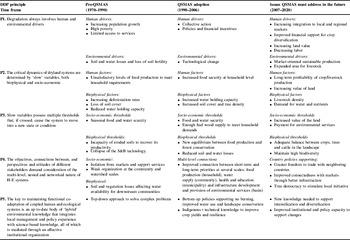
The QSMAS is a complex and dynamic system that consists of a suite of unique adaptive management systems being applied and modified by individual farmers. While this diversity makes generalizations more difficult, they also help explain the evolution of the QSMAS and point to its potential value in other parts of the world. In Table 1, we summarize the results of the application of the five principles of the DDP to each of three periods (pre-, post- and future-QSMAS).
Summary of results of DDP-based analysis (19).

Pre-QSMAS (1970–1990)
During the 1970s, the Department of Lempira experienced a rapid expansion of agricultural activities influenced by human and environmental drivers (DDP Principle 1): increasing population size (growth rate of 3% per year), migration from neighboring regions (including from El Salvador) and high poverty (90% of population lived on less than two dollars per day, 64% suffered of malnutrition and 90% were illiterate)Reference Stafford Smith, Reynolds, Stafford Smith and Reynolds27. Thousands of poor farmers practiced subsistence agriculture on more than 20,000 ha of communal forests using slash-and-burn farming. The extensive deforestation and overexploitation of these forests led to increased soil erosion (as much as 109 Mg ha−1 yr−1)Reference Alvarez Welchez and Cherret11, reduced soil cover and decreased soil fertility and water holding capacity (DDP Principle 2), causing decreased food production (maize 500–800 kg/ha, beans 200–300 kg/ha and sorghum 400–700 kg/ha)Reference Argueta13. In time, these factors drove production systems past a threshold beyond which they were not able to meet household needs for food (one family of eight people consumes 1500 kg maize and 400 kg beans per year) and were no longer resilient to droughts and soil fertility decline (DDP Principle 3). Isolation, poor health and education services and weak social organization triggered further land degradation and extensive migration of locals to urban areas and elsewhere in search of work (DDP Principle 4).
In the 1980s, the Honduran government initiated a program to solve the food crisis by introducing improved crop varieties and subsidizing inorganic fertilizers and herbicides for Lempira farmers. During this period, the use of chemical fertilizers and herbicides increased from 25 to 80% considering all farmsReference Ruben and Clercx28. Nevertheless, despite intensive promotion of this program by the government, it had limited success because of the lack of access by most farmers to capital and technical assistance (DDP Principle 5). Moreover, the practice of this type of agriculture on slash and burned fields often further promoted soil and water losses.
Post-QSMAS (1990–2006)
After the devastating effect of a severe drought in 1987, the Honduran government and FAO jointly pursued a new strategy in Lempira to both reduce poverty and to increase crop production, while promoting restoration and conservation of native tropical deciduous forest26.
The QSMAS emerged as a product of a community-based learning process in which local indigenous knowledge pertaining to no burning, slashing, mulching and pruning of native forest vegetation was combined with technical knowledge (use of spot fertilization, improved crop varieties and zero tillage/direct planting) (DDP Principle 5). Local residents (e.g., farmers and teachers at the technical schools) and local government authorities worked together with development agencies to evaluate, adapt and integrate new and existing practices and knowledge to develop the QSMAS. The key guiding principle was to maintain adequate soil cover throughout the year. This was achieved through a variety of practices, including tree pruning and using crop residues as mulch, minimizing or eliminating tillage, and introducing improved seeds and targeted fertilizer applicationsReference Clercx and Deugd12. As a result, on-farm maize and bean yields increased 54 and 66%, respectivelyReference Argueta13 (DDP Principle 2). A recent report of a study conducted by scientists of the Centro Internacional de Agricultura Tropical (CIAT)—Tropical Soil Biology and Fertility (TSBF) Program comparing slash-and-burn with QSMAS plots of increasing age (2–10 years of use) confirmed the improved capacity of QSMAS to retain soil and water22. According to this study, soil loss in slash-and-burn plots was five times greater than in QSMAS plots. Water loss by runoff was 25–60% greater in slash-and-burn plots than in QSMAS plots. Conversely, water infiltration in QSMAS plots was 15–30% greater than in slash-and-burn plots.
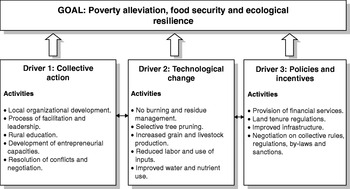
Although the adoption process of QSMAS was initially driven by short-term increases in crop yields at the farm level, its widespread adoption by thousands of farmers can be explained on the basis of a complex interaction with three main drivers of developmentReference Ayarza and Welchez29:
1. Collective action to focus on capacity building of local and regional organizations to support small farmers and improve education (DDP Principle 2).
2. Technological change to increase the resilience of local and regional production systems (DDP Principle 3).
3. Policies and incentives to promote the adoption of new production technologies (DDP Principle 1).
Figure 2 shows the main activities associated with each driver. Adoption was also facilitated by farmer application of the ‘Human Farm’ principles developed by Elias SanchezReference Smith30. These principles emphasize that improved management of natural resources needs to be accompanied by the strengthening of human capital at the individual and community levels (DDP Principle 2).
Drivers and activities associated with scaling up of QSMAS in the Lempira region.

With the support of FAO and several NGOs, local communities strengthened their capacity to negotiate incentives and benefits for the region (DDP Principle 4). Household heads organized water committees at the micro-watershed level to improve access to safe water. Local governments negotiated with the central government to implement long-distance learning radio programs (DDP Principle 4) and to improve the curricula of local schools and achieve better access to health services (DDP Principle 2). FAO and other development projects supported the formation of small cooperatives and financial services to strengthen the entrepreneurial capacity of men and women to transform and add value to their agricultural outputs and sell them through local and regional markets (DDP Principles 3 and 4). Access to rural finance enabled farmers to purchase better seeds, fertilizers and herbicides to improve crop production and invest in irrigation systems for subsequent diversification of their production systemsReference Suazo, Gómez, Mejía, Villatoro, Castro, del Cid, Zelaya, Cherret, Lindemann and Gaviria31.
Communal banks were another important financial mechanism supporting the implementation of the QSMAS. Their role was not limited to credit provision; they also served as a focus for collective action and enforcement of local policies. For example, credit was given only to farmers who did not burn their land. This new ‘moral order’ was supported by national and local laws forbidding the use of fire and protecting common forestlands and water reservoirs (DDP Principle 2).
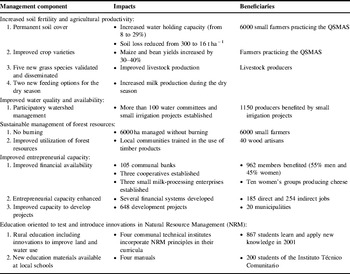
This process caused a profound change in the organizational culture and structure of development in the region (DDP Principle 4). A new threshold of guaranteed food security, improved soil and water productivity and enhanced managerial capacity was reached as a result of a new balance between production and conservation (DDP Principle 3). The system resulted in a 27% reduction in labor requirements and an 18% reduction in land preparation and weed controlReference Argueta13. At the landscape level, QSMAS contributed to the conservation of more than 40 native species of trees and shrubs26 and the fields serve as sinks for methane with low emission levels of nitrous oxide22. Table 2 summarizes the main impacts of QSMAS in terms of land and water productivity (DDP Principle 2), forest conservation and local strengthening at household and community levels (DDP Principle 5).
Impacts and beneficiaries of the adoption of the QSMAS in the Lempira region (30).

Future-QSMAS
During the past 16 years, the widespread adoption of the QSMAS in the Lempira region has improved food security, water availability (DDP Principle 2) and has ensured an adequate supply of fuelwood for small farmers. More recently, however, the intensification and diversification of agriculture have been accelerated in response to increasing opportunities to sell to local and regional markets (DDP Principles 1 and 4). Although new markets bring new opportunities for farmers, they also pose some challenges. These changes can simultaneously lead to both increases and decreases in sustainability (DDP Principle 3), as the QSMAS is further modified. For example, some innovative farmers are planting introduced grasses under the QSMAS to intensify livestock production and others are simply increasing livestock consumption of crop residues. While the former can increase animal output and maintain or improve soil structure and fertility (DDP Principle 2), the latter could eliminate the hydrologic benefits of the QSMAS if protective soil cover were removed and soil compaction resulted (DDP Principle 3). Vegetable crop production with irrigation, stimulated by increasing trade with neighboring El Salvador, has the potential to increase cash flow, but these new production systems may require different soil and water management strategies (DDP Principle 4).
Other anticipated concerns, such as increasing pest and disease incidence (DDP Principle 3), will demand new knowledge and inputs (DDP Principle 5). In fact, anecdotal observations from researchers and farmer comments indicate that herbicide and insecticide use are already high in the areas that have adopted QSMAS. Another major concern is the increasing risk of more severe weather events (DDP Principle 3) that have been observed in the past because of climate change.
Although some intensification and diversification are clearly possible while maintaining the benefits of the current QSMAS, continuing co-adaptation of this human–environmental system will be required (DDP Principle 1) to maintain its resilience and benefits (DDP Principle 2), including improved water storage, recycling of nutrients and environmental services for downstream users. The discussion below focuses on key issues that QSMAS practitioners should consider if the benefits of the system are to be maintained.
Integration with markets
The construction of a bridge between the Lempira region and El Salvador during the 1990s was a key event (DDP Principle 3) that accelerated the integration of small farmers to markets and cross-border trade (DDP Principle 4). Small farmers practicing the QSMAS have benefited by selling their maize and bean surpluses at elevated prices. If international demand for maize continues to increase in the future, due to interest in the production of bio-fuels (DDP Principle 4), the pressure to increase production will rise, and farmers will need to learn how to further improve crop water and nutrient use efficiency (DDP Principle 5). Conversely, access to grain imports (whole and/or as industrialized products), coupled with labor shortage and off-farm income could reduce farmers, interest in local grain production, thus increasing livestock and open grassland expansion in QSMAS-dominated areas (DDP Principles 1 and 3).
Improved rural financing
Access to formal and informal credit markets in the region should stimulate crop and livestock intensification of QSMAS. Farmers may reduce the area devoted to traditional crops and allow the introduction of new crop options with market potential using irrigation, improved storage facilities and improved varieties. Because of improvements in soil fertility and water availability under the QSMAS, crop and livestock production can be increased allowing further intensification of the system. However, indiscriminate increase of livestock can affect soil conditions, ground cover and tree density (DDP Principle 3). To be sustainable, intensification will have to be based on the strategic allocation of available soil and water resources under QSMAS to maintain an adequate tree density and soil cover and avoid soil compaction and erosion. A new cycle of technological change based on the combination of local and technical knowledge will likely be required to sustain an increase in crop and livestock production (DDP Principle 5).
Land value
Land ownership and value have been positively associated with the use of soil conservation practicesReference Jansen, Siegel and Pichón32, and in some cases the value of the land has increased because of the use of these practices (DDP Principle 2). This has been the case for land managed under QSMAS. Although there is no formal system to price the land in the region, farmers generally recognize that under QSMAS, land value is at least 30% higher than in areas without QSMAS (DDP Principle 3). This is a positive factor that may limit drastic changes of the system under intensification processes. Many farmers growing new crops on rented lands are now obliged to maintain permanent tree cover without burning.
Reduced labor
Family labor is decreasing due to the greater number of children attending school and the continuous out-migration of young people to the main cities in Honduras and USA (DDP Principle 4). This will become another factor influencing the intensification and diversification processes.
Toward a New Balance to Support Intensification and Diversification
If QSMAS is to continue to support the sustainable growth of the rural population in Lempira, a new balance between production and conservation will be needed (DDP Principle 3). This balance will require an optimum allocation in space and time of financial and land resources to support diverse crop and livestock production systems. Improved agricultural practices associated with the QSMAS will result, on the one hand, in enhanced productivity and resource quality and, on the other, in increased land value and reduced risks that will contribute to improved economic viability and social acceptance of the system in the long term (DDP Principle 2). This will require that local communities in the Lempira region learn to negotiate policies to ensure the benefits of improved land and water use for both upstream and downstream users. Economic benefits of improved water availability for downstream users should be shared with small farmers in upper catchments under a new arrangement (DDP Principle 4). Given the increased scarcity of both water and energy, this hydrologic benefit alone could support the adoption of the QSMAS. The alternative threshold will be of degradation and loss of resilience of the system if indiscriminate intensification of crop and livestock occurs without maintaining an adequate tree density and soil cover and avoiding soil compaction and erosion (DDP Principle 3).
The primary elements of the QSMAS—replacement of forest clearing, burning and tillage with thinning, pruning and direct planting—could be adopted and adapted in many parts of the world (Fig. 2). The key elements of the development process—honest participatory research and development—can also be usefully extended to other regions. However, adapting the system must be done carefully if long-term benefits are to be realized. As fresh water becomes scarcer, and demands for food and biofuel increase, it is also crucial to conserve biodiversity. To accomplish these goals simultaneously requires innovative approaches to crop production, such as described for the QSMAS to help restore degraded landscapes in Honduras. While the DDP is a useful framework for systematically identifying the critical variables and processes that determine the sustainability of any particular production system, it is ultimately no more clairvoyant than the collective wisdom of those who choose to apply it. The DDP can, however, help ensure that knowledge is integrated and applied.
Acknowledgements
We are grateful to Carlos Zelaya, German Flores and Edgardo Navarro of the FAO—Lempira Project for their comments and insights during the development of this paper. Thanks to Edwin Castro and Vilia Escober for taking care of details regarding travel and accommodation of the whole team when doing the field work. Finally, we express our gratitude to all producers and directors of the Institutos Tecnicos Comunitarios at Candelaria and Guarita for their enthusiasm and interest in the application of DDP in the region. Their comments were invaluable. Funding for this publication and an associated workshop was provided by a United States National Science Foundation grant to ARIDnet (NSF-DEB-02–34186). The manuscript also benefited from earlier research and development efforts supported by the FAO and CIAT.