INTRODUCTION
The human intestine supports a diverse and active ecosystem of microorganisms distinct from the human genome, collectively referred to as the gut microbiota (Bäckhed, Ley, Sonnenburg, Peterson, & Gordon, Reference Bäckhed, Ley, Sonnenburg, Peterson and Gordon2005). All three domains of cellular life (i.e., archaea, bacteria, and eukarya) can be found in the microbiota, together outnumbering human cells in the gut by approximately 10 to 1 (Bäckhed, et al., Reference Bäckhed, Ley, Sonnenburg, Peterson and Gordon2005). In healthy hosts, this ecosystem contains mostly symbiotic and commensal organisms that coexist without harm to either the host or to the microorganisms themselves (Bäckhed, et al., Reference Bäckhed, Ley, Sonnenburg, Peterson and Gordon2005). In fact, a healthy gut microbiota benefits its host by supplying essential nutrients and aiding in digestion and immune functions.
However, the composition of the microbiota is influenced by many factors, including intestinal motility, pH value, and bodily secretions, even extending to host lifestyle factors, such as antibiotic usage, diet, stress, and age (Tilg & Kaser, Reference Tilg and Kaser2011). While some changes to the composition of the microbiota and variance across individuals is normative, dysbiosis of the gut microbiota can become pathogenic. Dysbiosis can result from host or environmental factors and has been linked to several disease conditions, including inflammatory bowel disease, some types of cancer, obesity, and metabolic disorders (Tilg & Kaser, Reference Tilg and Kaser2011).
While research on the connection between the gut microbiome and the brain (i.e., the gut–brain axis) is newly developing and research in humans is limited, a parallel literature demonstrates possible links to both neurocognitive and psychiatric outcomes (Sarkar et al., Reference Sarkar, Lehto, Harty, Dinan, Cryan and Burnet2016). One such study used a microbiome depletion/transplantation paradigm. Microbiota isolated from obese C57BL/6 donor mice eating high fat diets were transplanted to nonobese mice. These nonobese, diet-naïve mice showed changes in exploratory and stereotypical behaviors (reflecting increased anxiety), as well as decrements in learning and memory in response to the microbiota transplant (Bruce-Keller et al., Reference Bruce-Keller, Salbaum, Luo, Blanchard, Taylor, Welsh and Berthoud2015). While specific changes were not thoroughly investigated, investigators did find lower levels of Akkermansia muciniphila (a Verrucomicrobium) and higher levels of Bilophila sp. (a Proteobacterium) in the microbiota of the obese mice on high fat diets than their normal weight, normal diet counterparts (Bruce-Keller et al., Reference Bruce-Keller, Salbaum, Luo, Blanchard, Taylor, Welsh and Berthoud2015).
Another study examined C57BL/6J mice switched from a normal chow diet to either a high fat or a high sucrose diet. After 2 weeks of a high-sucrose diet, mice exhibited problems in multiple cognitive abilities (e.g., cognitive flexibility, working and long-term memory), as well as decreases in Bacteroidales and increases in Lactobacillales and Clostridiales (Magnusson et al., Reference Magnusson, Hauck, Jeffrey, Elias, Humphrey, Nath and Bermudez2015). Those mice on a high fat diet showed decreased cognitive flexibility, increases in Erysipelotrichales and Clostridiales, and decreases in Bacteroidales (Magnusson et al., Reference Magnusson, Hauck, Jeffrey, Elias, Humphrey, Nath and Bermudez2015).
A study using NIH Swiss mice used an antibiotic treatment from weaning onward to deplete the gut microbiota during a key developmental period. Compared to control mice, those with depleted gut microbiota through development demonstrated reduced anxiety and reduced apparent memory for familiar objects and social learning as adults (Desbonnet et al., Reference Desbonnet, Carke, Traplin, O’Sullivan, Crispie, Moloney and Cryan2015).
Initial research in humans has also linked composition of the gut microbiota to cognitive changes. Bajaj et al. (Reference Bajaj, Ahluwalia, Steinberg, Hobgood, Boling, Godschalk and Wade2016) examined fecal microbiota and cognitive function in patients with and without liver cirrhosis. In persons with cirrhosis, poorer cognitive function was correlated with higher proportions of Lactobacillales and lower proportions of Enterobacteriaceae and Porphyromonadaceae. Additionally, individuals with poorer cognitive test scores exhibited increased inflammation, and initial evidence for an interaction between inflammation, gut dysbiosis, and cognitive function in healthy individuals without liver-cirrhosis was also demonstrated (Bajaj et al., Reference Bajaj, Ahluwalia, Steinberg, Hobgood, Boling, Godschalk and Wade2016). The current study sought to further explore the possible association between the composition of the gut microbiome and cognitive function in a sample of healthy older adults.
METHODS
Participants
A total of 43 older adults were recruited from a community recreation and wellness center (Table 1). Study participants were English-speaking and 50–85 years of age. Exclusion criteria included: (1) history of neurological, developmental, or severe psychiatric disorder (i.e., conditions known to independently impact cognitive function); (2) The Mini Mental State Exam (MMSE) score ≤24; (3) antibiotic use in the past 30 days; (4) history of significant gastrointestinal surgery; (5) history of alcohol or illicit drug dependence; or (6) history of severe heart, kidney, or liver problems.
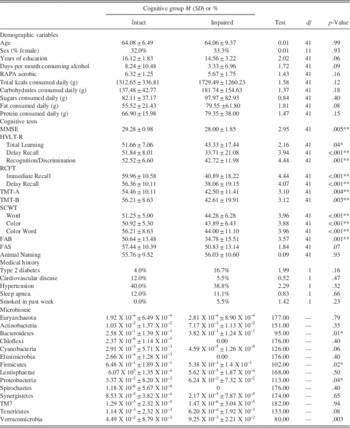
Demographic information, test scores, and microbiome distributions of 43 community-dwelling older adults

*p<0.05.
**p<0.01.
RAPA aerobic=Rapid Assessment of Physical Activity Aerobic, MMSE=Mini Mental State Exam, HVLT-R=Hopkins Verbal Learning Test – Revised, RCFT=Rey-Osterrieth Complex Figure Task, TMT=Trail Making Test, SCWT=Stroop Color Word Test, FAB=Frontal Assessment Battery, FAS=Verbal Association Fluency
To facilitate analyses with the modest sample, participants were grouped into Intact versus Impaired groups based on cognitive test performance. Participants with test scores falling one or more standard deviations below normative test performance on two or more tests (i.e., Impaired) were compared to those with one or fewer impaired test scores (i.e., Intact). This approach accounts for the high prevalence of individuals obtaining a single impaired test score in this age range (>70%, Palmer, Boone, Lesser, & Wohl, Reference Palmer, Boone, Lesser and Wohl1998) and corresponds with the median number of impaired test performances within the sample (median=1.0; Intact group 0.60±0.50 impaired tests vs. Impaired group 4.33±2.03 impaired tests). Intact (N=25) and Impaired (N=18) groups did not differ on key demographic, medical, or lifestyle characteristics (including dietary habits) and no covariates were used for analyses (See Table 1).
Procedures
All procedures were approved by the Kent State University Institutional Review Board. Participants were recruited from a local community recreation and wellness center. After providing written informed consent, participants completed the neuropsychological test battery, administered by an examiner and using paper and pencil, in a quiet room. After testing, participants received the self-report questionnaire packet and stool sample kit, with instructions to complete them at home and return by mail. The stool samples were collected in kits prearranged by Ubiome (www.ubiome.com). Samples were mailed directly to Ubiome in sterile, capped tubes containing proprietary buffer. 16S rRNA amplicon sequencing was done following protocols from the Human Microbiome Project (Human Microbiome Project Consortium, 2012).
Measures
Cognitive test battery
A brief neuropsychological test battery assessed cognitive functioning. Measures were chosen for their known sensitivity to cognitive dysfunction in an older adult population and all raw scores were transformed into t scores using normative data.
Global cognitive function
MMSE examines global cognitive functioning by briefly assessing various cognitive domains. Total scores range from 0 to 30 with lower scores indicating poorer performances (Folstein, Folstein, & McHugh, Reference Folstein, Folstein and McHugh1975). Low MMSE scores were used as an exclusion criterion and were not used as measures of cognitive function in analyses.
Attention/executive function
The Frontal Assessment Battery (FAB) is a composite measure of executive function and comprised of six subtests, incorporating aspects of conceptualization, mental flexibility, inhibitory control, and sensitivity to interference (Dubois, Slachevsky, Litvan, & Pillon, Reference Dubois, Slachevsky, Litvan and Pillon2000). Trail Making Test A (TMT-A) has individuals draw lines to quickly connect numbered circles in ascending order and provides a measure of complex visual scanning and psychomotor speed, while Trail Making Test B (TMT-B) has individuals alternate connecting numbers and letters (e.g., 1–A– 2 – B, etc.) and provides a measure of set-shifting (Dikmen, Heaton, Grant, & Temkin, Reference Dikmen, Heaton, Grant and Temkin1999). The Stroop Color Word Test (Golden & Freshwater, Reference Golden and Freshwater2002) requires that individuals indicate the color ink in which a word is printed, while ignoring the word itself, which is a different color word (e.g., “blue” printed in red ink). It is a commonly used measure of mental flexibility and selective attention.
Memory
The Hopkins Verbal Learning Test-Revised (HVLT-R; Brandt, Reference Brandt1991) is a test of verbal memory requiring learning, recall, and recognition of a 12-item word list. The Rey-Osterrieth Complex Figure Task (RCFT) measures memory for complex visual information by asking participants to copy a complicated geometric figure (learning task), immediately draw the figure again from memory (immediate recall), and later draw the figure from memory (delayed recall; Loring, Martin, Meador, & Lee, Reference Loring, Martin, Meador and Lee1990).
Language
A measure of verbal fluency (Verbal Association Fluency, FAS) asks participants to name as many words beginning with a specific letter as possible in 60 s (Lezak, Howieson, Bigler, & Tranel, Reference Lezak, Howieson, Bigler and Tranel2012), and the Animal Naming task asks participants to list different animals for 60 s (Lezak et al., Reference Lezak, Howieson, Bigler and Tranel2012).
Questionnaires
Self-report questionnaires were used to clarify possible group differences. A brief Medical History Questionnaire asked participants to indicate histories of medical conditions, such as hypertension, type 2 diabetes, sleep apnea, and gastrointestinal disorders, among others. The EPIC-Norfolk Food Frequency Questionnaire (FFQ; Mulligan et al., Reference Mulligan, Luben, Bhaniani, Parry-Smith, O’Conner, Khawaja and Khaw2014) quantifies usual food intake over the past 30 days. The Rapid Assessment of Physical Activity (RAPA) offers a valid assessment of physical activity among older adults (Topolski et al., Reference Topolski, LoGerfo, Patrick, Williams, Walwick and Patrick2006).
Statistical Analyses
All microbiome data were represented as proportions of total microbiome and then centered before all analyses. Due to small sample size and non-normal distributions, Mann-Whitney U tests were used to compare composition of the microbiome between Intact and Impaired groups. Spearman correlations examined the association between specific phyla and performance on individual cognitive tests. Mean imputation was used to confirm group assignment for a participant with missing test data on a single subtest (Stroop Color Word Test – Color) using regression analyses from demographic (e.g., age, education, sex) and remaining cognitive test scores.
RESULTS
Between-Group Differences in Gut Microbiome Composition
Mann-Whitney U tests using a 95% confidence interval revealed a different distribution for Bacteroidetes (p=.01), Firmicutes (p=.02), Proteobacteria (p=.04), and Verrucomicrobia (p=.003) for Intact relative to Impaired groups. Intact persons exhibited a lower proportion of Bacteroidetes and Proteobacteria and higher proportions of Firmicutes and Verrucomicrobia than the Impaired group. See Table 1. Mann-Whitney U tests using a 95% confidence interval also revealed nonsignificant trends for differences in distributions for Cyanobacteria (p=.06) and Tenericutes (p=.08).
Correlation between specific phyla and cognitive test performance
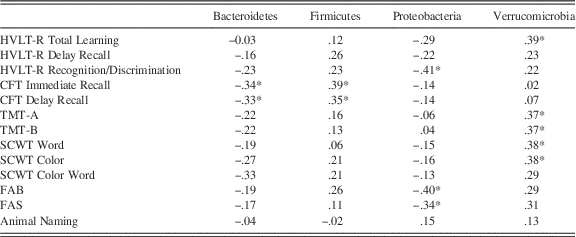
Spearman correlations examined possible associations between the significant phyla in the above analyses and specific cognitive tests. Analyses showed several significant associations, most commonly between Verrucomicrobia and measures of attention, executive function, and memory. Specifically, larger proportions of Verrucomicrobia were significantly correlated with better scores on HVLT-R Total Learning, TMT-A, TMT-B, SCWT Word, and SCWT Color (r ranging from 0.37 to 0.39; p<.05). Greater proportions of Firmicutes were significantly correlated with higher scores on the CFT Immediate (r=0.39; p<.05) and Delayed Recall tasks (r=0.35; p<.05), while higher proportions of Bacteroidetes were correlated with poorer performances on the CFT Immediate (r=−0.34; p<.05) and Delayed Recall tasks (r=−0.33; p<.05). Higher proportions of Proteobacteria were significantly correlated with poorer scores on HVLT-R Recognition/Discrimination, FAB, and FAS (r ranging from −0.34 to −0.41; p<.05). See Table 2.
Correlations between microbiota phyla and cognitive test performances.

* p<0.05.
HVLT-R=Hopkins Verbal Learning Test – Revised, RCFT=Rey-Osterrieth Complex Figure Task, TMT=Trail Making Test, SCWT=Stroop Color Word Test, FAB=Frontal Assessment Battery, FAS=Verbal Association Fluency
DISCUSSION
The findings from the current study are consistent with past work highlighting an association between the gut microbiome and cognitive function, although findings vary somewhat across studies. Generally, the presently observed correlations indicate that higher proportions of Firmicutes and Verrucomicrobia may be in some way beneficial or protective for cognitive function, while higher proportions of Bacteroidetes and Proteobacteria may be less beneficial, or possibly deleterious. Such findings are similar to past work in a mouse model using a microbiome depletion/transplantation paradigm, in which proportions of Verrucomicrobium were positively associated and proportions of Proteobacterium were negatively associated with learning and memory performance (Bruce-Keller et al., Reference Bruce-Keller, Salbaum, Luo, Blanchard, Taylor, Welsh and Berthoud2015). Likewise, previous work in humans also found negative correlations between proportion of Proteobacteria and Bacteroidetes with cognitive impairment in persons with severe liver dysfunction (Bajaj et al., 2011).
In contrast to the present findings, in a study using high fat or high sugar diets to manipulate the gut microbiota in mouse models Bacteroidetes were positively correlated and Firmicutes were negatively correlated with cognitive function (Magnusson et al., Reference Magnusson, Hauck, Jeffrey, Elias, Humphrey, Nath and Bermudez2015). Full interpretation of such findings is difficult, as the many factors influencing the composition of the gut microbiome are just beginning to be understood and very few studies have directly examined its possible link to neurological function. Similarly, the appropriate level of analyses of gut–brain relationships is unclear at this time (e.g., phyla, genera, etc.) and requires clarification through future work in large samples.
Despite this early stage of the literature, there are several likely mechanisms that warrant evaluation, although investigation of these mechanisms was outside the scope of the current, preliminary study. One such possibility is the known relationship between gut dysbiosis and greater inflammation (Sarkar et al., Reference Sarkar, Lehto, Harty, Dinan, Cryan and Burnet2016). Chronic inflammation has long been viewed as a contributor to cognitive decline (Trollor et al., Reference Trollor, Smith, Agars, Kuan, Baune, Campbell and Brodaty2012) and there is some evidence that dysbiosis, rather than a specific phylum of bacteria, may lead to greater inflammation (Tilg & Kaser, Reference Tilg and Kaser2011).
Other possible mechanisms have also been suggested for the link between the gut microbiome and neurocognitive outcomes, including communication through the vagus nerve, production of bacterial metabolites, and enteroendocrine signaling (as reviewed by Sherwin, Sandhu, Dinan, & Cryan, Reference Sherwin, Sandhu, Dinan and Cryan2016). Each of these pathways has the potential to influence a wide range of physiological processes within the brain. Other work shows that the gut microbiota can impact other known contributors to cognitive outcomes, including glycemic control (Tilg & Kaser, Reference Tilg and Kaser2011). Identification and elucidation of these possible pathways is much needed, particularly as they may lead to novel intervention targets that promote neurological health through manipulation of the gut microbiota.
Findings from this preliminary study are limited in several important ways. First, the small sample was comprised of healthy community-dwelling older adults and future studies should include patient samples to examine a wider range of cognitive functioning. Second, the present study found a cross-sectional relationship between the gut microbiome and cognitive test scores, but does not provide insight to possible mechanisms or trajectories of such a relationship. Prospective studies that include pre-/pro-biotic supplementation will shed light on the relationship between the gut microbiome and cognitive functioning, as they have been proposed as possible therapeutics for psychiatric conditions (Sarkar et al., Reference Sarkar, Lehto, Harty, Dinan, Cryan and Burnet2016) and may provide similar benefits for neurological deficits.
Additionally, antibiotics are known to affect the microbiome, and the 30-day exclusion criterion used here may not capture persons on longer or more frequent courses of antibiotics and may influence the observed findings. Finally, our preliminary study used self-report measures to assess dietary habits and physical activity levels, which may account for the lack of association found between diet and performance on cognitive testing. Studies that more precisely measure dietary intake, particularly feeding studies or the use of a more detailed diet log to log food intake over time, and physical activity, such as actigraphy, will help clarify the observed association between the gut microbiome and cognitive function (as dietary habits and physical activity are primary contributors to gut microbiome composition) and may assist in disentangling the often inconsistent relationships between these factors and cognitive outcomes.
In brief summary, the present study found an association between the composition of the gut microbiome and cognitive functioning in a sample of healthy older adults. Such findings raise the possibility that the gut microbiota is a potential contributor to neurological outcomes in late life and future studies may lead to novel intervention targets.
ACKNOWLEDGMENTS
Conflicts of Interest and Sources of Funding: None.