


1. Introduction
The idea that diverse teams are better problem-solvers than teams of experts is intuitively attractive. In an influential paper, Lu Hong and Scott Page (Reference Hong and Page2004) introduce so-called landscape models and demonstrate that a functionally diverse group of agents can perform systematically better than a group of agents selected for their individual ability.Footnote 1 Their “diversity trumps ability” result is one of the cornerstones of an anti-epistocratic, egalitarian, and deliberative-democratic narrative (Landemore Reference Landemore2013): collective success does not come from hand-picking the best but from bringing a variety of skills to the table.Footnote 2 Ironically, however, the diversity–expertise trade-off in deliberative collectives has rarely been studied in radically different frameworks. This paper aims to fill this important gap, and revisit the implications for epistemic deliberative democracy.
The diversity–expertise trade-off concerns a possible tension between the individual expertise in a group and its diversity. Virtually everyone agrees that expertise requires epistemic competence (Hardwig Reference Hardwig1985; Goldman Reference Goldman2001, Reference Goldman2018).Footnote 3 Accordingly, this paper focuses on this epistemic dimension and characterizes an agent’s level of expertise as her capacity to adequately solve problems and reliably form true beliefs. Concepts of diversity can attach to different attributes such as gender, ethnicity, cognition, expertise, perspectives, heuristics, etc. Whether and how these different types of diversity can be valuable is an important research question (Steel et al. Reference Steel, Fazelpour, Crewe and Gillette2021; Sulik et al. Reference Sulik, Bahrami and Deroy2022); nonetheless, following the large majority of work on the diversity–expertise trade-off, this paper focuses on the value of cognitive diversity, which refers to diverse perspectives, interpretations, heuristics, and predictive models (e.g., Landemore Reference Landemore2013, 89).Footnote 4
In Hong and Page’s landscape models teams face a search problem where they must find the optimal solution among thousands of options. But what about binary classification problems where there are only two options available? Binary classification problems are common in legal, scientific, policy, and political domains. Consider a legal case where a group of judges has to decide on whether a defendant is guilty or not; a scientific case where a group of scientists has to figure out whether a particular virus causes some disease; a policy case where a committee has to decide on whether to approve or deny a given drug; or a political case where a group of political representatives must decide on whether all residents should be required to have health insurance. Landscape models cannot, and were never intended to, address deliberative groups facing binary classification problems.
This limitation is not unique to landscape models, but characteristic of the broader literature on the wisdom of the crowd. Indeed, the literature predominantly focuses on aggregation (possibly preceded by deliberation) and on large groups, but the diversity–expertise trade-off in small, deliberative groups has not been studied systematically for binary classification problems. This paper aims to fill this gap by introducing and utilizing a new modeling framework where agents deliberate to solve binary classification problems, where one option is objectively or intersubjectively correct.
I model deliberation as an exchange of “evidences,” such as opinions, empirical facts, observations, arguments, intuitions, or personal experiences.Footnote 5 Evidences can be complex, such as personal experiences or complex arguments. Evidences might be (inferentially) misleading, that is, they can support the wrong option. The closest precursor is Dietrich and Spiekermann’s (Reference Dietrich and Spiekermann2025) model of deliberation as sharing and absorbing evidence, but they focus on the impact of pre-vote deliberation on the outcomes of majority voting. Another close relative is Hong and Page’s (Reference Hong and Page2025) recent model of interpreted signals where individuals use approximations (i.e., interpreted signals) to solve binary classification problems, but they focus on characterizing the range of collective accuracies under majority rule. Instead, my study aims to improve our understanding of the diversity–expertise trade-off in deliberation—modeled as the exchange of (possibly complex, possibly misleading) evidences. In turn, I will argue that my approach provides new insights on the epistemic credentials of deliberative democracy.
The paper is organized as follows. I begin with presenting existing approaches to the phenomenon of the wisdom of the crowd, and show that there is a gap concerning the diversity–expertise trade-off for deliberative groups facing binary classification problems (section 2). Then, I present the new evidential sources model (section 3) and my simulation studies (section 4). Subsequently, I explore the ramifications for epistemic deliberative democracy (section 5). I end with a brief summary and discussion (section 6).
2. Diversity and ability in deliberative contexts
A group of individuals can outperform individual experts (de Condorcet Reference de Condorcet1785; Galton Reference Galton1907), a phenomenon widely known as the wisdom of the crowd (Surowiecki Reference Surowiecki2005; Page Reference Page2007). Diversity is often celebrated as an important driver of the wisdom of the crowd. To gain a better understanding of collective wisdom and ignorance, it is important to draw a distinction between aggregation and deliberation, and to distinguish between different types of problems:Footnote 6
-
• prediction problems where agents must predict (or estimate or forecast) a certain value or quantity (e.g., the value of a stock);
-
• search problems where agents must find the optimal solution among thousands of options (e.g., the best policy to a social problem);
-
• sparse classification problems where agents must choose between a limited set of options (e.g., the best political candidate).
Prediction problems include Galton’s (Reference Galton1907) famous problem of estimating the weight of an ox, where the average of the estimates of many individuals was more accurate than the estimates of individual experts. In these problems, the task is to determine a certain value or quantity, such as the weight of an ox, the value of a stock, or the effective drug dose, that can be mapped to a continuous scale. Combining multiple predictions has been well studied (Armstrong Reference Armstrong and Scott Armstrong2001). Moreover, not only empirical evidence (Batchelor and Dua Reference Batchelor and Dua1995) but also formal results (Lamberson and Page Reference Lamberson and Page2012) indicate that diverse groups can trump expert teams. It should be noted, however, that the research on combining predictions concerns an aggregation problem and does not address the value of diversity in deliberation.
Search problems concern cases where one must find the optimal solution among many discrete options. In Hong and Page’s (Reference Hong and Page2004) seminal landscape models, teams deliberate to solve a search problem where they must find the optimal solution among thousands of options. One of their central results is a computational experiment where they report that random teams trumped teams composed of the best-performing agents.
There have been several responses and modifications to the original work by Hong and Page.Footnote 7 Although their result has sometimes been taken to show that diversity always trumps ability, the actual results only demonstrate that diversity can trump ability in some circumstances. Indeed, partly because they only prove a possible link and not a necessary one, most of the ensuing literature has focused on explicating when diversity trumps ability.Footnote 8
In any case, landscape models are limited to search problems and are ill-suited for studying binary or sparse classification problems. Indeed, Weymark (Reference Weymark2015) proved that landscape models are not applicable to binary problems. Moreover, I performed a simulation study that shows that landscape models are also ineffective for studying the trade-off between diversity and expertise in sparse classification problems involving ten options.Footnote 9 These results are not surprising, since the landscape models were not meant to capture sparse classification problems. Rather, they indicate that landscape models cannot inform us about the diversity–expertise trade-off in deliberative contexts concerning sparse classification problems.
Sparse classification problems are cases where one must find the best option among a few options. In particular, in binary classification problems, agents must select the objectively or intersubjectively correct option among only two options. Condorcet famously showed that in such binary classification problems, under certain conditions, the majority judgment is more reliable than individual expert judgments (de Condorcet Reference de Condorcet1785). Although some of these conditions have been questioned, there is, by now, a rich literature on jury theorems generalizing Condorcet’s findings beyond these restricted settings (Dietrich and Spiekermann Reference Dietrich, Spiekermann, Zalta and Nodelman2023).
More recently, Dietrich and Spiekermann (Reference Dietrich and Spiekermann2025) have utilized a new evidential sources framework to model deliberation and studied whether deliberation can improve majority decisions. Relatedly, Hong and Page (Reference Hong and Page2025) have developed an interpreted-signals framework to characterize the range of collective accuracies under majority rule, which depends, among other things, on the diversity of the group. Going beyond the binary case, Keuschnigg and Ganser (Reference Keuschnigg and Ganser2017) adopted the lens model and performed simulation studies to show that the effects of group composition depend on the social aggregation function and the type of problem: diversity is key mainly in prediction problems with aggregation via averaging and much less important in sparse classification problems with aggregation via plurality rule. In any case, the literature predominantly focuses on aggregation (possibly preceded by deliberation) and on large groups, but the diversity–expertise trade-off in small, deliberative groups has not been studied systematically. This paper aims to fill this gap.
3. The evidential sources model
In this section I present the new evidential sources framework (section 3.1), discuss and operationalize the concept of diversity at the heart of my study (section 3.2), and discuss some numerical examples that lead to some preliminary findings (section 3.3).
Although the goal of this section is to describe the model’s main components and mechanisms, a given model’s explanatory value hinges on how well it matches the intended target. While empirical correspondence is well beyond the scope of the paper, I would like to flag that one indirect way to gauge the empirical fit is to describe the competences of the pool of agents represented by a particular model (or parameter setting) and compare those to the real-world target. For example, given the political ignorance of voters (Somin Reference Somin2013), it seems reasonable that the pool of voters is best represented by models that yield pools of agents who are not very competent. From this perspective, let me foreshadow that I will describe the pools of agents that are represented by different parameter settings in section 4.1 and will later use it to explore the implications for epistemic deliberative democracy in section 5.
3.1. The model
My new modeling framework focuses on binary classification problems, where one option is objectively or intersubjectively correct. In these evidential sources models, agents can decide between two options by receiving information from sources. These sources can have different levels of reliability. For example, a reputable newspaper is (presumably) a better source on political issues than a ten-year-old child; some scientific measurement tools are more accurate than others; and a court justice is more informed about the legal system than a first-year philosophy student.
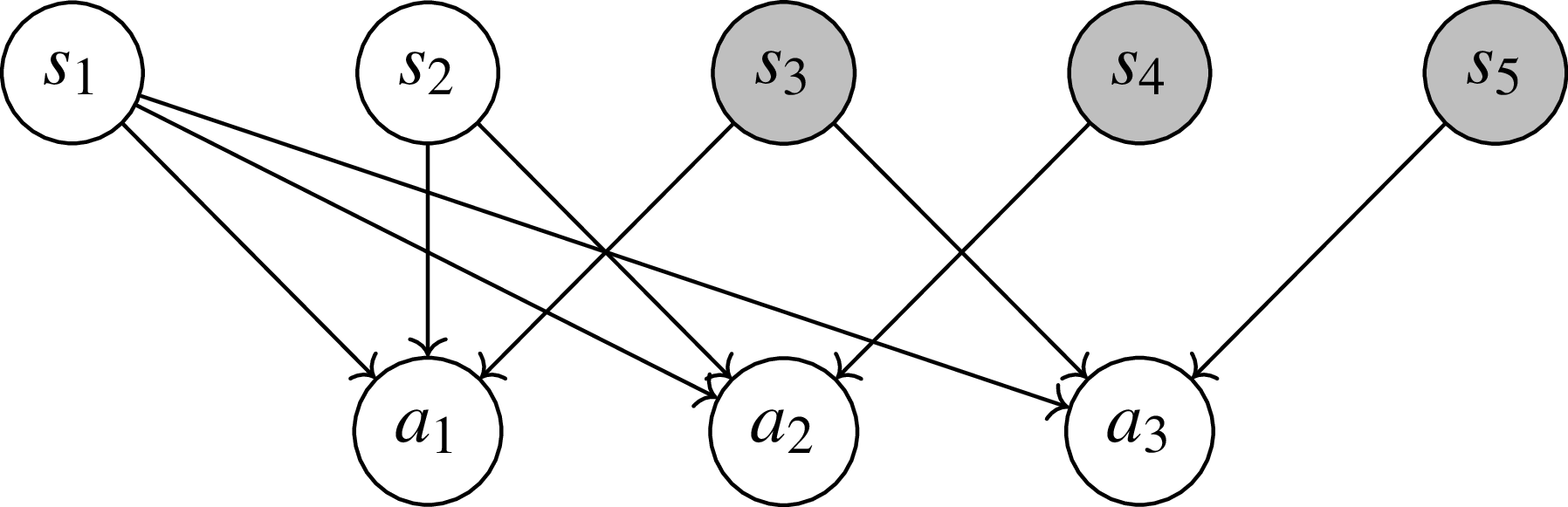
Models consist of sources, agents, and teams. Figure 1 presents a stylized example with three agents and five sources, where edges represent the sources that are accessed by the agents.Footnote
10
Let us discuss these in turn. Sources can be more or less reliable and some could even be systematically unreliable. Each source
 $s$
is assigned some probability
 ${p_s}$
representing the likelihood that the source will generate, produce, or share inferentially accurate evidence, i.e., evidence that supports the correct option. The “valence” of an evidence captures which option it supports. We assume that (the valences of the evidences generated by) the sources are probabilistically independent.
A stylized evidential sources model consisting of five sources
 ${s_1}$
–
 ${s_5}$
and three agents
 ${a_1}$
–
 ${a_3}$
. The coloring of the sources represents a stylized model run, where the evidence produced by the white sources (resp., gray sources) was (inferentially) accurate (resp., inaccurate). Observe that in this particular model run: (a) agents 1 and 2 have a correct belief, while agent 3’s belief is incorrect; (b) the opinion-based dynamics leads to a correct collective decision (because the majority of the agents have a correct belief); (c) the evidence-based dynamics leads to an incorrect collective decision (because the majority of the sources accessed by the team produced inaccurate evidence); and (d) the boundedly rational evidence-based dynamics leads to a correct collective decision (because the accurate evidences are accessed five times (including double counting) while the inaccurate evidences are only accessed four times).

Sources with reliabilities below 100% are imperfect in the specific sense that they may occasionally generate (inferentially) misleading evidence, i.e., evidence that supports the incorrect option. This imperfection is realistic, and it is compatible with malignant sources but also with truthful and sincere sources. After all, scientific evidence and inductive reasoning involves inductive risks. Hence, even truthful and sincere observations can be misleading, that is, support the incorrect option. Moreover, in non-monotonic reasoning contexts, facts can be misleading. Consider the classic example of Tweety. Suppose we were to learn the fact that Tweety is a bird. We would (legitimately) draw the conclusion that Tweety can fly. However, it turns out that Tweety is a penguin and is unable to fly. This case illustrates that truthful information (Tweety is a bird) can be misleading (i.e., support the conclusion that Tweety can fly).
An agent’s classification heuristic is modeled by the sources she has access to. An agent forms her beliefs on the basis of the “valence” of the evidences produced by the sources she has access to. For instance, in Figure 1, agent 2’s heuristic is given by sources 1, 2, and 4. Although sources were assumed to be independent, the fact that two agents’ heuristics can overlap entails that agents need not be independent. Indeed, in Figure 1 the agents are not independent because they all access source 1.
For simplicity’s sake, I assume that agents form their individual opinions by adopting majority rule. An agent’s individual score represents their level of expertise; it is the probability that the agent succeeds in selecting the correct option.Footnote 11 An agent’s score can be calculated from the reliability of her sources by going over all possible configurations of valences of the evidences of her sources. This opinion formation mechanism employs the simplifying assumption that all evidences have equal strength. This simplification offers an instructive, intelligible, and tractable base case, which could be modified in future work.Footnote 12
In my model, higher levels of expertise are correlated with repeated success.Footnote 13 Let me explain. The individual score is the probability that an agent succeeds in selecting the correct option, averaging over all those configurations of valences of the evidences of the agent’s sources that lead to a correct opinion (weighted by the probability of the configuration). In other words, experts in my model have the capacity to repeatedly utilize their sources to gather reliable evidences and form true beliefs.Footnote 14 Hence, higher individual scores represent higher likelihoods of repeated success.
Teams are modeled as sets of agents. Teams communicate internally before forming a collective decision between the two options. A team’s score is the probability that it succeeds in selecting the correct option. I consider three deliberative mechanisms:
-
(1) Opinion-based dynamics: Agents communicate their opinion (not the underlying evidences) and the team’s collective decision follows the majority opinion.
-
(2) Evidence-based dynamics: Agents communicate all their evidences and the team’s collective decision follows the majority evidence.
-
(3) Boundedly rational evidence-based dynamics: Agents communicate all their evidences and the team’s collective decision follows the majority evidence—possibly with double counting.
Figure 1 illustrates these different mechanisms in a stylized example. I will discuss these different deliberative mechanisms in more detail in section 4. At the risk of oversimplification, we could say that the basic units in these mechanisms are opinions, evidences, and assertions, respectively. For example: in the first case, team members communicate their opinions concerning whether a given defendant is guilty of a robbery; in the second case, team members communicate their evidences, such as an eyewitness statement or an argument that the defendant has no reason to steal the goods because they are wealthy; in the third case, team members not only communicate their evidences but an evidence also receives extra weight when it is communicated by multiple agents (in a sense, each separate assertion receives weight).
3.2. Operationalizing diversity
Cognitive diversity refers to the variety of perspectives, interpretations, heuristics, and predictive models people use to form beliefs and make choices.Footnote 15 In my model, agents form their beliefs and make decisions by applying the majority rule on the (valences of the) evidences generated by the sources they have access to. My notion of evidences is very broad and includes not only empirical facts but also opinions, observations, arguments, intuitions, and personal experiences. Therefore, an agent’s classification heuristic, which is represented by the sources she has access to, can be interpreted as her perspective (how she views the problem) or her decision heuristic (how she makes her decisions). Accordingly, I operationalize diversity as a lack of overlap in the agents’ classification heuristics (i.e., a lack of overlap in the agents’ evidential sources).Footnote 16 For example, in Figure 1, agents 1 and 2 are less diverse than agents 2 and 3. In general, the more diverse two agents’ classification heuristics are, the lower the correlation between their decisions will be.
More technically, the diversity of two heuristics
 $A$
and
 $B$
,
 ${\rm{\Delta }}\left( {A,B} \right)$
, is defined by the proportion of sources that are in only one of them:Footnote
17
 $\Delta \left( {A,B} \right) = {1 \over 2}\left( {{{\left| {A\backslash B} \right|} \over {\left| A \right|}} + {{\left| {B\backslash A} \right|} \over {\left| B \right|}}} \right).$
A team
 ${\mathscr T}$
of agents is represented by a set of heuristics, i.e., a set of sets of sources (
 ${\mathscr T} \subseteq {2^S}$
). The diversity of a team
 ${\mathscr T}$
of at least two heuristics,
 ${\rm{\Delta }}\left( {\mathscr T} \right)$
, is given by the average diversity of pairs of heuristics in the team:
 $\Delta ({\mathscr T}) = \gamma \cdot \mathop \sum \limits_{{A,B \in{\mathscr T}}\atop{A \ne B}} \Delta \left( {A,B} \right),$
where
 $\gamma = 1/(|{\mathscr T}{|^2} - \left| {\mathscr T} \right|)$
is a normalization parameter so that
 $0 \le {\rm{\Delta }}\left( {\mathscr T} \right) \le 1$
.
3.3. Examples and preliminary findings
In this section, we discuss some numerical examples and draw out some preliminary findings and observations. First, to investigate the diversity–expertise trade-off, we must consider situations where the heuristics are not equally good. Hence, we must consider evidential sources models where the sources are not equally reliable (otherwise, all heuristics would be equally good).
Second, let us consider a numerical example where there are 18 available sources and the heuristic size is 3. Suppose that four sources are highly reliable (say, 90%) and all the others are unreliable (say, at chance level 50%). Let us consider teams of size three. A diverse team could consist of agents who access only unreliable sources. The expert team, on the other hand, would consist of agents who only access highly reliable sources. Clearly, the expert team will perform much better than this diverse team—irrespective of the deliberative mechanism.
Third, observe that in the previous example, a diverse team could also consist of agents who access some highly reliable sources. More generally, any permutation of the sources will give rise to another team that is equally diverse. Hence, although there is typically only one expert team, there are multiple (maximally) diverse teams. The fact that there are multiple diverse teams complicates the analysis of the diversity–expertise trade-off, because we must compare the performance of the expert team to the performance of a set of diverse teams. In rare cases, the expert team might trump some diverse teams but not others. To the best of my knowledge, this complication is rarely discussed in the literature on landscape models—Singer (Reference Singer2019) is a notable exception.
Fourth, let us consider another numerical example where there are 18 available sources and the heuristic size is 3. Suppose the sources are roughly equally reliable. In particular, suppose that four sources are slightly more reliable (say, 60%) than the others (say, 59%). Let us consider teams of size three. In this case, the expert team would consist of agents who only access the slightly more reliable sources, and these experts will have a large degree of overlap. Diverse teams, on the other hand, would consist of agents without any overlap. As a result, it can easily be verified that diverse teams perform much better than the expert team—irrespective of the deliberative mechanism. The advantage of individual expertise is counteracted by the disadvantage of interdependence.
In sum, we observed that expertise trumps diversity in some cases, while diversity trumps expertise in others. Moreover, in virtually all cases there are multiple (maximally) diverse teams, which complicates the analysis of the diversity–expertise trade-off.
4. Simulation studies
In this section, I discuss and motivate the parameter choices in my simulation studies (section 4.1) and then present the results of my simulation studies concerning opinion-based (section 4.2), evidence-based (section 4.3), and boundedly rational evidence-based (section 4.4) dynamics. I discuss various robustness checks in section 4.5.
4.1. Simulation parameter choices
Simulation studies involve decisions that determine which areas of the model’s parameter space are covered (and which are left out), because it is often impossible to cover the entire parameter space or because certain areas of the parameter space are implausible or irrelevant. I consider scenarios parametrized by the team size, the heuristics size, the number of available sources, and the sources’ reliabilities. The goal of this subsection is to explain my parameter choices and to give an (indirect) interpretation of the different parameter settings.
In sum, my parameter decisions were:
-
(1) teams of size 9;
-
(2) heuristics of size 5;
-
(3) models with 13 and 17 available sources; and
-
(4) models with equidistant reliability distributions with means ranging from 0.55 to 0.75.Footnote 18
First, following the existing literature on landscape models, I decided to focus on teams of size nine—although this decision is, admittedly, rather arbitrary.Footnote 19
Second, people can only consider a limited number of evidences. Since empirical research in cognitive science strongly suggests that people can typically process and recall between three and five pieces of information (Cowan Reference Cowan2001, Reference Cowan2010), I decided to only consider heuristics of size 5.Footnote 20, Footnote 21 After all, the size of an agent’s heuristic represents the number of evidences used in their individual belief-formation and decision-making.
Third, the number of available sources is chosen in such a way as to correspond to the total number of available heuristics typically considered in simulation studies based on landscape models: between 1,320 and 6,840 available heuristics (Holman et al. Reference Holman, Berger, Singer, Grim and Bramson2018; Grim et al. Reference Grim, Singer, Bramson, Holman, McGeehan and Berger2019; Reijula and Kuorikoski Reference Reijula and Kuorikoski2021).Footnote
22
The set of all possible heuristics (or agents) in a given parameter setting is determined by the number of available sources
 $n$
and the size of the heuristics
 $k$
; their total number is given by
 $\binom{n}{k}$
. Given my focus on heuristics of size 5, I considered models with 13 or 17 sources, which correspond to 1,287 (
 $=\binom{13}{5}$)
and 6,188 (
 $=\binom{17}{5}$)
possible heuristics, respectively.
Fourth, my choice regarding the source reliability distributions is mainly guided by simplicity and tractability. I focused on, so-called, equidistant source reliability distributions with a fixed range of 0.2. These reliability distributions are represented by their mean. For example, mean 0.7 corresponds to an equidistant reliability distribution on the interval
 $\left[ {0.6,0.8} \right]$
.Footnote
23
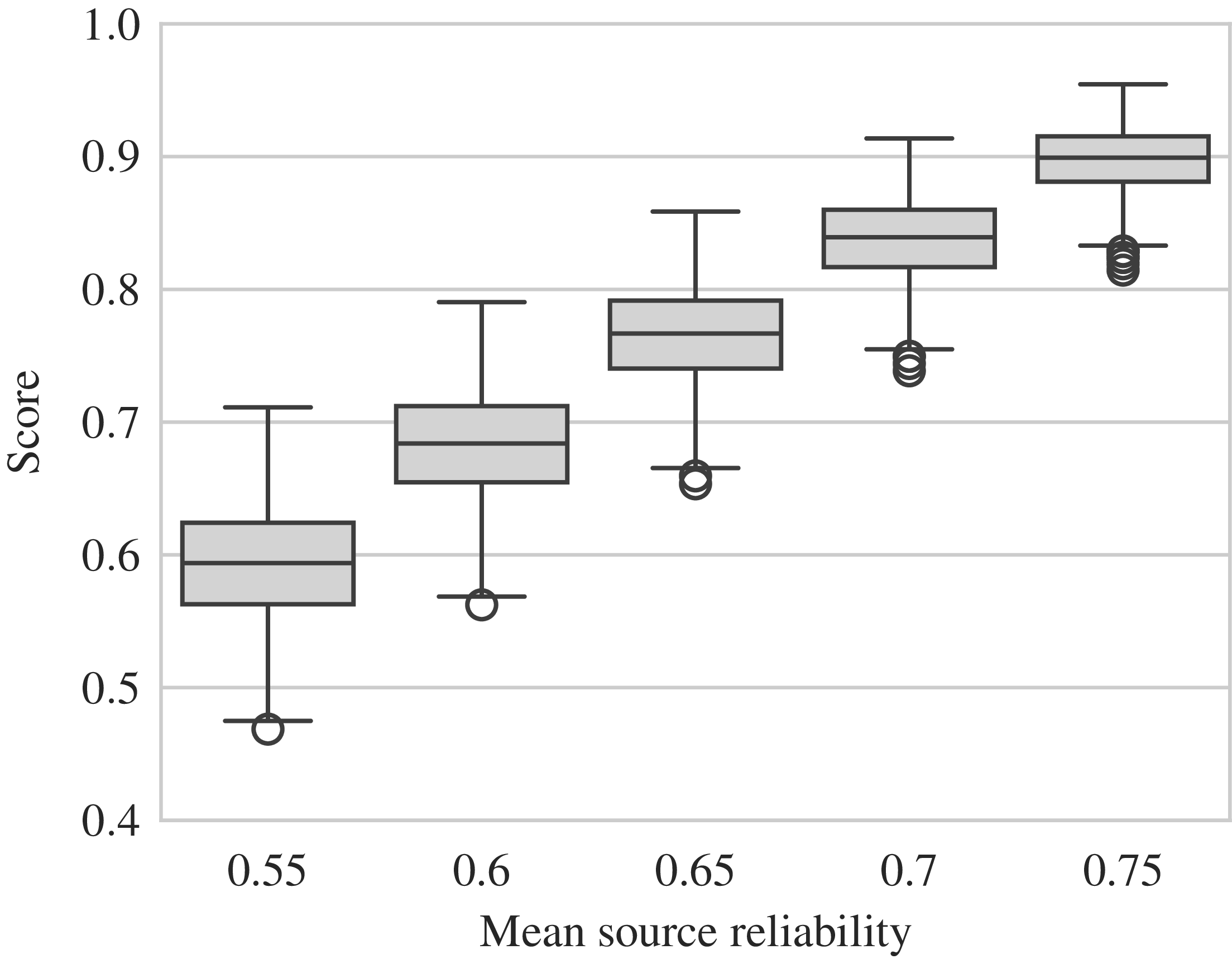
I considered several such equidistant distributions with different means. I decided to include the equidistant distributions with means ranging from 0.55 to 0.75, in steps of 0.05. Since the best-performing agent has a score greater than 96% when the source reliability mean is 0.75, I did not consider higher means. Note that the equidistant distribution with mean 0.55 includes some anti-reliable sources whose reliability falls below chance level.
Given one such parameter setting, I considered all possible heuristics and computed their individual scores. The team of experts consisted of the heuristics with the highest individual scores. The diverse teams were generated by sequentially adding members using a greedy search procedure.Footnote 24 Subsequently, I calculated the teams’ scores for each of the three deliberative mechanisms by going over all possible configurations of valences of the evidences of the sources. For a given deliberative mechanism, the team’s score is given by the sum of the probabilities associated with those configurations that led to a correct team decision.
Before proceeding to my simulation studies, I propose to improve our understanding of the parameter space in the simulation study. To do so, I present box plots of the individual scores of all possible heuristics in Figure 2, one for each parameter setting.Footnote 25 There are two useful ways to interpret this figure. On the one hand, these plots can inform us about the difficulty of the problems. After all, it seems plausible that lower individual scores are associated with harder problems. Indeed, in harder problems, everyone will perform worse. Hence, my simulation study might reveal whether diversity trumps expertise in hard or easy problems.
Individual scores.

On the other hand, it seems plausible that these individual scores represent features of the pool of agents. Higher individual scores represent scenarios where the pool of agents has more knowledge and skills. The thought is that the individual scores not only depend on the difficulty of the problem but also on the skill set of the particular sample of agents. For example, when deciding whether a defendant is guilty, the individual scores of legal experts will likely be higher than those of lay people; and when determining whether a certain treatment will improve a patient’s health, the individual scores of general practitioners will likely be higher than those of high-school students. The problem is the same, but the pool of agents differs. From this perspective, my simulation study might reveal whether diversity trumps expertise when the pool of agents is already quite expert or when it contains novices.
4.2. Simulation I: Opinion-based dynamics
In this section, I present the simulation results concerning opinion-based dynamics. In opinion-based dynamics, agents communicate their opinions—not the underlying evidences—and then follow the majority opinion. Although this assumption may appear quite simplistic and unrealistic, many well-known models of belief propagation are opinion-based, where opinions are mapped to a continuous scale (DeGroot Reference DeGroot1974; Lehrer and Wagner Reference Lehrer and Wagner1981; Hegselmann and Krause Reference Hegselmann and Krause2002) or a nominal one (Liggett Reference Liggett1985; Nowak et al. Reference Nowak, Nowak, Szamrej and Latané1990; Axelrod Reference Axelrod1997). This two-step mechanism relates to the voting literature on heterogeneous, correlated voters (Ladha Reference Ladha1992, Reference Ladha1993, Reference Ladha1995; Berg Reference Berg1993; Pivato Reference Pivato2017) and on indirect majority systems (Boland et al. Reference Boland, Proschan and Tong1989; Berg Reference Berg1997).Footnote 26
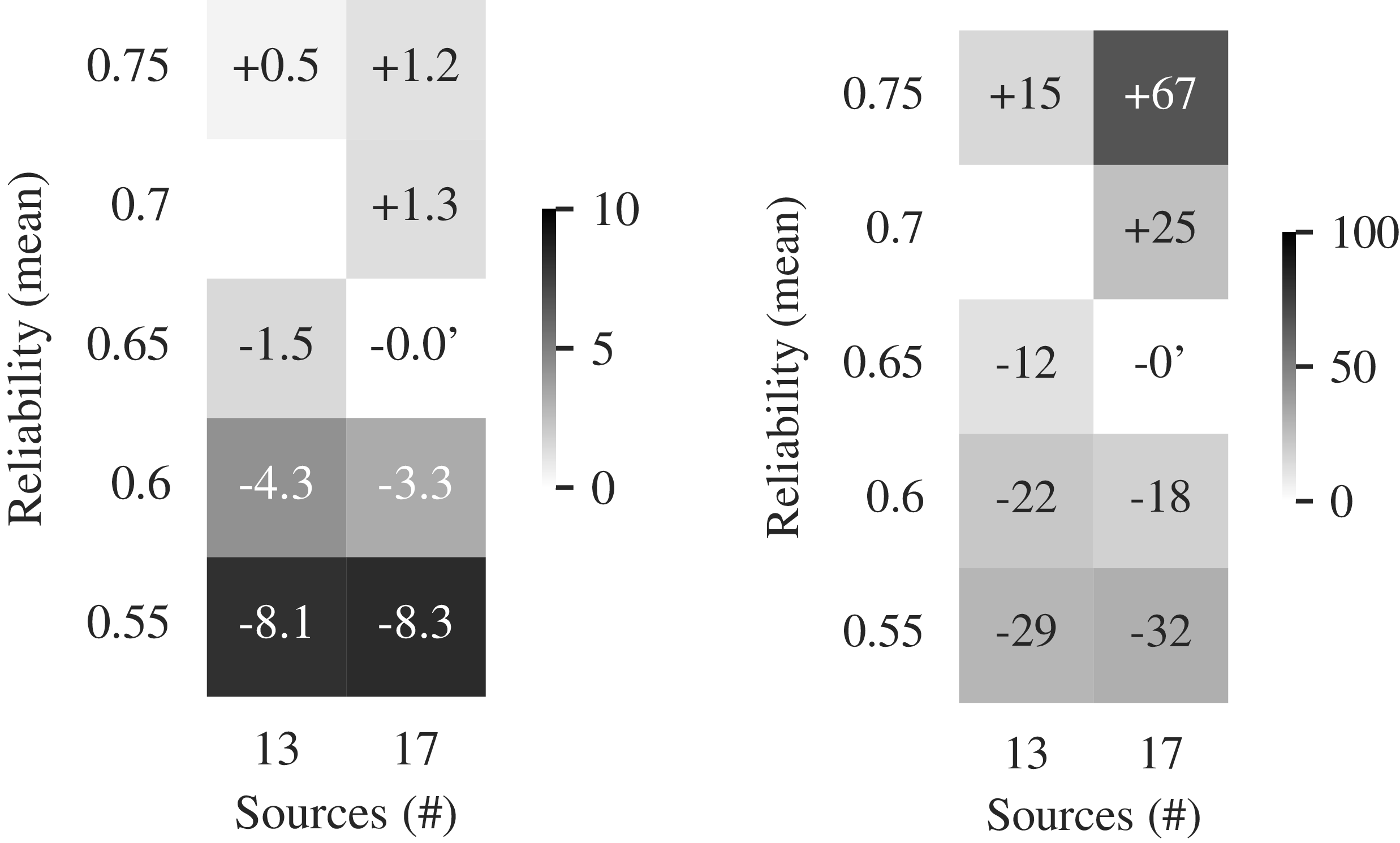
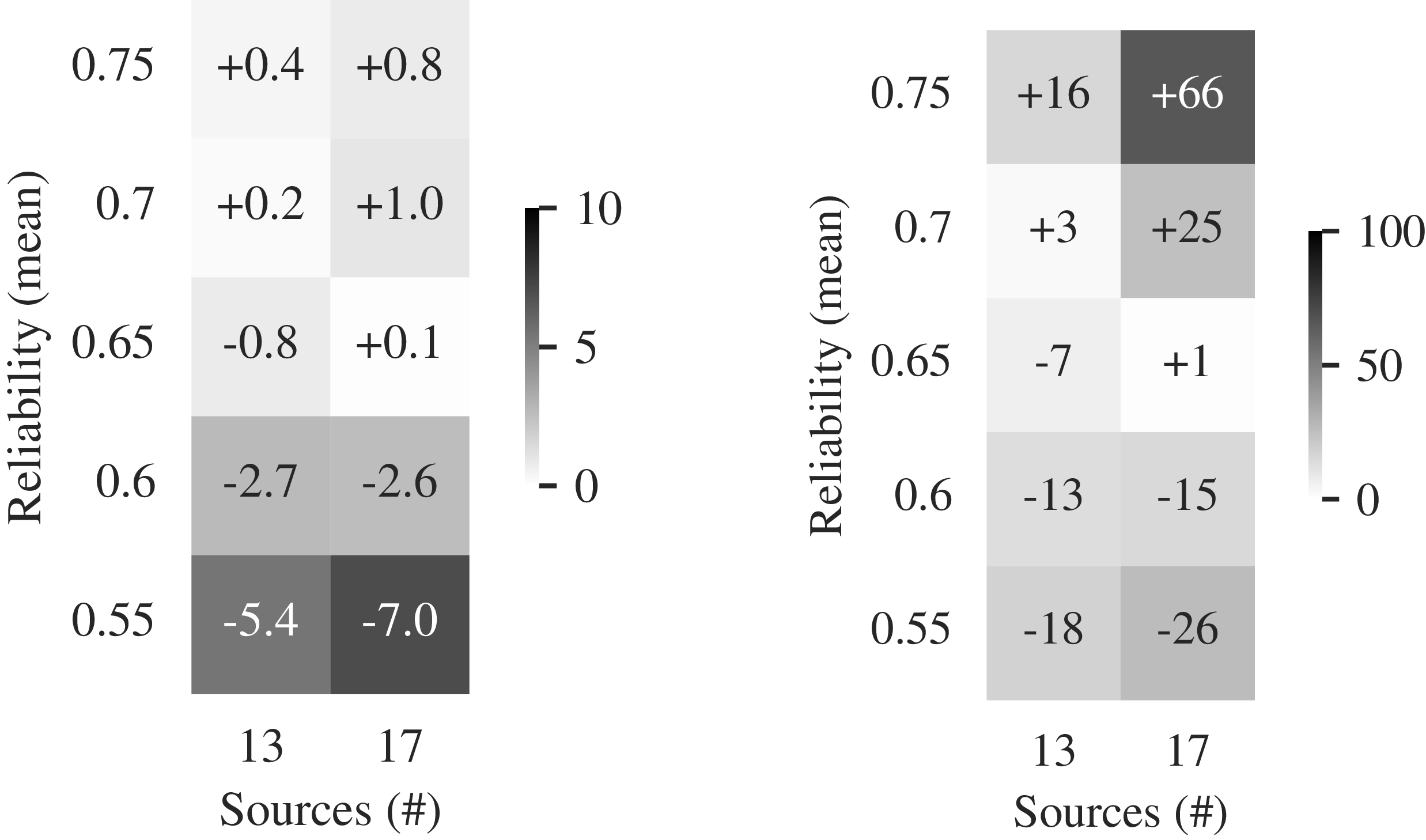
Figure 3 presents the results of my study, showing the performance difference between diverse teams and expert teams, that is, the difference between the median score of 10,000 diverse teams and the expert team’s score.Footnote 27 It is instructive to consider both absolute and relative performance differences. To report relative differences, I decided to report the relative difference in the error rates of diverse and expert teams. This relative difference is measured relative to the team that performs best in the given circumstances. For example, if the expert team’s score is 80% and the diverse team’s score is 90%, their error rates would be 20% and 10%, respectively, the difference 10%, and the relative difference 100%.
The diversity–expertise trade-off for opinion-based dynamics.

The results clearly indicate that there is no universal winner: diverse teams outperform expert teams in some contexts, and vice versa. The trade-off appears to depend on the number of available sources and especially their reliability. Let me summarize some observations. First, diversity trumped expertise when sources where highly reliable. After all, diverse teams performed better than expert teams when the mean reliability was 70 or 75 percent.
Second, expertise is more valuable when sources can be unreliable (i.e., close to chance level) or anti-reliable (i.e., below chance level). Indeed, expertise trumped diversity when the mean source reliability was 60% and 55%, i.e., when sources could be unreliable or anti-reliable, respectively. Moreover, when sources are weakly reliable (i.e., 65%), expert teams continued to perform slightly better than diverse teams. Hence, my simulation study showed that expertise is valuable when sources can be unreliable or anti-reliable. Moreover, given the observations at the end of section 4.1, diversity trumped expertise mainly when the problem was easy and/or the pool of agents was already quite expert.
Third, classification problems can afford broader or narrower pools of conceptual resources. If we think that the pool of conceptual resources is correlated with the number of available sources, then the simulation results appear to indicate that, when the sources are not anti-reliable, diversity becomes more valuable when the pool of conceptual resources is widened. This partially confirms Grim et al.’s (Reference Grim, Singer, Bramson, Holman, McGeehan and Berger2019) finding that wider pools of conceptual resources benefit diversity; however, contrary to their findings, the width of the pool of conceptual resources did not affect the qualitative outcome of whether diversity trumped expertise in my study.
Before moving on to further simulation studies, I should remark that statistical significance is different from practical significance. So, although virtually all simulation results were statistically significant and had a large effect size, we ought to be careful in drawing conclusions about their practical significance. On the one hand, it often seems questionable whether an absolute performance difference of, say, 1% bears any practical significance. In some cases, this tiny performance advantage might be outweighed by other considerations. On the other hand, in high stakes decisions, a 1% (absolute) performance improvement might be highly relevant.
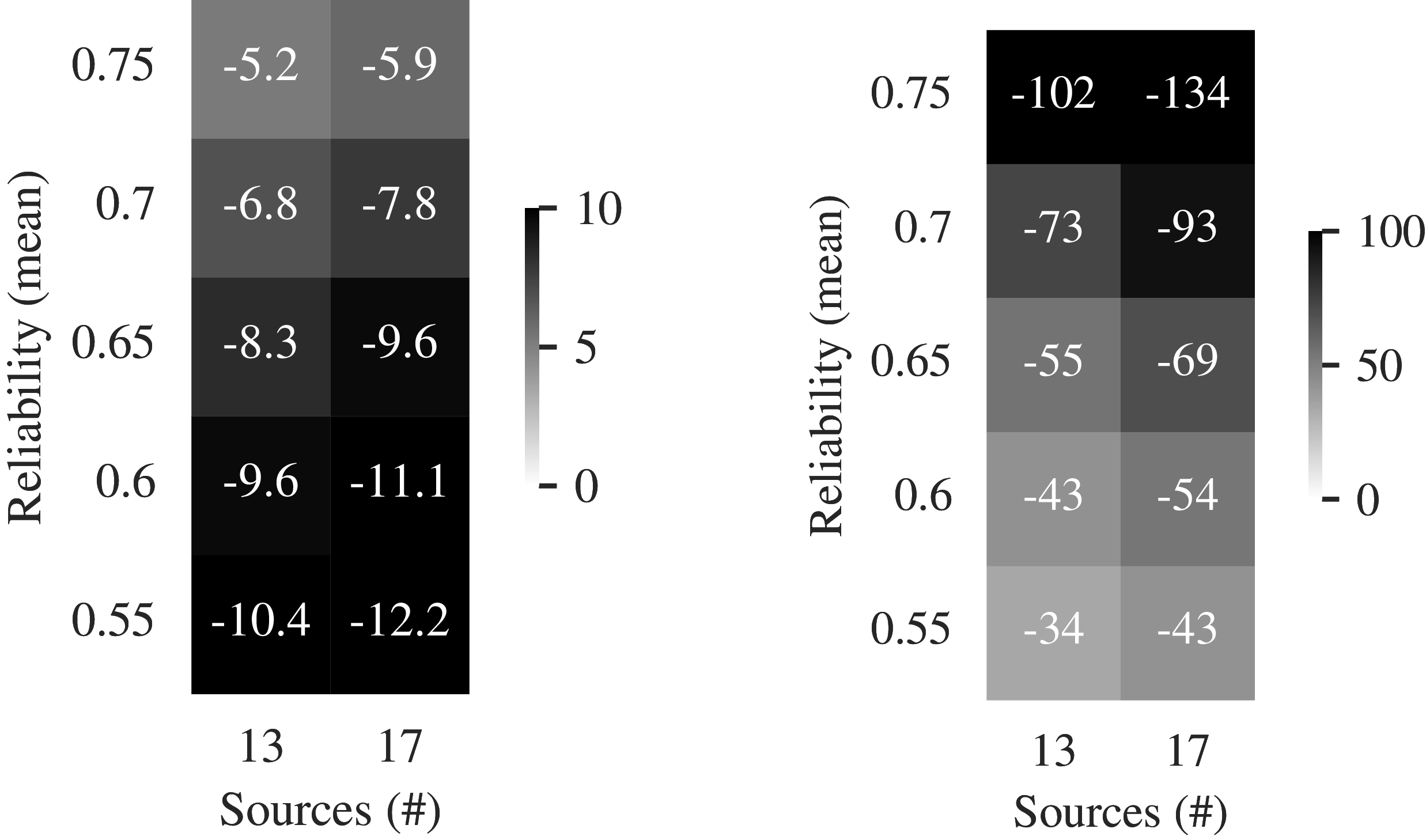
What explains our results? The diversity–expertise trade-off concerns the trade-off between selecting for ability or diversity. Let us start with ability. One would expect that higher individual performance differences favor the expert team. Figure 4 presents the ability gap: the median difference in the average individual scores between members of the expert team and the diverse team, showing both absolute and relative performance differences. Observe that the absolute ability gap narrows when the source reliabilities increase, while the relative ability gap widens. Hence, the absolute measure provides the best insight into the diversity–expertise trade-off.
The ability gap.

We proceed with diversity. The difference in diversity between the expert team and diverse teams was 0.41 and 0.51 for scenarios with 13 and 17 sources, respectively. For example, when 13 sources were available, the difference in diversity implied that the members of the expert team on average had 41% more overlap than the members of the diverse team. In particular, given the heuristic size of five, this meant that, on average, members of the expert team had two out of five sources more in common compared with members of the diverse team. To grasp the extent of the correlation between experts, we can show that the agreement rate between experts is high: the likelihood that two experts agree varies between 75% and 94% and increases when sources become more reliable (see online supplement B).
The fairly high degree of correlation between experts prompts the hypothesis that the expert team may not do much better than the highest-scoring individual. Indeed, we can show that the expert team performs only slightly better than the highest-scoring individual: the absolute performance improvement is at most 1.7% (see online supplement B). Moreover, in all scenarios where the expert team trumped diverse teams, the highest-scoring individual also trumped diverse teams.
In conclusion, the ability gap and degree of correlation among experts jointly explain the diversity–expertise trade-off for the opinion-based dynamics. The homogeneity of the expert team makes it the case that it does only slightly better than the highest-scoring individual. In scenarios where the ability gap was large enough (i.e., bigger than 8%), this lack of diversity among experts did not jeopardize their lead over teams of diverse—but worse-performing—individuals. By contrast, when the ability gap was smaller (i.e., below 8%), diversity trumped expertise.
4.3. Simulation II: Evidence-based dynamics
The difference between the opinion-based dynamics and the evidence-based ones is in the content of the communication. In opinion-based dynamics, agents communicate their opinions, while the agents communicate all their evidences in evidence-based dynamics. Similar evidence-based dynamics have been introduced before (e.g., Mäs and Flache Reference Mäs and Flache2013; Ding and Pivato Reference Ding and Pivato2021; Dietrich and Spiekermann Reference Dietrich and Spiekermann2025) but none of them addressed the diversity–expertise trade-off. This mechanism is related to the voting literature on heterogeneous, independent voters (Grofman Reference Grofman1975, Reference Grofman1978; Margolis Reference Margolis1976; Feld and Grofman Reference Feld and Grofman1984; Owen et al. Reference Owen, Grofman and Feld1989), where voters would correspond to the sources accessed by a given team in my model and the majority competence would correspond to the team’s score for the evidence-based dynamics.
In any case, although we previously observed that expertise often trumped diversity for the opinion-based dynamics, it is plausible to think that the evidence-based dynamics favors diversity. After all, diverse teams have a greater coverage and will therefore share more evidences. When evidences are generally inferentially reliable, it seems plausible that greater diversity will lead to better team decision-making.
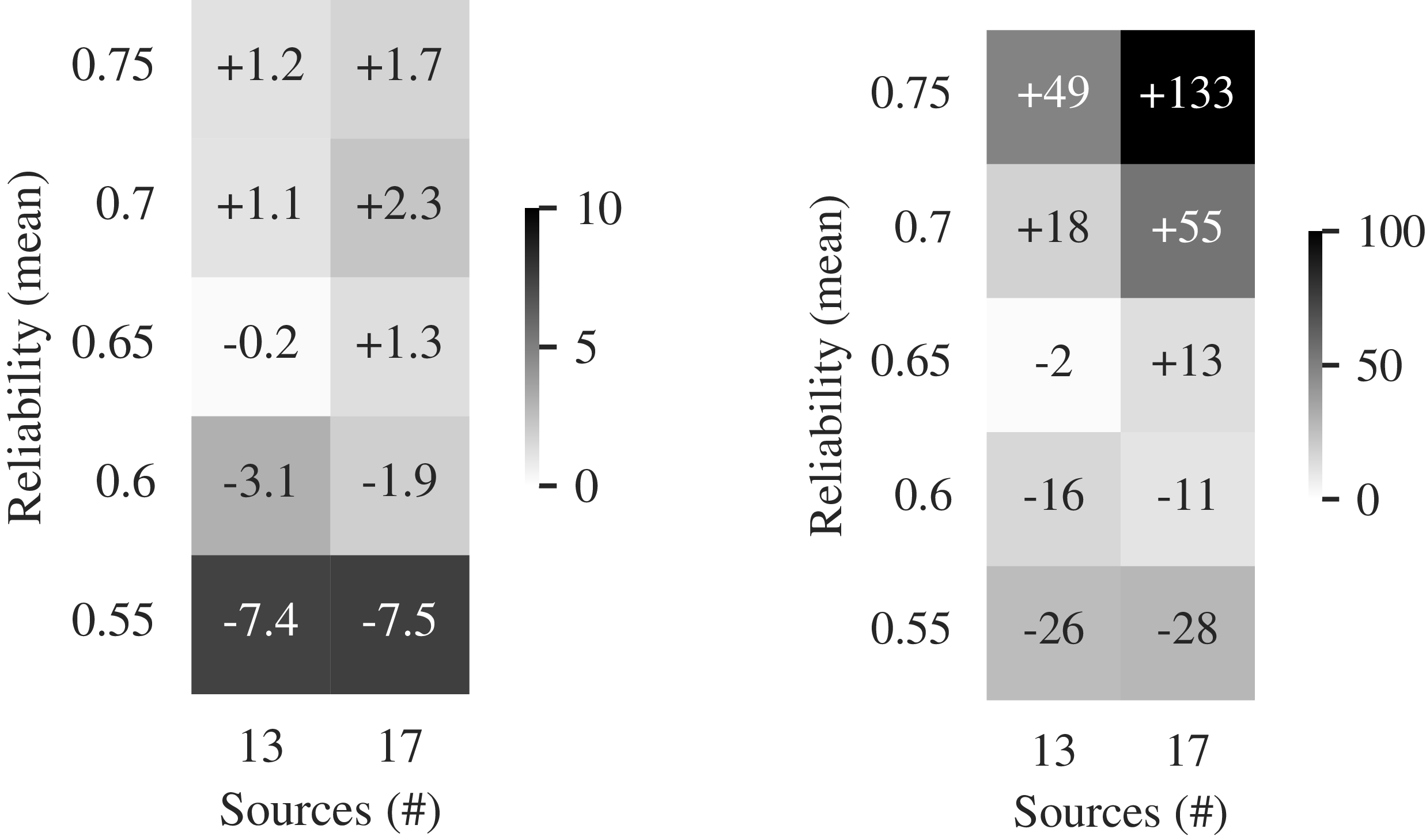
Let us consider the results of my simulation study concerning evidence-based dynamics: see Figure 5. Let me sum up a few observations. First, to my surprise, the qualitative results regarding the diversity–expertise trade-off are virtually identical to the opinion-based dynamics. That is, I expected there to be scenarios with a strong DTE reversal, that is, scenarios where expertise trumped diversity for opinion-based dynamics while diversity trumped expertise for evidence-based dynamics. However, a comparison of Figures 3 and 5 reveals that, except for the scenario where there were 17 sources available with a mean reliability of 65%, such diversity–expertise reversals did not obtain in the considered scenarios. Hence, once again, diversity trumped expertise mainly when sources were (at least weakly) reliable, the problem was easy, and/or when the pool of agents was already quite expert.
The diversity–expertise trade-off for evidence-based dynamics.

Second, the quantitative results appear to indicate that the evidence-based dynamics favor diversity over expertise, in comparison with opinion-based dynamics. Indeed, the absolute difference shifted slightly towards diversity, at least in absolute terms (except when the mean source reliability was 75%). In contrast, the relative difference hardly changed between opinion-based and evidence-based dynamics. This suggests that the evidence-based dynamics had an approximately similar relative effect on the performance of expert and diverse teams, while having a disparate absolute effect.
What explains this diversity–expertise trade-off? In evidence-based dynamics, the diverse team acts like an individual who accesses all sources. In contrast, the expert team acts like an individual who accesses the top sources—but not all sources. More specifically, in the considered scenarios, the expert team acted like an individual who accesses the top nine sources. So, the diverse team covered four and eight sources more than the expert team when there were 13 and 17 sources available, respectively. Hence, the diversity–expertise trade-off is constituted by the advantage of including more sources and the disadvantage of including suboptimal sources. For example, when the source reliability mean was 55%, some sources were anti-reliable and, hence, it is not surprising that expertise trumped diversity. In comparison, it is somewhat surprising that expertise trumped diversity when there were 13 sources available and the source reliability mean was 65%. After all, in that scenario, all sources were (at least weakly) reliable (above 55%). In sum, the diversity–expertise trade-off for evidence-based dynamics is mainly explained by the sources’ reliabilities.
4.4. Simulation III: Boundedly rational evidence-based dynamics
The previous evidence-based dynamics could be called unboundedly rational in the sense that the team’s decision procedure avoids overcounting evidences. In the boundedly rational dynamics, when two agents communicate the same evidence, that evidence receives extra weight. Hence, evidences can be overcounted, which exaggerates the influence of that evidence and may lead to suboptimal collective decision-making. Overcounting aligns with the empirical finding that people believe repeated information more than new information, a phenomenon known as the repetition-induced truth effect (Hasher et al. Reference Hasher, Goldstein and Toppino1977; Dechêne et al. Reference Dechêne, Stahl, Hansen and Wänke2010). Moreover, overcounting is not necessarily irrational, especially when certain evidences are more reliable than others or when certain sources are more trustworthy or reliable than others (Lehrer and Wagner Reference Lehrer and Wagner1981; Grofman et al. Reference Grofman, Owen and Feld1983).
It is hard to form a hypothesis for these dynamics. On the one hand, the expert team seems to suffer heavily from overcounting, given the higher degree of overlap. Diverse teams, given their wide coverage and minimal overlap, will not suffer as much from overcounting evidences: all sources will be counted roughly equally. Thus, prima facie, expert teams seem more vulnerable to skewed counting. On the other hand, it seems plausible that skewed counting is only suboptimal when it leads to overcounting evidence from certain sources regardless of their reliability. Given that the expert team is overcounting evidence from the most reliable sources, overcounting appears to track the fact that certain sources are more reliable. By contrast, since diverse teams count evidence from all sources roughly equally, counting appears to be divorced from the sources’ reliability. Hence, diverse teams appear to be more vulnerable to arbitrary counting.
Let us see how these opposite predictions pan out by considering the results presented in Figure 6. Let me sum up a few observations. First, again to my surprise, the qualitative results regarding the diversity–expertise trade-off are virtually always irrespective of the deliberative mechanism—the only exception is the scenario with 17 sources and a mean reliability of 65%.
The diversity–expertise trade-off for boundedly rational evidence-based dynamics.

Second, in scenarios where diversity trumped expertise, the boundedly rational dynamics further expanded the performance advantage of diverse teams (compared with the other deliberative mechanisms). In contrast, in scenarios where some sources were anti-reliable, the boundedly rational dynamics increased the deficit of diverse teams compared with the evidence-based dynamics. Hence, the risk of arbitrary counting in diverse teams appears to be outweighed by the risk of skewed counting in expert teams when sources are not unreliable.
What explains these results? The expert team heavily overcounted the top sources (see Table 1). Hence, it appears that the expert team may act similar to the best-performing individual. Indeed, we can show that the expert team performed only slightly better: the (absolute) improvement is at most 1.6% (see online supplement B). Nonetheless, whenever the expert team trumped diverse teams, the best-performing individual also trumped diverse teams. So, the qualitative results concerning the diversity–expertise trade-off appear to hinge on the best-performing individual.
Source weights for the expert teams
| Source number | 1 | 2 | 3 | 4 | 5 | 6 | 7 | 8 | 9 |
|---|---|---|---|---|---|---|---|---|---|
| Source weight | 9 | 9 | 8 | 6 | 5 | 3 | 2 | 2 | 1 |
Table 1 Long description
A table comparing source weights for expert teams. The table has two rows and nine columns. The first row is labeled 'Source number' with values ranging from 1 to 9. The second row is labeled 'Source weight' with values 9, 9, 8, 6, 5, 3, 2, 2, and 1 respectively. The table shows a decreasing trend in source weights as the source number increases.
In comparison, the diverse team counted all sources roughly equally. So, it seems plausible that diverse teams acted similarly for both evidence-based dynamics. Indeed, we can show that there is only a minute performance difference of at most 0.5% (see online supplement B). This confirms the suspicion that counting hardly affected diverse teams.
All in all, for boundedly rational evidence-based dynamics, diverse teams acted similar to diverse teams with evidence-based dynamics, while expert teams acted similar to the best-performing individual. So, the diversity–expertise trade-off is, once again, constituted by the advantage of including more sources and the disadvantage of including suboptimal sources. However, in contrast with the evidence-based dynamics where the expert team acted like an individual who accesses the top nine sources, in this case, the expert team acted similar to an individual who accesses the top five sources.
4.5. Robustness
The central result of the simulation study is two-fold.
-
(1) Diversity trumped expertise when sources were (at least weakly) reliable, when the problem was easy, and/or when the agents were already quite expert.
-
(2) Expertise trumped diversity when some sources were anti- or unreliable, when the problem was hard, and/or when the pool of agents contained novices.
I performed various robustness checks and considered smaller teams, larger heuristics, heterogeneous heuristic sizes, more sources, and source reliability distributions with narrower and wider ranges (details can be found in online supplement C). Overall, the robustness analysis shows that the result concerning when expertise trumped diversity is robust, but the result concerning when diversity trumped expertise is not robust. So, the circumstances where diversity trumps expertise might be even more constrained. In general, the robustness checks indicate that expertise is more valuable when the heuristic sizes are larger, heuristic sizes are diverse, there are fewer sources available, and/or the source reliabilities vary more.
5. Epistemic deliberative democracy
Epistemic democrats analyze the epistemic value of democracy and (typically) justify democracy based on its epistemic credentials (Cohen Reference Cohen1986; Estlund Reference Estlund2008; Estlund and Landemore Reference Estlund, Landemore, Bächtiger, Dryzek, Mansbridge and Warren2018; Goodin and Spiekermann Reference Goodin and Spiekermann2018; Landemore Reference Landemore2013). The basic assumption of epistemic democrats is that there exists some procedure-independent measure of success (i.e., truth), and democratic decision procedures should be evaluated in terms of their reliability of leading to successful outcomes by that measure (Cohen Reference Cohen1986). Epistemic democrats often rely on mathematical results such as Condorcet’s jury theorems, the miracle of aggregation, or Hong and Page’s diversity-trumps-ability result to argue that democratic decision procedures are epistemically justified.
These epistemic justifications of democracy are threatened by citizens’ staggering lack of political knowledge (Somin Reference Somin2013; Achen and Bartels Reference Achen and Bartels2017). But, despite their ignorance of political facts, citizens can successfully use informational cues and shortcuts in their political decision-making (Lupia Reference Lupia2006; Goren Reference Goren2013). Moreover, comparisons between uninformed citizens and their informed counterparts show that uninformed citizens fall between a coin toss and the informed citizen (Bartels Reference Bartels1996; Lau and Redlawsk Reference Lau and Redlawsk1997, Reference Lau and Redlawsk2006). Hence, under the plausible assumption that informed citizens are better than chance level, the empirical evidence indicates that (uninformed) citizens are minimally competent in the sense that they are better than chance level at determining which political option is best. Although minimal competence levels may suffice to justify democratic aggregation methods (e.g., majority voting) on the basis of Condorcet-like jury theorems (Goodin and Spiekermann Reference Goodin and Spiekermann2018; pace Caplan Reference Caplan2007), it is an open question whether it suffices for deliberative democracy.
To determine the epistemic value of deliberative democracy, I will assume that deliberative democracy is operationalized in terms of small, diverse, deliberative citizen assemblies. Moreover, I will assume, like epistemic democrats, that there exists some procedure-independent measure of success. Do small, diverse, deliberative citizen assemblies perform better than expert teams on this epistemic score? According to my simulation study, this hinges on whether the evidential sources used by citizens are (at least weakly) reliable, whether political problems are easy, and/or whether the pool of citizens is already quite expert in the political domain. If so, diverse teams of citizens can outperform expert teams. If not, expert teams outperform diverse teams of citizens. Hence, we must determine which parameter settings best capture these deliberative assemblies.
Although rigorously fitting the model’s parameters lies beyond the scope of the current paper, we can obtain a reasonable guestimate of citizens’ competence. Experiments by Lau and Redlawsk (Reference Lau and Redlawsk2006, 79) indicated that: “Seventy percent of the subjects (206 out of 293) would not have changed their vote after learning everything there was to learn about the two candidates.”Footnote 28 Without going into the details of their experimental design and methodology, it is important to note that (hypothetical) informed voters are still not perfect. Although it is hard to predict how well these findings generalize, it seems reasonable to assume that citizens’ competence, on average, falls between a coin toss and 70%. Now, Figure 2 illustrates that this corresponds to evidential sources models with mean source reliability of 55% and 60% in my simulation study.Footnote 29 Furthermore, my simulation study robustly showed that expert teams trumped diverse teams in these circumstances. One could even argue that my simulation study paints an overly pessimistic picture of expert teams, because experts would be even more competent than the best agents in many parameter settings. In any case, I conclude that, from a purely epistemic perspective, when selecting for small, deliberative assemblies, one should prioritize expertise over diversity.Footnote 30
I should add one important caveat. The previous argument assumes that the deliberative assemblies are made up of fairly uninformed citizens. Instead, deliberative democrats could propose more elaborate procedures that ensure that the participants in the deliberative citizen assemblies gain relevant knowledge and competence (e.g., Fishkin Reference Fishkin2009); for example, they may receive balanced briefing materials prior to deliberation. Overall, my simulation study suggests that the epistemically best teams are diverse teams consisting of agents who are already quite expert. Hence, one might conjecture that diverse, deliberative assemblies of fully informed citizens outperform teams of experts.Footnote 31
6. Conclusion
The idea that promoting diversity leads to better collective decision-making is a powerful one. However, there is a tension between selecting for diversity or ability. On the one hand, diverse teams can make use of more diverse evidences, but, without appropriate epistemic guardrails, they are at risk of relying on suboptimal (or even unreliable) evidences. On the other hand, expert teams leverage the most reliable evidences at the expense of lower evidential coverage, excluding many (potentially) available evidences. I have shown that diversity and expertise are important for optimizing collective decision-making in different circumstances, where diversity enhances epistemic coverage and expertise ensures deliberation is based on reliable information.
In my study, diversity trumped expertise in some situations, and vice versa. I presented a novel evidential sources framework and analyzed whether, when, and (if so) why diversity trumps expertise for three different deliberative mechanisms—one based on opinions and two on evidences. Surprisingly, the qualitative results were virtually identical for all three deliberative mechanisms. Generally, expertise robustly trumped diversity when some sources were anti- or unreliable, when the problem was hard, and/or when the pool of agents contained novices. In contrast, diversity trumped expertise when sources were (at least weakly) reliable, when the problems were easy, and/or when the pool of agents was already quite expert. But, since the latter finding was not robust across reasonable variations in the model’s parameters, the conditions when diversity trumps expertise may be more constrained.
What is the implication for epistemic deliberative democracy? Although citizens’ knowledge of political facts is staggeringly low, citizens appear to be minimally competent in the political domain (for instance, by relying on cues or shortcuts). While minimal competence may suffice for epistemic justifications of aggregative forms of democracy, I argued, on the basis of my simulation study, that the epistemic credentials of deliberative democracy are questionable. After all, in those parameter settings that were compatible with reasonable estimates of citizens’ competence, expert teams trumped diverse teams.
All in all, my simulation study demonstrates that diversity and expertise are both important—diversity addresses the risk of suboptimal coverage, expertise that of unreliable evidence. My results suggest that optimizing the team composition will require selecting for diversity with some epistemic guardrails. So, to improve collective knowledge acquisition we must strike the right balance between expertise and diversity.
Supplementary material
To view supplementary material for this article, please visit https://doi.org/10.1017/psa.2026.10200. All scripts necessary to reproduce the results are available on Zenodo (Duijf, Reference Duijf2025) and on GitHub (https://github.com/HeinDuijf/DiversityAbility), including a walkthrough of the model on a GitHub page.
Acknowledgments
I am grateful to Daniel Cohnitz, Janneke van Dis, Dominik Klein, Max Noichl, Uwe Peters, and Kai Spiekermann for their thoughtful feedback on earlier drafts of this paper. I would like to thank the Centre for Digital Humanities at Utrecht University, in particular Jonathan de Bruin, Kirsten Schutter, and Jelle Treep, for their invaluable support. I also thank the audiences at presentations in Amsterdam, Bochum, Düsseldorf, Groningen, Luxembourg, Paris, and York, whose valuable questions and suggestions helped me improve this work in many ways.
Funding statement
None to declare.
Declarations
None to declare.











 s1
 s5
 a1
 a3


 Open access

