

Introduction
After decades of continuing improvement, mortality rates in England, Scotland, Wales and Northern Ireland stalled around 2012 due to economic austerity policies (Marmot et al., Reference Marmot, Allen, Boyce, Goldblatt and Morrison2020; Walsh & McCartney, Reference Walsh and McCartney2025). For some communities, mortality has increased. In Scotland, the gap in premature mortality between the most and least deprived areas became bigger in 2021 than at any time since measurement began in 1997 (Scottish Government, 2023). Since then, consumer prices have increased by over 20 per cent during the ‘cost of living crisis’. This inevitably spread and deepened economic hardship, including food and fuel poverty, and is expected to worsen population health significantly, particularly for more deprived groups (Broadbent et al., Reference Broadbent, Thomson, Kopasker, McCartney, Meier, Richiardi, McKee and Katikireddi2023).
Systematic differences in health outcomes, reflecting different social and economic circumstances, have been observed in the UK since at least the mid-19th century (Macintyre, Reference Macintyre1997). These connections between contextual conditions and population health outcomes are the basis of the social model of health. In this model, human health is shaped outside of the body by the social, cultural and economic conditions in which we live. Therefore, policy teams working on housing, employment, education, transport, spatial planning, welfare and other areas all contribute significantly to population health outcomes. Through various means, policy decisions in these domains get under the skin to protect human health or to generate illness. This model is based on many decades of international epidemiological, sociological and qualitative evidence, summarised by Black (Reference Black1980), Link and Phelan (Reference Link and Phelan1995), the WHO Commission on the Social Determinants of Health (2008) and many others.
In contrast to the social model, health is often understood according to the biomedical model (Deacon, Reference Deacon2013; Engel, Reference Engel1977; Nettleton, Reference Nettleton2020). In this model, human health is decontextualised from the individual’s social and physical surroundings. The physical body and the perceptive mind are separated. Individual bodies are subject to universal biological dysfunctions known as ‘diseases’, which can be mechanically fixed by doctors and other medical professionals. These dysfunctions are often caused by other biological entities such as germs or viruses; by human behaviours, such as smoking; or perhaps by genetic misfortune.
At the individual level, the biomedical model underlies our use of healthcare systems. Millions of diseases and illnesses are successfully treated by medical professionals every year. But the biomedical model may interfere with the social approach required for preventive population health policy by dominating public and media conceptualisations of health (Levay et al., Reference Levay, Gibbons, Down, O’Neil and Volmert2018; L’Hote et al., Reference L’Hote, Fond and Volmert2018), facilitating the depoliticisation of health (Bambra et al., Reference Bambra, Fox and Scott-Samuel2005; Qureshi, Reference Qureshi2013) and therefore responsibilising individuals in the aggregate for population health outcomes (Baum & Fisher, Reference Baum and Fisher2014; Kriznik et al., Reference Kriznik, Kinmonth, Ling and Kelly2018).
Another example of this interference can be found in Smith (Reference Smith2013), who described the biomedical model of health as an ‘institutionalised idea’ within public health policy settings, meaning that ideas that were inconsistent with it were adapted to become consistent, or excluded altogether from consideration. Lynch (Reference Lynch2020) described an ‘international consensus’ among researchers about health inequality – built on the social model of health – as a ‘policy frame’ that was subservient to the dominant ‘policy paradigm’ of neoliberalism. Even when policy texts identify social causes of health problems, they frequently promise solutions located within the medical model: a phenomenon known as ‘lifestyle drift’ (Popay et al., Reference Popay, Whitehead and Hunter2010). Implicit in all these critiques is the highly limited use and impact of the social model of health compared to the medical model.
According to the social model, policy efforts to improve population health and reduce social inequalities in health require cross-governmental policy action to shape the conditions that protect populations from illness in the first place. Co-ordinating different policy teams towards common goals has been a hugely challenging ‘administrative Holy Grail’ (Peters, Reference Peters1998, p. 295) for many years, with various agendas proposed for the task. Economic agendas based on ‘inclusive growth’ have promised to prioritise bottom-up, locally rooted development, while taking interest in various social goals and ensuring that people and places are not excluded (Naik et al., Reference Naik, Abbs, Elwell-Sutton, Bibby, Spencelayh, Shafique, Burbidge, Antink, Alanko and Anttila2020). The ‘wellbeing economy’ movement has sought to promote a policy agenda that prioritises social and environmental goals over economic growth, with substantial engagement from governments in Scotland, Wales and Northern Ireland (Wallace, Reference Wallace2019).
Meanwhile, health policy teams have promoted the Health in All Policies (HiAP) approach, which promotes the systemic integration of health into social and economic policymaking. But HiAP has faced multiple difficulties (Amdam, Reference Amdam2023; Cairney et al., Reference Cairney, St Denny and Mitchell2021). There are process issues that remain unresolved: for example, how to design and enforce the thorough application of health impact assessments (Rogerson et al., Reference Rogerson, Lindberg, Baum, Dora, Haigh, Simoncelli, Parry Williams, Peralta, Pollack Porter and Solar2020). There also appear to be inter-group tensions: challenges of engagement or buy-in with other sectors (de Leeuw, Reference de Leeuw2017; Greszczuk, Reference Greszczuk2019); a need to build cross-sectoral trust and relationships (O’Flynn et al., Reference O’Flynn, Buick, Blackman and Halligan2011; Williams, Reference Williams2002); and a requirement for leadership and enthusiasm at all levels (Carey & Crammond, Reference Carey and Crammond2015; Greer & Lillvis, Reference Greer and Lillvis2014). Synnevåg et al. (Reference Synnevåg, Amdam and Fosse2019) asked if the relative ‘dominance’ of health departments may make other policy actors feel devalued. This implies the possibility that cross-departmental agendas led by departments other than health may find engagement and enthusiasm easier.
This paper searches for the social model of health in two devolved policy settings interested in both preventive policy action for health, and on ‘inclusive growth’ or ‘wellbeing’-based collaborative non-health agendas. This paper asks whether conceptualisations of health might vary in different policy teams in ways which could assist or interfere with the construction of cross-sectoral agendas to improve population health and reduce social inequalities in health. Might social or economic policy teams work within a paradigmatic framework that includes the social model of health? Is it possible that newly created devolved policy settings may not have yet institutionalised the medical model of health? These questions are explored via frame analysis of policy strategy documents, and semi-structured interviews with policy actors.
Methods
Case selection
This research sought to explore alternative cross-sectoral policy approaches to improving population health at devolved levels. Therefore, case selection would be limited to devolved polities with an expressed commitment to ‘inclusive growth’, ‘wellbeing economy’ or related agendas. No other criteria of similarity or difference were considered.
Greater Manchester Combined Authority (GMCA) was selected as the first polity to research, including health policy texts and actors from the Greater Manchester Health and Social Care Partnership (GMHSCP). GMCA is a combined authority comprising one elected councillor from each of the ten local authorities of Greater Manchester, and an elected mayor. It has policy authority in several social and economic policy areas of importance to health and to inequalities – such as transport, housing and planning – in a city-region of almost three million people. At the time of commencing this research, GMCA’s most recent overall strategy document – Our People, Our Place (2017 – sought to ‘create a thriving, inclusive economy’ (p. 34). Further, a series of reports commissioned by GMCA from external policy experts (Coyle et al., Reference Coyle, Flanders, Glaeser, Mazzucato, Overman and Singh2019; Marmot et al., Reference Marmot, Allen, Boyce, Goldblatt and Morrison2021; Pickett et al., Reference Pickett, Atcha, Fahnbulleh, Lupton, McInroy, Westwood and Woolley2021) demonstrated a polity with active interest in exploring social, economic and health inequality issues.
The Scottish Government (SG) was further selected as a polity to research, alongside Public Health Scotland (PHS) following its inception in 2020. SG has extensive policy authority within Scotland on issues of importance to health and to inequalities, including education, transport, housing, healthcare and some taxation powers. Other important policy areas, including tax and other macroeconomic policy, are reserved by the UK national government. SG made inclusive growth an economic priority in 2015; and in 2018, it named ‘sustainable and inclusive economic growth’ as one of its two central purposes (alongside ‘increased wellbeing’) in its National Performance Framework. In the same year, SG was a co-founder of the ‘Wellbeing Economy Governments’ group (WEGo) as it sought to collaborate internationally to develop the idea of a ‘wellbeing economy’.
Analysing policy texts
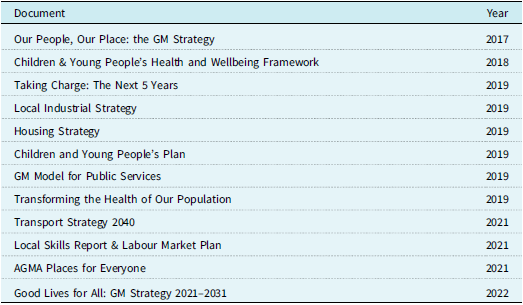
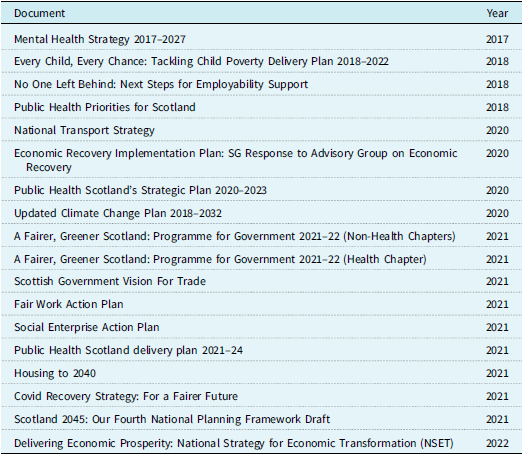
GMCA’s strategy text Our People, Our Place (2017) was published exactly five years prior to the expected end of the text analysis phase of this research, when a new GMCA strategy (Good Lives for All (2022)) was expected to be published. Therefore, this five-year window was chosen as an appropriate timespan for analysis. Policy texts from both polities released during this time were screened for references to inclusive or wellbeing economic agendas, and to health or wellbeing. From a long list of twenty-four GMCA texts and forty-two SG texts, texts were prioritised to represent a broad range of policy interests due to the key influence of social and economic determinants on health. Where multiple texts on the same policy area were available, one was chosen for inclusion; and risk-factor-specific health policy texts were excluded. Twelve GMCA and eighteen SG policy texts were ultimately chosen for analysis (see Tables 1 and 2).
GMCA texts analysed

Table 1. Long description
A table titled ‘GMCA texts analysed’ contains two columns: Document and Year. The table has twelve rows, each listing a different document and the year it was published. The documents include strategies, frameworks, and plans related to various aspects of public services and community development. The years range from 2017 to 2022. The table is organized chronologically, with the earliest year at the top and the latest at the bottom. Each row provides the title of the document in the first column and the corresponding year in the second column. The documents cover a range of topics such as health, wellbeing, housing, transport, and local industrial strategies.
Scottish Government texts analysed

Table 2. Long description
A table with two columns: Document and Year. The table lists various Scottish Government documents along with their respective publication years. The documents include Mental Health Strategy 2017-2027 (2017), Every Child, Every Chance: Tackling Child Poverty Delivery Plan 2018-2022 (2018), No One Left Behind: Next Steps for Employability Support (2018), Public Health Priorities for Scotland (2018), National Transport Strategy (2020), Economic Recovery Implementation Plan: SG Response to Advisory Group on Economic Recovery (2020), Public Health Scotland’s Strategic Plan 2020-2023 (2020), Updated Climate Change Plan 2018-2032 (2020), A Fairer, Greener Scotland: Programme for Government 2021-22 (Non-Health Chapters) (2021), A Fairer, Greener Scotland: Programme for Government 2021-22 (Health Chapter) (2021), Scottish Government Vision For Trade (2021), Fair Work Action Plan (2021), Social Enterprise Action Plan (2021), Public Health Scotland delivery plan 2021-24 (2021), Housing to 2040 (2021), Covid Recovery Strategy: For a Fairer Future (2021), Scotland 2045: Our Fourth National Planning Framework Draft (2021), Delivering Economic Prosperity: National Strategy for Economic Transformation (NSET) (2022).
For ‘health or wellbeing’ broadly understood, NVivo was used to identify the five key elements of a policy frame, as defined by Lynch (Reference Lynch2020, p. 16), in each text: the definition of a problem; a causal story explaining the origin of the problem; a moral judgement that implies the need for action; an attribution of responsibility to particular actors to solve the problem; and a recommendation for how the problem should be solved. This allowed for a synthesis of ‘health or wellbeing’-related descriptions into an overall ‘health or wellbeing’ policy frame for each document.
Semi-structured interviews with policy actors
To understand how policymakers considered health in the construction of ‘inclusive’ or ‘wellbeing’-related agendas, policymakers involved in key policy areas were spoken to directly. Semi-structured interviews were considered preferable to focus groups as a methodologically natural way to generate detailed insights from individual actors which could be withheld in a group setting (Gill et al., Reference Gill, Stewart, Treasure and Chadwick2008). Ethical approval for interviews was granted by the University of Strathclyde in May 2022. Thereafter, all interviews were conducted via Microsoft Teams, due to participant preferences, and lasted between forty-five and eighty-eight minutes.
Initial findings from text analysis were presented at a conference in March 2022. Three attendees with contacts within GMCA then suggested potential participants to contact. Similarly, Scottish Government contacts suggested initial potential participants, who were contacted by e-mail. Each participant was asked to suggest appropriate colleagues who may be interested in participating. Ultimately, twelve interviewees in GMCA (two in health policy teams), and twenty-two in SG (seven in health policy teams), were recruited. The twenty-four social and economic policy participants worked in equalities, economic development, skills and employment, housing, transport, spatial planning, public services, climate and devolution; two participants worked in policy research. In this paper, participants are identified by polity (GM or SG), number (P01-P22) and policy area (H for ‘health’, O for ‘other’).
Anonymised transcripts of interviews were analysed both deductively and inductively using NVivo. High-level categories were created to code data in relation to analysed policy texts, and about key themes from prior literature on health inequalities. Hundreds of further categories were created to represent insightful data, which were then moved, merged and modified into a final coding structure divided into five main ‘channels’ of data. This article derives from analysis of data from the ‘Policy Approaches to Health’ channel.
Findings
The medical model of ‘health’ and the social model of ‘wellbeing’
In this first section analysing data from this research, findings about ‘health’ which align it with the medical model are contrasted with findings about ‘wellbeing’, which are aligned with the social model, as summarised in Table 3.
The medical model of ‘health’ and the social model of ‘wellbeing’

Table 3. Long description
A table comparing health and wellbeing across different levels and aspects. The table has two columns and three rows. The first column is labeled ‘Health means’ and the second column is labeled ‘Wellbeing means’. Row 1: Health means individual-level, Wellbeing means social determinants of. Row 2: Health means physical illness, Wellbeing means physical and mental health. Row 3: Health means owned by health policy, Wellbeing means not owned by health policy.
Health = individual illness
Social and economic policy participants frequently used ‘health’ to mean ‘illness’, ‘ill-health’ or ‘disease’. No health policy participant used ‘health’ in this way. This ‘health as illness’ conceptualisation was particularly apparent in responses from economic policy participants, including in the use of terms such as ‘health-related inactivity’, ‘health-related benefits’ and ‘health-related benefit dependence’ [GMP10O]. Social policy and health policy participants more often used the adjective ‘healthy’ to describe an absence of illness, and one who worked between social and health policy teams specifically defined health as ‘an absence of infirmity or a health condition’ [GMP09O].
On the other hand, both ‘ill-health’ and ‘disease’ were specifically used only eleven times each by the thirty-four interviewees, the latter within a narrow range of specific medical collocations: ‘respiratory disease’, ‘cardiovascular disease’ and ‘infectious disease’ in relation to Covid-19. ‘Illness’ was used only four times across all interviews; on one occasion, it was used by a health policy participant to contend that what I had described as ‘non-health’ policy texts were in fact ‘very much health policy plans, they’re just not illness policies, they’re not NHS policies’ [GMP12H]. By implying that the strategies produced by health policy teams were in fact concerned with illness, this comment acknowledges that this conceptualisation of health as illness was common.
This ‘health as illness’ conceptualisation is a core feature of the biomedical model of health, and contrasts with the oft-cited (and criticised (e.g. Huber, Reference Huber2011)) WHO definition ‘Health is a state of complete, physical, mental and social well-being and not merely the absence of disease or infirmity’.
Wellbeing = social determinants (of health)
In both Greater Manchester and Scotland, social and economic policy participants frequently expressed a preference for ‘wellbeing’ rather than ‘health’ as a policy goal. Several participants described ‘wellbeing’ in ways that aligned it closely to the social model of health, while ‘health’ remained associated with health policy, healthcare and a medical model of health.
Policy participants in this research regularly described ‘wellbeing’ as representing something wider or broader than ‘health’, but otherwise not clearly defined:
Q: Is that a deliberate inclusion of health within wellbeing [in the text]?
A: Yes. What it means to be able to live a good life, a healthy, happy, fulfilled, economically viable, functioning life. It’s yeah, all of the above, it’s a broad brush. [GMP01O]
The combination of wellbeing’s broadness compared to health, but without specific meaning, allowed social and economic policy teams to directly engage with ‘wellbeing’ in a way they felt unable to do with ‘health’. This was revealed by asking social and economic policy participants about the role of ‘health’ in their work, and then following that up with a similar question about ‘wellbeing’. These questions repeatedly elicited direct connections between ‘wellbeing’ and social or economic determinants of health, while ‘health’ remained individual and biomedical:
Maybe it’s also my interpretation of wellbeing, I then would really start to factor in the wider determinants of health […] I think that then wholly encompasses all of the work we do. [GMP06O]
Wellbeing was chosen for a reason in the Greater Manchester Strategy. It’s designed to be something that doesn’t make people think ‘oh that’s NHS, shove it over there’. [GMP07O]
I would say there’s things like the Real Living Wage campaign or the Good Employment Charter work is about wellbeing, but not necessarily health, at least directly. [GMP08O]
Not just health in particular but also how trade impacts the everyday life of people, so looking at their jobs, equality in general, their environment, so that all falls under the wellbeing principle. [SCOP16O]
I guess narrowly you could say health is the thing that is experienced by an individual and is related to their biology and their physiology, and wellbeing is that broader community-based public health aspect that then starts to link into employment and all those things that become the determinants of health. [SCOP20O]
Health = physical
Further, while ‘health’ may include mental health, data suggest a tendency for ‘health’ to be predominantly understood as physical. Transport policy participants in both settings responded to questions about ‘health and wellbeing’ by describing ‘health’ as predominantly having a physical meaning: ‘I think sometimes when we think about health, we do put an emphasis on physical health, I think that’s almost a default thing’ [GMP05NH].
However, while the term ‘mental health’ was used repeatedly by almost all participants, no participant used the term ‘physical health’ except to contrast it with mental health.
Analysis of conceptualisations of health inequality across the GMCA and SG texts also suggests a tendency for health to predominantly refer to physical ill-health. Across the GMCA corpus, inequalities in mental health outcomes were specified only six times, from a total of eighty-six mentions of inequalities in health, while inequalities in mental health outcomes were specified in the SG corpus twenty-eight times from a total of 139 health inequalities. Of these twenty-eight, ten were found in the Mental Health Strategy (2017), and a further eight in the Covid Recovery Strategy (2021). Therefore, policy texts appeared to primarily describe inequalities in physical ill-health, rather than in mental ill-health.
Wellbeing = physical and mental health
In contrast to ‘health’, ‘wellbeing’ had a close connection to mental or psychological states: ‘We know that mental health is critical, it’s just a critical part self-evidently for wellbeing, it’s one of the biggest things that affects wellbeing’ [SCOP13O].
Participants who used ‘wellbeing’ in this sense used it to describe mild psychological variations, rather than severe mental illness. One participant described the development of a new Mental Health and Wellbeing strategy (Scottish Government & COSLA, 2023), which would include a definition of ‘mental wellbeing’ as ‘our internal positive view that we are coping well psychologically with the normal stresses of life’ [SCOP06H].
Some mental health researchers have recently criticised the ‘conflation’ of mental health with wellbeing, on the grounds that it may marginalise severe mental illness and restrict access to services for those most in need (Jackson & Haslam, Reference Jackson and Haslam2022).
On the other hand, health was widely understood by policy participants to be included within, but narrower than, wellbeing. A Scottish transport policy participant identified the use of ‘health and wellbeing’ to mean ‘physical health and mental health’: ‘When we talked about ‘health and wellbeing’ in the National Transport Strategy… it was about physical health and mental health, I think. So “health and wellbeing” I think enables that, physical health and mental health broader definition than ‘health’ only’ [SCOP08NH].
Two participants described how the Covid-19 pandemic had contributed to a distinction between biomedical ‘health’ and broader ‘wellbeing’, again associated with mental health, due to the impacts of ‘lockdown’ restrictions on socialising opportunities for younger people:
Especially immediately post-pandemic, health was the NHS, and it involved scrubs, wellbeing is wider because you think about the impact of lockdown on children and young people. For some it was that they weren’t getting enough exercise and that their mental health suffered. For others, you couldn’t measurably say that their mental health had suffered, but you knew that they’d lost out on something… And so it was looking, how do we restore those opportunities for socialisation and give them that back? [SCOP18O]
Health = health policy
Twenty of the twenty-two social and economic policy participants interviewed used ‘health’ as shorthand for health policy colleagues or teams. Only one of the eleven health participants did likewise, in the context of discussing policy team responsibility for health inequalities. Some examples of the social and economic team use of ‘health’ to mean ‘health policy’ colleagues or teams are given as follows:
The timing of the writing of the new [Greater Manchester Strategy] coincides with a lot of change in the health world, the integrated care system [GMP03O]
Q: What role does health play in your work? A: “So I have a lot of interactions in different ways with [senior health policymaker].” [SCOP03O]
We know that there’s some significant analytical heft in health [SCOP09O]
Sometimes you’re helping health itself make a stronger case for its economic contribution [SCOP13O]
This conflation within policy settings of ‘health’ with ‘health policy’ leads to the complications of social relations being attached to ‘health’ within that setting. Discussions of health are not limited to the embodied experiences of populations or individuals, but also of favourable or unfavourable judgements of colleagues, or of organisational competition between teams. This has particular relevance in settings where groups of people are in competition – for the attention of political leaders, for example, or additional resources for the better pursuance of their interests – where the actions of some individuals or groups may be judged in ways entirely disconnected from the social problems they professionally pursue.
These relational issues were evident in interviews with economic and social policy participants in GMCA. First, a senior economic policymaker criticised the health expansionismFootnote 1 of population health colleagues:
It’s not true of health and care generally, [but] it is very true of people in population health who see everything exactly through that lens of: the ultimate aim of everything has to be health. And they view everything through that lens and go round telling other bits of the system what they think they ought to be doing in order to improve population health and, a fair amount of time, piss other people off, in the same way as if I went round telling the system you’ve got to be doing this for the economy, it would piss them off as well. And I put that down as a particular attitude and approach of people who work in public health that I don’t see in other parts of the system, or other policy areas. [GMP08O]
Later, a social policy participant criticised NHS colleagues and clinicians for impeding collaborative work: ‘It’s still a battle, all the time… I suppose organisationally with the NHS, but it’s not, it’s individuals within those infrastructures isn’t it? To take your blinkers off and look at the broader system and the impact of that broader system on your patients’ [GMP09O].
These criticisms may seem to present a no-win situation for health actors. On one hand, they are criticised for crossing boundaries; on the other hand, they are criticised for maintaining boundaries. Those who try to engage with others are ‘evangelical’ and ‘piss people off’, while those who do not are ‘blinkered’. This seems to reflect unclear expectations of population health actors and of healthcare actors: while both are nominally ‘health’ actors, the former must prioritise boundary-crossing collaboration to achieve their long-term goals in accordance with the social model of health. While no clinicians were interviewed in this research, their daily experience with patients might understandably encourage shorter-term, more acute priorities, even among those who understand well the social model of health (Mackenzie et al., Reference Mackenzie, Skivington and Fergie2020). But these very different approaches are mixed together – including in this research – by sharing the ‘health’ label in policy settings.
An alternative reading is that the above critiques are of expressions of ‘healthism’, as described by Crawford (Reference Crawford1980) as a ‘preoccupation with health as a primary – often the primary – focus for the definition and the achievement of well-being’ [emphasis as original]. In contexts such as HIV/AIDS (Crawford, Reference Crawford1994), physical education in schools (Kirk & Colquhoun, Reference Kirk and Colquhoun1989) and obesity (Mackert & Schorb, Reference Mackert and Schorb2022), healthism is said to encourage harmful othering and stigmatisation. The allegation of healthism is apparent in the perspective that ‘people in population health […] see everything exactly through that lens of: the ultimate aim of everything has to be health’. In the policy context of this research, this boundary-crossing emphasis on health appears to ‘piss other people off’ by devaluing the interests and work of other policy areas.
Another economic policy actor in GMCA described how the expertise and authority associated with health policy limited their own influence on decision-making in comparison:
I think what was more important than anything else, was [pause] to get buy-in at a local level it needed somebody there with an NHS badge on to be talking about it or else it would just get no traction. So I’d have conversations, present information, it wouldn’t really land the same way as if it was a colleague working for the NHS. So that was something we found, that was quite interesting, I suppose.
Q: So the NHS badge, the NHS brand has a power to it?
Yes. Whether it’s the NHS brand or whether it’s ‘this is somebody who works in health’, it’s ‘they know what they’re talking about so therefore we will do it’. Rather than, I don’t know, if I worked in economic development, you know, there’s this ‘you’re not interested in people, you’re just interested in GVA and money’ and so on. [GMP10O]
Other interviewees associated ‘health’ with a particular approach to evidence that compelled them to confess a lack of health expertise. In Scotland, a social policy participant struggled to answer the question, ‘is health part of the work you do?’, pausing several times to reflect on it: ‘Why am I shying away from “health”? Partly because in the Scottish Government health is a very set thing; there’s an area that works on health, and I’ve never worked there so I don’t feel like I know huge quantities about it’ [SCOP18O].
These accounts, from a variety of social and economic policy actors, make it clear that health policy-specific attributes could make social and economic policy actors ‘feel devaluated’ (Synnevåg et al., Reference Synnevåg, Amdam and Fosse2019), and may contribute to interpersonal tensions between social and economic policy actors and health policy teams seeking collaboration.
Wellbeing = not health policy
Part of the identified preference for ‘wellbeing’ over ‘health’ outside of health policy was due to social and economic policy participants’ association of ‘health’ with health policy teams and healthcare. For example, when asked whether their strategy text might have considered ‘health’ as a key principle rather than ‘wellbeing’, a Scottish economic policymaker replied: ‘Wellbeing is a lot broader isn’t it? So you’re trying to capture a lot more aspects there. Whereas, I think in a way you open the floodgates if you put health, then someone could say well why didn’t you put climate or, you know what I mean’ [SCOP16O].
Similarly, when asked about the limited use of the word ‘health’ in Good Lives for All (2022), an economic policymaker in Greater Manchester responded: ‘If you report about health or any other policy area in that way, it would have been going against the whole ethos or the whole approach that we were trying to take with the strategy’ [GMP08O].
On the same topic, a GMCA social policy participant described a conscious avoidance of referring to specific policy domains:
It’s a deliberate decision not to talk about health, as it’s a deliberate decision not to talk about any particular policy line. So we had the same comments from education and skills, we had the same comments from the culture team, we had the same comments from digital, ‘I don’t see where we are in this’. [GMP01O]
In these data, social problems concerning health, education and skills, culture, digital issues and climate change are translated into the professional identities of the colleagues who are tasked with dealing with each problem. So the lack of discussion of health in Good Lives For All is attributed to avoiding ‘any particular policy line’ or ‘policy area’ and complaints from colleagues; and making health a key theme of a policy text would ‘open the floodgates’ to counter-claims by other teams. In this way, avoiding internal competitive conflict among different policy teams is described as a key motivation for the framing of cross-cutting policy goals.
How is ‘health’ framed within policy strategy texts?
Frame analysis of health policy texts found that they frequently framed ‘health’ in individualistic terms consistent with the medical model of health. This may be unsurprising, given the inclusion of healthcare policy texts within ‘health’ policy. For example, GM’s Taking Charge text presents health overwhelmingly in terms of disease and illness, suffered by individuals and resolved medically, while minimising the wider determinants of health or wellbeing.
In contrast, ‘health’ frames within the social and economic corpus demonstrate two key findings: firstly, that a broader language is required to meaningfully describe health or wellbeing according to these texts. For example, the GM Model for Public Services (2019) outlines plans to integrate a range of public services into neighbourhood-based, person-centred services, using the language of ‘needs’ rather than ‘health’. When ‘health’ is foregrounded in the document, it is to declare an intention to assimilate it: ‘Implementing the GM Model means we can exploit the opportunity to integrate health with everything and everything with health’ (p. 21).
Secondly, this analysis finds that policy domains serve as embedded interpretive frameworks to facilitate certain health or wellbeing frames, which include some ideas and exclude others. For example, GM’s Places for Everyone (2019) and Scotland’s National Planning Framework 4 (2021) overwhelmingly conceptualise health or wellbeing as a matter of place or community, to the almost total exclusion of other ideas. In these examples, health or wellbeing are conceptualised very specifically in relation to the policy domain – each key social determinant of health – while excluding almost all other determinants of health.
These two findings combined mean that, while individual texts may seem to frame health or wellbeing rather narrowly, such a corpus of social, economic and health policy texts taken together can encompass a range of conceptualisations, with various causal stories, problems, solutions and actors identified. This suggests that social and economic policy settings can often have conceptualisations of health or wellbeing that are more consistent with the social model of health than health policy settings.
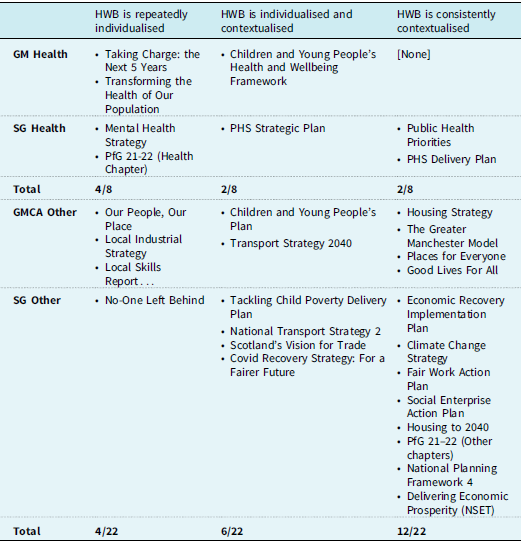
Table 4 provides an overview of each policy text analysed in this literature: those on the left repeatedly individualise health or wellbeing; those on the right consistently frame health or wellbeing within social contexts; those in the middle provide contextualisation, but not consistently. As it shows, half of the analysed health policy texts made strong or repeated biomedical or behavioural assumptions about health, while only four of the social or economic policy texts did likewise. On the other hand, more than half of the social and economic texts consistently framed health as an outcome of social or economic conditions.
Interviews with social and economic policy actors suggested that two individualised conceptualisations of health may have been inserted into their texts by contributions by health policy colleagues; further, a set of disease-specific targets in Our People, Our Place (2017) were ‘inherited’ from a health policy text.
However, while social and economic policy texts often contextualise health or wellbeing according to a social model of health, social and economic policy actors largely consider health in relation to the medical model, according to interview data. Therefore, it appears to be the topic focus of the written policy text that creates the contextualisation, rather than the beliefs or understandings of the actors in different policy settings.
Perspectives on ‘health in all policies’
When ‘health’ is understood to mean ‘health policy’, as described above, ‘Health in All Policies’ (HiAP) also takes on a different meaning: that health team goals have supremacy over other policy team goals. Health policy participants acknowledged the risk of this perception, with one detecting ‘mistrust’ from non-health policy colleagues, and two others referenced the ‘fortress health’ idea:
I don’t like coming in and saying this is about getting health in all policies, because I think that doesn’t land well with policy teams outwith DG Health. Because there’s this, people talk about fortress health, and the health budget has been protected at all costs really for the last 10-15 years […] I guess it’s that, just from an interpersonal effectiveness kind of respect, I don’t think that us going out and saying, ‘what can you do for health?’ is the way to engage people. [SCOP14H]
Social and economic policy participants rejected that health had imperative status, or the supremacy of health policy, as implied by ‘Health in All Policies’. For some, the lack of a health imperative was evident in its absence from mandated assessment procedures: a lack of regulatory legitimacy (Synnevåg et al., Reference Synnevåg, Amdam and Fosse2019). For others, health was just one of many sets of outcomes to consider in a setting of limited capacity:
Yeah I understand why you’re coming to say ‘think about health’, but there’s messages coming across government ‘think about race equality’, ‘think about gender’, think about, there’s quite a lot of messages coming across. And now I work in trade and I tell people ‘think about trade’, so that’s another aspect that you’re trying to mainstream [SCOP16O]
Participants described a competitive marketplace for limited policymaker attention: while some cross-governmental issues are given the status of legal duty and therefore prioritised, others must be promoted by the policy teams primarily responsible. This internal marketing, determined by an actor’s changeable professional interests, is exemplified by SCOP16O’s comment: ‘And now I work in trade and I tell people ‘think about trade’’. Further, both transport policy participants briefly advocated for ‘Transport in All Policies’. These participants did not attempt to legitimise a trade imperative, or a transport imperative, on normative grounds, but were acting according to their professional roles. One economic policy participant in Greater Manchester expressed a preference for ‘inequalities in all policies’:
…because ‘inequalities’ captures all of them. It’s not putting one type of inequality over and above another. It’s saying actually these are all important, they all interact with each other and you can’t place one above the other. And therefore it doesn’t exclude in the same way that making health inequality [sic] dominant then obviously excludes…” [GMP08O]
Here, the refusal to grant imperative status to any ‘type of inequality’ because to do so would ‘obviously exclude’, makes clear that the participant’s priority is the inclusion of various policy teams and interests.
These data present two fundamental challenges to population health policy actors: how can they promote the importance of health to non-health policy actors while avoiding charges of healthism and of health expansionism? These challenges each relate to the two ways ‘health’ is understood in policy settings. In the first case, because ‘health’ is associated with narrow understandings of illness, such a focus is rejected by proponents of broader conceptualisations of wellbeing. In the second case, because ‘health’ is associated with health policy, such boundary-crossing is resisted by those with inter-relational suspicions or resentments.
Discussion
This research finds that ‘health’ is understood in policy settings in two ways which impede a social approach to improving population health and reducing inequalities in health. Firstly, health in policy settings is transformed into the policy problem of illness, which leads to a focus on individual-level healthcare. Secondly, health in social and economic policy settings is shorthand for ‘health policy’, which is also strongly associated with healthcare, and which gives ‘Health in All Policies’ an alternative reading as a claim to dominance. Therefore, this paper adds to critiques of ‘Health in All Policies’ as a health policy-led enterprise facing collaborative and relational difficulties within policy settings.
Criticisms by GM policy participants exemplified the double-bind facing health policy actors. On one hand, healthcare actors were criticised for apparently resisting efforts to consider the wider determinants of health, while on the other hand, population health teams were criticised for being ‘evangelical’ in crossing policy boundaries to promote ‘Health in All Policies’. This conceptual confusion seems inevitably to lead to disappointment and frustration, as health policy actors acting in healthcare fail to address social determinants; while others working in population health tread a tightrope between trying to influence colleagues to act on their behalf, without provoking resentment or distrust.
Participants also widely supported ‘wellbeing’ rather than ‘health’, or a ‘wellbeing approach’ or ‘wellbeing economy’, more broadly. In this analysis, ‘wellbeing’ is preferred to ‘health’ for three key reasons: it closely aligns with the social model of health; it includes psychological as well as physical states; and it bears no relational baggage within policy settings, in contrast to ‘health’. These findings support the contention of Walker and John (Reference Walker and John2012) that ‘wellbeing’ is a preferable term to describe the aims of public health as it is more likely to engage a broad range of policy actors and stakeholders, with less risk of medicalisation or individualisation.
However, ‘wellbeing’ carries risks, as well as appeal. For McLaren (Reference McLaren2025) and others, a focus on ‘wellbeing’ but not ‘economy’ risks undermining critical engagement with the fundamental problems of neoliberal capitalism. Many of the harmful corporate practices inherent to neoliberalism are visible in the growing industry around the related idea of ‘wellness’, which individualises solutions to social problems (Karreman et al., Reference Karreman, Zenone, Maani and Hawkins2026). Huge literature on psychological or subjective wellbeing also focuses on individual-level perception rather than common social contexts (Diener et al., Reference Diener, Oishi and Tay2018).
The finding that social and economic policy actors feel included by ‘wellbeing’ as opposed to excluded by ‘health’ could be described using a range of theoretical constructs describing the characteristics of ambiguous ideas: ‘buzzwords’ (Cornwall, Reference Cornwall2007); ‘chameleonic ideas’ (Smith, Reference Smith2013); ‘coalition magnets’ (Beland & Cox, Reference Beland and Cox2016); or ‘collaboration magnets’ (Khayatzadeh-Mahani et al., Reference Khayatzadeh-Mahani, Labonté, Ruckert and de Leeuw2019) can be presented in attractive ways to gather widespread initial support.
However, eventually such ideas must be defined if they are to be operationalised, and at this stage support may be lost. In Hill O’Connor et al. (Reference Hill O’Connor, Smith, Hughes, Meier and Purshouse2023), the process of defining ‘inclusive growth’ within the Scottish Government was seen to contribute to it losing support: the ambition first imagined by supportive policy actors was perceived to be lacking in its specification. The ambiguity of ‘wellbeing’ leaves it at similar risk (Hayden, Reference Hayden2025).
Conclusion
This research finds the medical model of health remains prevalent in two devolved policy settings, both in health policy texts and in interview data from social and economic policy participants. The social model of health is also visible: portions of it are detectable in individual social and economic policy texts, and health policy actors interviewed here expressed commitment to it. However, health policy actors were criticised both for maintaining boundaries within healthcare, and for crossing boundaries to encourage collaboration for ‘Health in All Policies’. These criticisms highlight the fundamentally different roles of healthcare and population health actors, who work within medical and social models of health respectively, but who are nevertheless united in policy settings as ‘health’ actors.
A clearer conceptual divide reflecting the key distinction between reactive medical and preventive social models of health – perhaps of ‘healthcare’, ‘care’ or ‘medicine’ for the former, and ‘wellbeing’ for the latter – would enable healthcare actors to focus on the clinical needs of patients, while also allowing population health teams to dissociate themselves from healthism and from resentments associated with healthcare. Further, it may helpfully distinguish between widespread psychological responses to social conditions, and more acute psychological conditions that require intensive support. Finally, consistently distinguishing between ‘healthcare’ and ‘wellbeing’ may also clarify vital public and policy debates about the importance of pursuing preventive approaches to ill-health through social and economic policy, as a separate and additional requirement to the ever-present demands for healthcare funding.
Individualisation or contextualisation in health and other texts

Table 4. Long description
A table comparing individualization and contextualization in health and other texts. The table has 4 rows and 3 columns. Column headers are HWB is repeatedly individualized, HWB is individualized and contextualized, and HWB is consistently contextualized. Row labels include GM Health, SG Health, GMCA Other, and SG Other. Row 1: GM Health, Taking Charge: the Next 5 Years, Transforming the Health of Our Population, Children and Young People’s Health and Wellbeing Framework. Row 2: SG Health, Mental Health Strategy, PHS Strategic Plan, PFG 21-22 (Health Chapter). Row 3: GMCA Other, Our People, Our Place, Local Industrial Strategy, Local Skills Report, Children and Young People’s Plan, Transport Strategy 2040. Row 4: SG Other, No-One Left Behind, Tackling Child Poverty Delivery Plan, National Transport Strategy 2, Scotland’s Vision for Trade, Covid Recovery Strategy: For a Fairer Future.
Funding statement
This research was conducted as part of the systems science in Public Health and Health Economics Research – SIPHER Consortium – and I thank the whole team for valuable input and discussions that have informed this paper. I particularly wish to thank Kat Smith, Lisa Garnham, Clemmie Hill O’Connor, Gillian Fergie and Anna Macintyre.
This work by the SIPHER Consortium was supported by the UK Prevention Research Partnership (MR/S037578/2), which is funded by the British Heart Foundation, Cancer Research UK, Chief Scientist Office of the Scottish Government Health and Social Care Directorates, Engineering and Physical Sciences Research Council, Economic and Social Research Council, Health and Social Care Research and Development Division (Welsh Government), Medical Research Council, National Institute for Health Research, Natural Environment Research Council, Public Health Agency (Northern Ireland), The Health Foundation and Wellcome.
Competing interests
The author declares that he has no known competing financial interests or personal relationships that could have appeared to influence the work reported in this paper.


 Open access

