Over recent years there has been an increased interest in children's sensitivity to the discourse constraints that determine appropriate choice of referential expression. The same referent can be referred to in a variety of different ways (the spotty dog, the dog, that one, he, null), so children are faced with the challenging task of working out the circumstances under which it is appropriate to use these various forms of referring expression. Understanding how to use referring expressions in a conventional manner requires the child to take into account what her interlocutor already knows or could reasonably infer from the context, and this is influenced by informativeness, givenness, or accessibility features (Ariel, Reference Ariel1994, Reference Ariel, Sanders, Schilperoord and Sporen2001; Allen, Skarabela, & Hughes, Reference Allen, Skarabela, Hughes and Behrens2008; Bock & Warren, Reference Bock and Warren1985; Chafe, Reference Chafe1994; Givon, Reference Givon and Givon1983; Gundel, Hedberg, & Zacharski, Reference Gundel, Hedberg and Zacharski1993; Greenfield & Smith, Reference Greenfield and Smith1976). The more accessible a referent is, the more likely it is to be referred to with a low information (pronominal) form or, in some languages, omitted altogether. The accessibility of a referent and therefore a speaker's choice of referring expression is influenced by whether the referent is given or new in discourse, its perceptual availability, whether the speakers are engaged in joint attention, the type of question asked, the number of available referents, whether the referent is differentiable from other available referents, and whether the speaker wishes to explicitly contrast one referent with another, among others (e.g., Allen, Reference Allen2000; Clancy, Reference Clancy and Clark1993, Reference Clancy, Du Bois, Kumpf and Ashby2003; Guerriero, Oshima-Takane, & Kuriyama, Reference Guerriero, Cooper, Oshima-Takane and Kuriyama2006; Matthews, Lieven, Theakston, & Tomasello, Reference Matthews, Lieven, Theakston and Tomasello2006; Narasimhan, Budwig, & Murty, Reference Narasimhan, Budwig and Murty2005; Paradis & Navarro, Reference Paradis and Navarro2003; Prat-Sala & Hahn, Reference Prat-Sala and Hahn2007; Rozendaal & Baker, Reference Rozendaal and Baker2009; Salomo, Lieven, & Tomasello, Reference Salomo, Lieven and Tomasello2010; Serratrice, Reference Serratrice2008; Serratrice, Sorace, & Paoli, Reference Serratrice, Sorace and Paoli2004; Skarabela, Reference Skarabela2007).
There is a complex interaction between accessibility, argument realization, and syntactic role. In what has been termed preferred argument structure (PAS; DuBois, Reference DuBois1987), only one referent is typically realized lexically per referential clause (rather than by a less informative pronominal or null form). In addition, the subjects of transitive clauses are more likely to represent accessible information and therefore to be realized pronominally than either the subjects of intransitive clauses or the objects of transitives. By contrast, in the absence of any shared information between speakers, and under circumstances where the subject of a transitive clause refers to an inaccessible referent, speakers must choose a high information form. Children must therefore learn to evaluate accessibility independently of the typical realization of arguments (PAS), and this is the focus of the current study.
How do children learn to do this? Within usage-based approaches, language is thought to consist of constructions that are themselves form-meaning mappings (Goldberg, Reference Goldberg1995, Reference Goldberg2006). Thus, part of acquiring a particular grammatical construction is learning the typical function it serves and its typical lexical instantiation. From this perspective, children's early knowledge of grammatical constructions should be tied to their prototypical instantiations, and there is evidence to support this claim. Across a range of constructions, children show higher levels of performance in both comprehension and production when the exemplars tested map onto the prototypical instantiation of that construction in terms of its lexical items, the use of pronouns versus lexical nouns, the animacy of the participants, and its word order or case marking among other factors (e.g., for transitives: Chan, Lieven, & Tomasello, Reference Chan, Lieven and Tomasello2009; Dittmar, Abbot-Smith, Lieven, & Tomasello, Reference Dittmar, Abbot-Smith, Lieven and Tomasello2008; for relative clauses: Arnon, Reference Arnon2010; Brandt, Kidd, Lieven, & Tomasello, Reference Brandt, Kidd, Lieven and Tomasello2009, Kidd, Brandt, Lieven, & Tomasello, Reference Kidd, Brandt, Lieven and Tomasello2007; for ditransitives: Rowland & Noble, in press; for sentential complements: Kidd, Lieven, & Tomasello, Reference Kidd, Lieven and Tomasello2006; for questions with long-distance dependencies: Dabrowska, Rowland, & Theakston, Reference Dabrowska, Rowland and Theakston2009). However, in these prototypical exemplars, a number of cues might coalesce to indicate the meaning of the utterance, for example, both word order and case marking, or word order and animacy, may jointly indicate the agent of an action (Bates & MacWhinney, Reference Bates, MacWhinney and MacWhinney1987). When cues are put into conflict, children may rely on different cues than adults to determine the meaning of the sentence (e.g., Chan et al., Reference Chan, Lieven and Tomasello2009; Dittmar et al, Reference Dittmar, Abbot-Smith, Lieven and Tomasello2008; Ibbotson, Theakston, Lieven, & Tomasello, Reference Ibbotson, Theakston, Lieven and Tomasello2011).
The competition model framework (Bates & MacWhinney, Reference Bates, MacWhinney and MacWhinney1987) is also relevant in the study of discourse pragmatic cues (e.g., see Chen, Reference Chen1998, on competition between stress and word order to indicate given/new information). The subjects of transitives have a very strong tendency to represent accessible referents and to be realized pronominally. For example, in Dubois’ (Reference DuBois1987) study of Sacapultec Maya, only 3.2% of transitive subjects represented information that was new to the discourse and was represented by a lexical noun phrase (NP), a pattern (PAS) observed in a variety of languages (Goldberg, Reference Goldberg, Horn and Ward2005). English child-directed speech also follows PAS with a high proportion of simple transitives having a pronominal subject (83%) and/or a lexical noun object (64%; Cameron-Faulkner, Lieven, & Tomasello, Reference Tomasello2003). Children are likely, therefore, to acquire the knowledge that transitive subjects tend to be realized as pronouns. However, as the majority of subjects are both pronominal and accessible, they may not appreciate the need to use more informative referring expressions if the subject referent is inaccessible. A fuller understanding of how accessibility affects argument realization in the transitive must come from a comparison of the form and function of the subject and object roles, and consequently, is likely to take developmental time. To the extent that it is possible to establish the role of accessibility in referent choice in child-directed speech, inaccessible referents are associated with higher information forms (e.g., Clancy, Reference Clancy and Clark1993; Guerriero et al., Reference Guerriero, Cooper, Oshima-Takane and Kuriyama2006). However, in naturalistic data one does not have access to the speakers' shared knowledge that can render apparently inaccessible referents accessible and contribute to referent choice. Moreover, only a subset of the features known to affect choice of referring expression are typically coded in any given study; thus, information about other contributing factors is overlooked. Given the multitude of pragmatic features that determine referent choice, it would be surprising if children showed adultlike sensitivity to all of these sources of information from the beginnings of acquisition. Consequently, even if referent accessibility in child-directed speech was perfectly correlated with choice of referring expression, it is unclear whether children would have sufficient access to this information to prioritize it over other potential sources of information regarding choice of referential form. We might therefore expect that if accessibility and PAS are put into conflict, children are likely to be more sensitive to PAS, especially for transitive subjects.
Before children can be expected to tease apart the relative contributions of accessibility and sentence position to choice of referring expression, it is first necessary to ask two questions. (a) Are children sensitive to accessibility, that is, do they use overt forms to refer to referents that are relatively inaccessible in the discourse, and null or pronominal reference for highly accessible referents? (b) Do children's utterances reflect PAS? Are the objects of transitives (and subjects of intransitives) more likely to be realized lexically than the subjects of transitives? Across a variety of languages, there is evidence that from around 2 years of age, inaccessible referents are more likely to be realized overtly than highly accessible referents. Moreover, children produce a higher proportion of overt referents as the subjects of intransitive verbs and objects of transitive verbs than as the subjects of transitive verbs (e.g., Allen, Reference Allen2000, for Inuktitut; Clancy, Reference Clancy and Clark1993, for Korean; Guerriero et al., Reference Guerriero, Cooper, Oshima-Takane and Kuriyama2006, for Japanese; Narasimhan et al., Reference Narasimhan, Budwig and Murty2005, for Hindi; Paradis, & Navarro, Reference Paradis and Navarro2003, for Spanish; Serratrice, Reference Serratrice2005, for Italian). This has led researchers to conclude that from very early in development, children show sensitivity to the accessibility of referents in the discourse context and to patterns of PAS. Even in languages such as English that do not normally allow argument omission, children omit subjects (but objects to a much lesser extent) during the earliest stages of acquisition (Bloom, Reference Bloom1990; Gerken, Reference Gerken1991; Hyams & Wexler, Reference Hyams and Wexler1993; Valian, Reference Valian1991), and there is some evidence that discourse pragmatic factors may account for these omissions (e.g., Hughes & Allen, Reference Hughes and Allen2009).
However, what is not clear is the extent to which children really understand the influence of particular pragmatic features. As there are a number of different discourse features known to affect argument production (e.g., discourse or perceptual availability, joint attention, disambiguation, contrast), establishing which features children are sensitive to, and under what conditions, is a challenging task. Without controlling for overlap and interactions between pragmatic features it is impossible to determine the unique contribution of each (Serratrice et al., Reference Serratrice, Sorace and Paoli2004). Some studies have analyzed children's speech with respect to a composite or broad measure of accessibility (Clancy, Reference Clancy and Clark1993, Narasimhan et al., Reference Narasimhan, Budwig and Murty2005; Serratrice, Reference Serratrice2005). Others have included a number of features analyzed separately but without controlling for the overlap between them (Paradis & Navarro, Reference Paradis and Navarro2003; Serratrice et al., Reference Serratrice, Sorace and Paoli2004). Still others have focused on just one or two factors with the consequence that the results could be confounded as the influence of discourse features other than those under investigation and the potential interactions between them are unknown (Guerriero et al., Reference Guerriero, Cooper, Oshima-Takane and Kuriyama2006; Rozendaal & Baker, Reference Rozendaal and Baker2009; Skarabela, Reference Skarabela2007).
Two studies using naturalistic data have attempted to examine the independent contributions of pragmatic factors to argument realization. Allen (Reference Allen2000) coded the speech of age 2 years, 0 months (2;0)–3;6 Inuktitut-speaking children for eight different discourse features and determined both their combined and individual influence on choice of referring expression using logistic regression techniques. However, these eight features together did not account for all of the data, leading Allen to appeal to further factors such as joint attention and repetition/imitations to explain the remaining data (see also Allen, Reference Allen, Bowerman and Brown2008, for the cumulative effects of discourse features). Skarabela and Allen (Reference Skarabela, Allen, Skarabela, Fish and Do2002) examined the independent impact of joint attention by focusing exclusively on utterances where the only pragmatic feature present was newness. In their sample, they found 3168 subject and object referents, but of these, only third-person referents (347) were included (first- and second-person referents were considered given). Of these, 83 referents were new, and of these, only 22 were produced in the absence of joint attention. In these data new referents were omitted 78% of the time overall (65/83), but only 36% of the time in the absence of joint attention (8/22) providing evidence for its independent contribution. However, the sample was small, and even with these tight controls 36% of the data remains unaccounted for. Thus, although good attempts have been made to isolate the relative effects of individual discourse features in naturalistic data, when the rigorous methodological controls necessary to fully isolate the features of interest are applied, the outcome may be a very small sample that limits the conclusions that can be drawn.
A number of experimental studies have attempted to examine in more detail children's sensitivity to specific discourse pragmatic factors by controlling the discourse and perceptual context. Studies have shown that when answering questions, 2-year-olds are sensitive to the prior mention of referents in the question in their selection of referring expression (Campbell, Brooks, & Tomasello, Reference Campbell, Brooks and Tomasello2000; Wittek & Tomasello, Reference Wittek and Tomasello2005, see also Prat-Sala & Hahn, Reference Prat-Sala and Hahn2007, for data on Catalan). Furthermore, Matthews et al. (Reference Matthews, Lieven, Theakston and Tomasello2006) showed that English-speaking 2-, 3-, and 4-year-olds were sensitive to the prior mention in discourse of the target referent, producing full nouns when the referent had not previously been mentioned but preferring to use pronouns or omit the referent altogether when it had previously been mentioned (see also Salomo et al., Reference Salomo, Lieven and Tomasello2010). However, only the 3- and 4-year-olds in Matthews et al.'s (Reference Matthews, Lieven, Theakston and Tomasello2006) study were sensitive to the perceptual availability of the referents. Serratrice (Reference Serratrice2008) also investigated the effects of discourse and perceptual availability and question type on choice of referential expressions in 3-, 5-, and 6-year-olds and included an adult group (Study 1). She found that 5- and 6-year-olds but not 3-year-olds were more likely to provide lexical nouns when the listener could not see the screen, or when she could see the screen but asked a general question (What's happening?). However, they failed to produce lexical nouns (unlike adults) when the listener could not see the screen but asked a more specific question (What's that person doing?). Serratrice (Reference Serratrice2008) concluded that for the children, the cue contained within the more specific question that implies that the speaker knows the identity of the referent (That person) overrides the cue contained within the perceptual context (the speaker cannot see the referent and therefore cannot know its identity). In Study 2, Serratrice (Reference Serratrice2008) investigated children's sensitivity to ambiguity as indicated by the number of referents available in the perceptual scene (one vs. two), and manipulated whether the listener could or could not see the characters (who could be differentiated by gender-marked pronouns). She found that when there was only one available referent and the speaker could see, there were no differences across age groups: all groups used a high proportion of null or pronominal reference. However, when there were two referents available, irrespective of whether the listener could see the referents, 3- and 5-year-olds tended to use null, pronominal, or one/the other reference, whereas 6-year-olds and adults predominantly used lexical nouns, even though gender-marked pronouns would be sufficient to disambiguate the referents when the listener could see them. Serratrice (Reference Serratrice2008) argued that the presence of two referents placed demands on the speakers' abilities to represent the referential scene, resulting in the lower activation of each referent, which in turn led to a higher use of lexical nouns to disambiguate the context (Arnold & Griffin's two-character effect, Reference Arnold, Brown-Schmidt and Trueswell2007).
Thus, to date, studies have shown that young children show some sensitivity to a number of different discourse features, and that most appear to make a unique contribution to children's argument realization, although the precise interactions between them are not well understood. However, (a) few studies have specifically focused on whether discourse features affect subject and object realization in the same way, in particular on how children (or adults) might behave if accessibility features conflict with patterns of PAS, and (b) most studies consider children's sensitivity to discourse pragmatic principles in relatively straightforward communicative contexts. Although the aim of many of these studies has been to understand children's sensitivity to discourse pragmatic principles in the context of their day-to-day interactions (see Allen et al., Reference Allen, Skarabela, Hughes and Behrens2008), it is also important to establish how children fare under more complex discourse conditions. In this study complexity is operationalized as communication about referents that can only be differentiated by use of complex NPs (in contrast with the complex task of generating narratives on which there are a number of studies, see, e.g., Kail & Hickmann, Reference Kail and Hickmann1992; Orsolini, Rossi, & Pontecorvo, Reference Orsolini, Rossi and Pontecorvo1996; Warden, Reference Warden1976; Wong & Johnstone, Reference Wong and Johnstone2004). Before outlining the current study, these two issues are briefly elaborated.
First, although a number of both naturalistic and experimental studies have examined the role of discourse pragmatics in licensing argument omission, few have analyzed the subjects and objects of transitive verbs separately (see Allen, Reference Allen, Sorace, Heycock and Shillcock1997, Reference Allen, Slabakova, Montrul and Prévost2006, for arguments relating to subject–object asymmetry). Serratice et al. (Reference Serratrice, Sorace and Paoli2004) separated subjects and objects in their English and Italian data and found that although subjects were omitted more than objects, when discourse features were taken into account, omissions were licensed for both argument types. As discourse features often overlap, however, it is not clear which factors had the strongest influence, nor whether this was the same for both subjects and objects. In a recent experiment, Salomo et al. (Reference Salomo, Lieven and Tomasello2010) focused on German-speaking children of 2;3's production of verbs and objects according to whether they represented given or new information, with all conditions containing a given subject referent. They found that the subject was omitted or pronominalized 93% of the time, whereas in their patient-given condition children used null or pronominal reference only 78% of the time to refer to given objects. However, as the children were asked a question that suggested that the agent (but not the patient) represented given information, it is possible that this apparent subject–object asymmetry is due to the cumulative effect of multiple cues. In the current study, we examine argument realization for the subjects and objects of simple transitives in English under the same discourse conditions to determine how discourse pragmatic principles interact with PAS.
It is important to assess children's sensitivity to discourse pragmatic factors against adult performance. From a usage-based perspective, linguistic representations are derived from exposure to language use, and change over the course of development according to the distributional properties of the input and the speaker's prior language experience (Abbot-Smith & Tomasello, Reference Abbot-Smith and Tomasello2006). When different cues are put into conflict (such as accessibility and PAS), it is important to know how the adult language user behaves in order to better understand how sensitivity to different cues might develop and change over development (e.g., MacWhinney, Bates, & Kliegl, Reference MacWhinney, Bates and Kliegl1984). Few studies have examined caregivers’ sensitivity to discourse constraints when situated in the same conversational or experimental context as children (although there is a large adult literature). Those studies that include naturalistic caregiver data suggest that adults show probabilistic sensitivity to discourse features, using low information forms at least some of the time for apparently inaccessible referents (e.g., Clancy, Reference Clancy and Clark1993; Guerreiro et al., Reference Guerriero, Cooper, Oshima-Takane and Kuriyama2006; Paradis & Navarro, Reference Paradis and Navarro2003; Rozendaal & Baker, Reference Rozendaal and Baker2009). However, as these studies do not assess all of the features known to affect argument realization it is unclear whether the data are probabilistic or reflect the fact that referents were accessible on some other feature thus rendering low information forms acceptable. There is a clear need for further studies that include adult data to determine how discourse features work both in isolation and in interaction (e.g., see Serratrice, Reference Serratrice2008). In the current study, an adult group is included to evaluate how adults perform on the task in question, and to compare children's performance against this baseline.
Second, by 4 to 5 years of age, children can demonstrate Level 2 perspective-taking skills (Flavell, Reference Flavell, Beilin and Pufall1992) to adopt another's perspective and appreciate that their interlocutor's representation of an object may differ from their own (e.g., Flavell, Everett, Croft, & Flavell, Reference Flavell, Everett, Croft and Flavell1981). The relative accessibility of a referent in discourse represents a particular case when a speaker must take into account not only how that object is represented by their interlocutor (how accessible it is), but also how one can appropriately refer to it, and clearly these are not the same thing. A number of studies have examined children's abilities to take into account what is perceptually available to their interlocutor to differentiate between two similar referents, where an adjective or other restrictive modification (the green frog, the frog on the mat) is needed for disambiguation. From a discourse–pragmatic perspective, the prediction is that the presence of a competitor referent in the linguistic or physical domain (known as disambiguation, contrast, or interference) will cause speakers to use more informative referring expressions to resolve the ambiguity (Allen et al., Reference Allen, Skarabela, Hughes and Behrens2008). A body of evidence shows that by 5 years of age, children are sensitive to this kind of disambiguating information. When cued with a specific question about a target referent (e.g., Which frog went to Mrs Squid's house?), 4- to 5-year-olds notice potential ambiguity in the referential scene, and select complex referring expressions to indicate the target referent on 87% of trials (Hurewitz, Brown-Schmidt, Thorpe, Gleitman, & Trueswell, Reference Hurewitz, Brown-Schmidt, Thorpe, Gleitman and Trueswell2000). Moreover, even in the absence of a question about the specific target referent, 4-year-olds can produce unambiguous lexical expressions (The Mummy with the microphone, the Daddy eating cake) around 30% of the time, increasing to 84% after training that highlighted the uninformative nature of children's early responses (Matthews, Lieven, & Tomasello, Reference Matthews, Lieven and Tomasello2007). However, older children and adults sometimes show redundancy, producing informative referring expressions when the intended referent is unambiguous in context. Nadig and Sedivy (Reference Nadig and Sedivy2002) found that 5-year-olds were able to use a disambiguating adjective to indicate one of two similar items (e.g., big cup) when both were perceptually available to their interlocutor, but both children and adults also sometimes produced disambiguating adjectives when their interlocutor could see only one of the two items (cf. Bahtiyar & Kuntay, Reference Bahtiyar and Kuntay2009; Study 2). Taken together, these studies suggest that 5-year-olds are aware of, and can indicate linguistically, ambiguities in referential identity that require complex referring expressions for disambiguation. In the current study, we investigated how referential ambiguity requiring modifying expressions for its resolution interacts with accessibility as determined by prior mention in discourse. One possibility is that referential ambiguity might reduce the relative accessibility of all referents as speakers must divide their attention between them (Arnold & Griffin, Reference Arnold and Griffin2007; Serratrice, Reference Serratrice2008). This might result in children and adults adopting maximally informative referring expressions across the board irrespective of their prior experience with (accessibility of) individual referents. In contrast, if the production of complex referring expressions in itself places increased demands on the speaker, we might expect that children will resort to using lower information forms such as pronouns as some researchers have suggested that pronouns carry a lower processing cost (e.g., Bloom, Reference Bloom1990).
In the current study the following three questions are addressed. First, do English-speaking 5-year-olds and adults show sensitivity to accessibility in their selection of referring expressions to refer to subjects and objects? Second, how do patterns of PAS influence choice of referring expression for subjects and objects? Third, how does the complexity of the discourse context, defined in terms of the number of available competing referents and the requirement to use a complex referring expression for disambiguation, affect children's and adults’ sensitivity to accessibility and patterns of PAS? If speakers are sensitive to the discourse feature accessibility and recognize its priority over PAS patterns of argument realization, we should find that they use maximally informative referring expressions to refer to inaccessible referents irrespective of whether they represent subjects or objects, and irrespective of the complexity of the scene. In contrast, if speakers are sensitive to PAS and assume it takes priority over accessibility, we would expect them to produce less informative referring expressions in subject than object position, irrespective of accessibility or of the complexity of the scene. Finally, if speakers are sensitive to both features, but do not consistently prioritize one over the other, we might expect to see a complex interaction with different choices of referring expression according to accessibility, sentence position, and the complexity of the scene.
METHOD
Participants
Thirty-two English-speaking 5-year-olds and 16 English-speaking adults participated in the study. The children (17 boys, 15 girls) had a mean age of 5;0 (range = 4;6–5;5). They were recruited from primary schools in Birmingham and Henley-on-Thames, UK. Two additional children were excluded from the study because they did not complete the full test session (1) or did not speak (1). The adults (5 males, 11 females) had a mean age of 27 (range = 20–55) and were recruited from a mixed population of undergraduate students and working adults.
Materials and design
Twenty-four pairs of animal puppets were used in the study. Each pair was designed to have a clear distinguishing feature (e.g., mouse with big whiskers vs. small whiskers, pig with a curly tail vs. a straight tail). Puppets were grouped into eight sets of three pairs, one set per block of four video clips for the purposes of presentation. There were two conditions in a between groups design. One group of 16 children and one group of 8 adults took part in the unambiguous referent condition. In this condition, only one puppet from each pair was used; thus, for any one block there was a choice of three puppets, each of which was a different animal. A second group of 16 children and a second group of 8 adults took part in the ambiguous referent condition. In this condition, both puppets from each pair were used. Thus, for any one block of four video clips there was a choice of six puppets, two each of three different animals. This meant that in the unambiguous condition, a simple noun response (e.g., cat, dog) would be sufficient to uniquely identify a referent, whereas in the ambiguous condition a simple noun response would be ambiguous, and a modified NP was required to uniquely identify a referent (e.g., the pig with the curly tail). Within-subjects variables were the accessibility of the referent (inaccessible/accessible) and the sentence position (subject/object).
Four video clips were made for each of the eight blocks. The first two clips each showed one of the puppets carrying out an intransitive action (e.g., cat jumping, cat dancing) and were each three seconds in duration. The third and fourth clips represented the test contexts and showed two transitive actions (e.g., cat chasing dog, cat dropping duck) of 5-s duration. The original puppet that had participated in the first two clips also participated in the transitive actions along with a different animal puppet from the current set. Thus, the puppet that participated in clips one and two was established as accessible and the additional puppets that participated in clips three and four were deemed to be inaccessible. Although all physically present referents were named at the start of each block of videos, following Allen et al. (Reference Allen, Skarabela, Hughes and Behrens2008), referents not mentioned in the previous five utterances were assumed to be inaccessible. The intervening intransitive action video clips and instructions from the experimenters ensured that there was a clear differentiation between the accessible and inaccessible referents with respect to mention in prior discourse. Moreover, accessible referents were singled out in the physical context, whereas inaccessible referents were not, and there were no cues to determine which of the inaccessible referents would participate in any given action; thus, inaccessible referents also required disambiguation (contrast, interference). The syntactic role occupied by the accessible puppet in the transitive scenes was manipulated to include equal numbers of appearances as the subject and object of the transitive verbs. The order of presentation of the eight blocks of videos was fully counterbalanced. Responses were video-recorded for later analysis.
Procedure for children
Children were invited to sit next to an experimenter (E1) at a table in front of a computer screen. A second experimenter (E2) sat opposite them across a table so that she could not see the computer screen. To the side of E2 were a series of sticks onto which puppets could be placed. Puppets were placed out of view and grouped into eight sets of three pairs, one per block of video presentations. As a general introduction, the children were told that they would see a series of video clips on the computer about lots of puppets. Their task would be to tell E2 what they had seen so that she could act it out with the puppets on the sticks because E2 could not see the computer and therefore would not know what had happened. E1 informed the children that she would tell them what she thought each clip was about to ensure that there was no ambiguity as to what action was carried out. The children were also told that they would have to tell E2 which puppet to choose, as there were a few different puppets available. Inaccessible referents could not be identified by nonlinguistic cues (gaze, point) as they were located in close proximity to each other but out of reach of the child, nor could the experimenter guess which puppet was the intended referent as there were always at least two puppets in addition to the accessible referent (see Appendix A for a sample scene).
Prior to each set of video clips, a selection of puppets was placed on the sticks to the side of E2 so that all puppets were physically present, three puppets in the unambiguous referent condition, and six puppets in the ambiguous referent condition. E2 then named all of the puppets using simple nouns in the unambiguous condition and modified NPs in the ambiguous condition to familiarize the children with the puppets and their distinguishing features. At the start of each block, the children were told that they would see four video clips about a specific character who was named by E1 (e.g., These videos are all about the cat/the cat with big whiskers). This served to establish one referent as accessible (mentioned in the discourse, and the topic of the subsequent interaction). To demonstrate that E2 had heard this statement, E2 picked up the relevant puppet from the array and clarified which character the videos would be about using a simple noun with a demonstrative (So all these videos are about this cat). Before playing each video clip, E1 put a still shot of the action on screen and told the children what she thought the video was about (e.g., I think this video is about dancing). After viewing each clip children were asked by E1 to explain to E2 what they had seen so that E2 could act it out with the puppets (Can you tell E2 what you saw?). For each clip, E2 selected puppets according to the children's responses and performed an action. She always kept the target puppet in her hand to maintain its accessible status (and the focus of shared attention) but placed other puppets, once used, on the sticks. If E2 did not have sufficient information from the children's initial response to select puppets and identify the action, then the children were prompted for the missing information by E1. Children were only prompted for further information if their response did not meet the requirements of the discourse pragmatic principle accessibility. Thus, if children used simple nouns, demonstratives, pronouns, or null reference to refer to the puppet established as accessible, this was accepted. However, if children did not use a lexical noun to refer to an inaccessible referent (or a modified NP in the ambiguous referent condition), E1 prompted them for further information (e.g., Can you tell E2 who the cat/he was dropping/who was dropping the duck/him or Can you tell E2 which duck? if children responded with duck for an inaccessible referent in the ambiguous referent condition). Participants were prompted until all necessary referents and the action were identified. Prompting was intended to give children some feedback regarding the informativeness of their responses to prevent them simply sticking with a single erroneous strategy throughout the task. However, only the children's first responses for each of the third and fourth video clips referring to transitive actions were coded for analysis. After each block of four clips, the current set of puppets was removed from view and a new set placed on the sticks to the side of E2. The same procedure was then followed to establish one of these referents as accessible, and the four video clips played. This procedure was followed for one warm-up trial and then repeated until all eight test blocks of videos had been played.
Procedure for adults
The procedure for the adults was exactly the same as for the children. The only difference was that adults only saw four of the eight sets of video clips as we anticipated fewer missing data points for the adults. The order of presentation of blocks was fully counterbalanced.
Coding
Responses describing the transitive actions depicted in the third and fourth video clips in each block were coded according to the type of referent used to represent the subject and object. There was a possible total of 16 subject and 16 object arguments for each child, and 8 subject and 8 object arguments for each adult. Responses were coded as complex NPs (modified nouns that uniquely identified the referent), simple lexical nouns, pronouns/demonstratives,Footnote 1 and null reference. Utterances where only a verb was produced were excluded as it was impossible to tell whether children were simply naming the action or omitting both subject and object arguments. Similarly, for responses where the children changed the verb to an intransitive verb that required only one argument (e.g., produced fall when the target verb was drop), the referent not encoded by the verb was excluded (rather than assumed to be null). All other argument omissions were included. The children's and adults’ gestures were also coded as although the referents were placed close together to ensure that pointing or eye gaze could not uniquely identify new referents, iconic gestures could have been used to indicate distinguishing features. However, none of the participants used gesture to any significant degree, and thus use of gesture was not analyzed further. Data from six children was independently coded by two trained researchers resulting in a 100% agreement rate for the type of referential expression used to refer to the subject and object of the test scenes. The adult data was coded by the same two researchers collaboratively but did not result in any disagreements. Finally, all coding was verified by the author.
RESULTS
The children produced 787 responses that could be included in the analyses. A further 202 arguments were excluded due to verb only responses, 18 arguments because children failed to respond at all, and 17 arguments due to intransitive verb substitutions that encoded only one of the referents. Responses were evenly distributed across the four response categories (subject/object + accessible/inaccessible). Of these, 13.1% were null, 27.3% were pronominal, 53.4% were simple nouns, and 6.2% were complex NPs. Before examining the children's and adults’ response patterns in detail, we looked at the types of responses given by the children according to the individual verbs used in the test scenarios. This was to ensure that individual verbs were not biased toward eliciting fewer full subject–verb–object responses in the data that might reflect children's belief that particular verbs could be used intransitively. Analysis revealed that across verbs a similar proportion of responses were full transitives with both subject and object arguments produced (M = 0.54, SD = 0.05). Only 0.01 of responses consisted of a subject and verb where the subject represented the patient of the demonstrated action (SD = 0.02), and only 0.02 (SD = 0.02) were subject–verb responses with a plural pronoun subject (e.g., They were hugging). This shows that individual verbs elicited similar response patterns, and the children very rarely used these verbs intransitively to describe the resulting action of the patient. We also examined the data to determine whether the children showed any effects of training in the study as the children were provided with feedback on their responses. An analysis of variance examining the number of maximally informative responses produced for the first four versus the last four trials showed a main effect of trial, F (1, 30) = 5.48, p = .026, M = 1.22 maximally informative (MI) responses on the first four trials, M = 1.49 on the last four trials, but no significant interactions with sentence position, accessibility, or ambiguity. The children provided more informative responses as the study went on, but this was not influenced by the variables of interest in the current study.
To investigate the effects of sentence position, accessibility, and ambiguityFootnote 2 on choice of referring expression in 5-year-olds and adults, mixed effects logistic regression models were fitted to the data using Laplace approximation (Baayen, Reference Baayen2008; Baayen, Davidson, & Bates, Reference Baayen, Davidson and Bates2008; Jaeger, Reference Jaeger2008). Separate models were run to establish the circumstances under which participants produced maximally informative responses (MI: a complex noun in the ambiguous condition, a simple noun in the unambiguous condition), simple nouns, pronouns or, for the children only, null arguments. Participant (N = 48) was added to all models as a random effect on the intercept in order to take individual differences into account.Footnote 3 The mean proportion of responses of each type according to age, sentence position, accessibility, and ambiguity are reported in Appendix B.
If speakers are sensitive to accessibility, there should be more MI responses for inaccessible than accessible referents, and the provision of MI responses for inaccessible referents should be 100%. If the children fail to fully appreciate the need to use complex NPs in the ambiguous condition for inaccessible referents, they may still show sensitivity to accessibility in their choice of noun rather than pronoun or null arguments for inaccessible referents. If PAS influences responses, we might find more MI and simple noun responses for objects than for subjects, even when the referent is accessible, and more pronominal or null reference for subjects, even when the referent is inaccessible. If ambiguity influences responses, we might expect to find more MI and noun responses in the ambiguous than unambiguous condition, reflecting the greater uncertainty over the identity of the target referent, and the greater need for the speaker to disambiguate and keep the target referents in mind.
MI responses
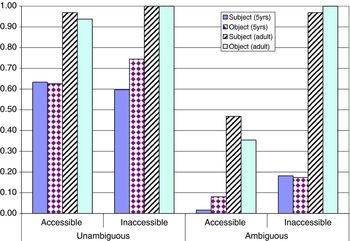
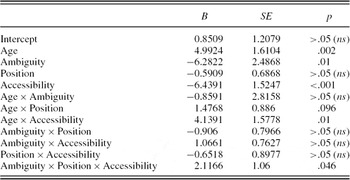
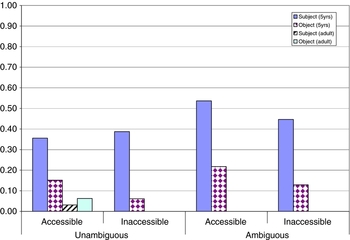
To determine how accessibility influenced choice of referring expression, how accessibility interacted with PAS, and the effects of referent ambiguity we first examined the proportion of MI responses in each condition (see Figure 1). Table 1 provides an overview of the model.
The mean proportion of maximally informative responses. [A color version of this figure can be viewed online at journals.cambridge.org/aps]

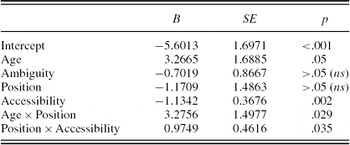
Mixed effects model for effects of age, ambiguity, sentence position, and accessibility on maximally informative responses

The model showed main effects of age, accessibility, and ambiguity (adults produced more MI responses than the children, there were more MI responses for inaccessible than accessible referents, and there were more MI responses in the unambiguous than ambiguous condition overall). However, there were also two-way interactions between age and accessibility, and age and sentence position (marginal), and a three-way interaction between ambiguity, sentence position, and accessibility.
Both the children and adults showed some sensitivity to accessibility, using more MI responses to refer to inaccessible than accessible referents, but this difference was much less marked in the children (0.42 vs. 0.34) than in the adults (0.99 vs. 0.68). When we consider the role of PAS in reference choice, the adults produced MI subjects and objects at similar rates (0.85 and 0.82, respectively), whereas the children were less likely to produce MI subjects (0.36) than MI objects (0.41), in line with PAS. Moreover, although inaccessible referents were more likely than accessible referents to be realized with a MI response overall, responses in the unambiguous condition were particularly influenced by PAS. Specifically, there was no difference in the rate of MI responses for accessible and inaccessible subjects (accessible 0.80, inaccessible 0.80), but there were fewer MI responses for inaccessible subjects (0.80) than inaccessible objects (0.87). As the adults produced only MI responses for inaccessible referents in the unambiguous condition (1.0), it was the children who failed to overcome PAS and recognize the need to provide MI responses for inaccessible subjects (e.g., He was kissing the dragon, subject inaccessible, object accessible, accessible subjects 0.63, objects 0.63, inaccessible subjects 0.60, objects 0.74). Neither the children nor the adults, however, produced more MI responses for accessible object referents than accessible subject referents, contrary to patterns of PAS. Finally, both the adults and children produced fewer MI responses overall in the ambiguous condition, but the difference between inaccessible and accessible referents was larger than in the unambiguous condition.
Simple noun responses
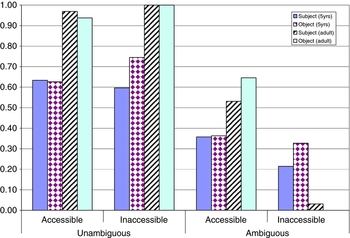
To further investigate sensitivity to accessibility, its interaction with PAS, and the effects of referent ambiguity, the proportion of simple noun responses was examined (see Figure 2). Table 2 shows a summary of the model. There were main effects of accessibility and ambiguity (there were more noun responses for accessible referents, and for referents in the unambiguous condition), but there were also interactions between age and accessibility, sentence position and accessibility, age and ambiguity, and ambiguity and accessibility that mediate these effects.
The mean proportion of simple noun responses. [A color version of this figure can be viewed online at journals.cambridge.org/aps]

Mixed effects model for effects of age, ambiguity, sentence position, and accessibility on simple noun responses

With regard to accessibility, the children used nouns to refer to both accessible and inaccessible referents at similar rates (0.50 vs. 0.47), whereas adults were more likely to use nouns to refer to accessible (0.77) than inaccessible referents (0.51). This reflects the adults’ greater use of complex NPs to refer to inaccessible referents in the ambiguous condition (e.g., The dragon is spraying the goat with the big horns, subject accessible, object inaccessible). The children used few complex NPs overall, but their simple noun use was not biased toward inaccessible referents, even in the ambiguous condition (e.g., The fox was pulling the mouse; subject inaccessible, object accessible). This suggests that the children were not simply failing to use complex NPs to differentiate referents in the ambiguous condition (instead thinking that a simple noun would suffice), but they were also failing to appreciate and/or encode the inaccessibility of referents in the ambiguous condition.Footnote 4 With regard to the influence of PAS on referent choice, the data show that accessible subjects and objects were realized as nouns at similar rates (0.62 vs. 0.64), whereas inaccessible subjects were less likely to be realized as nouns (0.46) than inaccessible objects (0.52). This difference is driven by the children's responses showing that they were unable to overcome PAS (e.g., He kissed the dragon, subject inaccessible, object accessible vs. The cat was dropping the duck, subject accessible, object inaccessible), and is observed in both the unambiguous and ambiguous conditions (adults inaccessible subjects 0.52, objects 0.50; children inaccessible subjects 0.41, objects 0.54). Finally, we examine the effects of ambiguity. Although both the children and the adults used nouns more often to refer to referents in the unambiguous condition, this difference was much more marked in the adults (unambiguous 0.98, ambiguous 0.30) than in the children (unambiguous 0.65, ambiguous 0.32). In addition, simple nouns were used to refer to both accessible (0.79) and inaccessible (0.84) referents in the unambiguous condition (e.g., The cow is throwing the horse), whereas in the ambiguous condition, accessible referents were more likely to be realized as nouns (0.47) than inaccessible referents (0.14). As already alluded to, these differences reflect the adults’ use of complex NPs in the ambiguous condition and their greater use of simple nouns overall, in contrast with the children's lower use of both simple and complex NPs and concurrently higher use of pronominal and null reference (e.g., He's hugging the panda; He was squashing, subject inaccessible, object accessible; He's trying to tickle him; He's throwing, subject accessible, object inaccessible). Thus, the ambiguous condition led the children to use less informative referring expressions overall.
Pronoun responses
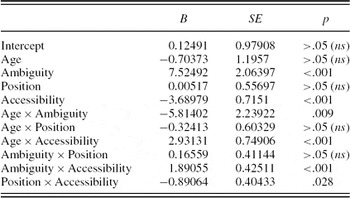
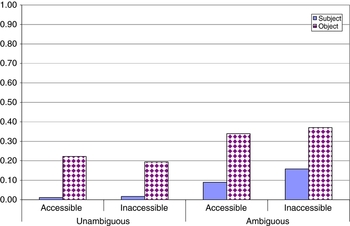
The use of pronominal reference was examined to determine whether there were differences between the adults and children in their use of pronouns, and to see whether the children's pronoun use showed sensitivity to accessibility, was biased according to PAS, or differed according to ambiguity. Table 3 shows the model outcome, and Figure 3 displays the data.
The mean proportion of pronoun responses. [A color version of this figure can be viewed online at journals.cambridge.org/aps]

Mixed effects model for effects of age, ambiguity, sentence position, and accessibility on pronoun responses

The model showed main effects of age and accessibility (children used more pronouns than adults and more pronouns were used for accessible than inaccessible referents). There were also interactions between age and sentence position, and between sentence position and accessibility. First, the adults hardly ever used pronouns, and did so equally with reference to both subjects (0.01; He's pushing the penguin along) and objects (0.02; The teddy's kissing him), whereas the children were far more likely to refer to subjects using pronouns (0.43; He's hugging the panda) than objects (0.14; The ladybird was stroking him). Second, although the children used similar rates of pronominal reference for both accessible and inaccessible subjects (0.45 vs. 0.42), they were less likely to refer to inaccessible objects pronominally (0.10; He's tickling him) in comparison with accessible objects (0.18; He's trying to pull him). These analyses show that although the children showed some sensitivity to accessibility, using pronouns more often to refer to accessible than inaccessible referents, their use of pronouns was not always appropriate. Specifically, the children were more likely to use pronouns to refer to subjects than objects, mirroring PAS, but their use of pronoun subjects extended equally to contexts in which the subject was inaccessible (0.42). The lack of any effects of ambiguity shows that the children's use of pronouns was unaffected by the number of potential competitor referents (although Figure 3 shows that there was a tendency for pronoun use to increase in the ambiguous condition, perhaps suggesting that increased cognitive load leads to greater rather than less pronoun use).
Null arguments
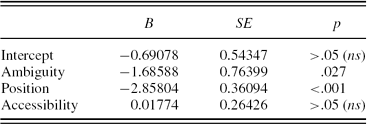
The response data show that the children (but not the adults) sometimes omitted arguments altogether. An additional model was therefore fitted for the children's data to investigate the circumstances under which they omitted arguments. Table 4 shows the outcome of the model, and Figure 4 shows the children's null arguments.
The mean proportion of argument omissions in the children's data. [A color version of this figure can be viewed online at journals.cambridge.org/aps]

Mixed effects model for effects of ambiguity, sentence position, and accessibility on children's null responses
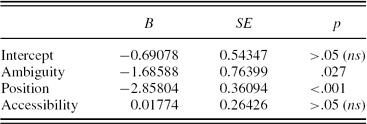
The model showed main effects of sentence position and ambiguity but no interactions between any of the variables. Thus, argument omissions were not determined by the accessibility of the referent. The children were less likely to omit subjects (0.07; Pulling the mouse) than objects (0.28; He was pulling), contrary to PAS, and were less likely to omit referents in the unambiguous (0.11) than ambiguous (0.24) condition, providing further evidence that the complexity of the ambiguous condition led children to provide less rather than more informative responses. As the same verbs were used in both the ambiguous and unambiguous conditions, object omission cannot simply reflect the children's (erroneous) understanding that the verbs in question could be used intransitively, allowing omission of the object. If this was the case, we would expect to see similar levels of object omission across the two conditions. Moreover, it is not clear why the children would choose to use an intransitive verb with a single argument if their intention was to communicate to E2 what she was supposed to act out with the puppets, unless the omitted object argument represented the most accessible referent. However, the children's argument omissions did not differ as a function of accessibility. It is thus not entirely clear what factor(s) motivated the children's argument omissions, in particular for objects, and this will be taken up in the Discussion Section.
DISCUSSION
This study examined children's and adults’ sensitivity to the discourse pragmatic feature accessibility and manipulated whether accessible or inaccessible referents appeared in the agent or patient role of a transitive action corresponding to subject and object position in an active transitive. The positioning of an accessible referent in subject position and an inaccessible referent in object position is consistent with PAS patterns, whereas the reverse pattern is inconsistent with PAS. In addition, the discourse context was manipulated such that in the unambiguous condition speakers could use a simple noun to uniquely identify a referent, whereas in the ambiguous condition a complex NP was required to uniquely identify the target referent. Three research questions were addressed.
First, how does the discourse pragmatic feature accessibility influence choice of referring expression? The results show that although both the 5-year-olds and adults displayed some sensitivity to accessibility, there were differences across conditions and age groups in the pattern of responses. Overall, both children and adults provided more MI responses for inaccessible than accessible referents, but this was more marked in the adults than in the children, was more apparent in the ambiguous than unambiguous condition, and was not observed at all for subjects in the unambiguous condition. When the pattern of simple noun responses was examined, only the adults showed sensitivity to accessibility (instead selecting complex NPs for inaccessible referents in the ambiguous condition), whereas children used simple nouns equally for accessible and inaccessible referents. In contrast to the adults who used very few pronouns at all, the children did use pronouns, and their responses showed some sensitivity to accessibility, but this only applied to objects. Finally, the children's use of null reference was unaffected by accessibility. Overall then, the 5-year-olds failed to show the same degree of sensitivity to accessibility as the adults, notably in their underuse of complex or simple lexical NPs for inaccessible referents.
These data raise the question of why the adults did not use a higher proportion of pronouns for accessible referents. One possibility is that the physical presence and labeling of the puppets prior to each block of videos introduced potential ambiguity, either for the speaker (Arnold & Griffin, Reference Arnold and Griffin2007) or in the speaker's assessment of the listener's knowledge state. Another is that the experimenter's prompt, which did not explicitly label the accessible referent, served to distance the referent's previous mention in discourse rendering more informative referring expressions appropriate (Ariel, Reference Ariel1990). The use of a noun, although not strictly necessary, may thus have served to clarify the identity of the target referent. Either way, the children's greater use of pronouns suggests that they were less aware of potential ambiguity or less cautious than the adults in their inferences concerning the accessibility of the referents for their interlocutor.
Second, how does PAS influence choice of referring expression? According to PAS, subjects are more likely to be realized pronominally, whereas objects are more likely to be realized as lexical nouns, and this is the predominant pattern found in child-directed speech. The data show that PAS had very little impact on the adults’ responses, whereas its effects on the children were more apparent. The adults used maximally informative responses equally for subjects and objects overall, whereas children produced more MI responses for objects than for subjects, in line with PAS. The effects of PAS were also mediated by accessibility and ambiguity. Neither adults nor children differentiated subjects and objects in their use of MI responses for accessible referents or for inaccessible referents in the ambiguous condition. However, in the unambiguous condition the children produced fewer MI responses for inaccessible subjects than for inaccessible objects. This is in line with PAS where objects are more likely to be realized as nouns, but runs counter to the demands of the accessibility of the referents. Similarly, the children (but not the adults) produced fewer noun responses for inaccessible subjects than inaccessible objects in both the unambiguous and ambiguous conditions, and more pronominal reference for subjects than for objects, irrespective of the accessibility of the referent. However, the pattern of null arguments was not in line with PAS as a greater number of object than subject arguments were omitted. Overall then, the children's sensitivity to PAS appeared to be fairly strong and outweighed their sensitivity to accessibility, particularly for subject arguments. As failing to be sufficiently informative was linked to PAS, were speakers also more likely to be overly informative when referring to accessible objects in comparison to accessible subjects, in line with PAS? The data suggest not. Both MI and simple noun responses were unaffected by sentence position for accessible referents.
These results provide further evidence to add to the body of studies that shows that children are sensitive to the pragmatic feature accessibility in their choice of referring expression (see, e.g., Allen et al., Reference Allen, Skarabela, Hughes and Behrens2008), although not to the same extent as adults. However, these results provide an important qualification for this observation, showing that sensitivity to accessibility is directly affected by sentence position and/or semantic role. In naturalistic studies, although accessibility, when defined as prior mention in the discourse, does not exclusively determine children's choice of referring expression, this is typically because there are other discourse factors at play to indicate the intended referent. In this experimental context, inaccessible referents were ambiguous on all pragmatic features, and due to their physical location, could not be indicated by nonlinguistic cues such as eye gaze or pointing. Although in principle children could have used iconic gestures or mime to convey information about the referent, in fact, they did so very rarely, and only when they also used an appropriate referring expression. Thus, the only appropriate way to refer to an inaccessible referent was to select an appropriately informative referring expression, but children's sensitivity to this was moderated by sentence position.
As previous studies have shown, children's utterances, particularly by age 5, conform to PAS in that new information tends to be introduced in object position and with lexical nouns, whereas given information tends to appear in subject position and be pronominalized (e.g., Allen, Reference Allen2000; Clancy, Reference Clancy and Clark1993; Guerriero et al., Reference Guerriero, Cooper, Oshima-Takane and Kuriyama2006; Narasimhan et al., Reference Narasimhan, Budwig and Murty2005; Paradis & Navarro, Reference Paradis and Navarro2003; Serratrice, Reference Serratrice2005). One explanation for the observed pattern of results is that at 5 years of age children are still learning the precise circumstances under which PAS patterns should be modified as a result of competing informational demands. In particular, these children appeared to assume that it was informative to use pronouns to refer to subjects, regardless of whether those subjects represented accessible or inaccessible referents. Why might this be the case? First, the dominant pattern in child-directed speech is for transitive utterances to contain pronominal subjects and lexical noun objects (Cameron-Faulkner et al., Reference Cameron-Faulkner, Lieven and Tomasello2003), but this bias is stronger for subjects than for objects. Within a usage-based approach (e.g., Tomasello, Reference Tomasello2003), children who are sensitive to the distributional characteristics of the input might be expected to produce a high proportion of pronoun subjects, irrespective of their information status, because they have little opportunity to evaluate the independent contributions of sentence position and informational status to choice of referring expression. For objects, choice of referring expression in the input is more varied; hence, there is greater opportunity to observe the relation between reference selection and information status (cue validity). This, in turn, will reduce the likelihood that children will erroneously use pronouns to refer to inaccessible object referents (Bates & MacWhinney, Reference Bates, MacWhinney and MacWhinney1987). Second, a number of studies have shown that subjects in general are associated with greater discourse prominence. Referents introduced as the grammatical subject are more likely to be perceived as the intended referent of a subsequent pronoun than those introduced in other argument roles (Arnold, Eisenband, Brown-Schmidt, & Trueswell, Reference Arnold, Eisenband, Brown-Schmidt and Trueswell2000; Song & Fisher, Reference Song and Fisher2007; cf. Arnold, Brown-Schmidt, & Trueswell, Reference Arnold, Brown-Schmidt and Trueswell2007), and also more likely to be later pronominalized (Arnold, 1998; Hickman & Hendricks, Reference Hickmann and Hendriks1999). Moreover, the processing of lexical NPs is slowed down if they refer to a previously mentioned subject, whereas this effect is not observed for other grammatical roles. Thus, the use of pronouns to refer to previously established subjects facilitates successful communication (Gordon, Grosz, & Gilliom, Reference Gordon, Grosz and Gilliom1993). Similarly, Brennan (Reference Brennan1995) suggests that by placing a referent in subject position, speakers are indicating that it is the current focus of their attention, and is a likely candidate for subsequent pronominal reference. One possibility then is that the 5-year-olds in the current study were sensitive to the distributional characteristics of the input and knew that the subject referents of transitive clauses tend to be both accessible and realized pronominally. If children mistakenly assume that subject status alone conveys sufficient information for their interlocutors to identify a target referent, this could lead to the erroneous production of pronouns in situations when the referent has not previously been established. The children clearly had difficulties in weighing up the independent contributions of subject status and prior mention, although the task posed no problems for adults. This could be because at 5 years of age, the children were still in the process of developing Theory of Mind (for an overview, see Flavell, Reference Flavell1999). As a result, their ability to take on the perspective of their interlocutor may have been limited, especially in a context that required them to discard the bulk of distributional evidence concerning the nature of sentence subjects.
One other possibility worth considering is that children may have overused pronouns in subject position because speakers are more likely to pronominalize accessible referents when they reoccur in the same sentence position (Arnold, 1998; Arnold, Bennetto, & Diehl, Reference Arnold, Bennetto and Diehl2009). Counterbalancing meant that within each set of videos, the two test videos could both have an accessible agent, both an accessible patient, or one of two possible orderings of an accessible agent and accessible patient. We might therefore expect that children should use more pronouns in the second test scene if the referent appeared in the same syntactic role as in the first scene, and fewer pronouns if the referent changed syntactic roles in the second test scene. Although this effect should hold for both subjects and objects, there may be an additional influence for subjects as the accessible referent appeared as the subject of two intransitive actions prior to exposure to the transitive test scenes. Chi-squared tests were used to compare the number of pronoun/omitted references for accessible subject arguments in the second test scene as a function of whether the accessible referent had appeared in subject or object position in the first test scene, and the same was done for objects. There were no significant differences in the data, showing that the children were equally likely to use pronominal reference to describe the second test scene, irrespective of whether the accessible referent occupied the same or a different syntactic role as in the first test scene. Thus, the children were apparently not overusing pronominal reference in subject position due to repetition of syntactic role. These results are likely to reflect the fact that the test sentences were not produced in quick succession (as occurs in narratives or spontaneous discourse) and, thus, any effect of recurring sentence position is likely to be substantially reduced.
Another interesting aspect of the children's data lies in their use of pronominal reference in subject position compared to null reference in object position. By 5 years of age, children are well past the early stage in development when English-speaking children erroneously omit sentence subjects. Thus, it is perhaps unsurprising that they use pronouns in subject position. However, it is rather surprising that they tend to omit the object altogether as object omissions are typically infrequent in English, even at the earliest stages of development, and are considered ungrammatical (e.g., Radford, Reference Radford1990). Goldberg (Reference Goldberg2001) argues that in English, objects can be omitted when under low discourse prominence as licensed by increased emphasis on the verb and a lack of focus on the object. It may be that the two intransitive actions that served as the contexts for establishing one puppet as accessible served to highlight the subject and changing nature of the verb and deemphasize the object, irrespective of whether the object itself was accessible or inaccessible. This could be viewed as abstract syntactic priming of an intransitive subject–verb construction or as a pragmatic principle affecting which referents are perceived as more relevant to the situation. In either case, the effect was strong enough to override the children's existing knowledge of the transitivity of the test verbs by omitting the object at least some of the time.
Third and finally, how does the complexity of the referential scene (potential ambiguity) affect choice of referring expression? For the adults, differentiation of referents according to accessibility was much more apparent in the ambiguous than unambiguous condition and was reflected in their choice of simple versus complex NPs according to the degree of accessibility of the referent. The increased complexity of the ambiguous condition also affected the children's responses. Both the adults and the children used complex NPs more often to refer to inaccessible than accessible referents, but the children rarely produced a complex NP spontaneously (they were, however, aware of the potential ambiguity as evidenced by their ability to indicate the correct referent following additional prompting). Did the children think that simple noun responses would suffice, as in the unambiguous condition? The data suggest that this was not the case as the children produced more pronoun responses and argument omissions and fewer noun responses in the ambiguous than in the unambiguous condition. Thus, the presence of additional competitor referents, rather than making the children more informative, had the opposite effect, reducing their levels of informativeness.
The difference in performance according to the complexity of the referential scene raises some interesting issues. First, the data seem to go against Ariel's (Reference Ariel1994) observation that speakers sometimes choose informative forms for highly accessible referents to avoid interference from other potential referents. The data from the unambiguous condition could be seen as reflecting this strategy—there were three possible referents in the scene and thus the use of nouns for accessible referents might serve to reduce possible interference. However, if this was the case, we would also expect speakers to use maximally informative referring expressions in the ambiguous condition where there were even more competitor referents. Instead, adults continued to use simple nouns most of the time, and the children used more pronominal and null reference. Second, the data do not seem wholly consistent with the two-character effect, that is, the observation that speakers are less likely to use pronominal reference for accessible referents if there is more than one referent present in the discourse and perceptual scene (Arnold & Griffin, Reference Arnold and Griffin2007). The theory is that speakers organize information for their own benefit rather than for their interlocutor. When there are multiple referents competing for attention, the resulting lowering of activation for each individual referent means that pronominal reference is reduced as all referents are perceived to be less accessible. Thus, we might have expected that in the ambiguous condition, the increased number of referents would result in the increased use of maximally informative referring expressions but as we have seen, this was not the case. One possibility is that as Arnold and Griffin suggest, the effect may only operate when both referents are mentioned in the prior discourse rather than simply being physically present (although see Serratrice, Reference Serratrice2008). Another possibility is that adults were attending initially to the two characters on the video screen and ignoring the other puppets on the table. Their use of simple nouns would therefore serve to disambiguate the two characters in their own minds, but they were clearly also taking their interlocutor into account by using maximally informative expressions to indicate which of the two possible cats, dogs, and so forth, was the intended referent when that referent was inaccessible to their interlocutor.
The children's data, however, are harder to explain. The children clearly found the task in the ambiguous condition fairly difficult and exhibited frequent disfluencies while formulating their responses. Arnold and Griffin (Reference Arnold and Griffin2007) argue that disfluencies reflect increased processing loads in planning an utterance; hence, there is less attention available for individual referents, thus reducing their activation. Consequently, they predict that disfluencies should be associated with reduced pronoun use. Despite both the increased planning and availability of competing referents, the children used more pronouns. Why might this be the case? Previous studies have shown that when the cognitive demands placed on children are increased, their communicative competence appears to decrease. Thus, Pechman and Deutsch (Reference Pechmann and Deutsch1982) found that when 6-year-olds were required to attend to multiple dimensions of an object to uniquely identify it from a set (e.g., color and size), they resorted to nonlinguistic pointing, even though this did not serve to identify the target referent. Moreover, studies of early language acquisition have shown that children's performance on a variety of syntactic structures improves when pronouns are used (active transitives: Akhtar, Reference Akhtar1999; Childers & Tomasello, Reference Childers and Tomasello2001; relative clauses: Kidd et al., Reference Kidd, Brandt, Lieven and Tomasello2007; passives: Savage Lieven, Theakston, & Tomasello, Reference Savage, Lieven, Theakston and Tomasello2003; auxiliary verbs: Theakston, Lieven, Pine, & Rowland, Reference Theakston, Lieven, Pine and Rowland2005), and that children tend to substitute low frequency lexical items with higher frequency forms (e.g., Akhtar, Reference Akhtar1999, for transitive verbs; Kidd et al. Reference Kidd, Lieven and Tomasello2006, for sentential complements; Theakston & Rowland, Reference Theakston and Rowland2009, for auxiliaries). These findings are thought to reflect frequency-driven learning from the input, with higher frequency resulting in more entrenched and more easily accessed linguistic representations (Braine & Brooks, Reference Braine, Brooks, Tomasello and Merriman1995). Thus, one possibility is that when children's processing powers are stretched, as in the ambiguous context where multiple referents competed for attention and the task of disambiguating them became perceptually more difficult, they resort to early learned and more easily produced syntactic structures. For many grammatical constructions, this will typically include pronouns, but children may fail to fully appreciate how their use interacts with the knowledge state of their interlocutor.
In conclusion, the current study shows that 5-year-old children's understanding of how the discourse pragmatic feature accessibility operates to determine choice of referring expression is influenced by patterns of PAS in interesting and complex ways. In this study discourse features were controlled to allow a direct comparison of subject and object provision, and the data reveal that a subject–object asymmetry persisted that cannot be explained by appealing to further discourse or nonlinguistic cues. Rather, the data suggest that children are operating with a basic understanding of the distributional properties of PAS, such that subjects are typically realized pronominally, and that new information is typically introduced postverbally in the object role. This level of knowledge will serve children well in the majority of discourse contexts, resulting in apparently high levels of competence in naturalistic discourse. However, what children still have to learn is the precise interaction between choice of referring expression and information status. Children's apparently sophisticated abilities to appropriately select referring expressions in naturalistic discourse may mask an immature understanding of how information status determines choice of referring expression in circumstances in which information status competes with patterns of PAS, and in particular, under more complex discourse conditions.
APPENDIX A
Description of a sample scene
Children are told that they will watch some videos about a series of puppets and their job is to tell E2 (who can't see screen) what they see so she can act it out with the puppets.
A selection of puppets is placed on sticks. E2 describes the puppets, pointing to each in turn
• Unambiguous: “There's a cat, a duck, and a dog”
• Ambiguous: “There's a cat with big whiskers, a cat with short whiskers, a duck with a big wing, a duck with a small wing etc.”

Videos are introduced: “We're going to watch four videos now about one of the puppets”
• Unambiguous: “These videos are all about the cat”
• Ambiguous: “These videos are all about the cat with long whiskers”

E2 picks up a target puppet: “So all these videos are about this cat.”

E1 puts a still shot of video 1 on screen: “I think this video is about jumping.”
• E1 plays video 1, then says: “Can you tell E2 what you saw?”
• If the child fails to respond, further prompts are used until the child responds.
• E2 selects the correct puppet and performs the action as instructed.

E1 puts a still shot of video 2 on screen: “I think this video is about dancing” and follows the same procedure as for video 1.

E1 puts a still shot of video 3 on screen: “I think this video is about chasing”
• E1 plays video 3, then says: “Can you tell E2 what you saw?”
• The child responds: If E2 has sufficient information to select two puppets, she performs the action as instructed. If E2 does not have sufficient information E1 says:
• Unambiguous: Can you tell E2 who the cat/he was chasing/who was chasing the dog/him?
• Ambiguous: as above, except that E2 asks for further information about specific referent if required, for example, Can you tell E2 which dog?
• E2 selects the correct puppets and performs the action as instructed, then places the nontarget puppet back on the sticks, keeping the target puppet in her hand.

E1 puts a still shot of video 4 on screen: “I think this video is about dropping” and follows the same procedure as for video 3.

E2 then puts all puppets away, gets the next set of puppets out, and repeats the procedure above.
APPENDIX B
Mean proportion of each response category according to age, sentence position, accessibility, and ambiguity

ACKNOWLEDGMENTS
I thank Victoria Edgington and Olivia Irving for help with data collection and the preparation of the stimuli used in this study and the schools and children who took part in the study. Thanks also to two anonymous reviewers for their helpful comments.