1. Introduction
The emergence of new institutional economics (NIE) in the 1970s has had major repercussions in economics. In less than 20 years NIE saw notable successes, including: four Nobel laureates, significant impacts on major policies such as anti-trust law and development aid, increasing penetration of mainstream journals, and a large and growing body of adherents, applied research, and relevant datasets. This robust institutionalization is remarkable for a field that first took shape around some relatively vague intuitions and was divided from birth into several distinct schools of thought. NIE's different schools began more intense and productive discussions with the creation of an international society in 1997 – the International Society for New Institutional Economics or ISNIE. Over time, NIE's early intuitions have been progressively transformed into powerful conceptual and analytical tools that have spawned a vigorous base of empirical research. NIE, initially dominated by Americans, took off in the rest of the world and especially in Europe; today many, if not most, of the submissions to the ISNIE journal of the Social Science Research Network are from non-Americans.
NIE's successful institutionalization should not obscure its roots as a revolutionary paradigm. Nor should it mask the continued resistance to aspects of its research program or obscure its persistent divisions. Despite fruitful dialogues within ISNIE, there is no general theory of institutional economics and NIE is in many ways a still decentralized field of inquiry. Indeed in some ways NIE is still more of a movement than a field. There are also glaring gaps still to be filled; we mention a few in the last section of this paper.
NIE is characterized by its stress on institutions as rules and norms, its examination of the microanalytics of firm and market organizations and the ramifications for public policy, its search for dynamic rather than static explanations of economic evolution, its acceptance of interdisciplinary approaches, and its openness towards case studies and other less mathematical methodologies. Yet despite this receptivity towards less formal approaches and inductive reasoning on some occasions, prediction and empirical testing are very much the norm in NIE. While in debt to the work of earlier institutional economists, especially Commons, NIE has accepted much of the neoclassical paradigm – with certain important exceptions that we describe below. These exceptions have powerful implications that should progressively transform mainstream economics towards a radically different paradigm.
This paper reviews the intellectual origins of NIE, documents the sometimes-bumpy road to its current successes, explores its future, and elucidates the challenges ahead.Footnote 1 The next section summarizes intellectual origins of NIE, describing its core concepts and the central contribution of Ronald Coase. Section 3 traces the transformation of NIE from early ideas to analytical tools, in particular the evolution of transaction cost economics as embodied by the work of Oliver Williamson, and institutional analysis as represented by the work of Douglass North. Section 4 documents the diffusion of NIE and its success. The paper concludes with a discussion of NIE's future and the challenges that lie ahead.
2. The intellectual origins of NIE
Virginia Woolf once asserted, ‘on or about December 1910 human character changed’ (Woolf, Reference Woolf1928: 4). We cannot be so bold in dating the origins of the changes introduced in economics by NIE.Footnote 2 They emerged from the confluence of several major contributions: Ronald Coase's ‘The Nature of the Firm’ (Reference Coase and Ménard1937) and ‘The Problem of Social Cost’ (Reference Coase1960), North and Davis’ Institutional Change and American Economic Growth (Reference North and Davis1971), North and Thomas’ The Rise of the Western World (Reference North and Thomas1973), and Williamson's Markets and Hierarchies (Reference Williamson1975). Although there were predecessors, as with all schools of economics, these four contributions became the building blocks that transformed NIE's initial intuitions into a useful analytical apparatus and helped solidify the challenge to mainstream economics.
Influences
There are a number of other schools of thought that developed simultaneously and are closely associated with or even part of NIE that we do not have space to cover adequately here.Footnote 3 These include the theories of Mancur Olson on collective action, public choice theory and the work of Buchanan and Tullock, the contributions of Duncan Black and Kenneth Arrow, and the work of positive political scientists such as Ken Shepsle and Barry Weingast. Closely associated with NIE is the work of Harold Demsetz, in the continuation of the property rights approach, and the contributions of numerous scholars who participated in the yearly meetings animated by Erik Furubotn and Rolf Richter in Saarbrucken.Footnote 4
However, when it comes to the history of how ISNIE was born and developed, we think that the two branches on which we focus here led the way and represent the dominant group of participants.Footnote 5 The Handbook of New Institutional Economics (2005) includes a relatively wide spectrum of contributors to NIE, including the four Nobel laureates, although some other major names (e.g., Aoki,Footnote 6 Barzel, or Demsetz) are missing. Other ideas that shaped NIE came from managerial sciences (e.g., Chester Barnard), the legal tradition, and especially law and economics (e.g., Llewelyn, Macneil, and Posner), history (e.g., the cliometrics group), sociology (e.g., Merton and Macaulay), and other fields.Footnote 7 This rich heritage served sometimes as a source of inspiration and sometimes as a constraint to be overturned.
Key concepts
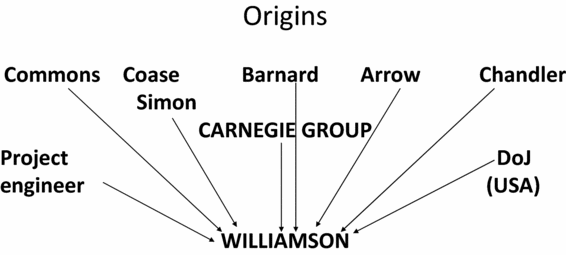
NIE is rooted in several early traditions of economic thought. As a young economist Ronald Coase initially posited himself in the British tradition from Smith to Marshall to Arnold Plant.Footnote 8 He was further influenced by his drive to challenge part of this British tradition, especially the then ascendant Pigovian school of thought. NIE was also rooted in earlier institutional economics; for example, Williamson cited his debt to Commons, and North to economists at the National Bureau of Economic Research (NBER), especially Kuznets. In addition, Oliver Williamson learned interdisciplinary social science at Carnegie Mellon University and was influenced by, among others, Kenneth Arrow, Alfred Chandler, Ronald Coase, and Herbert Simon. Douglass North had been a Marxist until he was increasingly exposed to neoclassical economics and to new perspectives opened by his research in economic history and his strong interest in political science.Footnote 9
NIE ultimately went beyond its forbearers and contemporaries to develop its own building blocks. Three key concepts – transaction costs, property rights, and contracts – became the ‘golden triangle’ of NIE. These concepts, combined with NIE's increasingly radical behavioral assumptions (see North, Reference North2005), progressively structured its two leading branches.
The first key concept to NIE is transaction costs, which arose in Coase's Reference Coase and Ménard1937 paper ‘The Nature of the Firm,’ when he asked, why are there firms?Footnote 10 Why doesn't all exchange take place in the market? His answer was that there are costs to transacting in the market: a would-be trader must find someone with whom to trade, get information on price and quality, strike a bargain, draw up a contract, and monitor and enforce the contract. A firm can reduce these transaction costs under certain circumstances by replacing bargaining among the many owners of the factors of production with coordination by a hierarchy. Transaction costs were absent in the standard neo-classical model, which assumed that transactions were immediate and frictionless, actors had perfect information, and firms were black boxes transforming inputs into outputs.
The concept of ‘transaction costs’ is so central to NIE because it is central to the economy. As Coase (Reference Coase1998) pointed out, the organization of transactions, with their inevitable costs, determines what goods and services are produced and the capacity of any economy to take advantage of the division of labor and specialization. Transaction costs are at the core of Williamson's work on the choice between market and firm and North's work on political transaction costs and on why countries are rich or poor. We explore both in section 3.
The second key concept, property rights, also came from Coase. In ‘The Problem of Social Cost’ (1960) he explored the harmful effects that occur when the exercise of one owner's rights causes some harm or cost to owners of other rights. As Coase showed in that paper, the assignment of property rights only matters because of positive transaction costs. Under the neoclassical assumptions of zero transaction costs, owners whose rights are harmed by others can negotiate (costlessly and with perfect information) payments or transfers in a way that will maximize production.Footnote 11 With positive transaction costs, ownership, liability, the legal system, the state, and the general institutional setting become central.
Property rights in NIE also differ from those of neoclassical economics, which assumes that people trade physical or virtual commodities. As Coase (Reference Coase1959) explained what people really trade are rights, the rights to perform certain actions. The concept was further developed by Armen Alchian (Reference Alchian1965), who defined property rights as a set of rights to take permissible actions to use, transfer, or otherwise exploit or enjoy the property. Such rights may be enforced by law, as Coase assumed, but are more often enforced by etiquette, social custom, and social ostracism (ibid).
Here again Coase's original idea was expanded and operationalized in subsequent development. Williamson demonstrated that property rights are vulnerable to opportunistic predation. He further showed that private arrangements are usually less costly than the legal system in enforcing rights. North analyzed how differences in the distribution and quality of enforcement of property rights affect the different ways societies develop. Elinor Ostrom further enhanced the concept by analyzing how the damaging effects of poorly defined and enforced private property rights can be avoided through community governance. Pre-Ostrom, most analysts assumed that only private property or government regulation could overcome the over-exploitation and degradation of common property resources such as fishing grounds. Ostrom showed that community groups will produce outcomes superior to state regulation or private ownership when the boundaries of the users and resources are clearly defined and the group monitoring and enforcing the rules are tightly-knit with strong social norms and procedures for making and enforcing rules.
The third core concept is contracts, broadly defined as written or unwritten agreements between parties. The idea of contract was also introduced by Coase, but in the very specific context of his 1937 analysis of how firms differ from markets. Two assumptions are critical to NIE's concept of contracts and distinguish it from the standard model: contracts are (1) never perfectly enforced and (2) never perfectly complete. The ‘Northean’ branch emphasized contract enforcement institutions, particularly the polity, ideas which later developed into a theory of the tradeoffs involved in enforcement (North, Reference North1981: chap. 4).Footnote 12 Individuals can enforce contracts and protect their rights with private armies or private police, but this is costly. Alternatively they can cede a monopoly over coercion to the state. State enforcement might reduce private costs but it invites state encroachment on rights, creating the dilemma: who polices the policeman? (see North et al., Reference North, Wallis and Weingast2009, and also Greif, Reference Greif, Ménard and Shirley2005; North and Weingast, Reference North and Weingast1989; Weingast, Reference Weingast1993.)
Williamson's concept of contract became central to the NIE analysis of governance, as emphasized by the Nobel Committee in 2009, and the source of many successful empirical investigations. Williamson defined a contract as ‘an agreement between a buyer and a supplier in which the terms of exchange are defined by a triple: price, asset specificity, and safeguards’ (Williamson, Reference Williamson1996: 377; italics in original). In his formulation of incomplete contracts, opportunism – the idea that parties to a contract might defect from the spirit of cooperation when the stakes are great – overturned neoclassical behavioral assumptions (Williamson, Reference Williamson1971). We take up these issues later.
These three concepts – transaction costs, property rights, and contracts – are not the only concepts developed by new institutionalists over the years, but they encapsulate the central core of NIE and make its paradigm so distinctive.Footnote 13 The theoretical core of NIE starts from the premise that because transaction costs are positive, information is costly and incomplete and contracts and property rights are imperfectly defined and enforced. Under such circumstances, the institutional framework is a crucial determinant of economic performance. This distinguished NIE from mainstream economics from the beginning, even before the early intuitions and ideas of Ronald Coase were progressively transformed and reinforced by major contributors.Footnote 14
3. From early ideas to analytical tools
In the late 1960s and early 1970s, the early ideas introduced by Coase coalesced into what Williamson christened New Institutional Economics (Williamson, Reference Williamson1975: chap. 1) with its two leading schools of thought associated with Williamson and North. These were not the only ideas affecting NIE; other important thinkers included Steven Cheung, Harold Demsetz, and Elinor Ostrom (see Figure 1). The new movement also influenced a large body of followers, some of whom we flag in Figure 1.
Influences on NIE.

Transaction cost economics and Williamson
The intellectual origins of Williamson's ideas are well documented.Footnote 15 At Stanford he studied management and, thanks notably to Kenneth Arrow, also discovered economics. Later at Carnegie he was exposed to the rich multidisciplinary approach developed by Herbert Simon, Richard Cyert, James March, and others. His field experience in large firms and bureaucracies exposed him early on to problems of governance, first as a young graduate from MIT working as a project engineer and traveling extensively to Asia in the late 1950s and later as a young economist working on issues of mergers and acquisitions at the Department of Justice. The period at Justice fed his thinking about vertical integration and contractual relationships.Footnote 16 We illustrate these influences graphically in Figure 2.
The Williamsonian school.
We can see how this background matters if we consider how Williamson's ideas have evolved. The Economics of Discretionary Behavior (Reference Williamson1964), based on his dissertation at Carnegie, complemented and extended the question raised by Coase in Reference Coase and Ménard1937: if firms exist, what is their role and the role of management?Footnote 17 This interest in the internal organization of firms converged with his growing interest in vertical integration, the now famous ‘make or buy’ tradeoff. His landmark paper ‘The Vertical Integration of Production: Market Failure Considerations’ argued that ‘. . .the substitution of internal organization for market exchange is attractive less on account of technological economies associated with production but because of what may be referred to broadly as “transactional failures” in the operation of markets for intermediate goods’ (1971: 112). Integration allows firms to take advantage of ‘the wide variety and greater sensitivity of control instruments’ (p. 113) and of the flexibility offered by ‘fiat’ as a ‘conflict resolution machinery’ (p. 114). These are central themes later developed in Markets and Hierarchies (1975): incentives, control, and administration on the one hand; small numbers, complexity, and uncertainty on the other. Markets and Hierarchies integrated intellectual sources as diverse as Arrow, Barnard, Chandler, Commons, Coase, Hayek, and Simon to explain how integration might overcome market failures.
Williamson's Reference Williamson1971 paper also provides a second and complementary explanation for vertical integration: ‘contractual incompleteness’ (p. 117), an idea which he pushed further in ‘Transaction Cost Economics: The Governance of Contractual Relations’ (1979).Footnote 18 The 1979 paper operationalized the effects of transaction costs on contracts, and detailed Williamson's now well-known triplet of transactional attributes – uncertainty, frequency, and transaction-specific investments. It analyzed how different types of contracts and the alternative governance structures in which they are embedded are aligned or misaligned with these three attributes. This paper launched a stream of empirical research that sealed the success of transaction costs economics.Footnote 19 But the 1979 paper did not stop there. Williamson also considered cases where the cost of integration is so high that firms may decide not to integrate but also not to switch back to standard market contracts. Instead they may choose another form of governance, then identified as ‘bilateral structures, where the autonomy of the parties is maintained. . .’ (p. 250). This reasoning was later extended to more complex structures, christened hybrids (Williamson, Reference Williamson1996: chap. 4), which opened the way to another abundant stream of empirical research (Ménard, Reference Ménard, Gibbons and Roberts2012).
The ‘antitrust implications’ flagged in the full title of Markets and Hierarchies Footnote 20 also stimulated research on regulation and on the institutional embeddedness of governance structures. An important contribution in that respect is Williamson's ‘Franchise bidding for Natural Monopolies – in General and with Respect to CATV’ (1976/1985: chap. 13), which is part of a wonderful trilogy with papers from Demsetz (Reference Demsetz1968) and Goldberg (Reference Goldberg1976) about regulating monopolies. Williamson's analysis subtly examined alternative contractual solutions for the supply of public utility services, substantiated by a case study of a cable television company. It examined transactions in much greater microanalytic detail than has been characteristic of prior studies of regulation, highlighting the importance of contract implementation and its complex interaction with the institutional environment (1976: 73 sq.). Williamson used the same methodology and concepts to elucidate how ‘The match of governance structures with transactions that results from these economizing efforts’ (1979: 253) can be used to unravel regulatory issues, as illustrated by his discussion of the Schwinn case, in which this producer of quality bicycles was sued by competition authorities because of the restrictions it had imposed on franchisees (1985: 183 sq.).
More recently, The Mechanisms of Governance (1996) and ‘The New Institutional Economics: Taking Stock, Looking Ahead’ (2000) summarize the further development of the analytical framework Williamson first presented in the 1970s. New advances included more attention to hybrid modes of organization,Footnote 21 the exploration of the impact of financial choices on governance, and analyses of credible commitment and its role in regulation and development. This last topic bridged the gap between transaction cost economics and institutional analysis.
Institutional analysis and NorthFootnote 22
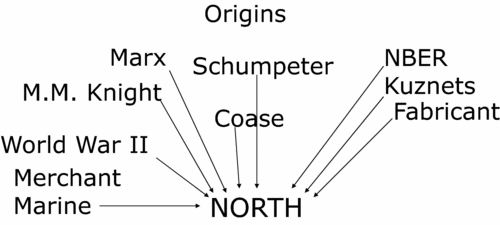
Douglass North's approach to institutional analysis was influenced by his experience in the Merchant Marine during the Second World War, which affected his early interest in the productivity of ocean shipping and his later views on violence. He was also heavily influenced by the ideas of Joseph Schumpeter and the economists he met during a year at the NBER in the mid-1950s, including Solomon Fabricant and Simon Kuznets. We illustrate these early influences graphically in Figure 3.
The Northean school.
North began applying neoclassical economic tools to history (and in the process became a founder of the new field of cliometrics), however, he also began to deviate noticeably from a strictly neoclassical approach by incorporating institutions. In 1968 he began his departure from the standard model in his famous paper on productivity in ocean shipping (one of the most quoted research works in economic history according to the Nobel committee). In that paper he argued that technological change did not always play the preeminent role in fostering productivity that most economic historians had claimed (North, Reference North1968). Instead it was a reduction in piracy, the agglomeration of goods in a few large ports, and the growth of larger, more organized markets that explained much of the productivity gains in shipping since 1600.
North began to develop a theory of institutions to explain key events in American history in a joint book with Lance Davis, Institutional Change and American Economic Growth (North, Reference North and Davis1971). He did the same for European history, and increasingly concluded that the tools of neoclassical economics ‘were not up to the task of explaining the kind of fundamental societal change that had characterized European economies from medieval times onward’ (North, Reference North1993: 3). Rather, he argued that new institutional arrangements such as written contracts enforced by courts were largely responsible for successful European economic development, as he powerfully documented in his 1973 book with Robert Thomas, The Rise of the Western World: A New Economic History (North and Thomas, Reference North and Thomas1973).
This theoretical framework, which North further developed in Structure and Change in Economic History (North, Reference North1981), was useful in explaining European and American history. But North was still not satisfied with its answers to some fundamental questions, such as: why do institutions change? And, why are some countries rich and some countries poor? North's initial framework assumed that institutions were efficient, and that institutions changed when the net benefit from change outweighed the cost. How could these assumptions be true when for centuries most countries have suffered under persistently inefficient institutions, causing persistently poor economic performance? Searching for a realistic explanation, North abandoned the neoclassical assumptions about human rationality and boldly began to develop economic models that incorporated politics, ideology, and beliefs.
In North's seminal Reference North1990 book, Institutions, Institutional Change, and Economic Performance, institutional change occurs when economic or political entrepreneurs who have the bargaining strength to change institutions perceive ‘that they could do better by altering the existing institutional framework on some margin. But their perceptions crucially depend on both the information the entrepreneurs receive and how they process that information’ (ibid.: 8). Their information is often incomplete, their models imperfect, and their reforms ‘path-dependent’ – constrained by the existing set of institutions. Radical reforms are also constrained by societies’ inherited belief systems. ‘Societies that get “stuck” embody belief systems and institutions that fail to confront and solve new problems of societal complexity’ (North, Reference North1994: 6). The sticky nature of beliefs and institutions helps explain why underdevelopment has been so persistent in most of the world and why imported rules, laws, and constitutions have been so unsuccessful. Shared beliefs do sometimes change, however. To understand better how beliefs change, North turned to cognitive science and its study of how humans use mental models to explain and interpret the world and how learning in response to new experiences can produce an incremental process of change in beliefs and preferences (North, Reference North2005: 77).
North recently joined with John Wallis and Barry Weingast to modify his earlier framework to explain human history (North et al., Reference North, Wallis and Weingast2009). To increase their rents powerful elites formed coalitions that included specialists in violence who could protect non-military elites, such as traders or the clergy. Through their monopoly on violence the elites limited outsiders’ access to valuable resources – land, labor, capital – and valuable activities – trade, worship, education – thereby securing their privileged access to rents. These rents in turn gave the elites an incentive to abide by their agreements to limit violence, creating a stable equilibrium that North and his co-authors called ‘limited access orders’, which are the dominant social order today. The open access societies that emerged in Europe after the industrial revolution and that characterize modern developed countries are the exception.
4. The diffusion and success of NIE
Through the efforts of Coase, North, and Williamson, NIE rapidly attracted new adherents among economists, as well as in political science, management, law, sociology, and anthropology, among others. NIE's rapid diffusion can be seen in Figure 4, which shows how publications with ‘new institutional economics’ in the title, abstract, or keywords grew from zero before the late 1970s to over 500 by 2000–2009 according to Econlit. This understates the numbers since the publications in Figure 4 are only in economics and do not reflect the perhaps much faster acceptance of new institutionalism in other fields.Footnote 23 Moreover, many publications in NIE do not use the term ‘new institutional economics’ in the title, abstract, or keywords (for example, North, Reference North1994) and many NIE publications are not in journals, and those journal articles that do appear are often not in mainstream economics journals, reflecting the revolutionary nature of the movement.
Number of publications with ‘New Institutional Economics’ in title, abstract, or keywords (according to Econlit). Source: Authors’ calculations based on Econlit: www.aeaweb.org/econlit.
To better capture NIE's expanding influence we searched Econlit for NIE's three central concepts – contracts, property rights, and transaction costs. Of course, these terms, particularly contracts and property rights, are not solely found in NIE, yet their upward trend shown in Figure 5 also reflects the diffusion of NIE over the period.
Number of publications with central NIE concepts in title, keywords, or abstract (according to Econlit). Source: Authors’ calculations based on Econlit: www.aeaweb.org/econlit.
Finally, we can track the diffusion of NIE through citations of three of its leading scholars, Coase, North, and Williamson. Figure 6 shows the same acceleration in citations in the last two decades that we saw in the previous charts. Since the citations in Figure 6 from the Web of Science only refer to journal articles, and omit North's and Williamson's widely popular books, they grossly underestimate the actual number of citations.
Citations of Coase, North, and Williamson (Reference Williamson1975–2009; articles only). Source: Authors’ calculations based on Web of Science.
With the spread of research on NIE an informal network of new institutionalists began to emerge, as scholars attended each other's presentations at meetings in economics, managerial sciences, history, and other social sciences. Participants in this informal network were very loosely connected, and there were few opportunities for the different schools of thought to interact except through haphazard encounters in formal conferences. The sporadic nature of these encounters prompted some network members to propose a more structured forum that could promote and support new ideas, foster a dialogue between the distinct schools of NIE, diffuse NIE more widely and systematically, and unite NIE's adherents in an effort to transform economics and the social sciences more broadly. The birth of this network was boosted by Rudolf Richter, who organized, initially with Eirik Furubotn, an annual research seminar on institutions starting in the summer of 1983 in Germany.Footnote 24
These growing ties were institutionalized as the International Society of New Institutional Economics or ISNIE. ISNIE proved to be a milestone in the development of NIE. Although the ideas of Coase, North, and Williamson would have been hugely influential had ISNIE never existed, NIE would have fared quite differently. At the time ISNIE was created, NIE was on the periphery of economics, despite Coase's and North's Nobel prizes. Its adherents often were isolated from other economists; few succeeded in publishing institutional papers in mainstream journals; and many advised their PhD students that dissertations using the NIE analytical frameworks that they themselves preferred would probably not be accepted by mainstream economists. ISNIE, by bringing together a critical mass of like-minded scholars and new institutionalism's most famous luminaries, helped enhance the legitimacy of NIE as a field of scholarship and persuade a wider audience of the validity of its core concepts. ISNIE also attracted new scholars, particularly young scholars, to NIE.
All this is not to deny that there is still continued resistance and even ignorance of institutional concepts among some scholars, particularly in economics.Footnote 25 Papers still appear in prestigious journals on the cost of trade without any reference to Coase or transaction costs, or on the factors determining growth, without any reference to institutions or to North. Even as NIE has gained adherents, mathematical methods have continued to dominate mainstream journals and university economics departments, especially in the US. The practical difficulties of analyzing institutions econometrically, which often require new datasets and much greater amounts of information, will slow its wider acceptance. New institutionalists are still widely scattered and represent at best a small minority in almost all economics departments, which makes it a challenge to attract new PhD students. Outside the US, however, NIE has won faster acceptance, especially in developing countries where mathematical models seem less relevant to dramatic problems. We return to the issue of formalism in Section V.
Despite obstacles, the speed of NIE's dissemination has been striking. One reason for its success was the collapse of the planned economies. The revolutions in Eastern and Central Europe opened a Pandora box of choices among institutions for societies intent on building market economies. Northean analysis could help inform these choices. North's analytical framework was also useful for explaining underdevelopment, prompting considerable enthusiasm among the aid community. There was also an upsurge of papers drawing on Williamson's ideas for testing transaction costs hypotheses about vertical integration and, to a lesser degree, his hypotheses about hybrid modes of organization.Footnote 26 Williamson's approach also became very influential in analyses of marketing, strategic behavior, and other managerial issues, while Coasian themes permeated the ‘Law and Economics’ research that Coase had promoted as the long-time editor of the Journal of Law and Economics. Ostrom and her analysis of collective action and the management of common pool resources also became increasingly influential. (Many other contributors to NIE could be added, of course.Footnote 27)
In the 1990's there was also an upsurge in papers by mainstream economists that incorporated institutions into neoclassical models, prompting John Nye to comment sardonically, ‘We are all institutionalists now’. Typically these papers adapted a standard macroeconomic growth model by adding institutional variables to cross-country regressions.Footnote 28 In 2008 Shirley counted 59 studies finding significant correlations between long-run growth in gross domestic product (GDP) and such institutional variables as property rights, political freedom, economic freedom, civil liberties, institutions supporting cooperation such as trust and religion, and (negatively) political instability (Shirley, Reference Shirley2008: 81).
‘Institutions’ in most of these correlations are not specific rules or norms, but broad abstractions, usually aggregates of experts’ subjective rankings of corruption in government, bureaucratic quality, rule of law, freedom of expression, or similar generalizations that the authors claim are clusters of institutions or proxies for institutional quality.Footnote 29 But regardless of what these variables measure, even when different measures from different sources are used, they have statistically robust and arithmetically large correlations with long-run growth (see Shirley, Reference Shirley2008: 80). These strong correlations explain why [some] ‘Growth economists who, as mentioned earlier, used to rely almost uniquely on pareto-optimal-complete-market-perfectly competitive neoclassical models, now systematically abandon their traditional paradigms without being ashamed and they discuss the role of institutions without thinking they are doing second-rate research’ (ibid.: 17, emphasis added).
These broad institutional proxies seem at odds with NIE's emphasis on the need to measure and understand specific institutions. And these studies often ignore the unobserved beliefs and norms that ultimately determine how rules and laws function in practice (Greif, Reference Greif2006: 20–21). They also defy North's admonishment that identical laws or rules can produce very different outcomes across countries. Nevertheless, the widening use of institutional variables raised the visibility of NIE and the challenge it presented to the standard model.
5. The future of NIE
A crucial question for the future is: will NIE modify the standard neoclassical model on the margins, or will it foster a new paradigm? North, Williamson, and other early new institutionalists did not argue that they were creating a paradigm that overturned the standard neoclassical model. Nevertheless, a central assumption of standard neoclassical models was challenged at the dawn of NIE with Coase's insistence that positive transaction costs could not be assumed away without ignoring the very reason why firms exist. Transaction costs ‘produce an economic universe that is strikingly different from the one envisioned in neoclassical economic theory’ (Furubotn and Richter, Reference Furubotn and Richter1997: 445; italics in original). The implications are profound; for example, the transaction costs literature overturns much of the mainstream approach to regulation (Joskow, Reference Joskow2002; Ménard and Ghertman, Reference Ménard and Ghertman2009).
The likelihood is not that NIE will offer a complete alternative to the standard neoclassical paradigm but rather expand and alter the standard paradigm to the point that it is transformed into something very different. Few institutionalists would be ready to claim that NIE offers a fully articulated paradigm today and it is well beyond the scope of this paper to offer a new theory.Footnote 30 But we can sketch the outlines of the expanded paradigm by comparing NIE to the standard model. The theoretical core of NIE accepts that competition works to equilibrate supply with demand through the price mechanism, but under very different assumptions about information, individuals, firms, transactions, property rights, contracts, the role of the state, and the environment. Because of transaction costs, property rights can no longer be perfectly defined, nor can contracts be assumed to be complete and perfectly enforced, giving rise to ex post opportunism, something never seriously contemplated in the standard neoclassical model which assumes that well-organized markets are enough to discipline parties to trade. Positive transaction costs means that institutions, which are exogenously determined in the standard model but endogenous constraints in NIE, become the subject of analysis.
The standard model is further changed by North's evolving treatment of the individual. Initially NIE adopted bounded rationality, the idea that people's choices are constrained by costly information and the limits of their cognitive competence, but they still ‘act consistently with their preferences when presented with alternative opportunity sets’ (Eggertsson, Reference Eggertsson, Alston, Eggertsson and North1998: 18). In NIE these opportunity sets are defined by institutions, especially the legal system, since institutions determine property rights. More recently NIE has incorporated the idea that human reasoning is filtered through mental models shaped not just by individual experience but also by society's shared beliefs and norms. Some, though not all, institutionalists accept North's evolved view of path dependence, where prior institutions constrain individuals’ choices and preferences, a view which brings NIE much closer to earlier institutionalists. Does it enhance our understanding of behavior when we characterize such individuals as maximizing preferences within a constrained opportunity set? Or should we, as North argues, build dynamic models of economic evolution that transform the standard neoclassical model?
To take another example of how NIE has evolved away from the standard theory, earlier NIE posited a binary decision between markets and firms, now it incorporates a host of hybrid modes of organizing with very different governance characteristics. These developments remain largely ignored by mainstream economists who still build their models and their policy recommendations on the trade-off between markets and integrated firms. However, questions remain to be explored in the NIE approach. Is this diversity of arrangements well specified by simply incorporating transaction costs into an extended model? Do we, as Williamson contends, need to substitute discrete structural analysis for standard marginal analysis, and if so, what is the impact of this change on how market economies work?
NIE faces many other questions to be solved and offers many other challenges to the standard model. As mentioned earlier, many important concepts of the classical paradigm, such as scarcity and competition, remain central in NIE. And, although NIE's emphasis is unambiguously on substance, new institutionalists fully acknowledge the relevance of modeling and the importance of appropriate methods, such as econometrics and experimental economics, to test its core propositions.
How likely is it that the standard, neoclassical model will be transformed to incorporate NIE's core assumptions? There are several important obstacles. One is the increasing dominance of mathematical methods in economic studies, especially in the US and in prestigious economics journals. While the statistical significance of institutional variables in cross-country regressions has captured the attention of mainstream economists, the broader complexities and nuances of the full NIE paradigm greatly burdens the modeling exercise. The dominance of formalism as it exists today helps explain why the economics profession still views NIE as a sideline to mainstream economics. Yet NIE has infected the thinking of a number of mainstream economists who seem unaware that they have caught the institutional virus. Prominent mainstream economists who have incorporated institutions into their models, such as Acemoglu and Robinson (Reference Acemoglu and Robinson2012) and Djankov et al. (Reference Djankov, Glaeser, LaPorta, Lopez-de-Silanes and Shleifer2003) do not see themselves and are not seen as new institutional economists and seldom trace their ideas to NIE's founders such as Coase, North, or Williamson. Moreover, while economists who care about applied research are not resistant to institutional arguments, those more interested in modeling for its own sake largely remain immune to the institutional bug.
Another obstacle to a new paradigm is the incomplete and the sometimes-improvisational nature of NIE's evolving theories. Much of NIE, as Langlois (Reference Langlois2013: 3) described, compares ‘plausible institutional systems in real-world contexts rich in transaction (and other) costs. Explanation here consists in arguing that, and in detailing precisely how, the institutional system we observe is actually confronting some specified economic problem better than alternative candidates would have done’. An as yet unfulfilled agenda for the future is to forge more scientific methods to confront broad issues of growth and performance and to construct a robust theory of institutions. NIE still has not settled on a unified and integrated view of equilibrium or efficiency, on how to deal with the possibility of multiple equilibria, and on the dynamics of institutions. Such issues remain major challenges to NIE.
A related obstacle is continuing theoretical divisions within NIE. Some of the differences between North and Williamson may be less problematic than is often perceived, since they are similar to the differences between a macro and micro perspective. More serious are the divisions over fundamentals such as the definition of institutions. For example, North defines institutions as rules of the game, while Greif defines institutions as a system of shared beliefs and internalized norms (Shirley, Reference Shirley2008: 18). Differences also arise over whether a firm is a variant of markets (Alchian and Demsetz, Reference Alchian and Demsetz1972), a ‘nexus of treaties’, or ‘contracts’ (Aoki et al., Reference Aoki, Gustafsson and Williamson1990), or part of a continuum of arrangements (Cheung, Reference Cheung1983). Markets too have been conceptualized differently: as organizational forms (Arrow, Reference Arrow1974), institutions (Hodgson, Reference Hodgson1988), or a variety of governance structure (Williamson, 1991/1996: chap.4). Ménard (Reference Ménard1995) helped clarify some of the ambiguities in NIE when he characterized institutions as the ‘institutional environment’ that delineates the rules within which markets and organizations (from firms to hybrids) operate. Over time we expect some of these differences will disappear as more and more research produces dominant perspectives, although continuing competition between distinct points of view will also persist and should be welcomed as a sign of a healthy and progressive field of inquiry.
Besides developing a more robust theory, NIE faces a number of other challenges if it is to flesh out a convincing paradigm. These include: overcoming the internal divisions mentioned above; dealing more deeply with institutional change; expanding the empirical and theoretical work on informal institutions; developing data to allow more careful definition and measurement of the effects of institutions in a variety of settings; building more adequate models to capture the links between theory and empirical analyses. NIE scholars need to make progress on a theory describing satisfactorily the interaction between North's institutional framework (the scaffolding for human transactions) and Williamson's structure of governance (the matrix in which the integrity of a transaction is organized). Any synthesis between these two schools of thought must address a lot of issues that will likely shape much future research (see Ménard, Reference Ménard2001). One central question is: how do the (Northean) rules that determine the security and functioning of property rights or the laws that affect contractual credibility and enforcement shape the choice of (Williamsonian) modes of governance and of the ways to organize transactions? A related question is: what are the comparative costs of different institutional schemes, such as different judicial systems for implementing contractual laws? Several recent contributions began to bridge the gap between these two schools, a trend likely to continue.Footnote 31 Another important area for future research is innovation, specifically: how do different modes of organizing transactions at both the microanalytical level and at the level of the institutional framework affect the development of capabilities and the dynamics of innovation?
Methodology is another underdeveloped area. Most of the models used in the NIE literature are uncomfortable adaptations of standard neoclassical models with the inconsistencies mentioned earlier. Some institutionalists, such as Greif and Ostrom, have made considerable progress using game theory; experimental economics is also yielding promising results. One challenge to the model builder is NIE's stress on realism and detail, which greatly complicates the modeling problem. The challenge of realism has also required many institutionalists to develop their own datasets,Footnote 32 and to engage in extensive field research, vividly illustrated by the fieldwork done by Elinor Ostrom and her followers. The data requirements are formidable and much future work must be devoted to overcoming data gaps if NIE is to offer a feasible challenge to the elegant simplicity of the standard model. Empirical research has been a strong point for institutional economics, old and new, and we expect to see considerable future research devoted to improving our measures of formal and informal institutions and testing their properties and impacts. Those wedded to formalism will likely never see imperfect but realistic institutionalist models as sufficiently precise, but if the goal is to meet Ronald Coase's call for economics that is useful beyond the blackboard, that changes the way we see a question, then NIE offers the greater promise.
NIE has also made considerable progress using focused case studies; examples include Coase's study of the Federal Communications Commission (FCC), Williamson's study of Oakland's cable television (CATV), North and Weingast's study of the Glorious Revolution, Ostrom's comparative case studies of common property, and the studies collected in Analytic Narratives (Bates et al., Reference Bates, Greif, Levi, Rosenthal and Weingast1998). Despite the poor opinion that most mainstream economists have of case studies, they have proven to be a valuable tool for understanding the rich details inherent in institutional analysis, especially when they are informed by theory and conducted with rigor.
6. Conclusion
The future of NIE, and indeed of social science more generally, will likely see more partnerships across disciplines and some startling new marriages. To transform economics we need to enlist the help of lawyers, anthropologists, sociologists, and others, as Coase (Reference Coase2002) asserted. Economics has already had profound influence in political science, in public choice, in law through law and economics, in history through cliometrics, and in other parts of social science where economic reasoning and econometrics are making strong inroads. NIE with its pragmatic, empirically grounded approach is especially well situated to collaborate with these sub-disciplines. ISNIE already manifests this trend, with members from political science, management, law, sociology, and anthropology, and with collaboration outside the social sciences as well, as evidenced by North's partnership with cognitive scientists and the developing links with neuroeconomics and behavioral economics. The diverse background of the contributors to The Handbook of New Institutional Economics (Ménard and Shirley, Reference Ménard and Shirley2005/2008) provides strong evidence of NIE's interdisciplinary character.
Our optimism about the future of NIE is rooted in this strong appeal across disciplines and also in its powerful attraction to young scholars and policy makers from developing countries. This natural attraction has been strengthened by the work of the Ronald Coase Institute, which trains and otherwise assists young scholars to study the institutions in their own economies so that problems can be more readily identified and overcome. On January 20, 2014 the Coase Institute had 470 graduates from 66 countries. Most were economists, but many studied political science, management, law, history, sociology, engineering, and other fields. These young scholars, freed from the conventions that often hamper more established academics, are assiduously gathering new data, pursuing new empirical issues, and pushing the frontiers of empirical research on institutions.
Much work is still to be done and there is the real possibility that the transformation we envision will not occur. In that case mainstream economics may well wither like a depressed inner city, as Olsen and Kahkonen (Reference Olson and Kahkonen2000) once described it, while NIE and like-minded segments of the social sciences flourish in the suburbs. In thinking about the future relationship between NIE and standard mainstream economics we can take heart from the words of the person who, more than any other, started this field, Ronald Coase:
The influence of New Institutional Economics will be exerted in the various sub-disciplines of economics. Guerrilla actions will take place which will result in the New Institutional Economics dominating first one and then another of these sub-disciplines, as indeed is beginning to happen. When this process has gone on for some time the leaders of our profession will find themselves Kings without a Kingdom. There will be no overturning, but in Judson's words, an opening-up.Footnote 33 We will not replace price theory (supply and demand and all that) but will put it in a setting that will make it vastly more fruitful (Coase, Reference Coase1999: 5).