INTRODUCTION
The echinoids are the most charismatic marine invertebrates of the phylum Echinodermata. Their number in Puerto Rico increased recently with the addition of Cassidulus caribaearum up to 16 species (Benavides-Serrato, Reference Benavides-Serrato2006; Rodríguez-Barreras et al., Reference Rodríguez-Barreras, Sabat, Benavides-Serrato and Bontemps2012). In a recent survey conducted on the east coast of the Puerto Rico Island, we found another new unrecorded echinoid: Echinoneus cyclostomus. We have noticed an imbalance between irregular and regular echinoids reported for Puerto Rico. Potentially, this numerical difference could be a consequence of the small sizes and burrowing behaviour of some irregular sea urchins (Hendler et al., Reference Hendler, Miller, Pawson and Kier1995). In some cases, the specimens are found only when the echinoids are dead. Furthermore, this echinoid usually lives under rock slabs or pieces of coral rubble, which complicates its detection. The presence of E. cyclostomus was to be expected because Puerto Rico is already within its geographical range area; however, the species had not yet been reported for Puerto Rico.
This small sea urchin inhabits mainly shallow waters throughout the tropics; however, the species can inhabit down to 570 m depth (Serafy, Reference Serafy1979; Hendler et al., Reference Hendler, Miller, Pawson and Kier1995). The species has been reported in Australia, Bermuda, Hawaii, the Seychelles and Tanzania. In the Caribbean E. cyclostomus is present in México, Belize, Honduras, Costa Rica, Cuba and Panama (Del Valle et al., Reference Del Valle, Solís-Marín, Abreu Pérez, Laguarda Figueras and Durán González2005; Laguarda-Figueras et al., Reference Laguarda-Figueras, Solís-Marín, Durán-González, Ahearn, Buitrón-Sánchez and Torres-Vega2005; Alvarado et al., Reference Alvarado, Solís-Marín and Ahearn2008). In addition, the Smithsonian National Museum of Natural History has deposited in its collections samples from Anguilla, Antigua and Barbuda, Haiti, St Lucia, Suriname, and the US and British Virgin Islands. With this new record, we confirm its presence and increase the number of shallow-water sea urchins known from Puerto Rico to seventeen.
RESULTS
SYSTEMATICS
Phylum ECHINODERMATA Klein, 1754
Class ECHINOIDEA Leske, 1778
Order HOLECTYPOIDA Duncan, 1889
Family ECHINONEIDAE Wright, 1857
Genus Echinoneus Leske, 1778
Echinoneus cyclostomus Leske, 1778
MATERIAL EXAMINED
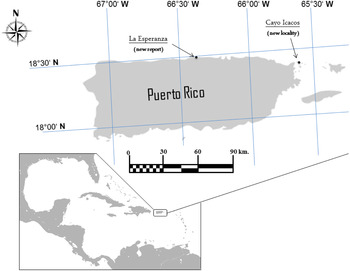
The test of E. cyclostomus was collected in September 2012, at Playa La Esperanza (18°29′0.47″N 66°31′26.24″W) on the north coast of Puerto Rico (Figure 1). The locality is characterized by rocky substrate with sand rubble and sand patches, which is considered its typical habitat (Hendler et al., Reference Hendler, Miller, Pawson and Kier1995). The sample consists of a test collected in perfect condition, without spines and white in colour. The test is small (16.7 mm long × 12.5 mm wide), elongated oval in shape, and approximately cylindrical in the cross-section. Mouth and anus are in ventral position close to each other. The test was deposited in the Zoology Museum collection of the University of Puerto Rico, Río Piedras Campus under the code EEES-001.
The localities of Echinoneus cyclostomus (new record) and Cassidulus caribaearum (new population) in Puerto Rico.

Cassidulus caribaearum was recently reported for the north coast of Puerto Rico (Rodríguez-Barreras et al., Reference Rodríguez-Barreras, Sabat, Benavides-Serrato and Bontemps2012). Now, a third population of the species was found at 3 m depth in Cayo Icacos (18°23′16.93″N 65°35′34.01″W) in September, 2012. This site is located on the north-east coast and is in between the other two localities: Culebra and Manatí (Figure 1). The two entire specimens collected at this locality were deposited as reference material in the same collection with the code EECC-005.
ACKNOWLEDGEMENTS
We thank the projects PD-295 and R92-110 of the Sea Grant College Program and the Center for Applied Tropical Ecology and Conservation (CATEC) of the University of Puerto Rico for their economic and logistic support. We especially thank Paul Bayman, PhD and Francisco Solís-Marín, PhD for their critical review of early versions of this manuscript.