Introduction
Many agricultural crops have weedy relatives that are sexually compatible and share a common pollinator (Hancock et al. Reference Hancock, Grumet and Hokanson1996; Spencer and Snow Reference Spencer and Snow2001). Pollen from herbicide-resistant crop plants fertilizing wild, weedy, or de-domesticated plants could potentially enhance the ability of weedy relatives to compete with the crop and other weeds for resources (Arriola and Ellstrand Reference Arriola and Ellstrand1997; Baker Reference Baker1972; Doggett Reference Doggett1995). Many studies have documented the existence of crop-to-weed gene flow and the persistence of crop genes in wild populations (Arriola and Ellstrand Reference Arriola and Ellstrand1996; Burger and Ellstrand Reference Burger and Ellstrand2014; Ellstrand and Hoffman Reference Ellstrand and Hoffman1990; Ellstrand and Rieseberg Reference Ellstrand and Rieseberg2016; Ellstrand et al. Reference Ellstrand, Prentice and Hancock1999; Haygood et al. Reference Haygood, Ives and Andow2003; Hokanson et al. Reference Hokanson, Hancock and Grumet1997, Reference Hokanson, Ellstrand, Dixon, Kulembeka, Olsen and Raybould2016; Linder et al. Reference Linder, Taha, Seiler, Snow and Rieseberg1998; Lu et al. Reference Lu, Yang and Ellstrand2016; Meirmans et al. Reference Meirmans, Bousquet and Isabel2009; Morrell et al. Reference Morrell, Williams-Coplin, Lattu, Bowers, Chandler and Paterson2005; Pilson and Prendeville Reference Pilson and Prendeville2004; Ramirez-Valiente and Robledo-Arnuncio Reference Ramirez-Valiente and Robledo-Arnuncio2015; Snow et al. Reference Snow, Andersen and Jorgensen1999; Spencer and Snow Reference Spencer and Snow2001). Crop–weed combinations associated with relatively higher rates of pollen-mediated gene flow include species that are sympatric and cross-compatible, flower synchronously, and have the same ploidy level. In these cases, long-term introgression of crop genes in weed populations is maximized when F1 progeny are at least as ecologically fit as their weedy parents in agroecosystems (Sahoo et al. Reference Sahoo, Schmidt, Pedersen, Lee and Lindquist2010). Long-term introgression of crop genes is reduced in other crop–weed combinations owing to physical separation of gametes in space or time, cross-incompatibility mechanisms, or reduced fitness of the F1 (Ellstrand and Hoffman Reference Ellstrand and Hoffman1990; Lee and Natesan Reference Lee and Natesan2006; Spencer and Snow Reference Spencer and Snow2001).
Pilson and Prendeville (Reference Pilson and Prendeville2004) reviewed the potential impact of genetically engineered (GE) traits via crop-to-weed gene flow and concluded that it is crucial to identify which environmental conditions are likely to allow the frequencies of GE alleles to increase in wild populations as a means of establishing the environmental impact of crop genetic technologies. Ramirez-Valiente and Robledo-Arnuncio (Reference Ramirez-Valiente and Robledo-Arnuncio2015) indicated that increased heritable genetic variance within populations of crop–weed progeny could facilitate long-term establishment by providing more alleles for natural selection to act upon. In essence, the introduction of a GE allele with a strong positive effect on reproductive success can provide that heritable genetic diversity. In such a case, the potential fitness advantage conferred by the GE allele itself should be evaluated for its impact on the time to fixation in the weedy population, as is often the case when a gene confers resistance to pests or pesticides. First, the relative fitness of the resultant hybrid in the absence of the fitness advantage conferred by the transgene, if any, should be considered. For example, the relative fitness of weeds carrying a crop herbicide-resistance gene should be evaluated in both selective and nonselective environments to account for on-farm crop rotation tactics aimed to control herbicide-resistant weed populations. Second, the potential for continual gene migration (as might occur if GE crops were frequently planted near sympatric species) should be determined, as it is a possible route by which GE allele frequency could increase or persist in weedy populations (Haygood et al. Reference Haygood, Ives and Andow2003; Lee and Natesan Reference Lee and Natesan2006).
Grain sorghum (Sorghum bicolor [L.] Moench ssp. bicolor) is a major crop grown in the United States for animal feed and ethanol production (Paterson et al. Reference Paterson, Bowers, Bruggmann, Dubchak, Grimwood, Gundlach, Haberer, Hellsten, Mitros, Poliakov, Schmutz, Spannagl, Tang, Wang, Wicker, Bharti, Chapman, Feltus, Gowik, Grigoriev, Lyons, Maher, Martis, Narechania, Otillar, Penning, Salamov, Wang, Zhang, Carpita, Freeling, Gingle, Hash, Keller, Klein, Kresovich, McCann, Ming, Peterson, Mehboob-ur, Ware, Westhoff, KFX, Messing and Rokhsar2009). The species includes S. bicolor nothosubsp. drummondii, a feral, de-domesticated weed common in U.S. agriculture (Defelice Reference Defelice2006). Sorghum bicolor nothosubsp. drummondii differs from grain sorghum in several ways. First, S. bicolor nothosubsp. drummondii seeds shatter and have a dormancy mechanism to facilitate dispersal and overwinter survival in the soil, whereas seed shattering and dormancy have been selectively bred out of grain sorghum. Second, S. bicolor nothosubsp. drummondii lacks recessive dwarfing alleles at major loci used in grain sorghum to reduce canopy height, maximize harvest index, and facilitate machine harvest. Sorghum bicolor nothosubsp. drummondii’s height improves its competitive ability with taller crops such as maize (Zea mays L.) and increases its range of seed dispersal (Burnside Reference Burnside1965; Fellows and Roeth Reference Fellows and Roeth1992; Horack and Moshier Reference Horak and Moshier1994; Jacques et al. Reference Jacques, Vesecky, Feltner and Vanderlip1974).
Schmidt et al. (Reference Schmidt, Pedersen, Bernards and Lindquist2013) reported rates of cytoplasmically male-sterile (CMS) sorghum-to-S. bicolor nothosubsp. drummondii gene flow (which occurred primarily through wind pollination) as high as 16% within the crop, and up to 2% at 200 m. Phenotypic markers (leaf midrib color) were used to identify F1 progeny produced by maternal S. bicolor nothosubsp. drummondii plants, and these were fully fertile relative to both parents (CMS is recessive in sorghum). While rates of within-year gene flow observed in this study may be slightly inflated due to the use of CMS S. bicolor nothosubsp. drummondii seed parents (which would decrease pollen competition on stigmas), the data suggest that pollen-mediated gene flow is likely between these subspecies, and nuclear crop traits can be expected to transfer unless additional containment strategies are imposed (Gressel Reference Gressel2012, Reference Gressel2015; Haygood et al. Reference Haygood, Ives and Andow2004; Lee and Natesan Reference Lee and Natesan2006; Meirmans et al. Reference Meirmans, Bousquet and Isabel2009).
Sahoo et al. (Reference Sahoo, Schmidt, Pedersen, Lee and Lindquist2010) evaluated the fitness of an F1 population derived from CMS S. bicolor nothosubsp. drummondii × wild-type grain sorghum crosses and found F1 fitness to be similar to or greater than that of the S. bicolor nothosubsp. drummondii parent based on height, leaf area, biomass, and seed production traits. These results provide evidence that native (non-GE) grain sorghum genes lack a fitness penalty at the F1 stage. This is expected, as many traits selected for during domestication are recessive (e.g., lack of seed shattering or dormancy, decreased height). However, the CMS S. bicolor nothosubsp. drummondii and grain sorghum parents used by Sahoo et al. (Reference Sahoo, Schmidt, Pedersen, Lee and Lindquist2010) were highly inbred, so heterosis in the F1 may have resulted in artificially inflated fitness values that would decrease in subsequent generations. Furthermore, seeds of F1 plants were produced by the female S. bicolor nothosubsp. drummondii plant and were therefore similar to those of S. bicolor nothosubsp. drummondii in seed size and glume structure. Haygood et al. (Reference Haygood, Ives and Andow2003) suggests that relative fitness of generations following the F1 is key to determining the true potential for genes to become stably introgressed into wild populations. We hypothesized that fitness differences might become more evident in the S. bicolor nothosubsp. drummondii × grain sorghum F2 population, because heterosis would not be as pronounced, segregation would occur, and seeds produced on the F1 plant (F2 seeds) are intermediate in glume structure and size, which may affect overwinter survival (Sahoo et al. Reference Sahoo, Schmidt, Pedersen, Lee and Lindquist2010).
Sorghum bicolor nothosubsp. drummondii seed survival following burial in the soil is known to be much greater than that of cultivated sorghum. Jacques et al. (Reference Jacques, Vesecky, Feltner and Vanderlip1974) found that most sorghum did not survive 4 mo of burial, but that some S. bicolor nothosubsp. drummondii seeds survived as long as 36 mo. They found that seeds placed deeper in soil had a greater chance of survival, and those with open glumes did not survive well. Fellows and Roeth (Reference Fellows and Roeth1992) corroborated the earlier findings and correlated germination after burial to glume tightness. They also found that removing glumes decreased S. bicolor nothosubsp. drummondii seed germination following burial due to microbial degradation of the caryopsis and concluded that glumes played a role in protecting the seed. Glumes evaluated in the current study were present but reduced (they did not fully encapsulate the seed). They were also relatively uniform in phenotype, as they were produced by the F1 parent. Therefore, we hypothesized that overwinter survival and emergence of F2 seeds might be reduced relative to that of S. bicolor nothosubsp. drummondii, similar to that of the grain sorghum parent. If so, this would be a significant fitness penalty. Reduced fitness of the F2 at any stage of growth may reduce the rate of crop-gene introgression into feral S. bicolor nothosubsp. drummondii populations. Therefore, the objectives of this study were to (1) compare overwinter survival and emergence of seeds from the F2 plants relative to their S. bicolor nothosubsp. drummondii and grain sorghum parents; and (2) compare growth and fitness traits of the F2 plants relative to their parents.
Materials and Methods
Our objective was to duplicate, as much as possible, an in situ crop–weed F2 population that would be expected to result in a grain sorghum field infested with S. bicolor nothosubsp. drummondii. Therefore, 22 S. bicolor nothosubsp. drummondii panicles (one panicle per plant) were randomly collected from an in situ population at a single site near Arapahoe, NE, in the fall of 2010. Panicles were threshed by hand and stored at 4 C for 1 mo to break dormancy. A subsample (approximately 5 seeds) from each panicle was sown in pots (10-L; each pot contained seeds from one panicle) filled with growth medium containing half soil and half commercial potting mixture (Metro-Mix® 360, Sun Gro Horticulture, 770 Silver Street, Agawam, MA 01001) and grown in a greenhouse (25/20 C day/night under ambient light conditions supplemented with sodium-halide lamps for a 14-h photoperiod). Pots were watered daily and supplied weekly with a balanced fertilizer to avoid water or nutrient deficits. Staggered plantings of a commercially available grain sorghum hybrid (‘DKS 42-40’) were also sown in pots (10-L) to ensure floral synchrony among the crop and weeds. One day before anthesis, S. bicolor nothosubsp. drummondii florets were hand-emasculated and bagged, and the next day, fresh pollen from grain sorghum was manually transferred to 20 to 25 stigmas per individual S. bicolor nothosubsp. drummondii plant. This process was repeated for at least one S. bicolor nothosubsp. drummondii plant produced from each of the original 22 S. bicolor nothosubsp. drummondii panicles collected to generate a single, genetically diverse F1 population. Two F1 seeds from each S. bicolor nothosubsp. drummondii plant were sown in a greenhouse isolated from any other sorghum pollen. Panicles were not covered and fans were used to facilitate pollen movement among F1 plants to simulate the open-pollinated field conditions that would exist in a weedy agroecosystem. The resulting F2 seeds produced on the F1 plants were bulked in equal quantities by weight to form a single composite sample and mixed thoroughly for use in experiments to test the fitness and survival of the F2 population relative to that of its grain sorghum and S. bicolor nothosubsp. drummondii parent populations. Remaining seeds from 20 of the original S. bicolor nothosubsp. drummondii panicles were similarly bulked by weight and comprise the S. bicolor nothosubsp. drummondii parent population. All seeds used in these experiments were stored at 4 C from the time they were collected (S. bicolor nothosubsp. drummondii, F1, F2) or purchased (grain sorghum) until the time of planting.
Overwinter Survival
To determine overwinter survival of the F2 population relative to its parent populations, wire baskets with a mesh size of approximately 1-mm2 were constructed to retain the seeds in the location they were placed (Wortman et al. Reference Wortman, Davis, Schutte, Lindquist, Cardina, Felix, Sprague, Dille, Ramirez, Reicks and Clay2012). Baskets were 0.3 m by 0.3 by 0.1 m deep, and the top of each basket was left open so as to not exclude seed predators. The experiment was conducted at two Nebraska locations in the fall of 2012 (Lincoln and Clay Center) in soil that had been tilled with a tandem disk. Neither location had a history of S. bicolor nothosubsp. drummondii presence. Baskets were placed in soil to a depth of 5 cm, filled with excavated soil, and smoothed by hand. Two baskets (subsamples) were placed in each plot (experimental unit). On October 23 (Lincoln) and October 25 (Clay Center), 100 seeds from each population (treatments) were sprinkled on the soil surface of each basket. Seeds were spread evenly across the surface of the basket, but not incorporated, to simulate seed dispersal of S. bicolor nothosubsp. drummondii or harvest loss of grain sorghum seeds. In addition, glumes were not removed from the seed of any population, because they would be present in self-sown seed in a typical weedy agroecosystem and can affect overwintering ability. A white square made of plastic PVC tubing was then placed around the two baskets and staked to the soil to identify each plot and facilitate locating the baskets the following spring. Beginning May 10, 2013, the number of seedlings that emerged within each basket was counted, and seedlings were removed by hand every 5 to 7 d. At the end of July, one of the seed baskets from each plot was exhumed, and soil was gently removed using sieves. Cumulative seedling emergence was calculated by summing the total plants emerged over time. The total number of seeds recovered was recorded and assessed for viability using the squish test (Forcella et al. Reference Forcella, Wilson, Dekker, Kremer, Cardina, Anderson, Alm, Renner, Harvey, Clay and Buhler1997). The second basket was left in the soil for an additional year; cumulative emergence and total number of seeds recovered were tested and recorded as above.
Growth and Fitness Components
This experiment was conducted at the University of Nebraska Agronomy South Central Agricultural Laboratory near Clay center, NE (40.58°N, 98.14°W) in 2012 on a Crete silt loam (montmorillonitic, mesic, Pachic Argiustolls) with less than 1% slope; and at the University of Nebraska Research Farm near Lincoln, NE (40.86°N, 96.60°W) in 2013 on a Butler silt loam (fine, montmorillonitic, mesic Pachic Arguistoll-Abruptic Argiaquoll) with less than 1% slope. The experimental areas were tilled using a tandem disk the prior fall, and subsequent rainfall events left a relatively uniform seedbed. Fields were fertilized with 175 kg N ha−1 in the spring using dry urea fertilizer. The Clay Center location was initially intended to be under rainfed conditions, but was irrigated using a linear move irrigation system three times (2.5-cm each time) due to a severe drought, which was considered the minimum amount of water necessary to prevent loss of the experiment. The Lincoln location was maintained under rainfed conditions. The experimental areas were hand weeded as needed throughout the season.
The experiment was arranged in a randomized complete block design with three treatments (populations) and four replicates. An experimental unit was a single 3-m row. Fifty seeds were hand sown and evenly spaced along the row to a depth of 2.5 cm. Rows were spaced 0.76 m apart, and a 1-m alley was placed between replicates. A border row of grain sorghum was maintained around the entire field to minimize differential growth at the edges due to border effects. The 2012 experiment in Clay Center was initiated because it appeared that the 2012 Lincoln experiment would be lost to extreme drought. To give seedlings an initial start in 2012, seeds were started in the greenhouse, and plants were transferred to the field on July 11. The 2013 experiment was planted directly in the field on June 3. The two locations were attempted in both years, but Lincoln had very poor emergence and severe seedling mortality of all populations due to severe drought in 2012, and the Clay Center location was destroyed by a hailstorm in August 2013; thus, data reported in this study are from one location per year. Therefore, each is considered a unique environment. Because seeds used in the 2012 experiment were obtained from freshly produced F2 seeds, those seeds were subjected to 4 C for 1 wk before initiation of the experiment to break seed dormancy. Seeds used in the 2013 experiment were stored at 4 C for 1 yr.
Plant height of five randomly selected plants was measured weekly. When panicles began to flower, five randomly selected plants from each plot were destructively sampled to determine aboveground biomass partitioning by separating samples into reproductive (panicles before seeds were produced), stem, and leaf biomass; and leaf area was measured using an area meter (LI-COR 3000, Li-Cor, Lincoln, NE). Due to the labor-intensive nature of destructive sampling required to assess aboveground biomass partitioning at anthesis in this large study, five randomly selected representative plants within each plot were composited into a single sample, and data were recorded. For ease of presentation, data were averaged to report per-plot data on a per-plant basis (Barker et al. Reference Barker, Knezevic, Martin, Walters and Lindquist2006; Sahoo et al. Reference Sahoo, Schmidt, Pedersen, Lee and Lindquist2010). Panicles of individual plants (including those of tillers) from five additional plants per row were bagged with pollination bags before seed shattering and were harvested at seed maturity to determine fecundity, including total seed production and 100-seed weight.
Statistical Analysis
The potential for a population by environment (location) interaction for each trait was investigated in PROC MIXED of SAS (v. 9.3; SAS Institute, Cary, NC) by treating the interaction as a fixed effect; if the F-test was not significant (P>0.05), data were pooled across environments. Data were subsequently fit to a linear mixed model using PROC GLIMMIX. Population was considered a fixed effect, whereas replicate was nested in environment, and environment was treated as a random effect. A heterogeneous variance structure was fit to the residual variance using the _RESIDUAL_ and GROUP options with the RANDOM statement to account for potential differences in the residual variance among populations. Homogeneity of the residual variance among populations was expected due to making morphological comparisons among a crop hybrid (which would be very uniform), an in situ weed population, and an F2 population; this was tested using the HOMOGENEITY option with the COVTEST statement. If the test had P>0.05, indicating equal residual variance, the model was refit without the heterogeneous variance structure. When a significant F-test was detected, population trait means were separated using Fisher’s protected LSD test at P=0.05 by using the LINES option with the LSMEANS statement.
Results and Discussion
Overwinter Survival and Emergence
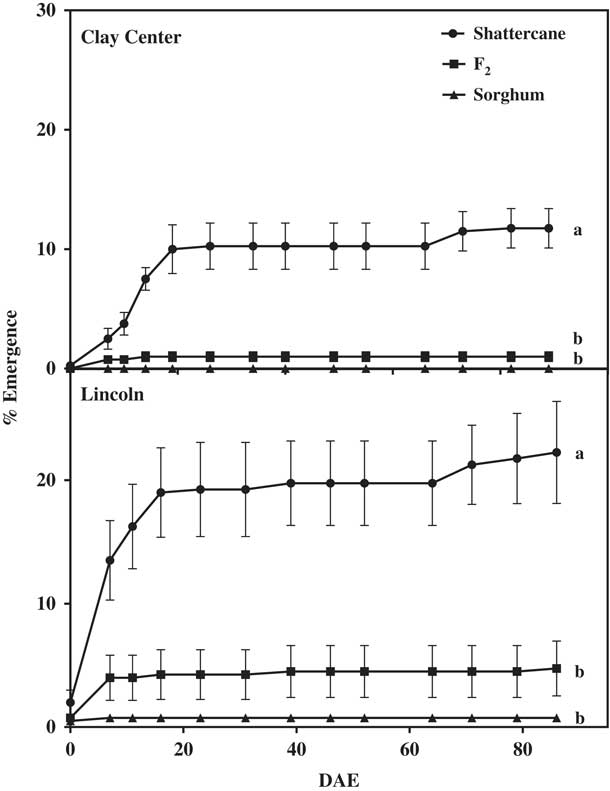
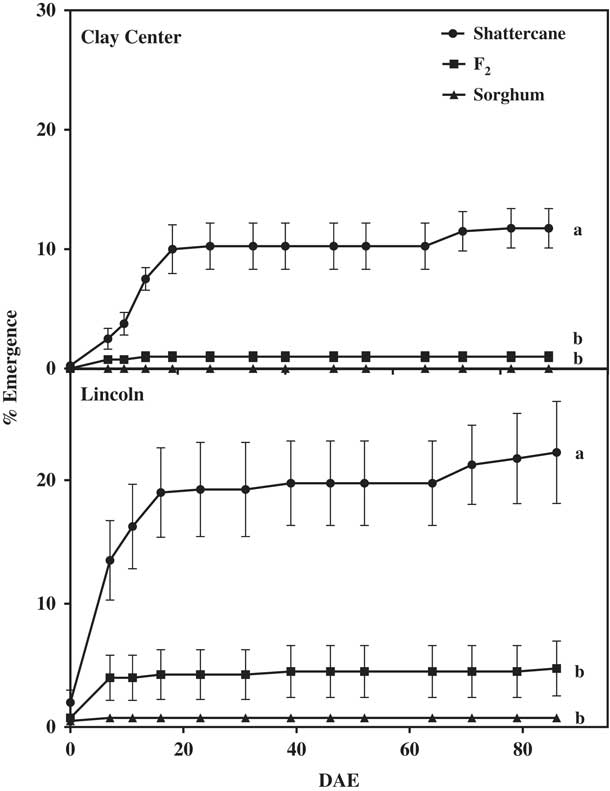
Emergence (mean % ± standard error of the mean [SEM]; Figure 1) versus time (days after the first observation of emergence, which occurred on May 10, 2013) are presented within environment (Lincoln or Clay Center, NE). Statistical inferences were calculated only at the end of the season for total cumulative emergence and are based on LS means generated from pooled data, as no population by environment effect was detected (P=0.07). Across environments, cumulative emergence of the F2 population (1.4%) and grain sorghum (0.2%) did not differ, but LS means of both were lower than that of S. bicolor nothosubsp. drummondii (8.5%). At the end of the 2013 growing season, 9% (Lincoln) and 3% (Clay Center) of ungerminated S. bicolor nothosubsp. drummondii seeds were recovered from the first basket and determined to be viable, but no F2 or grain sorghum seeds were recovered at either location (unpublished data). No seeds or emerged seedlings were recovered from any baskets in 2014. Therefore, we conclude that 91% to 97% of S. bicolor nothosubsp. drummondii plants were lost from the population due to predation, winter kill, or spring germination; whereas 100% of the F2 and grain sorghum seeds were lost from the population. These results indicate that S. bicolor nothosubsp. drummondii seeds overwinter better than F2 seeds when they are produced by F1 plants that are the progeny of maternal S. bicolor nothosubsp. drummondii and paternal grain sorghum plants (which would influence glume morphology and adhesion to the F2 caryopsis). Reduced overwinter survival of cultivated sorghum compared with S. bicolor nothosubsp. drummondii in Nebraska was also observed by Jacques et al. (Reference Jacques, Vesecky, Feltner and Vanderlip1974) and Fellows and Roeth (Reference Fellows and Roeth1992) when seeds were buried. To our knowledge, this is the first overwintering study of unburied S. bicolor nothosubsp. drummondii seed.
Field emergence (mean ± SE, n=200) of Sorghum bicolor nothosubsp. drummondii (shattercane), F2, and grain sorghum seeds harvested from plants grown at Clay Center, NE, and Lincoln, NE, in the summer of 2013. Time is reported in days after first observed emergence (DAE), which occurred on May 10, 2013. Seeds were sown in seed trays at both locations (environments) in November 2012 and overwintered in the field. Only total cumulative emergence (at the end of the season) was used for statistical comparison. No population by environment interaction was detected (P>0.05), so statistical inferences are based on pooled data.
Additional seeds of the grain sorghum, S. bicolor nothosubsp. drummondii, and F2 populations were visually assessed for any morphological differences that may have impacted overwinter survival or emergence. Sorghum bicolor nothosubsp. drummondii seed had glumes that tightly encapsulated and adhered to the caryopsis, whereas commercial grain sorghum caryopses as meant only subtended by glumes, which may be completely open or missing, leaving the kernel mostly or entirely exposed. The F2 seeds generally were intermediate between these two extremes: they had slightly larger caryopses than S. bicolor nothosubsp. drummondii seeds with somewhat smaller glumes that did not tightly adhere. Jacques et al. (Reference Jacques, Vesecky, Feltner and Vanderlip1974) and Fellows and Roeth (Reference Fellows and Roeth1992) both attributed glume structure to the ability of seeds to overwinter. Fellows and Roeth (Reference Fellows and Roeth1992) in particular identified tannins present in S. bicolor nothosubsp. drummondii glumes as the likely chemical component inhibiting seed germination before overwinter burial and reducing microbial degradation in the soil. This protective effect was more pronounced when glumes fully enclosed and tightly adhered to caryopses. It is likely that reduced overwinter survival and emergence of the F2 seeds in the current study were at least partly due to the open and intermediate glume structure. However, it is important to note that predation rates were not measured in any of these studies and cannot be ruled out as an alternative explanation for differential loss among populations. It is possible that larger seeds (a bigger calorie reward) or less protected seeds (reduced or absent glumes) of grain sorghum and the F2 relative to S. bicolor nothosubsp. drummondii may increase predation.
Overwintering survival of the F1 seed (the maternal parent of the F2 population) was not tested, because it was formed on a S. bicolor nothosubsp. drummondii parent; therefore, the glumes encapsulating it were produced by S. bicolor nothosubsp. drummondii. Sahoo et al. (Reference Sahoo, Schmidt, Pedersen, Lee and Lindquist2010) previously found slight germination differences at low and high temperature extremes in the F1 using fresh seed, and large differences in germination between S. bicolor nothosubsp. drummondii and grain sorghum. Because glumes are maternal tissues, segregation of seed protection characteristics was most likely to appear in mature individuals in the F2 generation (encapsulating F3 seed). In light of the differences in overwintering survival of the F2 seed, and different germination patterns among S. bicolor nothosubsp. drummondii and grain sorghum at low and high temperatures, we assume overwintering of F2 seed produced by the F1 to be the most likely bottleneck in the long-term survival of crop–weed progeny populations in cooler regions.
Growth and Fitness Components
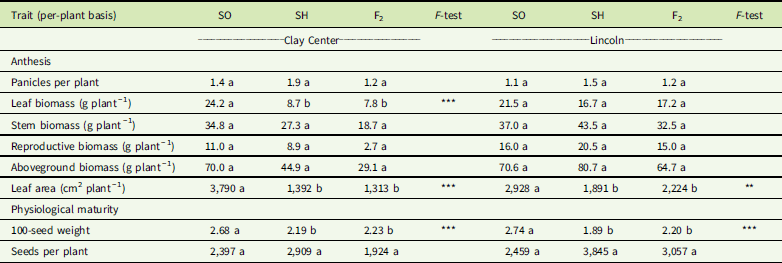
These experiments were intended to be rainfed, but very hot and dry conditions prevailed in central Nebraska in 2012, and the experiment required irrigation at Clay Center to prevent its loss. It was minimally irrigated (2.5-cm water) three times, only when drought stress was made evident by severe leaf curling. Population by environment interactions were observed only for leaf mass and leaf area at anthesis (P<0.05, unpublished data); thus, only leaf-mass and leaf-area data were analyzed within year, whereas all other data at anthesis and physiological maturity were pooled across environments. For ease of presentation, growth and fitness trait LS means are presented within year, but statistical comparisons are based on the preferred statistical model (Table 1). Leaf biomass per plant was greatest for grain sorghum and similar for S. bicolor nothosubsp. drummondii and the F2, but only at Clay Center in 2012. Similarly, leaf area per plant was greatest for grain sorghum (3,790 cm2 in 2012 and 2,928 in 2013) and similar for S. bicolor nothosubsp. drummondii and the F2 (which ranged from 1,313 to 2,224) across years. We expected that leaf area per plant would be maximized at the time of flowering because all leaves would be fully developed and senescence would be minimal. Therefore, leaf area per plant at this stage could be an indicator of relative competitive ability within the crop canopy. No other fitness traits at anthesis differed among populations.
LS means for fitness traits of grain sorghum (SO), Sorghum bicolor nothosubsp. drummondii (SH), and F2 populations at anthesis and physiological maturity are shown for two Nebraska environments (Clay Center 2012 and Lincoln 2013).Footnote a

a Five randomly selected plants (subsamples) per plot (experimental unit) per population (treatment) were analyzed in a randomized complete block design with four replicates (n=20) in each environment. Means within row and year followed by the same letter do not differ at P≤0.05 when an F-test was observed at P=0.05 (**) or 0.01 (***). Data are presented within environment, but statistical comparisons among population means are based on the preferred model for each trait (within or across environments).
The observation of no differences in total aboveground biomass among grain sorghum, S. bicolor nothosubsp. drummondii, and the F2 populations contrasted with the results of Sahoo et al. (Reference Sahoo, Schmidt, Pedersen, Lee and Lindquist2010), who found the F1 hybrid to have greater biomass than both the S. bicolor nothosubsp. drummondii and sorghum parents. We suspect this may have been due to heterosis, which is commonly observed in F1 generations, which would be expected to decrease in the F2. Aboveground biomass was made up mostly of stem tissue, followed by leaf and reproductive tissues in all populations; however, based on LS means from the pooled data, it was less variable for sorghum (70.2 ± 14.6 SEM g plant−1) than in S. bicolor nothosubsp. drummondii (62.8 ± 14.6 SEM g plant−1) and the F2 (47.0 ± 14.6 SEM g plant−1), as denoted by the increasing error:mean ratio. This reflects the genetic uniformity of the hybrid crop. It may also indicate the presence of genetic variability for biomass production under drought stress in the S. bicolor nothosubsp. drummondii parent population and the F2, which could be selected upon to adapt both populations to increasingly dry environments. Breeding for improved abiotic stress tolerance, primarily to drought, has been underway for many years in sorghum and will only increase now that the crop has been classified as an advanced biofuel (USEPA 2012). To the extent that crop drought-tolerance traits are heritable, expressed in the F2, and seeds survive winter, it is likely that they could provide an additional route to stable introgression of crop alleles in weed populations as rainfall patterns become more variable and irrigation more limiting. Conversely, drought-tolerant S. bicolor nothosubsp. drummondii accessions may be sources of favorable alleles for sorghum. Mickelbart et al. (Reference Mickelbart, Hasegawa and Bailey-Serres2015) recently reviewed the known genetic and physiological mechanisms conferring Poaceae crop tolerance to drought, among other abiotic stresses, and candidate genes and pathways are available for developing molecular markers to screen both genetic variability and expression among crop–weed populations in drought-stressed environments.
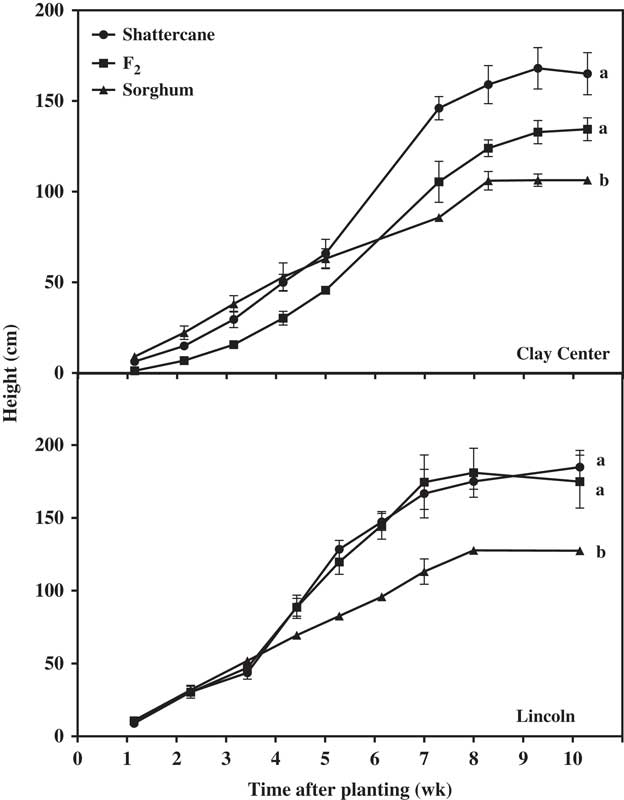
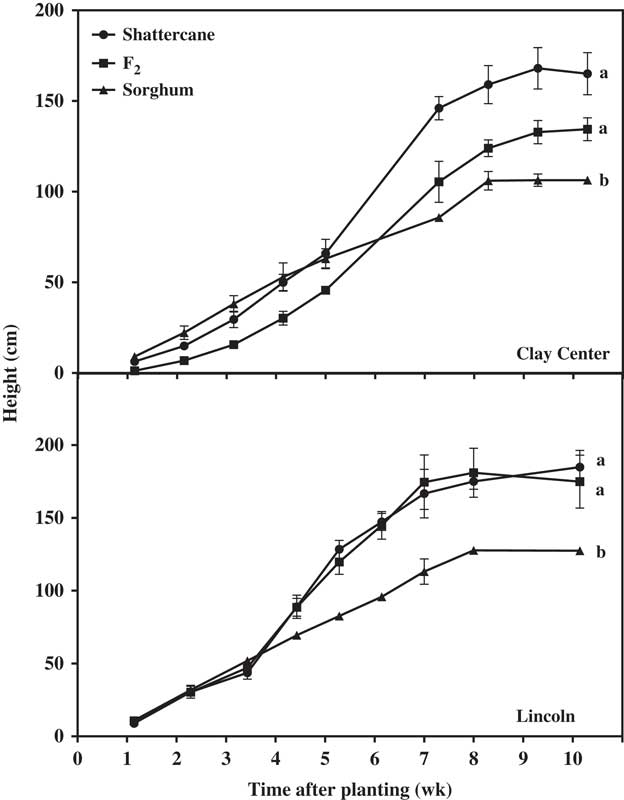
Mature plant height was greatest for S. bicolor nothosubsp. drummondii and the F2, and lowest for grain sorghum (Figure 2). The greater height of the F2 relative to grain sorghum was likely due to complementation of several recessive dwarfing loci inherited from the grain sorghum parent by wild-type (height-restoring) alleles inherited from the S. bicolor nothosubsp. drummondii parent. Sahoo et al. (Reference Sahoo, Schmidt, Pedersen, Lee and Lindquist2010) had reported that F1 plants were taller than their S. bicolor nothosubsp. drummondii parents; similar heights among the F2 and S. bicolor nothosubsp. drummondii in the present study can probably be attributed to the loss of heterosis typically expressed in F1 hybrids. Similarly, aboveground biomass production did not differ among the F2 and S. bicolor nothosubsp. drummondii.
Plant height (mean ± SE, n=20) over time in 2012 (Clay Center, NE) and 2013 (Lincoln, NE) for Sorghum bicolor nothosubsp. drummondii (shattercane), the F2, and grain sorghum. Only final height (at the end of each season) was used for statistical comparison. No population by environment interaction was detected (P>0.05), so statistical inferences are based on pooled data.
As might be expected, 100-seed weight was greatest for grain sorghum across years (2.67 to 2.73 g), whereas the 100-seed weights of S. bicolor nothosubsp. drummondii and the F2 ranged from 1.89 to 2.23 g and did not differ appreciably from one another (Table 1). The number of seeds produced per plant was numerically greatest in both years for S. bicolor nothosubsp. drummondii (2,909 to 3,845 seeds), but did not differ from that of grain sorghum (2,397 to 2,459 seeds) or the F2 (1,924 to 3,057 seeds). Sahoo et al. (Reference Sahoo, Schmidt, Pedersen, Lee and Lindquist2010) reported increased seed production by S. bicolor nothosubsp. drummondii plants relative to grain sorghum or the F1, with significant differences among the populations. Seed production per plant is heavily influenced by genotypic and environmental factors, but phenotypic plasticity is often greater in weed species than in crops. In addition, the F2 generation (unlike parental or F1 generations) would be segregating for a wide range of both crop and weed traits.
In general, all populations were taller and more productive in 2013, but differences among them were more pronounced during the drought in 2012. This observation preliminarily indicates that abiotic stresses typically associated with climate change (drought and heat stress) may magnify differences in plant competitive ability among grain sorghum and related weeds in agroecosystems and merits further study.
Height is an important weedy characteristic that allows plants to better compete for sunlight in a canopy, especially in a tall crop canopy such as corn. Moreover, taller plants may enable seed and pollen to be spread at a greater distance than would be the case with shorter plants. Reduced height or vegetative biomass at flowering may indicate decreased competitive ability for aboveground resources at that point. For example, in a mixed canopy, shorter plants may be less efficient at obtaining light resources up to anthesis, or they may delay development of reproductive tissues until later. The F2 produced a similar number of panicles and seeds compared with S. bicolor nothosubsp. drummondii, which would lead to similar numbers of offspring. In addition, 100-seed weight was similar for S. bicolor nothosubsp. drummondii and the F2. Larger seeds sometimes lead to increased seedling growth rates, quicker establishment, and success emerging from deeper in the soil profile (Rees et al. Reference Rees, Condit, Crawley, Pacala and Tilman2001). While deep seed burial is certainly possible in an agricultural setting due to tillage, the lack of larger seed size in the F2, likely would not contribute to increased fitness relative to S. bicolor nothosubsp. drummondii in more southern climates where overwinter survival is similar.
Most traits we evaluated did not differ among the populations, indicating that increased fitness of a previously studied F1 population (Sahoo et al. Reference Sahoo, Schmidt, Pedersen, Lee and Lindquist2010) may have been largely due to heterosis. In general, the F2 population was most similar to its weedy S. bicolor nothosubsp. drummondii parent with respect to the fitness traits evaluated. We conclude that the F2 population lacked any morphologies typically associated with a large gain in ecological fitness under typical agroecosystem conditions relative to the weedy parent, such as much greater height or seed production. This suggests that the rate of crop allele fixation in S. bicolor nothosubsp. drummondii populations following a onetime crop-to-weed gene-flow event might be slow in the absence of crop genes that themselves confer a fitness advantage such as herbicide resistance to subsequent generations. Repeated gene-flow events may be required to maintain high frequencies of crop alleles in these populations. Similarly, the absence of morphologies typical of reduced ecological fitness would prevent crop allele loss once introduced. Based on our results, we expect that most crop alleles, once introduced into S. bicolor nothosubsp. drummondii populations, are likely under neutral selection, such that their gain or loss is predominantly due to genetic drift and not selective environmental pressures. While under some conditions, as was the case in 2013, it appears that the vegetative and seed production of the F2 population were numerically as high as the S. bicolor nothosubsp. drummondii parent population, reduced survival of the seed brings their overall fitness into question. If fitness is simply defined as the likelihood of a seed surviving winter and producing a seedling the following year, we can calculate the relative fitness (RF) of the F2 population versus S. bicolor nothosubsp. drummondii as 1.4/8.5 or 0.16 when data are pooled across years. The selection coefficient (s) can be calculated as 1 − RF (Falconer Reference Falconer1989), or s=0.84. This is to say that, using this measure alone, the average individual in the S. bicolor nothosubsp. drummondii population appears 84% more likely to pass on genes to subsequent generations than the average individual in the F2 population. It appears that the open glume structure exposes the seed to increased microbial degradation, as suggested by Fellows and Roeth (Reference Fellows and Roeth1992), or to predation. However, plants that do emerge in subsequent seasons would contribute to stable introgression of crop genes in the following generations. Our results provide evidence that F2 plants resulting from pollen-mediated gene flow from conventional grain sorghum to S. bicolor nothosubsp. drummondii will be at most as fit as the weed parent, and likely less fit. We assume that subsequent generations (F3, F4, etc.) or backcross generations (resulting from ongoing gene flow to the crop and/or weed parent) will not gain additional fitness traits in the absence of selective pressures favoring crop alleles.
Ongoing gene flow from grain sorghum is a likely route leading to stable crop-gene introgression in S. bicolor nothosubsp. drummondii populations, especially in warm regions where overwinter survival would be expected for grain sorghum and F2 plants. Because there is no apparent reproductive barrier between grain sorghum and S. bicolor nothosubsp. drummondii (Sahoo et al. Reference Sahoo, Schmidt, Pedersen, Lee and Lindquist2010; Schmidt et al. Reference Schmidt, Pedersen, Bernards and Lindquist2013), and crop-to-weed hybridization has been observed at rates as high as 16% (Schmidt et al. Reference Schmidt, Pedersen, Bernards and Lindquist2013), there is no reason to believe that the F1 and subsequent generations could not be pollinated by grain sorghum at similar rates. Average overwinter survival of F3 seed (progeny of the F2) would be expected to be greater than that of the F2 in colder climates due to segregation for glume adhesion to and enclosure of the caryopses. Backcross progeny among the F1 plants and the crop, S. bicolor nothosubsp. drummondii, or any surviving progeny could maintain sorghum genes in the weedy S. bicolor nothosubsp. drummondii population once introduced. Our results indicate that the frequency of specific crop alleles would primarily depend on overwinter survival of the F2 and which selective pressures are imposed upon them in the cropping system. For example, crop-to-weed gene flow of herbicide-resistance alleles in the presence of herbicide-selective pressure would tend to increase the frequency of resistance alleles in the weed population if seeds survive the winter and emerge in spring, because individuals carrying them will have greater reproductive success (seeds plant−1) than individuals carrying wild-type alleles. Thus, once herbicide-resistant grain sorghum is grown, rotation to alternative chemistries that are effective on grass weeds will be vital for controlling such escapes. In particular, we previously developed a risk assessment model for the evolution of acetolactate synthase (ALS)-resistance alleles in S. bicolor nothosubsp. drummondii populations when grain sorghum contributed an initial source of resistance alleles under different cropping system strategies (Werle et al. Reference Werle, Tenhumberg and Lindquist2017). Results clearly showed that 3- to 5-yr crop rotations incorporating glyphosate were most effective at maintaining S. bicolor nothosubsp. drummondii population densities below economically damaging thresholds despite rapid fixation of crop ALS-inhibitor resistance alleles. Following the commercialization of sorghum ALS-resistance technology, it will be important to empirically validate rates of crop-to-weed gene flow and S. bicolor nothosubsp. drummondii evolution outlined in the simulations of Werle et al. (Reference Werle, Tenhumberg and Lindquist2017) and any impacts conferred by overwintering loss in cool versus warm climates.
In addition to herbicide-resistance traits, it may be of future interest to study the effects of heat and drought on floral traits and fertility among crop–weed populations of Sorghum species and any impacts they may have on fitness or competitive ability in these early introgression generations (F1 and F2). These impacts would include not only those directly conferred by crop abiotic stress-tolerance alleles, but also those conferred by genomic regions in linkage disequilibrium with them. The same would be true for loci linked to herbicide-resistance alleles. For example, Hartman et al. (Reference Hartman, Hooftman, Uwimana, van de Wiel, Smulders, Visser and van Tienderen2012) conducted large field studies of crop–weed Latuca (lettuce family) hybrids. When a crop gene was linked to a genomic region associated with a strong selective advantage (increased seed production), genotypes carrying the crop gene produced more seeds. By contrast, genotypes carrying a crop gene linked to a region associated with a strong selective disadvantage (decreased seed production) produced fewer seeds. Indeed, linking transgenes to genomic regions that would decrease hybrid progeny fitness is one suggested means of mitigating crop-to-weed gene flow (Gressel Reference Gressel2012, Reference Gressel2015; Snow et al. Reference Snow, Andersen and Jorgensen1999).
In summary, we evaluated several components of ecological fitness in an F2 population descended from crosses of grain sorghum to S. bicolor nothosubsp. drummondii to establish the baseline competitive ability of the F2 relative to its parents in the northern Great Plains. Experiments were conducted in the absence of a crop allele that itself impacts fitness (such as herbicide resistance or abiotic stress tolerance) and selective pressures that favor such alleles. If crop allele introgression occurs, our results suggest that the F2 progeny generally would be most similar morphologically to the weedy parent. Seed overwinter survival may be significantly decreased relative to S. bicolor nothosubsp. drummondii, similar to the grain sorghum parent, which may have a greater impact on emergence the following season in cooler, northern regions than in warmer, southern regions. We conclude that crop-to-weed gene flow from current conventional grain sorghum hybrids does not improve the relative ecological fitness of individuals in subsequent generations beyond that of the original S. bicolor nothosubsp. drummondii parent.
Acknowledgments
This project was supported by the Biotechnology Risk Assessment Program competitive grant no. 2010-33522-21658 from the USDA–National Institute of Food and Agriculture. No conflicts of interest have been declared.