INTRODUCTION
The Rastafari Indigenous Village (RIV) is a Rastafari-themed educational and cultural tour founded in Montego Bay, Jamaica, in 2008, by members of a local socially conscious Rastafarian arts group, the Indigenous Initiating Circle of Nature (IION). The Rastafari of IION, according to a key RIV member, Arlene, are a “social family network united by their shared concerns over the slow responses of the Rastafari movement to rapid socioeconomic changes taking place within Jamaican society.” They articulate their concerns through their talents as artisans, poets, musicians, craftspersons, designers, and as a fusion Reggae-Nyabinghi music group. Nyabinghi music is traditional Rastafari drumming, named after one of the oldest Rastafari denominations, played during religious services and rituals. As a network, the IION share aspirations to raise positive awareness, to increase education in their communities, and to create economic opportunities through collective and cooperative development.
The idea for the RIV came to the group in 2007 when a party of 90 black American tourists approached them with a request for an immersive experience into Rastafari culture that focused on the wellness aspects of Rastafarian food, herbal remedies, and spirituality. Given the size of the tourist group, the IION approached the Tourism Product Development Company (TPDC) for assistance in organizing the event. The TPDC is a government agency charged with overseeing the standards of tourism “products,” namely attractions like craft markets and tours. Another function is advising various local communities on the development of new tourism projects related to regulations, training, and overall compliance.
With the help of Arlene, who was their contact at the TPDC, the group held a successful event, leading them to recognize that creating a similar, more permanent experience would be an opportunity to take advantage of a clear gap in the market. Doing so could help them achieve their social agenda and provide income for the members. Additionally, this would be a chance to present Rastafari culture to visitors and to share its message on their terms, correcting what members considered thin, one-dimensional portrayals of Rastafari that were heavily oriented toward Bob Marley and reggae music. Admitting that tourism could be used as a mechanism of development, sustainability, and outreach was difficult for the group because of Rastafari’s anti-capitalist tradition. Footnote 1 The tourist industry is often viewed extremely negatively, with many Rastafari members of the group remarking that “tourism is ‘whore-ism.’” This sentiment drew on the Rastafari ideology’s strong aversion to all things “Babylonian,” a Rastafari designation for the Western state and their religious, political, social, and economic apparatuses and the inequity and injustice that they represent. Anything Babylonian is conventionally considered verboten to Rastafari practitioners. Moving toward this endeavor caused a rift in the group, leading to the early departure of several members. Arlene’s academic training and interest in heritage tourism led her to become a partner in the newly founded venture. Together, with First Man—one of the co-founders of the RIV and its primary spokesperson—they formed a tour company, under a limited liability registration as “the Rastafari Indigenous Village” and a non-profit organization, the Royal Africa Hall Benevolent Society, to qualify for public funding.
At the start of my fieldwork in 2011, the RIV was led by First Man and Arlene. However, because the village does not officially subscribe to a hierarchical organization, the term “guided” was preferred. The members of the village included the performer and original IION station member, Izinigha, who also oversaw the village craft mall; Maureen, who ran the onsite “ital” kitchen; the village’s Nyabinghi drummers Jah Teba, Golden Ankh, Fire Shine, and Jah B; and local dub poet Ras Rod. Ras Rod would, over the duration of my fieldwork, take on a more central role in the direction of the village. There was a larger auxiliary membership to the village, who seldom participated in the day-to-day tours but took part in special events. The village’s members came from impoverished to modest backgrounds, and one of them lived on the premises for lack of residence elsewhere.
The RIV members entrusted Arlene, First Man, and Ras Rod with the direction of, and decisions for, the village and mainly enjoyed the fact that they simply were able to earn an income while pursuing their interests. Work in the village gave them a sense of autonomy, as it was a space where they “had no boss,” which was explained by Arlene to be the village’s intentional “horizontal” organizational structure. This flat structure is also derived from the tendency toward acephalous organization that is prevalent among Rastafarian groups and from the long enduring ethic of self-enterprise and suspicion of authority espoused by the culture. Footnote 2 However, while their income was somewhat steady, it was still insufficient for them to avoid work outside the village. This fact would at times temper their sense of investment in the village project. Therefore, they often struggled in interviews to articulate their ambitions for the village and what long-term value it held for them. For this reason, this article depends heavily on the accounts of First Man, Arlene, and Ras Rod.
In this article, I examine the radically alternative strategy employed by the RIV to stake claim to the country’s cultural reputation, for which they believe their culture is under-credited. Their approach is radical because while the RIV believes this participation creates financial opportunities for village members, as well as mitigates their cultural exploitation, the tour integrates the RIV, and, therefore, Rastafari, into the circuit of tourist revenue and, thus, into the state and the wider economic scheme that profits from their culture. Integration into this system is part of the exploitative “Babylon.” This moral opposition to the state adds analytical complexity to more conventional accounts of the challenges between state and capitalist imperatives against the indigenous claiming of rights, by further elucidating the ethical stakes for indigenous groups in their efforts to secure rights. Additionally, the RIV case shows how indigeneity, when based on flexible and contingent criteria, becomes a similarly flexible tool in the seeking of commercial gain. This article analyzes the RIV’s market participation and their claims of indigenous cultural property rights to reconsider the relations between the market, cultural property, and indigeneity. In doing so, it moves beyond cultural property as a means by which indigeneity is defended against capitalist dispossession to explore instead how it is produced within that capitalist challenge.
INDIGENOUS FRUSTRATIONS
Unlike indigenous groups defined through the experience of settler colonialism, Rastafarian claims to indigeneity are made problematic by the culture’s late post-emancipation inception and the choice of membership. The Rastafari community does not, in fact, qualify as an indigenous community under prevailing international models. Under those models, groups are indigenous by “having a historical continuity with pre-invasion and pre-colonial societies that developed on their territories, consider themselves distinct from other sectors of the societies now prevailing on those territories, or parts of them.” Footnote 3 Rather than employing the notion of indigeneity as articulated in the Pacific, Africa, North America, and South Asia, members of the RIV chart a path to their autochthonous identity through the particular model of the Maroon community in Jamaica, which has had success in obtaining indigenous recognition.
Jamaica’s Maroon communities, descendants of militant and organized groupings of escaped African slaves who through multiple successful skirmishes and battles with Spanish and, later, British colonists, won sovereign recognition and territory from the British in the sixteenth century. Footnote 4 The cultural retention made possible by this early separation from the still enslaved populations on the island’s plantations accorded the Maroons a sense of ethnic and cultural distinction. In the vein of this Maroon model, Rastafari indigeneity has become defined by various instruments that provide indigenous status through the mechanism of traditional knowledge. Their claim of indigeneity through traditional knowledge creates a discourse around cultural property that includes individual self-identification as members of an indigenous community; the entitlement of displaced persons to the continuity of pre-displacement tradition; and the rights of a traditional community and minority group. Footnote 5
Traditional knowledge as a category of cultural property produces alternate imaginaries that help realize claims of indigeneity and sovereignty. Footnote 6 These imaginaries are possible, as Haidy Geismar asserts, through the process of “provincialization,” a process where indigenous and sovereign claim making adopted global property models. Provincialization and its property forms “consolidate multiple discussions of rights, allowing participation in wider spheres of exchange, while at the same time limiting the terms of their engagement.” Footnote 7 With the RIV, provincialization works in concert with what Tania Li has termed the “management of dispossession”—the means by which the concept of indigeneity defends against the dispossessing or displacing endeavors of capitalist interests. Footnote 8 In these scenarios, indigeneity runs up against capitalist-enabled dispossession, or other external challenges, which, in response, engender alternative political and economic subjectivities, strategies, and moralities. What the RIV case demonstrates is that the experience of capitalist dispossession can produce and define indigeneity.
The RIV’s economic strategy proposes and generates their indigeneity and is the basis on which they make their claims to autochthony, the logic being that they are safeguarding their indigenous culture from exploitation through market participation. Through cultural property, the RIV members reposition themselves within Jamaica’s economy in the manner that Geismar and Li contend, which they do through a narrative of indigeneity defined by the histories of slavery, colonialism, and the post-independence persecution that chiefly constitutes Rastafarian ontology. In other words, they are indigenous in part because of those experiences, and cultural property, as emblematic of those experiences, serves as a potent imaginary for the development and assertion of indigeneity. Deborah Thomas provides useful insight into how to analyze Rastafari’s alternate indigeneity in this manner through considering the history of Rastafari persecution in Jamaica:
[T]he framing of Rastafari as Jamaica’s indigenous population … is not only a bit of rhetorical sleight-of-hand … it is also an attempt to redefine “indigenous” as that which has been created and developed on Jamaican soil, though not necessarily prior to European conquest. … [Indigeneity] is mobilized instead to draw attention to a history of disenfranchisement—both politically and in relation to land ownership. Redefining indigeneity in this way, then, gives teeth to the reframing of citizenship … [t]o position Rastafarians as indigenous is thus not only to emphasize the connection to land and their rejection of the technologies and simulacra that provide toxic structure to the modern condition or to focus on aspects of the lifestyle that are rooted in a relationship to the natural landscape that few Jamaicans currently maintain. It is also to invert the usual hierarchies, to convince people around the world of Rastafarians lifestyle. Footnote 9
Claims to indigeneity, on the basis of Rastafari’s complicated history, as Thomas asserts, enable the legitimation of Rastafari citizenship and place within the geographical and political landscape of Jamaica. However, the “social and affective … content of indigenous territoriality” is challenged by the Rastafari’s cultural influence in Jamaica, which complicates claims to explicit ownership of Rastafarian cultural products. Footnote 10 There is a public and shared notion of culture in Jamaica, to which Rastafari significantly contribute, Footnote 11 not to mention globalization’s amplification of Rastafari’s continuing influence and reach. Footnote 12 This influence is problematic because the cultural property rights of Rastafari lie within the claims of indigeneity made on a collective, yet distinct, basis of possession where that collectivity, especially in the context of commercial infringement, is mandated by cultural difference. Footnote 13
According to Katherine Verdery and Caroline Humphrey, such difference is “a homology between the oneness of the group or ‘people’ and certain kinds of objects in which they see their identity as residing.” Footnote 14 The categorical dichotomy in conventional cases of settler colonies makes such difference simpler to determine than in Jamaica, a former British colony now populated in the majority by the descendants of once-enslaved Africans, where there is no ethnic distinction between Rastafarians and other black Jamaicans. The exception here are the claims of indigeneity made by Maroons, whose cultural distinctness became contracted in the 1738 treaty with the British. Moreover, the electability of Rastafari adherence complicates who does or does not count as part of the “people”—whether Rastafarian, Jamaican, or both—and who can access their objects. Because of the blurred lines between Rastafarian and Jamaican identification, there is a need for Rastafari to assert their difference and their separation.
There is an already long-established system of differentiation employed within Rastafari based on an adherence to the culture’s various tenets and countless permutations of identification and belonging based on one’s diet, race, nationality, politics, religious rigor, and sexual orientation. The result is a continuously debated, subjective, and fluid rubric that determines the degree to which one is authentically Rasta. Considering the widespread adoption and consumption of Rastafari style and cultural practices, this process has become increasingly open-ended. Thus, to make a case for claims to indigeneity, Rastafari must configure indigeneity as more than a compound of Jamaican birth, a history of disenfranchisement, race, and an emphasis on a natural, rooted way of life. This is done through emphasizing the role of objects in particular commercial efforts, activities, and presentations, which does much to advance the creation of Rastafarian indigeneity. This strategy has had some success through the RIV tour. The tour demonstrates indigeneity through knowledge of Jamaica’s medicinal flora, the drumming and chanting of “ancient” Nyabinghi music, and their chosen garb of decorated burlap in the Rastafarian colors of red, gold, and green. Indigeneity in the village is thus a position of identity manifested in practices and products qualified as traditional knowledge.
THE RIV TOUR
The RIV, located on a roughly three-acre-sized parcel of land, was conceived as an authentic living, interactive museum that introduces a broad range of visitors to the many facets of Rastafari and Jamaica. It is a “working village” in that, while only one of the “villagers” lives on the premises, they work together as a community to live the philosophy, movement, and lifestyle of Rastafari. Visitors to the village numbered more than 1,000 in 2011 and included Jamaican school children, university students, and residents but mostly overseas tourists. These visitors included a mix of middle-income Europeans and Americans, who were almost always white. The tour companies with whom the RIV partnered, however, significantly determined the makeup of the clientele. One, in particular, Caribic Tours, had a strong base with tourists from Germany and the Netherlands. Toward the end of my fieldwork in 2013, as the village benefited from broader publicity by the Jamaica Tourist Board, the visitors became much more diverse.
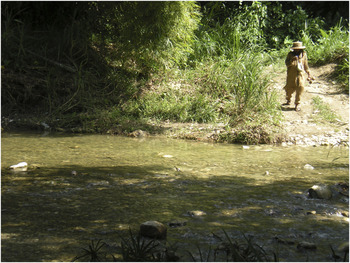
After the tourists leave their tour bus and pass through a garden and across a lawn owned by the RIV’s lessors, they approach the Montego River, which at this point in the stream bed stands no deeper than a foot (see Figure 1). The group hears how rivers are vital to Jamaica and that the country’s original Taíno name, Xamayca, means “the land of wood of water.” As the guests remove their shoes and roll up their pant legs preparing to cross, the guide explains the spiritual symbolism of rivers saying: “[L]ike life you never go through the same river twice.” The group is invited to take a reflective moment to “give thanks” and use the opportunity to “take one step at a time and to share the world-space communally.” The tourists are very taken by this moment. In the process of crossing, some guides opt to explain that in Yoruba heritage the river is represented by the river goddess named Oshun, the “river mumma.” The guide tells visitors that Oshun controls the river, and he or she invites them to make an offering to her by throwing five $1 Jamaican coins into the river.
Village Member Preparing to Meet Guests across the River (courtesy of author).

Having crossed to the other bank, guests decide to either slip on their shoes or to take in the full experience barefoot like their guide. A tall bamboo wall that panels the background is the next point of discussion. The guide tells the group that bamboo is technically a grass, and one of the world’s fastest growing grasses, and that it helps clean the air, and she also explains how the Jamaican bamboo differs from its Asian variant. The group’s interest piques when the guide mythically explains how bamboo must be cut only on the darkest of nights, absent of moonlight. By this point, the Nyabinghi drums being played in the village can be heard in the distance. As the group moves along the path toward the sound, the guide draws attention to a Poinciana tree, whose pod seeds provide the beads used in the maraca-like shakers played in conjunction with the Nyabinghi drum orchestra. Guests are encouraged to shake fallen pods as they walk along. Next, the guide shows the group an area with Castor plants and shares the plant’s medicinal benefits. The guide then advertises that castor oil made by a local woman is available for purchase in the village.
Talk of the plant segues into a discussion of the banana trees coming up on the approach. The trees are a treat for North American and European visitors, who, though representing the largest consumer markets for bananas, have seldom, if ever, encountered the trees in person. The visitors receive a lesson on the uses for bananas, both unripened (green) and ripened ones, and, as an allegory demonstrating the relatedness between all nature, are told that bananas, like human babies, take nine months to grow. Past the bananas, the group comes upon an old, semi-functional manual sugar cane mill. The guide simulates how the cane is pushed through while turning the top mechanism to produce the juice, during which he introduces the history of slavery and sugar production on the island. Tall coconut trees are just beyond the mill, and, as the group moves nearer to them, they receive a brief history on how sixteenth-century Spanish settlers introduced the tree to the island as well as a description of the uses for coconut’s water, oil, and husks. The group is warned not to stand underneath the “generous” trees. Passing Heliconias and other attractive flora like ginger and lilies and stopping briefly to sample the unfamiliar Otaheite apples, the group is shown the “shame me macka” herb, which is the star of the walk because of its rapid contraction and expansion when touched.
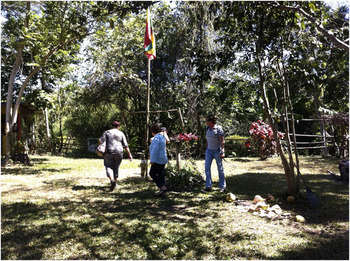
The full pulse of Nyabinghi drumming welcomes the group as they enter the grounds and rest on shaded bamboo benches with a full view of the village. Coconuts are cut fresh for demonstration, and the guests drink the coconut water in small bowls made of dried coconut shell. The second segment of the tour starts with a lecture on the histories of Rastafari, slavery, and Jamaica in a blended narrative that conveys an articulate Rastafarian cosmology. The guide directs the groups’ attention to the bonfire lit in the center of the village. He explains the symbolic importance of fire as an object and agent of spiritual purification. The group is brought near the bonfire to “the seal,” a small ritualistic basin of water surrounded by herbs, which sits in the center of a rock outline of Jamaica. At the seal, the guide talks about the importance of entering into a sacred space and being balanced within it and one’s self. The guide explains that the herbs have balancing energies and that those who enter the village should likewise be spiritually aligned and are invited to become so by circling the seal three times (see Figure 2).
Guests Walking around the Seal (courtesy of author).

Next, the guests arrive at the “ital” kitchen. “Ital,” a variant of the word “vital,” is indicative of a vegan, unprocessed diet that has a religious significance equivalent to kosher and halal. Maureen, who runs the kitchen, gives a presentation on what comprises the Rastafari diet and extols its salubrious effect. Displaying a variety of herbs, nuts, and fruit, Maureen details their nutritional and medicinal components, often challenging more daring visitors to try the diminutive “bird pepper,” or Pequin pepper, a hot chili pepper cultivar, which she asserts is good for digestion. After the kitchen, the group moves on to a labyrinth made of three-foot-high bamboo posts. The labyrinth is one in a worldwide network of labyrinths registered with the Labyrinth Society. Guests are encouraged to meditate as they make their way through the maze, which is described as a “healing garden.” Behind the labyrinth, an herbal spa overlooks the river where massages and “bush baths” are provided.
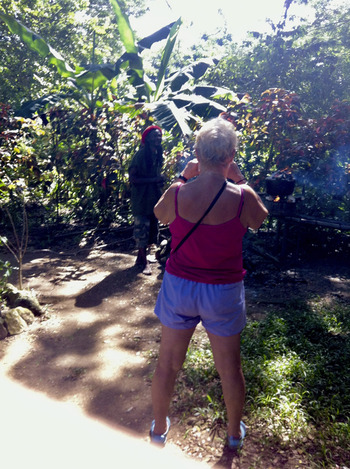
After a few guests venture through the labyrinth, the rest of the group passes a little hut, with a hammock hung inside, known as the “chill out hut.” There, tourists take pictures standing in front. It stands as a representation of a purported village residence. Across from the hut, one of the “villagers” demonstrates ital cooking by beating herbs in a large mortar and tending to a yam roasting on a wheel rim stove (Figure 3). Opposite the hut is the herb garden with over 90 varieties of herbs and plants used within the local medicinal repertoire. Called the village’s herbal “farmacy,” the guide typically goes over about six or so herbs like “search mi heart,” “leaf of life,” “dog tongue,” and “guinea hen.” As the group explores the selection, the guide explains that marijuana is not grown in the garden because, contrary to popular belief, the plant is illegal in the country.
Tourist Photographing Village Member at Cooking Exhibit (courtesy of author).

The tour then culminates with a visit to “the big hut,” modeled on the tabernacle erected for traditional Nyabinghi ceremonies, where members of the Nyabinghi sect of Rastafari celebrate major holy days. Inside the big hut, guests sit on bamboo chairs and benches that face a gathering of drums. The hut is decorated with pictures of key members of the Rastafari pantheon—Haile Selassie, Marcus Garvey, and Empress Menen of Ethiopia—as well as their speeches and with other African and African diasporic iconographies, such as the Egyptian ankh and the Ashanti adinkra symbols. All of the members of the village are present in the hut, and the program continues with a talk about the principles, beliefs, and practices of Rastafari. During this lecture, guests eat a light snack of fruits served in bamboo, coconut, or calabash dishes. Poetry is recited alongside chanting and singing, accompanied by the soaring Nyabinghi drumming. The chanting continues while guests are invited to try the drums. Photos of village members are permitted at this point, and those who attempt to take photos beforehand are told that doing so would be objectifying the villagers, reminding guests that they are partaking in a cultural exchange and a not one-way spectatorship. At the presentation’s end, guests can purchase personalized engraved shakers and other Rastafarian and Jamaican-themed souvenirs at the onsite “craft mall” and visit the museum with more information and Rastafari artifacts. There are also three two-story cottages with toilet facilities to accommodate guests who wish to remain in what many come to regard as paradise.
RIGHTS AS MARKET ETHICS
The RIV tour taps into a worldwide trend of lifestyle ideologies oriented toward slower and more traditional forms of living. One way in which they have aligned themselves in this manner is their affiliation with the slow food movement, sending representatives to the organization’s 2008 Terra Madre conference in Italy. These activities are consonant with well-established health conscious practices, products, and lifestyles touted as the antidote to the fast-paced lives led in the developed world. Rivke Jaffe, building on the term “eco-chic,” has coined the phrase “ital chic,” which she defines as “consumption that combines environmental, ethical, and health concerns with a luxurious, chic sensibility … articulated principally through the indigenous practices, philosophy, and aesthetics associated with Rastafari.” Footnote 15 In identifying ital chic, Jaffe borrows Ennis Edmonds’s definition of “ital” as “a commitment to using things in their natural or organic states.” Footnote 16 The ital principle is central to the Rastafari lifestyle, which comprises members’ “livity” or spiritual life. It is the commodification of the Rastafarian “ital livity” that Jaffe has identified as the driving force behind ital chic. Ital chic is a taking up of local, traditional practices through the international popularity and pull of Rastafarian culture, which is recognized as being part of the global trend toward balanced, organic, clean living.
Processes like ital chic appropriate Rastafarian culture, symbols, and aesthetic forms for commercial profit with little or no benefit returned to Rastafarians or any particular community among them. A number of products that carry direct, or suggestive, markings or references to the culture note this process, such as restaurants, natural food and beauty products, and even the wearing of dreadlocks. This appropriation also encompasses a broad range of sentiments, such as rebelliousness or creativity, thereby opening the “auratic, affective, social worth” of Rastafari culture for use in much broader commercial contexts. Footnote 17 Examples include the Rastafarian red, gold, and green tricolors being used on a regular display in Adidas’s copyrighted three-stripe motif. Another is the employment of Rastafarian terms in the names and promotion of products, such as London-based Jamaican Blue Mountain coffee start-up and Irieville’s brand of “Irie Coffee.” The use of the term “irie,” which is a superlative form of being “all right,” serves in this case to demonstrate both the impact of ital chic as a presentation of relaxation as well a sense of coolness. Critically, it shows that ital chic can also include the use of Rasta language.
A prominent example of this use of language was Volkswagen USA’s 2013 Super Bowl advertisement, “Get Happy.” It featured a white American office worker in a nondescript company of manifestly disgruntled and pessimistic employees and opened with the classic nine-to-five worker moan: “I hate Mondays.” In the advertisement, the lead actor, speaking in Jamaican patois encourages everyone to be more optimistic with a heavy dosing of “Jamaicanized” phrases, such as “turn that frown upside down.” When the positive affirmations fail, he eventually succeeds by giving a few colleagues a ride in his Volkswagen Beetle, and they begin speaking in patois as a result. The Jamaican media criticized the commercial as a racist parody of Jamaican culture. Yet, however “Jamaican” the advertisement appeared, the terms used throughout the commercial were predominantly Rastafarian. For example, the cast regularly responds with the traditional affirmative Rastafarian phrase: “Yes, I”—the “I” pronoun used in Rastafari speech, known as “Iyaric,” to represent the God principle in man, commonly referenced as “I and I.” Aside from the terms, the general positivity expressed is a strong reference to the stereotypical relaxed attitudes of Rastafarians, often ascribed to all Jamaicans. These products trade on the aesthetics and “spirit” of Rastafarian culture. They “(dis)articulat[e]” the “brand logics” of Rastafarian cultural products by distilling and perverting the ethical principles that lie within the language and material presentations of Rastafari culture to profit from its values. Footnote 18 These broad and economically generative commercial circuits trade on the performative, aesthetic, and ideological productions of Rastafari and are therefore seen as infringements upon Rastafarian rights that offer neither compensation nor recognition. The RIV uses the village project to mitigate this loss of revenue from products and, perhaps more importantly, control over the cultural image by trading on the phenomenon of ital chic.
The RIV understands the market through an ethic of rights, through which their religion, language, and heritage take the form of cultural property. The infringement of cultural property becomes read through the long endured transgression of the rights of black people. The desire to fight against marginalization and oppression serves as the basis of the rights claims that Wayne Modest has identified as being part of the trend of “new indigeneities.” Footnote 19 Modest continues that the result of these claims is a “complicated relationship between objects, history, place, and Caribbean identity.” Footnote 20 Inherent in these complications is a “resistance to the uncontrolled proliferation of signs,” where cultural property claims seek recompense for both historical and contemporary abuse, which have culminated with the current unauthorized use of Rastafari cultural images and objects. Footnote 21 For the RVI, the configuration and utilization of cultural property rights serve as an equalizing force in the commercial re-appropriation of Rastafarian culture.
Without provisions that protect cultural property, various cultural communities and their related industries in Jamaica, like Rastafari, are vulnerable to exploitation by outside groups. First Man expounded on this point, saying:
We don’t have any real ownership on nothing, and without having ownership, “free trade” is what is taking place. Other people can really come and take away our ideas and culture because we don’t have the instruments to protect our self. A man can come and buy people’s things, set up a factory or choose a factory on the outside, and there is no interference from government, and then you find you have no legs to stand on more than to just quarrel. All you can do is to have something in place that shows that this is wrong, [otherwise] we are not going to know what to tell government, and we are going to continue to battle in trying to get it from them people.
The quarreling to which First Man refers is an argument of market morality, claiming injustice in the market system particularly when the government is complicit. Without sufficient institutional safeguards or processes that provide commercial security for craftspeople or others in the creative industry, the only recourse is to quarrel.
First Man’s views are shared by both the Jamaican Intellectual Property Office (JIPO) and the Jamaican Promotions Corporation (JAMPRO), which are the two agencies respectively charged with protecting Jamaica’s intellectual and cultural property and promoting the country’s commerce. JIPO seeks to curtail the increasing amount of foreign profiting from Jamaican-inspired products by the creation and issue of protective seals and markings as well as by bringing suit against any breach of copyright. Charles Robertson, a top administrator for JAMPRO, conceded in an interview with me that the government has been “a poor steward of Jamaica’s cultural property.” The poor stewardship was due to the limits of these agencies’ power and reach, which has meant that little is possible in the way of addressing concerns over intellectual and cultural property infringement. He explained that JAMPRO has witnessed Chinese and Indian businesses capitalize on Jamaica’s brand through manufacturing, and, likewise, other foreign groups profit from Jamaican-branded sauces, coffees, music, and culture. He stated: “A number of foreign [companies in] countries seem to take the brand and develop a product surrounding it and sell it back to us.” He noted the efforts of his organization and JIPO to begin the task of registering items, images, and so on, but he admitted that the challenge is their regulation: “We don’t have the resources to police, for example, if someone in the US infringes on our copyright. We can’t sue them from Jamaica it has to be done there, so the brand has to be registered there and then you litigate in the States.” Robertson’s admission demonstrates the complexity of Michael Brown’s titular and seminal question: “Who owns Native culture?” a question complicated by the limited resources available to claimants in the Caribbean, whether they are Rastafarians or the state. Footnote 22
It is important to note that Robertson’s understanding of cultural property is not the affective, ontological product of the Rastafari but, rather, the statist notion of asset ownership, which assumes the language of rights as prevalent in Euro-American property discourses. This distinction is problematic because, on these latter terms, issues concerning any claims are situated within a “property regime” or the “dominant set of shared understandings about property in a given political economy.” Footnote 23 The property regime of the state would rebut Rastafarian property ideals tied to their philosophies and principles, which are incongruous with state and capitalist objectives. Through the language of these terms, the notion of rights as understood by the RIV become difficult to locate in the regime of property ownership as it is recognized in Jamaica because state-adhered property discourses ultimately favor the Jamaican government and corporate entities.
The dilemma that Rastafari face is whether to be conscripted into, and thereby complicit with, the state or to continue to permit the regular commercial infringement of their identified rights. For the RIV, the best course of action has been the creation of attractive products that gain protection through market dominance. First Man explains: “We need to try and make our own markets, and there are so many products that the Rasta man can do right now, like the Village. No one can really right now do a product like the Village and have it as authentic as it can be.” The commercial value and potential diversity of Rastafarian commodities would, according to First Man, naturally arise from the village project in other products and projects. One such idea was the easy merchandising of Jamaican Blue Mountain Coffee, which is marketed in RIV packaging. This model of marketing locally made goods under the RIV brand was conceived to encompass some future products, including soaps, oils, and crafts. In addition, each facility in the village was thought to be an independent attraction. One could come to the village solely for the spa services or to stay in the cottages without necessarily partaking in the tour. The village’s strategy has indeed succeeded in gaining state and commercial recognition, and it has received investment from the Jamaica Social Investment Fund (JSIF) and promotion from the Jamaica Tourist Board. Despite the Jamaican government being unable to defend against infringements on what it considers Jamaica’s cultural property, much less that of Rastafari, as noted in Charles Robertson’s account, the creation of the village brings those elements into the highly protected domain of the country’s tourist industry.
GONE INTO BABYLON: MARKET MORALITIES
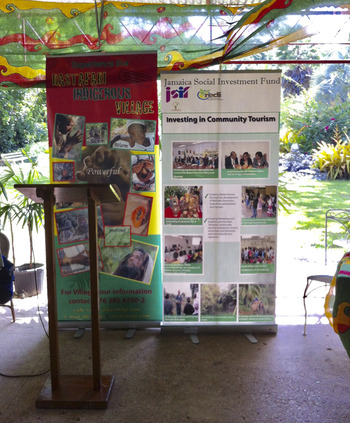
The RIV’s recognition by the Jamaican state has enabled a kind of indigenization but only as far as its culture is viable as an economic resource. Being brought into the Jamaican nation-state, however, determines legal recognition and the making of legal claims on its terms, which has led to social and political concessions, beginning with the effective abandonment of the Rastafarian political aversion to state engagement. Footnote 24 This assertion might seem difficult to square with the benefits to the RIV, which include a development grant worth over Jamaican $20 million (US $200,000) to fund significant renovations in the village, which was awarded by the JSIF and the Rural Economic Development Initiative (see Figure 4). The support from the state has brought the village into the official catalog of attractions listed by the Jamaica Tourist Board, placing it squarely within the remit of this organization’s promotion of ital chic. The RIV is a prototypical example of emerging forms of heritage and community tourism in Jamaica, classified as the “village-as-business” model, which is intended to aid community infrastructure development to establish businesses around community tourism. Village as business projects have gained the attention of the United Nations (UN) Education, Scientific and Cultural Organization’s World Heritage Centre as well as the interest of several governments invested in developing community and heritage-based tourism programs. A South African delegation of entrepreneurs, scholars, and state officials expressed their enthusiasm for the model when visiting Jamaica and the village during my fieldwork. They sought to learn how to apply the model to Rastafarian “villages” in the country, indicating, perhaps ironically, how the RIV contributes to the continued proliferation of the commercialization of Rastafarian cultural practice.
Event Celebrating the RIV JSIF Partnership (courtesy of author).

The RIV’s increased support from government funding initiatives and agencies was not without criticism from other Rastafarian groups, who claimed that the RIV’s involvement in tourism directly contradicted the principles of Rastafari’s anti-Babylonian ideology. In explaining the difficulty of their position, Arlene recalled:
We had to go around to the community of Rasta and explain that what we are doing is progress. I had to let them know that it is criteria based … to receive any funding you have to be in tourism, you have to be a benevolent society, be an LLC ... all of these things. And the community said, “of course [we] are using the name of Rastafari to collect how much money.”
It was also difficult for some members of the village to move away from the self-funded model and apply for government funding. First Man reflected on the at times difficult discussions about what some members considered to be the village “going into Babylon.” He mused: “Even though you might say you don’t want to take Rastafari totally into that mode, you certainly don’t want a situation where we can’t manage to survive in the 21st century. You have to be able to deliver on (provide for) certain things.”
For the RIV, indigeneity and rights work to reconcile this seeming contradiction. But the capitalist implication of indigeneity does not sit well with the Ethio-Africa Diaspora Union Millennium Council, more concisely known as the “Rastafari Millennium Council” (RMC). Founded in 2007, the RMC is an umbrella organization composed of multiple Rastafarian groups, including the RIV, which works on behalf of the broader Rastafari community with the aim of representing their causes and protecting their rights. Two of the Council’s four-point mission objectives exclusively address intellectual and cultural property and the theft and abuse of symbols, emblems, music, and cultural marks—the tangible and intangible heritage of the Rastafari community worldwide.
To improve their situations or seek redress, the RMC, like the RIV, makes property claims through a “politics of recognition.” Footnote 25 However, rather than seek state protection the RMC has appealed to the UN World Intellectual Property Organization (WIPO) in their fight to address their claims of infringement. WIPO has for some time demonstrated support for Jamaica’s Maroon communities, and members of the RMC have recently been able to attract their attention. Council members have begun participating in WIPO activities during the organization’s visits to the country. Once such event that took place during my fieldwork saw delegates from the Charles Town Maroon community of Portland, Jamaica, Council members, and one RIV delegate participate in a multi-day seminar on the documentation of indigenous cultural practices (see Figure 5). The RMC’s assertion of indigeneity is the basis for the relationship with WIPO and mirrors the attempts by indigenous groups to translate and mobilize their indigeneity into political and economic recognition.
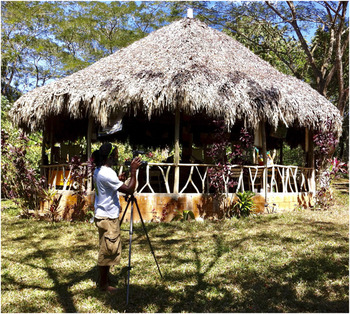
RIV Member Taking Part in WIPO Cultural Documentation Project with Equipment Provided by WIPO (courtesy of author).

While the RMC and the RIV both make claims of cultural property and seek to appeal to organizations like WIPO, what differentiates, and has caused some friction between, the two is the RIV’s active participation in the tourist market, which complicates the Rastafari’s core counter-position to capitalism. For the RIV, the “wait-and-see” process of indigenous recognition is insufficient for actually protecting their rights, especially in that the process in which the Maroons have advanced the furthest still has not financially benefited their community. First Man declared that “the Maroons are searching for a model themselves, and they still don’t have one that empowers the individual; everyone is working trying to get paid, which is the same with us [for] now, but for the future, their model has no definition.”
According to Ras Rod, the RIV is “Rastafari put into a framework of modern existence” and a blueprint for sustainability of the community. First Man, picking up on that sentiment, explained that Rastafari began in a “technological time, and was spread by technology.” Thus, they “exist in a modern time [but] are choosing ancient ways, [as a] modern people who are making a decision to balance technology ... to move on into the twenty-first century ... and it’s an attitude that is necessary for development.” To defend their market participation, Ras Rod asserted that the “[RIV] model is Haile Selassie model” and that they are “following along the words of the Almighty.” His statements refer to the recommendations for development in the canonical text and autobiography of the Rastafari deity and former Ethiopian emperor Haile Selassie I. Footnote 26 Thus, for members, the village is a potential model not just for Rastafari but also for all indigenous communities, as the group envisages a day when the village can develop beyond an attraction and perhaps into an actual village where Rastafari buy and cultivate land and manufacture goods.
Rastafari possibly become compromised in the space of this justification. However, that space may yet provide the “possibility of alternatives” that resolves Rastafari’s intersectional conflict of state, market, and culture. Footnote 27 The model for Rastafari, thus, risks the simultaneous sanitization and pacification of the sharpest aspects of Rastafari culture. Footnote 28 Bretton Alvaré demonstrates this possibility among a group of former radical Rastafari in Trinidad who endeavored to found a non-governmental organization (NGO) to access funding for their social projects. Footnote 29 Proceeding through the requirements of the state’s NGO registration process challenged the group’s revolutionary ideology, causing a re-evaluation of their notions of social justice. In order to not only qualify but also to compete with other NGOs for the funds, the group had to conform to what were considered compromised conventions of NGO practice. Footnote 30 Compliance then potentially engenders the distancing from various subjectivities and principles, like radicalism, that are intrinsic to Rasta ideology and practice. Jaffe notes that in the commercialization of Rastafari, the group must undergo a process of becoming “clean and proper” to achieve acceptability. Footnote 31 The question remains how, or even if, partaking in the business of Rastafari helps to attain the rights of property or if the group simply becomes another stakeholder in the success of “the creeping commodification of their cultural products and practices.” Footnote 32 However, this is complicated since the group, comprised of members who are mostly poor, have to contend not only with the market’s demands and inequalities but also with how to reconcile the possibilities it offers with their moralities.
CONCLUSION
As stated at the beginning of this article, the ideology of Rastafari itself was a means by which black Jamaicans coped with the systemic suffering produced by the Jamaican colonial state. The group came to epitomize “the sufferer,” serving as a lasting reminder of the wickedness of that system. However, this suffering, over time and conveyed through Rastafarian-popularized reggae music, became the basis of commercial interest. The RVI was envisioned as a format to recoup the “interest” of Rastafarian commerce from those who have capitalized on the culture. This process, though, has not been without its complications and controversies. Again, Rastafari’s anti-capitalist orientation runs in direct contradiction to the commercial model of the village. However, as evidenced by tourism marketing, there is a firm sense that Jamaican commercial potential is tied up in the “‘exploitable’ collective self” of Jamaican culture, an issue that stands at the heart of this discussion. Footnote 33
Thomas has noted the apparent contradictions and incongruences between the prevailing ethos of Rastafari and its adherents’ “resistance to tethering their futures on the whims of a neoliberal global market that privileges movement, entrepreneurship, and individualism.” Footnote 34 She warns against the temptation to give projects like the village a cynical read and suggests instead to view the project in light of its temporal context, suggesting that we
[t]hink about what Rasta’s shift from disengagement to engagement means in contemporary context and, in the process, consider the kinds of engagement that are possible today, compared with those that might have been possible at other moments. … [I]f during the modernist moment of the mid-20th century Rastafarians condemned the state, defined citizenship in relation to Africa, refused wage labor and instead emphasized self-determination and self-sufficiency through forms of communal living, in the neoliberal era they seek greater recognition from and representation within the Jamaican state. So while they continue to emphasize self-determination and self-sufficiency, the means by which this might be realized have changed. Footnote 35
At the heart of the RIV’s project of intellectual property is a radical proposition with the potential to ultimately challenge who truly owns, or at least can speak for, Jamaica’s cultural brand. The RIV project could disrupt what has been for so long the un(der)-credited popular packaging of Caribbean culture as Rastafarianism. However, by its conscription into Jamaica’s national branding campaign, the RIV has lessened its ability to challenge the unrestricted notion of what Jamaica’s brand is, as the Jamaican state seeks the broad commodification of homebred cultural activities and resources as a strategy for development Footnote 36 through the creation of distinctive “image industries” linked to tourism. Footnote 37 If the RIV had pursued its project of seeking intellectual property rights to their fullest realization, they could have been able to demonstrate that much of the cultural content of brand Jamaica does not rest on a generally Jamaican authenticity but, instead, draws its aesthetic forms from the utopian cultural, and, to an extent, political, vision of the Rastafarian movement.
So, then, does the village project demonstrate “the ways in which consumption, the state, and Rastafari have come together at a specific point in Jamaica’s history?” Footnote 38 Or is it alternatively a capitalist manifestation and logic that depresses Rastafari resistance through commodification? Although popular Rastafari narratives continue to present Rastafarians as exiled in Jamaica from their African homeland, Footnote 39 there is a recognition as to how Rastafari might be reconciling their place within the Jamaican polity. Neil Roberts, taking his cue from Sylvia Wynter’s meditation on how Rastafari’s longing for Africa has caused them to “stumble upon their Jamaican roots,” Footnote 40 writes that the character of Rastafari “has undergone alternations because of the globalization of movements, transformations in understandings of the moral economy, and domestic state realignments resulting from global flows in an increasingly interconnected age.” Footnote 41 The RIV proves Roberts’s point through its project of cultural property rights and its relationship to the market. This project’s central logic of indigenous claim making complicates a cultural commitment to market resistance because the very use of indigeneity to separate the market from Rastafarian values demands a market-based employment of indigeneity as a means for Rastafarian claims to rights. The case of the RIV, therefore, shows the extent to which market logics frame contemporary notions of rights and how the market conscripts positional identities, such as indigeneity, in their procurement. At the same time, however, the RIV shows the market-enabled manipulability, and, thus, productivity, of those identities, perhaps creating in time greater and more versatile openings to rights claiming.
ACKNOWLEDGMENTS:
I would like to thank all of the members of the Rastafari Indigenous Village for welcoming me into their community and especially Arlene, First Man, Ras Rod, Maureen, and Jah Teba for their kindness, openness, and insight. In memory of Kanaka and Golden Ankh of the village.