Introduction
Traumatic brain injury (TBI) is a leading cause of death and disability in young adults (Corrigan, Selassie, & Orman, Reference Corrigan, Selassie and Orman2010). A TBI can result in lasting physical (Walker & Pickett, Reference Walker and Pickett2007) and cognitive (Dikmen, Machamer, Temkin, & Mclean, Reference Dikmen, Machamer, Temkin and Mclean1990; Draper & Ponsford, Reference Draper and Ponsford2008) impairment, as well as behavioral changes (Kelly, Brown, Todd, & Kremer, Reference Kelly, Brown, Todd and Kremer2008). These injury consequences are often associated with functional disability, unemployment, and social isolation (Dikmen, Machamer, Powell, & Temkin, Reference Dikmen, Machamer, Powell and Temkin2003; Ponsford, Draper, & Schönberger, Reference Ponsford, Draper and Schönberger2008; Sherer et al., Reference Sherer, Novack, Sander, Struchen, Alderson and Thompson2002; Tate & Broe, Reference Tate and Broe1999).
Given the impact of a TBI, it might not seem surprising that high rates of anxiety and depression have been found in TBI survivors (Ashman et al., Reference Ashman, Spielman, Hibbard, Silver, Chandna and Gordon2004; Bombardier et al., Reference Bombardier, Fann, Temkin, Esselman, Barber and Dikmen2010; Gomez-Hernandez, Max, Kosier, Paradiso, & Robinson, Reference Gomez-Hernandez, Max, Kosier, Paradiso and Robinson1997; Kim et al., Reference Kim, Lauterbach, Reeve, Arciniegas, Coburn, Mendez and Coffey2007; Kreutzer, Seel, & Gourley, Reference Kreutzer, Seel and Gourley2001; Seel et al., Reference Seel, Kreutzer, Rosenthal, Hammond, Corrigan and Black2003; Whelan-Goodinson, Ponsford, Johnston, & Grant, Reference Whelan-Goodinson, Ponsford, Johnston and Grant2009), across the whole spectrum of injury severity (Fann et al., Reference Fann, Burington, Leonetti, Jaffe, Katon and Thompson2004). However, debate continues regarding the causes and most effective treatment of anxiety and depression after TBI (Fann, Hart, & Schomer, Reference Fann, Hart and Schomer2009). Several studies have shown that anxiety and depression after TBI are related to the injured person's functional status (Deb, Lyons, Koutzoukis, Ali, & McCarthy, Reference Deb, Lyons, Koutzoukis, Ali and McCarthy1999; Draper, Ponsford, & Schönberger, Reference Draper, Ponsford and Schönberger2007; Fedoroff et al., Reference Fedoroff, Starkstein, Forrester, Geisler, Jorge, Arndt and Robinson1992; Hibbard et al., Reference Hibbard, Ashman, Spielman, Chun, Charatz and Melvin2004; Jorge et al., Reference Jorge, Robinson, Arndt, Starkstein, Forrester and Geisler1993; Malec, Brown, Moessner, Stump, & Monahan, Reference Malec, Brown, Moessner, Stump and Monahan2010; McCleary et al., Reference McCleary, Satz, Forney, Light, Zaucha, Asarnow and Namerow1998; McCrimmon & Oddy, Reference McCrimmon and Oddy2006; Temkin, Machamer, & Dikmen, Reference Temkin, Machamer and Dikmen2003; Whelan-Goodinson, Ponsford, Schönberger, & Johnston, Reference Whelan-Goodinson, Ponsford, Schönberger and Johnston2008). However, it is not clear whether anxiety and depression after TBI are a cause or a consequence of poor functional status. While it could be argued that anxiety and depression after TBI are an emotional reaction to the experience of the functional consequences of the TBI, psychiatric disorders might also have a negative impact on the functional status on brain injury survivors. It has also been argued that the relationship between psychiatric disorders and functional status is bi-directional (Wilson & Cleary, Reference Wilson and Cleary1995). In line with this assumption, Von Korff et al. (Von Korff, Ormel, Katon, & Lin, Reference Von Korff, Ormel, Katon and Lin1992) found a synchrony in change between disability and depression amongst high users of health care, although to our knowledge this finding has not been replicated in a TBI sample.
From a philosophical stance, it might not be possible to prove causality (Popper, Reference Popper1963). Of note, a multiple regression analysis per se does not prove causality. However, Hill (Reference Hill1965) has defined a set of criteria to be considered when trying to establish causality. One of those criteria is the concept of temporality: What comes first? In the context of the present study, does poor functional status after TBI predict later depression and anxiety, do depression and anxiety after TBI predict later functional status, or is the relationship reciprocal? One approach to examining this question is to measure depression, anxiety, and functional status repeatedly in the same individuals (cross-lagged design or panel study; Pelz & Andrews, Reference Pelz and Andrews1964). The relative impact of the variables measured at the first time point on the variables measured at the second time point can then be examined either with a set of standard multiple regressions or with a path analysis in a structural equation modeling (SEM) framework (Kline, Reference Kline2005). The latter allows not only for the calculation of regression coefficients, but also for determination as to how well the postulated model as a whole is supported by (“fits”) the data as well as the comparison of the relative fit of competing models.
In the TBI population, we are aware of only two studies focusing on the association between depression and functional status that have used a cross-lagged design. Gomez-Hernandez and colleagues (Reference Gomez-Hernandez, Max, Kosier, Paradiso and Robinson1997) measured the occurrence of depression and satisfaction with social functioning five times throughout the first year post-injury in 65 individuals who had sustained a mild to severe TBI. The authors found social impairment, especially fear of job loss, to precede the development of depression in the early months post-injury. From 6 months post-injury, the authors found a reciprocal relationship between depression and dissatisfaction with social functioning. However, only bivariate analyses were conducted. The relative temporal influence of social impairment and depression was therefore not determined.
Pagulayan and colleagues (Reference Pagulayan, Hoffman, Temkin, Machamer and Dikmen2008) investigated the temporal relationship between depression, as measured by the Center for Epidemiological Studies Depression Scale, and functional status, as measured by the Sickness Impact Profile, over three time points across the first year post-TBI. The authors found a uni-directional relationship: While depression did not predict participants’ functional status, functional status predicted depression. These findings have important clinical implications. Pagulayan et al. (Reference Pagulayan, Hoffman, Temkin, Machamer and Dikmen2008) concluded that depression is preceded by functional limitations, and that both functional limitations and depression need to be treated, since “treating only the depression may not have the anticipated positive effect of increasing daily functioning.” The authors noted that a replication of their results was warranted.
We are not aware of any study examining the temporal relationship between anxiety and functional status after TBI with a cross-lagged design. Such studies would have important implications for the treatment of anxiety and functional limitations. Therefore, the current study aimed to examine the temporal relationship between depression, anxiety and functional status after TBI. Given the multitude of organic and psychosocial factors that can have an impact on anxiety, depression and functional status after TBI (Fann et al., Reference Fann, Hart and Schomer2009; Jorge & Robinson, Reference Jorge and Robinson2003), we hypothesized the temporal relationships to be reciprocal, rather than uni-directional. This is reflected in the cross-lagged models displayed in Figures 1 and 2.
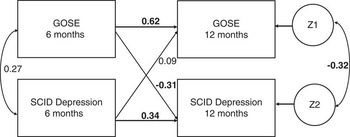
The temporal relationship between depression and functional status. GOSE = Glasgow Outcome Scale—Extended; SCID = Structured Clinical Interview for DSM-IV. Curved lines represent correlations; straight lines represent regression coefficients. Correlations and standardized regression coefficients are displayed. Z1 and Z2 are the residuals of the dependent variables. Coefficients in the model with p < .05 are printed boldly. The analysis was statistically controlled for covariates age, gender, level of education and PTA duration. These covariates are omitted from the figure.

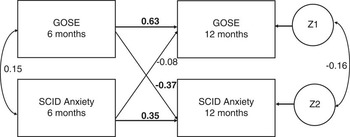
The temporal relationship between anxiety and functional status. GOSE = Glasgow Outcome Scale—Extended; SCID = Structured Clinical Interview for DSM-IV. Curved lines represent correlations; straight lines represent regression coefficients. Correlations and standardized regression coefficients are displayed. Z1 and Z2 are the residuals of the dependent variables. Coefficients in the model with p < .05 are printed boldly. The analysis was statistically controlled for covariates age, gender, level of education, and post-traumatic amnesia duration. These covariates are omitted from the figure.

Methods
Design and Participants
The data presented here are drawn from a larger, ongoing longitudinal study of psychiatric disorders after TBI (Gould, Ponsford, Johnston, & Schönberger, Reference Gould, Ponsford, Johnston and Schönberger2011). For the present study, data from 6- and 12-month follow-up were used.
Participants were individuals with TBI who were admitted to Epworth Hospital, Melbourne, for rehabilitation. The hospital provides rehabilitation to 30–50% of all TBI patients in the Australian state of Victoria, within the context of a no-fault accident compensation system. Inclusion criteria were: complicated mild to severe TBI; age at injury 16–80 years; no previous TBI or other neurological disorder; residence in Australia; and sufficient cognitive and English ability to complete interviews, as determined by the treating neuropsychologist.
Of 430 admissions to the ward between August 2005 and December 2008, 142 were ineligible (33%; predominantly due to an additional neurological condition, inadequate cognitive ability, and insufficient English knowledge), 276 were approached for research (64.2%), and 12 were not able to be contacted (2.8%). Of those approached, 172 were recruited into the study (62.3%). There were no significant differences between participants and those who were eligible but did not participate according to gender (χ2 = .7; df = 1; p = .403), age (t = 0.355; df = 286; p = .723), duration of post-traumatic amnesia (PTA; t = −0.445; df = 262; p = .656) or GCS score (t = −0.291; df = 279; p = .771). The participants had significantly more years of education (t = −2.294; df = 224; p = .023), which may be attributed to the more thorough recording method used with participants than used by medical records. By the 12-month follow-up assessment, 122 of the 172 (70.9%) remained in the study; with 10 participants later meeting exclusion criteria; 18 withdrawing from the study; and 22 unable to be contacted.
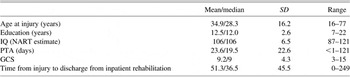
One hundred twenty-two individuals entered the study. Reflecting the general TBI population, there was a preponderance of young male participants (Table 1). The majority of participants had a severe head injury, with 26% of participants having a PTA duration (measured prospectively with the Westmead PTA scale) of seven days or less, 44% a PTA duration of eight to 28 days and 30% a PTA duration greater than 28 days. On the Glasgow Coma Scale (GCS), 38% of participants scored between 13 and 15, 15% between 9 and 12, and 47% between 3 and 8.
Participants’ demographic and injury-related characteristics (N = 122, 79% male)

Note. NART = National Adult Reading Test; PTA = post-traumatic amnesia.
Procedure
Study procedures are described in detail in Gould et al. (Reference Gould, Ponsford, Johnston and Schönberger2011). Hospital and university ethics approvals were obtained. All participants had given written consent to participate in the study. Participants completed the initial assessment during their inpatient admission or soon after discharge, following provision of written informed consent.
Measures
Demographic information was obtained using a semi-structured interview. Injury-related information was retrieved from hospital patient files. The lowest pre-intubation Glasgow Coma score measured in the first 24 hours post-injury was used as the measure of injury severity.
The presence or absence of psychiatric disorders was determined with the Structured Clinical Interview for DSM-IV (SCID; First, Spitzer, Gibbon, & Williams, Reference First, Spitzer, Gibbon and Williams2002). The SCID is a semi-structured clinical interview used to diagnose DSM-IV-TR Axis I psychiatric disorders. The SCID is often described as the gold standard for the measurement of psychiatric disorders. For the current study, the presence (coded as 1) or absence (coded as 0) of depressive and anxiety disorders was determined, firstly, at any time in the three to 6 months post-injury, and second, at any time between 6 and 12 months post-injury.
Participants’ functional status was measured with the Extended Glasgow Outcome Scale (GOSE; Wilson, Pettigrew, & Teasdale, Reference Wilson, Pettigrew and Teasdale1998). The GOSE is a global measure of functioning and disability with good inter-rater reliability (Pettigrew, Wilson, & Teasdale, Reference Pettigrew, Wilson and Teasdale2003). Outcome was rated in the categories upper good recovery, lower good recovery, upper moderate disability, lower moderate disability, upper severe disability, lower severe disability, vegetative state, or dead. The ratings were performed by a clinician based on responses to standard questions. GOSE ratings were available for 91 participants at 6 months post-injury and for 114 participants at 12 months post-injury.
Data Analysis
A Mcnemar-Bowker test was computed to determine change over time on the GOSE. Since the SCID measurement intervals were not equally long (3 to 6 months vs. 6 to 12 months post-injury), change in the rates of anxiety and depression disorders over time was not determined.
Cross-lagged analyses (Kline, Reference Kline2005) were performed to investigate the temporal relationship between anxiety, depression and functional status. These analyses were performed as path analyses within a structural equation modeling framework, using Mplus 6 (Muthén & Muthén, Reference Muthén and Muthén2010). Given the categorical nature of the SCID variables and the limited sample size, Weighted Least-Squares with Mean and Variance Correction (WLSMV; Muthén, Du Toit, & Spisic, Reference Muthén, Du Toit and Spisic1997) were used as the method of estimation of the model parameters.
In a first analysis, depression and GOSE scores at 12 months post-injury were the dependent variables. Predictors were SCID depression and GOSE scores at 6 months. According to our study hypotheses, in the model, both dependent variables were assumed to be predicted by both predictors. Furthermore, the dependent variables were assumed to be correlated with each other, and also the independent variables were correlated with each other. This is the classical structure of a cross-lagged design (Kline, Reference Kline2005; Pelz & Andrews, Reference Pelz and Andrews1964). In addition, the analysis controlled for demographic and injury-related factors by including gender, age at injury, level of education and Glasgow Coma Scale scores as predictors of GOSE and SCID at 12 months alongside and correlated with GOSE and SCID at 6 months. The model is displayed in Figure 1. Demographic and injury-related factors are omitted from the figures for the sake of clarity. Since all variables were assumed to be related to all other variables, this model had zero degrees of freedom. Therefore it did not make sense to determine the overall fit of the model. In a next step, to examine whether the prediction of GOSE from SCID differed significantly from the prediction of SCID from GOSE, the two cross-lagged paths in the model were constrained to be equal and it was tested whether the fit of this constrained model was significantly poorer than the fit of the unconstrained model. This was done by using the χ2 test that Mplus provides for comparing the fit of nested models when using the WLSMV estimator.
The cross-lagged analyses were then repeated in an identical manner, but with SCID anxiety instead of SCID depression (Figure 2).
Results
Rates of Anxiety and Depression
Rates of disorders are described in detail in Gould et al. (Reference Gould, Ponsford, Johnston and Schönberger2011) In brief, 22 (19%) participants had a depressive disorder three to 6 months post-injury, and 30 (26%) participants had an anxiety disorder during this time interval. Thirteen participants suffered from both anxiety and depression. Thirty-eight participants (31%) had a depressive disorder between 6 and 12 months, and 35 (29%) participants had an anxiety disorder in this time frame. Twenty-three participants suffered from both anxiety and depression. The most common depressive disorder was major depression. The most common anxiety disorder was anxiety disorder not otherwise specified.
GOSE Scores
At 6 months post-injury, 7% of the participants had a severe disability, 74% had a moderate disability, and 20% showed good recovery. At 1 year post-injury, 6% of participants had a severe disability, 69% had a moderate disability, and 25% had good recovery. This small improvement in functional status was not statistically significant (McNemar-Bowker t test; p = .23).
Cross-lagged Analysis
The first cross-lagged analysis examining the temporal relationship between SCID depression and GOSE (functional status) revealed the following (see Figure 1): At both 6 and 12 months post-injury, poor functional status was not significantly related to the occurrence of depression (p = .054 and p = .09, respectively). Poor functional status 12 months post-injury was predicted by poor functional status at 6 months (p < .001), but not by depression at 6 months (p > .05). The occurrence of depression between 6 and 12 months post-injury was predicted by the occurrence of depression at 6 months (p = .006) and also by poor functional status scores at 6 months (p = .048). The fit of a model in which the cross-lagged paths were constrained to be equal was not significantly poorer than the fit of the unconstrained model (χ2 test; p = .95). This means that the prediction of depression at 12 months from functional status at 6 months was not significantly stronger than the prediction of functional status at 12 months from depression at 6 months.
The second cross-lagged analysis examining the temporal relationship between SCID anxiety and GOSE (functional status) revealed the following (see Figure 2): Poor functional status was not related to the occurrence of anxiety at both 6 and 12 months post-injury (p = .23 and .41, respectively; curved lines). Poor functional status 12 months post-injury was predicted by poor functional status at 6 months (p < .001). The occurrence of anxiety between 6 and 12 months post-injury was predicted by the occurrence of anxiety at 6 months (p = .001) and also by poor functional status scores at 6 months (p = .02). The fit of a model in which the cross-lagged paths were constrained to be equal was not significantly poorer than the fit of the unconstrained model (χ2 test; p = .44). This means that the prediction of anxiety at 12 months from functional status at 6 months was not significantly stronger than the prediction of functional status at 12 months from anxiety at 6 months.
Discussion
This is the first study on the temporal relationship between anxiety and functional status following TBI. Furthermore, it is only the third study to examine the temporal relationship between depression and functional status after TBI with a cross-lagged design, and it is the first such study to use SEM analysis.
Rates of Anxiety and Depression
The high rates of anxiety and depression we found in the current study are consistent with previous research (Bombardier et al., Reference Bombardier, Fann, Temkin, Esselman, Barber and Dikmen2010; Fann et al., Reference Fann, Burington, Leonetti, Jaffe, Katon and Thompson2004; Kreutzer et al., Reference Kreutzer, Seel and Gourley2001; Whelan-Goodinson et al., Reference Whelan-Goodinson, Ponsford, Johnston and Grant2009) and underline the importance of understanding the etiology of these disorders to be able to develop effective interventions (Fann et al., Reference Fann, Hart and Schomer2009).
GOSE Scores
At both 6 and 12 months post-injury, the majority of participants had a moderate degree of disability, and some even a severe disability. This finding shows the importance of understanding the factors contributing to poor functional status after TBI.
Contrary to our expectation, no significant improvements in functional status were found. It cannot be ruled out that individuals with lasting disabilities were more willing to participate in the 12-month follow-up than individuals who were faring better. This is a potential limitation of the current study.
Cross-lagged Analysis
Overall, the occurrence of anxiety and depression were related to patients’ functional status in a rather similar manner. Contrary to previous studies (Deb et al., Reference Deb, Lyons, Koutzoukis, Ali and McCarthy1999; Draper et al., Reference Draper, Ponsford and Schönberger2007; Fedoroff et al., Reference Fedoroff, Starkstein, Forrester, Geisler, Jorge, Arndt and Robinson1992; Hibbard et al., Reference Hibbard, Ashman, Spielman, Chun, Charatz and Melvin2004; McCleary et al., Reference McCleary, Satz, Forney, Light, Zaucha, Asarnow and Namerow1998; Whelan-Goodinson et al., Reference Whelan-Goodinson, Ponsford, Schönberger and Johnston2008), no significant associations were found between functional status and depression and anxiety 6 months post-injury and at 12 months post-injury. With regard to depression, at a descriptive level, the effect sizes were small to moderate and might have been significant in a larger sample.
However, the key question in the current study was whether psychiatric status and functional status influence each other over time. As hypothesized, the occurrence of both depression and anxiety between 6 and 12 months post-injury was predicted by patients’ functional status 6 months post-injury. This finding may reflect the emotional burden that can result from the functional limitations caused by a brain injury. Interventions aimed at supporting patients in learning to live a satisfying life despite their functional limitations might therefore have the potential to reduce the likelihood of occurrence of later psychiatric disorders. Such interventions might include provision of practical domestic and community assistance, social skills training, vocational support and opportunities for leisure activities. Bombardier and colleagues (Reference Bombardier, Bell, Temkin, Fann, Hoffman and Dikmen2009) have shown how a telephone intervention aimed at improving functioning by using a problem-solving and behavioral activation approach was effective in reducing depressive symptoms 1 year after TBI. Given the strong impact that the functional consequences of a brain injury can have on a person's self-perception (Gracey, Evans, & Malley, Reference Gracey, Evans and Malley2009), it could be argued that such problem-solving interventions should be combined with psychotherapeutic sessions (Christensen, Caetano, Stuss, Winour, & Robertson, Reference Christensen, Caetano, Stuss, Winour and Robertson1999; Prigatano, Reference Prigatano1999).
While functional status 6 months post-injury was predictive of the occurrence of depression and anxiety between 6 and 12 months post-injury in the current study, the reverse was not true (even though the cross-lagged paths did not differ significantly from each other, which was likely the consequence of limited statistical power). This finding is not in agreement with the expected reciprocal relationship between depression and functional status that had been found by Gomez-Hernandez et al. (Reference Gomez-Hernandez, Max, Kosier, Paradiso and Robinson1997), using bivariate statistics. Rather, we have replicated the finding by Pagulayan et al. (Reference Pagulayan, Hoffman, Temkin, Machamer and Dikmen2008) that poor functional status preceded depression, while depression did not seem to worsen functional status. However, even though an impact of depression and anxiety on functional status could not be found in the current study, we would not rule out that such disorders can have a detrimental impact on physical health (Moussavi et al., Reference Moussavi, Chatterji, Verdes, Tandon, Patel and Ustun2007) as well as on social functioning and employment status. In any case, clinicians need to be sensitive to the potential for development of emotional changes, especially in those individuals who struggle to cope with the functional limitations in their everyday life, screen regularly for presence of depression and anxiety disorders and see that appropriate treatment is provided by trained clinicians.
Limitations
When interpreting the findings of the current study it should be kept in mind that the impact of the organic brain injury on depression and anxiety has not been examined in the current study. TBI might well have a direct impact on depression and anxiety in the first 6 months post-injury. Jorge et al. (Reference Jorge, Robinson, Arndt, Starkstein, Forrester and Geisler1993) found only early-onset depression after TBI to be related to the location of the brain injury. However, the current study focused on the time from three to 12 months post-injury. Furthermore, a multitude of factors can contribute to the development of anxiety and depression and to poor functional outcome after TBI (Fann et al., Reference Fann, Hart and Schomer2009; Jorge & Robinson, Reference Jorge and Robinson2003). Although demographic and injury-related factors were controlled for, the cross-lagged design used in the current study is obviously a simplification, since it focuses on depression, anxiety and functional status only. Future studies might choose to measure functional status in a more detailed manner than is assessed by the GOSE, using a measure that will allow it to examine the relationships between psychiatric status and the different facets of functional outcome. Finally, larger samples are required to compare the relative strength of regression paths in cross-lagged models.
Conclusion
The findings of the current study indicate that poor functional status after TBI is predictive of the development of depression and anxiety disorders. Appropriate interventions helping patients to live with their functional limitations might prevent the development of psychiatric disorders.
Further research is needed on the temporal relationship between anxiety, depression and functional status beyond the first year post-TBI, and on the development of evidence based interventions aimed at preventing psychiatric disorders as well as interventions for the treatment of anxiety and depression following TBI to maximize long-term outcome (Fann et al., Reference Fann, Hart and Schomer2009).
Acknowledgments
Funding for this study was provided by the Victorian Neurotrauma Initiative. The authors have no financial involvement or interests.