INTRODUCTION
Reproduction of mammals is markedly seasonal in the temperate zones owing to strong and predictable fluctuations in resource abundances and climatic conditions over time. Photoperiodic changes are pronounced and act as a trigger for reproductive processes (Hau Reference HAU2001). In tropical regions, environmental seasonality is less pronounced or almost absent. But, despite photoperiodic changes being minimal around the equator, many tropical animals are known to reproduce seasonally as well. Photoperiodic changes in tropical areas have long been regarded as too small to be detected (Bronson Reference BRONSON1988, Gwinner & Dittami Reference GWINNER, DITTAMI, Follett, Ishii and Chandola1985, Miller Reference MILLER1965). Although the majority of vertebrate species occurs in tropical areas, we know almost nothing about the proximate factors that trigger reproduction in tropical animals (Bronson Reference BRONSON1989, Wingfield et al. Reference WINGFIELD, HAHN, LEVIN and HONEY1992). However, from tropical birds it is known that they can use even minute photoperiodic changes for their timing of breeding (Hau et al. Reference HAU, WIKELSKI and WINGFIELD1998) and tropical mammals respond to small photoperiodic changes in experiments as well (Van Horn Reference VAN HORN1975, Wayne & Rissman Reference WAYNE and RISSMAN1991). But our understanding of how photoperiod acts on free-ranging, tropical species is still marginal.
Beside proximate factors, ultimate factors can also act as drivers for seasonal breeding. Reproduction, especially lactation, is energetically expensive (McLean & Speakman Reference MCLEAN and SPEAKMAN1999) and individual fitness depends on an optimal timing of reproduction, i.e. whether or not reproduction coincides with optimal food resources. Reproductive synchrony describes the timing of an individual's reproductive cycle with that of other individuals (Ims Reference IMS1990), e.g. oestrus synchrony. Social factors may modulate the extent to which oestrus occurs simultaneously in several females, e.g. in polygynous mating systems. Female mammals are known to synchronize oestrus to impede male mate guarding (Porter & Wilkinson Reference PORTER and WILKINSON2001), but synchronized oestrus can also increase female–female competition because fewer males are available as mating partners (Arark Reference ARARK1988, Howard Reference HOWARD1980, Kappeler & van Schaik Reference KAPPELER, VAN SCHAIK, Kappeler and van Schaik2004) as documented well in primates (Dunbar Reference DUNBAR1980, Wallis Reference WALLIS1985, Zinner et al. Reference ZINNER, SCHWIBBE and KAUMANNS1994).
Even though bats constitute the second largest mammalian order (Nowak Reference NOWAK1994, Simmons Reference SIMMONS2005) and the dominant mammalian group in tropical ecosystems (Bass et al. Reference BASS, FINER, JENKINS, KREFT, CISNEROS-HEREDIA, MCCRACKEN, PITMAN, ENGLISH, SWING, VILLA, DIFIORE, VOIGT and KUNZ2010), our knowledge about the endocrinology of bat reproduction in free-living animals is poor. While hibernating bats of the temperate zones display almost exclusively seasonal monoestry, tropical bats exhibit almost all forms of reproduction known for bats (Jerrett Reference JERRETT1979, Racey & Entwistle Reference RACEY, ENTWISTLE, Crichton and Krutzsch2000); probably because tropical ecosystems warrant the evolution of a broad spectrum of reproductive patterns and mating systems (McCracken & Wilkinson Reference MCCRACKEN, WILKINSON, Crichton and Krutzsch2000, Racey & Entwistle Reference RACEY, ENTWISTLE, Crichton and Krutzsch2000).
We studied the timing of reproduction in the Neotropical bat species Saccopteryx bilineata (Emballonuridae). We investigated whether females of a colony come into oestrus around the same time each year and whether times of oestrus are synchronized in females of the same colony. In general, we asked if reproduction is seasonal and what proximate factors may cause reproductive seasonality. We monitored female reproductive hormones (oestrogen and progesterone metabolites) and the time of oestrus from faeces collected daily between October and January from four different years, because we suspected this is the time of potential oestrus. We calculated predictability of the environment using the mathematical model of Colwell (Reference COLWELL1974), assuming that the extent of environmental predictability is affecting the reproductive pattern of organisms. We hypothesized that reproduction in S. bilineata is seasonal and influenced by climatic changes. We tested the following predictions: if reproduction is seasonal, oestrus should occur around the same time each year. If oestrus in S. bilineata is influenced by environmental factors, dates of oestrus should coincide with changes in photoperiod, rainfall and/or ambient temperature.
METHODS
Study species
Saccopteryx bilineata (Emballonuridae) is distributed from Mexico to south-eastern Brazil (Yancey et al. Reference YANCEY, GOETZE and JONES1998). During daytime, this 8-g species roosts in well-lit caves, hollow trees or in and around abandoned buildings. At night it feeds strictly on insects. Colonies can contain up to 50 individuals and are subdivided into smaller social units, so-called harems. Each harem consists of two to four females that are defended by an adult male. Groups are stable throughout the whole year. Saccopteryx bilineata exhibits a polygynous mating system (Bradbury & Emmons Reference BRADBURY and EMMONS1974). Almost all females of harems give birth to a single offspring each year. A previous study suggested that the mating season is restricted to November and December and that gestation length averages 169 d in this species (Voigt & Schwarzenberger Reference VOIGT and SCHWARZENBERGER2008). Young are weaned at an age of 10–12 wk (Yancey et al. Reference YANCEY, GOETZE and JONES1998).
Environmental parameters
La Selva receives an average of 4000 mm annual rainfall, with a short and mild dry season from January to April (Sanford et al. Reference SANFORD, PAABY, LUVALL, PHILLIPS, McDade, Bawa, Hespenheide and Hartshorn1994). During the course of our study, a weather station monitored temperature and rainfall on an hourly basis at approximately 400 m from the studied colony. We calculated the time of sunrise and sunset for each day at La Selva Biological Station using the program Astronomy Lab (Shareware – Eric Bergman-Terrell).
Sample collection
Faecal samples of S. bilineata were collected daily between October and January of the years 2001, 2005, 2006 and 2008 from a Central American colony approximately 10° north of the equator. Our study colony was situated in an abandoned building at the property of La Selva Biological Station. La Selva (10°26′N; 83°59′W) lies within the Caribbean lowlands of Costa Rica (Heredia Province) and comprises 1615 ha of privately owned tropical rain forest. All bats in the colony were marked with coloured and numbered plastic bands (AC Hughes Ltd., Sussex, UK; Size: XCL). Females were marked on the left and males on the right forearm for individual identification from a distance of up to 3 m. In general, colony members have individual roosting sites that are defended against other colony members. Thus, we monitored individual roosting sites each morning between 07h30 and 09h30. Each night, after all bats had left the colony, we collected faecal pellets from below the individual roosting sites. For this, we installed a trough made out of a 5-cm-wide fine-pored wire mesh below roosting sites from which we collected the pellets. Due to the high fidelity of individuals to their roosting sites, we were able to assign faecal samples to individual bats on an almost daily basis. Dropping were transferred into Eppendorf tubes and stored at −20 °C until shipment on dry ice to the laboratory at the Institute of Biochemistry of the University of Veterinary Medicine Vienna, Austria.
Hormone assays
We extracted oestrogen and progesterone metabolites from faecal samples using methanol and diethylether as described previously (Schwarzenberger et al. Reference SCHWARZENBERGER, FREDRIKSSON, SCHALLER and KOLTER2004, Voigt & Schwarzenberger Reference VOIGT and SCHWARZENBERGER2008). Faecal samples were weighed (range: 0.01–0.24 g) and total sample mass was adjusted to 0.5 g by adding water. Then, 1.0 ml of water and 4.0 ml of methanol were added. Samples were vortexed for 30 min, centrifuged and then 1 ml of the supernatant methanol was transferred into a new vial, mixed with 0.5 ml of a 5% NaHCO3 solution and re-extracted with 3.0 ml diethyl ether. The ether phase was transferred into a new vial and evaporated. The residue was re-dissolved and diluted with assay buffer (1:10 to 1:100 according to concentrations). Aliquots were analysed by enzyme immunoassays for immunoreactive progesterone (20-oxo-pregnane) and oestrogen metabolites as described earlier (Schwarzenberger et al. Reference SCHWARZENBERGER, FREDRIKSSON, SCHALLER and KOLTER2004, Voigt & Schwarzenberger Reference VOIGT and SCHWARZENBERGER2008). The group-specific antibodies used in the enzyme immunoassays were raised in rabbits and assays included 20-oxo-pregnanes (antibody: 5α-pregnane-3ß-ol-20-one 3-HS:BSA) and total oestrogens (antibody: estradiol-17ß-OH 17-HS:BSA). Significant cross-reactivities in the progesterone metabolite assay were those with 5-reduced steroid metabolites (pregnanes); the oestrogen assay detected oestrone and oestradiol. Assays were validated by demonstrating parallelism between standard curves and serial dilutions of faecal extracts. The intra- and inter-assay coefficients of variations for these assays ranged between 10% and 15%, respectively.
Time of oestrus
We timed day of oestrus for each female based on the increase and decrease of oestrogen and pregnane metabolites. As described by Voigt & Schwarzenberger (Reference VOIGT and SCHWARZENBERGER2008) oestrogen metabolites increase for 1–2 d in oestrous females, followed by a shallower and steady increase in pregnane metabolites. The day of oestrus was defined as an increase in oestrogen metabolites over 2–3 d that exceeded previous oestrogen concentrations by three standard deviations of baseline values. In several females we were not able to detect the day of oestrus as females left the colony sometimes for one or several days.
Calculating predictability
We calculated the predictability (P), contingency (M) and constancy (C) for oestrus times following the equations in Colwell (Reference COLWELL1974). P is defined as the sum of C and M. C describes the uniformity of the variable across time intervals within a year whereas M describes the regular seasonality of the variable across time intervals within a year. Values of P can range from zero to one, with zero describing a high unpredictability and one describing a high predictability. P can be either high because the environment is constantly the same or because fluctuations are very regular.
Statistics
Data were analysed using SPSS 13.0 (SPSS Inc., 1998, Chicago, IL, USA). We checked for normal distribution using the Kolmogorov–Smirnov test and for equality of error variance using Levene's test. Data are presented as mean ± SD and all tests were performed two-tailed at a significance level of 0.05. We used a repeated-measures analysis of variance (RM-ANOVA) to test for differences in oestrogen concentrations during pre-oestrus, oestrus and post-oestrus periods and used Mauchly's test to check for sphericity.
RESULTS
Environmental parameters
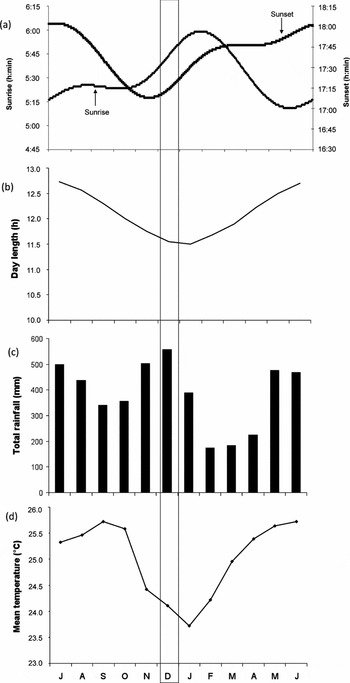
Photoperiod. The difference between the shortest and longest day at La Selva Biological Station during the course of a year is 1.2 h (Figure 1a, b). Day length increases during the first half of the year and declines during the second half. The shortest day length is 11.5 h in January and the longest is 12.7 h in July. In November, December and January, day lengths are shortest, but times of sunrise and sunset are changing (Figure 1a, b).
Times of sunrise and sunset (a), day length (b), mean total rainfall per month (c) between 2001 and 2008 and mean ambient temperature (d) between 2001 and 2008 at La Selva, Heredia Province, Costa Rica. The box represents the month when most female Saccopteryx bilineata were in oestrus.

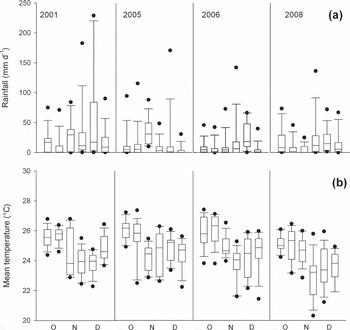
Rainfall. In general, two rainfall peaks occurred at our study site, one between June and July and another between November and December (Figure 1c). In December 2001, rainfall reached in total 1089 mm mo−1, whereas during other years December rainfall was only half or even less than that (314 mm mo−1 in 2005, 501 mm mo−1 in 2006 and 500 mm mo−1 in 2008). La Selva received peak daily rainfall during the first half of December (229 mm d−1 in 2001 and 171 mm d−1 in 2005). In 2006 and 2008, days with the heaviest rainfall occurred earlier, in the second half of November, 142 mm d−1 in 2006 and 136 mm d−1 in 2008 (Figure 2a).
Daily rainfall (a) and daily mean ambient temperature (b) between October and December in 2001, 2005, 2006 and 2008 at La Selva, Heredia Province, Costa Rica. We split each month into two parts (first half of the month: days 1–15, second half of the month: days 16–31 or days 16–30), so that each month is represented by two boxes. The box represents the median and the upper and lower quartiles. Whiskers represent the upper and lower deciles. Black dots represent values outside the upper and lower deciles.

Temperature. At the study site, mean temperatures decreased from October to January (Figure 1d and 2b) and increased again from February to September (Figure 1d). Annual difference between the month with the highest mean temperature (25.7 °C in September) and the month with the lowest mean temperature (23.7 °C in January) was 2 °C. Temperature changed most from October to November when mean temperatures decreased 1.5 °C from 25.6 °C to 24.1 °C. We found this general pattern in all investigated years (Figure 2b). In the second half of October 2001 temperature equalled 25.7 °C and decreased to 24.5 °C in the first half of November and to 23.8 °C in the first half of December. The strongest decrease in mean temperature was 1.4 °C in 2005 from end of October to the first half of November. In 2006 and 2008, mean temperatures decreased from 26.1 °C, respectively 25.1 °C at the end of October to 23.7 °C and 22.8 °C respectively, in the second half of November.
Oestrogen and progesterone metabolites
During the course of the study, the focus colony varied in the total number of resident females. While the colony contained 25 adult females in 2001, we counted only nine adult females in 2005. Between September 2006 and January 2007 the colony included five adult females and 2 y later six adult females.
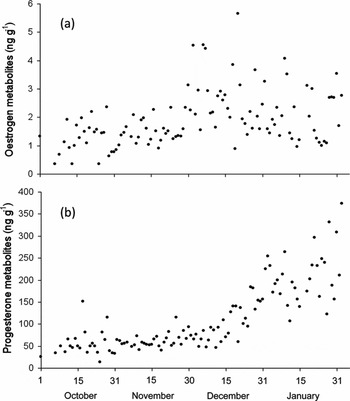
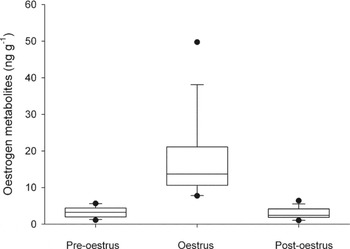
Median oestrogen and progesterone concentrations changed between October and January (Figure 3). We pooled all available oestrogen and progesterone metabolite concentrations for a Julian day of our study period. Thus, sample sizes varied from 3–24 d−1. Oestrogen metabolite concentrations averaged 18.2 ± 11.5 ng g−1 at day of oestrus (Figure 4). We analysed oestrogen metabolites 3 d before (pre-oestrus) and 3 d after (post-oestrus) the physiological oestrus and found a significant difference between concentrations before and after oestrus compared with the day of oestrus (RM-ANOVA: n = 17; df = 2, 32; F = 27.8; P < 0.0001). Pre-oestrus concentrations equalled 3.27 ± 1.45 ng g−1 and post-oestrus concentrations 2.92 ± 1.56 ng g−1. Faecal progesterone metabolites increased from November to the second half of December (Figure 3b).
Faecal oestrogen and progesterone metabolites (ng g−1) that were measured in droppings from Saccopteryx bilineata between October and January in the years 2001, 2005, 2006 and 2008 in a colony in Costa Rica. Samples were pooled for a Julian day and daily sample sizes varied from 3 to 24.

Oestrogen metabolites (ng g−1) during pre-oestrus, oestrus and post-oestrus times (n = 17) in female Saccopteryx bilineata studied in a colony in Costa Rica.

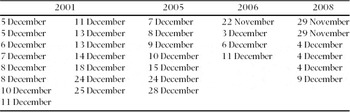
The days when females were in oestrus are summarized in Table 1. None of the females came into oestrus in October or the first half of November. Instead, oestrus times clustered during the first half of December. In 2001 and 2005, the first female came into oestrus on 5 and 7 December respectively. In 2006 and 2008, the first female came into oestrus slightly earlier, on 22 and 29 November respectively. We detected the last oestrus on 25 and 28 December in 2001 and 2005 and on the 11 and 9 December in 2006 and 2008 respectively.
Oestrus days of female Saccopteryx bilineata living in the studied colony in four years. In total, we observed 25 females in the colony in 2001 (covering 60% of them by reproductive monitoring), nine females in 2005 (78%), five females in 2006 (80%) and six females in 2008 (100%).

Oestrus predictability
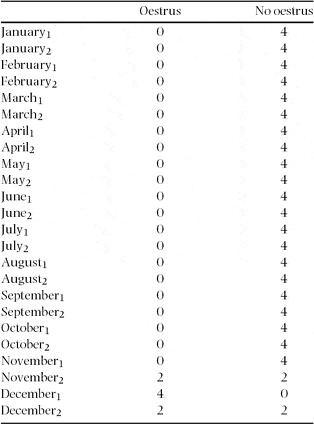
We used a frequency matrix for the reproductive state to calculate predictability (Table 2). The predictability index P for oestrus equalled 0.917. P consists of the additive components of constancy (C) and contingency (M). C was 0.586 and M was 0.331. The coefficient M/C, which is named environmental information factor Ie, equalled 0.565.
Frequency matrix for the female reproductive state (oestrus or no oestrus) by half months (i.e. January1 = 1–15 January; January2 = 16–31 January). Four years (2001, 2005, 2006 and 2008) have been investigated and the numbers represent the number of years (n = 4) in which the reproductive state occurred. Females were assigned as oestrous or not oestrous for each half month and the occurrence of oestrus in each year was added in the rows. Data from this table were used to calculate predictability, constancy and contingency.

DISCUSSION
Despite the fact that tropical climates lack strong seasonal fluctuations, reproduction of many tropical mammals is restricted to relatively short periods. Indeed, our data showed that oestrus in the small tropical bat Saccopteryx bilineata is highly predictable and clusters in the first half of December. This pattern was consistent across all studied years. Furthermore, our results revealed that female S. bilineata exhibit only one oestrus per year. Our analyses of environmental data indicated that females came into oestrus when day lengths were shortest and times of sunrise and sunset were changing and when, at the same time, heavy rainfalls and low temperatures coincided. We applied the model of Colwell (Reference COLWELL1974), which reveals that even though S. bilineata lives close to the equator it is exposed to a predictable environment based on photoperiodic and climatic information. We suggest that S. bilineata uses small photoperiodic changes as a long-term cue for reproductive timing and sudden heavy rainfalls and low temperatures as short-term cues to optimize reproduction.
Timing of reproduction
Our data on female oestrus in S. bilineata indicate a pronounced seasonality in reproduction and a seasonal monoestry in female S. bilineata. Oestrus times clustered in the first half of December. As oestrus occurs nearly at the same time each year, we used the predictability theory model of Colwell (Reference COLWELL1974) to evaluate how predictable oestrus and environmental variables are for S. bilineata. The terms P, C and M should be sufficient to describe periodic phenomena. A P value close to one indicates a high predictability and there are two possibilities of high levels of P, either a high level of constancy of resources or a high level of regularity of good environmental conditions. Knowledge of several factors that may influence periodic reproduction, as well as their combination, would be necessary to fully predict the environment for S. bilineata. Instead, we used the status (in our case: females being in oestrus or not in oestrus) for our matrix to calculate P. This approach allows us to predict the sensitivity of individuals to environmental factors (Wingfield et al. Reference WINGFIELD, HAHN, LEVIN and HONEY1992). Our calculations yielded a P value of 0.917 for oestrus timing, which reveals a high sensitivity towards environmental variables and also a high predictability of the environment. Wingfield et al. (Reference WINGFIELD, HAHN, LEVIN and HONEY1992) distinguish between two different information sources that may influence reproduction, ‘initial predictive information’ and ‘supplementary information’. The factor Ie (ratio of M and C) gives insight into the relative contributions of predictive and supplementary factors. As C is higher (0.586) than M (0.331) in the present case, the factor Ie becomes smaller than one. In our case Ie equalled 0.565. Wingfield et al. (Reference WINGFIELD, HAHN, LEVIN and HONEY1992) argued that under such circumstances, individuals are most sensitive to initial predictive information and that supplementary information is less important. Thus, S. bilineata may use predictive information like photoperiodic changes for reproductive timing with a limited sensitivity towards supplementary information, like rainfall and temperature, which is probably used to finally induce ovulation.
Proximate causes for reproductive seasonality
The most important proximate factors regulating mammalian reproduction are changes in photoperiod, light intensity, temperature and rainfall, which in turn influence food supply. The importance of photoperiod and its influence on reproductive timing was mainly studied in bats from the temperate zones (Beasley & Zucker Reference BEASLEY and ZUCKER1984, Racey Reference RACEY, Olembo, Castelino and Mutere1978). In temperate zone bats, spermatogenesis occurs in summer, but mating takes place when day lengths become short. While Racey (Reference RACEY, Olembo, Castelino and Mutere1978) found no clear evidence of photoperiod control of spermatogenesis in an experimental study, Beasley & Zucker (Reference BEASLEY and ZUCKER1984) found differences in spermatogenesis and development of accessory sex glands when bats were exposed to either short or long photoperiods. Studies on the importance of photoperiod on bats living close to the equator are rare. Some failed to find a relationship between the circannual rhythm of reproduction and photoperiod, like in the tropical bat Anoura geoffroyi (Heideman & Bronson Reference HEIDEMAN and BRONSON1994, Heideman et al. Reference HEIDEMAN, DEORAJ and BRONSON1992). In the tropical short-nosed bat Cynopterus brachyotis testis size was positively related with photoperiod (Bumrungsri et al. Reference BUMRUNGSRI, BUMRUNGSRI and RACEY2007). Also for other small tropical mammals it has been demonstrated that they can respond to photoperiodic changes, although studies focused mainly on animals held in captivity (Rissman et al. Reference RISSMAN, NELSON, BLANK and BRONSON1987). Heideman & Bronson (Reference HEIDEMAN and BRONSON1993) reported on the ability to respond to changes in photoperiod at 5° to 10° latitudes in the Syrian hamster, but also suggest that in the equatorial tropics, the use of non-photoperiodic cues may be more common because of a higher signal-to-noise ratio. For birds, Wikelski et al. (Reference WIKELSKI, HAU and WINGFIELD2000) showed that gonad growth rate is influenced by rainfall and changes in the tropical photoperiod and that the tropical seasons are as predictable for the spotted antbird (Hylophylax n. naevioides) as they are for many bird species of the temperate zones. An experimental study by Hau et al. (Reference HAU, WIKELSKI and WINGFIELD1998) revealed that spotted antbirds are able to perceive the photoperiod in Panama, which has an annual amplitude of 1 h.
Photoperiodic changes in Costa Rica are small with an annual difference of 1.2 h in Heredia Province between the longest and the shortest day, but even such small changes may be one of the proximate factors S. bilineata uses to regulate reproduction. During the second half of the year the day length is decreasing and in November and December, when females come into oestrus, day lengths are short. At the same time in November and December, times of sunrise and sunset are markedly changing. The regular seasonal variation in sunrise and sunset times might be an important signal used close to the equator (Gwinner & Dittami Reference GWINNER, DITTAMI, Follett, Ishii and Chandola1985), as has been demonstrated in plants (Borchert et al. Reference BORCHERT, RENNER, CALLE, NAVARRETE, TYE, GAUTIER, SPICHIGER and VON HILDEBRAND2005). This variation in sunrise and sunset times might also be relevant for animals living close to the equator (Hau et al. Reference HAU, PERFITO and MOORE2008).
In addition to photoperiod and once the HPG axis has been stimulated, other factors like sudden changes in rainfall and ambient temperature allow the animal to fine-tune reproductive processes (Perfito et al. Reference PERFITO, TRAMONTIN, MEDDLE, SHARP, AFIK, GEE, ISHII, KIKUCHI and WINGFIELD2004). The analyses of climatic data from Costa Rica showed that oestrus times in S. bilineata coincide with heavy rainfall and lowest temperature levels. We analysed data from four years and were able to demonstrate that female oestrus coincides with adverse climatic conditions consistently. In all four years of this study, heavy rainfall and low temperatures were detected, when females were in oestrus. In 2006 and 2008, females came into oestrus earlier than in 2001 and 2005. It emerges from the seasonal pattern of rainfall that the period of heaviest rainfall occurred during the first half of December in 2001 and 2005, but earlier in 2006 and 2008, in the second half of November respectively. These data suggest that heavy rainfall coincided with the time at which females first came into oestrus. For ambient temperatures and the timing of oestrus we found no clear link. But since heavy rainfall is usually associated with a decrease in temperature, it may be difficult to distinguish between these two variables. Our data show that female S. bilineata probably use heavy rainfall events to induce reproduction, maybe because heavy rainfall is followed by an increase in insect food supply which may reduce foraging time for the bats and can be used as a short-term cue.
Several studies investigated reproductive timing in relation to environmental factors. Heideman & Bronson (Reference HEIDEMAN and BRONSON1994), for example, proposed that Neotropical nectar-feeding bats use minor changes in precipitation to trigger reproduction. Photoperiod and rainfall can trigger processes involved in reproduction by their influence on the energy balance of an animal. Rainfall leads to an increase of insect abundance (Racey Reference RACEY and Kunz1982) and in turn to a reduction of foraging time for insectivorous bats. Energy balance and cues like photoperiod are coupled to neurons in the brain that secrete the gonadotropin-releasing hormone (GnRH) and induce the secretion of gonadotropin, which in turn can result in ovulation (Bronson Reference BRONSON2009). It is known that food deprivation can lead to reproductive inhibition (Bronson Reference BRONSON1989). The use of climatic changes for reproductive timing is known from other species as well. Studies of primates showed that the degree of reproductive seasonality is directly related to seasonal variation in environmental conditions (Fedigan & Rose Reference FEDIGAN and ROSE1995) and that timing of birth often coincides with favourable environmental conditions (Strier Reference STRIER1991). In chimpanzees, for example, the number of females in oestrus was negatively related to mean temperature (Anderson et al. Reference ANDERSON, NORDHEIM and BOESCH2006).
Ultimate causes for reproductive seasonality
Despite relatively constant photoperiod and temperatures in tropical areas, seasonal food availability is common for tropical species (Nelson et al. Reference NELSON, BADURA and GOLDMAN1990). Tropical birds use food cues to evaluate the suitability of environmental conditions for breeding (Hau et al. Reference HAU, WIKELSKI and WINGFIELD2000). For mammals, the most energy-demanding period of reproduction for females is lactation (Bronson Reference BRONSON1988). Its timing should coincide with the time of peak food abundance (Bumrungsri et al. Reference BUMRUNGSRI, BUMRUNGSRI and RACEY2007, Racey Reference RACEY and Kunz1982, Racey & Entwistle Reference RACEY, ENTWISTLE, Crichton and Krutzsch2000). It is assumed that seasonal reproduction in the tropics reflects seasonal changes in food availability (Racey Reference RACEY and Kunz1982). Rainfall has a direct influence on food abundance and is a major driver for birth intervals in many tropical bat species (Cumming & Bernard Reference CUMMING and BERNARD1997, Racey & Entwistle Reference RACEY, ENTWISTLE, Crichton and Krutzsch2000). Insect abundance at La Selva is highest during the peak of the rainy season around June (Bradbury Reference BRADBURY1979) and this coincides exactly with the time of offspring birth in the insectivorous bat S. bilineata.
Often reproduction is far more synchronized than would be expected from environmental factors alone. Reproductive cycles are also be influenced by social factors. Female reproductive synchronization could be advantageous because of cooperative breeding, reduced risk of predation on infants (Boinski Reference BOINSKI1987) and reduced harassment (Kavanagh Reference KAVANAGH and Seth1983). Oestrus synchrony may also facilitate female mate choice by reducing the chance of monopolization by males (Ridley Reference RIDLEY1986, Zinner et al. Reference ZINNER, SCHWIBBE and KAUMANNS1994). Kummer (Reference KUMMER1968) reported more sexual interactions of female baboons with ‘outsider’ males when females were simultaneously in oestrus. In the studied S. bilineata population, 71% of the offspring represent extra-harem young. Therefore harem holders do not have exclusive mating access to females of their harem, although the overall success of harem holders is still higher than in non-harem males (Heckel et al. Reference HECKEL, VOIGT, MAYER and VON HELVERSEN1999). But female synchronization can also be maladaptive because of limited access to males followed by possibly increased female–female competition (Pereira Reference PEREIRA1991).
In S. bilineata odours play an important role in courtship behaviours, mate choice (Caspers et al. Reference CASPERS, FRANKE, VOIGT, Hurst, Beynon, Roberts and Wyatt2008, Voigt & von Helversen Reference VOIGT and VON HELVERSEN1999, Voigt et al. Reference VOIGT, CASPERS and SPECK2005) and species recognition (Caspers et al. Reference CASPERS, SCHROEDER, FRANKE, STREICH and VOIGT2009). Males show hovering flights in front of females at several times of the day and do so more frequently prior and during mating season (Voigt et al. Reference VOIGT, STREICH and DEHNHARD2007). At this point, we cannot exclude the possibility that odour components could play a role in inducing female oestrus.
Bats show a high variety of reproductive patterns. Our knowledge of bat reproduction has recently increased and studying the underlying endocrinology is essential to understand reproductive activities. Our study is one of a few of its kind that focus on free-living bats. By monitoring female endocrinology on a long-term basis we showed that female reproduction is highly predictable in a bat species that lives in the tropical rainforest with less-pronounced seasonality.
ACKNOWLEDGEMENTS
The study has been conducted in accordance with the Ministerio del Ambiente y Energia (MINAE), Costa Rica and all authors declare that the study complied with the current laws of Costa Rica. The authors thank all students who contributed to sample collection and Elke Leitner who analysed our samples in Vienna. La Selva Biological Station, especially Bérnal Matarrita, is acknowledged for providing the meteorological data. The authors also highly acknowledge Hartmut Schedler who helped with the model of predictability and Danilo Brenes for his valuable support in various ways. Financial support was provided by the Deutsche Forschungsgemeinschaft (Vo 890/12).