INTRODUCTION
Depression is common and disabling (Murray & Lopez, Reference Murray and Lopez1996; USDHHS, 1999). Late-life depression and depressive symptoms are associated with functional decline, family stress, heightened risk of medical illness, less complete recovery from illness, and premature death from suicide or other causes (Unutzer et al. Reference Unutzer, Patrick, Diehr, Simon, Grembowski and Katon2000; Blazer et al. Reference Blazer, Hybels and Pieper2001; Charney et al. Reference Charney, Reynolds, Lewis, Lebowitz, Sunderland and Alexopoulos2003). In light of the prevalence of depression and its associated public health burden in older adults, it is exceedingly important to determine risk factors that are associated with both the presence and severity of late-life depressive symptoms and syndromes.
Research has established several risk factors for depression in adults and older adults, including genetic and endocrine factors (National Institute of Mental Health Genetics Workgroup, 1998; Blazer, Reference Blazer2003), personality traits (Jorm et al. Reference Jorm, Christensen, Henderson, Jacomb, Korten and Rodgers2000), conflicted relationships, and low levels of social support (Barnett & Gotlib, Reference Barnett and Gotlib1998; Blazer, Reference Blazer2003), and stressful life events (Monroe & Simons, Reference Monroe and Simons1991). Evidence is also accumulating to indicate that religious involvement may be associated with the occurrence or severity of depression (Koenig et al. Reference Koenig, McCullough and Larson2001; Smith et al. Reference Smith, McCullough and Poll2003), although there are inconsistencies regarding the nature of the associations between specific types of religiosity and depressive symptoms (Koenig et al. Reference Koenig, Hays, George, Blazer, Larson and Landerman1997a; Schnittker, Reference Schnittker2001; Baetz et al. Reference Baetz, Griffin, Bowen, Koenig and Marcoux2004).
One challenge in evaluating the literature on religion and depression is the wide variety of measures used to assess ‘religiousness’. Research conducted with adults and older adults indicates the importance of capturing at least three distinct components: A public ‘organizational’ component, that is, frequency of attending worship services; a private ‘non-organizational’ component, that is, frequency of prayer or other private religious activities; and a measure of ‘intrinsic religiosity’, that is, the salience or perceived importance of religion to the individual (Allport & Ross, Reference Allport and Ross1967; Hoge, Reference Hoge1972; Ainlay & Smith, Reference Ainlay and Smith1984; Koenig et al. Reference Koenig, Hays, George, Blazer, Larson and Landerman1997a; Baetz et al. Reference Baetz, Griffin, Bowen, Koenig and Marcoux2004).
Koenig et al. (Reference Koenig, Hays, George, Blazer, Larson and Landerman1997a) used measures of organizational and non-organizational religious activity to evaluate the cross-sectional relationships between religion, social support, physical health and depression. Investigating a large racially diverse random sample of community-dwelling American elders from the southeastern USA, and taking into account the effects of physical health and social support, they found that frequent church-goers were physically healthier and half as likely to be depressed as non-church-goers. However, in contrast to expectation, watching religious TV or listening to religious radio was associated with higher levels of depression. The authors acknowledged the limitations of their cross-sectional data and called for further research using longitudinal designs.
Findings from at least three longitudinal surveys also indicated associations between self-reported measures of religiosity and depressive symptoms, although results again varied according to the type of religious involvement examined. Braam et al. (Reference Braam, Beekman, Deeg, Smit and van Tilburg1997) conducted a 1-year longitudinal study of religious salience and depressive symptoms in community-dwelling elders in The Netherlands. Although not associated with incidence of depression, religious salience was associated with improvement in depressive symptoms, especially among those participants with chronic disease, pain or functional limitations. In a subsequent report on the 6-year course of depressive symptoms in older Dutch citizens (Braam et al. Reference Braam, Hein, Deeg, Twisk, Beekman and van Tilburg2004), they found that frequency of church attendance was inversely correlated with self-reported depression, especially among those with functional limitations. Similarly, Idler & Kasl (Reference Idler and Kasl1992) found that private religiosity attenuated the level of depressive symptoms over a 3-year period among recently disabled, community dwelling older men living in New Haven, Connecticut, although neither private nor public religiosity had an impact on subsequent depression in the sample as a whole.
Schnittker (Reference Schnittker2001) analyzed longitudinal data from a nationally representative sample of American adults followed for 3 years in order to test for linear and curvilinear effects of religious involvement on depression. The possibility of curvilinear effects emerged from previous theory and research suggesting that religion may have detrimental as well as positive effects on mental health (Schumaker, Reference Schumaker and Schumaker1992; Ross & Sastry, Reference Ross, Sastry, Axneshensel and Phelan1999). Results indicated a U-shaped effect of religious salience on self-reported depressive symptoms but no effect of religious service attendance when social integration and health factors were controlled. There was also a positive effect of ‘spiritual help-seeking’ such that those who reported more spiritual help-seeking also reported more depressive symptoms.
To summarize these longitudinal studies of community dwelling adults and older adults, most reported a relationship between some form of religious involvement and subsequent depression level, although the results are variable according to the type of religious involvement and the nature of the relationship (e.g. linear versus curvilinear). Moreover, the finding of an association between religiosity and improvement in depressive symptoms applied most specifically to those with serious physical illness or disability. It is important to note that all of these studies controlled for other explanatory variables, such as increased social interaction, that are inherent in public religious participation. However, all of these survey studies used only a brief self-report depression scale (the Center for Epidemiologic Studies – Depression; Radloff, Reference Radloff1977) to assess for depression, rather than standardized observational measures.
One longitudinal study of older adults admitted to medical in-patient services used standardized clinical assessment of depressive syndromes in addition to a brief, self-report measure. Koenig et al. (Reference Koenig, George and Peterson1998) found that higher levels of intrinsic religiosity predicted faster recovery from clinical depression in a sample of carefully diagnosed, older adult in-patients, whereas private religious activities and church attendance did not.
The present study was conducted to further investigate relationships between religious involvement and depressive symptoms in a carefully diagnosed sample of older adults recruited from primary care offices in the northeastern USA (Rochester, New York) and followed longitudinally for 1 year. We conducted standardized observational assessment of depressive symptoms across time in a primary care sample, while controlling statistically for the effects of medical illness burden and social interaction. Based on previous findings, we predicted that baseline measures of religious involvement would be inversely related to depressive symptoms in both cross-sectional and longitudinal linear analyses. Given the mixed nature of previous studies and because some have reported curvilinear effects of religiosity on depressive symptoms (Schnittker, Reference Schnittker2001; Abernethy et al. Reference Abernethy, Chang, Seidlitz, Evinger and Duberstein2002), we simultaneously tested for curvilinear relationships between religious involvement and depressive symptoms. That is, we tested whether moderate levels of religious involvement would be associated with decreased levels of depression or depressive symptoms, whereas extremely high or low involvement would be associated with increased depression.
METHODS
Setting and patients
The study methods, including a detailed description of sampling procedures, have been described previously (Seaburn et al. Reference Seaburn, Lyness, Eberly and King2005). In brief, we attempted to enroll all patients age 65 years or older who presented for care on selected days from participating primary care offices in internal medicine and family medicine, including private practice and hospital-based clinic settings. Potentially eligible participants were asked for permission to approach them by telephone after their primary care appointment, to ask about study participation. Consenting patients, constituting 50·1% of all potentially eligible participants, were then called in the order in which they were first seen until that week's allotment of study interview slots was filled. All participants who gave written informed consent, using procedures approved by the University of Rochester Research Subjects Review Board (RSRB), subsequently underwent in-person, semi-structured interviews by a trained rater in their homes or University of Rochester research offices. Research staff also reviewed each subject's primary care medical chart, extracting all recorded information about mood and cognitive symptoms, disorders, or treatments, as well as active and past medical problems and current medications. The semi-structured interviews included the Structured Clinical Interview for DSM-IV (SCID; Spitzer et al. Reference Spitzer, Gibbon and Williams1994), the results of which were used only for descriptive purposes in this study, that is, to describe the initial diagnostic presentation of our sample. Interviews and chart reviews were conducted at study intake and again at 1-year follow-up, supplemented by interim structured telephone interviews which included repeated assessment of depressive symptoms 6 months after study intake.
Measures
The Geriatric Depression Scale (GDS; Sheikh & Yeasavage, Reference Sheikh and Yesavage1986) was used to compare enrolled and non-enrolled individuals from the primary care offices. For primary study analyses, depressive symptom severity was assessed with the 24-item Hamilton Rating Scale for Depression (HAMD; Williams, Reference Williams1988), an examiner-rated instrument that has been widely used and validated in older and medically ill populations. In our research group, inter-rater reliability has been high, for example an intra-class correlation coefficient of 0·93 for the HAMD (based on six raters and five subjects), and κ-coefficients for the diagnoses of mood disorders ranging from 0·66 to 0·86 (p=0·0003, based on six raters and three subjects).
Religious involvement was measured by the Duke Religion Index (DRI; Koenig et al. Reference Koenig, Parkerson and Meador1997b), a six-item self-report scale of public-organizational, private-non-organizational, and intrinsic religiosity. Public-organizational religiosity (ORA) was assessed by a single item asking, ‘How often do you attend church or other religious meetings?’ Response choices encompassed a six-point scale ranging from ‘1’ (‘Never’) to ‘6’ (‘More than once a week’). Likewise, private-non-organizational religiosity (NORA) was measured by a single item asking, ‘How often do you spend time in private religious activities, such as prayer, meditation or bible study?’ with response choices ranging from ‘1’ (‘Rarely or never’) to ‘6’ (‘More than once a day’). Intrinsic religiosity (IR), a concept established by Allport & Ross (Reference Allport and Ross1967) to reflect an individual's subjective sense of the degree of his or her spirituality, was measured using the sum of three items: ‘In my life I experience the presence of the Divine,’ ‘My religious beliefs are what really lie behind my whole approach to life,’ and ‘I try hard to carry my religion over into all other dealings in life.’ For each item, response choices ranged on a five-point scale from ‘1’ (‘Definitely not true’) to ‘5’ (‘Definitely true of me’). Participants rating any DRI item as ‘not applicable’ or ‘don't know’ were removed from the analyses.
Medical illness burden was measured by the Cumulative Illness Rating Scale (CIRS; Linn et al. Reference Linn, Linn and Gurel1968), a validated measure of the amount of pathology in each organ system. The CIRS was completed by a physician-investigator (J.M.L.) based on information extracted from the primary care chart as well as participant interviews.
Social support was measured by the social interaction subscale of the Duke Social Support Inventory (DSSI-SI; Landerman et al. Reference Landerman, George, Campbell and Blazer1989), a four-item scale that assesses the number of non-family members to whom one feels close within 1 hour of travel, the frequency of interactions in the past week with others outside of work and not living with the participant, and the number of non-work phone conversations in the past week. The fourth item asks about attendance at meetings, religious and otherwise. It was omitted because of the confound with religious involvement assessed by the DRI. It should be noted, however, that this approach does not allow for specific assessment of church-related support that could at least partially account for positive health effects. Responses to all items of the DSSI-SI ranged from ‘0’ to ‘1–4’ to ‘⩾5’.
Data analysis
Data analysis was conducted using SAS version 9.1. Descriptive statistics were reported in terms of means and standard deviations. Collinearity between the three religious variables (ORA, NORA and IR) and between the religious variables, DSSI-SI, and CIRS was checked. The condition index for the religious variables was 2·28, indicating that the variables were not highly correlated. Likewise, the religious variables, DSSI-SI, and CIRS were not highly correlated, as indicated by a condition index of 2·29. To test for relationships between religious involvement and depressive symptoms, linear and curvilinear (quadratic) analyses were conducted (α<0·05, two-tailed). Quadratic terms were constructed using centralized values of the first-order terms in order to reduce correlations.
Cross-sectional analyses
A general linear model was used that included quadratic and linear terms of each of the three religious measures as independent variables and HAMD score as the dependent variable. Age, gender, CIRS and DSSI-SI were included as covariates because of their established associations with depression or religiosity (e.g. Ainlay & Smith, Reference Ainlay and Smith1984; Piccinelli & Wilkinson, Reference Piccinelli and Wilkinson2000). Inferences for these cross-sectional regression analyses were based on generalized estimating equations (GEE) so that no distribution was assumed for the response variables. This approach increases the robustness of the results (Liang & Zeger, Reference Liang and Zeger1986; Hanley et al. Reference Hanley, Negassa, Edwardes and Forrester2003; Das et al. Reference Das, Poole and Bada2004).
Longitudinal analyses
These were conducted as above except that 1-year HAMD score was used as the dependent measure, with baseline HAMD used as a covariate. Antidepressant treatment was not covaried, as it was not independently associated with depression outcome in naturalistically followed primary care cohorts, probably due to confounding by indication (Lyness et al. Reference Lyness, Caine, King, Conwell, Duberstein and Cox2002, Reference Lyness, Heo, Datto, Ten Have, Katz, Drayer, Reynolds, Alexopoulos and Bruce2006). As in the cross-sectional analyses, inferences for the regression models were based on the distribution-free GEE to improve the robustness of study findings. Note that by including baseline depression in the model, we addressed the potential dependence of the probability of the missing outcome at 1-year follow-up on the baseline response; i.e. the missing at random (MAR) assumption (Rubin, Reference Rubin1976).
RESULTS
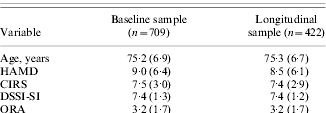
Of 1415 participants approached for study enrollment, 709 (50·1%) completed intake assessments. As reported elsewhere (Sanders et al. Reference Sanders, Lyness, Eberly, King and Caine2006), while complete information on non-enrolled subjects was not available due to privacy considerations established by the Health Insurance Portability and Accountability Act (HIPAA; USDHHS, 2003), enrolled participants did not differ from non-enrolled patients on age, gender, or GDS (Sheikh & Yeasavage, Reference Sheikh and Yesavage1986) based on available baseline data. This completion rate was consistent with previous work in primary care settings (Schulberg et al. Reference Schulberg, Mulsant, Schulz, Rollman, Houck and Reynolds1998). The enrolled participants included 448 women (63·2%), and comprised 653 (92·4%) Caucasians, 39 (5·5%) African-Americans, and 15 (2·1%) individuals from other racial or ethnic groups. They ranged in age from 65 to 97 years, with a mean age of 75·2 years (s.d.=6·9). In terms of religious affiliation, 315 (44%) identified themselves as Protestant, 230 (32%) as Catholic, 81 (11%) as Jewish, 42 (7%) as ‘other’ religion, and 32 (5%) as having no affiliation. Religious affiliation was not answered for nine individuals (1% of sample). Forty (5·6%) had current major depression and 47 (6·6%) had current minor depression, consistent with prevalence studies of primary care elderly (Schulberg et al. Reference Schulberg, Mulsant, Schulz, Rollman, Houck and Reynolds1998; Lyness et al. Reference Lyness, Caine, King, Cox and Yoediono1999). HAMD scores ranged from 0 to 37 with a mean of 9·0 (s.d.=6·4). Other descriptive results, including mean (s.d.) scores on the DSSI-SI, CIRS, and the three DRI scores are shown in Table 1.
Comparison of mean (s.d.) descriptive variables for baseline and longitudinal samples
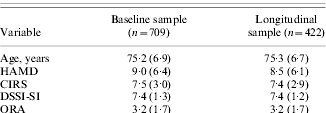
HAMD, Hamilton Rating Scale for Depression (Williams et al. Reference Williams1988); CIRS, Cumulative Illness Rating Scale (Linn et al. Reference Linn, Linn and Gurel1968); DSSI-SI, Duke Social Support Inventory – Social Interaction subscale (Landerman et al. Reference Landerman, George, Campbell and Blazer1989); ORA, Duke Religion Index – Organizational Religiosity (Koenig et al. Reference Koenig, Hays, George, Blazer, Larson and Landerman1997b); NORA, Duke Religion Index – Non-Organizational Religiosity (Koenig et al. Reference Koenig, Hays, George, Blazer, Larson and Landerman1997b); IR, Duke Religion Index – Intrinsic Religiosity (Koenig et al. Reference Koenig, Hays, George, Blazer, Larson and Landerman1997b).
One-year follow-up assessments were completed on 422 (59·5%) of the 709 original participants. Fourteen (2%) of the original participants died within 1 year of the start of the study. Those who completed 1-year follow-up did not differ from those who were not followed longitudinally in terms of age, gender, ORA, CIRS, or DSSI-SI. However, they did differ in terms of baseline HAMD score and religiosity such that those who were assessed at follow-up had lower HAMD scores (χ2=6·94, df=1, p<0·01) and were more likely to endorse private religiosity (χ2=8·64, df=1, p<0·01) and intrinsic religiosity (χ2=5·12, df=1, p<0·05). Means (s.d.s) of descriptive and study variables for the baseline and longitudinal samples are presented in Table 1.
Cross-sectional effects of religious involvement on depression
Cross-sectional analyses
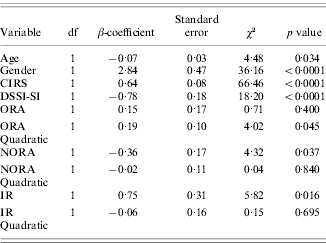
Controlling for age, gender, medical illness burden and social interaction, there was a statistically significant U-shaped relationship between ORA and baseline HAMD score (χ2=4·02, df=1, β-coefficient=0·19, s.e.=0·10, df=1; p<0·05; see Table 2). Mean (s.d.) HAMD score for those participants scoring extremely low (i.e. ‘1’), low (i.e. ‘2’ or ‘3’), high (i.e. ‘4’ or ‘5’) or extremely high (i.e. ‘6’) on ORA were 8·57 (s.d.=6·07), 8·28 (s.d.=5·63), 8·73 (s.d.=6·42) and 11·40 (s.d.=7·83), respectively. Although there were no curvilinear associations between baseline HAMD score and NORA, or baseline HAMD and IR, the regression model did reveal significant linear associations between baseline HAMD and these two religious measures (see Table 2). Consistent with the study hypothesis, private, non-organizational religious involvement was associated with less depression (‘NORA’: χ2=4·32, df=1, β-coefficient=−0·36, s.e.=0·17, p<0·05). Contrary to our hypothesis, intrinsic religiosity was positively associated with HAMD score, such that greater intrinsic religiosity was associated with more depressive symptoms (‘IR’: χ2=5·82, df=1, β-coefficient=0·75, s.e.=0·31, p<0·05).
Cross-sectional regression of primary study variables on Hamilton Rating Scale for Depression (HAMD) (sample size: 675)
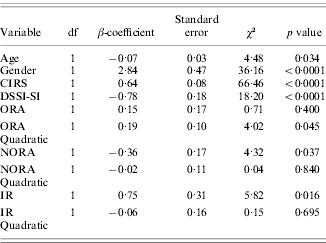
CIRS, Cumulative Illness Rating Scale (Linn et al. Reference Linn, Linn and Gurel1968); DSSI-SI, Duke Social Support Inventory – Social Interaction subscale (Landerman et al. Reference Landerman, George, Campbell and Blazer1989); ORA, Duke Religion Index – Organizational Religiosity (Koenig et al. Reference Koenig, Hays, George, Blazer, Larson and Landerman1997b); NORA, Duke Religion Index – Non-Organizational Religiosity (Koenig et al. Reference Koenig, Hays, George, Blazer, Larson and Landerman1997b); IR, Duke Religion Index – Intrinsic Religiosity (Koenig et al. Reference Koenig, Hays, George, Blazer, Larson and Landerman1997b).
Longitudinal analyses
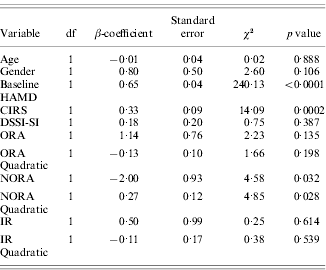
As shown in Table 3, the general linear model revealed a significant U-shaped relationship between NORA and 1-year HAMD score such that individuals with extremely high or low NORA tended to have more depression (χ2=4·85, df=1, β-coefficient=0·27, s.e.=0·12, p<0·05). Mean (s.d.) HAMD score for those scoring extremely low, low, high, or extremely high on NORA, were 9·78 (s.d.=6·63), 8·76 (s.d.), 8·30 (s.d.), and 9·49 (s.d.), respectively. As shown in Table 3, baseline HAMD and CIRS scores were associated with 12-month HAMD.
Results of regression of primary study variables on 1-year Hamilton Rating Scale for Depression scores (HAMD) (sample size: 402)
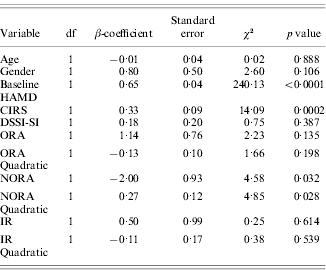
CIRS, Cumulative Illness Rating Scale (Linn et al. Reference Linn, Linn and Gurel1968); DSSI-SI, Duke Social Support Inventory – Social Interaction subscale (Landerman et al. Reference Landerman, George, Campbell and Blazer1989); ORA, Duke Religion Index – Organizational Religiosity (Koenig et al. Reference Koenig, Hays, George, Blazer, Larson and Landerman1997b); NORA, Duke Religion Index – Non-Organizational Religiosity (Koenig et al. Reference Koenig, Hays, George, Blazer, Larson and Landerman1997b); IRI, Duke Religion Index – Intrinsic Religiosity (Koenig et al. Reference Koenig, Hays, George, Blazer, Larson and Landerman1997b).
CONCLUSIONS
Previous studies conducted with samples of seriously ill or community-dwelling elders have underlined the complexity of the relationships between religious involvement and depression (Koenig, Reference Koenig, Hays, George, Blazer, Larson and Landerman1997a; Schnittker, Reference Schnittker2001; Smith et al. Reference Smith, McCullough and Poll2003). Consistent with those reports, this investigation of older adults recruited from primary care offices revealed different associations between religiosity and depression, depending on the type of religious involvement examined.
We found that those participants who initially reported extremely high or low engagement in private religious activity such as prayer, meditation or Bible study were more depressed at 1-year follow-up than those reporting moderate amounts of such activity. However, participants who were unavailable for follow-up were more depressed and less privately or intrinsically religious at baseline than the rest of the sample. Although we did control for these baseline differences in the analyses, this finding should be interpreted cautiously until replicated by future studies.
What mechanisms might account for the apparent relationship between private religiosity and depressive symptoms? Koenig et al. (Reference Koenig, Hays, George, Blazer, Larson and Landerman1997a), Schnittker (Reference Schnittker2001), and Smith et al. (Reference Smith, McCullough and Poll2003) have posited that religious involvement in general may reduce vulnerability to depressive symptoms through a variety of psychosocial and health-related mechanisms, including enhanced social support and improved health (Koenig et al. Reference Koenig, Hays, George, Blazer, Larson and Landerman1997a; Smith et al. Reference Smith, McCullough and Poll2003). However, our study controlled for both medical burden and social interaction, the latter of which would be less expected to have an inherent association with private religiosity. As well, if these mechanisms were operative, we would have expected to find longitudinal associations with other forms of religiosity in addition to the private component.
Other potential explanations for our finding include the possibility that those elders reporting moderate levels of private religiosity are better able to make positive appraisals of life experiences through activities such as prayer, meditation or Bible study. Pargament (Reference Pargament1997) argued that religiously involved individuals have enhanced resources for decreasing the stressful nature of life events. Perhaps private religiosity is an important vehicle for religious coping in a primary care sample of older adults because it can be employed at any time and any place, regardless of one's circumstances. Further studies of primary care elders using measures of positive and negative religious coping (cf. Pargament et al. Reference Pargament, Koenig and Perez2000) are needed to further examine this question.
It is also important to account for the curvilinear shape of the longitudinal association between private religious involvement and depression. One potential explanation involves the role of self-perceptions (Shaver et al. Reference Shaver, Lenauer and Sadd1980; Schnittker, Reference Schnittker2001). Extremely high levels of religious involvement may be associated with decreased perceptions of personal control or self-efficacy (Schumaker, Reference Schumaker and Schumaker1992). Conversely, extremely low levels of religiosity may be associated with a tendency to take too much responsibility for problems, focusing excessively on personal failings as the cause for life's difficulties. Studies of the relationships between religious involvement and factors such as self-efficacy, self-esteem or locus of control in older adults are rare but much needed. These interpretations of our findings remain speculative until confirmed by future studies.
Although cross-sectional results must be interpreted most cautiously, they were examined here for the purpose of comparison with previous studies. Contrary to expectation and earlier reports (Braam et al. Reference Braam, Beekman, Deeg, Smit and van Tilburg1997; Koenig et al. Reference Koenig, Hays, George, Blazer, Larson and Landerman1997a; Strawbridge et al. Reference Strawbridge, Shema, Cohen and Kaplan1998; Baetz et al. Reference Baetz, Griffin, Bowen, Koenig and Marcoux2004), we did not find evidence of an inverse, linear relationship between organizational religious activity and depressive symptoms. Instead, we found a U-shaped relationship such that those reporting moderate levels of attendance at religious services were less likely to be rated as depressed. Consistent with expectation, we found that self-reported frequency of private, non-organizational religious involvement was inversely related to HAMD depressive symptoms; that is, those reporting greater involvement were rated as less depressed.
Consistent with the findings of Baetz et al. (Reference Baetz, Griffin, Bowen, Koenig and Marcoux2004), we detected an unexpected positive association between intrinsic religiosity and depressive symptoms in cross-sectional analyses, indicating that those who rated religion as more salient in their lives were rated as more depressed. These results stand in contrast to previous findings from medical in-patient samples that higher levels of intrinsic religiosity were associated with faster recovery from clinical depression (Koenig et al. Reference Koenig, George and Peterson1998) or fewer self-reported depressive symptoms (Koenig et al. Reference Koenig, George and Titus2004).
This divergence in findings could result from inherently different meanings of ‘intrinsic religiosity’ across samples of older adults with varied degrees of medical illness. Our primary care sample represented a range of illness severity, but more closely approximated the community sample of Baetz et al. (Reference Baetz, Griffin, Bowen, Koenig and Marcoux2004) who also reported a positive association of intrinsic religiosity with depressive symptoms. Perhaps belief in the central importance of religion is more protective when one is seriously medically ill because religion offers a world view consistent with benign interpretations of illness and death (Koenig et al. Reference Koenig, Hays, George, Blazer, Larson and Landerman1997a). Indeed, it has been noted that inverse associations of religiosity with depression are strongest in those with chronic illness or disabilities, or in those facing multiple or severe life stressors (Koenig, Reference Koenig, Hays, George, Blazer, Larson and Landerman1997a; Schnittker, Reference Schnittker2001; Smith et al. Reference Smith, McCullough and Poll2003).
As noted previously (Koenig, Reference Koenig, Hays, George, Blazer, Larson and Landerman1997a; Schnittker, Reference Schnittker2001; Smith et al. Reference Smith, McCullough and Poll2003), cross-sectional associations must be interpreted most cautiously and cannot be used to establish causality. Even though our study improved on some previous investigations by using an observer-rated measure of depression that was less likely to be confounded with other self-report measures, we consider these cross-sectional findings to be quite tentative until replicated in further longitudinal studies of primary care patients.
As a further methodological caution, it should be noted that our study employed very brief, one- to three-item measures of religious involvement and did not comprehensively address other aspects of religiosity such as spiritual help-seeking, religious coping, or satisfaction with one's religious affiliation. Therefore, it may be that we would have detected more associations or different associations of religious involvement and depression had we used more comprehensive measures, especially those that allow for assessment of both positive and negative forms of religiosity (Pargament et al. Reference Pargament, Koenig and Perez2000; Smith et al. Reference Smith, McCullough and Poll2003). Similarly, the measure of social support did not address socialization with fellow churchgoers, so we were unable specifically to examine or control for this type of social interaction.
As an additional concern, our sample of community dwelling elders recruited from primary care offices did not allow for generalization of findings to other populations of older adults, for example, clinical samples of depressed older adults, medical in-patients, or community-dwelling elders who might be reluctant to seek medical care. Moreover, only about half of those eligible to participate did so, making it more difficult to extend our findings to the entire population of older adults visiting out-patient primary care practices.
Despite these methodological limitations, our results support the existence of a relationship between religious involvement, especially private religiosity, and depressive symptoms in a sample of older adults recruited from primary care offices. Further longitudinal studies of primary care samples using more comprehensive measures of religious involvement, careful controls for various types of socialization and medical illness, and both linear and non-linear statistical methods are needed to confirm these findings and elucidate potential explanatory mechanisms.
ACKNOWLEDGEMENTS
This work was supported by NIMH R01 MH61429 and K24 MH071509 (J.M.L.). We wish to thank the patients, staff and providers of the following primary care practices: University of Rochester Medical Center Department of Medicine, Pulsifer Medical, East Ridge Family Medicine, Highland Family Medicine, Olsan Medical, Clinton Crossings Medical, Panorama Internal Medicine, Highland Geriatric Medicine, and Culver Medical. We also thank the following for their technical assistance: Karen Gibson, M.S.Ed., Constance Bowen, M.A., James Evinger, M.Div., Cameron Gardner, M.D., Michael New, Andra Niculescu, M.D., Jean Sauvain, B.S., Jill Scheltz, B.A., L.M.T., and Judy Woodhams, M.F.A.
DECLARATION OF INTEREST
None.