Introduction
The concept of the linguistic landscape (henceforth LL) includes all linguistic objects that characterise public environments, including but not limited to warning signs, instructions, public road signs, advertising billboards and posters, street names, graffiti, and notices on government and nongovernment buildings (Landry & Bourhis, Reference Landry and Bourhis1997: 25). There is no doubt that the LL is a very significant domain for the examination of the cultural, socio-political, and economic changes that occur in a speech community (Backhaus, Reference Backhaus2007; Gorter, Reference Gorter2017; Jaworski & Thurlow, Reference Jaworski and Thurlow2010; Pakarinen & Björklund, Reference Pakarinen and Björklund2017). The use of the LL approach to analyse how English is constructed and negotiated in the Jordanian context can provide new and important insights and evidence into the wide spread of English in a little-explored area, and can contribute to our understanding of the use of English as a global language.
This paper investigates the use of English in the LL of Jarash, Jordan. Located in the north of the country, about 30 miles from the capital Amman, and bordering Almafraq to the east, Zarka to the southeast, and Irbid to the north, Jarash is characterised by constant change and activity. However, it is also one of the most ancient cities in Jordan, and so is an important attraction for foreign tourists. In recent years, the city has become increasingly globalised, paving the way for the extensive use of English throughout the commercial LL.
To establish links between language(s) and types of stores against a background of clearly conflicting language policies (Spolsky, Reference Spolsky2004), and to provide important insights into the use of English in the Jordanian commercial domain, I divided the signs into four categories, i.e. supermarkets and grocery stores, fashion stores, electronics stores, and other stores, such as hair salons and pharmacies. The theoretical assumption behind this paper is that the high display of English is associated with businesses selling relatively expensive, occasional goods (e.g. fashion stores), while businesses selling relatively cheap, everyday goods (e.g. grocery stores) are assumed to be more linguistically represented in Arabic than in English.
Although the use of English as a sign of modernity and commerce is not a new phenomenon in the Jordanian context, it has been extensively reinforced since the dissolution of the Soviet Union in 1991. The concept of glocalisation is here deployed as a critical approach to examine the role of English in the Jordanian context. This glocal approach towards the proliferation of English assumes that English is not fixed, but changes according to circumstances, regions and communities in which it is used. This is displayed in the hybrid and creative linguistic forms used in the Jordanian commercial written context. One example of this glocalisation is the use of Arabizi, also known as Romanised Arabic, which is the practice of the transliteration of Arabic into Roman letters and Arabic numerals.
Data
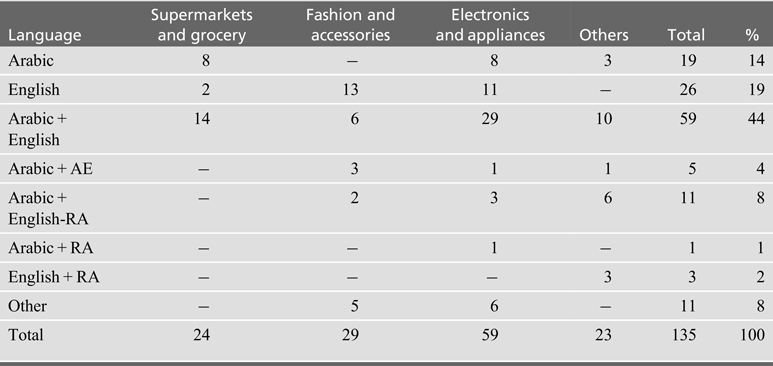
The corpus of this study was obtained from 135 signs on the fronts of supermarkets, fashion stores, computer and electronics stores, pharmacies, hair salons, and mobile phone stores. International brand names, such as the most widespread in this context being Pepsi, Coca Cola, Beko, and Samsung, were not included in the study. Slogans, normally inscribed in English, were coded according to the language of origin. Local brand names, such as National Paints and National Electric were coded according to the language of origin. Official signs, including municipal signs and inscriptions on government buildings, were excluded. The signs were photographed using a digital camera between April and May 2016. As displayed in Table 1, all signs were coded according to monolingual, i.e. English and Arabic, bilingual, i.e. English-Arabic, Arabicised English (AE), Romanised Arabic (RA), and English-RA, and trilingual, i.e. Arabic-English-RA signs.
Summary of languages used in the LL of Jarash city centre

The data for the current study were collected in the central part of Jarash. The area was deliberately selected based on its high concentration of businesses such as supermarkets, grocery shops, fashion stores, electronics stores, hair salons, laboratories, and pharmacies. The historical sites of ancient Jarash were not surveyed, since it was considered that the data would be distorted by the need to cater to foreign tourists. The signs collected from shop names, brand names, billboards, and advertising posters were defined following Backhaus (Reference Backhaus2007: 55) as ‘any piece of written text within a spatially definable frame’. Thus, all LL items visible to passers-by were considered, with the exception of non-commercial signage such as official signs and graffiti, which were excluded as irrelevant to the research hypothesis. An approximately 200-metre stretch of the centre of commercial Jarash was examined. Commercial signs were first coded according to language/script, i.e. Arabic, English, and Arabizi and store type, i.e. Supermarkets and Grocery, Fashion and Accessories, Electronics and Appliances, and Others, which were mainly pharmacies and hair salons.
Results and discussion
As Table 1 shows, within the 135 signs recorded in Jarash city centre, English is the dominant language with 26 signs, nearly 19% of all signs, recorded. Monolingual Arabic signs are less used with only 19 signs, approximately 14% of all signs. Of a total of 59 signs, the bilingual pattern English-Arabic is the most common multilingual pattern of the LL of Jarash.
Nevertheless, English does not necessarily only appear in Roman script. English in Arabic script alongside Arabic appears on five signs, 4% of all signs, while Arabic in Roman script alongside Arabic and/or English is found on 15 signs, 12% of all signs. In many cases, Arabic appears in Roman script, examples of which include proper names such as Maher and Al-Swaidi. Not only might English be provided in Arabic script on fashion and electronics stores and hair salons, such as shop names مسايا (Messiah), كيوت (Cute), and رويال (Royal), but also the names of some stores are provided in RA, especially on the fronts of hair salons and mobile phone stores, for example Al-Jelany (الجيلاني) and Haboosh (هبوش).
There is no question that the high visibility of English in commercial signage is consistent with other studies (Schlick, Reference Schlick2003; Griffin, Reference Griffin2004; Backhaus, Reference Backhaus2007; Hasanova, Reference Hasanova2010; Pavlenko, Reference Pavlenko, Shohamy, Ben–Rafael and Barni2010; Alomoush, Reference Alomoush2015; Selvi, Reference Selvi2016) that present credible evidence for the increasing symbolic status of English as a universal language. Neither on the fronts of supermarkets nor on those of grocery shops are there any examples of mixed codes. On the contrary, the high frequency of code-mixing practices on other shopfronts, as Table 1 suggests, brings together and enhances linguistic innovation and creativity in the LL. The transliteration of English words into Arabic script is so popular that it reinforces social interaction in order to convey ‘a cosmopolitan air rather than to attract an audience proficient in English’ (Huebner, Reference Huebner and Gorter2006: 41). Other studies (Cenoz & Gorter, Reference Cenoz, Gorter and Gorter2006; Barni & Bagna, Reference Barni, Bagna, Gorter and Shohamy2009) suggest that English plays an insignificant role in bringing about any ethnographic significance or ethnolinguistic consideration of new and ancient minority languages, and the Arabicising of English words shown in Table 1 appears to confirm this.
Supermarkets and grocery shops
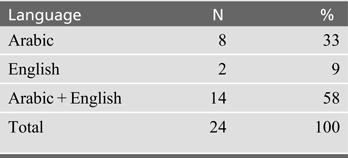
Central Jarash has many supermarkets and grocery shops. As Table 2 shows, 24 signs, nearly 18% of all signs, are found on shopfronts. In the analysis of the data recorded in commercial central Jerash, 14 (58%) out of 24 signs are provided in both Arabic and English while eight (33%) and two (9%) monolingual signs are presented in Arabic and English, respectively. The less affluent location of the storefronts is a decisive factor contributing to the overall higher presence of Arabic than English.
Numbers and percentages of languages on fronts of supermarkets and grocery shops

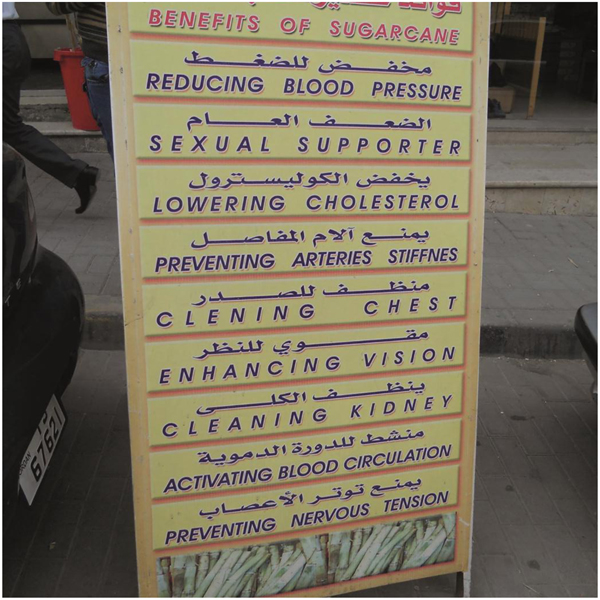
Most of the English wording either duplicates translations from Arabic (see examples in Figure 1), or provides a combination of a monolingual instruction and brand name on the same sign, such as the instruction Push and Extra chewing gum produced by the Wrigley company. The sign in Figure 1 is inscribed in both Arabic and English, but it is also appealing to young Jordanians who are often taught the necessary knowledge and skills required to interact and communicate in English.
English-Arabic bilingual advertisement in front of a grocery shop

On the one hand, most of the signs used are translations from Arabic into English and vice versa on traditional and non-traditional shopfronts, including Push, Open, and New Gum, Wrigley's Extra signs, business names, such as No Way منير للهدايا, the Arabic wording of which reads/munji:r lilhada:ja:/ ‘Muneer for Gifts’, and two advertisements outside a supermarket (Figure 2). On the other hand, the monolingual Arabic signs are six Quranic verses and sayings uttered by the prophet Muhammad such as بسم  الرحمن الرحيم meaning ‘In the name of Allah, the most gracious, the most merciful’, and two business name signs such as الفيحاء للمواد التمونية that read /ʔalfajħa:ʔ lalmawa:d ʔatamwi:nijah/ ‘Alfihaa for Food Supplies’, while the English signs are just two occurrences of the business name Market for Fun.
English used on an Islamic clothing shop sign

It is surprising that the phenomenon of Arabizi, which is brought about by a combination of CMC (computer-mediated communication) and globalisation, a process through which young generations of Arabs are currently using new media and growing up with it, is absent on supermarkets. Both, Arabic in Roman script and English in Arabic script, are commonly used on commercial stores, but it seems that the names of new products and innovative concepts, seemingly much more used on fashion stores, electronics, and other stores, are rarely used on these stores. According to the data collected in this study, supermarkets tend to include all types of food available in Arabic rather than in English, Arabizi, or AE. This can be partly attributed to the fact that the shopping area where the signs were recorded is not one of Jordan's more affluent. Bilingual and multilingual signs on shopfronts do occur frequently in Jordan's most affluent shopping areas (Alomoush, Reference Alomoush2015).
Fashion and accessory stores
It is worth mentioning that shopping in the Jordanian marketplace is normally exhausting and carried out in the town's busiest shopping streets. It can be done in shops and shopping malls and on shopping pushcarts, many of which are municipally licensed in return for paying monthly taxes. Fashion stores in Jordan are very much visited by women and men alike, so that central Jarash is abundant in fashion stores. Fashion and design have recently started to constitute an essential component of Jordan's cultural life. It is not unusual to see that Western fashion, including winter, autumn, spring, and summer fashion accessories and clothing, has been more and more popular than in the past, especially among the younger generations.
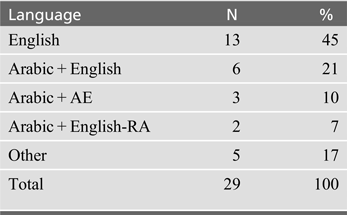
As Table 1 shows, one in every five signs (20%) is associated with fashion and accessory stores. In order to emphasise the high quality of the products sold as well as the latest fashions and trends, many store owners tend to choose English names for their shops. Most remarkably, the majority of the signs, 13 out of 29 (45%), as shown in Table 3, on fashion stores are inscribed in English-only, while Arabic is accompanied by AE on three signs (10%) and the Arabic-English bilingual pattern appears on six signs (21%). English business names include English lexical items (Table 3), including but not limited to Gents Elegance, A class above the rest, BOSS fashion, UNISEX, Diesel Man, and JEANS & FASHION. In addition, two English words (i.e. cute and Messiah) appear three times in Arabic script. Foreign business names do not only include English lexical items, but there are also Italian names. Five out of 29 signs, approximately 17%, feature Italian in both Roman (3 appearances) and Arabic (2 appearances) script. This is because the latest clothing fashions and trends have been under the influence of the stereotyped views of European countries, including but not limited to England and Italy.
Distribution of languages on fronts of accessory and fashion stores

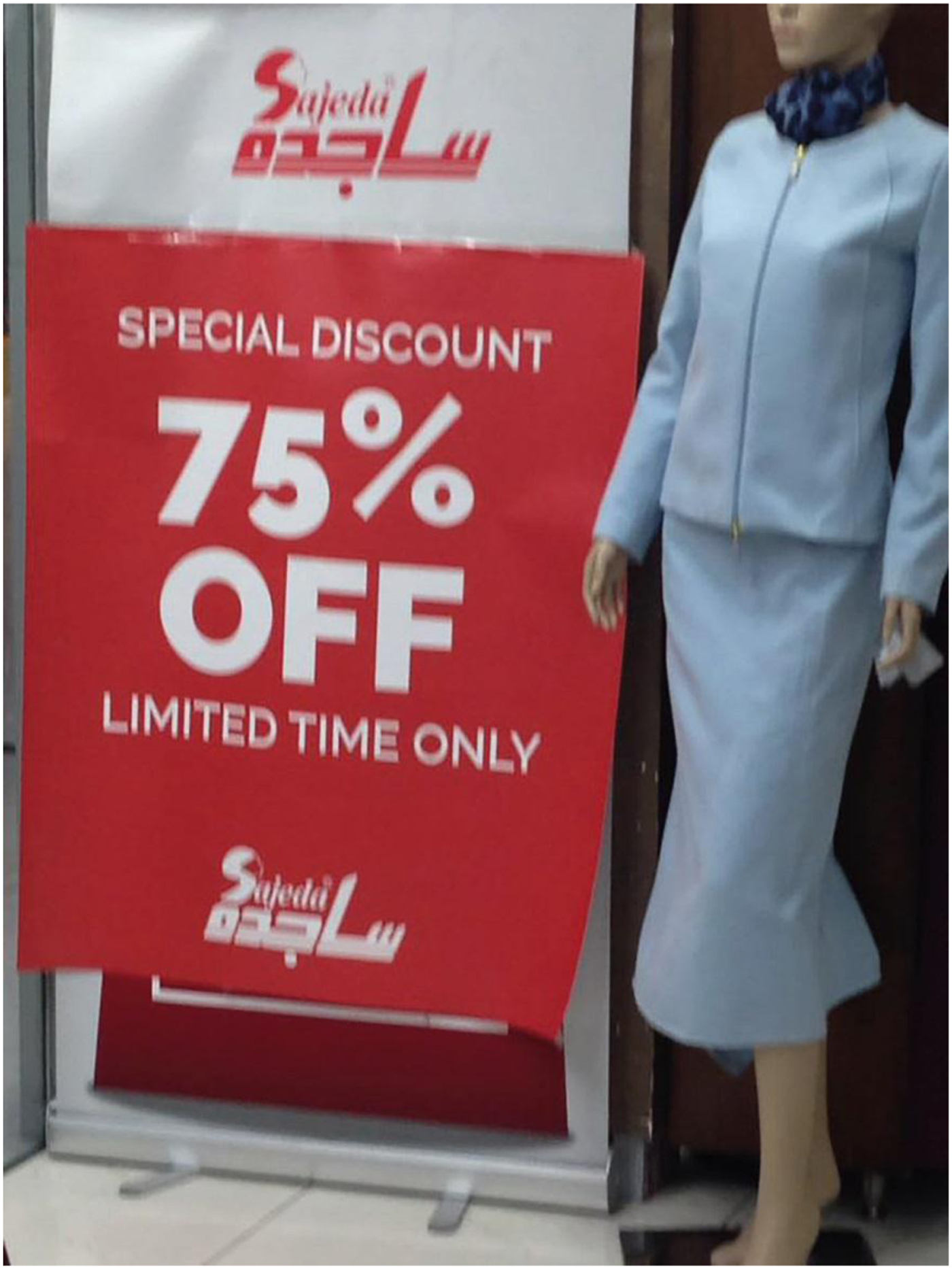
Arabic in Roman script is found on two signs, examples of which include the proper name Al-SUWAIDI, originally ‘السويدي’, and the local brand name ساجدة transliterated into Sajeda, as displayed in Figure 2. Nowadays, colloquialisms and foreignisms are increasingly no longer regarded as linguistic corruptions and distortions that generate cynicism and fear about pure Standard Arabic (Alomoush, Reference Alomoush2015). As Figure 2 illustrates, both the English and Arabizi wording feature a special discount advertisement for Islamic fashion womenswear.
Many fashion shops and other local businesses not only select English business names and catchphrases, but some others also use another foreign language, as in the Italian proper name Romena found transliterated into Arabic script on three separate signs on the storefront of a fashion store. Even though it can be argued that English is extensively used for symbolic reasons, English in central Jarash might be used for interaction and communication with the foreign tourist population who may not only pay a visit to the historical ruins of the town, but also come across the marketplace. Based on my observations in the LL as well as on previous LL research studies (Alomoush, Reference Alomoush2015; Al-Naimat, Reference Al-Naimat2015), it seems that English, alongside other multimodal devices, is often used to symbolise Western outstanding feminine beauty and masculine elegance on these shopfronts.
Home appliances, electronics, and mobile phone stores
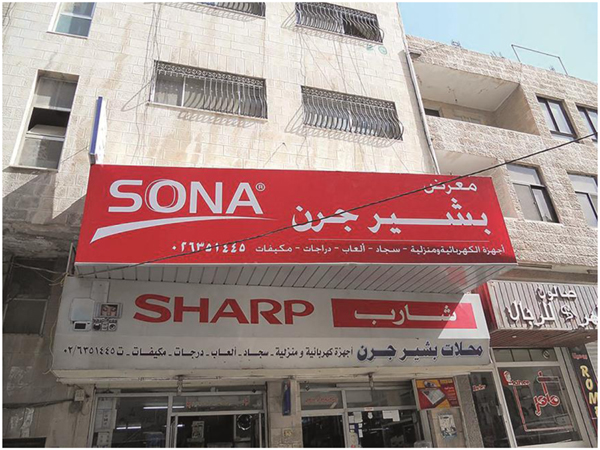
Costly household appliances such as white goods (refrigerators, washing-machines, water coolers, etc.) and electronics (televisions etc.) have only recently become necessary products for Jordanian consumers, and so international and national companies are keen on promoting and publicizing their products in retail businesses. The increasing significance of international and national brands in retail services is evident in the presentation of these brand names in large font sizes on signs, especially as contrasted with the smaller letters on the same sign. The visual dominance of English is associated with the notion of commercialism, as displayed in Figure 3, which presents the Japanese multinational company Sharp in larger letters than other parts of the text.
A brand name written in a larger font size than the remainder of the text

Approximately 43% (59 out of 135) of all signs recorded relate to home appliances, electronics, and mobile phone stores. These businesses are located in the most affluent areas, and customers are often from the middle classes. As Table 4 shows, English features in 11 monolingual signs (nearly 18.5%), all of which include examples of Samsung's slogan Everyone's invited, the brand name Sharp, and LG advertising posters. Eight out of 59 (nearly 13.5%) of the monolingual Arabic signs are business information and names, in addition to Quranic verses and the prophet Muhammad's Hadiths.
Distribution of languages on the fronts of home appliance and electronics stores

In many instances, the originators of signs, i.e. commercial companies and shop owners tend to transliterate the names of new items and ideas as they occur in the original language, normally English, for social and lexical needs (see Table 4). The presence of software, hardware, and Link in Arabic script partly relates to the assumption that these terms are often briefer and more semantically precise than the respective Arabic equivalents such as ‘برمجة’, ‘معدات’,and ‘رابط’ (reading /barmadʒah/, /maʕda:t/, and /ra:bitˤ/ respectively) (cf. Alomoush, Reference Alomoush2007).
The Arabic-English bilingual pattern features 29 signs (nearly 49%), while other multilingual patterns appear on 11 signs (approximately 19%). It is noteworthy that either English or Roman script features on all monolingual and multilingual signs. Nowadays, commerce is a growing sector of Jordan's economy, so that home appliances, electronics, and mobile phone stores find it increasingly necessary to meet the linguistic needs of the local population. The interrelationship between language and the economy, or linguistic ‘commodification’ (Heller, Reference Heller2003), explains the visibility of English alongside Arabic. This means that production and consumption contribute to the growing presence of English whose principal purpose is to maximise economic profits for these businesses.
Other stores
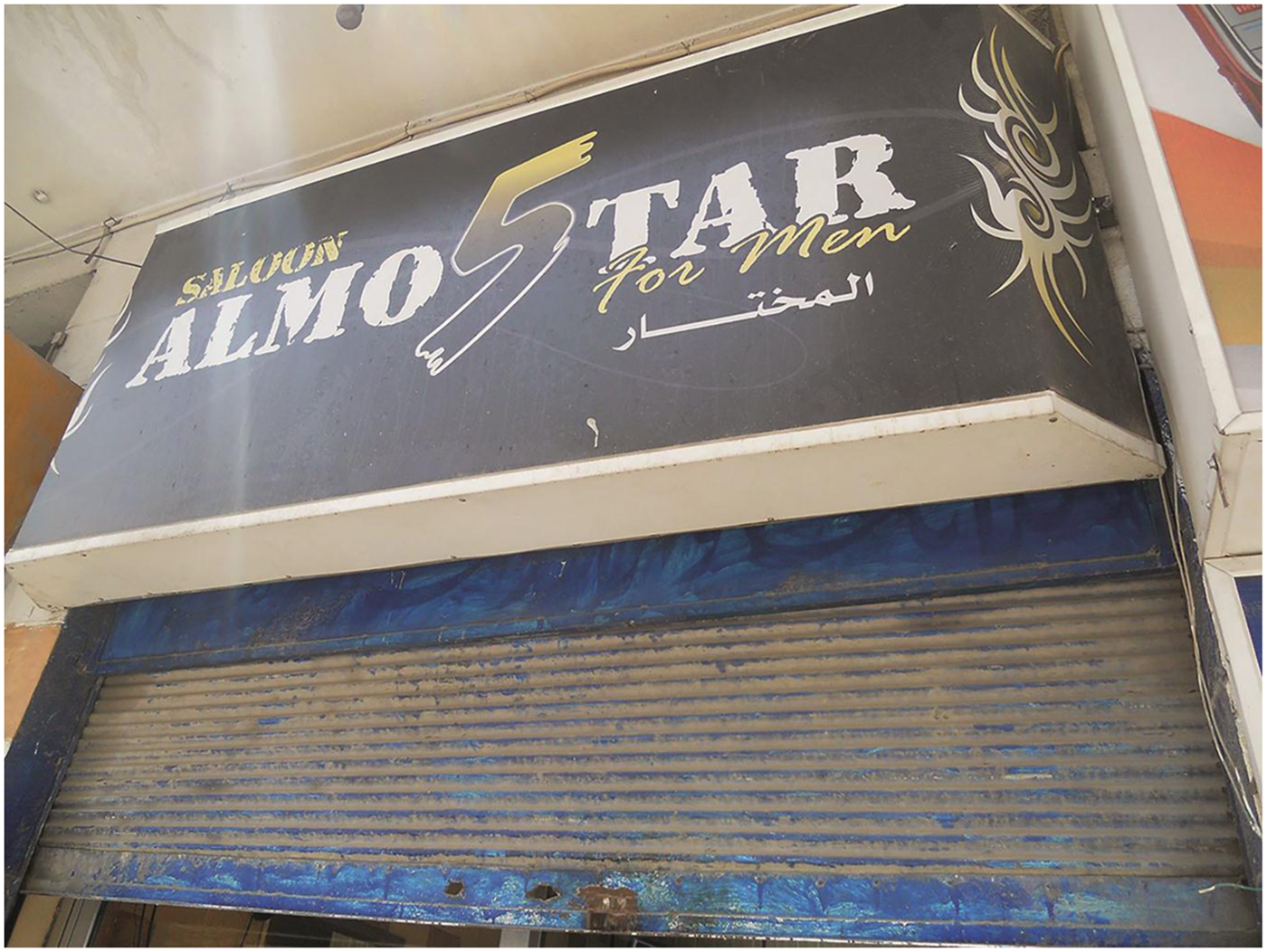
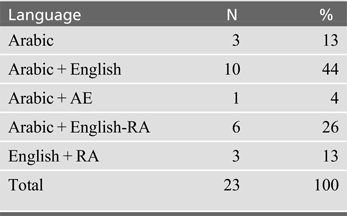
Central Jarash is abundantly supplied with other service stores, particularly hair salons, pharmacies, and laboratories. 17% of all signs recorded, 23 out of 135, relate to other services. The zero-presence of monolingual English signs on these shopfronts can be attributed to the fact that English brand names are unavailable, and business names tend to include Arabic-English names. This is contrasted with fashion stores, whose business names are more likely to be entirely written in English, while three (13%) feature Arabic monolingual signs (Table 5). 10 out of 23 (44%) also feature Arabic-English bilingual signs, five of which represent duplicates of the bilingual sign Pharmacy صيدلية, while other signs are overlapping bilingual signs (e.g. Med Labs Consultancy Group مختبر جراسا الطبي, the Arabic wording of which reads /muxtabar dʒara:sa: ʔatˤibi:/ ‘Garaasa Medical Laboratory’). On the storefronts of hair salons, six (26%) feature the trilingual Arabic-English-RA sign (Figure 4), and three (13%) feature the bilingual English-RA pattern (Table 5).
A hair salon sign displaying the trilingual Arabic-English-RA pattern

Numbers and percentages of languages on fronts of other service stores

The incorporation of global and local elements into the written commercial domain and their joint impact on linguistic behaviour are manifested through the employment of Arabic, English, and/or Roman script in creative ways. One strategy is to use Arabic words in Roman script, as in the case of المختار transliterated into Roman script as ALMO5TAR, appearing in much larger font size (Figure 4). This linguistic creativity constitutes an essential part of youth culture, in that shop signs and advertising posters displaying modernity and trendiness seem appealing to the younger generations in Jordan. This no doubt raises questions as to whether the increasing acceptance of Roman script on signs will have a visible and lasting impact on Jordanian Arab cultural identity, despite the fact that the Arabic alphabet has been incorporated into all computer systems in the country (Al-Fawaz, Reference Al-Fawaz2014). This is evident in the gradual extension of the use of Arabizi throughout the country, which presents some credible evidence for the growing popularity of Western styles and tastes at the expense of an overwhelming predominance of monolingual Arabic signs, an ideology targeting the younger generations, who feel positive towards the visibility of English and Arabizi in urban centres (Alomoush, Reference Alomoush2015; Al-Tamimi & Gorgis, Reference Al-Tamimi and Gorgis2007).
Conclusions
The study indicates that English tends to be the dominant language in the domains of innovation, technology, and fashion, as opposed to supermarkets and grocery shops. This strong presence of English has increasingly become a characteristic feature of the marketplace. English is not only required in the visual marketplace, but has recently become an integral part of the socio-cultural life of Jordanians.
It is clear from the data analysed that English monolingual signs are more widely spread in the LL than Arabic ones. It is not surprising that nowadays in Jordan English has become a symbol of social prestige and status, and the basis of commercial success and excellence. Accordingly, English constitutes an essential component of the construction of the LL, as reflected in the linguistic practices carried out by shop owners and commercial companies. However, linguistic innovation and creativity also flourish in situations when English comes into contact with Arabic, as demonstrated through widespread code-mixing practices (AE and RA), indicative of a melding of global and local elements.
 OMAR IBRAHIM SALAMEH ALOMOUSH is Assistant Professor of English linguistics at English Department, Tafila Technical University, Jordan. He completed his PhD at the University of Liverpool, UK. His research focuses on sociolinguistics, English and globalisation, language policy and planning, linguistic landscape, and Arabic linguistics. He has published a number of papers in Arabic sociolinguistics and other sub-fields of linguistics. His address details are as follows: P. O. Box 179, Tafila 66110, Jordan. Email: alomoushomar@ttu.edu.jo; alomoushomar@yahoo.com.